Sally Mann at the PG

I was disappointed in various ways at the Photographer’s Gallery opening of a show of Sally Mann‘s work yesterday evening, the last to take place in their current premises before they close for extensive rebuilding. But the show, The Family and the Land, which continues until 19 September 2010, is certainly worth at least a brief visit.

I was a greatly impressed by Mann’s At Twelve: Portraits of Young Women which brought her to the attention of the photographic world when published by Aperture in 1988, although the quality of the reproductions failed to do justice to her work.  (It was her second monograph, following Second Sight: The Photographs of Sally Mann which had been published in 1983.) At the time my students included many young women just a few years older than her subjects and a number of them were inspired by her work in their own projects. But it also disturbed some, as you can read in a thoughtful review by portrait photographer Elsa Dorfmann who felt uneasy about what she calls Mann’s manipulative approach.

Although none of the pictures from At Twelve are included in the current show (the programme notes state that she “first came to prominence for Immediate Family” which was exhibited and published four years later) I think it is more than arguable that ‘At Twelve‘ has had a much greater direct influence on other photographers, with an avalanche of projects dealing with girls in this age group since then.

Immediate Family‘  also published by Aperture four years later in 1992, but this time with seriously good duotone reproduction, also had a powerful effect both on me and my students. One smallish area of the gallery has a dozen or so images from this project, although I would have liked to see many more. Of the sixty plates in the book, only a handful are inclued in the show (The Last Time Emmett Modeled Nude, 1987, The Perfect Tomato, 1990, Vinland, 1992, Candy Cigarette and Emmet, Jessie and Virgina, 1989.) There are over 30 images on the Houk Gallery site (the last of those listed is titled EML there, which includes one or two others on the gallery wall.

Immediate Family caused a stir that went well outside the world of photography, with accusations from the right that it was child pornography and promoting pedophilia. There is a long essay by Valerie Osbourn which makes some of the controversy clear and also has some good descriptions of some of the images concerned. Before leaving for the opening I heard a rumour being spread by one a well-known photography critic that this show would be raided by the police who would demand the removal of some of the works. Given the choice of images it was perhaps just an illustration of that particular man’s warped sense of humour. But it was something that occasionally worried me when I was using Immediate Family in my teaching, and a few of my students obviously were rather disturbed by her images.

Having photographed my own children and others in my family in the previous twenty years it was something that neither surprised or disturbed me – and I had indeed been shocked at the powerfully negative response to a few of my own pictures when I had shown them in public in the 1970s.

There are people who have a problem with showing children and family life as it really is rather than in some idealised way, although Mann’s work goes beyond just doing this, with some carefully constructed tableaux. As she writes in her introduction to the book, “Many of these pictures are intimate, some are fictions and some are fantastic, but most are of ordinary things every mother has seen.” And at least some fathers and uncles too.

Later, Mann turned to wet collodion, learning the process from two of the modern masters (now fairly numerous), though perhaps deliberately avoiding becoming too competent at it. It’s much ‘artier’ if you don’t quite get it right (or perhaps more accurately in her case in every sense get it spectacularly wrong.) One or two of her pictures in the series Faces, giant close-ups of the faces of her now rather older children from 2004, have a real touch of the Julia Margaret Camerons, though others to me lacked any presence.

Applying this technique to the kind of American landscapes of the Civil War in rural Georgia and Virginia certainly had a powerful resonance, and the best of this work is impressive, and the accidents and degradation of the process powerfully evocative while on other prints it seems merely an irritating affection. Size too is an issue in her work (and of course the art market) and there are images in this show that I think would actually be more powerful at 8″x10 ” than at 40×48″ or whatever. (Her latest show, Proud Flesh, returns to a more sensible size.)

What Remains is in some ways a disturbing set of images, its subject matter the decomposing bodies at what seems like a rather ghoulish research project in Tennessee. There is a warning notice in the gallery that some may find the work disturbing, though I think I found it annoying. One of the photographers I met at the gallery would have liked to have seen these pictures made with high definition using modern film, camera and lenses. In a way I think she was right, and they would have been more effective, but I’m not sure I would have wanted to view them. I was reminded of many years ago when one of my students photographed in the local hospital mortuary, and I was very relieved to find that the low light conditions there meant that all her pictures were blurred by camera shake.

Immediate Family remains by far the most important series of Mann’s career, and it has never been shown in any depth in this country – and to this extent the current show (an edited version of a touring exhibition from the Museum of Modern Art, Sweden) was a disappointment. It was amazingly her first solo show in the UK, and tried to do too much but ended up doing too little. A second disappointment was that the photographer was delayed and not present at the opening. The third came at the bar. Fortunately there are some decent pubs within a short walk of the gallery, but it may account for what seemed a rather thin attendance for the opening of one of the rare shows of genuine photographic interest at the venue.

You can read an interview feature with Sally Mann by Blake Morrison on the Guardian site, and see more of her pictures, including images from Faces and Proud Flesh on the Gagosian Gallery site. She is also featured in the episode ‘Place‘ made in 2001 on the Art:21 site which also has clips and interviews about the wet collodion process and other aspects of her work.
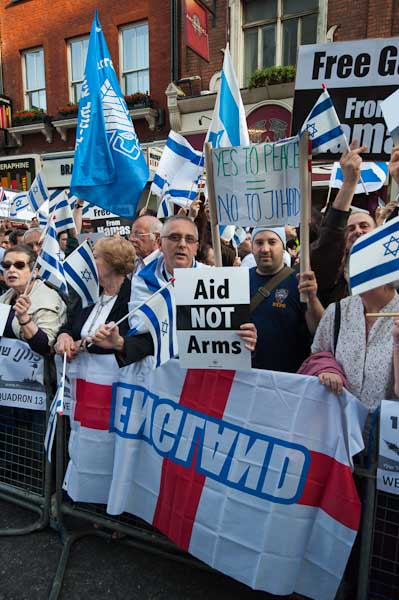
Celebrating Murder

© 2010, Peter Marshall

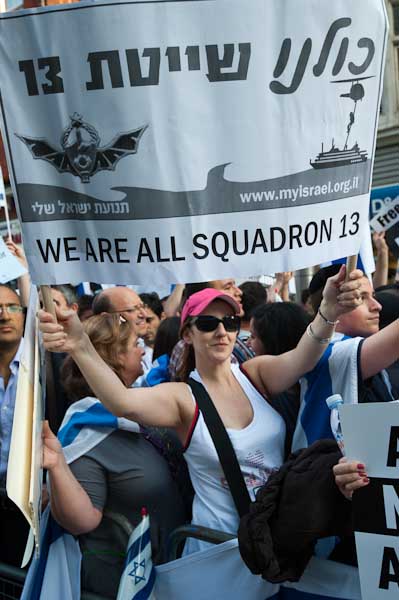
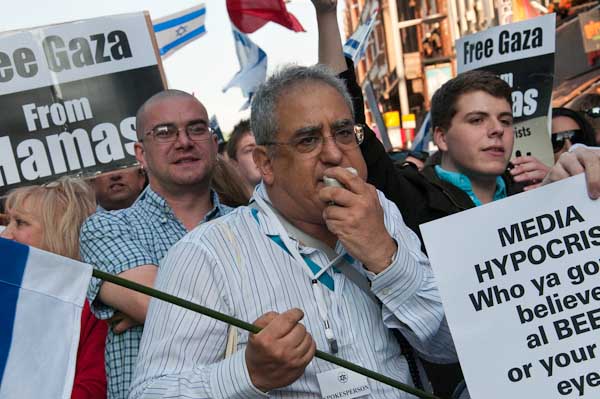
I would probably have gone to the Israeli Embassy to photograph the demonstration organised by the Zionist Federation UK to support the action of the Israeli armed forces in storming the Gaza flotilla and killing nine of the peace activists on board in any case. But hearing that the English Defence League (EDL) intended to add their support to the demonstration made me determined to go along to photograph it.

© 2010, Peter Marshall

On its Facebook page, the English Defence League (EDL) Jewish Division shortly after commented “In a show of solidarity with Israel, EDL supporters did not fly any flags except the Israeli flag. The support of the EDL was noticed within the crowd – our flags flew high and proud” and elsewhere on the page a member asserts that 5 or 6 of them actually took part in the protest, while another small group of EDL sat and watched from the other side of the road “waiting incase anything kicked off” (sic)  and that one of them was possibly arrested. Over 500 people have expressed that they ‘like’ the Facebook group

Although I was pleased to read that the Board of Deputies of British Jews has condemned the EDL’s supposed support for Israel, some of the statements reported from people in the Zionist Federation before and at the event appeared to welcome their support, although I think later they made clear their opposition.

According to the [not] english defence league jewish division blog, one of the supporters of the EDL Jewish Division, former CST (Community Security Trust) member, Mark Israel, claims Jews should back the EDL as an alternative to existing community groups. Later I was pleased to read it reported that the EDL’s “advances have been swiftly rebuffed by Jewish leaders”

There was an England flag along with the many Jewish ones, and a man with an explicitly anti-Muslim placards. And although I cannot positively confirm the EDL claims that there were a number of them among the demonstrators I have no reason to doubt it.

© 2010, Peter Marshall

While responsible Jewish organisations around the world at least expressed regret at the loss of life during the boarding of the flotilla, I heard nothing of this from those demonstrating. Their mood seemed to be exultant, stressing their support for Squadron 13 who had carried out the killings. At one point a section of the crowd at least was chanting ‘dead Palestinian scum‘.

I know that many Jews do not share these feelings. Some indeed were a few yards down the street in a counter-demonstration together with Muslims and others.  My own view is that peace can only be achieved through talking to people, not by blockades but by negotiations. And as history has shown in Ireland, South Africa and elsewhere around the world it means talking to people who you don’t like and who you call terrorists.

More text and pictures from the demonstrations opposite the Israeli Embassy on My London Diary.

Ethics and Images

Reuters issue guidance to its photographers and journalists in A Brief Guide to Standards, Photoshop and Captions, which has probably become one of the most misunderstood documents on the web. As might be expected, it includes a great deal of very good sense, but although the principles set out in the document are useful and straightforward enough, most people have misinterpreted the intent of the guidelines.

Unless you work for Reuters (or a similar agency) and have the luxury of leaving working on your pictures to the picture desk, they are really nothing to do with how or how much you should work on your own images.

I don’t have anyone to do my work and I don’t like the idea of leaving others to work on my pictures. Back when I used film I preferred to make almost all my prints myself, regarding my input into that as a part of my work as a photographer. I learnt to be a good printer, and certainly a far better printer than anyone I could ever afford to print my work for me; good enough to be asked quite a few times by other photographers if I would print their work, though I always said no.

The Reuters guidelines are there so that photographers who have not been granted greater “Photoshop privileges” don’t mess up their pictures but leave the real jobs to the trained guys on the desk, who photographers are encouraged to ask to do things like “lighten the face, darken the left side, lift the shadows etc.”  Too many of those who have commented on them or recommended them simply have failed to realise this (and it’s an easy trap I’ve to some extent fallen in in the past.)

It isn’t in any case sensible to try to lay down rules about exactly how much of this or that tool is permissible, not least because many photographers will use different software and hardware. Trying for example to set down limits for sharpening ignores the very different approaches to in-camera sharpening (even of RAW files) adopted by different camera manufacturers. Even using the Nikon D300 and D700 I find different levels of ‘capture sharpening’ appropriate when importing images into Lightroom.

The key to what is or is not acceptable is always intention, both when taking pictures and when processing them.  The three rules that Reuter’s give boil down to respecting the content and journalistic integrity of the image and not doing anything that would mislead the viewer. This is basically all we need to keep in mind and apply.

Photography – at least in the areas of documentary, photojournalism and news – should be about the accuracy and clarity of transmitting information and ideas. Adjustments made to images which are essentially to correct the defects and limitations of lighting conditions, the photographic equipment, photographic skills and process are generally acceptable, while those that seek to alter the scene as perceived by the photographer or to produce graphic derivatives are generally inappropriate for documentary, photo-journalistic or news photography.

Traditionally in black and white photography, printing involved burning and dodging of areas to create an image that expressed more clearly the photographer’s intentions. Some of the best known photographers – Gene Smith being a prime example – at times pushed this perhaps beyond acceptable limits, but it is a degree of control over our work that few photographers would want to relinquish.

One area where it often becomes important is when using direct flash, where the lighting in various areas of a picture can be very unbalanced and some differential correction is often necessary.

What I think might help is to try and lay down some guidelines for photographers, and I’ve made a start on this below by trying to put various things we may do on a kind of spectrum of acceptability – between those things we should always attend to and those that we should never do. Of course there are problems, and sometimes its a matter of degree – almost anything can be taken too far and become unacceptable.

Although some of the vocabulary may be taken from Photoshop, I now see little reason for photographers to use this software other than for one or two very specialised tasks. Lightroom 3 now does more than 99% of what I need that I used to use Photoshop for.

Always appropriate (as necessary)

  • dust removal (scratch etc removal from film)
  • level adjustment
  • colour temperature adjustment
  • exposure adjustment
  • brightness adjustment
  • minor contrast adjustments
  • slight cropping
  • image rotation
  • highlight removal
  • image resizing
  • image sharpening (best done with suitable plugins rather than Photoshop)
  • distortion correction
  • noise reduction (Lightroom 3 probably removes the need for specialist software)
  • Vignetting reduction/removal

Often appropriate

  • Curve adjustment
  • Local dodging
  • Local burning
  • flare removal
  • local contrast adjustment
  • perspective correction

Sometimes appropriate

  • Deliberate blurring/pixellation of detail (eg to hide identity)

Seldom appropriate

  • radical cropping

Never appropriate

  • Content sensitive fill
  • Removal or addition of important image elements

I’m sure there is much I’ve missed out, and this is intended as an initial attempt at a rational discussion of the issues. It does reflect my own practice as a documentary photographer who has worked with both film and digital.

There are some difficult questions to which I have no answer. For example the use of slow shutter speeds to produce blur, sometimes with the addition of flash to produce visually powerful effects has long been accepted as legitimate in these areas of photography, and continues to be so in the digital age. But similar if not identical results can be achieved using suitable software. Personally I find this unacceptable, but find it hard to justify my opinion as to why it matters at which stage of the process this is done.

There are also some – relatively few – special cases where some extreme graphical techniques are appropriate. These generally are so obvious that it is hardly necessary to label them as such.

Against the Deportation Machine

The first week of June was the European Week of Action to Stop the Deportation Machine and there were two demonstrations planned on Tuesday afternoon as a part of this, both at immigration reporting centres in London.  Both are ordinary looking office blocks, and you have to look very closely to find the small brass plates that tell you anything about what goes on inside. But if you are a refugee or asylum seeker a visit to either of them can be a very stressful occasion – and one that could end with you being put into a holding cell en route to forcible deportation to a country where you may face persecution, torture and even death if an official decides not to believe what you tell them.

Photographing demonstrations like this presents some problems. Firstly there usually isn’t a great deal to photograph – a rather anonymous building, a fairly small number of demonstrators and not a lot happening. Occasionally there are also people present who do not want to be photographed, at times because their own position as asylum seekers remains unresolved. And on this occasion things were not improved by some rather persistent light rain.

Communications House, more or less next to Old St tube station just north of the centre of the City of London is a place I’ve photographed several times, as there are regular monthly demonstrations here as well as the occasional special event.

© 2010, Peter Marshall

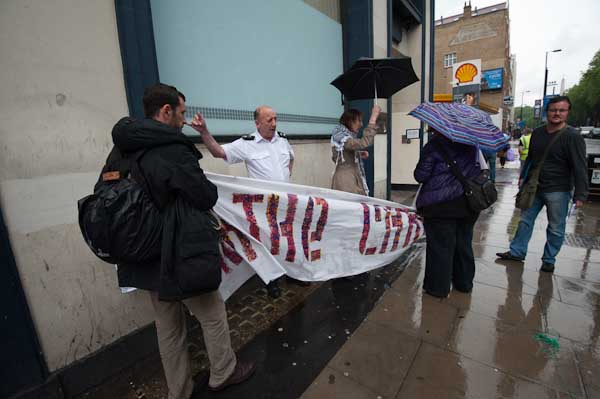
A little light relief was provided by the security men who came out and told the protesters that they had to remove the banners which they had taped to the wall of the building. One of them tried to tell me I couldn’t take his picture, but since I already had taken quite a few frames I didn’t really bother to put him right.  I left a little before the protest ended to have a coffee at one of my favourite cafes a short walk away, the Juggler, which has a gallery space where I’ve organised a number of shows in the past, most recently ‘Taken in London‘ last year.

There were rather more demonstrators later in the afternoon at Beckett House, next to London Bridge Station, and for a while it did stop raining, but remained dull and dreary. I’d got there around the time the protest was supposed to be starting and there was nobody there, and instead of waiting as I should have done I took a short walk around the area. More than 20 years ago I did a little research and wrote an self-published an A4 leaflet with an industrial archaeology walk of the West Bermondsey area just to the south (I printed and sold between 500 and a thousand copies – later made available on-line here) with a couple of photos and a bad photo-derived drawing, and I still like to have a look now and then to see how things have changed (and quite a lot has.)  The last time I paid a visit was for Zandra Rhodes’s birthday and a fashion show on Bermondsey St.

© 2009 Peter Marshall

As such diversions tend to, it took me a little longer than I expected and by the time I got back to Beckett House (named I suspect for Archbishop of Canterbury, Thomas Becket, killed in December 1170 and made a saint rather than the Labour politician and one-time Foreign Secretary Margaret Beckett)  things were in full swing and I had missed some of the action, with a possible sighting there of one of the new Home Office ministers. After our new election came up with the Lib-Con government, few of us can recognise any of those involved.

© 2010, Peter Marshall

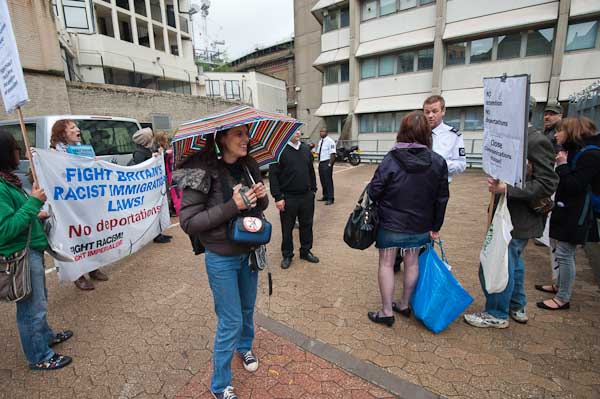
This second ‘Against the Deportation Machine‘ demonstration was a slightly larger event, with around 30 people taking part, and became just a little lively when most of them decided to take a walk around the building and demonstrate in the car park at the back, so that those working on that side of it could see what was going on. The security men got a little worried at this, and came out and made the demonstrators leave, one lifting the gate barrier to make our exit easier.

You can read more about the two demonstrations and the reasons why people were demonstrating as well as see a few more pictures from Communications House and Beckett House on My London Diary.

Editors and Photographers

The relationship between editors and photographers can sometimes be somewhat fraught – and the stories of the battles between Gene Smith and the guys at Life Magazine is one of the great enduring (and largely true) legends of photography. Of course it was a relationship that produced some of the classic photo essays, and although Smith was certainly not the greatest editor of his own work, without these battles I think we can be pretty sure his work would have been less well presented.

Balance wasn’t a concept Smith had a lot of time for, at least when it came to publishing his work, and he almost single-handedly brought Magnum to its knees during his relatively short time with them when he was photographing Pittsburgh, having started the job with one of the most illustrious of photo-editors, Stefan Lorant, who wanted 100 pictures to illustrate a book, while Smith had his own idea.

Although my essay on Smith is digitally “out of print” you can read a few comments about him and editing in a post here, Editing Your Work.  Smith spent at least two years trying to edit the 17,000 images he made in Pittsburgh, but eventually gave up and around 45 years later (and some twenty years after Smith’s death)  it took five years for Sam Stephenson of the Center for Documentary Studies at Duke University to produce the exhibition and book Dream Street, possibly the greatest testament to Smith’s photography and a book that should be on the bookshelf of anyone with an interest in documentary, but also a warning to photographers.

Like many photographers, I think I’m both the best and the worst editor of my own work. Best because I know it better than others and usually have some idea of what I was intending. Worst because I have a strong emotional involvement and am often distracted by things that are not actually in the picture but are more about the situation and process of making the image.

This train of thought was prompted by a piece on the Photoshelter Blog, written for photo-editors, Top 10 Ways To Make A Photographer Fall In Love With You. It’s the third in a series by Photoshelter co-founder  Grover Sanschagrin which started with Top 13 Ways to Piss Off a Photo Editor and continued with Top 10 Ways To Piss Off A Photographer. All three pieces were based on asking a selection of either working photographers or editors and contain a great deal of sometimes obvious common sense.

Robert Bergman

My copy of ‘Aperture 199′ arrived a while back, and while I glanced through it, the review by Andy Grundberg of the work of Robert Bergman didn’t greatly attract my attention, largely because I thought the photographs printed with it were not of any great interest. But a piece by Joerg Colberg in Conscientious has (as so often) attracted my attention, and he links to a feature on Aperture’s Exposures blog, Right on Time by David Levi Strauss in which he attacks Grundberg – and gets a reply – now with a link to the review.

It’s a spat that perhaps doesn’t interest me too greatly, but has led me to think more about Bergman. Perhaps the best place to start is with this piece on Real Clear Arts by Judith H. Dobrzynski which links to her piece in Wall St Journal with 11 photographs. There are also a few different images on Dazed. You can also see these pictures possibly a little larger at the US National Gallery of Art, which also has a 15 minute conversation between senior curator Sarah Greenough and Bergman, as well as a singularly uninformative list of pictures in their collection which are not available on line!

I’d actually love it if I thought that someone who had photographed for almost 60 of his 65 years before being ‘discovered’ was a great unsung genius – hope for the rest of us ageing photographers – but unfortunately I don’t think so on the evidence I’ve seen.

And do take a look at Aperture magazine. I can assure you there are more interesting things in it than this review.

A Bad Few Days for Lenses

I’ve just put on line at My London Diary the pictures that I took on May 22 at the EDL/Patriot March through Westminster. It wasn’t an event I felt particularly happy about covering, with several groups on the political right involved that I’ve photographed before. But though I may not agree with their politics and certainly not with the way that they express them, I think they have a right to honest coverage. And in the longer term I think photographing and writing about them clearly and as accurately as I can is better at exposing them than the kind of diatribe that I sometimes see elsewhere.

© 2010, Peter Marshall

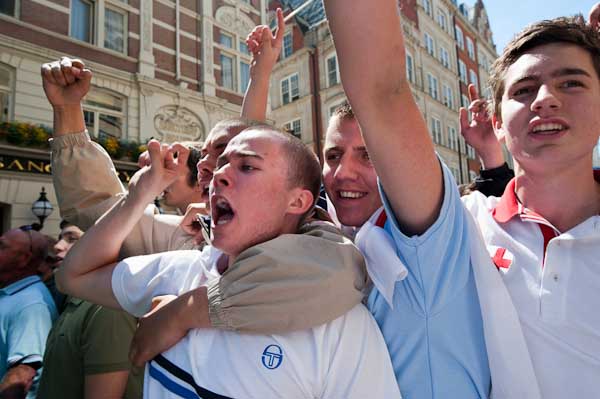
They complain about the coverage they get from the media generally, but although occasionally I think they have a point, generally they get the coverage they do because of how they behave both generally and in particular how they behave towards the press.

If you want accurate reporting, then it helps to have a clear press release rather than none at all, and it isn’t enough to keep repeating you are not racist, you need to stop supporters chanting racist slogans or insulting people.

© 2010, Peter Marshall

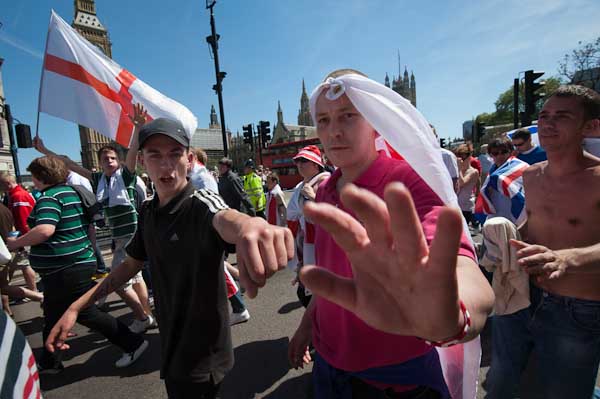
Although things started off in a fairly friendly manner, towards the end of the event many of the demonstrators were threatening press photographers, pushing them away, grabbing their cameras and holding hands over lenses.  It doesn’t make a positive impression!

© 2010, Peter Marshall
I wanted a higher viewpoint so…
However I have only myself to blame for an incident as the march started. While photographers were crowding around photographing the guys at the front of the march I decided I needed to lift a camera above my head for a ‘Hail Mary‘ to get a higher viewpoint.  I had two cameras around my neck and as I lifted one, somehow the second, which I thought I was holding by its strap, crashed to the ground.

It was a D300, with a Nikon 18-200mm and an SB800 flash, making quite a heavy package and it landed on the tarmac road lens first, smashing the filter, with the batteries from the flash spilling out. Other photographers helped me to scrabble to pick up the pieces as the marchers moved forward, and one helped to remove most of the broken filter with a small knife.

Stupidly I cut my thumb rather deeply on the broken glass and spent the next twenty minutes or so dripping blood as I continued to photograph with the other camera having dumped the broken bits into my camera bag.

I put another lens – the 10.5mm fisheye on the D300 and was very relieved to find that it at least was still apparently working. Looking at it later there didn’t seem to be any obvious damage, though I perhaps still need to check the autofocus more carefully.

There was some minor damage to the SB800, breaking the hinges of the flash diffuser, but otherwise that too seems to be in working order – and I’ve been using it since with few problems. Perhaps when I have a moment I’ll take it in for repair, but it hardly seems worth the bother.

The 18-200mm was a different story. The filter thread had been damaged making it impossible to remove the remains of the broken filter, and although the lens looked physically sound, once I tried to zoom it became clear that there were some very serious problems. On closer inspection I’d broken quite a lot of the mechanism inside the lens and there were some bits of broken glass – lens elements – in the middle of the lens.  It was fairly clearly beyond economic repair.

The Nikon 18-200 isn’t the cheapest of lenses, but I’d had it since it came out a few years back and it had already needed several repairs. The photographer who was standing next to me when I dropped it told me he was on his fourth of them! It really is an amateur lens, both in terms of performance and also lack of robustness,  and one we only put up with because it is just so versatile with the huge zoom ratio. You can go out with it anywhere as your only lens and, so long as it isn’t raining and there is a reasonable amount of light it will be the only lens you will need.

So I wasn’t too upset over it. It was a lens I expected to have to replace in the near future, and one that I’d had considerable use from. And at least at home if not with me I had a replacement for it, making use of the Sigma 24-70 f2.8 and 50-200 f5.6 lenses to cover more or less the same range.

The following Monday I went out for a walk with a few of the family to Richmond Park, taking just this combination. Not quite as convenient as the 18-200, but better quality. Towards the end of the walk, disaster struck again, and the 24-70 refused to zoom past around 28mm. It was an almost new lens, hardly used since I’d received it as a replacement from Sigma for an earlier one that I’d had problems with.

The following day I packed it up and sent it back to Sigma for servicing. A few days later I got a phone call from them asking why I’d sent it as it seemed to be working properly. Whatever had caused the jam had been cured by the shaking as it went through the post!    I told them in greater detail than in my letter and they went away to work on it, getting the lens back to me a few days ago.

But when I sent off the 24-80 I didn’t have a lens to cover between 35mm and 75mm which is a pretty important range, so I needed to find a replacement quickly. After a little research I ordered a Nikon 18-105mm rather than a new 18-200mm. Although it doesn’t have quite the range, most of what I take is at the lower end, and it is after all a 27-157mm equivalent, so a respectable telephoto.

But the Nikkor AF-S DX 18-105mm f/3.5-5.6 G ED VR (to give it its full mouthful) has several other points in its favour. It is a smaller, lighter lens and a better optical performer in almost every respect than the 18-200, and seems  considerably more robust – though still not a pro lens. And at less than half the price of its bigger brother it was irresistible.  By noon the following day I had it on my camera and was back in business. When I know I’m going to need something longer I’ll take the Sigma 50-200mm as well.

David Hurn

I came into photography in the 1970s, and completely missed the great input that David Hurn made into creative photography in the UK in the 1960s, meeting him for the first time in the early 1980s, when I had a short argument with him in the questions following a talk he gave on one of his shows.

The show wasn’t one of his better efforts, and his reply to my question appeared to me to be entirely based on commercial rather than artistic criteria, so I’ve perhaps never warmed to the man as I should, though I do have his Wales: Land of My Father (2000) on the main bookshelf in my living room (along with a volume by one of the many photographers whose career was intimately bound to his, Josef Koudelka.)

Had I started in photography ten years earlier I might have got to know him better, and if I had been ten years younger I would certainly have yearned to attend the course that he ran from 1973-90, the School of Documentary Photography at the Gwent College of Higher Education in Newport, Wales.

David Hurn is now 74, and his latest book, Writing The Picture with poet John Fuller was published by Seren on June 5th 2010. You can read more about his remarkable life in a feature by Graham Harrison on Photo Histories, where there is also a link to the book, as well as to the title sequence from Barbarella in which a space-suited Jane Fonda weightlessly disrobes.

Harrison attributes former student Dillon Bryden as stating that David’s course  engendered the work ethic and a very particular code of understanding, and although in many ways a strength, particularly in giving its students a way of making a living, it was perhaps also a weakness, pushing them down a particular route.  But it was certainly a great shame when this vocationally oriented course was lost in the scramble for university and degree status.

In his piece, Harrison writes “David Hurn says the art establishment in Britain remains staggeringly snobby about photography, and is particularly resistant to photojournalism and documentary photography.” Despite the work of Hurn and others this remains only too true.  Although he and other photographers did serve on the Arts Council in various ways, photography has never really got a serious look-in, though for a year or so in the 1970s it seemed it just might.

I’ve always felt it summed up the situation pretty well that, until 2001, the only money I had ever got from the Arts Council had been a couple of small payments from the Poetry budget. And in 2001 the money came from ‘The Year of the Artist‘ and again was not specifically for photography.

You can see some of David Hurn’s pictures on his Magnum page, and also worth reading is a piece on Hurn by the late Bill Jay, another vital figure in British photography in the late 1960s through Creative Camera and Album magazines.  This starts:

While still in my 20s, I showed David Hurn my photographs, the results of more than seven years of struggle to be a photographer. It took him about 30 seconds to look through the lot and deliver his judgment: boring. “Derivative”, he said. “You won’t make it.”

We have been friends ever since.

British photography might have had a rather different story had Jay not, as Harrison relates, been turned down for a post at the National Portrait Gallery.

Save 6 Music

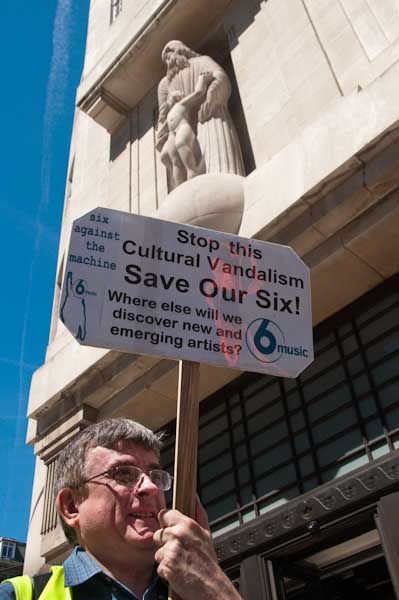
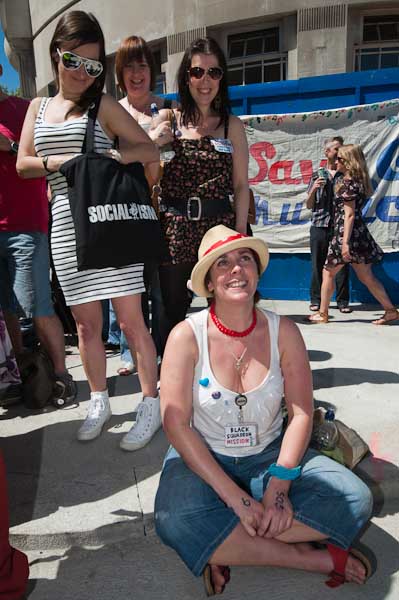
I’m getting rather behind with putting work on My London Diary, and so far I’m only somewhere in the middle of May and its June already. Yesterday I did manage to finish putting up pictures of a demo outside Broadcasting House to stop the BBC cutting a couple of stations, 6 Music and the Asian Network – more pictures here.

© 2010, Peter Marshall

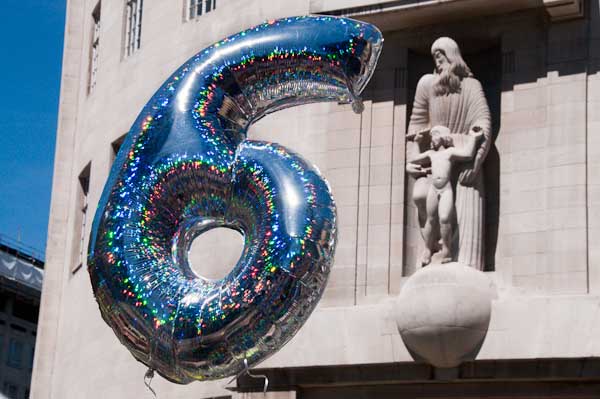
Broadcasting House is truly an ‘iconic building’, a phrase that seems to have come into the constabulary vocabulary here to mean almost any large building in London, but at least I had no problems in photographing it. But the building as a whole is perhaps a little difficult to integrate into pictures taken more or less next to it, though I did try once or twice. But really it worked better when I concentrated on the significant detail of the Eric Gill statue above the main doorway. Here’s another:

© 2010, Peter Marshall

And of course, as so often with demonstrations it helps to get the message in the picture.

6 Music isn’t a station I listen to – it just doesn’t appear on my radio as it doesn’t broadcast on FM, though I could of course listen on-line.  But what little I have heard of it seems to me admirable, very British and very quirky, and this showed in the slogans, placards, banners, dress and performances at the event, and I hope too in my pictures.

© 2010, Peter Marshall

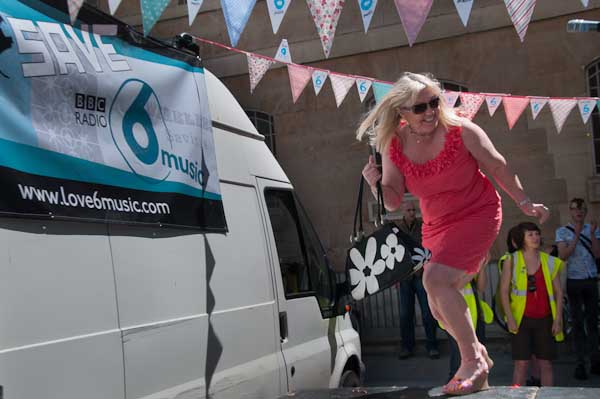
Although I took some straightforward portraits of the station’s presenters – who were of course appearing in their capacity as licence fee payers rather than presenters, it was a couple of pictures of Liz Kershaw bounding up onto the stage that interested me more; the first image unfortunately  I didn’t get quite right, but the second (and there wasn’t time for more) I think catches her well.

© 2010, Peter Marshall

It’s exactly as I saw and framed it – I seldom crop, though it’s not a religion, just usually things are stronger if I get it right when I take the picture. And this is 100% of the frame.

Another Niche For Film

In Digital Myths a month or so ago I tried to question some of the strange reasons that some people – even some photographers – still have for clinging on to film.  I think for most it’s very much as Hilaire Belloc put it in his ‘Cautionary Tales for Children”, keeping a-hold of Nurse. That digital really is something better rather than something worse isn’t enough to remove the fear.

But film does still have its uses, and if you are planning a trek to the North Pole you might be advised to use it, according to a piece in the Amateur Photographer.