Road to 2012 at NPG

The latest stage of the National Portrait Gallery/BT Road to 2012 project is on show (admission free) in the Studio gallery of the London National Portrait Gallery from now until 26 September 2010. It consists of a larger set of pictures from the project than previously shown by Brian Griffin along with some individual portraits of athletes by Bettina von Zwehl.
© 2010, Peter Marshall
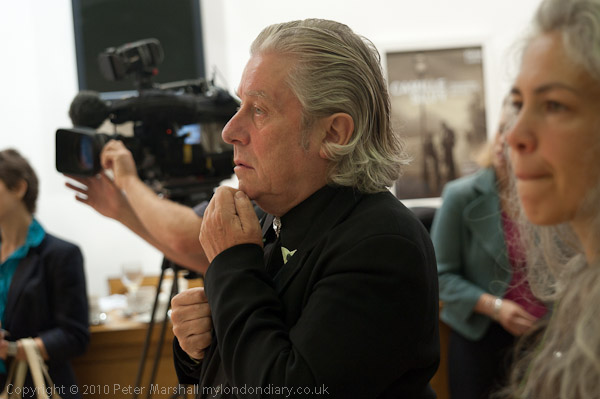
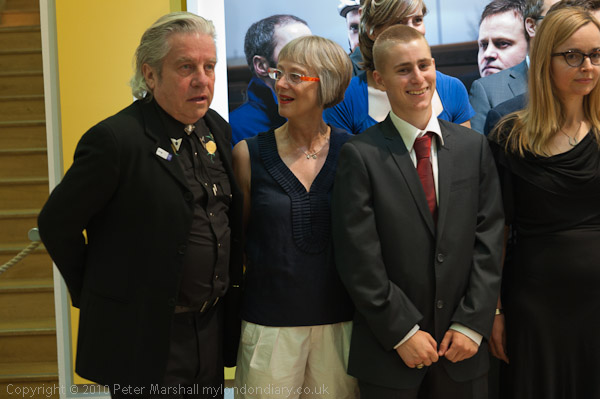
Brian Griffin listens to the speeches at the NPG

I think you can see all the pictures, along with much other material about how they were made on the NPG project web site although it seems to me to have an unnecessarily confusing interface to navigate. Of course seeing the pictures in  reproduction on the web (click on them to see them larger) is no substitute for seeing the actual work.
© 2010, Peter Marshall
At the NPG non-Breakfast event

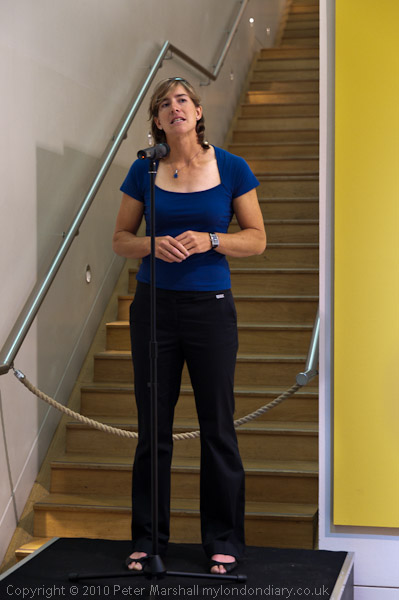
I went to the so-called “Breakfast Launch” of the show (an entirely breakfast-free event) where one of the athletes pictures, rower Katherine Grainger talked about being photographed by von Zwehl.
© 2010, Peter Marshall
Katherine Grainger

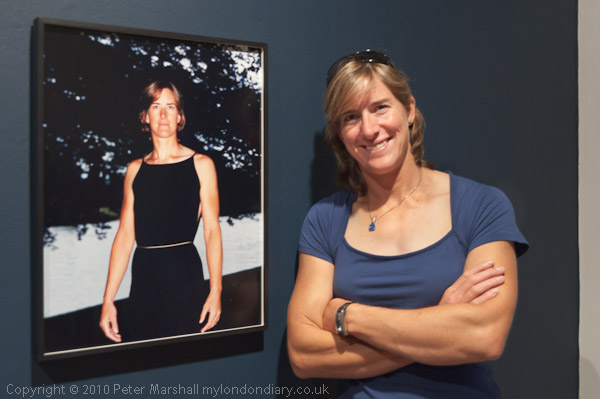
Later I was able to photograph her standing beside the portrait of her (all photographs in this review are © Peter Marshall 2010, but included works by the photographers in the show in them are © Bettina von Zwehl – National Portrait Gallery/BT Road to 2012 Project or © Brian Griffin – National Portrait Gallery/BT Road to 2012 Project respectively.)
© 2010, Peter Marshall
Katherine Grainger and her portrait by Bettina von Zwehl

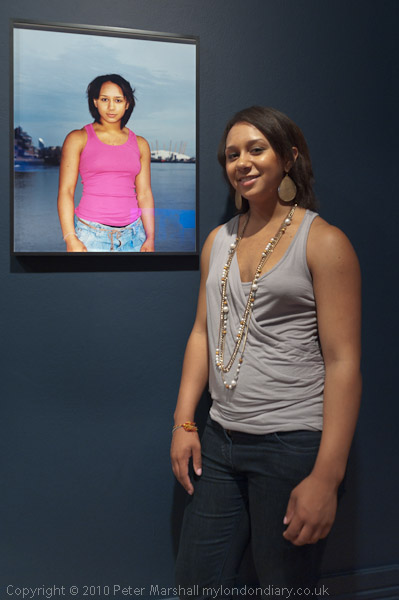
It and the similar pairing of young weightlifter Zoe Smith I think typify the problem I have with her portraits.
© 2010, Peter Marshall
Zoe Smith and her portrait by Bettina von Zwehl

Somehow to me these portraits all look too much the same. And unfortunately they don’t seem to much resemble the real people who were used to make them. It’s a particular look which I think best suits sullen adolescents but none of those in the show fits that bill. They seem to be images that tell me more about the photographer than the sitter, which isn’t what I want from a portrait.
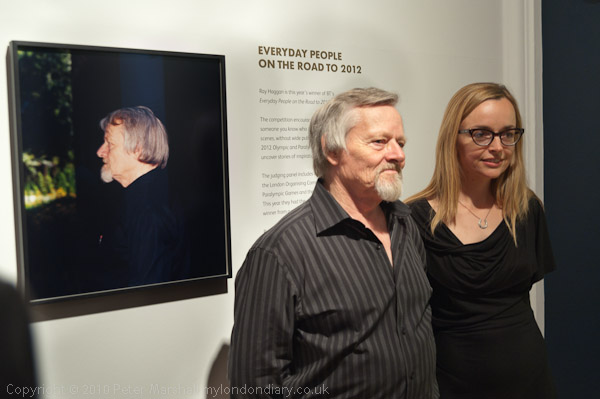
© 2010, Peter Marshall
Roy Haggan won the Everyday People competition – his prize a portrait by Bettina von Zwehl – perhaps the most recognisable of those on show

As you can see, these pictures are surprisingly small – only moderately sized – and at this scale fail to demonstrate the kind of quality that the 8×10 camera can give. I’m not usually a fan of printing stuff large, but I do think these needed a greater scale, although I don’t think I would have found them any more convincing. One aspect of the larger format is that the subject stands out more from the background with the greater inherent depth of field, but here, combined with the over-lighting of the subject it often creates a kind of cardboard cut-out effect. Looking at a number of these I felt they would almost certainly have been improved by using only ambient light.

I know that von Zwehl is a very successful photographer and have admired some of her previous work, but I just don’t get these images. The gallery notes on the show describe them as “meditative observations of face, mood and physique” but I fail to find this in them. Doubtless it’s my loss.
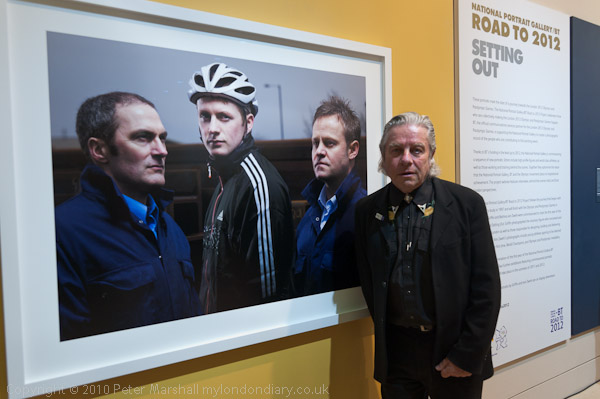
© 2010, Peter Marshall
Brian Griffin with his portrait of the Kenny Family including track cyclist Jason Kenny

I have long been a fan of Brian Griffin, and as well as producing interesting work he is always an interesting guy to talk to. These works show that he has lost nothing of his touch and the show includes several that can rank among his best over the years.
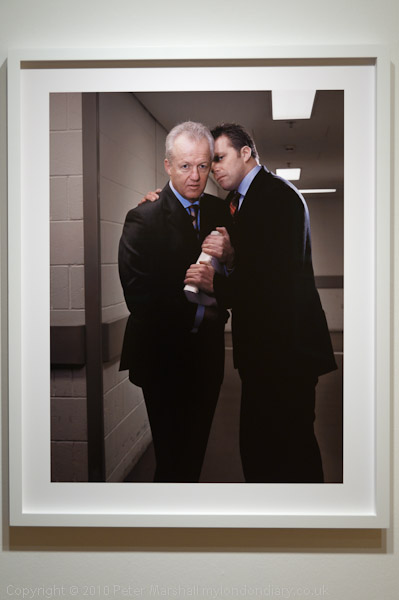
© 2010, Peter Marshall
‘The conspirators’ – Simon Clegg and David Luckes

My favourite of the new works is one which I immediately christened “the conspirators“, perhaps a scene out of Hamlet, where David Luckes‘s right eye peers out over the shoulder of Simon Clegg. Both of them have a hand on the 395 page report written by Luckes in 2000 which persuaded the Mayor of London and the government to back the bid, and its white plastic spine is surely the murder weapon. Something very nasty is certainly about to happen! As we’ve now found out.

I’ve also included this image to show the framing of these works with a white border and a white frame, which I think as very effective.

There are others that struck me powerfully too. Ken Livingstone, posing with LDA Managing consultant Tony Winterbottom shows Ken pointing and Griffin makes powerful use of the frame with one finger pointing to his left exactly at its edge, and the other hand on the opposite edge above the open palm of Winterbottom, doubtless waiting for the cash to drop into it. Ken is of course wearing a red tie, the only touch of colour in the scene, taken in front of a dynamically sloping background at City Hall, reinforcing the dynamic thrust of Ken towards the frame edge.
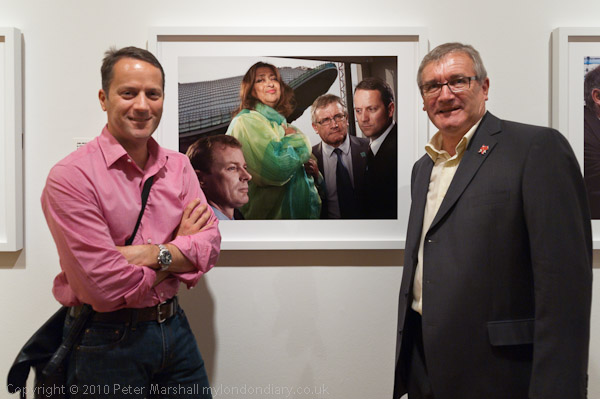
© 2010, Peter Marshall
The Aquatic Team -Jim Heverin, Zaha Hadid, Stuart Fraser and Mike King

Many of those in Griffin’s pictures are men in grey suits (and some women too) but one dramatic piece of colour is provided by architect Zaha Hadid in a group showing the Aquatics centre team. Like many of his works this also illustrates his very theatrical use of lighting (and also some superb printing of his work.)

There are just one or two which I don’t think work, some where perhaps he seems to almost be parodying his own work, and others that just don’t quite come off. But overall he is creating a powerful set of work. It may well be the best thing to come out of the Olympics.

[My own ‘Olympic’ contribution is the book of pictures ‘Before the Olympics: The Lea Valley 1981-2010.’]
Cuts & Compacts

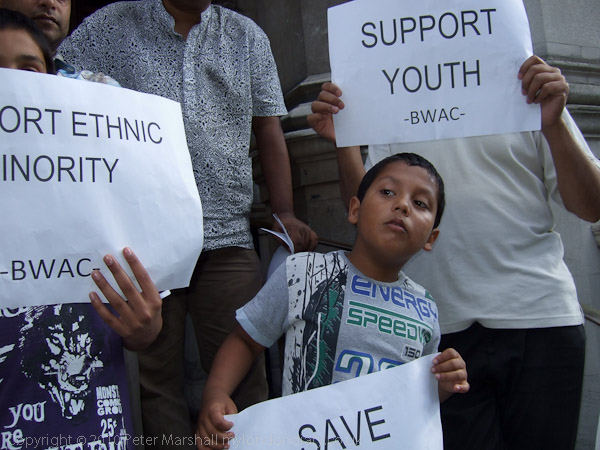
I hadn’t actually gone to Croydon to photograph a demonstration but to pick up some my pictures that had been at a show in the library there. But the library is next to the town hall in one of those fine Victorian municipal complexes (though perhaps not as fine as that in my own home town, replaced by a featureless shopping centre in the 1970s) and there were around 50 people protesting on the town hall steps.

© 2010, Peter Marshall

Unusually, and because I had half a dozen framed pictures to carry home, I hadn’t taken a ‘proper’ camera with me, but I did have my small Fuji F31fd compact in my pocket, so I went across and took a few pictures, some of which you can see on My London Diary, where I also have written more about this protest over the withdrawal of grants to many local voluntary groups including the BWAC – something we will see happening across the country.

Of course at the scale reproduced here, apart from the squarer aspect ratio it is hard to tell the difference between this image and what I might have taken using my normal Nikon. What did surprise me was how little difference there is between this image and those when looked at much larger on screen.

Part of the reason for this is that instead of using the jpeg image straight from the Fuji camera I imported it into Lightroom, and worked on it in much the same way as I would have done with a RAW image from the Nikon, using some noise reduction, altering contrast and exposure, burning in some of the highlight areas and opening up the shadows.

There are differences, with a little kind of blue haze around some of the edges that Lightroom can’t remove, and the image is only 6Mp rather than the 12Mp from the Nikons.  But overall the result is pretty good, and would certainly hold up well for an A4 full page reproduction.

Perhaps the biggest difference was in taking the pictures, both in how I could work and in the reactions of the people I was photographing. There were two guys from the local press also taking pictures at the same time using the same kind of gear as I would normally have, and they were getting rather more attention and cooperation from the protesters than I did.  It wasn’t a problem as I generally like to work in a more informal way than the local press, but there was a noticeable difference in the interaction.

But I also felt that I was working more or less blind, holding out the camera in front of me and peering at an almost invisible image on the camera back in front of me and had very little idea exactly where the edges of the image would be.  After taking the pictures it was possible to see a little better by holding my hand around the screen, but I couldn’t really tell if the pictures were sharp or see them well.

It wasn’t a very visual event, with only a handful of placards and nothing much happening, and I had other things to do so was unable to stay long and see if anything developed. It served to remind me why I find it worthwhile to carry a couple of relatively heavy cameras and a bag with extra lenses rather than a camera that would slip in a pocket – even though the quality of the results – with some help from Lightroom – was a pleasant surprise.

Working with jpegs in Lightroom requires a few different settings to normal. The main thing to remember is that jpegs have already been subjected to a tone curve in the camera and don’t need your usual one on import. I find the Linear Contrast option gives the best result with my files. Again your normal import sharpening is unlikely to be needed as the jpeg will already have been sharpened (even if you have selected to turn off sharpening in the camera options. The camera will also have applied some noise reduction but it may be possible to do a little more with Lightroom without losing image detail.

Camera settings are of course also vital. If you are working with a compact and want high quality results you need to make sure you use the lowest possible ISO setting for the lighting conditions as well as highest quality jpeg setting (called Fine on some cameras) and also a large enough image size – usually the maximum the camera can produce, and certainly at least 6Mp.  Other settings such as contrast, sharpening and colour are also important, and you will almost certainly get the best results if you are working with your images in Lightroom if you use the lowest contrast and sharpening settings and also the most neutral colour.

Battersea & Wandsworth

 © 2010, Peter Marshall

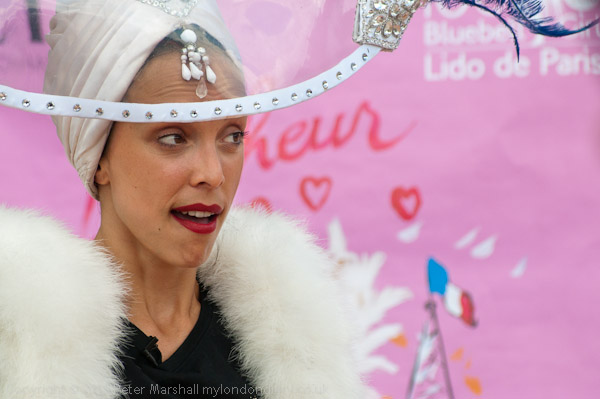
After a fairly quick and not too productive visit to the early Bastille Day celebrations in Battersea Park last Sunday (more pictures) I decided to go for a walk along the Thames. There don’t seem to me to be many ways you can photograph a lively quartet of young women dancing the can-can (and it’s been a long time since I was in any way turned on by frilly red underwear) and I’ve never really understood why anyone would pay to watch the kind of dance spectacle put on by the Bluebell Girls at the Lido de Paris.  It was I suppose moderately diverting for a few minutes at Battersea Park, but I certainly had no desire to watch it again.

The Thames Path had considerably more visual interest on offer, and a few surprises as you can see from the pictures.

© 2010, Peter Marshall

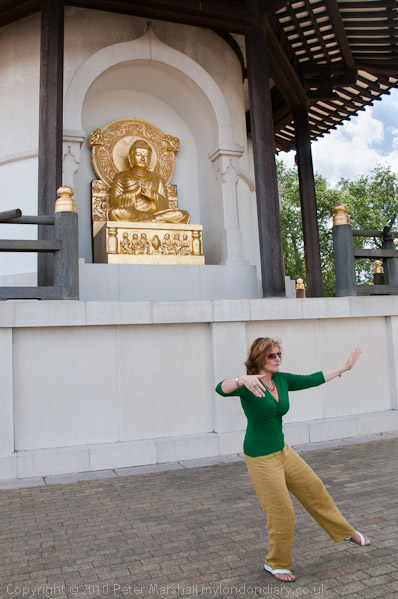
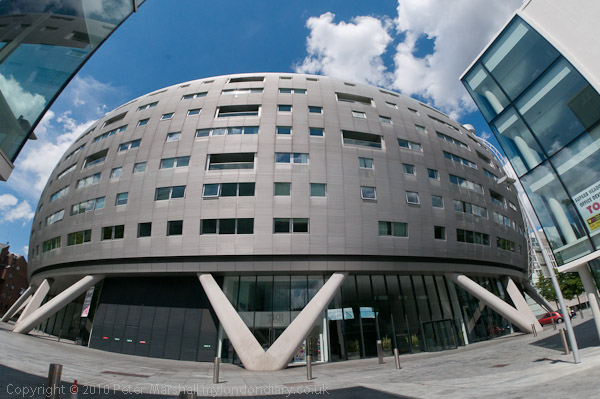
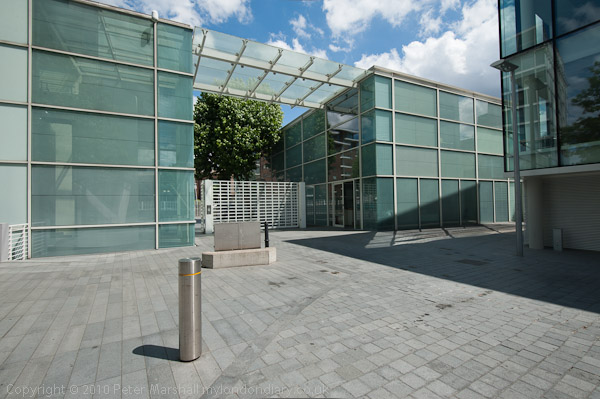
Of course I’ve walked this way before – and was at the Peace Pagoda last month for its 25th anniversary.  I’ve photographed the buildings of Albion Riverside before, some fairly remarkable recent cityscape and probably an improvement over the bus garage they replaced – one of relatively few London riverside residential developments of some architectural interest, along with the neighbouring offices of it’s architects, Foster + Partners.

© 2010, Peter Marshall

© 2010, Peter Marshall

Both provided me with an opportunity to try out the possibilities for image correction of Lightroom 3,  although for Albion Riverside I chose to only slightly reduce the fisheye perspective of the 10.5mm Nikkor, as is fairly obvious in the curvature of the straight-sided buildings at left and right. The lower image of the architects offices has been corrected for the fairly obvious barrel distortion given by the Nikon 16-35mm f4 lens at 17mm, and had I not been in a rush to put work on the web site I could also have corrected the very slight convergence of verticals and rotated the image the very slight amount needed to keep the verticals absolutely vertical.

Although very large amounts of correction do give visibly less sharp or detailed results it is very easy to make small corrections in Lightroom, and produce an image from a relatively quick hand-held exposure into the kind of picture that would once have needed long and careful setting up with a camera on a tripod, and probably only really possible with a camera with movements. Of course not all architectural shots need everything so tightly controlled, but it is good to be able to do so easily if required.

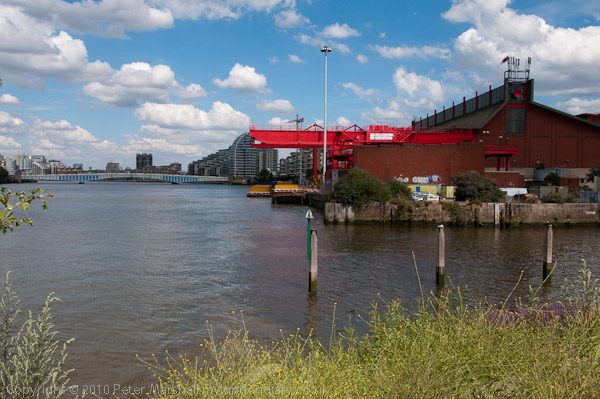
As you can see in the pictures on My London Diary, I walked on around four miles in all, turning back to catch a bus just beyond the mouth of the Wandle. The temporary path there has a fence around 6 foot tall with railings too close together to photograph through with the largish lenses on my Nikons, and on my previous visit there in April I gave up at this point.

This time I decided to photograph over the top of the fence, and held the camera up above my head on the top of the fence, far too high to look through the viewfinder. I always knew there must be a use for ‘Live View’ mode, and this was it. Although the bright sunlight prevented me from seeing the image on the back of the camera with any clarity, I could see enough to tell whether or not I had the camera level.

© 2010, Peter Marshall

I’d have preferred the tide to be lower and will need to go back one day when it is to get some more pictures, but as you can see the image is pretty well level, thanks to just a little tweaking in Lightroom.

More of the pictures from the Thames Path on My London Diary.

Fiesta!

 © 2010, Peter Marshall
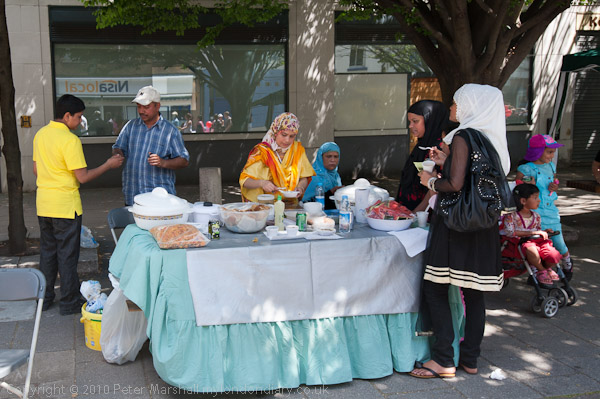
One of many food stalls at the Somerstown Festival of Cultures

Last Saturday I was in St Pancras, not the station but the area of London just to the west of it, photographing two linked events, one a neighbourhood street festival in an area which includes many people from various countries around the world, and the other, just a few yards away, a part of one of our great institutions, the British Library.

© 2010, Peter Marshall

The BL is also one of our younger institutions, and until around 40 years ago was simply a part of the British Museum, with the great reading room at the centre of that complex. I got to know it and took just a handful of pictures of it when my wife worked there in the early 1970s, though those negatives are now sadly in a very poor state.  But although the new building has many advantages, and I’ve been to several fine exhibitions there, its always seemed to me architecturally disappointing. I find the interior disorientating and the exterior rather a hotchpotch that lacks the kind of organisation I admire. Much of the site too is covered by a large courtyard which appears 99.9% of the time to be unused and a kind of no-man’s land between the street and the library.

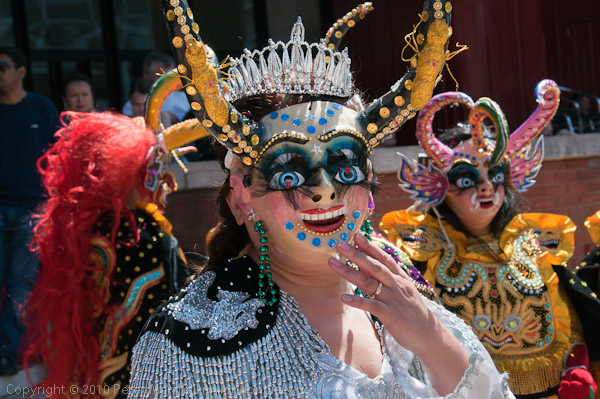
But this was one of the rare occasions when it was being made use of, for a festival of Latin American music and dance, Fiesta!, and I split my time between covering the dancers here and the street festival a short block away, though I also tried with little success to photograph a demonstration in Trafalgar Square a short tube ride away which, as is often the case, was rather less of an event than expected.

© 2010, Peter Marshall

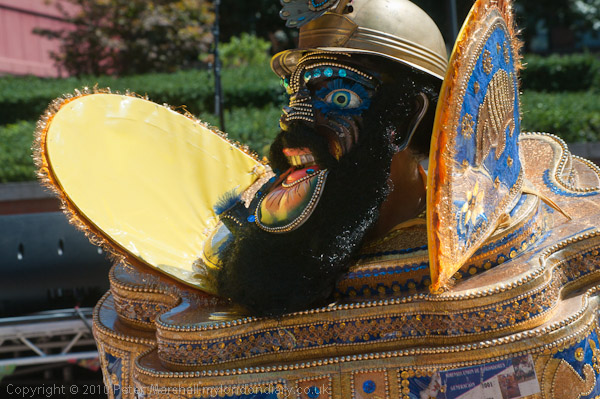
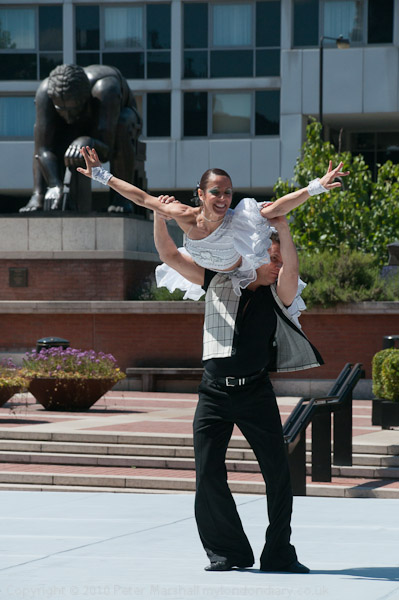
Many of the dancers had exotic costumes and it would have been hard to take a picture of them which didn’t have at least some interest because of this.  The main visual problem I had was in trying to place the event in context.  The building isn’t very recognisable and in any case for nearly all the time I had my back both to it and also to the audience, which was generally rather sparse and spread out. Probably the most recognisable feature on the site is the statue Newton, after William Blake by Sir Eduardo Paolozzi, and I used this in the background in a number of images, although it raised the second problem later in the day in that it meant working more or less directly towards the sun.

© 2010, Peter Marshall

Light levels were generally fairly high through the day, and so was the heat. I felt for the guys dancing in heavy costumes, I was having enough of a problem simply standing in the sun to take pictures. More pictures on My London Diary

At the street festival, almost every picture seemed to be in a mixture of sun and shade, and although sometimes I could use fill, for other pictures it wasn’t possible or I didn’t have time to put the flash on the right camera. Using two bodies I find it just too much to have both with flashes in the hot shoe, so generally find I have it on the wrong one when I have to grab a pictures quickly!

But really I just could not get into the mood. I often find it hard to start taking pictures, there is a kind of mental barrier to climb to overcome my very British inhibitions, but usually once I start things are fine. It didn’t quite happen at this event, and I don’t know why. Perhaps it was connected with going back and forth from one thing to another and not really getting stuck in, perhaps it was the heat, but somehow I just couldn’t relax and get on with the job. So although there are a few pictures on My London Diary that are OK, I wasn’t satisfied with the day.

Leon Levinstein at the Met

Like many with an interest in photography I’ve been reading the blogs and reviews from this year’s Arles Rencontres and from what I’ve seen I’m pleased I didn’t make the effort to go there. But one show I would like to see opened recently at the Met in New York, Hipsters, Hustlers, and Handball Players: Leon Levinstein’s New York Photographs, 1950-1980.

Levinstein was really the guy who wrote the book of what we now call ‘street photography’, so perhaps it’s rather unfair of Ken Johnson in the New York Times to denigrate the show as “a compendium of street photography clichés.” Much of it only became clichés because others followed his lead. But then I find it very hard to take with any seriousness the writing of someone who can describe Tina Modotti as “a master of the genre” along with Weegee and Robert Frank. This isn’t by the way a criticism of Modotti, though I’m not her greatest fan.

Gallerist James Danziger presents a markedly more sympathetic view, though I’d take exception at his suggestion that Levinstein is “more known and appreciated by dealers and curators than collectors or even photographers“, as I think more than almost anyone else I can think of he is a “photographer’s photographer”, (as indeed the Economist describes him in a short piece with a small set of images from the show) but although I’ve not seen the show I do know his work and Danziger is spot on when he says “he’s the real deal.”

Vince Aletti in The New Yorker gets to the nature of the work well when he talks of Levinstein as a loner “communing with New York at its grittiest, clearly relishing the experience” and producing work that is “brutal, brilliant, and uncompromising.”

In the Village Voice, Robert Shuster picks it as the only photographic show in his art recommendations and in a short piece compares him with Frank and finishes with the statement “Levinstein deserves wider recognition for recording the fleeting, quirky scenes of city life.”

The Met now has a decent short piece on him on their site, the real gem of which is a po0dacst with exceprts from a 1988 archival recording in which Leon Levinstein talks about his work.

The Howard Greenburg Gallery site isn’t my favourite – in my view a rather bad use of Flash, and if you have a recent Flash version installed you may well be told you haven’t got the correct one, but it will still actually work if you tell it you have. Under the ‘Artist’ tab if you scroll down you will find Levinstein and eventually a set of around 40 of his images.

Section 44 Victory

 © 2010, Peter Marshall

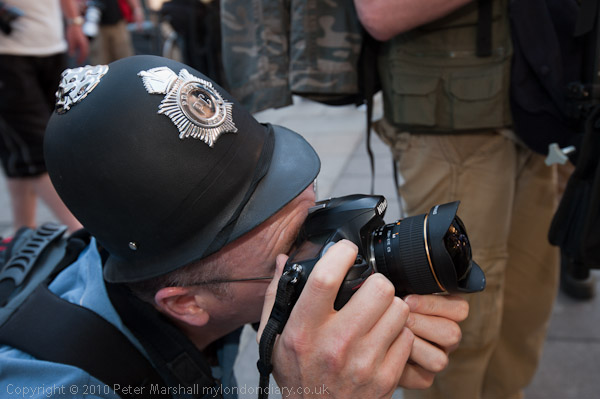
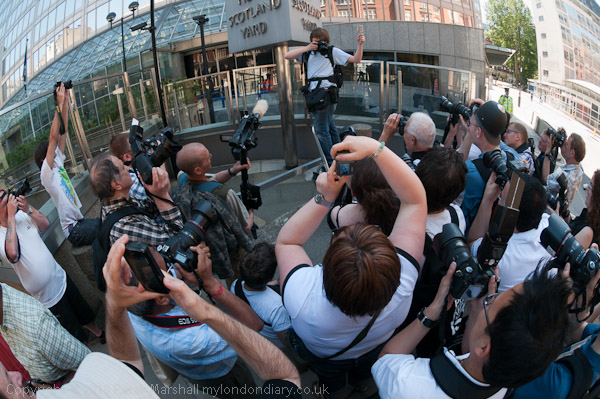
Last Sunday around 50 of London’s finest photojournalists and a few other friends of freedom gathered at Scotland Yard to celebrate the European Court of Human Rights ruling that meant ‘Section 44‘ which police had been widely using to harass photographers (as well as demonstrators) was illegal. Yesterday we heard that Home Secretary Teresa May had finally bowed to the inevitable and accepted their decision. Section 44 truly was dead.

© 2010, Peter Marshall
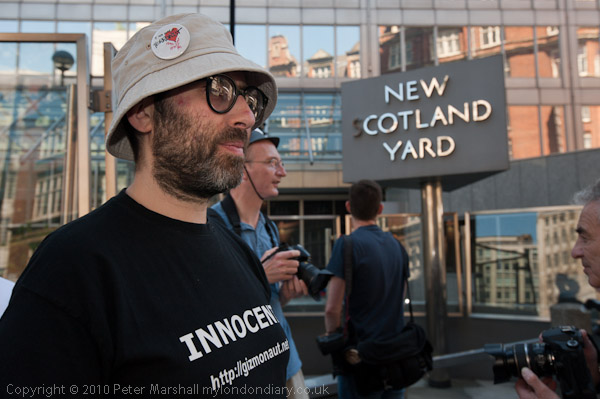
Innocent man, David Mery, at New Scotland Yard

It may well have been the media storm over the police arrest of a young freelance covering a military parade in Romford the previous week that had been the last nail in the coffin for this ill-conceived legislation, although it was probably about the only offence which Jules Mattson wasn’t accused of during the farcical eight or nine minutes he recorded police digging themselves a deeper hole.

© 2010, Peter Marshall
Jules photographing and being photographed

Jules was held up on his way to Sunday’s  ‘flash-mob’ not by police but by witnessing a traffic accident, but when he did arrive those of us still there certainly gave him a hero’s welcome before posing so he too could take a picture of the demonstration.

Jules got in the news again on Tuesday, having been asked to photograph an event where his former army cadet group was among those being inspected by Prince Charles.  Police were consulted as he came into the area and were happy with him there, but when he stopped to take pictures of the Prince saluting his group of cadets, a grey suited member of Charles’s bodyguard ran towards him and held him for a few seconds before apparently being satisfied that he was not intent on assassination.

It looked like the end of the incident, but shortly after a couple of plain clothes police in flowery frocks (allegedly female) from the police covert operations group (still usually referred to as SO10, though officially now  SCD10, and and one of the 10 Specialist Crime Directorates  – or possibly 11, though if so SCD3 is a closely guarded official secret) came over and grabbed him.  He was questioned, and stopped and searched before being held for around 30 minutes; he could have left earlier, but sensibly demanded a stop and search form which the officer concerned deliberately went through very, very, slowly indeed.

Of course the loss of Section 44 does not mean an end to police harassment of photographers, and nor will the issuing of yet more statements and circulars telling them to lay off the press. But I think they are coming under increased pressure to actually do something about it by the increasing media coverage, as well as more settlements being made in favour of photographers.

With everyone there having at least one camera and spending a lot of time using it, getting pictures that were more than a simple record of the event was hard. Of course there are obvious things you have to take, and I did.  But there were perhaps one or two of those on My London Diary that stood out among the rest.

More on the Olympics

One of the reasons I’ve been getting a little behind in posting about my own work here is that I’ve been busy putting the finishing touches to my first book of pictures of the Olympic area (It’s now completed and I’m waiting with interest to see it in print.)  The Lea Valley around London’s second river, the Lea,  is an area I started to photograph in the 1980s and have continued to go back to occasionally ever since.

In the early 1980s my work on Hull had been accepted for a major museum show there and I was looking to repeat my success in London. Possibly the reason it didn’t happen was that the subject I chose for my next major project was the Lea Valley, which at that time absolutely nobody other than me seemed to have an interest in.

Then I could walk along the Northern Outfall Sewer for several miles and have the area completely to myself, and the paths along the various waterways of the back rivers crossing Stratford Marsh would, at least in the close season for fishing, be totally deserted.

Things have changed drastically with the success of the London Olympics bid, and last Tuesday I had to keep stopping as I rode along the path on top of the sewer, long since re-branded as the ‘Greenway’ which was crowded with various groups of visitors.

Thanks to the Olympics, the area has also been noticed by the London Festival of Architecture and was the site of an ‘urban gardening’ intervention by students from the University of Innsbruck, Austria.

© 2010, Peter Marshall
Urban gardening alongside the Lea Navigation by Bow Flyover

I’d gone there to continue my series of images of the Olympic area, where I’ve been trying to make roughly monthly visits to see the progress on the site.

© 2010, Peter Marshall
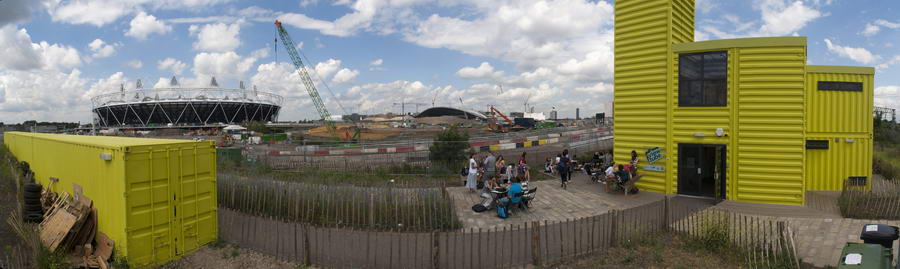
Olympic stadium, Greenway and View Tube
and also to meet an artist friend with whom I’m working on a joint project with us both producing images from the same areas of London – and the Olympic site is one we’ve chosen.  We’re looking for a venue in London for an exhibition of our joint work, though so far without success.

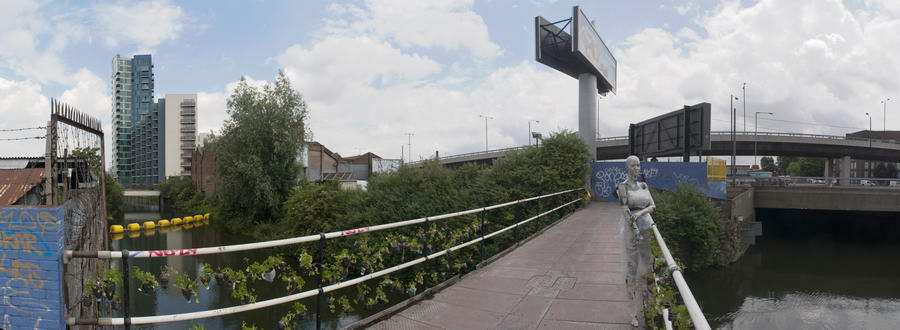
I spent around an hour there taking photographs, particularly some panoramas – like the one above. I’d hope to be able to photograph from the viewing platform there, but unfortunately it isn’t available when school groups are using the classroom, so this time I couldn’t do so.

But I had thought to bring a monopod with me, virtually a necessity to take pictures above the temporary fencing that lines the area now. The mesh of this isn’t particularly fine, but you can’t put any Nikon DSLR lens through it and at six foot and a couple of inches its hard to photograph over unless you are rather tall.

The monopod is good for panoramas anyway as you can rotate the camera while keeping it in the same position (though I’d forgotten my attachment which enables rotation around the lens near nodal point, which is essential if you have any close objects in the frame.)  But unfortunately it only reaches up to a little over five foot, so I had to hold it well off the ground so that the camera had a clear view over the fence.

This introduces other problems. It’s hard to keep the monopod in exactly the same position between exposures and the camera may actually be too high to reach to fire the shutter. For a single exposure the self-timer can deal with the second problem, but if you want to make multiple exposures while rotating the camera in order to make a panorama it makes getting the camera back into the same position problematic.

So although it might have been nice to lift the camera higher for some shots, in practice when making panoramas I was limited to the height I could reach to the shutter release.  And making panoramas works best when I can work either with the foot of the monopod firmly on the ground, or with some part of it braced against some solid structure.

For the panoramic images I decided to use a fixed 20mm lens, a Nikon f2.8.   It has reasonably low distortion and cuts out one possibility – altering the foal length that can make multiple images with wit zooms hard to stitch.To make panoramas that are easy to make and print, I want to stick to using a single row of images, and a relatively wide lens produces images that work together with those taken with my swing lens film cameras which have lenses of roughly 26mm focal length. Y

However carefully you work, the geometry means you lose some vertical coverage when stitching images  (the actual amount depends on the angular overlap between images) and starting from 20mm. Screwing the camera directly to the top of the monopod means using it in landscape mode, which isn’t ideal, but is considerably simpler.

What I would welcome is a  more compact monopod. The cheap unbranded model I have is reasonably light and sturdy, has rapid locks for quick and reliable extension and extends at maximum stretch to hold the camera exactly at my eye level, but is around 17 inches when collapsed, too long to fit my camera bag, though it does just slip in at an angle to the bag on my Brompton folding bike which I often ride in London.  But looking through the various models available (ranging in price from a tenner up to around £250) I can’t really see anything better.

And there is of course nothing better than PTGui for stitching the images. You can see the above pictures and a few more on My London Diary, where there are also some more non-panoramic images of the urban gardening, as well as from the Olympic site and my travels back into the centre of London by a rather roundabout route on the Brompton.

© 2010, Peter Marshall
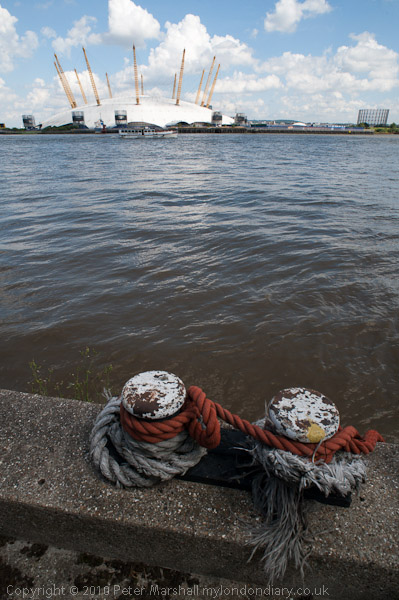
I didn’t cross the river here at Blackwall, but cycled down to the foot tunnel at Greenwich

Carl de Keyser & Google Earth

I meant to point out last week that Carl de Keyser has been answering questions on David Alan Harvey‘s ‘Burn‘, “an evolving journal for emerging photographers.” Some of the comments make interesting reading, though of course not everyone has “Two assistants in Magnum/Paris” who ” go around the entire European coastline on Google earth and put flags in places where they think I might find an interesting situation to photograph that reflects that idea of waiting for the big one.”

I’ve written about de Keyser’s work on several occasions and as well as on Magnum you can also see more on his own web site, and on the site devoted to his latest project Moments Before the Flood, involving the whole European coastline.

He is currently working in the UK, and on the site you can see his images from a number of places I’ve also photographed, including Hornsea, Withernsea and Skipsea,  and I see that on Saturday he was in Brighton, photographing its derelict West Pier.  Pictures are going up more or less as soon as they are taken and comments are welcome on the site.

Although I admire his photography, and there are plenty of good pictures, I’m not sure that I think that the project is really quite coming together, though I’ve only looked through the 80 or so pictures from the UK.  It’s perhaps just a little too scenic (and in one or two cases too picture postcard) although of course the editing may well sort that out.

But sometimes looking at his pictures I do get the impression of a man in a hurry driven by a huge mission to complete,  and driving at great speed from ‘flag’ to ‘flag’ around our coastline.

Hornsea, Skipsea and Withernsea  particularly interested me because I’ve visited them quite a few times over the years (of course I’ve also been to many of the other places around the coast) and have photographed the effects of erosion there and along the whole Holderness coast.  But I think I took my best pictures when I used a bicycle to get around, there is a lot to be said for working at a slower speed.

But Google Earth and Google Streetview and other mapping and satellite image services have very much changed the way we can look for subject matter.

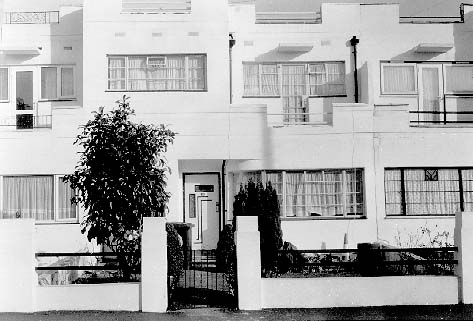
I had a  query yesterday about a picture I took in 1995 in London (its on the Buildings of London site I wrote in 1996 and have hardly updated.)

© 1995, Peter Marshall

(Sorry it’s not a great scan, but technology back then was relatively primitive.)

Of course I could go back to my contact sheets from 1995 and find the image, and fortunately I had put down the details and was able to confirm that the street I’d given was correct. It also had a six figure grid reference, but that only locates it to roughly a hundred metres. Rather than just check on the map, I started with finding the street on Google Earth then used ‘Street View.’ And it wasn’t there – which is why I’d had the query.

Fortunately one of the other frames I had of the building showed the right hand corner where there was a street with a name I could read with a magnifying glass from the contact sheet, so I could tell exactly where it had been. Back to street view and I could also clearly identify the very dull red brick block that had replaced a rather interesting piece of 1930’s architecture.

Of course the new block has an extra storey and almost certainly made a decent profit by fitting more units into the same space. And probably the new building will be more energy efficient and with luck the roof won’t leak, often a problem with ‘modern’ buildings that were really designed with warmer drier climates in mind.

If I was in power I  would insist that any new building that replaced an old one had to be at least as architecturally distinguished. But our planning system has little control over visual aspects of building, as you can see on almost any walk through London.

Economist Blunders

Thanks to the New York Times Media Decoder blog you can read the story of how The Economist doctored a cover picture to make it show Obama all alone gazing apparently down at his feet on a Louisiana beach with a handy oil rig in the distance.

The problem is that this isn’t at all what the original photograph showed. Firstly Obama was in a group of three people, one of whom was cropped out and the second, closer to him, retouched away.  Almost as significantly, the hazard tape in front of the three and the material in front of them on the beach – which in the original appears to hold his attention – has also been cropped away. For copyright reasons you will have to click on the link above to see the two pictures.

I don’t know what caption the photographer put to his original image, but it could have gone something like “Obama looks at pollution evidence on the beach and consults with US coastguard Admiral Thad W. Allen and local parish president Charlotte Randolph.”  The picture used in on the cover would suit a quite different caption, suggesting a lonely and desperate man looking down in despair.

The most depressing and rather frightening aspect of the story is that the deputy editor concerned seems to have no idea of the gross distortion that her decision to change this photograph has caused. She writes “the presence of an unknown woman would have been puzzling to readers.” It seems to show a very low opinion of Economist readers and in fact it was not an “unknown woman” (surely a gratuitously offensive description when we have both her name and photograph), but one with a  peculiar relevance to the scene which the image showed, the president of the particular parish in which Obama is standing and on whose beach the oil has landed.

Emma Duncan, deputy editor of The Economist goes on in her e-mail to state “We don’t edit photos in order to mislead” when clearly the evidence shows the opposite is true. Either she doesn’t take at all pictures seriously or fails to understand them.

The difference between the two pictures is just like the difference between writing “President Obama was alone on the beach racked by worry about the pollution” and “President Obama visited the beach with the local parish president and a US Coastguard Admiral to see the damage for himself“. I’m sure Duncan would see that those statements were different and that to substitute one for the other was misleading – and it really makes no difference if you do it with pictures rather than words.

The Economist needs to quickly apologise to its readers for misleading them – and also needs to make sure that it leaves the editing of pictures to someone who understand them. They wouldn’t do this kind of thing with words and doing it with images is equally corrosive to their credibility.

South Korea Lose

Coming home on the train I met a whole group of friends of my wife and they saw my camera bag and asked me what I had been photographing.  “The World Cup” I replied, and it was true, although I hadn’t actually been to South Africa. Had I just flown back into Heathrow I might have come on that same train, as there is a local bus service rather ridiculously called by the rail company a ‘Rail-Air bus link’ which takes you to one of the local stations we had just passed through, though being rather more sensible I would have simply caught a different local bus that would take me (rather slowly) to ten minutes walk from my home.

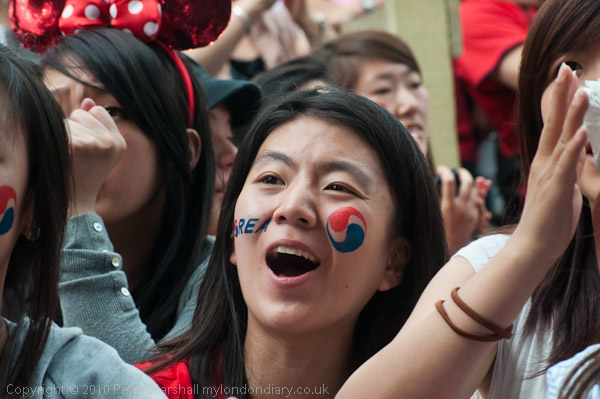
© 2010, Peter Marshall

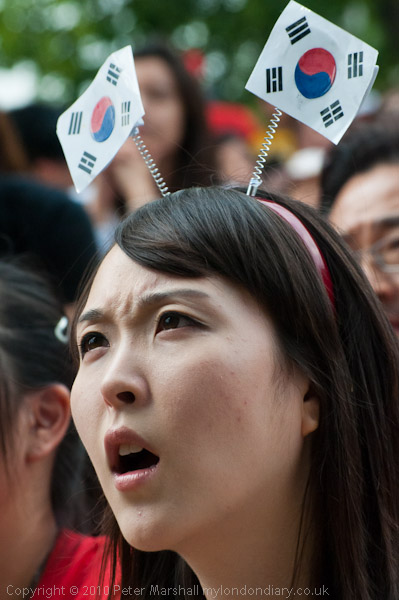
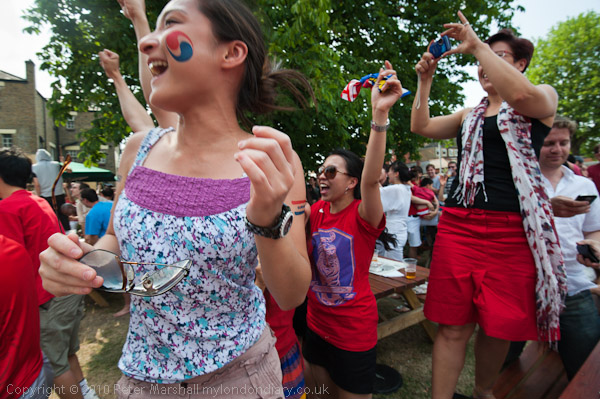
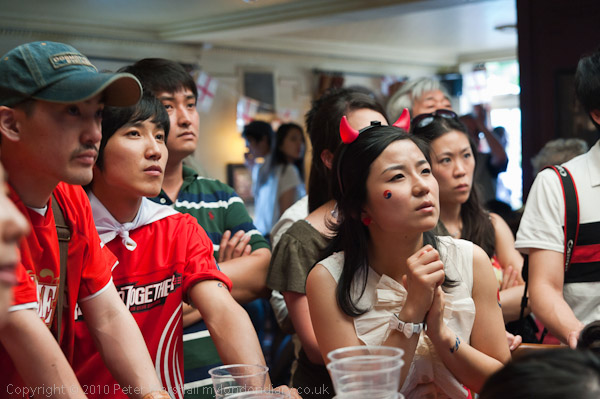
Actually I’d been in south-west London, at the Fountain,  a pub in New Malden in the centre of Britain’s South Korean community, watching the match between South Korea and Uruguay on a series of large screens surrounded by hundreds of excited South Koreans.

They had every reason to be excited because their team – many of whom play for English league sides from Manchester United down – had put up a pretty good show, dominating play for much of the game, and with a little luck the game would have been down to penalties or even gone in their favour.

© 2010, Peter Marshall

I’d decided to take the 16-35mm on the D700 along with the 24-70mm for the D300 (36-105 equiv) as my two main lenses, although at least for the first half I found myself shooting mainly with the 55-200mm on the D300 (80-300 equiv) as I stood between the screens along one side of the large pub garden facing the spectators.  There were certainly plenty of interesting faces and expressions as the game ebbed and flowed.

© 2010, Peter Marshall
South Korea Equalise – 1:1!

After the interval (time for a decent pint as my colleague had rushed to the bar just before the half ended) I decided to make use of the wide angle and mingle with the crowd, which involved quite a lot of crouching down so as not to interfere with their sight lines as they watched. Fortunately the seating was on a slight slope which made things easier.

We’d got permission from the pub manager to photograph, and very few people seemed at all worried by me getting close to take pictures with the wide angle. It’s perhaps a little odd as it is physically rather a long lens – and I sometimes get confused and pick it up when I want my telephoto – which is a little shorter. The long design is to make the rays incident on the sensor closer to perpendicular which causes problems as the sites on the sensor are at the bottom of small pits, leading to cut-off with oblique rays. Sometimes it’s an advantage as people to one side think you are shooting things further away, but it’s big enough to be a little intimidating when pointed straight at you.

© 2010, Peter Marshall

Probably it’s easier to photograph Korean supporters than English and I think they are less obsessed with ideas of privacy and more sociable and less suspicious than typical English groups. And although most were enjoying a drink, I think they were considerably more sober than I would expect from English fans.  At the end of the match, most left immediately. Obviously they had nothing to stay and celebrate, but few felt a need to drown their sorrows. I’d gone inside the pub to take pictures there a few minutes before the match ended. My colleague had stayed inside, working with flash (and I’m sure his results were fine) but I found I could get usable results in the fairly dim interior at ISO 2000 and above.

More pictures.