The Three Cities of Photography

[Text of my speech at the opening of ‘Paris – New York – London‘ at the Shoreditch Gallery, London on 20.10.2010. The show continues until 29.10.2010.]

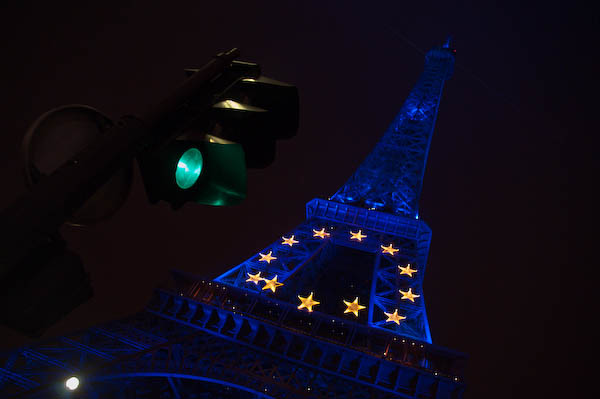
Stars of tonight’s show are the most vital cities in the history of photography, Paris, New York and London. As we know the twin birth of our medium was announced within a few days in Paris and London in 1839; New York was to dominate much of the twentieth century.

The most notable British photographer of the last century illustrates their relationship well. Bill Brandt was a German who re-invented himself as a Londoner, learnt photography in Paris, and when he had the first major solo exhibition by a living photographer in any of our leading art institutions, his Hayward Gallery show came from the Museum of Modern Art in New York.

London dominated photography in the 19th century. One of our greatest photographers was Roger Fenton, honoured by a blue plaque on a fine house overlooking Parliament Hill Fields. But after a few years as our leading photographer he abandoned photography and went back to making some money instead – as a lawyer. Despite the strength of photography here, this country has never really accepted photography, never developed a culture, a community that supports it.
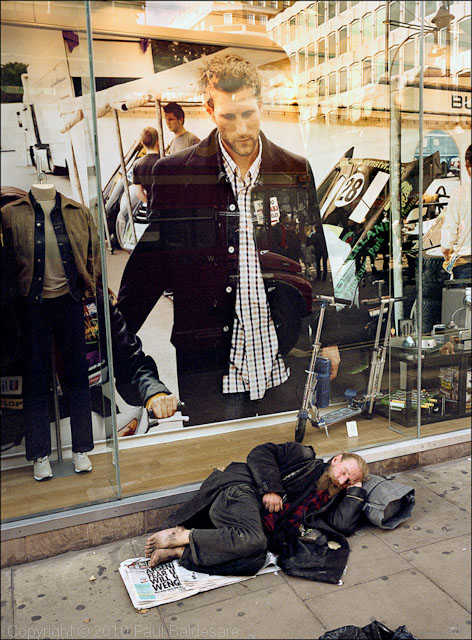
© Paul Baldesare
Sleeping vagrant, Davies St, Mayfair, London. Paul Baldesare

Paris’s great period was between the two World Wars; Atget was still working in the twenties, Henri CartierBresson was young and active in the next decade and others including Capa, Brassai, Kertesz and Man Ray flocked there. But photography was just one of the arts that flourished, and the inspiration for my own work on the wall here came more from Surrealist literature and in particular Aragon‘s ‘Paris Peasant.’
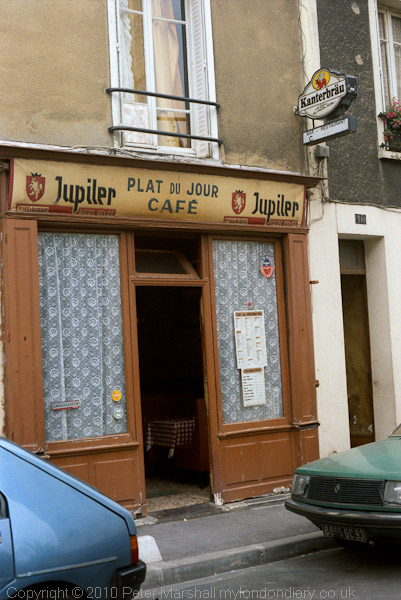
© 1988, Peter Marshall

One man almost single-handedly dragged the US to the forefront of photography around the start of the twentieth century, and Alfred Stieglitz in New York repeated his miracle when he published the work of Paul Strand in the final two editions of Camera Work in 1916-7. Later the city was the home for a hugely vital upsurge of photography in the form of the New York Photo League, closed down by McCarthyism at the start of the 1950s.

Alexey Brodovitch came from Paris to New York in the mid 1930s, becoming art director of Harper’s Bazaar and in the 1950s and 60s established a legendary laboratory for photographers. Two who went through that mill, John Benton-Harris and Tony Ray-Jones came to London in the late 1960s and helped to kick-start a decade of resurgence of photography here which lasted through most of the 1970s, particular through their influence on the magazine ‘Creative Camera‘, based in London, though its publisher, Coo Press was kept afloat by men in braces in the pigeon lofts of our northern cities who bought its other publications.

This was only a short-lived flutter, soon cut down to size and emasculated by a British establishment that refused to take photography seriously (and held its nose and kept it at arm’s length when it had to take it at all), and in particular the Arts Council and their ‘photographic flagship’ in London, the Photographers’ Gallery, or as I christened it a couple of years ago after its move to new premises, the zombies of Ramilees St. The gallery made only half-hearted attempts to encourage and nurture photography in this country, and these were abandoned completely  in the late 1980s.

I was one of the photographers influenced by that outburst of the 1970s, and Paul Baldesare‘s work developed particularly from that of Tony Ray-Jones and John Benton-Harris.

Although a photographic culture is still almost completely lacking here, there have been a few small glimmers of hope arising if sometimes rather dimly and uncertainly from a general pea-soup of indifference. Photofusion in Brixton, Host not too far from here, and, perhaps most notably, the East London Photomonth, now celebrating its tenth year. I’m pleased to have been able to be involved with it through shows here in the last three of these.

Peter Marshall 20.10.2010

[I ended with thanks to various people and also an advert for Photo Paris, which includes the pictures from Paris on show here, as well as mentioning that work from two of us was on sale. Pictures from the opening in a later post.]

Paris Photo 2010

When I wrote about photography for About.com, one of the things I was keen to promote was photography that was taking place outside the charmed circle which was largely defined by US dealers, US galleries and US academics, with a little help from their Western European colleagues.

Of course there were photographers from outside that area who were recognised, but they were largely restricted to a few whose work had somehow been discovered in the USA and rewarded with major exhibitions there, for example the great Czech photographer Josef Sudek.  His work was brought to New York by Sonja Bullaty.  At the age of 22 she had escaped from a death march after four years imprisoned by the Nazis  in the Lodz Ghetto, Auschwitz and Gross-Rosen concentration camps, and hid until liberation when she was able to return to Prague and became ‘apprentice-martyr’ to Sudek. Two years later distant relatives discovered she had survived and sent her the money to go and live with them in New York, where she worked as a photographer (along with her husband, New Yorker Angelo Lomeo) for the rest of her life. It was her work and particularly her book of pictures by Sudek, published in 1978 that brought his work to the attention of the US-based photography world – and to me.

There were many others too – including many from the USA – who brought pictures from photographers around the world to exhibitions and wrote about their work, and of course many photographers from around the world made their way to America and to New York – in many respects the world capital of photography –  in particular. But when I started writing a professional column in 1999 it was still true that photography was very much dominated by US photographers and US opinions. There had even been some little discussion about whether as a non-US citizen who didn’t live in New York I was actually a suitable person to write about the medium (and not being American was one of a number of reasons why I finally lost the job, though it was more important that I insisted on taking photography seriously.)

I tried to do a little to educate the photographic public (and although I had many readers around the world it was mainly an American public) that there had been and was photography outside the states of the union and outside the at times narrow definitions largely set down by the Museum of Modern Art. One area of the site I set up was devoted to ‘World Photography’ and at first I concentrated on Central and South America, treating it country by country, starting with Argentina (by the time I was sacked I had got as far as four features on Mexican photography in a total of 16 from that area, 6 from Africa, 13 from Asia, 2 from Australasia, 38 from Europe as well as 23 from North America.)

Most of those from Europe were from England and France, but I had written about photographers from Hungary, Albania, Lithuania, Russia and Finland, and was preparing to write more about photography in Central and Eastern Europe when my contract was terminated. But while I don’t pretend my work had any great influence,  it did I think represent a current of opinion whose time had come and others obviously shared some at least of my ideas, and photography has been opening its borders and becoming more international in the past decade.

I’m particularly pleased to see that this year’s Paris Photo has a special emphasis on photography from Hungary, Poland, Slovakia, Slovenia and the Czech Republic. Whether or not you are going to Paris this year you can see some of this work on line, and Lens Culture has  a preview of more than 300 images in a high-resolution slide-show.

Not all of the pictures are from Europe; the second image in the slide show is by one of my favourite Japanese photographers, Issei Suda. One of his books was the first book of Japanese photography I ever bought, many years ago.  The slide show, like Paris Photo, is an incredible mixture with work to suit every taste (or lack of it) with quite a few images that seem to me totally pointless, but also much to delight.

See Also

Meet Me in Paris?
November in Paris & Lensculture fotofest

Alec Soth

I’ve written a few times recently about Alec Soth, and he now has a new web site and its front page says:

My name is Alec Soth. I live in Minnesota. I like to take pictures and make books. I have a Labradoodle. I also have a business called Little Brown Mushroom.

Go there and click on the link and you’ll find the Labradoodle is well-named. Fortunately the site also has pictures from half a dozen of his projects:

all of which need you to scroll across the page* to see more pictures. The site also has quite a lot of information about him, definitely a good idea as he must get thousands of students writing to him with similar questions and he can just tell them to look on the web site.

If you have a large screen, it’s better to click on the picture and watch them larger as a slide show, but you need to have a screen around 1500 pixels wide to see the landscape format images properly, as on smaller screens the left side menu gets in the way.

The images in the slide show good quality jpegs, maximum dimension 1024 pixels but may not look their best in your browser as they are AdobeRGB images. These will only display correctly if your web browser is color managed. You can find out more and check that on the image at top right of this Web Browser Colour Management Tutorial, which should not alter when you move your mouse over it or click on it.  If you find it changes it is worth considering updating your browser. Recent versions of Firefox are colour managed (though it can be switched off) and I think Safari always has been.  The only version of Internet Explorer I have is IE7, and it isn’t.

Without colour management browsers will normally display all files as sRGB (or at least roughly so) as 95% of monitors use the same 2.2 gamma as sRGB. This is why it almost always makes sense to convert your files to SRGB before putting them on the web. Very few monitors can actually display many colours outside the gamut of sRGB in any case, so if you display an AdobeRGB file on them with colour management it won’t look any better than if it was converted to sRGB, and without colour management will look considerably worse.

Of course if you are at all interested in looking at photographs on the web you will have already have a properly profiled and calibrated monitor – to to 2.2 gamma and D65- 6500 Kelvin – and you can read more about that on the tutorial linked above. As G Ballard explains, the Mac default of 1.8 can cause problems.

While many lesser photographers (and sites such as Magnum) are pretty paranoid about putting images on the web, limiting the size and decorating them with watermarks, Soth does neither. It’s good for all of us who like looking at his work and particularly for those students I mentioned earlier who can print them off in their reports, and for other ‘fair use‘ of the images. If your work is as well known as his, you don’t need to worry too much about the images becoming ‘orphans‘, the main reason I now include both metadata and a visible watermark on all new web images.

*I’ll possibly think that is sensible design when I get a mouse that comes with a ball on top rather than a wheel, but not before.

Shore: Photography and the Limits of Representation

I didn’t get to Stephen Shore’s talk in London on Tuesday, but I’ve just been listening to it and watching it on video on the AA School of Architecture web site. Shore has been the director of the Photography Program at Bard College in upstate New York since 1982, but most of us probably know him for his 1982 Aperture book Uncommon Places, which gave many of us a new impetus to explore colour photography.

He talks about the nature of photography and the four tools that a photographer has at his disposal, “focus, moment & duration, choice of frame and choice of vantage point.” He says “Photography is essentially an analytic medium  … a photographer starts with the whole world and every decision brings order to it … a photograph is solved more than it is composed.”

It’s a long video – 90 minutes – but it held my interest for most of that time, and is a very clear exposition of his views on photography and of course of his own work. As well as the actual talk the video also includes the whole of the question session with Shore after the talk.

Inscape No 80

 © 1979, Peter Marshall
Street Games, Argyle St area, Hull, 1979. Peter Marshall

More years ago than I care to remember I enrolled on an evening class in the History of Photography being offered at the Camden Working Men’s College just down the road from Mornington Crescent (and doubtlessly coincidentally around the time the famous game of that name made its first appearance.)

It was partly a matter of curiosity – I’d never seen such a course offered as an evening class before, but perhaps more importantly, as I was teaching photography it could be counted as “in-service training”, both cutting down the pressure to go on far more boring courses and also meaning I could claim back both course fees and travel expenses from my employer. An added bonus was that the student card for this short course enabled me to claim a 10% discount from my favourite supplier of photographic materials for the next few years.

From the first session the lecturer, William Bishop, made it clear that although he had all the right art history tools he saw the course as an opportunity for him to learn about the history of photography rather than having a great deal of knowledge about it to impart.  It became very much a dialogue between him and those of the students – myself included – who knew rather more about photography and photographers, and one that proved constructive for us all.

A few years later,  Bishop, who had by this time been reduced by me to Bill in the interests of alliteration, decided to set up a ‘small magazine’ covering photography, producing the first issue of ‘Inscape‘ in Autumn 1992. Immediately I saw it, I contacted him and suggested he might come and make use of my equipment and desk-top publishing skills to improve the production quality, and we produced a few issues this way until he was successful in getting a grant to buy his own computer and scanner.

I had a few pictures in some of the earlier issues and the occasional one since, but I’ve not been a regular contributor to Inscape. My interests have perhaps moved rather in a different direction since those early days, and while the magazine has occasionally published work that interests me, there has also been much that has left me cold or worse.

Inscape is a word coined by Gerard Manley Hopkins, and there is a good short exposition of it on The Victorian Web by Glenn Everett. Inscape for him was essentially a both a Romantic and a religious idea, a revelation of the essence of a thing and an insight into the reason for its creation.  It is one of several attempts to describe the feeling that a particular moment or vision has a special significance.

© 1979, Peter Marshall
Betty’s Corner Store, Selby St, Hull, 1979. Peter Marshall

When we take personal photographs we are perhaps selecting selecting points of view on the real world that seem for us have some particular resonance – an “inscape” and hence the title of the magazine which

is about sharing our personal work, our personal photographic visions, with others. It is about appreciation rather than confrontation and argument, but it is not intended as a cosy corner to slumber in because it believes that the tradition of picture making that has personal meaning is alive and still developing.

It is something of a surprise (although I’ve kept up my subscription over the years) that Inscape is still going 18 years later. I think it started with five issues a year and is now quarterly, and the quality of the reproduction has improved significantly. The three pictures here are from a set of nine printed in Inscape No 80, at least some of which have a connection with its “An Architectural Theme“.

© 1979, Peter Marshall
Albert Dock, Hull, 1981. Peter Marshall

Others might be better suited to the theme of the forthcoming issue number 81, The Urban Scene, for which the copy date is 21 Dec 2010.  Like most small magazines (and unfortunately some very large ones), Inscape does not pay for contributions – the whole thing is very much a labour of love on a minuscule budget by Mr Bishop.

My set of pictures is only one of the contributions to the issue, with photographs by I think ten other photographers and written contributions by the Editor and the mysterious “mjp”.

© 1979, Peter Marshall
Fishers, Spring Bank, Hull, 1979. Peter Marshall

The magazine is now I think on sale in some very selected outlets and costs £3.60 or you can try through the web site, where back numbers are £2.50 post free in the UK. A subscription for 4 issues in the UK is £15.

There are a few more of my pictures from Hull on the Urban Landscapes web site, and I’m currently working through several years of photographs preparing a Blurb book on Hull which should appear later this year, under the title of my 1983 show there, ‘Still Occupied; A View of Hull‘, although the selection of images will be different to the 144 or so I showed then.

Meet Me in Paris?

© 2008 Peter Marshall
All ready to go to Paris

I think that I’ve now sorted out my trip to Paris for Paris Photo next month, along with my interpreter (not that I really need one, but my wife’s French is more than considerably better than mine, and both of us are extremely fond of the city.)  I’ve sent off for my accreditation, booked a hotel room (at the same hotel as last time, which isn’t perfect but is cheap), booked my tickets on Eurostar  – of course I’m not flying.

© 2008 Peter Marshall
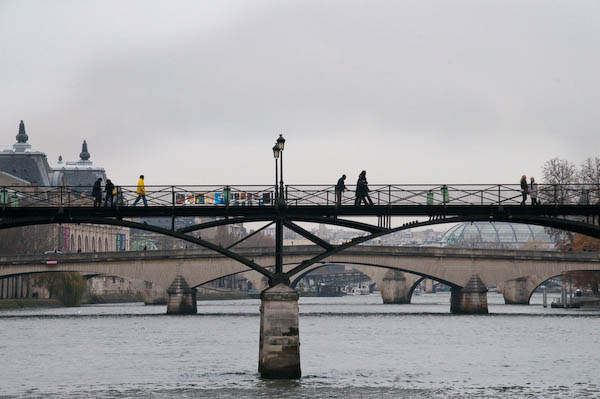
Pont des Arts, Paris, November 2008

Although we met in Manchester rather than Paris, my wife and I spent our first holiday together there a couple of years before we were married, sleeping in separate twin rooms in a student hostel a nine miles south of the city centre in Massy-Verrières, then a rather large building site on the Luxembourg line, although we were in the older part of the town.  It’s the only year I’ve been in France to celebrate Bastille Day, where we went to the celebrations on the main square there,  where people really did dance to accordion music in the streets.

We went back there a few years ago on the day when the Tour de France was finishing on the Champs-Élysées, catching a train back to the centre which should have got us there in time to see it. Unfortunately the line came to a halt around 25 minutes before the cyclists arrived, with the driver settling down in a signal box to watch the finish.

You can read about my last visit to the Mois de la Photo in 2008 in a series of articles under the heading PARIS SUPPLEMENT.   As well as the trade show, Paris Phot, with dealers from around the world showing the work of their photographers, their are exhibitions across the city in the ‘Mois del la Photo’ and even more shows in the fringe festival. For a month, but particular around the few days of Paris Photo, the city is really alive to the sound or rather sight of photography.

In 2008, apart from Paris Photo, which is a great opportunity to see work by established photographers from around the world, I got to see around 40 other exhibitions, as well as attending several openings and a few other parties,  meeting many photographers from around the world I already knew and other new faces.

© 2008 Peter Marshall
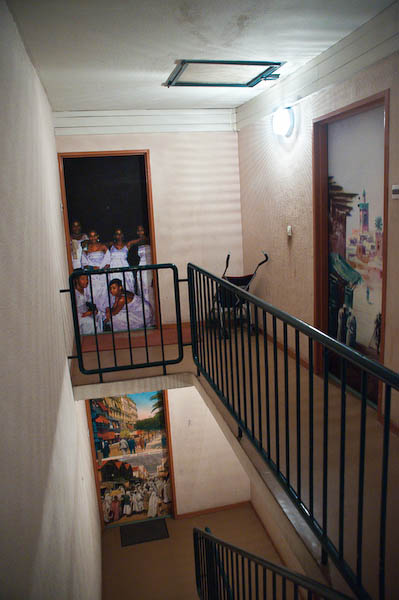
One of the fringe shows was on the landings of a social housing block,
Cité des trois fushias, 20e

You can see many more of my pictures from Paris on my Paris photos site, although not from that 1966 visit, when I dropped my camera in a lake!

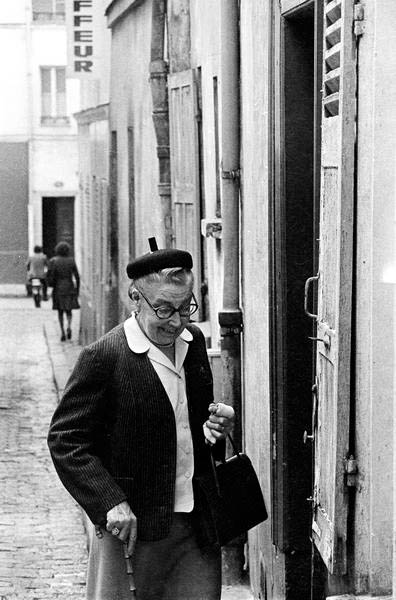
© 1973, Peter Marshall
This woman was walking along a back street in Montmartre in 1973.

If any of you reading this are going to be in Paris at any time between Nov 17-22 I’d be delighted to meet you – and if you are having an opening I’ll do my best to be there and to write about the work. You can e-mail me at petermarshall(at)cix.co.uk – or add a comment here.

More on AFP v Morel Copyright Theft

Go to duckrabbit to read the latest on this clear case of image theft that I’ve mentioned several times before. Large agencies – and not just AFP – appear to to making an attempt to take over any images that don’t have the photographer’s name stamped across them in large letters.

As it says:

It’s no exaggeration to say that the arguments presented in court mean that this case, if it goes AFP’s way, could affect all photographers who use the web.

A few months ago I started putting a discreet but visible watermark on all images that I post on the web, but of course my images go to libraries without this. I’ve also written many times about the need to embed metadata in all images, and I’ve followed my own advice on this for some years.

© 2010, Peter Marshall
A discreetly watermarked image from June 2009

What I’d really like to see is a feature implemented on all new cameras (or at least all professional models) that adds a little black border to the bottom (or longer side) of every image containing our copyright message to every image that is taken – so that every picture we take is automatically labelled. It wouldn’t be too difficult to implement or make the images much larger.

It could of course easily be removed – even automatically – by users, but would put the onus on whoever did so to be sure they had the right to do so.

Is this an idea about cameras worth pursuing?

I didn’t mention it when I added a comment on duckrabbit, where I mentioned the need for photographers to join together to oppose these image grabs. At the moment I know my union has been quite supportive of some photographers over individual copyright cases. But if there are large numbers of photographers whose work is being used without permission by some of the large agencies, perhaps their is a possibility in the US of taking a ‘class action’?

East London Photomonth Opens

Tonight I was one of rather few people at the opening party of the 10th East London Photomonth, a festival which had been organised over the years by a Maggie Pinhorn of Alternative Arts along with her very small team.

There were quite a few other photographic events on last night – and I’d come to this as one of the several hundred photographers taking part, whereas otherwise I would have chosen to be elsewhere.

This year’s venue – Amnesty in Shoreditch – didn’t have the attraction of last years Bethnal Green Museum of Childhood, and certainly the show there by Paul Trevor attracted a number of leading members of the photographic community, making it a very much more upbeat occasion.

Photomonth has grown into a pretty vast event – as we saw from a continuous projection during the evening showing the press images from the participating galleries (though unfortunately as too often at photographic events nowadays showing them not quite sharp so I kept reaching for my glasses only to find I was already wearing them. There are apparently over 200 events in the programme.

Photomonth is the only photographic festival we have in London and I’ve supported it over the years, organising shows for the last three editions, but tonight I couldn’t but feel that it needs to evolve. One of its great strengths is participation – anyone who can find a space can take part – but it is also, as that projection at times demonstrated, a weakness.

It seems to need a clearer focus, perhaps with a more central photographic core. The festival events do include some lectures but possibly there should be some more high-profile shows as a central feature – rather than the current rather peripheral events (and some of which I’d gladly see downplayed.) Comparing it with the Mois de la Photo in Paris, at the moment it seems to be almost entirely the fringe ( Le Mois de la PhotoOFF) with nothing at the centre. It isn’t just or even mainly about quality, although perhaps some lines do need to be drawn, and if you’ve visited Paris during the festival or read some of my accounts of it here you will know that some of the best work is to be found in L’Off.

(This picture was the only one where the low light levels in the hall became a problem. Digital has made it quite possible to work in almost any available light, but the girls (who were waiting to collect a bottle of champagne on someone else’s behalf) were in a fairly dim area, and at f4 there wasn’t quite enough depth of field.)

You can look at the full programme on line or pick up a printed version at any of the participating spaces which this year include a great many eating places in what is called eatyourartout.  On Saturday we hang our show Paris – New York – Londonat the Shoreditch Gallery, which is part of a café, The Juggler, though unlike some café shows you can see it easily without having to clamber over café clients. The gallery, although linked to the café has a separate entrance, and though I can personally recommend the rolls and coffee (and they sell one of the few truly drinkable bottled lagers) you can see the show without feeling that you have to buy anything. It was due to open on that day, but anyone who comes early will have to look at it on the floor rather than the wall.

Today I got the copies of my postcard for the show, and earlier in the week some copies of the Photo Paris book. The next post here is the invitation I’ve been busily sending out for our ‘opening/closing’ party on October 20th. We delayed it for a couple of weeks until John Benton-Harris gets back from another visit to New York. And if you are in London it really is an invitation to come and meet me and the others and to see the work.

A Busy Day (Part 2)

The minimum wage in the UK has just gone up – from today it is £5.93 an hour for adult (over 21) workers, an extra 13p. Of course it isn’t enough to live on in London, where there is a strong campaign for a London Living Wage, (LLW) established  by the Greater London Authority, which was raised earlier in the year to £7.85 per hour.

© 2010, Peter Marshall

Groups including ‘London Citizens‘  have led a powerful campaign (I photographed their launch in 1976 and a number of their actions since, for example here and here as well as their big marches and demonstration) , particularly in the City of London, to get employers to both pay the LLW and improve working conditions. It’s in the City that we get some of the most blatant examples of inequality – with the same offices being worked in during the day by bankers getting million pound bonuses and cleaned at night by people being paid less than enough to live on.

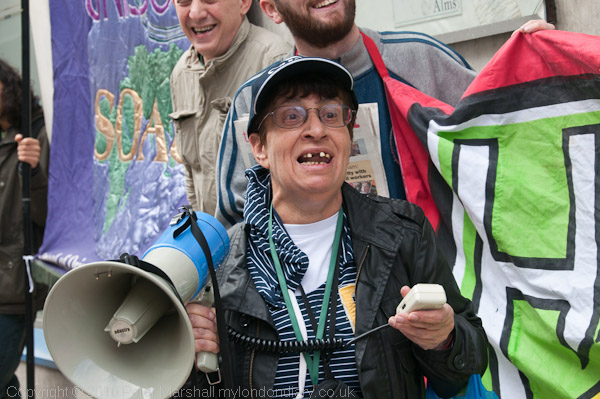
Trade unions have played a part in these campaigns, though it often seems to be much more driven by local branches and activists than real support from the centre – except in the case of the RML. And on Saturday the Tube Union branch of the RML called for a demonstration outside the London headquarters of Initial Rentokil who they allege is making use of irregularities in the immigration status of many of London’s lowest paid workers to bully and intimidate its workforce.  Workers who complain about unsafe working conditions and try to organise their workmates to stand up for their rights have been reported to the immigration authorities who have then carried out ‘dawn raids’ on workplaces.

The companies who employ these workers break the law by turning a blind eye at sometimes doubtful paperwork (or lack of it) and London would soon grind to a halt without the essential work carried out by its estimated 400,000 improperly undocumented workers, many of whom have lived and worked here for many years (the Conservative Mayor of London has actually given his support to  considering an immigration amnesty for the majority of them.) Because of their status, many of these workers do not want to bring attention to themselves by demonstrating in public, so this protest was by a group of trade unionists and workers rights activists.

Freelances of course are not covered by any minimum or living wage, and many of us work long hours with very little financial return. There were three NUJ members covering the protest. My story and pictures appeared on Demotix, and are unlikely to result in any income. You can see them rather better on My London Diary.

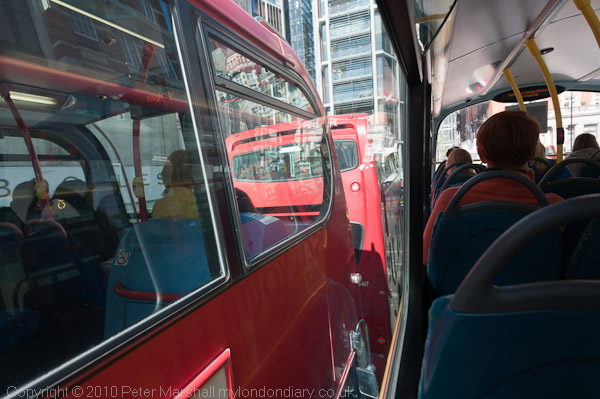
Earlier in the day, while stuck in traffic on the top floor of a double decker I’d had a slightly mystifying photographic moment while taking this picture.

© 2010, Peter Marshall

One third in from the left edge is a woman in a yellow coat, and looking from my seat all of her head was clearly visible, while when I looked through the camera she was partly obscured by the frame between the bus windows. I moved back as far as I could in my seat and she was still obscured, and for just a few moments I couldn’t understand why.

Then I looked at the lens I was using, the Nikon 16-35mm f4 on a D700 body. Despite the short focal length I was using (it was taken at 19mm) the lens actually sticks out so its front element is around 8 inches in front of my eye. Without going into any optical theory I think that means that it is actually viewing the scene from around that distance less 19mm – still over 7 inches – in front of my eye. So or the camera to see exactly from my viewpoint I need to move back that 7 inches. Which in this case would have meant being in the seat behind. So I didn’t quite get the picture I wanted.

From Old St it was a short ride on the 243 to Haggerston, where there are considerable changes taking place with the regeneration of the Haggerston West and Kingsland estates. Its a process that (seen as an outsider) seems to have learnt something at least from the great mistakes of earlier years and the kind of fight that I was personally involved with in Manchester in the 1960s with the Moss Side Housing Action Group, one of the pioneers in this country both of the use of direct action over redevelopment and the involvement of the local population through ‘planning for real’ participatory events.

What is probably London’s largest photographic show, along the length of a large block of 1930s council flats (and I think around the side too) facing the canal expresses the importance of people in planning, with its huge portraits of former residents covering the windows of empty flats. The portraits are photographically straightforward head shots – some, apart from size would fit the requirements for a passport – and I think some have possibly faded rather (or were badly printed to start with – certainly some images on the web are better .) But ‘I Am Here’, initiated by residents of Samuel House and  produced by Fugitive Images,  an artist collaboration founded in 2009 by Andrea Luka Zimmerman, Lasse Johansson and Tristan Fennell (information about the regeneration and the project is on the web site) is on an impressive scale. I spent a few minutes working out the best way to show the whole frontage in a single image, and ended up with taking pictures at around 12 pace intervals with the 16-35mm, which I later cropped and combined into a single image in Photoshop.

© 2010, Peter Marshall

One of the problems in photographing the artwork (as often) was reflections, with the sun making some of the heads invisible when viewed obliquely. Shooting straight on helped to solve that issue, but not eliminate it entirely. It wasn’t possible for me to get further away and still see  the whole of the flats, although students at the new Bridge Academy on the opposite bank of the canal would get a good view.

The Nikon 16-35mm attracted some attention while I was photographic this. A man came up and asked me if he could take a photograph of it, and got out his phone, but the battery was dead. Could I stick around for five minutes he asked, while he ran home to get his camera. I was amused and also wanted to take a few more pictures and said ‘Fine’.  So he came running back and took a few pictures, wanting an image of an impressive looking lens to use in a video project he was working on. I’ve had people ask me if they might take my picture many times, but I think this must be the first time anyone has asked to photograph my lens.

© 2010, Peter Marshall

As a former teacher, I’ve been appalled by successive government’s education policies which have almost totally ignored all proper educational research and had a profoundly divisive effect on our education system. Academies like these were one of several great follies of the last Labour administration, a continuation of disastrous Conservative policies – and the LibCon alliance will doubtless find a way to further weaken state education.

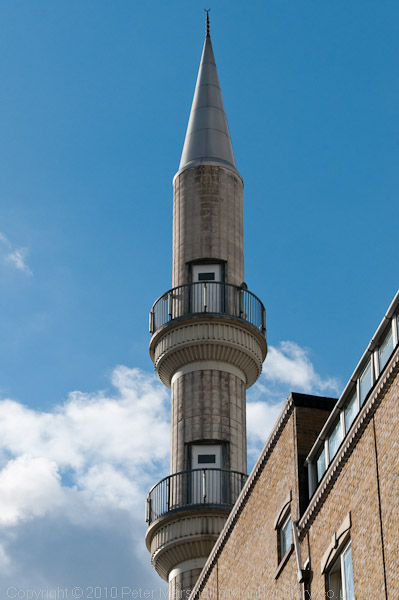
I have some happier memories of Laburnum St, where the Academy is, and in particular the two Laburnum St parties I photographed in 2006 and 2007, and it was a little sad to walk down it today in its current rather dilapidated state. But at the end of the street the minaret of the Suleymaniye Mosque on Kingsland Road lifted my spirits a little as I walked to the bus stop.

© 2010, Peter Marshall

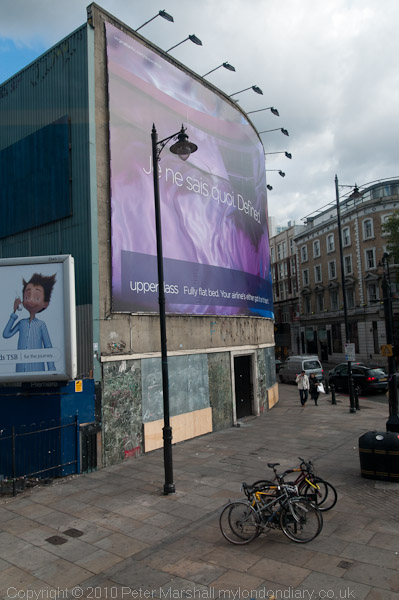
But later as I sat on the 243 we passed the former Foundry pub, and I felt sadder again at the loss of a vital resource where I’ve attended several interesting shows over the years.  I read the advert across its frontage and completed a literal translation ‘I don’t know what’ with ‘we are coming to’ and the guy on the phone at left seemed rather to be scratching his head.

© 2010, Peter Marshall

There are more of the pictures from Haggerston (and elsewhere) on My London Diary.

UK Customs

I won’t comment on the Brighton show by seven-year-old Carmen Soth (with a little help from her dad, Alec) , because I’ve not seen it. Part of the Brighton Photo Biennial, (BPB) it goes  on show at the Brighton Museum & Art Gallery from Oct 2nd – Nov 14th 2010 and  you can read rather more about it in The Guardian. I first heard about it on Soth’s Little Brown Mushroom blog, where you can see Carmen’s shooting list.

Soth came to the UK around the end of March this year with his family to work on a commission for Brighton, but on arrival was told by an immigration official that as he didn’t have a work visa he could not do so. The official threatened him with immediate deportation, but finally let him stay for a holiday with his family, warning him that if he took any pictures he could get two years in jail.

So he went around with Carmen, who had his digital camera and took the pictures with a little help and advice from Dad. But I guess if she comes back to the UK she’ll be facing those two years banged up in Holloway.

It’s a story that illustrates the mess we are in over immigration, where government and opposition have for years been engaging in a bidding war to see who can look toughest for the right wing press.  But it also threatens the right of all journalists to report on events in other countries –  or at least on those from other countries to report on what is happening in the UK.

Frankly I’m amazed that neither those running the BPB nor Magnum of which Soth is a member had the right connections to get an incandescent Tessa Jowell on the line from the Department for Culture, Media and Sport and a few heads bashed together at the UK Border Agency, the decision reversed and the official concerned given a rather stiff reprimand.

Practically we now seem to be one of those countries for which you need a second passport that does not mention your profession as a journalist or photographer and which you need to enter as a tourist in order to carry out your job.

Actually I think the show may well be worth a visit. Years ago I gave my son, then around the same age, a cheap plastic ‘Russian’ camera when he would sometimes accompany me taking pictures. I think he produced some more interesting results then than he sometimes does now.

I wrote an article to go with some of his pictures and submitted it to the Amateur Photographer, with some silly title like ‘Easy, Peasy, Shutter Squeezy‘. It was the only piece I sent them that they didn’t publish, the editor telling me that they felt their readers might feel insulted by seeing that a seven-year-old could do better than them.