Larry Fink’s “The Democrats”

A Review by John Benton-Harris

“The Democrats” by Larry Fink
(July 4 -15 August)

I told myself, being that I’m a socially and politically minded observer, that I couldn’t leave town without taking this one in. I suppose I was hopeful that Mr Fink would reveal some degree of criticism, understanding and feeling for these candidates, their entourages, the press, and possibly even the political process, that would further enlighten and motivate me, simply because that’s what I aspire to do when looking in on “My America”.

Sadly I was disappointed, but equally not surprised; for it takes a kind of distance from the everydayness of American life, and new American Photography, to begin to see and catch this nation, its people and its problems, with a minded timing, and from a perspective that has relevance. It also takes a certain kind of freshness, deceptiveness and tenaciousness, that no stay at home American photographer ever gets to develop. That is why no one since Robert Frank in the mid to late 50’s has managed to articulate a more lucid and complete visual account of the growing complexities of today’s America, for my fellow American photographers are all much to obsessed now with establishment career objectives (obtaining their “Pulitzers” or their “One Person Show at MOMA”) to truly focus on this subject and a meaningful chronicling of it.

I believe that Frank’s stab at this kind of (here hinted at) critical analysis only failed because Robert committed too little, in terms of thinking, analysing, researching, and seminally never questioned his actions and motives, before during and after his road-running across my native land. He also relied too much on momentary feelings and his innate bitterness towards cold war America, to achieve the exceptional goal that could have been his. If he had only spent more energy and a greater period extending the unique story dialoguing that “The Americans” intermittently revealed, he would be even more regarded the he is today.

Now, if I can say that about Frank, you can guess what’s coming after looking at Fink’s big scale small offering. Let me start by saying, if someone wants to win my vote for being an artist they are going to have to offer up something more then a casual snapping of these candidates and covering all the angles at what is essentially a staged event, especially if they are attempting to market there results as “Art”. Now I do realise it’s not easy to work within a limited time frame and with limited access, but from the look of these 29 large well finished images displayed over two rooms at New York’s PACE/MACGILL Gallery located at 32 E 57th Street, Mr Fink (to my eyes) made no attempt to use this small opportunity to bring anything interesting or remarkable to our attention, as an able journalist or as a significant artist; he merely looked, shaped and shot when he had line of sight. Then he selected, ordered, finished and presented these outtakes from this wasted opportunity, to conform to his art world signature.

It’s difficult enough to seize on a meaningful moment, when one presents itself, even when you’re regarded, as I am, as a constant pricker of the human condition. But if one hasn’t the quintessential qualities for satirical commentary or something even better to aid and guide one in their expression, then one should steer clear of a explosive subject like this, especially in today’s political climate. But if you’re going to stand up and ask to counted, you had better have something worthy and relevant to offer. Otherwise you and those who represent you will rightly be seen just as opportunists, trying to hop a ride on the political bandwagon, for some quick personal profit. In closing, Mr Fink’s view of the Democrats may declare his support of this party and candidate, but it offers up nothing in the way of commentary, criticism or optimism, for it poses no questions, offers no answers, and also does nothing to entertain us.

Copyright © John Benton-Harris – July 18th 2008

Installation views of the show are on the Pace McGill web site.

Are You being Served?

Are You being Served’ is not, as its name suggests, about a department store, but about the small shops that are common in the inner city area around the Museum of Childhood in Bethnal Green and Hackney in the East End of London. (If you look on Tom Hunter‘s web site, you will find this work under the more prosaic and I think rather better title, ‘East End Business.’)

I first met Hunter when his work ‘The Ghetto‘, a photographic sculpture of a street in London Fields, just up the road from the Bethnal Green museum, was one of the star exhibits in a show at the Museum of London in 1995, in which I also had a couple of pictures, and I’ve written about his work on several occasions, most recently when he became the first photographer to have an exhibition in London’s National Gallery.

When I visited the show (it continues at the Museum of Childhood until Nov 9, 2008), there were 16 moderately large colour prints on the wall of the Museum, tucked away to the left as you enter. Although the museum was busy with school groups coming in an out during the 20 minutes or so while I was there, I was the only person to come and look at them at that time. Curiously, an Evening Standard review had talked of their being 30 prints, so there appear to be 14 that have gone missing (or a curious lack of numeracy by that reviewer) or perhaps hidden elsewhere in the museum. On the web there are roughly 40 images, including most if not all of those I saw in the show.

What I think the show needs for its current location- and the pictures would serve well – is a well-written worksheet getting visitors to the museum – who mainly are school-children – to look at the images and question the content and their responses to it. What it gets is an essay of typical academic mystification. But it isn’t fair to blame Tom Hunter for the text which accompanies his pictures.

The pictures seem to me to be a workmanlike response to a relatively simple brief. The essay says they “were inspired by a nineteenth-century model of a local a butcher’s shop in the Museum of Childhood” (sic) What it fails to note is that pictures such as this were a staple of Victorian photography, and a genre that has continued to attract photographers to the present day. Its the kind of thing that many students have a go at in their courses (one of many project ideas that we used to suggest to students on the courses I taught on) and that has filled rather too many books of photographs and exhibitions – including at least one other in a major London gallery in the past year.

Many of us have been drawn to photograph such small businesses, largely because of the way they reflect the personalities and culture of their owners. You can see a few of my own attempts in this area among the pictures in my own ‘Cafe Ideal, Cool Blondes, and Paradise‘, (1986-96) in which I deliberately avoided photographing the shop owners, who are at the centre (often literally) of Hunter’s pictures.

It goes without saying that Hunter does it pretty well, although perhaps this isn’t the work he will particularly want to be remembered by. It is certainly all good, workmanlike stuff, but nothing that has the appeal of – for example, Walker Evans’s 1936 Roadside Stand near Birmingham.

Library of Congress image
(You can download a high res version of this from the US Library of Congress to print.)

Compositionally, Hunter I think largely follows the lead of Evans, liking when possible to adopt a square-on viewpoint. This may have limited his choice of subject matter, as many of the local shops will have been just too small or have been laid out in the wrong way to allow him to work in this manner.

The pictures do – of course – as the essay I think takes rather a lot of words to say, reflect the multicultural nature of the area. It would have been hard for them not to. But while it suggest that there “is always a sense of the anticipated customer” I think this is clearly not the case. They are very clearly about being photographed and it is the interaction between photographer and photographed that enlivens these images.

It is a relationship that tends to be unsure, and Hunter does seem to very much put his subjects at ease. They may be thinking he is a slightly crazy (as people often do think photographers are – though the police posters try to convince them we are all dangerous terrorists), but they perhaps think he is a harmless and rather pleasant lunatic and are happy to humour him.

There are some curious excitements in these images that certainly made my visit worthwhile. One is I think a rather small shop, forcing Hunter for once to work from an oblique viewpoint, actually looking in through the doorway. Most of the image is taken up by a glass-fronted display case of pastries (rather like a museum show case), and the shopkeeper and his shorter female assistant are in a small area above some kind of electrical unit at the right of the image. There is something about the image – perhaps their sharpness while this unit, a little closer to the camera is slightly out of focus, that makes them look not like actual people but like some kind of cardboard figures in an advertising display (traditionally large format camera movements might have been used to produce an oblique plane of focus for an image like this.) The oddity is enhanced by the side of the display unit, which has a patterned effect and, at first glance a metallic look to it. My mind interprets the side as a surface that should reflect rather than transmit, and we can see the left side of the man’s shirt and shoulder through it, but visually the strong check pattern seems to be in front. It is a curious and rather compelling effect.

Another image shows a huge patterned suitcase like some leopard in its den between two African men surrounded by suitcases and cardboard boxes; they are relaxed, leaning back, but there is a menace as that leopard may at any minute pounce. But perhaps my favourite image is a Chinese fish and chip shop, again seen through a doorway to get the necessary distance, the L plate on a box on the back of a scooter tilted crazily at the right of the image; but what really makes it for me is the contrast with the elegance of the peacock screen poking up behind the counter.

This was also a show that made me think about technical questions, particularly about the differences there might have been in this work had Hunter used digital instead of film.  Looking at it on his web site also made me think about the differences between viewing a set of images on screen and on the gallery wall. But these are questions I had better return to in later post.

A genuine Richard Prince photograph?

I’ll let you into a secret. Richard Prince does actually take photographs, or at least I think he may. Not many – most of the time he’s happier ripping off other people’s work, to the extent of $3.4 million for his photograph of a Marlboro cowboy ad.

I don’t really understand why anyone would want to pay that sort of money. It’s not a picture I would want on my wall, but if I did why not just go out and make my own copy for considerably less. It does seem to be an awful lot to pay for what is essentially a can of the artist’s excrement (Piero Manzoni  got to that first.)

There is a nice story in an Independent feature by Charles Darwent published just before the opening of Prince’s show ‘Continuation‘ (at the Serpentine Gallery in Hyde Park, London until 7 Sept, 2008) in which he finds a rip-off of one of his ‘Girlfriend‘ series on the cover of French Vogue and reacts indignantly to them stealing ‘his’ work. (These were readers’ girlfriend photos ripped from the personal pages of biker mags and re-photographed by Prince.)

You can also read a review of the show in the same newspaper by Sue Hubbard, which I think gives an clear view of the man and his work.

I do actually think his art is of some interest, but also that photography is something rather different (and rather more important), and we shouldn’t really waste much if any of its limited cultural space on work that basically just isn’t photography.

Richard Prince isn’t a photographer. Or not much of one. Take a look at his web site, and under ‘photographs’ I think there are possibly a few that were really seen and taken by him. Perhaps the series ‘Upstate Photographs‘ is his own work (though equally it could be an album he picked up in a yard sale.)

Finally, thanks to Jörg Colberg’s Conscientious for pointing me to two rather wacky reviews, one in the Observer ‘Shame he’s a one-trick pony‘ and a second, which may, as Colberg suggests, lack logic, but I think tells the reader rather more about the work, Bidisha‘s Guardian blog, ‘Girls, cars and body parts: Richard Prince’s shallow American dream‘ – and don’t fail to read the comments. In particular arthouart writes “What really is at issue is the bankruptcy of irony in Art, like most of Prince’s work its an insider one liner, if you don’t get it you don’t belong.” Which perhaps gets to the root of why I think I’ve wasted far too much time on this already and should apologise to readers and return to the real world and photography.

A Looking Glass Eye – Exit Gallery

A LOOKING GLASS EYE’, 21st Century London‘ (which continues until 12 Sept, 2008) is the first show I’ve been to at the ‘Exit Gallery‘, the stairs up out of London’s best photographic bookshop, Claire de Rouen Books, on the first floor at 121-5 Charing Cross Road, just north of Foyles.

Exit opening
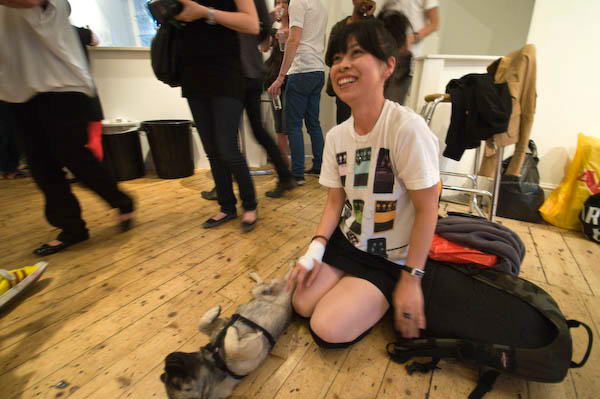
At the opening at Exit

There, around 140 unframed works of various sizes from enprint to poster (including one multiprint work) were each pinned by four bright shiny nails to around a dozen different areas on the stairs and landing in irregular grids, bereft of names or captions. At the opening party it was difficult to see the work for the press of bodies. As Brian David Stevens says on his ‘Drifting Camera‘ blog, “it was a fun party” and he has a few pictures from it there. You can see a couple which show the actual installation with some of the guests on Edmond Terakopian‘s blog – and that’s my shoulder visible in a check shirt at the bottom left of the top image, with I think Daniele Tagmani and Thabo Jaiyesimi in the centre.

There were a few copies of plans of the wall layout available, with squares and numbers on them, but even with the help of these it was confusing to march pictures to photographers, although there were a few that were instantly recognisable. It would have been rather easier to have the individual plans and lists pasted on each section of wall – our better still some rather easier and more informative system there, but things will of course be rather easier without the crush of bodies on the opening night. I’m not sure quite how many photographers have work in the show – perhaps 50 – and most of them seemed to be there and with a few friends.

Unlike the curate’s egg, this really is a show that is good in parts, and if the intention was to provide a full cross-section of work from the last 8 years on London ranging from the superb to the rather ordinary, it was successful. Print quality also seemed to cover a similar range, with work representing the best work from some of London’s leading labs on the wall together with looked like inkjet prints on cheap paper from the kind of printers that cost less than a set of inks. Some photographers seem to have decided that it wasn’t worth taking a great deal of trouble for work that was going to be nailed onto a wall – and the fact that the gallery showed several pictures partly obscured by electrical conduit or similar wall-clutter suggests a certain contempt on their side.

Of course there are different approaches to the medium. Not every black and white needs the Ansel Adams treatment, and I’ve been to shows I’ve loved where the prints were made on a photocopier. But there needs to be some kind of match between the intentions of the work and the syntax of the printing process. Otherwise even good prints can be bad prints and bad prints are best reserved for the rubbish bin, not the gallery wall.

But there is plenty of work here to interest most viewers (although the photographer I arrived with left very quickly) and not just from the biggest names, although several of the half-dozen pictures by Simon Wheatley were among those that appealed to me most (though work by some other photographers I admire was disappointing.) Among the highlights for me were Brian David Stevens, who I mentioned before, and wrote about for his work that stood out in Press Photography 2008 with several fine black and white prints, and David Boulogne had some of the more interesting details from suburbia (some of which at least are from his Henorama project) which I perhaps like because they remind me very much of some of my own work with similar subject matter in the 1970s and 80s.

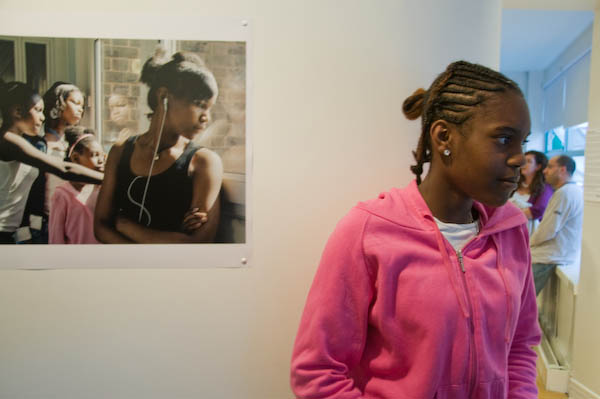
Simon Rowe picture & model at Photofusion opening
At Simon Rowe’s Photofusion opening – the picture at left was in the Exit show

Another photographer I’ve mentioned before is Simon Rowe, and the work here included some of that shown at Photofusion earlier this year.

But this is a show with a wide range of work, and others will doubtless find other work that attracts their interest. If you are in London it’s worth a visit, but give yourself plenty of time, as you will want to spend quite a while browsing and buying from the incredible stock of Claire de Rouen Books.

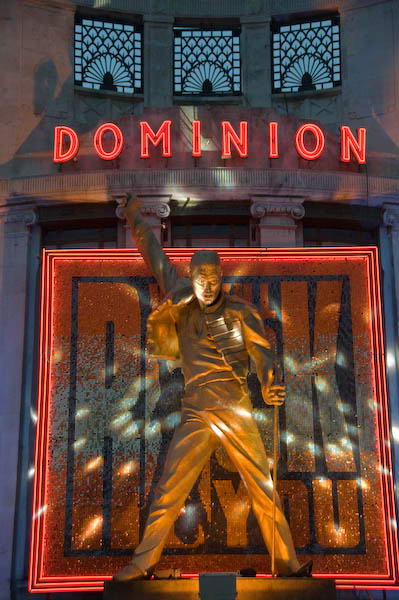
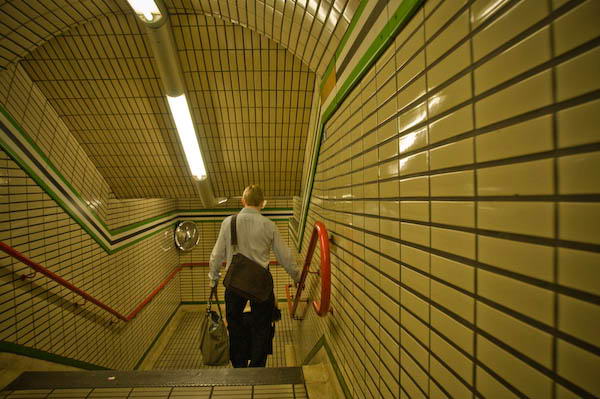
The gallery is close to Tottenham Court Road Station, and I took a couple of surprisingly upright pictures there on my way home.

Dominion TCR
Dominion, Tottenham Court Road

Tottenham Court Road

Lens Culture #16

Lens Culture, dedicated to “Photography and Shared Territories” (international contemporary photography, art, media, and world cultures) has long been one of my favourite on-line reads, and it’s good to see another new issue from Jim Casper that keeps up the high standard he has set.

I’ve not yet had time to read everything, but there are some incredible photographs by Denis Darzacq of shoppers flying in French hypermarkets. He really does photograph real people in mid-air, working on film and not a touch of Photoshop, though I think some of the incredible guys he collaborates with may need some treatment for bruises after he has got the shot. I remember seeing and writing about his images of dancers in mid-flight a couple of years ago, large and perfect prints, and standing there wondering how he did it for some minutes, eventually deciding there really were no special tricks – just working with great performers and catching them at the right moment – and with the right lighting. That little word ‘just‘ does Darzacq no justice.

Y0u can also read about – and see work from – a couple of festivals, PhotoEspana in Madrid and Look 3 in Charlottesville, Virginia, notable for its interviews – and there is more coverage of these at PDN Online

Save at Jessops

The quote from McCullin about Dixons reminded me that I meant to mention another camera chain, Jessops. Years ago I used to buy film from them, getting a 10% student discount (no, I wasn’t a student, just needed the discount, and a friend was one of the store managers) which made it reasonably priced.

Last week when I needed to buy a new wide-angle lens, I found a site called Camera Price Buster which gives discount codes for Dixons and Jessops. These change from time to time so the code I used, LENS10, will probably no longer work – so check that site for the current one – which may be more or less generous.

The 10% discount using this made my new lens cost only a few pounds more than a rather doubtful tax-free import from Hong Kong, but even better, I was able to order on line and pick up my new lens an hour later from the local Jessops without paying any delivery charge. And while I don’t welcome paying taxes, I don’t really like to cheat on them either.

It’s the first time I’ve used this local collection service, but it worked without any problem – and no waiting in for expensive Fedex or those wretched other couriers who can never seem to find my house first time.

However, I’m still waiting for a UV filter for the lens, as the cheapest Jessops could offer was £35, and that was perhaps in too thick a mount, while a ‘professional quality’ multi-coated filter from 7dayshop costs less than £9. It does mean paying postage, but there are always a few other things I need to make up a worthwhile order. But despite what I said above about tax, I’m happy to save the VAT in ordering from Jersey.

More about this lens – a Sigma 10-20mm EX f4-5.6 when I’ve had time to use it for a few weeks, but my initial thoughts are positive. The Sigma EX lenses do seem to be well built, and it feels better in this respect than the Nikon lenses I own, and the lens hood feels dignificantly more durable too.

Leica M8 – Michael Kamber’s Iraq Field Test

I’ve always liked to use rangefinder cameras, particularly when photographing people and events. Of course they had their drawbacks, particularly some of the cheaper Soviet Leica copies I started with in the early 70s, where viewfinders sometimes seemed to bear little relation to the image.

But once I’d bought my Leica M2 things were fine, and then I added a Minolta CLE, perhaps my favourite ‘Leica’ of all. Eventually I was moved by the need for a slightly more modern design, and along came Konica with a design that actually had auto exposure that worked.

Of course I also needed SLRs for their extra flexibility and the ability to use longer lenses. Although in extremis I’d use the excellent 90mm f2.8, Leica’s forte was at 35mm and below, with my favourite (but often maligned) Summilux 35 f1.4 a superb tool in low light, and Voigtlander providing some excellent and cheap super wide angles.

Then came digital, and for various reasons I had to switch to using an SLR system, Nikon or Canon. At the time the Nikon D100 had just arrived and seemed the best of the reasonably affordable cameras – though it’s poky dim viewfinder was a real pain. Later came the D200 – the first digital I liked using – and now the improved D300, but all along I’d been hoping for a digital rangefinder I could warm to and use.

Epson were the first, and it wasn’t bad, but I felt sure that Leica would come up with something better, and waited for the M8. Eventually it came, got some good write-ups – though there were a few minor problems noted, and after a while someone noticed its problems with IR and we had the filter fiasco, but the problem didn’t seem insurmountable.

So finally, feeling a little rich after a few good months I bought one in Spring 2007. Ten days later I lost the contract that had provided more than 50% of my income for the past few years.

It was a bad start, but I was actually more worried by the problems I was having with the M8, particularly since none of my lenses were coded so the camera could recognise them. I made the mistake of using the M8 on a job and then spent hours in Photoshop selecting parts of the image and removing the purple.

In time I worked out how to get usable results from the camera most of the time. I’ve taken a few decent pictures with it, mainly with the Summilux, which, according to Leica is not compatible with the camera. Using the free ‘Cornerfix‘ I can even get reasonable colour with the Voigtlander 21mm (with the IR filter in place.)

I’ve not yet come to like using the M8. Compared to the Minolta/Konica cameras it seems an imprecise and blunt instrument, unreliable and with inaccurate framing. Colour balance and exposure control are hit and miss, and processing the RAW files is a real pain compared to those from the Nikon. It seems hardly usable above ISO 640 due to noise, although to be fair the results at ISO 320 can be exceptionally sharp and detailed – certainly a little superior to the D200 in that respectg.

I have other problems with the camera, even using it for my relatively undemanding needs. It is good not to have to carry a camera bag when I take it out – a spare lens tucked in a pocket and the camera – at least when not in use – hanging around my neck are all I need, but more often I’m deciding to pick up the bag with the Nikon gear when I have to choose, even if it can be a pain to carry it around all day.

What prompted me to write this was reading the warts and all thoughts of a photojournalist trying to work in Iraq with an M8, Michael Kamber’s Leica M8 Field Test, Iraq.

This is an honest and detailed account of his experiences with the camera – and illustrated by the results. On the opening page he says it is “a detailed look at my experiences with the M8, most of which have been negative. Please keep in mind that there are many other photographers who like the M8.”

You can also see Kamber‘s work on his web site, and on the Digital Journalist site

I’d love to find out how to really like my M8, but it’s proving rather hard work.

McCullin Interview

I think that the interview between John Tusa and Don McCullin was first broadcast on Radio 3 in August 2002, so I’m not sure why it should surface again as a news item on Photo District News last week – or why they should write “John Tusa recently interviewed McCullin about his work, his anger, the public nature of grief and more.”

That said, it’s worth listening to – or reading the transcript – again, as McCullin has a few things to say and talks very honestly about his feelings and how vital they are to his photography.

There are several other interviews with McCullin on the web, including one in 1987 with photographer Frank Horvat, which has the advantage of including some of his pictures, and another from 1995 on Zeugma.

His pictures are not particularly well shown on line, though you can see a miserly few at the V&A and a small and relatively recent set from Darfur where he went for Oxfam on the BBC, first shown in 2007 – and there is also a short video on which he talks about them. Otherwise, a Google Image search is perhaps the best way to see more of his work online.

McCullin talks to Tusa about his liking to travel light: “I’m not like Father Christmas, from Dixons, standing there, covered from head to foot in equipment.

Press Photography 2008

The results of the UK 2008 Press Photographers Year were announced on June 6, rather early when for the rest of us 2008 still has 7 months to run. Looking at the chosen pictures for the it is hard to reconcile this fine selection of work with the kind of visually illiterate trash that fills most of the papers that I pick up. Based on them, something over 90% of the pictures should really be of models falling out of their dresses or TV actresses looking even more boring than they do on the box.

The failure of photography in most of our press isn’t a failure of photographers, but a failure of editors – and often a failure to be willing to pay for better pictures when the crap comes cheap or even free. Scratch almost any freelance and you will find stories of editors and journalists saying how great the work is, then not hearing anything when you mention money, and finding that the publication has used a cheap image from an agency contract or even sent in free by a reader.

There is plenty of good photography here, and quite a few photographers I know (as well as those I don’t) are to be congratulated for getting their pictures among the 146 here, whether or not as winners of the 13 awards.

At risk of upsetting those I know who I don’t mention, there are two photographers here whose work I find outstanding. One is the Guardian’s Sean Smith, who gets the first prize for multimedia, and the other is Brian David Stevens, (also see his web site) who has some intriguing black and white work, including some of the best portraits in the selection and some interesting reflections that remind me slightly of the best work of Trent Parke, but are all his own.

This year a decision was made to enlarge the Sports photography sections, and the result is disappointing. There are a few fine sports pictures here, but rather too much that is simply very well done but perhaps rather uninspired. Some of my first published work was sports photography, but I soon saw the error of my ways. It is an area that tends to reward the retaking of similar images and to reject or sideline creativity – although there have been some fine exceptions over the years – and I can think of some fine work in World Press Photo.

OjodePez 13

Should you ever need to know the Spanish for ‘Fish Eye lens‘ it is ‘objetivo ojo de pez‘, which explains the name of the Madrid-based OjodePez magazine (link is to the English version) which recently invited Aaron Schuman, the Editor of the on-line SeeSaw Magazine to guest edit Issue #13, and you can now see work from it on line (and perhaps be amused by its little Capa falling soldier logo.)*

OjodePez13

Schuman’s issue is ‘This Land Was Made for You and Me‘, and his land is of course America, as seen by Ryan McGinley, Alec Soth, Jessica Ingram, Richard Mosse, Stephen Shore, Colby Katz, Kalpesh Lathigra, Todd Hido and Tim Davis.

It isn’t actually the work by the best known and most fashionable of these that appeals to me most, although all of the stories have their interest. I’ve seen this work by McGinley too often before; perhaps this isn’t Alec Soth at his best (though there is one image I like very much,) and certainly Stephen Shore‘s work here will not enhance his reputation.

But anyone with an interest in documentary photography will find much to attract them, and I particularly liked the work of Kalpesh Lathigra on the Pine Ridge Indian Reservation and Tim Davis‘s ‘Retail’, night images of simple houses in small-town America, their windows reflecting the garish retail neon of petrol stations and fast food outlets.

Also on the site are two videos related to the issue, with a 10 minute feature ‘Two Way Street’, shot for public broadcasting in California, in which Todd Hido looks at how he takes his pictures of models in carefully chosen hotel rooms and outdoor scenes, mainly at night, as well as editing them for a book. It is a video I found of considerably greater interest than the on-line page spreads. A shorter piece looks at ‘Hunting Rabbits‘ by Colby Catz, and there are other videos related to earlier issues – work from which can also be seen as well as other material on the site.

Although you can see a good selection of images on line, the text is reproduced too small to read easily, and you will need to buy the print edition for that and the essays by Geoff Dyer, Joerg Colberg, Michael Famighetti, Robert Fitterman and Aaron Schuman. Someat least of these writers appear prolifically on the Internet (who doesn’t these days) so you will have a good idea what to expect. There appears to be no UK distributor for OjodePez, though it is available in USA, Switzerland, Germany and Australia as well as Spain, but it may be available through some gallery shops etc.

Aaron Schuman‘s own Seesaw is one of the best of on-line magazines, and it’s a pleasure to view and mention again the Winter 2008 issue, including work by Reiner Riedler who I met at ‘Rhubarb’ last year, and others including ‘Lot 116′ an intriguing set of black and white images found in Brighton (UK), 2007 by Schuman.

* Note
The interface for OjodePez uses a lot of java, which on my machine it isn’t quite fast enough, and certainly not always intuitive. At first I got the impression that there was very little content on line and thought that perhaps I needed to subscribe to see more, but after a while I realised how it works. Regular users of the site – and I suspect the site designer – will doubtless regard it as a model of elegant and clear interface design.

Click on the picture to go to the first page of the story, then page icons in green at top right (though the may go on to the next line at the left) show the available pages – click the second of these to go to the next and so on.