Autumn is official

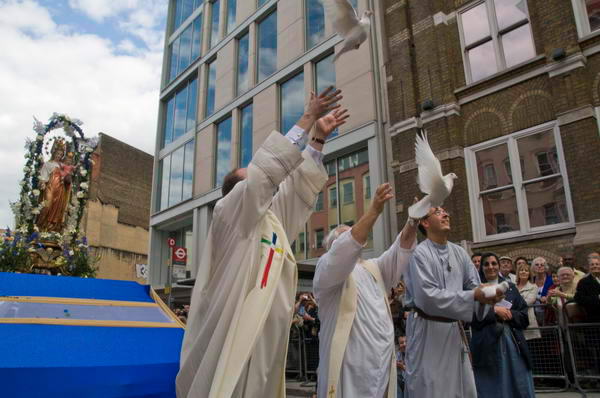
The Druid Order seem a very nice, friendly bunch of people who welcome photographers taking pictures at their events. The leaflet they gave me gives the “three fundamental principles of wisdom:
Obedience to the Laws of nature
Effort for the welfare of mankind
And heroically enduring the unavoidable ills of life
.”
A little more learning from nature would certainly have helped us avoid the sad state we’ve got the planet into at the moment, and heroic endurance is likely to be in great demand in the future.

There are various Druid groups around, but the Druid Order seems to be the largest and more publicly orientated in England, with regular public meetings in Covent Garden and public ceremonies for the Spring Equinox on Tower Hill
the Summer Solstice at Stonehenge (outside the area I normally cover for ‘My London Diary’) and the Autumn Equinox on Primrose Hill, where I was with them again on Sunday.

Primrose Hill has a fine panoramic view over London, although the air is seldom really clear enough to enjoy it fully. It is really quite a noticeable hill, and most photographers will also recognise it as the location for one of Bill Brandt’s finest portraits, of painter Francis Bacon, made there in the early evening in 1963. This is an image I’ve written about before, in part as a good example of Brandt being very clear in his mind exactly how he wanted his images to look, making an appointment with Bacon to meet him at that exact place at the right time for the kind of light he needed. Bacon squeezed a little awkwardly at the edge of the frame, looking out of it stony-faced in his black leather coat (doubtless garment and expression also at Brandt’s order), the leaning lamp post with its light against the gloom of the burnt-in sky, the triangle of path leading to the scraggy trees at the brow of the hill and the darkened grass creating a surreal background, and a little light (available or added?) from the left bringing out the face of the subject and some detail in his coat.

Fenton, who I’ve also written about before at some length, had a rather nice house on the edge of the park with a view across it. A blue plaque marks the house, one of rather few in London related to photography.

This Sunday it was bright and fairly clear as I walked up the hill. People were running up it, jogging around the park, and admiring the view from the top. I watched a small group of the druids, still in ordinary clothes, practice a little of their ritual and read a chapter or two enjoying sitting in the sun while waiting for things to happen.

On My London Diary you can see my pictures from the hill and of the druids, both as they prepare for the ceremony – putting on their robes and lining up, and during it.

Unfortunately I had to leave before the end of the ceremony to get to St Paul’s Cathedral where I was meeting some friends for a walk – so perhaps I’ll need to go back another year to photograph the end of the event.

Incidentally I intend to rewrite some of my old features from another place (most needed revising in any case) and post the new features here or elsewhere. But 8 years of writing is a lot to tackle.

Weddings and Compacts

I’m not a wedding photographer. I’ve only officially photographed three weddings in over 30 years as a photographer, one of which was a couple of years back when my own younger son got hitched, and I could hardly refuse his request. It was a long day, and the pictures cover well over 12 hours, and show a certain deterioration towards the end which could be slightly alcohol-related. There are just a few of them on My London Diary that give some of the flavour of the day, with some text that of course starts with me quoting Brodovitch’s “so you want to be a wedding photographer!”.

The other two occasions each has a little story, but I’ll keep those for another time. Of course I’ve been to other weddings, but I make a point never to take a ‘real’ camera and to stay well out of the way of the professionals.

So on Saturday, a guest, I turned up to the Gurdwara with just a little Fuji F31fd digital in my pocket, as despite having been told it would be fine to take plenty of photographs, I was really intending not to take much. But it was my first experience of a Sikh wedding, and I soon found myself caught up in the colour and human interest of the event, and shooting at least as much as I would have done with my Nikon.

Given the minute size of the sensor, the results are surprisingly good; perhaps the main failing isn’t noise or sharpness, but the colour quality. Hard to pin down, but it just somehow lacks the smoothness of colour and tone that the D200 provides, and at 6Mp the files are of course a little smaller.

Light was a problem, although the area where the main ceremony was held has a lot of natural light and the team of photographers covering the event had added a couple of movie lights, they and I were shooting with flash as well. I’m sure the results they got with their SB800 units – my normal choice of flash – were rather better in that respect than the tiny built in flash on the Fuji, although it did a decent job (with of course a considerable amount of red-eye.)

One of the reasons for choosing this model was its relatively good performance in lowish light, and a second its relatively short shutter lag, and both were useful. What I still hate about it is the lack of a viewfinder. Holding a camera out in front so you can see the viewing screen is just not a good way to work. It is much trickier to frame, and the camera is much harder to hold steady. So quite a few shots were not sharp, many more than I would expect with the Nikon under similar conditions. The vibration reduction (VR) in the Nikon 18-200 would also have come in useful.

Push-button zooming is also a little of a disaster – very difficult to control the rocker switch accurately and much slower to be precise than the manual ring on an SLR lens. The 8-24mm zoom is roughly equivalent to a 24-72mm on the DX Nikons (35-105 on ‘FX’) and there were times when I would really have liked a wider view.

All cameras are compromises, and given the size and low cost of the F31fd (mine as £133) it proved a remarkably effective tool. A final compromise for me is that the camera has no raw mode, and I was shooting using the highest quality jpeg it provides. The 2Gb XD Picture Card did add another £25 to the cost, but does hold around 680 images – enough to keep me happy most days – though of course I also needed to spend another £13 on a spare compatible battery.

The images straight out of the camera seemed a little harsh, with some empty highlights and blocked shadows, as well as some small colour temperature problems in some images. I could have tried sorting these out in Photoshop, but instead imported the images using Lightroom. (Incidentally this is now at version 1.2, another free upgrade for registered users.)

I don’t quite understand how, but this appeared to let me get something extra out of many of them, although not as much as with RAW files. I was also surprised to find that those files that I looked at later in Photoshop didn’t have any of the ‘comb’ effect – gaps in the histogram – which I would have expected from working on them. I also converted the files to Adobe RGB which I normally use with the Nikon.

Looking at the files in detail it is clear that one of the main problems with my use of the camera is camera shake at speeds where I would normally have no problem with hand holding. Its a problem that I think would not be there if the camera had a viewfinder so it could be used held to the eye. I’ve not had the camera long, and I’m still struggling with the camera manual, which goes out of its way to be friendly while giving you as little actual information as possible. It has as what is called a ‘picture stabilisation’ mode, which appears to be is a simple auto program that selects higher ISO and shutter speeds than normal – but has been misleadingly named to suggest the camera incorporates image stabilisation – which it does not.

What it does have is excellent performance at high ISO. Although the quality is best at the slowest ratings of ISO100 and 200, many of the images at ISO800 are perfectly usable. At ISO1600 it is still remarkably good. Without the use of specialised noise-reduction software the results are in the same region as those from the Nikon D200 at the same speed. Things do fall apart rather at ISO3200, but it looks as if we are going to have to save up for the Nikon D3 if we really want to work at that speed.

You can see more of the pictures from Saturday’s wedding on My London Diary. I tried hard to capture all the key events in the ceremony without being in the way of those doing the job officially. I’m not sure if I can live with the Fuji. I’m thinking of trying to use it at the wide-angle setting either completely without a viewfinder, or possibly by adding a sports or accessory viewfinder on to the top of the camera.

Not A1 at Lloyds

When the idea of Open House days first came up I thought it was a great one, and in the first couple of years I went into quite a few places otherwise inaccessible to the public, and even took a few pictures, although photography wasn’t always allowed. Now it has perhaps become too popular, and except for those locations where you need to book in advance (and where places tend to fill very rapidly) there are often extremely large queues.

One of the longest queues this year was at the Lloyd’s building, and the London Citizen Workers took advantage of the event to hold a demonstration. Cleaners at Lloyd’s – whose members are among the wealthiest people in the country – are some of the lowest paid in the capital, and the contract firm that employs them apparently provides no sickness pay or other benefits. They have so far resisted the campaign by the LCWA for a ‘London living wage’ for cleaners, which demands £7.20 an hour, along with entitlement to sick pay, holidays and access to a recognized trade union.

It was a small but vociferous demonstration, and some of those queuing expressed surprise at the poor treatment of the people who keep the Lloyd’s building clean. The Living Wage campaign reveals the poor treatment of essential workers, who are trapped in a ‘working poverty gap.’

Technically it was an interesting but difficult job. More film and megabytes have been used on the Lloyd’s building than any other modern building in London, and its shining silver surfaces have a definite appeal to photographers. The red banners and tabards of the demonstrators added some exciting colour, and the strong sunlight coming down the street some powerful lighting effects. But although visually stimulating, it was murder to photograph, with contrast hitting the extremes.

Picket at Lloyd's London

At least with digital you get a clear view of the problems you are facing, although in this case they were not entirely soluble. Although flash fill can bring up the foreground, it could not deal with the lower floors of the building which were in deep shade while the upper levels were in bright sun. A few years back I would have shot this kind of thing on black and white without fill (as a colleague was still doing with his Leica and doubtless getting great pictures) and probably cursed on location my inability to take wider images, and back in the darkroom cursed the empty shadows and dense highlights.

More pictures on ‘My London Diary‘.

Peter Marshall

Not Another Drop

Saturday I photographed a demonstration at which the police could not have been more helpful. Perhaps hardly surprising, since they were a part of the ‘Not Another Drop‘ campaign started in 2001 by the Community Safety Partnership uniting the Met and Brent Council. The annual Peace March – this was the fourth – was founded by Patsy Hopwood, whose student son, Kavian Francis-Hopwood was shot dead on the Stonebridge Estate in 2003 – still an unsolved crime.

Supporting the march were several local church groups (including a Brazilian congregation from the area) and families of several of the many young people who have met similar violent deaths in Brent in recent years, many of whom were shown on posters carried in the march. Although obviously the aims of the march can only be applauded, it was perhaps disappointing not to see greater support from the various communities in the area, with only around 250 gathering for the start of the march at Stonebridge, although more were expected for the rally at the end of the event in South Kilburn.

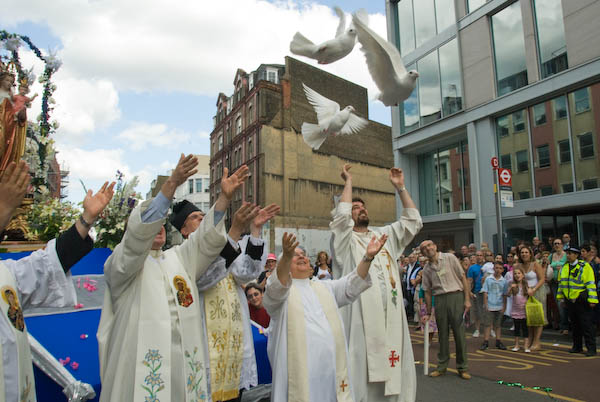
One of the trickier parts of the event for the half-dozen or so photographers present was the release of white doves shortly before the march started. I’m still not quite sure whether to rely on my reflexes or the 5 fps mode of the D200 to try to catch the peak moment. What I actually did was to try to catch the moment and then hold my finger down to get the next few frames at 5 fps. In fact the second exposure turned out to be the best, but I was left wishing I had one slightly earlier – and perhaps slightly later. It’s one of the few situations where I’d really like to have the 9fps that Nikon promise us for the D3 due later this year.

More pictures from the event on My London Diary.

Lewisham 1977

I wasn’t at the battle of Lewisham in August 1977. For some reason I was away from London and so missed the events that took place. One of the best account of them – and some great images – is in the issue of Camerawork about the event, and it’s worth getting hold of a copy if you can. You can also read a great deal of detail – along with pictures and video etc – on the Lewisham77 web site.

Briefly, the fascist National Front tried to march from New Cross through the centre of Lewisham. Local people and socialists from all over London and further afield came to stop them – just as the East End had stopped Mosley in Cable Street in 1936.

The NF were demoralized and defeated – and so were the police. After the NF had been sent packing, the police turned on the socialists with unprecedented brutality – particularly be the Special Patrol Group. But the demonstrators fought back and with the youth of Lewisham, largely black, defeated the police.

There were many arrests, and it was the first time that British police used riot shields outside of Ireland. Lewisham Police station was partly trashed, and was later replaced by a new fortress, said to be the largest police station in Europe.

Lewisham High Street
Batwinder Rana talks about the Battle of Lewisham in Lewisham High Street.

Last Saturday, as a part of ‘Lewisham’77’, a series of events organised by local historians and activists supported by the Centre for Urban and Community Research at Goldsmiths University of London and other groups held a commemorative walk from Clifton Rise in New Cross to Lewisham High Street, with some of those who were present recounting their experiences at key sites along the route. If you were there, Lewisham77 would like to record your memories of the event for a DVD and publication. Since it is now over 30 years after the event, you apparently no longer have to be afraid about revealing any illegal actions!

More pictures from the commemoration on My London Diary.

Bad Press?

Yesterday I was out covering protests against the arms fair taking place in East London as a freelance photographer. I wasn’t commissioned but I hope to sell some of the pictures through the libraries I place work with as well as possibly direct from my own ‘My London Diary’ web site where they will be posted shortly. I’ve also already contributed a couple of short reports to ‘Indymedia‘ on both the march by the ‘Campaign Against the Arms Trade‘, here passing down the Barking Road,

CAAT March on Barking Road

and the Space Hijackers, who hired a tank (or at least some similar military vehicle) to take

CAAT March on Barking Road
themselves to the event after the police had stopped their own real tank. In the picture it has just arrived and stopped outside the main vehicle gate of the arms fair.

Like most news photographers, I have a press card. On the back of mine it says “The Association of Chief Police Officers of England, Wales and Northern Ireland and the Association of Chief Police Officers in Scotland recognise the holder of this card as a bona-fide newsgatherer.

A few months ago a joint working party of police and journalists came to an agreement over guidelines for relations between the press and police, recognising the need to allow proper access to events and cooperation between police and those carrying the card.

Unfortunately although the Chief Police Officers may recognise the card – and have read the guidelines, too many officers lower down haven’t. Yesterday, when asked at one point to show my card, I was even told it wasn’t a real press card and the officer concerned wouldn’t recognise that I was press. Last year I took a picture of a fellow photographer and union member having a similar confrontation:

In his case, the police held him inside a cordon for 20 minutes although several colleagues showed their own cards to make it clear his was genuine. I was lucky in that I was just threatened with arrest if I didn’t stop arguing and get back on the other side of a police line. So I did as I was told despite being rather worked up. Unfortunately although I told him I was taking his number I was so agitated that I forgot it before I could write it down, so I can’t make a formal complaint. I thought I had it on a picture, but it isn’t visible.

I’ve lost count of how many times I’ve been threatened with arrest for just trying to do my job. I don’t think I’m getting any special treatment, and other photographers who photograph similar events suffer in the same way. Mostly I get on well with police, and they are sometimes very helpful, and of course I recognise that they often have a difficult job.

In handling demonstrations such as this by the Space Hijackers, they do seem to me to make the job more difficult for themselves by deliberately provoking the demonstrators, often moving them – as they did me – for no good reason and imposing arbitrary restrictions. The continued and over-aggressive photographing of people also raises the temperature and can be of little real use – they must by now have several thousand images of me on record.

Police photograph partying demonstrators
Demonstrator and police photographer

I go to events aiming to record what happens, to tell the story – as I see it – using my camera. I like to think of my camera (and flash) spreading a little light on what is happening, and making it known to a wider audience.

Some police – not all, but too many – seem to want to keep things private. They would prefer the press didn’t come along to demonstrations, or at least stayed in a nice neat area somewhere under police control. They think of those of us who cover such events and interact with the protesters as ‘bad’ press.

More pictures from both events on ‘My London Diary’ shortly.

Peter Marshall 

My Peckham

Peckham had a mythical quality for me as a young child, the distant place not at the end of the rainbow, but of the No 37 bus route. When I finally was taken there it lived up to its promise, the gloomily industrial end of the Surrey canal at Canal Head, bustling crowds in its cosmopolitan high street, and at the large green expanse of Peckham Rye. Although I never heard a bus conductor shouting “Garden of Eden!” as the bus reached what was then a common rendezvous for courting couples and would have been too young to have understood his meaning.

Over twenty years later, returning in the 1980s, both Peckham and I had changed a little. There was no water in the canal for a start, and although the high street was still cosmopolitan, the cosmos had shifted slilghtly. Peckham had also started to gain a reputation for something different, particularly in parts of the area, such as the 1965 North Peckham Estate. And I was a photographer.

Mostly what interested me at the time were the older buildings, the remains of a prosperous early and mid-Victorian suburb (many of the meaner houses had by then been replaced by even meaner council estates,) which I photographed in black and white, but the colour pictures were more concerned with Peckham and how we lived in the 1980s. These are scans from the en-prints made at the time, so are slightly and rather randomly cropped. The originals show a little of that special shift to brown of ageing Kodak prints, still visible in the scans despite my corrections.

Canal Head
Canal Head with settee, 1989 (C) Peter Marshall

Choumert Road
Choumert Road, 1989 (C) Peter Marshall

Choumert Road
Choumert Road, 1989 (C) Peter Marshall

Rye Lane
Rye Lane 1990 (C) Peter Marshall

Since then I’ve been back to Peckham occasionally. Earlier in 2007 I accompanied the Human Rights Jukebox in June, and returned for the end of its showing and the ‘I Love Peckham‘ festival h in August. For that there were sofas on the street in Canal Head once again.

I Love Peckham

The last (I think) event of ‘I Love Peckham‘ was a show, ‘Peckham Rising’ at the Sassoon Gallery which I have written about in another piece on this blog.

Peter Marshall

Peckham Rising

The Sassoon Gallery is a nicely converted space in a railway arch under Peckham Rye station (train or bus is much the best way to travel there), in an enclosed yard which is reached by walking through a bar, Bar Story, in Blenheim Grove.

Peckham Rising is only on show until 9 Sept, so get there fast (open noon-6pm.) It is a show curated by Paul Goodwin, a research fellow at the Centre for Urban and Community Research at Goldsmiths in nearby New Cross, as a part of his ‘Re-visioning Black Urbanism’ project. It includes work by three artists, photographs by Thabo Jaiyesimi and Daniele Tamagni and a sound piece by Janine Lai.

Installaion - Thabo Jaiyesimi
Thabo Jaiyesimi’s work on the gallery wall

Thabo’s series of eight images taken on the streets explore some of the issues and cultural richness of the area, often using vivid and emotional colour. A sign for housing in front of a locally notorious block of flats, shop fronts making the link to Nigeria, and another image with a black woman making a phone call tell of the distant roots of many in the area. A crowd bustles in front of the bus from central London, a black woman in a white coat pulls her shopping trolley in from of a bright orange wall and a telephone carrying a advert for the 2005 film ‘Get Rich or Die Tryin’, a partly autobiographical movie in which Curtis “50 Cent” Jackson as ‘Marcus’ plays a drug dealer who aspires to be a professional rapper.

(C) Thabo Jaiyesimi
Image courtesy of Thabo Jaiesimi

For me the most interesting image was one taken on the recent protest against gun crime in Peckham. Thabo’s flash lights up a pink glove pointing at the poster on a man’s chest reading “MURDER £20,000 reward”. The black girl’s finger points as she reads the smaller print, but reads like a gun. You can see more of his work on his web site.

Installation - Daniele Tamagni
Daniele Tamagni’s work on the wall

I talked to Italian photographer Daniele Tamagni about his work in Peckham, and he showed me a newspaper feature on his previous show of pictures taken in black churches in Peckham. The large image from this project on show at the Sassoon was an extremely striking picture, a sea of white-robed figues with a woman in the foreground coming towards the photographer cradling a baby. The only white face in the image, carefully framed between the figures, is a statue of Jesus, arms outstretched on the wall at the front of the church behind the people.

Although there were a number of interesting images in his work, overall I found the selection too disparate, and at the same time too small to represent the multiplicity of Peckham. I would much rather have seen a more focussed display of his work – such as that on the churches or another project Tamagni has done on hairdressers in the area.

Listenitng to the sound piece by Janine Lai
Listening to Janine Lai’s sound piece

The voices recorded by Janine Lai, who works at Peckham Library presented an interesting kaleidescope of views from Peckham residents, although I found the presentation difficult to follow, trying to listen to two people at a time. It will also doubtless work rather better during the rest of the show than at the opening, with only three sets of headphones available. Perhaps for the opening it could have been put through a loudspeaker?

Perhaps the hardest part of the show for me were the texts by the curator, Paul Goodwin. In so far as I could understand the rather obscure language that is apparently a prerequisite for academic credibility, I think that he seemed to be promoting a rather uni-dimensional view of Peckham that is as limiting in its different way as the media stereotypes which he seeks to confront.

But Goodwin’s intention is, at least in part, to promote dialogue, and both the show and the lively ‘Peckham Regeneration debate‘ that took place during the opening showed a more cosmopolitan Peckham than emerges from the apparently simplistic viewpoint of black urbanism. It is an interesting show, although I’m not quite sure why, according to ‘Myspace‘ it is Female and 47 years old!

The Debate
The Peckham Regeneration debate – a contribution from the floor

You can see more of my pictures from the opening, (shot with a Leica M8 and a 35mm f1.4 lens that can almost see in the dark) on ‘My London Diary‘ shortly. They include images of the speakers at the debate, more of the installation and some pictures of the photographers I met at the show.

Footnote
The Sassoon name is one with an interesting Peckham connection. The Sassoon family were Sephardic Jews, descendants of King David, and were some of the first Jewish settlers in Bagdhad, where they became courtiers and wealthy businessmen. But it was only in the nineteenth century that David Sassoon established a great empire trading with India and the Far East, and sent one of his son’s to open a small outpost in London in 1858. After his death, the family, sometimes referred to as the Rothschilds of the East, largely moved to England.

In 1932-3, the incredibly wealthy widow of Meyer Elias Sassoon, Mozelle Sassoon, engaged architect Maxwell Fry to build Sassoon House, his first modernist work, a still striking block of working class flats in St Mary’s Road, Peckham, as a gift to the Pioneer Housing Trust in memory of her son, R E Sassoon.

(C) 2007, Peter Marshall
R E Sassoon House, Peckham. (C) Peter Marshall, 1989, 2007

Mozelle was the great aunt of Siegfried Sassoon, although he first met her in 1914 when he was in his late 20s. His artistic talent probably came mainly from his mother’s side, where hordes of the Thornycroft family – including many talented women, were well-known as sculptors and painters in the 19th century – as you go over Westminster Bridge you pass Thomas Thornycroft’s ‘Boadicea and Her Daughters.’ But probably the best-known Sassoon now is hairdresser Vidal, who, so far as I know, is without links to Peckham (although his Greek-born father’s family had its origins in Iraq) and was born in poverty in Whitechapel.

Peter Marshall

Taming the Swirl

Since I’ve had the Nikon 10.5mm semi-fisheye I’ve come to regard it as an essential lens. It isn’t something I want to use every day on every subject, but when you find a subject that needs it, it is generally the only thing that will do.

One thing I love is the ability to shoot in crowds, where you have essentially zero working distance – if you try and draw back to get your subject in frame, other people just fill up the gap. With the ‘fish’ you can avoid leaving gaps and take your pictures. But there is a down side, and it is what happens close to the frame edges, where people (or anything else) gets curiously curved towards the edge and stretched out vertically. Sometimes you get a face that looks more like a caricature drawn on a kind of crescent moon.

Corrected Image
Image has been corrected using Fisheye Hemi.

It’s all a matter of perspective, and working on digital makes it a simple matter to alter the perspective projection; many images are considerably improved by re-mapping them using the free Panorama tools plugin for Photoshop. Its perhaps surprising that changing to the normal rectilinear mode seldom gives usable results, at least not without excessing cropping. It just isn’t a viable method for very wide angles of view, as it greatly stretches anything near the edges of the picture.

Usually the best results are made using the ‘QTVR-Panoramic’ setting, although the ‘PS-Sphere’ can also be interesting. Both do however involve a noticeable loss of the image.

You can see some examples and comments in my Getting More from the Nikkor 10.5 Fisheye
and also Fisheye Hemi and other plugins. The others include the very versatile PTLens, an essential tool for anyone shooting digital, particularly if you ever photograph subjects with straight lines.

The two images here were both made using the appropriate Fisheye Hemi plugin to remap the perspective. I also used Lightroom to remove chromatic aberration and remove the slight lightening at the edges of the frame – a kind of negative vignetting.

Corrected using Fisheye Hemi
Another corrected fisheye image

I don’t know what Reuters would make of this; it almost certainly would be in breach of the actual rules they set down. To me, this kind of manipulation is an important part in making my pictures more accurately represent the situation I was photographing. It would be nice if lens-makers could produce lenses that worked more like the way that we see things, but I think physically impossible. With digital we can use software to get closer.

Peter Marshall

The Time of Her Life – Lesley McIntyre

I wasn’t sure whether to bother to go to Photofusion for the opening of their current show, but I’m glad I did. ‘The Time of Her Life‘ is a series of pictures by Lesley McIntrye of her daughter Molly, born in 1984 suffering from a muscular disability that was never properly diagnosed. At birth, doctors had thought she would only survive for a few weeks or months, but she was actually 14 when she died.

McIntyre had to devote her time to being a parent and was unable to continue her photographic career as she had hoped. Instead she began a detailed photographic record of Molly’s life, which she was determined should be as normal as possible. The pictures reveal a very full life, but only hint at the battles that lay behind this, fighting the discrimination against the disabled, insisting that her daughter be educated in a normal mainstream school.

The images are surprising varied given that they all feature the same subject, and give a very positive and life-affirming message. They have a realism that avoids pathos while giving us a warm and poignant portrait of Molly. The book ‘The Time of Her Life’ was published by Jonathan Cape in 2004 and is still available; it was Highly Commended in the John Kobal Book Award in 2004.

Of course openings are also a good opportunity to meet and talk to people, and not the best time to see the show, and it was good to meet old friends and make a few new connections. It wasn’t too hard to drink a few glasses of wine and a couple of beers too. The show continues until 29 Sept, and I hope to go back for a longer look. Photofusion photography centre is just a couple of minutes walk from both Brixton underground and overground stations, as well as many bus routes. When I photographed on buses for a transport project, Brixton was one of my favourite places to work, with lively bus queues and never long to wait for a bus. The gallery is just a few yards from Europe’s largest Caribbean food market, well worth a visit. John Gay (1909-99 – born Hans Gohler in Germany, he moved to England in 1933) , took some rather atmospheric photographs of it in the early 1960s.