Druids and Viewpoint

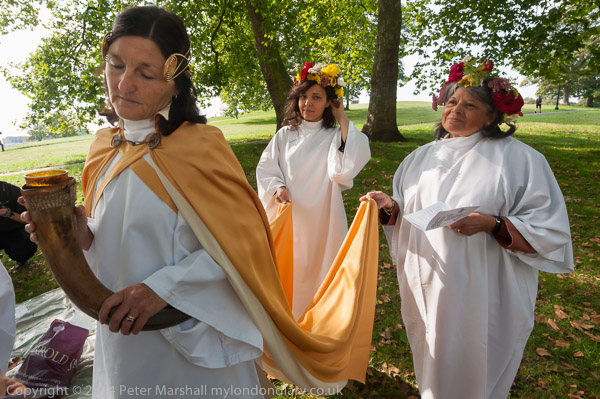
Twice a year I get an invitation from The Druid Order through the post inviting me to their Equinox celebrations, and although I’ve now seen them a number of times both at Tower Hill in Spring and on Primrose Hill in Autumn, I still like to go. Its an interesting spectacle to watch and still presents a challenge to photograph, even more of a challenge to try and produce different photographs of. I’m not sure I succeeded in that second aspect this time.


D700, 16-35mm at 16mm, f9 1/320 ISO 640

Primrose Hill is certainly the more spectacular of the two locations, with the green grass a better surface and the distant view of London. Tower Hill has its historical associations, but the Tower is a little distant and the closer buildings uninspiring. In some past years they used to process some distance through city streets which had some visual possibilities, lessened now as they emerge from the church hall next door.

I also have my suspicions that the ancient druid rites may well have been very different to these rather dry and solemn occasions. Probably a much more bloody and drunken orgy than these carefully scripted routines following the book. But the ceremonies doubtless satisfy those who take part in them and surely encapsulate some truths about the relationship between us and the planet we live on that are essential to the future of the species. We have to respect the earth, not desecrate it, and to be aware of our relationships with nature.

D700, 16-35mm at 16mm, f9 1/320 ISO 640

This is one of the very few occasions on which I screw anything into the tripod socket on any of my cameras. I hate tripods. I’ve never found one that really suited me – either too heavy to carry any distance or too flimsy and short to be of much use. If I could afford an assistant to carry the tripod (and much more usefully in London, the umbrella) I might think differently, but probably not. Tripods get in the way and slow you down. I’d rather lose the imperceptible scintilla of sharpness in the odd image than use one. Most of my images are at least sharp enough.
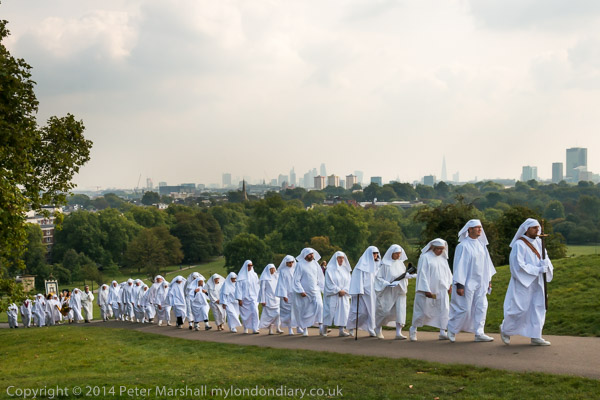

D800E, 18-105 at 25mm (37mm equiv)  f14 1/800 ISO 800

I had to use one when I photographed the multiple image panoramas for the ‘Secret Gardens of St John’s Wood’ as it was essential to get the lens nodal point in virtually the same place for all of the exposures. Though I messed up the only ones I screwed the camera in place for, and generally worked just by resting my hand supporting the lens at the correct place on the tripod plate. I used one – a solid Manfrotto – for some of my film panoramics too, particularly with the expensive Widelux which had no viewfinder or spirit level, but soon abandoned it with relief once I was working with the cheap Horizon that came with both.

But for this occasion, what I took to Primrose Hill was a monopod. It’s relatively light but still won’t fit into my camera bag, which is a pain. I put it across the top of the contents and close the cover and it stays there until I open the bag to get something out and forget it’s there, and then it isn’t any more. Fortunately I’ve yet to drop it anywhere completely unretrievable.

Also in my camera bag is a long cable release, an electronic thing that fits into the fancy socket on the front left of the camera. I did experiment with a cable-less release, with a little box in the hotshoe plugged into the same socket and another with an aerial in my hand, but it seemed more fuss for this job.

The monopod screws into the tripod socket on the base of the camera, or rather it should, but I have a strap that screws in there, with its socket that I always forget and screw the monopod into instead. What I should do is unscrew the strap – and then use the quick release built into the strap to remove it from the camera – before screwing in the monopod.

In use it makes no difference, but when you come to remove the monopod, it comes off the camera with the strap, leaving the camera hanging from the other end of the strap only, and it takes a mole wrench to separate the monopod from the other end of the strap. Unless your assistant carries a mole wrench (if you have either) your only recourse is to screw the monopod back in and keep working with one attached to you camera. Which I did.
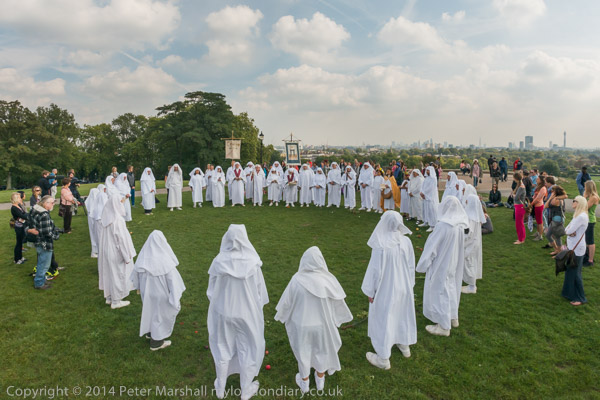

D800E 16mm fisheye, f16 1/1000 ISO 800

The purpose of this is to photograph the circle from a high viewpoint, particularly with the fisheye 16mm lens. But holding the camera high above your head you can’t see through the viewfinder. Live view puts the image on the rear screen, but it’s almost invisible from below with the sky reflected in the glass. The Nikons have a ‘virtual horizon’ feature which is a little more visible and I sometimes try to use, looking for a green line. But it still isn’t easy to see

It really is a problem trying to keep the camera level – and necessary unless you want a curved horizon. What I mean to take with me but always forget is a plumb line which ought to solve that problem. Until I do so I will just have to rely on guess work and taking quite a few exposures in the hope that some will be ok.

It isn’t too easy either to keep the camera pointing in exactly the correct direction, working very close to the circle even with the very wide angle of the fisheye.

Of course there are high-tech solutions to the problem. With the Fuji cameras I have an app that lets me control the camera and see the viewfinder image on my phone, which I might try another time. But I think I would need a cradle of some sort to fix the phone onto the monopod or to grow a third hand (or that assistant again.)  Perhaps better still would be a drone, though I’m unsure how well that would go down with the druids, especially were I to fly over the druids, and it adds another level of complexity. It would probably need to be used at a greater height, and I think the kind of view I’m getting from monopod level is probably the most interesting.
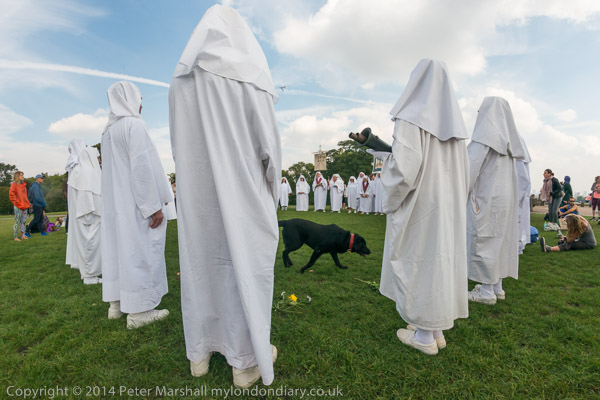

D800E 16mm fisheye, f16 1/1000 ISO 800

But perhaps I’ve already done enough on these druid ceremonies, and if I wanted to take the work further should look at it in some very different way. Though that – like the drone – is probably something I’ll leave to others.
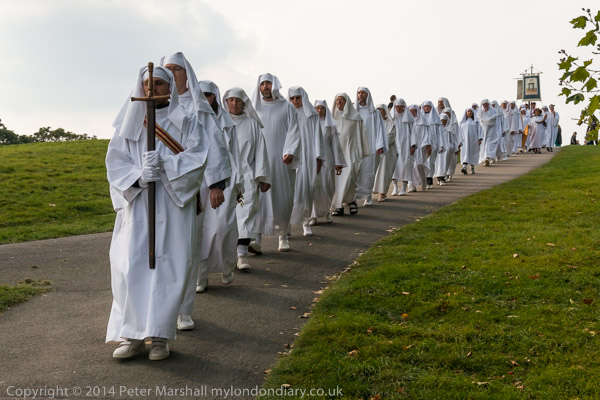

D800E 18-105 at 42mm (63mm equiv) f13 1/640 ISO800

There are more pictures on My London Diary, in Druids on Primrose Hill and as usual the images, apart from the one on the ‘month’ page with the text are posted there in more or less the order in which they were taken, and are my attempt as usual to try and tell the story mainly through images, though some words of explanation are necessary to go with them. There are a few captions, but there just aren’t enough hours in the day for me to do this as well as I would like.  As you may appreciate it  is now less than a month to the winter solstice and I’m only now on this blog writing about the equinox.

I’ve included exposure details, though they don’t have a great deal of meaning. All were probably taken on P setting and with -0.3 stops exposure compensation. All on pattern metering, with probably all on autofocus. Generally the camera does it at least as well as I could, though I occasionally make changes when time allows.
Continue reading Druids and Viewpoint
Lewis Baltz 1945-2014

I met Lewis Baltz when I went to a workshop led by him at Paul Hill’s Photographers’ Place in Derbyshire around 1979, having been greatly impressed by his work in ‘The New Industrial Parks near Irvine, California which I had seen in books and magazines from the US. Along with Robert Adams and Stephen Shore his work has had a great influence on my photographic practice.

He brought the page proofs of ‘Park City’ with him to the workshop and we were able to compare them with his original prints, and I rather put my foot it in when I told him I felt that some of the book versions were an improvement on his original prints. He had only just received these and I think would probably have rather spent the time looking through them on his own than with us. I got even more into his bad books when I commented on the tonal problems of using the ultra-slow b/w films he was working with that were not designed for pictorial photography. They were problems that I experienced too. Then he had been using some ultra-slow Kodak recording film, but later he moved to Technical Pan, and that was a beast I spent some years trying to tame to my satisfaction. When it was good it was very, very good, but…

I don’t think he looked at the work of any of us taking part in the workshop – rather unusually, but it was a short workshop, certainly if he did I remember nothing he said about the work I had taken from my Hull project, but he was very generous in showing and talking about the work of the other ‘New Topographics‘, including some who were hardly known in the UK. I think it was him who got me excited about the work of Robert Adams, as well as that of Anthony Hernandez and also Chauncey Hare, with whom I later had a brief correspondence. I’ve not met Baltz to talk with since that workshop, but his death still came as something of a shock; someone I’d once spent a few fairly intensive days with and a man a few months younger than me.

I well remember standing in a London bookshop a few months later with Park City in my hand, looking though the images and trying to steel myself to buy it. But here in the UK it was I think £50, roughly a week’s pay for me, and I reluctantly put it back on the shelf.  Perhaps I would have gone without food for a few days, but it would be hard to explain to my wife and two sons. Of course it would have been a good investment.

I still have the signed copy of ‘Nevada’ he sold at the workshop, and I did buy Chauncey Hare‘s Interior America, which was going cheap in a sale at the Photographers’ Gallery shortly afterwards, perhaps I was almost the only photographer here who appreciated his work. I wrote about him and the book perhaps 10 years ago on About Photography, and was pleased when a new and larger book of his work was published in 2009.

Baltz remained very much in the eye of the photographic public and I followed his work in the pages of some of the more expensive photographic magazines and at exhibitions such as Paris Photo, but there doesn’t seem to be a great deal of his later work on line.  George Eastman House  has a largish collection of his very early work and there is more information on American Suburb X. There is an interesting related note at SFMoMA, who also have the best on line collection of his work up until 1979 I’ve found, although only around a quarter of the 81 works listed have images available.

You can also find some quotations from him on the web, including this:

I believed it was necessary to investigate photography, dismantle it, jettison all the non-essential components, and begin again with a stripped down but more powerful idea of what is, or could be “photographic”.

and

I’ve thought that when people appear in a picture, they automatically are perceived as the subject, irrespective of how they are represented. I wanted the only person in the picture to be the viewer.

Perhaps once you have stripped it down it isn’t too easy to know which way to go. The second quotation was a point of view in my own mind for years, though perhaps I have got over it now, and was perhaps behind my thinking for the photographic show I curated back in 2001, Cities of Walls, Cities of People.

Focus E15


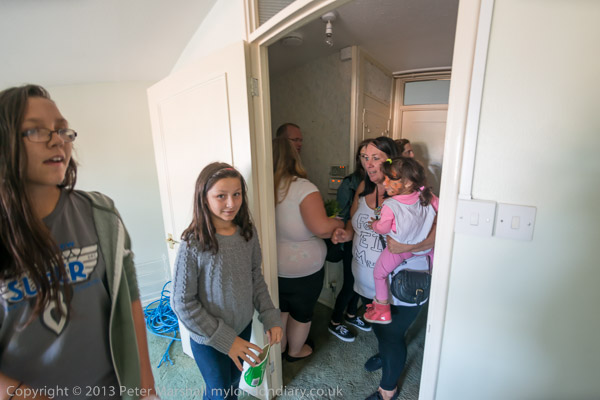
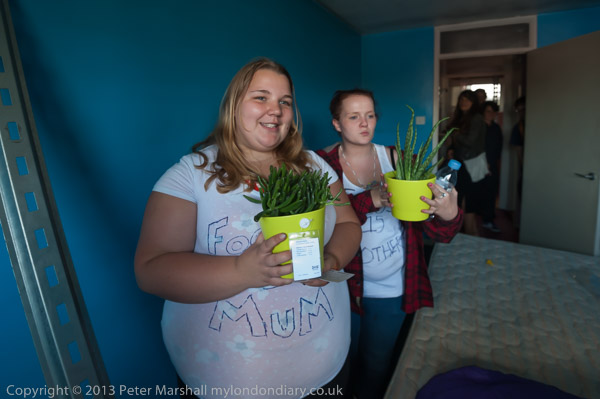
Jasmine and Sam of Focus E15 Mums hold the pot plants they have been given for moving into the Carpenters Estate flats

Housing is fast becoming a really major issue in the UK, and particularly in London, where property prices and market rents have risen so much that most of those who work there can no longer afford to live there. The current minimum wage is £6.50 per hour,  which works out to roughly £1050 per month for a typical worker without overtime. Those who get the London Living Wage are a little better off at around £1400 a month. Newspapers have recently been reporting on the tenants of the New Era Estate, a fairly typical inner London estate, currently paying rents of around £600 per month who are threatened with a rise to ‘market rents’ of around £2400 per month.

People may qualify for the misnamed Housing Benefit, (it’s really more a benefit for landlords), but the benefits cap introduced by the government (including an overall benefits cap of £500) make this totally inadequate in London. The only viable solution to the problem of keeping London running is a crash programme to build low-rent social housing, but neither of the major political parties is seriously proposing this, and while there is considerable building taking place in London, the vast majority of it is high rent private properties, many of which are being bought by overseas investors. Some simply leave them empty while property values soar, others rent them out to companies for employees here on short-term visits or as holiday lets.

Some Labour councils are among the worst offenders in this process, getting rid of social housing and profiting from sales to developers. Some have even made a mess of this, with Southwark Council reported to have lost millions in the costs of emptying the Heygate estate came to more than the bargain deal the developers made. Of course some individuals – both on the council and the developers – do nicely out of these schemes.


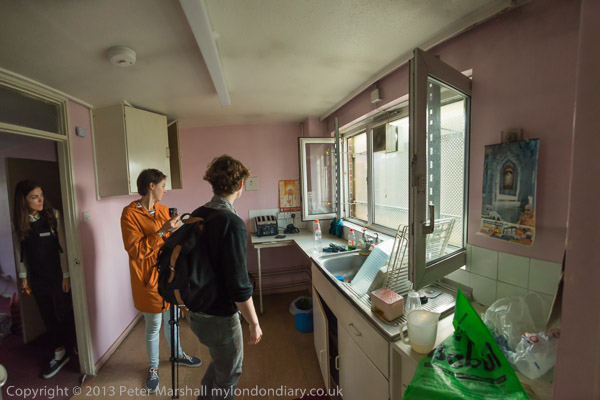
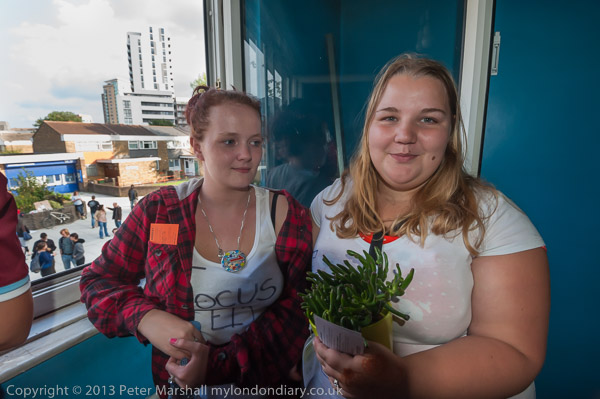
Jasmine and Sam in one of the Carpenters Estate flats while the Focus E15 MumsFirst Birthday Party continues outside

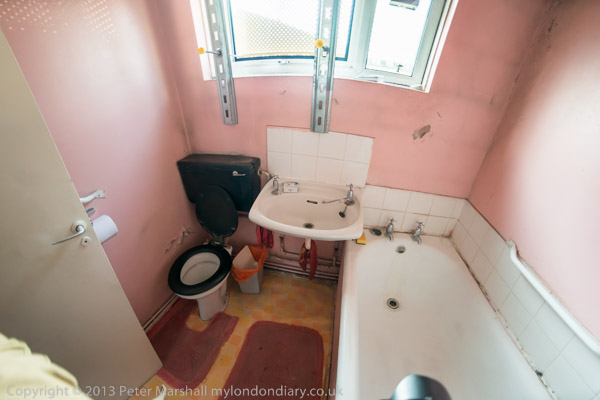
Newham Council, 100% Labour and with an elected Mayor have for ten years been trying to empty out and sell the Carpenters Estate, next to the centre of Stratford with its excellent transport links. It is truly a prime site, but unfortunately an earlier Labour council which had the interests of the people of the area in their heart built a well-planned council estate on it.  One that people liked living in, and despite ten years of harassment, that some are still living in.  In a borough with one of the worst housing shortages – and particularly of social housing – some properties there in excellent condition have been boarded up and empty for ten years.

Newham is also where one of the most vital campaigns over housing has been taking place, led by young mothers from a hostel for which the council decided to cut the funding to the housing association for a little over a year ago. The mothers, with some help from political activists, decided to make a stand together and fight, forming the Focus E15 Mums campaign.  They refused to move away from London to be rehoused in Birmingham or Hastings or elsewhere, away from jobs, family and support systems as the council suggested. They set up a weekly protest stall on the high street every Saturday, protested at the housing association, at the council and elsewhere, and turned the insights they developed from their fight into a more general ‘housing for all’ protest against what they had come to realise was a policy of ‘social cleansing.’

I’m pleased that I’ve been able to photograph some of their protests and help through my pictures in gaining public attention to their fight, though I regret not having done more – but there are so many calls on my time. I was sorry, having been there to take these pictures of their re-occupation of a block of four flats at the centre of the Carpenters Estate, not to have found the time in the following couple of weeks to go back and record some of the events they staged there in what was always intended as a short-term occupation of the properties.

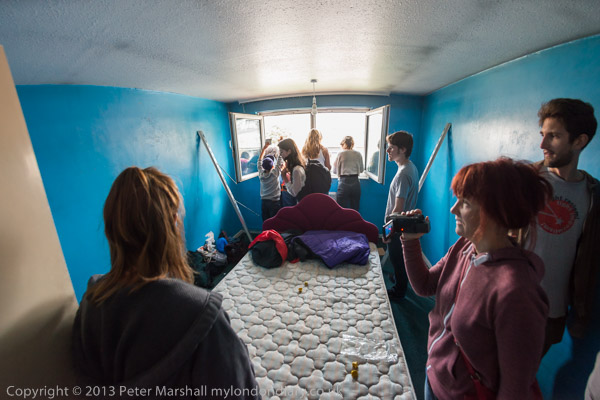
Photographically it was a little tricky in that there was little light inside the flats, and not enough for the pictures I took as I first went inside them, in the hall and on the stairs. Most of the metal grilles were still in place, with a little light coming through the pattern of holds in them, but parts were still very dark.

I’d anticipated this, and together with the knowledge that I’d be in a crowded and confined space had switched to the 16mm f2.8 while waiting to go inside – it was a long wait and I’d had plenty of time to think about it.  One thing I often feel the lack of with my Nikon cameras is fast lenses. Back when I was using film one of my favourite Leica lenses was the 35mm f1.4 (it had cost me about a month’s salary when I bought it second-hand around 1980.)  That aperture makes it 8 times as fast (3 stops) as the 16-35mm f4 Nikon lens.

The two fastest Nikon lenses I own are the 16mm f2.8 fisheye and the 20mm f2.8 – and I’d left the latter at home. For many purposes not having fast glass doesn’t matter – particularly when we can know work at ISOs that were not viable in the days of film. You get the same shutter speed with an f4 lens at ISO 3200 and an f1.4 lens at ISO400.  But this was a time when the f1.4 at ISO 3200 would have been rather better.

It doesn’t matter so much when your subjects are static. Even handheld with wide-angle lenses its quite possible to get sharp results at half a second – just not every time. The 16-35mm has image stabilisation, but I’m unconvinced it is of much significance with wide angles, though it certainly helps on longer lenses.

As we went in it was also quite crowded and the physical size of the 16-35mm can be a problem – the 16mm fisheye is a nicely compact lens.  Once we got into the actual rooms things were easier, and I was able to take pictures with both the 16mm and the 16-35mm, and to lower the ISO, even down to ISO800 for some pictures.

This was one of my favourite interiors, taken with the 16mm fisheye, processed with the Fisheye Hemi plugin to make the vertical and near-verticals more or less straight.  The woman at the left looking into the room is in the darker corridor, but lit be light through the doorway (with a little help from Lightroom.)  Stopped down to f5 makes everything sharp (the near objects at right just slightly less so), and even at ISO 2500 the quality is pretty good. Of course noise reduction, removal of chromatic aberration and fringing in Lightroom help. At 1/100th second there is perhaps just some very slight blurring of parts of the people as they look around, something that I like. On the original it is easy to zoom into the image and read the year 2014 on the calendar on the far wall.

When the protesters moved in they found the flats in good order, and the water was still connected. The council soon turned it off after the occupation began. The picture above shows one of the perils of using the 16mm fisheye – and that large 16-35mm on the camera hanging down from my neck with its lens hood intruding into the image.

September 21st, when I took these pictures, was the second day of the London Open House Weekend (a week later than the rest of this country) so although it hadn’t been listed in the official catalogue, this was of course the Focus E15 Open House Day and there are many more pictures both of the party and the occupation of the flats in My London Diary.

Continue reading Focus E15

EDL and Pictures

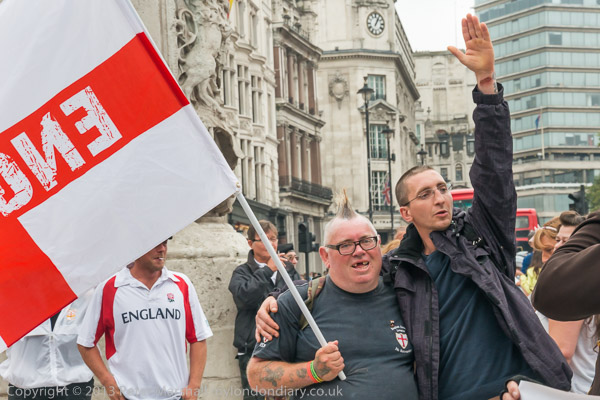
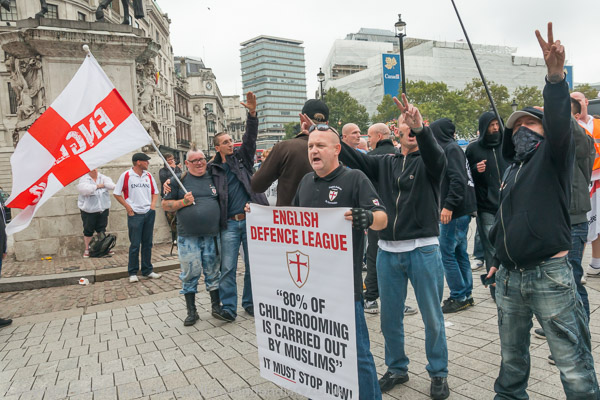
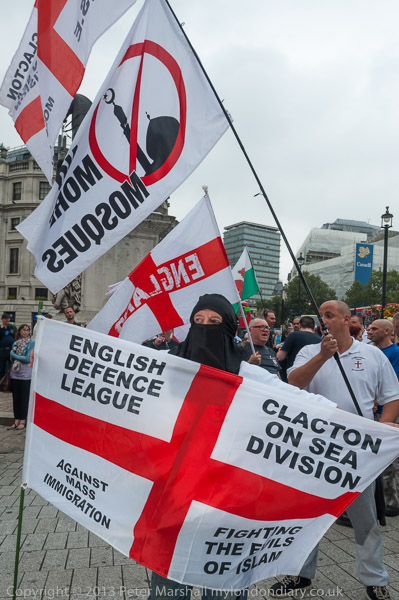
These two men were posing for a photograph in Trafalgar Square, not posing for me, though I’d photographed the man on the left several times earlier, but for a picture being taken by a man with a phone – I think the elbow seen at the right of image is his. The man in the centre is looking at me and may be aware that I’m taking a photograph, though I’m a short distance away using the 18-105mm at 62mm (93mm equiv). He is wearing an EDL sweatshirt, with its motto ‘No Surrender’ and holding an England flag. He probably isn’t aware of the raised hand salute the man with an arm around his shoulder is making for a photograph. Its something most who come to EDL marches have learnt to avoid, preferring to raise two fingers, as you can see in the image below, taken a second later with the same lens in wide-angle, but there are almost always a few who stick to the old ways.

The EDL have often accused photographers of misrepresenting such gestures, of catching someone waving to his friends. Here I think it is clear that this is not the case. It wasn’t the only such gesture that I saw during the event, but was certainly atypical. And gestures are often easily misinterpreted.

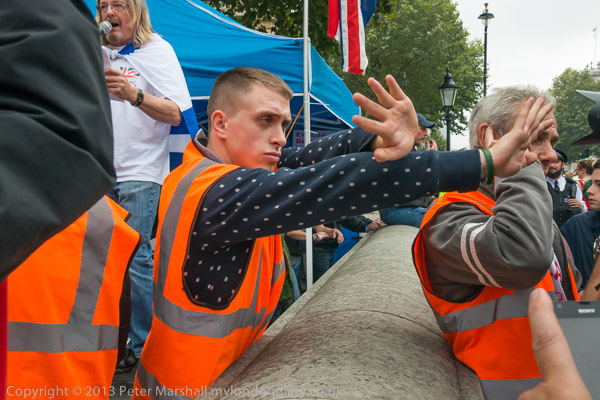
This was one that perhaps left little room for misinterpretation, with one of the EDL stewards holding both palms in front of the lens  of another photographer who like me was attempting to photograph the public rally that came after the short march.  Again taken with the D800E and 28-105mm, at 26mm (39mm eq) and perhaps just cropped a little too tightly in camera. with the top of the speaker’s head cropped at upper left, and the lens hood just not quite pushing far enough into the image.  Perhaps it could also be made a little clearer in post-processing. Like around 99% of the images I use this is the un-cropped frame – I try hard to crop in camera and sometimes perhaps do so too tightly.

I don’t know why the steward felt he wanted to stop one of my fellow journalists photographing the event. There might well have been a good reason for trying to stop anyone recording the speaker, but I suspect the EDL will themselves have put videos of his speech on the web.

The EDL did seem to be making an effort to improve their image. Early in the day I’d heard a steward tell someone to put their can of beer away when he started drinking in the pen opposite Downing St, and there was certainly less drinking than at earlier events. The meeting point for the march wasn’t this time at a pub, but in the traffic island at Trafalgar Square with Charles I on his horse.  And although some groups were drinking, most people were simply standing around and talking. Some posed for photographers and others were happy to be photographed. I had a few polite conversations, including some with people who recognised me from earlier events (and hostile comments on the web) and was able to wander freely without harassment.

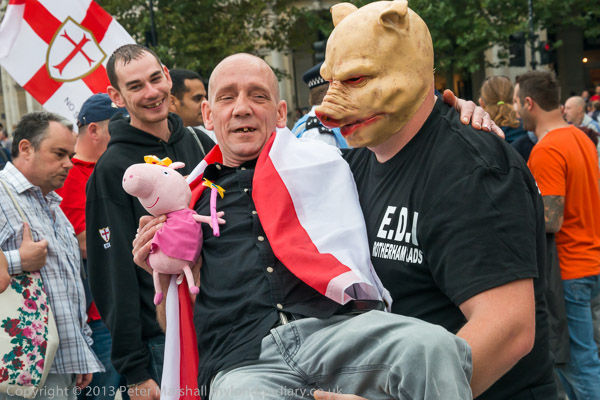
Again the man carrying the pink pig was posing for a friend of his to take a picture, being held by the man in the E.D.K. Rotherham Lads shirt and pig’s head mask.  I was a little too far away to get the picture exactly how I would have like, and by the time I had moved closer the picture had gone. Again I perhaps could have framed a little less tightly, but I didn’t have a clear view. I did take some other pictures of the man in the mask a minute or two later, some with a wide-angle, which are graphically stronger, but perhaps this one is a more truthful images of the event.

There are always dilemmas. Does producing strong images glorify the activities of the EDL? Do photographers inevitable sensationalise groups like this? Do we always pick on the atypical but photogenic?

Of course we have to dramatise, to make pictures which will interest the viewer – or else no one is going to look at them event when they do get published. And while I may disagree with the politics of the EDL and other extreme right groups, they do include some visually interesting individuals. But I try hard not just to photograph these people but to show the events in the round, to tell the story through my pictures.

Back in the days when reproducing images was difficult and expensive there was perhaps some justification for the way that newspapers handled images, with those that used photographs (and some of the more serious press didn’t) generally picking a single image. Magazines would perhaps use a few, but even with the ‘illustrated magazines’ they were seen as subservient to the text.

Economics and production have changed, both in print and of course on the web, but the major media still largely stick to the old mould. Where they have embraced images it has largely been as video. Some publications will occasionally add an ‘image gallery’. But I can think of no major publication that has ever seriously engaged with Moholy-Nagy’s 1930s statement ‘The illiterate of the future will be ignorant of the use of the camera and pen alike’.

I’m not sure what the results of taking this seriously would be, though of course there were some attempts in those illustrated magazines, both back in the 1930s and since. Occasionally there are article which effectively mix text with pictures on the web, but not I think that really go far enough.

My own My London Diary for practical reasons largely separates images and text – site design and time constraints don’t allow me to go further in this direction. It’s also not possible for one person to effectively cover almost any event both as a photographer and as a writer; the two require different approaches. Combining videography with writing  is rather easier, as the video provides a continuous stream which records the event, while the still photographer has to concentrate on moments.  And for us the sounds and speeches are often a distraction while for the writer they are essential. A video camera can act as a notebook for the writer (particularly those ignorant of shorthand) in a way a still camera cannot.

Giving journalists a camera and sending them to events to write and photograph is to sideline photography, and some of the results that we have seen show this clearly. But it is also true that the media have seldom managed to use images effectively.  And perhaps photographers have played some part in this, with the willingness to play along with the clichés, often in the name of professionalism, particularly in the UK.

Any publication that tried to do so would of course be accused of ‘dumbing down’ in our logocentric culture, but there is no reason why this should be the case. Images can add to understanding and appreciation of events without in any way compromising the written text, while the current emphasis on getting writers to take photographs will undoubtedly damage their writing.

And were publications to serious use photographs, both online and in print, they might just become more popular, reaching a wider audience. Which would be good news, and even perhaps reverse the current financial bankruptcy of photographers, as repro fees continue to plunge. If the papers used ten of my pictures in place of one to help them tell the story effectively it would just about compensate for the lower rates compared to twenty years ago.
Continue reading EDL and Pictures

Mitie’s Heathrow Prison

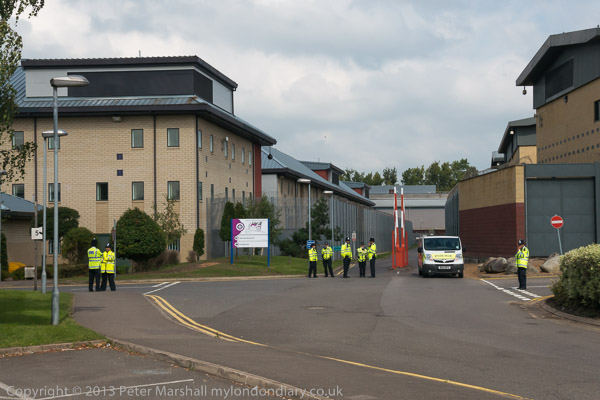
On September 13th I was back again at Harmondsworth, but things had changed, not for the better.  There was a new sign up in front of the buildings, and a new name, ‘Heathrow Immigration Removal Centre‘, combining what had previously been the Harmondsworth detention centre on the left of the road with the Colnbrook centre, a high security unit to its right under the very dubious ‘Care and Custody’ subsidiary of Mitie, one of the private contracting companies our government uses to distance itself from the shameful neglect and maltreatment that immigrants and asylum seekers are subjected to by our immigration laws.

And, as you can see in the picture, the police were waiting for the protesters, and a couple had come to talk with those who had arrived early to begin the protest, telling them that they would not be allowed onto the site along the road next to those tall fences, where those inside the prisons would be able to see and hear them.

Police blamed the change in policy on the new management, although protesters suspected it was perhaps motivated by the increasing tension inside these and other immigration prisons following the death of Rubel Ahmed eight days earlier in Morton Hall immigration detention centre in Lincolnshire after he was refused medical treatment for chest pains, despite being heard by other prisoners screaming in agony. The prisoners took over the centre in protest and their resistance was brutally suppressed.

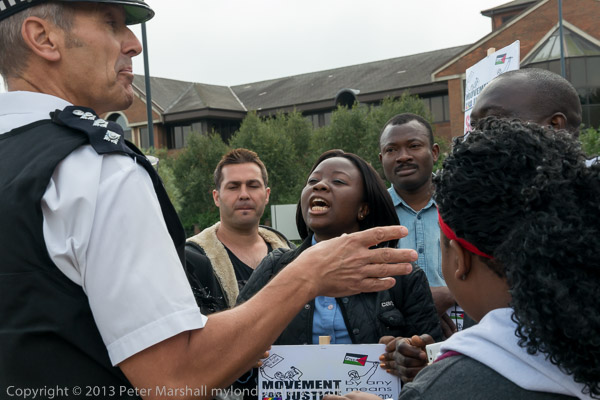
When I arrived protesters were arguing about their right to protest around the prison with one of the police officers, and I moved close to photograph this. It was easy to photograph either the police officer or the protesters, but rather harder to get a picture which shows both in a meaningful way, and I think the image above was the closest I came to it – there are a few others of the situation in Close UK Immigration Prisons on My London Diary, so you can make up your own mind.

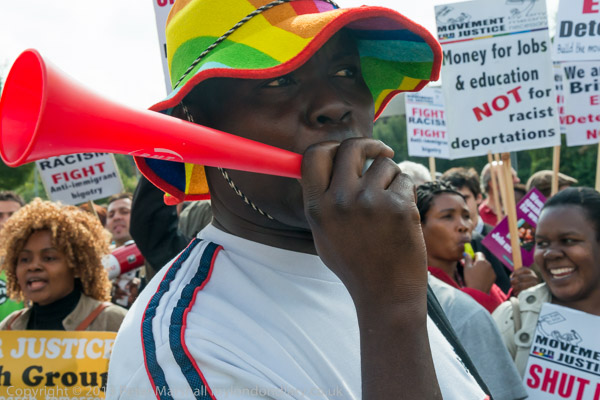
Photography is very much a matter of making judgements, both when taking images and editing them. I’ve photographed the man below with his rainbow hat at several protests, and obviously he is a pretty colourful subject.  I took quite a few pictures of him, particularly when he was blowing the bright red horn, and again this is the image that I think works best.

Firstly there is the framing of him, cutting that horn neatly at the left edge and the red edge of his hat just at the top edge of the frame. But the background is also important, showing the crowd of people. The two women’s faces at each edge help, but it is particularly the various texts that made me pick this frame. Going around the frame there are words like Justice, Racism, Fight, Shut and the complete placard, just tangential to the red hat band, the well known protest refrain ‘Money for Jobs & education NOT for racist deportations’.

That red band also just touches the man’s right eye (on our left) – had my camera been an inch higher it would have been lost. It’s partly a matter of luck that all these things came together in this frame, but also a matter of working on the subject and feeling for the it until luck happens. What perhaps this picture doesn’t on its own shown is the incredible dynamism of the protest, though I think the colour and composition gives some indication. Again there are other pictures on My London Diary.

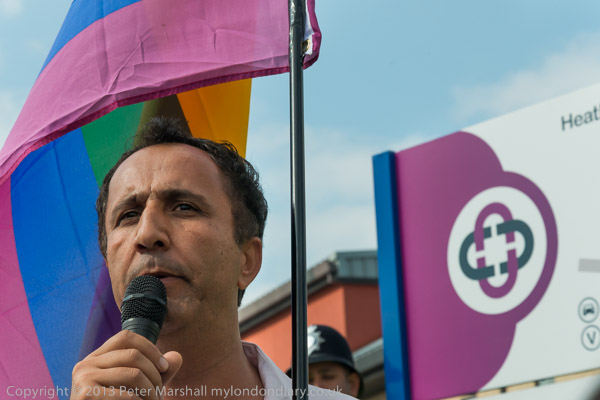
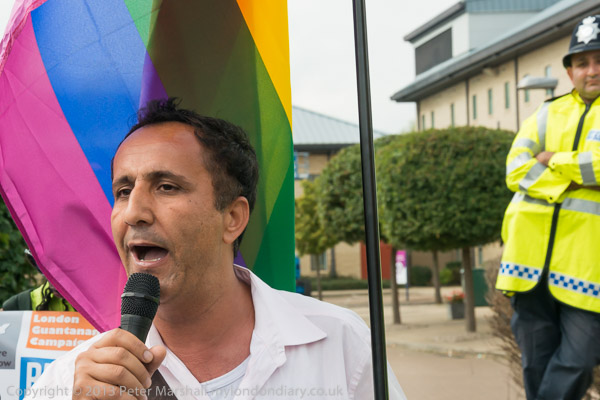
The next two images show a former prisoner in the centres talking about the conditions inside, and I was quite please with both of them.

I wanted to photograph him speaking, and was attracted by the similarity of the colour in the flag and that of  the Mitie sign and worked from a low position to combine the two.

Standing up and moving very slightly I could show him speaking with the prison building more clearly behind and the police officer watching him. Despite both having the same man and flag, I think these images have a very different feel to them. I think I prefer the lower one, mainly because of the greater animation of the speaker.

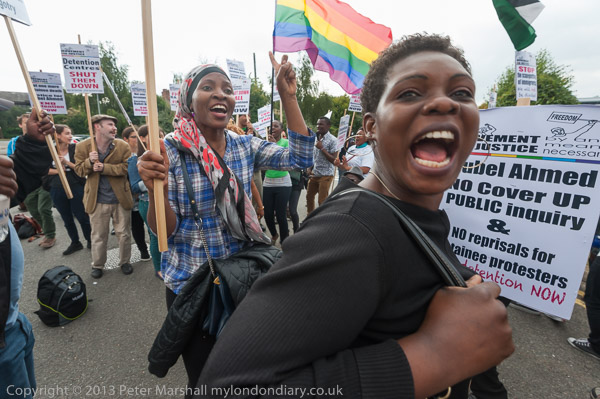
I tried hard and in several ways to show something of the dynamic nature of the protest and am not completely happy with any of my images (not that I ever am, though a few I feel quite please by.) One that does have some appeal, largely because of that wide open mouth and grinning face so close to my wide-angle lens perhaps show something of the energy of the protesters. Many of them have suffered inside these prisons, some still face the agony of reporting and knowing they may be locked up and deported, and others have lost friends or relatives sent back to uncertain or dangerous futures, imprisonment and worse.

I’ve written on previous occasions about the issues involved and the attitudes that lie behind (and too often politicians and others do lie) the shameful treatment this country hands out, particularly to those from countries that we grew rich from in the days of the British Empire, and continue to exploit through multinational companies.  It’s important that people learn more about what is actually happening behind the high fences and locked doors of centres like this and the whole mindset that allows it to go on in what is still claimed to be a civilised and democratic country. And that they are closed down.

More at Close UK Immigration Prisons

Continue reading Mitie’s Heathrow Prison

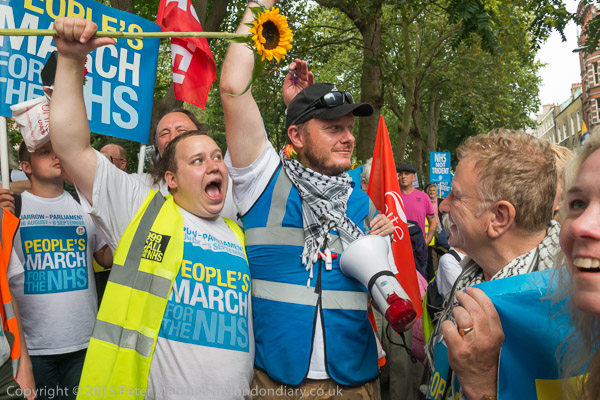
Save the NHS


Marchers at the rally before the final stage – Craig Farlow in cap centre

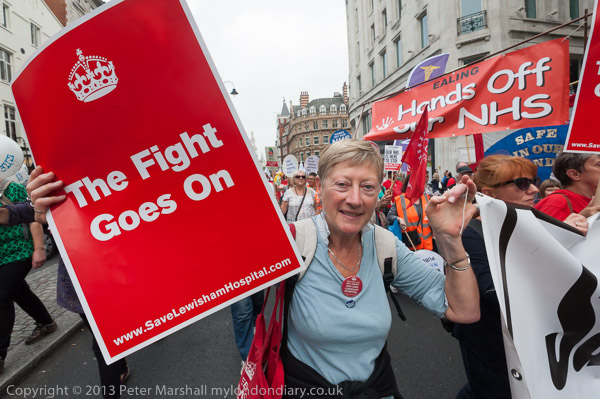
The fight to save the NHS continues, though many parts of it have now been taken over by private companies. It is very big business, and one in which many of our leading politicians have a financial interest. And although the Conservatives are the worst offenders, Labour and Lib-Dems are not far behind. And of course UKIP – or at lest Nigel Farage –   would be even worse. But one of the things I find it hard to forgive Labour for was the introduction of PFI, the scheme under which they got large capital projects – like new hospitals – built but shackled the NHS to huge repayments – and at interest rates which now seem ridiculously high.

I’m fortunate to have lived almost all of my life while we had the NHS. When I’ve needed it, free health care has been there – and without it I probably would not be here. It’s not a perfect system, and has particular problems from a governments that keep making unhelpful changes, but generally delivers a high standard of service at a much lower cost than – for example – the US system which has so attracted Conservative health ministers.  It’s had to see any reason for this attraction other than the huge profits that healthcare companies make from it.

There are good clinical reasons for wanting to concentrate specialised clinical care in fewer well equipped and staffed centres, but it isn’t this that lies below most hospital closures. It isn’t even the need to make economies because of the financial situation – even if one accepts that.  The main driver is the huge repayments of PFI loans, that has led to the pressure to close solvent and clinically successful hospitals such as Lewisham.

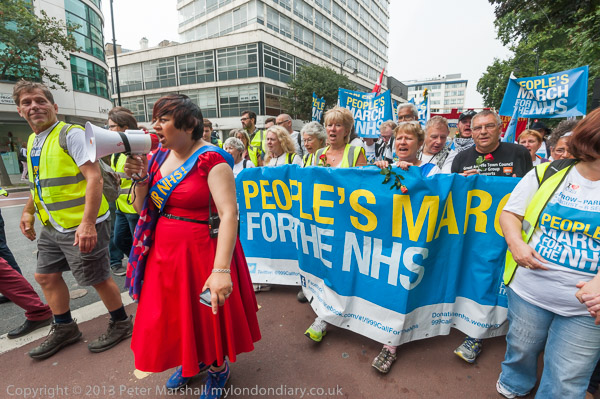
The People’s March for the NHS began in Jarrow, up in the North East, and was based on the Jarrow March (Jarrow Crusade)  of 1936, when over 200 unemployed men marched to London, petitioning parliament for help for their town. All they got was a pound for their fare home. And that same amount, though in this case a pound coin, was included in the medals awarded to this year’s marchers who had gone the whole distance when they arrived in London on September 6th 2014.

The 2014 Jarrow March, the People’s March for the NHS NHS, came about from a suggestion by Craig Farlow, one of those who marched the whole distance – the ‘300 milers‘. I think they took the same route, and like the original marchers were supported by local people along the route, staying in churches and other buildings. One big difference was the presence of the ‘Darlo Mums‘ rather than the all-male event of the 30’s.


The march leaves on its final stage led by Rehana Azam, GMB National Organiser for the NHS and the 300 milers

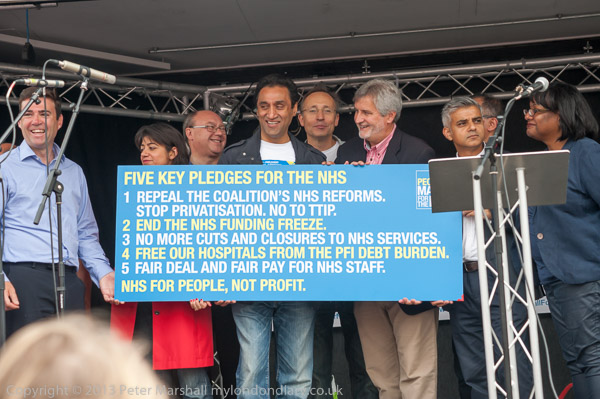
The march appeared to receive relatively little support from the left establishment, though unlike in 1936 the Labour Party and the TUC didn’t actually oppose it. There were indeed many trade unions and union branches who supported it, and the main organiser, Rehana Azam is the GMB National Organiser for the NHS. On the platform during the final rally in Trafalgar Square there were at one point the Shadow Minister of Health and half a dozen other Labour MPs holding the large poster listing the marchers demands, and during his speech Andy Burnham pledged that the Labour Party would repeal the Health and Social Care Act which has opened up all of the NHS to privatisation.  But it is the same Labour Party that is backing the TTIP treaty which will have the same or greater effect.

The main problem I had taking pictures was simply the crowds and space to work. Crowds of supporters and marchers at the rally in Red Lion Square before the final short march, and crowds of photographers in the relatively small press area in front of the stage at Trafalgar Square. Space there was restricted with part of the area in which press usually work being fenced off up for the official video crew and roughly half as seating for the disabled, most of which was unoccupied while I was there. It was difficult and at times impossible to get a good enough view of what was happening on stage, not helped by the sun shining directly towards us.

Continue reading Save the NHS

Remembering the Dead

A few months ago, late on Sunday evenings, I lay in my hot bath listening to BBC Radio 4’s weekly omnibus editions of a series of programmes about the events that led to the start of the Great War in 1914. It was a remarkable series which illuminated how the pride, stupidity and greed of a few rich and powerful men can lead to catastrophe for millions, and made evident the strength of anti-war feelings prevalent in Britain in the months leading up to the war, something which seems to have been largely overlooked in our national myth.

It was a war both my parents lived through, though my mother was only just finishing her school years when it finished. My father worked in a munitions factory, then joined up and went to both France and after the war ended to Germany, but was rather more at danger from the British authorities than the Germans, not being good at keeping his mouth shut and obeying obviously nonsensical orders.

By 1918 there were many Germans who were also getting fed up with nonsensical orders, and the Great War ended not because of a military victory,but because German sailors mutinied, setting out from Kiel and Wilhelmshaven to Germany’s industrial centres where they gained the support of the workers and then on to the capital, with the Kaiser being forced to abdicate on 9th November 1918 when the streets of Berlin were taken over.

Like many workers in the UK, German workers had actually been opposed to the war at its start, with hundreds of thousands of socialists going out on the streets in August 1914 against it. As Paul Mason writes in his Channel4 blog post, How did the first world war actually end?

‘We know now, thanks to the publication of records and memoirs, that it was entirely possible to have stopped the first world war. Key members of the British cabinet were against it; large parts of the social elite in most countries, including Germany, were stunned and appalled by the unstoppable process of mobilisation.’

The ‘War to end all wars‘ sadly didn’t, despite the experiences of those who survived and the work of war artists and poets which vividly depicted its horrors. Perhaps nothing in history is inevitable, but the settlement at the end of that war certainly created the conditions for the next great war twenty years later.

So while we remember and celebrate the bravery of those who fought and the sacrifice of those who were killed, perhaps we should do so with a sense of mourning and of the futility and horror and one that includes those on both sides.

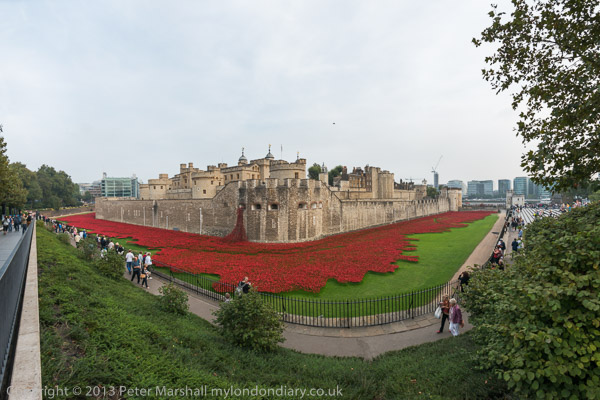
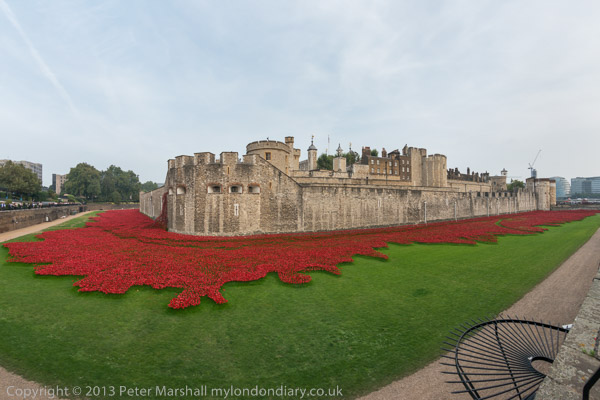
I’ve already published some pictures and thoughts about the field of poppies around the Tower of London, a spectacle that has caught the public imagination and dominates the front pages of many papers. I didn’t file my own pictures,  as I did not want my work to be used to glorify war. On my own sites I have control over how my work is used.

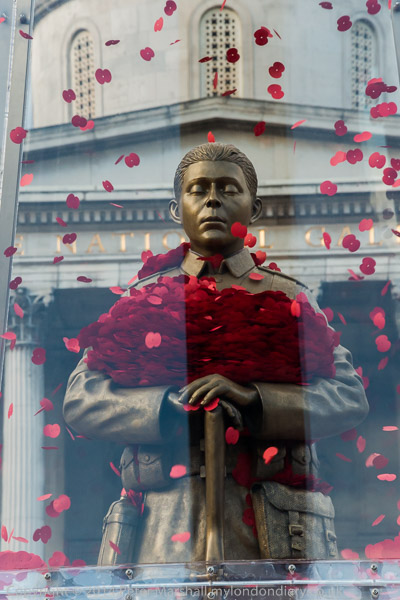
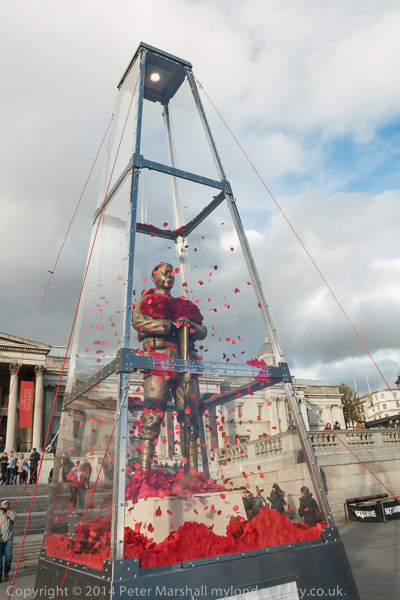
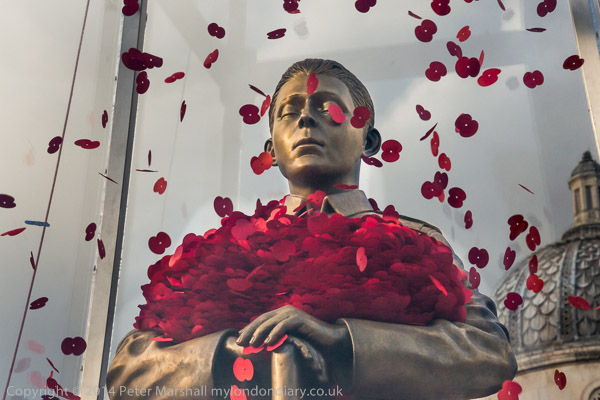
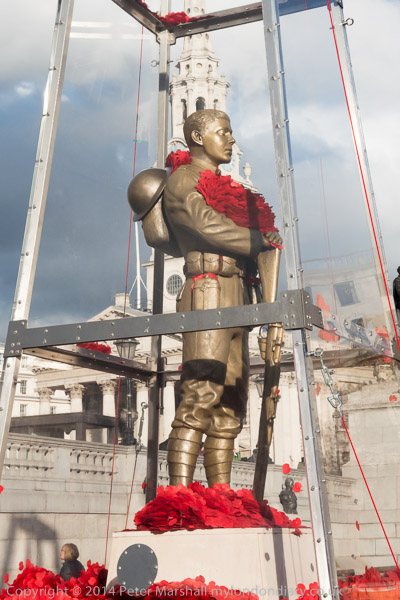
On Friday, another memorial sculpture was unveiled in Trafalgar Square, Mark Humphrey‘s brass ‘Every Man Remembered‘, a brass figure of an ‘unknown soldier’ standing on a block of Somme limestone, caged in a perspex enclosure and cradling a huge agglomeration of poppies in his arms, with hands resting on his rifle butt, another pile of poppies fixed around his feet. As I watched it and the tourists photographing it for around half and hour, every five minutes I saw a cloud of poppies being blown into the air around the figure.

There are I think far better figures of men who fought on war memorials around the country – at which many as I write (on Sunday morning on the 9th Nov) will be marking the occasion with services and military parades. The perspex canopy looks cheap and temporary (which I assume it is, but that isn’t a reason why it should so obviously look so), while the plinth lacks character. I rather like the poppies ‘blowing in the wind’, if only for the possibly unintended reference to Bob Dylan.

Almost all of those present around these memorials will be wearing red poppies, though a few may also wear a white poppy. In the past I’ve bought a red poppy and worn it, the ‘Poppy Fund’ providing income to support injured ex-services personnel, a good cause – if one that should perhaps be met by government rather than charity. There is a red poppy, with its rather strange green leaf, on our living room table as I write, where it will stay so far as I am concerned until recycled after November 11th.

Continue reading Remembering the Dead

Internet Down & UP!

It’s a few days since my previous post here – and here’s the reason why:

Sunday Morning

Friday night my broadband connection went down. I dialled up the service number and reached a repeated message telling me “There is a fault”, which I knew already, but at least confirmed that my service provider knew as well.

A couple of hours later the red light on my hub changed back to blue and I breathed a sigh of relief, and sent off two of the five stories I had been working on from earlier in the day. By the time I’d finished the next the WAN light had changed to orange and the connection was dead again. It was half past one in the morning, so I went to bed, hoping to be able to send it and the other two almost ready stories off before I went out on Saturday morning.

But when I rolled out of bed the light was still orange. I had breakfast and tried the service line, which now had a much longer message about faults, but my exchange wasn’t among those listed. All other areas, according to the recorded message had no problems. I listened a second time to be sure I hadn’t missed my area, then leafed through my User Guide and dialled the service number, which was carefully hidden at the bottom of page 14.

After around half an hour in a queue (if they really thought my call was important they would have more staff) I was then connected to ‘Elizabeth’ who appeared to be in India, but did her best to help me, with further long periods on hold while she had tests run on my line and a call back when the line dropped.  Most of the things she asked me I’d already tried, but there was a rather odd few minutes when she had be running for a screwdriver to undo the two screws on the white box fixed on the wall, but then had to tell me just to screw them back in again. But after around another 45 minutes or so told she had gotto the end of her script, and told me she would have to ‘escalate’ my problem.  And that if I had to actually have an engineer come round to fix the problem it would cost me £129.99 if it turned out to be a problem of my equipment etc.

Unfortunately all escalation meant was that I could expect a telephone call from someone who actually had some technical knowledge thirty hours later, for which I’m now waiting. It didn’t improve my temper to be got out of bed at 8.02 am this morning (it is a Sunday and I wasn’t intending to do very much this morning) for a reminder call that I could expect a phone call between 13.30 and 15.30.

If the line – as the checks made by during my call with Elizabeth suggested – is OK, I suspect the problem will be with my VDSL modem, which I’ve had for a few years. But I hope it won’t be too long before I’m back on-line.

Even though I’m not completely cut off from the internet –  I can still access my e-mail and read Facebook, Twitter and view web sites on my smartphone – the loss of broadband has come as a great shock, and brought home the extent to which I rely on it now.  I could I suppose find a free Wi-Fi connection with my notebook computer and continue to work that way, but it just would not be the same.

None of the stories that I haven’t been able to upload yet – including another from Saturday – are actually particularly time-sensitive, though the agency I send them too likes to think otherwise. I’ve long told it that it would be better off forgetting the instant news market – the big agencies will always do it better – and concentrate on features, magazines and books.

There is perhaps a financial disincentive for me to file promptly. If I do so my work will almost always be sent out on a service to subscribers who benefit from free usage for the next 48 hours. Photographers get paid according to the number of pictures that are sent out, not related to usage, and the monthly amounts are pitiful. Sending in pictures more than 24 hours after an event means they will not go to subscribers.

What I’m not sure is how this might effect later sales. Back in the old days, newspapers used to have picture editors who would have looked at the work coming in and night have mentally or electronically saved images they thought might be useful later. Now I suspect this doesn’t happen, and pictures – except for the breaking news feed – will largely be found through Google images, and what matters are keywords.

But what I’m truly missing is not the thought of income, but not being able to share the pictures I’ve taken with friends and with the people who I’ve photographed. Of course eventually I will, and you will get to see the pictures I took, some here and more on My London Diary. A few days without broadband are not too important here, where I’m already a little over a month behind in posting. Though on >Re:PHOTO I do sometimes like to be a little more topical, and perhaps today might have been sharing with you my pictures and thoughts on the memorials to the First World War at the Tower of London and in Trafalgar Square.  I’m now hoping that my normal service can be resumed in time to do so on Armistice Day – Tuesday – though my gloomier side remembers those confident assertions from 1914 that it will all be over by Christmas.

Later on Sunday

Well, the call I should have had between 13.30 and 15.30 finally happened – with profuse excuses – at  17.30.  I told the guy all I could and suggested that there was probably a problem with my VDSL modem as all the line tests they could do remotely seemed OK. After he had exhausted all the tests he could do I finally got an appointment for an engineer to call – on Tuesday between 1pm and 6pm.

Monday

Although I’d not had broadband since the early hours of Saturday I hadn’t been entirely without internet connectivity. I’d been able to connect on my  phone and reply to a few urgent messages on e-mail and Facebook.  But I had still felt really cut off from things – on-line contact has really become such an important part of my working life – and to some extent of my social life too. Not being able to easily update my web sites or upload photographs from home was a real problem. And there were just so many little things that I would have looked up on the web, but it was mostly too much hassle to do on my phone.

I’d logged in a few times on my notebook – much easier to read e-mail etc than on a phone- but had not managed to find a good connection. I’d start sending an image and the line would drop halfway through. I’d copied the files I needed to upload onto a memory stick  and was thinking of going out to a coffee shop that offers free internet access when I had a better idea, and simply moved right to the front of my house.

There I was able to get a much better signal, and one that was stable, not dropping off after a couple of minutes. It was a pretty obvious thing to do and I kicked myself or not trying it sooner. it too perhaps two or thre times as long as usual to upload my stories, but eventually the work I’d wanted to put on-line on Friday and Saturday was now there.

Tuesday

Today the engineer came, surprisingly at the start of the five hour time period I’d been given. And he seemed to really know what he was doing. I now have a new – and upgraded – hub, with a built-in modem, and also some dodgy outside wiring replaced, and have also almost cleared the backlog of less urgent replies to the 649 e-mails waiting on my mail server since last Friday. Fortunately most of them don’t need an answer.

And I’m hoping my life is now going to get back to normal. The outage has made me miss a few things I would otherwise have done – today rather than waiting because the engineer was coming later I would probably have been photographing events concerned with the anniversary of the 1918 armistice, and on Saturday and Sunday for various reasons I missed events I would otherwise have covered. I’m able to write this now because  I had to cancel going to a meal with old friends because I didn’t know what time the work would finish.

It hasn’t been entirely negative either. I have got through quite a lot more image editing on the computer than I would have done with the distractions of the web available. And I should have a better connection with the improvements in the new hub, both for the internet and also on connecting between the different computers on my home network. The renewed cabling should also make the whole system less likely to fail in the future, though at the moment I’m still typing with fingers crossed.

Normal service should be resumed shortly!

September 2014 My London Diary

Most of the last three days I’ve spent catching up with my work from September, sorting out and editing the pictures I took in the last half of the month and putting them with stories and captions onto My London Diary.

As you can see from the roughly 30 entries below, it has been a busy month for me yet again

September 2014

Sainsbury’s told Stop Selling Illegal Goods
By the Royal London
HP told Stop Supporting Israeli Military


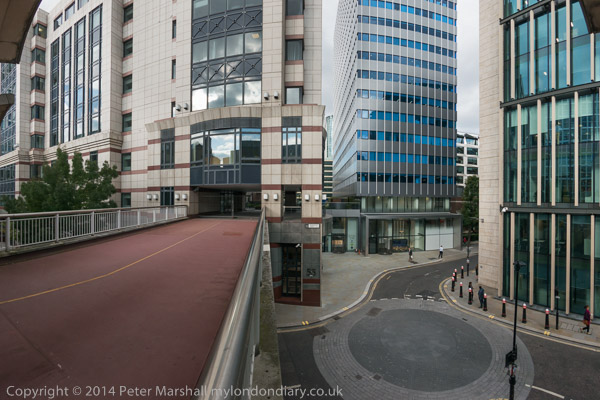
City Wall, High Walk
Don’t bomb Iraq
CETA Trade Deal Threat to Democracy


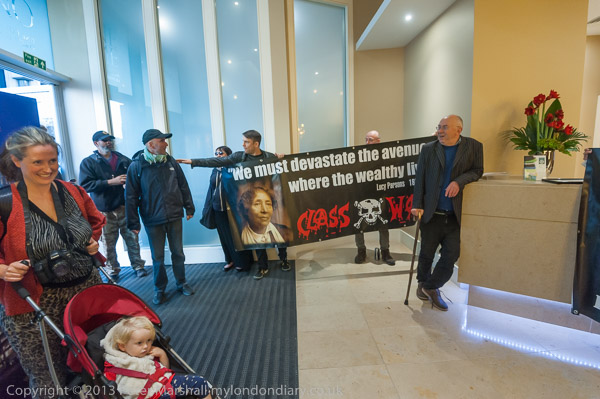
Class War Occupy Rich Door
Gambia anti-Gay Bill


Druids on Primrose Hill


Focus E15 Open House Day
Peoples Climate March
EDL London March & Rally
Music at Class War Poor Doors


Sea of Poppies
Vintage Cinelli in poor state
Freedom for Alfon – Anarchists protest
Stop the Human Zoo petition to Barbican
Shian Tenants protest Huge Fuel Bills


Close UK Immigration Prisons
Colnbrook and Heathrow
IWGB Cleaners protest at Deloittes
CETA (TTIP) Trade Deal
Balfron Tower
Poor Door Broken, Rich Door Protest


People’s March from Jarrow for NHS
Mourning Mothers of Iran
Rolling Picket against Israeli violence
Stolen Children of the UK
Class War ‘Poor Doors’ picket Week 6

Continue reading September 2014 My London Diary

New York Chinatown

If you’ve not already seen them, do take a look at Bud Glick‘s pictures of New York City’s Chinatown in the 1980s which were featured in an article byDL Cade on Petapixel yesterday. There is a generous selection with the feature but more on the photographer’s own site.

Like many of us, Glick is finding that scanning his old negatives gives them a new life, enabling him to print those that were previously unprintable and finding others than at the time were neglected. Things that may have seen rather ordinary or insignificant at the time can gain a new perspective thirty years on when so much of what was photographed has disappeared or drastically changed.

As Cade writes “Images he overlooked in the past now jump out at him as culturally significant, and Photoshop allows him to salvage some he would otherwise not be able to use.” The feature also has some comments by Glick, but having read it it is worth going to his web site to see more pictures.


The other work on Glick’s web site is more recent, and I particularly enjoyed seeing his set of images of Paris, a city I’ve often visited at this time of year for the tremendous amount of photography that is shown there in the Mois de la Photo and Mois de la Photo – Off every other year, and of course what is probably the world’s most important fair for photography dealers, Paris Photo. There are links to the shows I’ll be missing on LensCulture, although of course its meeting the photographers and so many others with with an consuming interest in our medium – like Jim Casper at LensCulture – that really make Paris in November so rewarding. You can read a series of articles starting at these links  about some of my earlier visits in 2012 and 2010, and on The Eye of Photography (L’Oeil de la Photographie) can read the list of openings you are missing tonight – and there will be further similar posts.

This year, for the first time for quite a while, I didn’t feel up to it, not least because I’ve been so busy with events in London.  Perhaps – if things quieten down here, which seems unlikely at the moment – I’ll pay a visit to Paris just to enjoy the city in the spring instead.


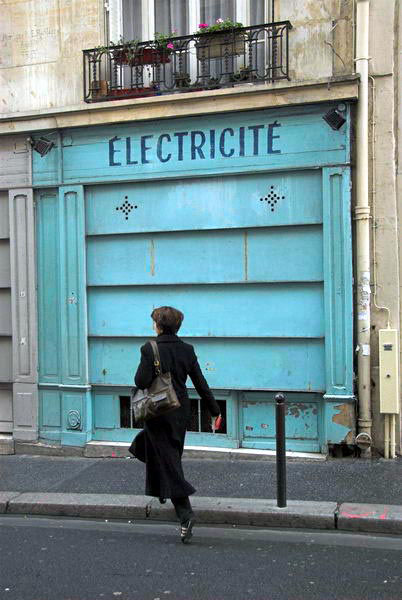
Paris 2006 Peter Marshall (taken in November on my way to Paris Photo)

Like Glick, I’ve also found that scanning my old negatives gives them a new life, and I’ve put many of them on the web, as well as into collections self-published on Blurb. As well as the books on the Lea Valley, Hull and London, the series on London’s Docklands now has four volumes and I’m working on the fifth. And there are already a couple on Paris, one in black and white and another in colour, from the 1980s. All the books are still available from Blurb (and most more cheaply to UK customers direct from me) and although none is likely to become a best-seller, I continue to get occasional sales. Much of the work in the books can also be seen on the web.
Continue reading New York Chinatown