A New Magna Carta?


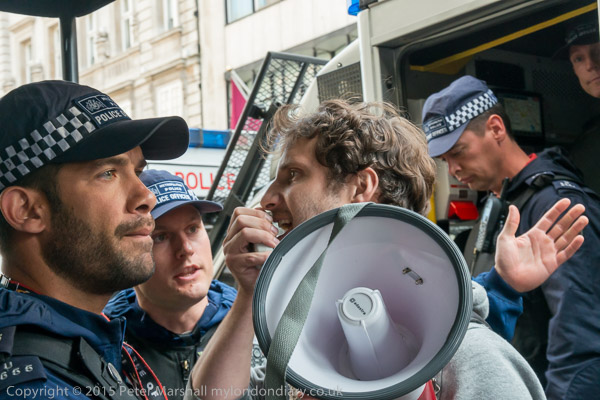
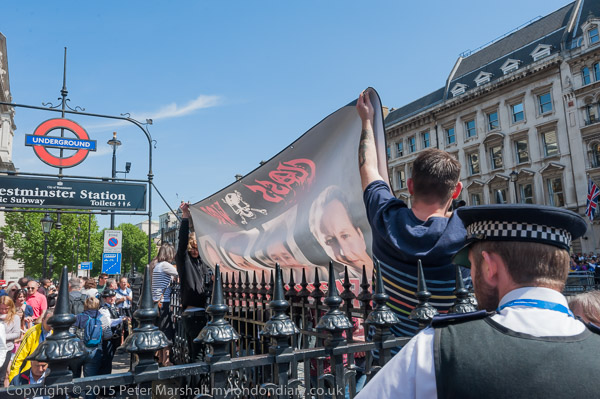
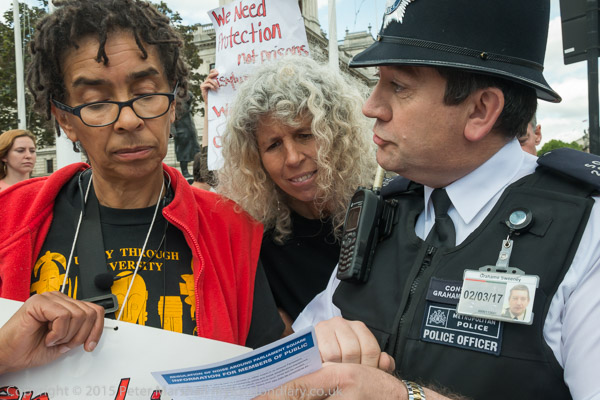
A police officer comes to tell protesters they need permission use a megaphone to speak in Parliament Square

On June 15th 1215 King John met the Barons at Runnymede and put his seal on Magna Carta, which several hundred years later began to be touted as the basis for our legal system and the “foundation of our liberties”. John immediately then went off and wrote to the Pope, Innocent III, and got him to declare it “null and void of all validity forever” on the grounds that he had signed it under duress.

There were later versions of Magna Carta that reinstated the important parts of the treaty so far as our law and liberties are concerned, and we might have been better to wait to celebrate until 2017 or 2025, but in perhaps the whole thing is misguided, as the rights and freedoms involved were not novel, but date back certainly to before the Norman conquest; Magna Carta was their reinstatement rather than their genesis.

What we need now is not a celebration of Magna Carta, but a new Magna Carta, to replace the rights and freedoms that we have lost – and which if our current government has its way we will lose more of, with proposals to repeal Human Rights legislation, bring in corporate control under TTIP, further restrict trade union rights, close down freedom of information requests and more.

Of course it isn’t just the current Tory government who are responsible, not just them and the ConDem coalition. The two previous New Labour governments brought in an enormous number of new laws, many of the impinging on our freedom, and of course governments both Tory and Labour before them. But it does seem to have taken on a new impetus since the last election.
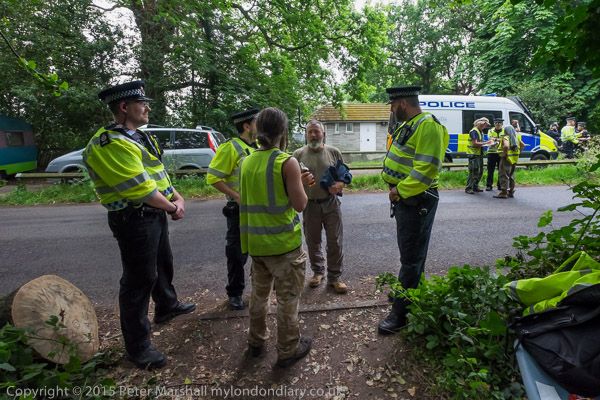

Police prevent people coming to celebrate Magna Carta at the Runnymede Eco-Village

It isn’t just laws, but also the way that the state and authorities act, often using the police and security agencies and abusing the laws. And a very clear example of this was over the suppression of the Magna Carta festival planned at the Runnymede Eco-Village, which I’ve written about here earlier. A huge police operation took place to stop just several hundred people celebrating peacefully close to where the charter was signed.

The Eco-Village was evicted and their homes destroyed around a week ago, following a court decision a few days earlier, which privileged the rights of property owners above those which were important in the thirteenth century charters. The villagers were looking after the forest rather better than the owners, and were not in the way of the development at the top of the hill.
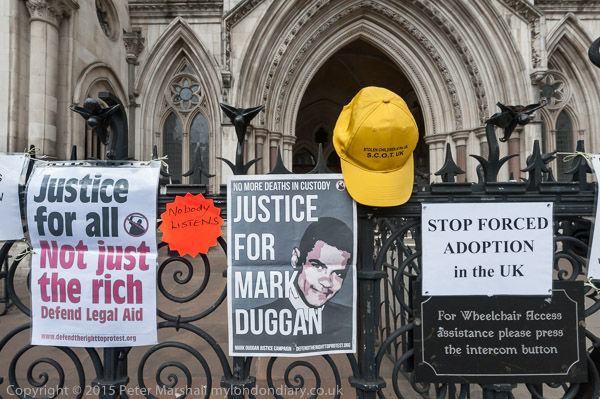
On the anniversary of Magna Carta, I began at the Truth & Justice Magna Carta Day Protest outside the Royal Courts of Justice by the Campaign for Truth & Justice. While there were – as my account I think makes clear – some rather odd characters and views among those taking part, it is hard to doubt that there is something rotten at the heart of our society.
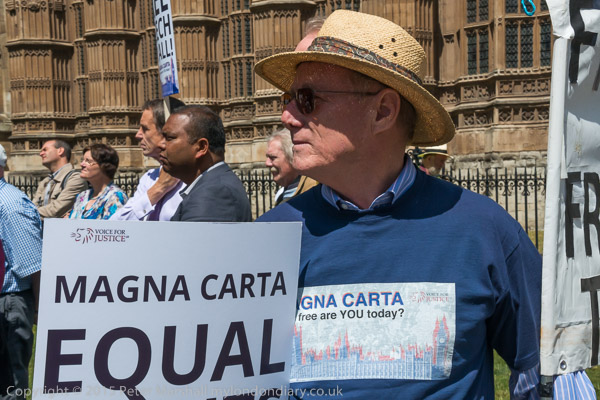
From there I went to another rather odd group, Voice for Justice, with whom I felt rather less empathy. It really did seem to me that these people were protesting for the freedom to be a bigot rather than standing up for the kind of values which I feel important. Though some of their placards said ‘Magna Carta – Equal Rights for All’ they seemed firmly opposed to equality laws.
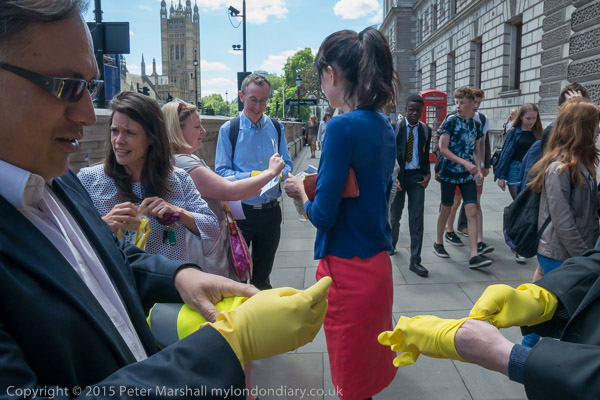

Protesters wore yellow rubber gloves like cleaners might wear

Not far away, the PCS were protesting for a true living wage for all governent workers on the 25th International Justice Day for Cleaners and Security Guards outside the Treasury. Fine I thought, but why just those who work for HMRC. All workers deserve a living wage – something even the government now seem to believe in, though their idea of a living wage is far too low.
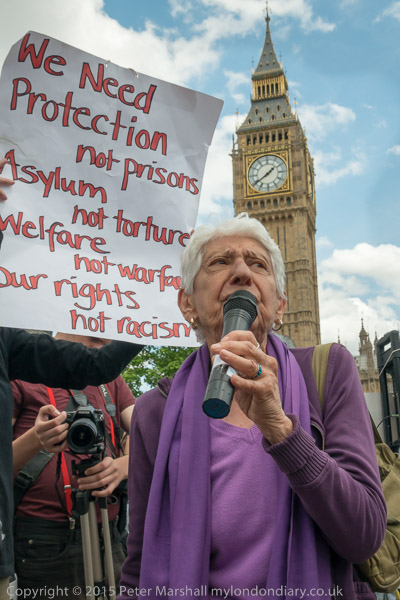

Selma James

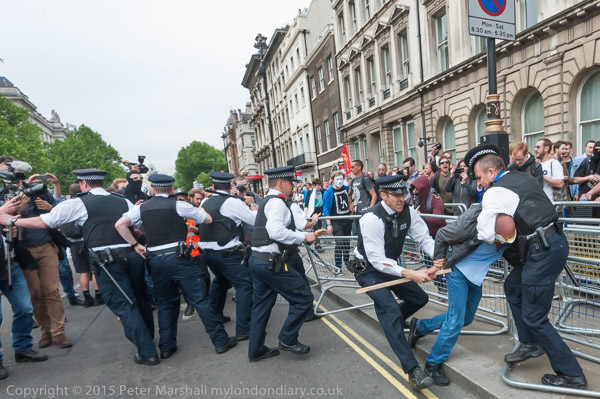
Back in Parliament Square, another protest was taking place, Close Yarls Wood, End Detention! with the All African Women’s Group leading a rally in the International week against detention centres, calling for the closure of all immigration detention centres to be shut down. And up came a police officer to tell them of the restrictions on protest outside Parliament.
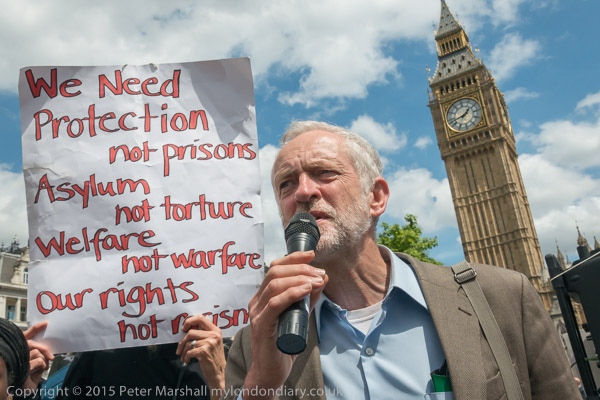

Jeremy Corbyn MP

I’m pleased to say that they more or less ignored him, with Selma James and another speaker being followed by 3 MPs, Jeremy Corbyn, Kate Osamor and John McDonnell before the protesters marched to Downing St to deliver a report on rape and sexual abuse in Yarl’s Wood.
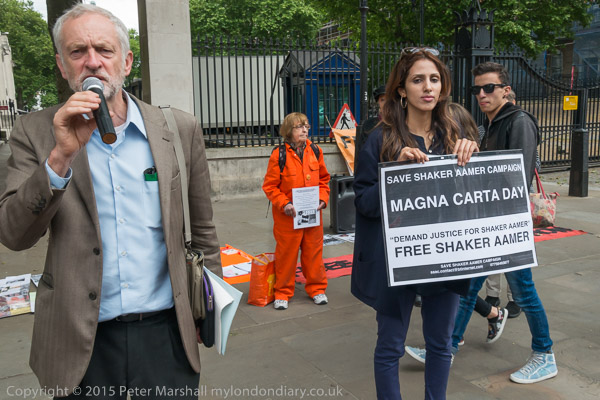

Jeremy Corbyn MP

Downing St was convenient for me, because the next event in my diary, Magna Carta justice for Shaker Aamer was taking place on the opposite side of Whitehall. Speakers there again included Jeremy Corbyn and John McDonnell.
Continue reading A New Magna Carta?

Swanscombe


Coal Wharf at Bell Wharf, Swanscombe. A ropeway took coal to the factory

I’m still working on my North Kent book with images from the 1980s that I’ve mentioned here before, and looking at some of the images from back then made me want to go there again, especially since parts of the area are changing.

Of course I have returned occasionally over the years, and published and exhibited some later images, such as those in Estuary and my book Thamesgate Panoramas (as always those with UK addresses can order the print version more cheaply direct from me, though I recommend the PDF from Blurb at £4.99.)


Where the Eurostar emerges from under the River Thames

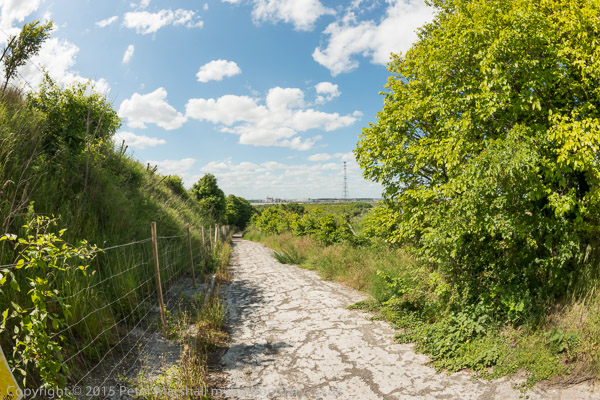
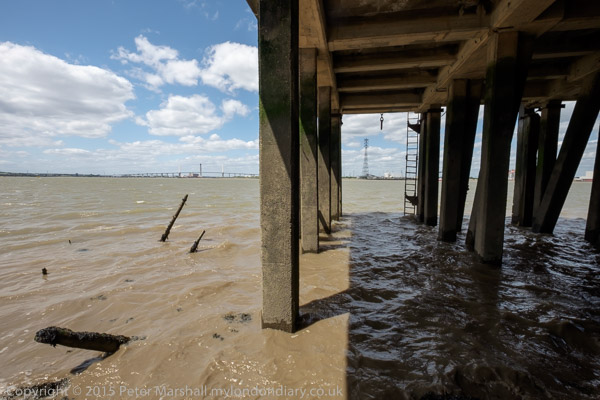
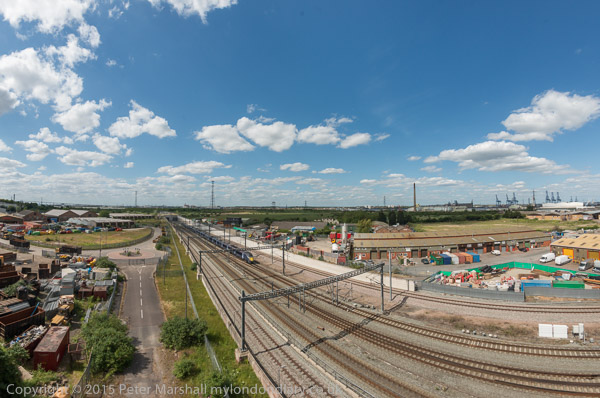
One particular area under threat is the Swanscombe Peninsula, a triangular area of Kent that juts out towards Essex a little to the west of Gravesend. It’s both an ancient and a modern crossing point, where pilgrims crossed the river on their way to Canterbury, and where enormous pylons, 623 ft high, carry the National Grid across, while the HS1 Eurostars dive into a a tunnel at high speeds close to Ebbsfleet station (where just a few stop) though the more local Javelin services reduce the journey times to central London to 18 minutes for the wealthy. There are plans for what sounds like a particularly tacky theme park based on films and TV programmes which has government backing to cover the whole area.


Pilgrims Road – and a giant pylon in the distance on the opposite side of the Thames

I took the slow route to Swanscombe station on a Gravesend train. The time difference for me is minimal, as the fast trains go into St Pancras, to the north of London, and I can catch the slower trains far more conveniently at Waterloo East, and get there about as quickly but with much less climbing up and down and walking in stations. This was important as I was taking my Brompton with me and together with my cameras it adds up to quite a weight. Best not to carry it at all – and I didn’t need to on the marginally slower route.

This kind of consideration makes me wonder about the calculations presented to justify prestige transport projects, such as HS2 against the less sexy options of increasing traffic on existing routes. Shaving a few minutes off the time from Birmingham to London isn’t a big deal if you end up in Old Oak Common – or at the other end you come into Curzon St when your onward journey is from New Street station.  Changing the London terminus for Eurostar from Waterloo to St Pancras might have cut the Eurostar journey times, but had no effect on my overall journey times for that matter.

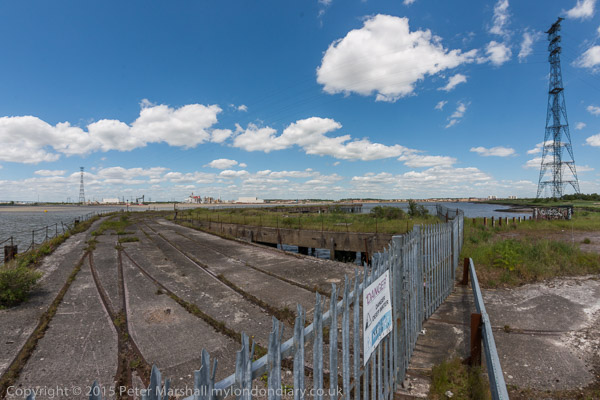
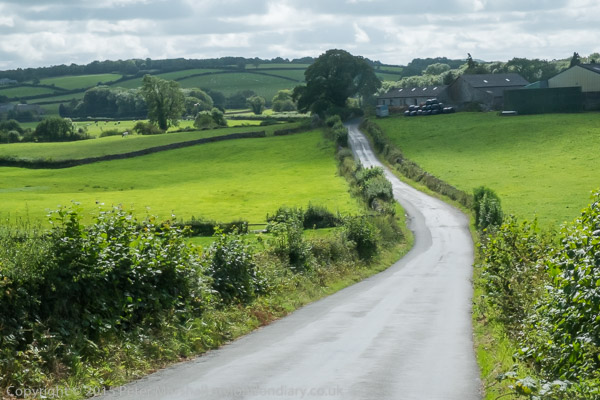
When I first visited Swanscombe it was in parts a desolate wilderness, with heaps of waste from the former cement works, which was still standing. Disused rails led to fenced off piers. Everything now is rather more overgrown, but otherwise much of the peninsula has a similar feel.


Bell Wharf: coal and clay came in, and cement was sent out. Taken standing on the Brompton

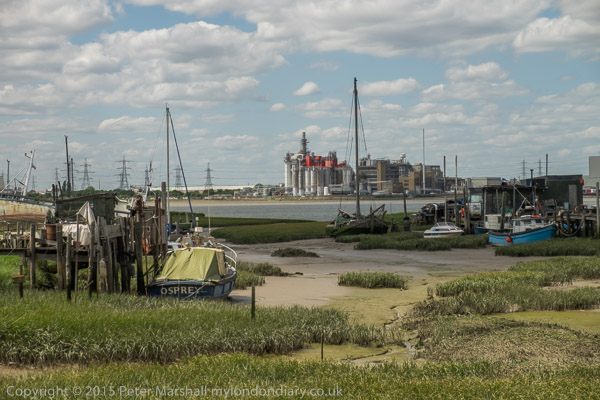
I didn’t find Broadness salt marshes in my early explorations of the area, taking a more inland route and missing it. One of my favourite landscape pictures was taken there in 2006, but I’d never fully explored the area, and this was just one of the things I set out to do.

And I took a similar view to the one, that I’d made 9 or so years ago, though then the tide was rather higher, with the creek filled with water.

The creek is at a dead end – probably why I’d not bothered to go to it in the early days. Then I always went on foot, slow, sometimes exhausting, but still the beast way to see the country. Taking a bike enables me to cover more ground and in areas like this can be ridden along footpaths as well as roads, It means I’m happy to go half a mile down a dead end knowing I’ll just have to ride back, whereas on foot I might well decide not to bother. From here I came back and cycled to another dead end, opposite the Tilbury Docks, before returning and going back by Botany marshes, now rather more domesticated as a nature reserve.

The bike is also useful for photographing over walls and fences. Several images in the Swanscombe set were made with the Brompton leaning against a wall or fence and with me standing one foot on the saddle and the other on the handlebars. There is a tendency for it to roll away dangerously but it does add a useful couple of feet to my stature.

Rather than a normal camera bag, I was using a Brompton bag which fits on the front of the bicycle, and working with two cameras, the Nikon D800E with the 16mm full-frame fisheye, and the Fuji X-T1 with Fuji X 10-24mm (15-36mm equiv) and 18-55mm (27-82mm equiv.) The Nikon images have been converted into a cylindrical perspective with horizontal angle of view around 146 degrees.

For most of the day both cameras worked perfectly, but on the way back to the station I stopped briefly to take some pictures looking south from the main road, which runs along the narrow spine of chalk left between two large quarries. I wanted to be sure to get good detail so I turned the ISO dial on the Fuji X-T1 down to 200. Unfortunately the dial below the ISO dial, the Drive dial, turned as well, into the so-called ‘Advanced Filter’ position, with disastrous results.


Fuji’s ‘Advanced’ filter uncorrected. I’m not sure whether this was ‘Toy Camera’, ‘Minature’ or ‘Pop Colour’

The Advanced Filter selection is a clear case where more is less, a capability the camera would be better without, though presumably marketing don’t think so. There are perhaps people who want a setting that destroys your images in camera rather than leaving that to Photoshop, but I’m not one of them.


A near identical frame after considerable general and local work in Lightroom

Worse still, not only do the ‘Advanced filters’ mess up  your pictures with silly effects, they also switch from Raw to jpeg. I was left with garish images, all subtlety of colour lost, and because they are jpegs it is impossible to get back to the original image. I’ve done my best with the image above, but the sky in particular remains impossible, with all cloud detail absent and some vignetting still visible. You can see the difference if you compare it with an image taken at more or less the same place using RAW with the Nikon.


Nikon D800E, 16mm fisheye. From RAW file

The default settings on the X-T1 actually make it very easy to select the filter in error, simply by pressing the Fn1 button to the right of the lens mount.  It’s one of several defaults it makes sense to change to something innocuous.

On My London Diary you can see more of my pictures of Swanscombe and the adjoining areas and also read more about the area, my ride around it and the pictures.

Continue reading Swanscombe

July 2015


Al Qud’s Day march in London

It seems to take me a long time to get anything done. But finally I’ve finished writing and uploading the diary entries and images for July to My London Diary. July turned out to be rather a disappointment for me in various ways, not least in my Nikon D800E suffering what I think is a terminal breakdown.

Jul 2015

Reinstate the Sotheby’s 2
BBC protest over Palestinian Hunger Strikes
National Gallery Leaving Party
Loddon & Thames


Kurds blame Turks for Suruc massacre
Make seats match votes
FreeSteve Kaczynski from Turkish Jail
Festival of Our Lady of Mount Carmel
10 years since Iran hanged gay teenagers
Ecuadorians support ‘Citizen Revolution’
Eritreans Vigil for Peace?


Falun Dafa vigil against Chinese Atrocities
Whitecross Street Festival
Justice for Tyree
Reinstate the Sotheby’s 4
The Jurors


Surround Harmondsworth
Al Quds Day march
IWGB protest at Royal College of Music


Sotheby’s 4 sacked for protesting
Save Shaker Aamer weekly vigil
Joint Strikers Budget Day Rally
DPAC Parliament Square Budget Day protest


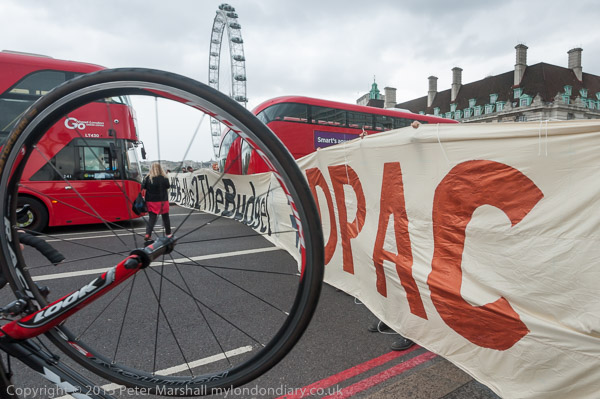
DPAC blocks Westminster Bridge
DPAC ‘Balls to the Budget’
Darent Valley Path & Thames


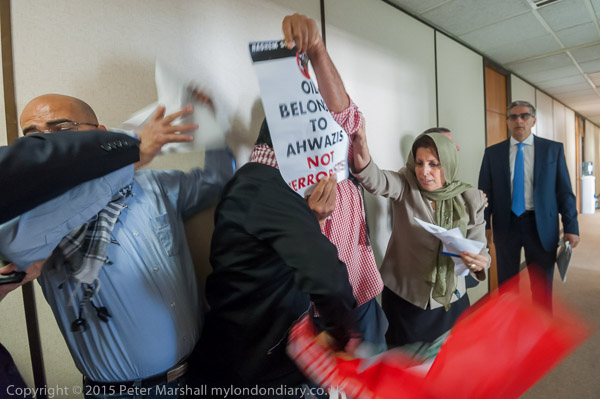
Ahwazi crash secret UK-Iran business meeting
Sotheby’s ‘Dignity under the Hammer’ protest

Continue reading July 2015

Gibson’s Political Abstractions

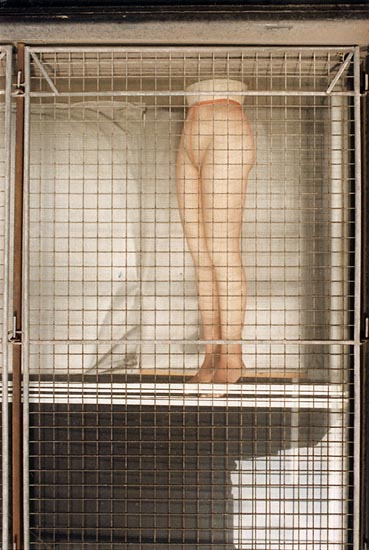
A post in the L’Oeil de la Photographie sent me looking again at the work of Ralph Gibson,  who has a show which opened a few days ago at the Mary Boone Gallery in New York, Political Abstractions. The show, which continues until Oct 31, 2015 consists of diptychs, pairs of images sometimes in colour and sometimes black and white. I’ve read the text in L’Oeil and in the gallery press release without getting a great deal of enlightenment, but you may do better than me.

One of the things that inkjet printing makes easier it printing a black and white and a colour image on the same sheet of paper, and most of the images on-line pair colour and black and white, though some use two black and whites, and I think one – on Gibson’s own site – has two rather similar colour images. But mostly the pairs seem fairly unrelated, with a few showing a similar line or shape (or pattern or shadow, according to the press release, which also has nice summary of Gibson’s signature “everyday objects isolated, strongly shadowed, and cropped so that they become potent and mysterious.”)

I fail to understand why Gibson terms these works ‘Political’, though the release states: “The subject of the work
becomes not the individual images, or their juxtaposition, but the act of looking” which may be behind the use of the term.

Early in my time as a photographer I became something of a fan of Gibson, and certainly made a few images that (for me at least) recalled some of his in the early 1970s, and my copies of his Lustrum trilogy, The somnambulist (1970), Deja-Vu (1973) and Days at Sea (1974) are dog-eared and falling to pieces. Though I’ve also been impressed at more recent shows and publications it sometimes feels that there is little new in his work. There is perhaps only a short divide between a style and a rut and sometimes I’m unsure which side of that distinction the newer work lies. But there are still images that Gibson produces that have a powerful resonance. Whether or not that is increased by pairing them I leave – like Gibson – to the viewer.


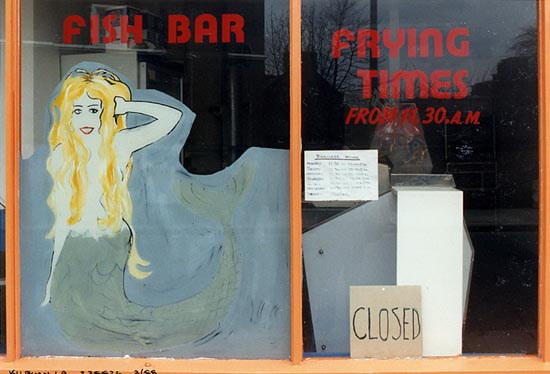
Kensal Green, 1988. Peter Marshall, from Café Ideal, Cool Blondes & Paradise

Ralph Gibson certainly encouraged my photography through his publications (including the other books from Lustrum as well as his) and also in person on the one occasion I showed my work to him, I think in 1988 when he had a London exhibition at the Photographers’ Gallery. Not just to him but at a public criticism to a crowded space in the gallery where I took up my portfolio with some trepidation, after he had been fairly tough on the work of a previous photographer. I’d taken colour prints – from the body of work that produced (among other things) my ‘Café Ideal, Cool Blondes & Paradise‘ and he spent some time looking through the book as I stood there shaking.


Shoreditch, 1986. Peter Marshall, from Café Ideal, Cool Blondes & Paradise

His comments and questions were fortunately both perceptive and positive and it was a great encouragement to me to continue that work.

Poplar, 1988. Peter Marshall, from Café Ideal, Cool Blondes & Paradise

Continue reading Gibson’s Political Abstractions

Summer 2015?

Today it really seems summer is over. The rain stopped and I went out in the sun, getting a little hot in my jacket to buy something to bring home for lunch, thinking it would be nice to sit out in the garden and eat it with a glass of wine, but by the time I got home, dark clouds filled the sky and there were a few drops of rain. And it was dark by 8 o’clock.

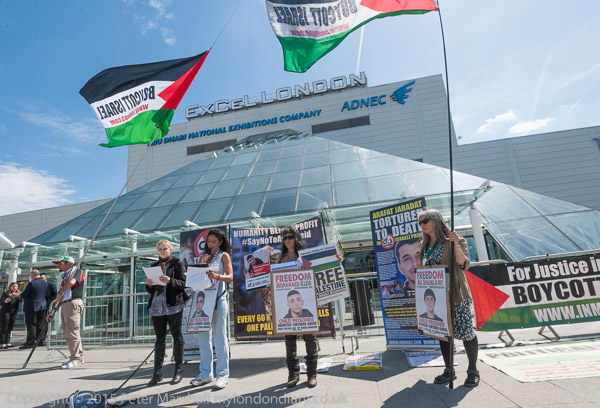
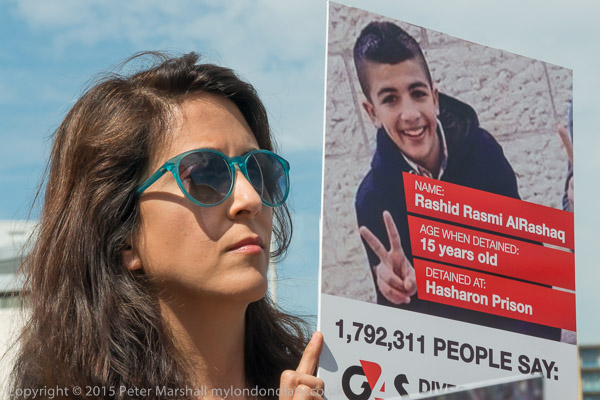
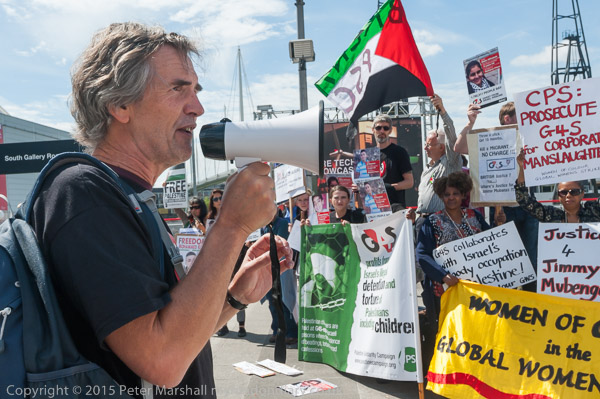
Looking back we hardly seemed to have had a summer at all, but there were a few good days, and one was early in June, when there was a protest in the morning at the Excel Centre in East London, where G4S had chose the UN International Day of Innocent Children Victims of Aggression to hold their AGM. Actually like me they probably didn’t know there was such a day, but it was established back in August 1982. And though it’s an international day and relates to all children around the world, it was established because the UN General Assembly, meeting in a emergency special session on the question of Palestine, was “appalled by the great number of innocent Palestinian and Lebanese children victims of Israel’s acts of aggression“.

Unfortunately the UN General Assembly’s resolution 33 years ago appears to have done little to change the situation for Palestinian children, and the protest was aimed at G4S because of its involvement in running the Israeli prison system in which young Palestinians are held, sometimes in solitary confinement in underground cells, are threatened and sometimes tortured. There are regular protests outside the G4S HQ in Westminster which I’ve occasionally covered, but the AGM brings together a wider range of organisations comprising the StopG4S coalition to protest, not just about their work in Israel but also in this country, where they are best known for their failure to provide security at the London Olympics and the death of Jimmy Mubenga during his forcible deportation. They currently run five UK prisons as well as a young offender institution and secure training centres and “is the main provider of in-country escorting, overseas repatriation services, and the operator of four of the eight of the privately run immigration removal centres in the UK.”

Although there was plenty to photograph outside, with protesters from the various groups, much of the protest takes place inside the AGM, where protesters purchase shares to entitle them to attend. When they ask awkward questions or otherwise protest inside the meeting they are removed, sometimes rather forcefully, by security staff. After the bad publicity following the publication of a mobile phone video taken of this at last year’s AGM, mobile phones were not allowed to be taken inside at this year’s events – and I certainly had no chance of taking pictures there.

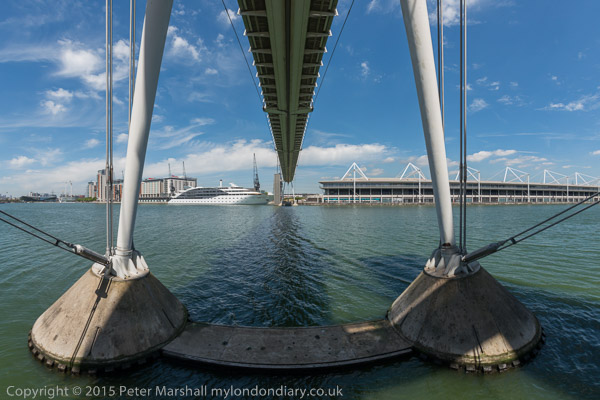
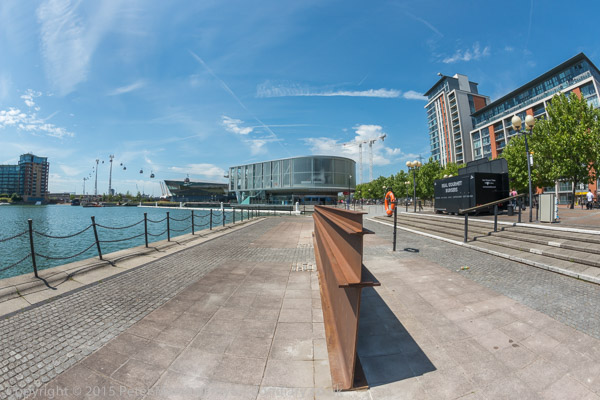
But it was a fine day, and the protests had started early, and by 11.50 I felt I’d taken enough (though looking back at G4S AGM Torture Protest I think I could have done better) and had the rest of the day to myself. I started by going over the high-level bridge across the Victoria Dock next to the Excel Centre, then walked around the dock to photograph the three sculptures there as a part of The Line – Sculpture Trail.

It was an experience that left me under-impressed. The docklands cranes, the high level bridge and the cable car all seemed rather more interesting than the sculptures, with the only work of the three there really having a strong presence being the tall figure of Vulcan, a 30ft-high bronze by the late Scottish artist Eduardo Paolozzi. This proved tricky to photograph, situated on a corner where I wanted to be suspended over the water for what seemed likely to be the best viewpoint. Perhaps it would be easier at a different time of day.


Martin Creed’s ‘Work 700’ perhaps looks better straightened out

I was working to produce very wide angle images, using the 16mm fisheye on the D800E, and transforming these to remove the curvature of vertical lines. The D800E has a big advantage for this in helping you to get the camera level, providing markers at the right and bottom centres of the viewfinder. Get both of them showing as little triangles and you have the camera straight and level. It would be slightly easier with the camera on a tripod, but you can – and I always do – work hand-held.


Barking Barrage

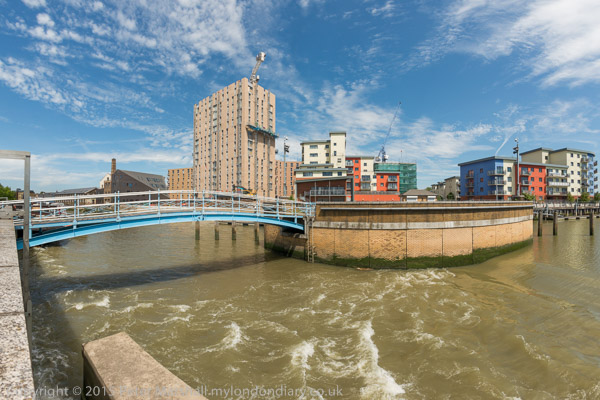
As usual I’d bought a Travelcard, so I could then travel on to anywhere in London, and decided to revisit the River Roding and Barking Creek. I’d tried a few years back to walk along the riverside path there and found it was closed. Unfortunately I found it still was and again had to walk in the other direction and went as far as the Barking Barrage, which I crossed and then returned along the other side of the river to the A13 to catch a bus.

Continue reading Summer 2015?

Celebrating Corbyn


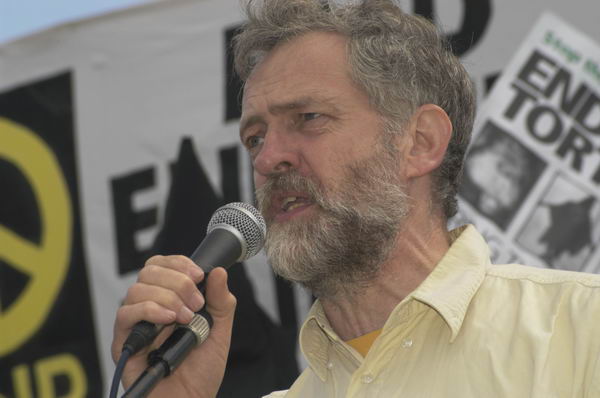
Jeremy Corbyn, MP, End The Torture, Bring The Troops Home Now 22 May 2004

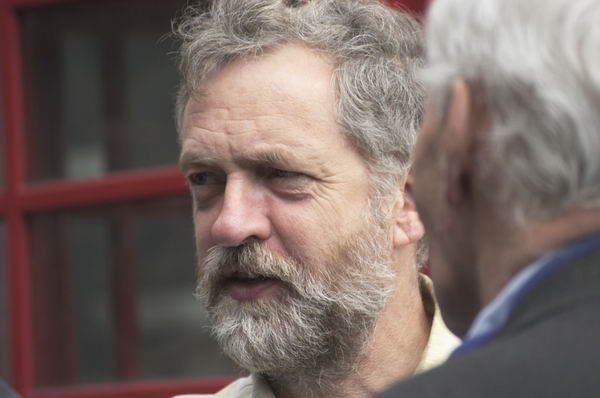
As I sat in the garden this afternoon, taking a rest after a week of hard work – 16 stories in the last six days – and still quietly celebrating Jeremy Corbyn‘s victory in the Labour leadership election with another glass of white wine, I wondered when I had first photographed Jeremy.

Certainly it was long ago, almost certainly in the BD era (before digital, which for me really means before 2002.) In more recent times it sometimes got to be embarrassingly often bumping in to him so regularly, along with another Labour MP Jphn McDonnell, destined now for a leading role in the Shadow Cabinet. Both men I admire for their integrity, even if their views on the moderate side. The idea of Corbyn being on the extreme left put forward by Cameron and other Tories (including some in the Labour party) is laughable, though I hope his election is a sign that we genuinely have a widespread reaction against the lurch to the right by Thatcher and Blair.

But enough party politics. Searching for my pictures of Corbyn presented some problems, but mainly that before digital I have only a limited capacity to search my images digitally. I actually got seriously into computing with an Amstrad PC 1512 in 1986, though I’d by then been using computers at work for six or seven years, mainly to catalogue my work. And I do have a database that lets me find images by locations and key words that I started then and covers my black and white work until sometime in 2000. But somehow it never seemed worth taking the time to fully enter people and events I covered into this, though some get on it. Most were filed separately to my main projects which were largely related to the urban fabric of London and thus not entered on the database.

Although I went digital to the extent of buying a Nikon D100 at the end of 2002, I could only afford one Nikon lens, a 24-85mm (equivalent to 36-127mm). The library I was then submitting images to could not at that time handle digital files, working with only black and white prints and colour transparencies, so most of my serious work was still on film. My earliest pictures of Jeremy will certainly be somewhere in those black and white negatives and probably in the 1990s.

By 2004 when the two images above were made I was still working with the D100, but had managed to afford a longer lens, though I can’t now remember which it was. The top image was taken at 140mm (210mm eq) and the lower one at 195mm (292mm eq), both in Trafalgar Square. I suspect it was a fairly cheap Sigma zoom, perhaps a 55-210mm, possibly the one that disappeared out of my camera bag in January of the following year when I was photographing the Red Army Choir. Not I hasten to add by one of the choir members, but in the very densely packed crowd of onlookers. I wasn’t too sad to lose it, though it was a very light lens to carry, but it did give me a good excuse to buy the newly introduced Nikon 18-200mm.


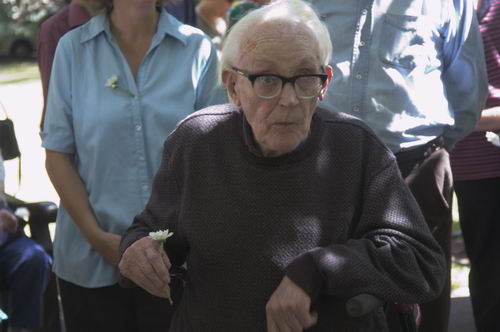
Michael Foot, Hiroshima Day Aug 6th 2004

I’d photographed Jeremy again as he compered the annual Hiroshima Day Ceremony that August, but its a rather ordinary picture and I seem to have been having problems with developing raw images at the time. Perhaps more interestingly, also present is someone with whom Jeremy is sometimes compared, Michael Foot, and I have several pictures of him. Foot was crucified by the press for wearing a donkey jacket to the Remembrance Day protest (of course it wasn’t really a donkey jacket) and Jeremy will doubtless get similar treatment this November, both for his attire and the white poppy he is expected to wear (though he might follow the advice of some others I know who wear their white poppy together with a red one.)


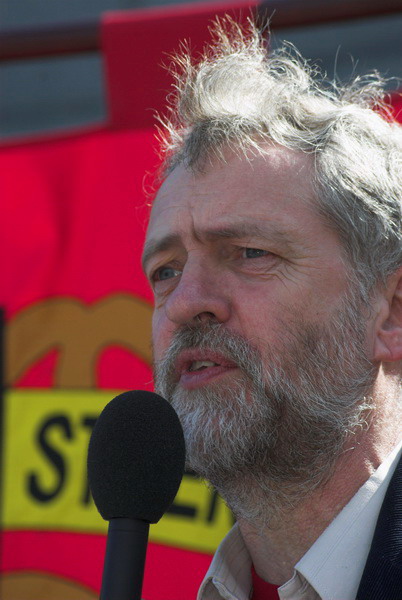
International Workers Memorial Day London, April 28, 2006

I’ve always felt that Jeremy and I share the same tailor, though not literally, but we certainly have a similar attitude to dress and hair. His hair is rather more lively than mine but we have quite similar beards and I have occasionally been mistaken for him, though I don’t think we look much alike.


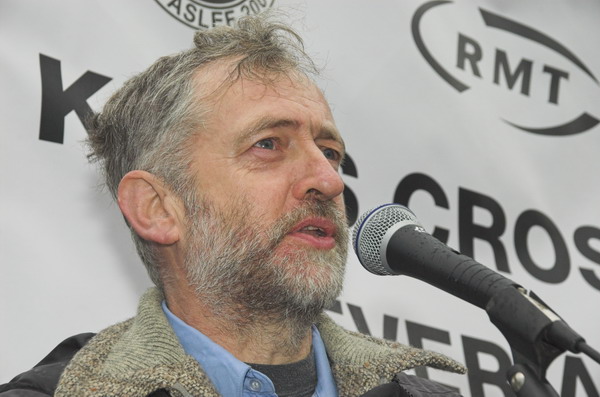
Kings Cross – never again! London, 26 Nov 2005

By November 2005 I was working with a Nikon D70, bought on the cheap as a grey import. Although an ‘amateur’ camera it was far superior to the D100, and by then I was getting rather better at raw conversion, partly because of improved software.

Time for another glass. Though for Jeremy it will be another cup of tea.

Continue reading Celebrating Corbyn

The New East

Somewhere I picked up a link to an article in the Calvert Journal from July this year, In focus: 29 women photographers picturing the new east written by Anastasiia Fedorova who states:

With cameras in hand, women are leading the way in defining the visual identity of the new east. Reclaiming their gaze from a conservative, male-dominated society, they are exploring gender roles and sexuality, myths and archetypes, the body, landscape and the urban environment. Here’s our pick of the female photographers at the head of the pack in picturing the new east.

Its an interesting selection, with much worth looking at. Quite a few of the photographers are now working mainly in the old west so some names may well be familiar to you.

I wondered about the Calvert Journal, which I’d not come across before and find it is published by the Calvert 22 Foundation, “a non-profit UK registered charity created in 2009 by Russian-born, London-based economist Nonna Materkova” which describes itself as providing: “A guide to the contemporary culture of the new east: the post-Soviet world, the Balkans and the former socialist states of central and eastern Europe” and as well as publishing the on-line Calvert journal established the Calvert 22 Gallery, (currently closed for refurbishment) dedicated to the contemporary art of Russia and Eastern Europe, in two floors of a converted warehouse on Calvert Avenue in Shoreditch, East London.


Arnold Circus, Bethnal Green (C) Peter Marshall, 1986

Calvert Avenue is a street I’ve often walked down, leading to Arnold Circus, at the centre of the Boundary Estate which has a good claim to be the oldest council housing in the world, built starting in 1890 by the Metropolitan Board of Works and completed by the then new London County Council. (That body’s successor, the Greater London Council, was the victim of one of Thatcher’s most malicious and senseless acts, from which London still suffers, with a ridiculous, divided and unsuitable system of government for a major city.)

It was a slum clearance scheme, replacing part of London’s most notorious slum, the ‘Old Nichol’. You can read a little more about it in my post Bethnal Green Blues, and much more about the area as a whole and its people in Cathy Ross’s ‘The Romance of Bethnal Green’ which that post is partly about.

The gallery and other recent developments in Calvert Avenue are a part of the gentrification of the area. One blogger described it in this way: “Just a few years ago it was semi derelict save for the launderette and newsagent, but now the street is a buzzy destination for the style-savvy supporters of the independent retailer revolution.” That semi-derelict street was of course the home to many who now find themselves priced out of the area as it gets taken over by oddly-bearded ‘hipsters’.

One of the events I missed photographing in July was a street party in neighbouring Camden; its event page on Facebook included the following:

The heart of Camden is being ripped out, pubs are being converted to luxury flats no one can afford, venues are under threat, the market is flogged off to be a casino (and yet more unaffordable flats) Rents are rising….fast.

Soon this community will be an unrecognisable, bland, yuppie infested wasteland with no room for normal (and not so normal) people.

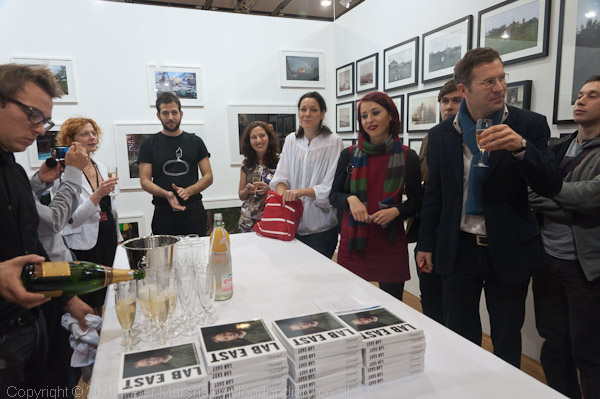
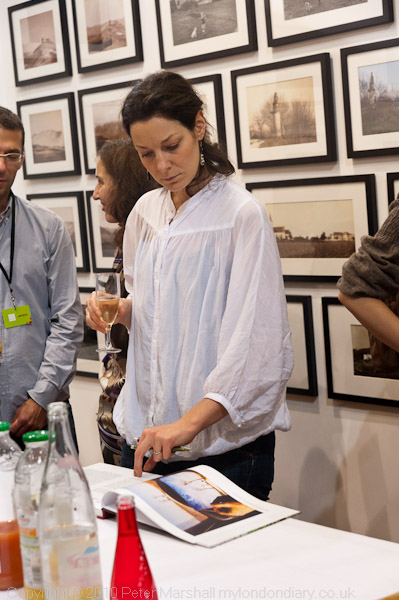
Back in 2010 at Paris Photo I went to the launch of the book ‘Lab East’, featuring 30 young photographers from Central and Eastern Europe, writing about it on this site.

I don’t think any of the women from this book are included in the Calvert Journal feature. Partly this reflects the great number of interesting photographers emerging from Central and Eastern Europe, but also I think that ‘Lab East’ seems to be more at a grass roots level, while the more recent feature is more about those who have already made it in the west.

Eight a Day

I don’t normally do Royal occasions. I think the only sensible approach in British history regarding the monarchy happened back in 1649, with the execution for high treason of Charles I, though I don’t approve of beheadings. Just a shame that the Commonwealth went wrong and the monarchy was restored.  I also don’t like royal occasions because of the gawping and fawning crowds, and also the security that surrounds them. And opportunities for photography, except for a privileged few, are often rather limited.  So May 27th this year was the first time I’ve ever been in London for the State Opening of Parliament.

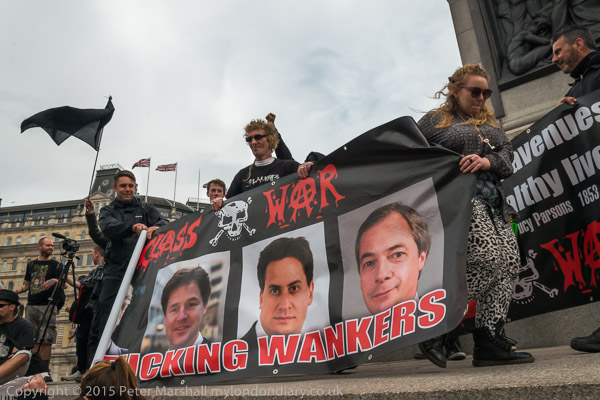
I hadn’t gone to photograph the Queen, but some of the friends I’d made covering the protests against ‘poor doors’. Class War had decided to protest at the event.

It wasn’t the best planned of protests, and they had perhaps not  realised the enormous level of policing that would be applied to ensure that the right to protest was denied to anyone in the area on the day.  Quite why the Queen should be granted this level of immunity from protest isn’t clear.


Nikon D700, 16-35mm

But one group of protesters I was with was stopped around 50 yards from the royal route, and then were escorted away and followed closely by police for the next couple of hours. A couple of others were more successful, managing to display the Class War political leaders banner for perhaps half a minute on the actual route – though a quarter of an hour before she came down it. Police jumped on them rapidly, forced them to take down their banner and made sure the moved away.

After a while Class War decided to make their way to a nearby pub. They were followed by at least twice as many police who stood on the opposite side of the road watching and were still there an hour later when I left to go elsewhere. More about it at Class War protest Queen’s speech.


Nikon D800E, 18-105mm DX

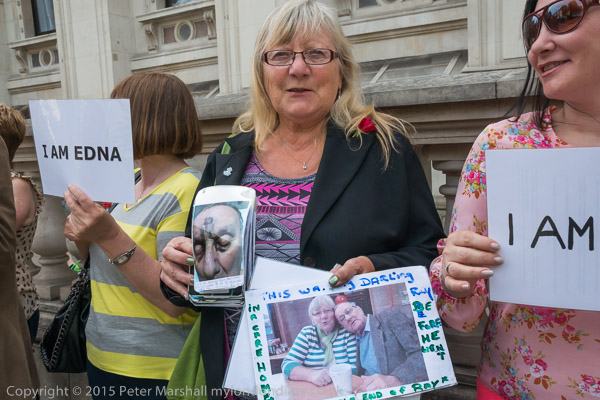
Here, well away from the Queen, a protest was taking place, but very differently. The organisers of ‘I am Edna’ – protect whistle-blowers had applied to the police for permission and had accepted the limits they had set for the protest. I think these included not using amplification of any kind, staying in one place and not handing out leaflets. Most protesters would find these unacceptable.

I continued on my way to Trafalgar Square and sat down to read a book while I waited for the next protest. But soon I looked up and saw that some Class War people had come to the square and were standing close to me. There were now only two police officers watching them from about 20 yards away, even though they were only standing around in the square.


Nikon D800E, 18-105mm DX

Suddenly we noticed another small group of police had arrived and were surrounding a man, questioning and apparently arresting him, and people rushed across to find out what was happening.  Police pushed those asking questions away and refused to say anything about what was happening, and a larger crowd of those waiting in the square for a further protest soon gathered around.

More police came, and the man was marched away followed by a large group of protesters to one of the many police vans now around the area in Northumberland Avenue. A young man standing there was roughly pushed aside by an officer, and when he objected was arrested as well.
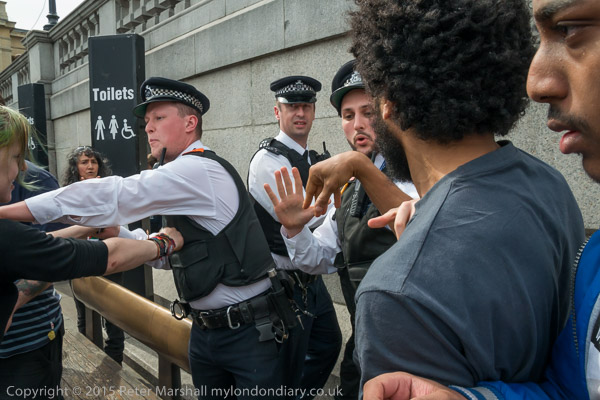
By this time, surrounded by an angry crowd, some of the police realised that they needed to explain their actions, and eventually we found that the man arrested first was not being taken for anything connected with the protest but for an earlier offence elsewhere. Had that been made clear earlier the situation shown in Police arrest man in Trafalgar Square, including the second arrest – could have been avoided.


Nikon D700, 16-35mm

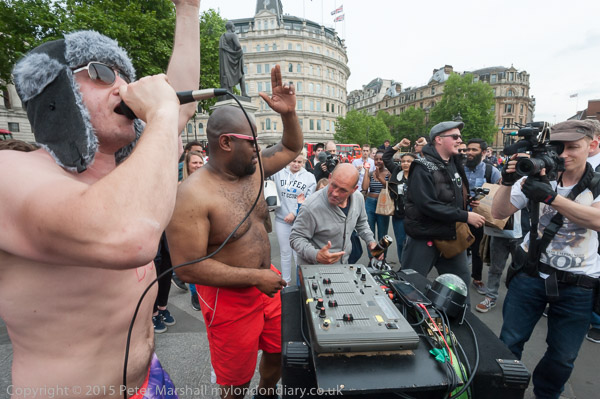
Next we heard loud music, and ran across the square to find a mobile disco and people dancing. Disco Boy had come to play Trafalgar Square as an unsolicited warm-up act for the student protest expected shortly. I followed him and the dancers until he left the square, going on to play in Whitehall and outside Downing St.


Nikon D800E, 18-105mm DX

More noise told us that the student rally organised by the National Campaign Against Fees and Cuts, NCAFC, was beginning, and all those who had been waiting around the square for this hurried towards the plinth of Trafalgar Square. Class War had come to support them and took their place on the plinth with them, getting huge cheers when they unrolled their new political leaders banner, along with several others.

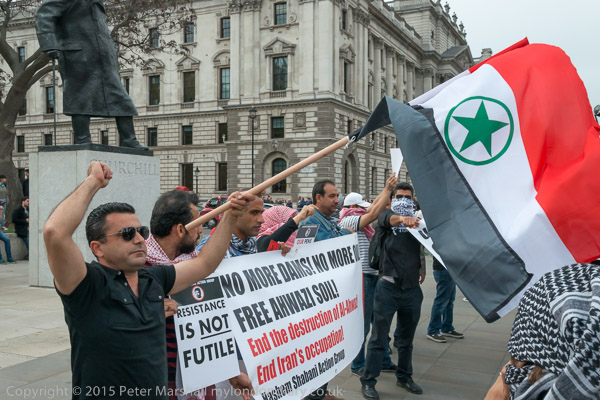
The NCAFC perhaps felt a little upstaged by this, and by others who joined them on the plinth, the Hashem Shabani Ahwazi Arabs, and although there were several speeches by student leaders, it felt a little downbeat.


Nikon D750, 16-35mm

But the rally was only a prelude to the NCAFC March against ‘undemocracy’ which soon started off down Whitehall towards Parliament. Police formed a line across just before Downing St, but officers were too spread out and it would hardly have stopped a Sunday School outing, with students soon pushing past. The police made a more determined effort to stop the marchers lower down in Parliament St where barriers had made the road narrower, with some parked police vans. A few students were pushed to the ground by police and held, but many of the students simply did as I did and walked by on the other side of the barriers.

After a few minutes – and a little posing with batons and some arrests – police realised they had failed and withdrew, continuing to follow the protest as it went through Parliament Square and up Victoria St.


Nikon D800E, 18-105mm DX

I’d more or less loss interest and stopped to record yet another protest as the Ahwazi Arabs had left the march in Parliament Square to call for an end to the Iranian attacks on their heritage and identity in their homeland which was occupied and incorporated into Iran in 1925, mainly because of its rich oil fields.

I ran on to find the NCAFC marchers again, and caught up with some of them marching back towards Westminster along Petty France. They protested briefly outside the DWP in Tothill St but a line of police diverted them from the Conservative HQ around the corner and they came back through Parliament Square to go up Whitehall and protest outside Downing St.


Nikon D800E, 18-105mm DX

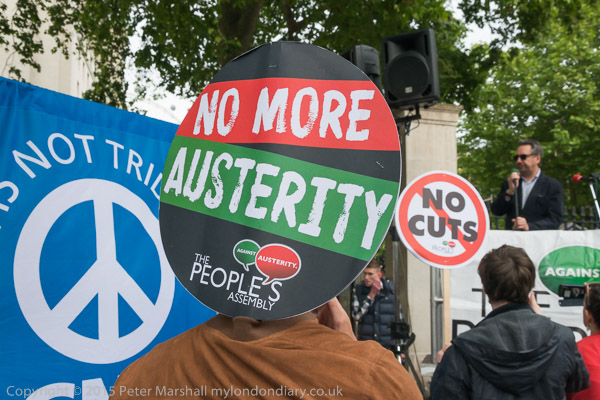
It was unfortunate – though not unexpected – that the People’s Assembly had decided to organise their own End Austerity Now rally at the same time as the NCAFC march.  But when that march stopped outside Downing St, the People’s Assembly rally was still going strong and I went across to take pictures there for a few minutes.

Visually it wasn’t exciting, just people standing around, few of them with placards or posters, listening to speakers. Most of them were saying things we’d all heard many times before, and most of the audience could probably have gone up and made the same speeches. I amused myself a little in the image above lining up the circular symbol and placards like some gear train in a machine, imagining it was generating the speech that John Rees at right was producing.

When I made it back across the road the rest of the NCAFC marchers had arrived, and within a minute or so they started to leave, intending to go up the Mall to Buckingham Palace. I turned in the opposite direction; the light was fading fast and it had been a long day, covering eight stories, and I had much work still to do on them.
Continue reading Eight a Day

Holiday Pictures

As regular readers may have noticed I didn’t post much last week. I was away from home staying together with a group of friends in a large house overlooking Morecambe Bay, and although I did take a notebook computer with me as well as a smartphone so I could check e-mail etc, neither is really comfortable for writing. Anything more than a dozen or so words on the virtual keyboard is a trial, and although my notebook has a half-decent keyboard, its smaller screen makes putting together pictures and text tedious. Coupled with a rather flaky WiFi signal at the residence posting would have been difficult.

But I was in any case on holiday, getting very tired with a lot of walking and largely thinking about other things for a week, though of course I did take some pictures. I’d not taken the Nikons – too heavy to carry around, but I did have a fairly useful kit, with the Fuji X-T1 and X-E1 bodies, 10-24mm, 18mm, 18-55mm Fuji lenses, the Samyang fisheye and a Leitz 90mm f2.8 short telephoto. Along of course with half a dozen batteries, the whole lot weighs around a third of my normal Nikon kit.

Two batteries per camera body per day seems to be the absolute minimum for the Fuji cameras, even if you take few pictures. I was glad that I’d taken along my ExPro dual channel charger too, as those batteries are slow to charge. I still think there is some kind of power fault in my X-T1, though it’s been back for servicing at Fuji twice. Sometimes batteries seem to run down very quickly and the body gets rather warm.

The only lens I didn’t use at all on the trip was the fisheye, though I wish I had. There were many truly panoramic views that it would have done justice to, where I used the rather less wide sweep of the 10mm end of the wide zoom. Nothing wrong with the pictures, but looking at some of them I feel a truly wide view might have been an improvement. I need to be in the right mood to use the fisheye, and somehow that didn’t happen.

Perhaps its just that I’m not really a landscape photographer, and just didn’t get sufficiently involved with my subjects in the AONB (Area of Outstanding Natural Beauty) we were staying in and walking around, Arnside & Silverdale. Or perhaps I was simply too exhausted; the web site says it has “almost 100km of well-maintained footpaths and narrow lanes and byways” and we seem to have walked along most of them at least once in our week there. Certainly we walked well over a 100km in the week, though there were some paths we took numerous times; my legs are still recovering.

When I started using digital seriously at the end of 2002, working away from home for any length of time always involved the problem of how to store the images that you were producing. Then we worked with Compact Flash cards, and back then a 1Gb card was  large, though if like me you worked with RAW images, still only large enough to store a few hundred compressed images. Since then, images have increased from 5 or 6 Mp to two or three times this size, 16 Mp on the Fuji X-T1, but 32 Gb cards now cost less than half the cost of much slower 1 Gb cards then.

So now there is no need for portable hard-disk based storage devices like the ‘Image Tank‘ I had to use back then, with its slow copying from cards to tank every evening. I took with me two 32 Gb SDHC cards and several 16 Gb spare in case I should fill these.

I take relatively few pictures when on holiday compared to working, and when I got home and sorted through eliminating the obviously worthless and some at least of the duplicates, the total for a week was just over a thousand images – 29Gb. I’m now slowly working through these, selecting the best and processing them to write them out from Lightroom.

Processing images from Fuji cameras takes rather longer than from Nikon RAW files. Using the Nikon cameras – particularly the D700, D800E and D810 – working with automatic white balance (AWB) in most cases gives an excellent colour balance, but all my files from the Fuji cameras, also taken with AWB, are off balance.

Yesterday I posted about this on a Fuji Facebook group and found other photographers have a similar problem. Their best advice seems to be to always work at a fixed colour temperature – such as 5000K – and then batch correct for images taken under the same lighting conditions using Lightroom.

I poked around in the camera manuals and menus and found that under the Auto white balance setting there is a WB Shift option. (I think there is the same facility on the Nikons, but I’ve never needed to use it.) I’d assumed that the default 0,0 setting on this would always give correct AWB, but it turns out that this is not so.

Soon I found myself facing a white wall and making a series of exposures with the X-T1 at different settings to find a proper white by adjusting the AWB setting, settling on R2, B-5. I just hope now that the same setting will actually give a true AWB under different lighting conditions. It’s a shame I hadn’t realised this before, though I think the X-T1 when I first used it gave better results with AWB and suspect it changed with one of the various firmware upgrades.

I also found that the X-T1 enables you to measure and store three custom white balance settings by photographing a suitable white object, though it isn’t possible to alter the names of these from Custom 1, 2 and 3. The X-E1 has only one custom setting. You can also alter the built-in settings (Fine, Shade etc) to your taste, and also the Kelvin colour temperature settings. This seems a little odd; 5000K should mean 5000K, and perhaps it does, and the adjustment is simply intended to enable you to chose colour temperatures between those offered on the menu.

I file all my images on the computer in folders by date of taking, which I find the easiest way to locate files. You can also set up virtual collections in Lightroom under various subjects or search on keywords to locate images on the same subject etc. The web site ‘My London Diary’ also acts as a useful index to my work, with its site search. It includes a representative selection of virtually all my digital work, with captions and other text allowing searching even if images are not key-worded. LR searches are fine, but are restricted to a single catalogue. LR can’t really cope with huge catalogues, and I have now decided to start a new one every year for my digital work.

Working through the holiday images, I have the additional task of selecting them on metadata into groups taken with each camera. I work through these correcting colour balance – often being able to apply the same correction to a large batch of them and then perhaps a little minor fiddling on a few. Then I need to do the same to those taken with the other camera. It isn’t a huge problem, but it does add to the processing time.

I also took a few jpegs. Not on purpose, but when without thinking I altered the ISO dial on the X-T1 to ISO 100 when I decided I needed the highest quality to enable some giant enlargements. It had the opposite effect, degrading the image quality  from that at the base ISO of 200.

Fuji do mark the setting on the dial as ‘L’ rather than 100 as a warning (and small symbols in the viewfinder do tell you that you have changed from RAW to jpeg) but it is surely a design flaw that Fuji allow users working on RAW to choose ISO settings that don’t give RAW images. It’s certainly a real pain both with the low and high ISO settings when it happens. With the low ISO setting I lost essential highlight detail, giving some odd effects in skies and a coarser feel to the images.

Is there really any point in having an ‘L’ setting like this on any camera (and it isn’t just Fuji who do so?)  Does it even produce better results for those using jpegs? Or is it just another of those stupid features driven by marketing people? Whatever, if you have told the camera you want to work in RAW it shouldn’t sneakily change to jpeg.

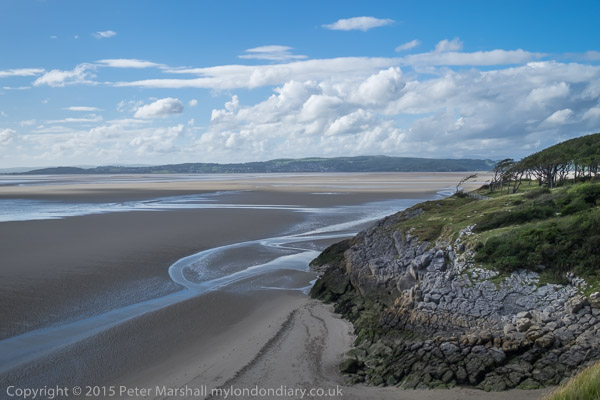
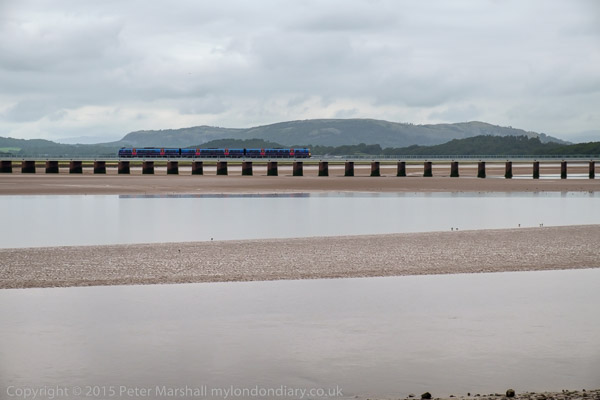
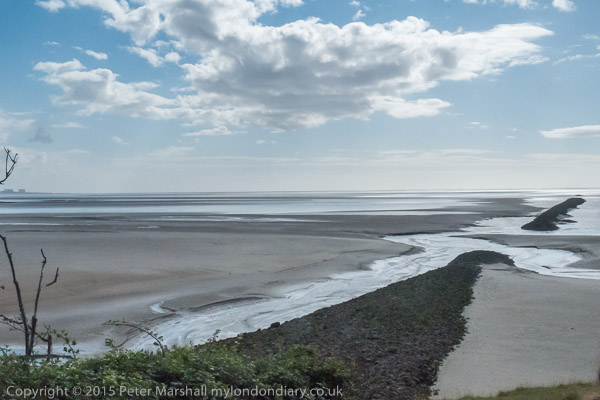
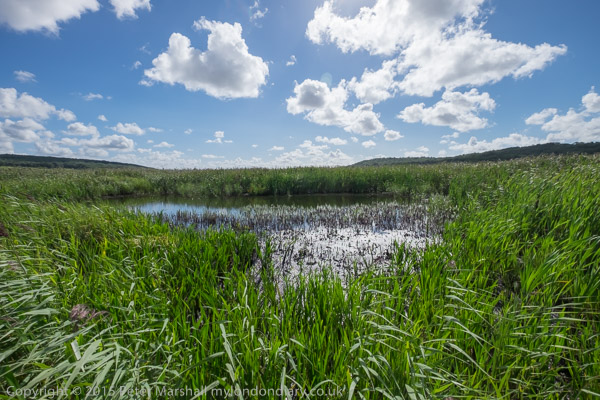
We chose a good week to go away, with heavy rain and some local flooding at home. There was rain where we were staying, but almost all at night, and plenty of blue sky along with clouds during daytime as you can see from these pictures.

Continue reading Holiday Pictures

Carnival Time


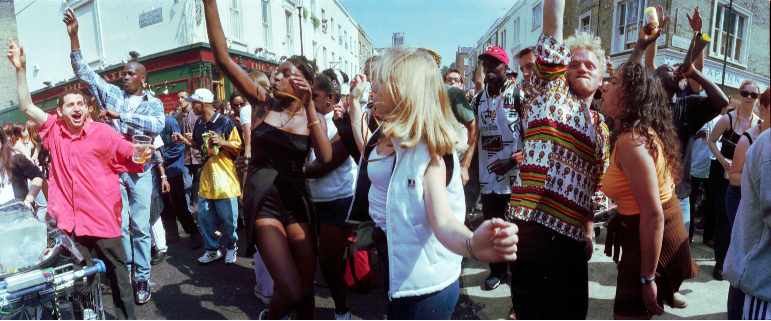
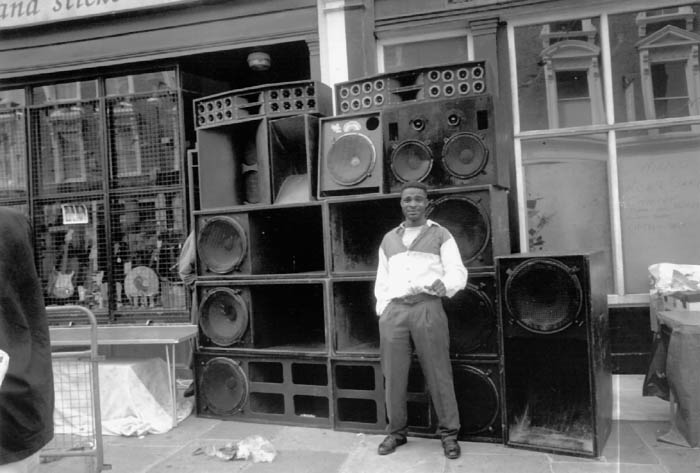
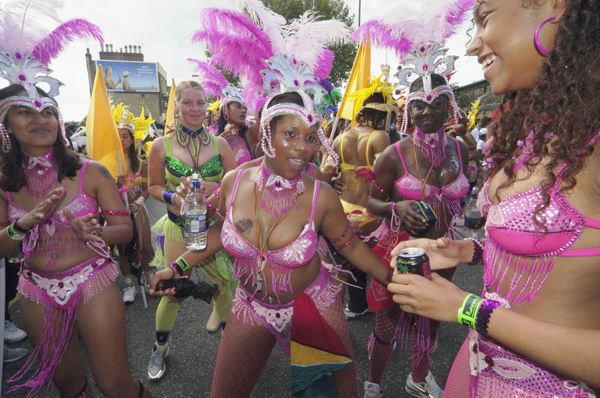
Notting Hill Carnival, 1991

I won’t be going to Notting Hill for Carnival this year, and I feel I’m missing something. But at the moment I’ve a splitting headache, and just can’t get in the mood for dancing on the streets and taking photographs.


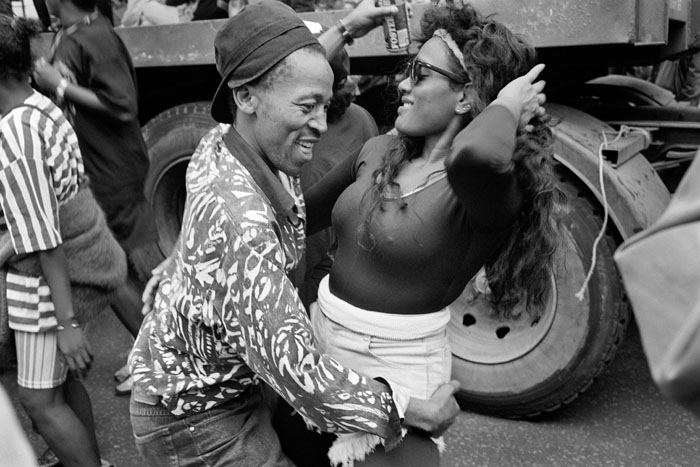
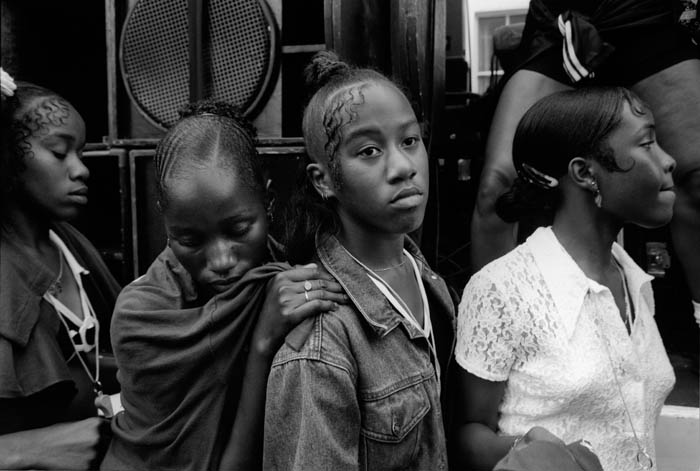
Dancing to KCC and the Rocking Crew, 1998

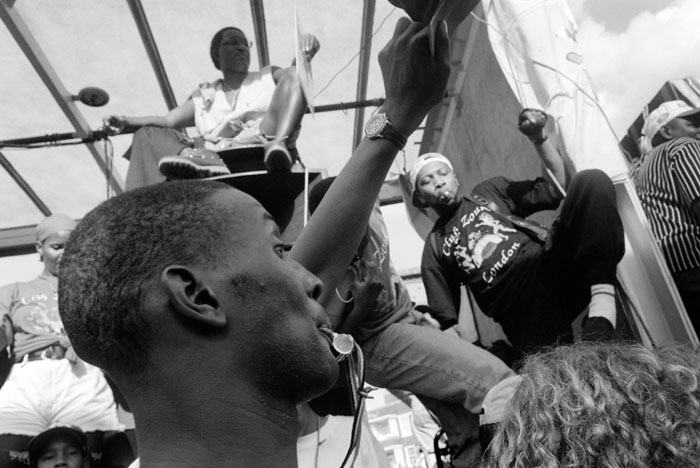
Carnival suffered from a lot of very negative publicity in the mass media in its early years, and still comes in for it at times. It was perhaps this that kept me away from it before the 1990s, when I went and discovered what a great event it was. For the next 20 or so years I went every Sunday and Monday to take pictures, except for 2005.

That year I had injured my knee jumping down from the plinth in Trafalgar Square a couple of days earlier and was finding it difficult to walk. My doctor had examined it, and it was one occasion I felt rather let down by the NHS, as he advised me it would probably be six months before I could get the phyisotherapy it needed, by which time it would almost certainly have got better anyway, and suggested if I could afford it that I go for private treatment at a local sports centre where staff were used to handling knee injuries. As someone resolutely opposed to private medical practice I decided to grimace and bear it.

I packed a small bag – water bottle, Minolta CLE* with 28mm, films, Minolta 40mm lens – emptied my valuables from my pocket except for a few notes and coins and set out for the station, about a quarter of a mile away, determined to get to Notting Hill. When I collapsed in agony going over the footbridge to the station I finally realised it was no use and abandoned the project, crawling back up the steps, hobbling along the road clinging to fences home. It was a few weeks before I could walk without pain, but I kept true to Nye Bevan.
Since then there has been the odd year when I’ve been away from London on the last Monday of August, but otherwise I’ve been to Carnival on at least one of the two days. I missed it in 2013 as I was up in Yorkshire, and then last year I was planning to go on the Monday, but decided to stay at home with my family. I’ve photographed over 20 years of Carnival, and perhaps feel there is nothing new for me to say about it.

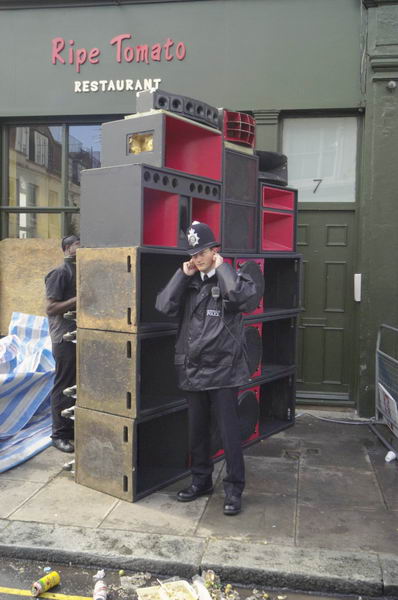
If it was a very short journey, I’d certainly call in for a bit and enjoy the atmosphere, maybe even take a few pictures. It isn’t a major expedition, though the sheer numbers attending sometimes makes travel something of a problem, but enough to put me off. Perhaps too, its because I’m getting older and have come to dislike the crowds and extreme volume, sound which at times vibrates the road surface and your internal organs and often left me part-deafened for several days afterwards.

But it is still an attraction, at least in theory. If you’ve never danced arm in arm drinking Red Stripe down Ladbroke Grove in a vast crowd behind a sound system you’ve never lived in London.


*The Minolta CLE, arguably the best Leica that Leica never made. And the 28mm f2.8 possibly the best ever lens for street photography, when new knocking spots off the Leica equivalent. Unfortunately over time these developed their own spots on interior glass surfaces, making them unusable and uneconomic to clean.

Continue reading Carnival Time