Cyclists Die

As I’ve mentioned here before I’m a cyclist, though not a very active one at the moment, just jumping on a bike to go down our local shops or post a letter etc, and the very occasional longer ride. When I taught at a local college, I cycled to work and back every day, perhaps around five miles in all, except on half a dozen days in many years when thick snow halted traffic and I made it in on foot – to find none of the students had made it. Cycling was a little exercise that helped keep me healthy, but also the fastest, most reliable and certainly the cheapest way to get there.
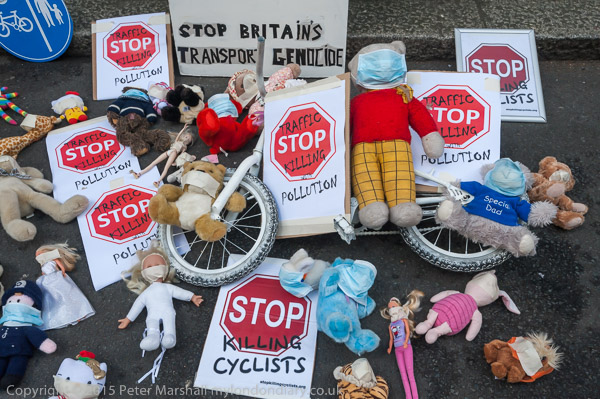
In the suburbs where I live, the main danger for cyclists is fast-moving traffic, and drivers who fail to see cyclists. There are also those drivers who believe that cyclists have no place on the roads – and recently the UK’s Transport Secretary Chris Grayling has suggested cyclists are not road users, just a few weeks after he knocked one off his bike opening his car door.

Central London’s slower moving traffic can actually make cycling there safer, and the danger in London is mainly from lorries and other large vehicles with restricted views turning left over cyclists. But there is another hidden danger which kills many cyclists and pedestrians – air pollution from traffic fumes.

Research by scientists at Kings College for the Greater London Authority and Transport for London published in 2015 established that 9,5000 people per year die early in London due to high levels of nitrogen dioxide (NO2) and fine particulate matter (PM2.5s). Over 60% of these were attributed to NO2, and Oxford Street has the worst NO2 levels in the world, mainly because of diesel vehicles, particularly the large number of buses. But all internal combustion engines – diesel or petrol – produce NO2.
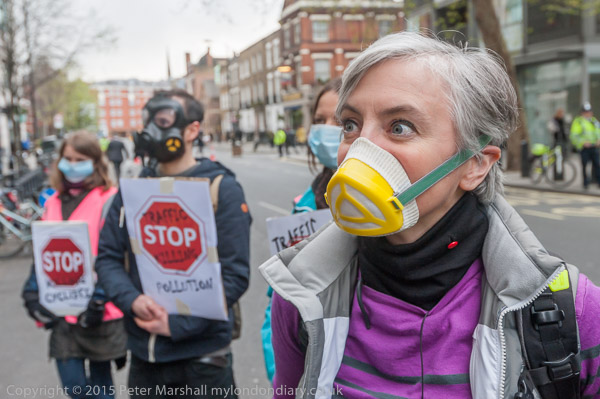
It isn’t just deaths. Many of those who die early have suffered for years from lung diseases, heart problems, cancers, asthma, emphysema and lung infections. And along with Birmingham and Leeds, NO2 levels in London have been well above EU safety limits for more than 5 years.

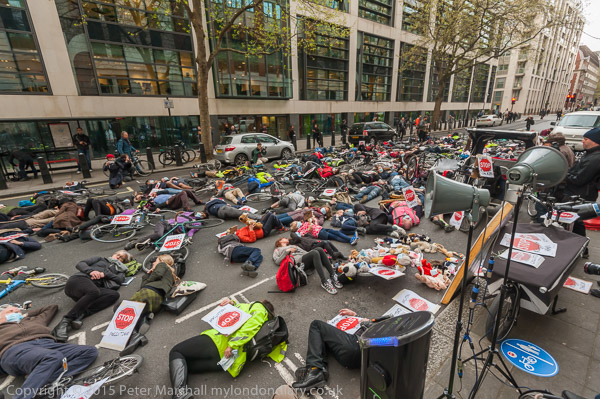
Cyclists are particularly effected by air quality because they are more active than the average street user and closer to vehicle exhausts. So Stop Killing Cyclists called a die-in outside the Department of Transport to demand the government take urgent actions to address the problem, with 8 demands which I list at Stop Air Pollution Killing Cyclists.
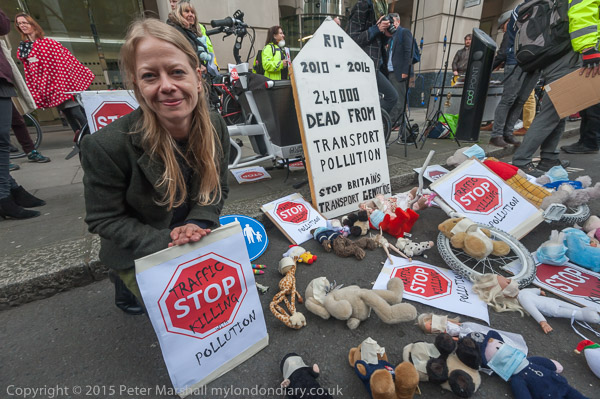

Sian Berry

The protest took place ahead of the London Mayoral elections, and all of the candidates were London asked to respond to this list of demands, and their answers were commented on at the event. Those from the two main candidates, Sadiq Khan, who became Mayor and Zac Goldsmith were disappointing. Despite his claims to be an environmentalist, Goldsmith showed an almost complete lack of concern, and Khan was little better. One candidate – Sian Berry for the Green Party – both accepted the full list and came to take part in the protest, though we all knew she sadly had little chance of winning the election.
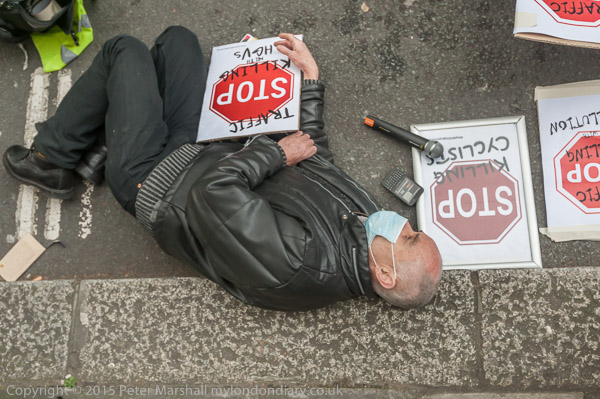

Donnachadh McCarthy, Co-founder Stop Killing Cyclists, taking part in the die-in

The publication of the report has so far led to a few minor changes or promises of future change. Two bus routes have become zero-emission, and others are to follow, and the High Court in November ruled that the government really had to take some effective measures over diesel vehicles – and revealed that the Treasury had previously prevented them doing so.  Mayor Sadiq Khan has stated the intention to bring in pollution charging this year and to bring forward establishing the Ultra-Low Emission Zone to 2019.
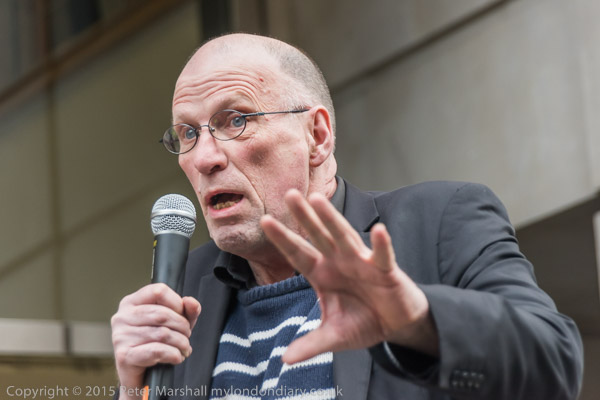

Environmental campaigner John Stewart, best known for his campaigning against Heathrow expansion

But at the same time, the government has announced its intention to back a new runway at Heathrow, which will seriously increase pollution in London, both from aircraft and from the extra traffic the runway will generate.  There is simply no way that pollution targets can be met if Heathrow is allowed to expand.
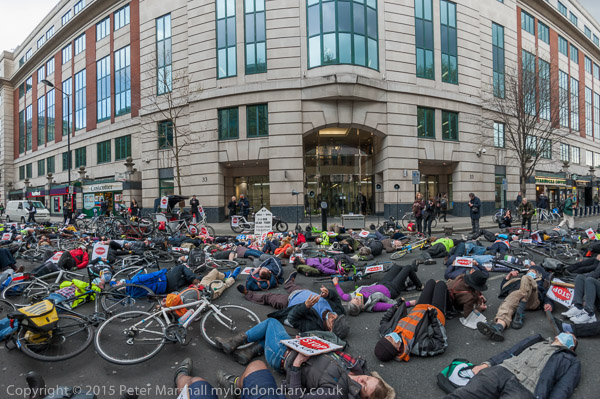
As usual, to capture overall images of the die-in the 16mm full-frame fisheye was useful, though the image at the tops of the post was made with the rectilinear 16-35mm lens.
Stop Air Pollution Killing Cyclists.

Continue reading Cyclists Die

Doctors & Teachers

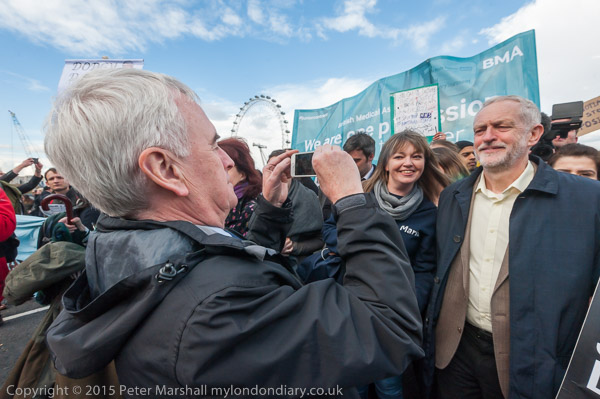
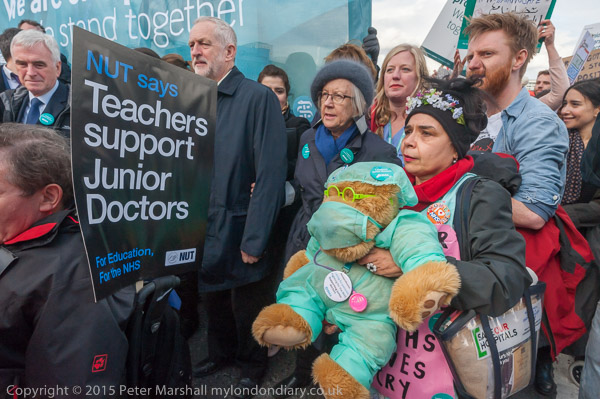
This was a photo that I felt more or less summed up the march by doctors and teachers on the first day of the two-day strike by Junior Doctors’ last April.

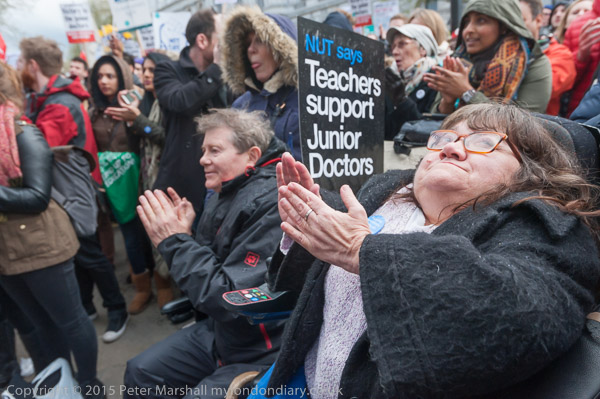
From the banner at top left with its message ‘stand together‘, Shadow Chancellor John McDonnell, the poster ‘NUT says Teachers Support Junior Doctors’, Labour Party leader Jeremy Corbyn and supporters including a ‘Save Our Hospitals’ camapaigner carrying a large teddy dressed in surgical gear.

It perhaps could have been clearer in showing that the NUT poster was on the back of a wheelchair – and my framing at left has cut off the face of a well-known disabled activist and speaker, World of Inclusion and Coordinator UK Disability History Month Richard Rieser – but his presence would have drawn attention away from the rest of the image. You can see him in a lower image on this page.

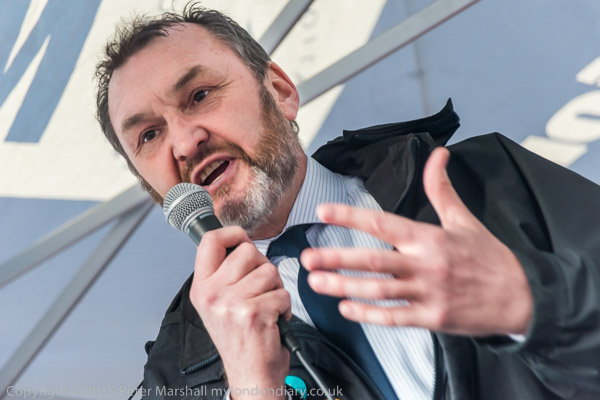
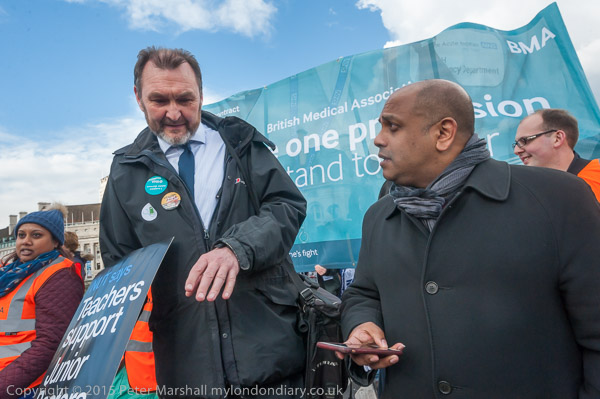
Missing from it were NUT deputy general secretary Kevin Courtney and Johann Malawana chair of the Junior Doctors Committee, shown in the second image, but you can’t have everything.

What isn’t clear in these pictures is the pushing and shoving from a few misguided stewards and other photographers that made getting some of these pictures at the front of the march difficult.

But there was one photographer who didn’t get hassled by stewards – John McDonnell taking a picture of one the marchers with Jeremy Corbyn.

The pavement opposite Downing St where there was a rally was also very crowded,  and it was difficult to move around. There were plenty of good speeches and I was able to get some reasonable pictures of most of the speakers, but photographing people in the crowd was more difficult.

It was quite an interesting list of speakers, including both Jeremy Corbyn and John McDonnell as well as Green Party MP Caroline Lucas, PCS General Secretary Mark Serwotka, Vivienne Westwood, Vanessa Redgrave, several junior doctors and others, as well as NUT Deputy General Secretary Kevin Courtney (above) who later used one of my pictures of him in his election campaign to become NUT General Secretary. I was pleased that he won, though I can’t really take much credit for the victory.

More at:

Downing St rally for Junior Doctors
Doctors & Teachers march together

Continue reading Doctors & Teachers

Hull Photos 12/1/2017-18/1/2017

12 January 2017

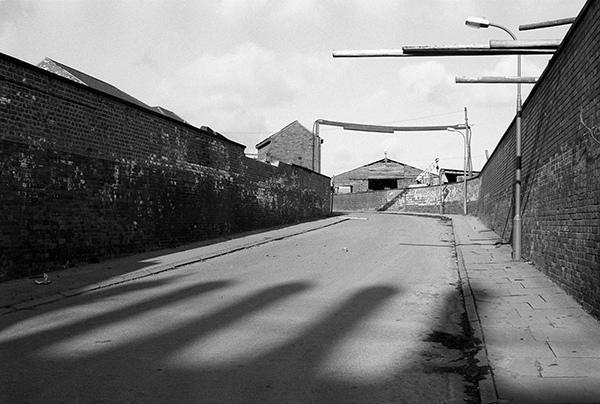
Subway St was the main route in and out of the Fish Dock for men and lorries and the subway led under the main railway line – and after this picture was taken, the A63 main route into Hull, Clive Sullivan Way. The shadows at the bottom of the image are from the chimneys of one of a number of fish smoking houses in the area, I think now all demolished.


27p44: Subway St leading to St Andrew’s Dock, 1981 – Docks

13 January 2017

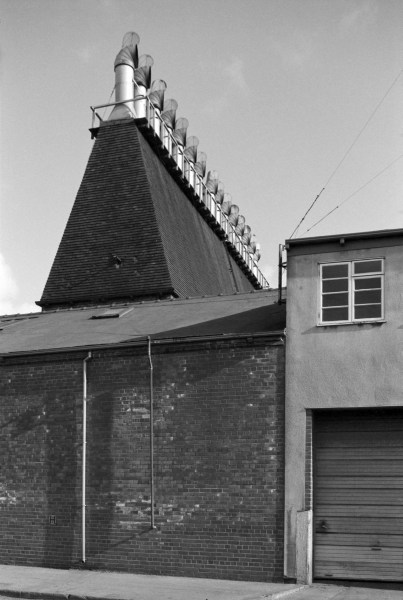
This fish smoke house was one of a number in the area close to where Subway St led into the Fish Dock – and probably this picture was taken either on West Dock Ave or Subway St close to their junction with Goulton St. Rows of chimneys like this on top of a steeply sloping roof were a familiar sight in the area between Hessle Rd and the Fish Dock.


27p45: Fish Smoke House, Goulton St, 1981 – North & West Hull – Hessle Rd

14 January 2017

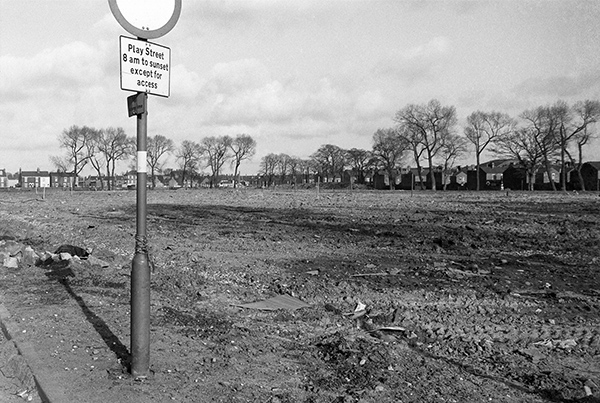
This is the image I chose for the cover of my book ‘Still Occupied’ and from my contact sheet it appears to have been taken in the Goulton St/Subway St area, although when I showed it in 1983 it was titled ‘Clearance area near Woodcock St‘, around 600m to the north-east. I’m afraid the exact location of some of my pictures is something of a mystery as I did an awful lot of wandering around while taking pictures.

Those more familiar than me with Hull may be able to identify the large curved roof in the right background, and below it, just in front of the houses a small obelisk on a plinth, though these details are probably too small to be seen clearly on the web image, and there are more monuments on a low mound in the centre of the picture, so this is definitely a burial ground. Just to the left of the post, partly obscured is a building which could be a pub.

Today, writing this, I spent a little more time researching this (thanks to Google Streetview), and the street at the left is definitely what is now called Conway Close, though when I took the picture it was Division Road. The mound and monuments are the Division Road burial ground – an overspill from Holy Trinity – and the houses at right are terraces from Tyne St. The buildings close to the post have I think all been demolished. The ‘Play Street’ I was on the edge of was I think Beecroft St or Massey St. The latter is still there with a ‘Play Street’ sign and the muddy area is now a grassed open space.


27p46: Play street and cleared site, 1981 – North & West Hull – Hessle Rd

15 January 2017

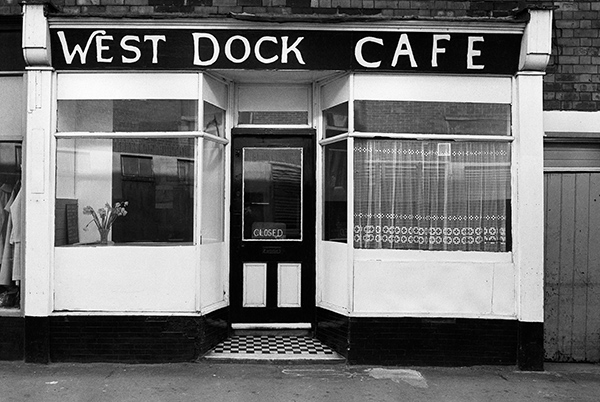
One of my favourite images from Hull, with its lively lettering and rather erratics letter heights in the sign-writing, the vase of daffs, one with a broken stem, and the patterning of the net curtain, the step and the frontage as a whole, which together I find rather satisfying. It was probably taken on a Sunday as there is a closed sign on the door.

I never went inside; like many working in Hull around noon I would rush back for dinner at ‘home’ before returning to work for the afternoon. My mother-in-law would put it on the table at 12.15 precisely. A friend who worked on Sculcoates Lane used to rush down to Paragon Station, jump on the train to Hessle for his home dinner his mother had waiting for him as he arrived, ate up and then rushed for the train back to Hull and a rather speedy return to the office.

It was about two and three-quarter miles from here to Loveridge Ave, and if I was lucky I might get the Fish Dock bus I think a 27. But otherwise I was then fairly young and fit, and at ‘scouts pace’ I might make it in 25 minutes. I daren’t be late.


27p53: West Dock Cafe, West Dock Ave, 1981 – North & West Hull – Hessle Rd

16 January 2017

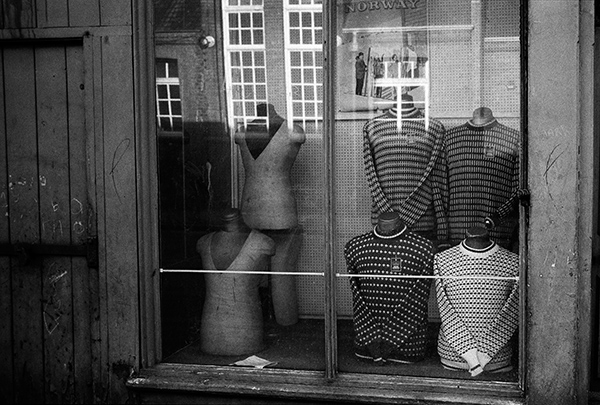
Another picture from West Dock Ave, a shop selling Norwegian jumpers for fishermen. There is a very straightforward and workmanlike look to the shop, with its boarding and simply set out display of four wooden forms showing off different jumper patterns. Presumably the others are in there bare as they only currently have four patterns.
You can still buy genuine Norwegian Merino wool jumpers, though probably not in West Dock Ave and the genuine article will cost you £150 or more. They use ‘raw’ wool which retains its natural lanolin and the fibres are spun along the fibre in a worsted weave rather than the normal wool weave across it. They are noted for warmth and breathability and have a natural water repellence due to a thick weave and the natural oil.

One of my brothers made several visits to Norway before his death when I was 20, and brought me back not a jumper, but thick woollen knitted socks. These were of oiled wool and came with the strict instruction – DO NOT WASH. But eventually they did need washing, or keeping in a different room.

Apparently you can then wash them with a little baby oil in the water to replace the natural oils. But I didn’t bother, and later relegated them to serve as bed socks, keeping my feet warm in winter and meaning I didn’t need to put on slippers when I got up in the middle of the night. I think they lasted well over 30 years.


27p55: Norwegian jumpers, West Dock Ave, 1981 – North & West Hull – Hessle Rd

17 January 2017

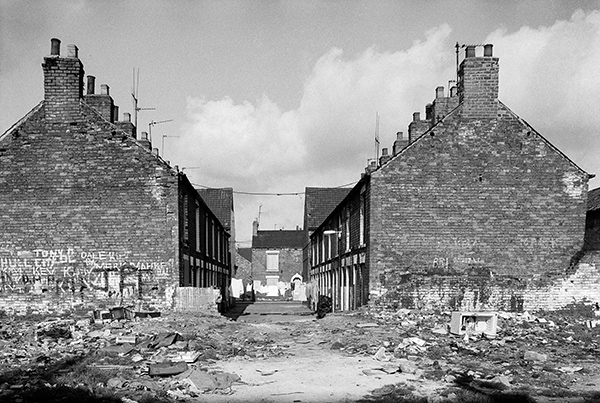
It’s easy to place the picture of the shop window and the jumpers with some precision, as the reflection in the window shows it was taken opposite the school in West Dock Ave. This terrace is the next frame on the film, and I think was probably taken as I walked further south down West Dock Ave, and perhaps shows one of the terraces leading off east from Subway St – which would be the road behind the line of washing. But I could have wandered further, perhaps towards any of the three streets named after leading public schools, Rugby, Eton and Harrow presumably by some Victorian developer with a warped sense of humour.

Probably there are people in Hull who could remember having written their names on these walls, Tony, Kev, Mark, Dale and the others. Back in the days before spray cans graffiti was considerably more basic. And some years earlier another Tom, Sir Tom Courtenay, born in Subway St, lived at 29 Harrow St from the age of 4 in 1941 until 1959.


27p56: West Dock Avenue area, 1981 – North & West Hull – Hessle Rd

18 January 2017

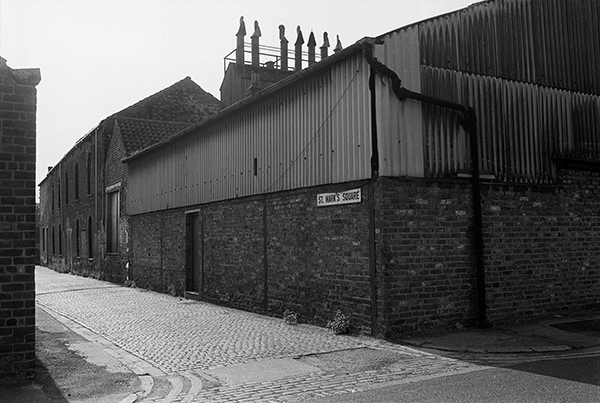
Four months after taking the picture above I was back in Hull and went back to roughly the same area. St Mark’s Square is not the only thing that Hull has in common with Venice – it also has the parish and church of St Charles Borromeo, a sixteenth century Cardinal and administrator of the archdiocese of Milan which stretched from Geneva to Venice, and it used to have a great deal of water in the centre of the city, though rather less since Queens Dock was filled in as public gardens in the 1930s and a disturbing shopping centre plonked down on stilts in Princes Dock in 1990-1.

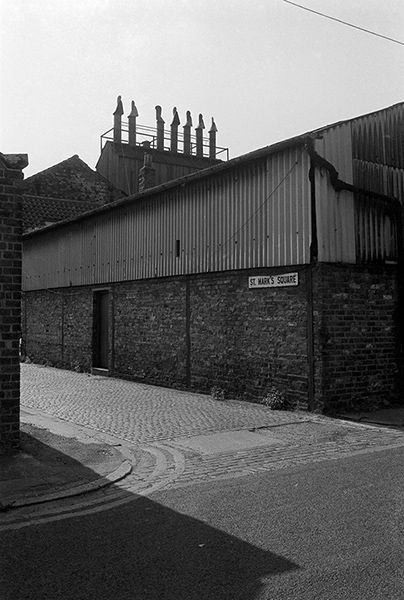
Hull’s St Mark’s Square is perhaps a little less imposing than its Venetian counterpart, but was at the centre of Hull’s first out of town suburban development by Thomas English, a wealthy local shipbuilder in the first decade of the nineteenth century  known as the Pottery Ground. Edgar was one of his sons, and there is also an Alfred St, named after the other, as well or course as English St.  Where St Mark came in I don’t know – there wasn’t a church there, though it did have a Wesleyan Chapel in the early years. St Mark’s Square was an open square for some years at the centre of the new development. All that remains from around 1802-3 appears to be the street pattern.


28h15: St Mark’s Square from Edgar St, 1981 – North & West Hull – Hessle Rd

And I turned my camera to portrait orientation for a second picture.

28h21: St Mark’s Square from Edgar St, 1981 – North & West Hull – Hessle Rd


You can see the new pictures added each day at Hull Photos, and I post them with the short comments above on Facebook.
Comments and corrections to captions are welcome here or on Facebook.
Continue reading Hull Photos 12/1/2017-18/1/2017

England, and Saint George!

A few minutes on Wikipedia convinces me that April 23 has more than its share of famous births, deathas and commemorations of which the best known here is of the man the Eastern Orthodox call “Holy Glorious Great-martyr and Victory-bearer and Wonderworker George“, a Palestinian (or Turk) of Greek parentage and a Roman soldier – if he actually existed. Certainly the dragon didn’t, and was not involved in the legend that made him a saint, in which, undoubtedly like some Christians of the era, he was tortured at length before being beheaded for refusing to convert to the Roman gods following an edict by Emperor Diocletian in AD 303 which led to three years of such persecution, though applied with differing severity across the Roman Empire.

April 23 is a day George shares with a number of other saints, with Wikipaedia listing around a dozen for the Eastern Orthodox, including George’s mother, two soldiers converted by witnessing George’s martyrdom and the wife of Diocletian, as well as another 14 pre-schism Western Saints, post-schism Orthodox saints, new martyrs and confessors (though due to our change to the Gregorian calendar they celebrate these April 23 events on our May 6th.) In the West, George shares his feast day with Adalbert of Prague and Gerard of Toul, while both the Evangelical Lutherans and Episcopalians in the USA commemorate the life of Japanese Christian pacifist, reformer and labour activist Toyohiko Kagawa (1888-1960) which seems to me admirable. It’s a shame we’ve never heard of him here.

Shakespeare was probably born on April 23 1564, and certainly died on April 23 1616, giving us another reason to commemorate – and UNESCO chose April 23 as UN English Language Day, (one of six promoting its official working languages,) for that reason. It’s also UNESCO World Book Day, though in the UK we celebrate this on on the first Thursday in March instead, as April 23 is often in the Easter school holidays.

In England, St George’s Day once ranked with Christmas as a major celebration, an occasion for feasting and drinking, but its celebration became less important after the union with Scotland, and had almost disappeared in the last century. One or two people still wore a red rose, and some official buildings flew a flag, though usually the Union Flag rather than the English flag of St George. The day never became a bank holiday, partly because of its closeness to Easter (and the Church of England even moves his feast day when it gets too close to Easter, moving it from April 23 to the Monday following the Second Sunday of Easter.)

Back in the last century, even English sport teams and their supporters would often use the Union Flag rather than the English St George Flag, but it was sport and particularly football that led to a resurgence for the red cross on white, and pubs showing England games at the World Cup on TV that led to its proliferation across the land. It became associated with football supporters, and with the largely right wing hooligans involved in football violence who dominated many ultra-nationalist groups, often styling themselves as patriots, and looking back to a mythical past of an all-white England ruling an empire around the world, or even launching crusades against the infidel foreigners.

A strange alliance between these ‘patriots’ and others who have tried to reclaim the English flag from the bigots has led to an increase in official commemoration of St George’s Day this century, which has involved groups including the BBC, English Heritage and London Mayor Boris Johnson, as well as some churches, and it’s a mixture that has been reflected in my photographs of the day over the years.

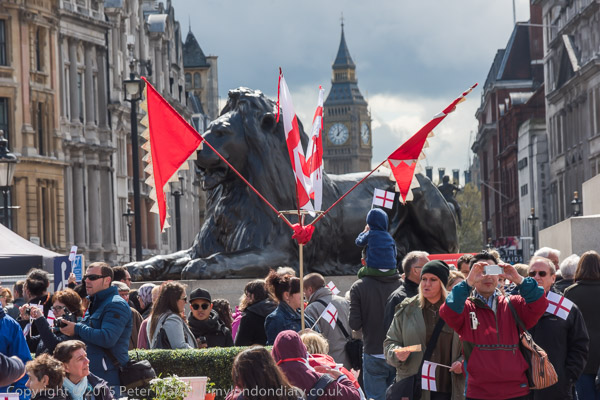
In 2016, St George’s Day actually fell on a Saturday, and I expected to see more activity than in other years, but was in the end rather disappointed. The Mayor’s day of events in Trafalgar Square seemed rather lacking in spirit, and all more organised events by ‘patriots’ in the London Area seem to have evaporated, perhaps because of increased militancy by anti-fascist groups. I paid a brief visit to Trafalgar Square, but found little to photograph – perhaps things got better later in the day, but the few pictures I’ve seen by others don’t encourage that thought.

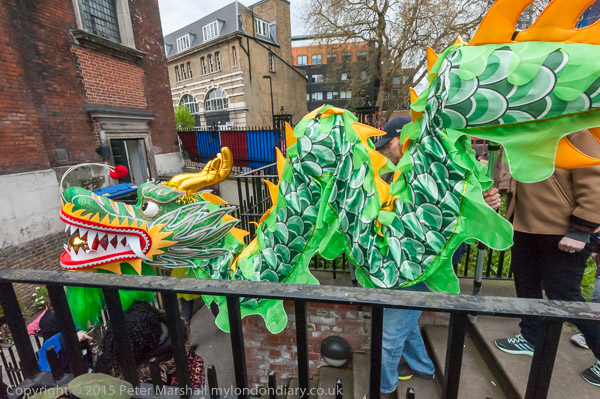
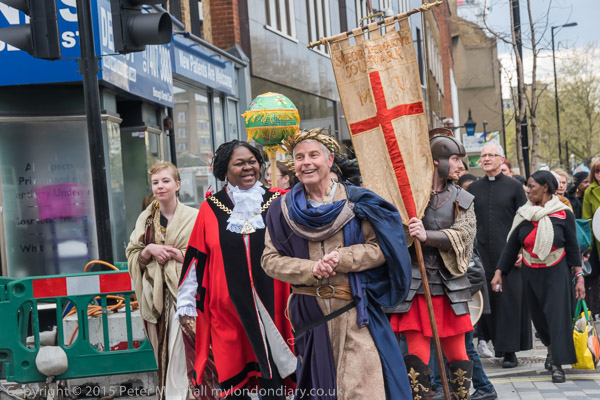
South of the river in Southwark things were a little better with a festival ‘A Quest for Community’ with the aim of ‘Taming the dragon of difference’ involving a St George’s Day procession from the Roman Catholic Cathedral of St George to the Church of England St George the Martyr in Borough High Street. As well as St George, Diocletian and his daughter, a sooth-sayer and of course a dragon, it also included drummers and the Mayor of Southwark, to whom I was pleased to be able to point out a blue plaque and tell her a little about one of the Borough’s more famous son’s, photographer Bert Hardy, who grew up in ‘The Priory’ which was on our route.

She had been unaware that one of Picture Post’s best-known photographers and a pioneer in using 35mm in press photography had come from her patch – and never really left it, though advertising brought him enough money to buy and live in Chartlands Farm, Limpsfield Chart near Oxted. And about how his powerful photography had powered the textbook example of an unsuccessful advertising campaign, ‘You’re never alone with a Strand’ along with an outstanding ‘noir’ TV ad shot by Carol Reed with music by Cliff Adams that would have topped the charts had the BBC not banned it for advertising cigarettes. Even at 3s2d for 20, nobody wanted to be seen as lonely enough to buy them.

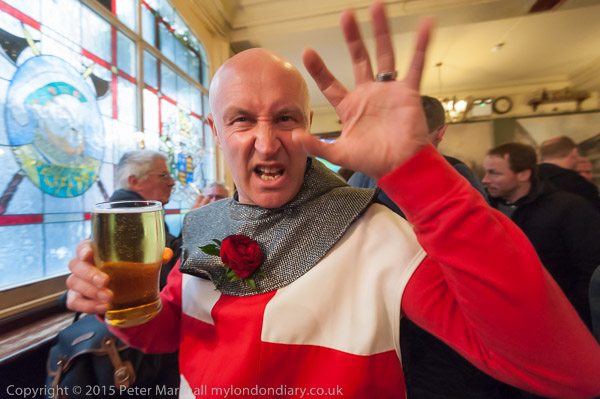
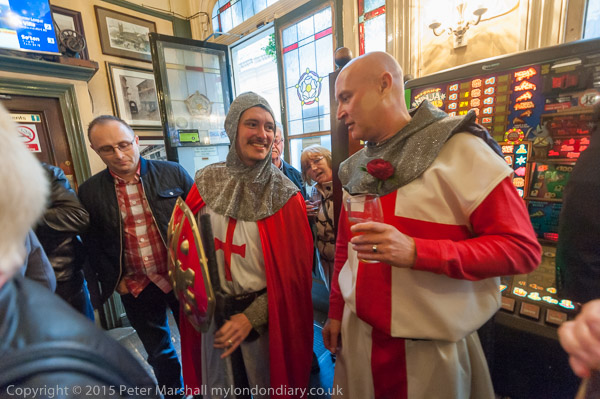
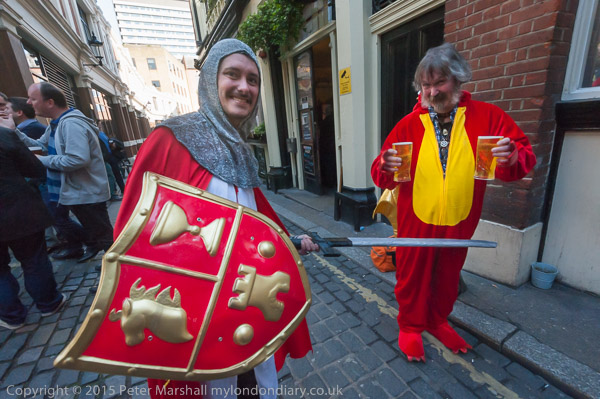
The procession ran late, and I didn’t have time to watch more than a few minutes of the play that followed, and missed the free pint that was waiting for me in the City where Leadenhall Market was also celebrating our patron saint. Instead I met with friends at the Old Kings Head in Kings Head Yard just off Borough high St, a welcome survival of a traditional English pub – and where better to meet not just one St George, but two, the second accompanied by his very own dragon.

I forget why we left. Perhaps it was the thought of a good dinner waiting for me at home, but I stopped for a minute or so in the yard outside for a last picture of St George with his dragon holding his own and George’s pint in the alley outside, a rather different and very English version of the legend, and my favourite picture from a long day.

More at:
St George in Southwark Procession
St Georges Day in London

Continue reading England, and Saint George!

Whose Streets? Our Streets!

My thanks to writer on the New York Times Lens Blog for pointing out the exhibition ‘Whose Streets? Our Streets!‘ currently taking place at the  Bronx Documentary Center until March 14, 2014, but more importantly for most of us, on-line.  Curated by photo editor Meg Handler  and historian Tamar, it features work by 38 photographrers, including a few familiar names.

But as Handler says in the Lens feature, few of the pictures  were widely seen when they were taken; “It used to be, you’d show your contact sheets to a couple of your friends and that was it,” she said. “They’d rarely get seen.”

Handler goes on to say that the freedom of movement for photographers ended in 2002, but she continued by saying that any demonstrator with a phone can now project images to the world almost as the events are happening.

I’m not sure how different things are in New York to here in London, but here there is certainly no shortage of photographers covering protests, and while it’s obviously true that protesters with smart phones now tweet and post images as events take place, this is a rather more recent phenomenon.  When I first got a mobile phone, a little after 2002, like most at the time it didn’t have a camera, and it was only at the end of that decade that phones with cameras began to be widespread.

Things did change around 2002. Photographers got digital cameras – like the Nikon D100 I bought towards the end of the year. A few professionals had used them earlier, but mainly in more lucrative areas than photographing protests. For a few years after most of the photographers at demonstrations here were still using film – and I continued to use both film and digital for several years.

Back then, unless you had something that was startling news, you took your pictures, came home, developed film, looked at the contacts, maybe made a few prints and took them to the agency a day or week or more later. If you though you had something special, you would phone a paper and if they were interested take them the film to rush through for the next day. Staffers would of course take in their films – and most of the protest pictures published were from photographers on the staff of the major agencies and papers. They only bothered to attend major events, and seldom stayed for more than a quick photo-op.

Photographers who really covered protests were a different breed – and it shows in the pictures in the Bronx show. Here – as there – some worked for the left-wing magazines and small circulation newspapers – such as Mike Cohen who gave me advice at times when we covered protests and whose work appeared regularly in the Morning Star, Socialist Worker and Searchlight, which also regularly featured pictures by David Hoffman, a photographer who some on the extreme right confuse me with and I get a share of his abuse along with that really intended for me.

The other thing that has changed and encouraged more photographers to cover events is the growth of online photo agencies that have little or no bar to submissions. Sites like Demotix (bought out and closed down a year ago by the Chinese to end its competition with Getty) encouraged people to put much unfocussed (often literally as well as metaphorically) photography online – with many more people becoming photographers, and a few of them producing work at least as good as that of the professionals who disparaged such sites. And of course there are professionals around the world who now contribute to such on-line agencies.

The freedom of movement all ended in 2002,” states Handler, but here protesters have often managed to avoid being penned by police, and except for those on the extreme right and some anarchists, protesters have largely remained on good terms with most photographers.

So we have more photographers than ever taking pictures at protests, although no more pictures are being used. Many that do appear are pretty poor because what matters most is not quality but getting the images in first, with many photographers rushing into a corner before a protest has even started to file some pictures. It’s a race I refuse to take part in, but then I’m in no danger of going hungry or getting evicted if my pictures don’t make the news. Like those photographers in the Bronx show I’m more interested in telling the stories – but at least now I can get them out on Facebook and My London Diary even if the newspapers don’t pick them up.

Another big change is of course the move to colour that came with the move to digital. There are rather more colour pictures in the Bronx show than I would expect from any similar UK show of the same era, but it is still black and white that dominates. Now using black and white is largely only an affectation practised by a few largely younger photographers hwo have never really learnt how to use it, other than clicking on a button in Lightroom or other software.


Hull Photos 5/1/17-11/1/17

5 January 2017

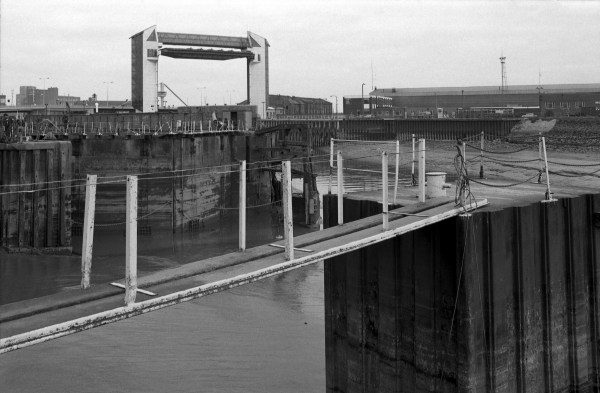
Today’s picture is at the mouth of the River Hull, looking up-river from the end of Nelson St towards the tidal barrier which had been built the previous year, although everyone in Hull says that they forgot to lower it on the first occasion it was needed. Since then it has prevented flooding on many occasions, with recent floods arising from surface water rather than tidal ingress. The barrier was upgrade recently.

27o43: Dry dock entrance and Tidal Barrier, River Hull, 1981 – River

6 January 2017

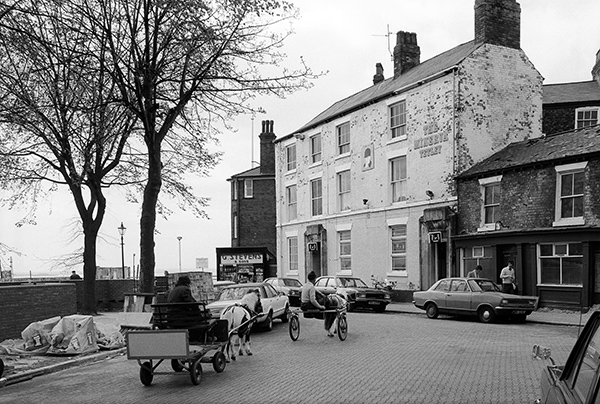
Nelson Street is already paved with interlocking bricks, work is going on to replace the old pavements, and walls are in place to make this a tourist attraction at least for those living in the city. You can see the Humber over the walls with the heads of a few visitors looking out over the river. The two men driving pony carts are there for an afternooon outing too. I was there with family and we were more interested in the sweets from G Stevens than the Minerva.


27o52: The Minerva and pony carts, Nelson St, 1981 – Old Town

7 January 2017

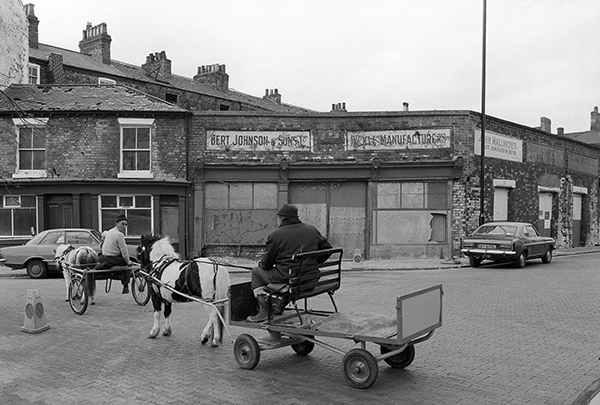
This corner is now Henry Vernone Court, and the white wall at top left is that of the Minerva in yesterday’s picture which was taken a few seconds earlier. The building between the Minerva and the derelict property of Bert Johnson & Sons has since been rebuilt and now has only a single storey as ‘The Minerva Brewery’. The first door around the corner in Pier St has the number 10 above it, but the sign higher on the building is for John Mallinder, Fruit Commission Buyer, 5 Humber Place, which is a short distance away on the other side of Wellington St, facing what is now the Marina, and now the address of Global House.


27o53: Pony carts, Nelson St/Pier St, 1981 – Old Town

8 January 2017

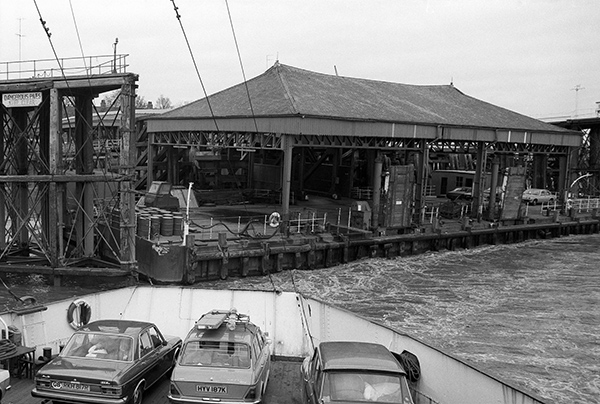
Taken in April 1981, a few months before the ferry service ended on 24th June 1981 with the opening of the Humber Bridge. The ferry – the diesel paddle steamer Farringford – is about to dock at the floating pontoon which had a roadway leading up to the pier (also known as Hull Corporation Pier.) The 1930s pontoon was removed after the ferry closed, but the pier is still there, rather tidied up now.


27o64: Humber Ferry approaches Hull Victoria Pier, 1981 – Old Town

9 January 2017

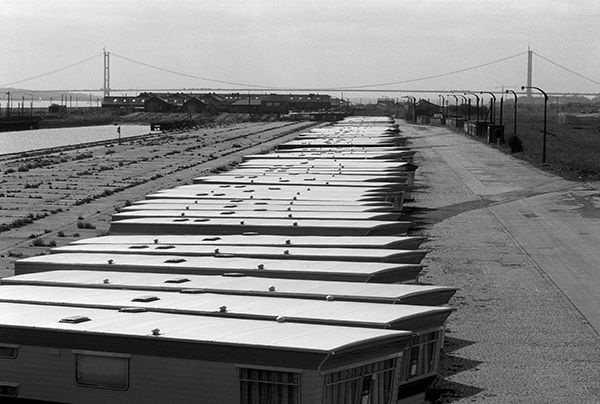
Today’s featured image is taken from with a picture from the footpath into St Andrew’s dock showing an empty dock and a row of caravans stored alongside the roadway, dominated by the Humber bridge in the background.


27p23: Caravans and Humber Bridge, St Andrew’s Dock, 1981 – Docks

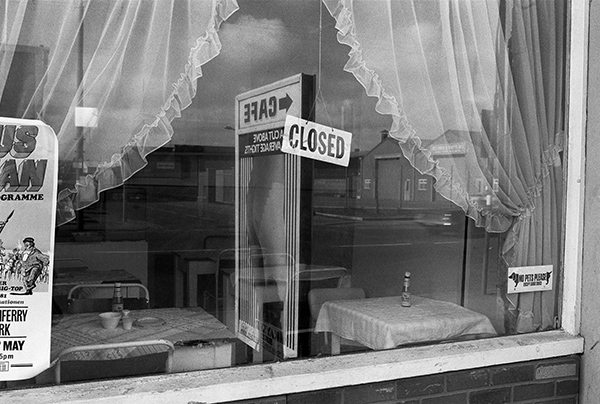
I’ve also added a picture of a cafe window, very similar to one previously posted. I’ve included it because I can’t decide which I prefer, and I think I have exhibited both of them at different times in the past. Today I think this second one is better.

10 January 2017

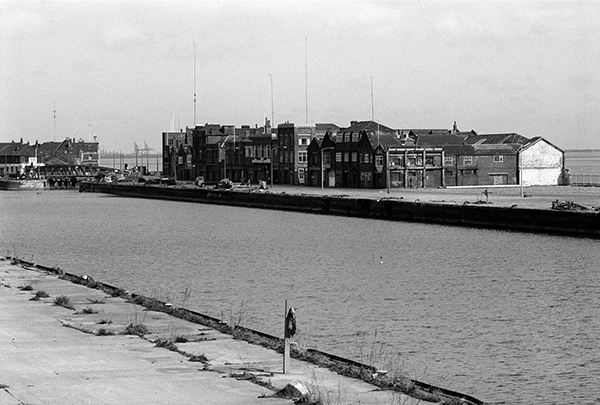
St Andrew’s Dock was named after the patron saint of fishermen when it was opened in 1883, though most people in Hull new it as the ‘Fish Dock’ and knew when the wind was in the wrong direction and could smell it. But in 1972 it was decided to move what was left of the fishing industry to Albert Dock, and St Andrew’s closed to shipping in 1975. It was part filled in four years after I took this picture and the western part of the site is now St Andrew’s Quay Retail Centre. I was trespassing on the north side of the dock, but the Trans Pennine Trail goes across the bridge at the left of the picture – and then continues beside the Humber.


27p24: St Andrew’s Dock, 1981 – Docks

11 January 2017

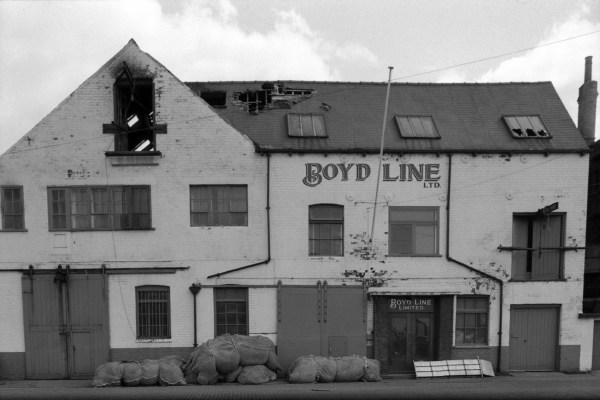
By the 1980s, fishing from Hull was dominated by British United Trawlers freezer fleet based in Albert Dock who quickly ran down their operation, leaving two family firms, J Marr and Boyd Line in Hull. Both were later bought by the Icelandic company UK Fisheries Ltd, part of Samherji HF.


27p26: Boyd Line Ltd, St Andrew’s Dock, 1981 – Docks

You can see the new pictures each day at Hull Photos, and I post them with the short comments above on Facebook. Comments and corrections to captions are welcome here.
Continue reading Hull Photos 5/1/17-11/1/17

Found at last

Back in 1983, the Radio Times and BBC2 held a ‘Photo-Assignment‘ competition for the BBC2 National Photographic Week Competition, and although I didn’t like the idea of having to send off my film along with the two 10×8″ prints I decided to enter a set of pictures taken in Hull. I loaded a roll of FP4, 36 exposures loaded from bulk into a camera body and set out on a Sunday morning in early August for a trip around the city taking pictures for the competition on that body as well as some just for myself on a second camera.

Back home later in the week I developed the film, selected my two pictures and sent them off to New Broadcasting House in Manchester on 22.8.83. I was reminded of this today when I read the label on the back of an old print with my entry form stuck to it. It wasn’t the picture they chose, but the other I sent in was selected and they made two 12x9s and a 16×12 of it for showing on BBC2 and the touring exhibition. Not owning A TV (I still don’t, seeing enough in life and not having the time to watch it secondhand), I got my college to record the programme so I could see my picture on it for a few seconds.

But it was the picture rather than the reverse of the print that caught my attention, and I realised it was an image I hadn’t seen since 1983 and had forgotten about completely. And it wasn’t a bad picture and would certainly have been included in my Hull book had I had it to hand. So I looked for it in my file containing the contact sheets from Hull, searching for it at some length, but it was nowhere to be found.

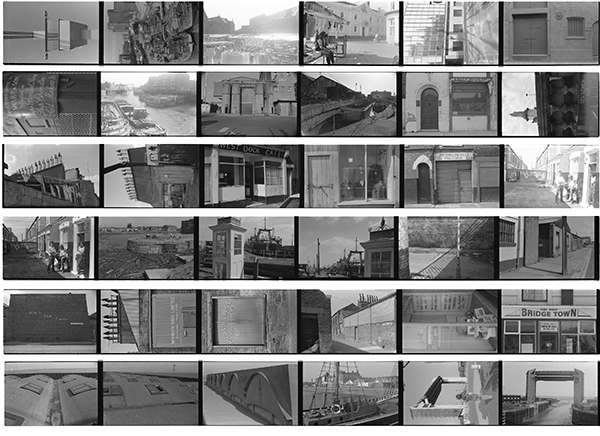
The BBC had of course returned my negatives in the stamped addressed envelope I had included, and they came back in October or November and were filed with the work I was taking then – but somehow I forgot to make a contact sheet, which made the negatives were very difficult to find. Finally I did find them, and made the digital contact sheet above, rather too small to be seen properly in the small version on this post, but good to see at full size on my screen.

Looking at the set of 36 pictures, it’s obvious that I had decided to go an visit some of the favourite locations I’d photographed earlier and retake versions of images I’d taken before. This isn’t generally a very good idea, as if you have made a good picture before you are likely to get something that doesn’t match up to it when you return.

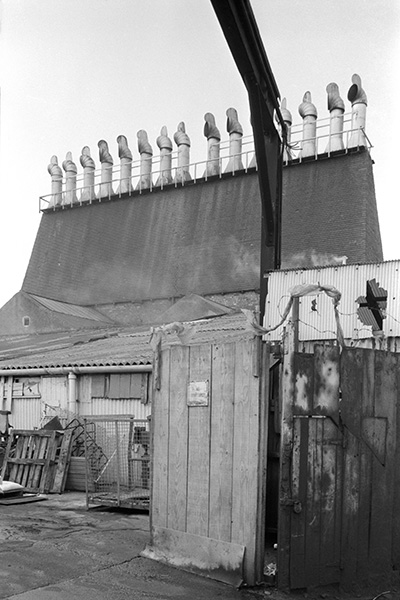
Though mostly I seem to have tried hard to make pictures that were just a little different, and in some parked cars or other obstructions made a repeat performance impossible. If you have are following my daily posts on Hull Photos for the UK City of Culture 2017, then today’s image showed the shadows of the chimneys of a Fish Smoke House, perhaps even the one in the image above, though there were several others in the area, all now gone – a piece of heritage lost.

The other of the two I printed for the BBC – which was the one they selected I also took on the other camera I was carrying – and I think did it rather better, and in time two better images will appear on Hull Photos – and I’m unlikely to post it myself (its the fourth frame from the left on the fifth row down.)

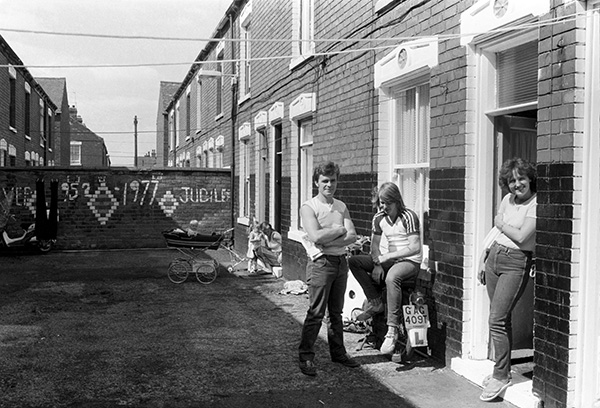
But the image I’d found this morning I’d only taken on the film for the BBC and it’s  only one in the 36 where I made two exposures, presumably because I realised I had over-exposed the first. The two are almost identical  so far as the three people in the foreground are concerned ,though the over-exposed frame is just a little better framed and has the woman and child in the background in a different position. It would have been hard to get a decent print from the negative in the darkroom, but I may be able to rescue it digitally.

The pictures were taken using an Olympus OM-1 camera, and the FP4 was processed in Acutol. There are two slightly darker bands across every frame, only noticeable in even areas such as sky. I’m unsure whether these represent a film fault or uneven processing, but at least with digital these can be treated, and they are almost entirely invisible after a little work in Photoshop.

Faulty film was not that unusual, particularly in bulk film, and I had some batches replaced by Ilford over the years, though they ever admitted the faults. Now I might be able to reclaim some of those faulty negs by digital retouching if I have time and patience.

I had found the print when I went up into the dark recesses of the loft in my house, looking for more of the actual prints I showed in Hull back in 1983. I didn’t have a great deal of luck with these, only coming across a handful to add to those I’d already found. Perhaps I had sold a few, and others might have got lost or still be hiding in a cupboard or lost after taking them to talks or shows.

But as well as the  print which led to my rediscovery of that BBC competition film, I also found a slide filing sheet with 14 sides from Germany in the early 1980s, including an image I’d spent several days searching the house for when I was producing the book ‘German Indications‘ and had to leave out, and a couple of others that might have been included had these slides, obviously selected to send to a gallery at some point along with some black and white prints been available.

A couple of others are probably the originals of images which I reproduced from duplicate slides, although most of the duplicates, made using an Illumitrans slide duplicator, were of exceptionally high quality. The only way I can identify the originals is if they are in the original Agfa slide mounts, but some of them I will have taken out of these for various reasons, especially if I wanted to reproduce the full image, a small part of which is hidden by the slide mount.

The image above is in the book (and the preview on line) but with a different colour balance to the new scan. I’m not sure which is more accurate, but the book image, considerably more yellow, is closer to the slide, though my memory prefers the bluer version above, though perhaps it is just a touch too blue… 

Which reminded me of a post on The Online Photographer a couple of days ago, on Color Correction (which I’d spell as Colour Correction) which is worth reading, including some of the comments. And you are welcome to download the above image as one to practice on though of course despite the lack of a watermark it is still copyright.

Slide films always added their own personality to the colour pictures we took, and we have now rather got used to the more accurate rendition of digital, though digital cameras too have their own differences. I generally prefer the results from my Nikons to those from the Fuji cameras I less often use, but others rave in admiration of the Fuji colours, especially in jpegs. I just adjust their RAW files to give something that seems more like I see.
Continue reading Found at last

Axe Drax Again


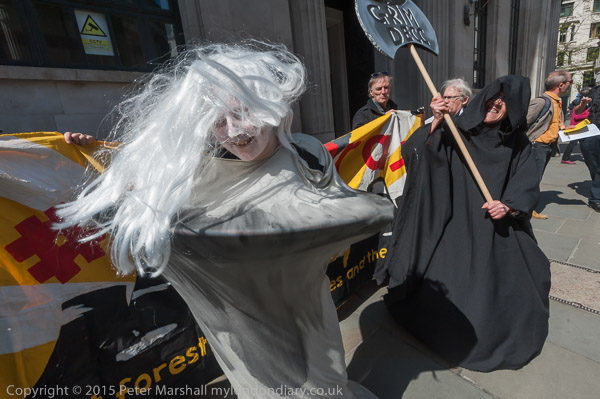
The ‘Grim DECC’ attacks a Drax cooling tower with his axe

Some protests are rather drab, with little visual material to work with, which can make for a hard time for the photographer. I like the challenge of photographing people, and there are always people to photograph, but the problem is to get those people to visually express something about the protest. Unless of course they are celebrities, names the papers lap up and will publish almost any picture of- though sometimes they are inundated with pictures of them and even if your photographs are better than the rest, the chances of an editor even looking at yours are small.

Celebrities aren’t any more interesting to me than the next guy, though some people are more interesting to photograph than others. Including some well-known people, though others don’t impress me, particularly some women who hide their faces behind a heavy mask of makeup which robs them of life. Protesters – and most people I watch avoiding eye contact when I’m sitting on the tube – are generally more interesting.

I’m often surprised at how poor some of the pictures of people we see in the press are. And I don’t mean the amateur snapshots which might be the only available image of a murder victim, but the work of professional photographers. Of course editors sometimes deliberately pick bad pictures because they make the subjects look bad. The kind of images that I usually don’t bother to import onto my computer and disappear when the card is formatted ready for the next day’s work.

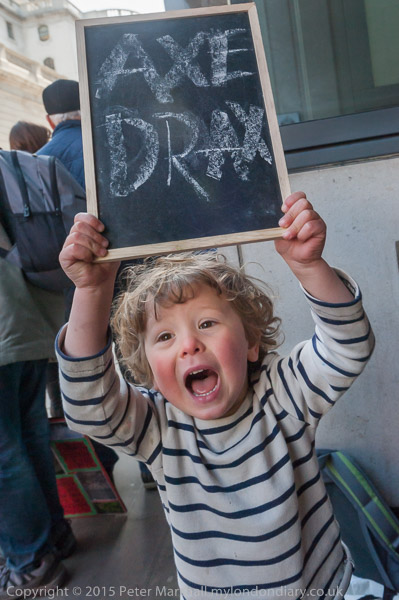
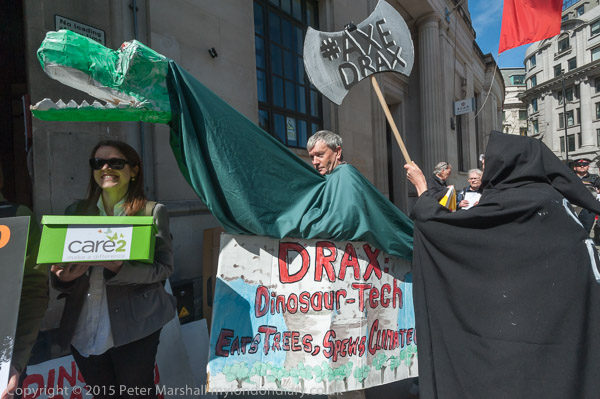
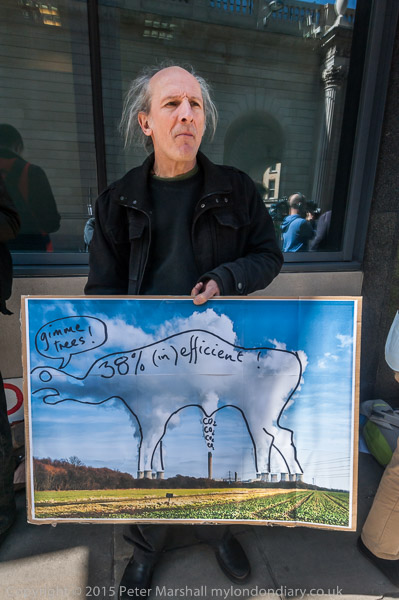
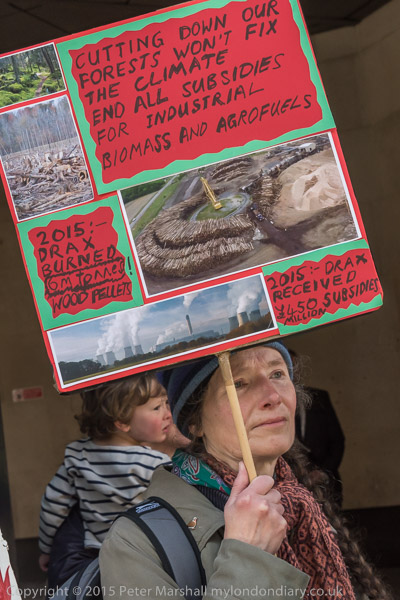
Axe Drax presents a different challenge, with an embarrassment of symbols – a Draxosaurus, a cooling tower and a grim reaper with his ‘Grim DECC’ axe, and some splendid banners as well as the people. I’ve photographed the Draxosaurus a few times now, and I think I have not yet managed to get a good picture – and I do wonder how many people who see it understand what it is about. The cooling tower is much better, though sometimes hard to see it is a cooling tower in photographs, and the Grim Reaper is fine if rather hard to see where he fits in – and the DECC is certainly not attacking Drax or its cooling tower, rather cosseting them – it’s axe is reserved for green initiatives.

Drax is about dirty coal and environmentally unfriendly biomass – which is benefitting from green subsidies, while genuinely green developments are getting sidelined. It’s about huge CO2 emissions, the devastation of large areas of Colombia with open-cast mining. And while I may get some interesting images, it sometimes feels like I’m trying to write a story in English with only a Cyrillic font.

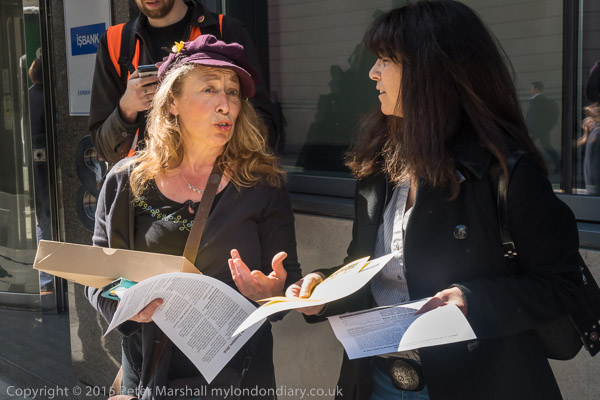
Physically it’s also difficult space to work in, with a narrow pavement in front of the Grocers Hall with a fairly steady stream of pedestrians. The City of London police keep telling me not to obstruct the pavement most of the time I’m taking pictures – and object when I stand – as they are – in the gutter. For quite a few of these pictures I not only had to look to see the subject, but also to see when the police had turned away and I could get into a suitable position.

It’s actually inevitable that this pavement will be somewhat obstructed – and it would be sensible and cause little obstruction to road traffic, which isn’t particularly heavy and gets held up by the traffic lights anyway – to put down a few cones to give a yard or so more to allow free movement along the pavement for pedestrians. And to get those officers off my back. There probably is a limit to the number of times they will warn me I’ll be arrested for obstructing the pavement before they really do, and I think on this occasion I came pretty close – despite being careful not to actually get in the way of people who were walking past.

More pictures at Drax AGM Biomass opposition and more about the campaign on the Biofuelwatch web site.

Continue reading Axe Drax Again

December 2016

Remember December? Not so long ago, Christmas and all that. Actually I do find it difficult to remember things now, and often when people ask me if I’ve done anything interesting recently it takes me a very long time to answer, and sometimes I need to look in my diary. Weeks and events do somehow seem to merge into each other, and I’m often rather pleased that I can look back to ‘My London Diary‘ to remember those things that I went to and photographed.

Of course I do have an actual diary too, though again it is now online, where I put down in advance when I get invitations or appointments and the details of the events I hope to photograph, though for various reasons it isn’t always possible to do so. In December I managed to get to around half the events I had an interest in. A few there just wasn’t time to get to, with other events over-running, and some days I just had to rest, too tired after other things.

When I do go out to take pictures, I usually like to have a piece of paper in my pocket on which I’ve written the important details – times and places, what the event is about, details of any buses or trains I hope to use, occasionally a name and phone number for the organiser etc. I could put it all on my smartphone, but its more convenient to have it written down, usually on a quarter sheet of scrap A4. That way a quick glimpse stops me heading for Trafalgar Square when the protest I’m going to photograph is actually in Old Palace Yard. And yes, I’ve done that before now.


Dec 2016

New Years Eve Walk
Boxing Day Walk
Howls of protest for death of the NHS


Heathrow “M4-15″protesters at court
Doctors & Nurses Die-in for Syria
Kurds protest for a Free Kurdistan
Vigil on Chelsea Manning’s 29th birthday


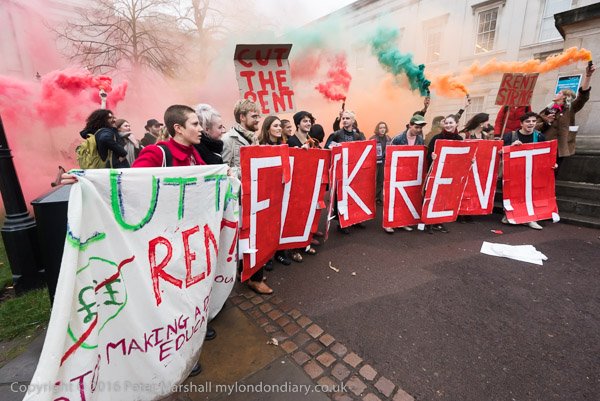
UCL Students protest rents and marketisation
Save Yazidi women and girls
Human Rights Day call close Guantanamo
Balochs UN Human Rights Day protest
London Santacon 2016
BBC censors prison struggles
Save the Rhino
Silent Chain for Europe
Israel free British citizen Fayez Sharary


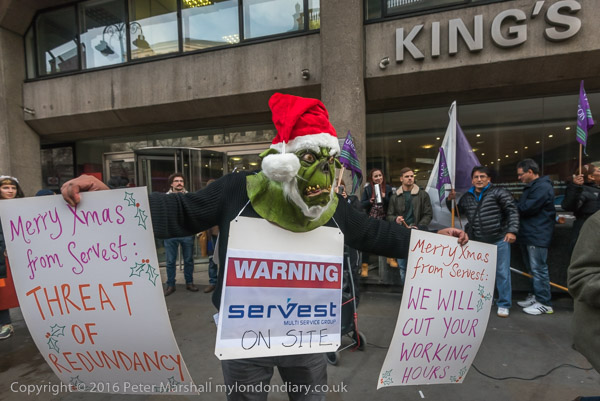
King’s College cleaners Servest protest
Movement for Justice Supreme Court picket


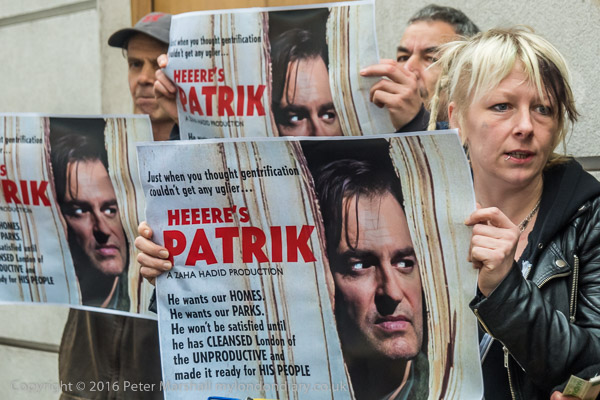
Class War protests ‘fascist architect’
Cannizaro Park
South Ascot Walk


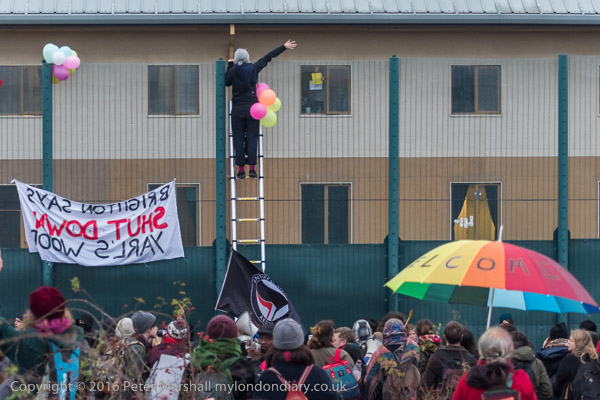
Shut Down Yarl’s Wood 10


Justice for LSE Cleaners

London Images

Continue reading December 2016

Do I have a problem?

On the ‘United Nations of Photography‘ site you can read a contribution by an anonymous ex-photographer, who took his last picture as a professional in 2006, I’m a Photographer and I Have a Problem…, and it got me thinking a little about my own and other photographer’s motives, particularly in the main area of photography which I’m now involved with.

The writer is not the only photographer I’ve known who has had similar thoughts and a change of career – in his case to becoming “a Support Worker (£7.20 per hour) at a Residential Drug and Alcohol Rehabilitation Centre.” The current weekly hourly minimum in the UK, it’s actually better money than many photographers now earn, though I’m sure that was not the reason for the change.

Yesterday as I waited outside Harrods for a protest there to begin, I was talking to one photographer about the poor wages earned by some workers in the world’s richest store owned by the richest family in the world – the Qatari royal family. Many of the waiters there get either that same legal minimum hourly rate, or just a few pence more, while that “needy” family get the lion’s sahre of the tips and service charge the public think are for them. We reflected that many if not most of the photographers present put in long hours for a pretty low return, in many cases amounting to an even lower hourly rate than that minimum.

I thought too of a series of exchanges with Chauncey Hare after I’d written about his work. I’d first seen his work when Lewis Baltz showed some of it at a workshop I attended, and went out and bought his 1978 book ‘Interior America’. In the 80s he gave up on photography and became a therapist who concentrated on work related abuse. The piece I wrote about him is no longer on the internet, but you can read a review on ‘5B4’ of the eventual republication of his work as ‘Protest Photographs‘, an extended version of that 1978 Aperture publication.

While informative, Mr. Whiskets’s review is I think in one aspect misleading. The light printing of the book was not “so typical of books from the late 70s” but was the result of a deliberate aesthetic choice by Hare – as was the harsh flash lighting; I think he did not want his work and the book to be seen as “art” but as a manifesto. But I was pleased when in 2009, a few years after our on-line conversation, someone managed to persuade him, as I had failed, to have his work re-published.

The anonymous photographer’s article is illustrated with an image of smashed cameras and equipment; Hare threatened to destroy all of his work – 50,000 negatives, 3500 prints and 30,000 35mm slides and many taped interviews – unless the University of California’s Bancroft Library would accept it as a donation. Fortunately they did, and now the library holds all rights and permission to reproduce pictures from his work in social situations requires the following sentence to be used with them: “These photographs were (or ‘this photograph was’) made by Chauncey Hare to protest and warn against the growing domination of working people by multi-national corporations and their elite owners and managers.” There are no items on-line.

Later yesterday, another photographer said to me that he didn’t mind about the protest we were photographing, all he wanted was “some action“. I didn’t reply but thought to myself that I was only there because I did mind, did care about the issues and the people, and that although I’d do my best to take pictures of anything dramatic that occurred, it wasn’t what motivated me.