Fotofest – Birmingham Mark II?

I was a little surprised to see a picture by Vee Speers at the top of the press release for the Fotofest International Discoveries II show which opens today in Houston and continues until December 19.  Of course I really love her pictures, but I’d hardly call her a ‘discovery’ given the amount of previous exposure of her work, not just the The Birthday Party, first shown in Australia in 2006 which is now on show in Houston, but also previous work including ‘Bordello‘ which first shown in Italy in 2002.
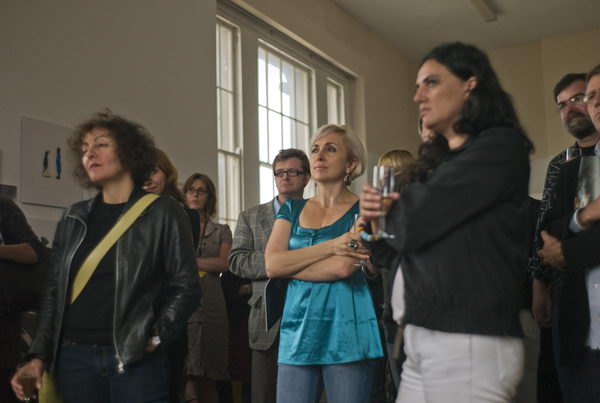
© 2009 Peter Marshall.

I first met her at Birmingham at Rhubarb Rhubarb in 2007, though she first attended in 2005. In 2007 her pictures were on the wall of the room where I was looking at portfolios, one of several fine photographers selected for the show ‘Otherlands‘, though I’d seen her work previously in magazines. Surprisingly Birmingham doesn’t get a mention in the Fotofest release, although it was most probably there she met the senior curator of Fotofest, Wendy Watriss, who was a fellow reviewer.
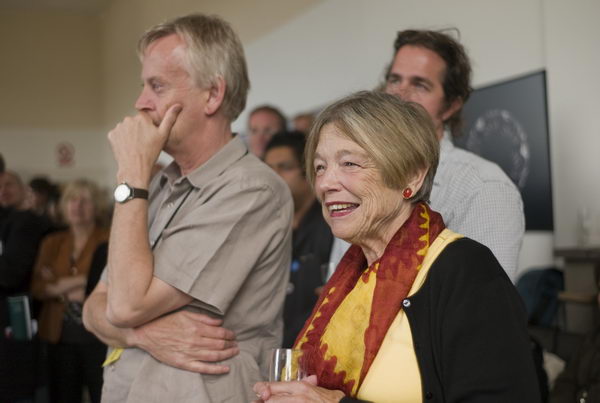
© 2008 Peter Marshall

Chinese artist Wei Bi’s re-staging of his 80–day experience in a Chinese prison — a sentence received for making a photograph. His large black and white photographs are minimal, showing a surreal relationship between near expressionless guards and disoriented prisoners. One of his images appears at the top of an earlier press release.

Alejandro Cartagena, born in the Dominican Republic lives and works in  Monterrey, Mexico and at Houston he is showing large-format brilliantly coloured images of the dramatic and ever-expanding suburban development of the area. He has shown work widely in Mexico for around 5 years as well as contributing to international group shows. I particularly like some of the ‘NewWork’ on his site.

Minstrel Kuik Ching Chieh was born and raised in a Malaysian fishing village but she studied photography in southern France. You can see her work, including RRose which is being shown at Houston on her blog.

Christine Laptuta produces work about the mystery of land, “its ambiguity, disruption and rhythm.” She chooses to represent ordinarily vast landscapes in multiple printed miniature platinum/palladium contact prints.

The constructed landscapes of cities are focus for Rizwan Mirza‘s photographs. His shadowy nocturnal images reflect the tension between the mysteries of darkness and the lighting.  Born in Liverpool he studied with John Blakemore in the early 1990s and also came to Rhubarb Rhubarb in 2008, although the previous year he showed at various galleries and festivals including PhotoEspana, Madrid, Spain. His work was also on show – not in FotoFest – in Houston in 2008.

Born Tokyo 1948,  Takeshi Shikama has been showing his black and white photographs of trees since 2004, and “The Silent Respiration of Forests” first appeared in a Tokyo gallery in 2006.

Working between Seoul, London and Paris, Korean-born MiMi Youn was one of the three winners of the Lens Culture – Rhubarb Photo Book Awards in 2008 along with Kurt Tong who divides his time between China and the U.K and has photographed a little-known and officially banned element of ancient Chinese funerary practice; Joss Paper or “Spirit Money.”

Brian Griffin – Olympic Portraits

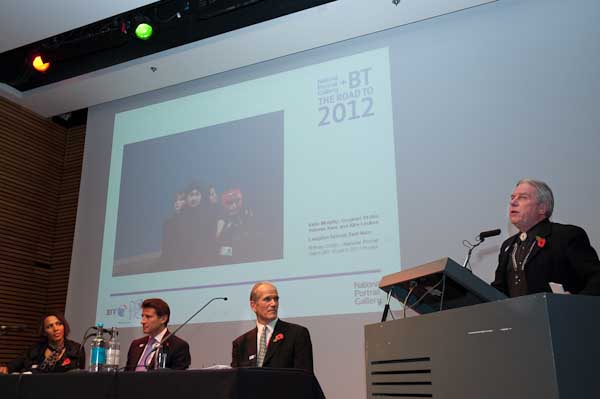
I was in two minds as to whether to accept the invitation to the National Portrait Gallery‘s launch of the NPG/BT Road to 2012 Project. The decision to have the games in London is arguably one of the greatest British tragedies of the 21st century to date and it’s legacy for the Lea Valley and East London likely to be only slightly less damaging than Enola Gay’s flight over Hiroshima in August 1946.

But of course the games are going to happen in around a thousand days time, and it’s good to see anything positive that comes from it – such as this project. Brian Griffin is certainly one of the best portrait photographers currently working anywhere in the world at the moment, and it would he hard to think of a better person to photograph those people connected with what is – whatever I think about it – a major project. The six images unveiled today are the first of 20 by him, and commissions to other photographers will bring the total to 100.  I hope those others chosen to work on the project will also be chosen on merit rather than, as so often happens in such things, for political reasons.

I’m not against sport. In my youth I played for various teams, getting a medal myself at the age of ten as a part of an all-conquering wolf club soccer team that included three players who went on to play professionally and at 16 I knocked over ten seconds off my Borough’s record for the quarter mile, finishing a hundred and fifty yards ahead of the next runner. But in my view games are for playing rather than watching and taking part is more important than winning. I think it’s a part of the Olympic Ideal, which doesn’t seem to have much part in our official professional programme for sport.

© 2009 Peter Marshall

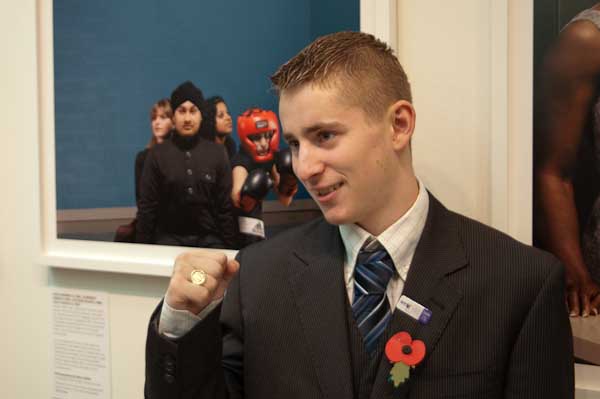
Sandy Nairne, the Director of the NPG opened the event and was followed by rather predictable speeches from Lord Coe and Dame Kelly Holmes, but it was photographer (or artist) Brian Griffin who was the star performer, talking about some of his experiences in making the pictures and his thinking behind them.  Above the speakers throughout the presentation was his picture of four from the thirty East London young people who went to Singapore to support the games bid, and he told us how he had decided to from them into a single sculptural group, but when he had taken what he thought was his picture, Alex Loukos in his red boxer’s helmet, jumped out from the group and made the image that he quickly captured and we saw on the screen.

© 2009 Peter Marshall

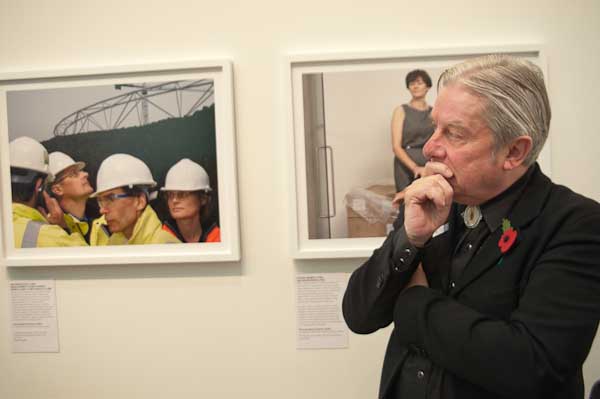
Although Brian stressed that he thinks about his work as a fine artist, he still has the openness to the moment that makes his work truly photographic, and nowhere was this shown more in the set of six images that was unveiled at the event than in a picture of four civil engineers in hard hats under the Olympic stadium which for me – and several others at the event whose opinions I respect – was the outstanding image of the set. I was told that he has also taken a very fine portrait of Lord Coe, but this is apparently being held back for a later date.

© 2009 Peter Marshall

You can see all six pictures on the NPG site, under the heading ‘The First Commission’ and read some of Brian’s comments about them on the London2012 blog.    (Unfortunately I’m not allowed to post the pictures here at a size I think useful – so you will need to click on the links to see the work.)

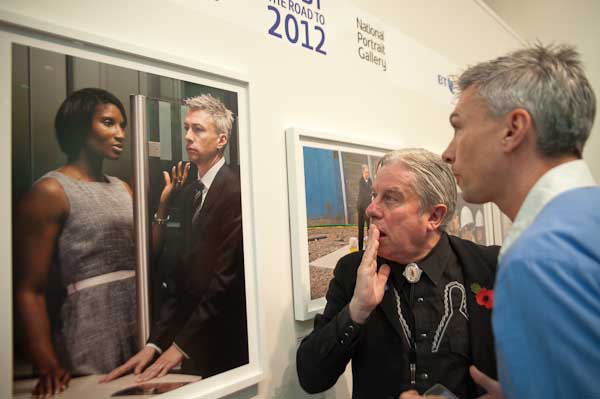
Brian writes there “So, for example, the portrait of Jonathan Edwards and Denise Lewis. The colouration of this image, in the steel and glass environment of the building, echoes the feeling from a painting by the pre-Raphaelite Sir Edward Burne-Jones. The portrayal of Denise also leads me to the Edward Burra painting ‘Harlem’.”

© 2009 Peter Marshall

In front of the actual print, my immediate thought was “Beam me up Scotty!”, and there is a definite “Star Trek” feel to this image, exaggerated perhaps by Jonathan’s hair looking like he’s got his hands on the Van der Graf machine and a slightly unreal quality about Denise Lewis’s skin tone and gesture which is a little more apparent in the actual print than in reproduction. However you see it, it remains a striking image.

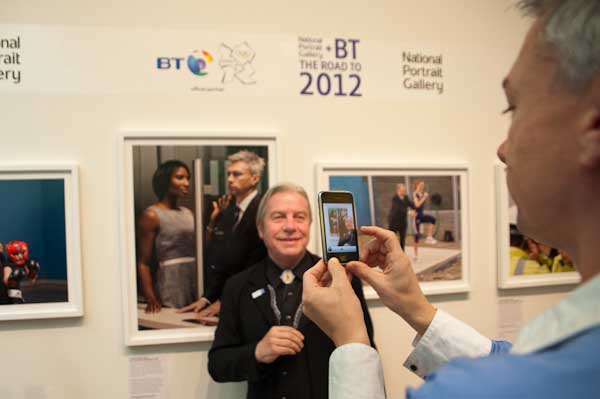
Of course all of the pictures are excellent in their own way, and it was a bonus to have a number of the sitters present at the event. Not only could we see them with their pictures, and at least in some cases photograph them, but also I was able to catch one of them, triple-jumper Jonathan Edwards, getting his own back by taking Brian’s picture in front of his portrait.

© 2009 Peter Marshall

It was good – as always – too meet Brian again, and also of course some other old friends and a few new ones. But as I left the picture below flashed into my mind and I felt a sudden sadness about the missed opportunity to make this a Green Games and incorporate the Manor Gardens Allotments into the site – and to see how Brian might have photographed Hassan and Sam and all the others.

© 2007 Peter Marshall
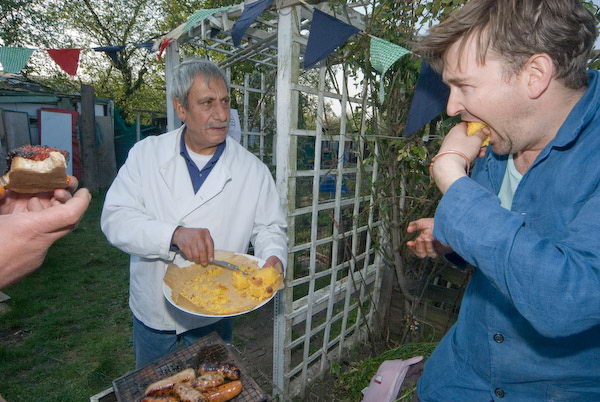
Sam Clark tries some of Hassan’s cake – which was great – while I wait for Sam’s sausages
Manor Gardens Allotments on the Olympic site, April 2007
.
Peter Marshall

More pictures from the NPG/BY Brian Griffin event on My London Diary shortly.

Jane Bown

Last Thursday I read a post on Twitter about the Guardian Interactive feature on Jane Bown, which accompanies a show of her work next door to the Guardian at Kings Place, on until 21 Nov 2009 and a new book of her work.

The site has an excellent collection of her portraits and a video in which she talks about her time at Guildford School of Art studying with Ifor Thomas, her first assignment for the Observer in 1949 and some key sessions since then, including photographing the Beatles, The Queen, Francis Bacon, Samuel Beckett and others.

She has really had an incredible career as a portrait photographer, and I’ve always admired her simple and straightforward style both as a photographer and a person. Once well-known for carrying her camera in a basket, she never worried much about equipment. She got an Olympus OM1 with a standard lens when it came out in the early 1970s and is still using it.  When the Queen, awarding her an MBE, asked what she did, the reply was “I’m a hack.” Later she got a CBE and when both women were 80 the Queen sat for a session with her.

You can also view an earlier presentation on her work, made at the time of the publication of ‘The Unknown Jane Bown’ and an essay about her written in 2007  by Germaine Greer.  Photographers will find some details interesting, such as her “40-year-old Olympus OM1 cameras, with a 50mm F2.5 lens”  wondering how she managed to get the camera in 1967 when Olympus only announced it in 1972 and thinking that the lens looks rather like the more familiar and very fine f1.8 that most of the rest of us used, but it still makes interesting reading.

Bert Hardy Talk

Years ago I remember going to hear Bert Hardy  talking about his own work at the Photographers’ Gallery. It was an entertaining evening, but a rather predictable one, as by that time he had a rather carefully worked out script that he followed almost word for word about his life and work on every occasion. It was good to go and see him and watch him perform, but there was little if anything new in the actual content.

The selection of pictures too was predictable. Not least because back in the “good old days“, the “golden years of photojournalism“, photographers worked for hire and the publication owned the pictures, which in the case of Picture Post, disappeared into the Hulton empire. Getty, not am organisation I usually have much praise for, deserve credit for having preserved material that might otherwise have been lost from the Hulton Archives.

And on November 10th, 2009,  Graham Harrison is giving a talk, The Unseen Bert Hardy, showing images recently rediscovered in that Picture Post collection at the Photographers’ Gallery, 16-18 Ramillies Street, London W1F 7LW,  at 7:00pm. The PG also has a nice little selection of his images for sale on line, although the thumbnails are a little misleading*. Harrison, whose Photo Histories site I’ve mentioned before and should visit more often (don’t go there unless you have a lot of time to spare!), was able to look through hundreds of original Picture Post contact sheets and find many Hardy pictures and stories that were never used.

There is a taste of what is in store in Doorstepping a city: how Bert Hardy captured life in Barcelona during the Franco dictatorship on Photo Histories. Spain was under the powerful thumb of Franco’s fascist dictatorship and times were tense as a general strike was taking place in Barcelona as Hardy arrived. Some of his pictures were published together with a story by James Cameron in ‘Barcelona: city in ferment‘ on April 15, 1951, but the others have just sat in the archive until now.

Although Hardy had got into photography with a Leica, in Spain he was using a square medium format camera, presumably a Rollei or Rolleiflex*. This gave the distinct advantage in tense situations of working with a camera held at waist-level with a quiet shutter. One disadvantage was its fixed standard lens, but this was an age where the publishing climate didn’t expect the kind of close intrusion and ‘big close ups’ we take for granted in the press today.  Much of the time he was on the street the camera was probably largely hidden in the folds of his coat. It must also have helped that people generally were much less aware of cameras and their possibilities than today, although some of his subjects have clearly realised they are being photographed, most seem to have remained unaware of the photographer.

Cameras then were simpler beasts, and although they lacked the automatic functions that we now take for granted (but curse when they let us down)  experienced photographers could set the aperture and shutter speed they would need without having to look at the camera (and without of course the help of a light meter.)

Focus with medium format might need some attention, but experienced photographers  became precise judges of distance, in more active kinds of work preferring to set focus by scale rather than relying on the much slower process of viewing the image on the viewing screen.  For many situations they would focus in advance on a particular distance – perhaps 10 ft – and then move or wait to be at exactly that distance when taking the picture.  (This is something street photographers still do, even with modern cameras that may have autofocus, though generally using closer distances and wider lenses with greater depth of field to give a zone of focus ; turning off autofocus – and autoexposure – cuts the lag between pressing the release and the picture being taken.)

Framing with the larger negative was also less of an issue, although some of the contacts on the slide show suggest that at times Hardy did it with great care. In general photographers were advised to leave plenty of space around the subject to allow for cropping that was almost always applied by editors both to fit images into the page layout but also as a way of showing they were doing their job (sometimes even when it meant ruining the pictures.)   Only two of his eight images printed in the Barcelona story are used in the square format they were taken, although that figure is probably higher than average and perhaps reflects the higher regard for images by Picture Post than most other publications.

* On the PG site, all the thumbnails are square but many of the images aren’t, having been taken on 35mm. Presumably apart from his Blackpool girls on the promenade rails, taken with a Box Brownie, the remaining square format images were largely made with a Rollei.

Quite incidentally in this set of pictures I notice the Spanish dancer in his 1954 image complete with leering British sailors in a Gibraltar bar is wearing pants under her swirling skirts, while I was embarrassed to find from some of the pictures that the flamenco dancer I photographed in London a few years ago wasn’t. Only slightly embarrassed, but I did choose not to publish the images that had revealed more to a fast shutter speed than was clearly apparent to the naked eye.

Paris Photo 2009

I don’t think I’m going to make it to Paris for Paris Photo this year, although I always enjoy a visit there and there is so much to see not just at the show but also elsewhere in the city.  Even though this year it won’t be ‘Le Mois de la Photo’ – which only takes place every other year – there is always a lot of photography to see at this time.

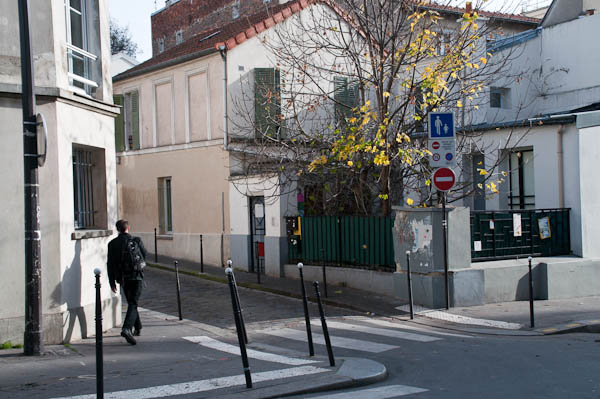
© 2008 Peter Marshall

It’s also a good place to meet a few old friends from around the world, and those who live in Paris, including Jim and Millie Casper. Lensculture is one of the truly essential photographic sites and partner in Paris Photo and Jim has put a great set of one hundred and sixty-seven images on line from the show to whet your appetite for a visit there. I just don’t have time to write about them all, but there are some fine images there (and just a few things I hope never to see again.)    But I can’t resist mentioning a lovely Inge Morath colour image I’ve not seen before.  There are also of course other things worth taking a look at in the new ‘issue’ of Lensculture.

Just thinking about it again to write this short note has made me think again, tempted by the idea (and I’ve even downloaded the accreditation form.)  But given the value of the pound and my lack of commissions and sales at the moment a trip like this is very hard to justify, at least to my accountant and the tax man.

© 2008 Peter Marshall

You can read and see rather more than the above two pictures from my trip last year in a ‘PARIS SUPPLEMENT‘ on My London Diary. And perhaps I’ll save up to make the trip again in 2010.

Taken in London at TINAG

This Is Not A Gateway (TINAG) is a voluntary organisation that creates arenas/platforms for those whose point of reference is the city. Working across disciplines, TINAG encourages inter-cultural dialogue and rigorous production through four strands: FESTIVAL, SALONS, PUBLICATIONS and ARCHIVE.

The TINAG 2009 Festival is taking place now – 23 – 25 OCTOBER 2009 – in Hanbury St, Spitalfields, between Brick Lane and Commercial St, just across the road from the old Spitalfields Market. And on Sunday morning in a session that starts at 11.00 am, Paul Baldesare and myself will be doing a 5 minute presentation on our show Taken in London. Assuming the technology works, we will be projecting all 41 pictures from the show during that time, as well as talking very rapidly!

© 2009 Peter Marshall.

You can download the festival programme as a PDF, and it does give details of all the sessions and events in Hanbury St, though I was disappointed to find that there was no listing of the events outside this area – such as Taken in London.

Prix Pictet announced later today

The winner of the Prix Pictet will be announced tonight, and you can see the work of the 12 selected finalists on Lensculture.

The twelve are:

  • Darren Almond, UK
  • Christopher Anderson, Canada
  • Sammy Baloji, Congo
  • Edward Burtynsky, Canada
  • Andreas Gursky, Germany
  • Naoya Hatakeyama, Japan
  • Nadav Kander, South Africa
  • Ed Kashi, USA
  • Abbas Kowsari, Iran
  • Yao Lu, China
  • Edgar Martins, Portugal and
  • Chris Steele-Perkins, UK

I’d find it very hard to pick a winner from these, although there are two or three photographers whose work I’m surprised made it to the last 12, and I don’t think are showing anything like there best work here. Of course in most cases I’ve only seen the work on the web, though there are a few pictures I’ve seen before elsewhere.

If I had to choose,  I think it would be between Naoya Hatakeyama and Ed Kashi, so those are probably two without a chance if my record at predicting such things stands.

As well as the £60,000 prize to be announced by Kofi Annan, honorary president of the Prix Pictet,  at the Passage de Retz Gallery in Paris today, there will also be a commission for one of the twelve photographers.

Three came along at once…

Sometimes demonstrations seem to be like London buses, and after you’ve waited ages, three come along at once.  It happened last Saturday, when as well as the three events in London I did get to – if rather briefly to two of them – there were also demonstrations I would have liked to cover in Swansea and Ratcliffe-on-Soar. But I’d decided I wasn’t up to the roughing-it that joining in with the Climate Swoop to photograph what was planned as a 24 hour action.

I’d actually visited Ratcliffe-on-Soar a few years ago – and it has been pretty popular with photographers, not for the tons of carbon dioxide it creates, but simply visually, and it did have its attractions.

But I think since I was there they’ve put up a rather better fence, and last weekend there were a thousand or two police getting in the way of the view. If you want to see some pictures from the demonstration, one of the better sets of images I’ve seen is by Fil Kaler, and there a quite a few videos that give some of the atmosphere from  – here’s a poetic one on Blip.TV and you can also see how a Climate Camp medic came to the aid of a policeman who had collapsed – and there are more videos on that site. Perhaps surprisingly, one of the fuller reports of the swoop was on CNN, just a pity they didn’t use any of the decent pictures that were available – but presumably they have a contract with Getty that means their pictures are dirt cheap or even at zero marginal cost.  Just a pity they aren’t rather better.  The three photographers I know personally who did go there all got considerably more interesting pictures.

Swansea too has its attractions, but it was a long way to go for what was expected to be a rather small demonstration by the right-wing EDL (or possibly WDL – Welsh Defence League) and rather more than three times as many in a counter demonstration by Unite Against Fascism. I’ve so far only found one picture of this protest on the web.

In London I had a busy day, starting with the Tamils, then rushing to Knightbridge for an anti-fur march before going back to Westminster for a demonstration against forced deportations of refugees back to the still terribly unsafe Baghdad. But each of those deserves its own post on the blog.

Violet Isle – Alex Webb & Rebecca Norris Webb

Burn has a truly beautiful set of images from the book Violet Isle by Alex and Rebecca Norris Webb from Cuba, together with a Q&A session with the two photographers.

It held my attention particularly because a few days ago I wrote Viva Cuba! Havana Cultura, but there are several really breath-taking images among the dozen on show, and you can see them at a decent size without the usual Magnum watermark.

Given the  treacle speed that I seem to be getting from the web today it took me quite a while to see all12 pictures, but it was worth the wait.

Mitch Epstein’s Power

In last Saturday’s post on the Lens blog at the New York Times you can see 15 pictures by Mitch Epstein from his new book American Power and on the NYT itself you can read an article by Randy Kennedy about the six-year project that led to the book.

The pictures are well worth a look – faintly reminiscent of at least one recent project on the UK, but to my eye rather more interesting – and the story is also worth reading. Photographing power stations – even with an 8×10 – attracted the attention of law enforcement, and at one site he was told by an FBI man “If you were Muslim, you’d be cuffed and taken in for questioning.” On another occasion his camera was mistaken for a missile launcher!

On Epstein’s web site you can also see work from some of his earlier projects, Family Business (2000-2003), The City (1995-1999), Vietnam (1992-1995), Common Practice (1973-1992) and Recreation (1973-1988.) Artnet also has an online catalogue.

Born in 1952, Epstein studied at Rhode Island School of Design before going on to study with Gary Winogrand at Cooper Union in 1972-4.

He was one of the long list of photographers featured in the book by Sally Eauclaire that defined ‘The New Color Photography‘ in 1981 (it included among others Harry Callahan, William Christenberry,  Mark Cohen, John Divola, William Eggleston, Emmet Gowin, Jan Groover, Len Jenshel, David Hockney,  Les Krims – who refused to let her use a picture, Helen Levitt,  Joel Meyerowitz, John Pfahl, Stephen Shore, Sandy Skoglund, Eve Sonneman and Joel Sternfeld) and also in the more focused vision of her later volumes ‘New Color, New Work‘ and ‘American Independents.’