40 Years

The first time I wrote about Nicholas Nixon‘s series ‘The Brown Sisters‘ I think was when the project with an annual photograph of the four of them – one the photographer’s wife –  had been going for 25 years. At the start of this month the New York Times published the 40th in the series at the bottom of an article in the magazine, 40 Portraits in 40 Years, written by Susan Minot.  In November 2014, the Museum of Modern Art in New York, MoMA, is holding a show of the 40 images and publishing the book, The Brown Sisters: Forty Years.

It seems to me to be remarkable enough that the five people concerned, Heather, Mimi, Bebe, Laurie (always shown in that order, left to right) and the photographer, have actually managed to get together every year for a photograph since the first in 1975, certainly not something we could have managed in my own family. The photographer was born in 1947 and so is now 66 or 67, and the sisters must be not that different in age. And remarkable too that it should have resulted in a series of such quality (though I find a few a little weak compared to the others.)  There are links to more of the pictures in a recent post here about a series of annual self-portraits by Lucy Hilmer, which she began the year before Nixon’s Brown Sisters.

I first became aware of Nixon’s work when he was included in an exhibition in 1975 at George Eastman House curated by William Jenkins called “New Topographics: Photographs of a Man-Altered Landscape.” I didn’t get to Rochester to see the show, but I read about it and saw pictures from it in magazines and books, as well as a couple of years later attending a workshop with one of the other photographers involved, Lewis Balz, who talked about  and showed work by those in the show and others working in a similar vein. A few years later I bought a small publication, Nicholas Nixon, Photographs From One Year (Untitled 31); the year was in 1981-2, and the book came out in 1983. Some of the pictures from the book are in the MoMA collection (organised by date – start here – but not all images here from 1981-2 are in the book.)  The title and format of the book reflected Nixon’s desire to deliberately set himself different goals for each year of his work.

The 39 plates in that book are finely reproduced more or less actual size from Nixon’s 8×10″ contact prints, and it is a superb set of pictures of people in and around their homes in some of the less affluent districts of American cities, with an introduction written by photographer Robert Adams. Inside my copy are some brief notes made for when I was talking about the work to students, including this about the apparent relation between Nixon and the groups of people he was photographing:

They are not the ‘subject’ but with him part of the act of photographing. And it is an act which does not simply restate the beauty and sensuousness of natural light correctly pictured, but respects and affirms those within its frame.

Copies of this thin book, 48 pages in all, are still available for from around £3 second-hand (a fraction of what it cost me, as the cover price of $16.00 would have meant it was on sale for £16 or more here), and it is well worth buying, even though postage may double the cost.  It may well appreciate shortly, as one dealer is already asking over £50 for a copy.
Black Square Portraits

On Wired you can see 23 portraits made by Anastasia Taylor-Lind who spent most of February in Maidan Nezalezhnosti, Kiev. Noting that “There were more photojournalists than protesters on the barricades of Independence Square” she decided whe had to do something different, and eventually decided to make posed portraits of some of those involved in the protest, men in their makeshift armour and women carrying flowers. The Wired page tells the story and also links to the Instagram movies she made of her Hassleblad and Bronica viewfinder images while setting up these portraits, and which gave a more or less instant preview of her work.

It took her a while to get things sorted out, and it was only after a trip back from London that she brought with her a folding frame to hold the black muslin background that works so well in the pictures – a selection from the 96 in her book ‘Maidan—Portraits from the Black Square’ , a limited edition of 750 copies. You can see her at work on a video on the Gost site, and signed copies of the book are available from the photographers own web site. If you are not already familiar with her her work, it is certainly worth visiting the site and looking through the stories on line there, each interesting  in its own way.


Fushi Kaden – Issei Suda

It was in the late 1970s that I got to know Clare de Rouen, who was then running the bookshop at the Photographers’ Gallery, and we were both members of a loose group who often found ourselves drinking at talking – mainly about photography – in the upper bar of the Porcupine on the corner of Great Newport St and the Charing Cross Road after various events at the Photographers’ Gallery (then in Great Newport St.)  She was a striking figure, truly an Egyptian goddess;  I had come across her a few years earlier at the ICA where I was a very infrequent attender, but it was only later that I came to know her.

At that time the Photographers’ Gallery was still of interest to photographers, and I would go to see all the shows there, as well as many of the meetings, including those of a ‘Young Photographers‘ group that met there, where we would bring work and various well-known names would sometimes drop in and show their work and look at ours. It was a lively group, and often gave the Education Officer whose job it was to look after us something of a hard time, particularly as she was significantly less well informed about photography than most of us.

The group was a part of the educational aspect of the gallery that was important to earn its charity status and Arts Council grant, but was I think rather unpopular with the management – and they jumped at the chance to get rid of it when a small group of largely amateur photographers who had been to workshops at Paul Hill’s Photographers’ Place in Derbyshire went to them with a proposal to form ‘London Independent Photography‘. Though the gallery, having encouraged and backed that group, very quickly withdrew any support after it was set up and it continued on an even more independent basis – as it still does.

Bookshops played an important role in my development as a photographer, and the people who ran them were vital. At first for me it was the Creative Camera Bookroom, but after that closed the Photographers’ Gallery bookshop largely took its place. When you went into either of them, you didn’t just browse the books (though you could if you wanted) but met people who were enthusiastic about the books that they stocked and would talk intelligently with you about them.  There were fewer books published in those days, and whenever I went in Clare would be keen to show me something she thought was good and that I would be interested in. And I was never a great customer in terms of spending – in the early days I couldn’t afford to buy many books – and later much of my collection came as review copies.

Later she moved a little up the Charing Cross road to Zwemmers, where the small photographic book shop she ran there was impossibly crowded with books, many of which were otherwise unobtainable in the UK, including a large selection of Japanese photography, almost all of which was new to me. I spent hours one afternoon going through book after book, at last coming across one that I simply had to buy: Fushi Kaden, photographs by Issei Suda*. I’m not sure why the 100 largly square format images had such a strong resonance, and the short English text at the back of the book told me very little. There is more in Japanese that I can’t read, but the English was of little more use, containing the mysterious sentence “It was not, however, until he produced the photographs using mirrors (appearing in the later section of this present work) that Suda established his own style.’  My only guess is this may be a reference to a change in camera, perhaps from his original Rolleiflex TLR to a simiilarly square format SLR. Next time my son comes to stay I’ll see if he can make sense from the Japanese, though all he normally reads is Manga.

What got me thinking about Issei Suda – and then about Clare de Rouen – was an article in the NY Times Lens blog today, Japanese Swordsman With a Camera, which has 14 of Suda’s pictures along with some text by Rena Silverman. I think all but one of the 14 are in the book that I bought, published in 1978 and are on show at Miyako Yoshinaga in New York until Oct 18, 2014.

The best place to see his work on-line seems to be Charles Hartman Fine Art, but you can also see a good selection of his images on ASX and a video there looks at two books, one by Hiromi Tsuchida and the second by Issei Suda. It’s also worth looking at Only Photography, which has some well reproduced images and also the cover of the book that I bought back in the 1980s. There is also an exhibition of 40 prints and a lengthy text on Facebook from Trans Asia Photography Review but the images there seem just a little lacking in contrast to me.

Later Clare opened her own bookshop further up the Charing Cross Road, upstairs above a sex shop, and showed work mainly of young photographers on the stairs. By then I had no more room at home for books, and seldom bought any. Openings there were impossibly crowded and I think the last time I saw her I greatly embarrassed myself when I dropped a bottle full of beer, handed to me out of a tub of ice and water, the wet neck slipping through my fingers.  She quickly and efficiently cleared up the mess and handed me another bottle.


* I’ve just searched for this on AbeBooks and the only copy listed there is from a Spanish bookseller, for around £300 including shipping, so it was a good investment.


Tavakolian versus Carmignac

Iranian photojournalist Newsha Tavakolian (born 1981) gives her reasons for  returning the 50,000 Euro grant and stepping down as the winner of the Carmignac Gestion Award for photojournalism 2014 in an article Newsha Tavakolian versus Carmignac published today on The Eye of Photography (L’Oeil de la Photographie).  In it she makes clear her reasons for doing so, because of the interference of French investment banker Edouard Carmignac in the presentation of her work.  She writes:

from the moment I delivered the work, Mr. Carmignac insisted on personally editing my photographs as well as altering the accompanying texts to the photographs.”

and that his interventions had the effect of changing her work from “a subtle attempt to bring across the realities of life of my generation in Iran to a coarse and horrible clichéd view about Iran.”

Tavakolian states that the Carmignac Foundation has a persistent attitude of erring on the side of controversy, and that their behaviour towards her and her work is at odds with its stated aim of being “committed to champion the personal and, by definition, minority view”, attempting to straitjacket her subtle and nuanced individual perspective into the clichés about Iran. As she points out, even their statement they made about the ‘adjournment’ of her exhibitions and book they state this was due not to her standing up for the integrity of her work but to ‘severe pressure’ applied by the Iranian government on her and her family. She describes this as “absolutely false, and laughable”.

Tavakolian was one of the photographers – others included Azadeh Akhlaghi, Gohar Dashti, Shadi Ghadirian, Babak Kazemi, Abbas Kowsari, Ali and Ramyar, and Sadegh Tirafkan whose work was shown earlier this year at Somerset House in Burnt Generation: Contemporary Iranian Photography, and one of her pictures in a set of images on Iran’s young middle-class from The Observer shows a man sitting at a table with his face covered with shaving foam, ‘to draw attention to her feeling that, “Men in Iranian society are often perceived as angry and bearded in the west”’.

Hers is a principled stand, and one that as a photographer I whole-heartedly applaud. Too often the price of having work published or shown has been to have the views of others imposed on it. Her website  – and those of the other photographers listed above – is worth spending time looking at to understand something about both her own perspective and the realities behind living in Iran.

Hugh Mangum (1877-1922)

These days I seldom seem to have a good word for the BBC, and their coverage of the Scottish question in recent weeks has further mired their reputation. It will be hard to believe any report from their political editor Nick Robinson after he was widely perceived to have made “a brazen and quite spectacular lie” about Alex Salmond’s lengthy response to his questions at a press conference.

So it’s nice to get a little away from politics and have something positive to say about one of our great British institutions. In the BBC online Magazine there is an interesting article by Rob Brown of the BBC World Service, The photographer who rejected racism in the American south, about a relatively unknown photographer, Hugh Mangum (1877-1922), a self-taught itinerant photographer from Durham in North Carolina who travelled by rail across North Carolina, Virginia and West Virginia and set up temporary studios producing low cost portraits for anyone who wanted a photograph of themselves or their family.

The Penny Picture Camera he used allowed for a variable number of images on a single glass plate, cutting the costs of each exposure (and hence its name – with the smallest pictures costing only a penny), and sometimes the photographer would get things a little wrong, producing unintended if sometimes interesting multiple exposures.

Some of the pictures have been on show last month at the Museum of Durham History, curated by Sarah Stacke, who is working together with Margaret Sartor of the Duke University Center for Documentary Studies on a book about Mangum. You can see all of the 688 surviving negatives in the  Hugh Mangum Photograph Collection on-line in their fine Digital Collections site, where you can also download images at various sizes for  study and personal use.  The surviving images are almost certainly only a small fraction of his work.

Mangum was unknown to me until I read the BBC World Service article, although there was an article by Stacke about him on the NY Times Lens blog in August last year that I missed.

You can see more about Penny Picture Cameras on the web, and there is a detailed description of the 5×7  Century Penny Picture camera which was manufactured by the Century Camera Company from  1900 to 1907, and then when they became part of the Kodak empire by the Folmer & Schwing Division of the Eastman Kodak Company until 1926. After leaving Kodak they made a similar camera until 1937. There were also other cameras of this type available and I don’t know if it was a Century that Mangum used for his work.

Mangum’s pictures are interesting in showing us such a cross-section of the population of the US South, working across the boundaries of race in a society that was, as Stacke says “marked by disenfranchisement, segregation and inequality — between black and white, men and women, rich and poor” and also for the directness of the images, showing the people he photographed as individuals.

Devon/Dorset Holiday Snaps

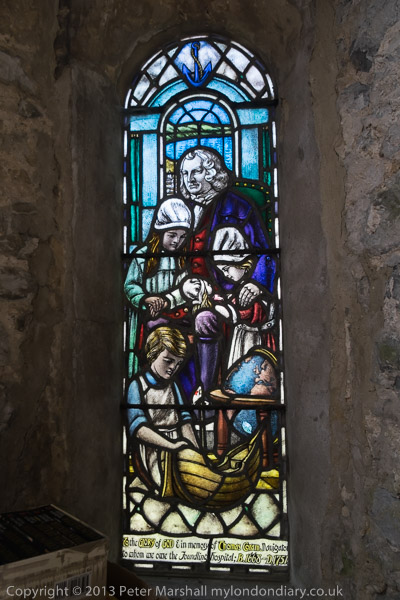
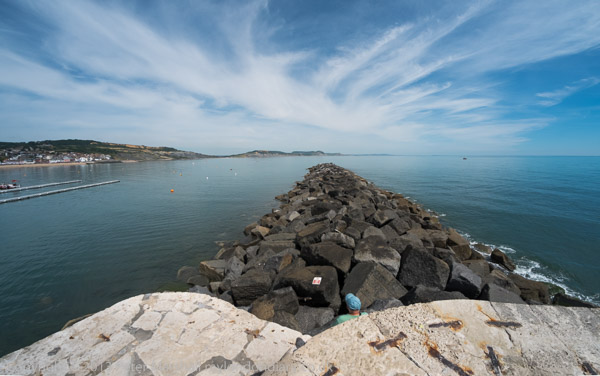
Not London, but its convenient to post my holiday snaps in My London Diary, and there were some London connections. We were staying just a few miles from Lyme Regis, and one of its more famous sons was Thomas Coram, the founder of the Foundling Hospital in London’s Coram’s Fields, and there is a window for him in the parish church.

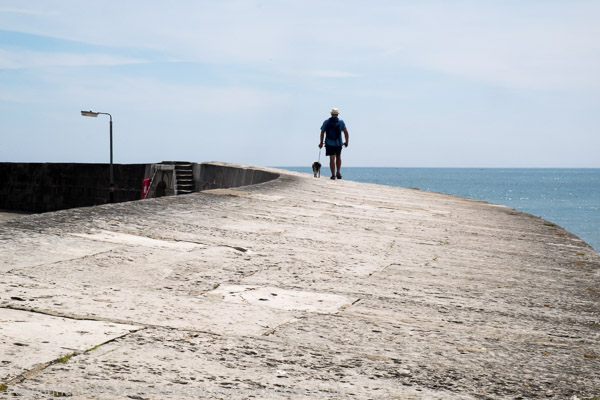
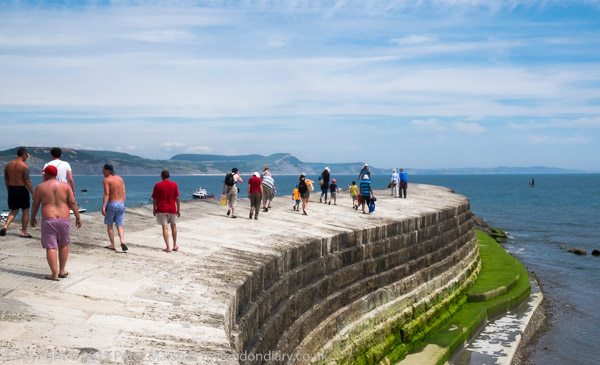
But for most people Lyme Regis means fossils and possibly (largely thanks to the French Lieutenant’s Woman) The Cobb, a slightly odd shaped harbour wall.  We did go looking for fossils – and found quite a few small ammonites – but none were really worth photographing, and the rocks they were on were either far too large to move or too crumbly to keep, though we did take a couple of lumps back to show the friends we were sharing an ex-hotel in the middle of nowhere with.

The slope is handy to allow the waves to run back off, though the sea was pretty flat when we were there, and most of the time there were quite a few people walking along it.

The only really good fossils we saw were in shops and the museum – and the museum also has quite a few interesting local photographs, including some taken by Roger Mayne (1929-2014), best known for his work on children playing in Southam St and elsewhere in North Kensington between 1956 and 1961. When I met him he complained that people never realised he had ever taken anything but these pictures, but looking at the work on his own web site these pictures do seem to me to stand out.

In 1974 he moved together with his wife, playwright Ann Jellicoe to Lyme Regis, where she developed the idea of community plays and became, along with John Fowles, co-curator of the Lyme Regis Museum for some years – and later both Jellicoe and Mayne were patrons of the Town Mill, rescued by volunteer efforts over ten years from dereliction to become both a working watermill and to house various artisanal businesses. You can see a couple of Mayne’s images of Lyme in the Landscapes section of his web site.

If you look at the pictures in Devon/Dorset Holiday you will find that we did quite a lot of walking – not least because where we were staying was a little over three miles from Lyme and further from anywhere else, and although we were close to a bus stop, the first bus into Lyme came at 10.59 and the last bus back was timetabled for 16.59, though it was always late when we took it.

So I was very pleased to be carrying a couple of Fuji cameras rather than my more usual Nikons. I was going to take just one camera, the Fuji X-T1, but in the end decided the Fuji X-E1 was so light and petite that I might just as well take that along as well to save me having to change lenses so much. I took three lenses, the Fuji 18-55mm zoom and 14mm, and the Samyang 8mm fisheye, which at f2.8 was a stop faster than the others.  All three lenses are fully usable wide open, though like all lenses they improve a little a stop or two down, and both bodies performed well.

Its actually an advantage that the 8mm is a manual lens, as you hardly ever need to focus. Both the click-stopped aperture ring and the focus ring are commendably firm, and even clumsy fingers like mine seldom knock them from position. Set the lens at infinity and f5.6 and you never need to touch it again.  I did miss the level indicators of the Nikon D800E when using this lens, as any up/down tilt in the camera gives you a curved horizon, and while the unusual projection used by this lens is better when using the images uncorrected, correction software doesn’t quite work as well with them. Its a lens I love using, and as you can see I probably used it too much!

I have two problems with the 14mm, though optically it is fine. Firstly it is quite easy to shift from manual to autofocus mode or vice-versa by pushing the focus ring – great when you want to, but can be disastrous if done by accident and not noticed. Of course you should notice, as the viewfinder shows quite clearly when you have autofocus by giving a green square outline. But if you get absorbed in making pictures you can miss this.

More annoying is the very loose aperture ring, turning with only a slight detent on every 1/3 stop. Not so bad if you set the aperture manually, but if you set it to A, that slight touch takes it to f22, which is a disaster. Of course a 14mm lens should not have an f22 setting in any case – far too much diffraction – and it would be better limited to f16.

The 18-55mm has no real problems that I’ve noticed. As with most zooms these days the performance is more or less on a par with fixed focal lengths. I sometimes turned off the optical image stabilisation by accident when changing lenses, but most of the time it makes little difference in any case.

The X-T1 viewfinder is amazingly good and I only notice it is electronic when there is a slight delay moving to an area with very different light intensity. I’ve fitted the accessory larger eye-cup, which perhaps makes it a little better when wearing spectacles, as I now need to.

For the kind of holiday photography I was doing the only real problem with both cameras was battery life. I needed to carry at least one spare battery for each body and to charge both the spare and the one from the camera every night. On at least one fairly long day I had to change the battery in the X-T1 twice. It would doubtless have helped if I kept turning the cameras off after taking a picture, but with Nikons you don’t need to. I can only remember once this year I’ve had to change a Nikon battery I put in the camera fully charged before leaving home before I got back to put it in the charger again. And Fuji batteries seem to take longer to charge too. It’s a problem you can live with, but annoying.

I’m also having a problem with the combined dial on the left of the top-plate of the X-T1, which alters the ISO. You have to press down the centre to change the ISO, which is fine, but this dial is now very stiff, and usually turns the lower surrounding mode dial with it – the lock button unlocks the ISO but seems to lock the ISO to this. Unless I remember to check  and return the mode setting I find myself taking a panorama or bracketing when I want a single shot.

Devon/Dorset Holiday

Continue reading Devon/Dorset Holiday Snaps

Russet Landscapes

Tuesday night I was at the opening of WE ARE THE LANDSCAPE at The Russet in Hackney, and it seemed to be well-appreciated by those present. The Russet describes itself as a ‘restaurant, cafe and creative space‘ which ‘ is part of the Hackney Downs Studios family: a centre for creativity and collaboration in East London.’

Certainly the cakes on sale there looked delicious (but probably quite unsuitable for diabetics).  The site was converted from an old print works, and the venue still has something of the feeling of an old industrial interior, though with some comfortable seating rather like a loft apartment furnished from the better stuff people’s parents were throwing out. If you are into local, fresh, seasonal, artisanal and artistic this is a place for you. Here are the details:

THE RUSSET 07733444421 17 Amhurst Terrace, E8 2BT

10 Sep – 05 Nov Mon-Sun 9am-10pm

Paul Walsh – Kajsa Johansson – Dominik Gigler – Arnau Oriol – Susan Andrews – David Boulogne – Alessandra Chilà – Chris Dorley-Brown – Peter Marshall – Mike Seaborne – David George

The show is a part of

photomonth – The East London photography festival


For obvious reasons being one of those involved I’m not going to write a review of the show, which was curated by David Boulogne and Tendai Thomas Davies. But I was pleased to read this, posted by David on the show’s Facebook page this morning:

First review “Well curated and executed exhibition. The work on itself is a proof of a clear vision, commitment and passion. The result , a compelling piece of art-filled with cultural, socio-economic and historical weight – 10/10

You can also read some short texts about the eleven photographers who have work in the show on the 2012pics blog. I’d not met Tendai who organises the gallery space at The Russet before, but I find we share a taste in music, and I’m listening to some Archie Shepp he linked to as I write.

But what I can do is to post the five pictures of mine in this show here. They are already on-line along with many others on my London Photos site, which is now two books out of date, and they come from London Dérives, a series of almost two hundred images on-line and are among the 73 pictures from this included in the book/PDF available from Blurb.

All five pictures were taken in 1979, and all at locations within a fairly short walk of The Russet.

In the book description on Blurb is the following – including a quotation from the French situationist Guy Debord, best known for his ‘Society of the Spectacle‘, influential on many of us involved (if peripherally in Manchester rather than Paris) in the student protests of the sixties, though this comes from another work, and is a fresh translation for my book.  The single short passage there – longer than this below, but still only a couple of hundred words – took several days of agonising and consultation with French speakers as well as the expert services of the ‘in house’ translator I married back in those times. Here it is:

London Dérives
ISBN 978-1-909363-08-3

People well know that there are gloomy quarters and others that are pleasant. But they generally convince themselves that the smart streets give a sense of pleasure and that the poor streets depress, without any nuance. In fact, the the variety of possible combinations of ambiances, like the solution of chemical substances into an infinite number of mixtures leads to feelings as different and as complex as arise from any other form of spectacle.

Pictures from numerous walks “without goal” through London in the mid 1970s and early 1980s which aimed to capture some of the nuances of that city.

Continue reading Russet Landscapes

25 Years of Drik

Hard to believe it, but there are still people with an interest in photography who haven’t heard of Drik, the innovated photo agency set up by Shahidul Alam in Dhaka, Bangladesh 25 years ago. As he puts it in his blog, “Tired of being pitied for our poverty, and do-gooder attempts to ‘save’ us, we had decided to become our own storytellers.”


Shahidul Alam talking in London in 2011

It has been a difficult journey, starting on shoestring resources, and for which they also had to create much of the infrastructure, including setting up Bangladesh’s first email network using Fidonet. The government did their worst to close them because of their support for human rights, sending police to shut down some of their shows, and they were “stabbed in the street, arrested, and generally persecuted.”

The photographic school set up by Alam and those working with him, Pathshala, the South Asian Media Institute in Dhaka is now widely recognised as one of the leading schools of photojournalism in the world, and many photographers who have studied there have become well-known, and its former students increasingly feature in the major international photojournalism competitions.

On my table downstairs, until now unopened, is the September issue of ‘New Internationalist‘ magazine – which I’ve subscribed to since its inception (and before it became ‘New’ in 1973, when it was the magazine of ‘Third World First, a student group now known as ‘People and Planet’) though I don’t always get around to reading every word – and I’m still reading the previous issue. It’s essential reading if you want to know what is really happening around the world – and why – and not just what Murdoch and his like want you to know. Over the years they have published a number of articles by Alam, including The Majority World looks back in 2007, as well as making use of images from Drik and Majority World, another of his initiatives.

The latest issue of the magazine has a double-page spread, ‘Telling our own stories‘, celebrating 25 years of Drik, which you can see and download from Alam’s post. I’m pleased to add my small voice to the congratulations.

Duckrabbit, Ethics & Sheep

Most days when I’m not out taking pictures I spend at least a few minutes (more often about an hour) before I start on my own work for the day looking through Facebook posts and a number of blogs and web sites on my newsfeed, stopping to read those that really catch my interest. One blog that often does this is duckrabbit, and I’ve often shared posts from there on this blog.

There are a couple of things in the past few weeks that have interested me there, and the latest is a post by John Macpherson The thin blue line reflecting on two posts about Ferguson, one by a black police officer and the second an Al Jazeera Opinion piece by Malcolm Harris: ‘Unethical journalism can make Ferguson more dangerous’. It’s this second post that is particularly pertinent for photographers who cover events – as I occasionally do – where some of those involved may be breaking laws, where Harris suggests that “publishing images with identifiable faces” in situations like this is a “violation of accepted practice“.

Macpherson makes some very sensible comments about this and while there are situations where anonymity should be respected, journalists are not there to decide on who is breaking the law, but to report “the situation as it unfolds, and recording it with professional objectivity.”

Of course there are situations that call for anonymity, and times where journalists can only work on that basis or when we chose to do so by the careful choice of camera angle and framing, but this isn’t something we should do without careful consideration, and not something that would generally apply on protests on the streets. I’m careful at times not to include “innocent bystanders” in my pictures, and have been known to advise people wearing masks to protect their identity to actually cover their faces with them. But I think those acting openly on the street can have little complaint if their actions are reported openly.

There have been a few occasions when I have decided not to take pictures, on the grounds that a particular image would misrepresent the event I was covering. I’m not sure in most cases my decision was right, and it would have been better to take the pictures and decide later whether or not to use them. But for most journalists now there isn’t a ‘later’, with publications and agencies demanding images almost before they are taken, rather than the several hours that allow me to consider and edit my work.

My photographs have never been used in court, but I have on several occasions provided copies to protesters to help in the preparation of their defence (I think as so often the charges were dropped in all these cases) where the pictures showed police acting in an aggressive manner.

Photographs, and particularly still photographs, are in any case rather curious evidence, seldom providing reliable evidence on their own. They need captions, explanations, supporting testimony. Even with information now embedded in digital images they are often not entirely reliable about when and where they were taken, and, as we photographers certainly know, an image taken a fraction before or after, or from a slightly different viewpoint may provide a quite different impression of what was taking place.

The second duckrabbit piece, ‘Cut out the crap‘ is a short link to a blog post by Bartosz Nowicki to the work of a little-known photographer from Wales. Peter Jones grew up in Abwerystwyth and after various night classes studied photography “at Manchester College of Art and Design ’66-’69 where I was influenced by the work of Edward Weston and Tony Ray Jones. Went to London to look for work and found a job as John Thornton’s first assistant.” But then he came home to Wales to visit his sick mother,  got drawn in to the family farm and never touched a camera for 30 years, only becoming involved in photography again when his sister entered him into a Millennium project where people were given disposable cameras and free processing. When ill health forced his retirement from farming he started taking pictures again, buying a Leica M6 and a 35mm and 50mm lenses. The images on the blog are from a project “Welsh Farming Community” which he says “will come to it’s conclusion when my shutter stops blinking.” It’s an interesting story with some fine images and I think should at some point make a fine book.

How Not to Write About Women Artists

When I taught photography, many of our best students were women. Perhaps over the years there were half a dozen who I thought really had potential as photographers, but I can only recall having that same feeling about one male student. As it happens he is the only one who has gone on to become really successful as a photographer, though others who passed through our classes with less obvious photographic talent have made a living behind a camera. As Eric Barker puts in in his  Time article on careers, “Persistence trumps talent”. Or perhaps it is rather harder for people who have a definite personal vision find to produce work that fits the dimmer perception of others.

Many of the contemporary photographers whose work I admire are women. I’ve never thought to check what percentage, but certainly many come to mind, not because they are women but because of their work. Where perhaps in the first hundred of so years of the history of photography women were notable exceptions – because of wider societal restrictions and conventions – this is no longer the case. And some of those exceptions were truly notable – including such examples as Julia Margaret Cameron, Berenice Abbott and Dorothea Lange. Wikipedia has an interesting list.

When I was teaching and when I was writing about the medium for a living I wrote about and used examples from the work of many women photographers, some well-known, others less so. Many of our students were inspired by the work of Diane Arbus, Cindy Sherman, Nan Goldin, Sally Mann, Jo Spence, Fay Godwin and others – as well as that of male photographers.

I wrote as well about others who I felt deserved to be better-known – such as Nelly’s and Grete Stern (neither well-served on the web) and about a few others who were well-known but whose work I could not relate to or felt rather lacking in photographic interest. Although I mainly wrote about things I liked, I was running a site which I felt had to provide at least basic information across the whole range of things photographic (though I drew a line at so-called “glamour”.)  But there were a few women photographers whose reputation seemed to me more connected with feminist politics than artistic production, though this was and is dangerous territory for male comment and I largely restricted myself to giving the facts and links rather than opinions in their cases.

It was a link to an article posted by Alan Griffiths of Luminous Lint that started me thinking about “women photographers” again. In Hyperallergic, Alex Heimbach (a freelance writer and graduate student at NYU) reviews a recent book with the title ‘Women Photographers from Julia Margaret Cameron to Cindy Sherman‘ under the heading How Not to Write About Women Artists.

The photographers – who are arranged alphabetically, itself a curious choice, begin chronologically with Anna Atkins, who, while an important figure in the history of photography, was probably not a photographer. Her Photographs of British Algae: Cyanotype Impressions, its first installment published in 1843, is considered to be the first photographically illustrated book, using the cyanotype process invented the previous year by her friend Sir John Herschel and the photogenic drawing technique she had learnt from another friend, a Mr Talbot. Quite likely she had learnt his calotype process from him as well, and may have been the first woman photographer, but no evidence of this remains. The Wikipedia article on her provides a rare link to a piece I wrote about her work in 2005, rather a flashback for me.

Among the 55 photographers in the book by Boris Friedewald listed on the contents page (which you can view on the ‘Look Inside!’  page at the Amazon link above) are around 40 that I have at some time or other written about, one I know personally, half a dozen I’ve not heard of and a similar number who I feel certainly don’t deserve inclusion. There are quite a few – including Atkins who perhaps fall outside the remit of the title, the others being from post-Sherman generations. You can also see the pages on Berenice Abbott and Eve Arnold in the preview.

But the article by Heimbach has some more serious criticisms. As she writes; “it’s impossible to imagine an equivalent book titled Men Photographers: From Eugène Atget to Jeff Wall.” And while projects like these ideally “serve to illuminate lesser-known artists, who may have been discounted because of their gender (or race or sexual orientation or class)“, too often as seems to be the case with this book “their thoughtlessness generally renders them pointless at best and misogynistic at worst.”


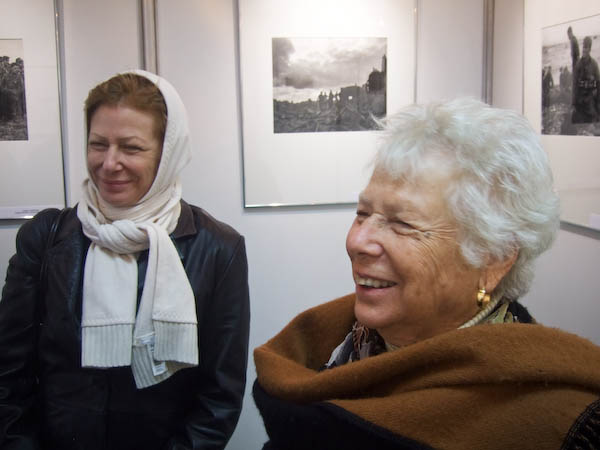
Nina (left) and Naomi Rosenblum with pictures by Walter Rosenblum, 2007, Peter Marshall

There is more to her argument than this, and the article is worth careful reading, and she contrasts its approach with that of Naomi Rosenblum‘s A History of Women Photographers, (incidentally first published by Abbeville Press in 1994, rather than 2010), a book I used, together with Rosenblum‘s A World History of Photography in my teaching.) As Heimbach says “Rosenblum’s book aims not only to highlight the work of female photographers, but also to dig into what their gender means for their lives and careers. Rosenblum offers not just a who but a why.”