Deutsche Börse Prize 2015

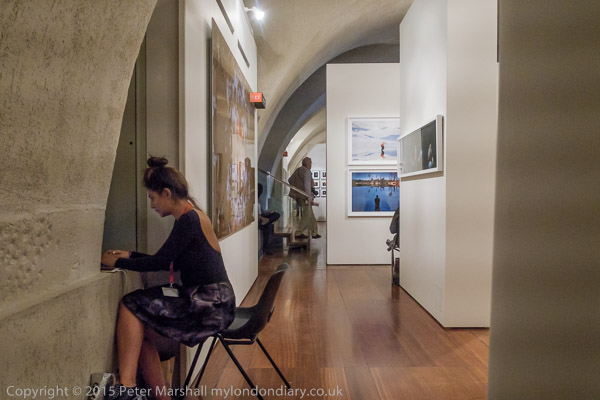
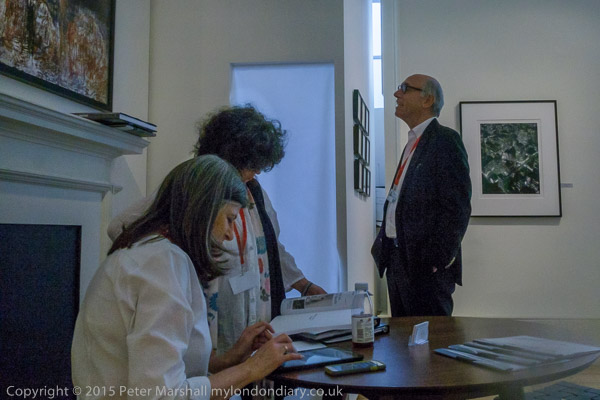
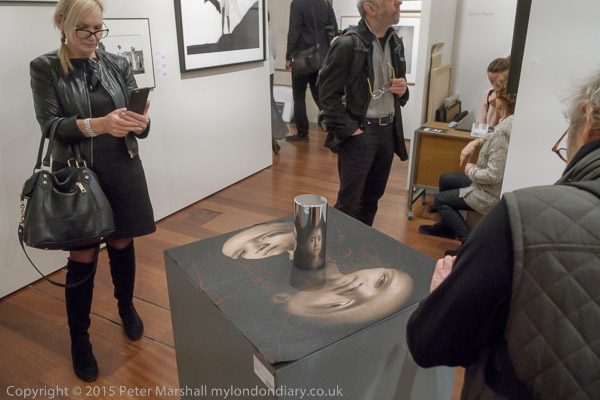
For once I have to say I was pleased to hear the result of the Deutsche Börse Prize. Although I wasn’t entirely enchanted with the work of Mikhael Subotzky (b.1981, South Africa) and Patrick Waterhouse (b.1981, UK),  Ponte City was an impressive publication which includes some truly excellent photography, and I felt it stood head and shoulders above the other three short-listed works. Perhaps for once the gap between the winner’s £30,000 and the £3,000 to the runners up which I’ve always thought fundamentally unfair could be justified.

The DBP isn’t of course just about photography, its also a prize on several levels about politics which has often resulted in work which I think has little place in a photography gallery being short-listed and sometimes even winning. Unlike this year, politics has meant it often hasn’t been the best photography that has been successful.

Ponte City is a work that uses photography, but certainly isn’t just photography, but unlike many concepts it has photography at its heart and uses it well. There are some superb images here, and some of the other things – like the series of pamphlets published as a part of the book – are fascinating if not for their photography.

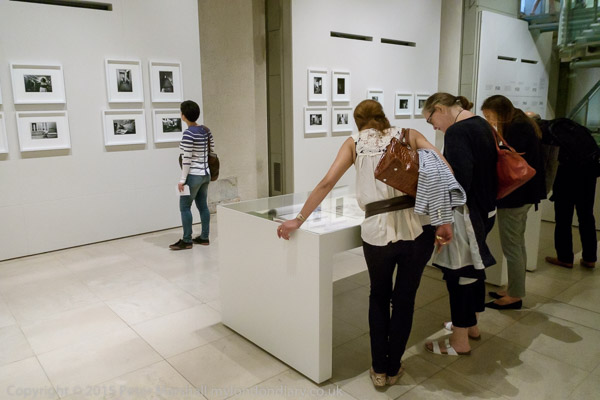
There is still time to see this and the other three sets of work that were short listed as the show continues at the Photographers Gallery until 7 June. I think it says something about the gallery’s fundamental contempt for photography that on the web page about the prize, the images from the four projects are shown as a narrow strip cropped from an image, 720x260pixels, an aspect ratio of 2.76:1,though of course you can see the full picture on the artist’s individual pages.

That for Subotzky and Waterhouse shows 7 full images along with one detail view of a multiple image and a gallery view, as well as a postage stamp sized video, which in my browser refuses to go full screen or link to Vimeo except by some tricky right clicking, though perhaps that may have been because of a current heavy demand on the site. You can however watch it on Vimeo, where  the page also has links to the videos of the other three artists. I’d suggest changing the video to HD and making it full screen unless you are viewing it on some miniature device.

The other work I found of some photographic interest were the portraits by Nikolai Bakharev  made on Russian public beaches, mainly in the 1980s, when there were various restrictions on photography and the taking and circulation of photographs containing nudity was strictly forbidden.

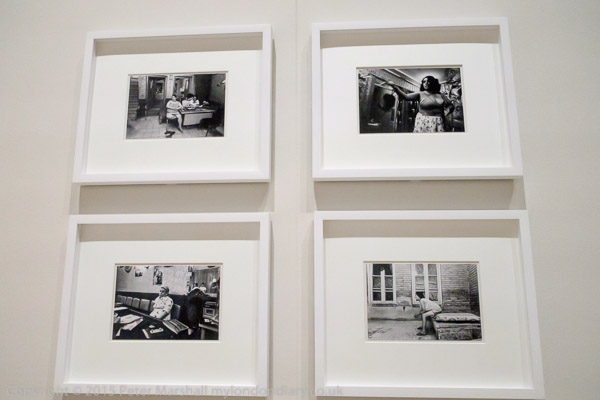
While some of these excited me, there were too many that seemed to have little to offer. I had rather similar doubts about the portraits of black gay women by Zanele Muholi, where though the project may have been commendable and worthy, it needed some stronger images. And although I know people who enthuse over the work of Viviane Sassen, it did nothing for me.

Gardeners Delight?

‘The Gardener’ Jan Brykczyński (Dewi Lewis Publishing, 2015)

I have to confess to being a colourist. Someone who seems more affected than the general population and by the art photographic establishment in particular by colour. I had to quickly leave one room in Photo London when confronted by wall-sized images with a particularly nasty thin yellow cast.

My first real job was as a colour chemist, in the research lab of a company making dyestuffs, where small differences in shade were vital. For various reasons I didn’t stay in it long but perhaps something of it stayed with me. When I began as a photographer in the early ’70s, carrying two cameras, one for black and white and another for colour, I was seldom if ever in doubt about what was a colour and what and black and white image and my work in the two was quite different. I was, as a then eminent photographer commented on my work, a colourist.


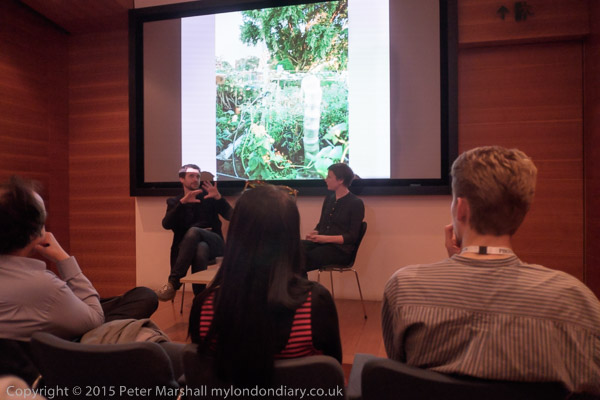
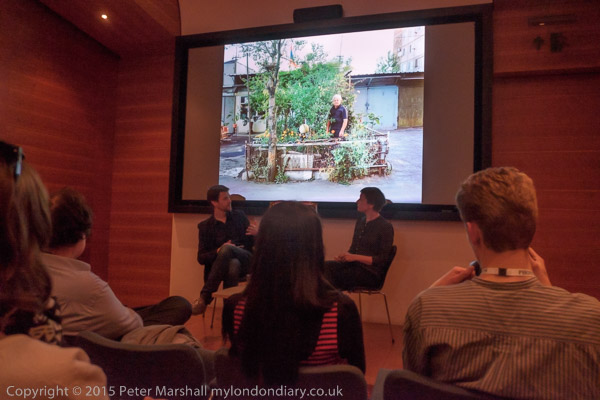
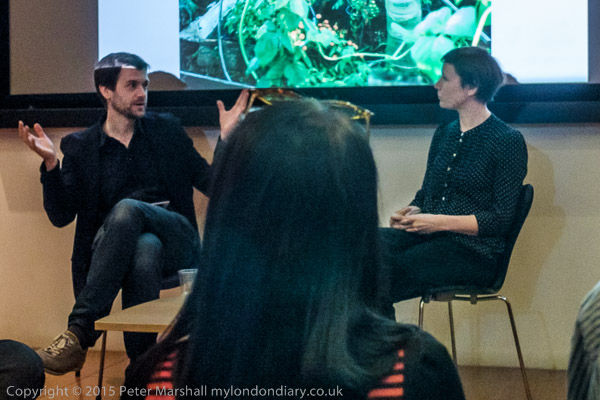
Jan Brykczyński talks to Diane Smyth at Photo London detail- apologies for poor quality

Few photographers now actually work in black and white, and most of those who do seem to think – if they think at all – in colour. Others certainly do think in colour, and Jan Brykczyński is certainly one of them, but his colour is rather different to mine – around R+3 B+7 different from both me and Photoshop, as I find if I put one of his images into that programme and examine the colour of a neutral shade.

It may not seem a great deal, but R+3 B+7 is enough to make me feel a certain nausea when I turn the pages of this book, and it gets in the way of my appreciating his imagery. I have a slightly smaller problem with the rather muted colours and contrast. Brykczyński uses a large camera (4″x5″?) and film, and likes to shoot on dull days, staying in and researching when the sun comes out, to lessen the technical problems of light and shade. Colour film has always been balanced for summer sun (or tungsten); back in the bad old days of transparencies you had to use CC filters when the sun went in to get the colour right, though with the switch to negative we got lazy and made the corrections on the enlarger and it almost worked. But breathed a huge scream of relief when digital gave us more accurate colour with far less hassle. Film has become relegated to a ‘look’, something one can apply to digital with what a less polite than me photographer referred to as ‘f**king up filters’.

I’m not criticising Brykczyński for having chosen a particular aesthetic with its desaturated and slightly unreal colour, just relating my own difficulties in approaching his work though a barrier which for me is hardly mountable but others may take in their stride; from his comments in the presentation at Photo London, the approach may in part derive from having to blend together images taken at different times in four very different areas. But personally I would have liked to have seen a book that represented differences in the conditions under which the images were made rather than attempt to minimise them for the sake of a perhaps spurious unity.


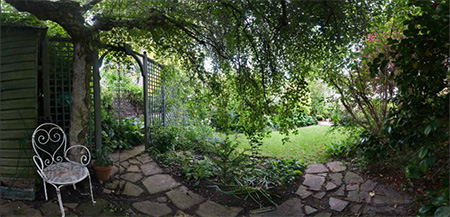
A very different garden image from ‘Secret Gardens of St John’s Wood’ by Peter Marshall’

As a photographer who has also produced a very different book on gardens I appreciate the problem of dealing with all that green. And back to that room I had to leave, some can live with (or at least work with) and pay very silly money for giant images I find nauseating.


Jan Brykczyński talks to Diane Smyth

So I struggled to appreciate this book, although the images there are at least clear. I felt for the photographer at the presentation, where his images on screen behind him and Diane Smyth of the BJP asking him questions were projected at a standard that would have disgraced an amateur gardening club in a run down church hall. It seemed a disgraceful contempt to the photographer and his work and the seriousness of his approach as well as to a paying audience. Some images from the position I was sitting, a few rows back from the front, were almost completely burnt out with the screen a glaring white.


I took pictures only when a few images were better projected

The project looks at urban gardeners in 4 cities in very different states of development and with very different histories, Nairobi, New York, Warsaw, and Yerevan in Armenia, and seems to attempt to suggest à la ‘Family of Man‘ that whatever our social arrangements and historical development, at base people around the world are much the same. It’s a thesis undoubtedly close to the heart of a multi-national Swiss-based giant like Syngenta, and behind the singular title ‘The Gardener‘ that the photographs, mixed together as they are in the book, rather triumphantly overcome.

Perhaps behind the book there is a rather more subversive mind than the company hoped for. Perhaps I should make myself a pair of colour-correcting spectacles to enable me to get to grips with it more adequately. But you may well not share my personal problem.

Boiko, Brykczyński’s series on  rural life among the Rusyn people (a small group of farming people who apparently consider the name Boyko derogatory) in the Ukrainian Carpathian Mountains which became his first self-published book is a fascinating series (and  I have no problems with their colour), as too is the group of photographs of the sheep farmers of Árnes in Iceland that won him the Syngenta Award, with a grant to pursue the project and, later, to publish the book ‘The Gardener’.

Born in Poland in 1979, much of Brykczyński’s work has been on rural areas. He is a founding partner of Sputnik Photos, an international collective of photographers that focuses on transformation in Eastern Europe and post-Soviet states.

Continue reading Gardeners Delight?

Photo London

I wasn’t going to bother with Photo London. I’m rather busy and thought there were better things I could do with my time, so hadn’t bothered with accreditation. But a day or two ago I decided I could fit in a few hours there on my way to something else, and took up an invitation to a book launch (more of which in a later post) which included a complimentary day ticket.  If you have to pay, a day ticket costs £20 (concessions £17) and the show continues until Sunday 24 May.

There certainly are things worth seeing, particularly the first UK showing of a remarkable project by the late Iranian documentary photographer Kaveh Golestan in the in the Citadel of Shahr e No (New Town), Tehran’s red light district, a walled ghetto where 1,500 women lived and worked, between 1975–77. With the Iranian revolution the whole area was destroyed, together with many of the women in it.

Beneath the Surface, 200 rarely-shown photographic works from the Victoria & Albert Museum Photographs Collection, features a fine collection of work by William Strudwick (1834-190), an employee of the V&A. The museum purchased around 50 of his cityscapes, ‘Old London: Views by W Strudwick‘ in 1869, and then proceeded to disperse them around their collection, only re3cenly reuniting them for this show. There are some other interesting prints from a century ago or more, but the choice from the last hundred years was rather less interesting, with a number of good but well-known works, and some more contemporary work about which the museum may well feel rather embarrassed in another hundred years.

I was disappointed by the show of Sebastião Salgado’s Genesis series as large-format platinum prints. Frankly many of these images were more convincing on the magazine page. Making platinum prints doesn’t necessarily mean better prints as this exhibit proves. Elsewhere on some of the gallery stands there were rather better prints of his work and I think it is more suited to silver or inkjet.

The backbone of Photo London is of course the commercial gallery shows, and in the main I found these a little disappointing. There was an awful lot of large and rather empty images and a dearth of interesting photography, and the range of work didn’t seem to match that which I’ve seen at every Paris Photo I’ve attended. There were things that were good to see, but most of them I’d seen before, and very little that was new.

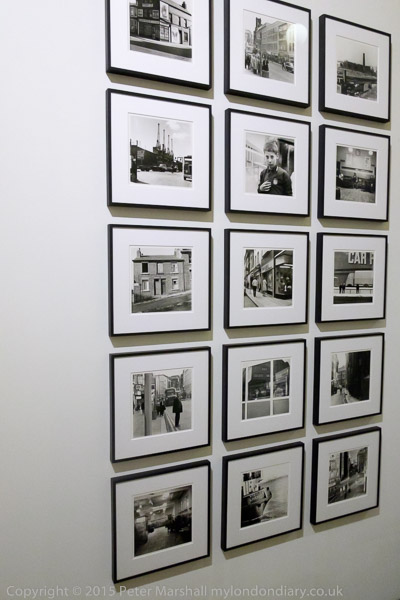
One of the more interesting was the series series Liverpool 1968, by Candida Höfer, black and white images made during a trip there when she was twenty-four years old. If anyone doubts the dire effect of the Dusseldorf school on photography they should go and study these images made long before she studied with the Bechers, whose work I admire but who seem as teachers to have inspired a huge pyramid of boredom, with just the occasional photographer and work of interest. They were I think at Galerie Zander.

Another set of pictures that I really admired was by Anthony Hernandez, Landscape for the Homeless showing at the Galerie Polaris stand. A book of these was published by the Sprengel Museum, Hannover, Germany,in 1996 and there is an article in Unhoused. The book was a relatively small print run and is fairly rare and a little expensive.

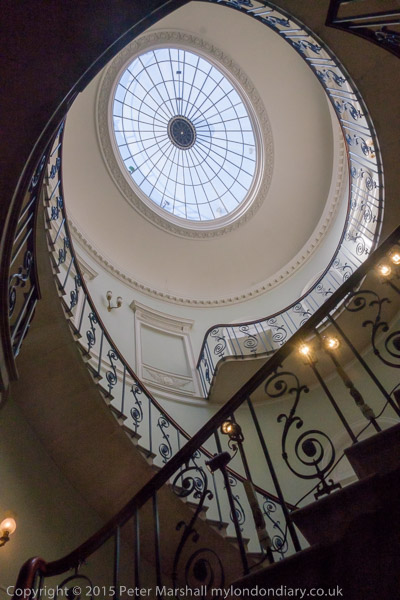
Somerset House is a fantastic building, but a rather confusing layout which wasn’t quite clear to me from the exhibitor map, and I had to ask my way a couple of times but eventually I think I managed to find everything in the show, including the LensCulture area which is all on its own with a separate entrance, and where work by all 31 award-winning photographers of the LensCulture Exposure Awards 2014 was on show.


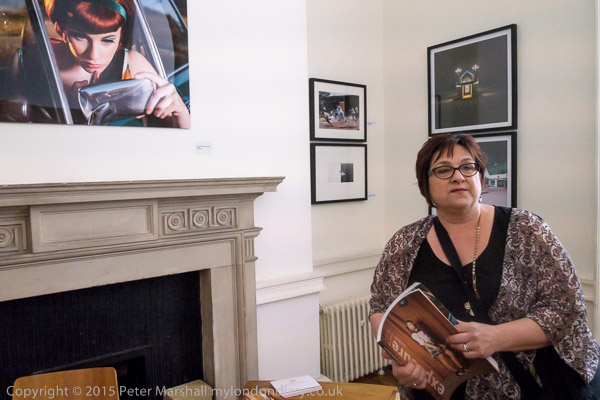
Raina Stinson, with her winning image ‘Alluring‘ at top left, holds the Lensculture Awards Catalogue

Also on the LensCulture web site you can see their view of Photo London – rather different to mine, but recommended.
Continue reading Photo London

Max Pinckers

Thanks to a Facebook post by photographer George Georgiou for a link to Colin Pantall’s blog post Liverpool Look/15: Don’t Take Boring Pictures, a look at the current Liverpool at Look/15 Festival continuing until Sun 31 May 2015.

Were I in Liverpool I would certainly go and take a look, although the big show, Martin Parr and Tony Ray Jones in Only in England at the Walker Art Gallery is one already seen in London, and which I reviewed here last year as well as posting a link to a review by John Benton-Harris, who knew TRJ well.

While I had huge reservations about the ideas behind the show and some aspects of its presentation and John made very clear his thoughts on the misrepresentation of his friend’s work, I still concluded “It really is one of the most significant shows of photography here in the UK for some years“. In part that is a reflection on the fact that most of the more significant photography shows fail to get a showing in this country. But it is an opportunity to see around 50 vintage images taken by TRJ (if rather fewer of them actually made by him than claimed) but also as a reminder of what a good black and white photographer Martin Parr could be back in the 1970s.

But this is also a show which contains Parr’s selection of work the TRJ rejected, printed in a way he would have felt totally unsuited to his work, contradicting the clear directions he gave to people – like Benton-Harris – he got to make prints for him. It was a travesty that Benton-Harris clearly felt strongly about and makes his feelings abundantly clear in his review, and I think represents a failure to respect the work of Ray Jones by the organisation entrusted with his legacy.

What prompted me to write this post today was however the final section of Pantall’s post, about the apparently rather hard to find show of work by Belgian photographer Max Pinckers, Will They Sing Like Raindrops Or Leave Me Thirsty, a project on “the price of love in India and the stories encountered daily by the Love Commandos, a volunteer group working to prevent honour killings by providing assistance to those who have found love outside their prescribed destiny” which you can explore in greater depth on Pinckers’ own web site.

The work is the fourth self-published book by Pinckers (as well as a self-published book dummy – I’m unclear about the distinction) and copies of it are expensive, with a ‘special edition’ including a signed print still available for 320 Euros and shipping. There is an interesting interview with the photographer about his earlier highly praised book ‘The Fourth Wall’ by Taco Hidde Bakker, though this was a work that failed to arouse much of my interest.

Looking on-line at a selection of pages from the latest book and images on the web site, I find the work far more suited to the web presentation, which animates the series of images of images which on the page – which despite Pantall’s assertion – do sometimes become rather boring.

Andrzej Baturo – 50 Years

It seems a very long time ago that I first met Andrzej and Inez Baturo in Bielska-Bialo, and it’s something of a surprise when I realise it was only 10 years ago.

You can read more about my first visit to Poland and the first FotoArtFestival held in Bielsko-Biala, Poland in June-July 2005, organised by the Foundation Centre of Photography there, with Andzej, the centre’s president as Art Director and Inez, the vice president as Programme Director in my Polish diary.

It was a fine festival, with an international cast of photographers, one from each of around 25 countries, with some well-known names including Eikoh Hosoe from Japan, Boris Mikhalov from Ukraine, and Ami Vitale from the USA, as well as work by the late Inge Morath (Austria) and Mario Giacomelli (Italy) and others. There was also a strong Polish representation, with soft-focus pictoriasm by Tadeusz Wanski from the middle of the twentieth century, and the much gritter group show ‘”Unoffical Image” – Polish photoreportage of the 1970s/80s‘ which included work by Andrzej Baturo.

Last year Galeria Bielska showed ‘Andrzej Baturo – 50 Years Of Photography‘ with around 200 images over the years since he began taking pictures in 1962. You can read an English version of the page about it, which quotes Andrzej as saying:

The photograph was first invented simply to record social realities, but with time, social documentary photography and reportage photography have both been raised to the status of art, much in the same way as the journalism of Hanna Krall or Ryszard Kapuściński are now considered great literature. I feel a close affinity with both these areas, and I’ve never been sure whether I’m more of a journalist than an artist, or the other way round.

The Polish version is here. Also in Polish, but worth watching for the images even if you understand little or nothing that is being said, is the video, Andrzej Baturo – 50 lat z fotografią. There is also a page about the show with some comments on his work on the Polish site Art Imperium, which I viewed through Google Translate.

There is now a crowd funding appeal for the publication of a book Andrzej Baturo – 50 years of photography. I’m not sure how well a link to the page through Google Translate will work, and if you understand Polish or have a browser that will automatically translate, you may find the Polish original works better. And even if like me you don’t speak Polish, the pictures speak in any language.

The various rewards available for supporting the publication are of course priced in Polish Zloty (PLN) and where items are to be posted, international postage would presumably need to be added. But 150 zł (about £27) for the 240 page hard-cover book with around 200 photographs seems very reasonably priced. But registering and using the Polish crowd-funding site might need the help of a Polish speaker and charges for converting currency may add to the cost.

Fox Talbot goes on-line

WHF Talbot, one of the inventors of photography, died some 115 years too early to set up his own web site (though I think there is little doubt that had he still been around he would have been at the forefront of that scientific advance too.)

But now the Bodleian Library is about to repair that omission, with “an ambitious project to create a new web-based research tool that will allow scholars and members of the public to view and search the complete photographic works of British photographic pioneer William Henry Fox Talbot.”

There is already some material on-line at the project site, including a blog to provide updates on the development of the William Henry Fox Talbot Catalogue Raisonné” and the project is a large and lengthy one, due to be completed by 2018. It is hoped that the publication of the work in this way will lead to new information and insights into the work of WHF Talbot – and perhaps even the discovery of new images that were made by Talbot and his circle of photographic colleagues.

My only slight quibble over what appears to be a magnificent development is over the statement: “Catalogues raisonnés are common in the world of art, serving as a detailed academic inventory of an artist’s work. However, nothing of this scale has been attempted for photography.”

While the scale of this particular project may be unique, there have been a number of publications which are essentially catalogues raisonnés for the work of the photographers concerned, though bearing in mind the different natures of photography and painting or sculpture. While it may be relatively simple to cover every painting by an artist, every print and every reproduction of a photograph by even a not very prolific photographer is an virtually impossible challenge. Ours is a prolific if not profligate medium.

You can read more about some of these photographic equivalents – including the magnificent two volume edition of Alfred Stieglitz, The Key Set and the 4 volumes of ‘The Work of Atget‘ in a post Photography Catalogues Raisonné by Loring Knoblauch on Collector Daily in 2009 – and the suggestions in the comments on that piece, which include references to a number of other photographic catalogues raisonnés.

2015 PDN Photo Annual

There is plenty of good photography in the winning work in the 2015 PDN Photo Annual, though there are some of the various categories that interest me less than others. They include quite a few that have me thinking ‘how slick’ rather than really appreciating, and rather too much ‘so-whattery’, but it’s easy to skip on to the more worthwhile.

As well as the well-known names, there are also quite a few new to me. If you are short of time, I’d recommend going to the Student section first. Much of the other good work you may already have seen, and this also seems to me the most consistently interesting group of work. And perhaps surprisingly given my lack of interest in most sports photography, the Sports section here (which I almost didn’t bother with) is one of the more interesting.

I think the PDN Gallery might be more useful if it featured rather fewer photographers – if you worked your way through all the work here and went on to follow the links to the websites you could spend a few weeks on this site. It perhaps isn’t as obvious as it might be that the ‘Next’ button at bottom right of the screen is a very good way to go through all the photographers in order, showing you the first of their images – and you can then either view more or quickly jump to the next person.

Time to Act

Or rather well past time for some real action on Climate Change was the message of a large and largely unreported protest in London at the start of March. In my account at Time to Act on Climate Change I began “Over 20,000 protesters marched through London” and while it is hard to be definite about the exact figures at such events it was certainly a large protest.
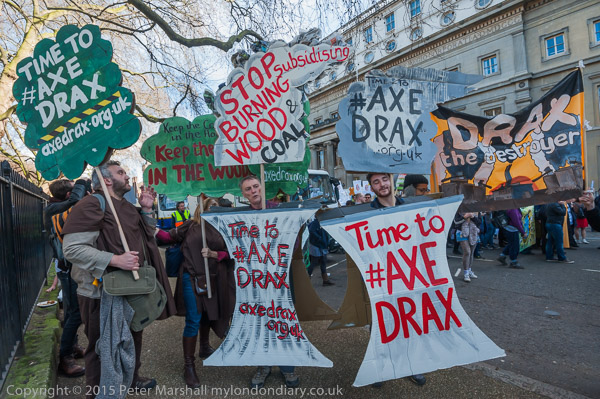

Time to #AxeDrax

Over forty-five years ago, when I first began to think about environmental issues (and even to speak in public on them), climate change was something that would happen in the future, the stuff of post-apocalyptic fiction such as J G Ballard’s ‘The Drowned World‘, first published in 1962 (though I only read it much later.) Now it is very much with us, and among the pile of discarded papers I moved to find my keyboard this morning I came across an article about wine producers buying up estates in Kent and Sussex as the Champagne region is becoming too warm.
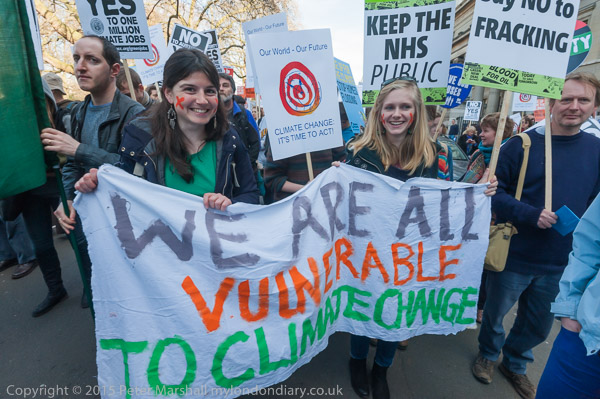

Champagne is perhaps the least of worries for most of this, though perhaps not for those in the 1% whose opinions driven by wealth really matter. But unlike many of those associated with global warming, one that is easily overcome by a simple shift of location. Less easy to solve the problems of countries such as the Marshall Islands or Bangladesh already suffering from rising sea levels and global climate instability.

Last September, ahead of the New York Climate summit we had another large march in London, the Peoples Climate March, about which I commented that it seemed to have been “taken over by various slick and rather corporate organisations rather than being a ‘people’s march’ and seemed to lack any real focus.”  Although some of those same organisations were backing this march, they were far less visible, and it was far more a march dominated by climate activists and grass roots organisations.

The important arguments are no longer I think about environmental or scientific details (though of course the detailed matters of ecology remain vital) but of politics – how we get the change we know is vital to save life on this planet, if indeed that is possible.  How are that small and wealthy elite – the 1% or perhaps rather fewer – to be persuaded to abandon their own increasingly insulated lifestyle of extravagance based on planetary exploitation for the sake of a future for the rest of us. Can it be achieved within the institutions – including governments – which they dominate or will it only happen through catastrophe or revolution?

Protests such as those I spend much of my time photographing often don’t acheive their aims, often indeed are asking the impossible, often are doomed to failure, but that doesn’t mean they are unimportant. There are sometimes small victories, but even more vitally they serve to bring issues into the open, to manage to break through the dictatorship of the elite over the public agenda, to slightly rock the government boat. They are the way that many things start to happen. And even in my gloom, especially in it, there is hope that something may happen over climate change. And much of that hope comes from the people that appear in my pictures and what they are doing.

The event began in Lincoln’s Inn Fields, the largest public square in London, including the surrounding roads around 250 yards by 180 yards, enough to make a large crowd look fairly sparse. As the front of the march was leaving from the south-west corner, people were still flooding in to the square from Holborn station and High Holborn. It took around 35 minutes before the last of the march – which at the start was fairly tightly packed – to leave the square.  The “Over 20,000” was the organiser’s estimate, and my own guess would have been a little lower. But where most of the media talk about hundreds when thousands are on the streets a little overestimate helps to balance things.

I stayed taking photographs in Lincoln’s Inn Fields until the end of the march had got fairly close to the start point, and then rushed off to catch up with its front. I had the advantage of being able to take a short cut where the marchers went around the one-way system at Aldwych, and they had been walking rather slowly with frequent stops, and I caught up halfway down the Strand.
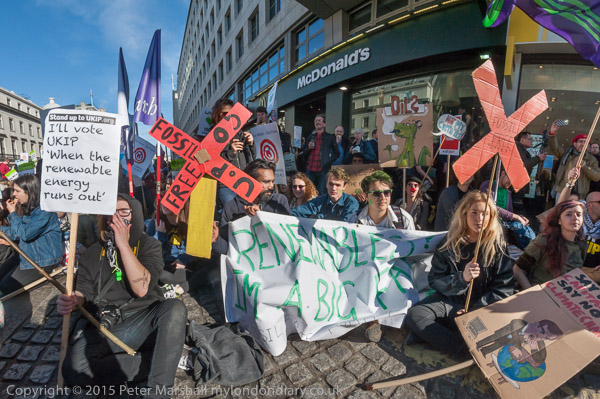

‘Renewables – I’m a Big Fan’. Fossil Free Pompey at McDonald’s

Ahead of us were several places where I thought some of the marchers might decide to make some kind of protest, and I kept close to a group who I thought might be involved in this. And as we approached McDonald’s I was not surprised when things livened up. But the police had also for once anticipated the action too, and McDonald’s had extra security staff on the door. Instead of trying to enter, people sat down in the road, and hundreds of other marchers followed their example, blocking the street and stopping the march.
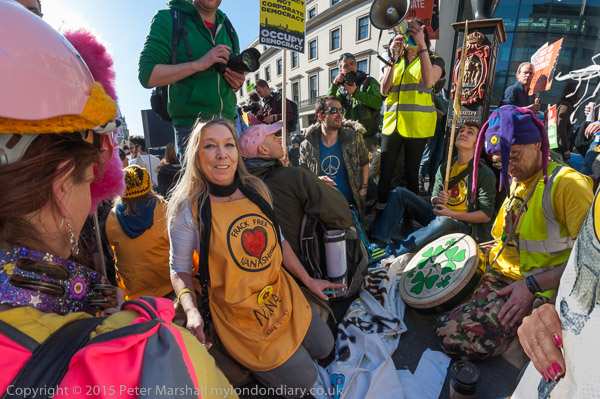

Tina-Louise Rothery and friends on the Strand

The low winter sunlight made photography difficult, with areas of deep shade and bright sun. Working with an extreme wide-angle as I mainly was, using fill-flash was impracticable, and although I tried hard to avoid blown highlights I wasn’t always successful. After  making some pictures close to McDonalds I stepped over protesters who were sitting or lounging on the road to get across to a group of anti-fracking protesters towards the far side of the road and joined them to take pictures.  Among them were several, including Tina-Louise Rothery and some of the other ‘Nanas’ who I’d met at previous protests, who it was good to meet again. It does make working with the 16mm fisheye easier when the people you are photographing know you and are happy to be photographed at close quarters.
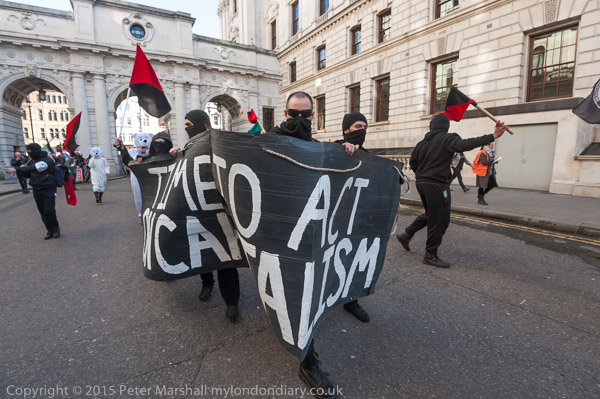

Time to Act on Climate Change

After a few minutes the protesters got up and the march moved on, though the corner of Trafalgar Square and turning down Whitehall.  Here the black bloc came to the front of the march, and I expected some lively scenes at Downing St.  There was a little shouting and they were joined by a small group of polar bears, but soon they were on their way again. On reaching King Charles St  they rushed off down it, followed by a small group of marchers. I ran down with them for a short distance, and then had to decide whether to stay with them or the main march.

Their protest might well have provided some images of clashes with police and of minor damage to property that would be likely to be used by the mass media. Thinking purely in terms of likely use of images and possible sales, I should have stuck with the black bloc. And I think like most photographers I welcome the adrenaline of confrontations. But I’m not happy with the way that such images are used by a press and broadcasting establishment dominated by the 1%, which picks on such things to obscure or denigrate the main issues. I vacillated, then turned around and ran back to photograph the main march as it came into Parliament Square.
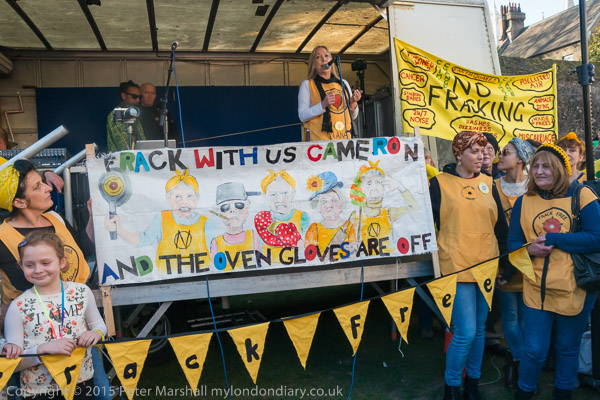

‘Frack With Us Cameron and the Oven Gloves are Off’

I was anxious too not to miss the rally on College Green and the opportunity to photograph the speakers and the crowd there. Though there was relatively little press interest as the only major celebrity input came from a video link with Vivienne Westwood speaking from Paris. But there were some interesting speeches and speakers, including John McDonnell and Caroline Lucas, Matt Wrack and others, with Tina-Louise Rothery bringing Frack Free Lancashire activists with her and John Stewart coming on with some of the polar bears who had protested earlier in the day at Heathrow.
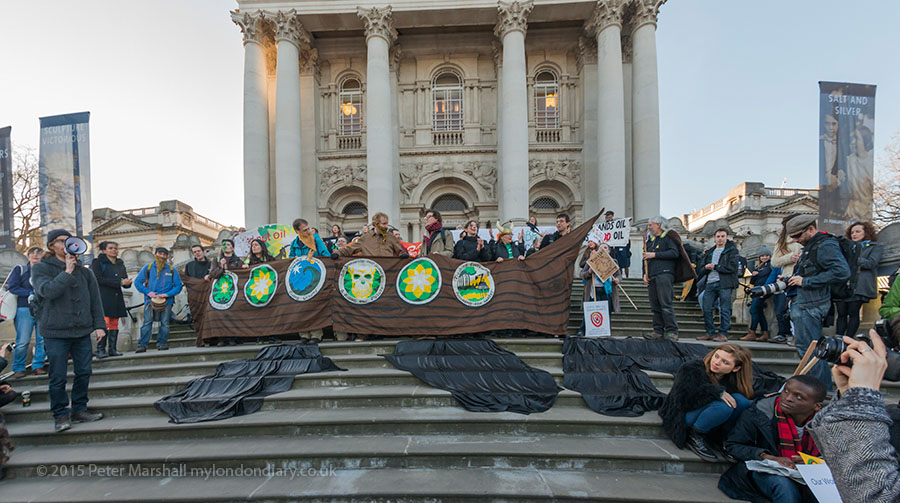

Almost corrected image of the Viking Longship and oil slicks against BP sponsorship of Art by ‘Art Not Oil’

At the end of the rally I had another choice to make. I could either go back north to Parliament Square and Westminster Bridge with activists likely to face confrontation with the police, or go south with Art Not Oil‘s Viking ship to protest on the steps of Tate Britain. Either would have taken me towards a station from which I could catch a train home, something my body was telling me it was time to do. Although Parliament Square would have been more exciting it was also more open-ended with perhaps hours of police kettles and confrontation, I went with the ship simply as a quick and easy option.  I’d done enough and needed a rest and dinner.

More at:
Time to Act on Climate Change
Climate Change Rally
Viking longship invades Tate steps
Continue reading Time to Act
Inside in France

Like me you probably missed the show Prisons: 2011 – 2014 by Grégoire Korganow which was at the Maison Européenne de la Photographie (MEP) from Feb 4th-May 4th, 2015. I’ve been just too busy to go over to Paris for a while, much though I would like to.

In 2010, Korganow was working in French prisons on the making of a doucmentary film about the man in charge of them, Jean Marie Delarue, The Comptroller General of Places of Deprivation of Liberty (CGPL). At the end of the filming, Delarue asked him if he would photograph the French prison system, and Korganaw had the unique opportunity to work in twenty prisons, spending 5-10 days in each of them over the next three years.

Korganow was made an ‘inspector of prisons‘ and he writes on his web site “I’m able to photograph everything; the inside of the cells, the exercise yard, the visiting rooms, showers, the ‘cooler’ (solitary confinement unit)… Day and night. I have access to all areas.”

As Pete Brook writes: “Korganow has made the most of his phenomenal access producing an unrivaled and varied of body of work about the French prisons.” It really does seem to be a remarkable study. As well as the exhibition, there is also a book, Prisons-67065 (the number is the total of prisoners in French prisons on Jan 1st, 2014), with 432 pages (ISBN-13 979-10-92388-05-3) which I’ve not seen. It seems to be a relatively small format but rather fat book from the dimensions on the publishers page of 17 x 22.5 x 5.2 cm and its weight of three and a quarter pounds. I can’t see anywhere the number of photographs it contains.

I read about the show on Pete Brook’s Prison Photography site, and the same feature, with larger illustrations is also on Vantage, which seems a site well worth looking at.  On its ‘About’ page it reveals simply “We are fans of photography” but then goes on to list an impressive list of editors and writers including of course Pete Brook, but also a number of other names I recognise.

Vantage is a part of Medium, which is a kind of publishing network and looks very interesting – you can find out more about it in Ten reasons why I love writing on Medium. If I didn’t already have too many other things to do I might be thinking about using it.


Stanley Greene in Brixton

Stanley Greene is one of the best photojournalists around (see his work on Noor if you have any doubts), and someone I’ve written about before, particularly over his coverage of Chechnya. You can – though I don’t now for how long – see his coverage of the UK elections on Catch Up on Channel 4 News.  Asking him to cover the it was certainly a great idea,  and you can see the results in a video which combines  video footage with his black and white images at From Beirut to Brixton: war photographer on election trail. And there is an article about it.


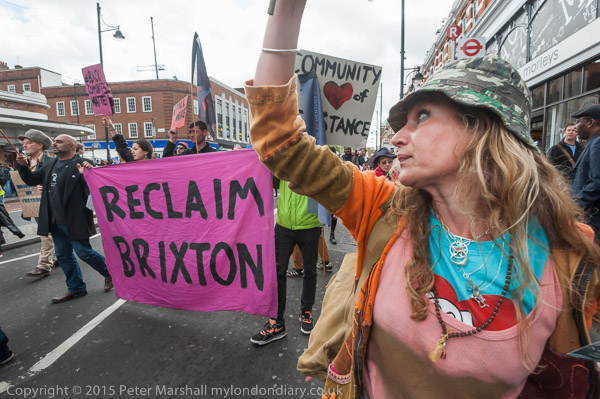
One of my pictures from earlier in the day in Brixton

I was in Brixton earlier in the day at the event which he covered, but didn’t see him there.  Much of his coverage from Brixton (it starts at 7m30s) is of people that I know and that I also photographed, and its great to see how a real master does it (though I did get a few decent pictures too.)


One of my photographs of Lisa McKenzie in Brixton

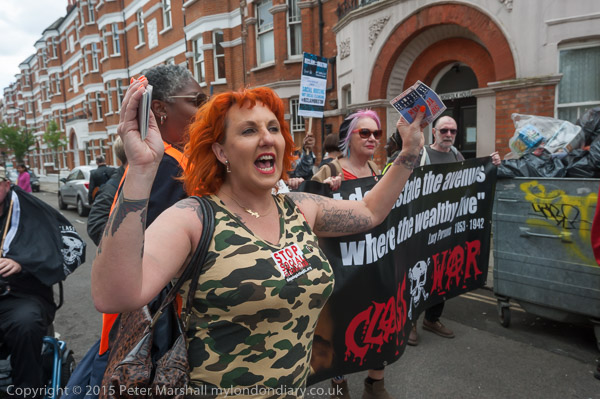
The piece does a fine job of combining video clips with the still images and also is nicely edited, combining well-selected opinions from people on the street – including Class War’s election candidate standing in Chingford against Iain Duncan Smith, Lisa McKenzie – with Greene’s own intelligent and somewhat laconic insights.  As he concludes, there is plenty of politics happening on the streets, “but it seems to me, its the politicians who aren’t taking part.”

Camera buffs will no doubt find the equipment hung around Greene’s neck of interest. In Brixton at least there were two cameras, one of which has the word ‘Nikon’ on it, but I don’t recognise it. Certainly it isn’t a D3s which he mentions in a 2012 interview on ClueCult :

I’ve got it all figured it out. I’m shooting Leica for black and white, Nikon D3s for big jobs where you pull out the camera to say “I am the photographer”. I’m shooting the Leica M-9 when it’s a digital work with an artistic flavor and I can match it up. I’m using the Olympus to do daily life, it is my diary.

Embedded in that interview is a short video trailer for his book Black Passport, which is better viewed at higher resolution on Viewtube. There is also a video interview with him by the French magazine Polka which is also worth watching.

Often I find photographs produced now in black and white an annoying affectation, with photographers sometimes thinking that working that way makes their images more ‘documentary‘. But there is a big difference between a photographer who thinks in black and white – as Greene clearly does here, and those who work in colour and simply convert the images to monochrome.  In the Channel 4 video, choosing to work with black and white photographs clearly also has the function of separating them from the video clips.
Continue reading Stanley Greene in Brixton