Laughlin’s Third World

One of the books I’ve had on my shelves for a very long time – since soon after it was published in 1973 – is is ‘Clarence John Laughlin: The Personal Eye‘, a catalogue for the Philadelphia Museum of Art exhibition and a double issue of Aperture, Volume 17, Numbers 3 & 4, also published ‘as a book for general distribution’.

I don’t think its distribution in the UK would have been very wide, but like many US photographic publications of the time it would have been available at the Creative Camera bookshop in Doughty St and doubtless advertised in the magazine.

For those without a copy on their bookshelves, you can get a good idea of Lauglin’s thinking from ‘First Principles of the Third World of Photography – THE WORLD BEYOND DOCUMENTATION AND PURISM ONE – TEXT AND IMAGES BY CLARENCE JOHN LAUGHLIN’ on Carnival of Dogs. His 12 point manifesto there begins “In Photography, as in all arts, the quality of the human imagination is the only thing that counts – technique, and technical proficiency, mean nothing in themselves” and ends “The limitations of photography are nothing more than the limitations of photographers themselves.”

Much of Laughlin’s work is now in the Historic New Orleans Collection, where you can view and zoom into many of his pictures, so many indeed that it is hard to know where to start. But it is worth paging through the many pages of thumbnails and picking some to look at.

Although in the end I learnt that my own creative interests were in purism and documentation, in my early years in photography work such as Laughlin’s made a strong impression on me, and I’m rather surprised that although I wrote about him and other photographers who might be considered to follow in his footsteps such as Arthur Tress in another place, this is the first time in several thousand posts I appear to have mentioned him here.

Laughlin’s work was brought to my mind by two posts Clarence John Laughlin: In Memoriam on Photocritic International by A D Coleman, who wrote about Laughlin in his 1977 critical survey The Grotesque in Photography.

The first piece takes its sub-title Prophet without Honor from the subtitle of the Laughlin biography, Clarence John Laughlin: Prophet without Honor by A. J. Meek, professor emeritus of art at Louisiana State University (University Press of Mississippi, 2007), and one of two stories in it recounts Coleman’s meeting with Laughlin around 1975 when the photographer showed his of work to collector Sam Wagstaff. He set out a strict set of conditions about what he expected anyone who bought his pictures must do – and after looking through the work, Wagstaff rejected the idea that a photographer should have any rights over their pictures after they had been sold.

Over the ages, artists have almost always had an uneasy relationship with those who have provided them with a living, but it is only in relatively recent times that photography has succumbed so entirely to patronage by individuals and corporations. Most of the early photographers were themselves wealthy and others have maintained some sort of independence based on various commercial practices and around the reproducibility of the medium.

The second piece, subtitled Lament for the Walking Wounded, is an article published by Coleman in his “Light Readings” column in the December 1977 issue of the magazine Camera 35, together with a postscript.

Published at the time without names, it recounted the speech by Hilton Kramer, then chief art critic for The New York Times, at a New York City national meeting of the Society for Photographic Education, in which Kramer held Laughlin up to ridicule not for his photography, but making tasteless jokes about his eccentric nature. Coleman himself felt ashamed after the event at having joined in the whole-heated laughter at a man he describes as on of “the walking wounded of photography” who have suffered from their dedication to the medium and “never got their due and are beginning to realize that they may never get it.”

Though relating events now around 40 years in the past, these are stories which are still relevant, perhaps even more relevant, today.
On this day…

Once upon a time I had to write a daily post on photography for several years as a part of my job. Of course I still write here most days, but then I wasn’t really allowed to write about my own work, which made things a lot harder, and I couldn’t take a day off whenever I felt like it.

Of course you don’t actually have to sit down and write a piece every day. You can write stuff when you have time or the mood takes you amd schedule it to appear later. I’m actually typing this at 10.25 on Wednesday but it will most likely appear on Saturday – unless something more urgent to publish means I will put it back a day or two or even longer. Just occasionally I get things wrong – as I did this week, when the post intended for Friday accidentally got published on Thursday afternoon when I pressed the wrong button.

Sometimes when I had to write those daily pieces there were plenty of things happening that I could write about – exhibition openings, books, new web sites, and inevitably obituaries etc. But there were days when I was stumped and would turn to various ‘On this day…’ sites for inspiration. The Library of Congress has its Today in History page which often features some interesting photographs from its extensive collection that might prompt a thought.

Those daily blog posts were a relatively small part of the job I was employed to do, and some were fairly short, though one of the reasons I eventually got sacked was for writing too much and writing for photographers rather than people who’d just bought a camera and had no idea what to do with it.

When I read a post by James McArdle on the Photohistory blog about his project On This Date In Photography I was interested but perhaps a little sceptical about his intention to present “an event that happened, or is happening, on the date of posting. Journalistic, not necessarily academic, it aims to broaden the interests of devotees of photography, with some posts specifically on British photo history, others more wide ranging.”

He goes on to state that the site is “a ‘labour of love’ I am undertaking for one calendar year to revive my research and writing in preparation for penning a book on an aspect of photography next year.”

I have to say that I’m very impressed by what I’ve seen so far, and suggest that his is a site you should all add to your bookmarks/favourites.  I haven’t read all the entries which he began in October, but enough to make me want to go back and read more. One almost at random, for December 27th, with the title Dream, looks at the photography of  Latvian photographer Gunar̄s Binde, born 27/12/1933  who I was pleased to meet and see his work in Poland in 2005.


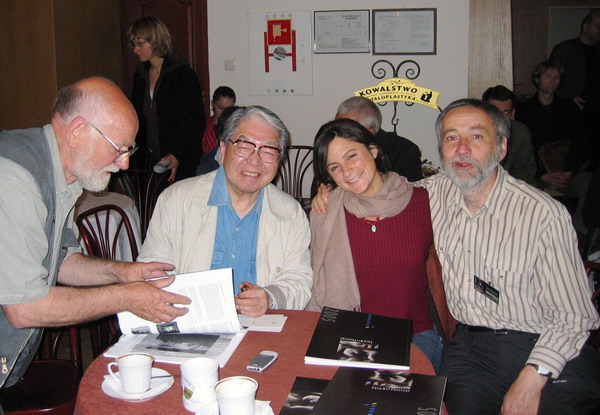
Gunars Binde looks through the catalogue as Eikoe Hosoe, Ami Vitale and I  for a photograph at the first international FotoArtFestival in Bielsko-Biala, Poland, where I represented the UK with pictures from London. You can read the more about the festival in my Polish Diary. Picture by Jutka Kovacs.

Charmes de Londres

I have quite a collection of books of photographs of London (as well as probably a few hundred thousand of my own pictures) but one of my favourites is ‘Charmes de Londres‘, credited to Jacques Prevert with photographs by D’Iziz-Bidermanas. Although most of the texts are poems by Prevert, it also has some quotations by others including William Blake and a Picasso drawing.

I didn’t buy this when it first came out in 1952, as I was then only seven and penniless – and it wasn’t in any case for sale, but came across it in an Oxfam shop perhaps 15 years ago, paying £19.50 for a copy in good condition. Perhaps remarkably you can still find copies of the original edition, published ‘hors commerce‘ for members of La Guilde Du Livre in Lausanne and printed by heliogravure (photogravure) on wood pulp free paper, for only a pound or two more. The previous year’s collaboration, published in the same way,  Grand Bal du Printemps, will set you back around 25 times as much.

Part of the reason you can still find copies of that original version (there are also later editions) is that it was a relatively large print run, with 10,300 numbered copies (mine is No. 4871) as well as 30 labelled I to XXX for the organisers of the guild. Although photographers often complain about getting second billing to writers when then works are published, Prevert had a much larger fan base!

The book is a reminder of the fine printing that could be achieved with photogravure, and it matches the mood of Iziz’s images perfectly. A recent post on Spitalfields Life,  Israel Bidermanas’ London, reproduces a fine selection of over 20 images from the book, without Prevert’s poems (which are of course in French) and gives a good impression of the subjects, but shows them in a more modern tonal interpretation, more contrasty and with intense blacks, which perhaps loses something of the gloomy charm of the original publication. This was a post-war London still under a gloomy miasma, though probably the real pea-soupers defeated the photographer few if any images have a clear distance.

The best way to see more of his pictures on-line seems to be to search on Google Images or Pinterest for ‘Izis Bidermanas‘.

Iziz was one of many fine photographers of Paris, and another was Willy Ronis (1910-2009). In 2004, French editor Alain Dhouailly published a limited edition of 130 copies of a set of 12 or his images printed by heliogravure which gives some background on the process. Ronis’s work is fairly widely avaialable and on galleries on the web, for example at Hacklebury Fine Art.

Grossman & the Photo League

Around 15 years ago, I wrote a series of articles and short notes about what was still then a very much overlooked part of American photographic history, but which is now referred to as ‘New York’s famed Photo League‘. An organisation that was destroyed by McCarthyism as ‘anti-American’ it remained largely outside the pale until this century, and I was pleased to be able write about it and to mention some of the photographers still alive and working who learned and developed their craft there, largely under the critical eye of Sid Grossman (1913-1955). I’ve mentioned it before on this site, including two posts with the same title, The New York Photo League where I quote from my 2001 article, and a longer version here.

You can get some idea of the critical blind-spot by reading the lengthy introductory essay by Gerry Badger to the 1985 Barbican show ‘American Images: Photography 1945-80’ which relegates Grossman and others to what is essentially a footnote to the later work of Robert Frank and the Photo League to an introductory sentence to the work of Aaron Siskind which makes clear that his importance as a photographer was due to breaking away from his early work with the League on Harlem Document.

Although none of Grossman’s work appeared in the Barbican show, that the work of several others involved in the Photo League does probably owes itself – as did much of the show – to the ideas and graft of John Benton-Harris, a native New Yorker who studied with Alexey Brodovitch, and who grew up with the work of the Photo League photographers and their successors and their views of his city.

As his artist page at the Howard Greenberg Gallery states, Grossman, who had founded the Photo League with Sol Libsohn in 1936, “had a tremendous influence on a large number of students who studied with him including Weegee, Lisette Model, Leon Levinstein, Ruth Orkin, Arthur Leipzig, Rebecca Lepkoff and numerous others.”

The main show at the Howard Greenberg Gallery in New York until Feb 11, 2017 is the “first solo exhibition in 30 years to explore the legacy of Sid Grossman” and the exhibition also includes “a small selection of work by some of Sid Grossman’s students including Rebecca Lepkoff, Leon Levinstein, Marvin Newman and Ruth Orkin.” Also showing at the gallery is a “companion exhibition with work by Sy Kattelson, a student and close friend of Sid Grossman.

Last September, Steidl co-published with Howard Greenberg Gallery ‘The Life and Work of Sid Grossman ISBN, 9783958291256′ with a biographical and critical essay by Keith F Davis, the first comprehensive survey of Sid Grossman’s life and work, with over 150 photographs “from his early social documentary work of the late 1930s to the more personal and dynamic street photography of the late 1940s, as well as late experiments with abstraction in both black and white and color.”

England, and Saint George!

A few minutes on Wikipedia convinces me that April 23 has more than its share of famous births, deathas and commemorations of which the best known here is of the man the Eastern Orthodox call “Holy Glorious Great-martyr and Victory-bearer and Wonderworker George“, a Palestinian (or Turk) of Greek parentage and a Roman soldier – if he actually existed. Certainly the dragon didn’t, and was not involved in the legend that made him a saint, in which, undoubtedly like some Christians of the era, he was tortured at length before being beheaded for refusing to convert to the Roman gods following an edict by Emperor Diocletian in AD 303 which led to three years of such persecution, though applied with differing severity across the Roman Empire.

April 23 is a day George shares with a number of other saints, with Wikipaedia listing around a dozen for the Eastern Orthodox, including George’s mother, two soldiers converted by witnessing George’s martyrdom and the wife of Diocletian, as well as another 14 pre-schism Western Saints, post-schism Orthodox saints, new martyrs and confessors (though due to our change to the Gregorian calendar they celebrate these April 23 events on our May 6th.) In the West, George shares his feast day with Adalbert of Prague and Gerard of Toul, while both the Evangelical Lutherans and Episcopalians in the USA commemorate the life of Japanese Christian pacifist, reformer and labour activist Toyohiko Kagawa (1888-1960) which seems to me admirable. It’s a shame we’ve never heard of him here.

Shakespeare was probably born on April 23 1564, and certainly died on April 23 1616, giving us another reason to commemorate – and UNESCO chose April 23 as UN English Language Day, (one of six promoting its official working languages,) for that reason. It’s also UNESCO World Book Day, though in the UK we celebrate this on on the first Thursday in March instead, as April 23 is often in the Easter school holidays.

In England, St George’s Day once ranked with Christmas as a major celebration, an occasion for feasting and drinking, but its celebration became less important after the union with Scotland, and had almost disappeared in the last century. One or two people still wore a red rose, and some official buildings flew a flag, though usually the Union Flag rather than the English flag of St George. The day never became a bank holiday, partly because of its closeness to Easter (and the Church of England even moves his feast day when it gets too close to Easter, moving it from April 23 to the Monday following the Second Sunday of Easter.)

Back in the last century, even English sport teams and their supporters would often use the Union Flag rather than the English St George Flag, but it was sport and particularly football that led to a resurgence for the red cross on white, and pubs showing England games at the World Cup on TV that led to its proliferation across the land. It became associated with football supporters, and with the largely right wing hooligans involved in football violence who dominated many ultra-nationalist groups, often styling themselves as patriots, and looking back to a mythical past of an all-white England ruling an empire around the world, or even launching crusades against the infidel foreigners.

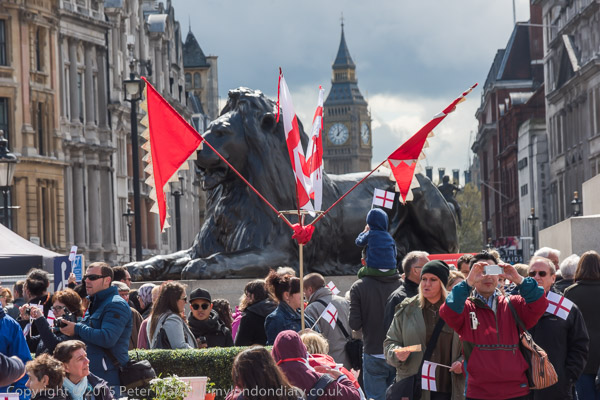
A strange alliance between these ‘patriots’ and others who have tried to reclaim the English flag from the bigots has led to an increase in official commemoration of St George’s Day this century, which has involved groups including the BBC, English Heritage and London Mayor Boris Johnson, as well as some churches, and it’s a mixture that has been reflected in my photographs of the day over the years.

In 2016, St George’s Day actually fell on a Saturday, and I expected to see more activity than in other years, but was in the end rather disappointed. The Mayor’s day of events in Trafalgar Square seemed rather lacking in spirit, and all more organised events by ‘patriots’ in the London Area seem to have evaporated, perhaps because of increased militancy by anti-fascist groups. I paid a brief visit to Trafalgar Square, but found little to photograph – perhaps things got better later in the day, but the few pictures I’ve seen by others don’t encourage that thought.

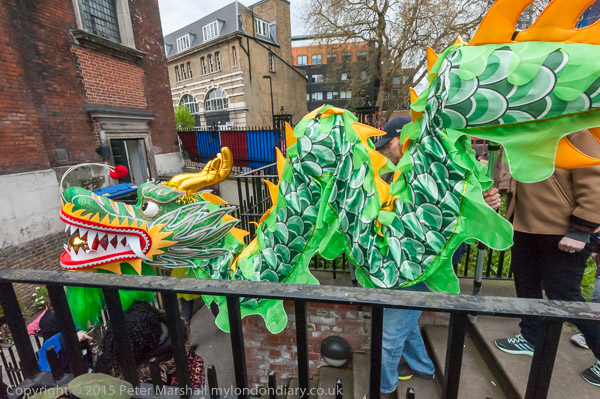
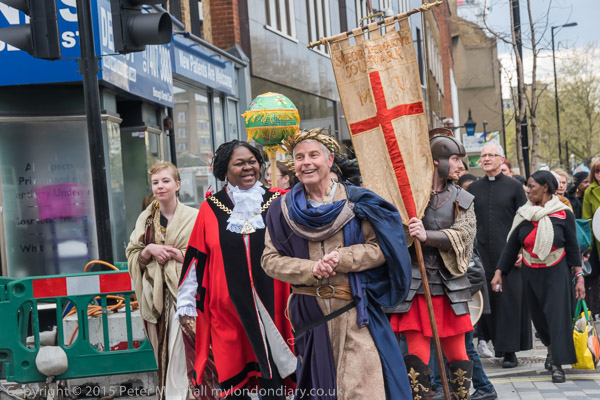
South of the river in Southwark things were a little better with a festival ‘A Quest for Community’ with the aim of ‘Taming the dragon of difference’ involving a St George’s Day procession from the Roman Catholic Cathedral of St George to the Church of England St George the Martyr in Borough High Street. As well as St George, Diocletian and his daughter, a sooth-sayer and of course a dragon, it also included drummers and the Mayor of Southwark, to whom I was pleased to be able to point out a blue plaque and tell her a little about one of the Borough’s more famous son’s, photographer Bert Hardy, who grew up in ‘The Priory’ which was on our route.

She had been unaware that one of Picture Post’s best-known photographers and a pioneer in using 35mm in press photography had come from her patch – and never really left it, though advertising brought him enough money to buy and live in Chartlands Farm, Limpsfield Chart near Oxted. And about how his powerful photography had powered the textbook example of an unsuccessful advertising campaign, ‘You’re never alone with a Strand’ along with an outstanding ‘noir’ TV ad shot by Carol Reed with music by Cliff Adams that would have topped the charts had the BBC not banned it for advertising cigarettes. Even at 3s2d for 20, nobody wanted to be seen as lonely enough to buy them.

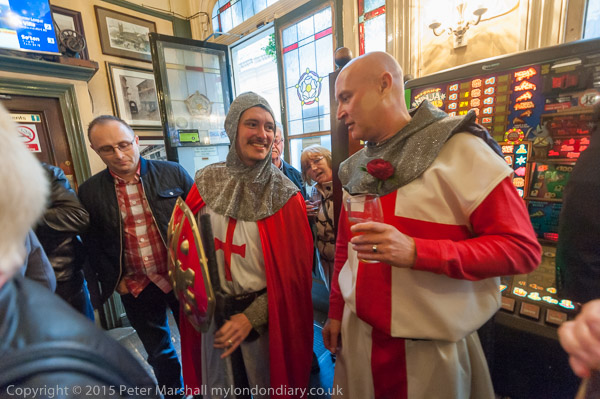
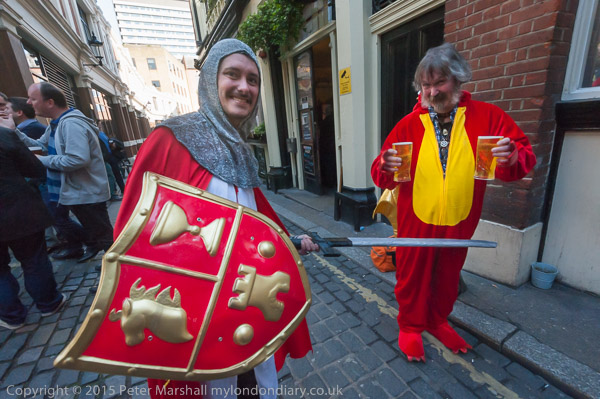
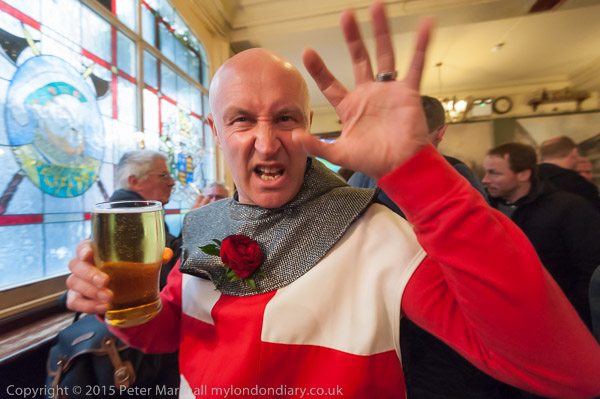
The procession ran late, and I didn’t have time to watch more than a few minutes of the play that followed, and missed the free pint that was waiting for me in the City where Leadenhall Market was also celebrating our patron saint. Instead I met with friends at the Old Kings Head in Kings Head Yard just off Borough high St, a welcome survival of a traditional English pub – and where better to meet not just one St George, but two, the second accompanied by his very own dragon.

I forget why we left. Perhaps it was the thought of a good dinner waiting for me at home, but I stopped for a minute or so in the yard outside for a last picture of St George with his dragon holding his own and George’s pint in the alley outside, a rather different and very English version of the legend, and my favourite picture from a long day.

More at:
St George in Southwark Procession
St Georges Day in London

Continue reading England, and Saint George!

Whose Streets? Our Streets!

My thanks to writer on the New York Times Lens Blog for pointing out the exhibition ‘Whose Streets? Our Streets!‘ currently taking place at the  Bronx Documentary Center until March 14, 2014, but more importantly for most of us, on-line.  Curated by photo editor Meg Handler  and historian Tamar, it features work by 38 photographrers, including a few familiar names.

But as Handler says in the Lens feature, few of the pictures  were widely seen when they were taken; “It used to be, you’d show your contact sheets to a couple of your friends and that was it,” she said. “They’d rarely get seen.”

Handler goes on to say that the freedom of movement for photographers ended in 2002, but she continued by saying that any demonstrator with a phone can now project images to the world almost as the events are happening.

I’m not sure how different things are in New York to here in London, but here there is certainly no shortage of photographers covering protests, and while it’s obviously true that protesters with smart phones now tweet and post images as events take place, this is a rather more recent phenomenon.  When I first got a mobile phone, a little after 2002, like most at the time it didn’t have a camera, and it was only at the end of that decade that phones with cameras began to be widespread.

Things did change around 2002. Photographers got digital cameras – like the Nikon D100 I bought towards the end of the year. A few professionals had used them earlier, but mainly in more lucrative areas than photographing protests. For a few years after most of the photographers at demonstrations here were still using film – and I continued to use both film and digital for several years.

Back then, unless you had something that was startling news, you took your pictures, came home, developed film, looked at the contacts, maybe made a few prints and took them to the agency a day or week or more later. If you though you had something special, you would phone a paper and if they were interested take them the film to rush through for the next day. Staffers would of course take in their films – and most of the protest pictures published were from photographers on the staff of the major agencies and papers. They only bothered to attend major events, and seldom stayed for more than a quick photo-op.

Photographers who really covered protests were a different breed – and it shows in the pictures in the Bronx show. Here – as there – some worked for the left-wing magazines and small circulation newspapers – such as Mike Cohen who gave me advice at times when we covered protests and whose work appeared regularly in the Morning Star, Socialist Worker and Searchlight, which also regularly featured pictures by David Hoffman, a photographer who some on the extreme right confuse me with and I get a share of his abuse along with that really intended for me.

The other thing that has changed and encouraged more photographers to cover events is the growth of online photo agencies that have little or no bar to submissions. Sites like Demotix (bought out and closed down a year ago by the Chinese to end its competition with Getty) encouraged people to put much unfocussed (often literally as well as metaphorically) photography online – with many more people becoming photographers, and a few of them producing work at least as good as that of the professionals who disparaged such sites. And of course there are professionals around the world who now contribute to such on-line agencies.

The freedom of movement all ended in 2002,” states Handler, but here protesters have often managed to avoid being penned by police, and except for those on the extreme right and some anarchists, protesters have largely remained on good terms with most photographers.

So we have more photographers than ever taking pictures at protests, although no more pictures are being used. Many that do appear are pretty poor because what matters most is not quality but getting the images in first, with many photographers rushing into a corner before a protest has even started to file some pictures. It’s a race I refuse to take part in, but then I’m in no danger of going hungry or getting evicted if my pictures don’t make the news. Like those photographers in the Bronx show I’m more interested in telling the stories – but at least now I can get them out on Facebook and My London Diary even if the newspapers don’t pick them up.

Another big change is of course the move to colour that came with the move to digital. There are rather more colour pictures in the Bronx show than I would expect from any similar UK show of the same era, but it is still black and white that dominates. Now using black and white is largely only an affectation practised by a few largely younger photographers hwo have never really learnt how to use it, other than clicking on a button in Lightroom or other software.


Do I have a problem?

On the ‘United Nations of Photography‘ site you can read a contribution by an anonymous ex-photographer, who took his last picture as a professional in 2006, I’m a Photographer and I Have a Problem…, and it got me thinking a little about my own and other photographer’s motives, particularly in the main area of photography which I’m now involved with.

The writer is not the only photographer I’ve known who has had similar thoughts and a change of career – in his case to becoming “a Support Worker (£7.20 per hour) at a Residential Drug and Alcohol Rehabilitation Centre.” The current weekly hourly minimum in the UK, it’s actually better money than many photographers now earn, though I’m sure that was not the reason for the change.

Yesterday as I waited outside Harrods for a protest there to begin, I was talking to one photographer about the poor wages earned by some workers in the world’s richest store owned by the richest family in the world – the Qatari royal family. Many of the waiters there get either that same legal minimum hourly rate, or just a few pence more, while that “needy” family get the lion’s sahre of the tips and service charge the public think are for them. We reflected that many if not most of the photographers present put in long hours for a pretty low return, in many cases amounting to an even lower hourly rate than that minimum.

I thought too of a series of exchanges with Chauncey Hare after I’d written about his work. I’d first seen his work when Lewis Baltz showed some of it at a workshop I attended, and went out and bought his 1978 book ‘Interior America’. In the 80s he gave up on photography and became a therapist who concentrated on work related abuse. The piece I wrote about him is no longer on the internet, but you can read a review on ‘5B4’ of the eventual republication of his work as ‘Protest Photographs‘, an extended version of that 1978 Aperture publication.

While informative, Mr. Whiskets’s review is I think in one aspect misleading. The light printing of the book was not “so typical of books from the late 70s” but was the result of a deliberate aesthetic choice by Hare – as was the harsh flash lighting; I think he did not want his work and the book to be seen as “art” but as a manifesto. But I was pleased when in 2009, a few years after our on-line conversation, someone managed to persuade him, as I had failed, to have his work re-published.

The anonymous photographer’s article is illustrated with an image of smashed cameras and equipment; Hare threatened to destroy all of his work – 50,000 negatives, 3500 prints and 30,000 35mm slides and many taped interviews – unless the University of California’s Bancroft Library would accept it as a donation. Fortunately they did, and now the library holds all rights and permission to reproduce pictures from his work in social situations requires the following sentence to be used with them: “These photographs were (or ‘this photograph was’) made by Chauncey Hare to protest and warn against the growing domination of working people by multi-national corporations and their elite owners and managers.” There are no items on-line.

Later yesterday, another photographer said to me that he didn’t mind about the protest we were photographing, all he wanted was “some action“. I didn’t reply but thought to myself that I was only there because I did mind, did care about the issues and the people, and that although I’d do my best to take pictures of anything dramatic that occurred, it wasn’t what motivated me.

Berger & Mohr

This morning the media is full of tributes to John Berger, and in particular his 4 episode TV series which I watched back in 1972, Ways of Seeing. You can now view these on Youtube (start with Part 1 and the links to the other parts will appear.)

But although I listened to a discussion about him on Radio 4 there was no  mention of his long collaboration with Swiss documentary photographer Jean Mohr, and in particular what is perhaps a rather better thought out book they produced together,  Another Way of Telling (1981), recently republished in a new and improved edition by Bloomsbury. You can read Berger’s essay ‘Appearances‘ photocopied from the 1982 US edition as a PDF online, but that misses the real feeling of the work, which needs to be taken as a whole.

Ways of Seeing‘ also came out as a Pelican original, and the book is rather better than the TV programme if you want to think about Berger’s work and ideas, which were not universally accepted. ‘Art-Language‘ in 1986 (Volume 4 Number 3 October 1978) was 123 pages of criticism of the book, much of it worthy of consideration.

Mohr’s first published collaboration with Berger was the book A Fortunate Man: The Story of a Country Doctor, first published as a hardback in 1967 (I bought it a few years later) and re-issued by Canongate Books in 2015. The new edition, as Rick Poyner points out has the advantage of much improved modern reproduction (though the more detailed images are less dramatic), but in several respects its design unfortunately fails to match the sensitive work in the original by Gerald Cinamon, which contributed greatly to its success in combining photographs and text.

On Mohr’s web site – if you select  ‘Itinéraire’ (or ‘Route’ if you view the site in English) you can browse through the  content of his CD “Journey of a photographer Jean Mohr” published in 2000 by  l’Association Mémoires de Photographes. As well as 1200 photographs, there are also texts, videos, interview and more.

As well as the collaboration with Berger – other books include Art and Revolution, (1969) A Seventh Man, (1975) and At the Edge of the World, (1999) – Mohr is well known for his images of Palestinian refugees, which began with a commision for the International Committee of the Red Cross in 1949 and continues through the years – including another ICRC assignment in 2002. His After the Last Sky: Palestinian Lives (1986) includes a poetic meditation on Palestinian identity by the late Edward W. Said in response to his pictures.

2016 Yunghi Grant awards

One Facebook group I’ve belonged to for some time is an invite only group with almost 5,000 members, The Photojournalists Cooperative, a confidential discussion forum where we can discuss photography related issues, largely on the business side of photography, in private. But what is no secret is that this group was created by Yunghi Kim, a photographer who has been with Contact Press Images for over 20 years.

Like all photographers Kim has her pictures taken from the web and used without permission, but she has been more diligent than most in chasing up these copyright infringements. A little over a year ago we read (and you can read it on Photoshelter) the she was to donate “$10,000 to create ten one-time grants of $1,000″ with money that she has received “from fees recovered from unauthorized use of my work”. You can read more about her and the grants in I Wanted To Protect Myself, and I Wanted To Empower Other Photographers on Vantage.

American Photo in January 2016 published a fine article, Yunghi Kim on Intimacy in Photojournalism by Hannah Smith Allen illustrate by some of her powerful images, and you can see more of her work on her own web site and she is also on Facebook.

Kim apparently got back enough from copyright infringements to continue the grant into 2016; entries closed on 20th December and another group of awardees was announced on Christmas Day, and I read about them on PDN Pulse a couple of days ago with a link to the announcement on Kim’s blog which gives some information – and of course a great image – from each of them. On it she writes:

We thank all those who submitted entries to this year’s grant; it was difficult to narrow it down to ten. Jeffrey Smith and I feel privileged to read everyone’s stories and proposals, and are heartened to see that there is really strong editorial thinking and story development even as funding resources become more challenging each year.

I am immensely proud of all the entrants of this grant: committed photographers who are a part of our photojournalism community, all doing meaningful work as best as they can manage, often under difficult circumstances. My life has been enriched by being able to help in a small way.

The submissions are selected by Kim “in consultation with Jeffrey Smith director of Contact Press Images. Decision-making is inherently subjective. Please no complaints.”

The grants are a wonderful initiative by Kim, and a great example of a photographer showing her concern and love for the medium and what it can achieve.


Photographers photographs

The Photographer’s Guide To Choosing the Right Bio Picture on PetaPixel certainly made me smile, and I hope it will you.

It’s not a subject I’ve ever given a great deal of thought to for my pictures of myself, and I’ve tended to simply pick the first one that comes to hand whenever I’ve needed to produce a picture of myself.

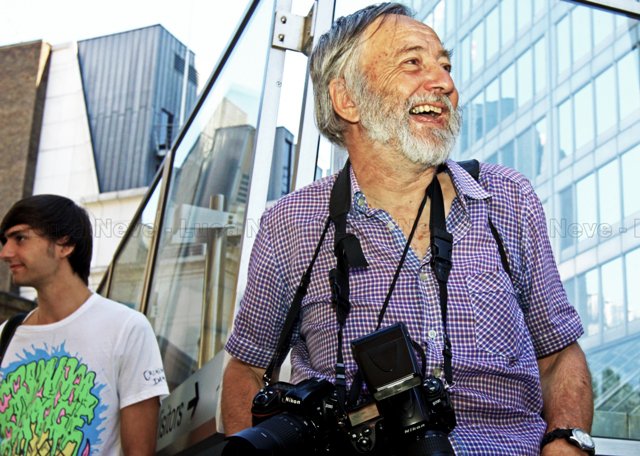
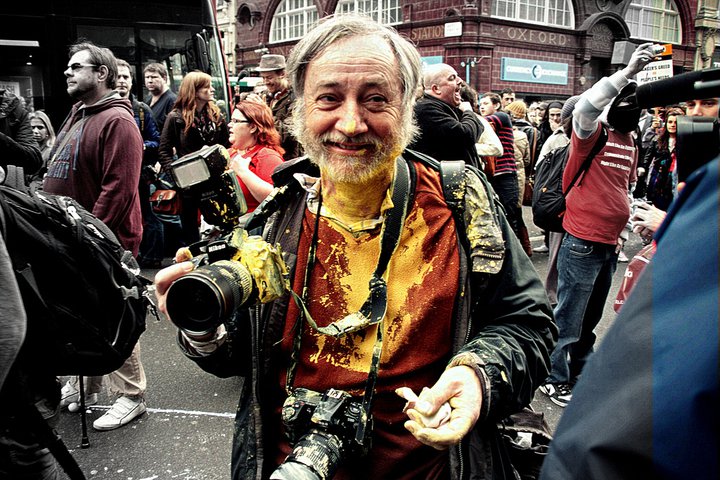
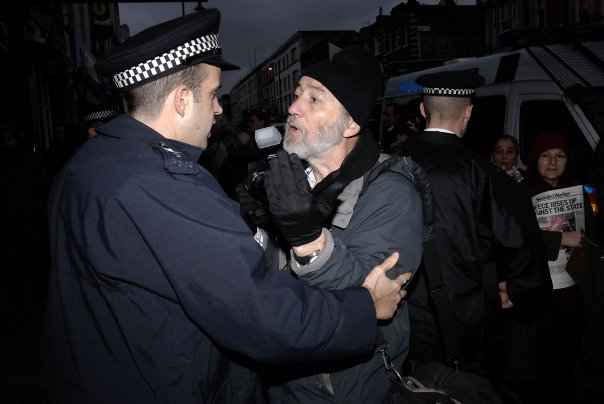
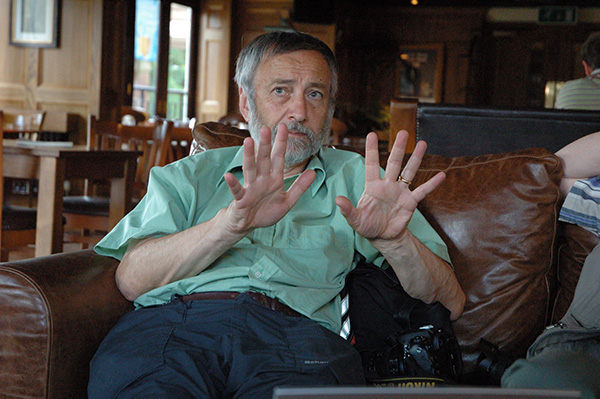
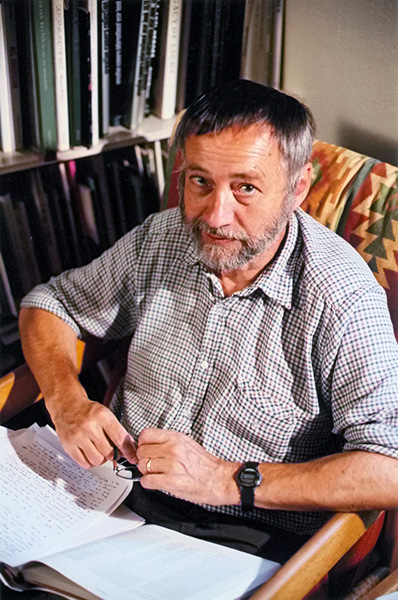
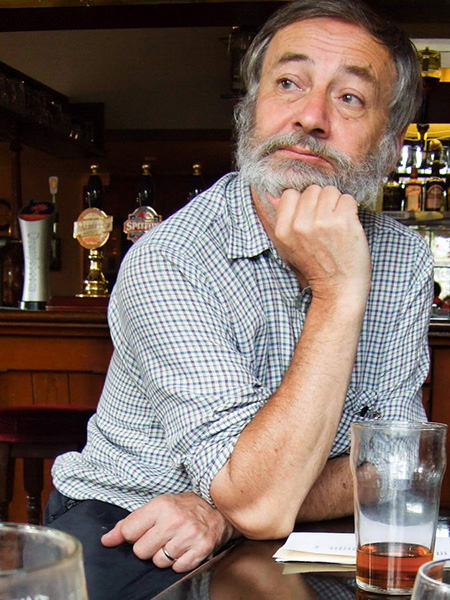
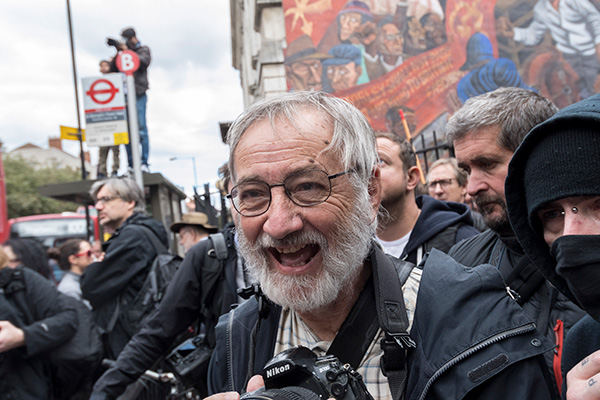
Photographers seem often to take pictures of other photographers, and there are a few that people have posted on my Facebook page or given to me. I don’t think any of them will mind if I post them here (and two are by friends who are now dead, Townly Cooke and Tony Mayne.) These are just a selected few of those I have.

Peter Marshall by Luca Neve
Me at a protest by Luca Neve

milena_nova-oxfordcircus
Photo by Milena Nova, paint by black bloc

paddygarcia_n725280682_1623841_1310
Photo by Paddy Garcia

paulbaldsare200607
by Paul Baldesare

peter_by_tony_mayne600
From a portrait session in my home by the late Tony Mayne

petermarshalltc600
Taken on my camera in the Prince Arthur pub, probably by the late Townly Cooke

Battle Of Cable Street 80th anniversary march and rally, Tower Hamlets October 201
Photo by David Hoffman at Cable St

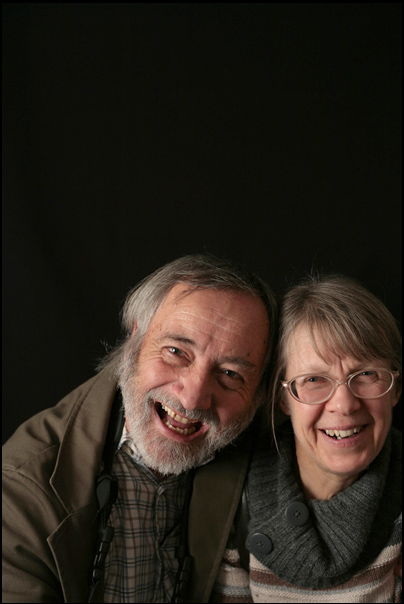
And finally one of me with Linda, which I think was a self-portrait at a party in Paris where one room was set aside as a studio for all the guests to make use of. I think it was probably me rather than Linda who pressed the cable release.

linda_peter_paris

All photographs copyright of the named photographers.