Le Retour

On Facebook today, Rina Sherman whose Ovahimba Years project I wrote about recently posted a link to a film made by Henri Cartier-Bresson, ‘Le Retour‘ (1946) which you can watch in full on YouTube.

In the film, about the return of French prisoners from the Nazi concentration camps at the end of the war, H C-B is credited only as technical consultant, but he was also the director, script-writer, as well as the editor and cameraman for much of the footage, working along with others from the US Army Signal Corps and with Claude Renoir also for the cinematography which includes some earlier wartime material by the US Signal Corps.

It is a remarkable documentary, and you will recognise at least one scene in it from one of Cartier-Bresson’s best known still images, and there are other scenes that reminded me of some of his framing.

Cartier-Bresson studied cinema with Paul Strand in New York in 1935 and worked as second assistant director to Jean Renoir for ‘La vie est à nous‘ and ‘Une partie de campagne‘ in 1936 and the 1939 ‘La Règle du Jeu‘ as well as directing two documentaries about the Spanish Civil War, ‘Victoire de la vie‘ (1937) and ‘L’Espagne Vivra‘ (1938.)

Cartier-Bresson was working for a French Army film and photography unit when taken prisoner in 1940. He managed to escape at his third attempt in 1943, and this and his work then for the Mouvement national des prisonniers de guerre et déportés, part of the French resistance, experiences which made him an ideal director of Le Retour.

The film deals with both the return of captured French soldiers and of civilians deported by the Nazis for political or racial reasons and has been criticised for failing to distinguish between these two very different groups who had been very differently treated. In this it was following the French government line of the time, and it concentrates on recording the human experiences of those held captive and their liberation and reunion with families and friends. The simplicity of the camera work and a minimal commentary combine to make it a powerful statement.

If, like me, you find the French at times difficult to follow, you may prefer to watch a version with English subtitles, though these are perhaps a little distracting. There is also a shorter US version made from the material under the title ‘The Reunion’.
Evolution of Photography

You’ve probably seen a graphic* that was reproduced a couple of months ago on PetaPixel under the title  Evolution of Photography: Exposures Versus Keepers, showing a 120 film roll, an aluminium can for a 35mm cassette and a SD card with the captions ‘12 exposures6 are awesome; 36 exposures6 are awesome; 2,000+ exposures 6 are awesome.’

Amusing perhaps, but is it true?

Firstly, obviously not. No one ever got 6 awesome exposures on a 120 roll, certainly not consistently. If you were lucky you got one or two that would do the job (and using 6×7 as I mainly did you only got 10 exposures and with 6×9 even fewer. Not to mention my panoramic camera that took 6×12 images.) ‘Awesome’ was very rare then as now. And moving on to 35mm, if Henri Cartier-Bresson could only manage a dozen a year, us lesser mortals certainly weren’t hitting one in six.

Of course it does depend on your subject matter. The types of thing you take and where you are. There is certainly rather more likelihood of an awesome image if you are standing on the moon with a Hasselblad than if you are in my back yard with a digital point and shoot. Or a Hasselblad.

I spend a lot of time at the moment going through stuff I took in the 1980s on film, mainly 35mm, though also some 120 and 4×5. Most of the pictures that are worth preserving are so because of the subject matter, and I often find myself cursing that I only took one or two frames of a particular subject. Cursing too because looking at what I did take brings back to memory things or situations I failed to photograph.

Film then for me was expensive – even though I mainly bought it in 100ft reels and then loaded it in total darkness – 100ft would give me 19 cassettes with 36 exposures. I’d started using a bulk film loader which was more comfortable but meant that the last few frames of every film were fogged. You lost images by working to the very end of the film – and like fishing the ones that got away were always the best. Loading in total darkness – two nails on the wall to mark the length to cut – enabled me to get the most from that bulk film.

Later I got a little wealthier and could afford to take more pictures, and even eventually could give up bulk loading. And I learnt from looking at the contacts of a well-known Magnum photographer who showed me how he usually only took two or three images on a 36x film, working with each subject until he was sure he had got what he wanted – or until the situation dissolved. He taught me that working around a subject in this way was something that made professional work stand out from amateur efforts. I began to use more film too, some days perhaps ten or a dozen cassettes. And my work I think improved for it.

Comparing what I took back then on 35mm and what I take now on digital, the one thing that almost always hits me is how technical standards have improved. Colour is cleaner and more accurate, images are generally sharper (especially in the corners) with reduced aberrations, and we can work in conditions of darkness that would have defeated us with film. It isn’t just the change to digital sensors in camera, but also the processing in programmes such as Lightroom and the developments in cameras and flash systems. (Better focus and exposure systems of course also help with film – and are perhaps even more important when using film.)

I certainly make more exposures with digital than I used to with film. It’s a great relief too never to have to worry about running out of film and being caught in mid-change when the vital moment occurs. I think Winogrand when asked if he ever missed pictures while changing film said there were no pictures when he was changing film, which may be true at several levels, but I know I’ve missed opportunities. Now if I ever run out of space on a card it’s either because I forgot to format it after the previous day’s work or I need to go and buy a larger card.

I also take a rather higher proportion of usable pictures. But the number of ‘awesome’ exposures I make hasn’t I think changed very much, though perhaps there is some slight improvement. It really isn’t anything to do with the camera or storage medium but about opportunities and ideas. And if anything digital gives me a rather better chance of turning those ideas into images.


*(Originally it came from photographer Mason Resnick and was published on his blog in January 2014. His Mason Resnick’s Photography Journal is certainly worth keeping an eye on.)

May Day Mayhem


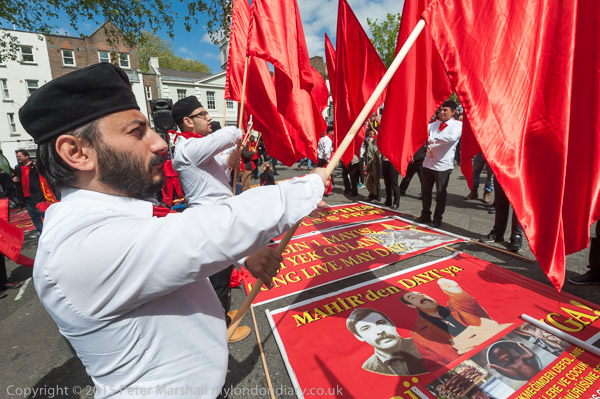
Halk Cephesi, Turkish Popular Front at the start of at the annual London May Day march at Clerkenwell Green

At the moment I’m living or wokring in three time zones. The real one, where I’m going out, attending events and taking pictures coming up to the end of July, My London Diary, where I’m stuggling with putting on-line the events of around a month earlier, and here, where I’m reflecting on what I was doing at the end of April.

Ideally, these three clocks should come together, or at least within a few days of each other, and I’ve been struggling hard this last week to try to bring them a little closer together, but, as one former UK Prime Minister once remarked in a rather different context, “Events, Dear Boy, Events…!”

I’m moving on to May, which of course starts for me with May Day. How I used to resent having to work on May 1st, and have a silly day off on the following Monday when I was a full-time teacher. Now as a freelance I go out and work all day, but it is at events celebrating May Day.


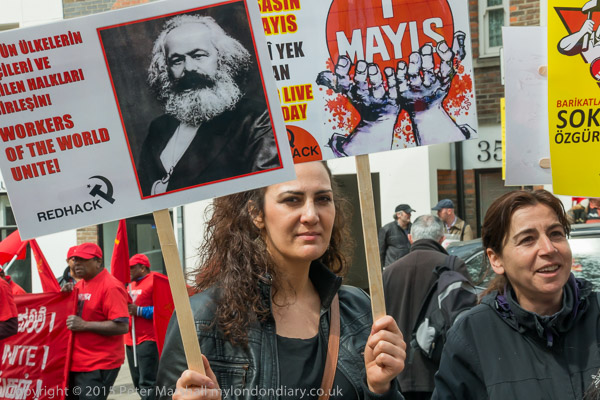
Redhack at Clerkenwell Green

May Day starts at the civilised time of noon in Clerkenwell Green, which is then pretty red (and there isn’t much green anyway at other times, merely a slightly desolate area with traffic running through it and disused public lavatories) with the flags and uniforms of various socialist and communist groups, particularly from London’s Turkish and Kurdish communities.


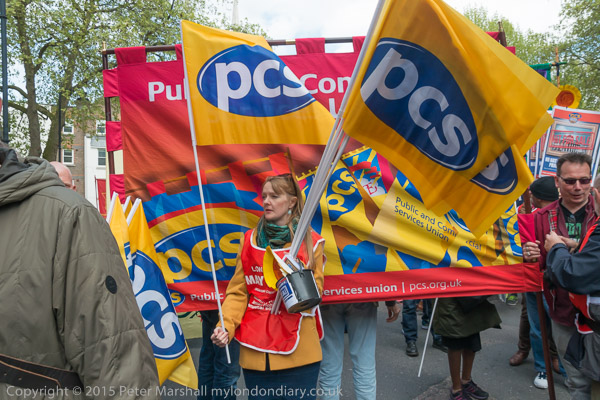
PCS wait near the exit from Clerkenwell Green for the march to start

Also present are various trade union branches at the front of the march with their banners and lurking towards the back some lively anti-capitalist and anarchist groups.


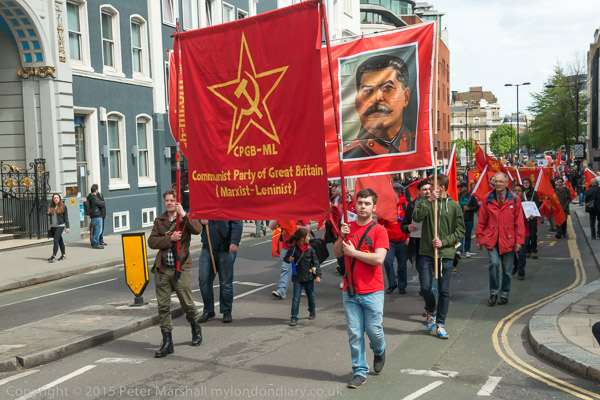
The Communist Party of Great Britain (Marxist-Leninist) on the march with Stalin

And there are a few of the usual banners with large portraits of Stalin, that always make me shudder a little – and he also appears rather smaller in the communist pantheons that adorn some of the other banners in the procession.


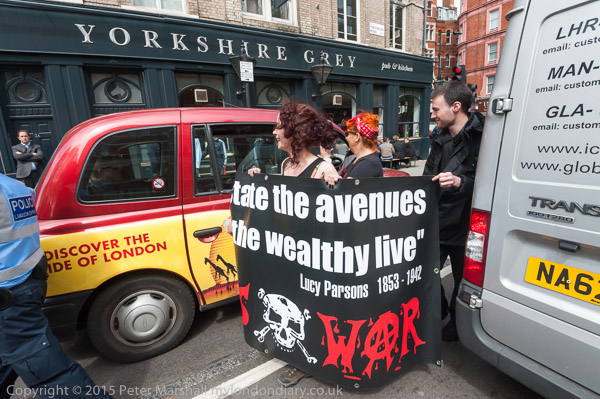
Class War make their way through traffic on the wrong side of the road

The march itself, generally a rather sedate parade along one side of the road, was enlivened by the anarchists, who decided to march along the other side where traffic was still flowing with their banners ‘Democracy is Dead‘ and ‘Rise. Riot. Revolt!‘ as well as Class War’s ‘Lucy Parsons‘ banner, all of which led to a little friction with the police – and to one of the marchers producing a banner out of her bag with an rather terse response.


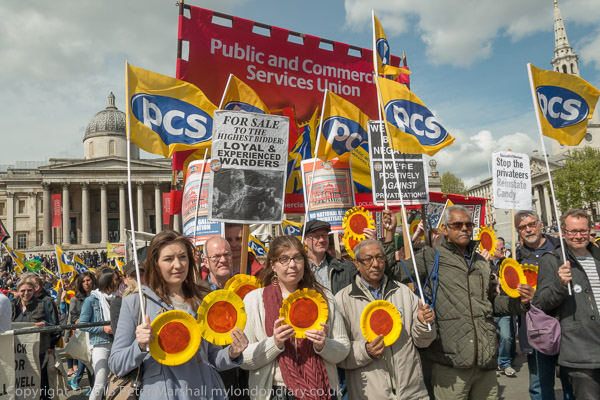
Striking National Gallery workers pose in front of the National Gallery in Trafalgar Square

The rally in Trafalgar Square tends to the tedious, and there was a little of that, but with a long-running industrial dispute over privatisation taking place at the National Gallery overlooking the square, there was at least something of interest.


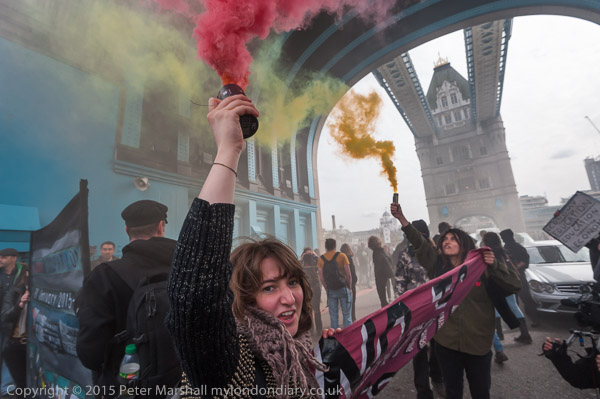
Education activists with flares on Tower Bridge where they have stopped traffic

I had to leave before the end of the rally, to cover an unadvertised event by Class War and other anti-capitalist protesters, who hoped to block several of London’s Bridges in a coordinated protest over housing & education cuts. In the end, only the protest on Tower Bridge that I was photographing took place.


‘Reclaim the Beats’ May Day party outside ‘Poor Doors’

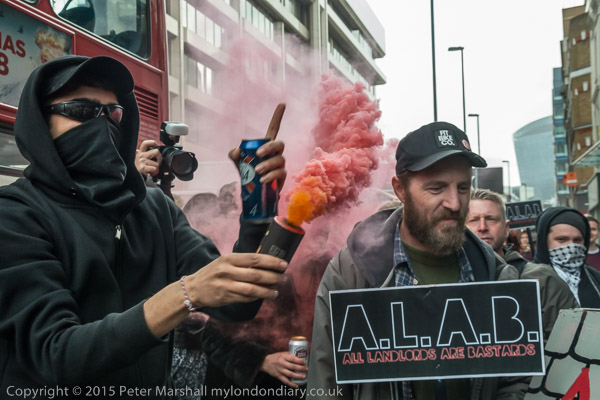
Class War had their own event an hour or so later, an “epic street party” outside One Commercial Street, a May Day Party at ‘Poor Doors’, or rather outside the door only the rich are allowed to use to the flats in this tower block.

By the time the party decided to take to the streets and march back to Tower Bridge for another protest I’d had enough and took the tube on my way home. I’d been on my feet and taking pictures for too long and needed to rest.

More about the May Day events and more pictures:

May Day march against austerity and racism
May Day Rally supports National Gallery
Anti-Capitalists block Tower Bridge
‘Reclaim the Beats’ at ‘Poor Doors’
Continue reading May Day Mayhem

Abir Abdullah on Nepal

On Shahidul Alams‘s ShahidulNews you can see Resilience and Reasons, with some large colour images made by Abdullah immediately following the Nepal earthquake, along with text by another photographer, Syed Latif Hossain. It’s a rather more positive view of the country and people after the quake than those in the Western press.

The New York Times Lens Blog published an interview with Abdullah about his project ‘Death Traps’, a project on the disastrous fires in Dhaka in 2012, with a slide show of 17 pictures.

Abir Abdullah (b. 1971)was one of the first batch of students at Pathshala, South Asian Media Academy in Dhaka and later a vice principal at the academy. Still based in Bangladesh, he is now a photographer for european pressphoto agency.

You can also see more of his fine work on his own web site.

Mary Ellen Mark (1940-2015)

I don’t often make web sites full-screen, but one you really need to see as big as you can is Streetwise by Mary Ellen Mark (1940-2015), her most memorable essay from Life magazine in July 1983. Time Lightbox also has a brief obituary, In Memoriam: Mary Ellen Mark (1940 – 2015) by Olivier Laurent on the photographer who died last Monday after a long illness. A tribute to Mary Ellen Mark’s extensive body of work will be posted on Timeon May 27th.

Her own web site has a great selection of her work from her books, starting with Passport, published by Lustrum Press in 1974, as well as other information and pictures. It has much more material from the book Streetwise including the texts and several clips from the film directed by Mark’s husband, Martin Bell.

Landscape of Murder


Antonio Zazueta Olmos
Last night I attended the opening of a photographic show by Mexican-born photographer Antonio Zazueta Olmos, based in London since 1994 and well known for his work for The Observer and other publications, and now for workshops in street photography he has led as a part of the Guardian Masterclass series.

The Landscape of Murder, on show at Rich Mix on London’s Bethnal Green Road until 30th May 2015 is the distillation of a remarkable project by Tony, in which he photographed the location of every one of the 210 murders that took place in London within the M25 over the two years 2011-2012. Rich Mix is more or less opposite Shoreditch Station, and a short walk or bus ride from Liverpool St.


A small crime at Rich Mix – Tony loses a hand

I wrote in 2010, before he began the project about his contribution to one of the best evenings at London’s Photoforum, and in particular the advice he passed on that ‘if you find yourself surrounded by photographers when taking pictures, you are almost certainly in the wrong place.’ in 2013, in a post Murder & Masterclass I looked briefly at some reports of his street photography classes and his Landscape of Murder project, recommending the dedicated web site, where you can see many of the images in this show.


But it was soon recovered


Sean O’Hagan

I won’t write much about the show itself, as you can read the text written by The Guardian’s Sean O’Hagan, who was present at the opening. A longer version of that article appears as the foreword in the book ‘The Landscape of Murder‘ which includes 79 of the images, along with a short text giving some details of the crime which also accompany the scenes on the wall at Rich Mix. The show there has very much fewer pictures on the wall and is perhaps stronger for it, though a few of my favourites from the book are missing. There is a projection in the rather dim mezzanine space where the show is held, and as seems to be usual for such things they were quite noticeably out of focus.

Although Rich Mix has hosted a few good photography shows, I get the impression that their heart is not really in it (for example see my comments in Paul Trevor at Rich Mix.) It’s centre is cinema, and those going into the cinema will walk past Olmos’s picture and I’m sure many will stop and look – as Tony tells me they were when he was there to help with the hanging. The lighting on some of the works is a little too dim, a shame as they seem superbly printed. But Rich Mix is a lively and stimulating arts centre that hosts many great events, and it’s good to see another fine photography show there, ad very bad news that the future of this place is now under threat – as indeed after yesterdays election results so much else is too.

London isn’t a violent city. It’s one I’ve walked around for 40 years and seldom felt at risk – and then mostly from riot police. The book ends with a short analysis by crime reporter and author Peter Stubley of murders in London and then details of all the 210 murders, along with thumbnails of Olmos’s images of the scenes.  The end papers present a map of the area marked with the locations – which is far more effective as a single large map in red on the gallery wall.
Continue reading Landscape of Murder

Greek thoughts

Let Greece Breathe! was a fairly busy event, with quite a few  photographers and videographers and fairly crowded, making it difficult to get exactly in the places I would like to have been.

Video and still photography have very different requirements, and sometimes this can be a problem. Video generally works best for most things when the camera is static for fairly long periods, at least much of the time, preferably on a tripod. In contrast, being in the same place for long as a still photographer is generally a bad thing, leading to too much repetition in your images. Even for simple things like photographing a speaker, its usually good to be able to vary the background. Composition is I think generally far more important in still images than in video.


At this event it was difficult for still photographers to move around without getting in the sight lines of a couple of video crews from foreign TV; it would have been easier had they set up closer to the tape separating the audience from the speaker. Though I tried hard not to get in the way I think that Greek TV viewers will have got the occasional view of my slightly bald patch on their screens.


To keep out of the way of the TV cameras I spent rather too much time close to one of the two speakers on stands at the front of the audience, and it was loud enough to probably damage my hearing and certainly to give me a headache – after a while I simply had to move away.

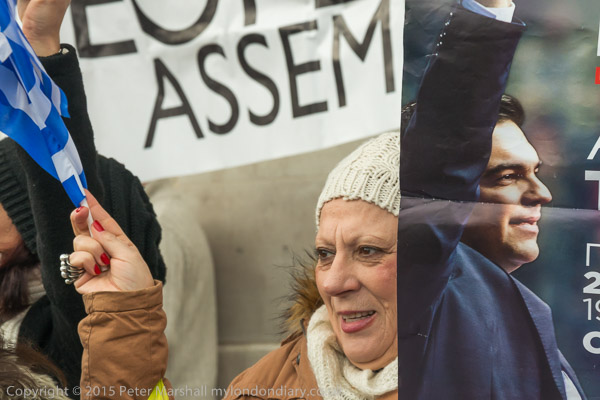
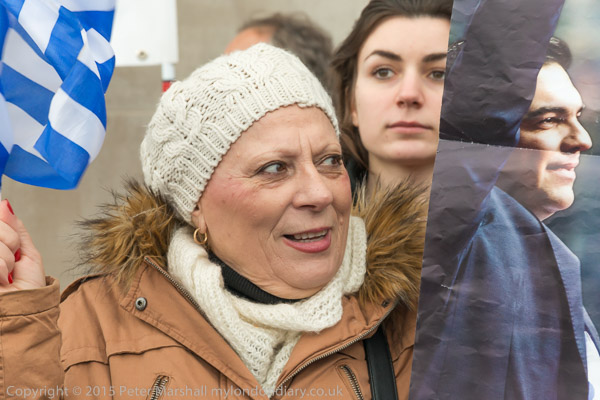
One of the things I try to do is to find an idea and then to pursue it until I’m happy that I have captured it (or sometimes simply have to give up.) One of the things that I noticed at this event was a Syriza poster of Alexis Tsipras with his head at roughly life size, and I tired to use this in pictures with the heads of real people, three of which you can see above.


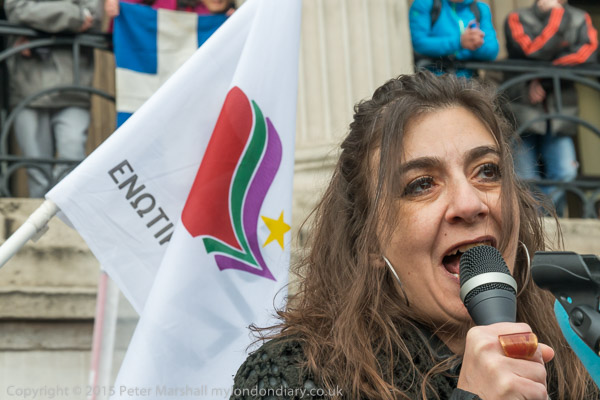
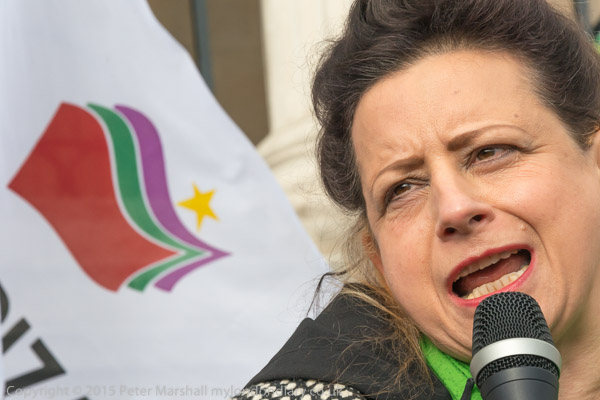
Another little series of images was of the various speakers with the Syriza symbol on a flag behind them. This was made a little tricker as the flag was being waved around, and flags are in any case often something of a challenge as they get blown around – or simply droop when you need them to fly. Add to that the need to catch the speakers in interesting or dramatic expression or gesture – and with their eyes open and you have a challenge.

There are a few more of these and some variations in Let Greece Breathe!

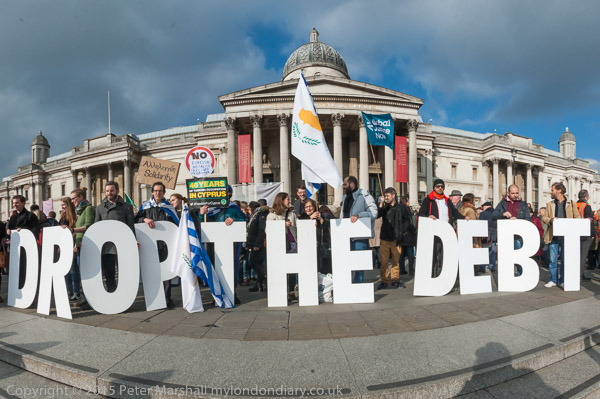
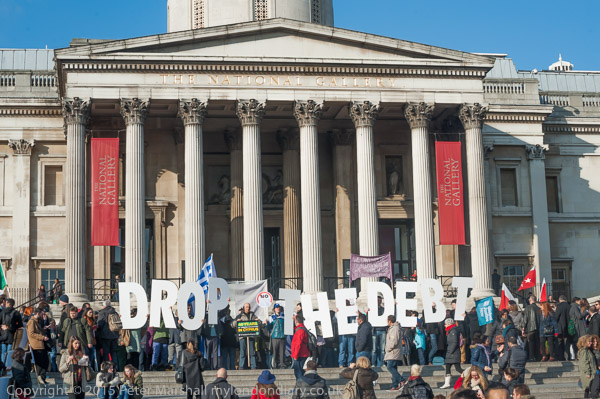
A different challenge was posed by a line of people on the steps leading down into the square from the North Terrace where the rally was held. If you approached too close it was difficult to get the whole message, while if you moved back, someone was almost certain to get between you and the message.

Often in situations like this the 16mm fisheye with its 146 degree horizontal angle of view solves the problem of getting close but getting everything in the view. But in this case I didn’t find it entirely satisfactory. Although the verticals are straight (thanks to the FIshEye Hemi plugin) I find the curvature of both the step at the bottom and the roofline a little distirbing. It is possible to remove these but only at the expense of some rather curious heights of the people across the central row who would get considerably taller towards the edges.

I tried with the 16-35mm, both from a fairly central position and also form one side of the othere, but was even less happy with the results and none of my attempts appear on line (though a long line of photographers was busily taken them from there.) But later I did go some way futher down into the square, far enough back to take a picture at the wide end of the full-frame 70-300mm. There are a lot of people in front of the message, but they appear less imporant from a distance. Possibly going even further away, particularly if I could have got a little height from climbing on to the plinth of Nelson’s column, would have given a better view, but the people put down their letters and dispersed before I had time to try it.

Continue reading Greek thoughts

Je Suis Chaleroi?

A new controversy has emerged from the latest World Press Photo, with exception being taken to the winning entry, The Dark Heart of Europe, by Italian photographer Giovanni Troilo in Contemporary Issues Stories. There are 10 images from the story at the WPP and a dozen on the photographer’s own web site, under the title Charleroi, La Ville Noire – The Dark Heart of Europe, which omits several in the WPP selection.

In this case the complaint is not about the processing of the images, though some might feel this is at least a touch over-dramatised, but about staging and the false image they give of the city, whose mayor Paul Magnette, while professing not to be and expert in photography complains that the story is anything but photojournalism, hiding aspects and distorting reality through staged images.

In his letter the mayor goes on to repeat some of the criticisms of the work raised immediately after the award by Belgian photographer Thomas Vanden Driessche who is quoted on the web site OAI13 (Our Age is 13):

L’utilisation de la mise en scène, l’éclairage artificiel mais surtout le caractère falsifié et mensonger des légendes participe à la construction de cette fiction prenant les apparences d’un reportage. Cela ne me causerait aucun souci si cet ensemble était le résultat d’une œuvre artistique très personnelle. Mais le photographe ne présente pas son travail comme tel. Au contraire, il donne manifestement une réelle dimension journalistique/documentaire à son approche. Le simple fait que cette série a été soumise au World Press Photo et surtout le fait qu’elle ait été primée lui confère une crédibilité journalistique.

Driessche is saying that staging, the artificial lighting and above all the false and lying captions result in the making of a fictional story in what appears to be reportage. This would not worry him in a personal artistic work, but this is not how the photographer has presented it. On the contrary he clearly presents it as a journalistic/documentary story and submitted it as such to World Press Photo who have given it credibility as journalism by giving it the prize.

The mayor’s letter, reproduced in part on the same site gives some details about who and what appear in some of the images, arguing that the reality they show is very different to the story implied by the photographer through the highly stylised images and deceptive captioning, ending his letter by stating that the photographer has deformed reality for the sake of a story which discriminates against the city of Charleroi, its people and the profession of photojournalism. He says that you will not find a single person living in the city who would recognise it from the story, and that is seems to be more a settling of grudges than investigative reporting.

Time Lightbox’s report of the story includes some translations of the comments in the mayor’s letter and includes a statement from WPP:

“We are currently verifying the facts behind the photo story, as we do with all the prizewinning pictures, and we are in touch with the photographer Giovanni Troilo.”

Of course, if photographers and journalists are doing their job properly they will often offend some people. Few organisations welcome any critical investigation, as many people, particularly whistleblowers, have found to their cost. For those of us who have no knowledge of Charleroi (and I imagine few of us have heard of it before this, let alone been there) we have only the opposing views and the nature of the photographs to inform us.

Photography cannot exist without a point of view, though in much we see that may well be a rather confused one. The strength of Troilo’s work which led to its success is in the clarity of his view and the dramatic way he has presented it. We all have to dramatise the situations we photograph, to give them some form in order to communicate with an audience.

For many photographers, the guiding principle was stated clearly by one of the legends, W Eugene Smith in his credo “Let truth be the prejudice”. Perhaps in this case truth may have given way to prejudice. It will be interesting to see what WPP responds.

Pancake Day

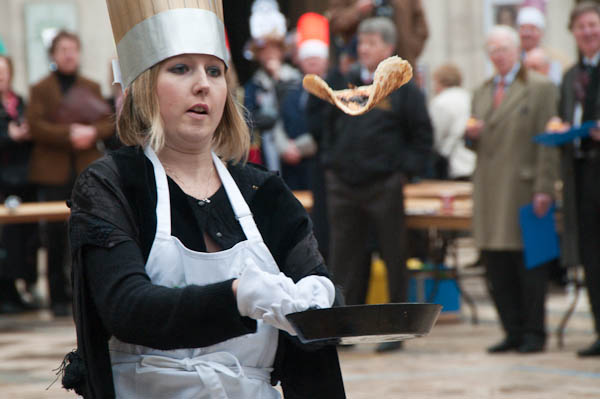
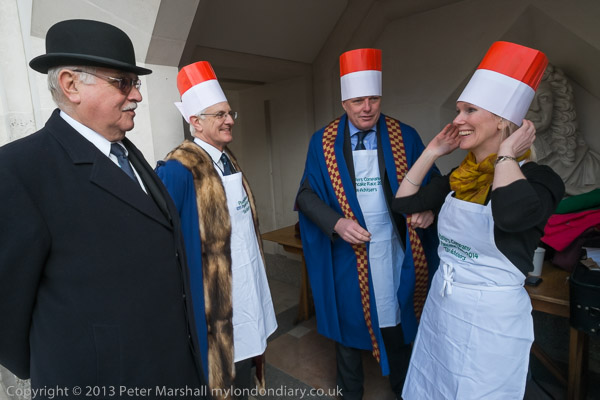
This year I just don’t have the energy for pancake races. Not that I ever took part in them, but since I first photographed the Worshipful Company of Poulters Pancake Race in 2007 I’ve returned most years, as well as photographing other races in Spitalfields and elsewhere.


Pancake Day 2011

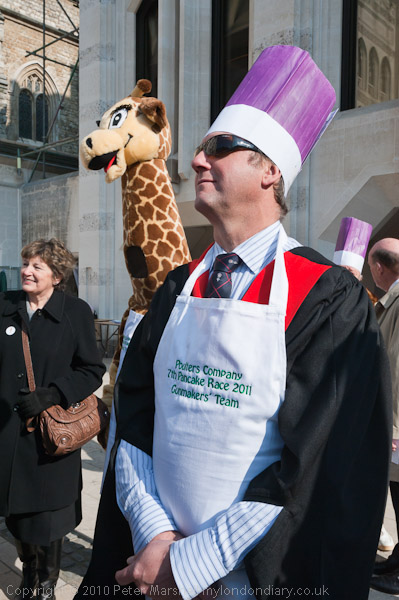
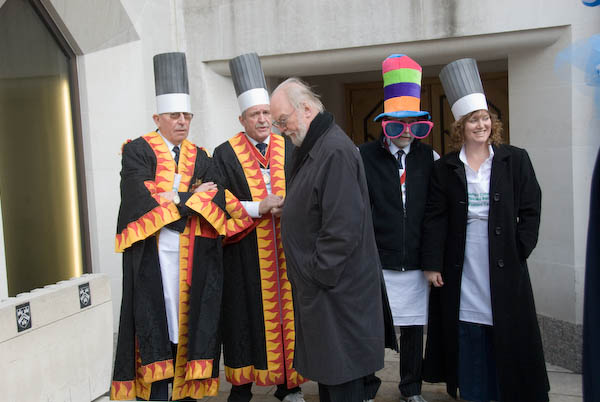
The race in Guildhall Yard has become something of a tradition for those taking part, particularly for a few of my photographer friends, and is certainly one of the odder events in the city. Hardly an ancient tradition (it began in 2005, a couple of years before I first went) but as I noted in 2007 is:

organised by The Worshipful Company Of Poulters which got its charter to regulate the sale of poultry and small game in 1368, and run, by permission of the Chief Commoner, in the yard fronting the Guildhall building, which got a controversial new gothic facade in 1788 thanks to George Dance the Younger. It was first run in 2005*, but as befits the city it has a serious set of classes and rules, music from the Worshipful Company of Musicians (1500), time-keeping by the Worshipful Company of Clockmakers (1631) and a starting cannon for each of the many races provided and fired by the Worshipful Company of Gunmakers (1637.)


Pancake Day 2012


Pancake Day 2013


Pancake Day 2014

Like most of the other pancake races, this is a charity event, and one thing the City is not short of is money. And while I suspect that many of those taking part will be up to all sorts of dodges to (mainly legally) avoid paying tax they will at least be giving some of their ill-gotten gains to good causes.


2008 Poulters’ Company Shrove Tuesday Pancake Race

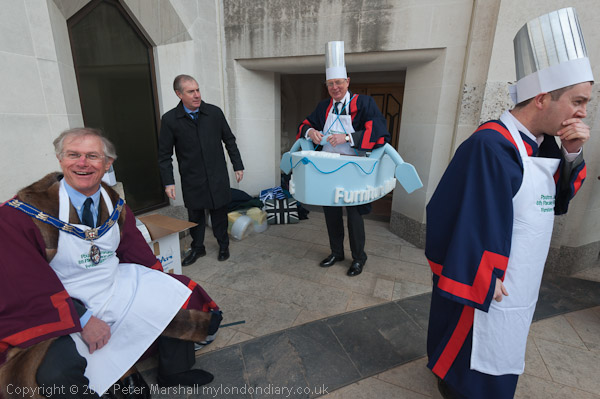
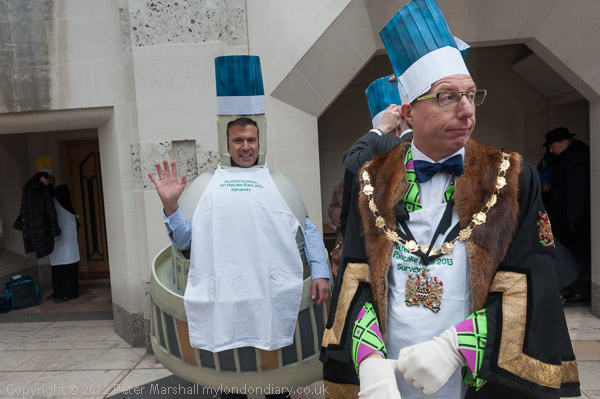
Its an event that often amuses me, with some very serious people trying hard to let their hair down and wearing very silly hats, but also one that shows how competitive the City can be – and with sometimes a certain amount of sharp practice despite elaborate rules and a large number of people observing compliance.


Great Spitalfields Pancake Race winners 2007

My own athletic ability has some years been taxed by jogging with a heavy camera bag from the Guildhall Yard to The Great Spitalfields Pancake Race across the border in Tower Hamlets. Taking place in what was a part of the Brewery site off Brick Lane, the shortest route is just over a mile, and the only sensible way to make the journey fast is on foot or bicycle. But taking a bicycle to events like this involves an unacceptably high risk of not having a bicycle for the journey home. So I walk and run and walk and run…

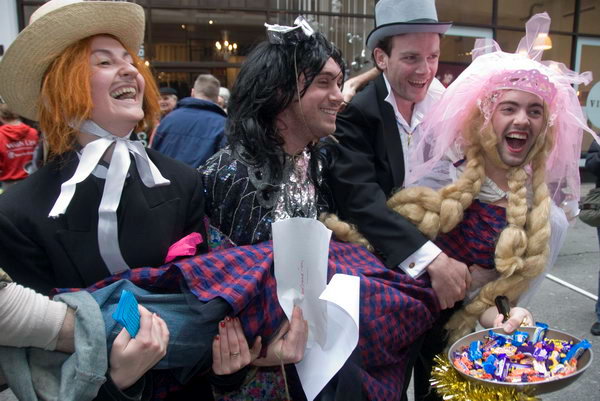
Unlike the Guildhall race, this and three others are included in the Official Tourist Guide to London. It takes place in a rather more confined space making it difficult to take pictures for the crowds of others taking pictures. It starts a little later than the Guildhall event, but they overlap in time and it isn’t really sensible to try and cover both – so most years I’ve done so. The contestants here are teams, mainly from local businesses and there is rather more fancy dress, and rather fewer rules, most of which are broken. It’s much more straightforward fun than with the Livery Companies.


The start of the 2008 Parliamentary pancake race

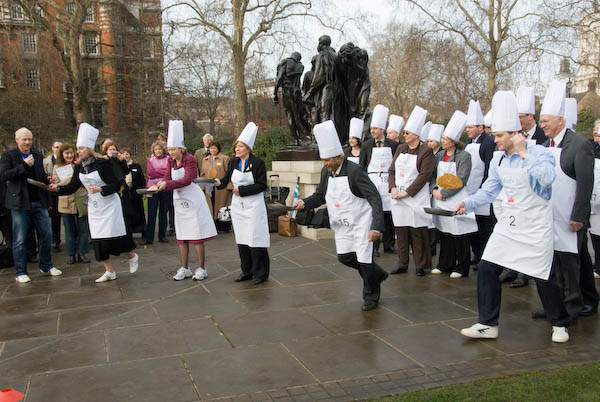
Another that I’ve photographed in the past – and is starting as I write now – is the annual race between media and parliamentarians in the Victoria Tower Gardens, which takes place too early to draw a very large crowd and is a rather more serious event. This is a highly organised and tightly fought race to raise funds for the charity Rehab – complete with a 32 page brochure for various sponsors to advertise in.

There are also an increasing number of other pancake races, mainly charity events around London, now including many suburban centres. I could even go and photograph one ten minutes walk away from where I live in Staines this lunchtime, and I may just stroll down there later, but I doubt it.  I’m not a great fan of pancakes (and crepes really give me the creeps – such a food rip-off) and I feel I’ve photographed enough.


* or 2004 according to the Clockmakers who ought to know.
Continue reading Pancake Day

Fingers Crossed


Ken Loach, Jasmin Stone of Focus E15 and Lisa Mackenzie, author of ‘Getting By’
D700, ISO 3200, 16-35mm at 16mm, 1/40s f4

For the moment at least, though I hesitate to commit this to print, I appear to have regained control of my computer systems here, and am back at work on a nice, largish and calibrated screen, with a proper keyboard after spending over two weeks on my very portable notebook.

To my right, the Drobo 5N has a reassuring row of green and blue lights as I type, and on the desk in front of me is the external hard drive that caused my problem. It took my desktop computer around 20 days to run a disk check, outputting error messages every few seconds on 450,000 files telling me it had insufficient disk space to fix the problem for each in turn, leaving me swearing at the sloppy programmer who wrote those routines.

It could even have been Mr Gates himself, for underneath Windows, even fairly recent versions such as Windows 7 which this computer is running, is a residue from the days of MS-DOS. But what was perhaps acceptable when a large hard drive was only 20Mb doesn’t scale up well to 3Tb. Though so far, when I’ve cautiously connected the rogue disk to a running Windows system it has served up the few files I’ve requested with no demur, so perhaps these slow routines somehow managed to solve some problems, though it will be some time before I examine the whole disk.

At the moment I’m slowly transferring work from about 10 days taking pictures from the Drobo into my Lightroom catalogue. It’s a slightly more complicated process than it might be as Lightroom doesn’t currently appear to be able to see the network attached drive, so I have first to copy the files across to a directly attached disk. At least this transfer is reasonably rapid, at around 40Mb per second. Once in Lightroom I’ll need to spend the usual amount of time making a final selection of images and developing them for my web site and archive. And of course updating my web pages.

Perhaps the biggest problem I’ve had over the 20 days is having to work with jpegs. When the lighting is easy, both Nikon and Fuji do a reasonable job, but whenever things get tricky, jpegs just can’t cope. And well Photoshop is a great programme (I think I’ve used it since version 2), Lightroom is just so much faster and I think better for most editing and adjusting. Of course I was taking RAW + jpeg, but wasn’t able to edit the jpegs as I only have an old version of Photoshop on the notebook. Probably I should have updated it and installed Lightroom (as I think my licence wold allow) but I kept thinking it wouldn’t be long before I was back on a real computer.

I doubt if sending out files based on the jpegs rather than raw will greatly have affected my sales, but I certainly noticed the difference in quality. As I slowly work through the backlog I’ll try and find some good examples and write a post or two here.

Friday was my first day back processing with Lightroom, and as well as the work from that day I also had some pictures from a friend’s book launch the previous evening. Thursday had been a long day; I’d covered two protests, then gone on to a third story, where I’d taken some pictures but didn’t really have enough to be worth submitting and then taken some urban landscape panoramas before the launch. By the time I’d come home, had some food and processed and submitted pictures from the first two events it was early morning and I needed to be in bed. But before I went out the next morning to take pictures in an icy windtunnel (aka Croydon) in South London I’d started to process the party images, taken in lighting that bordered on the impossible, thankful that I could resuscitate them in Lightroom. The landscapes will wait until I have more time.

Continue reading Fingers Crossed