RAW Converters: Capture One Pro 4.5

When I first started shooting digital, the RAW converter favoured by many pros was Capture One (CO), and so I bought a copy, and was reasonably impressed by the quality of the output although never by the speed of operation.

When Pixmantec brought out their RAW software I was easily converted, at least when the improved Pro version appeared. The output files looked more or less as good as those from CO, but the big advantages were in speed, workflow and a more intuitive interface.

Then Adobe bought up Pixmantec, wanting to incorporate its superior technology into their own products. Many of us were disappointed, but at least Adobe did give us the promise of a free copy. Lightroom when it finally arrived took a little getting used to (and I had to buy a higher spec computer to run it) but soon had me convinced that its integrated approach covering image management was the way forward.

More recently I’ve been more than impressed by Lightroom 2.1 RC (not a Catholic conversion but “release candidate“) which Adobe brought out rapidly to redress the problems which hobbled the performance of 2.0 on my machine.) Its burn and dodge tool in particular has almost completey removed the need to transfer any of my images to Photoshop in normal processing.

Long ago I’d subscribed to several future upgrades for CO, so I’ve kept up with the various releases of this. Although I didn’t use it often, there were occasional images where I just was not satisfied with the results I could get from Lightroom, and often found I could get a visibly better result with CO.

For some time, Phase One has been heralding the appearance of Capture One 4 PRO, and finally it has arrived. I downloaded and installed it this afternoon (I find it is version 4.5) You can see more about it on the Phase One site and download a trial copy if you want to try it out.

It is a real improvement over earlier versions, with improved tuning of image colours as well as a new skin tone tool. But even in these new tools there were some disappointments. One of the program’s problems has always been that it is in part a specialised tool for photographers using Phase One’s digital camera backs. It would simplify the software if this support (and that for some other tethered cameras) was eliminated from the normal version of the software. It remains rather less intuitive than Lightroom.

The lens correction tools are very welcome, but limited, again due to the software being seen as a support for Phase One. A product intended for pro use should at least come with lens profiles for popular Nikon (and Canon) lenses allowing the easy removal of lens distortions and chromatic aberration. However the the automatic CA removal works quite well and is fairly fast, and purple fringing is also handled quite well. (Presets are supplied for a few Contax and Hassleblad lenses.)

I was unable to carry out distortion correction as there were no presets for any lens that I use. The manual suggests you can adjust distortion manually (and save the results as Style presets for a very limited approach to automatic correction) but this is generally very difficult to judge with any accuracy. There is only a single control so more complex distortion cannot be handled. Manual vignetting adjustment is also possible, but so far whatever I’ve tried the ‘Color Cast’ check box and ‘Sharpness Falloff’ and ‘Light Falloff’ sliders and check boxes are simply unavailable clutter on the interface.

The other unacceptably poorly implemented feature in CO is Metadata support. You can add IPTC caption and copyright information, but not other essential fields such as keywords, location, date, category etc.

CO is probably a decenttool for studio-based photographers who don’t work with agencies or picture libraries and where optimum image quality is a high prioriyt. In particular it will appeal to those who find its “styles” useful rather than those who prefer their photography untrampled by such “creative effects.”

If you shoot on Nikon and need software to deal with the occasional file where Lightroom 2.1 doesn’t quite come up with what you need, then probably the best overall choice is the powerful if almost terminally unfriendly Nikon Capture NX RAW software (now actually NX2.) Just don’t ask me how to use it.
Should Magnum do fashion?

Alec Soth continues his campaign to turn the Magnum blog into a true ‘Web 2.0’ site interacting with its users rather than simply feeding them with some of Magnum’s truly fabulous eye-candy by posing the question ” Should Magnum do fashion?”

Of course Magnum photographers have done fashion in the past, and most particularly (as he points out) Magnum have  produced their Fashion Magazine series, with issues shot by a single photographer – previous issues have been by Martin Parr, Bruce Gilden and Soth himself.

The latest – just released – Magnum Fashion Magazine, shot by Lise Sarfati raises the issues more starkly for several reasons. Firstly because of her whole approach to documentary which has dealt more intensely with the people she has photographed than the other photographers, but most importantly because she has made use of those same people as models in her fashion pictures and shot in many of the same locations.

Of course there are those who argue that Magnum lost its true documentary heart some years ago, particularly with the inclusion of Martin Parr, whose approach caused some apoplexy among some more traditional documentary photographers at the time (and I think smoke was seen rising from at least one of my heroes.)

Until now it was always possible for those who had some sympathy with this view to apologise for Magnum and say that even if some of the work lacked the old spirit, at least Magnum was still supporting the serious work of photographers such as Lise Sarfati…

Had we looked at these pictures simply on the web or gallery wall would we have simply seen them as an extension of her earlier work? After all they are marked on Magnum as “Not for use in advertising or retail calendars“, so are they really so different from her other work?

Seen as a whole, I think they are, and I think they cheapen her work. Although taken individually most would fit into her approach, as a set of over 70 images the fashion fiction seems to me to take over, spreading a certain sameness and repetition.  I don’t know if it is the presence of stylists, the expectations of the “models” themselves or the pressure on the photographer to produce in a limited time-scale, but there seems to be a lack of intensity as well as a certain unwelcome gloss in these images.

I also wonder about the relationship between the documentary photographer and the people she is photographing, not just in this case but in general.  For me certainly, I’ve always felt that what I do is justified by the story that I tell; sometimes it may be of direct benefit to those who work with me,  or promote their cause or in some way enlarge people’s understanding or appreciation of the world.  Somehow I can’t fit selling frocks into that relationship.

So should Magnum do fashion? Well, Magnum photographers need to make a living and fashion is one of the safer and better paid ways to do that, so I’ve no problem with them doing a little on the side.  Even do a few weddings if they really have to. But I’d rather Magnum itself didn’t confuse it with their real work.

Road Trip

The first work by David Alan Harvey I remember seeing was some of his pictures from Cuba. I still really don’t know how he finds such powerful colour and at times I think he lives in some parallel universe where things are rather less grey than here. Cuba may well be a pretty colourful place, but I think what we see in his pictures owes more to him and his way of seeing than to  the subject matter.

There are over a hundred pictures from his Cuba book on the Magnum web site,  (Harvey joined Magnum in 1993, becoming a full member ub 1997) where you can also see much of his other work and he also has his own site with some interesting work on it, including some by other photographers, as well as information about the workshops he runs. These are not cheap, but I’m sure if you are ready for them could be very much worthwhile.

You can also learn more about his Emerging Photographer Fund, started in 2007, which gave its first annual award of $5000 this year to young British photographer Sean Gallagher to encourage his work on the encroaching desert in China. Gallagher is based in China and has quite a lot from there on his site, as well as some interesting travel photography from other places. Born in 1979, he became a photographer after graduating in Zoology in 2002. He spent a year as a Magnum intern in 2004-5, and his colour work shares some of Harvey’s energy and use of unusual foreground which shows us the subject in a different way. 

But perhaps the most interesting part of Harvey’s site is the blog, Road Trips. Harvey often doesn’t write a great deal on it, but what makes it interesting (and at times infuriating) are the comments.  Not just the odd comment, but literally hundreds of them (and yes, some of these are odd.)

Italy’s Ethnic Cleansing

Rt Click, View image to see larger

The problems facing the Roma in Italy were highlighted in July this year when media published pictures of holiday makers sunbathing on a beach near Naples ignoring the bodies of two drowned Roma teenagers.

In May 2008, the right-wing Italian government led by Berlusconi introduced a whole range of repressive measures to deal with what they describe as the “gypsy problem“. The measures remind many of the fascist policies under Mussolini – when Italian Roma were stripped of their citizenship and many died in concentration camps. They include dismantling all Roma camps and fingerprinting all Roma – children as well as adults.  Almost all of the Roma are actually Italian citizens. There have since been more or less daily reports of arrests, evictions and other attacks on the community, both by police and by criminals inspired by the government campaign.

Several camps have been burnt to the ground after Molotov cocktails where thrown into them, and many Roma have been left homeless. Forcible evictions from the camps by police have started and many Roma have been arrested.

There are around 150,000 Roma in Italy, less than 0.3% of the Italian population – a lower proportion than in many other European countries. Most of them live in desperately poor conditions in squatted camps around major cities.

Sentiment against Roma has also been hardened by the Italian population’s confusion between them and the mostly non-Roma Romanian migrants who continue to arrrive in Italy and the Roma are scape-goated for crimes committed by these often desperate Romanian refugees – another problem the rigth-wing government has exacerbated rather than attempting to solve.

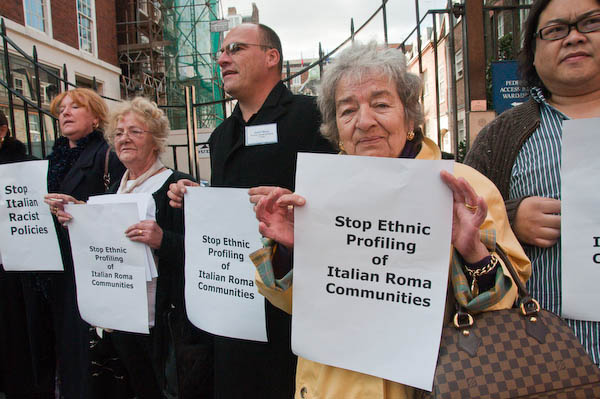
Around 20 people, many of them Roma, met at the gates of the Italian Embassy in London at Friday lunchtime (17 Oct) to protest against the human rights abuses in Italy which constitute ethnic cleanisng of the Roma. A deputation of four, including Peter Mercer, MBE, the Chair of the National Federation of Gypsy Liaison Groups were allowed into the Embassy to give their views.

Catherine Beard of the UK Association of Gypsy Women and European Forum delegate had brought back a distinctive ‘Against Ethnic Profiling‘ t-shirt from Europe.

Rt Click, View image to see larger

After the vigil outside the embassy, a number of the protesters went on to a meeting at the House of Lords.

A few more pictures from the event on My London Diary.

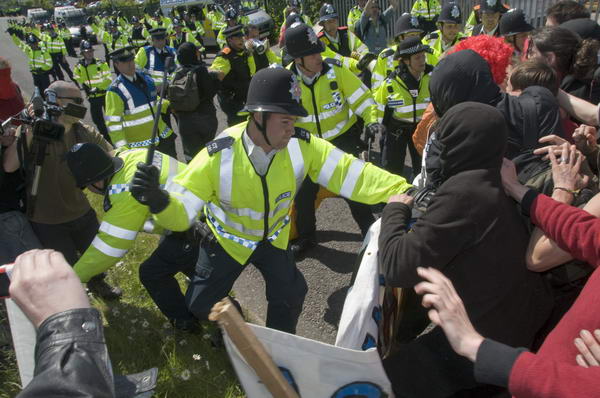
Police attack Photographers

I wasn’t feeling too well last Wednesday and didn’t feel up to going to Brighton to photograph the Shut ITT! demonstration there, a follow-up to Smash EDO’s ‘Carnival Against the Arms Trade‘ which I photographed last June. Had I made it his time there seems to have been a pretty good chance I would have ended the day with at least minor injuries from police action.

Rt Click, View image to see larger
Police use batons on demonstrators outside EDO in June 2008

In June the policing had got pretty heavy-handed, and apparently even more so after I had left early thinking the demonstration was more or less over, when for some unaccountable reason the protesters were actually let on to the factory site and there was considerable mayhem all round.

This time things were tougher still, and not just for the protesters but also for photographers. On his blog,  Jason Parkinson writes  about the police actions:  “I am sick to death of seeing my work colleagues getting hurt while trying to do their job” and talks about “a continuous pattern of abuse, ignorance, intimidation, harassment, surveillance and violence” directed at journalists, particularly photographers and videographers who need to be very much in the thick of things to get their pictures.

Two other photographers, Marc Vallée and Jonathan Warren have described how they were filmed and questioned before the start of the event, and told they were not allowed to photograph in the area where protesters were arriving.

Later, Vallée was assaulted by police (again!) and another photographer was bitten when a police dog was set on him, requiring medical attention. At least one photographer was pepper sprayed.

In my camera bag I carry a copy of the Guidelines for reporters, photographers and news crews for dealing with police at incidents published by the BPPA, CIoJ and NUJ in association with the Metropolitan Police, which on their reverse carry the Met’s guidelines for officers. As it states, these guidelines “have been agreed at senior levels by all parties.  Please use them in a spirit of mutual professional respect to resolve any problems.”

These guidelines were adopted by all police forces in Britain in April 2007. They lay down general principles that recognise the law, the duty of the media to report from the scene of incidents, and the police duty to help them in doing so where possible.

These guidelines are simply not being followed so far as the policing of protests is concerned. As Jason ends his blog post:  “There is no excuse to baton a photographer, no excuse to pepper spray a photographer and absolutely no excuse to use a dog as an offensive weapon against a photographer.” This isn’t my idea of “mutual professional respect.”

Bank rates

I’m not an economist. Nor a rich man, because I’ve never thought it worth my time thinking about money.

Rt Click, View image to see larger

When I grew up we had none. At least that was simple, although my mother kept careful accounts of every penny in a small red bock, balancing her accounts carefully each week to avoid getting into debt. Penny-pinching all the time, making do and mending.  But my early years were years of austerity and rationing for the whole nation, and being poor like we were wasn’t very different from being almost as poor as the rest of the people down the street.

Even on a student grant I was better off, and my first full-time job earned me more than my father ever had but I’ve never got into the habits of spending (except on cameras) and waste that most people seem to take for granted, so I’ve never had to really count the pennies.

Banks have changed dramatically since I opened my first account to handle my student grant cheque. Rather than computers there was a man in the corner sitting with a big black-covered book and when you presented a cheque the cashier would go over to him and check that your account had the funds to pay.

Now it seems they have all been busy trading with borrowed money, betting on bets in ways that no-one had thought to regulate, making huge profits for their shareholders and massive bonuses for themselves in the good times. Which have now come to an end and the taxpayers are having to pick up their massive losses.

The failure of the banks doesn’t give me any pleasure, not least because it also has resulted in a fairly dramatic fall in the value of my own investments towards a pension, which I thought (and had been assured) were reasonably safe. Oh well, its only money.

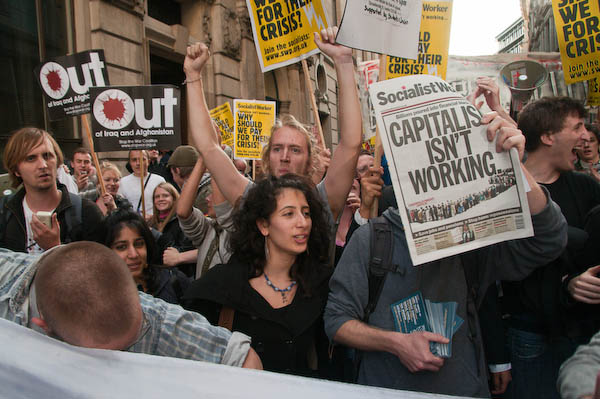
But I certainly had considerable sympathy for the protesters who organised the March on the City with the slogan ‘We Won’t Bail out the Bankers’. As usual, more details and pictures on My London Diary.

Rt Click, View image to see larger

Climate Rush – Deeds Not Words

Rt Click, View image to see larger
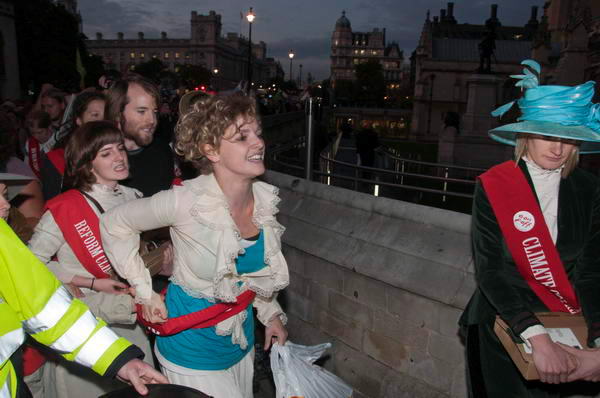
Women dressed as suffragettes, including Tamsin Osmond (center left) rush toward the entrance of the Houses of Parliament in London, Oct 13, 2008

Exactly 100 years ago, more than 40 women were arrested in the ‘Suffragete Rush‘ as they attempted to enter The Houses of Parliament in Westminster, London. To mark this centenary, young women concerned with the lack of political action to tackle climate change organised and led a ‘Climate Rush‘ rally in Parliament Square, calling for “men and women alike” to stand together and support three key demands:

  • No airport expansion.
  • No new coal-fired power stations.
  • The creation of policy in line with the most recent climate science and research.

It turned out – as expected – to be an interesting evening, although unlike 100 years ago none of the women managed to get into parliament and disrupt the proceedings there.  You can read more about it – and see rather a lot of pictures – on My London Diary.

Inside the building, the upper house was debating one of our more repressive pieces of proposed legislation, the Counter-Terrorism Bill 2007-08, and threw out by a large majority to proposal to allow suspects to be detained for 42 days before charge. However this is only one of several extremely suspect provisions, and we can only hope that their Lord and Ladyships will also throw out the proposals for secret inquests and look very carefully at the other provisions of the bill when they return to it in the next few days.

Lytchett Matravers

I must admit that until last week I had no idea that Lytchett Matravers even existed, let alone where it is. Nor for that matter its neighbouring village, Lytchett Minster.  And I think that is exactly how the people who live in these Dorset villages a few miles from Poole would like to keep it.

Rt Click, View image to see larger

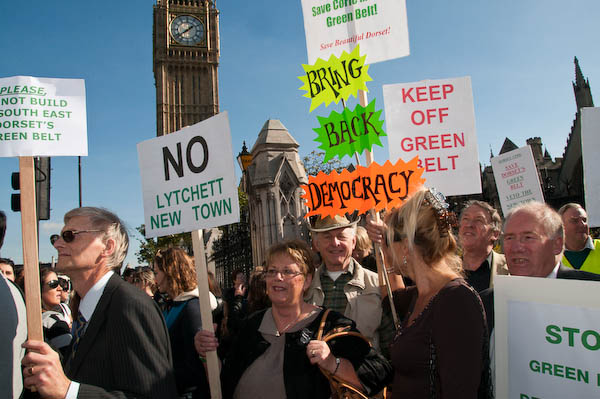
The government has other plans, intending in its Regional Spatial Strategy to include a new town of 2750 houses in the Green belt next to it.  This private development was rejected by the regional authority who drew up the draft plans, the local authorities in the region and bodies including Natural England, the Dorset Wildlife Trust, RSPB and CPRE, but somehow found itself in the final version of the draft currently waiting approval by Hazel Blears, Secretary of State for Communities and Local Government.

They had a big demonstration in Bournemouth to oppose the plans, and on Thursday some of them came to London to deliver a petition to the Prime Minister in Downing St.

In my lecture in Brasilia I talked about the need for a Green Belt that came about with the growth of car culture, and you can read a little about this in my post Under the Car which looks at my reaction to car culture. In Green Belt Protest Rally on My London Diary you can see my pictures and thoughts on last Thursday’s demo from Dorset. I wrote about another related event earlier in the year  here in Time Running Out.

Uganda

I’ve had a busy few days, and they started on October 9 which was the anniversary of Ugandan independence.

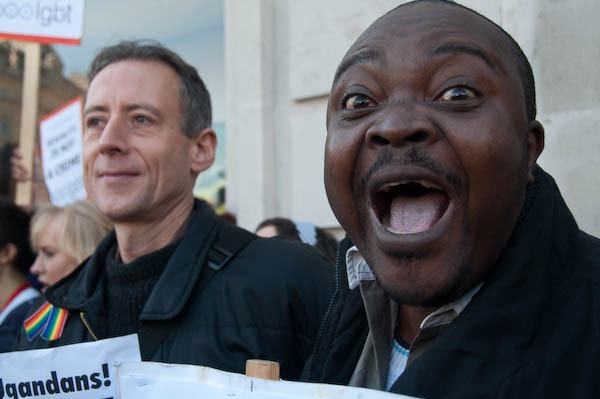
For gay Ugandans in particular there is little to celebrate.  Around 50 people met in a demonstration sponsored by the NUS outside the Ugandan Embassy in Trafalgar Square at noon on Ugandan Independence Day, Oct 9, to protest against human rights abuses in Uganda.

Rt-CLick and 'Show image' for larger
Peter Tatchell of Outrage! and Davis Makyala of Changing Attitudes
You can see more pictures and a longer comment on the event on My London Diary