Police and Photographers

One of my colleagues, Marc Vallée, has a piece in the Guardian today, The Met’s attack on photographers which examines the advice issued today by the Metropolitan police service (MPS) to the public and the media on photography in public places.
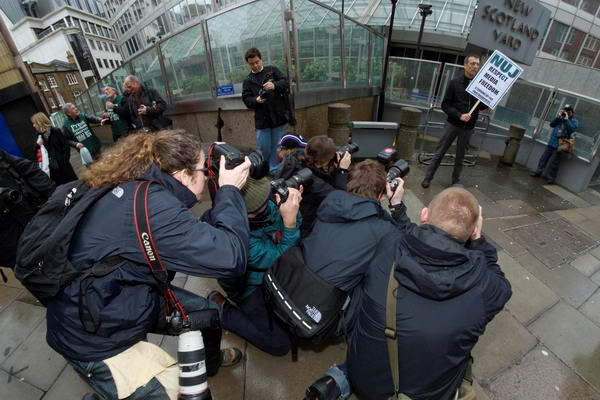
© 2008 Peter Marshall
Protest by NUJ General Secretary Jeremy Dear and photographers at New Scotland Yard, March 2008

It raises a number of important questions about such advice, and in particular of how sections 44 and 43 of the Terrorism Act 2000 apply to “protected journalistic material” where it is not at all clear that the police have the legal power to “view digital images contained in mobile telephones or cameras” that the advice claims.

The advice given by the MPS is that section 76 of the Counter Terrorism Act 2008 (referrred to by the MPS as 58a of the 2000 Act)  which makes it an offence to photograph police where a reasonable suspicion can be demonstrated that the information was of a kind likely to be useful to a person committing or preparing an act of terrorism should not be used to “arrest people photographing police officers in the course of normal policing activities, including protest.”

Which would be good news, except that there are, as Marc mentions,  at least two well-authenticated cases where it has been so used, including one  by a photographer I know who was covering the attempted eviction of a London squat – with absolutely no terrorist connections.

As Marc says “Professional photographers such as myself view it as part of an ongoing campaign to create a hostile environment for photography in the public sphere.” It’s something I first wrote about on ‘My London Diary’ almost five years ago – here is my exact text from October 2004 – all then in lower case. I’ve picked out the key parts in bold:

on the friday, critical mass were out on their bikes, together with rising tide and other environmental protestors. on a ‘london underwater 2050 tour of the g8 climate criminals‘. starting under waterloo bridge, they went on tour, visiting the london offices of several climate change villains, including petrol giants exxon mobil and bp and the canadian government, ending up outside the national portrait gallery, site of the annual bp-sponsored portrait award.
more pictures

it was a generally good-natured event, with an international samba band. from the top of a tourist bus an american voice asked the bill what was on. as he floundered to reply, the woman i was talking to suggested “hey it’s a fluffy takeover!”

most of the police were good-natured and cooperative throughout, but there were some ineffectual attempts to block the path of the demonstrators. by standing in the road the police blocked traffic, while the demonstrators simply walked around them.

worrying was the deliberate police use of photography as intimidation, with the police photographer going out of his way to confront demonstrators, aided by two other officers.

i worry because i think it is an attempt to attack civil liberties, but also because such behaviour makes all photographers suspect. i can only work effectively if i gain the trust and cooperation of those whose pictures i take. perhaps it helps that photography is one of the activities that also arouses suspicion and intimidation by the police.

as i walked away at the end of the demonstration, this team ran 50 yards down the road and caught up with me, one calling”excuse me, sir” and tapping on my shoulder. i turned to face him, and found myself looking into the lens of the police photographer, who took my picture as his colleague started to question me about who i was taking pictures for. it seemed clear and deliberate harassment, intended to intimidate a photographer acting entirely lawfully, photographing on the public highway.

This was the first time I was aware of being deliberately targeted by the police because I was a photographer, but it was the first of many times – and if we seriously believe that the police are now destroying all those images that they have collected over the years, there will be several thousands of pictures of me being deleted from hard disks and databases.

Another key moment for me came in April 2006, outside Harmondsworth Immigration Detention Centre, where I watched from a raised bank as a group of demonstrators were kettled by the police and a colleague showed his Press card. Officers told him that they didn’t believe it was a real press card, and he called to the 3 photographers watching from the bank to show ours to confirm.
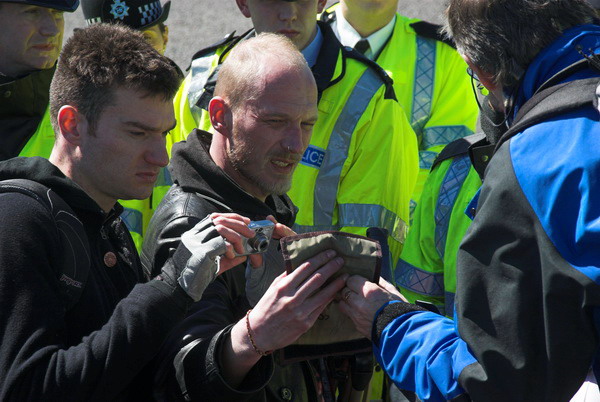
© 2006 Peter Marshall

Fortunately one of the other photographers rushed to do so, as I’d noticed as I came out that day that mine had expired at the end of the previous month!

Since then I’ve also been told by officers that my now current press card isn’t a real press card, though more often they tell me they just don’t care if I’m press.

What is particularly regrettable about the MPS statement is that it fails to refer to the published guidelines for MPS staff and photographers that were agreed between the Met and the BPPA, CIoJ and the NUJ and later approved by ACPO, although some aspects of this are summarised.

One key paragraph is missing:

Members of the media have a duty to report from the scene of many of the incidents we have to deal with.  We should actively help them carry out their responsibilities provided they do no interfere with ours.

Juggernauts in London

© 2009 Peter Marshall

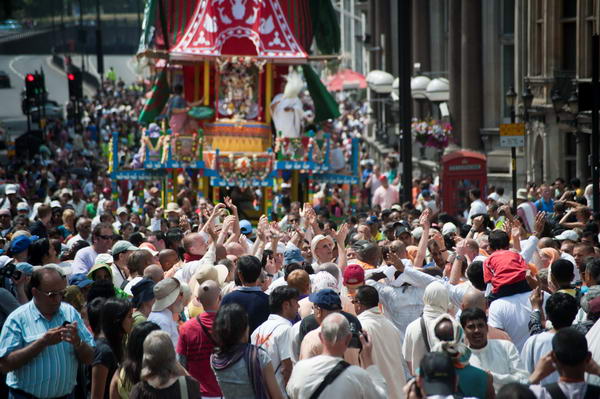
This was the view I got clinging to the side of a crossing light on a centre of the road refuge near Green Park station as the three chariots were pulled up Piccadilly in this year’s Sri Jagannatha Rathayatra Festival. This is the first chariot, the other two are hidden behind it in this picture.

I’m not quite sure why – perhaps it was the effect of heat on my brain – I’d decided to photograph the event with minimum depth of field, working with both lenses I had wide open for almost all the time.  This is actually a un-cropped full-frame (FX)  image made with a Sigma 55-200 mm DC lens designed for use on DX format only,  and shows hardly any vignetting or loss of sharpness – even when wide open at this focal length. Of course wide open isn’t very wide – f5.6 at this end of the range, and this for me was part of it’s attraction when I bought it a few years ago, as it makes for a very compact and light lens – and it was very cheap. I don’t shoot a great deal a long focal lengths, but I’m happy to carry a 350 g lens for the few occasions that I need it.

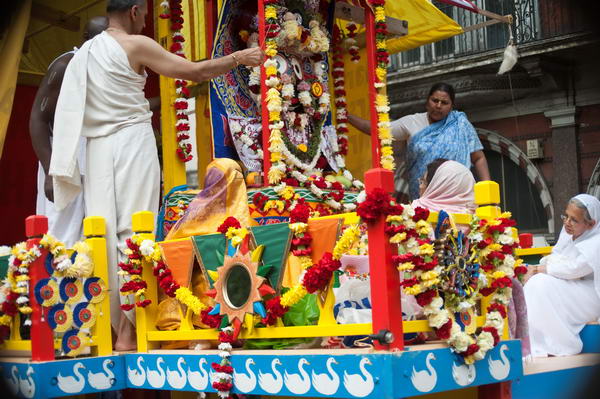
At the 55mm end – where the lens is f4 – there is some actual image cut-off, not visible in the D700 viewfinder but showing in the slightly larger image on the back of the camera. You can see it on this picture of Jaganattha taken from the same lamp-post:

© 2009 Peter Marshall
1/800, f4, 56mm (Exif reports this while the lens is engraved 55mm)

This cut-off is caused by the rather effective cylindrical lens hood – as I found later by using the lens without it (although there is also some partial vignetting – which can be dealt with in Lightroom. I’m thinking at the moment about taking a few mm off that hood with a hacksaw or perhaps ‘petalling’ it with a file, but can’t work out exactly how much it needs to be.

Sharpness does seem surprising good to the edges and corners, although  possibly a test chart would reveal weaknesses. But the glasses on the woman in white at the right edge are acceptably sharp, though her ear is a little soft!  Of course depth of field – and flatness of field also come into play. The railings and moulding on the balcony at top right actually get noticeably sharper towards the corner of the picture when viewed at 1:1.

It would certainly be useable on the FX format for many purposes – such as portraits – though might be a little lacking for say architectural work or landscape (though I did go on to try it on these later in the day.)

I was surprised at these results – other DX lenses that I have show some very noticeable cut-off – with the Nikon 18-200 at almost all focal lengths.  That doesn’t mean that this lens can’t be used on the D700, but it does restrict you to the DX format on the camera, with image files back to the 6Mp that we were used to on cameras such as the D100 – and just a little limiting on image quality. Given that the Sigma is also a better performer at least at the longer end, unless I need the full range of the 18-200, there is now no contest.

The D700 has a feature that will automatically crop the results from Nikon DX lenses if you set it to Auto crop. It’s perhaps good news that this doesn’t work for older Sigma lenses, so I can leave it set for when I feel a need for the 10.5mm fisheye, but don’t need to turn it off when I use the Sigma 55-200 DC.

© 2009 Peter Marshall.
The procession starts – taken at 24mm, f2.8
. Vignetting not corrected.

Although many of the pictures from the event were taken from that same spot above ground as the whole procession passed, I did also photograph more conventionally. For that I was using another Sigma lens, the new HSM 24-70 f2.8 – and working at f2.8. More about this lens at a later date.

Orbs, Bad Weather & Summer Nights

Last night I was at a London Bloggers Meetup and one of the other bloggers present asked me if I would take a look at some photographs she had posted on her ‘Shaman UK‘ site of ‘orbs’ and tell her what I thought about how they might be caused.

What I found was one image of orbs – a rather nice example  – and a number showing illuminated blurs well outside the orb zone – perhaps insects or even small birds. Orbs are actually circles of confusion, out of focus images of the lens iris caused by light reflected from small particles too close to be brought to a focus.

The orb image – with the two cats – still contains its Exif data, and it’s interesting to see that it was taken on a Nikon D40X using flash at 1/60, f3.5 (full aperture)  with a focal length of 18mm (27mm equiv.)  This is interesting, since ‘orb’ pictures are much more common with small sensor cameras; also unusual is the blog author’s comment, about some other images, that she was  “actually seeing the orbs through the view-finder prior to pressing the shutter. ”

You can read a considerably amount about orbs, and the Orb Zone Theory of how they are produced –  and how to make them – on the ASSAP site  (Association for the Scientific Study of Anomalous Phenomena) which also has an interesting feature Paranormal photos and analysing them. The book also gives some advice should you want to produce your own ‘orb’ images (though my own advice would probably be to consult a doctor.)

Looking at the pictures showing flash reflections from objects in the air reminded me of Martin Parr‘s 1982 book, “Bad Weather” and I wandered to the shelf where I thought I might find it, but it wasn’t there.  I hope I still have it somewhere around the house, partly because I still think it (his first book) is probably also his most interesting, but also because it now sells for silly prices. There used to be a gallery of images from the book on the Magnum site, but it is no longer there, and a search (enter ‘bad weather Parr’)  now only brings up ten pictures from the book (plus one unrelated colour picture.)  You can also (with difficulty and persistence) find the book on Parr’s own web site.  Clicking twice at the bottom right corner of the cover image then allows you to look ata pair of images from the book which have a similar effect to those here, his flash illuminating the falling flakes in the right hand picture (click again for a few more images from the book.)

The image on the left of the pair I think shows a similar effect with rain drops, which are all apparently moving upwards, as a result of the flash at the start of the exposure followed by a tailing off effect as they continue to fall.  It’s like photographing other moving objects with a slow shutter speed, to get a light trail behind the object you need to use rear-curtain flash – probably not an option on the camera Parr was using, but I’m sure he would in any case prefer the odder effect given in his picture.

Parr of course deliberately went out in bad weather, while ‘Shaman UK‘ chose more pleasant times and at least on one occasion a location close to the Tom Cobley pub. As she says “spending time on warm evenings, in a beautiful location, with good company, human and animal, while photographing Nature, was wonderful and also fun.”

Summer Nights” is another of my favourite photography books, by Robert Adams, and the V&A have a nice little piece on it with a dozen images, mainly taken around twilight (click on them for larger versions.) There are possibly some among those of his pictures on the Fraenkel Gallery site, but that – like Parr’s – is another though very different text-book example of how not to write a web site, and I gave up before finding out.

Nearby Café & Family Pictures

Nearby Café

A D Coleman opened his Nearby Café  web site along with a regular web newsletter, C: the Speed of Light in 1995, the same year as I put my first site, ‘Family Pictures‘ on line.  I’ve always enjoyed reading Coleman’s writing about photography, although of course I haven’t always agreed with everything that he says, but he is one of very few people to write intelligently about our medium. So I’ve made a habit of dropping in to the site occasionally to see if there is anything new on line.

“On the Front Burner” as a part of that site to producing a blog – written like this one using WordPress. It’s called Photocritic International, a title to which he has a better claim than most, and its one I’ll be following regularly. In fact there are at least two posts he’s already made that I want to write about when I have a little more time.

Family Pictures

Linda (C) 1976, Peter Marshall

My own first site –  Family Pictures – still looks almost exactly the same as it did in 1995, though minor changes have been made as browsers and html have evolved to keep it more or less in its original state, and then it was hosted on a free site in the USA. The scans, re-made early in 1996, slightly larger than the originals, look primitive by today’s standards with an odd dotty sparkle on most of them, possibly because they were from prints made on a Pearl photographic paper.

Linda, Richard & Sam (C) 1976, Peter Marshall

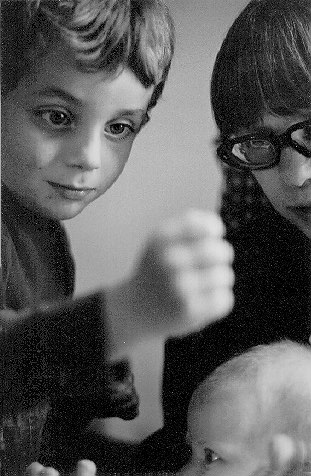
The pictures were already old work when I put them on line, taken between 1976 and 1982, and one of them shows a baby of six months or so who helped me work out how to write the site and put it on line in 1995. He now writes web sites as a part of his work.

One day I’ll perhaps go back and look at the work again – there are some pictures I know I should have included – and perhaps one or two I’d want to leave out, and I wince when I look at these scans. But for me it’s a little reminder of how much things have changed over the years, both personally and with the web – and how it has changed my own life.

Climate Rush – Palm Oil

One of the many not-so-bright ideas that entrepreneurs have come up with to combat climate change is biofuels. Of course there is some scientific basis in this – growing biomass takes carbon dioxide out of the atmosphere, and when you use the stuff you’ve grown as fuel it simply returns it, with no net increase. So, on the face of it, biofuels would appear to be carbon neutral.

But of course that’s simplistic, failing to take note of the actual inputs into the process, such as the work involved in tilling the ground, harvesting and processing the crops, producing any chemicals used in growing, pumping water, transporting materials and so on. So while it may be carbon neutral as a part of a local subsistence economy (like bonfires in my back garden) once it becomes part of a global manufacturing process it certainly isn’t.

Even more simplistic is the failure when thinking about biofuel production to take into account the effects of setting up such an industry on the ecology and communities where the industry is established.  There isn’t empty land going spare anywhere on the planet that could be used.

If you want to make a fortune out of biofuels, first you convince governments in the west that they are a good thing. This isn’t as hard as it ought to be, because too many are clutching at any straw(!)  that seems to be a technical fix for the climate that is better short-term than taking effective action. So we have an EU directive that says governments have to increase the amount of biofuel use.

Next you find a warm country with a corrupt government and large areas that could be suitably productive – perhaps at the moment covered by tropical rainforest, which is of course doing an important bit for the climate, but nothing for your profits.  A little promise of profits to those in government for making lax laws that allow you to steal land from its traditional users with a minimum of compensation (which of course nobody is going to bother to enforce you to provide) and you are in business.

A business that means grubbing up and probably wastefully burning forests to plant your monoculture biofuel crop, destroying species and habitat, forcing the inhabitants to scraping a living in  marginal areas.  Taking over land that once grew crops to feed local people- but will now be dedicated to keeping the cars of the rich world running.

One country where biofuel production is having disastrous effects is Indonesia. Species such as the Sumatra tiger and the orangutan are disappearing fast and the people who used to live in areas taken over for agrofuels have lost their ancestral lands and their livelihood.

© 2009 Peter Marshall.

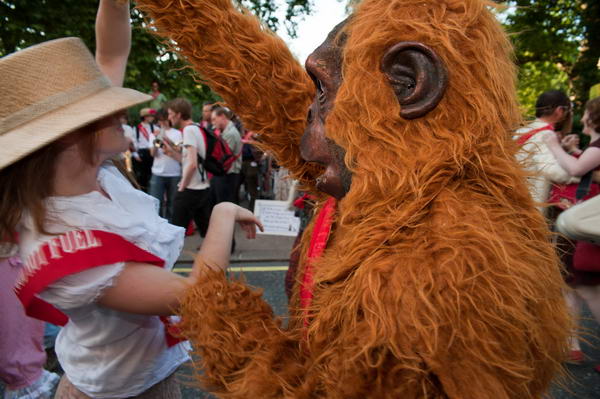
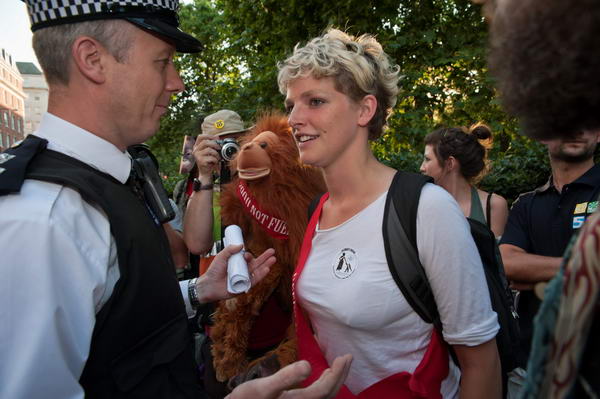
So the Climate Rush came to Mayfair, some dressed as usual as suffragettes, one as an orangutan – and quite a few smaller orangutans came as well –  to protest outside the hotel where a gala dinner for delegates at the World Agri Invest Congress was taking place. The protesters brought there own jazz band to hold their own ‘Gala Dinner and Dance‘ in the street outside.

© 2009 Peter Marshall.
Police fail to convince Tamsin Omond that being penned in would be a good idea

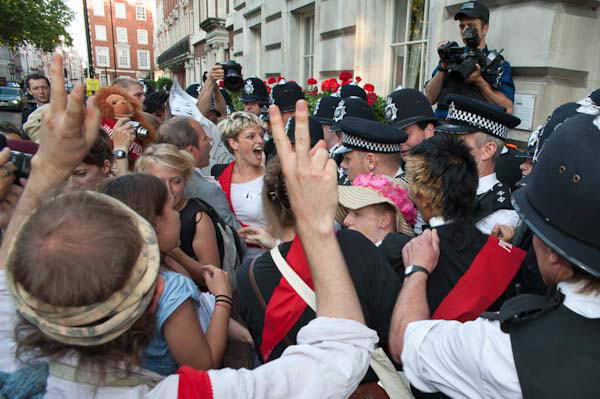
For most of the evening it was a well-behaved protest and police too were on their best behaviour, even when the protesters insisted on dancing on the road rather than in the pen the police had provided.  It wouldn’t have been a Climate Rush without an attempt to charge the doorway of the hotel, but although there was a little pushing and shoving, things didn’t really get greatly out of hand.

© 2009 Peter Marshall.

Back in the ’60s, a friend of mine was in court following a demonstration, charged with grievous bodily harm for having hit a policeman.  At some point in his cross-examination he was asked about the level of violence at the time, and replied that it seemed to him rather similar to that in a game of rugby. At which the judge sat up straight, turned towards him and and said “Ah, so you play rugger do you?” and we all realised he was going to be acquitted.

But last Wednesday I took my eye off the ball for a few seconds, and when the ‘rush’ started I was ten yards behind and couldn’t quite make it in front of the rushers, although I was moving considerably faster.  It had been a longish event and I’d lost concentration – and should have spotted the signs – and have set my camera to a higher ISO as the light was fading slightly. I did get some pictures, but too many were blurred, and I went home thinking I could have done better.

Oh yes, Michael Jackson came along as well – pictures and more on the event on My London Diary.

Support the SOAS 9

The Home Office Building in Marsham St in Westminster is perhaps the only government building in London from the past 50 years of any real architectural interest – quite a contrast from the boring blandness of those blocks on Victoria St or the terribly twee pipes of Portcullis House. It’s also a building that creates its own environment, and on hot days the water and the grass make it some kind of an oasis in Central London.

The light too is often luxurious, a kind of glow combined with the dappled sunlight that produce such a sheer pleasure that I sometimes find it hard to concentrate on making images.

© 2009 Peter Marshall.

It’s hard perhaps to reconcile this meliorating atmosphere surrounding the building with the inhumane starkness of some of the actions decided on inside, in particular over the hounding of migrants in this country and the decisions that are made and the evasion of justice that occurs, allowing – if not organising – pre-dawn raids in which doors are kicked down, people rounded up, forced onto planes and sent back, often to countries they have fled because of persecution, and where they may well face imprisonment, torture and even death.

Of course in theory this doesn’t happen, but too often it does in practice, with too many politicians and officials who just don’t care – or are frankly racist in their assumptions and actions.

It’s a building no one with a conscience can look at without feeling shame, and embodying the strange and awful paradox that those who are responsible for making and applying the laws often choose to ignore and short-cut them.

© 2009 Peter Marshall.

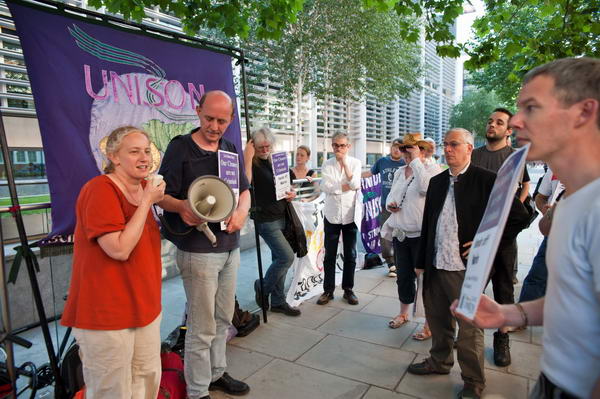
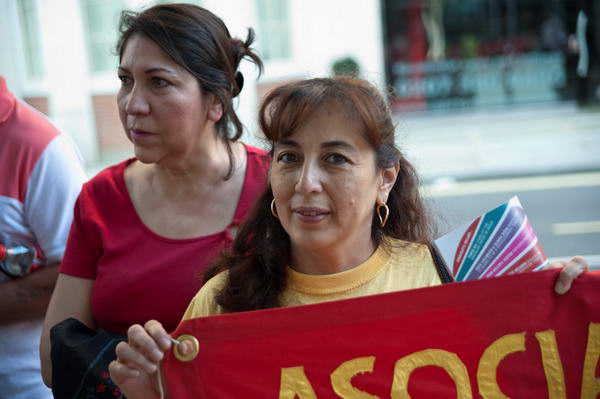
Cleaners at SOAS, School of Oriental and African Studies of the University of London, are largely migrants from Latin America.  Lime most places, SOAS outsources its cleaning to save money. And as is always the case this means that these cleaners are employed under conditions SOAS would not contemplate for its own staff. Outsourcing is only ever cheaper because the workers are exploited; it’s a tighter screw which gives them less for doing more, adds a profit for the shareholders and delivers the contract at a price that an ethical organisation couldn’t match. If we ever get a socialist government in this country it’s a practice they would make illegal – just as we’ve outlawed practices like sending children up chimneys.

Recently, cleaners in London have been getting organised, with the help of the trade unions and others, and demanding a living wage. The cleaners at SOAS had just achieved that, and in retaliation the contract firm employing them brought in the Immigration Police, kitted up in riot gear, to a meeting of cleaning staff at 6.30 am one morning.

The cleaners were detained and questioned without being allowed trade union or legal representation. Not surprisingly there were some who were not carrying papers stating they had a right to work here. Some may have been in this country legally but under our draconian legislation caught by the law that denies them the right to work. None of them were doing anything harmful, all of them were doing useful work, doing a cleaning job with unsociable hours and low pay that no British worker wants to do.

Nine were arrested and taken to Immigration Detention Centres – prisons for people who have not been convicted of any crime. Most of the nine have already been forcibly put on flights back to their native countries, although it is possible that some had a right to remain here, and some have all their friends and families here.

This demonstration was another of those occasions when I felt ashamed of my country and its lack of humanity. But at the same time proud that there are people like those at this demonstration who are fighting for human rights – and such campaigning does sometimes bring results.

One of the speakers was a civil servant and trade unionist, who asked us not to blame the civil servants who are just doing their job. It’s tough, but if your job demands that you are racist or unfair, then you should fight and take the consequences (in the Civil Service probably a transfer of another department.)  It’s a lesson the twentieth century should have taught us.

You can see the pictures on My London Diary.

Honduras Coup – London Protest

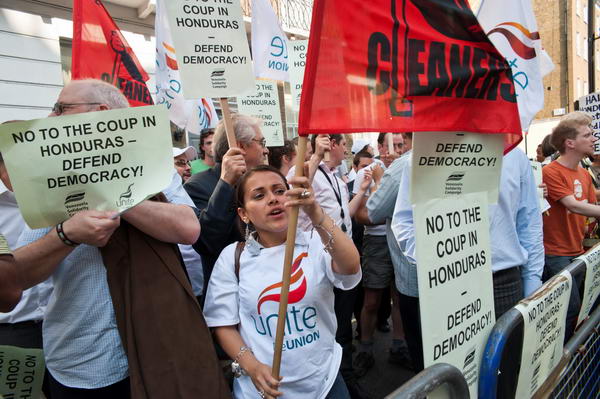
I rushed out shortly after writing about how a series of staged images had won Paris Match’s student photography contest to photograph an “emergency picket” opposite the Honduras Embassy in London against the recent coup and expulsion from the country of President Mel (Manuel Zelaya.)

When I arrived at the scene, a few minutes after the protest had been meant to start (thanks to the Bakerloo line coming to a complete standstill after a train failure at Baker St)  there were perhaps 50 people standing around, mainly in small groups talking to each other. A few did have placards, but you could hardly call it a demonstration. There was one other photographer there, someone I’ve known for a few years, whose work appears regularly in the left press, and occasionally more widely, and we too talked briefly, before I went off to say hi to a few of the demonstrators I recognised and take one or two pictures.

Five minutes later we were still waiting for something to happen, and the other photographer said to me “This is no use” (or rather words to that effect) “let’s get these guys organised” and shouted for the protesters to all come to our end of the pen and start doing something.  And despite my principles I did a little encouraging too and soon we had at least a slightly more interesting event to photograph.

© 2009 Peter Marshall.

But I suppose you could call it “faked” or “staged”, although once they were started off, they did exactly what they had come to do, demonstrating their opposition and making a noise about it. And probably they would eventually have got round to doing something very similar in time without the intervention.

I didn’t take any great pictures – you can see some of the others and read more about the protest on My London Diary. Three of the 15 pictures there were taken before the photographers got the event started.

Olympic Photography Paranoia

It’s nice to know that someone at the British Journal of Photography reads Amateur Photographer (interestingly the word ‘Amateur’ in the masthead of their web pages has now shrunk to about 2 point size)  and it was a ‘tweet’ from ‘1854’, that obscurely named BJP blog (of course I know why, but that doesn’t make it any less obscure) that sent me to the AP feature posted yesterday, Photographers a ‘security’ risk, warn 2012 Olympic chiefs. Not the snappiest of headlines (sorry!)

Like many of us, Dr Patrick Green is taking photographs around the Olympic site as it develops (I started in 1983, but that’s another story.)  And he was trying out  his new Olympus E-30 DSLR at Dorset Place, just off the Leyton Rd on the east boundary of the site a couple of weeks ago around 4pm on Sunday 14 June.

His picture in the AP shows a security guard standing next to a secuirty barrier witht he Olympic site in the background.  Dr Green says he was told that that photography was forbidden and one of the guards “threatened to call more security who he said ‘would come with dogs’.”

Dr Green apparently got to see a “security manager” who told him that his pictures posed a ‘security risk’ – terrorists might use the images to plot an attack if they were posted on the internet. And while an ODA spokeswoman stated “Filming and photography of the site from public highways and areas around the Olympic Park is permitted,” she also made it clear that anyone appearing to take a particular interest in security operations was likely to be talked to by the security guards.

While this event appears to be yet another example of paranoia about photography – and yet another skirmish in that long-running battle between security men and photographers, so far I’ve yet to have a real problem with security in taking hundreds if not thousands of pictures since the blue fence went up around the Olympic site.  One of the men putting up that fence did ask me why I was taking pictures – and so I told him, and although I don’t think he could be described as satisfied, that was the end of the matter. Other times I’ve seen security men looking at me and my gear, but so far I’ve not been asked about my pictures. And once or twice people from the ODA I’ve met have even been friendly.

I don’t think I’ve photographed in Dorset Place, a short street with not much of a view, though I have taken pictures from the next street off Leyton Road, Thornham Grove, and this is from just down the road:

© 2008 Peter Marshall

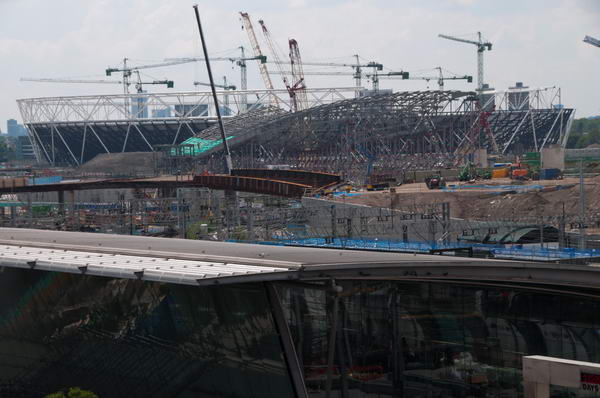
These buildings are mainly for the shopping centre. Here’s one taken last Saturday from half a mile or so away looking towards the Olympic stadium. I’ll put a few more on My London Diary later.

© 2009 Peter Marshall.
Stratford Station and the Olympic Site

Hoax Upsets Match

Probably most  will have read about the “student hoax” that won Paris Match’s annual contest for student photojournalism, a set of black and white images on how students at the French university of Strasbourg were making ends meet – if you’ve not seen the pictures, they are on the Paris Match site.

Students are shown searching through boxes left on the street after markets for food, staying in overcrowded rooms where they take turns to sleep on the floor, having to work as prostitutes, working long hours at low paid jobs, having to travel long distances from cheap lodgings…

At the prize ceremony, the two winners, Guillaume Chauvin and Rémi Hubert, from the Strasbourg School of Decorative Arts, read out a statement that the pictures were faked, made as an artistic gesture to point out the voyeurism and gullibility of the press. The Independent quotes them telling Le Monde, “We pushed the clichés to the limit. We thought the whole thing was so hackneyed that it could never win … We wanted to call into question the inner-workings of the attitude of the kind of media which portrays human distress with complacency and voyeurism.”

They were given the 5,000 Euros at the award ceremony, but the cheque was later stopped, although they claim not to have broken any of the competition rules in their work.  The rules will presumably be rewritten for next year!

Although the pictures are described as “entirely faked” this is arguable. Obviously they were pictures taken with the cooperation of the people involved, but the techniques and the level of direction are perhaps little different from those in many more legitimate photojournalistic projects.

Photographic history is of course full of such things – for example in the work of one of our greatest photographers, Bill Brandt, where so many of his deservedly well-known scenes of London in the thirties were acted to his direction by family, friends and servants.

It’s really the stories that were faked for the Match entry, or at least partly faked. Student poverty is a real issue, but the particular students shown were presumably not feeling its pinch in the way the captions to the images describe. The young lady in miniskirt and boots viewed from behind on a hotel or hostel corridor may well not be “Emma, 23 ans, Master de Philosphie” and may never have said “Pour pouvoir étudier le jour, je me sers de mon cul la nuit… ” But such things are happening and it is a picture that could well have appeared in the press entirely legitimately with the small text “posed by model” hidden at one corner.

I suppose the main thing I think about this work is that it represents a waste of time and effort. There is a problem of student poverty, and students such as Chauvin and Hubert have a privileged position to see it and document it in a truthful and serious work of reportage. To tell it without the clichés, without being hackneyed, though I’m not sure voyeurism is ever absent from photography.

Had they chosen to do so, their work would probably not have won the Paris Match prize, probably not even have been of interest to the magazines or to newspapers. The real problem lies in a culture that depends on prizes and values the voyeurism about distress these students were questioning.

You can see also see some of the other work entered for the competition on the Paris Match site, where the work by Chauvin and Hubert is not identified as the winning entry.  You can also watch a video of last year’s award ceremony, but not this!

New Topographics – Broadcast

Curator of photographs at George Eastman House, Alison Nordstrom talks to Brenda Tremblay  of Greater Rochester area public broadcasting organisation WXXI about the rather curious history of a small photographic exhibition that almost nobody saw which influenced a whole generation of photographers.

Of course we all know about the ‘New Topograpics’ or at least we think we do.  But certainly I found her short talk of considerable interest.

Of course I wrote previously about the new version of this show currently at George Eastman House and later touring – though not here.  Nordstrom mentions the slim catalogue for the original show – you can see a picture of it here. It had 23 black and white and one colour photographs- and 2500 copies were printed. The price Nordstrom suggests is considerably more than that paid in this 2004 auction. Also on Photoeye you can see more about the new book on the show by Nordstrom and Britt Salvesen, coming from Steidl at the end of the year.