Worldbytes Defend the Freedom to Film

Worldwrite is a Hackney education charity which teaches youths how to make film, putting out the efforts made by 16-25 year olds on the web as an alternative news channel, Worldbytes.org, and increasingly they are running into the same problems many of us face when taking photographs on the street.

Under English law, photography and filming is allowed in public places. You don’t need to get anyone’s permission or a licence to film on the streets, but more and more some people are taking it into their hands to try and stop it happening. As Worldwrite say: “we are finding it increasingly difficult to film in public places in Hackney: security guards, community wardens and self-appointed ‘jobsworths’ are refusing us ‘permission’ to film on many of our streets.

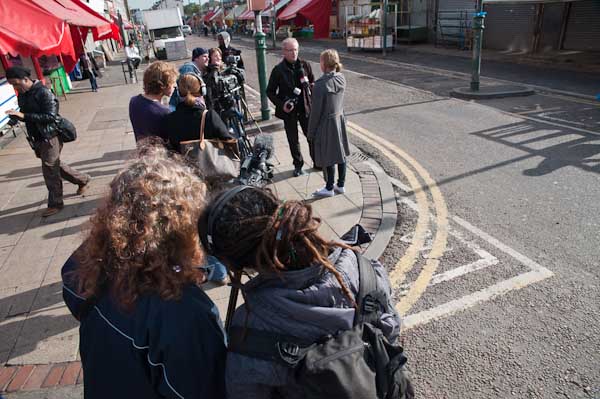
On Sunday 18 October, Worldbytes visited several of what they call ‘film-free places‘ in Hackney where their crews have run into difficulties and photographing to make a film about the problem, coming as a group to challenge these attempts to restrict our freedom, talking and interviewing people and handing out fliers explaining what they were doing and why.
© 2009 Peter Marshall.

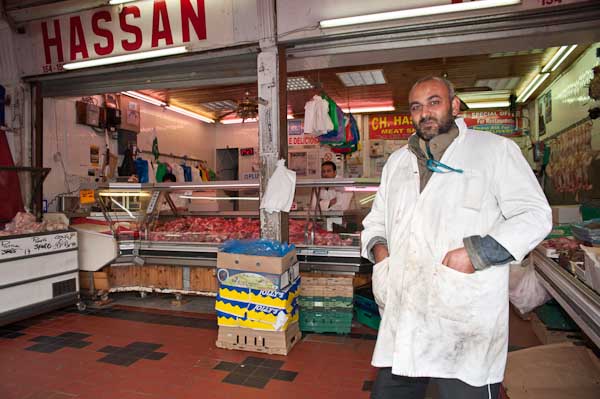
I met them at Ridley Road Market in Dalston, where I’ve photographed a few times over the years. Its one of London’s more interesting and multicultural markets, and there are always some interesting people on both sides of the stalls. I’ve had no problems there in the past, though there have been a few things I’ve decided it wouldn’t be wise to try and photograph. But Worldbytes crews have been told they can’t film there, not by the stall holders or other market users, but by employees of Hackney Council.

Worldbytes had issued an invitation for photographers and film-makers to go along and take pictures in support of their protest, and so I did. After talking to them, I decided to walk along the market and see if anyone working there objected to me taking pictures. Or indeed if council employees tried to stop me.

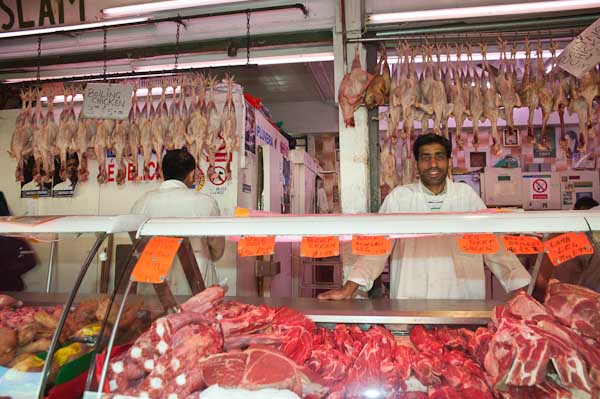
I took some general views without asking anyone for permission, but as usual, where I wanted to take pictures including stallholders or other people I asked if I might. Not because I need to, but out of politeness, and I shrugged my shoulders and moved on if they refused. Of course at times I photograph people who don’t want to be photographed, but this wasn’t appropriate here.
© 2009 Peter Marshall.

As I was using flash most of the time, it was clear that I was taking pictures and some people asked me to photograph them who I might otherwise have walked by. At one place I did stop to argue after having been refused – and eventually managed to get permission to take a picture; at another I got profuse apologies from an employee who was obviously sorry that the stall owner had decided not to cooperate with Worldbytes.

After around 20 minutes taking pictures I was asked if I would do an interview for the programme Worldbytes crews were making about the right to film, and although I much prefer to stay behind a camera I agreed. Though I do hope that my contribution is going to end up on the cutting room floor.
© 2009 Peter Marshall.

The council employees didn’t turn up to stop filming while I was there; probably Sunday is their day off. But it’s very hard to understand why Hackney Council should allow or instruct their employees in this way. They should know the law after all.

From what I was told it appears to be a case of misguided zeal around concerns about children and vulnerable adults, but the law is clear. As the Worldbytes flier put it:

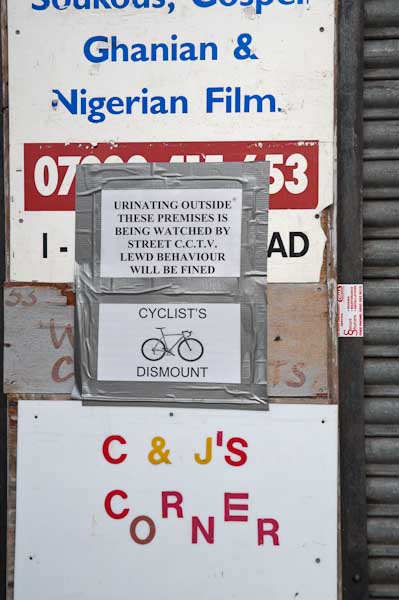
There is in fact NO LAW against filming or taking photographs in public places and permission or a licence is NOT required for gathering news for news programmes in public spaces.
© 2009 Peter Marshall.

Contrary to what many people think – possibly including Hackney Council – you don’t need permission to photograph children, though now even being seen with a camera anywhere near them arouses suspicion. Cartier-Bresson wouldn’t now get away with his great image of a boy on a street corner proudly bringing home the bread and wine without being attacked by vigilantes or questioned by the authorities and getting on the sex-offender’s register. Of course there are good reasons to be very careful when approaching children, and often photographers will now want to have the permission of the responsible adults, but it isn’t an offence and should not cause any problems to take pictures of normal activities in public, for example of children accompanied by their parents shopping in a market.

Some areas of the market may be privately owned, as increasingly is the case with public places, even those where the public has more or less unrestricted access. Canary Wharf, where photographers held a protest against restrictions on photography last month, is an prime example, along with most shopping centres. In these privately owned places the owners can make their own rules, and usually ban photography, though amateurs and tourists may be tolerated.

But the problems photographers face in most public places are linked to the current paranoia over terrorism, which has been pandered to by parliament with panic-driven legislation and by the police with advertising posters that suggested that a camera is a terrorist weapon. But even parliaments misplaced zeal looks almost reasonable when you look at the way these laws have been misapplied by police and public employees.

Laws meant to deal with terrorists have been used against peaceful protesters, against innocent tourists and against photographers. The police did get a small rap across the knuckles from the Home Office in a recent circular which reminded them that they should only use the terrorist legislation where there is a reasonable suspicion of terrorism, and it is clearly time that councils and other employers attempted to teach reason to their staff as well.

The last thing that would-be terrorists are likely to do is to walk around their prospective target areas with large cameras and tripods, making themselves obvious. They are unlikely to take photographs at all, but should they choose to do so, their most likely tool is a camera phone and they will definitely not want to be seen as photographers. In most cases the visual information already readily available from on-line high-resolution satellite photography or Google’s Street View is likely to be of more use.

Photography and film are important media of visual expression, and the freedom to take pictures, especially about the society in which we live, is a vital part of the freedom of expression that makes our society a free society – and we all need to be vigilant to keep it free.

Edited versions of this post have appeared on Demotix and Indymedia. More pictures from Ridley Road on My London Diary.
Griffin BBC Protest

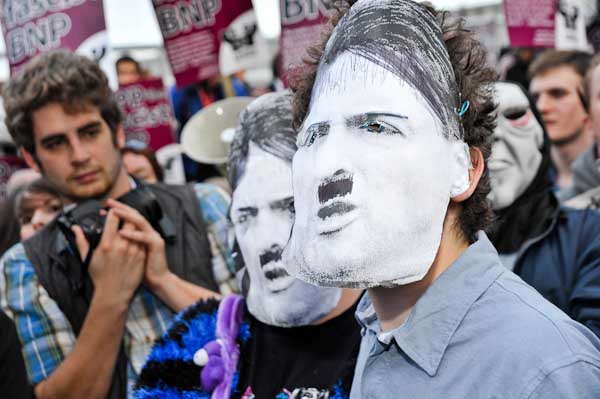
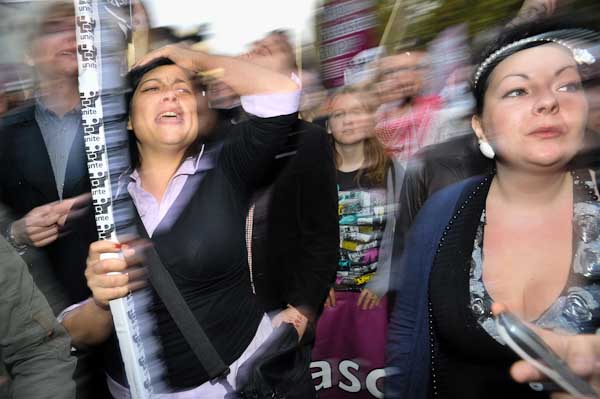
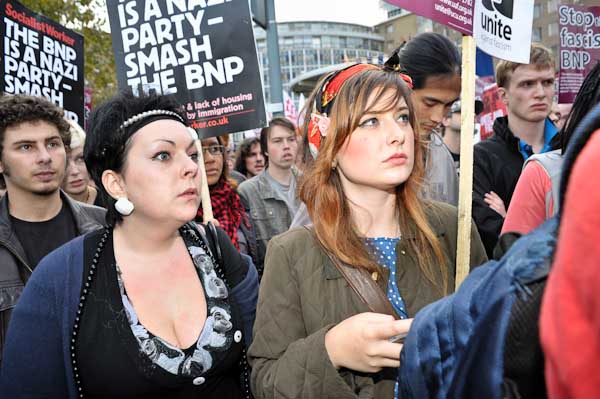
The BNP are a pretty nasty lot who I’ve photographed several times over the years but they weren’t around outside the BBC on Thursday night, just a thousand or two anti-fascists who are considerably more pleasant to be around and to photograph.

© 2009 Peter Marshall

But I did have problems taking pictures. The biggest was me, but also there were other photographers and videographers, as well as my camera and flash playing up.

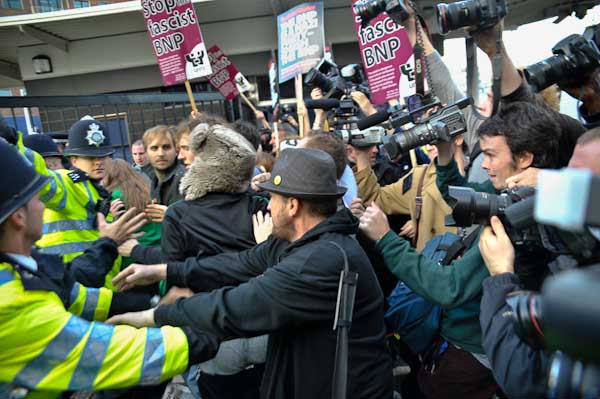
This was a very high profile event taking place outside the largest media organisation in Britain, so it was hardly surprising that there were a great many photographers there, both professional and amateur – and more guys with video cameras than I could count.

© 2009 Peter Marshall

This isn’t a great picture but it gives you some idea. It was taken very shortly after a group of demonstrators had surged through the gates at the left, and the police had grouped too late to stop about 30 or so. I was actually up with them, but decided not to go onto the BBC site but moved to one side to photograph. I’m always wary of getting into situations where I might get trapped, but here there were several photographers who were on the other side of the gates who might have got better pictures.  Those in the picture here probably didn’t get a great deal, but they mightily outnumber the few demonstrators trapped between them and the police.

There were just so many people taking pictures it was hard to get a decent position – and when you did it was 100% sure that some guy with a large video camera would push in front of you. One of my friends – even though he takes video – was actually trampled on by a BBC crew, so I guess I was lucky.

Although I’d planned to get on site early, things kicked off just as I arrived, and I rushed into taking pictures. Somehow, without my noticing it, my camera had decided to reset itself to the default settings, which frankly are extremely odd.  You might think I should have noticed, but I didn’t, probably because I wasn’t wearing my glasses. I can’t get used to using a camera with glasses on, but without them I can’t read the LCD screen.

So I shot everything on JPEG rather than RAW, which was a real pain, especially since the lighting was pretty tricky. But I contrived to mess up even more, taking pictures for quite a while on too low ISO and so getting problems with camera shake and lack of depth of field. But the camera was also up to some tricks, giving occasional frames with exposure that was way out of line with what was needed for no apparent reason.

Since it was beginning to get dark, I slotted the flash into the hot shoe, but in the excitement of the moment forget to check it was still on its usual setting. It wasn’t, and before I realised I’d shot quite a few frames hideously over-exposed. It wasn’t immediately obvious on the viewing screen as often I’d shot several frames fairly rapidly and when I checked on the back of the camera saw only the last – where the flash hadn’t fully recharged and the exposure was more or less ok.

Once I realised the flash wasn’t doing what it should I put on my glasses and tried to sort it out.  Whatever I did it didn’t want to work normally, although eventually I managed to get more consistent exposures.

Of course sometimes things going wrong can produce interesting results. I was using flash with a shutter speed of 1/60 to combine with ambient light at ISO800 on pictures like this one:

© 2009 Peter Marshall

and when someone with a video camera barges into you the results can be quite interesting:

© 2009 Peter Marshall

There are around 50 pictures from the event on My London Diary, and a tighter edit of around 15 from these on Demotix, where the feature made the front page.

Paris Photo 2009

I don’t think I’m going to make it to Paris for Paris Photo this year, although I always enjoy a visit there and there is so much to see not just at the show but also elsewhere in the city.  Even though this year it won’t be ‘Le Mois de la Photo’ – which only takes place every other year – there is always a lot of photography to see at this time.

© 2008 Peter Marshall

It’s also a good place to meet a few old friends from around the world, and those who live in Paris, including Jim and Millie Casper. Lensculture is one of the truly essential photographic sites and partner in Paris Photo and Jim has put a great set of one hundred and sixty-seven images on line from the show to whet your appetite for a visit there. I just don’t have time to write about them all, but there are some fine images there (and just a few things I hope never to see again.)    But I can’t resist mentioning a lovely Inge Morath colour image I’ve not seen before.  There are also of course other things worth taking a look at in the new ‘issue’ of Lensculture.

Just thinking about it again to write this short note has made me think again, tempted by the idea (and I’ve even downloaded the accreditation form.)  But given the value of the pound and my lack of commissions and sales at the moment a trip like this is very hard to justify, at least to my accountant and the tax man.

© 2008 Peter Marshall

You can read and see rather more than the above two pictures from my trip last year in a ‘PARIS SUPPLEMENT‘ on My London Diary. And perhaps I’ll save up to make the trip again in 2010.

Taken in London at TINAG

This Is Not A Gateway (TINAG) is a voluntary organisation that creates arenas/platforms for those whose point of reference is the city. Working across disciplines, TINAG encourages inter-cultural dialogue and rigorous production through four strands: FESTIVAL, SALONS, PUBLICATIONS and ARCHIVE.

The TINAG 2009 Festival is taking place now – 23 – 25 OCTOBER 2009 – in Hanbury St, Spitalfields, between Brick Lane and Commercial St, just across the road from the old Spitalfields Market. And on Sunday morning in a session that starts at 11.00 am, Paul Baldesare and myself will be doing a 5 minute presentation on our show Taken in London. Assuming the technology works, we will be projecting all 41 pictures from the show during that time, as well as talking very rapidly!

© 2009 Peter Marshall.

You can download the festival programme as a PDF, and it does give details of all the sessions and events in Hanbury St, though I was disappointed to find that there was no listing of the events outside this area – such as Taken in London.

Bike Power at the nabokov Arts Club

Another first for my work tomorrow when it will be projected for the first time by bike power!

© Peter Marshall

The nabokov Arts Club returns with another extravaganza of live theatre, music, comedy, poetry and visual art in a vast, atmospheric Victorian warehouse in the heart of Shoreditch … at Village Underground, recently named ‘Top Venue for Wow Factor’ by Time Out Londonthe Arts Club will be joining tens of thousands of people from over 150 countries for the biggest ever day of climate change activism. We’ll be part of a global action coordinated by 350.org to urge world leaders to take bold and immediate steps to address climate change and reduce carbon emissions. Within our solar-powered venue we will have a bicycle-powered art installation showcasing climate change photography…”

Which will include the set of 24 pictures – including the one above – that I put together for Foto Arte 2007 in Brasilia. Just in case you can’t get along to Shoreditch for what looks like a very interesting evening (and I can’t make it myself) you can see the full set of pictures here. As well as showing a number of demonstrations in London there are also some pictures from the Manor Gardens Allotments, which were bulldozed to make way for the London 2012 Olympics – see London Olympics – Green Disaster for my thoughts on that and links to some more pictures.

© 2007 Peter Marshall
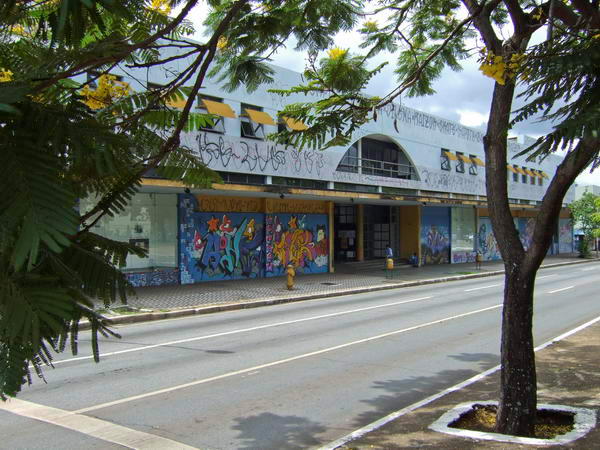
The venue for the Brasilia show  – more snaps from my Brasilia trip

The partying in Shoreditch goes on from 8pm until 2am – including an extra hour when we change back from Summer Time to GMT, always a sad moment for those of us who like to photograph out of doors. The people there are going to produce a banner which will be photographed on the rooftop with the City as a backdrop and become part of the 350.org campaign to put pressure on world leaders to actually agree to some effective action at Copenhagen in December.

Village Underground is just a few minutes walk from Hoxton Market, where the exhibition ‘Taken in London‘ with work by myself and Paul Baldesare continues until the end of the month at ‘The Shoreditch Gallery‘ in the Juggler – see Opening Night, Hanging Day and Taken in London for more details. And just before lunch on Sunday, Paul and I will be giving a five minute illustrated presentation on the show as a part of the ‘This is Not A Gateway‘ festival in Hanbury St, Spitalfields, again about a five minute walk away. Things really are all happening in this part of London – and Photomonth 2009 really is keeping photography very much at the heart of them.

Getty, Yahoo, Flickr & Picscout

The title Might Picscout Ultimately Cause Yahoo to Acquire Getty? is probably enough to put most people off reading  Dan Heller‘s latest post on his Photography Business blog, but if you want to see what the future so far as buying and selling photography on the web is likely to be I’d suggest you struggle through it. What follows come from my own attempt to understand what he is suggesting – and doubtless to put my own spin on it. It also helps to read some of Heller’s other pieces he links to, and in particular his comments about  Picscout’s Index Registry Connection (IRC.)

I’m not sure that there is a lot of good news for those of us who try and make a living – or a part of one – selling stock images. Heller sees a future in which image use will be integrated into applications such as DTP software so that when someone putting a page together wants an image to use, the software will find suitable images on the web using image recognition technology, identify the ownership of the image and licensing fee (if any) required and carry out the appropriate payment transaction.

Of course all the companies involved in this process are going to want their cut – the software provider, the search company and the company providing the licensing data etc – as well as the site hosting the images, whether it is an on-line agency or a social networking site.

So, as others have also pointed out, with so many taking their cut, there is going to be less for the actual creator. Heller does however suggest there will be a silver lining in that the actual volume of sales should increase greatly, so in total we may do better.

Agencies he suggests will also change; they will need to work at getting good rankings in search engines (at present some are virtually invisible) and Heller also suggest they will need to give up their current policy of acting as editors and instead aim for volume content – the more the merrier, never mind the quality.

I’m not sure that this is the case. Some agencies at least have a reputation for quality that enables them to charge premium fees. Years ago I remember being rather shocked to find that some photographers working on the same project as me were getting paid exactly twice the rate I was, not because their pictures were better but because they were Magnum. There were two prices for the same job.

Whatever new system emerges I’m sure that such differences in licence fees will continue, and that quality control will be essential in maintaining them. When the putative buyer is presented with a page or two of thumbnails of similar images, it will perhaps be even more important that your image stands out to attract sales.

Virtually every photographer will be familiar with the experience of opening a paper or magazine and thinking “why on earth did they use that picture?” when you know you had a much better image. With a much more comprehensive search based on image-recognition, your picture might have a chance too.

As to Getty, Yahoo and Flickr I think perhaps the writing is on the wall for Getty. I certainly wouldn’t mourn its passing.

Prix Pictet announced later today

The winner of the Prix Pictet will be announced tonight, and you can see the work of the 12 selected finalists on Lensculture.

The twelve are:

  • Darren Almond, UK
  • Christopher Anderson, Canada
  • Sammy Baloji, Congo
  • Edward Burtynsky, Canada
  • Andreas Gursky, Germany
  • Naoya Hatakeyama, Japan
  • Nadav Kander, South Africa
  • Ed Kashi, USA
  • Abbas Kowsari, Iran
  • Yao Lu, China
  • Edgar Martins, Portugal and
  • Chris Steele-Perkins, UK

I’d find it very hard to pick a winner from these, although there are two or three photographers whose work I’m surprised made it to the last 12, and I don’t think are showing anything like there best work here. Of course in most cases I’ve only seen the work on the web, though there are a few pictures I’ve seen before elsewhere.

If I had to choose,  I think it would be between Naoya Hatakeyama and Ed Kashi, so those are probably two without a chance if my record at predicting such things stands.

As well as the £60,000 prize to be announced by Kofi Annan, honorary president of the Prix Pictet,  at the Passage de Retz Gallery in Paris today, there will also be a commission for one of the twelve photographers.

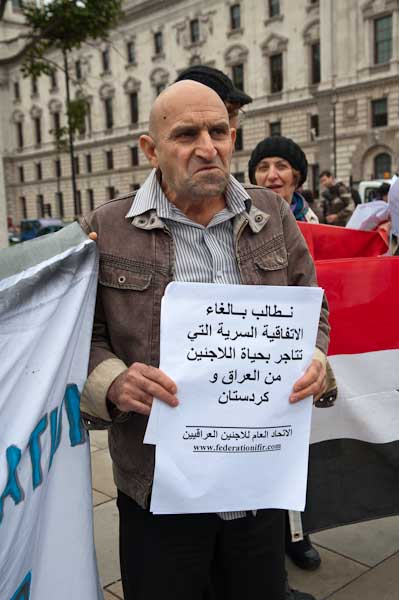
Stop Sending Refugees to Baghdad

© 2009 Peter Marshall.

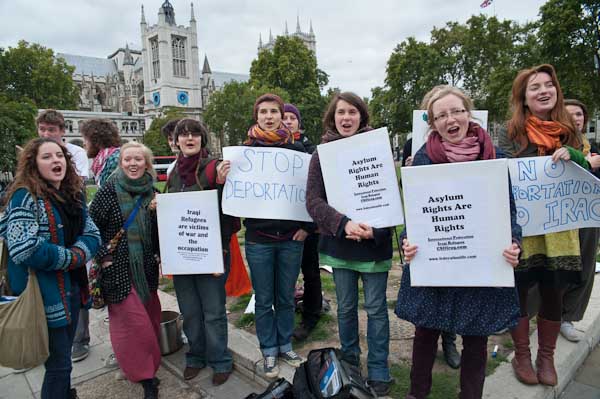
The Foreign Office advises “against all travel to Baghdad and its surrounding area” on the grounds that it is unsafe, but somehow the UK Borders Agency thinks it’s fine to forcibly take Iraqis who have sought refuge in this country on planes, fly them back there under heavy guard and dump them back on its streets, leaving them to fend for themselves having shoved a few dollar bills in their hands.

They flew 44 to the airport last, but the Iraqis refused to let most of them disembark. One who was put off there was interviewed by a reporter for the BBC, obviously in fear of his life, in hiding there. He’d only left Baghdad after his brother was murdered, convinced that it was a case of mistaken identity and that the real target for the attack had been him. Now he feared to meet his attempted killers on every street he walked.

© 2009 Peter Marshall.

It’s a sorry tale of a government determined to look tough over migration into this country, to appear to take a harder line than the Tories – or even the ultra-right. More about this shameful failure to meet our obligations under the UN Convention on the Treatment of Refugees and the EU on My London Diary.

© 2009 Peter Marshall.

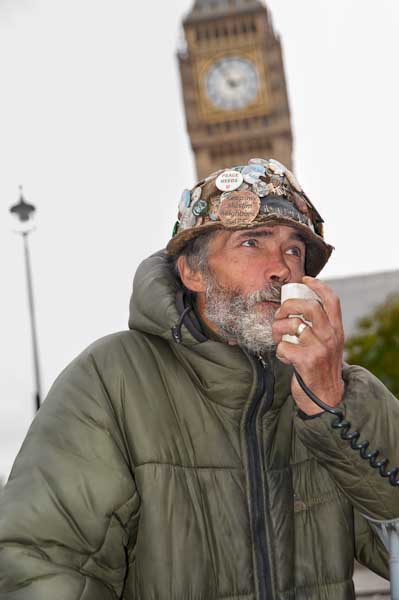
Standing alongside the lawyers, the International Federation of Iraqi Refugees and others at the emergency demonstration on Saturday was Brian Haw who has become a public hero for his continued peace protest in Parliament Square since June 2001 – over 8 years. It is a vigil that has taken its toll on him, but he still spoke strongly at the event.

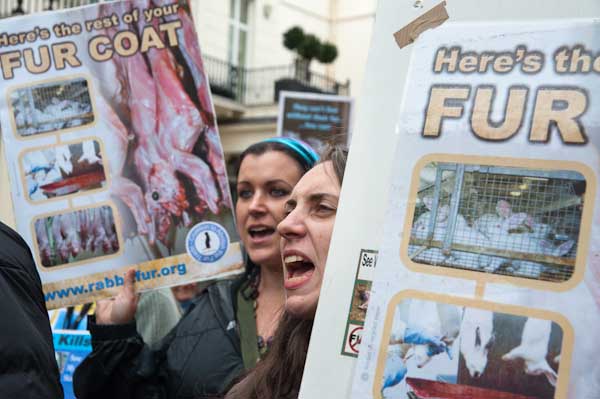
Fur is For Animals

I’m not a great supporter of animal rights. I enjoy eating meat and fish – though I also eat a lot of vegetarian dishes. But I do think we should treat animals with a decent amount of care and respect, and avoid the kind of cruelty that is so much a part of factory farming. It isn’t all like that, and I’ve known farmers who really care for the animals they raise and spend a great deal of time and effort in making sure that they are well treated. Of course I can’t be sure that all the meat I eat or all the dairy products come from farms like this, but we do try as much as possible to avoid factory farmed produce when we are buying food.

But there is no such thing as cruelty-free fur. Wherever countries have tried to provide less cruel conditions in fur farms the result has always been to make the farms unable to compete with those in other countries that have no concern for animal cruelty. The UK policy banning fur farms is the only sensible policy and one that should be adopted across the world.

Trapping and hunting of wild animals for their furs also involves considerable cruelty, and around the world traps are still in use in many countries that were banned here years ago. Shooting too often fails to kill cleanly, with some wounded animals escaping to die a lingering death, and young animals whose parent is killed may be left to starve.

© 2009 Peter Marshall

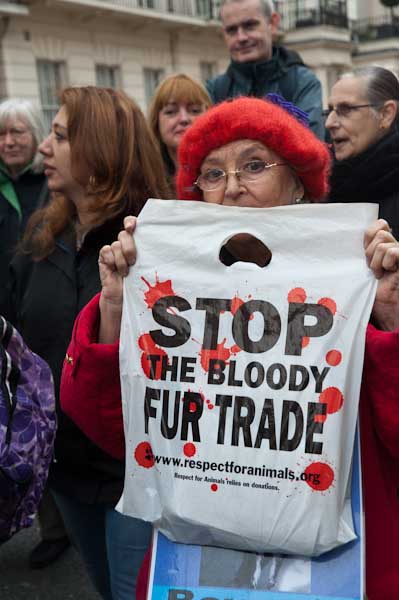
We don’t need to wear fur, and for almost any purpose that fur is used there are better vegetable or synthetic alternatives. Most fur used now is simply decorative, and even when produced under cruel regimes is still expensive. It’s become just a marginally less crass way than sewing large denomination notes onto clothes for people to say “look how effing rich I am darling.

© 2009 Peter Marshall

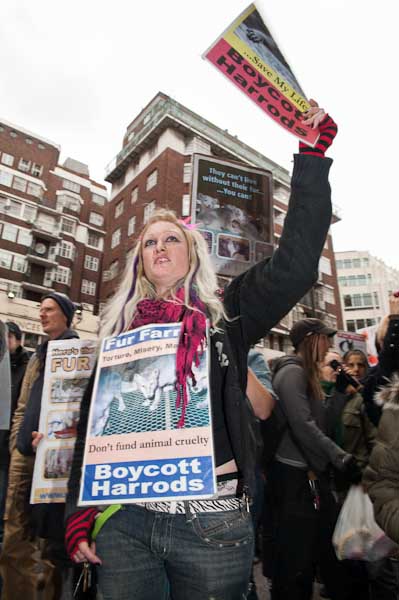
Wearing fur – including fur trimmings – had more or less become unacceptable in polite, civilised society, but recently some parts of the fashion trade have been trying to rehabilitate it. We shouldn’t need a Campaign to Abolish the Fur Trade in the twentyfirst century, but unfortunately we still do.

© 2009 Peter Marshall
Boycott Harrods – the only department store still selling furs

More on My London Diary about the National Anti-Fur March and more pictures

Almost all these pictures were taken with the 24-70mm f2.8, which was pretty much an ideal lens, enabling me to work close in and at a reasonable shutter speed and ISO in the rather poor light. There were just a few times when I wanted something longer (usually considerably longer) and rather more where something just a little wider was called for.  I think the ideal kit on full frame would have at its centre something like a 20-50mm lens, but unfortunately they don’t exist.

Tamils March Again

It would be hard not to feel a great sympathy for the Tamils. The world – including the UN and of course our own government have for many years decided to turn a blind eye to the takeover of Sri Lanka by the majority Sinhalese. Britain failed to protect their interests when we gave Ceylon independence, failed to inspire Commonwealth action over the years, but particularly at the time of the creation of Sri Lanka. The world looked away (or gave encouragement and arms)  as the Sri Lankan government imposed a military solution on the Tamil areas, killing many thousands of civilians as well as the Tamil Tigers.

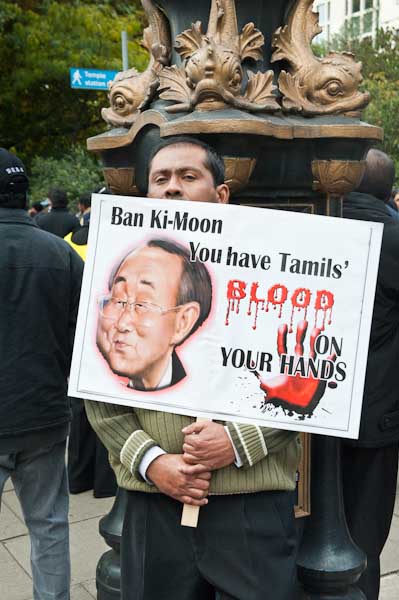
The Tamils were calling for the release of the  over 280,000 Tamil civilians – including at least 50,000 children  – still held in miserable and squalid conditions in camps run by the Sri Lankan military.  They want international aid agencies and press to have access to the camps and a full independent investigation of the war crimes committed by the Sri Lankan government and army. They have lost faith in the UN and its General Secretary Ban Ki-Moon.

© 2009 Peter Marshall.

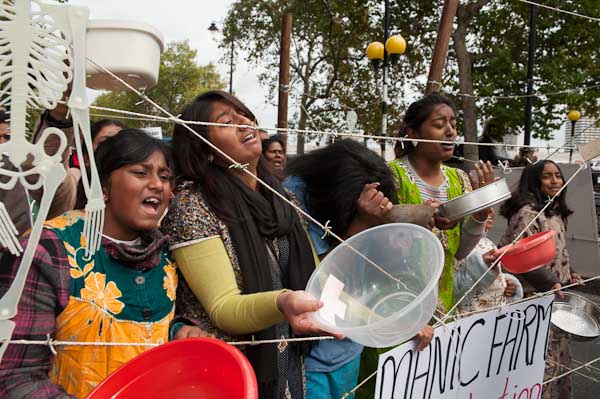
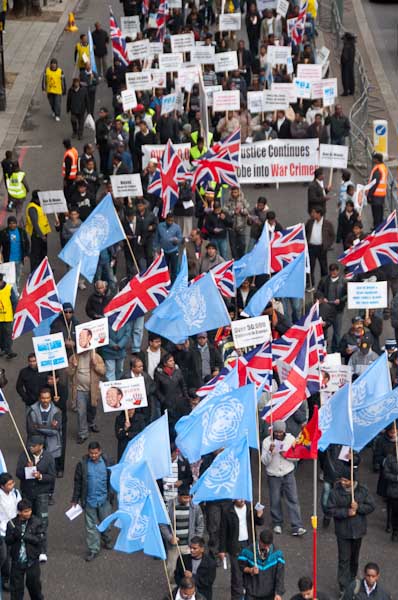
At the start of the demonstration at Temple, protesters seemed rather thin on the ground and the mood seemed  one of resignation and dejection, rather than the energetic enthusiasm of the much larger demonstrations before the military defeat. Even the ‘prisoners’ in the mock concentration camp leading the march seemed subdued, although by the time I left the march as it turned up Northumberland Ave they were noticeably more animated.

© 2009 Peter Marshall

But it was a difficult event to find anything to photography, which is perhaps why rather more than usual of my pictures were taken from a distance, looking down from the footbridge on the east side of the Hungerford Bridge (now one of the two bridges on each side of the rail bridge.)

© 2009 Peter Marshall

I wasn’t particularly happy with the pictures I took. I had hoped to catch up with them later in the afternoon before the march reached Hyde Park, but with the smaller numbers the police were able to pressure them to walk rather faster than on previous occasions where they had taken over the roadway and by the time I was able to get back the march had finished. You can see them as usual on My London Diary.