COP Out Camp Out

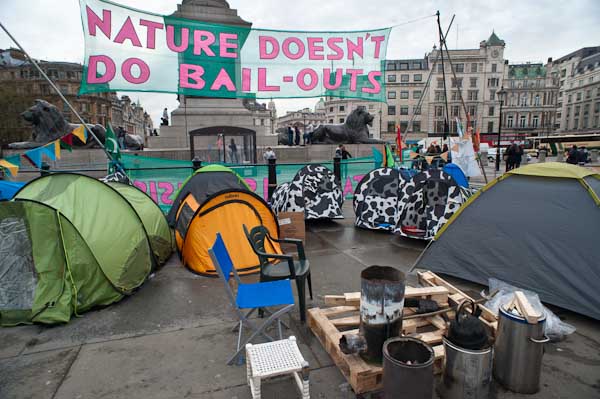
After all the demonstrations during the day on December 5, the climate campers took their tripods and tents to Trafalgar Square and set up camp in the middle of it, around the traditional Christmas tree and below Nelson.  And although they had no permission to do so and the Mayor of London isn’t pleased nobody much interfered with them.

Although originally they had only intended to camp for 48 hrs, they decided to stay while the talks in Copenhagen are taking place.  I called in on my way to another event on Tuesday and took a few pictures, although not very much was happening.

© 2009 Peter Marshall.

Which perhaps made it hard work to take pictures.

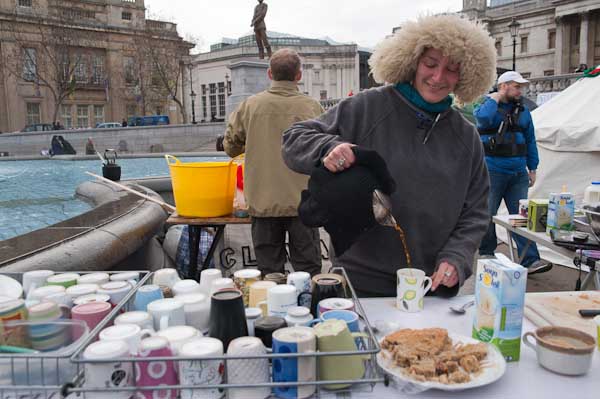
© 2009 Peter Marshall.

Though free mugs of tea were on offer to anyone who wanted one, and I took advantage of the offer.

More on My London Diary.

The March And The Wave

Saturday’s main event was organised by the Stop Climate Chaos Coalition, made up of over a hundred organisations whose only common feature is their concern over climate change and which have a combined membership of around 11 million – about 1 in 6 of the UK population.

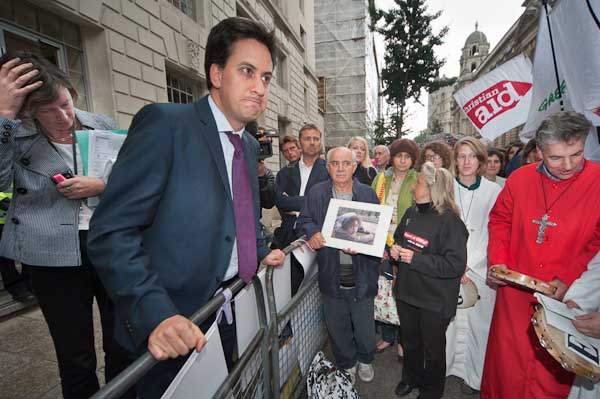
I first came across them a few months back when they organised a demonstration outside the Department of Energy and Climate Change and minister Ed Miliband came out in person to speak to them.

© 2009 Peter Marshall.
A real Minister (with a worried aide) and a false cardinal
with other demonstrators outside the DECC in September.

Although they didn’t succeed in getting all 11 million to come to ‘The Wave’ there were roughly 50,000 marching though London (so many that some were still at Trafalgar Square or in Whitehall at 3pm and missed the actual wave when Parliament was surrounded) making this the largest demonstration on climate change in the UK to date.

© 2009 Peter Marshall

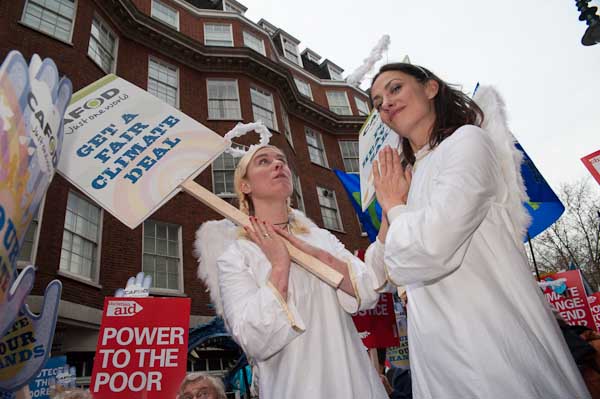
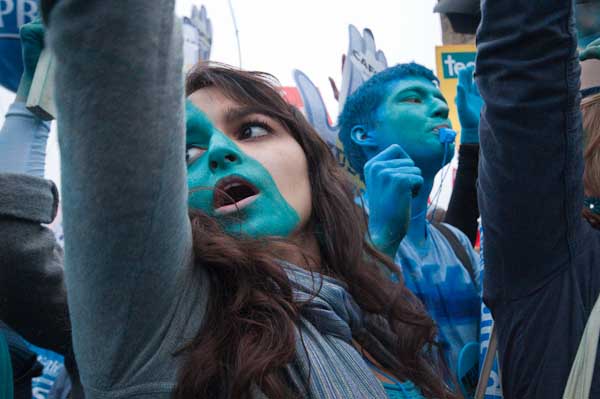
If the main event lacked the political bite of the Campaign Against Climate Change (who were taking part as one member of the coalition) there was certainly plenty of enthusiasm, fancy dress and blue face paint to make for some visually striking images.  The ‘Wave’ itself was perhaps something of an anti-climax, and the crush of photographers close to Big Ben at the head of the demonstration made photography difficult.

© 2009 Peter Marshall

Especially those photographers who hold their large DSLRs out at arms length in front of other photographers.  Photographic etiquette generally stops other still photographers from actually walking in front of you as you are taking pictures (nothing stops some guys taking video), but somehow a growing number seem to think its OK if you just hold your camera in front of others.

More pictures from the march and the final wave on My London Diary.

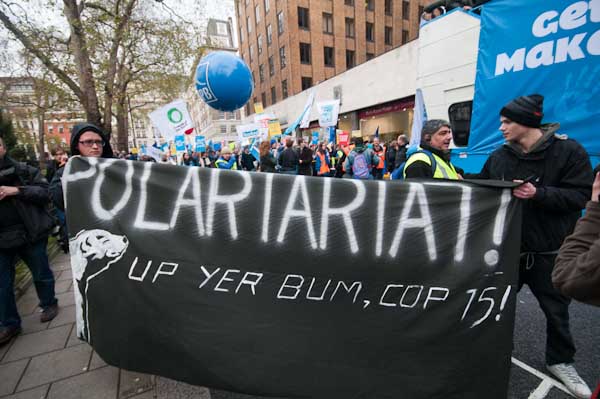
“Up Yer Bum COP 15!”

Another rare bit of humour in Saturday’s Climate march, with a banner from the “Polartariat”:

© 2009 Peter Marshall.

Along with a rather nice polar bear.

The anti-capitalist block joined the march at Berkeley Square and for a hundred yards or two this banner was at the head of the march, until stewards and police managed to persuade them to roll it up and go back and join in further back.

Although the block apparently had three banners, I only saw one other, with around twenty or thirty people, including both anarchists and a few Stalinists carrying flags with the message ‘For Bolshevism. The group left the climate demonstration before ‘The Wave’ around the Houses of Parliament.

More comment and pictures on My London Diary.

Police Dig Deeper Hole?

Police seem determined to spurn the usual sage advice about stopping digging in their relationship with photographers.  Read today’s news piece by Chris Cheesman on the Amateur Photographer, Police crackdown on City photographers, which recounts how Graham White was stopped by a security guared while photogarphing a building in Silk St. A police spokeswoman is reported as having said that the police advise photographers to inform a security official of their intentions, prior to taking pictures.

Yesterday AP reported yet another case of photographer harassment, in which a man taking pictures in Hounslow High Street was arrested, handcuffed and taken to Hounslow Police Station where he was held for three hours for a for a ‘Section 5’ Public Order Offence before being issued with an £80 fine and released. He intends to take the case to court rather than pay the fine.

Also today, in The Register, John Ozimek titles his piecePolice snapper silliness reaches new heights: City of London employ new ironic policing tactics‘ and recounts how London Tonight reporter Marcus Powell with an ITN crew filming a story about an earlier incident in which seven police officers in three cars and a riot van were called to deal with architectural photographer Grant Smith who was photographing one of the city’s Wren churches were questioned by police.

These incidents appear to be getting more common, despite various campaigns and demonstrations by photographers, a Home Office Circular, statements by the Home Secretary and ACPO, a debate in the House of Commons, comments in the Lords, features and leading articles in newspapers… But it seems that there is nothing and nobody that can bring the police under control.

You can of course read some more about the situation on the ‘I’m a photographer not a Terrorist‘ web site, which also gives details of a Mass Photo Gathering in defence of street photography to take place in Trafalgar Square at 12 noon on Saturday 23rd January 2010.  Something to put in your new Diary. See you there!

In the meantime, I suggest we all take our cameras with us whenever we go into town (any town)  and take pictures, even if we are only going shopping or to the pub and intend to delete the pictures (unless the police tell us to.)  That way we might wear the bastards down.

If you’ve got a camera, use it. Otherwise soon you won’t be able to.

Trust Me, I’m a Banker

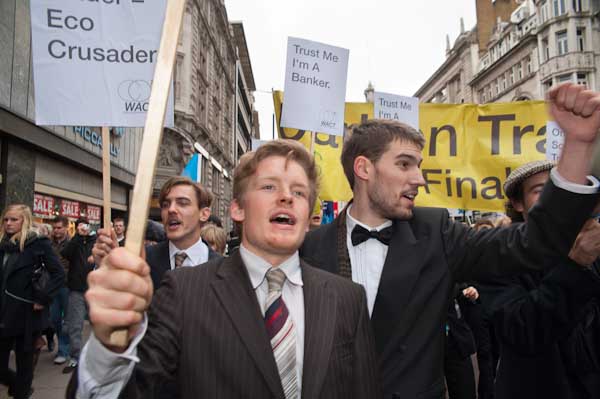
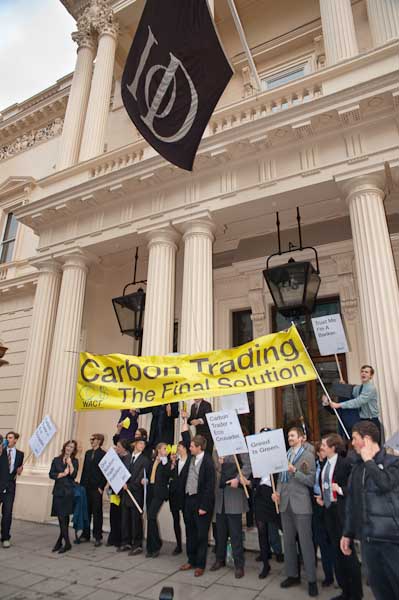
You may well not have heard of WACT, the ‘World Association of Carbon Traders‘ and some of the slogans on the placards they carried in Saturday’s Climate march may have surprised a few, though it would have been hard to miss the irony in ‘Trust Me, I’m a Banker‘ or others such as ‘Greed is Green‘. They also stood out from the others taking part in not following the recommended dress code of blue and preferring pin-stripe suits and ties.

© 2009 Peter Marshall.
‘Carbon Trader = Eco Crusader’ and WACT’s logo is CO2$

I don’t believe that photographers should pose people or tell them what to do when taking photographs – though I might occasionally ask someone to turn their placard so I can read the message, in general I’m at pains not to intervene in the situation I’m photographing. But as I photographed this group of ‘city gents’ (and ladies) coming down the road I couldn’t resist pointing out they were approaching the Institute of Directors, with the hope that they might in some way react. And they did, running across the road to pose for a group photograph in its doorway.

© 2009 Peter Marshall

Of course it is only too obvious at the moment that many people are profiting from climate change and that carbon trading is one way that the rich can make money and keep in charge – markets are always controlled by those with money.

More about the WACT and more pictures on My London Diary.

Campaign Against Climate Change

Saturday was a big day for climate protests in London, with the COP-15 Climate talks about to begin in Copenhagen, around 50,000 took to the streets to emphasize their view that all governments – including our own – should be doing more.

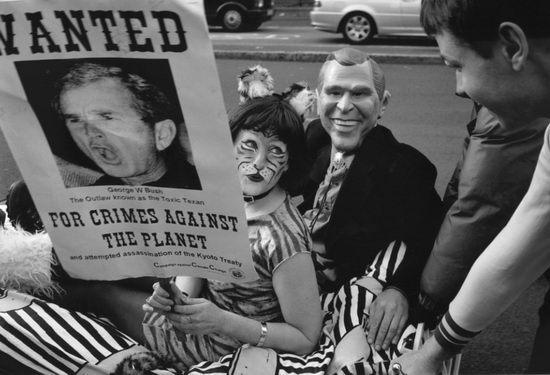
Of course some people and organisations have been doing that for years – notably the Campaign Against Climate Change, (CCC)  whose demonstrations I’ve been photographing for years – here’s one with a rather youthful looking George W Bush from the days when photography was on film and mainly black and white – March 2002:

© 2002, Peter Marshall
Campaign against Climate Change. George Bush – the ‘Toxic Texan’  had rejected the Kyoto Treaty. March 2002

The ‘tiger’ in the picture wasn’t in anyone’s tank but was in bed with George Bush and being pushed to the Houses of Parliament, but unfortunately the wheels fell off before we got there!

Actually I was I think mainly photographing in colour at the time – still on film, but the library where I put most of my pictures at the time only really wanted black and white, and colour needed to be on transparency while I was more sensibly shooting colour negative. Of course I had a scanner, but they wouldn’t have known what to do with a digital file – it’s easy to forget how quickly things changed.

Since then I’ve photographed quite a few more events organised by the CCC, both the series of annual National Climate Marches and smaller events in London – including recently those against dirty coal, airport expansion and the closure of one of our few green industries, Vestas Blades  (and here and here.)  So as well as the bike ride I’ve already posted about, I was determined to photograph their rally in Hyde Park on Saturday even though it was rather overshadowed by the much larger event organised by the Stop Climate Chaos Coalition, which brings together a wide range of well over a hundred varied worthy organisations with a concern over the climate, including various overseas aid charities, the RSPB, the Women’s Institute, trade unions and more – including the CCC.

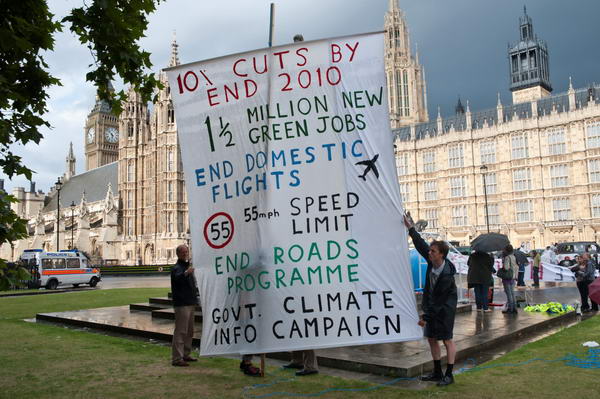
At their ‘Alternative Parliament‘ at Westminster in July, CCC had made their demands on the UK Government clear – as their banner shows.

© 2009 Peter Marshall
CCC Alternative Parliament, July 2009

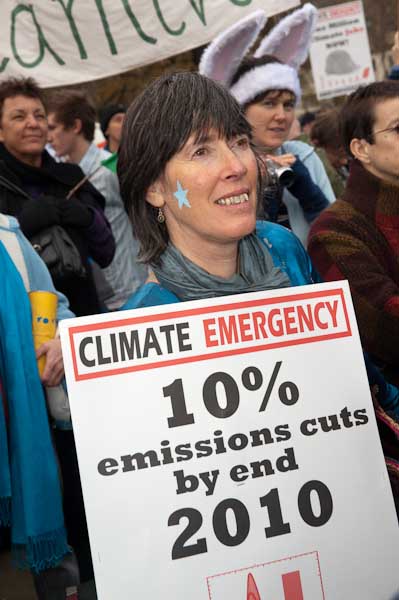
These two were the key demands of the Hyde Park rally:

  • Declaration of a Climate Emergency
  • 10% cuts by end 2010
  • A million green jobs by end 2010
  • Ban domestic flights
  • 55 mph speed limit – scrap the roads program
  • End Agrofuel use

If like me you missed most of the speeches at the rally, addressed the crowd of several thousand, you can listen to them, along with five songs that ‘Seize the Day‘ performed live there on YouTube. I always find it very useful when videos from events I’ve photographed are posted like this. When taking pictures I’m concentrating on finding visual solutions to show the event, and often miss much of the speeches, and its good to be able to come and watch them – when I have the time. And just occasionally its good to be able to fast forward or even skip the odd one. Although it wasn’t the case on Saturday I have photographed many political events were the ability to do this would have been incredibly welcome.

© 2009 Peter Marshall.

As usual you can read more about the actual event and see more pictures – including my favourite mermaid with a fish – on My London Diary.

On Yer Bike!

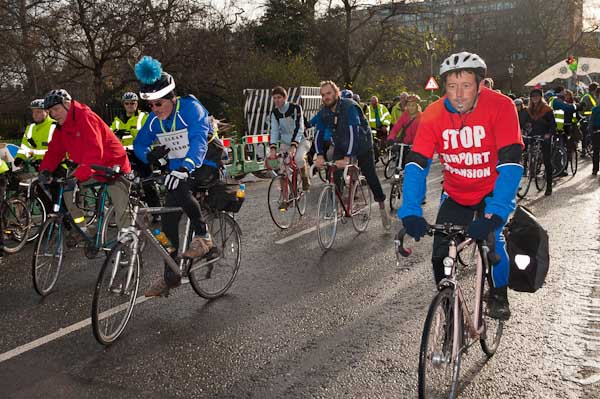
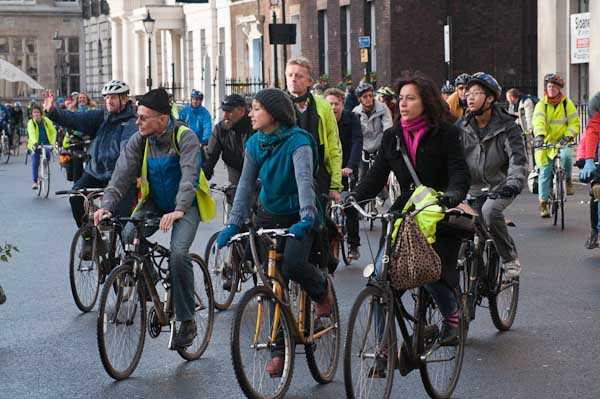
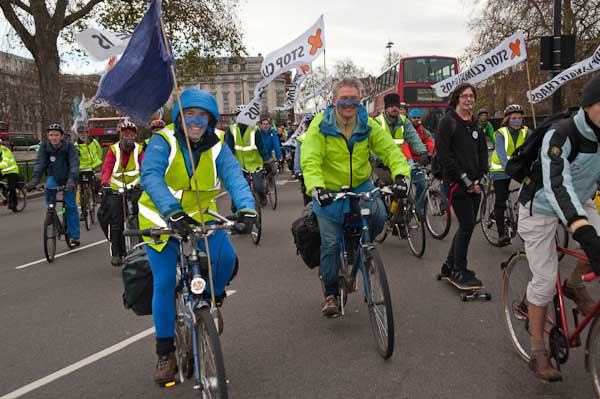
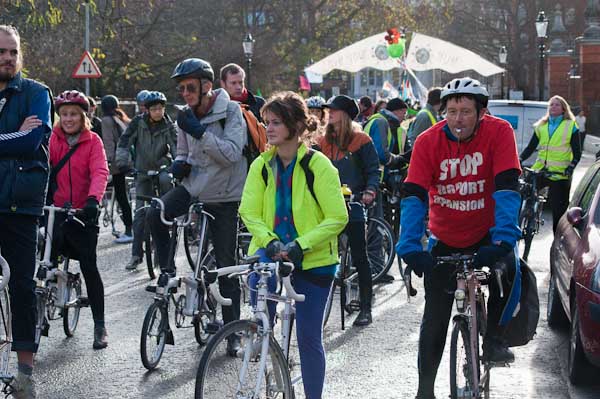
The Climate Emergency Bike Ride organised by the Campaign Against Climate Change last Saturday morning was pretty straightforward to photograph.  It can sometimes be useful to actually go on a bike when photographing bike rides, but it wasn’t convenient to do this on Saturday as I was going on to photograph other things where a bike would have been very much in the way.

Of course I could have left my bike somewhere locked up, but in London I normally like to use my folding bike, and these are very attractive to bike thieves because of their relatively high value and being so easy to transport away in a car boot or the back of a van. The big advantage of the folder for me is that it is so easy to put it onto a train – including the London Underground.

© 2009 Peter Marshall.
The start of the ride – sun right behind the riders

Anyway, I was without a bike, so an essential piece of research before the event was to find out the important places to be on the route and work out how I could get to these. Fortunately for this ride it turned out to be pretty simple – from the start at Lincolns Inn Fields I could go with the bikes the few hundred yards to Holborn Station, jump on a Piccadilly line train to Picadilly Circus and jog the quarter mile from there to the first stop outside BP’s Offices in St James’s Square in time for the ride to arrive.

© 2009 Peter Marshall.
I was waiting at St James’s Square when the ride arrived

Then it was only a few yards to the next call for the ride. From there I could make my way back to Piccadilly Circus and on to Marble Arch with plenty of time to spare for the bikes to arrive at the end of their demonstration.

© 2009 Peter Marshall
The end of the ride at Hyde Park

One thing I’ve learnt is to avoid trying to use buses when moving from one part of a demonstration to another. Marches or bike rides both tend to cause traffic chaos, and it can be extremely frustrating to be sitting on a bus in a traffic jam unable to get where you want to be.

Advance planning is also needed because some weekends the London Underground system has large parts shut down for engineering works,  so I check Underground (and bus) journeys on the Transport for London web site.  It isn’t infallible – last Saturday it was telling me I couldn’t use the train from home up to London which was actually running normally, and it isn’t unusual for it to suggest completely nonsensical routes. Particularly if I intend to photograph several events on the same day, the actual working out of the journeys between them can take an hour or two.

Everything worked out fine on Saturday, and I got to the right places on time, even managing to fit in a few more photos on the way.

© 2009 Peter Marshall.
The sun was not far out of the frame for this image

The only real photographic problems were at the start of the ride in Lincolns Inn Fields where a low winter sun was shining from behind the riders. Even the fairly effective lens hood on my 55-200 zoom had to be augmented by a carefully held hand, while those on the wider zooms are pretty ineffectual at the best of times. But by working slightly from one side and keeping a careful eye in the viewfinder for flare I was able to get some decent pictures making use of the lighting – and of course using fill-flash to bring out some shadow detail.

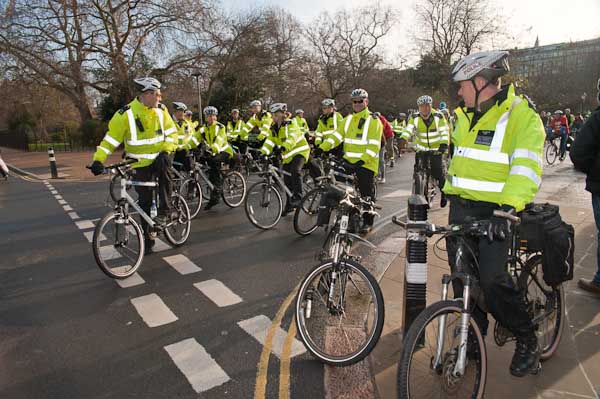
Using flash also creates problems, particularly because cyclists – like the police  – tend to have lots of bits of reflective clothing as well as other reflectors on their bikes. Often quite a little work is needed in Lightroom to tame these images, and that ‘magic’ highlight removal tool got a fair bit of exercise on images like these:

© 2009 Peter Marshall.

You can read more about the demonstration, part of a day of actions over Climate Change aimed at pressing the government to take effective action at the Copenhagen talks and in its policies here, on My London Diary, where there are also more pictures from the event.

We Remember Ian Tomlinson

Last Wednesday, 1 December, was exactly 8 months since the death of Ian Tomlinson after a police assault at the G20 protests. The Ian Tomlinson Family Campaign wants a full investigation to find out what happened and to bring those responsible for his death to justice.

They decided to hold a public Candlelit vigil in Royal Exchange Buildings where he was assaulted and invited the press and others to attend. I’ve written a more detailed account of the event on My London Diary (and also on Demotix) so I won’t repeat the details here, where I want to look mainly at some of the problems in photographing such an event.

Firstly of course there were perhaps 30 other professional photographers there- including some from the national press and the picture agencies as well as other freelances, along with several TV crews and some other videographers. This made it fairly difficult – and at times impossible – to get into the positions for taking the best pictures (and also means that the chances of getting my pictures used in the news media is even lower than usual.)  Working in confined spaces with professional photographers generally isn’t too bad – everyone appreciates the problem and within reason people cooperate with each other (with a few exceptions.)

Working with digital has actually made it a little harder, with a growing tendency by some photographers – even when working with DSLRs when they can’t see the image – to hold their camera out in front at arms length to take pictures – and usually getting it into the frame of the rest of us.  They wouldn’t actually walk in front of us to take a picture, but somehow they seem to think it’s ok to shove a camera out there.

Working with videographers, particularly from the TV stations can also be rather difficult. They tend to like to set up on large tripods and take and stay in a good position, and sometimes feel they have a right to barge in front of stills photographers. Actually on this occasion they didn’t do so, but it still creates a barrier to movement in a way that still photographers don’t.

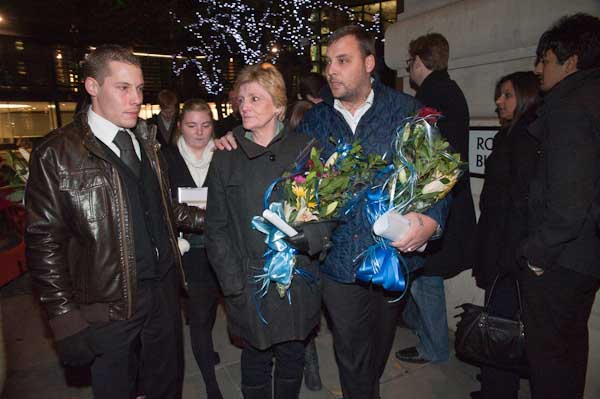
The light in Royal Exchange Buildings was fairly dim – it’s a pedestrian area and not particularly brightly lit.  I’d prefer not to use flash for a candlelit event, or at least only to use it sparingly to keep the effect of the candles. Using too much flash – as the the first picture – does create a very artificial effect an, with flash on camera particularly, does rather make people look like cardboard cutouts.
© 2009 Peter Marshall.
The Tomlinson Family arrive at the memorial event

This was taken at ISO2000, 1/60 f9, and flash is the main light source. The aperture ensures that I have sufficient depth of field to keep everyone sharp and even at f9 the ambient light does give some – if limited – background detail at 1/60s. I’d started taking pictures as they walked towards the event, moving backwards as they came; I hadn’t wanted to get in their way or stop them, but seconds after I started taking pictures I found myself with other photographers on both sides and behind me shooting over my should and I – and the family –  had to stop.

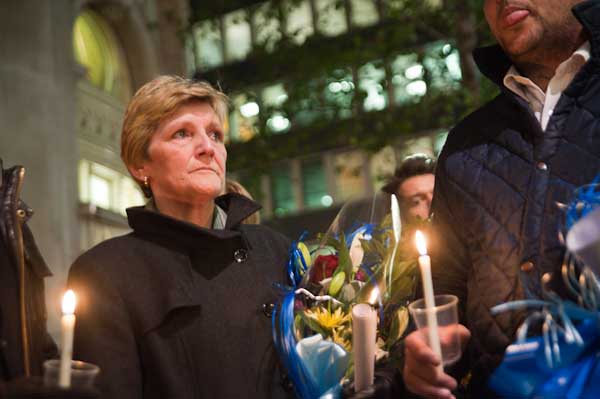
From there I managed to find a space crouching in front of the TV cameras and very close to the family. Having taken a few pictures with flash to make sure I had something sharp – if rather boring – I stared working by available light. Using the Sigma EX 24-70 f2.8, exposures were pretty variable, ranging from 1/20 to 1/60 at f2.8 to f3.5 at ISOs between 1000 and 3200.  Many frames were not sharp due to subject movement or camera shake, and the limited depth of field. The lens is just very slightly soft at f2.8 but good enough to use, particularly in difficult conditions.
© 2009 Peter Marshall
Mrs Julia Tomlinson

Flash is of course more intrusive, and although we had been invited to photograph the event and I wanted to produce pictures that might generate more publicity for the family campaign, I still found it hard at times to take pictures and wanted to do so with the minimum of intrusion. So when the family moved to the spot where Ian Tomlinson actually collapsed and died I needed flash to prevent blurring when they were laying flowers, but went back to available light to photograph them paying their respects after a short prayer from the minister present.
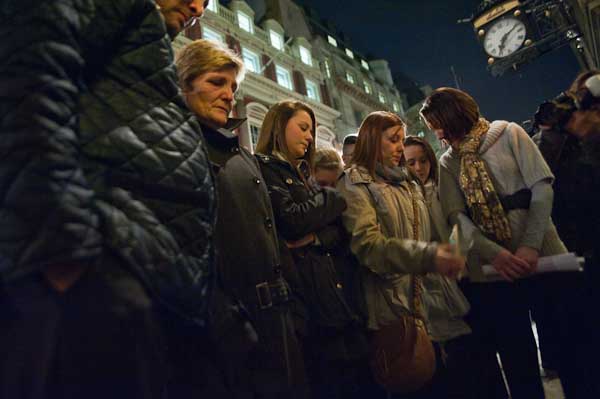
© 2009 Peter Marshall.

But after taking this I was not sure if it would have sufficient depth of field (looking at it now, although only Ian Tomlinson’s widow is really sharp, the image still works) and decided I had to take a similar picture using flash.
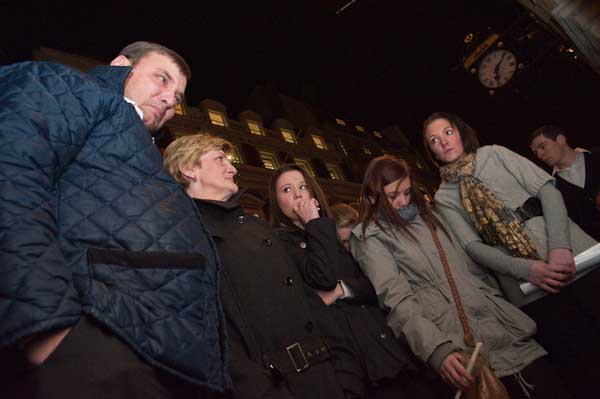
© 2009 Peter Marshall.

It is sharper, the colour is more accurate. Although probably I could process the raw file rather more carefully to get a better result, I think I prefer the atmosphere of the exposure using available light.

The story made the front page on Demotix, and I also published it on Indymedia, as well of course with a few more pictures on My London Diary.
More Police Paranoia

I think today is the first time I’ve read The Lone Voice blog, and it isn’t one I’ll be adding to my lists. It claims to be written by “FIDO The Dog”, a 43 year old Virgo male from Newport, Gwent who states he is “Fighting against the dhimmitude* and pc attitude that has taken over my country” and has an unfortunate fixation with Gordon Brown, Defence Secretary Bob Ainsworth and Alcohol Concern chief executive Don Shenker (about the last of which he does does have some sensible concerns.)

FIDO The Dog has made a number of posts about photographers being picked on by the police, and his post Yet more police abuse of photographers. features a couple of Welsh examples to add to the growing list of police overstepping their powers.

Yesterday Garry Chinchen was threatened with arrest for ‘breach of the peace’ when he stopped to photograph people on a jet-ski at the Glyn Neath Lakes water-sports centre from a lay-by on the A465. Despite the police apparently admitting that the pictures he had taken were perfectly lawful.

The Lone Voice also links to another incident I’ve read about before from last September, when a photographer from Motorcycle News had his camera seized (and returned after some argument) in a lay-by at Betws-y-Coed when he photographed a cop watching “a protest rally over North Wales Police’s heavy-handed treatment of law-abiding motorcyclists.”The MCN site has a picture of the event with audio of the argument between the photographer and the police officer.

There is another Welsh connection also, as The Lone Voice includes a link to a site that started life as started as an anti-racist football comic sold on the terraces of Cardiff City. But Urban 75, for some years now an excellent non-profit community site based in Brixton in south London, has a really useful feature Photographers Rights And The Law In The UKA brief guide for street photographers.

Of course in this campaign, The Lone Voice is certainly not alone. Yesterday, after Lord Carlile’s statement, the Photographer Not A Terrorist organisation was deluged with requests for media interviews,  and there were features on BBC programmes and elsewhere.  There is a rather nice story too on the BBC Viewfinder blog, written by Phil Coomes, picture editor and photographer for the BBC News website.

*the word dhimmitude comes from dhimmi, the protection awarded in Muslim states to non-Muslims under Sharia law which lays down both rights and responsibilities, but dhimmitude is a term largely confined to extreme right anti-Muslim campaigners in Europe who concentrate on the repressive and sometimes extreme aspects of this involving the persecution of Christians, and refers to attitudes of some liberal Europeans in accommodating Muslim ideas and practices.