Sikhs Don’t Forget 1984

Every year, Sikhs hold a march in London around the anniversary of the 1984 massacre in India, when their most sacred temple in Amritsar was attacked by the Indian Army.  Accounts of exactly what happened and why differ, but obviously many Sikhs feel very deeply about this event and the massacres of Sikhs that came later in the year after the Indian Prime Minister had been killed by her two Sikh bodyguards.

We don’t actually read a great deal about events in India in our newspapers, except at exceptional times, and there has been a great deal of violence over the years that has been unreported, particularly if it takes place away from the major cities.  It’s hard for an outsider like myself to know quite how seriously to take the Sikh claims of genocide – though certainly many Sikhs have been massacred, or to know how serious is the call for an independent Sikh state of Khalistan.

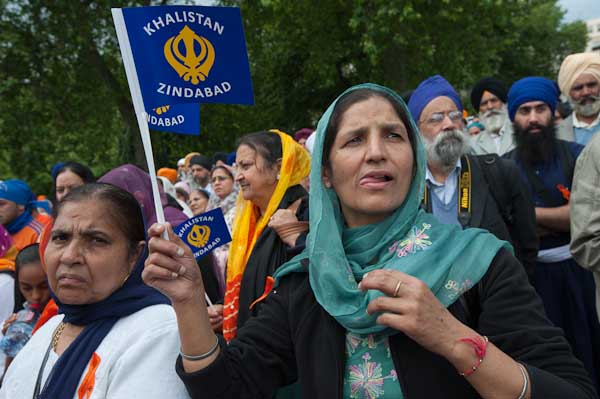
But certainly the march in London attracts Sikhs from around the country, and this year, the 26th anniversary, there were perhaps 5000 at the start of the march in Hyde Park and perhaps almost double that by the time the rally was taking place in Trafalgar Square.

© 2010, Peter Marshall
2010: Long Live Khalistan – Sikhs call for an independent Sikh state

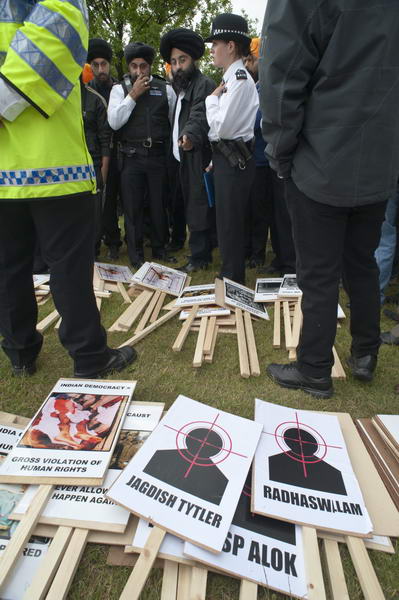
Its both a serious and a colourful march, led by baptised Sikhs in orange robes, at the front two men carrying the Sikh flags and after them the five holding their unsheathed swords up in front of them.  Perhaps because of the police complaints at last year’s march there were fewer placards and almost none of the graphic images of the massacres to which the police objected, and virtually none of the obvious support for the banned armed separatist group, Babbar.

© 2009 Peter Marshall
2009: Superintendent Kohli complains about some of the placards.

There were just a handful of Babbar t-shirts, and most of those I saw were worn by children rather than the large groups of young men and women last year.

There were many speeches, a few in English, but mainly not, although in any case I find I can’t follow speeches when my mind is engaged in making photographs. I do usually carry a small voice recorder and at times record them to listen to later, but at this event I didn’t bother. But it is a useful way to record the names of speakers and other useful information at times, often easier than finding a notebook and pen and writing them.

Its perhaps too easy to treat an occasion like this as simply an opportunity to record exotic images and unusual characters in the crowd, but I try to photograph in a way that reflects the mood of the event and as far as possible the issues. Banners and placards are important as the camera doesn’t record the spoken word, and the lack of them at this event made it harder.

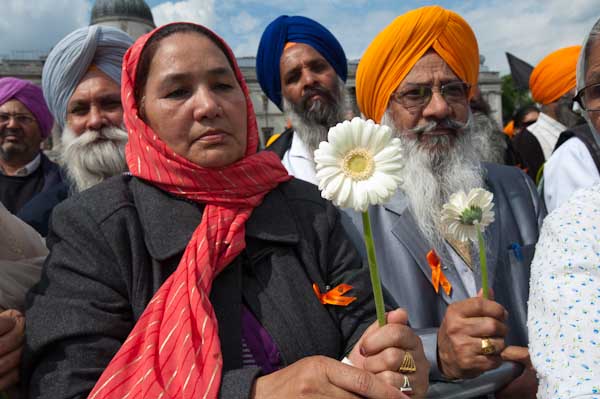
Most of the pictures I took were of something the event organisers announced a little diffidently as something visual for the press,  but it wasn’t the kind of silly publicity stunt that some PR guys like to think up. It did seem an apt way to let those at the rally take part in the event rather than just listen to speeches, by coming to lay flowers into large slabs of flower arranging foam making the shape 1984, the year of the massacre, 1984.

© 2010, Peter Marshall
2010: Sikhs wait to come up an place their flowers

As a small boy I used to accompany my mother as she visited the graves of long-dead relatives in half a dozen cemeteries in the area around where we lived, tidying them and putting fresh flowers on them, and all too often going along our streets we see the flowers on a fence or lamppost that mark where someone was killed.

More of the pictures from this year’s march and rally on My London Diary.

Ligthroom 3 – First Impressions

My upgrade copy of Lightroom 3 arrived yesterday morning – I’d ordered it on CD rather than as a download because I still like to have a box with the serial number on it. So here are my first impressions – and most of the things I mention I’ll post more about later, where helpful with some images to show the differences. Today I’m still trying to get to grips with it while cursing at not being able to get out and take pictures until after the gas engineer gets here to deal with our water heater that gave up on us just as I tried to shower this morning.

Installation

It installed without problems, other than me putting in my old serial number when required to licence the product and wondering why it didn’t work. Of course I needed the new one which was on the plastic container with the CD, and once I had entered that it actually automatically created another set of boxes ready filled in the original serial number. It would have been clearer had it provided both sets of boxes to start with, and labelled one of them ‘original’ and the other ‘upgrade’. It’s the kind of little thing that suggests an inability to think like the user seeing the install program for the first time. They really need to have idiots like me to test it on!

Other than that, there should perhaps be a rather more accurate warning about the time it will take to update your existing catalogue. I think it said it may take a few minutes and it actually took six hours. Yes I do have an over-large catalogue and a slightly ageing computer!

Stability and Speed

So far I’m both impressed and a little depressed with LR3. The promised extra speed and stability doesn’t make itself felt on my system, if anything it sometimes feels a little more sluggish at many operations. I’ve seen the message “an unknown error occurred” perhaps a dozen times today, and it doesn’t inspire confidence. And as with previous versions I’ve found a need to keep an eye on the software slowing down, when to keep working efficiently you need to exit and reload. It doesn’t take a great deal of time but it shouldn’t be necessary, and suggests some poor memory management.

A couple of times today, when I’ve been working through a filmstrip selection filtered to show only images with 2* and greater I’ve suddenly realised that LR3 has reverted to working on the full set of images, and there have been a few other similar glitches. Some of them may have been due to user error – often a problem with new software, but I’m not sure.

High ISO Images

Good news came when I tried the software on a set of images taken last Halloween, some at high ISO, and I think that every image showed at least a slight improvement thanks to the new processing engine, and certainly because of the improved noise reduction. Still perhaps not up to the best of external NR software – such as Noise Ninja, but I think the gap is small. If you are interested in seeing pictures rather than examining them microscopically I think you will find it good enough.

Distortion, CA and Vignetting

The other really big feature LR3 promised for me was the automatic treatment of distortion, chromatic aberration and vignetting. I’ll write more about that with some examples in a later post. It works pretty well and seems very flexible, and if a lens preset doesn’t do the job you can still do more things manually than you could before. But the real problem is that at the moment few of the lenses I use are covered by the software.

Lens profiles

Sigma apparently collaborated with Adobe and profiles are provided for over 50 of their lenses, but unfortunately not the one I most often use. Neither Nikon or Canon appear to have given any help to Adobe, and there are only a little over a dozen Nikon lenses and roughly twice that number of Canon lenses included, along with one or two from other manufacturers.

I think only two of the lenses currently in my active kit have profiles supplied, the Sigma 24-70 f2.8 and the Nikon 10.5mm fisheye.  It also has a profile for a Sigma 10-20 f4-5.6 DC HSM EX lens, but for some reason doesn’t automatically apply this – perhaps my lens is a different version, although it does seem to more or less work.

Adobe do supply a free download with targets to photograph and software to produce profiles for any lens, and when I’ve some spare days I’ll give it a try – but it looks like a fairly long job – with 72 sets of 9 carefully made images needed for a complete lens calibration of a wide-angle zoom. They encourage people to upload the profiles they’ve made and say they intend to make them available. But not so far for LR3 users.

There may actually be profiles available on the Adobe web site, but unless you have a copy of the latest version of Photoshop you cannot access them. I suppose  I  could install a trial copy to check for them and download if present, or find someone who has a copy and ask them to look for me, but I really think I should not have to do so.

Apparently they ran out of time to incorporate the button which would connect and download these additional profiles into LR3 – and so perhaps it will arrive in LR3.1 or soon after, but in the meantime they could avoid an awful lot of illwill from the buyers (or prospective buyers) of Lightroom simply by making them available for manual download. It would only take a minute or two of someone at Adobe’s time to make a zip file available of the whole set and update it every month or so.

But I frankly think we deserve rather better from Adobe. A make your own profile approach is acceptable for almost free software – such as PTLens – we deserve rather more given the cost of Lightroom, and we should be at least provided with profiles for the full current range of lenses from the major manufacturers. Neither the 18-105mm DX Nikkor nor the 16-35mm FX lens have a profile provided as yet.

File Export problems

This isn’t by any means a perfect release, and parts of the file export system have never worked too well. I export jpegs for my web site at 600×600 pixels, and although it’s convenient to do this from Lightroom, I’ve always been able to get both smaller files and higher quality by starting with full size output files from LR and batch processing them down to 600×600 in other software – including an old copy of ACDSee Pro which I mainly use as a file viewer.

Things may even have deteriorated in LR3. One of the files in the batch I tried it out on came out at 455KB, and several others were between 150 and 200KB. Back in the old days when we all connected dial-up I used to think 60KB was a large web file. Nowadays it isn’t quite so important, but 455KB is still over the top.

So I noticed that instead of specifying a percentage for size in the output dialogue you could chose a maximum size. I selected just the one image with the big output file and set the maximum size to 200KB and clicked. This time it came out as 565KB!

Fortunately there is a work around and I’ll have to get used to it – simply by outputting the files via the web module to a temporary web directory, then finding the image files and copying them to the folder in my web site and deleting the rest of the generated junk. That way the problem image came down to just 102KB and actually looks better – and it was no longer the largest file in the set. It looks to me as if files that needed a lot of local adjustment are not being properly handled in the export module. It’s a bit of a paing to have to do the extra steps.

Watermarking

LR3 does however enable you to very easily set up watermark presets, and I’ve decided from now on to include a relatively unobtrusive copyright message at the bottom left of each picture I put on the web. More about this in another post.

Should You Upgrade?

I think for most people the answer is clearly yes, it’s already worthwhile, and like previous Lightroom versions many of the annoyances will in time be removed by free fractional updates. Some which were present in previous versions will probably continue.  It’s perhaps surprising given the long time LR3 was in public beta that there still seems to be quite a lot to do.

But most of the problems are relatively minor, and overall it’s a very impressive program that does everything you need for almost all of your digital images from the point of exposure to the final output with a minimum of fuss and very little duplication of effort or files. Unless you have peculiar needs (and perhaps if speed is the only consideration and you don’t need the features this software offers) then Lightroom will simplify your work and get you better organised.

Like all such Swiss Army knives, other software can do some of the individual tasks it performs slightly better, but mostly the differences are pretty marginal. I’ll still use Photoshop occasionally (though mostly when working with scans rather than digital files) and some other software, but rely on Lightroom for the bulk of my work with images.

Some more detailed posts about LR3, with some image examples will I hope follow when I have time.
Gaza Flotilla Protest

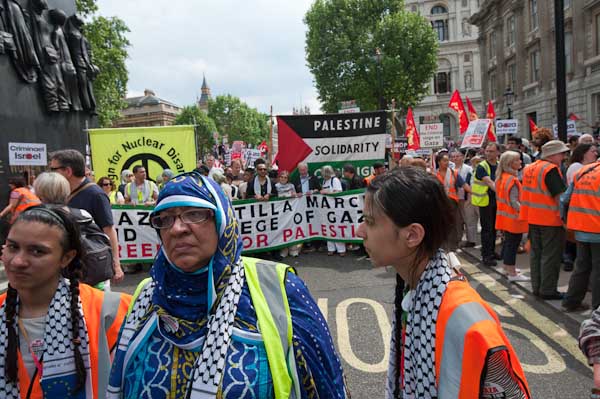
The central part of Whitehall close to Downing Street was already fairly crowded when I arrived, and the rally which I had been told would start at 1.30pm was already in full swing a quarter of an hour earlier.

It’s always a bit of a problem to know when to turn up for demonstrations; often I arrive early and hang around for ages until the protesters turn up, and occasionally I’ve given up and gone away before things have actually started.  Also probably around one in ten of the events I find or am sent information about never actually take place at all or at a different time or place than the information I’m given. But this one was certainly going to happen, and if it wasn’t quite on the massive scale the seven or so groups organising it had hoped, there were probably close to 20,000 by the end.

One of the vital skills you need to learn to cover demonstrations is how to get to the right place at the right time. Often, as in this case, it means pushing your way through tightly packed crowds. You need to to have a certain amount of confidence in your right to do so and to keep saying “Excuse me” to people as you push past. Usually it works and I was soon in a good position to photograph the speakers at the rally.

There was a small area around the microphones surrounded by barriers which I probably could have gained entrance to with my press card, but it was really too small, and there were too many people – mainly stewards – in it already. The main group organising the event were ‘Stop The War‘ and I’ve found them to be one of the most photographer unfriendly organisations in the universe, and today was no exception. On previous occasions I’ve been deliberately assaulted by their stewards, and on other occasions narrowly escaped serious injury as they pushed me roughly backwards. On one memorable occasion, the photographers present were so outraged at the treatment we were getting that we actually sat down on Park Lane and halted the demonstration until we were allowed to take some photographs.

So I kept outside the pen to get a decent working distance and avoid the stewards, just in case. Unfortunately both here and at the rally at the end of the march opposite the Israeli embassy in Kensington – where I again kept outside the barriers – there were too many stewards in the way, along with a few people with camcorders  (rather than professional video equipment) who I imagine were working for free for one of the seven organising bodies but also rather blocked the view for those of us outside. Had I been working inside, I would have had the courtesy to keep my head down, certainly when I was not actually taking pictures, and stewards should simply be kept out of the way.

To photograph people speaking I like to be far enough away not have to point my camera up at them at a steep angle, and preferably to be able to get a tightly framed head shot with a focal length of perhaps 100-150mm.

© 2010, Peter Marshall
Stop the War stewards keep the press at a distance. Why?

Before the start of the march, when people are lining up, it’s good to be able to approach the front of the march fairly closely to take some pictures, preferably without any stewards to get in the way. That way you can usually get some good images of those who are leading the march. But at Stop The War organised events such as this, photographers are generally kept quite a distance away, and on this occasion I found myself shooting with a 200mm from around 20 metres when I would prefer to be working with a 28mm or even shorter.

© 2010, Peter Marshall
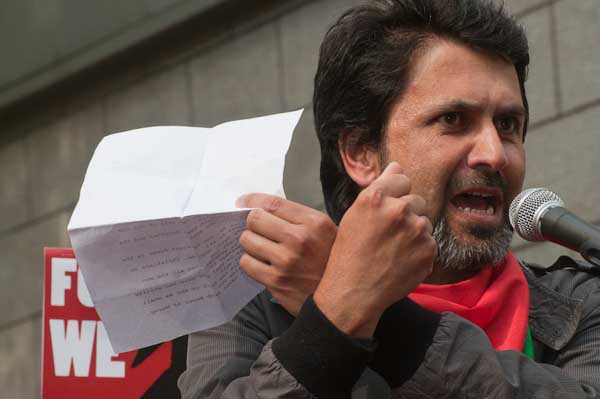
One of those held prisoner on the ship talks about the experience

Its perhaps less of a problem for some of the other photographers who carry huge lenses (something of a status symbol, particularly for Canon users who favour lenses elephantine in size and an off-white colour, and which I think really should be provided with a bearer.) But I only use a really long lens when I have to – like the Summer when I got Arts Council money to photograph women’s cricket – nice people but as well as the pictures here I also photographed the games.

So my 200mm is a slow 55-200mm, all of 340 g and 4 inches long with the hood reversed.  It’s a Sigma DC lens, f4-5.6 and no longer made, but noticeably sharper than the Nikon 18-200 zoom (which I managed to write off a couple of weeks back in any case.) Although only designed to cover the smaller DX format, by removing a few mm from the nicely effective lens hood, it also gives pretty acceptable results on full frame FX from around 70mm up (more here.) Compared to the elephant trunk lenses it looks a toy, but it delivers pretty well.

More pictures in Gaza Flotilla Atrocity Protest on My London Diary.

Sigma Lenses

Here’s a post I wrote a year ago, but never actually completed!  The pictures were taken on Sun 28 June 2009.

© 2009 Peter Marshall
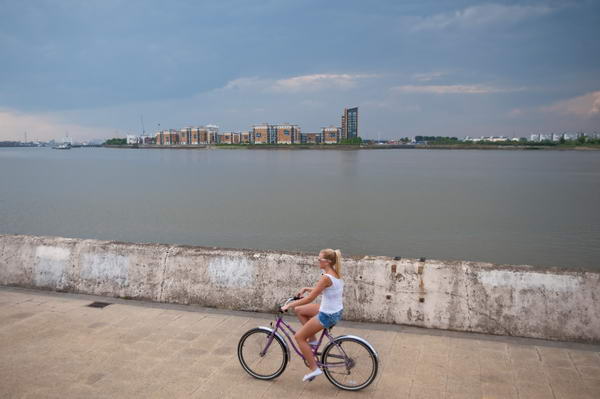
Less depth of field than I like at f2.8 – I should have stopped down

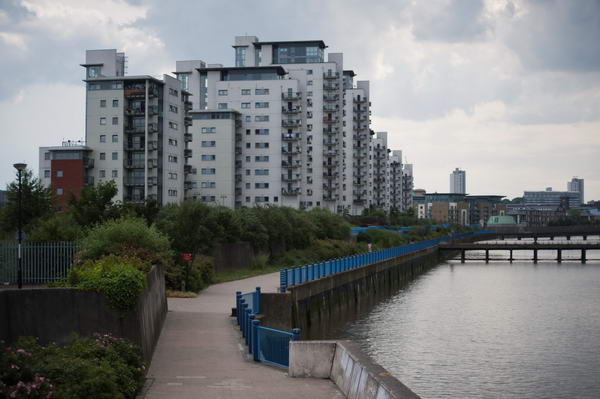
One or two of the pictures here and from the chariot festival earlier in the day don’t quite have enough depth of field for my taste; having just got a new Sigma f2.8 24-70mm I wanted to see what I could do with it, particularly wide open. The shot above was taken at f2.8, and although the cyclist and the wall are sharp, the buildings on the other side of the river are a little soft. In this case it may help the picture, but generally I think I prefer things sharp. The lens does pretty well wide open, but stopping down to f4 or more does just add a little edge on sharpness and also reduces the vignetting you can see in the images above and below, both or which are uncorrected. Of course it’s a simple job to correct this in Lightroom.

© 2009 Peter Marshall
Some noticeable vignetting on  FX with the Sigma DX lens

I was also working with a Sigma 55-200mm f4-5.6 DC lens, one of the lightest lenses I own at around 350g, which I’ve had for several years. I’ve never thoroughly tested this on the D200 and D300 I’ve used it on, but certainly the results seem at least one tad sharper than those from the Nikon 18-210mm, perhaps hardly surprising given its much smaller zoom range.

I tried this lens on the D700, but as it is a DC lens, designed for the smaller FX format I expected to have to switch the D700 to FX format.  To my surprise it seems to give pretty good results on the large FX format too, especially at the longer end. It has now been replaced by the slightly heavier 50-200mm f/4-5.6 DC which I’ve not tried and may or may not have a similar coverage.

Comment added on June 27 2010

I’ve used various Sigma lenses over the years, and particularly those in the EX range seem generally to be excellent performers and most of them have proved pretty robust. The Sigma 12-24mm EX (now replaced by a similar but improved model) is certainly good on the DX format, and the results are ok on FX, except that the 12mm end does really go too far on full-frame 35mm. The occasions where a rectilinear lens with a focal length of less than 16mm really works are few and far between – not a criticism of the lens but it is just a little too extreme.

It’s also a lens with an exposed very curved front element, impossible to use a filter for protection. Mine lasted for around 3 years before it began to have too many little defects to be really usable – giving vaguely soft areas or excessive flare whenever it was used against the light. The good news is that is wasn’t hugely expensive to have the front element replaced with a new one – I think about a fifth of the cost of a new lens, but the slightly bad news was that it took around a couple of months for the new part to arrive here to be fitted.

I’ve written before about the problems that developed with the Sigma 24-70mm.  Eventually I got a replacement lens from Japan and everything seemed ok for a couple of weeks. Then I was taking pictures on a family visit to Richmond Park and the lens jammed again, refusing to zoom past around 30mm. Cursing I packed it up and sent it back to Sigma, getting a phone call a couple of days later asking what the problem was because it seemed to be working perfectly. I think the shaking in the post must have managed to free whatever was jamming it. I told them what it had done and they promised to check it out before sending it back, and I hope the problem is now solved, but although it seems to be working perfectly I’m still keeping my fingers crossed every time I take it out.

One piece of good news is that this is one of the lenses that has a profile that comes with LR3, correcting the distortion (noticeable on some shots at the 24mm end), most of the chromatic aberration (which is pretty typical for a lens of this type) and the vignetting. So there are good reasons to use this lens now.

Would I buy Sigma again? Yes, despite the problems with this one lens. I’ve owned half a dozen or more others that have been good, and either had unique characteristics that appealed to me, or have offered a fairly substantial saving over the Nikon equivalents. And I think all of them have had better lens hoods – I get really fed up with the rather flimsy Nikon lens hoods which seem to fall off at a fairly light touch – they are just not made of a stiff enough plastic.

Photo Books

The latest publication from Alec Soth’s ‘Little Brown Mushroom‘ press is Bedknobs & Broomsticks by Trent Parke and it is probably sold out by the time you read this, though perhaps if you get an order in immediately you will be able to get one, at least if you have an address in the US it can be shipped to. At $18 it isn’t particularly expensive for a 40 page book around 7×8 inches, but it ain’t cheap either presumably because of the low print run.

Looking at the sample pages on the link above, I didn’t feel inclined to buy it myself, but nowadays probably most people who are buying things like this do so not because they want the book but because they think it will be a good investment. A couple of years ago I bought a copy of Parke’s first book, the 1999 ‘Dream/Life‘, a considerably more substantial volume. Then it cost me about £40, though I had to pay carriage from Australia. Now, as M Scott Brauer points out on dvaphoto, the cheapest copy on Amazon is going for a mere $849.99, although a quick internet search did find one elsewhere at only $681. Still £400 more than I paid.

There has been a huge rise of interest in photographic books in recent years, pumped up by a few publications dealing with them that have promoted some at times pretty obscure and unremarkable titles. Fortunately most of the best photographic books over the years have sold fairly well, and in a number of cases have been re-issued with improved print quality and sometimes better design and editing – and at times a great deal of interesting new content. Probably the best example of this is Robert Frank’s ‘The Americans’, where you can buy a recent edition on-line for less than £20. It’s a book no photographer should be without, though if you have the money and the shelf space, the Steidl ‘Expanded Edition’, an extremely weighty hardback is worth paying around double that for. (And if you can get Robert Frank to sign it you can ask an extra couple of thousand when you sell it!)

Unless you have a particular interest in bibliographic history, or are a collector, it isn’t worth buying any of the various earlier editions. They cost more and offer rather less. The Aperture edition I bought years back sells for anything from £60 to £350 and some others can be found around that price, while the first US edition sells for thousands – and around £10,000 for a signed copy. The book was first published in France and  you can get a copy of that edition, in fairly reasonable condition for under £2000!

It really is madness. But at least in this case you can get the best edition cheaply.

But I think for photographic publishing the future – or at least the foreseeable future – is with printing on demand. Which is why I’ve started to put my work out through Blurb – and I’ve got another and very different book almost ready. It isn’t a perfect solution, and a few changes at Blurb – or another company offering a comparable services at similar prices but with fewer limitations would help greatly.

Release Carnival

I’m getting very behind both with posting my work on My London Diary and also with writing about it here.  I’m not entirely sure why this is, today I can blame the hot weather which has made it difficult to get down to anything, but before that we’ve hd rather a cold spell. In part I’ve been busy with other things, including getting a new book ready to go on Blurb, still a little way to go. Also I’ve had a few little computer problems – this machine is, like me, beginning to show its age.

So, back to Saturday 5 June and I was in Torrington Square in the middle of parts of the University of London in Holborn for an event which had been widely publicised as the ‘Release Carnival’ ,organised by students and members of SOAS Detainee Support calling for the immediate release of children from detention centres, those privately run jails where the UK Borders Agency likes to dump everyone it can.

My problem – and their problem too – was that a few days previously, Israeli commandos had boarded one of the convoy of ships heading for Gaza and opened fire on the more or less unarmed civilians on board, killing at least nine and wounding more than 30 others.  So many of those who might otherwise have attended ‘Release’ were lining up in Whitehall for a rally and march to the Israeli embassy.

I too was going to join this march and rally, but had stopped on the way for the Release event, which was starting an hour earlier. But unfortunately there didn’t seem to be a great deal happening while I was there, which was a shame, but I did take a few picture before I had to leave, and later got some appreciative comments.

© 2010, Peter Marshall

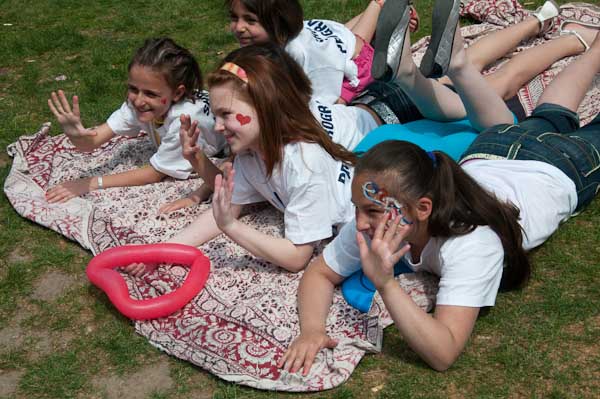
What was interesting was to find out a little about London’s Albanian community, which I had known absolutely nothing about before. London really is a great city because it has so many people in it from so many places around the world.  The group to which these children belong is called SHPRESA, and I and another photographer spent a while trying to think what these letters might stand for before I asked one of the women wearing a t-shirt with them on and found it was actually an Albanian word meaning ‘hope‘.

There are just a few more photographs on My London Diary, but we had to leave and jump on the tube to get down to Downing St for the Gaza rally before the Release event had really got going.

Name the Photographer

A nice little photo quiz from James Pomerantz on his A Photo Student blog – all you have to do is to name the photographer responsible for the 50 pictures he is posting in five installments (and 40 are already on line as I write.)

Some are pretty easy, one or two I’d be ashamed to know. So far my average is around five or six out of ten, though I could take a decent guess at a few more and probably find the answers fairly simply on line. But I don’t intend to answer, not least as the prize is some outdated film.

It’s probably not as outdated as some of the film I have around the place, but really I feel all film is outdated now.

Joe Deal (1947-2010)

I’ve heard and read quite a few people responding to the news of the recent death of photographer Joe Deal by expressing their ignorance about him and his work. He was of course one of the photographers in the famed ‘New Topographics‘ show of 1975, which changed the direction of landscape photography and was recently revisted at George Eastman House (though their web site is rather uninformative – there is more at LACMA, and a feature on NPR.)

I first saw his work in reproduction that year, and a little later he was one of the photographers that Lewis Baltz discussed in some detail on his workshop I attended, showing work from his then current project on suburban housing along the San Andreas Fault Line in Southern California. Like many other photographers who worked in the urban landscape I found this show refreshing and it altered all of our work – and you can perhaps see this in at least some of my and other photographer’s projects on the Urban Landscapes web site – such as my Meridian, DLR and other panoramic series.

You can see a good selection Deal’s Fault Zone series and other work from the period on the Robert Mann Gallery site, where he had a show in 2004. There is an obituary by William Grimes in the New York Times with a slide show and you can also see a second show which begins with some of his more recent images at the Robert Mann gallery.

Five things to do to protect your images

The latest post by US lawyer Carolyn E. Wright on her very useful PhotoAttorney blog suggests five things photographers can do to protect their online images.  Mostly its familiar advice (and Lightroom 3 might help if you intend to add a copyright watermark to all your pictures) there was one item in the five that was – at least for me – a little novel.

This was her suggestion on copyright management information (CMI), not a term I’ve used before. This is the kind of information we are always advised to put in the metadata of our image files such as your name and copyright information, so nothing new. But although I’ve heard a UK lawyer saying it’s an offence to remove this in this country, I didn’t know the position in the US.

According to Wright, it seems even clearer there, and under the U.S. Copyright Act (Section 1202) removing CMI carries a fine of $2,500 up to $25,000, with  lawyers fees and any damages from the infringement on top. And you can collect on this whether or not your images have been registered with the US Copyright Office.

She also suggests you should use a visible copyright notice on or adjacent to the image whether or not you have registered copyright, as even if your work has been registered it might be possible for an infringer to claim they had used the image without realising it was copyright, drastically reducing the damages you might get from having your work used.

I don’t intend to follow all of her suggestions. Registering with the US only makes sense you are prepared to go after big bucks in the US courts should your pictures be used without consent. And disabling right-click on your web pages will annoy innocent users, including those who can legitimately claim “fair use” such as students writing course essays. But I am thinking seriously about adding a small but clear copyright notice to all of the images I upload in future to my web sites – and of course making sure that all of the images have this and my contact information in the metadata.

For once the image by her that accompanies the post has some relevance, not for the two snow white birds in the image (probably the only oil-free birds to appear on the web in the past month or so) but at the bottom, very clearly visible, is her copyright line.

Lensculture 26

Lensculture issue 26 is now on line and as always there is much to look at, not least a preview pick of 40 pictures from the 2010 Rencontres d’Arles so that I can see what I will be missing from July 3-13 th (the exhibition programme continues until September 19th>.

I’ve thought about going there for years, but have never quite got around to it. Until around ten years ago there was a good reason, since it was always a very busy time for me at work, and it would have been difficult if not impossible to get the time off, but since then it’s largely been a matter of sloth and failing to persuade any of my photographic friends to accompany me.

Another feature I was very pleased to see was a selection of 16 images by Tony Ray Jones, a highlight of the recent Month of Photography in Krakow, Poland.  I did a very good PR job on his behalf with a lecture at the 2005 FotoArt Festival at Beilsko-Biala (just  a short trip down the road from Krakow) on the ‘Two Rays’ of British photography – Ray Moore and Tony Ray Jones, and again when I spoke in the same lecture hall two years later in a presentation of the history of British ‘street photography.’

You can see my pictures from Bielsko-Biala and a dairy of the 2005 festival there on line, though for copyright reasons I was unable to post my full lecture.  I also kept an online diary in 2007, in which I promise to make a version of my lecture available – but as yet I’ve not managed to do so. There are some copyright issues that I’ve not found a sensible way to resolve.