More on the Olympics

One of the reasons I’ve been getting a little behind in posting about my own work here is that I’ve been busy putting the finishing touches to my first book of pictures of the Olympic area (It’s now completed and I’m waiting with interest to see it in print.)  The Lea Valley around London’s second river, the Lea,  is an area I started to photograph in the 1980s and have continued to go back to occasionally ever since.

In the early 1980s my work on Hull had been accepted for a major museum show there and I was looking to repeat my success in London. Possibly the reason it didn’t happen was that the subject I chose for my next major project was the Lea Valley, which at that time absolutely nobody other than me seemed to have an interest in.

Then I could walk along the Northern Outfall Sewer for several miles and have the area completely to myself, and the paths along the various waterways of the back rivers crossing Stratford Marsh would, at least in the close season for fishing, be totally deserted.

Things have changed drastically with the success of the London Olympics bid, and last Tuesday I had to keep stopping as I rode along the path on top of the sewer, long since re-branded as the ‘Greenway’ which was crowded with various groups of visitors.

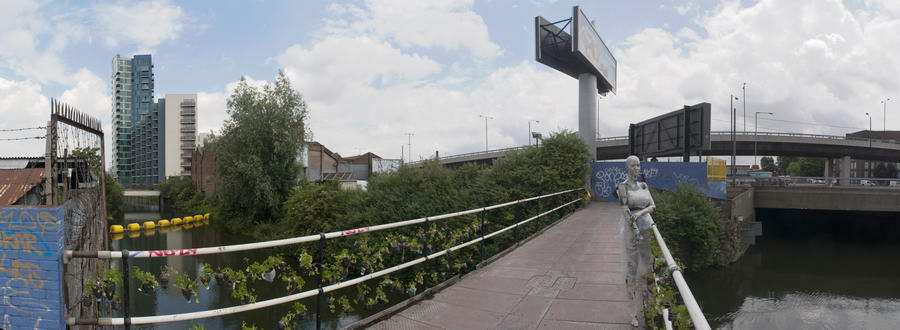
Thanks to the Olympics, the area has also been noticed by the London Festival of Architecture and was the site of an ‘urban gardening’ intervention by students from the University of Innsbruck, Austria.
© 2010, Peter Marshall
Urban gardening alongside the Lea Navigation by Bow Flyover

I’d gone there to continue my series of images of the Olympic area, where I’ve been trying to make roughly monthly visits to see the progress on the site.
© 2010, Peter Marshall
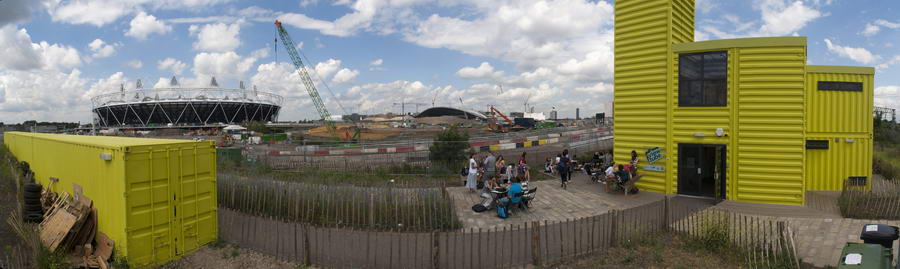
Olympic stadium, Greenway and View Tube
and also to meet an artist friend with whom I’m working on a joint project with us both producing images from the same areas of London – and the Olympic site is one we’ve chosen.  We’re looking for a venue in London for an exhibition of our joint work, though so far without success.

I spent around an hour there taking photographs, particularly some panoramas – like the one above. I’d hope to be able to photograph from the viewing platform there, but unfortunately it isn’t available when school groups are using the classroom, so this time I couldn’t do so.

But I had thought to bring a monopod with me, virtually a necessity to take pictures above the temporary fencing that lines the area now. The mesh of this isn’t particularly fine, but you can’t put any Nikon DSLR lens through it and at six foot and a couple of inches its hard to photograph over unless you are rather tall.

The monopod is good for panoramas anyway as you can rotate the camera while keeping it in the same position (though I’d forgotten my attachment which enables rotation around the lens near nodal point, which is essential if you have any close objects in the frame.)  But unfortunately it only reaches up to a little over five foot, so I had to hold it well off the ground so that the camera had a clear view over the fence.

This introduces other problems. It’s hard to keep the monopod in exactly the same position between exposures and the camera may actually be too high to reach to fire the shutter. For a single exposure the self-timer can deal with the second problem, but if you want to make multiple exposures while rotating the camera in order to make a panorama it makes getting the camera back into the same position problematic.

So although it might have been nice to lift the camera higher for some shots, in practice when making panoramas I was limited to the height I could reach to the shutter release.  And making panoramas works best when I can work either with the foot of the monopod firmly on the ground, or with some part of it braced against some solid structure.

For the panoramic images I decided to use a fixed 20mm lens, a Nikon f2.8.   It has reasonably low distortion and cuts out one possibility – altering the foal length that can make multiple images with wit zooms hard to stitch.To make panoramas that are easy to make and print, I want to stick to using a single row of images, and a relatively wide lens produces images that work together with those taken with my swing lens film cameras which have lenses of roughly 26mm focal length. Y

However carefully you work, the geometry means you lose some vertical coverage when stitching images  (the actual amount depends on the angular overlap between images) and starting from 20mm. Screwing the camera directly to the top of the monopod means using it in landscape mode, which isn’t ideal, but is considerably simpler.

What I would welcome is a  more compact monopod. The cheap unbranded model I have is reasonably light and sturdy, has rapid locks for quick and reliable extension and extends at maximum stretch to hold the camera exactly at my eye level, but is around 17 inches when collapsed, too long to fit my camera bag, though it does just slip in at an angle to the bag on my Brompton folding bike which I often ride in London.  But looking through the various models available (ranging in price from a tenner up to around £250) I can’t really see anything better.

And there is of course nothing better than PTGui for stitching the images. You can see the above pictures and a few more on My London Diary, where there are also some more non-panoramic images of the urban gardening, as well as from the Olympic site and my travels back into the centre of London by a rather roundabout route on the Brompton.
© 2010, Peter Marshall
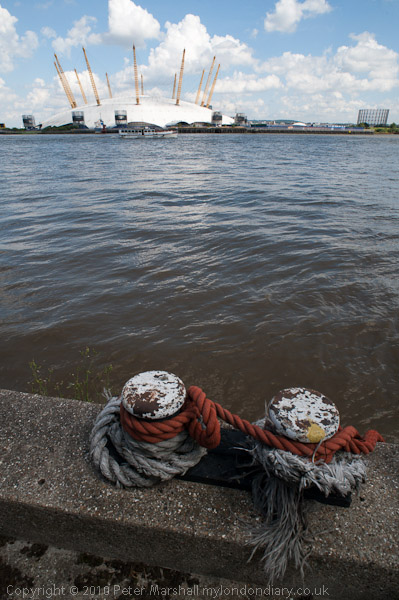
I didn’t cross the river here at Blackwall, but cycled down to the foot tunnel at Greenwich
Carl de Keyser & Google Earth

I meant to point out last week that Carl de Keyser has been answering questions on David Alan Harvey‘s ‘Burn‘, “an evolving journal for emerging photographers.” Some of the comments make interesting reading, though of course not everyone has “Two assistants in Magnum/Paris” who ” go around the entire European coastline on Google earth and put flags in places where they think I might find an interesting situation to photograph that reflects that idea of waiting for the big one.”

I’ve written about de Keyser’s work on several occasions and as well as on Magnum you can also see more on his own web site, and on the site devoted to his latest project Moments Before the Flood, involving the whole European coastline.

He is currently working in the UK, and on the site you can see his images from a number of places I’ve also photographed, including Hornsea, Withernsea and Skipsea,  and I see that on Saturday he was in Brighton, photographing its derelict West Pier.  Pictures are going up more or less as soon as they are taken and comments are welcome on the site.

Although I admire his photography, and there are plenty of good pictures, I’m not sure that I think that the project is really quite coming together, though I’ve only looked through the 80 or so pictures from the UK.  It’s perhaps just a little too scenic (and in one or two cases too picture postcard) although of course the editing may well sort that out.

But sometimes looking at his pictures I do get the impression of a man in a hurry driven by a huge mission to complete,  and driving at great speed from ‘flag’ to ‘flag’ around our coastline.

Hornsea, Skipsea and Withernsea  particularly interested me because I’ve visited them quite a few times over the years (of course I’ve also been to many of the other places around the coast) and have photographed the effects of erosion there and along the whole Holderness coast.  But I think I took my best pictures when I used a bicycle to get around, there is a lot to be said for working at a slower speed.

But Google Earth and Google Streetview and other mapping and satellite image services have very much changed the way we can look for subject matter.

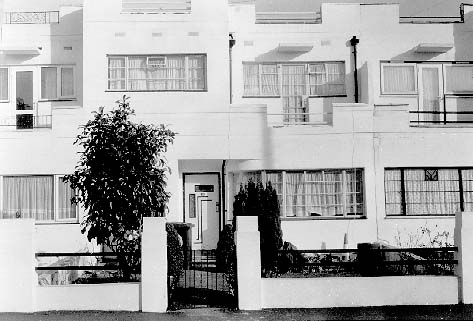
I had a  query yesterday about a picture I took in 1995 in London (its on the Buildings of London site I wrote in 1996 and have hardly updated.)

© 1995, Peter Marshall

(Sorry it’s not a great scan, but technology back then was relatively primitive.)

Of course I could go back to my contact sheets from 1995 and find the image, and fortunately I had put down the details and was able to confirm that the street I’d given was correct. It also had a six figure grid reference, but that only locates it to roughly a hundred metres. Rather than just check on the map, I started with finding the street on Google Earth then used ‘Street View.’ And it wasn’t there – which is why I’d had the query.

Fortunately one of the other frames I had of the building showed the right hand corner where there was a street with a name I could read with a magnifying glass from the contact sheet, so I could tell exactly where it had been. Back to street view and I could also clearly identify the very dull red brick block that had replaced a rather interesting piece of 1930’s architecture.

Of course the new block has an extra storey and almost certainly made a decent profit by fitting more units into the same space. And probably the new building will be more energy efficient and with luck the roof won’t leak, often a problem with ‘modern’ buildings that were really designed with warmer drier climates in mind.

If I was in power I  would insist that any new building that replaced an old one had to be at least as architecturally distinguished. But our planning system has little control over visual aspects of building, as you can see on almost any walk through London.

Economist Blunders

Thanks to the New York Times Media Decoder blog you can read the story of how The Economist doctored a cover picture to make it show Obama all alone gazing apparently down at his feet on a Louisiana beach with a handy oil rig in the distance.

The problem is that this isn’t at all what the original photograph showed. Firstly Obama was in a group of three people, one of whom was cropped out and the second, closer to him, retouched away.  Almost as significantly, the hazard tape in front of the three and the material in front of them on the beach – which in the original appears to hold his attention – has also been cropped away. For copyright reasons you will have to click on the link above to see the two pictures.

I don’t know what caption the photographer put to his original image, but it could have gone something like “Obama looks at pollution evidence on the beach and consults with US coastguard Admiral Thad W. Allen and local parish president Charlotte Randolph.”  The picture used in on the cover would suit a quite different caption, suggesting a lonely and desperate man looking down in despair.

The most depressing and rather frightening aspect of the story is that the deputy editor concerned seems to have no idea of the gross distortion that her decision to change this photograph has caused. She writes “the presence of an unknown woman would have been puzzling to readers.” It seems to show a very low opinion of Economist readers and in fact it was not an “unknown woman” (surely a gratuitously offensive description when we have both her name and photograph), but one with a  peculiar relevance to the scene which the image showed, the president of the particular parish in which Obama is standing and on whose beach the oil has landed.

Emma Duncan, deputy editor of The Economist goes on in her e-mail to state “We don’t edit photos in order to mislead” when clearly the evidence shows the opposite is true. Either she doesn’t take at all pictures seriously or fails to understand them.

The difference between the two pictures is just like the difference between writing “President Obama was alone on the beach racked by worry about the pollution” and “President Obama visited the beach with the local parish president and a US Coastguard Admiral to see the damage for himself“. I’m sure Duncan would see that those statements were different and that to substitute one for the other was misleading – and it really makes no difference if you do it with pictures rather than words.

The Economist needs to quickly apologise to its readers for misleading them – and also needs to make sure that it leaves the editing of pictures to someone who understand them. They wouldn’t do this kind of thing with words and doing it with images is equally corrosive to their credibility.

Section 44 Victory

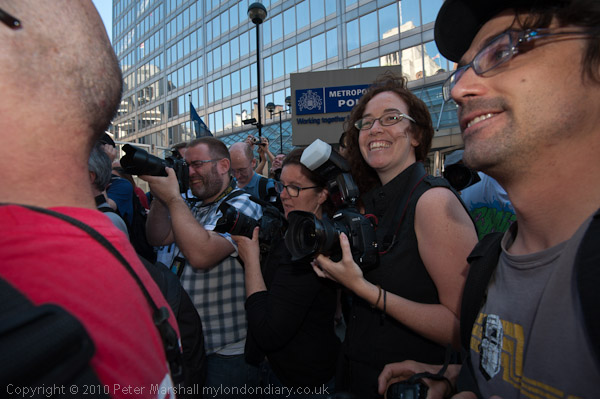
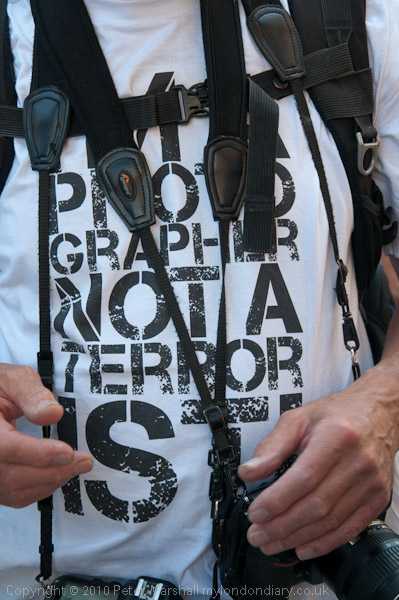
Photographers in London yesterday celebrated the final nail in the coffin of Section 44 of the Terrorism Act 2000 nailed in the previous week by the European Court of Human Rights. It wasn’t just used against photographers, though I think we suffered disproportionately, and all that now remains is for the government to give it a decent burial.

© 2010, Peter Marshall

There is some hope that some of the anti-photography laws such as Section 76 of the Counter-Terrorism Act 2008 (and I think its section 56a of the 2000 Act) which makes photography of the police and military that might be of aid to terrorists an offence will go with it.

© 2010, Peter Marshall

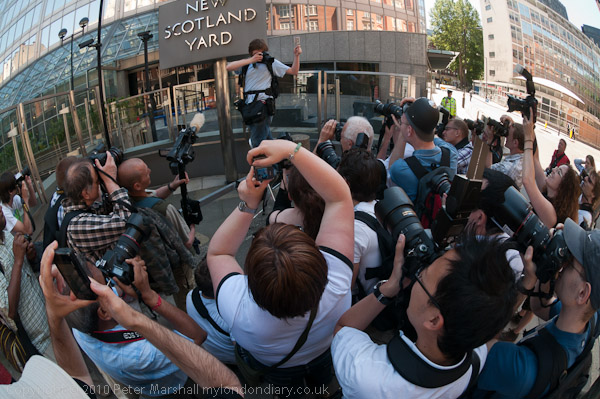
We  held a small victory celebration at New Scotland Yard at noon on Sunday and stood around taking pictures of each other. On David Hoffman‘s sousveillance blog (that’s him above) you can see me gazing up to heaven holding a Mamiya Press, though it wasn’t actually mine but its owner felt my beard went better with it.  Although I used to use medium and large format (when I had to) I never got around to buying one of these although I did rather lust after the 6×9 format (you could also fit 6×7 backs) and the rather splendid Mamiya 50mm on the model here, I think roughly equivalent to a 20mm on a 35mm camera. The widest lens I ever afforded for medium format was a superb but not particularly wide 65mm for a Mamiya 7 on the 6×7 format.

Things have changed so far as lenses and focal lengths are concerned. Forty years ago, 28mm was thought of as being exceptionally wide, although there were a few wider lenses they were really specialist items and few photographers used them. Come to that unless you were in a specialist field such as sports the longest telephoto in your kit was probably a 135mm, and my first 200mm was really something special. I didn’t find a use for the 300mm equivalent in my bag at this event, but it was worth fishing out the fisheye!

© 2010, Peter Marshall

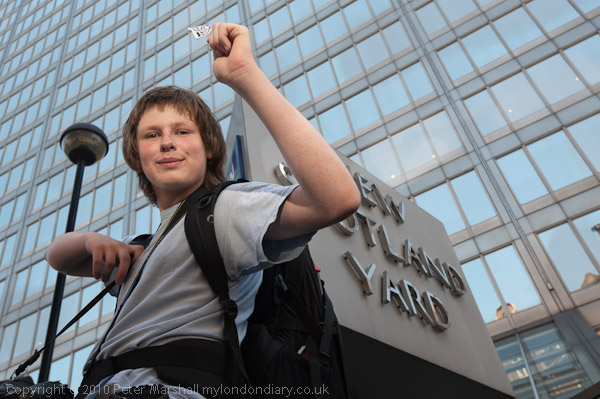
And the photographer at the centre of all this attention is none other than Jules Mattson who performed so well when wrongly arrested by police at Romford the previous weekend, also in the picture below.

© 2010, Peter Marshall

More about the flashmob and more pictures from my set on Demotix – and I’ll put them with a few more on My London Diary shortly.

South Korea Lose

Coming home on the train I met a whole group of friends of my wife and they saw my camera bag and asked me what I had been photographing.  “The World Cup” I replied, and it was true, although I hadn’t actually been to South Africa. Had I just flown back into Heathrow I might have come on that same train, as there is a local bus service rather ridiculously called by the rail company a ‘Rail-Air bus link’ which takes you to one of the local stations we had just passed through, though being rather more sensible I would have simply caught a different local bus that would take me (rather slowly) to ten minutes walk from my home.

© 2010, Peter Marshall

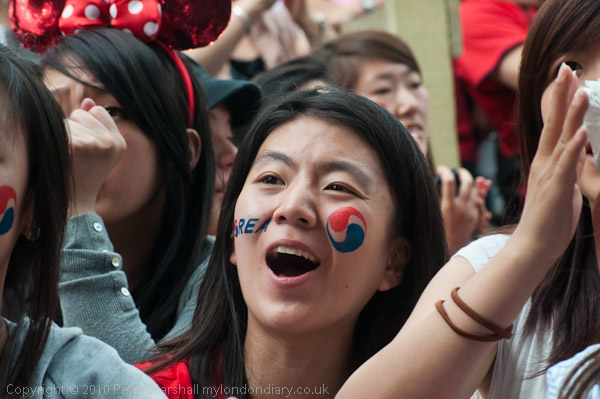
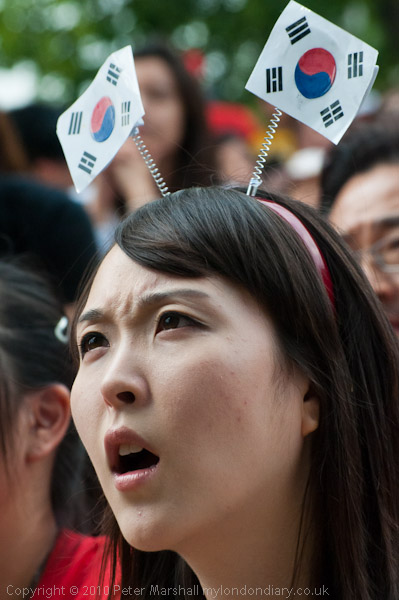
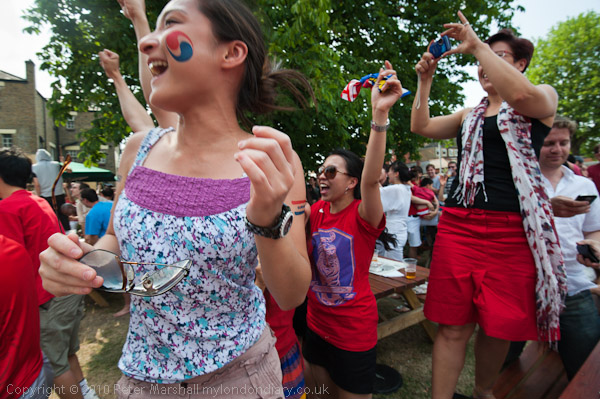
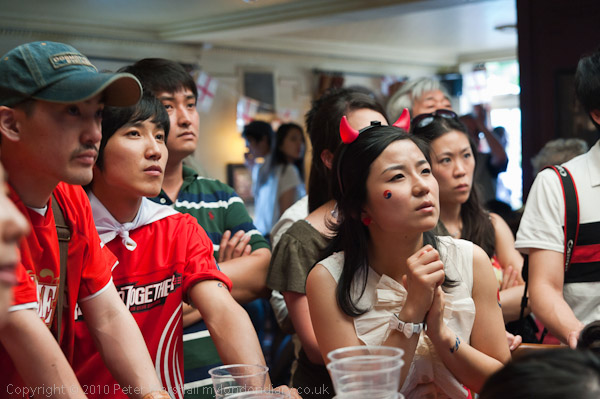
Actually I’d been in south-west London, at the Fountain,  a pub in New Malden in the centre of Britain’s South Korean community, watching the match between South Korea and Uruguay on a series of large screens surrounded by hundreds of excited South Koreans.

They had every reason to be excited because their team – many of whom play for English league sides from Manchester United down – had put up a pretty good show, dominating play for much of the game, and with a little luck the game would have been down to penalties or even gone in their favour.

© 2010, Peter Marshall

I’d decided to take the 16-35mm on the D700 along with the 24-70mm for the D300 (36-105 equiv) as my two main lenses, although at least for the first half I found myself shooting mainly with the 55-200mm on the D300 (80-300 equiv) as I stood between the screens along one side of the large pub garden facing the spectators.  There were certainly plenty of interesting faces and expressions as the game ebbed and flowed.

© 2010, Peter Marshall
South Korea Equalise – 1:1!

After the interval (time for a decent pint as my colleague had rushed to the bar just before the half ended) I decided to make use of the wide angle and mingle with the crowd, which involved quite a lot of crouching down so as not to interfere with their sight lines as they watched. Fortunately the seating was on a slight slope which made things easier.

We’d got permission from the pub manager to photograph, and very few people seemed at all worried by me getting close to take pictures with the wide angle. It’s perhaps a little odd as it is physically rather a long lens – and I sometimes get confused and pick it up when I want my telephoto – which is a little shorter. The long design is to make the rays incident on the sensor closer to perpendicular which causes problems as the sites on the sensor are at the bottom of small pits, leading to cut-off with oblique rays. Sometimes it’s an advantage as people to one side think you are shooting things further away, but it’s big enough to be a little intimidating when pointed straight at you.

© 2010, Peter Marshall

Probably it’s easier to photograph Korean supporters than English and I think they are less obsessed with ideas of privacy and more sociable and less suspicious than typical English groups. And although most were enjoying a drink, I think they were considerably more sober than I would expect from English fans.  At the end of the match, most left immediately. Obviously they had nothing to stay and celebrate, but few felt a need to drown their sorrows. I’d gone inside the pub to take pictures there a few minutes before the match ended. My colleague had stayed inside, working with flash (and I’m sure his results were fine) but I found I could get usable results in the fairly dim interior at ISO 2000 and above.

More pictures.

Watermarks

I don’t like visible watermarks on photographs. It so often spoils the enjoyment of photographs particularly where they are repeated at intervals across an image or are particularly large. Even where they are added in a reasonably sensitive way – as on the Demotix site which I contribute pictures to – for example this recent story about the Sharia Law related demonstrations in Whitehall or on other commercial sites, they sometimes just interfere too much with appreciating the pictures.

But increasingly I’m finding my work being used without permission or attribution on blogs and web sites, though unfortunately  so far seldom on the kind of site it would be profitable to take legal action against. Usually when I point out the problem I get an apology and a timely and appropriate response – removing the image or adding a link if it is the kind of non-profit acceptable use I’m happy to allow.

Most of the people who misuse images seem to do so out of ignorance. They search on Google Images, come up with a suitable picture and assume that because Google can use it so can they (despite what the site actually says.) We do have a lot of education to do about intellectual property rights.

Until fairly recently we didn’t realise the importance of image metadata and many web sites and web tools for preparing images simply stripped out any present to slim down image files as much as possible. In the days of dial-up connections, it paid to keep your sites clean and mean.  Now it’s long past time to get rid of such systems –  still around on some major sites – and everyone should now realise that removal of such information from files is an offence.

As a photographer I didn’t realise how important metadata was to me until relatively recently – perhaps around five years ago. Naively I assumed it was enough to just put a copyright statement on every web page, and metadata was then pretty obscure technology and time-consuming to add, even if you had software that could handle it.

Things have changed. Lightroom now adds my copyright data automatically from a preset to every digital image I take and import (its also there from the camera, but hard to find software that understands those notes.)  My Epson scanner software currently doesn’t have this capability, which I think is a major failing that they need to address.

The threat of orphan works legislation still looms over us here in the UK, despite the valiant efforts of some photographers (see New Thinking on Copyright) and our problem is that it does not only affect photographers. Some of the other groups with an interest in the matter were quite content with the proposals that were defeated, and I’m at all not convinced that we will get a satisfactory end result.

© 2010, Peter Marshall
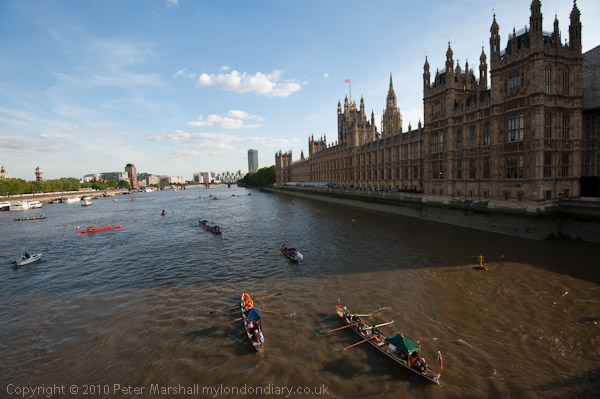
The watermark shows up well on the brown river water

So one of the things that I’ve changed as I moved to Lightroom 3 is to update my output settings for files to include a copyright watermark for all images I will put on the web. I’ve made it small, not very noticeable and in the bottom left corner of every picture. Although it isn’t always very readable, I think it is always fairly definitely present and hard to entirely miss.

© 2010, Peter Marshall
But not as well on some lighter images – though it’s still definitely there

It could easily be cropped off, although I think most people would realise they were doing something wrong if they did so. And I hope few of my pictures work quite as well with the bottom missing.

Actually, certainly when looking at a number of amateur sites, there does seem to be some kind of rule which applies, stating that the more prominent the watermarking the less the pictures are worth looking at (or stealing.) So I’m happier than mine are not too intrusive, though it might perhaps be nice to use one that automatically inverts the tone of the surrounding pixels in some way to produce dark print in light areas. I can’t at the moment see how to achieve this in Lightroom – unless someone has produced a plugin for it.

Budget Day Blues

We had an ’emergency’ budget ten days ago in the UK, though like most such things I don’t think it is going to make great changes. Perhaps the biggest thing for us is that from next January most things will cost more as VAT, our sales tax, is going to go up by 2.5%. So a camera or computer system now costing £1000 will cost another £25.  Not a great change, and currency fluctuations before then are quite likely to make a greater change in either direction, so it isn’t even necessarily a great incentive to go out and buy now.

© 2010, Peter Marshall
The flashing display on this lorry didn’t photograph well

There are traditional budget day pictures of politicians that I’m more than happy to leave to the staff and agency photographers who get paid to take such normally terminally boring stuff (which the papers etc keep on using) and just occasionally one of them will take something a little out of the ordinary that gets used.  Too often I’ve heard them show their work to other photographers and comment on the one good picture from such an event “of course they didn’t use it.”

But outside of this, it was pretty certain that more interesting things would be happening around Westminster throughout the day, though it was unfortunate I didn’t get there early enough for some of them, having business elsewhere to attend to. Parliament Square itself has been a more interesting place to be in over the last couple of months with the tents of the Democracy Camp set up on May Day adding to the long-term presence of the Parliament Square Peace Campaign that has brightened what was previously surely the most boring public square in London for over 9 years. It’s changed from being a grassed area almost impossible to reach, surrounded by traffic with no crossing places, to a lively area.

Last Tuesday, the High Court granted Mayor of London Boris Johnson  an eviction order against the Democracy Camp, and they have been given until 4pm today to leave or face forcible eviction. It is likely that many of them will fail to leave by the deadline, although I am not sure that the clearance will start then.

© 2010, Peter Marshall
Barbara Tucker keeping up Brian’s campaign as he was appearing in court on Budget Day

Although immediate eviction of the separate Parliament Square Peace Campaign is not expected, with the judge stating that Brian Haw had been camping legally in the square since 2001, this is only a temporary reprieve. The BBC reports the judge stating “As the terms of the injunction make it clear that he can continue to use a tent or similar structure provided he has the permission of the mayor, I would expect the mayor not to enforce the injunction against him until his application for permission has been considered.”

© 2010, Peter Marshall
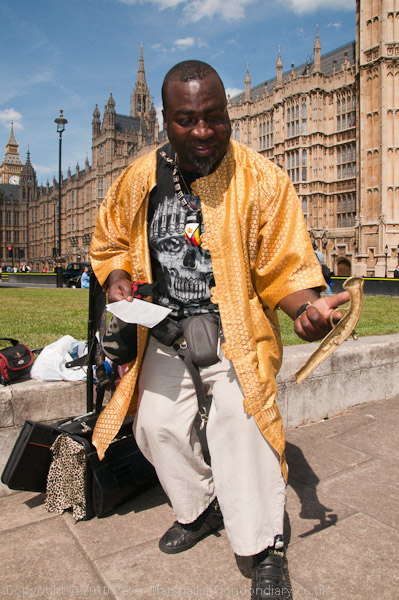
King David with his stop and search form and terror weapon

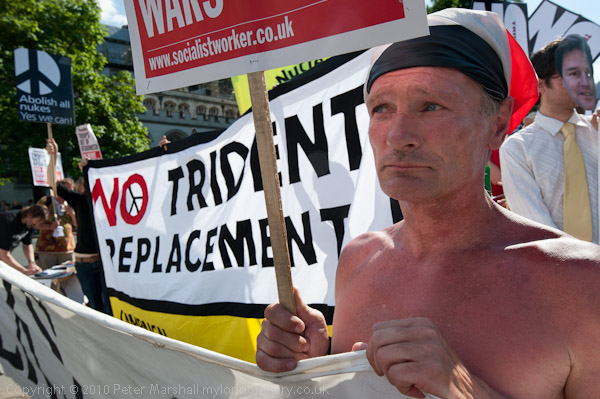
But back to Budget Day as well as the two groups living in Parliament Square there were also protests by trade unionists against government cuts, a protest over the housing problem, a funeral procession by a new group calling themselves ‘Can’t Pay, Won’t Pay‘. The police made asses of themselves by searching a man under terrorist legislation for waving a brass and clearly decorative antique pistol, the Democracy Villagers attempted and came close to making a couple of ‘citizen’s arrests‘ on former Labour ministers for their backing of the war in Iraq (which curiously some are now backing away from) and various politicians walked around in grey suits trying to look important and be interviewed by TV crews in the media village. And the final event (at least for me) was an early evening demonstration by CND and Stop the War.

© 2010, Peter Marshall

The real problem was knowing where to be at the right time, and I did miss some of the action (including those citizen’s arrests and the main trade union and climate change demonstration.)  It was also one of the few hot sunny days and at times I just went and sat down in the shade for a few minutes. Must add a sun hat to my camera bag!

More about what went on, and more pictures as usual in Budget Day in Westminster on My London Diary.

The Romford Incident

The arrest by police in Romford of young photojournalist Jules Mattson was a serious assault by police on the freedom of the press in this country.  I suspect they initially picked on him thinking he was an easy target, but his behaviour was an example to us all, keeping calm, continuing to state clearly what he was doing and his right to do so, showing a far greater appreciation of the law than the officers.  Throughout the confrontation in which he was eventually arrested by an Inspector Fish, he managed to continue to record the events, both on his i-Phone and also for much of the time continuing to take pictures with his camera which was on a strap around his neck, all despite having one arm twisted behind his back.  Of course when police illegally took his camera away from him he protested – and couldn’t take pictures.

You can read his own account, hear the recording and see some of his pictures on his blog. Even though at one point police pushed him down some steps (producing the single expletive in the recording) he continued to argue his case politely. As you can hear, it is an altogether remarkable performance, and one that few, if any,  more experienced photographers could have managed under the circumstances.

You can also read about the story elsewhere, for example in the Amateur Photographer, Boing-BoingThe Independent, The Register, Police SpecialsJack of Kent

You can also see some of his pictures in Police, photographers and the Law, a feature on EPUK in which Civil Rights lawyer Shamik Dutta answers fifteen key questions on police powers and photography in Britain today.

I first met Jules a year ago taking pictures at an event I was photographing, and was particularly impressed that he managed to sell his work to one of the organisations taking part. Since then I’ve met him regularly at events and occasionally seen his pictures on his blog and elsewhere – he has managed a remarkable amount of work considering he has also been working for his GCSEs. As well as putting images into various libraries he has also signed with one of the more active agencies around. As a full-time student not studying journalism he probably does not at the moment qualify to be a member of the NUJ, but certainly will have the support of many in the union, particularly in the London Photographers Branch where many of us know him, and his father is a member.

Legal action against the police is bound to follow, and I understand that he has the legal advice of the very same solicitor whose work last week resulted in Marc Vallee and Jason Parkinson each getting £3,500 compensation for being pushed around and forced to stop working outside the Greek Embassy in London in December 2008.

Sharia Shuffle

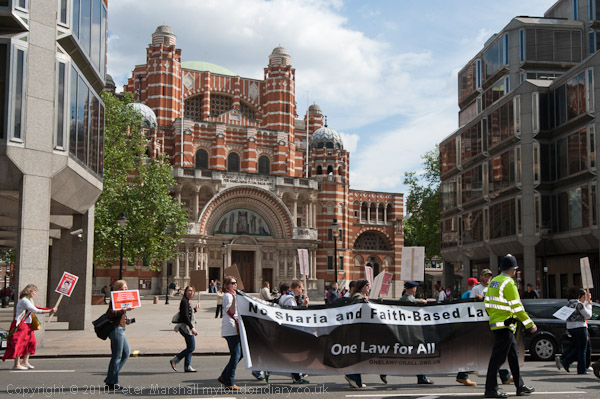
Whitehall got rather crowded at times the other Sunday afternoon with four different groups of protesters. The instigation of it all was a protest by ‘One Law For All‘, a group combining various people opposed to the imposition of Sharia Law in the UK.  They include members of various secular and human rights organisations and a large group of Iranian human rights activists, trade unionists and socialists of various persuasions. The denial of equality for women in Islamic societies is one of their main complaints and they call for laws to be secular and completely separate from religion, both in Iran and in this country.

© 2010, Peter Marshall

One Law For All  also believe in freedom of religion, but not in the right of people to impose their particular religious beliefs – or laws that arise from them – on other people.  Laws should arise from principles such as equality and human rights and not from religious books and their interpretations. In England we still have some remnants of faith-based laws – such as those against blasphemy, but in general our laws have moved away from this over the years.

© 2010, Peter  Marshall
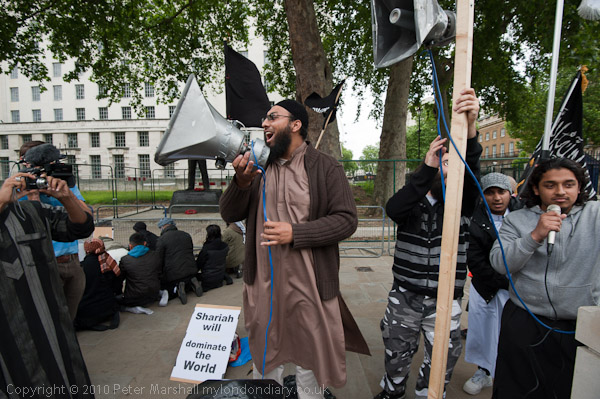
‘Sharia will dominate the World’

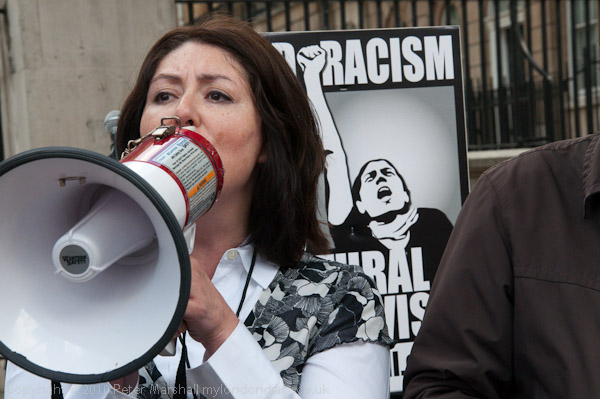
It clearly isn’t an Islamophobic movement, but  arouses vocal opposition from a small fringe group of fundamentalist Muslims who campaign for the UK to become an Islamic country.  This group, formerly Islam4UK but now calling itself Muslims Against the Crusades, is best known for its demonstrations at army home-coming parades, but was there a few yards down the road, using a high-power loudspeaker in an unsuccessful attempt to drown out the speeches at the One Law event. Fortunately police had places the two groups in pens separated by a few yards on Whitehall, and the rally was able to continue with few problems.

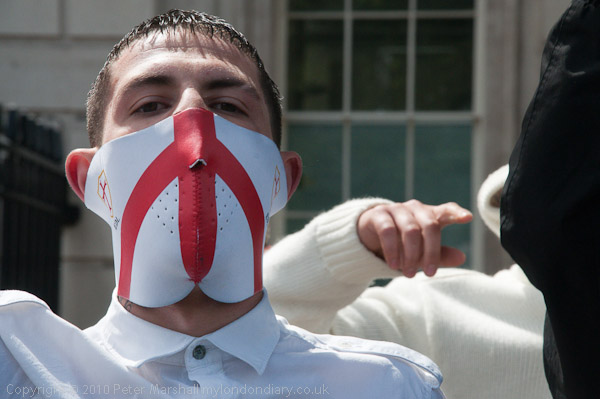
Next on the scene were around 20 or 30 members of the English Defence League, opposed to the increasing influence of Muslims on our former way of life in the UK. Some of the slogans they shouted were clearly Islamophobic, and One Law for all people clearly showed their disapproval of this. The police led them to a third pen, then searched most of the men and made sure they left the area.

© 2010, Peter  Marshall

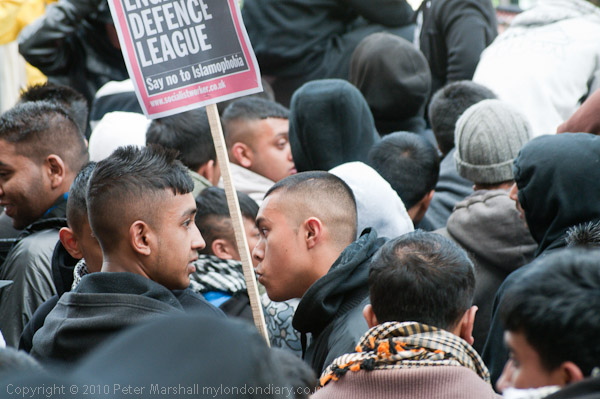
At this point I said to Chris Knight who was also watching the protest that it was hard to know who would appear next. But we didn’t have too long to wait to find out, as around 40 minutes later a heavily policed group of young Asian men came up Whitehall. They were looking for the EDL, and came from an East End rally against the BNP and EDL, both labelled by them as racist organisations. By then the EDL were long gone, and it wasn’t at all clear what these young men, mainly Muslims,  felt about either the Muslim or One Law For All protests.

© 2010, Peter  Marshall

While the police were holding this last to arrive group on the west side of Whitehall just past Downing St, the One Law For All protest started on its march to another rally at the Iranian embassy in Kensington.  They had got several hundred yards ahead of me and I ran after them and took a short cut across Parliament Square (those tents were a bit in the way.) As I ran, my SB800 flash decided to part company with the D700, suggesting that it was not fixed on properly – which may well account for the flash problems I had.

The combination of the Nikon 16-35mm on the D700 and the Nikon 18-105mm on the D300 (27-158mm equivalent) is a good one, the little bit of overlap between the two coming in handy, and covered virtually all my needs for these demonstrations. For some events the 105mm isn’t quite long enough, and it’s good to have the lightweight Sigma 55-200mm DC in my bag, and of course also the 10.5mm fisheye. There aren’t that many situations where the fisheye will work,  but when you need it nothing else will do. I didn’t use it here, though I did take a few with the 55-200 where the police were keeping photographers apart from the young Asians.

© 2010, Peter Marshall

Umbrella Parade

June 20 was World Refugee Day, and came at the end of a week where there had been various other events connected with refugees, although I’d not managed to photograph them though at the start of the month I had photographed a couple of events in the rather more radical European Week of Action to Stop the Deportation Machine. But the demonstration today was organised by the Refugee Week partnership, which  includes groups such as the UNHCR, Red Cross, Oxfam and Amnesty International.

Together they had ordered large numbers of white umbrellas,  rather more than the number of people who turned up for the protest, and others had brought their own decorated version, all to give the photographers something a little different to take pictures of. Unfortunately there weren’t many photographers, or at least not many pros, in evidence. Refugees aren’t news for our media unless they can manufacture some scandal or scare story about them flooding into the country in hordes, overburdening our social services, living a life of luxury thanks to our bountiful handouts. Unfortunately the truth – which is so very different – doesn’t get much of a hearing.

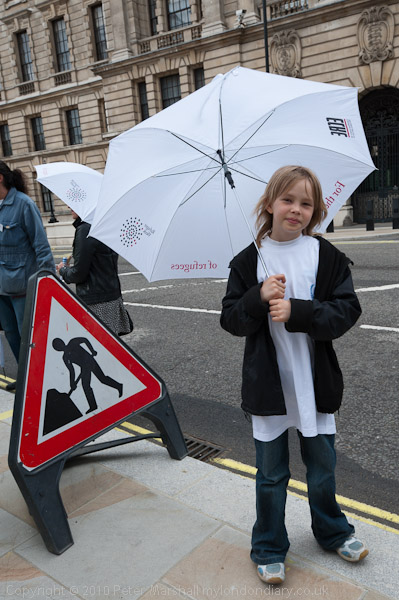
I don’t generally pose pictures, though I do often talk to people while I’m taking them and rather too often they pose for me when I do so, and I spend a lot of time asking people just to get on with what they were doing. This young girl really was just standing next to the road sign showing a man putting up an umbrella and I didn’t get her to pose :

© 2010, Peter Marshall

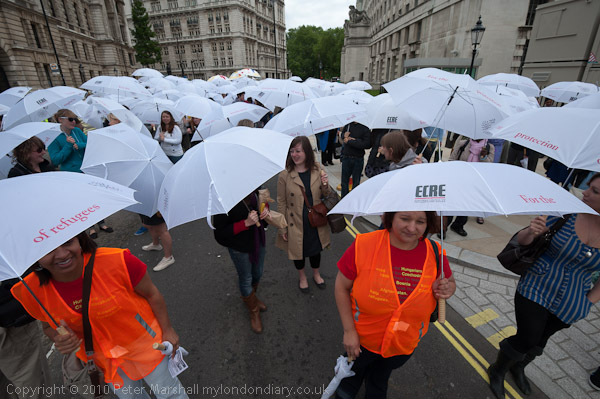
Probably the best opportunities for pictures came at the start of the parade and later when it was passing the Houses of Parliament, where Big Ben has the advantage both of representing the government and also meaning London to almost everyone around the world. At the start I was pleased to be able to take a view showing not just the street filled with people and umbrellas, but also to capture the full text around the umbrellas in the three most prominent”ECRE For the Protection of Refugees‘. It was just a little bit of luck, although had I been organising things I might have preferred it reading better left to right across the image. But this way the word ‘refugees’ gets more prominence.

© 2010, Peter Marshall

Incidentally, just after I’d taken the picture the woman on the left helpfully stepped out of my way, but by then I’d taken the picture. It was a ‘Hail Mary’ shot, holding the camera with the 16-35mm as high as I could reach, at 16mm, 1/500 f11.

© 2010, Peter Marshall

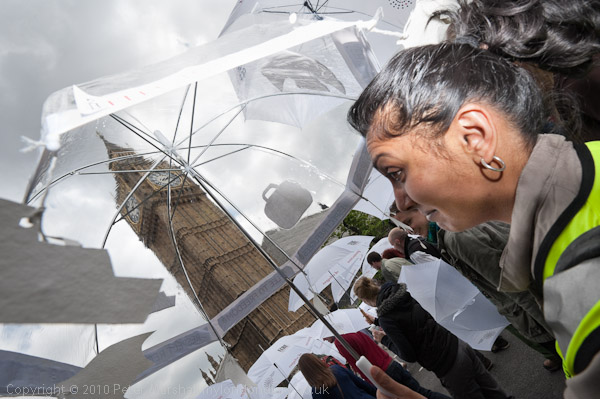
Some of the marchers had transparent umbrellas, so it seemed a good idea to shoot up through them at Big Ben.  Again nothing set up, I was walking along beside this woman, very close with the 16-35 at 17mm focal length, focus on the spokes of the umbrella and at f11 most of it is pretty sharp. As I noted in my previous post, I was having problems with flash, and only the top half of this frame received any flash exposure. Fortunately I needed it on the woman’s face and most of it was in that top half. I haven’t quite got the correction this image needs perfect (I did it in a rush to get the story on Demotix on the day) but I think it works well enough.

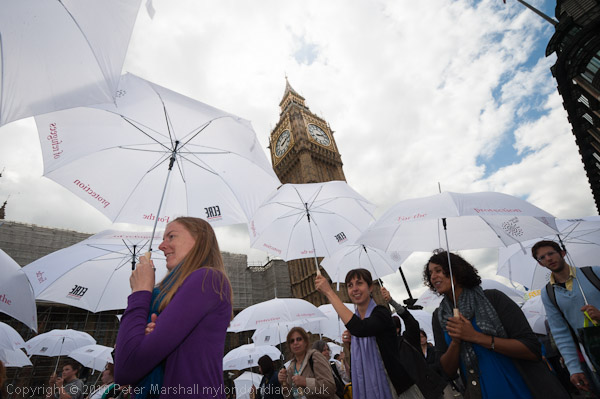
There are quite a few more examples of umbrella pictures in the set on My London Diary (which also tells you more about the event),  including some taken with the Nikon fisheye. Here’s just one more I liked with the 16-35mm, at 16mm:

© 2010, Peter Marshall