Flag Burning, Photography & Politics

© 2010, Peter Marshall
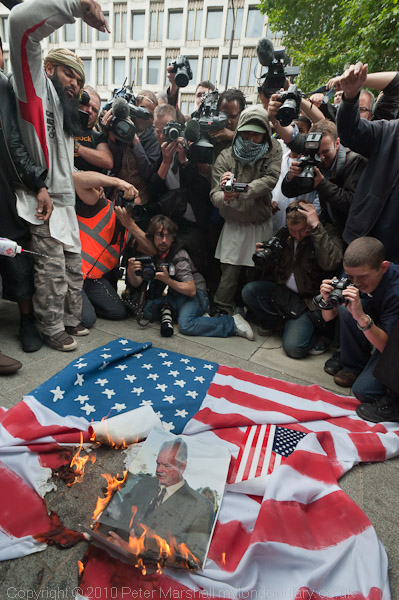
US Flag, photo of pastor Terry Jones, lighter fuel, US Embassy & Press. 16mm

One of the things that stuck in my mind from Antonio Olmos’s talk at Photoforum last Thursday was the advice given to him that he passed on to us, that “if you find yourself surrounded by photographers, you are almost certainly in the wrong place.”
© 2010, Peter Marshall
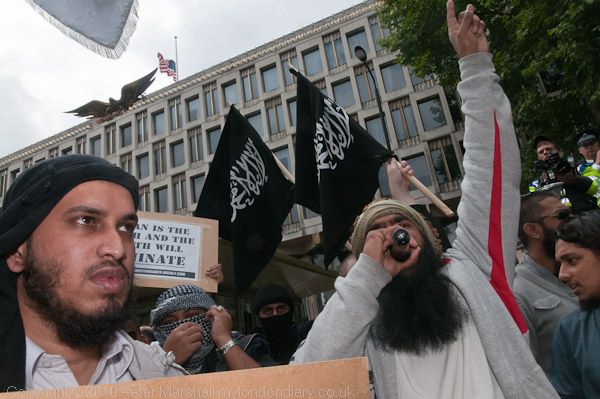
Rather tightly framed – and it would have been nice to read the placard

But at times at events such as Saturday’s demonstration and counter-demonstration outside the US Embassy in London’s Grosvenor Square there was rather a crush and it couldn’t be avoided. However at one point I found myself facing a very large group of photographers and was pretty sure that I was in a better place than they were.
© 2010, Peter Marshall
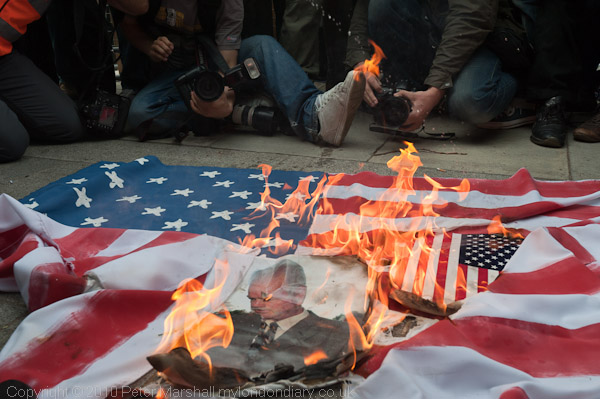
Pastor Terry Jones and the US Flag go up in flames

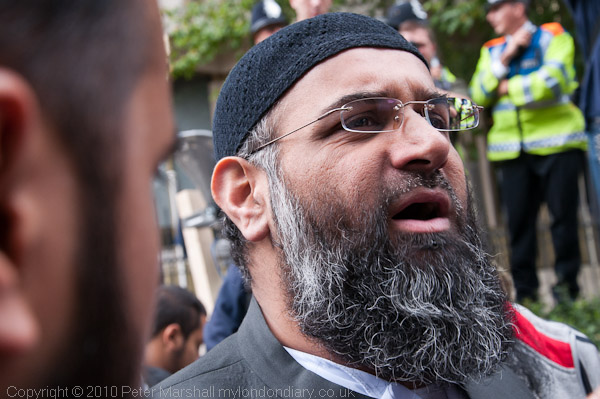
I’d been in the small crowd of Muslims Against Crusades taking pictures as they milled around on the pavement when I realised that their main man, Anjem Choudary, was beginning his speech and was able to get behind the front row of his listeners just a few feet from him to take pictures. I’d followed one man with a largish TV camera, and shortly afterwards there was another similar camera on my left shoulder. As often happens I had to move forward slightly to get their lenses out of my field of view, getting right up to one of the other MAC speakers.
© 2010, Peter Marshall
Anjem Choudary speaking outside US Embassy, police look on

Apart from wanting to photograph Choudary speaking, I knew that he was going to be around when they burnt the US Flag, so was a guy to stay close to. It would be good to get him in the frame as well as the burning flag, and if I could also have something recognisably the embassy in some of the pictures it would be a bonus. The most obvious thing was of course the eagle and flag – at half mast for 9/11 – on the top of the building.
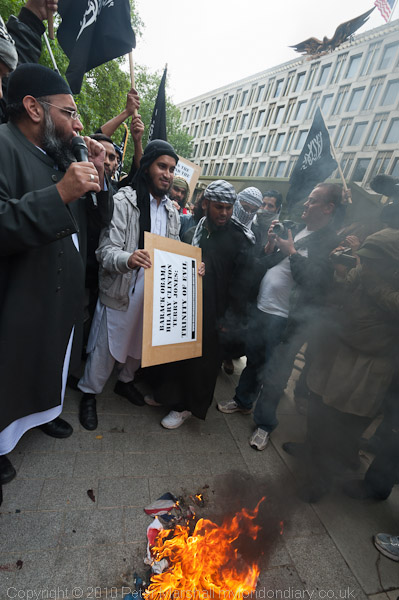
© 2010, Peter Marshall
A few more inches back would have been nice – but impossible

After the speech the crowd became more fluid as the flag was produced and I was able to move slightly to where I wanted to be. And I more or less got the pictures I had wanted, although at some point another photographer squeezed down low – but not quite low enough – in front of me. Those burning the flag placed it and also the photograph of pastor Terry Jones (which was remarkably resistant to burning) the right way round so far as I was concerned too, and the pack of photographers on the other side made an interesting background for some of the pictures.
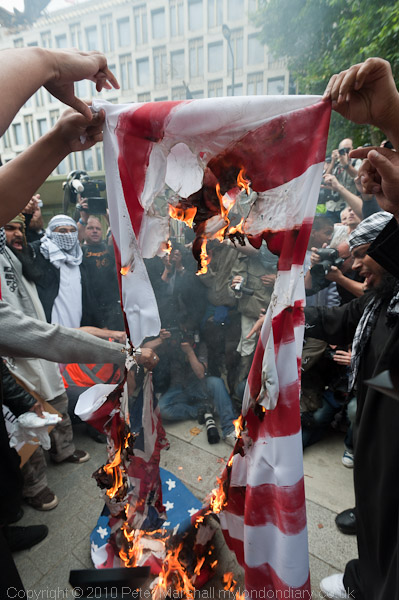
© 2010, Peter Marshall
Not quite low enough!

It would have been nice for all of us to have been able to move exactly where we wanted to get the best pictures, but of course that isn’t practical in such situations. There are always photographers saying “let’s move back so we can all get a picture”, but it seldom can work – and no hope at all in situations like this. You have to get in there while respecting the people working around you as much as possible by trying not to get in their way, and do the best you can.

Moving back occasionally makes sense, but generally it results in nobody getting a decent picture (and here we were in the middle of a crowd and couldn’t move back.) Capa’s dictum “if your pictures aren’t good enough, you’re not close enough” usually applies.
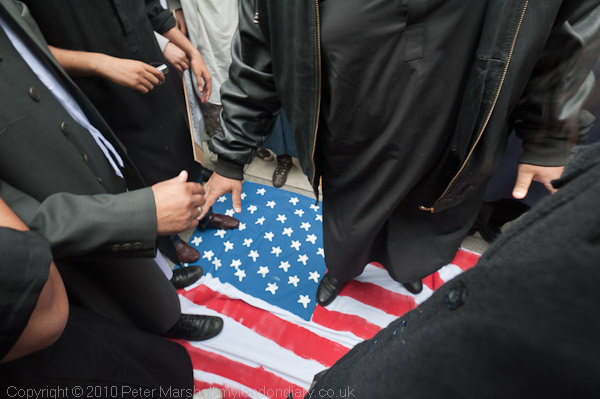
© 2010, Peter Marshall
Trampling on the flag needed a very close approach to see anything. 16mm

As people continued to squirt lighter fuel onto the flames I would have preferred to be a few inches further away as it was getting uncomfortably hot. Some of the pictures are taken at 16mm and the flames were rather closer than they look.
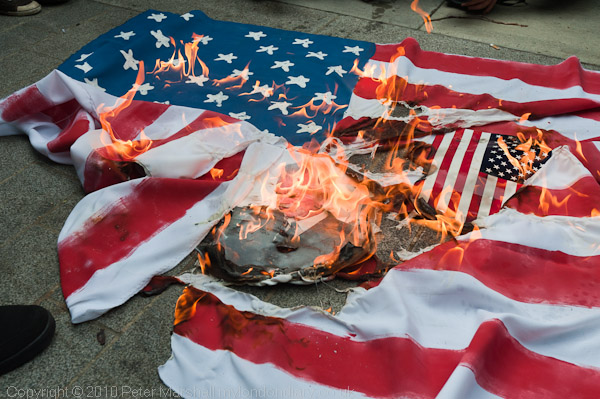
© 2010, Peter Marshall
35mm, but I was still getting rather hot

Later, as I was standing around between the MAC and the EDL and talking with other photographers we decided there was little to choose between the two groups of extremist demonstrators (or come to that government whose embassy we were in front of, that had given the world Vietnam, Guantanamo and more.) We thought about living under a country ruled by either of the two groups. The MAC seemed slightly more civilised, but there were other things to consider. “Beer” I said, “at least under the EDL you could get drunk enough not to care.” “Bacon butties” added another, but the real clincher came with “Adultery!”

My own politics? Well, if anyone ever tries to form a Liberal Democratic Christian Socialist Anarcho-syndicalist Environmentalist Situationist vaguely Pacifist party I’ll probably double it’s strength as shadow minister for culture and sport, areas where I would have some really interesting policies. Photography (real photography that is) would certainly get a much better deal under our administration and the current art establishment would be in for a very hard time. As for sport I’m at least 110% for it and think we should all be encouraged to do some, though of course I’d institute a total ban on anyone getting paid for playing games. You’ll have to wait for the rest of our manifesto.

More about the MAC protest and more pictures on Demotix,  where there is also a separate post about the EDL, who earlier had marched to the 9/11 memorial, laid a couple of wreaths and held a two minute silence for the 9/11 victims before coming to shout at the Muslim extremists. More pictures still in a few days time on My London Diary.
Brian Griffin at NPG

© 2010, Peter Marshall

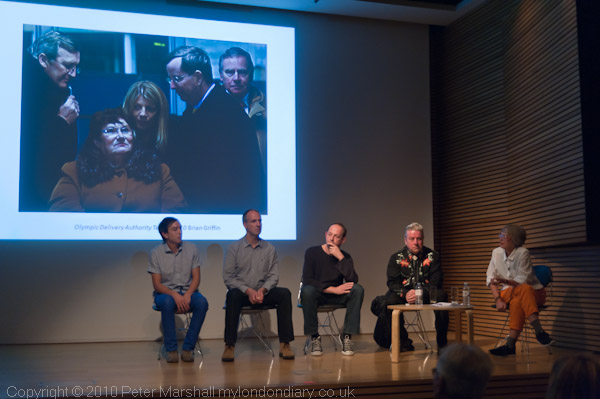
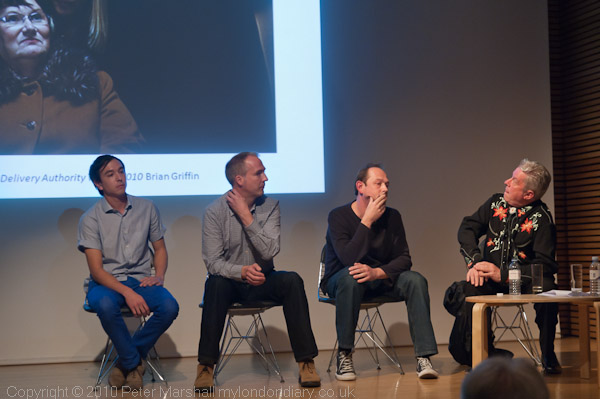
Last Friday evening Brian Griffin gave a talk on his photographs on display at the London NPG as a part of their London 2012 project until 26 September 2010 as a part of the late night opening there. I’d arrived over an hour earlier, having walked across from the Royal Festival Hall where I’d been meeting someone earlier who was on her way to an earlier start at the Royal Opera House, and thought I’d spend some time looking at the NPG collection and some of the other special activities on offer for the NPG’s ‘Late Shift‘.

I started by sitting for a portrait booth from ‘Take Away Art’ with Artist Joceline Howe hidden inside.  I have to say I found the two minute sketch of me disappointing, and the figure could have been anyone in a silly hat and a fancy frame, though I did rather like the portrait of the young lady who sat before me, but then she was considerably more attractive anyway.

I also took the opportunity to look at the exhibited work from this year’s BP Portrait Award, and have to say I found that disappointing too. There seems to be a current vogue for producing painted portraits that have a photographic look to them, and most of them I would have found rather disappointing as photographs. There were some other portraits I found more interesting but none of them were among the winners.

Also rather disappointing was the display ‘Twentieth Century Portraits‘, photographs taken by Dmitri Kasterine, that was due to open the following day but was actually in place for the Late Shift. Kasterine (b1932, England) whose father was a White Russian and mother English, began taking portraits in the early 1960s for Queen and other leading magazines, and the works on display include many well-known figures from the arts. A few of the pictures are rightly celebrated, the icons by which we remember, for example, Francis Bacon, but in the main I found most a little ordinary.

I think there is some more interesting work on his web site, and a family group I rather like on his blog posted last month that shows he is still busy.

Walking around the gallery it struck me that many of the more interesting pictures on display are not actually portraits – and that quite a few of the portraits are actually rather tedious, including much of the modern work. This came home to me particularly in a gallery entitled Expansion and Empire, where one of the more fascinating works shows Queen Victoria presenting a bible to an African guest, and another Florence Nightingale receiving the wounded at Scutari. (There is also another large image of the Queen visiting the wounded and also a picture of the relief of Lucknow.)  There are other portraits of Nightingale, the best of them certainly one of the small photographs on display but not shown on the web page. But it is the larger group images that dominate the room, and not just because of their size.

In a way I think Brian Griffin’s work for the Road to 2012 is a twenty-first century equivalent of these paintings of historical scenes, though of course he has not tried to portray actual scenes (though nor really do those historical examples.) But his work certainly does have something of their sense of theatre, although I don’t think Jerry Barrett or Thomas Jones Barker would have understood or sympathised with Anna Raybon‘s statement that the ‘Road to 2012‘ “was to be art, not PR“; clearly for them, even if the term was then unknown, PR and Art  coincided.

His talk was fairly well attended although there was plenty of room for more. Introduced by Raybon, the NPG’s Commissions Manager, the event started with a showing of the film clip of the live performance by Griffin and musician Steve Nieve on the Late show in 1988, which you can also watch on YouTube. Entitled ‘The Big Tie‘, it shows Griffin’s work on Broadgate, with a very young looking Griffin both talking and singing.

Friday he didn’t sing, but engaged in a conversation with Braybon about project and the making of some of the pictures. At one point Griffin demonstrated how he posed models “like puppets“, pushing and pulling their limbs into the positions he wanted, engaging them as actors in producing the scene he wanted. But he and Raybon stressed, the scenes only really came to life when one of the sitters added something of their own, such as when a young boxer leaned out of the tight sculptural group of four figures and raised his gloves to the camera.

Like most of his pictures, this image of the ‘young ambassadors’ from an East Ham school who had played a large part in swinging the decision to London was based on a painting, Griffin had an image of it in his mind but only actually identified it several months later on one of his frequent visits to the National Gallery.

Some of the sitters also had their own games to play. Griffin had wanted to photograph then minister Tessa  Jowell kneeling on the office carpet and draping herself onto a chair. But she came in and told him she wasn’t getting on her knees for anyone and he had to rethink. Is it just me that sees the picture that resulted with her arms out on a chair back as her with a Zimmer Frame?

© 2010, Peter Marshall

Griffin also stressed the teamwork involved in making these portraits, working with Braybon and others including his assistants on location – usually with two hours to make a picture. Towards the end of the performance he brought four of that team up onto the stage to answer questions – something that certainly came as a surprise to his printer, Mike Crawford.

© 2010, Peter Marshall

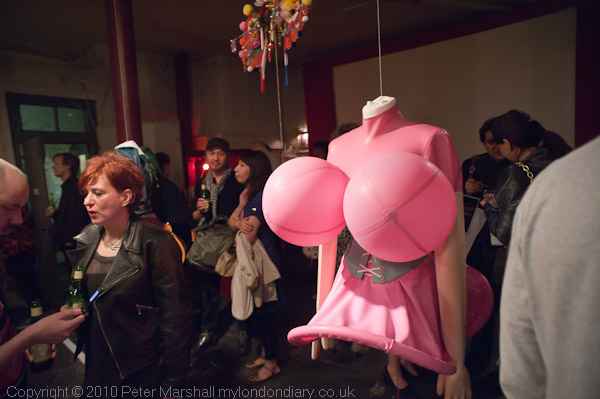
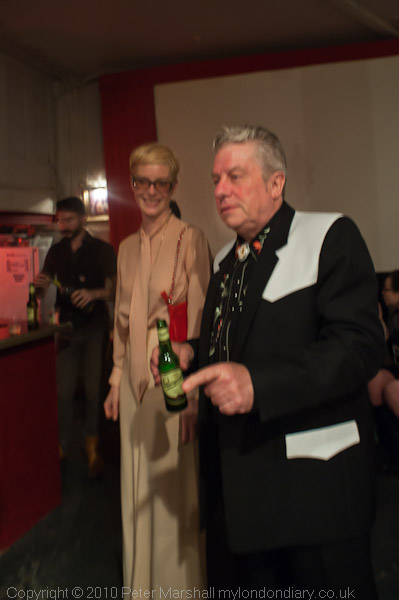
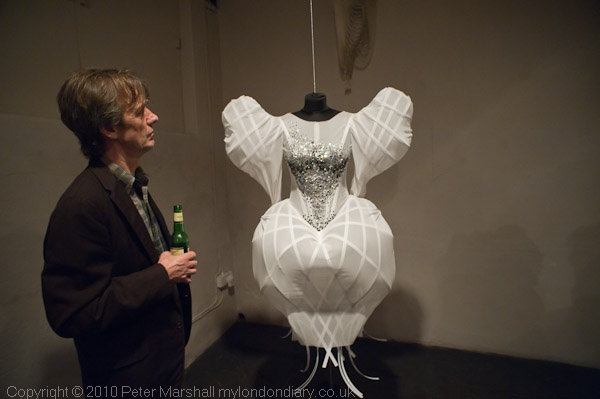
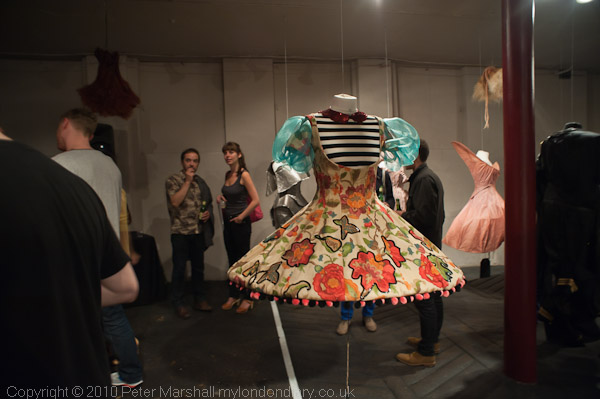
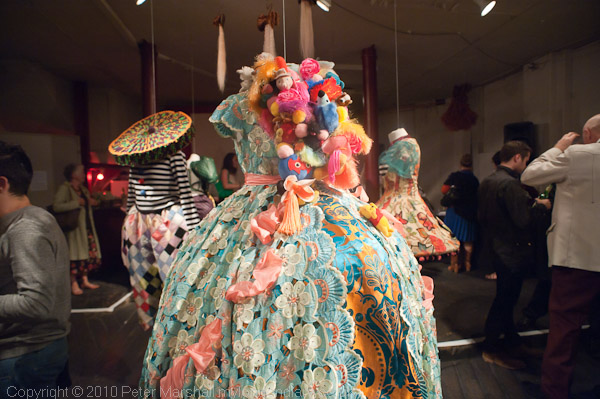
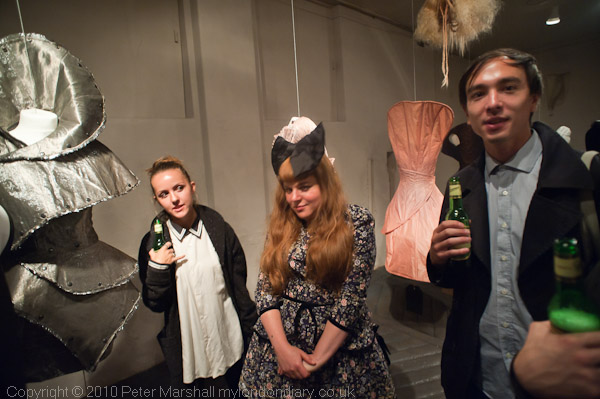
After the talk I went with Griffin and half a dozen of his friends to a show in the basement of the Horse Hospital in Bloomsbury, ‘Fake Food & Fast Cars: The Pop Couture of Kate Forbes‘, an incredible display of the “highly conceptual costumes” created by this film designer. It continues until 2 October 2010, and is certainly worth a visit.  I asked her if I might take some pictures, but failed to persuade her to move out of deep shadow in the dimly lit gallery.

© 2010, Peter Marshall
1/5s handheld and not quite sharp – Kate Forbes & Brian Griffin

© 2010, Peter Marshall

© 2010, Peter Marshall

© 2010, Peter Marshall

© 2010, Peter Marshall

Griffin, born in Birmingham in 1948, grew up in Lye,  between Halesowen and Stourbridge in Dudley and his show at the Collège des Bernardins in Paris from November 19 2010 to January 23 2011, ‘the Black Country’ is based on his memories of growing up there, with portraits based on people he knew as a child, including his family.

A couple of weeks ago he went back there to photograph some of the places that played an important part in his growing up including Ma Pardoes (The Old Swan pub) in Netherton, Netherton butchers, The Black Country Living Museum and Solid Swivel Engineering. After showing in Paris the pictures will go on display in Dudley in 2012.

Kate Forbes worked with Griffin on this project to ensure that the costumes reflected the period and location of his youth. The single picture from it on the web page, My Mother, 2010 shows a woman representing Griffin’s mother when he was a child, with hands soaked in some kind of black oily substance, in a factory overall.

Carnival Thoughts

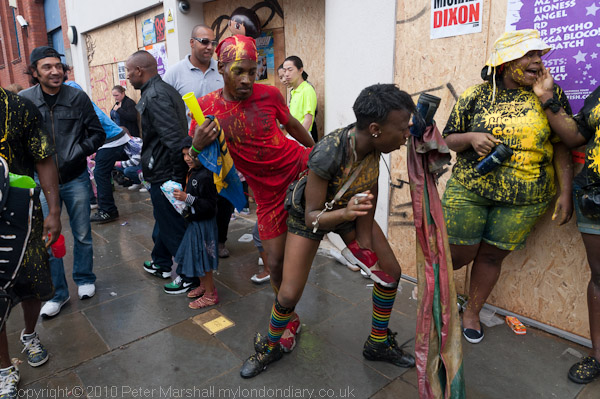
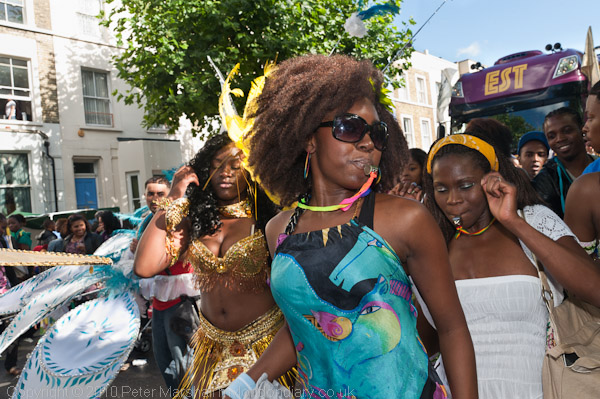
This year I didn’t spend as long as usual at the Notting Hill Carnival, arriving an hour or two later than usual as I was waiting for an gas engineer coming for an emergency service to our water heater on Sunday.  The weather forecast hadn’t been too good and it did seem a little less crowded than usual.

Sunday is Childrens’ Day at carnival, and is always a little less crowded, while the Bank Holiday itself can get too crowded to move around easily in many parts of the area. I find it rather easier to photograph on the Sunday, although the Monday is a better day for partying.

There did seem to be fewer elaborate costumes than previous years – perhaps the recession is hitting the carnival. Certainly many voluntary groups are expecting cuts in funding from local councils if these have not already happened.  But its always been the people that interested me more.

© 2010, Peter Marshall

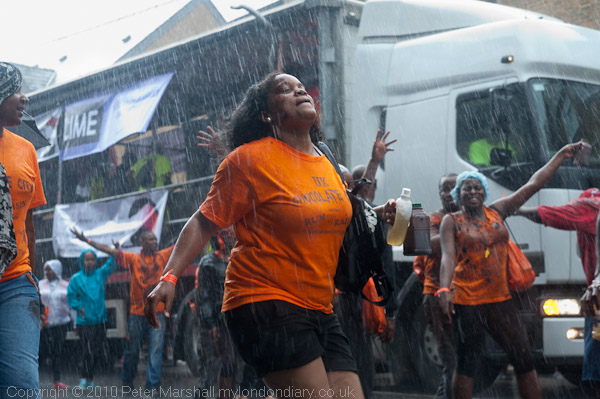
We got a little light rain, which didn’t dampen the atmosphere much at all, but dark clouds made a pretty drastic cut in light levels making photography a little trickier. But then it really poured down for a few minutes and I took shelter, while trying still to photograph the few braver souls who were partying on in the street.

© 2010, Peter Marshall

Fortunately for them (though perhaps not for me, as I rather like the effect of the driving rain) although the shower was very heavy it didn’t last long.  I was working at ISO 1250 and although the D700 is pretty waterproof I needed to keep just under shelter in that kind of downpour, so had the Sigma 24-70 set at 70mm. 1/160 s was just fast enough to get a sharp image despite the moving subject and gave rather nice streaks on the image.

Later the sun came out and the lighting got very contrasty. So working on Ladbrooke Grove I perversely decided to work in the trickiest area I could find for light. Fortunately Lightroom is able to work wonders if you shoot RAW (as I always do.)

© 2010, Peter Marshall
Image after processing in Lightroom

Here’s an example, with some of the people in deep shade and others in sun. I’ve evened things out a little with some fill-flash (nominally at -1 stop with the SB-800)  and exposed  (probably more by luck than judgement) to avoid burning out the almost white houses in bright sun in the background.  Here is what the file looked like when first imported into Lightroom:

© 2010, Peter Marshall
Raw file imported into Lightroom with my usual defaults

Back in the days of film and darkroom printing it would not have been possible to make these kind of changes.  Working with transparency, the starting point would have been completely burnt out in some areas – the situation hopeless. With colour neg there would have been similar highlight detail, possibly very slightly more, and with some fairly tricky burning I might have managed to bring out the blue sky and some of the building detail, but some of the more subtle changes would certainly have been impossible.

We do now have an incredible degree of control in the printing process, enabling us to change so much about an image with some precision. Back in the darkroom we could play around a little – as well as dodging and burning we could also try local warming of areas, swabbing them with concentrated developer or alkali, flashing and more, but they were all rather limited tricks and not exactly reproducible. Printing from the computer we can make precisely located and exact area adjustments of tonality, contrast, saturation, hue, sharpening etc.

Of course there may even be some people who prefer the effect of the original (as happened when I posted previously about how I’d improved a picture.  But it wasn’t the way I saw the scene and didn’t reflect what I was thinking when I took it.

Twickenham Pirates

It sometimes takes me quite a while to add things to ‘My London Diary‘ though I try to keep it as up to date as possible. But if you go there as I’m writing this on September 12th, the front page is still on August 2010. Well, at least the year is right, unlike quite a few other web sites.

My London Diary is a blog, but unlike this one that uses WordPress, it is rather more hardcore, hand-coded using html (though I speed things up a bit by making use of an ancient version of Dreamweaver, although there are some parts of the code it doesn’t understand.)  When I first put the site on line it didn’t seem possible to do the kind of thing I wanted to do as a blog, and even now it would impose limitations.

But the coding is hardly time-consuming, what takes the time is ‘developing’ and editing the pictures and writing the text. For events that I also post to ‘Demotix’ I usually write the text more or less immediately after the event, usually while the image files are being loaded to my hard disk and imported into Lightroom, and re-use that text with minor variations on My London Diary.  I’ll also select a small group of images for Demotix, and get them ready for uploading.
At some point I also make a wider selection of the images I’ve taken, process these in Lightroom and export full size high quality jpegs to my hard disk. These are the images that I generally work with, only going back to the archived RAW files if there is a special reason to do so.

© 2010, Peter Marshall

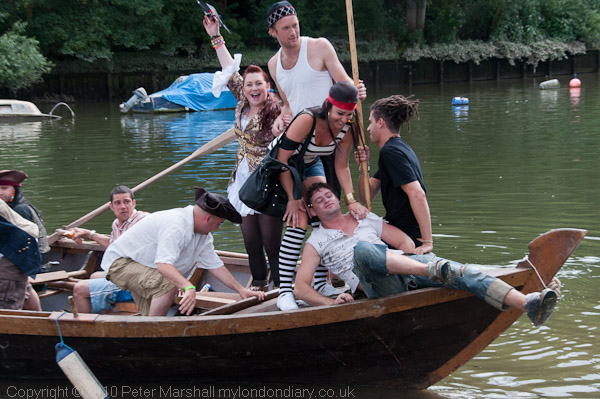
But I’d just forgotten about my trip to Twickenham, where I’d gone to meet my son and his wife and daughter and have afternoon tea (actually a beer in my case) with his mother-in-law. On the way we just happened to meet some pirates getting aboard for a trip on the river.  As well as some naked ladies and a few other little things. So I decided I ought to put some of it at least on the web.

Photo-Forum

Photographers who live in and around London who missed last night’s Photo-Forum should be kicking themselves. Apart from Ray Tang’s excellent brownies there was great photography from Antonio Zazueta Olmos and Kieran Doherty, making this perhaps the best evening yet. If you did miss it you can follow the links to their web sites where you will find most of the pictures that the two showed, but it just isn’t the same as seeing them projected on a large screen and hearing the photographers talk about them.

You can of course get something a little more personal on blogs, and both photographers write – if not too frequently – about their work online, with Olmos on photomexican (though the last post was in 2008)  and Doherty‘s started under his name in February this year.

Olmos impressed with his obvious love of photography, and in particular the  black and white work which inspired him to buy a camera by Bruce Davidson, Robert Frank and others.  And although he showed some fine colour work including set of pictures of Nicaraguan refugees he made it clear that black and white remains his first love. Some of his best pictures were produced travelling with just a single camera and lens (Leica M6 and 35mm)  although at times he took a deliberate decision to slow down his work by using a Mamiya C330 twin-lens camera. He found that people loved to be photographed by this camera and the different approach it entails, bowing towards your subject as you take the picture with the camera held firmly against your stomach.

Olmos also passed on a great bit of advice he himself received, that if you find yourself surrounded by photographers when taking pictures, you are almost certainly in the wrong place.

In recent years most of his work for the Observer has been portraiture, and although he now usually has to shoot for the paper in digital colour he still prefers black and white film, and showed us a powerful and varied portfolio of these images.

Doherty worked for many years for Reuters, and although he praised the freedom they usually allowed him, there was still obviously a great pressure to come up with the kind of pictures they wanted, and he obviously did a great job at doing so. His work showed a great willingness to experiment, having new ideas and trying them out.  But eventually he found he wanted more freedom and at a time when the recession was really hitting and all of us were finding things pretty tough (and he’d just taken out a large mortgage) decided to go freelance.

The most impressive of his work for me was a continuing project on Wooton Bassett, shot in black and white.  He is also shooting weddings, but not in the old formal way, but very much in a photojournalistic mode.

At every Photo-Forum there is a raffle, with the cash collected providing food in the pub after the event, and the prizes are usually prints donated by the photographers who give the talks.  And last night I was lucky and one of my tickets was drawn out of the hat. So I’m now the proud possessor of a print by Kieran Doherty.

Photo-Forum happens every second Thursday of the month, 6 – 8pm downstairs in the Jacobs Pro Lounge at 74 New Oxford Street London WC1A 1EU.

Doris’s 90th Birthday Ale

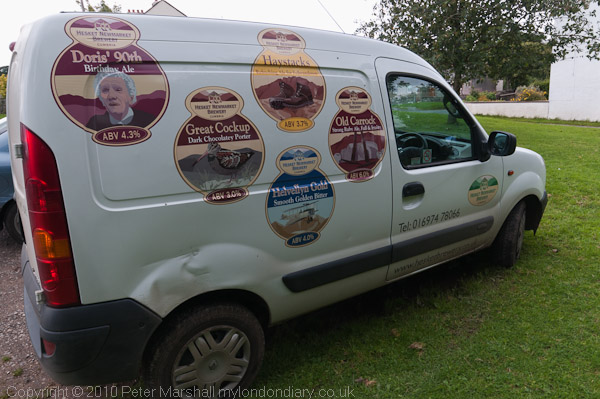
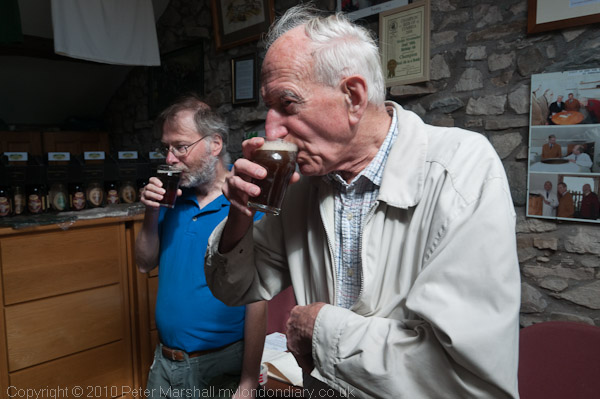
I don’t usually write about beer, but Doris’s 90th Birthday Ale is no ordinary tipple, and the Hesket Newmarket Brewery is probably one of the few things I find myself on the same side as unbonny Prince Charlie.

© 2010, Peter Marshall

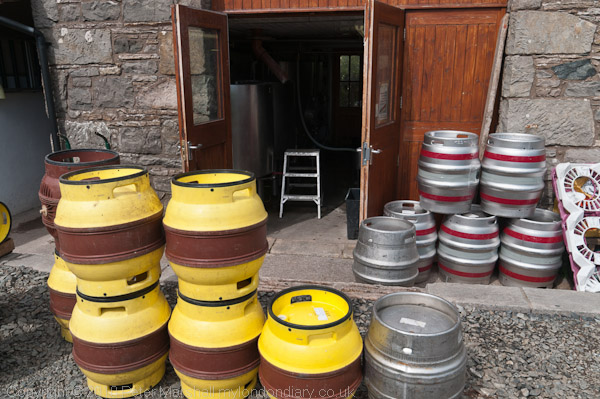
The brewery is an old barn at the back of a pub – the pub – in Hesket Newmarket, a small Cumbrian village about 15 miles south of Carlisle on the northern edge of the English Lake District. One thing that makes the Old Crown remarkable is that it is thought to be Britain’s first co-operatively owned pub, bought by a group of locals in 2003 when it would otherwise had closed. The cooperative had already bought the brewery in 1999 when Jim and Liz Fearnley decided to retire. They has set up the brewery in 1988 when they were running the Old Crown, and it became so successful that they had sold the pub in 1995 to concentrate on brewing.

© 2010, Peter Marshall

Doris was brewed in 1989 as their first expermental full malt beer, at the time of Jim’s mother-in-law’s 90th birthday, and he jokingly referred to it as ‘Doris’s 90th Birthday Ale’, although he had intended to name it (like most of the other brewery beers) after one of the local fells, Skiddaw. The name stuck and Doris became famous around the world among real ale drinkers. It was the beer that Prince Charles drank when he visited the village as patron of ‘The Pub is The Hub’ campaign. You can see more about the pub, the beers and the brewery on a video on the pub web site.

Unfortunately the pub doesn’t open at lunchtimes Monday to Thursday, so I was unable to try the pub food with a pint or two and had to make do with tea and a bacon roll at the nearby post office/shop/cafe, which was nice enough. But we did visit the brewery, and were treated to a glass of one of the ales, and could buy bottled beers.

© 2010, Peter Marshall

Travelling as I do mainly on foot and by public transport it’s hard to carry a great deal. Fortunately I’d left my Nikon 16-35mm at home, and its space in my camera bag was around the right size for a bottle of Doris’s 90th. Just a shame I couldn’t also accomodate the other half dozen brews on offer.

After arriving home, I had to let the bottle stand for a few days for the yeast to settle before carefully decanting Doris into a pint glass. It’s a clear orangey-brown liquid with a slight sparkle and a beer I could happily drink and drink…  If I lived in Cumbria I could see myself having it rather often with a meal in place of wine. The brewery web site describes it as ABV c4.3% and a “full flavoured, fruity premium beer with hints of butterscotch, carefully balanced with bitterness from Fuggles, First Gold and Herzbrucker Haler hops.”

Although these beers are avaiable at a number of pubs across Cumbria, most of the pubs I visited or went past were Jennings houses, and Jennings Bitter, the original beer from their Cockermouth brewery is a very decent pint which won the CAMRA Award for the Champion Beer of the North West 2009.

© Peter Marshall 1979
Photographers in the dimly lit pub at Brassington

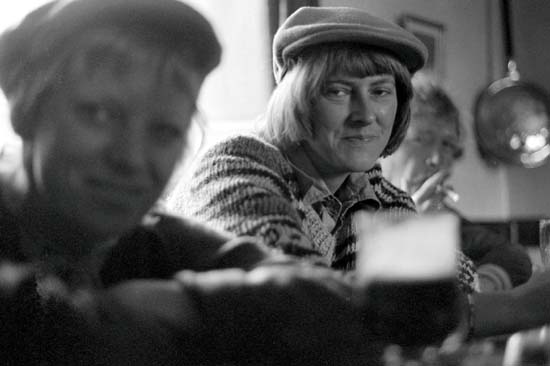
Jennings is now one of five traditional breweries in Marston’s Beer Company, and for me makes another rather tenous connection with photography. Although the series of photography workshops I attended in the 1970s were based at Paul Hill’s ‘Photographer’s Place’ in a converted barn at Bradbourne, their real centre of gravity was  a mile or two away at ‘The Gate’ in Brassington, where, as well as discovering much about photography I also came across for the first time, Marston’s Pedigree.

© 1979, Peter Marshall

More pictures from The Photographers Place and also some from Hesket Newmarket and the nearby village of Caldbeck, where you can see the gravestone of the famous huntsman John Peel on My London Diary.
Peter Sekaer Overhyped

Peter Sekaer (1901-50) was a Dane who went to New York in 1918, setting up a business producing posters for shop window displays. In 1929 he joined the National Art Students League to study painting meeting Ben Shahn, who probably got him interested in photography and also introduced him to Walker Evans. In 1933 he studied photography with Berenice Abbott at the New School for Social Reasearch and assisted for Walker Evans who was photographing artworks at the Museum of Modern Art.

Sekaer also went with Evans on his Resettlement Administration/Farm Security Administration (FSA) trip to the South, taking some pictures of similar subjects as they travelled around together. From 1936 to 1942 he worked for various US government agencies including the Rural Electrification Administration (REA), the United States Housing Authority (USHA) and the Office of Indian Affairs, working briefly for the Office of War Information (OWI) in 1941.

In 1945 he gave up working for the government agencies (and the American Red Cross) to freelance, moving to New York in 1947 where he did magazine and commercial work. A heart attack killed him in 1950, aged only 49.

Solo shows of his work took place at the Witkin Gallery, New York in 1980, in Copenhagen in 1990 and at Howard Greenberg Gallery in 1999. Books were published alongside the latter two shows. Currently the High Museum of Art in Atlanta, USA, which recently acquired 70 vintage prints of his work has a show ‘Signs of Life, Photographs by Peter Seaker, which continues until Jan 9, 2011 and there is also an accompanying book.

Searching for pictures under Sekaer’s name at the Library of Congress produces surprising few results; a set of images of an FSA trailer camp at the Vultee Aircraft Plant in Nashville Tenesse, taken in May 1941 for the OWI, and two earlier images, only one of which is on line.  The trailer camp pictures are undistinguished, a fairly dreary record of the site. The other picture shown, of mothers and children at the doorway of a brick home in a former slum area for the USHA, is a little more interesting but also rather routine.

The Library of Congress does include many fine photographs from the less well-known government agencies for which Sekaer mainly worked, taken by other better-known photographers – for example Arthur Rothstein. There are also some very run of the mill unattributed images. But unless I’ve missed something Sekaer appears to have produced little or nothing of worth for these agencies.

You get a rather more positive impression of him as a photographer by searching at the Addison Gallery of American Art which produces 17 results, one of which shows a page from a scrapbook containing 725 small prints by him (27 or 28 on the page shown appear to be contact prints including several frames of some subjects.) Not all of the other 16 pictures are on-line.

There are some nice touches visible in some of those which are. A young woman is posed behind a restaurant window in Charleston which has a cup of tea and a fish painted on it; the collar of her dress appears as a heart. But looking at most of them I can’t help thinking of rather stronger images of similar scenes by Walker Evans, Helen Levitt and others.

Sekaer’s ‘artist’ pages at the Howard Greenberg Gallery which include 25 images concentrates even more on those that make him seem heavily under the spell of Walker Evans. But frankly they just are nothing like as good. He isn’t a bad photographer, but just rather ordinary when compared with Evans  – as most of us would be. But there are two or three images that perhaps show something rather more personal, all including people. Images 19 – Lousiville, 1938, with two women and a child with an upturned tricycle and 21 – Untitled, 1938, with and old woman wrapped in a shawl on her front step, for me stand out above the rest.

Sekaer was obviously a proficient photographer, and doubtless his work adds something to our knowledge of the era he photographed, and the book may well be of interest. It’s good to see publications and shows of some of the minor figures of photography – and there were very many of them – whose contribution to photography is more in their collective input than in individual work. There are hundreds if not thousands more like him, and it would be good to see more of them recognised for what they are. But don’t let’s make them out to be overlooked geniuses.

You can read more about Sekaer and the High Museum show in a feature in the New York Times. Apparerently 53 or the works in the museum were acquired from the Howard Greenberg Gallery, and the piece quotes Greenburg as saying that had he lived to promote his work  “he would have had a great reputation.” Earlier the writer  seems to suggest that Walker Evans is better known because he “lived into his 70s and promoted himself as an artist as well as a documentarian.”

I have news for Eve M. Kahn – and also Mr Greenburg (though I think he already knows it but also knows his business.) Walker Evans is better known because he was an incomparably better photographer.

PG Closure Enigma

The British Journal of Photography somewhat surprisingly announces as a scoop the news that London’s Photographer’s Gallery will be closing for a month from September 19.

I thought the closure had been long planned and remember going to a presentation by the architects who were overseeing the redevelopment last year. And when I got home after the opening of the current Sally Mann show on June 18th I wrote:

I was disappointed in various ways at the Photographer’s Gallery opening of a show of Sally Mann’s work yesterday evening, the last to take place in their current premises before they close for extensive rebuilding. But the show, The Family and the Land, which continues until 19 September 2010, is certainly worth at least a brief visit.

So I’m hardly surprised at the news!

But the feature on the Photographers Gallery is perhaps one of the few interesting items in the otherwise rather tedious September issue of BJP, and you can read it online.

It’s also hard to understand the headline that says  ‘Photographers’ Gallery to close down for a year, answers criticisms‘ as it seems to me that it rather signally fails to do so in the article. I’ve been a member of the gallery since soon after it was founded in the 1970s (except for a short period where they lost my membership details)  but find it hard to disagree with the criticisms that so many photographers have of it and its programmes. 

Quoted by the BJP are Magnum’s Chris Steele Perkins (the BJP gets him to expand on his June statement “I don’t hate The Photographers’ Gallery, I just think they’re shit”) and Brian Griffin, along with other figures in photography.

The Photographers’ Gallery is funded as if it was a major institution covering the whole of photography in the UK, its £852,693 grant being almost as much as the other photographic recipients – Photoworks, Impressions Gallery, Open Eye Gallery, Photofusion, Redeye Photography Network, Hereford Photography Festival, Four Corners Film and Pavilion put together. What we really need is something rather more like New York’s ICP or Paris’s MEP, rather than an organisation that seems to be pursuing just a particular niche which many of us feel is peripheral to photography.

You can read my thoughts about the differences between the PG and the MEP in a post from two years ago, Paris and London: MEP & PG, and more of my thoughts about the gallery in a post from the opening of the gallery at its new site,  Zombies in Ramillies Street.

I’ve always supported public funding for the arts in principle and still do, but I often find it hard to do so when in so many areas so little of the funding flows directly into supporting arts practice and so much into questionable institutions.

Perpignan Winners

Lens has a nice feature on the top award winners at this year’s Perpignan Festival, with some interesting photography from Frédéric Sautereau winner of The Visa d’or – Daily Press for his work for French newspaper La Croix, VII photographer Stephanie Sinclair, winner of the Visa d’or Feature award for work for National Geographic & The New York Times Magazine and Damon Winter of the New York Times, winner of the Visa d’or News award.

It was indeed a very good year for photographers associated with the New York Times, although Lens would probably have run a similar feature even if their paper had not been involved.

So far as I can see in the awards page, none of the three winners or the other six nominated photographers is British or has any connection with any UK newspaper or magazine.

There are some fine British photojournalists, but we perhaps lack the kind of photographic culture that incubates great photography; few newspapers or magazines that publish more than individual images or encourage thoughtful photographic endeavour. So perhaps the lack of British names  on the list isn’t too surprising.

Heathrow Celebrates

 © 2010, Peter Marshall
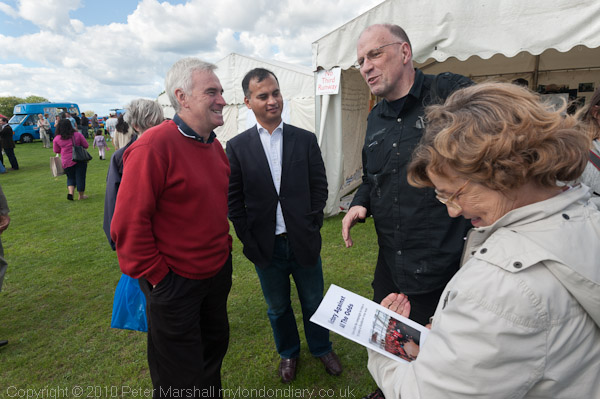
John McDonnell MP, John Stewart and others with Stewart’s latest work ‘Victory Against All The Odds’
My father used to cycle past the orchards of Heath Row, then one of the most fertile market gardening and orchard areas supplying food for London. My mother grew up on a market garden a couple of miles south of where the airport now is; around ten years ago the last remnants of the orchard her father planted were dug up for social housing.

Then came the airport, and they changed its name to Heathrow. We got used to planes passing a hundred or so feet above our heads on their way to touch down.  But the planes got larger and larger, and noisier and noisier. Then came the jets with a quantum leap in noise (and years later another leap with Concord, but fortunately there were few of them) and things became near impossible. Double glazing helped but meant you had to live with windows closed, and even then listening to the radio or holding a conversation was often difficult.

I moved a little away from the flight path, and when they built Terminal 4, the runway that took the planes closest to my house could no longer be safely used (bringing Heathrow down from its orginal five or six to a two runway airport.) But Heathrow seemed insatiable and unstoppable.  T4 was going to be the last they would ever need, but then came Terminal 5. Again they would never need another runway or terminal, but within a couple of years they were saying it was absolutely necessary to have a third runway – and it wasn’t long before they were also planning T6.

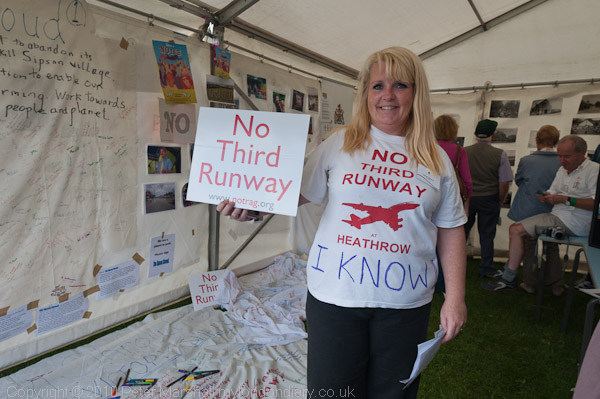
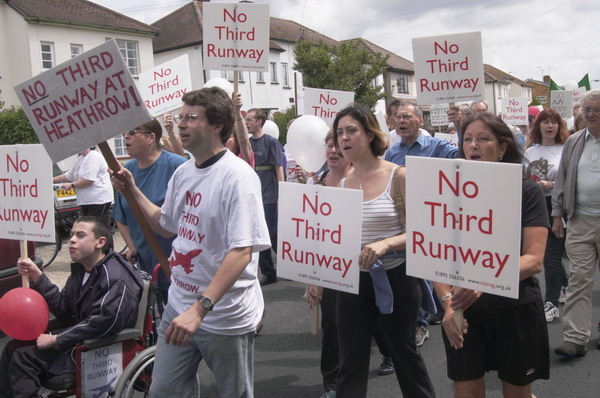
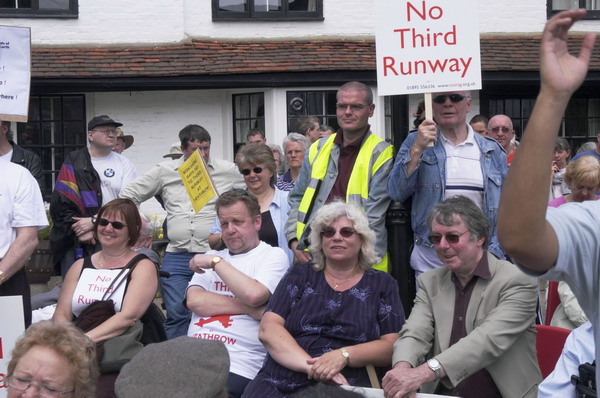
Local residents in Sipson, Harmondsworth and Harlington whose homes would have been demolished or impossibly blighted if the third runway went ahead decided to make a stand, and founded the ‘No Third Runway Action Group‘, NoTRAG. I photographed its first major demonstration in June 2003.

© 2003 Peter Marshall.
Marching in Sipson

© 2003 Peter Marshall.
The rally on the green at Harmondsworth

They kept up their fight, and built up a coalition with other groups including most of the local councils in the surrounding area and with environmental groups such as HACAN, led by John Stewart.  MPs too gave their support, including local MP John McDonnell (though my silly local MP preferred to support BAA – though it was his expenses rather than this that finally forced him to resign.) They fought the proposal at every level, with Greenpeace coming up with the idea of the ‘Airplot‘, a small piece of land in the middle of the runway site that ended up with over 80,000 beneficial owners – and I was one of them.The ‘Climate Camp‘ at Heathrow also did a great deal to raise interest and debate over the issues.

© 2008 Peter Marshall
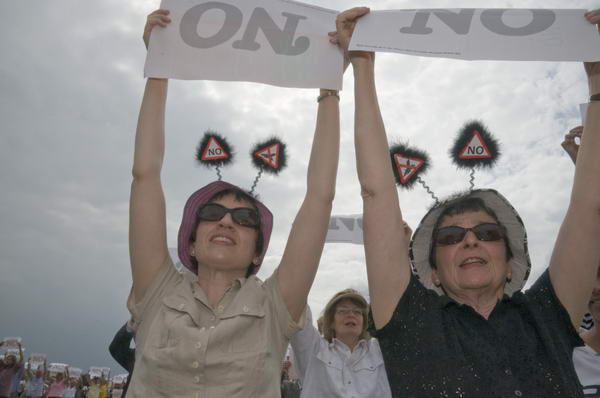
The Big No for Heathrow March & Rally, May 2008

Over the years I photographed many more events related to the campaign. More marches, Whitehall demonstrations,  the Terminal 5 Flashmob, and of course the Climate Rush on tour.

© 2009 Peter Marshall
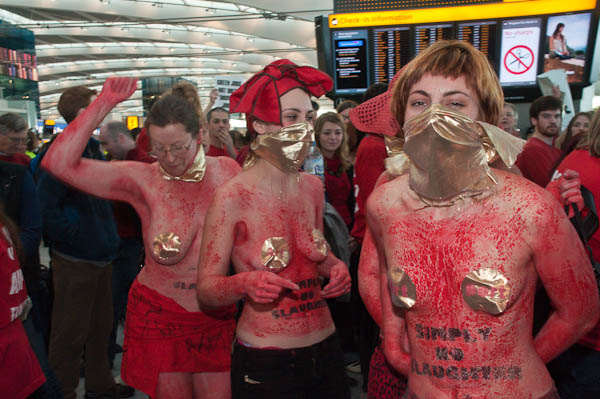
Terminal 5 Flash Mob

© 2009 Peter Marshall
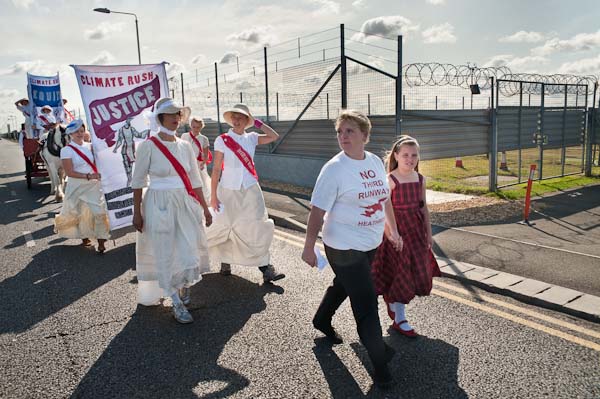
Climate Rush and NoTRAG at the perimeter fence, Heathrow

Airport noise caused by Heathrow effects much of West and Central London – several million people – and what had started as a local campaign soon became something much larger. And of course there were larger issues involved around the environment and a growing realisation of the accelerating damage that aviation was causing to it.

One important point came when the Conservative opposition came out against the proposal. Of course it was partly party politics, partly a matter of seeing the growing political importance of Green issues generally. And once they were in power they stuck to their decision, and the third runway is, at least for the moment, history.

© 2010, Peter Marshall

But although the photographs aren’t so interesting the event that pleased me most was the celebration at the end of August – pictures on My London Diary. It was as John Stewart said, a ‘Victory Against All The Odds‘. Everyone said at the start it couldn’t be done, but it was. And I’m pleased to have played a part – if very small – in it too.