Britain – What Lies Ahead

I’ve been spending many rather dreary hours recently retouching my black and white pictures from Hull in the late 70s and early 80s, including this image of the Humber Estuary, taken looking towards Hull from New Holland.

© 1981, Peter Marshall

It’s one of several hundred images I’ve recently rescanned and am working on before making a final selection for my next Blurb book, ‘Still Occupied, A View of Hull’, which will include images made between around 1975 and 1985. This is only one of a number of pictures I took of the channels in the Humber mud, though most were on the other side of the estuary.  This was made before the Humber Bridge opened, and we’d taken the ferry from Hull across the river. There wasn’t an awful lot to do on the other side – we could have taken a train to Grimsby, but decided against it, just walked around, took a few pictures and got on the ferry back.

This particular image is a distant vista of Hull, clearly recognisable on the far shore, but I also liked the crossing of the two gullies; most of the images I took showed single channels going out through the mud towards the distant water. One such image, taken by Vanessa Winship, who grew up a short distance upstream at Barton-upon-Humber, heads the FT Feature ‘Britain: what lies ahead?‘, in which she is one of ten photographers with connections to different parts of the country who were “asked to give us a glimpse of what the future might hold.”

Unfortunately, unless you subscribe to the FT you won’t be able to see the slide shows of their images, although you can read what they say and follow the links to their web pages, although the images that Winship took when she went back to her old school don’t appear to be either there or on her blog.  In the FT she writes that as a child she could look out of her bedroom river and see the lights on the other side – Hull – and would imagine that it was the end of the world.

I only crossed on the Humber ferry a couple of times, though I saw it many times arriving and leaving at the pier in Hull – perhaps even with Winship on board, travelling to college in Hull. Shortly after I took the picture above the Humber bridge opened, and the ferry stopped running, and I walked across the river to Barton. I’ve written previously in Sweet Nothings about Winship’s fine portraits of schoolgirls from eastern Anatolia.

Another familiar image on the accessible page of the FT came to me on a Christmas card from it’s author, John Davies and shows a scrap yard in front of a power station on the Mersey at Widnes. What you can’t see from the thumbnail on the FT page is that there is a St George’s flag flying above the top of the heap of metal in the middle-ground of the picture, put there by workers to mark their support of England in the 2010 World Cup.

The same picture appears in the ‘In Progress’ section of Davies’s web site,  and clicking on the link there takes you to a larger version and more information about this ongoing project “into the impact of waste disposal, landfill sites and recycling plants in North West England.”

Other photographers who feature in the FT article are Martin Parr, Patricia & Angus Macdonald, Simon Roberts, Simon Norfolk, Jem Southam, Hannah Starkey and Donovan Wylie.

I’m not sure that the piece as a whole has a great deal of insight into the state of the nation and its future, although perhaps some at least of the photographers appear to have a greater purchase on reality than  the FT’s comment and analysis editor Alec Russell who introduces the feature and reminds me that FT does after all stand for Fairy Tales.  I’m not sure that a world run by photographers would really be a good idea, but it could be a whole lot better than one run by bankers and economists.

Fay Godwin – Land Revisited

On Saturday The Guardian in its ‘Review’ section published an appreciation by Margaret Drabble of the work of landscape photographer Fay Godwin – and you can read it online too. It’s better online, as the single image which accompanies it, although smaller there, stands out much better on the screen than in the muted greys of newsprint, which also splits it unfortunately across the two pages of the spread.

It is of course a well-crafted piece, presenting much of the relevant information, but rather lacking so far as Fay’s relationship to the medium is concerned, and it contains at least one statement that I am fairly certain would have enraged her, when Drabble talks of her 1983 The Saxon Shoreway as an example of her “author-led publications“.  Indeed perhaps her only truly author-led work was her collaboration with Ted Hughes, Remains of Elmet (1979) which was one of her first and I think possibly her weakest works as a photographer. Drabble correctly describes this as a creative partnership between poet and photographer, but despite some fine images it is perhaps the only of her works in which she is arguably the junior partner.

The rules and attitudes of the publishing companies, which resulted in her early works – books which she had conceived,  and photographed, being listed under the names of the literary figures whose contribution other than their name was often rather minor (I can’t vouch for the actual words she used, and the phrase ‘I did everything but wipe his sodding arse’ that comes to my mind about one of them may well just be my own précis of her argument) with her simply as an illustrator remained a continual irritation to her, even after she gained the clout to get books such as Land (1985) under her own name.

I first met Fay at Paul Hill‘s cottage in Derbyshire, the Photographers Place in Bradbourne, where we had both gone to learn at the feet of Raymond Moore. She was then in her mid-forties and just becoming well-known in photographic circles as a landscape photographer. It was at the same place and probably the same time that I also met Roger Taylor who talks about her work  on the short video about the show, Land Revisited which continues at the National Media Museum in Bradford until 27 March 2011.

I never became a close friend, but we met occasionally at events and openings, and in many ways spoke the same language. Whenever we found ourselves together at a show we always took a tour around together, sharing our opinions (often unprintable) and enthusiasms about the work on the wall. We shared too some of the same influences – people like Moore and Bill Brandt who worked in this country, Paul Strand, and although we took it rather differently, the earlier US landscape tradition.

Brandt’s book ‘Literary Britain‘ was I think in many ways a fairly direct forerunner of much of her approach to landscape, and I think like me she would have preferred the perhaps rather gloomy 1951 original to the later more contrasty revision.

One of the texts on the National Media Museum site is by Fay, and in the previously unpublished ‘How Land Came About‘ her voice comes through very clearly, with a real sense of the frustrations she faced and felt in pursuing her work in an environment where photography was not valued by the UK publishing and media industries.  (Nothing has changed there!) There is also an interview with Fay from 2002 on the UK Landscape site.

Fay was fortunate in 1978 to receive a major award from the English Arts Council to photograph the British landscape during the brief period when they supported photographers rather than institutions. Work she produced from this provided the bulk of her show and book ‘Land’ (1985), perhaps the best of her books. The 2001 retrospective book Landmarks covers a wider range of her work as you can see her web site.

Fay died in May 2005, aged 74 (her website was updated to include some of the obituaries) and in 2008 “the entire contents of Godwin’s studio: negatives, contact sheets and exhibition prints (around 11,000 prints in total), as well as correspondence with some of her sitters including Ted Hughes, Philip Larkin and Doris Lessing” was accepted in lieu of Inheritance Tax by the government and is held by the British Library. You can see 128 of her images on their site.

I’ve written about her and her work on various occasions, most recently in a post here, Copying, Co-Incidence or Cliché? where both she and I made almost identical images of a sleepy stone lion at Chatsworth. Along the bottom strip of images on the page I link to containing her picture are thumbnails of a number of her finest images, and there are several others that are similar to pictures I’ve made and a couple that – at a glance – could be by Brandt. It doesn’t in any way detract from here as a photographer that this is so, but it does root her firmly in a tradition that she would have been happy to affirm, even if it seems not to have occurred to Margaret Drabble.

© 1980, Peter Marshall
This is not a photo by Fay Godwin! Sleepy Lion, Chatsworth  © Peter Marshall, 1980

Nick Clegg’s Birthday

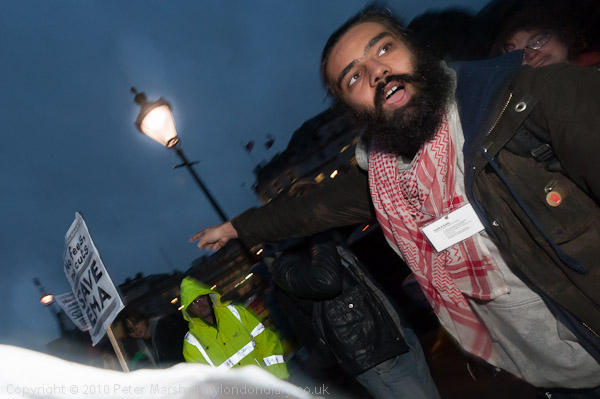
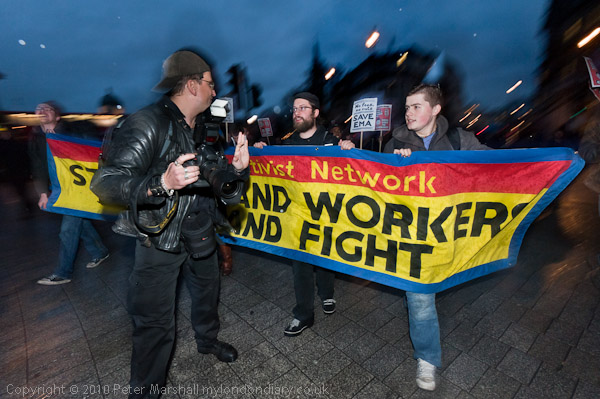
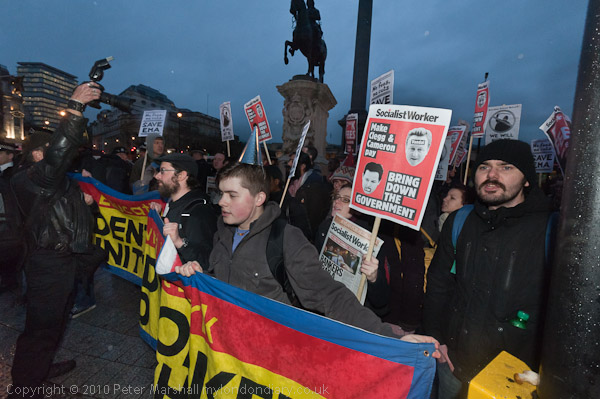
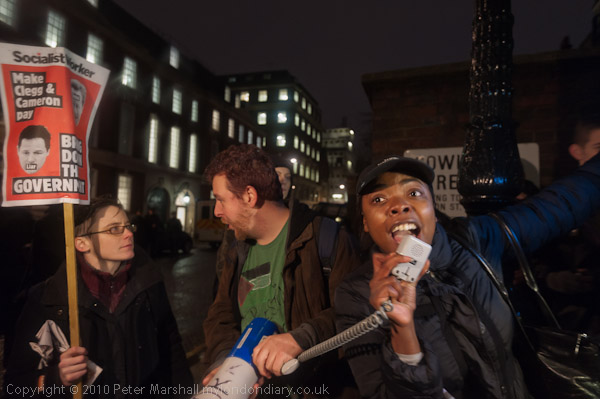
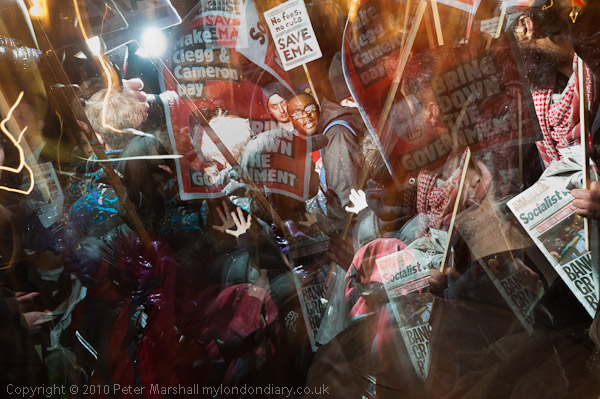
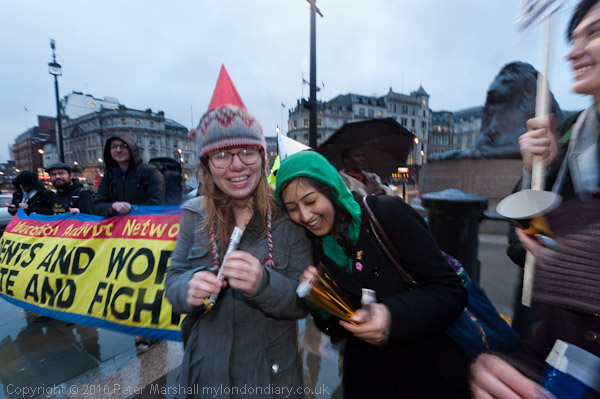
For some reason I didn’t get an invite to photograph the party, and I don’t think he has much to celebrate at the moment. But students seized on the opportunity to make a protest against university tuition fees, cuts in public services and in particular the loss of the EMA, the Educational Maintenance Allowance for 16-18 year olds, marching from Trafalgar Square down Whitehall and on past Parliament to the Lib Dem HQ in Cowley St.

Perhaps because of the weather it was a small protest, with only around a hundred taking part. It had been raining more or less all day, and perhaps the other nine hundred or so who had signed up to come on the Facebook page had decided they could wait until the next protest – which comes on Tuesday.  At 4pm when it was due to start there were probably more press than protesters in a wet Trafalgar Square, though a few more arrived a little later, and the light was already disappearing. So it was another day when I had to use flash.

The lens hood for the 16-35mm isn’t very effective at keeping off the rain – and I was holding a cloth over the lens between pictures, and wiping the UV filter as often as I could. But you still get drops landing on it while you are framing the image, causing blurred areas on the pictures.

Flash also lights up the falling drips, giving white spots on the images, an unnatural effect which doesn’t often improve them. I wanted to get plenty of detail in the background, so I was using slow shutter speeds with the flash, which tends to be rather hit or miss.

© 2011, Peter Marshall
ISO1600 1/13s f8

I soon switched to using 1/60 and had to put up with a rather darker background – it was getting around 2 stops less exposure.

© 2011, Peter Marshall

This was the call to start the march, and a picture I almost missed, very much grabbed on the spur of the moment, without time to think. This is actually the angle I took it as, though the picture is cropped at left and bottom, as there was too much of that close white coat in my way when I took it.

Again as I tried to photograph the start of the march, there was another photographer in the picture. I usually like to avoid other photographers in my pictures, unless there is a very good reason to do so, but sometimes there isn’t any choice. Possibly he adds something to the picture in this case. I’m someone who likes to work close to things, so I get in the way of other photographers trying to take pictures fairly frequently and they do the same for me.  But when everyone is trying to photograph the start of a march I usually work from one side (as I was here.)

© 2011, Peter Marshall

Apart from getting less in the way, I also usually find it makes the pictures a little more dynamic than a frontal view. There is usually plenty of time to get in close in the middle a little further on in the march without getting in other people’s way if I want to.

Of course we all get in each other’s way at times, and often other photographers will ask people to get back so that they too can get a picture.  But usually I’m happy just to work with what’s there – as in this case.

Trafalgar Square and Whitehall are of course fairly well lit, but the entrance to Cowley Street where the police had a barrier to stop the protesters was about as gloomy as it gets on London streets.

And it was here I made my big mistake of the day. I’d started taking pictures around dusk using  a mixture of available light and flash at ISO1200, and the D700 works fine in program mode for this, automatically altering the aperture when you switch the flash on.  But I altered the ISO to 3200 to cope with the lower light level and forgot to change to aperture (or shutter) priority mode. In ‘P’ mode the camera sets the aperture according to the ISO, and at 3200 it sets f10, which largely cancels out the advantage of  setting the higher ISO (see p382 of the manual.)  There must be a reason for this, but I can’t see it – surely it would make more sense to chose a single value – such as f8 -irrespective of ISO and to allow the aperture control to be used to vary this, as it does in non-flash P mode?

I knew I wasn’t getting what I wanted, but couldn’t work out why and how to put it right.  Of course the viewfinder display should have given me the information to work out what was happening, but somehow when I’m taking pictures it becomes completely invisible. Of course it’s usually there, but I just don’t see it.

I might have spotted my mistake, but it wasn’t the only problem I was having (along with the rain and being jostled by guys with big video cameras.) The D700 was in one of its moods where it wouldn’t focus, and half the time when I pressed the release nothing happened.  I started getting most of the information display blanking with a message [CHR] where the number of pictures remaining usually appears.

Turning the camera off and on didn’t help, but the error message disappeared for a bit when I opened the battery door and let the battery slide down for a few seconds then closed it up again, rebooting the camera. After a few exposures I had to repeat this.

Later, back home in the dry, I found on p413 of the manual that this indicates a memory card problem (so why CHR?) I hope it was just a dirty connection, and I’ve cleaned the card (a fast genuine SanDisk) as best I can, using a glass fibre contact cleaner brush and then pushing it in and out of the camera a few times. At home it now works perfectly!

I also cleaned the SB800 flash and hotshoe contacts, where there also seems to be a bit of a problem – I sometimes have to wiggle the flash a little after seating it to make a good connection.The cleaning doesn’t appear to have helped with this.

As you can see on My London Diary, I got some pictures, but they are not quite what I would have liked. By the time I finished taking pictures I’ve given up on the flash and was shooting by available light, largely provided by others using video cameras. But at ISO3200, 1/20,f4 few were as sharp as I would like and the colour with very mixed lighting was rather odd.

© 2011, Peter Marshall
Available light: ISO 3200, 1/20, f4

At one point I changed the flash setting and tried a really long exposure with flash, 2 seconds at f10, deliberately not keeping the camera still. While the shutter was  open after my flash three flashes from other photographers fired, each adding it’s contribution to my exposure, along with some video lighting.

© 2011, Peter Marshall

The result was mildly interesting.

A Small Step For Women

I looked hard on the Photo Boite web site, and on that of the Artbox (hold your mouse at right to skip the silly intro, but unfortunately the only way I could find to turn the annoying music off was at my speakers) to find information, but that isn’t what either of these sites are about. For me they concentrate too much on design rather than content and also get slightly up my nose by messing quite unnecessarily with my browser window, as well as being just a little on the slow side.

So I can’t tell you anything about how they selected the 30 women whose work is showcased on ‘30 Under 30 Women Photographers‘. Quite a few of them are French or based in France, some are Canadian or from the US, and a sprinkling from elsewhere. I didn’t recognise the names, but there were are few images I think I had probably seen before (and rather more very similar to others I’d seen before taken by other photographers, which is perhaps only to be expected in work by young photographers of either gender.)

Although I can’t say I found everything on the site of interest, and some of the work I found myself looking at rather more out of duty than interest, I think there are a few here that we may hear more of in the future.  The final item on each photographers set of pictures is labelled BIO and gives some information about the photographer – from just an email address to a page of text, sometimes in French.  But I think the site is , as it says on dvafoto, “Worth a look“.

So thanks to Matt Lutton and M Scott Brauer for posting a link to it, although I find their conclusion “It’s a great step in toward equality in the traditionally male-dominated field of photography” ridiculous. Although women are still under-represented in such surveys as PDN’s 30 (I think only around eight in the most recent selection) they have always included some of the best work there. A little over a third of the 30 Central and Eastern European photographers selected for the book ‘Lab East‘ were women. It may not be equality, but it is a very significant presence.

Of course, as Natalie Dybisz / Miss Aniela write in the foreword to ‘30 Under 30‘; “Visit a modern photography tradeshow like Photokina in Cologne, and most of the visitors you see swarming past are male, with their photography gadgets slung around their necks”. It’s a boy’s toy’s show which few if any serious photographers of either sex visit. There seemed to me to be a fairly high proportion of women among contemporary photographers represented by galleries at Paris Photo – and probably a majority in the people on the stands and in the aisles.

Women have been playing a vital part in photography for many years – even in Victorian times – although certainly very much under-represented until relatively recently and still to some extent, particularly in some fields now.  Almost all of my best students were women. I’ve known and worked with many women in photography and published many articles about women photographers – including some of what I consider my best writing on Julia Margaret Cameron, Berenice Abbott, Diane Arbus, Cindy Sherman, Nan Goldin and many more. Of course I didn’t write about any of them because they were women but because of the contribution they had made to the medium.

30 Under 30 Women Photographers‘ is one of many, many small steps that have been made towards equality, and I welcome and applaud it for that, though also wishing some of the work on show had been rather better.

Dancing on the Street

Thanks to Alan Griffiths of the Luminous Lint web site, which carries such a wealth of photographs for pointing out on Facebook a video interview with Joel Meyerowitz on featured on The New Yorker web site.

The clip is from a new 30 minute film by Cheryl Dunn,  on New York street photography, ‘Everybody Street‘, which was commissioned for the show the show ‘Alfred Steiglitz New York‘ just coming to an end at the  Seaport Museum  in NYC.

The Seaport Museum page on the film has links to the trailer and three clips which are on Vimeo. The trailer includes short comments from a number of the photographers, including Rebecca Lepkoff, now a remarkable 94 year old, who I wrote about some years ago as a part of a series on the New York Photo League, who has been documenting the city since the 1930s,  and as well as Meyerowitz there are also clips on Bruce Gilden and Mary Ellen Mark. Other photographers in the film include Tim Barber, Martha Cooper, Bruce Davidson, Jeff Mermelstein, Clayton Patterson, Ricky Powell and Jamel Shabazz.

Viewing Meyerowitz pretending to photograph on the streets of New York for Dunn’s camera made me very much wonder how that kind of behaviour would go down in – for example Peckham or Hackney, certainly without a film crew present.  But it – and his account of how watching Robert Frank at work – made him on the spot decide to throw up his job and become a photographer (he didn’t even own a camera at the time) also brought back some of my own thoughts and writing about photographing events on the street, and in particular this picture of mine from Notting Hill Carnival in the 1990s, about as a photographer becoming a part of the dance.

© 1991, Peter Marshall

London has also had its street photographers, and they too are to be celebrated later this year, although not so far as I am aware in a film. But ‘London Street Photography‘, opening at the Museum of London on 18 Feb 2011 (until 4 Sept) includes over 200 street images from 1860 to the present day, and includes  the work of 59 photographers – including around 47 still living, many of whom are still working. I’ll write more about this show – I have a colour  picture on the museum leaflet for it – and the accompanying book at a later date.

Flash or Not?

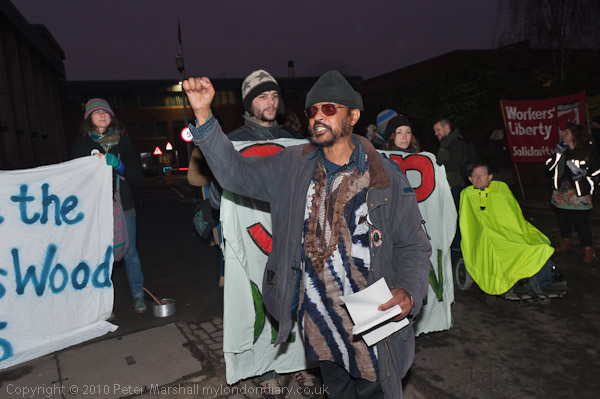
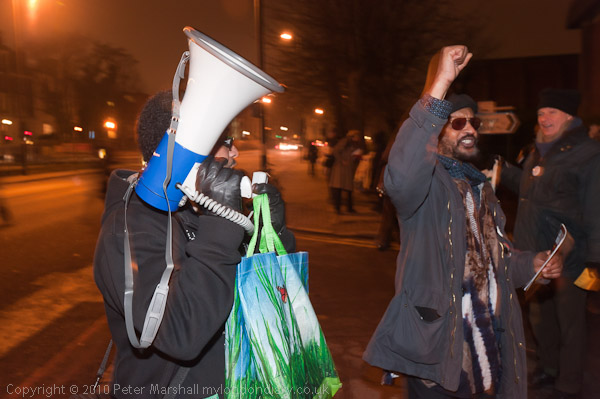
On New Year’s Eve I went to photograph a demonstration at Holloway prison (or as it calls itself ‘HMP Holloway‘.) You can read more about the protest calling for the release of the Yarl’s Wood 3 and see the pictures on My London Diary (or Demotix); here I want simply to look at some of the photographic issues. It was an overcast winter’s day, and even in the middle of the day the thick cloud cover had made it seem dark. The protest was starting at 4pm, and I determined to get there early to make the most of the light. I don’t much like having to use flash.

So I arrived at 3.50pm, to find only two people there, though others were beginning to arrive. So I wasn’t able to start taking pictures until a little after 4pm, by which time it was getting to be definitely dark.

While people were standing still, working without flash wasn’t a great problem, using the D700 at ISO 3200 and the 16-35mm wide open at f4 gave shutter speeds around 1/20 second. But once people start getting a little animated, things were rather different, and I had to use flash to get sharp images.

Here’s an example: Two consecutive images as the action was repeated, the first with flash:
© 2010, Peter Marshall
1/60 f8, ISO 1250, SB800 flash on camera

the second without:
© 2010, Peter Marshall
1/40 f4, ISO 3200. No flash

I made an error in choosing a slower ISO for flash, as it has severely reduced the exposure in the background of the image. I should have kept the ISO at 3200 and also used a wider aperture, perhaps f5.6 which would have put the ambient just around a stop down from the non-flash result.

The closer you get the ambient to the flash exposure, the more the chance of getting a blur combined with the flash on the moving person, often a nice effect, but other times something to be avoided. It might have been better to use a faster shutter speed with the flash, perhaps 1/125, though that would obviously have reduced the ambient fill over the image.

I can’t actually remember what I thought at the time, in fact I think I turned on the flash for the first image and didn’t really have time to think about it. Always easier in hindsight.

Neither image really truly reflects what things looked like. It was darker than the ambient only image suggests (showing detail in the dark skin tones meant I couldn’t afford to cut the exposure) and when using flash there is always the problem of fall-off, which you can fight against a little but not eliminate in outdoor images such as this.

Using flash makes the man in the foreground and his gesture stand out rather better; without flash shows the overall scene better, but he is not quite sharp, possibly both because of the slower shutter speed and less depth of field at the wider aperture.

A further complication in this case was that much of the available light in the foreground area was from sodium street lighting, almost all in the orange-yellow range of the spectrum and quite different from the flash output.

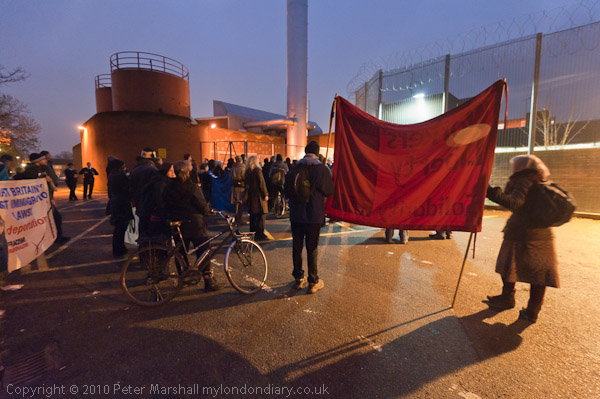
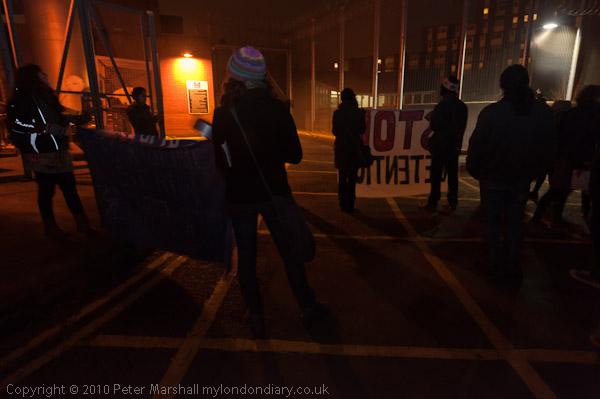
Later, around the back of the prison, some of the most effective pictures Later when it was completely dark and the group was at the back of the prison, there was a different lighting situation, with rather lower light levels and the people much more spread out. Working simply by available light produced some effective near-silhouettes, but when it got really dark some of the better results came from working with a small amount of flash to give a little detail.

© 2010, Peter Marshall
16mm, ISO 3200, 1/13 f4 no flash around 30 minutes after “sunset”

© 2010, Peter Marshall
An hour later with just a tiny bit of flash fill: 21mm ISO 1250 1/5 f8

For this I was using the ‘slow’ flash setting which allows the use of flash with slow shutter speeds, firing the flash at the start of the exposure (the normal flash setting has a user selected minimum shutter speed in some exposure modes, which I normally have set to 1/60.) I had to make a few experiments to get the flash level low enough to retain the mood of the image.

The Nikon also allows you to set rear shutter curtain flash, when the flash will fire at the end of a long exposure. It’s main use is that it get motion blurs that lead up to the sharp flash image.  On this occasion I managed to set it by mistake but took quite a few pictures with it as I found it rather amusing (and there really wasn’t a great deal happening that I hadn’t already photographed.) Using rear curtain flash is, I found rather unpredictable when trying to capture actions, but I rather enjoyed the challenge. It’s rather odd using it, as you get a pre-flash before the exposure and then the working flash at the end of the exposure.

© 2010, Peter Marshall
Using slow speed rear curtain flash: 32mm 1/5 f8 ISO1250 Rear flash

More pictures on pictures on My London Diary

Foto Follies 2010

I spent so long laughing at this great post by Jeremy Nichol on his Russian Photos Blog the other day that it got to be long past my bedtime and I forgot completely to mention it here. It’s worth looking at all the contenders for his awards, which are:

  • The Shop Till You Drop Award [sponsored by Adobe]
  • The Naked Gun Award For Photography And The Law
  • The Naked Gun Award For Photography And The Law
  • Quote Of The Year
  • The Heath Robinson Award For New Technology
  • The Stock Shockers Award For Image Misuse
  • Photo Credit Of The Year
  • Grand Prix de Folie Photographie

As might be expected, the Daily Mail makes a strong showing in the awards, scooping the Photo Credit of the Year with the breath-taking economy of it’s © Internet. Perhaps for 2011 they will take it a step further and save all unnecessary time-wasting and expense with the single all-purpose credit © Some photographer?

And no surprise that the winner in the final category was AFP for it’s spectacular mishandling of its copyright abuse over the Morel pictures which, as Nichol comments at the end of his Foto Follies 2010 Awards post, escalated a “simple and easily-settled matter of copyright infringement into a multi-million dollar court case .”

My Twelve for 2010

Yesterday I spent most of the day sitting in front a a computer. It was damp and rather misty and I needed to rest my foot which has been giving me pain for a few months now, so I turned down the offer of a long country walk with my wife and son, as well as the alternative of photographing the annual New Year’s Day parade in London, and tidied up My London Diary a little.

Every year this diary starts with a new page for the new year, with links to all the months in the year. That presents a small problem, in that when I set the page up, usually early in January, I’ve taken few if any pictures for that year. Most years it has started with a picture from the London Parade – this was the image from 2006:

© 2006 Peter Marshall.

and often that has been the last time I’ve got round to adding anything, although in 2009 I managed a picture from Jan 3 as well!

But this year – on Jan 1 2011 – I got around to updating the 2010 page, putting on a picture that I took in each month of the year.

Here are a couple of them, from August:

© 2010, Peter Marshall

and from September:

© 2010, Peter Marshall

and you can find out more about these and see the others on the My London Diary 2010 page.

The 12 pictures there include some of my favourites for 2010, but not all. The pictures I liked weren’t spread out nicely over the year, and there were several in some months but none in others. Also some were perhaps too peripheral to the event to be featured as the only image on the introductory page. Others were ruled out because I took them in portrait format, and the monthly page design works best with landscape format images (the opposite of this blog, where portrait format is better as it allows me to post large images.) And finally I wanted to the 12 between them to illustrate a reasonable range of the kind of events I’ve photographed over the year. So these are not my 12 best images for the year, although they probably include a few of them.

There is also the practical point that picking one from each monthly  page was relatively simple – I just had to look through a dozen web pages. To look through all of my work this year and select the best would have been a much larger job,  as I find (thanks to Lightroom) that I took over 83,000 in 2010, around 50,000 with the D700, 30,000 with the D300 and a handful with other cameras, a remarkable average of 225 a day. Not of course counting those that I deleted in camera before adding them to my catalogue, or those that I’ve since deleted from the catalogue.   So one of my New Year Resolutions must be to take fewer (and better!) images.

Detroit in Ruins

On The Observer web site today you can see a remarkable set of 16 images of ruined buildings – exteriors and intereiors – from the the US city of Detroit, made by two young French photographers, Yves Marchand (b1981) and Romain Meffre (b1987), self-taught photographers from the southern outskirts of Paris.  The illuminating report by Sean O’Hagan that accompanies the pictures, as well as explaining something of the background of the decline of Detroit, the city built on the car industry and once central to the American dream, later the Motown of the music industry, abandoned dream for dread, desertified into an American nightmare, also tells us a little about how the two photographers began this work.

Together they had been photographing abandoned buildings in Paris, and searching the web for more they came across a photograph of Detroit’s Michigan Central train station and immediately knew they had to go and photograph it. They made their first week long visit to the city in 2005, and returned for six further weeks in the next four years to produce a remarkable body of work, published rather expensively by Steidl as The Ruins of Detroit. You perhaps get a better impression of the work from the rather small page spreads on the Steidl page, but the best place to see it is the photographers’ website, where you can also see work from their Theaters project. It’s also worth exploring the ‘Press‘ section on their ‘bio‘ page.

Morel Case Continues

I’ve written previously about the dispute between Agence France Presse (AFP) and Hiatian photographer Daniel Morel in two posts, Agence France Presse v Daniel Morel and More on AFP v Morel Copyright Theft.  Basically AFP saw the pictures on Twitter and decided to use them, selling them to multiple clients and then not only claimed that they didn’t need to pay the photographer because he had put them on Twitter, but sued him for claiming copyright, asking a New York court to dismiss his claims.

An article on the NUJ Freelance Branch web site by Mike Holderness reports the result of that hearing, held on Dec 23, and it is generally very good news both for photographers in general and Morel in particular. The piece also links to the blog post giving details of the case by Associate Professor of Law Eric Goldman, of Santa Clara University School of Law, an expert on both cyber law and intellectual property law. Both posts link to the transcript of the proceedings. The court dismissed AFP’s suggestion that it could make free use of material posted on Twitter – AFP just didn’t have a case, as the judge makes pretty clear to their lawyer in the court proceedings, and it’s hard to see why they bothered to go to court on that issue.  So Morel can pursue his case and if AFP have any sense at all they (and Getty) will come to a settlement with him without a further court case.

Perhaps more importantly for the rest of us, the court  looked at Morel’s claim that AFP had breached section 1202 of the DMCA by removing copyright management information (CMI)  from the pictures. On Morel’s own page on Twitpic he had included his own name next to the images. AFP argued that CMI had to be actually included in the images, but the court decided otherwise. So even if you have images on line which don’t have metadata or a watermark, so long as your name is there on the page you probably have a claim under the DMCA if that information is not also kept with the images.

Things didn’t go entirely Morel’s (and Corbis’s) way. The court rejected the vicarious infringement claims against CNN and CBS because of a failure to plead any direct financial interest in their use of the images, and also their attempt to use trademark law.

The court transcript I think ends with the judge telling them it would be a good idea to come to an agreement, and if they cannot do so that the case could be brought back to him.

I still find it very hard to understand why AFP felt it could get away with this.