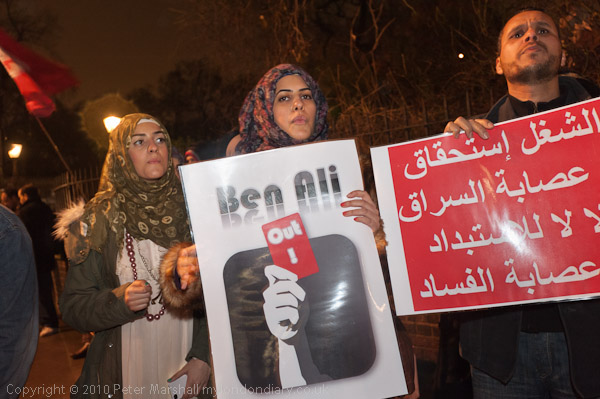
Penny Tweedie (1940-2011)

News of the death of Penny Tweedie came as a shock to me, when I read her Guardian obituary which reports that she died on January 14 at the age of 70. I didn’t know her well, but he seemed in rude good health when I last talked to her when she gave a presentation at the  NUJ Photographers Conference in May 2009, and was still very much taking an interest in photography and still taking pictures.  She didn’t at all seem an old woman, but a very lively person of my own generation, still young in spirit. We looked together at a few of the pictures in the NUJ exhibition, and she complimented me on my work in it.

Tweedie came into the profession from Guildford School of Art at a time when women were widely patronised and discriminated against. She had to fight against prejudice – even from the NUJ, and succeeded because  of her determination and talent – she showed she could cover all aspects of the job at least as well as the men.

You can see much of her work on her web site, including some of her better known portraits and some fairly recent pictures, such as those she supplied for the ‘Hospice in the Weald: Celebrating 30 Years Cookbook’ published last November. But her best work was made in the era when magazines published real photography and she worked for some of the best – National Geographic, Sunday Times, Observer, Independent and Telegraph magazines, using the money she made from them to finance less lucrative work, particularly for aid agencies including Oxfam. As  for the Hospice book, she often gave her work for good causes unpaid.

In 1975 the BBC sent her to Australia where she photographed a series they were making about Explorers, but it was the Australian Aborigines she met there that became her great preoccupation, and produced some of her best work and her books This, My Country  and Spirit of Arnhem Land as well as earning her a Walkley Award, Australia’s leading photographic award.

The Guardian article gives more details of her life and career, and includes near the end the chilling statement:  “it seems despair at the world’s lack of use for her craft finally induced her to take her own life.”

Inscape 81: The Urban Scene

I’ve written previously about Inscape, the ‘small magazine’ of ‘Personal Work in Photography‘ edited by William Bishop, which included a small portfolio of my work from Hull in Issue 80, ‘An Architectural Theme’.

The latest issue, No 81, includes work from a dozen or so photographers on ‘The Urban Scene‘ but more interesting to me was the written content, including two articles that make a call for further discussion.

Carol Hudson tells of her experience of using an iphone and asks “is photography, as we know it, now dead (or at the very least in retirement)?” and wants to hear what others “think about the rise and fall of the photographic document.”

A longer piece by Andy Biggs, headed by one of the more interesting images in the magazine, his photograph of the lower half of a rambler and a dog on a concrete pillar (a trig point?) at ‘The Wrekin’ that reminds me of an early Martin Parr, has the title ‘Is contemporary photography for constructed images only?’ and takes a look at some of the trends in photography over recent years away from the “desire by photographers to take their cameras out and record the world around” which he thinks photography should return to (and it’s a position I share) and ends with the short sentence: “Please discuss.” You can read a version of this article (without that final sentence) on his web site.

A quarterly magazine such as Inscape is not perhaps the most appropriate place for a discussion, which would inevitably proceed at a very slow pace. Perhaps the editor of Inscape should consider adding a blog to the Inscape web site, on which you can take out a subscription to this publication, which is also available at some select gallery shops.

When Inscape started, the Internet was in its infancy, and the only way to produce a magazine such as this was in print, but although the quality of that print has greatly improved, it could now be produced more easily and gain a greater readership and a wider group of contributors on the web. And if you have a copy of the magazine, and compare this image with the version of it on page 35, unless your monitor is badly in need of replacement, you will see that even though the reproduction in Inscape is pretty good for a magazine, the web can beat it hands down.


From ‘1989’ – you can see the web version & book online.

I’ve been a subscriber more or less since issue 1 and helped in the production of some of the early issues and also have a personal interest in this particular one, as one of the three book reviews in it is of my own book, 1989. The other two are ‘Intimations‘, Poems by Veronica More with photographs by Tom and Cordelia Weedon, and Gerry Badger‘s ‘The Pleasures of Good Photographs‘.

Also in Inscape 81 is a review of ‘Paris – New York – London‘ the show I organised in October including pictures by Paul Baldesare, John Benton-Harris and myself.  (The link above is to what Bishop refers to as my “learned and informative introductory talk” in his piece at the “wine-sodden celebratory evening.”) It certainly was a good night.

It’s encouraging to read anything about events such as this, and apart from in blogs (or at least this blog) there is little if any coverage of photographic events outside the few major galleries. Even though, as for example I said in my reports from Paris Photo, these are where the most interesting work is usually to be found (and of course plenty of the dire.)

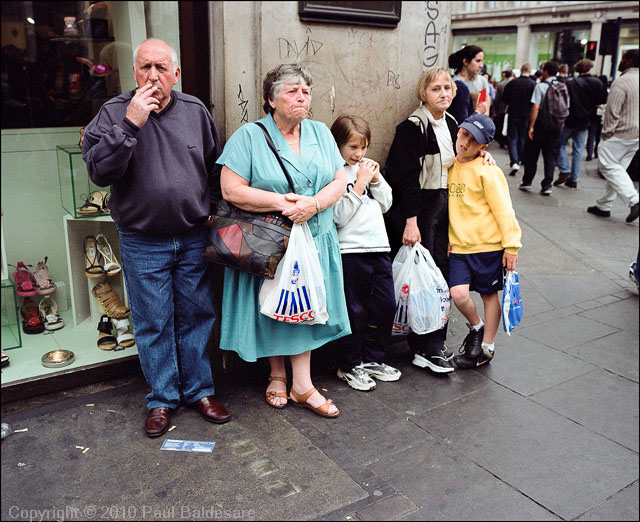
The two pictures reproduced with the review are both in black and white in Inscape, so here they are in colour:

© Paul BaldesarePaul Baldesare: A family group, Oxford Circus
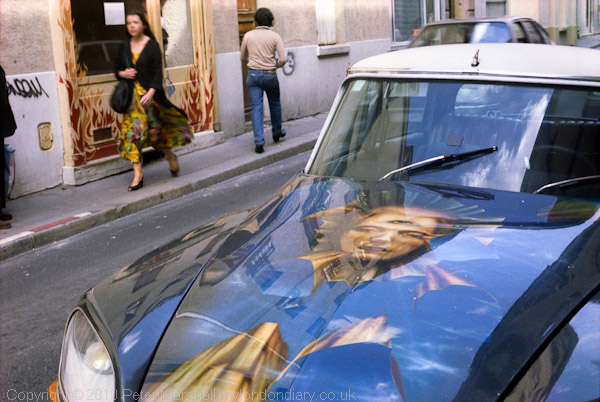
© 1988, Peter MarshallPeter Marshall: Paris 1988.

You can see more of the work from the show on the Paris – New York – London website, including some pictures by John Benton-Harris.

Contributions to the next issue of Inscape, on the theme ‘Work‘ are invited on the back page of the magazine, with a copy date of 21 March 2011.

Leave Counting Teaspoons to the Academics

It’s a while since I mentioned the online magazine Visura, which is now at issue 11. The highlight for me is a portfolio of the work of Elinor Carucci, pictures of her and her family. At the age of 21 she decided to “shoot things as they were happening. I returned to color film which is, for me, warmer, more vivid.”

The result over the years is a very intimate body of work, with pictures of her mother, self-portraits related to her own marriage and its problems, her back pain and her work for 10 years as a “professional Middle Eastern dancer, or as it is called in the West, a belly dancer.”

The work is very much a collaboration between her and her family, but particularly with her husband Eran: “Some of the photographs in this collection are a collaboration between us, a few of them are Eran’s own take on the situation, his own work.”

Other portfolios in the issue also have a very personal, intimate theme, and although I find some of them of interest they move me less, and at times some I think go over a difficult to define line of using people and some simply fail to engage me.

Stephen Crowley‘s images of men and boys from Afghanistan were made using the cameras and equipment of street photographers still working in old-fashioned ways there. It isn’t of course the calotype process as he states, but uses commercially produced photographic paper. There are some interesting images by Yannis Kontos (Kabul Photographers, under Features) of these photographers at work and some are also in Issue #8 of Daylight Magazine (it costs $5 to download) with a rather longer text. As one of them, Mia Mohammed, bemoans in a short article on CBSNews, his business is about to come to an end because his supplier no longer stocks the kind of photographic paper he needs. Despite the competition from digital there is still demand for these services which can be carried on in the absence of any electrical supply.

Looking at the pictures and text by Stephen Crowley, I can’t help thinking that this is a piece of work more about the story than about the pictures and that I would very much have preferred him to have made his pictures on large format film – still essentially nineteenth century technology. Or even on digital.

The teaspoons come in Visura columnist Charles Harbutt‘s account of how he became a photographer (Harbutt is one of several distinguished columnists and his Reflections on Kertesz appear in the current issue.)  When around 18 and taking pictures for a college newspaper Harbutt managed to attend a workshop run by two major figures in documentary photography, Roy Stryker and photographer Russell Lee.  Stryker picked on one of Harbutt’s pictures, a back view of a girl working in her family kitchen, and told him he should have used flash “so that future researchers could count the silverware and identify the dress pattern and get other significant facts about the family“.  Lee disagreed, as using flash would have lost the mood and made it impossible to take more than a single image of the situation. He said that “preserving the actual experience was what photography could do best. Leave counting teaspoons to the academics.”

Milton Rogovin Dies – His Work Endures

I was saddened to hear of the death of Milton Rogovin, although since he was 101 it was hardly a great surprise to hear the news that he died on Tuesday (18 Jan 2011.) The NY Times Lens blog has an illustrated feature with links to various aspects of his work (and to his obit in the paper), though perhaps his own web site is the best place to see his work. And he was perhaps the first centenarian photographer to start blogging. There are also some good links in the comments on the Lens blog.

I’ve written several times about Rogovin, and the most recent was on this site in August 2009. I think his work is important in particular for his recognition and celebration of the ‘ordinary’ working man, and occupies as important a place in the history of photography as other fine documentary photographers such as Jacob Riis and Lewis Hine.

One small but important technical point I picked up on from his work was about shutter speeds. When photographing people he liked to work on the edge where some slight movement might occur rather than us a fast speed that would be guaranteed to freeze any movement. For him and later for me it was something about showing living breathing people in his pictures, rather than butterfly specimens pinned to the board.

Pillow Fights

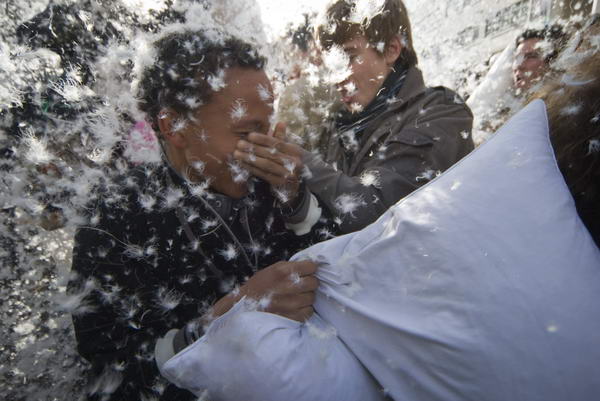
On Saturday I photographed my second pillow fight. The first was a couple of years ago, a flashmob in Leicester Square, and was really just for fun, although the pillows were flailed furiously and the air was soon full of feathers and a choking dust.

© 2008 Peter Marshall

What interested me about that event was that it was part of a global world-wide Global Pillow Fight, and one of the earliest examples of such organisation over the Internet.

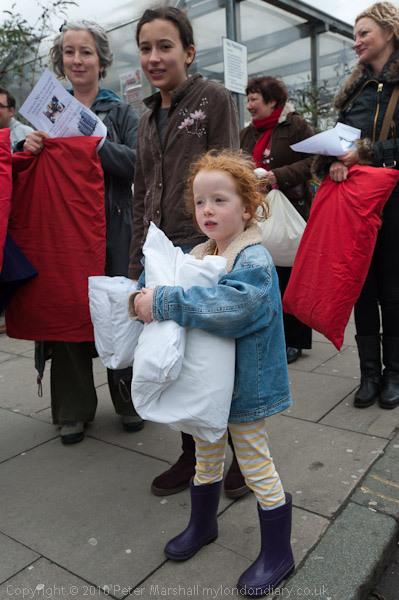
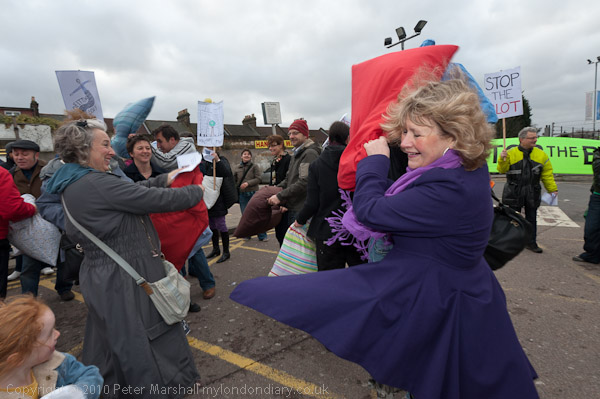
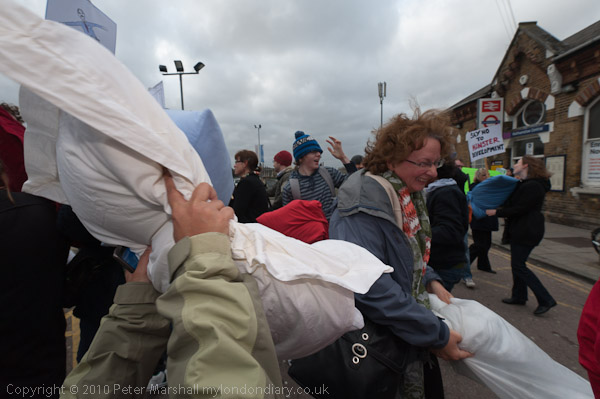
Saturday’s protest in Walthamstow was smaller and more sedate, though there did seem to be a few grudge matches taking place, particularly among some families.

© 2011, Peter Marshall

But it was chaotic and fairly short – all over in a little under 4 minutes, and again I longed for a viewfinder that gave a view outside the frame – as in a rangefinder camera. Most of the time I was working close to the fighting (and I did get hit a few times, but fairly gently) with the 16-35mm at its widest end.

Possibly a higher ISO than the 800 I was using would have been better as it was rather dull, and a few pictures were too blurred to use. As often I would also probably have been better working on manual exposure, but I’m getting lazy, and usually prefer to make use of the ‘flexible program.’ The normal program gives speed/aperture combinations that are good for static subjects, but simply by using the thumb wheel you can set a bias either towards smaller apertures (for greater depth of field) or faster speeds to stop action. That bias then remains in force until you alter it with the thumbwheel or switch the camera off.

© 2011, Peter Marshall

I also opted to use balanced fill flash with the flash unit as usual for me in the hot shoe. Fortunately flash synch is no longer a problem at faster shutter speeds, with auto FP high speed synch kicking in at 1/250 or 1/320 second and faster and normal synch at slower speeds. I think the difference is that with aFPhss the flash always uses a long enough output to cover the whole time the exposure slit is moving across the sensor, while in normal sync shorter flash durations are possible as the flash occurs when the sensor is completely uncovered, but in practical terms there isn’t any visible difference in the results. Presumably using aFPhss drains the battery more, so there is a longer time before the flash has fully recovered for the next exposure.

The SB800 has a reasonably fast recovery, particularly with the rechargeable NiMH cells most of us use, 4 seconds if the flash uses full output when using just the 4 batteries that fit inside the body. Usually using fill flash, it is ready much faster. You get a noticeably snappier response if you add the 5th battery in the ‘Quick Recycling Battery Pack’ but I find it harder to fit the flash into my bag with this attached, as well as more fuss changing batteries – and the spare battery packs hold 4, so carrying 5 means using two containers.

[Incidentally, next time I buy a flash for the Nikon, I wil look carefully at the Metz models which seem to offer similar features at a lower price, and also have upgradable firmware, which may offer some protection against obsolescence.]

© 2011, Peter Marshall

This time the pillow fight was to gain publicity for a campaign against a high rise commercial development where it was taking place. So as well as trying to capture some of the action I also wanted to find images that had some connection with the campaign. There weren’t many people with placards taking part in the fight – it’s hard to swing a pillow and hold one, but I did take a few pictures including them and the banner, as well as trying to get the Victorian station buildings in the background of some of the pictures.

More pictures and more about the event and the campaign in Pillow Fight Against Solum at Walthamstow on My London Diary.

Dancing at the Bank

© 2011, Peter Marshall

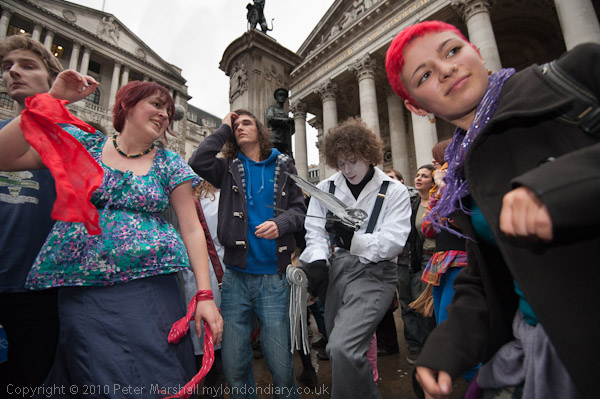
Last Friday I was at Bank at lunchtime, along with perhaps 80 demonstrators and what seemed like at least as many photographers and videographers.  It perhaps attracted so many cameras because it was really the first well-publicised event against the cuts and the fees rise since students came back after the Christmas break, or perhaps it was because it was a demonstration particularly by those involved in the arts and so would have been well publicised in all the art colleges. Of course everyone has a right to come and take photos, but it does make working a little more difficult, both as they get in your way and I try to keep – as much as possible – out of theirs.

Despite the murky weather with the occasional drop of rain it was a lively event. I started off working at ISO 1000 without flash, and using the Nikon 16-35mm there didn’t seem much reason to stop down below its maximum aperture of f4  – it’s sharp enough wide open and at 16mm you have pretty decent depth of field, while at 35mm you can certainly make fairly close subjects stand out a little against a slightly blurred background.

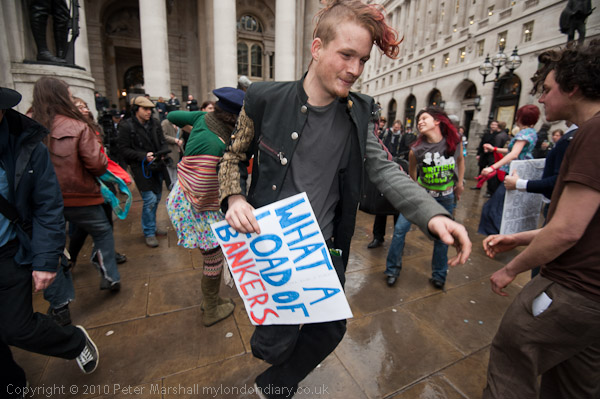
Once the dancing started I began to add some flash, as although I was getting a shutter speed of around 1/200 there can still be a little blur with close subjects, and the flash also brings the main subject out just a little.

© 2011, Peter Marshall
ISO 1000 1/160 f4, balanced flash fill, 16mm

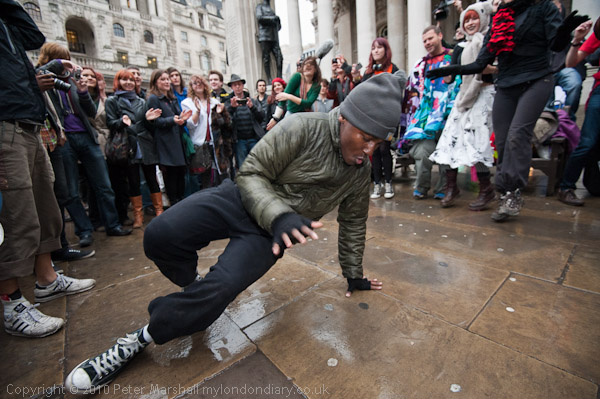
Once the break dancing started, I decided I needed a faster shutter speed and increased the ISO to 1600:

© 2011, Peter Marshall
ISO 1600 1/320 f4, balanced flash fill, 16mm

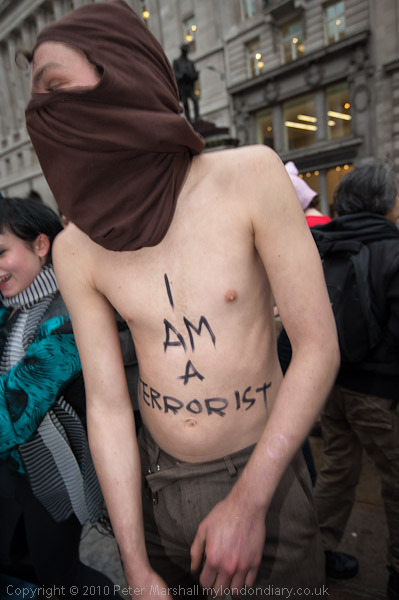
© 2011, Peter Marshall
ISO 1600 1/200 f4, balanced flash fill, 23mm

Without the flash, this ‘terrorist’s’ head would have been too blurred as he was dancing pretty energetically – you can see the slight double exposure effect there, while his torso was moving less rapidly and has remained sharp. I think the blur adds to the image, but it needs the sharpness of the flash exposure too.

The shutter speed changed a little frame to frame, as I was working using aperture priority auto-exposure.  It might have been better to switch to manual exposure, as the lighting was pretty constant over the area, and the shutter speed changes probably just reflect the amount of sky in the image. But I prefer to work on auto when covering events, as I seldom have time to think about exposures, and if for some reason the light does change can get images that are too far over or under-exposed.  All of the pictures I took were more or less correctly exposed – well within the limits of simple adjusted in processing the RAW files. If I was taking pictures of landscape or some other subjects where I would always have time to think I’d stick to manual and work to get the exposures spot on (probably using spot metering too) every time.  For photographing events I normally stick to matrix metering.

When using flash, the camera metering system doesn’t seem to compensate for the extra light, so most of these pictures are taken with exposure compensation on both camera and flash at -1/3 or -2/3 stop to avoid burning out the highlights.

Almost all of the time I also use autofocus, and with rapidly moving events like this that usually means the continuous servo autofocus (C) mode that will attempt to track a moving object.  The D700 (and other Nikons including the D300) has three autofocus area modes, and I often find myself switching between these while taking pictures. Probably the most useful is the Dynamic Area AF, where you select the focus point (I normally use 51 points) but when things get very hectic I sometimes switch to auto-area and let the camera decide.  The danger in using it is that it may focus on close foreground which you would happily leave blurred. But if you use autofocus on a selected area, it is all too easy for that area to be the background when you are working rapidly.

Back in the old days of range-finder cameras with manual focus when I was working on film I would always rely on ‘zone focus’  – setting focus and aperture perhaps so that depth of field covered everything from 5-8 foot. Occasionally I still do so, though it’s less convenient with zoom lenses and no (or inadequate) depth of field scales, as once set, it is faster than the best autofocus!

You can see more pictures from this event – and read more about it –  at Dance Against The Deficit Lies on My London Diary.

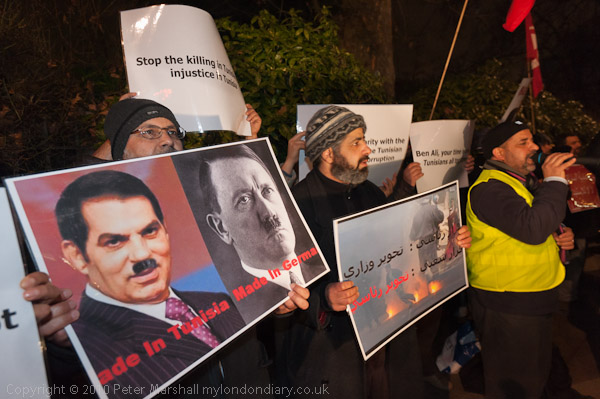
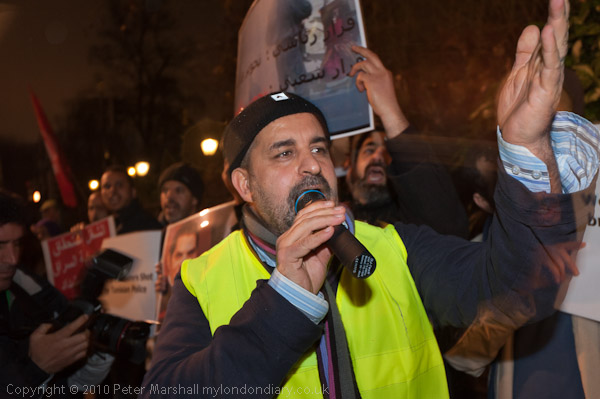
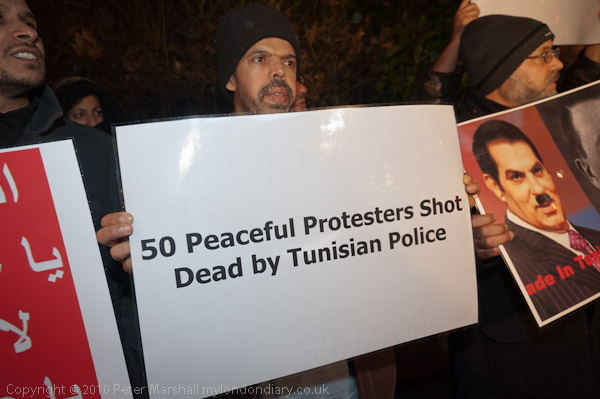
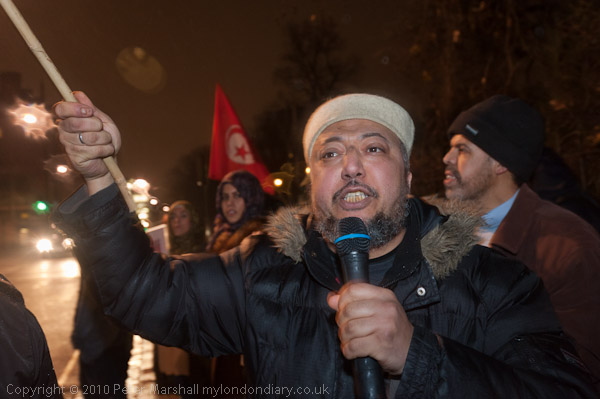
London Tunisian Protest

Yesterday I went to a meeting of photographers where a freelance who works for one of the tabloids was showing his work, and was profoundly depressed. Not by the quality of his photography but by the kind of assumptions that underlie photography for the press, and not just the red-tops.

© 2011, Peter Marshall
Opposite the Tunisian Embassy in London – 13 Jan 2011

It wasn’t just the attitudes of the speaker, but also some of the other photographers in the audience who at times seemed clearly to be justifying some of the work they did by simply denying responsibility for it – they were just following the orders of the editors.

Of course it is almost certainly right that if you want to make a good living from press photography you have to take on some fairly doubtful jobs from time to time, although there are some photographers who seem to have managed to avoid doing so.

Of course there was some questioning and discussion of the issues at the event, though I couldn’t bring myself to take part in it, partly because I’ve always chosen to remain on the periphery of the mass media. Teaching of course had its own moral problems, although I tried always to make it very clear to students that photography was only a directly vocational course for a tiny minority of those who studied it. There were quite a few students at the meeting, but most will find there is no – or not enough – work for them in photography after they graduate. I think we currently train more people every year than work in the whole “industry.”

On the way to the meeting I’d gone to photograph a demonstration opposite the Tunisian embassy against the killing of protesters on the streets. It wasn’t a huge event, but given the publicity that the events in Tunis and other cities in the country are currently getting I think it is genuinely news – rather more so than the minor misbehavour of minor “celebrities” that fills much of the press. But I think the only newspaper that had a photographer there was Al Jazera – and he, a friend of mine, had earlier in the day circulated the details to a number of photographers including myself. My report and pictures -including the one near the top of this post – appeared on Demotix around 11pm (and was selected for the front page), and on My London Diary the following day.

Demotix doesn’t make me a living, though recently it has been making me a little, selling my work on to papers etc, but I like it for the freedom it gives me to write my own articles and select my own pictures. Though in the rush to get work on line I don’t always make the correct choices. By today’s standards of course posting a story six hours after I took the pictures is incredibly slow, but it did at least give me a little time to review the images, both on the camera while travelling home and then larger on my computer screen. I also had time to process the raw files and make the necessary adjustments – exposure, contrast, a little burning and dodging and even a small amount of cropping to some. The result is all my own work and I take responsibility for it, mistakes (and I make quite a few) and all.

© 2011, Peter Marshall
Opposite the Tunisian Embassy in London – 13 Jan 2011 – not originally selected

Looking at the work again this morning, I’ve found some decent images that I passed over last night – including those shown here, and decided to make a few more minor adjustments to some I did use, and selected roughly double the number of pictures to put onto My London Diary, and written most of this post before I had to rush out to photograph two more events.

© 2011, Peter Marshall
Opposite the Tunisian Embassy in London – 13 Jan 2011 – not originally selected

© 2011, Peter Marshall
Opposite the Tunisian Embassy in London – 13 Jan 2011 – not originally selected

© 2011, Peter Marshall
Opposite the Tunisian Embassy in London – 13 Jan 2011 – not originally selected

Perhaps these pictures don’t add a great deal to the story, and several are very similar to pictures that I did use. But one of the things that the web allows us to do is to use images to tell stories in depth, and it’s a possibility I’ve been exploiting on My London Diary for some years, but which I think the conventional media outlets have been slow to grasp – outside some multimedia presentations.

Notting Hill, 1987

© 2011, Peter Marshall
Portobello Road, Notting Hill, April 1987      Peter Marshall

In a later post I’ll write about the problems I had in finding this image in my rather large collection. It’s a picture I took in the 1980s in Notting Hill, on a weekday in the market along the Portobello Road. There were two men – a trumpeter who you see – just about – in the middle of this picture, and hidden to his right, a saxophonist. Between them a music stand with some music neither was looking at, on the floor their instrument cases, one open for donations from the passing crowds, and a fairly small radio-cassette playing providing some backing.

They were playing outside a pub, and I stood for a while listening – they were good, but the first three frames I took of them were rather ordinary. They showed the scene, but it was somehow a little empty despite the people. I moved slightly closer and put the trumpet player in the centre of the frame, taking a slightly lower viewpoint. Fortunately he was getting more into his solo, pointing his horn down to the ground (I don’t think he had noticed me, but he could have been posing for the camera) and I took two more frames as  people walked between us.

This is the one I like most, partly because while the child at left seems to be dancing to the music his mother (I presume) appears to be grimly ignoring it.  It gets the feeling of the music playing and a crowd walking past. Lots of hands and arms and gesture. I like too the contrast between the suits of the two men in the right foreground, and the really tight framing of the trumpeter, almost hidden. The next frame showed him more clearly, and contrasted nicely the indifference a man and a woman walking past with his intensity, but lacked the complexity of this image.

I hadn’t gone to photograph the market, but had been working on a project photographing the buildings of London, and just happened to walk through the  street. The pictures were taken on an Olympus SLR,  probably with the 35mm f2.8 shift lens I used most of the time. I was also taking colour images on a second Olympus body, and here’s one from Talbot Rd,  not far away, probably taken on the same day.

© 1987, Peter Marshall
Tailor’s window. TalbotRd, NottingHill. 1987 Peter Marshall

Britain – What Lies Ahead

I’ve been spending many rather dreary hours recently retouching my black and white pictures from Hull in the late 70s and early 80s, including this image of the Humber Estuary, taken looking towards Hull from New Holland.

© 1981, Peter Marshall

It’s one of several hundred images I’ve recently rescanned and am working on before making a final selection for my next Blurb book, ‘Still Occupied, A View of Hull’, which will include images made between around 1975 and 1985. This is only one of a number of pictures I took of the channels in the Humber mud, though most were on the other side of the estuary.  This was made before the Humber Bridge opened, and we’d taken the ferry from Hull across the river. There wasn’t an awful lot to do on the other side – we could have taken a train to Grimsby, but decided against it, just walked around, took a few pictures and got on the ferry back.

This particular image is a distant vista of Hull, clearly recognisable on the far shore, but I also liked the crossing of the two gullies; most of the images I took showed single channels going out through the mud towards the distant water. One such image, taken by Vanessa Winship, who grew up a short distance upstream at Barton-upon-Humber, heads the FT Feature ‘Britain: what lies ahead?‘, in which she is one of ten photographers with connections to different parts of the country who were “asked to give us a glimpse of what the future might hold.”

Unfortunately, unless you subscribe to the FT you won’t be able to see the slide shows of their images, although you can read what they say and follow the links to their web pages, although the images that Winship took when she went back to her old school don’t appear to be either there or on her blog.  In the FT she writes that as a child she could look out of her bedroom river and see the lights on the other side – Hull – and would imagine that it was the end of the world.

I only crossed on the Humber ferry a couple of times, though I saw it many times arriving and leaving at the pier in Hull – perhaps even with Winship on board, travelling to college in Hull. Shortly after I took the picture above the Humber bridge opened, and the ferry stopped running, and I walked across the river to Barton. I’ve written previously in Sweet Nothings about Winship’s fine portraits of schoolgirls from eastern Anatolia.

Another familiar image on the accessible page of the FT came to me on a Christmas card from it’s author, John Davies and shows a scrap yard in front of a power station on the Mersey at Widnes. What you can’t see from the thumbnail on the FT page is that there is a St George’s flag flying above the top of the heap of metal in the middle-ground of the picture, put there by workers to mark their support of England in the 2010 World Cup.

The same picture appears in the ‘In Progress’ section of Davies’s web site,  and clicking on the link there takes you to a larger version and more information about this ongoing project “into the impact of waste disposal, landfill sites and recycling plants in North West England.”

Other photographers who feature in the FT article are Martin Parr, Patricia & Angus Macdonald, Simon Roberts, Simon Norfolk, Jem Southam, Hannah Starkey and Donovan Wylie.

I’m not sure that the piece as a whole has a great deal of insight into the state of the nation and its future, although perhaps some at least of the photographers appear to have a greater purchase on reality than  the FT’s comment and analysis editor Alec Russell who introduces the feature and reminds me that FT does after all stand for Fairy Tales.  I’m not sure that a world run by photographers would really be a good idea, but it could be a whole lot better than one run by bankers and economists.

Fay Godwin – Land Revisited

On Saturday The Guardian in its ‘Review’ section published an appreciation by Margaret Drabble of the work of landscape photographer Fay Godwin – and you can read it online too. It’s better online, as the single image which accompanies it, although smaller there, stands out much better on the screen than in the muted greys of newsprint, which also splits it unfortunately across the two pages of the spread.

It is of course a well-crafted piece, presenting much of the relevant information, but rather lacking so far as Fay’s relationship to the medium is concerned, and it contains at least one statement that I am fairly certain would have enraged her, when Drabble talks of her 1983 The Saxon Shoreway as an example of her “author-led publications“.  Indeed perhaps her only truly author-led work was her collaboration with Ted Hughes, Remains of Elmet (1979) which was one of her first and I think possibly her weakest works as a photographer. Drabble correctly describes this as a creative partnership between poet and photographer, but despite some fine images it is perhaps the only of her works in which she is arguably the junior partner.

The rules and attitudes of the publishing companies, which resulted in her early works – books which she had conceived,  and photographed, being listed under the names of the literary figures whose contribution other than their name was often rather minor (I can’t vouch for the actual words she used, and the phrase ‘I did everything but wipe his sodding arse’ that comes to my mind about one of them may well just be my own précis of her argument) with her simply as an illustrator remained a continual irritation to her, even after she gained the clout to get books such as Land (1985) under her own name.

I first met Fay at Paul Hill‘s cottage in Derbyshire, the Photographers Place in Bradbourne, where we had both gone to learn at the feet of Raymond Moore. She was then in her mid-forties and just becoming well-known in photographic circles as a landscape photographer. It was at the same place and probably the same time that I also met Roger Taylor who talks about her work  on the short video about the show, Land Revisited which continues at the National Media Museum in Bradford until 27 March 2011.

I never became a close friend, but we met occasionally at events and openings, and in many ways spoke the same language. Whenever we found ourselves together at a show we always took a tour around together, sharing our opinions (often unprintable) and enthusiasms about the work on the wall. We shared too some of the same influences – people like Moore and Bill Brandt who worked in this country, Paul Strand, and although we took it rather differently, the earlier US landscape tradition.

Brandt’s book ‘Literary Britain‘ was I think in many ways a fairly direct forerunner of much of her approach to landscape, and I think like me she would have preferred the perhaps rather gloomy 1951 original to the later more contrasty revision.

One of the texts on the National Media Museum site is by Fay, and in the previously unpublished ‘How Land Came About‘ her voice comes through very clearly, with a real sense of the frustrations she faced and felt in pursuing her work in an environment where photography was not valued by the UK publishing and media industries.  (Nothing has changed there!) There is also an interview with Fay from 2002 on the UK Landscape site.

Fay was fortunate in 1978 to receive a major award from the English Arts Council to photograph the British landscape during the brief period when they supported photographers rather than institutions. Work she produced from this provided the bulk of her show and book ‘Land’ (1985), perhaps the best of her books. The 2001 retrospective book Landmarks covers a wider range of her work as you can see her web site.

Fay died in May 2005, aged 74 (her website was updated to include some of the obituaries) and in 2008 “the entire contents of Godwin’s studio: negatives, contact sheets and exhibition prints (around 11,000 prints in total), as well as correspondence with some of her sitters including Ted Hughes, Philip Larkin and Doris Lessing” was accepted in lieu of Inheritance Tax by the government and is held by the British Library. You can see 128 of her images on their site.

I’ve written about her and her work on various occasions, most recently in a post here, Copying, Co-Incidence or Cliché? where both she and I made almost identical images of a sleepy stone lion at Chatsworth. Along the bottom strip of images on the page I link to containing her picture are thumbnails of a number of her finest images, and there are several others that are similar to pictures I’ve made and a couple that – at a glance – could be by Brandt. It doesn’t in any way detract from here as a photographer that this is so, but it does root her firmly in a tradition that she would have been happy to affirm, even if it seems not to have occurred to Margaret Drabble.

© 1980, Peter Marshall
This is not a photo by Fay Godwin! Sleepy Lion, Chatsworth  © Peter Marshall, 1980