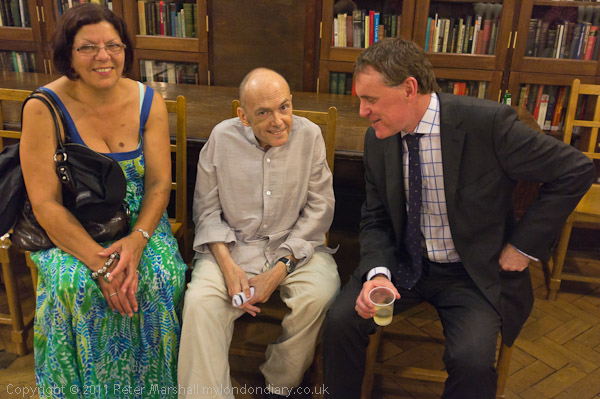
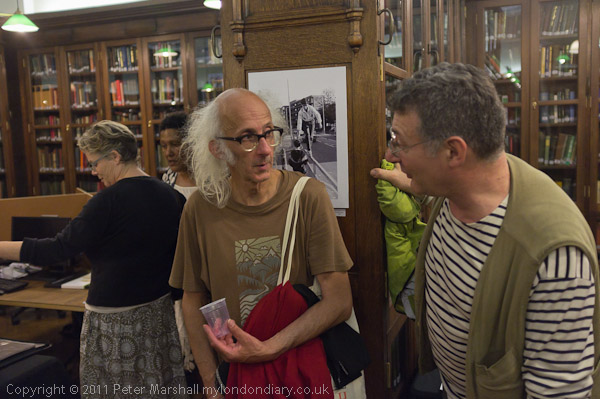
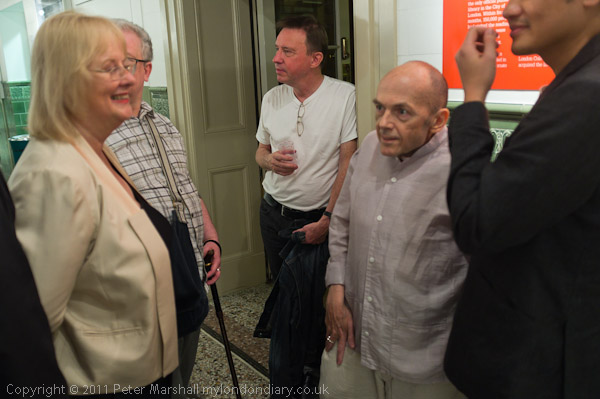
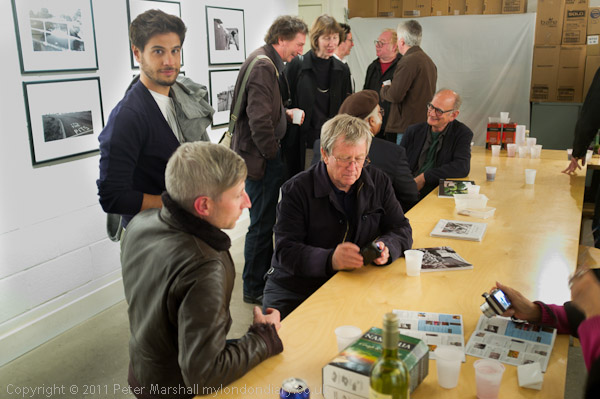
Which Clichés Have I Made Today?

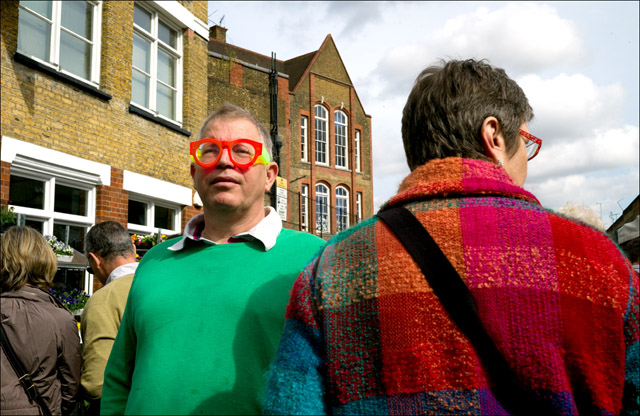
Well, actually none yet, as I’m just about to rush out and take them, but I really love this rant by M.F. Agha published in 1937 in US Camera, the Hippocratic Oath of a Photographer, republished on the Monsters and Madonnas blog of the  International Center of Photography Library.

Of course it needs a little bringing up to date, though I think I’ve taken a few candid pictures of fat ladies, finding those Marlene Dietrich posters is a little tricky, though some – such as the Mexican child – are still rather too common.

But suggestions as to updates are welcome!

Opening Night

© 2011, Peter Marshall
Towards the end of the evening when most people had left it was truly an elite gathering

Magical. It was for me at any rate, though adrenaline and alcohol are always a heady mix. Although our opening last night at the Shoreditch Gallery/The Juggler was never particularly crowded, there was a steady stream of people coming to see the show and pay their respects before moving on to one of the many other openings. First Thursdays are often busy, but this one especially so, as it was also the first Thursday of the UK’s largest photo festival, the East London Photomonth.

I’d had several apologies from photographers who were out of the country – and had to send my own to several who were at their own openings elsewhere across London. But among those who came to the opening were a good cross-section of the better photographers of the capital, as well as other friends who we were also pleased to see.

Even after we’d left the gallery – well after the agreed closing time – and a small group of us were talking outside, another dozen people turned up to look at the work.

As well as the 12 pictures I had on show, I’d also taken along the book ‘Before The Olympics‘ (and some others) with another 250 or so pictures from the Lea Valley. As several people pointed out to me, the reproductions of the pictures on the wall in that volume were considerably less subtle and less rich than the prints on the wall. Although Blurb, especially using the more expensive premium paper, does a reasonable job, it can’t match either a good darkroom print or a good inkjet print.

The prints I had on the wall were all made using Epson Ultrachrome K3 inks on Ilford Gallerie Gold Fibre Silk, and it is a very good combination. I’ve experimented with printing from the R2400 using just the three black inks in the K3 set (photo (gloss) black, light black and light black) which you can do using the Bauhaus Rip (or presumably with the Quadtone Rip) and although the results are good in terms of tonality, the prints have a slightly unhealthy looking greenish black in daylight. The best results I’ve acheived with this ink/paper combination come from using Epson’s own ABW (advanced black and white) mode, which allows you to alter the print colour and uses a small amount of the colour inks along with the three blacks.

I’d printed the set using the same print colour settings, and under daylight they were a pretty good match, but in the gallery lighting there were some noticeable differences in tone. I suspect this comes from different light bulbs (or perhaps just different ageing of bulbs) used in the display lighting. Some had a slight magenta to the black which fellow exhibitor Mike Seaborne tells me is normal for the Epson inks under tungsten lighting, while others were if anything more neutral than in daylight. I didn’t find the differences a problem, although Mike prefers to use HP printers as he says their inks exhibit little or no metamerism.

Back in the 1980s I printed these pictures – and all my best work on Agfa papers, mainly Agfa Record Rapid, which had something of a cult status among photographers (and which the late Peter Goldfield set up a company, Goldfinger,  with premises above his Muswell Hill pharmacy to import) and occasionally the rather warmer Portriga Rapid. But Record Rapid (and its Portriga cousin) had to change its formulation to cut out the cadmium in the nineties, and the new version was simply not the same. I moved to using Ilford papers, which were fine, but no match. Probably the next prints that I was truly happy with were on matte papers such as Hahnemuhle German Etching and Photorag using Piezotone inks from Jon Cone. They weren’t Record Rapid but had a rather different quality of their own.  Now with newer semi-gloss papers – such as the Ilford Gold Fibre – I can get prints which, with the advantage of the precise control offered by working with scanned digital files, are usually even better than those from the old days. Though RR could have a depth and a pearly opalescence that was only ever surpassed in the very best (and rather rare) examples of carbon printing.

The night also brought home again one of the small design faults of the Fujifilm FX100, the rather light detent on the exposure compensation dial, which is also perhaps a little too conveniently placed at the back right corner of the top plate. With a fewer glasses of Merlot I would certainly have realised that I was working at +2 stops and avoided the overexposure that ruined most of the images. And +2 stops when working at full aperture makes for long shutter speeds, so pictures were blurred as well as overexposed. But I hadn’t gone there to take pictures and wasn’t giving it my usual attention, so there are rather fewer images in this post than I would have hoped.

Final Reminder – East of the City

© 2011, Paul Baldesare
Columbia Market – Paul Baldesare

Tonight, Thurday 6 October at 6-8 pm at The Shoreditch Gallery is the opening of our show ‘East of the City‘ which if you can’t make it tonight continues in the gallery at ‘The Juggler’ until 29th Oct 2011. It’s a short walk from Old Street tube, just off Pitfield St, though I’ll take a bus.

My book ‘Before the Olympics‘ will be available at the opening – saving the excessive delivery costs normally involved. It has all12 of my pictures in the show, along with around 250 others, though not all from what is now the Olympic site.


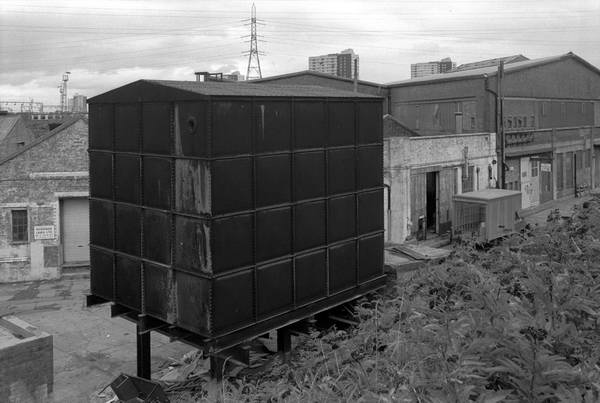
Marshgate Lane, Stratford Marsh, 1990.

From the Lions Point Of View

Isn’t it a thrill to have him here in London” said the woman behind me to a friend as we we all waited, hardly an empty seat in the small lecture area of National Geographics’s Regent St first floor, and the next hour or so listening to Shahidul Alam talking, showing pictures and answering questions certainly justified her anticipation.

© 2011, Peter Marshall

Probably most of us in the audience had some idea of the incredible transformation Dr Alam has made to the world of photography, not just in his native Bangladesh but worldwide, although so much still remains to be done, but I think all of us found there was even more to him – and his family – than we had been previously aware.

Alam’s mother in particular was a formidable woman; determined to get a university education despite the opposition of her mother to the education of women, she left home every morning in a burkha “going to visit friends” and went to study. Armed with her degree she dedicated herself to the education of women, and having found little backing for her project, bought a tent and used it to set up her own school for girls.

Later too we heard that his father had dared to evade the “invitation” sent to him along with the other leading intellectuals of the country to take tea with the occupying Pakistani generals in 1971 just a few days before the end of the war. It was a story accompanied by a picture by Rashid Talukdar of a severed head in rubble, from the killing fields of Rayerbazar. Altogether more than a thousand teachers, journalists, doctors, lawyers, artists, writers and engineers were massacred.

Shahidul Alam was sent to study chemistry in the UK in 1972, gaining his Ph.D in London, and taught the subject while at the same time developing an interest in photography, at first making camera club style pretty pictures. But then he came across photographs that were harder to understand and seemed to have more depth – such as Steichen’s ‘Heavy Roses’, said to be the last picture he took in France in 1914, sumptuous but slowly decaying and fading as the Great War started – and began learning to see and to work at finding out what was interesting about such less obvious pictures. While living in Kingsbury in Northwest London he photographed people in his locality and took them to the local paper, who published them as a spread on the back page and paid him a tenner for them (a local paper paying – how times change!) – his first professional work.

He had (and still has)  a particular love of photographing children, and having seen that a child portraiture studio – Young Rascals Studio in Acton – wanted photographers he went for an interview and got the job, and was soon the most successful of their photographers, earning around £350 a week, a pretty good wage at the time.

After a while, although he was doing well financially he decided that what he was doing was not something he wanted to devote his life to, and he made up his mind to return to Dhaka with his savings of £2800, and go back and live with his parents and try and become a photographer and take part in the life of his own country . It wasn’t easy to find any employment there, so he set up his own business as a photographer as well as starting to teach photography and work with communities.

Alam was at pains to point out that he had no problem with white western  photographers coming to photograph in his country, but that he felt that photographers from countries in the majority world had an understanding of their own communities that provided them with a different viewpoint. He wanted a pluralistic world in which different people got to tell stories, but was against the kind of monopolistic view that media around the world tended to project of countries like his own. This was brought home strongly to him while on a visit to Northern Ireland when a five-year-old showed her surprise at seeing him playing with a few coins. Even at that age she knew that people from Bangladesh didn’t have any money.

Increasingly too he began to question his own position in his own society, as a middle class man with a camera – and characteristically began to do something practical about it. In 1994 he set up a women’s’ photography group, bringing a woman to the country to teach them, and he also began teaching photography to classes of working class children.  He then set up the Pathshala school of Photography, now recognised as a world-leading school for photojournalism, with its students and ex-students gaining exceptional success in international competitions. It is also possibly unique in that all of those finishing the course have found work as photographers, though Alam did say that the market for photographers in Bangladesh was now becoming saturated and he was having to think about encouraging some students to work in ancillary professions such as picture editing and picture research.

It was great to see in his photographs and a short film clip how photography was being taken to the people in Bangladesh, with mobile exhibitions mounted on bullock carts and cycle carts being taken into villages, and also the work with village children. Alam also founded and directs the Chobi Mela international festival of photography held in Dhaka every two years which he set up is the largest photography festival in Asia and takes photography out on the streets (and on a boat) with a very different atmosphere to most festivals.

Through his photographic agency Drik, (now part of a wider multimedia organisation) set up in 1989, Alam has worked hard to change the way that rich world publications deal with events in Bangladesh and the majority world generally, although not always yet with great success. From 1983 the political events in his country turned him to documenting the political movement against the military rule of General Ershad which lasted, with minor changes until 1991. During the later years of that period there was increasing disorder and a ban on reporting pro-democracy activities – which newspapers responded to by ceasing publication. During this time Alam kept sending out pictures of the political events to news organisations around the world – who ignored them , as to them it wasn’t news. The only time the world press took any interest in Bangladesh was at times of natural disasters  – cyclones and floods. (Presumably, though he didn’t say so, this became news because of the pressure from the major aid agencies, who avoid involvement in ‘political’ issues.)

Alam’s talk was entitled ‘When the lions find their storytellers‘, from the widespread African proverb “Until the lion has his own storyteller, the hunter will always have the best side of the story.” Whoever does not have a voice is almost always going to be the loser. His life’s work has been trying to tell the lions’ story and to teach the lions so they can tell their own story.

Drik Picture Agency has played an important part in this, and more recently has set up ‘Majority World‘, a platform set up to allow “indigenous photographers, photographic agencies and image collections from the majority world to gain fair access to global image markets” and to present image buyers with “the the wealth of fresh imagery and photographic talent emerging from the Majority World.”

© 2011, Peter Marshall

He ended his talk with a little about two of his heroes, and the final image was what is now perhaps his best-known photograph, possibly the last official portrait of Nelson Mandela. As always, Alam had a story to tell, of how he was held up travelling from Mexico to take it and thought he had missed his chance to take the picture, but hearing about his transport problem, Mandela actually rescheduled the sitting for two days later. The picture seemed to be a suitable backdrop against which to take his picture and I got out my Fuji X100 and took a few frames from my third row seat, some of which needed rather drastic cropping.

© 2011, Peter Marshall

Questions at the end of the talk brought out some other vast aspects of his work that he had not included, including the work he and his fellow photographers have undertaken over the years on the vast environmental problems of his country, much of which is likely to disappear as global warming leads to sea level rise.

One questioner brought up the problem of the relationship between documentary and art photography, and of how Alam has managed to work so effectively across both spheres. It was during his answer that he removed the pair of ordinary inexpensive sandals he was as always wearing and held them up into the light, saying put them in a gallery with the right display and lighting and they would sell as a work of art for thirty or forty thousand pounds (I did think he might have to change his name to Tracey Emin as well) before putting them back on his feet and saying these are now just sandals again. It was only a part of his response, but like much of his talk, one that promoted thought. He also talked about the Crossfire project on extra-judicial killings in Bangladesh which rather than attempting to look at these by documentary photographs of events he made large format colour images of the places where the killings had taken place, exhibiting them together with the facts about the events in what he called “A quiet metaphor for the screaming truth” – and which was closed and barricaded by armed police – but as I also mentioned here was opened in the road outside the gallery.

It was a talk that was full of hope and inspiration, but one that also left me with something of a feeling of despair for the situation of photography in my own country. In Bangladesh things seem much starker and the struggles and possibilities more obvious. Here photography often seems strangled, choked by the money and prejudices of the art world, distorted by academia. We’ve seen the abandonment of our major documentary resource, Side Gallery, by the Arts Council and the continued side-lining of our most democratic photography festival, the East London Photomonth, by the photographic establishment.

Shahidul Alam’s first solo retrospective in the UK,  ‘My Journey as Witness‘ opens at Tristan Hoare’s gallery in the Wilmotte Gallery at Lichfield Studios, 133 Oxford Gardens, London W10 6NE on 6th October, and runs until 18 November 2011, with a  book of the same title being launched the in the UK on October 10 by Skira, Milan. Copies are actually already on sale and I took a short look at it at the National Geographic Store. It is certainly a tribute to Alam that the first volume in what Skira intend to be a multi-volume series on the arts of Bangladesh is devoted to him and to photography. The book has an introduction by Sebastião Salgado and preface by Raghu Rai.

Also here on >Re:PHOTO you can read about two earlier exhibitions curated by Alam, in  ‘Bangladesh 1971‘ at Autograph and ‘Where Three Dreams Cross’ at the Whitechapel Gallery in 2010. Writing about World Photography Day earlier this year (a piece prompted by a post on Shahidul News) I concluded:

Photography may have started in France (and England) and perhaps came of age in the twentieth century in Europe and the USA. But now much of the more interesting work is happening elsewhere.

It seems a good way to end this over-long piece too.
Speculation on Photographs (Part 2)

This is a continuation of Speculation on Photographs which includes a discussion of Erroll Morris’s exhaustive examination of the two Roger Fenton images from ‘The Valley of the Shadow of Death’, one with cannonballs on the path and the other without.

Morris seems to me to be unduly concerned with reality and with establishing a connection between photograph and reality. To him it really was important whether those cannonballs were where they landed, while to me it seemed unlikely in view of both momentum and gravity. (I wroteYou might also ask why so many balls should have stopped rolling on the smoother road rather than going down into the gully by its side, especially if you’ve ever played bagatelle.”)

Fenton was of course working before there were any well-established conventions about what was ethical in news photography (which he was more or less inventing), let along in art, and there can be no doubt that he saw himself as an artist, and that he was someone who carefully composed his pictures.  I imagine that he took one picture as soon as he arrived, unsure about whether it would be safe to stay long enough to make a second exposure, then set about getting things arranged in a more artistic fashion.

Soth goes on to show an example from his series Broken Manual which is a kind of re-creation of Robert Frank’s image through a curtained window in Butte Montana, though in various respects a very different picture. Without the reference to Frank’s earlier image it would I feel have very little interest, and I would certainly wonder why the photographer took it. He does give some answers to that question in the link he provides to How to Revisit an Iconic Photograph which includes some other of his re-creations of well-known images. Soth says that he learnt a lot from re-visiting these pictures, which I’m sure is true, but I feel that I gain much from looking at the re-results of his learning experience.

Another image he has used as a starting point and is illustrated in the article is Dorothea Lange’s ‘Migrant Mother’, and he raises an interesting point when he mentions that her “are dramatically out of focus.” It’s worth downloading the digital file LC-DIG-fsa-8b29516 made from the original negative from the Library of Congress to examine this claim (the link to the larger 55Mb file fails for me) which is used for the image below, displayed here to a smaller size – right click and select ‘ View image’ to see it larger. Unlike some of the other images on the LoC site, including some versions of this image, it does not appear to have been ruined by excessive sharpening* of the digital file (which doubtless seemed a good idea given the different standards of the 1990s), and apart from a difference in tonality is a good match for the vintage print reproduced there.

LC-DIG-fsa-8b29516 Library of Congress, Prints & Photographs Division, FSA/OWI Collection
Library of Congress, Prints & Photographs Division, FSA/OWI Collection. Public Domain

The image above is an actual 821×1024 pixel file, and I’m looking at it on my screen at actual size as I write, where it displays at roughly 8 x 10 inches (a twice linear magnification from the original 4 x 5 negative, made by Lange on her Graflex RB Series D. Working with this format and probably with the camera hand-held, depth of field would have been pretty minimal as a fairly wide aperture such as f5.6 or f8 would have been used to avoid camera shake. Film was slow in modern terms, and generously exposed negatives were desired.

Critical sharpness occurs more or less on the ear and check shirt of Florence Owens Thompson, and I suspect as Lange peered down into the reflex viewfinder that the squares coming sharply into focus caught her attention. The eyes are certainly not as sharp, but sharp by the standards of the day which were much less rigorous than ours.

Way back in the 1970s I happened to be around when a very distinguished ex-President of the Royal Photographic Society was setting up a panel of his work for a workshop about gaining the awards of that body, and made the mistake of commenting that the pictures on it  – prints around 20 x 16″ were unsharp – as they clearly were. He overheard my comment and I got very firmly told that I didn’t know what I was talking about, his pictures were sharp enough. By his standards they were, but not by our more modern expectations – and things have got worse now we are used to zooming in to the actual pixels on screen.

Soth is of course correct to say that the eyes are “dramatically out of focus” in that their slight unsharpness actually increases the dramatic effect of the image, although for me it is perhaps the blurring of the wrinkles on her forehead that is more telling. There is a contrast between the biting sharpness of the hair of the child at the right of the image and the softness of the woman’s face as she stares into an unknown but apparently hopeless future.

For me the most successful of Soth’s re-creations is clearly based on Ruth Orkin’s ‘An American Girl in Italy’. As he clearly says, what gives his picture and the original their “energy is that a real event took place.” Though I still think Orkin’s image works so much better that I would hesitate in showing the new work if it were mine.


*With scans, standards of sharpness and tonality have also changed considerably but differently over a shorter period, as scanner technology has improved. The Library of Congress (and on a much smaller scale myself) suffers from having been one of the pioneers of putting photographic images onto the web. Many of those old scans now look more like caricatures rather than reproductions of the images the represent, with drastic white fringing and obvious jpeg artifacts.

Speculation on Photographs

Alec Soth starts an interesting discussion with his The art of speculation on his Little Brown Mushroom blog, where he begins by quoting a series of Tweets by Erroll Morris which attempt to give a simple account of the principles of his new book Believing Is Seeing.

Perhaps the most contentious of them is the first:

1. All photographs are posed

which on an obvious level is obviously not so.  Morris makes it true by a redefinition of the word ‘posed’, as becomes clear in his discussion of the two Roger Fenton pictures of ‘The Valley of the Shadow of Death’, one with cannonballs on the path and the other without, where he writes:

Couldn’t you argue that every photograph is posed because every photograph excludes something? In every photograph something is absent. Someone has made a decision about what time-slice to expose on the emulsion, what space-slice to expose on the emulsion.

You can only argue this if you are prepared to alter the accepted definition of ‘posed’ to mean something intrinsically different to its normally understood and accepted meaning, of something that has been set up or re-ordered or arranged within the view of the camera.  Framing isn’t posing, nor is the selection of the moment, or indeed the other decisions we all make that affect the picture we produce. His is not just a silly and circular argument, but one that erodes our critical vocabulary.

The quotation comes from the third and final of his three articles on these two pictures, where his quest to establish without doubt the order in which the two pictures were made takes him both to numerous experts in photo history and interpretation of images as well as on a field trip to the Crimea.

Public domain: US Library of Congress cph 3g09217
You can download a 50 Mb file from the Library of Congress and print your own Fenton

You can read his full three part series on line starting at Which Came First, the Chicken or the Egg? (Part One) which has links to parts 2 and 3.  It was certainly a painstaking exercise, but after I’d spent a couple of minutes reading a little of part 1, all I wanted to know was if he had established the answer – and whether it agreed with my own immediate photographic intuition on first viewing the image that the cannonballs on the path were perhaps rather too nicely scattered. I posted some thoughts on the matter here in Cannon Balls to Fenton when these articles by Morris were first published in 2007.

Morris’s argument – as I say above –  seems to me to be saying that if we redefine ‘posed’ to mean made using the kind of selection and abstraction that is always  involved in making a photograph (even those ones that, to quote Leon Neal, you only got “you only got … by accidentally dropping your camera as your ate your Big Mac, firing a frame of the subject … as they passed behind you“)  then all photographs are posed.  I object to this kind of abuse of language.  Let’s find the right word and use it rather than cheapen another that has a normally accepted different and useful meaning.

 Soth discusses Morris’s second point:

2. The intentions of the photographer are not recorded in a photographic image. (You can imagine what they are, but it’s pure speculation).

It seems a rather partial truth.  Soth makes the point that our speculations about the photographers intention are essential to our experience of the work, andI think it we can also say that the photographers intentions are also integral to the production of the work. Soth discusses a well-known image by Robert Frank, of the view from a hotel window in Butte Montana. Although Frank’s intentions may not be recorded in it, had they been different then he would have made a different picture. Or no picture at all.

Frank’s intentions of course made him take not just this picture, but a large number of others, and to edit and sequence them in a particular way.  And though his intentions may not be recorded precisely in the book or any individual image, both rule out many possible interpretations. What we imagine when we read the work is certainly not “pure speculation” but an impure speculation that runs with rather than against the evidence provided.

Of course each of us sees a different picture when we look at this (or any other image) constructing it from our own interpretation of what we see and what we know about it, our previous experiences and the environment in which we come across it.  We see a different picture every time we look at it, but we are likely to have both in our individual and our shared experience certain perceptions about it which are likely to be in common.  Photography isn’t just a medium, it is also a community.

Continued in Speculation on Photographs (part 2)


Northern Outfall Sewer 1990, 2005, 2010…

Saturday afternoon I made another trip to the Northern Outfall Sewer (aka Greenway) on Stratford Marsh, a site I’ve been to many times over the years since my first visit around 1982. But this time I wasn’t just going to take photographs as I have done over the years, but to talk about my work, along with four other photographers, and to take part in a discussion with them and the twenty or so others present in one of the sessions of the ‘Salon de Refuse Olympique’ (I think seriously missing an acute accent on the third word of the title) which was described as “An Olympian marathon of salon debates for forthcoming book documenting and highlighting critical creative responses to the official London 2012 Olympic Games site and Cultural Olympiad.”

Our session, held in the View Tube,  entitled ‘Imagining the Olympics‘ was led by Dr Ben Campkin, Director of UCL Urban Lab and assistant director of Architectural Research at the Bartlett School of Architecture and the other photographers on the panel were Chris Dorley-Brown, Alessandra Chila, David George and Giles Price. Gesche Wuerfel also down to take part was out of the country but had sent some thoughts.

I don’t know how it will emerge in the forthcoming book, but for the event each of us was asked to send 3 photographs and to use these to talk about our work.  So here are the three pictures I sent and below them the text that I wrote and used as a guide to my presentation.

© 1990, Peter Marshall
London Olympic site 1990
© 2005 Peter Marshall
London Olympic site 2005
© 2010, Peter Marshall
London Olympic site 2010

 Before The Olympics – The Lea Valley 1981-2010 and Beyond?

Two of these pictures are in my book ‘Before the Olympics – the Lea Valley 1981-2010’ and the third taken shortly after I put that book together. A dozen of my pictures of the Olympic site in the 1980s including the first of these three are now in a show that opened this morning at the Shoreditch Gallery in Hoxton Market, part of the East London Photomonth.

I made that 1990, the next 2005 and the last 2010. All made more or less where we are now, a place where I’ve taken quite a few photographs over the years. Much of the work from the area is on my Lea Valley web site, which gets around 250 views a day, a rather small fraction of the 3.25 million a year for all of my work, but the active time on the site for the average visitor of almost a minute is high in web terms.  I showed over 250 pictures from the site in a presentation at the 2010 London Documentary Film Festival after which I was asked ‘Do you have a book’ and thought to myself ‘Why not?, and a couple of weeks later I did – and Blurb made it an editor’s pick and got me to talk about it at their week of presentations in London last November.

I began photographing London in the early 1970s, but only began work seriously in the 80s, having produced and exhibited a major project on Hull, where I’d found a way to approach the city. I’d also worked in Paris, where ten years earlier I’d come across and been inspired by the work of Eugene Atget. Other influences included topographic works such as the encyclopaedic ‘Face of London’ by Harold Clunn and of course Pevsner’s ‘The Buildings of England’ series, though this was in some ways a perverse stimulus in that I was often more excited by what he left out than what he put in.

Back then, few people were in any real sense attempting to photograph London as a city, and the scale was daunting. There were no digital cameras, no GPS, no geo-tagging, no personal computers, no Internet. I started with the A-Z of London, which fortunately after a few years changed from its own system to use the National Grid. At the base of my project was the idea of building up a corpus of work that would include what I felt to be significant buildings and scenes to represent every kilometre square of Greater London (though of course some were much more productive than others.) It remains an unfinished project, partly because of the scale (there are probably around 2000 such squares in my slightly elastic definition of London) but largely because it has been overtaken by the Internet and the explosion of photography in the digital era.

But this work, some of which was bought for the National Building Record and some put on my first major web site on my own domain in 1996 – it was called  (in a nod to Pevsner) ‘buildingsoflondon.co.uk’. I saw the work as a resource and a jumping-off point for other projects, some related to geography and transport – including projects on the Northern Outfall sewer, below us, the Lea Navigation and other rivers, and, not far away, the Greenwich Meridian, but others which were more a cultural exploration, such as ‘Ideal Café, Cool Blondes and Paradise’. Another major theme was the de-industrialisation of London, reflected in part in my ‘London’s Industrial Heritage’ site. The first portfolio I put together on the Lea was part of an unsuccessful application for Arts Council support around 1983, but many photographers who saw it were very encouraging, including one now very influential in the photography world who advised me to give up the day job – teaching – and go full time.

More recently I’ve returned to photographing the people of London, on the streets, in festivals and particularly in protests, and have become better known for a site called ‘My London Diary’. This work brought me back to the Olympic site, both to cover the protests against the Olympic bid and also the unsuccessful efforts by the Manor Gardens allotment holders to be a part of what might have been a truly green Olympics.


Of course these three are not the only pictures that I took over the years from more or less the same spot – and had I had the time I could have matched them more closely from my files. On the way to the discussion I went and made several more panoramas, including one from the same viewpoint. And on Sunday I was back on Fish Island and Hackney Wick taking a few more images of the Olympic site, some of which I’ll share in a later post – and of course in My London Diary.

You Almost Never Need Releases

I’ve long told people that you seldom need releases for the use of pictures of people, property, logos etc, and it it great to find a lengthy posting by Dan Heller, who has written a book on the subject that states this clearly. And although Heller is clearly writing from a US perspective, I think that most if not all of what he has to say would also apply here.

Basically, in his Busting Myths about Model Releases, Heller states clearly that you would only need a model release to use a picture where it could reasonably be seen to imply that the person shown was recommending or endorsing a particular product.  To get a judgement against you, the claimant would have to show that the mythical man on the Clapham omnibus seeing the picture in the way it was used would come to that conclusion.

If you photos are not being used to promote some kind of product, then there is no need to worry at all.

In a follow-up post, Commercial Releases and Model Releases he suggests that we need to replace the idea that model releases are needed for commercial use a concept that more accurately reflects the law, that of ‘advocacy’. And basically if it isn’t ‘Advocacy’ you can use it for any purpose without any kind of release. In particular you can use pictures in books, exhibitions, your own portfolio and of course your own web site without one.

If, like me, you are often told that you are not allowed to photograph in a particular private place, the good news is that any pictures you take before that you can use how you like. Of course in many places that information comes on the the ticket  that you buy to gain admission or is on a highly visible notice at the entrance.

There are perhaps other ways in which a photograph might be defamatory,  an area into which Heller has not yet strayed in this series of posts.

He does mention that there are cases where the photographer may have signed an agreement restricting their use of the pictures before taking them in what he calls a ‘closed session.’  Obviously such restrictions are then binding, although in general other than for some types of private photography I think photographers should either decline to sign these at all, or to cross through any restrictive clauses before doing so. Better not to do the job than to have great pictures you can’t use.

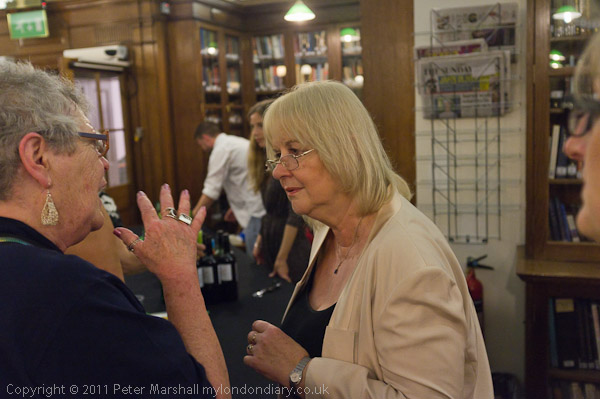
Photomonth Opens – Phil Maxwell

© 2011, Peter Marshall
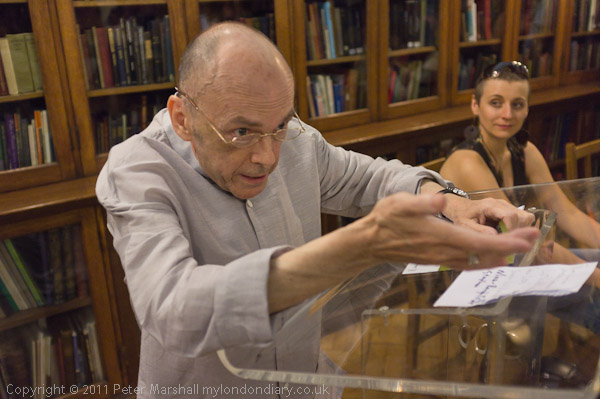
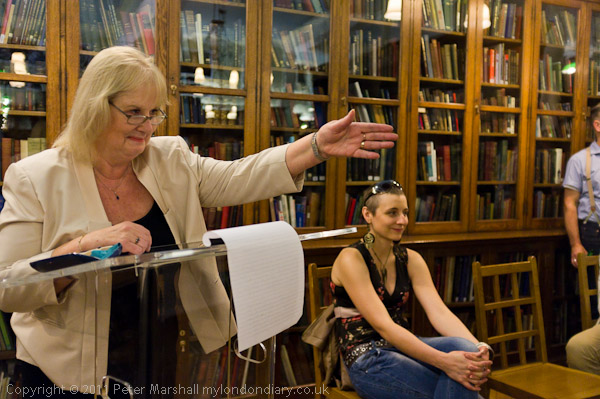
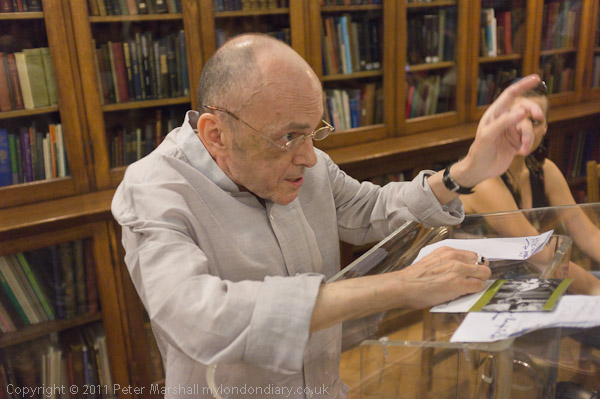
Phil Maxwell speaks at the opening

Tonight saw the opening of Photomonth 2011, still London’s only real major photography festival, although nominally limited to East London. That is a fairly elastic definition, and there are also a few shows outside the area, as well as some on-line.

There had been a suggestion that there might be a greater emphasis this year in the run up to the London Olympics on photographs of East London in general and the Olympic area in particular, which was why I organised the show ‘East of the City‘ as a part of it, with work by three photographers and including some of my own pictures from what is now the Olympic area, taken around 25-30 years ago.

Looking through the very extensive catalogue of exhibitions this year – well over a hundred shows in East London, as well as other activities, relatively few seem to have taken that suggestion to heart, but at the very centre of the festival, showing the the Bishopsgate Institute and Rough Trade East is Phil Maxwell’s ‘Forty Years On’, and it was this show that was the centrepiece of this years Photomonth opening.

I found it a slightly difficult show to view in the library at the Bishopsgate Institute, with some pictures high up on the wall above the book cases, and others rather smaller on the ends of the stacks. I was thankful that their was a listing of the images so I could work my way slowly around the space and make sure I saw them all, though I did find it a little annoying to have to change from my distance spectacles for those pictures on high and back to my ‘computer’ glasses for those at a lower level. Maxwell’s earlier work from Liverpool in the 1970s was rather easier to view, shown more conventionally in the corridor outside the library, and perhaps because of this and a more limited range of subject matter I found it photographically more coherent.

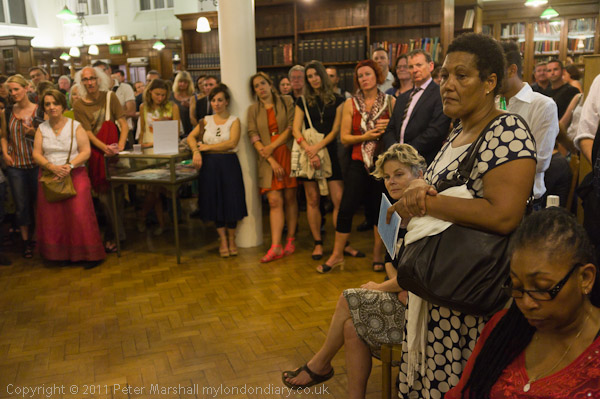
From Liverpool, Maxwell came down to London, and his pictures show that he took the East End to his heart, and the reception at the opening showed that the people there took him to theirs.

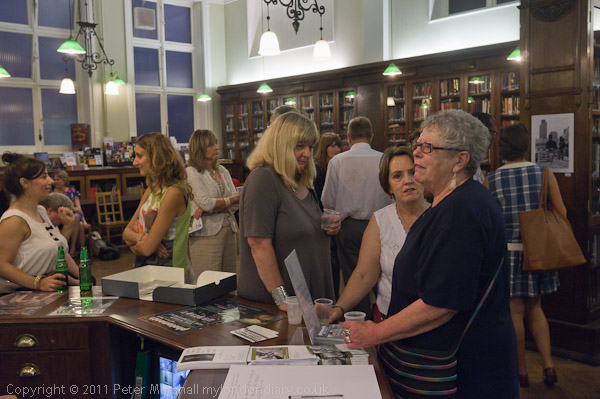
Here are some pictures from the opening on Thursday 29th – in time I will post more on the 2011 September pages of My London Diary.

© 2011, Peter Marshall

© 2011, Peter Marshall

© 2011, Peter Marshall
Festival Director Maggie Pinhorn introduces Phil Maxwell
© 2011, Peter Marshall

© 2011, Peter Marshall

© 2011, Peter Marshall

© 2011, Peter Marshall

© 2011, Peter Marshall

Over the next month there are many events and shows to enjoy in London  – see the details on the web site or pick up the brochure from any of the hundred or more venues.