Arms Unfair 1

Every two years since 2001 arms dealers and traders from around the world have descended on London’s Docklands for the world’s largest arms fair, DSEi, the euphemistically titled ‘Defence & Security Equipment International’ sponsored by our government where people around the world – including many from dictatorial regimes – come to buy the weapons and systems they will use to kill and repress people around the world.

Of course there are a few concessions made to give it a more positive image, with a few countries being excluded (though others may make deals on their behalf) and some universally banned weapons – such as cluster bombs – usually being kept under the counters rather than on display.

But as I note on My London Diary:

The UK Government’s Human Rights Annual Report for 2010 listed 26 countries where there was considerable concern over human rights violations, and in the same year it approved arms exports to 16 of these including as well as Libya, Israel and Saudi Arabia.

Protests against DSEi take place regularly through the year, both outside the ExCel Centre and at the offices and outside other events organised by the owners and organisers of DSEi, Clarion Events, and are led by groups such as East London Against the Arms Fair and CAAT (Campaign Against the Arms Trade.)

During the actual arms fair, police seal off a large area around it, closing off everything between the DLR line and the whole north side of the Royal Victoria Dock, as well as maintaining a strong police presence in the surrounding area. Opportunities for protests within sight or hearing of the event are very limited, and most of the protests this year took place elsewhere in London.

Although protests took place throughout the week of the arms fair, Tuesday 13th September when it opened was the main day of action called by the  ‘Stop the Arms Fair Coalition‘ and I came up to the Houses of Parliament at 10 am for the first event, a mock arms fair in Old Palace Yard.
© 2011, Peter Marshall

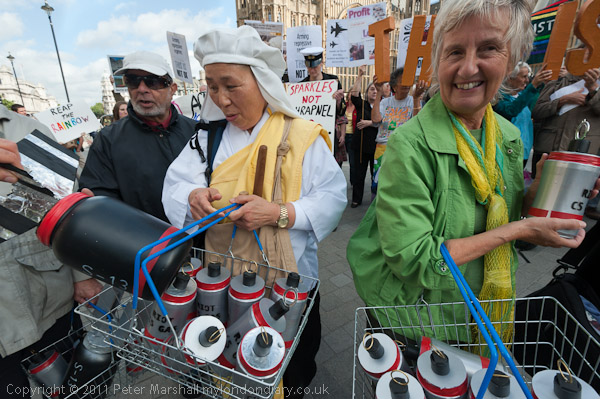
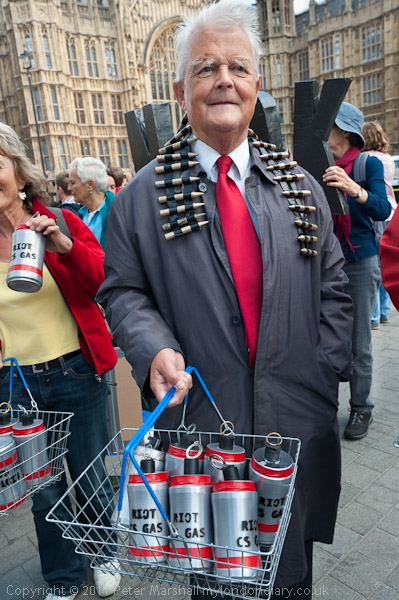
It was easy to get some pictures as people queued with supermarket baskets full of arms, and certainly some entered very much into the spirit of the event.

Our Houses of Parliament are fairly recognisable even without Big Ben which is hardly visible from Old Palace Yard where the event was set up. Parliament Square is a better venue for protests, both because that large clock is more visible and also because far more people see the protest, with a far more traffic passing through than at Old Palace Yard. Unfortunately although the permanent peace protest continues on the pavement there, the rest of the square remains fenced off and unavailable either for tourists or protesters. It is a ridiculous and entirely political decision.

Of course the truly iconic view of the Houses of Parliament – which I learnt from the dinner table bottle of HP Sauce – was from across the river, showing in detail its full length from the Victoria Tower at the left to Big Ben at the right. Along with the French text “Cette sauce de haute qualité est un mélange de fruits, d’épices, et de vinaigre pur. Elle ne contient aucune matière colorante ni preservatif ...” it has long been dropped, at first in favour of a vignetted view and now by more of a caricature (and has even disappeared completely on some containers.) The sauce remains only in name, and perhaps typically for something invented in Britain was sold to a French company and then Heinz and is now made to a different recipe (catering for US taste and healthier eating) in Holland.

There was of course no sauce at the SAFC arms fair, but lots of canisters of CS gas to deal with riots as well as some bombs and a few rockets. One of our best-known peace campaigners, Bruce Kent, grinned delightedly as he wore a necklace of bullets while queuing with his full basket of lethal goods.
© 2011, Peter Marshall
Bruce Kent stocks up with a good supply of CS Gas

Of course it was a staged event, as my pictures show clearly. Where things go wrong is not when others stage things but when photographers stage things for their pictures and they are used as if this was what was happening spontaneously. So far as  possible I try not to interfere with things, although pointing a camera at them almost always alters what happens, and at this event there were many people with cameras – and it was organised for them.

Photographically there were few problems, except in avoiding other photographers, who I don’t like in my pictures and in return whose way I like to keep out of as much as possible. As usual I worked mainly with the wide angle 16-35mm which means getting in close, but there was plenty of time and opportunity so that this didn’t really get in the way of those who like to stand further back.

I go in, take my pictures and then move back. What really annoys me at some events is when a photographer goes in close, takes some pictures and then continues to stand there in everyone else’s way, often while ‘chimping’.

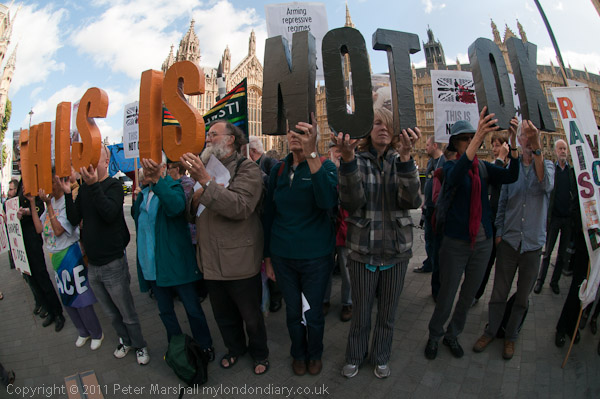
I took a few pictures with the 10.5mm fisheye, but this really came into its own later in the day.
© 2011, Peter Marshall

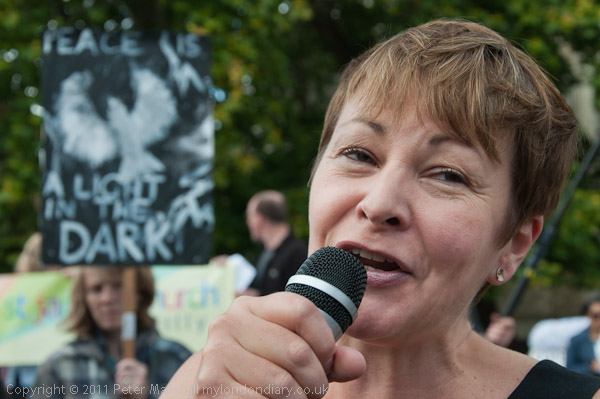
The 10.5 was the only way I could get the whole of the text ‘THIS IS NOT OK’ that people were holding up, as they were standing close behind the arms queue. I also took a few pictures using the 18-105 (27-157 equivalent on the D300) but there were relatively few images where I wanted to work above 50mm.  Though for Caroline Lucas speaking, a ‘portrait’ focal length worked well.
© 2011, Peter Marshall
Green MP Caroline Lucas speaking. 50(75eq)mm – a typical portrait lens focal length

More text and pictures at: Arms Fair Protest At Parliament.

The arms fair day of protest continues in the next post.
Size Matters

I’ve always liked small photographs. Photography started that way with the Daguerreotype, and they had a privacy and an intimacy that has perhaps never been surpassed, requiring anyone who wished to enjoy them to hold them in their hand, open their case and angle them to the light to reveal their delicately detailed secret.

Even when I first experienced actual photographs well over a hundred years later, they were still small objects, perhaps around 3½” by 2½” kept carefully pasted into albums and largely brought out on special family occasions to pass around.

Much later I began to buy photographic books (first I wrote ‘collect’ but I’ve never really collected books, although I now have several thousand; for me it isn’t a collection but a working tool) and although some books are large and have quite big images, I can’t think of one single example of a truly great photographic book with photographs larger than around 8 x 10″.

In the middle of the 1970s I joined a local photographic club, and then went on another much larger club a few miles away. There I found that serious photographs were expected to be 20×16″ or at least 16×12″. I did make a few prints that size, but then began to rather shock some people by following the advice of Ansel Adam’s ‘The Print’ which had become my darkroom bible and presenting my prints in large neutral white over-mats. 20×16 was around the right size for a 12×8″ which became my standard ‘large’ print size, while smaller images fitted on 16×12. By the time I left the club (more or less by mutual consent) a few years later there were quite a few others following my example.

© 1983 Peter Marshall
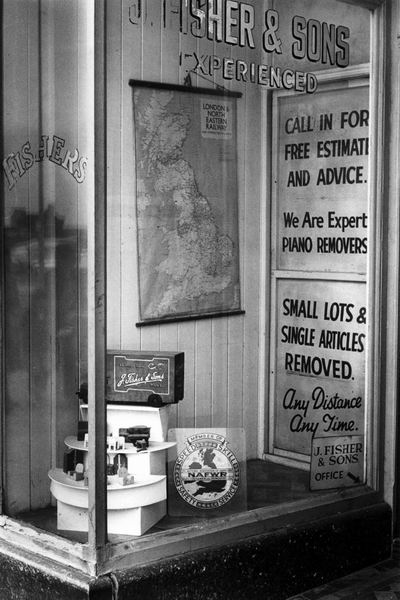
Fisher’s Removals, Spring Bank, Hull – from my 1983 show

My first – and really my only – big show in 1983 had around 140 images – I’m not sure now of the exact number, though it amuses me to think of it as 144 – a gross! Most were black and white images and were 160x106mm (approx 6.3×4.2″)  a size I chose as the ideal for photographs from 35mm.  They were shown mounted as pairs behind carefully cut white over-mats, rather like double page spreads in a book (with some pairs combined into a group of four one above the other.)

They were highly detailed prints and I think marked the zenith of my work as a photographic printer – working on such a small scale was tricky compared to making larger prints and they were all produced on Agfa materials which were shortly after replaced by inferior but less toxic materials.

Since then I’ve had a more relaxed attitude to print size, particularly with the advent of digital printing, which has enabled me to get more out of some of those old negatives – and now to even approach the quality of those old prints and even sometimes better it.  For last month’s ‘East of the City’ show the prints I made, again from 35mm, were nominally 360x240mm (ca 14.2×9.4″) and work well, though I think I would prefer them at a slightly smaller size the quality holds up pretty well.

Years ago when I used to take my work to a particular client he would look at my 10×8’s (image size around 9×6″) from 35mm and buy them, but tell me that what he really liked about images taken on large format cameras was that you could take a loupe to the print and see more detail. For some kinds of documentary work that may be important, but for other photography it may be totally irrelevant.

And while I may like small prints you can hold in your hand, they are not necessarily suitable for all occasions. If you are going to hang photographs on walls they probably usually work better at a larger size than the same pictures in books.

Two things got me thinking about size of prints today. The second was writing about Gursky’s 80×140″ images of hugely expensive banality (and being mounted on glass it must also be pretty heavy.)  But more pressing was the delivery here yesterday of the unsold prints from my ‘Secret Gardens of St John’s Wood’ show. I’m still hopeful that a few of them will be sold, but at the moment I have them to look after, and the large carton containing them is taking up too much space in my hall. Usually I keep prints in my loft, but the hatch to enter that isn’t large enough for the carton or even the largest print to go through.

© 2011 Peter Marshall
A 40×30″ print from ‘Secret Gardens of St John’s Wood’

I have one of the two 30×40″ prints that were made for the show and I live in a small house. My wife suggested hanging it on the wall of one of our downstairs rooms, but although it would fit it really is too large and out of scale with the other images already there. There are a couple of the smaller images that will fit nicely where one of my old triptychs fell down last year and I’ve not got around to re-framing it.

Fortunately I’ve managed to find what I think is an ideal space for the large garden image above, facing the landing at the top of the stairs, where it will fit nicely in the currently empty space above some smaller frames. The dark grey surround will I think look good on the rich brown hessian wall-covering and the image will almost be like a window in the wall.

But if someone were to give me the Gursky for Christmas that would have to go in the back yard. I think I’d leave it face to the wall.

Art & Photography

The recent record $4.3 million paid by an anonymous buyer for Andreas Gursky‘s bland and featureless view based on a fairly bland and featureless stretch of the Rhine, Rhine II, provides yet more evidence of the art world’s inability to understand photography. But then the art market isn’t about understanding images, but about making money from them, something it does extremely well.

Although Christie’s write (and possibly even think) that this work is “a dramatic and profound reflection on human existence and our relationship with nature on the cusp of the 21st century“, to me it seems profoundly shallow and to almost exactly negate our growing understanding of our place on this planet and how we might possibly attain a sustainable relationship to it. If our civilisation continues into the future I’m confident that it will not be too long before this work will be hidden away in the basement store of some museum never to see the light again. Although at some point doubtless rediscovered by some eager curator keen to make a reputation by re-evaluating and recycling the rubbish of the ages.

Is it worth $4.3 million? Well, of course not, except in the sense that anything is worth what someone is prepared to pay for it. In the short term it might even be a good investment, able to be sold on for even more, though I think in the longer term more likely to become an expensive embarrassment, it’s overblown size at 80 x 140 inches making it very much a green and grey elephant.

I’ve stood in front of many if not most of Gursky’s giant images and remained largely unimpressed. I’ve seldom found their size makes them any better, except in terms of décor. Huge modern offices and public buildings need works on a giant scale, hence the ‘healthy’ sales of giant photographs of very little that sometimes seem to dominate photographic dealer trade shows such Paris Photo (which I’ve just missed), boredom on an industrial scale.

Of course these vast empty walls could be filled more cheaply by painting images direct on them using the kind of techniques used for giant adverts such as those covering the backs of some buses, and there are plenty of out-of-copyright masterpieces that might be suitable for such treatment. But covering walls with expensive artworks isn’t really about the visual experience, more an affirmation of affluence. It’s a slightly more tasteful way of covering your wall with gold bricks or papering it with thousand dollar bills.

Gurksy’s approach to ‘Rhine II’ is essentially anti-photographic, although he starts with a photograph or photographs he then Photoshops out what he considers ‘intrusive features’ – people walking their dogs, cyclists, factory buildings and so on – but what to me are the essential guts of photography. It’s not really possible to know how much of the photograph remains, and what has been cloned or otherwise generated. It’s an image that for me has lost touch with reality, and that relationship with the real which is the essence of our medium.

It reminds me not of a photograph, but rather of some of the entirely computer generated images that many now produce. Drawn a few straight lines across the window, pick some appropriate fills, set randomness close to zero and blandness near infinity and you have your own Gursky. Though possibly also a copyright suit.

Salgado Talks

Sebastião Salgado now works using a Canon EOS-1Ds Mark III and you can read a fairly long interview with him on the Canon Professional site. Although I admire much of his work, somehow he isn’t a photographer whose pictures I would go out of my way to see, though I can’t quite justify why not. Perhaps he makes things a bit too neat and pretty for me, things that I feel should be messier and somehow have more life. But it’s hard not to admire the man and his work, including the “epic Genesis project” that this interview is about, though perhaps the description of the work as ‘epic’ is part of what worries me.

In some ways what I found most interesting about the piece was the technical stuff at the end, where we find that he has a specially modified camera to give him the 645 frame format ratio. He also says “I don’t look at the back of the camera after I take a picture. I only look [at the end of a day’s shoot] very quickly to see if there is a problem.” I have to admit that I don’t often look at the camera back, though I like to do so occasionally, not to see if I have got the picture I want, but more to see if I have got a picture at all. I find it only too easy to forget some vital setting which means I get the exposure totally wrong, perhaps forgetting that I had dialled in a couple of stops exposure compensation earlier. It does all appear in the viewfinder display, but I find I don’t usually notice that when I’m really engaged with the subject.

But Salgado really does take things a stage further,  pretending he is still using film and having contact prints made for him of the 10,000 images from each trip to work from and make his “edits with a loop.” The sentence that had me fooled for a moment until I realised that it meant a ‘loupe’.

He says he doesn’t shoot more on digital than he did on film, and on a 645 film camera, those 10,000 images would have ended up well over 600 contact prints. Perhaps he really did shoot that many films, but it seems rather a lot.

He then has his Paris lab make “a physical negative” from the digital file, and his prints are made from this. The article doesn’t make clear whether he – or his printer – works on the digital file to carry out any necessary ‘dodging’ and ‘burning’ or other corrections, or whether this are left to the final darkroom stage.

I also learn that he has 8 lenses and a 1.4x tele-extender, but perhaps surprisingly nothing wider than 24mm, which I would find rather limiting.  But I certainly applaud his advice to young documentary photographers that they need to have a good understanding “of history, of geopolitics, of sociology and anthropology” rather than technical knowledge being of paramount importance, though I see I have changed his word ‘knowledge’ into ‘understanding.’

Dale Farm

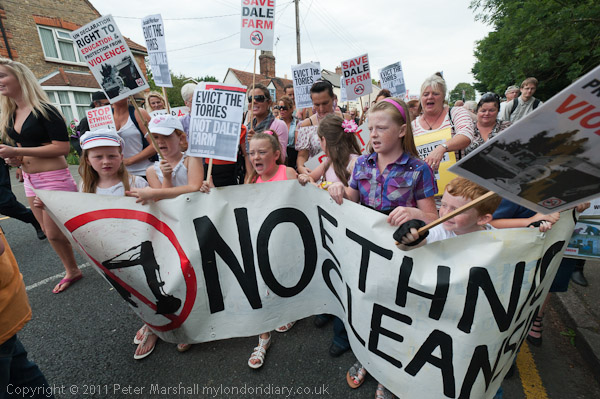
It’s now several weeks since police stormed Dale Farm and forced most of the residents along with protesters from the illegal site, but the story is far from over. Many of the travellers are determined to stay in the area, and at the moment many are still livng just a few yards down the road, although Basildon Council is expected to try and get a court order for them to be removed. There may too be further legal actions over the way that the eviciton was carried out, and also on the wider question of discrimation against the travellers, both in this particular instance and more generally over planning matters.

Although the dispute over the site has being going on for around ten years I had not visited Dale Farm before September this year. I seldom cover events outside London – although I admittedly have a slightly elastic definition of what that is, and certainly not not unless they are readily accessible by public transport. But there was another factor in this case, in that before I decided to read up about it, I’d dismissed it as a case about planning issues – which was how our legal system dealt with it.

Once I found out more it became clear that the issue over development on Green Belt was essentially an unimportant pretext, and that the real issue is one of discrimination against a particular community and their way of life.

© 2011 Peter Marshall

I’ve long had an interest in planning issues; it was reflected in my political activities back in the 1960s and later in a number of photographic projects – such as ‘Still Occupied – A View of Hull‘ which I brought out as a Blurb book last year, as well as later work around London which you can see on the urban landscapes site. What I saw when I finally made it to Dale Farm convinced me that this was an appropriate place for the site that it would be unlikely that any unbiased planning process would have refused, particularly given that at least part of the land had been in use for some time as a scrapyard and it was Green Belt only in name.

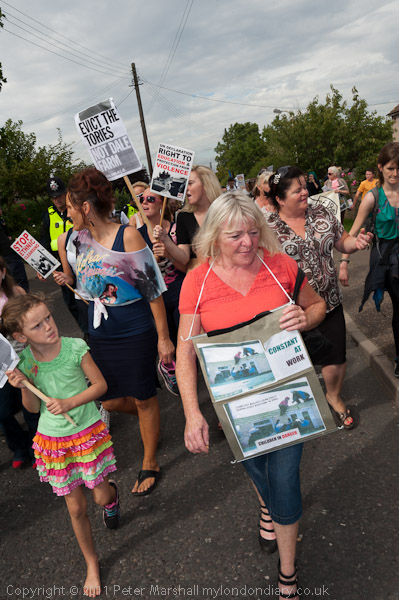
You can read more of my thoughts on Dale Farm and see pictures from the protest march against the evictions in March Supports Dale Farm Against Evictions on My London Diary.

© 2011 Peter Marshall

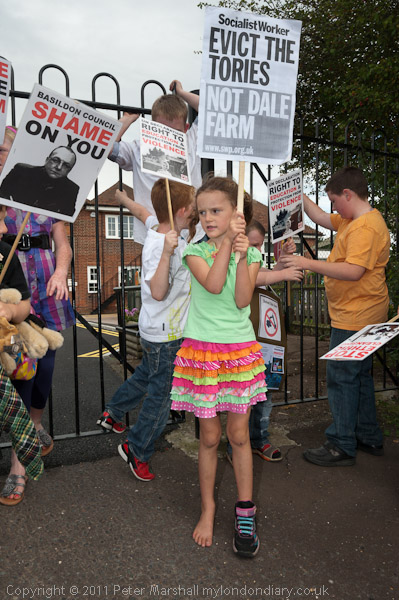
I don’t know why the girl in this picture was wearing only one shoe.

Most of the children had taken off their shoes while having a short rest a few minutes earlier on the seat in a bus shelter, and some had not bothered to put them back on to run the few hundred yards along the grass verge to the gates of their school. It was the contrast between the lurid trainer and her bare foot that drew my attention. I thought she had probably rushed to join the photo before having time to put on the second shoe. Certainly she had been wearing it when I photographed her earlier.

But some minutes later I photographed her walking along the road, still wearing just one trainer. So I assume she had either somehow lost it or it had fallen to pieces.

© 2011 Peter Marshall

The protest on September 10 started at Wickford Station rather than Dale Farm, a simple and fairly short journey for me – three trains with easy changes and I was there in around an hour and a half. Of course although the march was to start from the station, it was going to end at the site, around three and a half miles away, and I would then need to get back. Not a great problem, I could always phone for a taxi, and this is the kind of area on the suburban fringes where there were likely to be plenty of taxis.

But I decided seven miles was not a very long way – the kind of distance I often do on an afternoon walk, and it was going to be a nice day for a country walk. So I added the OS map of the area to my bag, and also found that if I got tired I could take a bus back to Wickford once I got to the main road.

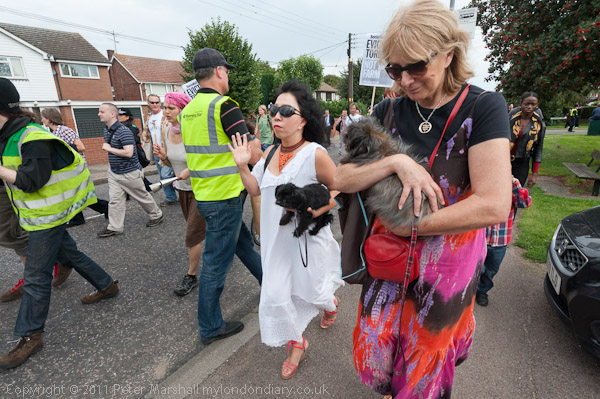
© 2011 Peter MarshallAt least I didn’t have a dog to carry

What I’d not taken into consideration was the weight of the camera bag I was carrying – not a huge weight, but around 14 lbs and feeling much heavier after a longish day, as well as the extra effort involved with running around and taking pictures. Walking back turned out to be something of an effort, and my planned route from the map was made longer when one of the minor roads shown on the map turned out to be a private road and I had to detour.

The route I took was pleasant enough, though made slightly trickier at one point where Basildon council’s map had put the path on the wrong side of a fence and they wanted the farmer who owned the land to pay to put their mistake right, as I heard from his father who I had stopped to ask the way. I had intended to put a picture in here, but I find I was so uninspired by the countryside that I didn’t take any.

But I was pleased after half an hour or so walking to arrive at the main road and a bus shelter, even if I had missed the bus I was aiming for and it was over half and hour until the next to take me back to Wickford. Photographers often have to wait around for things, and one of the things in my bag is always a library book, and I settled down on the seat in the shelter to read it until it was time for the bus.

Photomonth Photo-Open 2011

© 2011 Peter Marshall

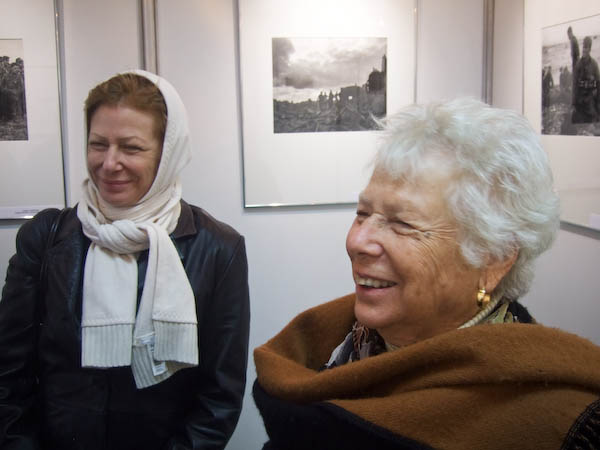
Yesterday I went to the opening of the 2011 East London Photomonth Photo-Open at Rich Mix on the Bethnal Green Rd. It was a fairly crowded event, with most of the 80 people who had submitted work there, along with their friends.

© 2011 Peter Marshall
I looked hard for anyone with red shoes but in vain

Photomonth is a uniquely democratic photography festival, and for me that has always been a very good reason to support it, although I’ve never yet entered work for the Photo-Open, preferring to curate group shows including my own work as a part of the festival in which those taking part do so on the basis of a small body of work rather than a single image.

For me the projection of images – though I didn’t stand and watch it all through last night, thinking that I could drop in again while I was passing as the show continues until 26th November and the centre is open daily from 10am to midnight – was in most ways more interesting than the small sample on display as prints, with many of those taking part having several images in the projection – which showed all images submitted.

The prints were printed by theprintspace, who also made the prints for my ‘Secret Gardens of St John’s Wood‘ which closes tomorrow (5 Nov 2011)  and the colour work was certainly excellent. I was not quite convinced that the (relatively few) black and white prints on show were quite at the same level, though they were certainly not bad prints. But black and white printing is still something of a dark art even though we have come out of the darkroom. I’m not convinced that C-types (which I think these were) can ever match the best inkjet prints; as I’ve commented before, “colour printing is a process while black and white is an art.”

© 2011 Peter Marshall

© 2011 Peter Marshall
Concentrating on choosing which image to vote for in the Photomonth Youth Award

© 2011 Peter Marshall
Watching the projection of all the images
Watching the projection did also make me wonder about the selection process involved, and certainly my own choice of images would have differed fairly radically from those on the wall. Among them there were certainly some interesting pictures – my favourite taken in a meat van – but there were also those that I could see little reason for selecting.

I think there was probably a deliberate decision to select work that showed the widest possible range of approaches and subject matter, and perhaps also to show work by people who had not previously shown.

© 2011 Peter Marshall
Watching the projection of all the submitted images

When  I arrived home I started loading the files as usual into Lightroom – I’d been taking pictures both on the Fuji X100 – a great camera for unobtrusive photography in low light, as well as using a Nikon D700 with 16-35mm. The files for the Fuji loaded without problem until the very end when Lightroom reported a problem with its catalogue file.  Some 14 hours later it is still chuntering away on the hard disk with “Catalog Repair in Progress” and I’ve decided to leave well alone until it either finishes or the computer crashes.

The Fuji focussed pretty well in the lowish light – I was working at ISO1600 with the lens wide open at f2 and some slowish shutter speeds – and I think I took some decent pictures, but there were situations where I needed a wider view than the 35mm equivalent.  With the maximum aperture of the Nikon 16-35mm at f4 I needed to use ISO3200, but that isn’t a great issue with the D700. I processed the D700 images on my petite notebook, which doesn’t have enough memory or horsepower to run Lightroom, and has a screen that gives a very different result if I move my head around. On the notebook I have an old copy of ACDSee and its image editor FotoCanvas, which can do some basic corrections, but I’ve done very little on these, other than some slight changes to exposure, watermarking and resizing. The colour balance is exactly as Nikon decided it ought to be.

When that catalogue is repaired – or I give up on it and start a new one – I’ll post some more images from the evening, and perhaps correct and tidy up these.

Rashid Talukder 1939 – 2011

I first became aware of Rashid Talukder at a show I wrote about here in 2008, ‘Bangladesh 1971‘ at Autograph, documenting the birth of that nation. His work in that show was outstanding and made me want to know more about him, and I found over 90 images on Majority World which confirmed my admiration for him. It was a vew further strengthened by his seeing his pictures again in Where Three Dreams Cross, 150 Years of Photography from India, Pakistan and Bangladesh, shown at the Whitechapel Art Gallery in 2010.

You can read a long and loving obituary of this man, the ‘elder brother’ of Bangladesh photography, in Shahidul Alam’s The light we failed to see, which gives a real insight into the man as well as the problems he faced as a photographer in Bangladesh. Alam, who co-curated both of the shows mentioned, has written a moving piece on his friend and colleague that deserves to be read in full, so I won’t quote from it, just urge you to read it, to take a long look at Talukder’s photographs and to be prepared to rethink some of your preconceptions about the history of photography.

=================================================

Naomi Rosenblum‘s ‘A World History of Photography’, first published in 1984 was at the time a ground-breaking volume, and one that I seized on with delight for my teaching as  it began to open our eyes to some of the things that had happened outside of the USA and Western Europe (and also for some of her insights into New York photography of which she and in particular her husband Walter Rosenblum had been such an important part) , but we can now see there was so much ground it left unexplored.

© 2007 Peter Marshall 
Nina and Naomi Rosenblum at the Walter Rosenblum show in Bielsko-Biala

Perhaps what we now need is a ‘Majority World History of Photography’ which would tell us more of that story.

Time Changes

I’ve been having problems with time on my cameras recently. It comes from using two Nikon bodies on most of the events I cover, the D300 and D700, and the need I feel to synchronise the time on the two of them.

When I get home from taking pictures I import the pictures from the CF cards onto my hard disk and an external hard disk, putting the images from both cameras into the same folder, renaming them so that they have a sensible and unique file name. Something incidentally that I just don’t understand why Nikon doesn’t incorporate into the firmware. It seems silly just to basically number them from 1-9999 and then start again. For most purposes it would seem to be useful and sufficient to allow photographers to choose a suitable naming convention which avoided duplication. My own preference would be yyyymmdd-xnnnn, where yyyy is the year, mm the month, dd the day, x a single character camera identifier and nnnn a sequential number, which is basically how I do things in Lightroom, except without the camera id digit which isn’t needed in that case.

Lightroom and other software can put the images in the order they were taken when you use more than one camera only if the times are synchronised. Another suggestion I’d like to make, this time to the writers of Lightroom would be to be able to lock the order it shows images in a folder by time. You can sort them this way, but sometimes it decides you want them in some different ‘user order’. I never do.

If your cameras have a different time, sorting on creation time will put your images in the wrong order, and it can be very annoying. So a couple of weeks ago, when I found the two bodies had somehow drifted to a few minutes different I spent a tricky ten minutes trying to synchronise the two bodies. And after quite a lot of button pushing and swearing sat back and relaxed when the two displays both changed with their hours, minutes and seconds in synch.

Unfortunately, when I next uploaded images to Demotix I got an error message complaining about the date on the images. After a little poking around I found that I had pressed at the wrong time at some point, and one of my cameras was now working in 2012 rather than 2011. I put it right. Then uploaded some more only to find I still got the complaint. Yes, they were 2011, but the month was 11 rather than 10, and with a few more button pushes things on the camera were fine.

Normally I would have noticed immediately I uploaded the files, as my import settings mean they would have gone into a different folder. But since my main computer was away for repairs I’d had to use my notebook, which hasn’t enough memory to run Lightroom.

It would of course be possible to make cameras automatically keep correct time (and change to and from Summer Time) but I don’t know it would be a good idea. I have a travel alarm clock that does so, which is fine so long as I only travel in the UK, but when I go abroad and set it to the local time, it keeps on that for a while to fool you, then changes back to UK time in the middle of the night, which can be fairly disastrous. So now I leave it at home. But perhaps the clocks could be more accurate – there is a drift of several seconds a week between the two bodies.

End of Summer Time

This morning as you will have noticed (unless you are in Russia) you probably put your clocks back and hour. Depressing, though I welcomed the extra hour in bed, we now have to suffer those early dark nights. Fortunately my alarm clock does that kind of think automatically, but my cameras don’t. So when I stop typing this, I’m going to go and tell them we are no longer on summer time. If you haven’t yet done so I suggest you do too. It took me a month or so to get round to it last time we changed the clocks. 

Actually I did this one one body by mistake yesterday. So the pictures I took on one camera all think they were taken an hour earlier than on the other.

Changing Times

Fortunately it’s easy with the right software to change the creation date, and to do it as a batch process so that if you correct one image all the others selected have their date altered by exactly the same amount. I did some on Lightroom and some with my default image browser, ACDSee Pro, which I also find easier to use when adding IPTC captions to my pictures.

Photographs Clear Protester

I wasn’t at the demonstration against David Willetts, Minister of State for Universities and Science when he went to speak at the Brunei Gallery Lecture Theatre of the School of Oriental and African Studies (SOAS) of London University last June, but fortunately some other photographers were there filming and taking pictures.

Simon Behrman, one of the four students arrested there, writes:

The police and the security acted aggressively, threatening people with CS gas punching and hitting various people including me. What had started out as a peaceful protest turned violent because of the police over-reaction.

He goes on to state that to justify their assaults on him, “they fabricated statements accusing me of attempting to kick and punch police officers and security guards.” His case under Section 4 of the Public Order Act came to court yesterday, and was dismissed less than halfway through the hearing.

Fortunately Behrman had a good lawyer who found photographs and video that had been taken of the event, which enabled his barrister to completely demolish the evidence of the first police officer who testified, leading the magistrate to tell the ‘prosecution that their case “had been blown out of the water”’.  You can read a fuller account and see some photographs and video from the event on the Defend The Right To Protest web site.

I’ve several times been asked to provide pictures to help with the defence of protesters, and have always done so if I had relevant material. The police too often photograph protests and the people taking part, but somehow they seldom seem to be able to provide pictures that show the police misbehaving.  Even CCTV seems to fail mysteriously under such conditions.

Unlike many of my colleagues, I’ve yet to be asked by police to provide pictures.  Often when they make requests it seems to be more a general trawling for information than wanting evidence about a specific event, and I think rightly such requests are generally ignored by journalists, at least unless backed by a court order. To do otherwise would be acting as if we were a part of the police rather than taking an independent position.

At some protests, photographers are not made welcome and people sometimes object to being photographed although they are demonstrating on the street in public. As this case shows, photographs by independent observers are an important safeguard of our rights.

Church & Mammon

© 2008 Peter Marshall 
Giles Fraser speaking in 2008

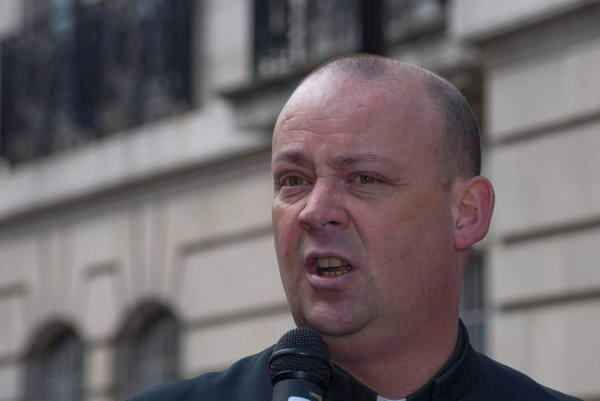
Yesterday’s resignation of Giles Fraser from his post at St Paul’s Cathedral came as little surprise, although I was sorry to hear of it. I’ve heard him speak many times on radio and occasionally in person, and have always been impressed by him if not always in total agreement with his views. The real surprise for me had come earlier, with his appointment to the job.

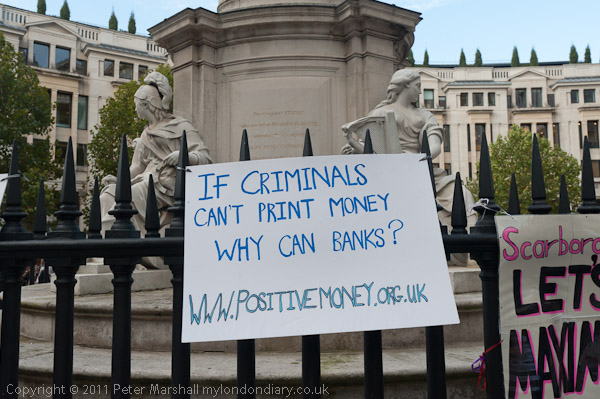
I was at St Pauls when the occupation started, and I’ve visited it a couple of times since, and was extremely surprised when the Cathedral decided to close its doors a week ago. It seemed to me then that the reasons given were entirely spurious; if there were any real health and safety issues they were obviously very minor, and the OccupyLSX were clearly cooperating already in various ways and would make the small changes necessary – as apparently they have now done.

© 2011 Peter Marshall
OccupyLSX left a wide clear path here at the request of the Cathedral

Clearly the decision by the Cathedral authorities seemed to me to be a political one, designed to put pressure on OccupyLSX to move and to try to gain the support of the media and public to get them to go.

In many ways OccupyLSX is raising the kind of issues around business and ethics that the church – and St Paul’s in particular – should have long been raising. Other churches have  been rather more active than St Paul’s in this respect, and various religious groups have been active in related areas. St Paul’s both because of its location and its authority in the church has a privileged position and rather than giving a lead for action has appeared to favour the City and the status quo. I suspect that this is not the first occasion the Rev Fraser has found himself in a minority and frustrated at his inability to lead the cathedral into Christian action rather than simply continuing the observance of church practices.

© 2011 Peter Marshall

It is hard to see what the future will hold for the occupation at St Paul’s. As a spokesman for the City of London authority said on the Radio 4 Today programme this morning, going to court to legally remove it could take several months and may be complicated by the division of ownership of the area in use between the City and the Cathedral. He was worried that the area might become one of permanent protest, like Brian Haw’s Parliament Square Peace Protest, still continuing after more than ten years of political, police, ‘legal’ and other harrassment, and outliving the death of its founder.

Personally I hope that even should OccupyLSX leave (as it orginally intended to do so) that the Cathedral will be moved into continuing some visible political action on what the protesters have reminded them is a splendid public platform. Any church that wants to continue to claim a link to its Christian heritage should be out there on the streets protesting now.