Richmond in the 70s

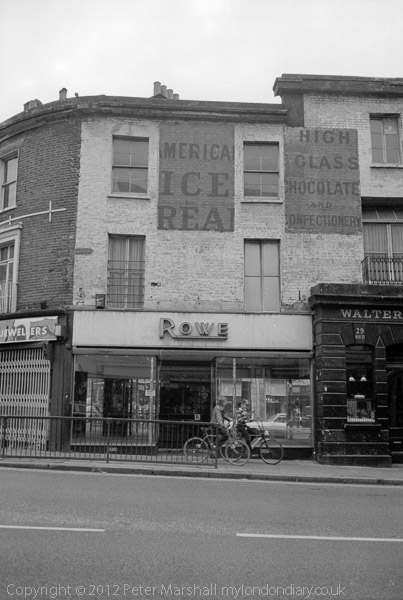
Sorting out the hundreds of my images from the 1970s that I’ve thought worth scanning I came across this one, not a great picture – which is perhaps why I couldn’t remember where I had taken it. I looked out the contact sheet to find little help. There were a series of half a dozen frames of this and adjoining scenes, but nothing obviously to indicate where I had been when I took them. The frames to one side were recognisably from the Shell Centre at Waterloo, and those after this were from close to my home, but there were no clues as to this location.
© 2013, Peter Marshall

The pictures seemed fairly carelessly framed (this may have been deliberate) and the only information I’d written on the contract was that they had been made with one of the several little Minox 35mm cameras I used to carry in a pocket all the time (I punched the filing hole through the model letters.) Hardly large enough to fit in a 35mm cassette, with a lens that folded into the body when not in use, these had a 35mm f2.8 lens that was every bit as good as the best SLR lenses. Or at least could be, as the first one I bought I had to fight with Leitz, the importers, to get changed as it was decidedly unsharp – at first I got back a rather sniffy letter from them pointing out that there were no performance standards for Minox products, but after I insisted they did replace it. It was a tough plastic clamshell design, but did break when it went flying out of my pocket as I ran down the street one day – and my insurance company perhaps surprisingly paid for the replacement. When that eventually broke down, Leitz apologised that they could no longer repair that model and offered me the latest version at around half price. So altogether I owned at least four of them over the years.

As well as being compact, it was also virtually silent, and great for photographing inconspicuously, although its automatic exposure was not always too reliable, and as with other very small cameras it was easy to get your fingers in front of the sensor – or the camera lens – when cradling the camera in you hand. The manual film wind also sometimes took rather a hefty effort with my thumb, which occasionally became rather painful.

Small cameras then didn’t necessarily mean worse results – those with good lenses could do just as well as larger beasts that took the same 35mm film and made images the same size – unlike with small sensor digital compacts.

I tried a few searches on Google using the shop names I could read on this and the other thumbnails I was looking at with some likely places and drew a blank, but once I looked at the scan at more or less full size I found the picture had a vital clue. Under the large 29 above one window the tiny bit of text I had thought to be decoration was actually the rest of its very short address, Hill St. Googling that suggested Mayfair, which it clearly wasn’t, but a quick search on my on-line A-Z found just two more Hill Streets in the Greater London area, in Richmond or St Albans.

I’d not visited St Albans in 1979 when the picture was taken, so it had to be Richmond, and it was good to be able to confirm this at the web site of the LB of Richmond and Twickenham, which has online a detailed  walk down Hill St, and I was soon looking at a picture of 29 Hill St taken in 1900, then the premises of Mr J.H. Jarvis, but clearly the same place at that on the right of my image.
© 2013, Peter Marshall

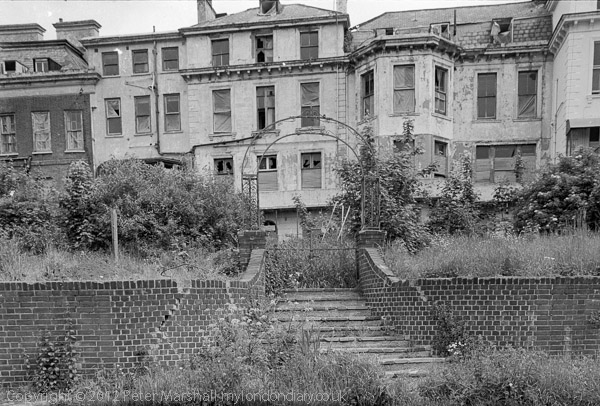
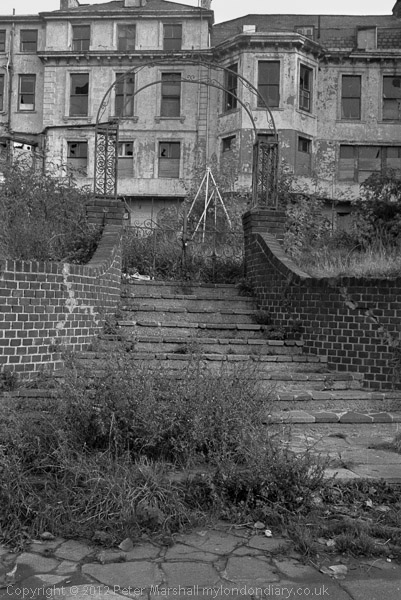
Around the corner are some much more recognisable properties next to the bridge which I’ve photographed on several occasions, and facing the river were the backs of some properties including a couple of listed buildings. I used to visit the area quite often at night some years earlier than my photograph, nursing a pint of bitter for an evening in my student years as I listened to the likes of Bobby Wellins playing in the old Palm Court Hotel. I wasn’t taking pictures then – I couldn’t afford to, as photography then was an expensive business – but later I took a few pictures of the exterior before the controversial redevelopment by Quinlan Terry in 1984 which rebuilt the Grade II listed façade but lost the atmosphere.
© 2013, Peter Marshall

The vertical image was taken in autumn 1979, probably with a Leica and the horizontal in May 1981, on an Olympus OM1. Little had changed though perhaps the weeds had grown a little.
A Cold Wednesday

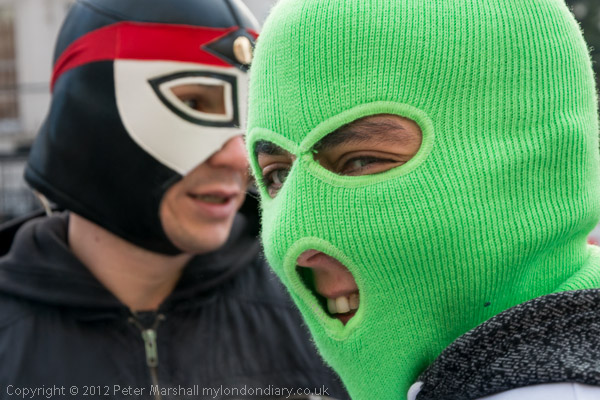
A week ago at this time, a little after nine in the morning, I was standing on the platform at my local station, waiting in a bitter wind for the train to take me to London. It was, for England, cold, around a degree or so above freezing. I don’t like cold weather, though I’d more or less dressed for it, with an extra layer under my thin coat and long johns under my lightweight trousers, an extra pair of socks and of course a scarf and hat, and I was keeping warm enough, though getting rather too hot when actually sitting on the train and bus which took me to Notting Hill for the Pussy Riot London Solidarity Demonstration close to the Russian embassy.

The cold weather had obviously put off protesters and when I arrived at the pen more or less opposite the embassy there was only one lone protester standing there with his placard. Across the road closer to the gates of the private road on which the several embassy buildings stand – and in which neither protests nor photography are permitted – was a small group of people, one photographer I knew talking to several students, some also with cameras who had also come for the protest, but decided not to stay.

As they got ready to walk off, I went across the road to photograph the one man in the pen, and the other photographer followed me and we talked to him and took a few pictures of him and his placard with the embassy in the background. Soon we were joined by another photographer, making it three to one.

© 2013, Peter Marshall
This was half of those at the London protest when I took the picture

By now I was wondering what to do. There didn’t really seem to be much of a story here, although it was a part of an international day of protest in support of the jailed Pussy Riot protester Maria Alyokhina, the London event was rather disappointing. I was standing in the cold and had at least half an hour before it was time to start my journey to my next appointment. It was too early to go to the pub, and I didn’t feel like a coffee. Fortunately another protester arrived, doubling the size of the protest, so the three of us talked to her and took more pictures. Then a few minutes later two men came, doubling the number again. More pictures. I was now expecting a group of four to arrive, and it was getting close to the time I had to think about taking a bus. Just as I’d said goodbye, rather disappointing a single further protester came to join, and I took a final picture or two before rushing to the stop. The protest was due to continue for almost another couple of hours and given the weather if I’d been going to protest I wouldn’t have been in any hurry to get there on time.

I like bus journeys in London, at least on double-deckers, where the top deck gives you an elevated view of the city and the streets, but they are seldom a rapid mode of travel. On foot the journey to the Royal Courts of Justice – around three and a half miles – might have taken me an hour, and the bus (taking a slightly less direct route) shaved five minutes off that. But it was warm, and saved me getting tired carrying a heavy bag. Underground is faster, though it involves more walking and I miss the view, but perhaps more importantly I can ride the buses for free but have to pay on the tube.

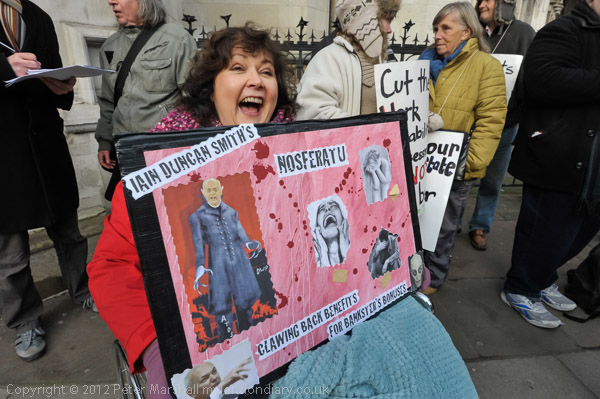
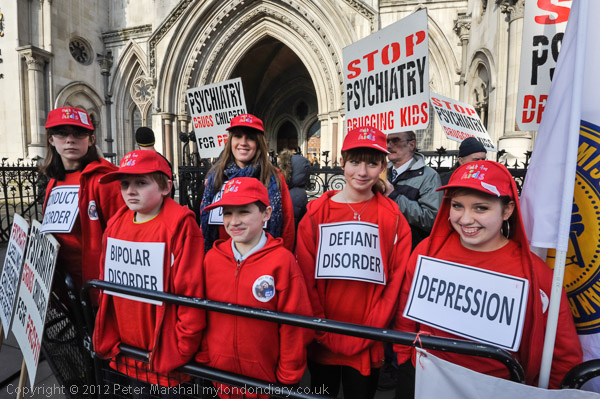
At the court I was surprised to find not one protest but two taking place. I’d come to photograph the Mental Health Resistance Network and Disabled People Against Cuts supporting a judicial review of Work Capablility Assessments on the grounds they violate the Equality Act by not being accessible for those with mental health conditions. They were setting up their protest on one side of the entrance, but in a pen on the other side were a large group of protesters with placards against psychiatrists and their dosing kids with dangerous medicines – Stop Psychiatry Drugging Kids.

© 2013, Peter Marshall

There was something in this second group that made me feel a little uneasy. In part it was the organisation, with neatly lettered large placards, red hoodies, and t-shirts, just too organised for a normal protest, more like a PR stunt. And though some of the things they were saying about the medicalisation of normal behaviour and the profits made from this by the drug companies are pretty sound, the name of their organisation, the Citizens Commission on Human Rights worried me. If it was a genuine citizen’s organisation I should certainly have come across it before. There were a few people wandering around with clipboards and at first I thought perhaps this was being organised for a TV film, but then I met a man in a white coat with a stethoscope and a batch of labelled pill bottles who threw me a dose of woo woo science and the penny began to drop. I still took some pictures and wrote up the story, because despite what they represent, from what they told me I felt the actual case they were protesting was a good one to protest.

© 2013, Peter Marshall

But the MHRN and DPAC’s Equality Protest Against ATOS Work Assessments was a more important protest, and one that effects many thousands of disabled people who are ‘being put through a traumatic and harrowing experience needlessly’, losing their benefits through incorrect decisions by tests administered by ATOS which the government’s own assessor has ruled ‘unfit for purpose’. It is an inhumane policy imposed by a doctrinaire government that seems to be taking a sadistic delight at creating hardship for the poor and disabled, with a total lack of understanding or empathy for those who suffer – and in some cases are driven to suicide.

The policy was the subject of a parliamentary debate last week and I’m pleased that at least one of the papers used one of my pictures from the protest. Parliament was clearly concerned by what is happening, although the government remained unmoved and unrepentant. This is certainly one of the nastiest policies of a cabinet that simply has no idea of the problems faced by those without millions in the bank. We need welfare reform, but unfortunately the Labour government set it off in the wrong direction, based simply on cost cutting rather than developing caring and personalised solutions that would actually be more cost effective.  Real assessments of people’s capabilities would make possible support that enabled them rather than leaving many contemplating suicide.

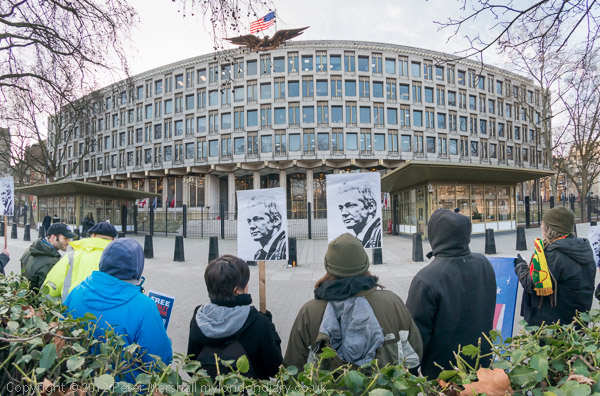
Another, slightly shorter, bus ride warmed me up and took me back west to the US Embassy in Grosvenor Square, where a regular protest in solidarity with Bradley Manning was being held on day 963 of his detention, as his defence were arguing at Fort Meade that his case should be dismissed because fo the failure to bring him to a ‘speedy trial’.  The protesters, who were going on to the Ecuadorian embassy to join the daily vigil there in support of Julian Assange, were there to Stand with Brad at US Embassy.  They stood in silence, their backs to the hedge, facing the US flag and eagle on the top of the of the building as they played the soundtrack of a video, ‘Collateral Murder’, showing war crimes by US forces, allegedly leaked by the ‘courageous whistleblower’ and published on Wikileaks, leading to Manning’s arrest and the US attempts to get Assange into their hands via Sweden.

© 2013, Peter Marshall

I made this picture stretching across the wide hedge, holding my D800 with the 10.5mm DX fisheye at arms length. It was tricky holding the camera level and getting the framing right, and it might have been useful if I could have remembered how to use ‘Live View’ though I’m not sure I could really have seen clearly enough. As always photographing flags can be a bit of a lottery, and I was lucky to get one frame where everything was right with the wind holding the flag right out above the eagle. The curve given to the embassy by the fisheye (and corrected to cylindrical perspective to get all the verticals upright) actually greatly improves the rather boring architecture) and the horizontal angle of view of around 140 degrees enabled me to get in around half of the line of protesters.

I left them as the soundtrack was still echoing from the front of the embassy, and again more protesters were still arriving, but I was cold and had had enough. It was time for another bus and then the train home.

________________________________________________________

My London Diary : Buildings of London : River Lea/Lee Valley : London’s Industrial Heritage

All photographs on this and my other sites, unless otherwise stated are by Peter Marshall and are available for reproduction or can be bought as prints.

To order prints or reproduce images

________________________________________________________

London Day and Night

I’ve been putting in a lot of time over recent months sorting out my own work from the 1970s and early 80s, and have just decided that Lightroom can help me organise this stuff in a similar way to my current digital work. I’ve set up a new catalogue ‘London1’ and have imported several hundreds of scanned images – 16 bit tiff files – into it.

The raw scans need quite a lot of work doing on them – and some things are much quicker in Lightroom, for example rotating and cropping – and it is also probably an advantage that the edits leave the original file untouched. There are some things – like retouching – where at least most of the work needs to be done in Photoshop, and it is easy to use Ctrl+E and open and edit the original and then save it to return to Lightroom. But with so many pictures to work with, I’ve decided only to retouch the scans when I actually need to make a print. Too much of a job to retouch everything.

In Lightroom it’s easy to tag, keyword, select and sort files into collections, and then to output an individual image or a whole set with a preset for a particular purpose – for web, or book pages etc. And at least one of my next set of books will be from my early pictures of London.

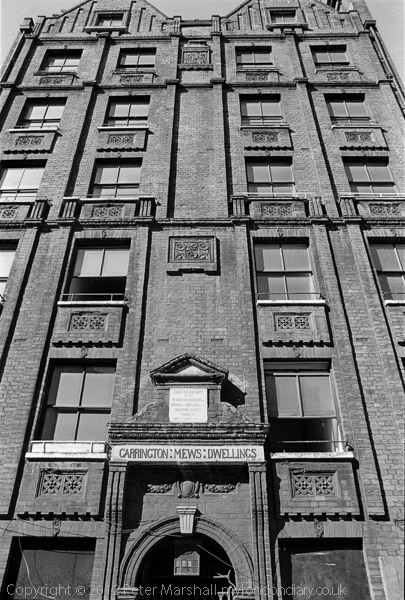
Or at least it’s fairly easy to keyword and caption pictures – it sometimes would have helped if I had bothered to make notes, which I wasn’t too good at back in the 1970s. It should still be easy when, as in the case of ‘Carrington Mews Dwellings’ the pictures come with their own label, along with another, too small to read on the web but easily legible on the original that tells you they were ‘Erected A.D. 1877 by the Metropolitan Association for Improving the Dwellings of the Industrious Classes’. There is a Carrington St in Mayfair – but Streetview shows it has nothing to match and Google can’t help for Carrington Mews either – and it isn’t listed in Wikipedia among the existing buildings erected by the MAIDIC. Pevsner of course wouldn’t have thought it worth mentioning, nor does it appear in the Survey of London. It is – or rather was, the bottom windows are boarded in my picture – somewhere close to Carrington St, as the adjoining image on the contact sheet is Whitbread’s ‘The Grapes’, still in Shepherd Market although now with décor rather less to my taste a free house ‘Ye Grapes.’

Of course they are not very early pictures of London, and people were photographing the city from the 1840s, when certainly a Mr Talbot made a calotype negative of  Nelson’s Column under construction in April 1844. 

One site that regularly published old pictures of London is Spitalfields Life, and a couple of days ago it had a feature The Forgotten Corners of Old London with images from the extensive collection of the Bishopsgate Institute – which is the source for many of its features on old London.  This particular set of pictures appealed to me as in some ways being like much of my own work, often recording things that seem peripheral or inconsequential but which have a certain resonance.

Another recent feature which  particularly appeals to me is Dark City: London in the 30s on the ‘Library Time Machine‘ of the Royal Borough of Kensington & Chelsea, which republishes well 15 of the evocative night photographs from from London Night – John Morrison and Harold Burdekin published in 1934. The book has a total of 50 photogravures in dark blue by Burdekin with assistance from Morrison who also wrote an introduction.  I could reproduce some of these pictures here, but its better if you go and look at them all on the Time Machine site (if you haven’t got a copy of the book.) I added it to my collection ten years or so ago when I was researching a piece on the photographers of London. It came from an era when night photography was becoming much easier, and was perhaps prompted by Brassai’s night images of Paris.  Today night photography is easier still, but it remains a good idea to take a companion in many places, even in parts of London. Burdekin made a deliberate decision not to include people in his pictures and the streets are eerily empty of traffic, but London then mainly went to bed well before midnight and it would probably have been hard to have found any to include in many of the places he photographed. London is much more of a 24 hour city now and you might find yourself waiting for a long time for some streets to be empty. Then you took your friends and relatives along if you wanted people in your pictures.

A Friday Afternoon in London

© 2013, Peter Marshall
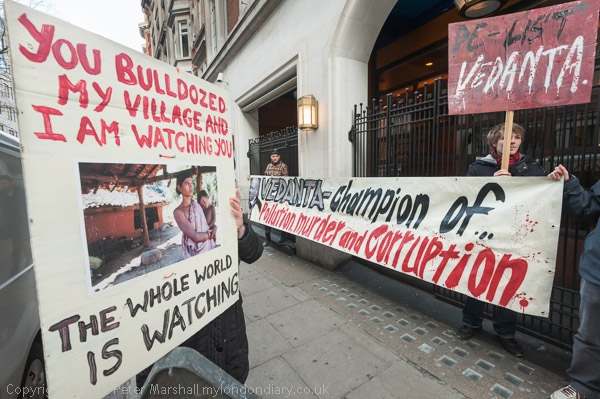
‘You bulldozed my village … the whole world is watching’ ‘De-List Vedanta.’

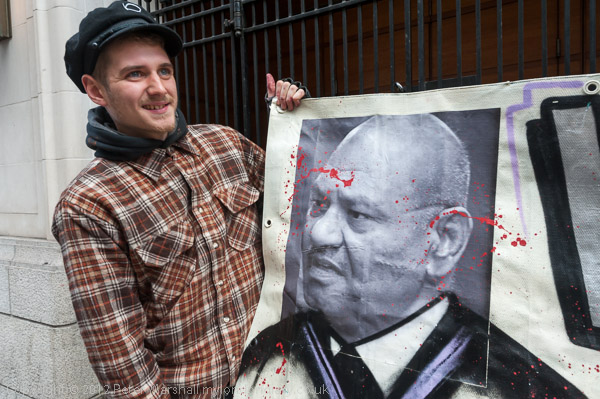
It took quite a few tries before I got everything how I wanted it for this picture. I could have speeded things up by directing things a little, but that would have meant crossing what is for me a vital line. But the poster, the banner and the placard here sum up what this protest outside the London Office of mining company Vedanta –  was about.

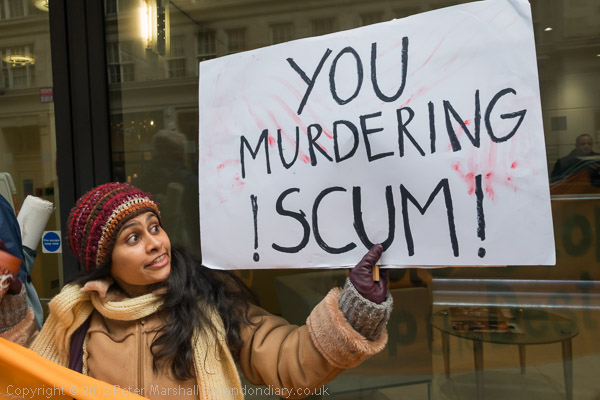
Of course I took pictures in which the people involved feature more prominently, including CEO Anil Agarwal himself with blood scattered across  his face on the end of the banner, as well as a forthright comment about him on a poster held by an Indian activist – and more at De-List Vedanta from London.

© 2013, Peter Marshall

© 2013, Peter Marshall

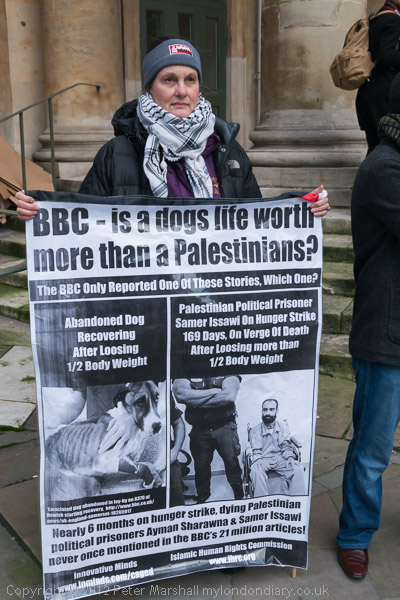
It was a fairly animated protest, but I couldn’t find anything very different to photograph. I had to leave after around an hour to go to the next event I wanted to cover, at Broadcasting House, around a quarter of an hour’s walk away, which was due to start at 2pm.  I arrived more or less on time, to find a few police and an empty pen set up for the protest. Shortly after the first protester arrived, and after another half hour or so there was a protest to photograph, if still a fairly small one, against the bias at the BBC against Palestine, and in particular their complete failure to report the hunger strike by two Palestinians held without charge or trial in Israeli prisons and the assault on one of them in the courtroom.

© 2013, Peter Marshall

You can see the other protesters and read more about it at BBC Ignores Palestinian Hunger Strikes.

I’d done all I could think of there by around 2.30pm, and wanted to find out where I could meet one or other of four or five walks that were taking place that afternoon marking the 11th anniversary of the illegal US prison camp at Guantanamo bay, mirroring the routes by which five men (or rather four men and a boy) had reached there, visiting the embassies of all of the countries who had colluded in their illegal rendition by the US. I’d missed the start, and the routes hadn’t been published, but I had the mobile numbers of the walk leaders for the two I was most interested in. Unfortunately neither were answering their phones.

So I was kind of looking for a needle in London’s haystack, but I had a few clues. I knew where they had started – one at the Pakistan and the other at the Afghanistan embassy – and I’ve visited most of the embassies in London at some time or other. I knew there were an awful lot of them in the area around Belgrave Square, so I took a bus to Hyde Park Corner and walked there. No sign of anyone there, so I thought I’d wander up to the Pakistan embassy. Again blank.  I realised then that I was close to the Ecuadorian embassy, so took a short detour to visit the daily afternoon vigil there and talk to the small group and take a few pictures – Assange Supporters Continue Embassy Vigil.

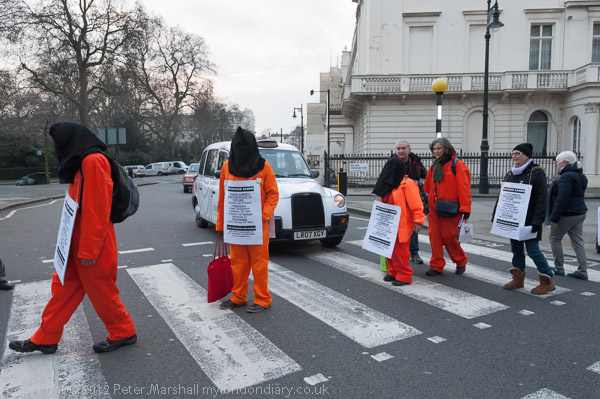
Finally as I walked away towards the French embassy on Knightsbridge at last I saw some orange suits in the distance and ran to meet the group of a dozen or so tracing Shaker Aamer’s illegal rendition – and on their way to Belgrave Square.

© 2013, Peter Marshall

I tried to get a little echo of ‘Abbey Road’ as they crossed the square, but without actually posing people to copy it closely. In Rendition Routes to Guantanamo you can read the letter they tried to deliver to the Turkish embassy (and they did give a copy to the Portuguese embassy) which makes clear what illegal rendition entailed.

By this time I was a little cold and tired, and I left the walkers who (like me) were going on to the US embassy for a vigil there and took a bus to one of my favourite London pubs not too far from there to sit down with a drink for half an hour in front of a warm open fire – and do a little editing of my pictures in camera. Then it was off to the US Embassy for my final event of the day, Guantánamo – 11 Years of Illegal Detention.

© 2013, Peter Marshall

It had been a long and tiring day for me, longer than I like to work now, and the pictures at the last event weren’t among my better examples. But although I was pleased to get on the bus and start my hour or so journey home, my day was not of course finished.

When I got home I still had to edit the pictures, do a little post-production, keyword and caption them and send them off, though I had to eat first, and it was well past midnight that I finished, even though I left writing the stories to go with the work until the following morning.  Few of the things I photograph make  urgent news, and I’ve decided to keep to my old-fashioned slow working methods rather than join the modern world and take a laptop with me when I’m photographing and send in pictures directly after I take them, but I try to get them in the same day. By the time I went to bed it was around 14 hours since I’d left home to travel to the first protest.

________________________________________________________

My London Diary : Buildings of London : River Lea/Lee Valley : London’s Industrial Heritage

All photographs on this and my other sites, unless otherwise stated are by Peter Marshall and are available for reproduction or can be bought as prints.

To order prints or reproduce images

________________________________________________________

A Year Without Shelter

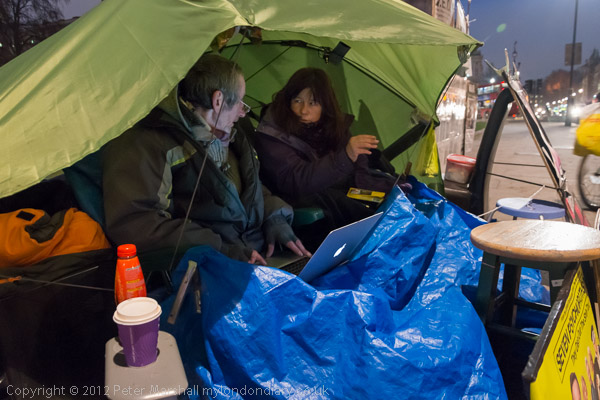
Barbara Tucker has now been just over a year in Parliament Square without shelter – police removed her tent on 16 Jan 2012.

© 2013, Peter Marshall

The peace protest on the pavement facing Parliament was started by Brian Haw on 2nd June 2001 and has continued 24/7 since then; Barbara was one of those who joined Brian in the early years and has continued his protest since his death in 2011, and on those occasions where she has had to leave the square – various arrests, court hearings and two spells of imprisonment – others from the campaign have ensured it continues.

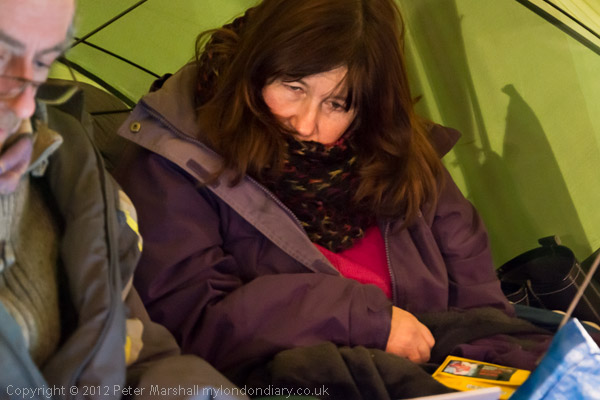
It’s a truly remarkable protest, and still continuing, though Barbara’s own future is under threat. On December 27th she began a hunger strike and as I write is on day 22 (you can see the current position on BrianHaw.tv, the campaign web site.)  A few days ago I was passing by and had time to stop briefly to see her. Then she looked cheerful and well but was too busy working on a statement to meet a deadline to talk. Although I would have liked to have talked with her – as I’ve done on many occasions in the past – I wasn’t quite sure what to say to her in the circumstances, and it was easier  being able to walk around and photograph her as she was working with a colleague.

I was on my way to a photographers meeting, and although I’d brought the D800 with me, with the 28-105mm lens, I hadn’t remembered to put in the flash, and it was pretty dark in Parliament Square. I set the camera to ISO3200 and to underexpose by one stop (otherwise it tries to produce pictures that are too bright, looking like they are taken during the day), but underneath the large umbrella where she was sitting it was pretty dark.

© 2013, Peter Marshall

It must help that the 28-105 is a VR lens, because otherwise my chances of getting a reasonably sharp image at 90mm equivalent focal length with a shutter speed of 1/5 second would have been slim. Of course I took several, and only a few were sharp enough to use. At shorter focal lengths things were a little easier as the maximum aperture is larger; f3.8 rather than f5.3 makes the lens roughly twice as fast. Taking a wider view was also easier as there was more light outside the umbrella, and with a wider subject I was getting shutter speeds of around 1/20th – seldom a problem with a wide-angle lens. The main light source for the pictures under the umbrella was the computer screen, which also changed slightly at times as they worked.  In most of the pictures I needed to use considerable ‘dodging’ particularly on faces, brightening and adding a little contrast, while there were often other areas that required burning. As almost always I took RAW files, which are considerably better for post-processing .

The D800 does have a built-in flash, but with many lenses you get a shadow at the bottom of the image if you make use of it. To my surprise it does seem to manage without doing so with the 28-105 at all focal lengths except for very close subjects at or very close to 28mm. I didn’t consider using it on this occasion as it would have have been too much of an intrusion, disturbing the two people at their work.

There are just a few more pictures on My London Diary in Parliament Square Hunger Strike. It’s freezing here as I write, and a terrible night for anyone sleeping out, even those not on hunger strike and denied shelter and not being harassed by police.

________________________________________________________

My London Diary : Buildings of London : River Lea/Lee Valley : London’s Industrial Heritage

All photographs on this and my other sites, unless otherwise stated are by Peter Marshall and are available for reproduction or can be bought as prints.

To order prints or reproduce images

________________________________________________________

The Mystery Woman

© 2013, Peter Marshall

You may recognise her (and comment if you do), but I have no idea who she was, but as she walked out of the Royal Courts of Justice yesterday lunchtime, two photographers who had been standing around ignoring the two events I was photographing sprang into action.

It wasn’t a pretty sight as they stood in her way, though she had clearly expected to be photographed and paused briefly for them to work – when I took these pictures – but they continued to pester her as she crossed the pedestrian crossing and on the far side of the road before she eventually walked off. Not only that, but they pushed and swore at another photographer who seeing what was happening had also decided to take pictures and they felt was getting in their way. He had just the same right as them to be there on the street and taking pictures and their action was uncalled for.

© 2013, Peter Marshall

The people taking part in one of the protests were watching this and asking each other who the woman was, and they asked me. None of us had a clue. I went up to one of the two photographers who was busily looking through his shots on the back of his camera and made a polite enquiry but he refused to give me any information at all. His response rather shocked me as I’m used to working with other photographers on the streets and there is a culture of sharing and cooperation.

I don’t work with paps, and don’t do that kind of photography. It gives photography and photographers a bad name. You can photograph people without hassling them, as I did on this occasion. But in the end it isn’t the photographers but the whole media culture which produces them that I’d like to see put an end to. Unfortunately whatever result finally comes out post-Leveson isn’t likely to alter this.

Exposure and Light Problems

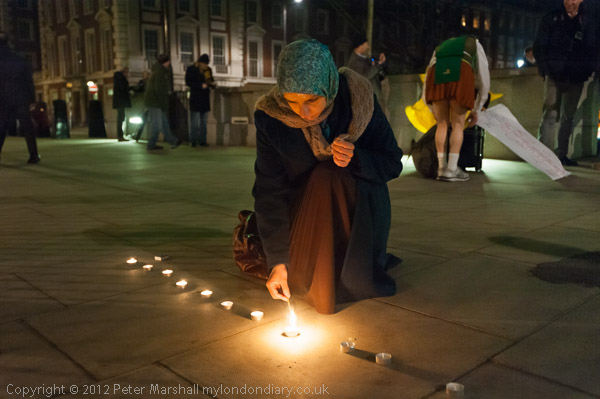
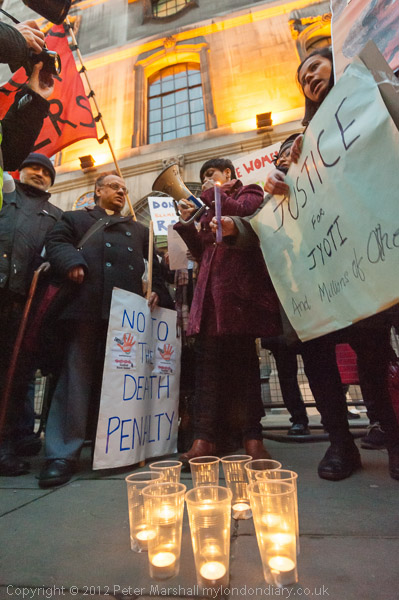
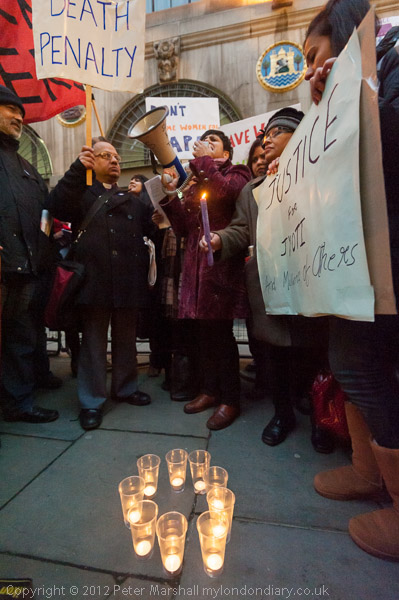
Here is another picture of the ring of candles at the protest against the Delhi Gang Rape outside the Indian High Commission in London.

Its always difficult to know how bright to make night images; I think visually the impression was of a darker scene than this, and I’ve perhaps taken too much care to get separation in the shadow areas. It would be more dramatic a little darker, especially at the bottom of the frame.

Automatic exposure tends to make night scenes too bright, but this was a little underexposed even though I was using +1/3 stop of extra exposure. Possibly the light sources – the 8 candles – actually in the picture were to blame, and working at 16mm focal length I was quite close to them. I was at the centre of a fairly tightly packed crowd and couldn’t move back at all. This was one of the first pictures I took of the ring of candles and I started by trying to work closer still and low, but the the candles didn’t really look like a circle, and the picture in my previous post, taken from around waist level, shows that better.

Either might have been a better picture with the 10.5mm semi-fisheye, which would also have let me take the scene in landscape format, but although using this would have given more of the circle of the crowd around the candles, it would also have included several other photographers and cameras. There really were far too many people trying to take pictures. I had to ask another photographer to pull back his camera strap to make these pictures.

Using flash would have ruined the effect of the candles, and people were moving quite a lot as they shouted slogans, so to try and avoid subject movement I was working using Shutter priority with a shutter speed of around 1/100s. The ISO was set at 3200 and I probably needed an aperture of around f2 but the lens has a full aperture of only f4. So the camera can’t do it, and I got a couple of stops of underexposure – despite the EXIF data telling me I actually had exposure compensation of +.3 stops. Of course the viewfinder display does indicate the underexposure, but in these situations the best thing to do is to actually take the picture and look at it (and the histogram) on the rear screen.

I don’t do a lot of chimping – it disturbs the flow of my work – but it really is essential to check on things like this that the histogram comes down more or less to zero in the shadow areas – and also that you are not getting significant highlight clipping. Then you know that you can adjust things as necessary in Lightroom. I think I have lost a tiny bit of insignificant detail in the candle flames – which could not be recovered with burning in as it wasn’t recorded.

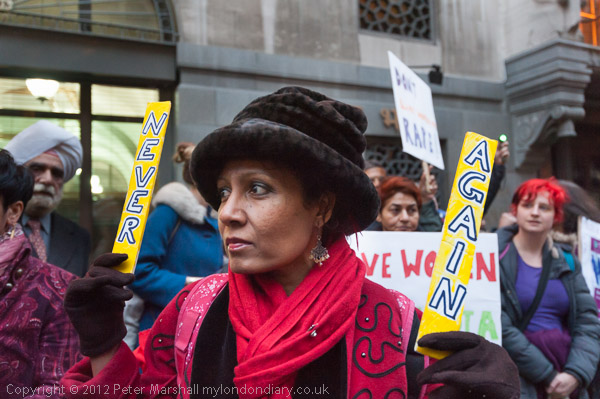
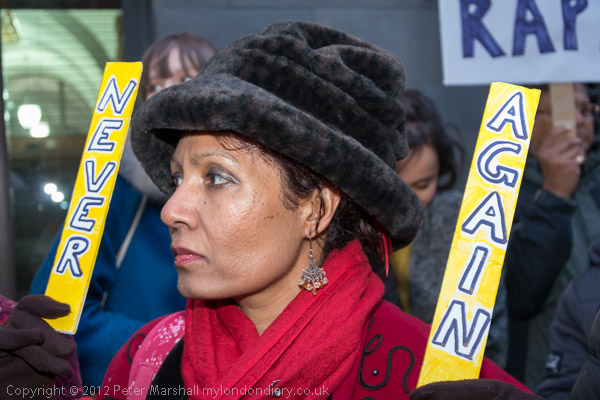
These two pictures, taken within a few seconds of each other from an almost identical position show the advantages and disadvantages of using flash. The upper image was with the 16-35mm on the D700 and the lower with the DX 18-105mm on the D800. I only take a single flash unit and it was on the D800 at the time.

The flash does make this woman and her two signs reading ‘Never Again‘ stand out more, but I much prefer the image using available light.

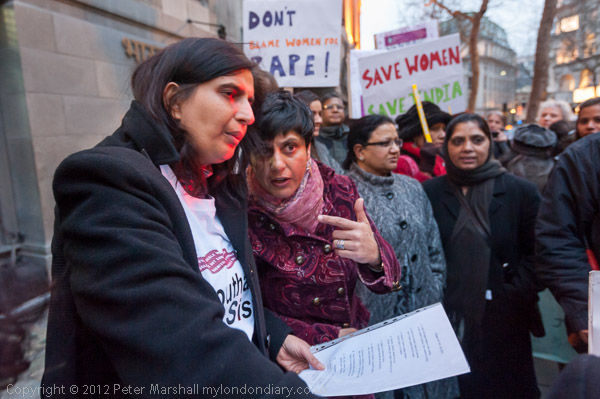
But there is a problem with working with available light at events like this with a lot of photographers present, and one that ruined quite a few pictures (you can just see it on a couple of others in the set on My London Diary.)  Here’s one that shows it but where I thought the effect was interesting.

© 2013, Peter Marshall

That red light on the closer woman’s face, a little spilling on to her t-shirt – is another photographer focussing. You seldom notice this if using flash, as the intensity of the flash overpowers the focus light pattern. But it really is a problem at busy events such as these, and there must be better ways to improve focus in low light that camera designers could think up rather than this.

There were areas where the available light just wasn’t enough to work with, and I’ve been experimenting with ways around this – but that’s something I’ll look at in a later post.

________________________________________________________

My London Diary : Buildings of London : River Lea/Lee Valley : London’s Industrial Heritage

All photographs on this and my other sites, unless otherwise stated are by Peter Marshall and are available for reproduction or can be bought as prints.

To order prints or reproduce images

________________________________________________________

End of the Vertical?

I thought this was probably the best image that I took last Monday at the Gang Rape Protest at Indian High Commission in London, or possibly one of the other two variations on it that are on My London Dairy.  But I knew when I took it that is was less likely to be used than some of the other pictures, simply because it it portrait rather than landscape format.

Although portrait images often fit the printed page best, and actually fit better into this blog, the move towards viewing images on screen has meant that landscape format has really become a norm and images in portrait format are less viable. I even get the feeling that many picture editors would prefer landscape format and even if they want to use an image in portrait format would prefer to do their own savage cropping on a landscape original.

It’s all to do with screen formats. Almost all normal screens are landscape format, and the trend over recent years has been away from the normal to the wide-screen – such as the 16:9 format screen I’m writing this post on.

It’s projection of images that shows up portrait format worst, and the use of computer for this. Back in the old days of slide projection, vertical and horizontal formats could usually be projected at the same size – so long as the screen was square. Computer projectors now often use a 16:9 format, allowing a 35mm format landscape image to be be projected to occupy most – around 85% – of the screen,  while a portrait image fills just over half of it – around 56%.  The longer dimension of the landscape image will be around 1.5 times that of the portrait.

When I got home and uploaded my images to Demotix as usual, I couldn’t use what I thought was my best image as the lead image to the post – because Demotix call for that too be your best landscape image. It fits the web page design better.

Continue reading End of the Vertical?

Ones to Watch?

The British Journal of Photography (BJP) has published its list of Ones to Watch in 2013, a selection they have made of 20 photographers from a list of over 200 suggested by an impressive list of “photographers, publishers, curators, picture editors and critics” as ” the photographers they believe will make their mark on the wider international photographic community in 2013.” It was perhaps a shame that having gathered this wide range of eminent consultants to put forward their suggestions that the final short list was picked by the magazine’s staff.

PDN has long carried out a similar exercise to select annually 30 photographers to watch, and you can see last March’s PDN 30 for 2012 on line.  I’ve written about their selections at times in the past, and while most of the photographers selected for such lists are very worthy, if you look back at one of the lists from ten years or so ago, there will probably be relatively few names you recognise, even if, like me, you spend far too much of your life looking at photography on-ine and in galleries etc.  In a way these lists are more about current fashions than about particular photographers. As always there are a few whose work I find exciting, rather more I think don’t really stand out from so many other good photographers whose work I see and one or two that really bore me.

Comparing the two presentations, PDN immediately gains points from me by its better understanding of alphabetical order, but although I don’t much like its web presentation with a drop-down list, there were many more photographers where I looked at the initial page and could summon the energy to click to see more work. And for those photographers whose work I was already familiar with, I felt the BJP had not selected a good image to represent them.

Probably the best known of those on the BJP list is Magnum nominee Jérôme Sessini. Take a look at his page on the BJP and then go to look at his work on the Magnum site, and I think you will understand what I mean.

Anyway, here is the BJP’s list in full – you’ll find links to them on the BJP page:

Adrian Fussell, Cyrille Weiner, Gert Jochems, Giorgio Di Noto, Hanna Putz, Jake Stangel, Jerome Sessini, Jim Mortram, Jiri Makovec, Jose Diniz, Jun Ahn, Kyoko Hamada, Lamia Maria Abillama, Lauren Marsolier, Max Pinckers, Namsa Leuba, Pari Dukovic, Paulina Otylie Surys, Ruth Van Beek, Samuel James

and this is PDN’s:

Mustafah Abdulaziz, Jenn Ackerman, Kyle Alexander, Meiko Takechi Arquillos, Michele Borzoni, Dominic Bracco II, Peter DiCampo, Eliot Dudik, Sarah Elliott, Mark Fisher, LaToya Ruby Frazier, Misha Friedman, Andrea Gjestvang, Mark Hartman, Lauren Hermele, Ingalls Photography, JUCO, Sam Kaplan, Peter Ash Lee, Sebastián Liste, Mark Mahaney, Chloe Dewe Mathews, Ilvy Njiokiktjien, Ryan Pfluger, Markel Redondo, AnaStasia Rudenko, Daniel Shea, Jake Stangel, Christopher Testani, Yasu+Junko

There is a useful set of links to these photographers web sites on the Photo Editor blog.

Jake Stangel is the only  photographer who has the honour of appearing on both lists. I took a look at his work on a familiar subject, London & Amsterdam. Maybe like the rest of us he has his off days.

Thamesgate Panoramas

I’ve been busy over the past month or two working on a new book, which a couple of days ago I decided to give the title ‘Thamesgate Panoramas: South of the River‘. It includes 38 panoramas that I took in a number of visits to the area between Woolwich and Gravesend (and a little further at each end) on the River Thames and its estuary between May 2000 and February 2001.

The area is part of the huge area out to the east of London which makes up the Thames Gateway, the regeneration of which has been a national priority since 1994.  Of course I didn’t know that when I first started going there to take photographs in the early 1980s attracted by several things, but it was clear then that things would change.

I’d read about the area before I went there. In a slim geography booklet I’d picked up remaindered somewhere for 10p, Lower Thameside by Roy Millward & Adrian Robinson, a part of  their ‘South East England: Thameside and the Weald’, published in the Landscapes of Britain series in 1971. And in a much older work I’d found in our local library, where the over-enthusiastic author of ‘A Pilgrimage of the Thames‘ (1932), Donald Maxwell says that when the cement industry has left the quarry-scarred landscape ‘will be called the Switzerland of England.’

© 2000, Peter Marshall
A page from the PDF version of the book

The main feature of the landscape is of course the River Thames and it features in many of the pictures, all of which are double-page spreads on the 10×8″ landscape format book.

I’ve made it available both as a print version and as a PDF. The PDF is better and considerably cheaper at £4.49 rather than the £26.99 for the printed book, the image quality is slightly better and you get a download link straight away rather than having to pay Blurb’s exorbitant postage rates and wait around 10 days. A slightly different version of the PDF is also available direct from me at the same price.

There is a preview of around half the book available on Blurb and embedded here.

All the images in the book are double-page spreads, and Blurb doesn’t handle these too well, though I think they all look pretty good. But they are almost perfect if you set up your Adobe reader to read the double pages – only almost because Blurb does put a dotted line in to show the join of the pages.*

With the books being printed on demand, printing takes place on different printers and there seem to be slight alignment differences – so even if you adjust things correct to the nearest pixel from a proof copy, they won’t be quite spot on in the next copy printed. There is also the problem that if you get it right for the print version it will be wrong for the PDF, and I would have to have two versions of the book, one for print and one for PDF.

This is the first Blurb book that I’ve produced using InDesign rather than Blurb’s BookSmart, and it was some time (and several software versions) since I’d used it. BookSmart does a great job and is free, but there are advantages to InDesign, and the Blurb templates available for it make it fairly simple to use, if not as straightforward as BookSmart.

© 2000, Peter Marshall
Northfleet, 2000

© 2012, Peter Marshall
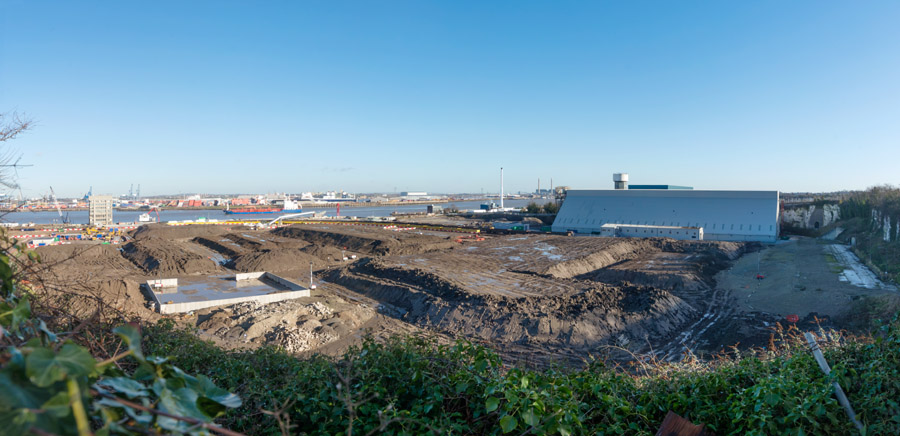
Northfleet, 2013

The two pictures above were taken from almost exactly the same point, but around twelve and a half years apart. The upper one was made with a swing lens panoramic camera and the lower – which I took on New Year’s Day – by stitching 3 digital images with the 16-35mm on the D800. They have roughly the same horizontal angle of view, but the swing lens camera has a focal length of around 26mm and gives less vertical coverage.

People have asked me about the title ‘Thamesgate’. It seemed an obvious contraction for ‘Thames Gateway’ as well as one that reflected a certain ambivalence I felt about the area and what has happened there over the years. And although there is a shopping centre of the same name in Gravesend and a few other things, it is unusual and should make the book easier to find in searches on Blurb and elsewhere.

________________________________________________

*I supply my own PDF without the dividing line.
Continue reading Thamesgate Panoramas