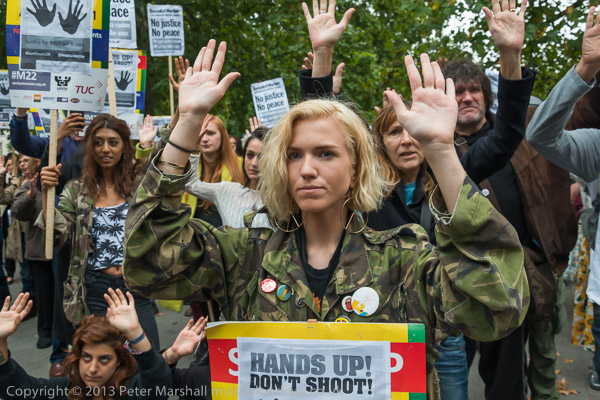
London to #Ferguson: Don’t Shoot!

In August I went to two events organised because of the shooting of unarmed black teenager Michael Brown in Ferguson, Missouri and the military-style response by the US authorities to the protests there that followed his murder.

Although the scale of that repression is something we haven’t yet seen in the UK, I’m writing this a couple of months later just before I go out to photograph the annual march by the United Families and Friends Campaign who have a long list of 3,180 individuals who have died in state custody since 1969; at the bottom it states ‘Too many have died in questionable circumstances. Too many killed unlawfully … and pitifully too few held to account for the deaths of those we name here.’ Also published today, accompanied by one of my photographs (and another by Matthew David), is the closing speech by writer and activist Kojo Kyerewaa from last month’s annual conference of the London Campaign Against Police & State Violence.

And another reminder that similar things happen here in London were the speeches at the first of the events I covered of Carole Duggan, the aunt of Mark Duggan, unarmed and surrendering to police when they shot him, and at the second by Marcia Rigg, the sister of Sean Rigg, killed inside Brixton Police station in August 2008.

The two events, both at the US Embassy in Grosvenor Square, were organised by different groups, the first by ‘London Black Revs‘, the Revs being short for revolutionaries, rather than men of the cloth, and the second, ten days later, by a wider range of organisations, led by Unite Against Fascism, and including the United Friends and Family Campaign as well as trade unions and other campaigns.
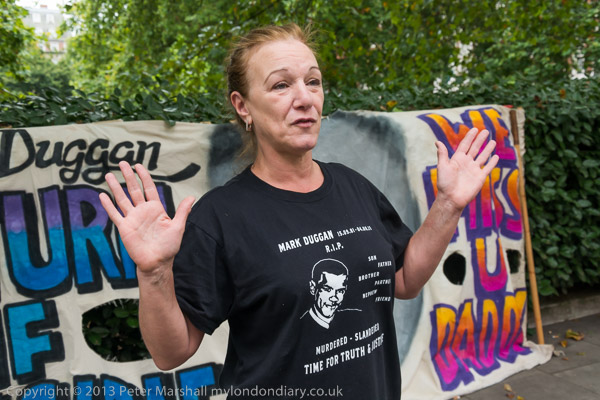
Prominent at the first event were the family of Mark Duggan, and in particular his aunt Carole Duggan, who spoke eloquently and at some length drawing out the parallels between his death and that of Michael Brown. Both were black, both were unarmed, both had raised their hands in surrender when they were shot by police. And both deaths were followed by a response from their communities that were turned to violence by police responses and followed by panic reactions by politicians. Both brought into swing a huge media effort by the authorities feeding lies and covering up the truth about what happened, and in various ways conspiring to deny justice.
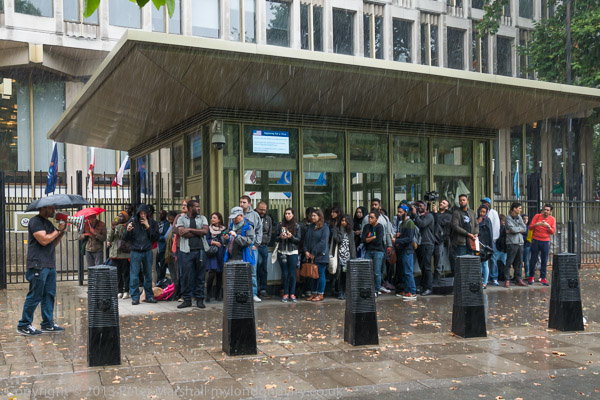
A torrential rainstorm added to the photographic problems of the event, though also providing some opportunities. At first I sheltered – along with many of those present – under the trees along the edge of the park facing the embassy, but soon the rain coming through and under their dense leafy canopy was too much, and I had to put my head down and dash for the cover of the broad concrete overhang of one of the embassy lodges with those shown in the picture above. It’s perhaps unfortunate that this picture suggests a rather smaller gathering, with others like me sheltering under the trees, under the canopy of the left-hand lodge and a few standing under umbrellas out of view.

Although it does show the rain, I don’t think any of my pictures give a real impression of just how heavy it was, a photographic problem for which I have no solution. Using flash certainly doesn’t work, though the light had sunk considerably and it would have been useful on this account, but it lights up every raindrop, with those close to the lens appearing over-large and out of focus and of course brighter. An effect well exploited by Martin Parr in his 1982 book  ‘Bad Weather‘,  I think the only one of his books I own that I actually paid my own money for, but not something that generally appeals to me or to editors. There are pictures in there by Martin that mean none of us should ever feel the need to do the same again.
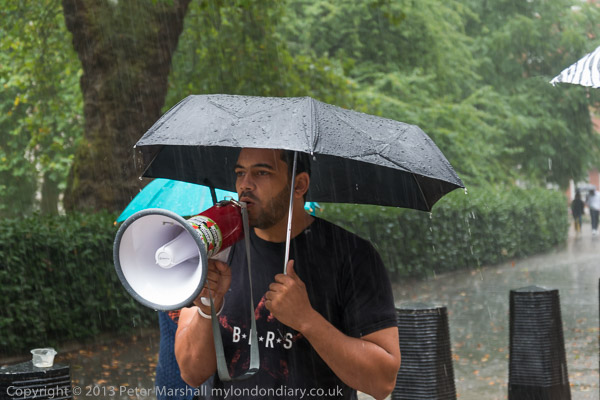
My damp dash did get me closer to the speakers, and I was able to photograph them from the dry as they, standing a few yards out in the open and holding an umbrella as well as a megaphone, were still getting rather wet. Although an umbrella stops most of the rain, with heavy driving rain a fine spray passes through and slowly soaks.
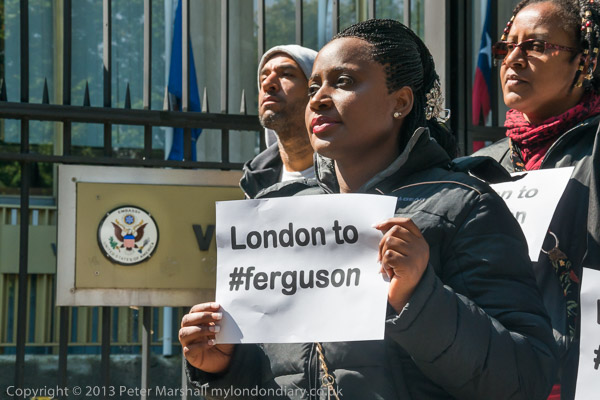
Eventually the rain did slacken and stop, and photographers and some of the people came out from under the canopies, giving more varied opportunities for photography. We were a little too close to the embassy for many pictures to include the US Eagle and flag was too sodden to fly, but there was a small plaque on the gates that I could include in a few images, though it meant stopping down the lens to a rather smaller aperture than I would normally use to get sufficient depth of field.

Fortunately it had got a lot brighter – the sun was out and causing some contrast problems. For the man speaking under the umbrella I had been working at 1/100s f5 (ISO 800) with the 18-105DX lens at 52mm (78mm equiv), while at the same ISO the exposure for those holding the ‘London to #ferguson’ posters I needed 1/500 f13 – at 66mm (99mm equiv.)  I think that means a difference of over 5 stops, though it’s too early to really do the maths as I write.

At the end of the protest, those present decided they would like a group photo in front of the embassy. I’m never a fan of group photos (except perhaps the Brown sisters) and certainly not for groups of this size. Photography always works best (or certainly almost always) on a more intimate scale – if Hill and Adamson had been able to photograph all 457 of the ministers at the First General Assembly of the Free Church of Scotland we would have just had one rather boring photograph rather than the earliest (and still one of the best) great collection of photographic portraits.

And the picture the activists wanted did rather remind me of that ‘Disruption Picture’, except there were rather fewer people and they were far less well organised. It too was impossible to take as the area in front of the large group was crowded with people with cameras and phones in the way. As usual people there were people shouting and gesturing ‘Let’s move back, move back‘ but while photographers might reluctantly respond if they see any chance that others will do so rather than just as usual move in front of them, holding up a phone to take a picture (or worse video) seems to render people terminally deaf and impervious to their surroundings. It really isn’t a licence to walk in front of photographers.
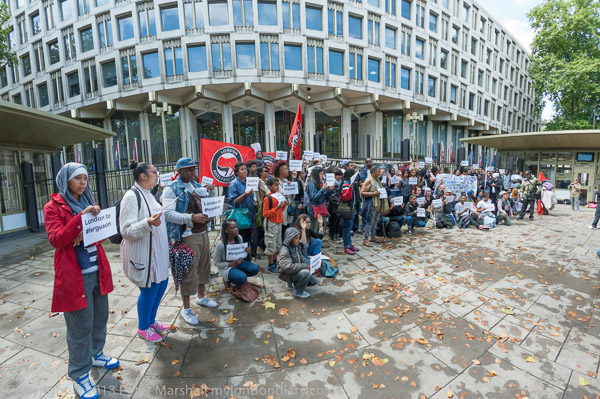
The only way I could manage to get everyone in – if not very satisfactorily – was by working close to one end of the wide spread group with the 16mm fisheye – and then converting the image to a cylindrical perspective to lose some of the fisheye effect. But even with the fisheye I could not get far enough back to take the picture from the centre of the group without people with phones and cameras being in the way.
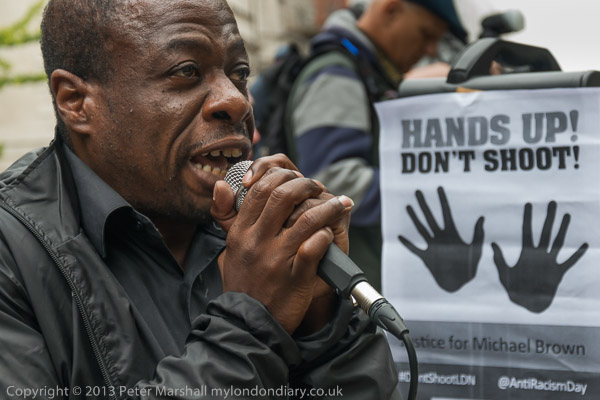
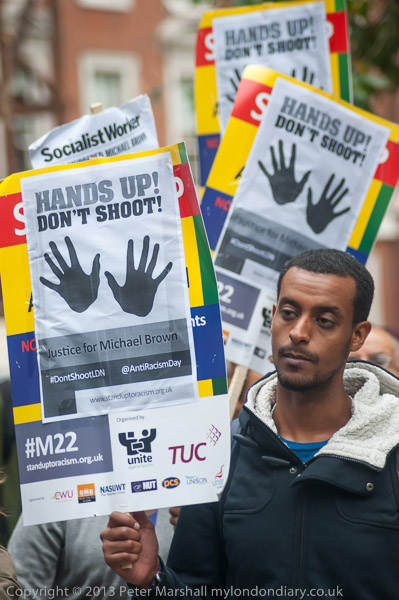
The second protest, ten days later, was held in the evening, and towards the north end of the embassy frontage, in front of the rather dreary statue of Eisenhower. The organisers had produced a graphic poster, two black hands with the message ‘Hands UP! Don’t Shoot!‘ which dominates perhaps rather too many of my pictures, though it was unmissable.
Weymann Bennett is someone I find it hard to take a bad picture of, and there were others speaking that I also like working with, including Marcia Rigg and Zita Holborne, who had brought along a couple of placards of her own.
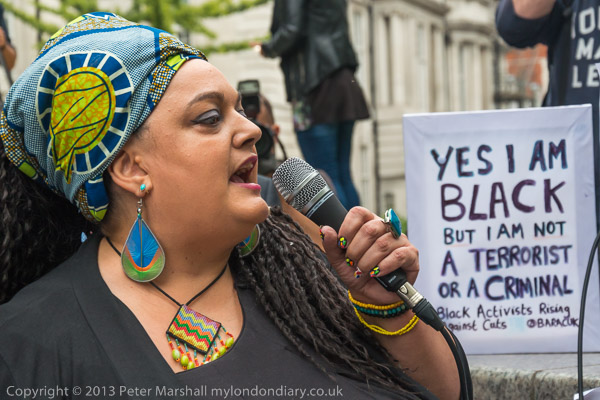
You can see her other one in another image of her, standing together with Marcia Rigg which is together with a larger selection of pictures from both protests – and text about them – on My London Diary:

Solidarity with Ferguson
Hands Up! Against racist Police Shootings

No Justice, No Peace!
Continue reading London to #Ferguson: Don’t Shoot!

Ozier Muhammad photographs protest for NYT

What attracted me most about the New York Lens blog video showing New York Times photographer Ozier Muhammad taking photographs at the People’s Climate March in New York was that it was showing another photographer working the kind of event that I often cover, though perhaps everything in London is on a slightly smaller scale.

It’s a shame that the video covering the Climate March when I saw it was preceded by an advert for Shell, one of the major companies responsible for climate change, and according to the Greenpeace petitionincreasingly desperate to plunder the Arctic in any way possible. It has recently made a deal with the devil: partnering with Russian oil and gas giant Gazprom to access the Arctic through Russia. If this joint venture continues, an Arctic oil spill is practically inevitable.” The petition as I write has 6,177,332 signatures from around the world and is hoping to reach 10 million. The video has them trying to make them look as if they are trying to save the environment, a prime example of ‘greenwash‘.

NYT videographer Deborah Acosta followed Muhammad who talks about how he works, mainly using a couple of digital Leicas but also a Canon with a very large zoom. I got the impression that neither of the Leicas had a particularly wide lens, and he seemed to like to work from a rather greater distance than I do, with perhaps rather less interaction with the people he was photographing, at least while he was taking pictures, though he was shown taking down some details from them after having made the picture, something I seldom need to do. As a photographer I would like to have seen more detail, but doubtless sharp eyed Leicaphiles will identify cameras and lenses in use.

I was also surprised at the amount of space there was inside the protest. At the London People’s Climate March things were considerably more crowded when I was photographing it.

Also surprising was that the event was covered for the NY Times by “upwards of 5 photographers” – and its perhaps not surprising that given so many of them around trying to file work he had problems. Although there were a lot of photographers covering the London event, I think the vast majority were freelances, and I think our media didn’t really consider the march as a major event. Except for the involvement of a few celebrities I doubt if any of our newspapers would have sent a single photographer.

It’s perhaps a shame that so much of the video is taken up with the problems of transmitting images and meeting deadlines, and I would have liked to see more of him at work, hear more of his comments about his approach and see more of his pictures from the day. You can see more of his work from elsewhere on his own web site, but not those from this protest. There is some fine work from the NATO protest in Chicago as well as other events around the world that he has covered in his more than three decades as a photojournalist.

I’ll write more later about my own work on the People’s Climate March in London, but for the moment here is just one image that perhaps shows a rather different view of what it is like to work at such an event – and taking the kind of pictures that our press are much more likely to publish than Muhammad’s more thoughtful work.


Not one of my best pictures – from the People’s Climate March in London. Nikon D700, 16mm

I didn’t go there to photograph this kind of thing, but I was there and thought that I might as well do it. It certainly isn’t one of the best images I made that day, and I had a very limited time as I had another event I strongly wanted to photograph and had to leave shortly after the march began.

Continue reading Ozier Muhammad photographs protest for NYT

Rene Burri (1933-2014)

René Burri, who died on October 20th, aged 81, was a photographer who was not appreciated as he should have been here in the UK – something which could be said about almost all photographers, but especially true in this case. Wikipedia lists almost 20 major shows of his work, quite a few of which were shown in several cities, but not a single one of them in the UK. I saw his René Burri – Rétrospective 1950-2000 in Paris in 2004 and was surprised at the breadth of his work, with many images that were unknown to me.

Most of us will recognise the six images he talks about in the video on Vimeo, and there are some others that are well-known as well as others that surprised me in another short video, Impossible Reminiscences, which came out for the publication of the book of the same title. But the best place to see his work is probably on his Magnum page, although the material on show there still only scratches at his huge output- he has left his archive of over 30,000 pictures to the Musée de l’Élysee in Lausanne.

The slide-show on Magnum starts with his first picture, Winston Churchill standing up in a car going through Zurich in 1946, when Burri was 13, and he was supremely a man with the great ability to be in the right place at the right time. But he was more than that; for him it was not just ‘f8 and be there’, but the ability to be there and to see things differently.

Of particular personal interest on the Magnum site was his set of over a hundred images of Brasilia, mainly taken around the inauguration in 1960, but also some images from the 1970s. Some of these brought back memories of my own trip there in 2007, though I wasn’t there to take pictures but to show them, and only took a compact camera with me.

I wrote briefly about the 2004 show in Paris as follows:

The queue at the MEP stretched out the length of the garden into the street, but it only took us around fifteen minutes to get in. Inside it was pretty crowded, at times too full to really look at the pictures. The main show was of work by Swiss photographer Rene Burri (1933-) who joined in 1955. Burri was a pupil of Hans Finsler at the School for Arts and Crafts in his hometown of Zurich. It was both an exhaustive and exhausting show that left me feeling that he would have been better served by a significantly more selective editor.

Burri is best known for such iconic works as his portrait of Che Guevara smoking a cigar. By far the strongest of the work on show was from his book on Germany made in the late-1950s (he brought out a revised version including some later pictures more recently.) Burri’s work is more traditional than that of his compatriot Robert Frank and more cerebral than that of Leonard Freed (who also produced a book on Germany.) Burri caught the Germans at a time when their memory of the war and the consequences of defeat were still very evident, and recovery was only beginning to make itself felt.

One image shows two elderly men in Weimar perhaps planning a holiday route, poring over a map spread over the bonnet of a car. The overtones of invasion are only too clear. Another picture of a street in Rheinpfalz on a misty day in 1959 has a man in the centre walking toward the camera. The street looks down-at -heel and the young man is a worker, wearing a hat and muffler. In is arms he holds awkwardly horizontal a baby, whose white bonnet is outlined perfectly against the black coat of an older and more distinguished figure walking away from the photographer. We see the new Germany coming out of its murky past with the hope of a brighter future, while and older generation is left behind in the past.

So far the obituaries I’ve seen have done little more than state brief biographical details together with a few pictures, with the best I’ve seen to date on PDN.  Doubtless more substantial accounts will be forthcoming – and if you come across any before I do, please feel free to add the details in a comment to this post.


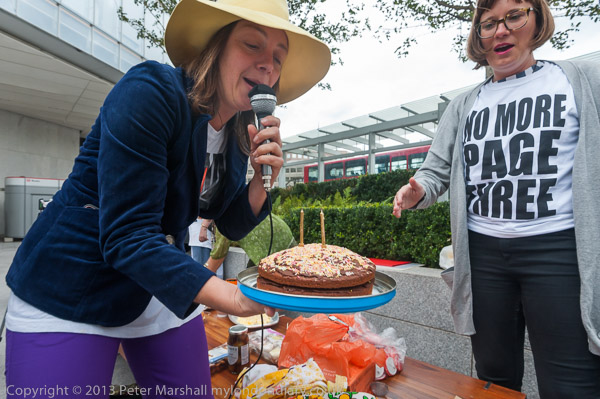
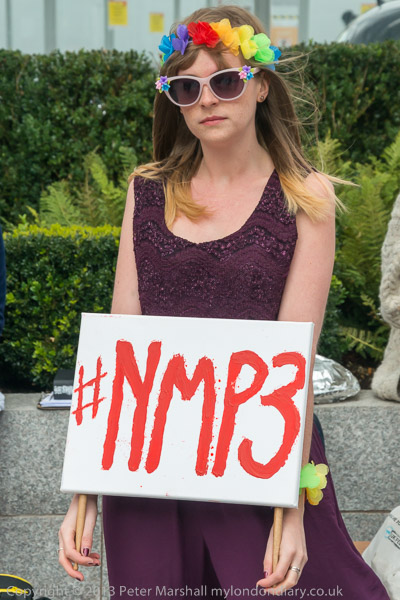
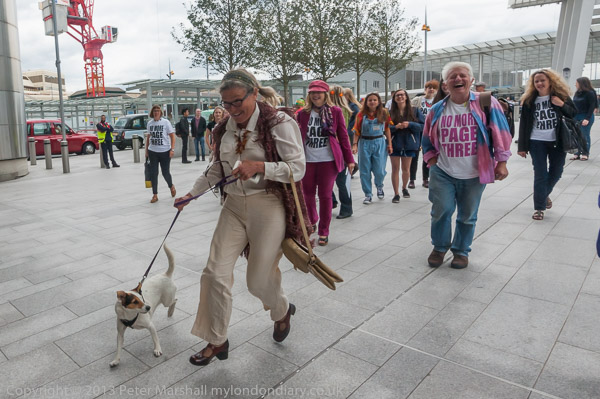
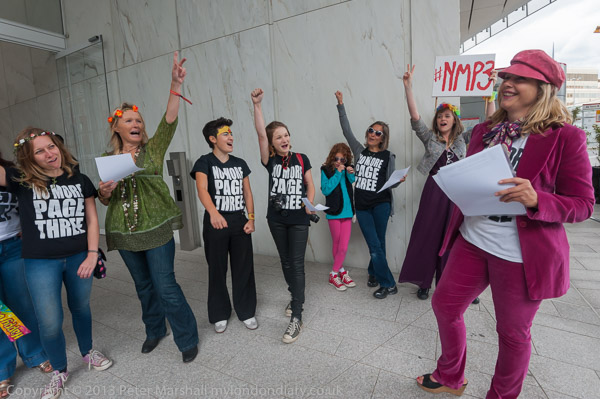
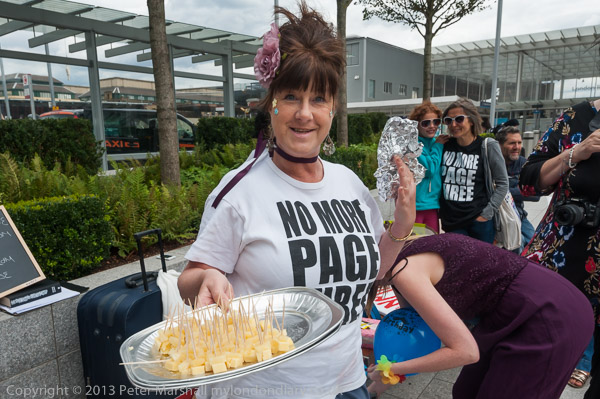
No More ‘Page 3’

I’ve never been a fan of The Sun newspaper, and have never bought a copy, though I have leafed through the occasional copy left on the train or elsewhere. It’s always seemed stuffed full of non-news about so-called celebrities and opinionated views lacking any factual basis with only the occasional actual news story, usually given an impressively shallow treatment. To me it’s always been the kind of newspaper that makes it hard to hold the views I have about the importance of a free press. And of course The Sun isn’t a free press, but a press controlled by the interests of one man, the owner of the giant media corporation which owns it. It isn’t about all the news that’s fit to print, but about all that Murdoch wants printed, news or not.

Why Murdoch should want pictures like those on Page 3 printed was simple when the paper was launched; it was a straight-forward commercial decision that he thought it would increase sales. It reflected and reinforced a particularly insulting view of the male working-class audience he wanted to buy the paper. It’s a decision he is now apparently having second thoughts about, as the world has changed since the first Page 3 appeared in 1970, shortly after Murdoch took over the title.  Around 40% of Sun readers are women now, and the No More Page 3 petition has so far attracted over 200,000 signatures.

When I wrote about photography for a living, I used to get fairly frequent approaches from so-called ‘glamour’ studios, asking me to publicise their activities, and sometimes offering me the chance to attend their courses free of charge. Although at times I wrote about photography of the nude (male and female) my response to them was always that I found the photography they promoted of no interest, though perhaps I tried to put it politely. But my objection to ‘Page 3’ is not that it shows part-naked women, but that it trivialises what is something very basic and fundamental to our human condition. Worse than that, I think it is essentially dishonest, telling lies about our humanity.

Frankly too, ‘Page 3’ is boring. That’s not to in any way disrespect the young women involved, but the mould into which they are processed. And in many ways the photographers and others involved in that processing are very professional in what they do. It probably isn’t something I could do – but then I don’t want to. I’d find it hard to live with myself if I did.

Part of the reason why ‘Page 3’ is boring is the near-interchangeability of the models, day after day. Real women are far more varied and more interesting – even if not half-naked – and of course not just, and even to a photographer not largely, for their physical characteristics. Too often women I’m photographing tell me that they “don’t look good in photographs” and I think my pictures of them prove the opposite to the world – if not to their own satisfaction.

One of the photographers had brought a chalk board for people to write their reasons for being at the event and be photographed holding. I took pictures of some of them holding it too and you can see them in No More Page Three on My London Diary, but I was too busy taking photographs to write my own view at the event.

Photographically the main problem I encountered was wind. It wasn’t a bad day, but a chilly breeze was being generated or attracted by the Shard and the News UK towers, and the candles on the cake for the second birthday of the campaign kept blowing out. I was also in danger of over-indulging in the seventies party food!
Continue reading No More ‘Page 3’

W. Eugene Smith Awards

I’ve not consciously come across the work of Joseph Symenkyj before, though a few of the pictures on his web site seem familiar, but his is a name I’ll probably now remember even if I’m rather unsure how to pronounce it. I find he is an American photographer who graduated from the New York School of Visual Arts in 2002, and what finally brought him to my attention in a post on the NY Times Lens blog is that he has been awarded this year’s W. Eugene Smith Grant in Humanistic Photography for his long-term project on family life in Ukraine.  On the web site you can also see his work on more recent events on the streets of the country.

The W. Eugene Smith Memorial Fund has also made an award to a more familiar name, Spanish American photographer Moises Saman for his four years of work on the Arab Spring and its aftermath, and there is some fine work on his Magnum pages.

James Estrin in his Lens post also mentions that Muriel Hasbun ‘received the Howard Chapnick award for the “Laberinto” project, a collaborative education and cultural preservation project that documents artists who worked during the Salvadoran civil war.’ I have to say I find most of her work on line leaves me rather cold, rather too academic for my liking, though I do admire her ‘Conversacio‘, a photographic  ‘conversation‘ exchanging photographs with Pablo Ortiz Monasterio.

Capa’s Missing Negatives Found

It’s a headline that offers rather more than it delivers. We can now be completely sure that there were no more pictures made by Capa during the D-Day landing. There never were any “missing” negatives, no ruined films. The negatives (or at least a large selection of them) are in the archive.

If like me you have followed with interest A D Coleman‘s investigations into the “missing” Capa negatives from D-Day, supposedly ruined in processing in the LIFE London office, you will want to read the latest episode, Alternate History: Robert Capa on D-Day (13) in which Coleman discloses where they “sit today, intact and available for study” (though currently unavailable until sometime next Spring due to relocation.)

It’s a disclosure that confirms Coleman’s previous conclusion that Capa only took 10 or 11 frames on Omaha beach and very much calls for an explanation of the legend that was clearly manufactured around Capa’s D-Day images. All 35mm four rolls survived processing and that the contents of them – apart from those frames from Omaha Beach – were deliberately suppressed. The existing images in the archive apparently match the notes Capa made about the films containing images of the briefing and embarkation from Weymouth already published.

But you should go to Photocritic International to read Coleman’s account, which gives great detail on his findings. If you haven’t already read them, there is a page linking to all the posts in the series, including those by guests, around 18 in all, with another promised with more about the negatives “and their implications, and related matters.”

Coleman’s correspondence  by email exchange with former LIFE picture editor John G. Morris which he published earlier ended with Morris accusing Coleman of “false accusations” and calling for a public apology. It seems clear now that it’s time for Morris, now 97, to tell the truth about what happened, despite any promises he may have made at the time.

For my own previous comments on Coleman’s Capa series see Capa Under Fire and More on Capa – Fraud.

Poor Doors 4

The series of protests outside one of London’s more prestigious (or at least more expensive) new developments is still continuing – after writing this I’ll be getting on the train to go to the twelth weekly event.  Other committments have prevented me from covering it every week, but I’ve managed to get to most of them, and it has been interesting to see how the events have developed.

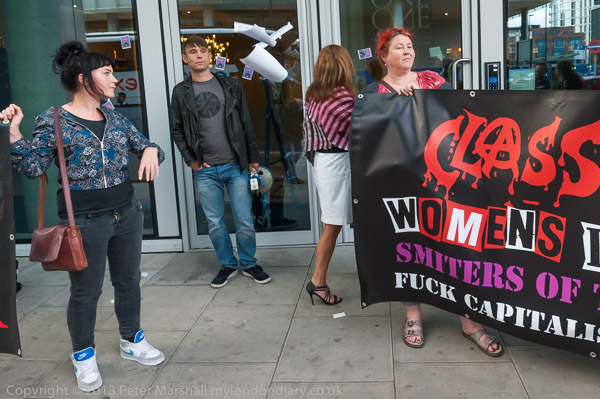
August 20th was the fourth week (and the third that I’d attended – you can see the first and third weeks on My London Diary) and as my headline Class War steps up ‘Poor Doors’ protest suggests, the protests were developing.

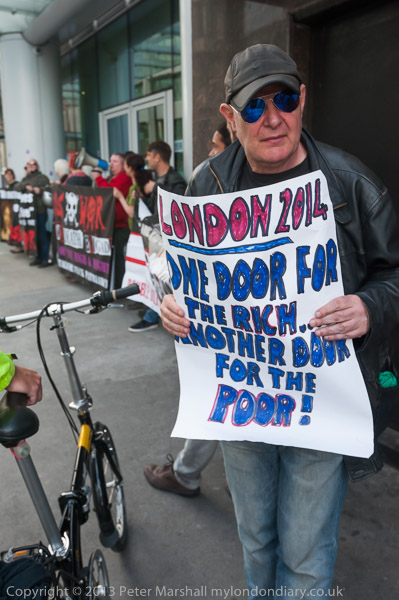
It was just as well that there were some incidents, as otherwise I was having trouble with trying to come up with something fresh each week, as the basic set-up was the same on each occasion. Protesters, banners, stickers, leafleting, the building security…  It really was getting hard to produce new images.


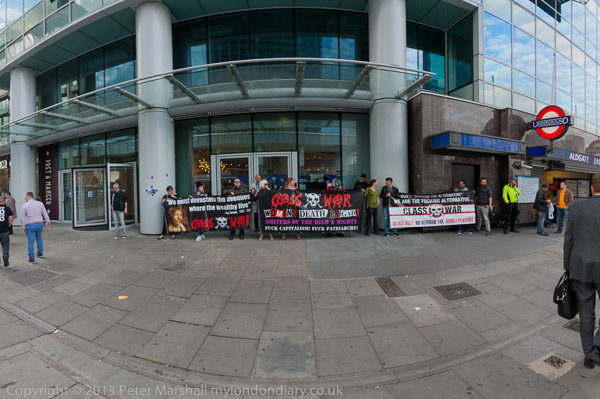
The 8mm fisheye gives an overall view with the three banners in front of the ‘rich door’

At least the banners had changed a little. Class War, the loose group that is behind these protests, has a good line in banners, intended to offend. As I wrote in My London Diary:

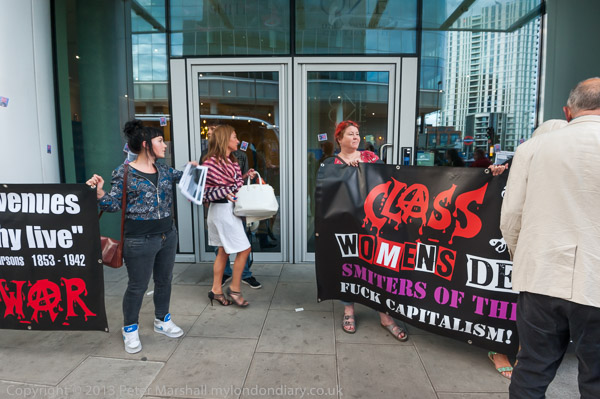
Class War draws attention to real and important issues – the gentrification of this and other areas of London and the financially based social cleansing that is resulting. They do so in a manner that is confrontational and theatrical, but amusing and not always entirely literal. Among the banners at today’s protest was that of the ‘Women’s Death Brigade’ with its message ‘Smiters of the High & Mighty’ and ‘F**K Capitalism! F**k Patriarchy!’

Almost everyone would agree that London has a housing crisis. And that little is actually being done about it. Most of the new developments – such as this block, ‘One Commercial St’ (confusingly its actual address is in Whitechapel High St) are actually making the situation for ordinary Londoners worse. As I also write in my piece on the protest ‘Tower Hamlets has a huge list of people wanting housing. The whole idea of building large blocks as investment properties for rich overseas buyers is simply obscene.’

Tower Hamlets council is at least I think doing its best to house its people, unlike neighbouring Newham, a monolithically Labour council. But council powers are very limited and no match for the developers who make huge profits from blocks such as these. The best they can manage are a few crumbs from the table – including the flats here behind the ‘poor door’ in a dingy alley along the side of the building.

You can read more about what actually happened on the evening, and more on the background in My London Diary. When I wrote it, I believed that there was no internal connection in the building between the parts containing the ‘rich’ and ‘poor’ residents, but that appears to be untrue, though I’m sure the door between the two parts is normally kept firmly locked.

But although there were some incidents to photograph, and I think I took some decent pictures of them, it also left me thinking about how much the still photographs leave out, and how easy it is to miss the critical moment.

In photographing this and other protests, I normally try to avoid taking pictures of people who are not really involved in the event, except in the background. Most of those actually going in and out of the ‘rich door’ are tourists staying there on holiday lets, who know nothing about the building and are not profiting from it, and unless they choose to become involved – perhaps by stopping to argue with the protesters – have little to do with the story.

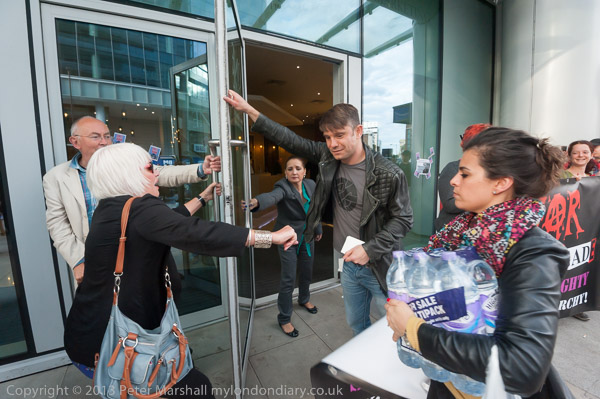
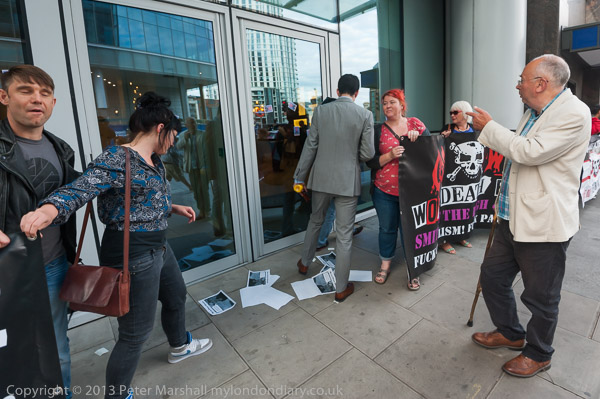
I’m not sure why I took a picture of the woman in high heels and a striped top carrying her white bag towards the ‘rich door’, perhaps just to show that people were still going in despite the protest. But I missed the moment just after this when she turned rapidly and snatched the leaflets from the hand of the woman at the left holding one of the banners, throwing them into the air, and by the time I had reacted she had turned back towards the door and the flyers were actually flying. Had I been taking a movie it would have been an interesting incident. You can tell how rapidly it happened as the papers are still in the air in the second image and the others in the picture have not reacted.

Finally, when someone came forward to hold her end of the banner, the protester moved to pick up the leaflets, as another person – a man in a grey suit – stepped carefully over the leaflets to enter the rich door.

Continue reading Poor Doors 4

A long pink scarf


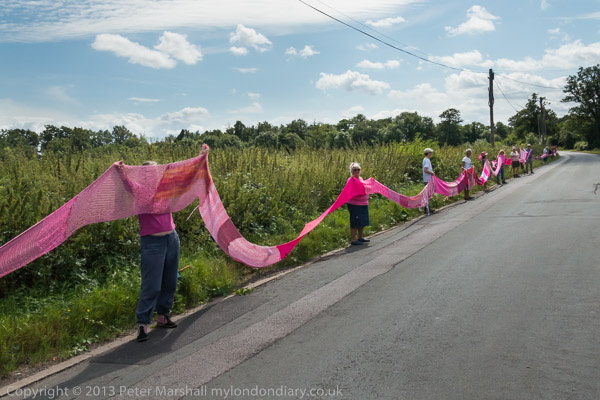
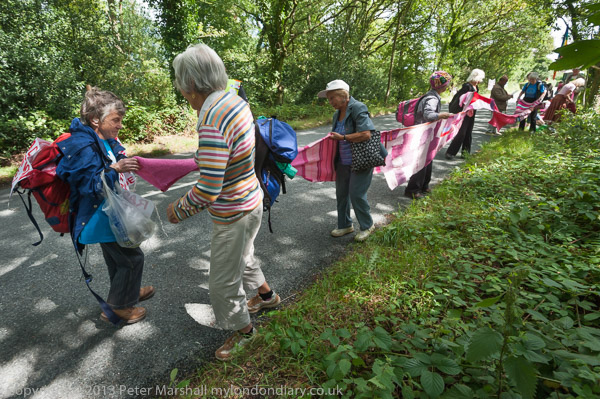
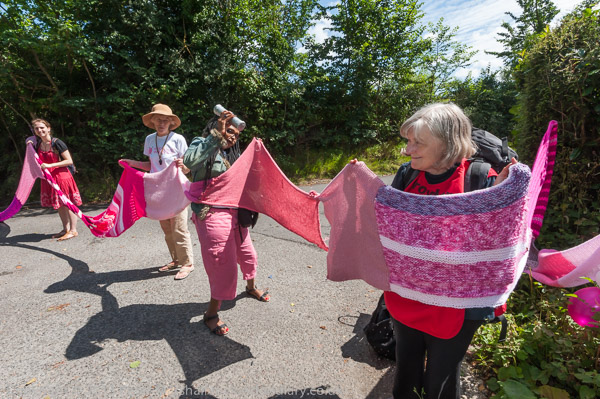
A short section of the seven mile scarf after joining

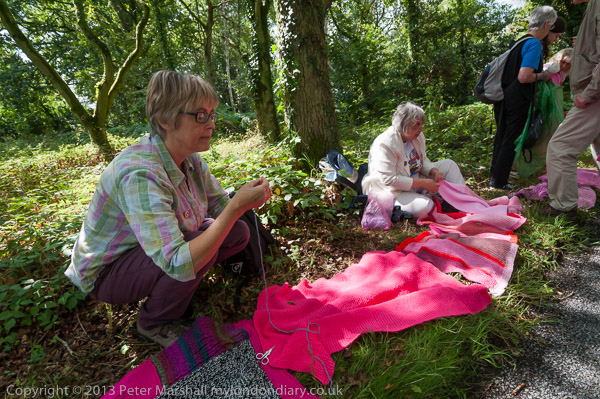
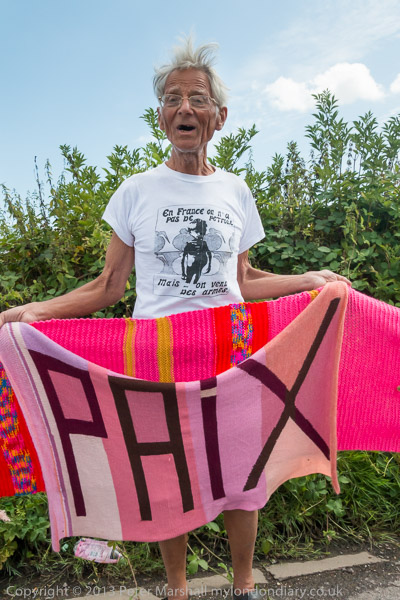
Seven miles long – and they had a bit left over. CND’s Wool Against Weapons protest on Nagasaki Day, 69 years after the second atomic bomb was dropped on Japan, stretched all the way from the atomic bomb factory in Burghfield to the better-known site at Aldermaston, both in rural Berkshire.  Neither end is particularly easy to get to by public transport, though I have at various times walked most of the way from London to Aldermaston, (including the final Reading to Aldermaston section of the CND Aldermaston March in 2004) it didn’t seem sensible to try to cover a 7 mile long event entirely on foot.


Joining the lengths of scarf at the roadside

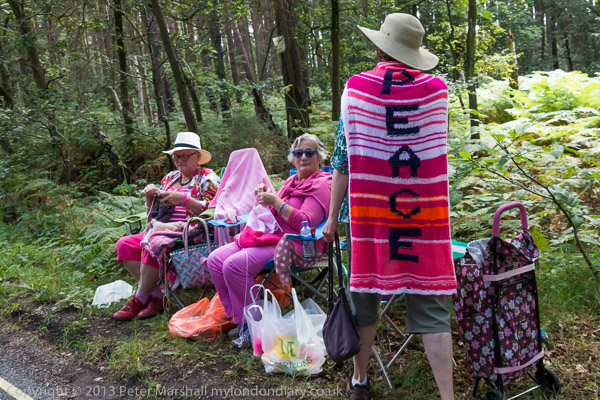
Hand-knitting or crocheting a scarf of this length and getting it into place clearly needed a great deal of planning and coordination. If people were knitting a 5 ft scarf you need a thousand of them for each mile and one of the major points about the protest was to get a great many people around the country – including many who for various reasons are unable or unwilling to get out on the streets – to participate. Groups around the country organised the knitting and brought the scarves joined together in rolls of around a hundred foot to centres along the route, from where they were stretched out and joined together.  Along the route there were ‘mile posts’ with small groups coordinating the event and some serving tea and coffee and snacks,  each one allocated to a different region.


Rolling out a spool of joined scarf lengths along the route

I could have got a lift to the route from the nearest rail station – Mortimer – but decided I needed to be more mobile, and the ideal way for the kind of distance and roads involved was a bicycle.  It would have been a long ride from home, but was easy to take it with me on the train to Reading, with Burghfield, where the London Region of CND was meeting a around half an hour’s ride away.

I’d planned it so I could take a relatively slow ride along the whole route, jumping off my bike wherever I saw an opportunity to take photographs, stopping at all of the mile posts to photograph what was happening there, and also between them where people were rolling out and joining up the scarf.  A bike has the great advantage that you can jump off anywhere, lean the bike against a fence or a tree or on the ground and take pictures. The route was along narrow country roads – some quite busy with traffic – and with relatively few places where it would be easy to park a car, particularly as the police were intent on keep traffic moving along the road as well as avoiding the protesters becoming roadkill.  It took me around 75 minutes to cover the 7 miles to the fence of the site at Aldermaston.


Two women were still knitting away at Aldermaston. Eventually the scarves will be turned into blankets for refugees

I’d wanted to be sure to cover as much as possible of the activities involved in the protest, and arriving at Aldermaston I was pleased to find a couple of women still knitting scarves, as well as a large display of various banners tied to the fence and to roadside trees.


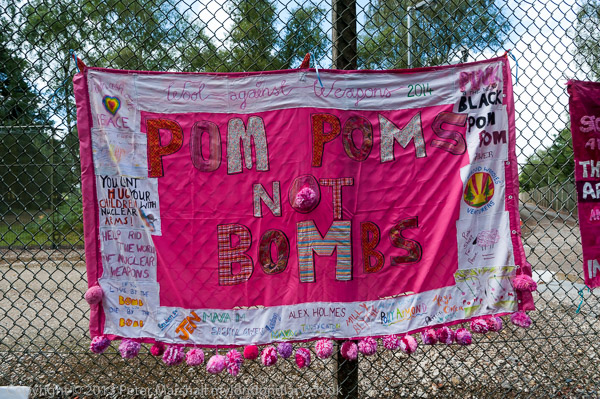
‘Pom Poms not Bombs’ on the fence at Aldermaston AWE

Going back to Burghfield was considerably faster – helped by a little wind and a longish downhill stretch, but mainly by only stopping once to take a few pictures – I made it roughly three times as fast. I even sped past the turning to Burghfield, but quickly realised my mistake as there was no roadside scarf, and had to brake and turn around.


Anti-nuclear protesters from France joined in and had knitted some scarves

The event had been planned to reach its climax at 1pm exactly, and stewards were phoning anxiously to check along the route that the whole length had been joined. They got the message just in time and everyone along the route was lifting up the scarf and making a lot of noise with bells and whistles.  I’d decided to run along and take pictures of as much as I could during the few minutes they would keep this up, keeping on foot as there would be people to photograph every few yards of my way, and this worked well. Stopping to take pictures meant I only covered a little over half a mile, although I got quite exhausted from running with a heavy bag between the frequent stops to take pictures.


Dancing with the scarf where it crossed a minor side road on the route

I stopped and talked with one group who were holding the scarf at a minor road junction  – lifting it up over a car that wanted to go down the side road, and dancing around the rest of the time.  The sun was coming almost directly from behind them and their shadows were dancing with them on the road.  The strong back-lighting took a little work in Lightroom to get the results that I wanted, but there was no way I could have used flash fill with a group strung out away from the camera.


CND symbols and Pete Seeger’s ‘Where have all the flowers gone?’ took me back to the sixties

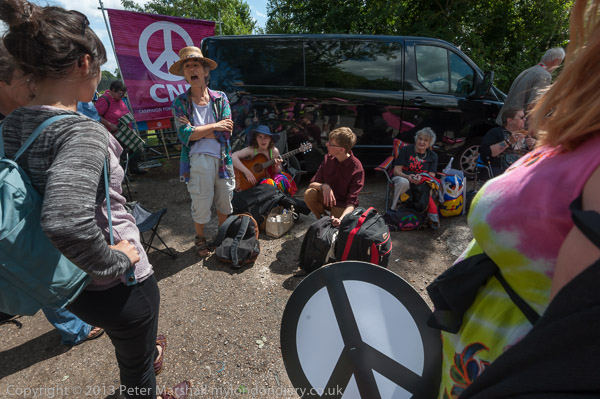
Back at the Burghfield base things were very much getting back into sixties mode – I’m sure they were singing ‘Where Have All the Flowers Gone?’ when I took the picture above and there were other songs and poetry readings, as well as some political speeches. I sat around for a while to recover from my run up the lane and back and after listening to CND General Secretary Kate Hudson decided I had the energy to cycle back to Reading for the train home and the lengthy editing of my pictures.

I was quite pleased with the set of pictures, taken with my usual Nikon D700 with 16-35mm and D800E with 18-105mm DX, though more for the overall view they gave of the event than for any individual images, though I had a nice set from my run after the joining up had been confirmed.  But there were one or two places where back home looking at the pictures I could clearly see I’d missed an opportunity. The most glaring was at the Aldermaston fence, where I hadn’t recorded the longest and largest banner in a single image.

I’ve got ‘What would you spend‘ in one frame and ‘you spend £100 million on?’ in another, but really getting the whole thing together would have been rather better!  If I’d taken them from the same place with the same focal length I could have joined them up, but rather better would have been to have used the 8mm fisheye to get it all in a single frame.  I was just in too much of a rush, too worried about actually making it back to Burghfield, and not realising quite how much faster my return journey would be.

Wool Against Weapons.

Continue reading A long pink scarf

Marcus Garvey Centenary

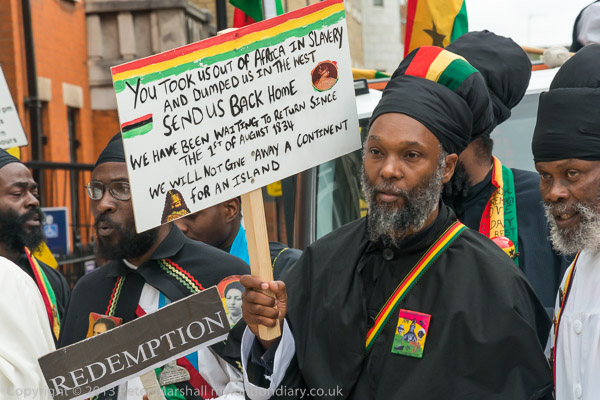
After working and studying in London, Marcus Garvey returned to his native Jamaica in 1914 and on 1 August founded the Universal Negro Improvement Association (UNIA) to unite all of Africa and its diaspora into “one grand racial hierarchy.”  The movement flourished when he took it to the USA and in 1920 claimed 4 million members.  August 1 had been chosen to found the organisation as it was Emancipation Day, the anniversary of the legal ending of slavery in the British Empire in 1834.

The slave trade had been banned in 1807, and two hundred years later I had photographed events commemorating this in Central London and in Kennington, Brixton and Clapham, which I described as “the spiritual and physical home of the abolition movement.”

As I wrote then, “fortunes made from slavery helped to build many of the institutions from which we still benefit, including our many of our great galleries and museums. Slavery founded many of our banks and breweries and other great industries, and made Britain a wealthy nation.” All of us in the UK – black as well as white – benefit from this legacy, even if, as I also pointed out, “the same wealthy elite that treated Africans so callously exploited the poor in Britain. My ancestors were thrown off their land and probably some were imprisoned for their religious beliefs by these same elites.”


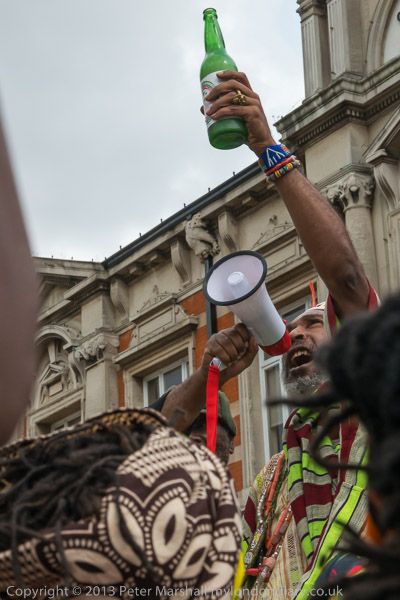
The bottle is of African Palm Juice, traditional for libations in many West African ceremonies

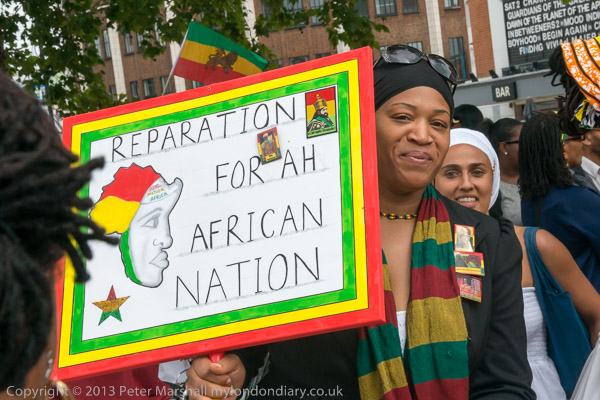
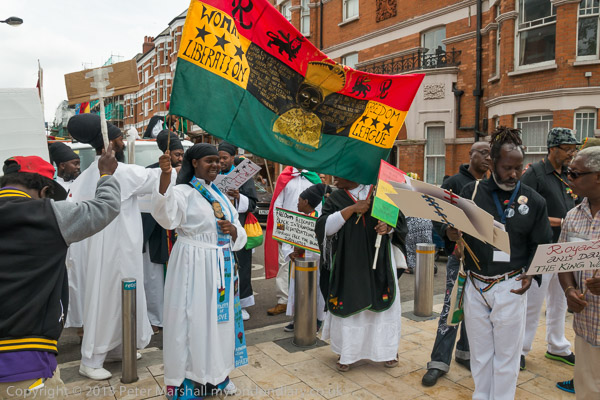
Since at least 1999, some African organisations and countries have been pressing for compensation to the descendants of those who were enslaved by the Atlantic Slave Trade, and the Marcus Garvey anniversary event in Brixton was a gathering before a march to Parliament to present a claim for reparations.

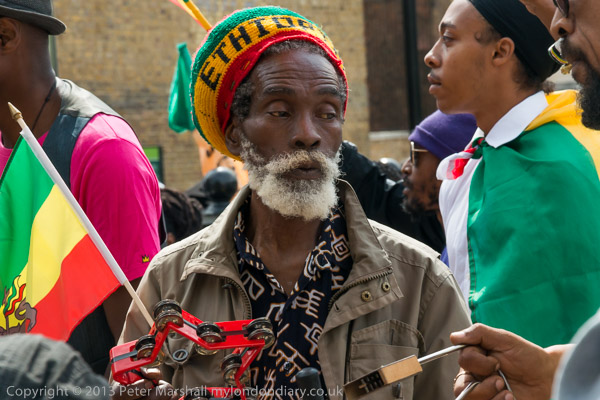
Among those at the event were a number of people who recognised me and greeted me, and a few  who wanted to know why I was taking photographs – who I was working for. As usual I answered them politely, telling them I was a freelance photographer with a particular interest in London and its communities and in protests, and that my work went into agencies and could be used in newspapers, magazines and books, and almost all seemed satisfied. Except one man, in pseudo-military garb, who felt that my presence as a white man at this event wasn’t appropriate, and threatened that some people present might violently object. But others were much more welcoming and clearly happy to be photographed, some asking me to take their pictures.

I’d hoped to photograph the start of the march but things seemed to be running rather late and I had to leave to cover another event while the speeches were continuing.

Pictures and Text: Rastafari demand reparations for slave trade
Continue reading Marcus Garvey Centenary

Faces & Funerals

A couple of short clips from the BBC World Service that are worth watching, both by photographers I know and whose work I admire.

The first is Derek Ridgers who talks to Dan Damon about some of the people he photographed in clubs and elsewhere which are in his book book ‘78/87 London Youth’.  Following on from this, Damon talks with Charlie Phillips about Afro-Caribbean funerals in London, with pictures from his forthcoming book ‘How Great Thou Art‘, successfully funded through Kickstarter. Photofusion in Brixton is showing this work next month – 7 November – 5 December 2014. You can see some of his other work on line at Akehurst Creative Management.

You can see a large collection of work by Derek Ridgers on his web site, with the archive there containing most of the pictures, and his blog containing some interesting and often amusing posts about his experiences while making the pictures.