Paris

I’ve often been in Paris in November – like many involved in photography visiting the city around the time of Paris Photo, the largest of the annual shows of the photography art market – and I knew that many people I knew would be in the city when I heard the news of the terrible killings there on Friday.

I’d heard the news late, having been busy working on a new book and not keeping up with the news and was on my way to bed when my wife told me about it. She phoned her brother who lives just outside the city with his wife first thing on Saturday to check they were OK. They were; though he had been at a bar on one of the streets where one of the attacks took place most of Friday afternoon, he had left for home several hours before the shootings.

It was a relief too to turn on Facebook and see updates from many of my friends in Paris assuring us all of their safety. Of course it is still a great tragedy but it is good to know that those that you know are safe, though as I write only around 30 of the 129 confirmed dead (with another hundred or so in hospital with various injuries) have been named and there could still be shocks.

Although most reports have said that the attacks occurred away from the tourist areas, there were in the areas of Paris I know best, and where I have often stayed and photographed on my visits there, particularly around the Canal St Martin where the attacks on Le Petit Cambodge, Le Carillon, La Casa Nostra and the Bataclan theatre took place.

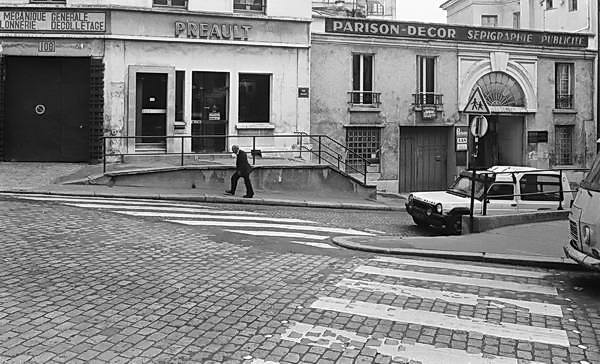
One of the pictures hanging above my living room mantelpiece shows a corner of Rue Bichat, though the shootings there took place a couple of blocks south where it meets Rue Alibert. It’s a street I’ve walked down many times and the same picture is also on the front page one of my more neglected web sites,  Paris Photos. Although it has quite a few of my pictures from Paris, particularly my pictures from 1973 and 1984, there are many more I should add.

My thoughts – like so many others around the world – are with Paris and those who have been killed or are suffering and their grieving relations and friends.

Harlem Argument

Don’t miss the New York Times Lens feature Gordon Parks’s Harlem Argument written by Maurice Berger, which looks at a show organized by Russell Lord for the New Orleans Museum of Art  in collaboration with The Gordon Parks Foundation and shown at NOMA in 2013-4. You have to register to get access to the museum’s pages about the show, but you can read their press release and articles by John D’Addario and offsite in a blog by John Edwin Mason.

It’s probably best to start by viewing the essay as it was published in LIFE over around nine pages (four double page spreads and two half pages) on the TIME site, – it starts on page 21 of the gallery, and viewed at full screen the text is legible too. The gallery also has separate views of some of the images they used and a few they didn’t, and again has text by Mason.

The New York Times feature comes as the show is open at Vassar’s Frances Lehman Loeb Art Center in Poughkeepsie, NY until Dec 13th 2015.  The essay ‘Harlem Gang Leader‘, published in LIFE Magazine, November 1, 1948 was Gordon Park’s first for LIFE, and although it is a powerful essay, I think it is probably true to say that the photographer lost the argument.  Red, the gang leader Leonard Jackson, as Berger writes:

“was dismayed by the photo essay’s portrayal of him as a slick gangster, living a fundamentally unhappy and lawless life. “Damn, Mr. Parks, you made a criminal out of me,” the photographer recalled him saying after the essay was published. “I look like Bogart and Cagney all mixed up together.””

Gordon Parks devotes a chapter of his autobiography, ‘Voices In the Mirror‘ to the story. At the time he was about twice the age of the teenage gang members he was photographing and impressed them with a flash car he was driving, a Buick Roadmaster which helped him gain their confidence. He also mentions that some of the pictures were taken with the help of an infra-red flash rigged up for him by LIFE and goes on to comment about the editing – but makes no suggestion that Red was dissatisfied with the article. On p110 he writes:

“There had been some contention between the editors and myself during the layout of the story.They had wanted to show Red on the cover with a smoking gun in his hand. I fought against it, even destroyed the negative to be sure it wasn’t used for such a purpose.”

Parks wanted to show a more rounded view of Harlem and the life of the gang members, but he still beleived that the essay had a positive effect, bringing gang violence to the attention of the public and also helping to cut the murder rate in Harlem, as least temporarily. He also recounts how almost 40 years latger, Red got back in touch to tell him he was getting an education and trying to stop Harlem youths taking the road he had.

October 2015

What? Its only November 11th and I’m posting that I’ve finished the whole of October for My London Diary? Yes, thanks to having been a little indisposed for a few days I’ve almost got up to date. So here it is. I’m more or less feeling OK now thanks. Perhaps get back to normal work tomorrow…

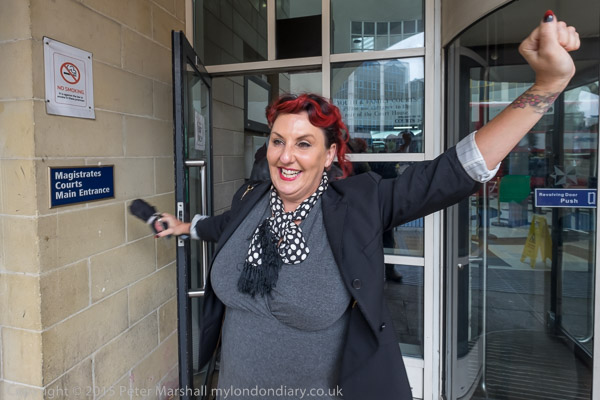
October was an interesting month for me. I almost got to be a witness in a trial relating to events I photographed earlier in the year, and it could just have been a trial that set an important precedent in restricting our civil rights. But fortunately it came up in a court that had more sense than to entertain the police nonsense – and was settled without any defence evidence being heard.

Perhaps too things are quietening down a little and I’m also trying hard to cut out some of the less essential things I cover. Certainly there are fewer stories than for some time.

Continue reading October 2015

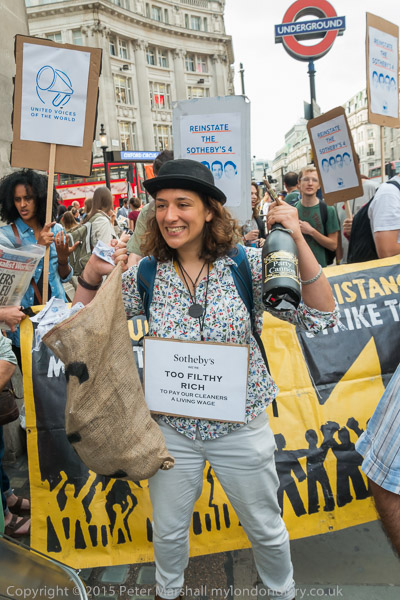
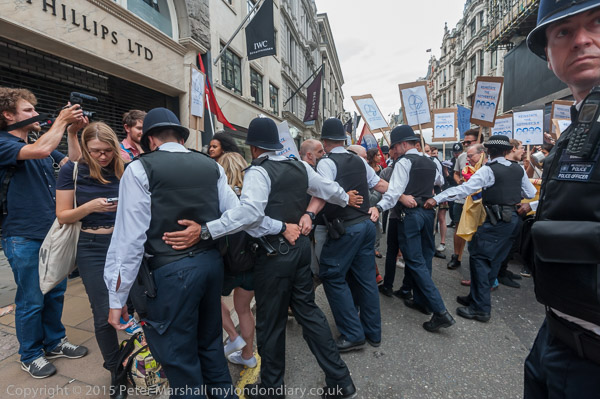
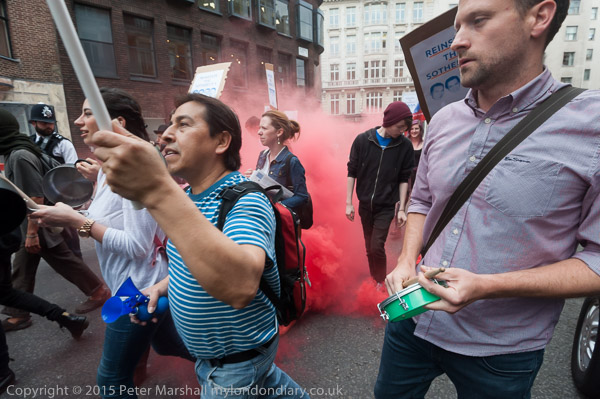
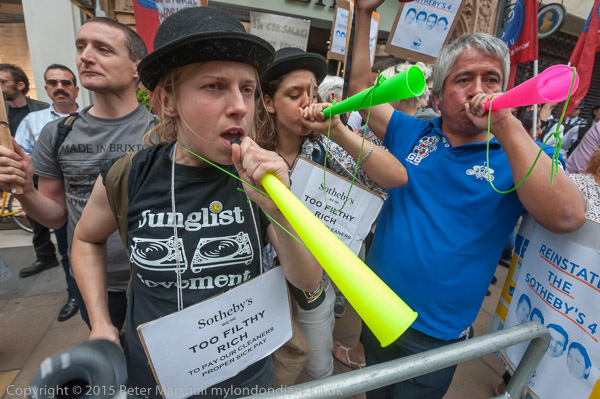
Sotheby’s Party Protest


A sack full of money and an equally fake bottle of champagne for a party-themed protest

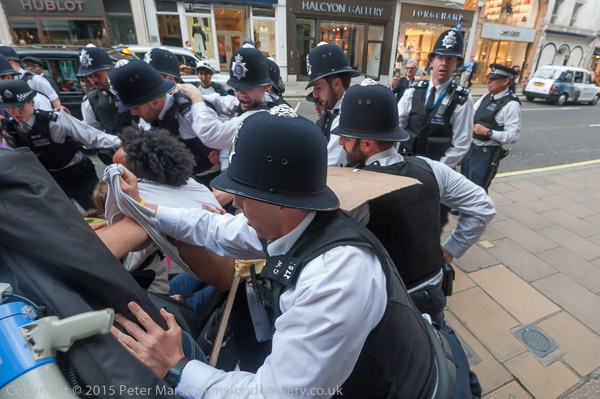
United Voices of the World went back to Sotheby’s intending to have a ‘protest party’ outside while Sotheby’s staff were having their staff party before their summer break inside the building. But the police were not in party mode at all, smarting from being given something of a run-around by the UVW at the previous protest.

Of course the union were there for a serious purpose, calling for the re-instatement of four cleaners who had been sacked for protesting outside their workplace calling for proper sick pay, holiday and pension arrangements.  The UVW want the Sotheby’s 4 to be re-instated.

The cleaners are not actually employed by Sotheby’s – so would not in any case have been inside at the staff party. They are employed by a contractor, Servest, but Sotheby’s had refused to let them come into work in the building, effectively sacking them.

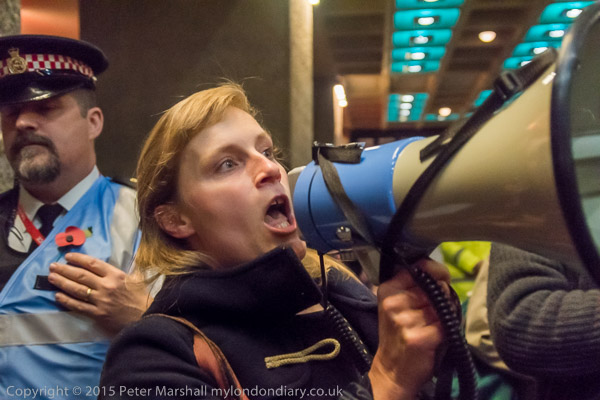
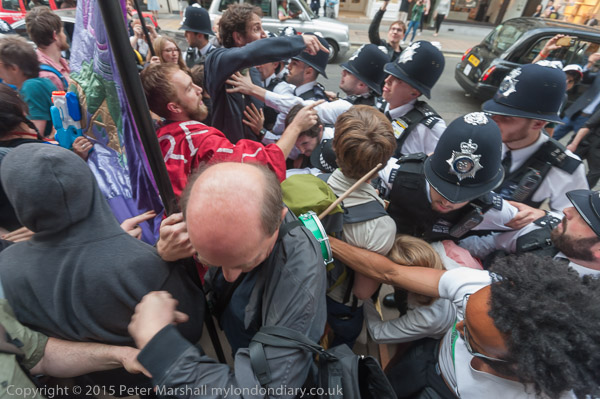
Had the police behaved sensibly there would have been a noisy but essentially good-natured protest outside the closed frontage of Sotheby’s, causing relatively little disruption to traffic in the area. But the police came determined to turn it into a battle and to show the protesters who was boss.  As the protesters came up to Sotheby’s they formed a block across the road, closing it to traffic for far longer than was necessary, eventually pushing the protesters off the road onto the opposite side of the street.

Later they attempted to stop the protesters from marching around the block, and again there was a lot of pushing and shoving by police, but the protesters walked around them and went around the block, letting off a couple of red smoke flares as they did so. When they arrived back at Sotheby’s police again pushed them off the road and behind the barriers which had been set up to contain the protest.

The atmosphere, which had started as good-natured was beginning to turn sour. People don’t like being pushed around by police, and when police again tried to stop them leaving the pen for a second walk around the block things got very heated. The protesters seemed to be pushing their way through when more police joined in, leaving the barriers behind unguarded.

People began unhooking them and moving out onto the street and it took a lot more pushing and manhandling of protesters by police to get them back. The police had really lost control, but the protesters weren’t really out to cause trouble – most just wanted an effective and peaceful protest and people just wandered around on the street shouting slogans.

Eventually police reinforcements arrived and brought the situation under control. It looked for a while as if they intended to arrest some of the protesters, but they thought better of it – and it was perhaps hard to know what the charges might be. Eventually UVW General Secretary Petros Elia spoke to one of the officers, telling him that they wanted to bring the protest to an end, and he went to see the officer in charge and the protesters were allowed to march away.

I made my way home, thinking that an essentially peaceful protest had been policed with unnecessary force, and had cost the public several thousand pounds more than had been needed – all because of a little police dented pride.

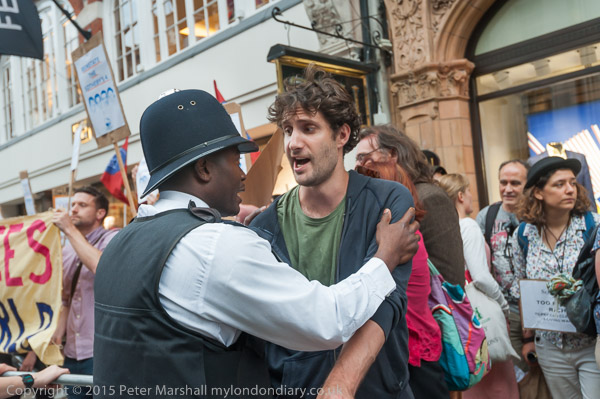
Photographing such events I need to keep a certain distance and objectivity, which can often be difficult. I also try hard to avoid getting in the way of the police in the discharge of their duty.  Often police don’t want to be photographed and can be unnecessarily obstructive – and I was asked to move back on a couple of occasions during this protest when I felt it was entirely unnecessary – and also got pushed out of the way rather roughly. Annoyingly police often ask photographers and protesters to move ‘for your own safety’ when its clear we are in no way at risk.

More at Reinstate the Sotheby’s 4.

Continue reading Sotheby’s Party Protest

Immigrants not Criminals


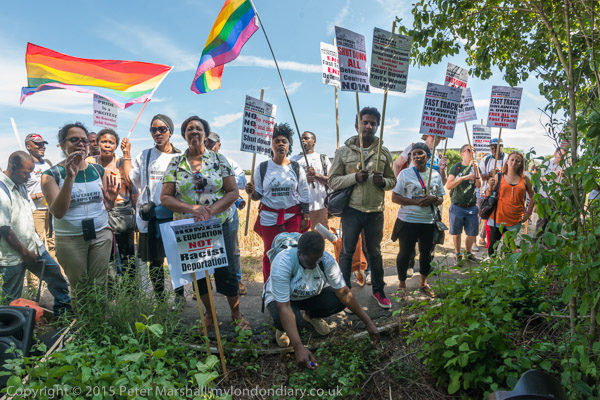
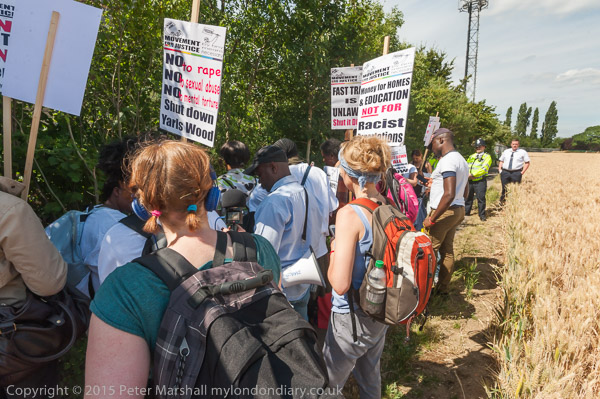
I photographed the protesters from inside the hedge in front of them using the 16mm fisheye

For years our right-wing press (and almost all the UK press is right-wing, owned by a handful of billionaires) have poured hate on immigrants, and successive governments have striven to outdo each other in repressive measures to stop people coming to settle and work in the UK. Unless of course they are extremely wealthy – its only for the rich that we really have freedom of movement around the world any more.

Words such as immigrant, asylum seeker and refugee have become terms of abuse in our racist press – and even in the reporting of more respectable organisations such as the BBC.

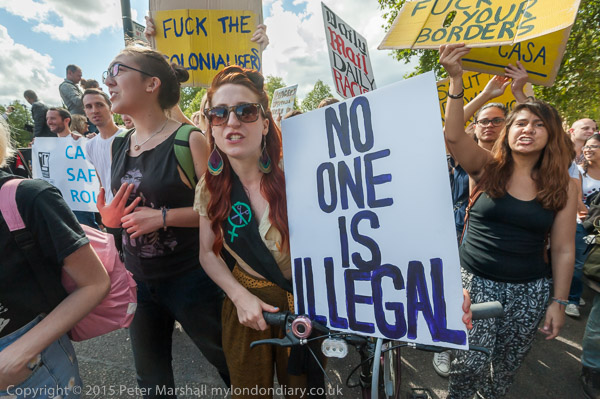
There has been an excessive obsession with numbers, and with terms such as ‘flood’ and ‘storm’ and even people who should know better talk and write about ‘illegal immigrants’ when there is no such thing; people may break the law but they are not illegal, as banners on these protests say – No One is Illegal.
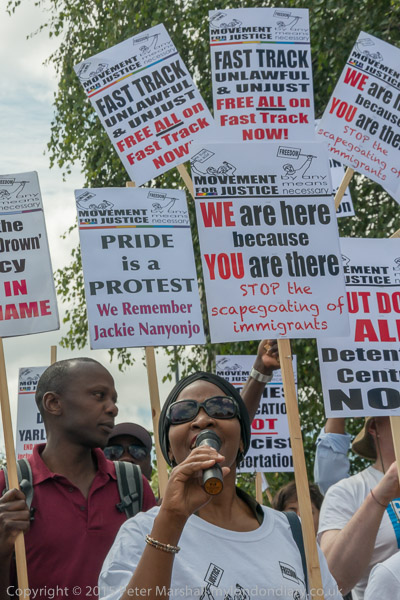
Scare stories are run about huge population increases and the ‘fact’ that the UK is overcrowded. It isn’t, although some parts of London certainly are with tourists, who the government is trying to encourage. There is pressure on services such as schools in some areas – largely because of a failure to direct resources where they are needed in a timely way and the deliberate sabotage of local authority planning with the introduction of ‘free’ schools and academies. The severe housing problem has little or nothing to do with immigrants, but is a long-term problem which has been exacerbated by ‘right to buy’, the end of rent controls and the introduction of housing benefit to subsidise landlords, a failure to implement much-needed land reforms and other government policies. The decimation of our manufacturing industry and the move to a service economy with a proliferation of dead-end low-paid work isn’t a result of migration but deliberate government policies… Immigrants are a simply a convenient scapegoat, without the means to counter their scapegoating.

Except that is through movements such as the Movement for Justice, which continues to fight for them and their rights and occasionally the courts which when people manage to get their cases heard also stand for human rights and the rule of law. That they should have to do so against the Home Office is ridiculous and shameful.
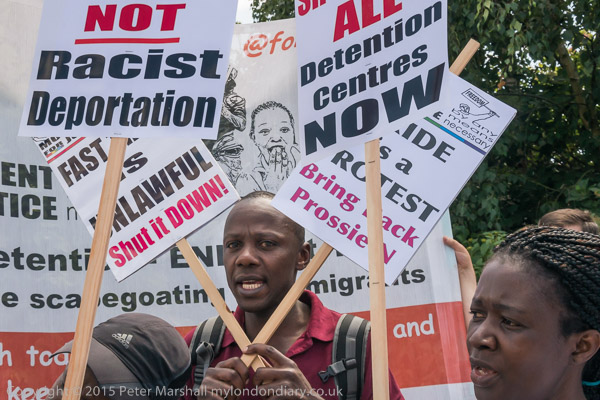
Migrants come here for various reasons, many as some of the placards at the detention prisons at Harmonsdworth & Colnbrook (Now renamed Heathrow Immigration Removal Centre) state ‘We are here because you are there.’ To Britain in particular because of the colonial legacy that built up our great cities – London, Bristol, Liverpool, Glasgow and the rest – and which continues though many international corporations based in London to exploit the labour, raw materials and consumer markets of our former Empire. Asylum seekers come because of wars and conflicts which arise from our invasion of Iraq, our earlier meddling with the politics and boundaries of the Middle East for oil, in Africa for its mineral resources and India for cotton, silk, and other textiles, tea and other goods (not forgetting opium.) And of course there was the trade in slaves, for which Britain perhaps too readily claims kudos for its abolition while refusing to fully acknowledge its involvement.

There is a remarkable inhumanity in sending those arriving to seek asylum, often traumatised by war, beatings, torture or rape, to detention centres. Even more inhumane to try and deport them back to the situations that forced them to flee by ‘fast track’ procedures deliberately designed to give them little chance to prove their suffering. The courts agreed, but still people remain at risk. Our Border Agency and immigration system – and the politicians that direct it – are inherently and institutionally racist and while some staff may work with good intentions (and sometimes are able to force sensible decisions) they do so within an overtly racist framework.

Normally in courts people are innocent until they are proven guilty, but for immigration the reverse applies – their stories are disbelieved and they have to prove they are true. It shouldn’t be like this. People should not be held for long and indefinite periods locked away from friends, and certainly should not be subjected to the rape, sexual abuse and mental torture that goes on in places such as Yarls Wood, private prisons staffed by overworked, underpaid and under-trained security staff.

The protests at Harmondsworth which houses male migrants have been going on for years – I first photographed there back in April 2006. More recently they have been a little overshadowed by MfJ protests at the women’s prison Yarl’s Wood, near Bedford, and by the revelations from inside there with undercover footage shown on TV. With a high profile demonstration due at Yarl’s Wood a few weeks later, there was less promotion of this protest and the numbers were a little lower than at some previous events.

Harmondsworth and Colnbrook prisons are next to each other, set back a hundred yards or so from the Bath Rd (A4) close to the east end of the Colnbrook bypass. A roadway goes down between their high fences to a BT site behind. Since the start of this year the protesters have been stopped from going down this private road and confined to an area in front of the Harmondsworth administration block near the front of the site. It’s hidden from the main road, though there is now in any case relatively little traffic along the A4, with most using the M4. The protests here are not visible to anyone but the prison staff and a few visitors to the prison.

Previously we would see some of the prisoners (our government thinks it makes it sound better to call them detainees) coming to the window and waving, holding up signs and welcoming the the protesters. Now they can’t see the protesters, but they can certainly hear the protest, and outside we can often hear them shouting back. Detainees are allowed mobile phones, and the protesters ring those inside and they can speak to the protest over them, though a mobile on speaker-phone held to a megaphone isn’t always too clear.

Among the protesters are those who have previously been held inside these and other immigration prisons, who also speak against the cruel and racist treatment inside them, the failures to provide proper medical services and the difficulties in trying to put together the case they should not have to make to prove their suffering against a culture of disbelief. While our justice system normally requires people to be proved guilty, under our asylum system they have to prove themselves innocent to avoid being returned to where they fled from oppression. But as the centre’s new name makes clear, this is not about justice, but about removing immigrants.
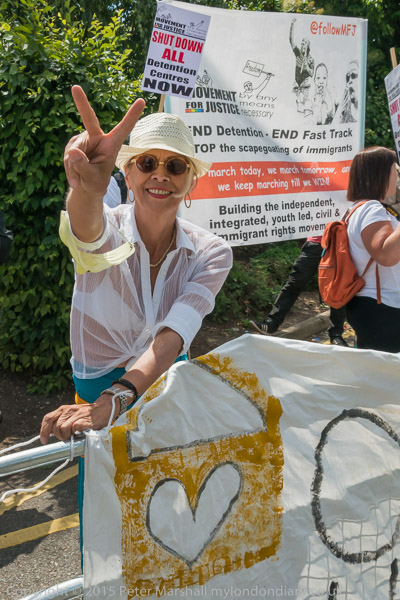
The protest pen gets fairly crowded, and the security staff and police won’t let me photograph from in front of it, though I do so as a matter of principle for a short while until forced to move inside. Telling police that it is a part of their job to facilitate the work of the press (and showing them the police guidance on this) doesn’t get you very far.
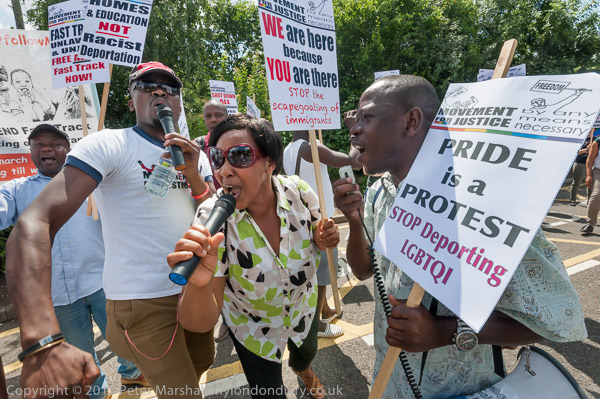
So I find myself working with very wide lenses – the wide end of the 16-35mm and the 16mm fisheye- in the middle of the protesters or sometimes leaning back over the barriers, hoping that being linked together they will not topple. I like working close, particularly with the fisheye, which brings a lot of interaction with the people I’m photographing, but it would be good to have the choice of a slightly longer view. The light’s good and I can use a reasonable shutter speed, needed even with a wide angle when the subjects are close and going across the field of view. It’s good not to use a very fast speed, and to sometimes get a little blurring as people wave their arms and fists, but mostly I’m working in the range 1/250-1/500. Again because I’m often very close I need to stop down for depth of field, and most the pictures are at f8 to f16. I don’t think much about shutter speeds and apertures when working, but set an ISO that gives me roughly what I want – in good light ISO640 or ISO800. Actually in terms of quality working with the D750 and D800E there is relatively little to be gained by any slower speeds, though I do use them for some landscape images.
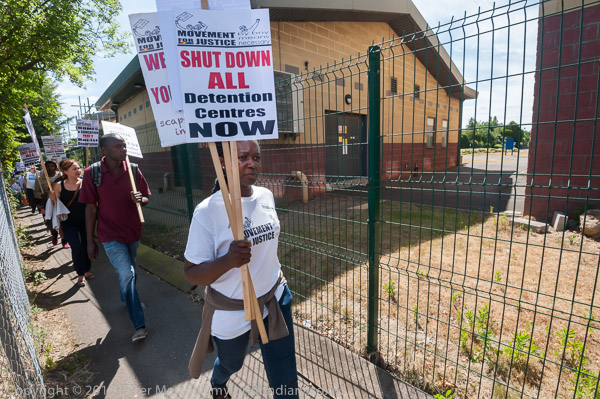
These are noisy protests so that those inside can hear, with drums and horns, but they are also protests with a lot of dancing and walking around in circles in the limited space available. As the protest was reaching its end, it marched out of the entrance onto the Bath Rd and then down a public footpath on the east edge of the Colnbrook prison, stopping in a field beside one of the blocks near the rear of the site. A large hedge and a tall fence behind it stopped us seeing any of the prisoners inside, but they were close enough to be clearly heard, and to join in with the shouting of slogans such as ‘Detention centre – Close them Down!’ with those outside. Police kept the protesters on the path by the hedge, and again the fisheye enabled me to work from inside the hedge looking towards the line of protesters along the edge of the field.
More pictures from the event on My London Diary at Surround Harmondsworth

Continue reading Immigrants not Criminals
DB Prize goes political

The shortlist for the 2016 Deutsche Börse photography prize is the subject of an article by Sean O’Hagan in The Guardian, Deutsche Börse photography prize shortlist: drones v the women of Tahrir, in which he writes it “is dominated by artists who engage with contemporary politics and social issues, from drone warfare to refugee activists in Africa.”

A small quibble in that, as he goes on to make clear in the next paragraph, Tobias Zielony actually “photographed the everyday life and struggles of African refugee activists in his native Germany for his exhibition The Citizen.” It’s work that seen on the web has only a limited appeal to me, but as well as the “Layout of 22 colour photographs, various sizes, on 11 large-scale pigmented inkjet prints, mounted on Aludibond, framed, 225 x 160 cm each” which you can view on screen the show also include an installation of newspapers, in 12 hanging displays, 130 x 205 cm each together with a 16 pages tabloid format which include the first-hand written accounts and interviews that O’Hagan mentioned. You get some idea of the look of these from the installation views of the show at the 2015 Venice Biennale also on the page.

Eric Kessels project ‘Unfinished Father‘ is more about an exhibition than about photography, and I’m not sure it will translate well to the Photographers’ Gallery. It certainly isn’t a book I would ever think of buying, and I think the photography in itself is of little interest, although the vintage images of the Fiats on the street towards the end of the short video have a certain charm, and incredibly empty streets.

Trevor Paglen‘s The Octopus is another installation which has little to offer me on the web, and from all I can see or read I doubt will engage me more in the gallery. But perhaps a closer investigation will bring out something of photographic interest.

I’ve mentioned Laura El-Tantawy‘s ‘In the Shadow of the Pyramids‘ several times on this blog, though unfortunately I missed the presentation she gave at one of our union meetings in London. But if you took my advice from In the Shadow of the Pyramids you will already have and have been impressed by her self-published book which is the subject of this short listing. And in response to a review of this work I added a little of my own thoughts in 1000 Words. The book as I predicted is sold out (and available on the web at around four times the original cost – but hang on and it will go up more), but the web site gives a great impression of the work and also includes page spreads and embeds a number of reviews.

I don’t much like these large competitions, which I think have a restrictive effect on photography, putting too much power over the future direction of the medium into the hands of a small and largely self-selected elite. It’s perhaps unhealthy too, that it’s banks which are behind a number of them – should we be relying so heavily on them for the future of the medium? And if these four photographers are all judged to be worthy of having their work exhibited at the Photographers’ Gallery I think there is something inherently unfair that just one of them should walk away with the £30,000 prize.  Usually it’s the wrong one.

LIFE Force

I had forgotten about Life Force*, a ‘a free, monthly, on-line, photo-led magazine which celebrates the art-form of the photo-essay‘ which has been available since the January 2011. The back numbers are still available and over the years it has built up a interesting and varied collection of stories, though perhaps not all of them are truly ‘great photography and pushing the boundaries of the medium to explore conciousness and human perception, by harnessing the unique power that photography holds to capture a moment for analysis.‘ But there is plenty worth looking at, including work by a number of photographers I know as well as some I was surprised to find I didn’t.

The November 2015 issue has seventeen stories, some old, some recent. Rather than talk about them all, I’ll perhaps mention just three of more local interest.

Tonight several of my friends will be out photographing in Lewes where the Firework Societies will be celebrating, including burning a giant effigy of David Cameron with a pig on his lap and another of Seb Blatter. Patrick Ward‘s pictures of the Lewes Bonfire Societies which he was able to cover as an insider give a good impression of the activities, though perhaps they lack a little of the excitement I’ve seen in some other images from these events.

I was more than a little envious at seeing Unseen London by Peter Dazeley who has gained access to photograph the ‘hidden interiors of some of London’s most iconic buildings, from Tower Bridge to Battersea Power Station, Big Ben to the Old Bailey‘ and has done so with great care. Although I’ve actually been inside quite a few of the places in this set, either I’ve not had the opportunity to take pictures or have had to make do with hurried snaps, full of other visitors. The only man in Dazeley’s set is a founder at work in the Whitechapel Bell Foundry, an image which for various reasons I feel does not fit well with the rest of the set.


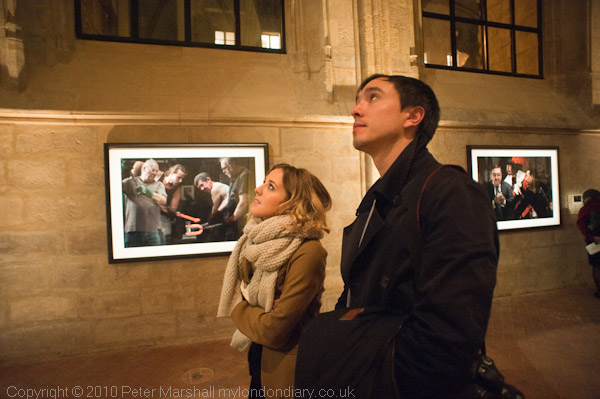
At the Paris opening in 2010 © Peter Marshall

Finally you can see Brian Griffin‘s Black Kingdom, work I have written about before when I attended the opening of his show of in Paris. You can see more pictures from that opening on My London Diary. Good though the work by the others is, his is perhaps the only one of the three I’ve mentioned that I feel is any way ‘pushing the boundaries of the medium to explore conciousness and human perception‘, though there are other essays on the page that could also be considered to have done so.


*I’ve not added links to the individual issue or essays as these are not permalinks and will change presumably when the December 2015 issue is published. To find them after that date you will need to use the ‘Back Issues’ link at the top of the home page and then select the November 2015 issue.
Continue reading LIFE Force

Are photographs ever portraits?


John McDonnell MP, Shadow Chancellor of the Exchequer speaking at yesterday’s ‘Grants Not Debts’ protest

I take a lot of pictures of people, some of which I share here and rather more on My London Diary. I’ve also photographed many others, including members of my own family and friends I know well. Quite a few of those are framed and hanging on people’s walls, while those I’ve taken of public figures have featured in various magazines and newspapers. Some are better than others but most are pretty routine, like yesterday’s picture of Shadow Chancellor John McDonnell, a man I know and have photographed on many occasions over the years.  It’s not a great image, but you can find worse of him every day in the newspapers.

But I’ve never thought of myself as a portrait photographer. And always rather questioned the whole idea of a photographic portrait. I think there are valid examples – for instance Alfred Stieglitz‘s truly intimate work on Georgia O’Keefe springs to mind, but there I’m thinking not of a single image, but of a whole set of images,beautifully presented in the 1978 Metropolitan Museum of Art publication ‘Georgia O’Keefe – A Portrait by Alfred Stieglitz’ which on the front dust-jacket flap states ‘His idea of a portrait was not just one photograph but a series of photographs that would be a portrait of the many aspects of a person.’ (The book is still available from book dealers at a ridiculously cheap price for such a well-produced and important work.)

There are many other pictures of people that I like, many of them good or even great photographs but few which really reach into the depths of a person in they way the best painted portraits do. Though its also very clear if you take a walk around inside – for example – the London National Portrait Gallery that there are many bad painted portraits as well as many poor photographic portraits both in the permanent collection and in their annual prize shows for photography and painting.

But even among photographers whose work I admire greatly, their ‘portraits’ are often the weakest work. Even with a master like Cartier-Bresson there are images which without the name of the famous sitter would probably never have been printed. (Some of his better portraits  along with some images that certainly are not portraits and one or two that perhaps fail to display his master touch and were clichés even before he made them are linked in the Portraits selection on his Magnum page.) And newspapers and magazines are full of poor or indifferent if sometimes technically competent images of people.

What got me thinking about this was a video created by The Lab in conjunction with Canon Australia in which they set up six portrait photographers to photograph the same man, giving each a very different story about him. Looking at what you can see of their results on the video published in the story by Shutterbug, each produced a very proficient image based on the story they were given, particularly as they were given only ten minutes (though often photographers have to do with considerably less, while painters often have months rather than minutes.) But I don’t think any of them was really a portrait of the person, rather an illustration for the story they were told.

Continue reading Are photographs ever portraits?

Jerusalem Day

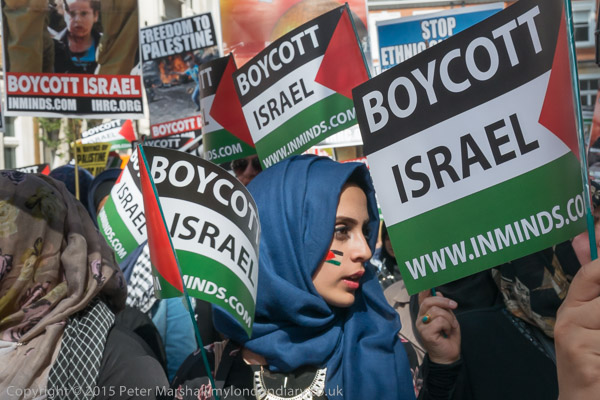
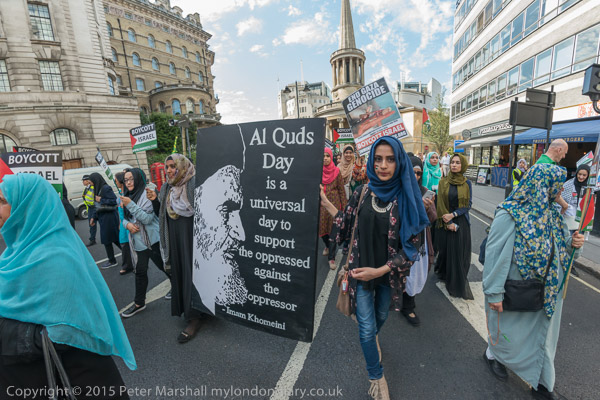
Al-Quds is the Arabic name of Jerusalem (and its Quds in Persian) and in 1979 the Iranian Supreme Leader Ayatollah Khomeini invited “Muslims all over the globe to consecrate the last Friday of the holy month of Ramadan as Al-Quds Day and to proclaim the international solidarity of Muslims in support of the legitimate rights of the Muslim people of Palestine.” He also said it was “a universal day to support the oppressed against the oppressor.”

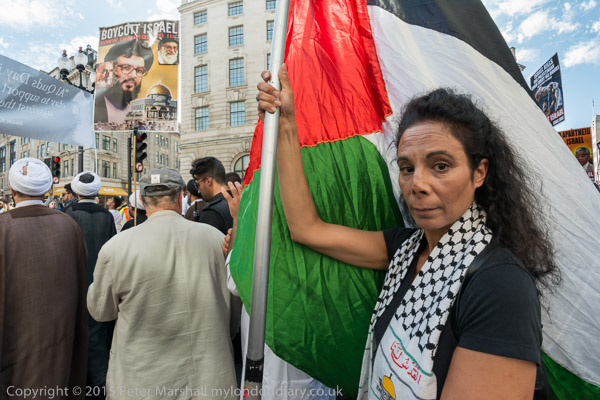
In Iran there are large state-sponsored protests against the Israeli domination of Jerusalem in particular, but also more widely against Israel’s repression of Palestinians in Gaza and the West Bank, and in support of the Palestinian cause. As well as in Iran, there are protests in a number of other countries around the world, including the UK. Here a major part of the protest is the call for a boycott of Israeli goods.

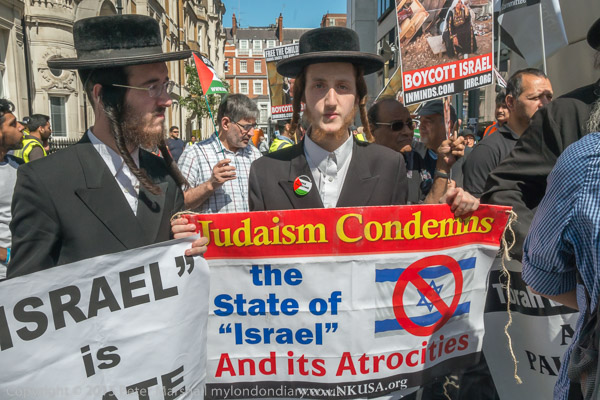
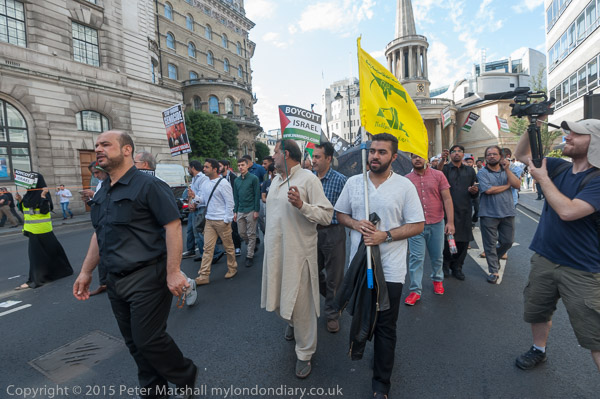
Although most of those actually marching in London are Muslims, including many from Birmingham, Manchester and other cities with substantial Muslim populations, the event is also supported by some non-Muslim groups, including the Stop the War Coalition and several Jewish groups including Jews for Boycotting Israeli Goods and the anti-Zionist ultra-orthodox Neturei Karta who oppose both the State of Israel and Zionism on religious grounds.

The march has been taking place annually in London for over 10 years (I think I first photographed it in 2006, though possibly I took images in previous years on film) and has attracted criticism from some Jewish and ultra-right groups, as well as various Iranian opposition groups – the march is organised by the Islamic Human Rights Commission which is thought to receive funding from Iran.

I’ve seen little evidence of anti-Semitism on these marches, and have seen the stewards take action to remove a clearly anti-Semitic banner. Clearly everyone marching is against Zionism and Israeli attacks on Palestinians and their human rights. One of the more curious spectacles on one previous march was s to see members of a neo-Nazi group, some with clear records of anti-Semitic actions hurling the insult of anti-Semitism at Jews and Muslims marching side by side and sometimes arm-in-arm through London.

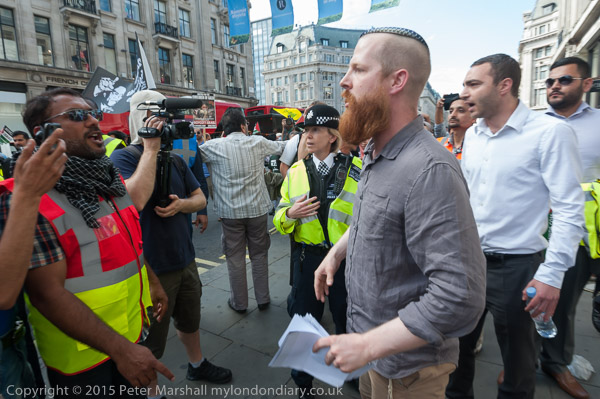
For the past couple of years there have been no real counter-protests – last year a pro-Zionist shouted and threw vegetables from an upper-floor window at the marchers and this year a young man shouted at the marchers and handed out misleading leaflets about how well Israel treated the Palestinians, arguing with some of them until the police led him away.

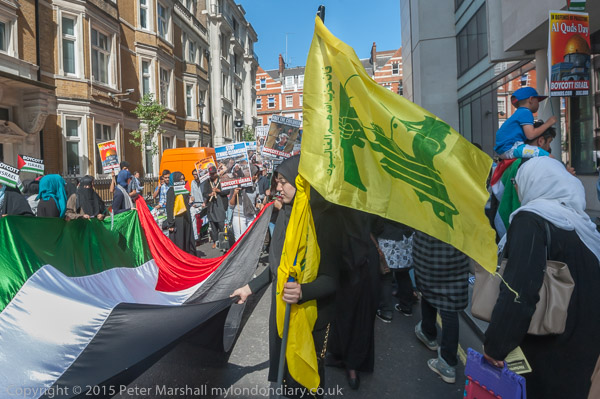
One complaint against the march has been that many on it carried Hezbollah flags and some have said this is illegal. The flag serves for both the military wing – which is proscribed – and the political party which forms a part of the Lebanese government, which, at least in the EU and UK, is not proscribed. There were in any case very few such flags in evidence at this year’s march -and I was looking carefully for them – a handful among the several thousand marchers.

Because of the origins of the event I was also particularly keen to photograph banners and posters which referenced Ayatollah Khomeini – and again these were relatively few. Overwhelmingly this is a march in support of Palestine and calling for its freedom and an end to Israeli aggression and repression there.

My pictures also include many more of women than of men on the protest, mainly because most of the women are in Muslim dress, while the men, apart from the religious readers wear the kind of casual dress that you would see on any high street. Just a few women turned away from my lens, but most seemed rather keen to be photographed, and I had no problems in taking pictures, something which has occasionally been a problem in the past at some Muslim events.

More on My London Diary at Al Quds Day march.

Continue reading Jerusalem Day

September 2015

Just over a month behind, last night I put the finishing touches to my posts on My London Diary for September 2015.


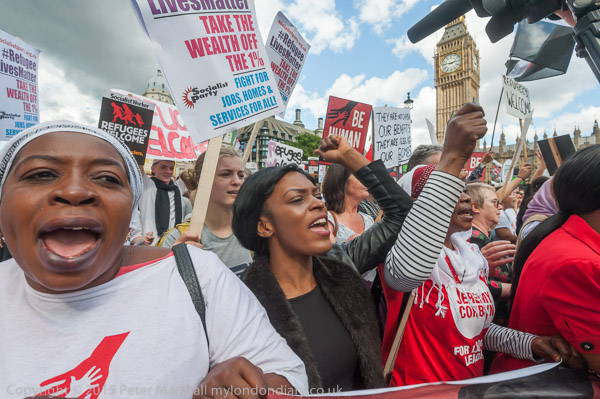
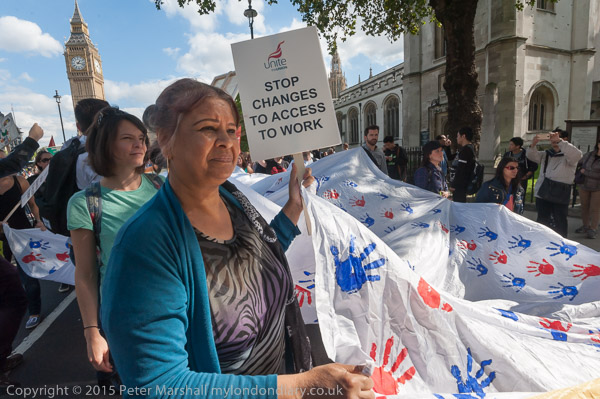
Refugees are Welcome Here march reaches Parliament

It was a busy month yet again for me, with over thirty stories, partly because of the DSEi East London Arms Fair – or rather the protests and events around it taking place, something which happens every two years.

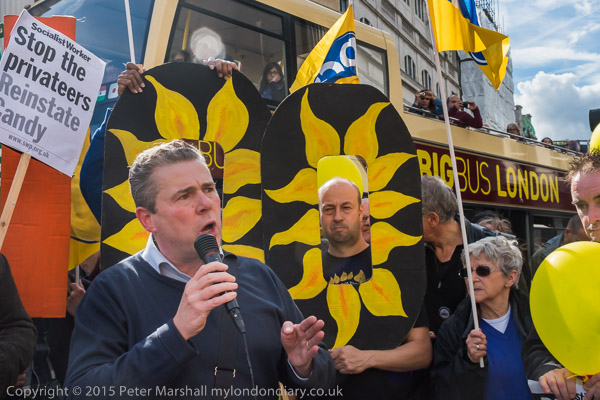
It was also a very interesting month, with the election of Jeremy Corbyn as Labour Party leader and his appointment of John McDonnell as Shadow Chancellor. I’ve photographed and talked with and listened to both of them speaking many times over the years, but this has meant that both of them have been too busy to attend the events I’ve photographed this month.

Knowing both of them the media response to the election has been ridiculous in the extreme – as have been the comments of both government and some Labour party politicians. The establishment is clearly running scared and throwing all kinds of ridiculous assertions at them. They clearly give the Labour Party its only hope of winning the 2020 election after its recent failures and would also put the country under rather better management than it currently enjoys, though whether they would be able to break the stranglehold of the city and the ultra-rich is debatable. I think in the end they are both far too reasonable and conciliatory to really make the radical changes the country needs, but I still have some hope for the first time in some years.

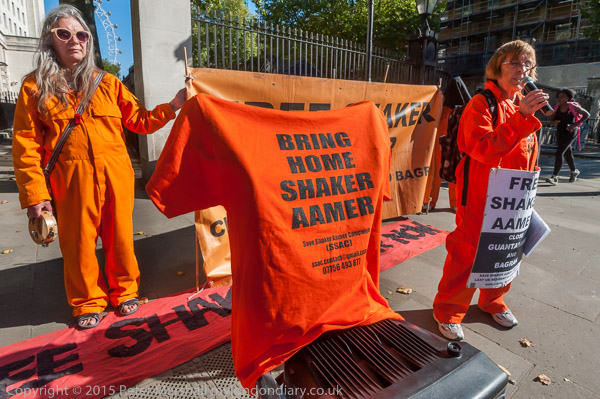
People often tell me that protest is useless and never achieves anything, but they are simply wrong. Two series of protests I’ve been photographing appear to have reached at least a reasonably successful conclusion this month, with an agreement being reached after 100 days of strikes at the National Gallery, and also apparently between the UVW and Sotheby’s, though I think details have yet to be finalised. The protests over refugees have so far only led to a minor shift in the Government’s position, but I think we may see more, and finally Shaker Aamer was released a couple of days ago and is back in a London clinic.

Continue reading September 2015