Stopping London Traffic Pollution

Every Saturday evening in my youth the BBC Home Service broadcast the radio programme ‘In Town Tonight’, introduced by the music of the Knightsbridge March by Eric Coates and traffic noise, halted by a loud shout ‘Stop!’ and the radio announcer’s voice “Once more we stop the mighty roar of London’s traffic …” It carried on, even becoming a TV show for a few years, an early chat show with celebrities and the odd and occasionally interesting rather random outside broadcast segment, most famously on a night spent in the waxworks Chamber of Horrors by Brian Johnston.

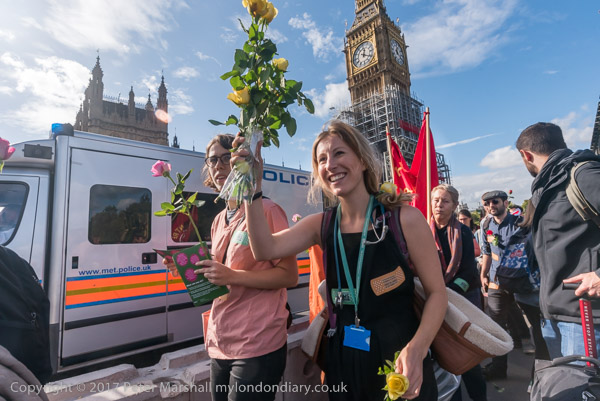
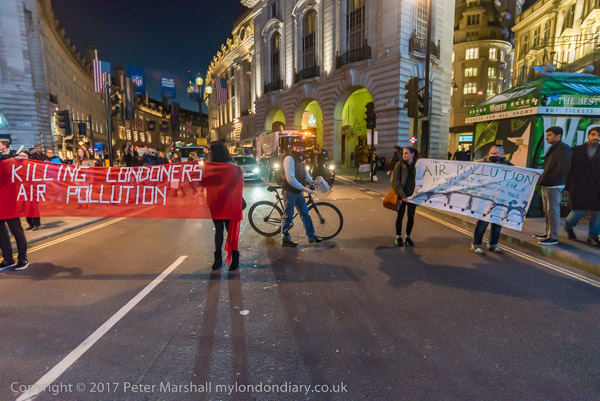
Memories of this and the comfortable fug as our family sat around the radio and a coal fire in our cramped living room came back to me as ‘Stop Killing Londoners‘ again stopped that mighty roar, if a little less dramatically, first at Oxford Circus, by stepping out with banners when the traffic was halted at the lights, in the sixth of their brief protests to highlight the thousands of premature deaths each year caused by air pollution in the city, largely by oxides of nitrogen and minute particulates from traffic. Official figures put the number of such deaths at very close to 10,000 deaths a year, and of course many more suffer greatly from illnesses caused or exacerbated by the polluted air, well above the legal limits for most pollutants.

Actions such as this are intended to force action from London’s Mayor and from TfL, who the protesters see as moving far too slowly and failing to confront those with vested interests, including London’s black cab drivers who are responsible for a surprisingly large amount both of the pollution and also the opposition to measures that tackle it, including the cycle superhighways. And until there is much greater public awareness of the problem, it is hard for the politicians to take more decisive action.

I’d met with the group on Oxford St around 6 pm, and as a photographer it was frustrating to see the light fading rapidly as we approached sunset and we were still waiting for more to arrive and the action to begin. It really was quite dark, and I wasn’t too well prepared for it. I’m always very surprised by the low light levels in parts of busy streets even in the very centre of London.
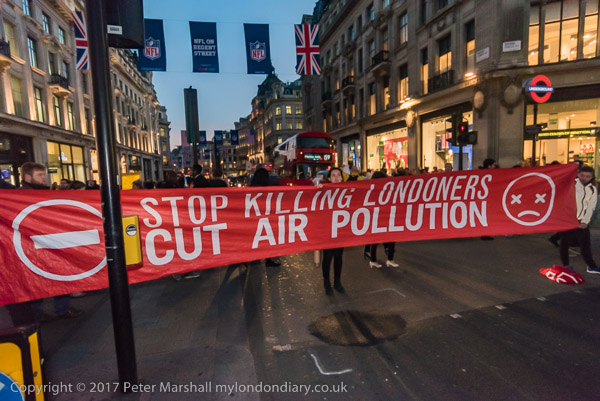
Flash generally isn’t a good option in wide open spaces for overall lighting, as it falls off with the square of the distance, but it does enable you to pick out people and banners closest to the camera, as in the picture above. But I didn’t want it to remove the shadows from the main lighting which was coming from the headlights of the vehicles stopped well behind those holding the banner.  In some of the other pictures this is a little more obvious.
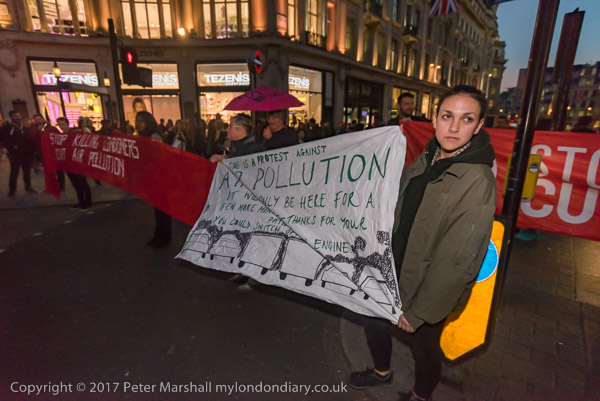
The effect of the light fall-off with distance from the flash becomes more of a problem when the main  subject is at an angle so that some parts of it are much closer to the camera and flash than others. I often try to lessen the problem by twisting the flash head to the side. The flash doesn’t  really cover the very wide angle of the 18mm used for the above picture, and by angling it away from the centre, in this case towards the left of the picture, puts the closer figure into the area where the light is falling off.  But still considerable burning of the closer part of the image and dodging of the further areas is called for in Lightroom.

It isn’t easy to remember to shift the flash head in the heat of the moment – and with these short protests I’m always very much aware that I do only have a very short time, and often – as on this occasion, rush around taking pictures and getting things wrong.  It’s easy to turn the flash head to the left for one picture and then forget to put it back when it really should be head on.
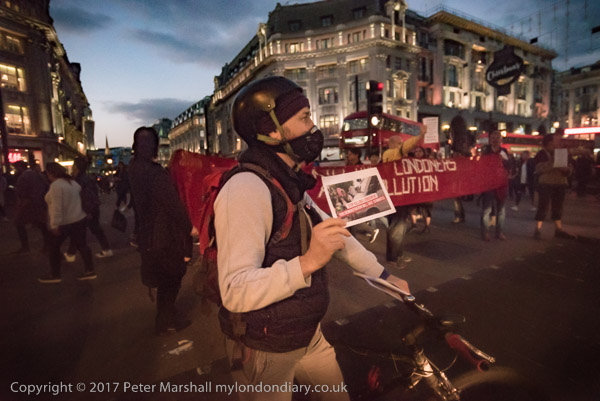
But my main problem in the heat of the moment was, as usual, my straying fingers.  Quite how I managed to turn the control dial and change the shutter speed from the 1/250th selected to stop motion as the protesters moved into position through 1/500th, 1/1000th, 1/2000th and even to 1/4000th before I finally noticed I had a problem is hard to fathom.  Though the problem was far less noticeable on the camera back then when I was later looking at them larger on the computer.  The above image was made on the D750 at 1/2500s, f/3.5, ISO 6,400 and is at least 4 stops under-exposed, probably rather more.

The grainy image and odd, low saturation colour actually result in a certain gritty attraction, though not one that I was aiming for – and certainly one that required rather more processing in Lightroom than I like or usually allow. At extreme underexposure the darker areas of images acquire an odd purplish colour which needs careful tinting to eliminate. Quite a few images were impossible to salvage from the gloom, and I only had time to take a few pictures as by the time I realised my error the protest was drawing to an end.
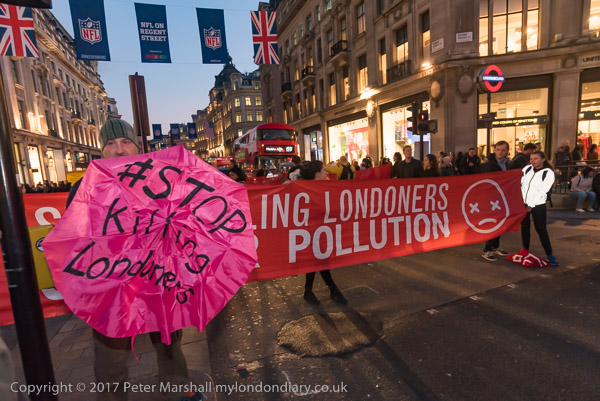
The difference in image quality is pretty dramatic, even viewed in these small web images, and I tried to retake a few of the earlier pictures, but time was very short. I did have plenty of time to reflect on my mistakes as I walked down Regent Street with the protesters to Piccadilly Circus, and here I managed to keep my errant fingers a little better under control, at least for the first part of the protest.
Although it was later, it helped too that Piccadilly Circus is generally rather better lit – here the bright lights of London are generally something of a reality. But, as you will see if you look at the images, by the end of the protest there, my fingers had wandered yet again, making me wonder if amputation is the only answer…
Stop Killing Londoners with traffic fumes

Continue reading Stopping London Traffic Pollution

More Hull Photos

Today I’ve added another small batch of images to my Hull web site, Still Occupied – A View of Hull, which takes its name from a show at the Ferens Art Gallery in 1983 of almost 150 of my pictures, many of which are now on the site along with several hundred more.   The pictures were taken at a time when large areas of the city were being demolished, and I came ‘Still Occupied’ written large three times across the windows and doors of a closed shop on Argyle St.

Now that I am no longer posting a new image every day with my comments on Facebook, I have begun to add the comments to the web site below the pictures. Comments and corrections are still welcome here on >Re:PHOTO. As usual, clicking on any of the images will take you to the relevant page on the web site where the images are presented a little larger.


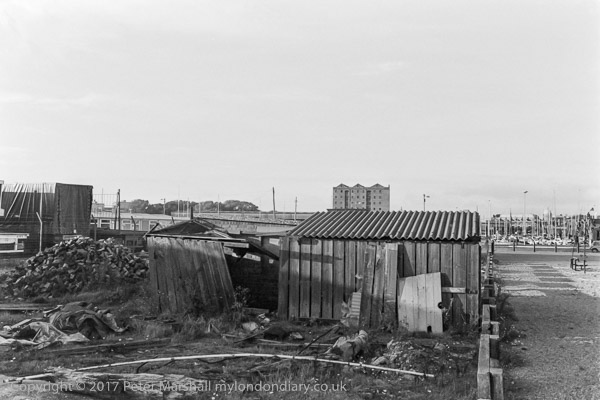
85-10n-21: Island Wharf, sheds west of Humber Dock Basin looking towards town centre, 1985 – Old Town

By 1985 Hull marina was full of boats and you can see at the right of the picture some of the buildings in the city centre through a forest of masts.

The remaining warehouses of Railway Dock appear over the roof of a rather basic shed in the centre of the picture, part of which has collapsed and at left are the ends of a couple of lorries parked in this area to the west of Humber Dock Basin, which I think was part of Island Wharf.

This area is very different now, with the modern office blocks of Humber Quays, including the World Trade Centre Hull & Humber which opened in 2008 in the building completed in 2007.


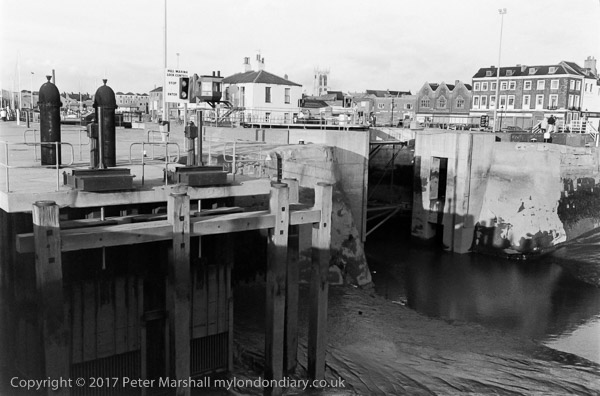
85-10n-22: Humber Dock entrance lock, 1985 – Old Town

The Humber Dock entrance lock still I think looks much as it did when I took this picture in 1985, not long after the marina had opened in 1983. Most of the more distant buildings are still there, though their use has changed.


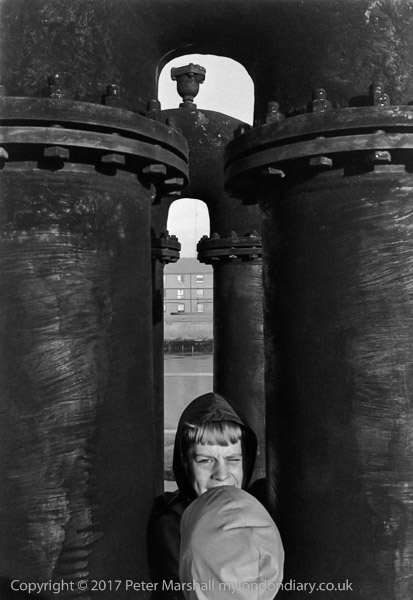
85-10n-23: Sam & Joe at Humber Dock Basin, 1985- Old Town

My elder son sits and looks at me with one eye as his younger brother faces away from me. Both have the hoods on their jackets up, as the area on the edge of Humber Dock Basin is open to the Humber and often cold and windy, as it was on this October day.

Humber Dock, Swing Bridge and Lock were all Grade II listed in 1970.


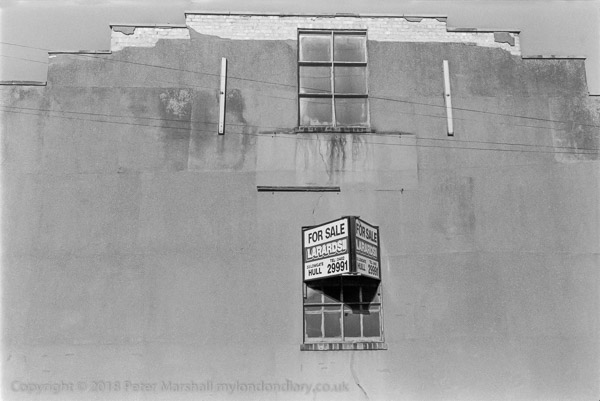
85-10n-33: Building for sale, Lime St, 1985 – River Hull

This building, for sale in 1985, is now a large shed from John Brockelsby Metal Management Ltd. It has a similar size and overall size as the earlier concrete structure, which could possibly be present under the cladding.


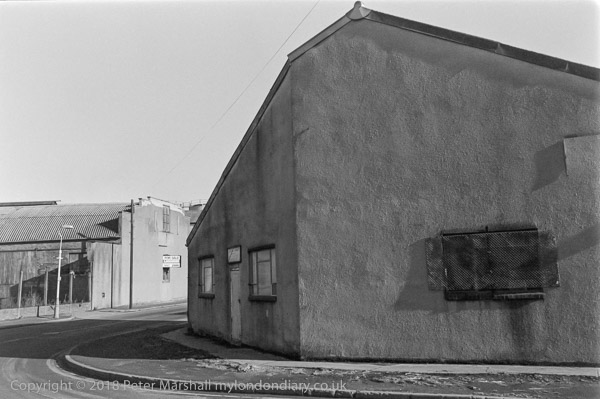
85-10n-34: 69 Lime St, 1985 – River Hull

It isn’t possible to read the name of the business at 69 Lime St when I took this picture, but from 1998 until 2012 when the company was struck off it was the registered office of Nitromorn Ltd, a car repair company. It was also the premises of A1 Bodycare a car body shop, which became a limited company as K C S Projects Ltd in 2012 but also operates under its former name at the same premises. The building also for some time was the office of the insurance compensation claims company Active Claim Services.

The building in the previous picture can be seen at the left of the picture.


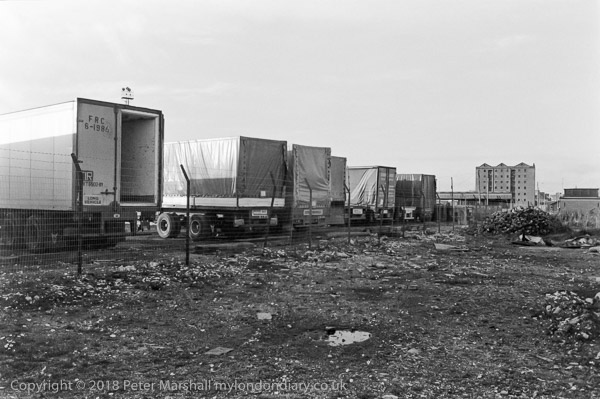
85-10n-36: Island Wharf, lorry park west of Humber Dock Basin, 1985 – Old Town

Another picture of the area just to the west of Humber Dock Basin, much of which was, as this picture shows used as a lorry park. Taken a few yards away from a previous picture it includes the same pile of rubble, possibly bricks, and two of the lorries which can be seen in that image. It does give a clearer view of the Railway Dock Warehouses


85-10n-41: Former College Lodge, 44 Beverley Rd, 1985 – Beverley Rd

Still very recognisable on Beverley Rd when I walked along it last year. According to Pevsner

“No. 44, an unusual stuccoed cottage of c.1837 probably by H.F. Lockwood who was architect of Kingston College (Now Kingston Youth Centre) to the N. The cottage was originally single storey; it has a Gothic doorway to the ground floor but windows with Classical detail to the first floor. It was seemingly the college lodge. The Gothic stone gate-pier to the l. is identical to the pair at the present entrance to the Youth Centre.”

Continue reading More Hull Photos

Loss, Lauds, Leaps & Lazarus

Of Loss, Lauds, Leaps, and Lazarus is the title of a yet another interesting post by Professor Larry J Schaaf, the Project Director of the Talbot Catalogue Raisonné at the Bodleian Library, Oxford.  I’ve mentioned the catalogue before and it is truly a magnificent project on one of the founders of our medium, one which I very much wish had been available when I had to write a few articles on W H F Talbot and the Calotype process.

Among the items covered in the latest weekly post is one on a process that Talbot experimented with prior to 1839 that I’d never heard of before, the lo-type, which has now been recreated by Grant Romer, involving the printing-out of images by extended exposure on iodised surfaces of copper or silver on glass, not dissimilar to the work of Daguerre in France.

Unlike Daguerre he did not break his thermometer and thus discover the use of mercury to ‘develop’ these images, instead using greatly extended exposures that produced both a positive metallic silver image and also some fairly strong colours from interference patterns. The colours are unrelated to the colour of the subjects, most of which were leaves and similar specimens in contact with the copper or silver surface.

Another topic mentioned in his note is the 209th anniversary of the birth of Anna Atkins on March 16th 1799, though it is actually the 219th anniversary if my maths is correct. She was the only daughter of a well known scientist of the time, John George Children and very close to him as her mother died when she was only a few months old. He brought her up and encouraged her as a scientist and she continued her scientific work after marrying a railway promoter in 1825.  She of course is deservedly famous for producing the first photographically illustrated book, Photographs of British Algæ: Cyanotype Impressions, its blue images produced exposing the specimens in contact with sheets of paper senswitized using the cyanotype process which had recently been developed by the man who proposed the term ‘photography’,  her friend Sir John Herschel and who had sent the details of his work to her father. Schaaf has some interesting news about new publications and exhibitions of her work later in the year.

More sadly, there is also an obituary for Peter James (1958-2018), “Head of Photography at the Library of Birmingham for more than 25 years until his job was criminally swept away in 2015.”  As well as his own thoughts, Schaaf also has those of a number of well-known people in photography who knew him.  I only met him on a few occasions, and we had once briefly discussed the possibility of working on a project together.  I was impressed as others were by his knowledge, appreciation and enthusiasm for photography and his early death is a great loss for phtoography in the UK.

Luxury Cars, Cheap Labour

I think I last owned a car in 1966 or 1967. It was both my first and last car and frankly something of a liability and it was a relief to get a few quid from the scrapyard when I drove it there. I had a driving licence for the next 48 years and did occasionally hire a car when necessary, though I stopped doing so after a minor accident when I drove off the road into a ploughed field. I wasn’t sure at the time if it had been caused by a mechanical failure or a momentary blackout. A few years later, after being diagnosed as diabetic, the second seemed most likely.

I’ve never been a car person. Except perhaps in my extreme youth where I carried my copy of I-Spy Cars onto our local streets, which were rather disappointingly short of Rolls Royce, Bentley, Ferrari, Maserati et al and rather stronger on Morris, Austin, Vauxhall and Ford, largely early post-war clapped out models. That Ford Popular was popular, as was the Morris Minor. My family never owned a car – my father rode an ancient bicycle and used a hand cart when he needed to shift anything heavy or bulky like building materials or furniture. His father had been killed in a traffic accident a few years before I was born, when his horse-drawn cart was hit by a car unable to stop as he turned right across its path into their entrance across the main road. But by the time I was born they could no longer afford a horse.

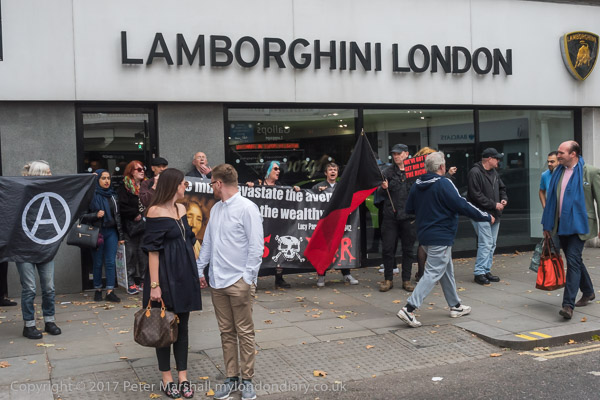
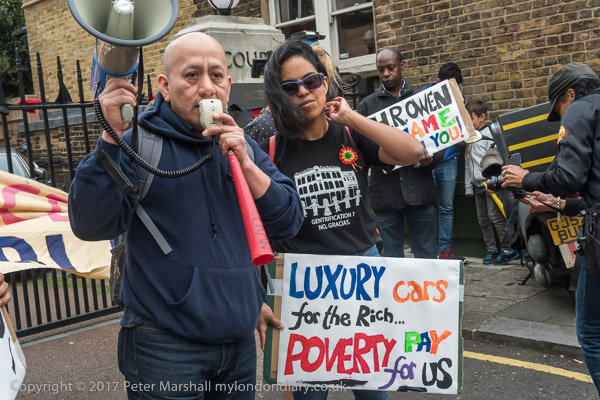
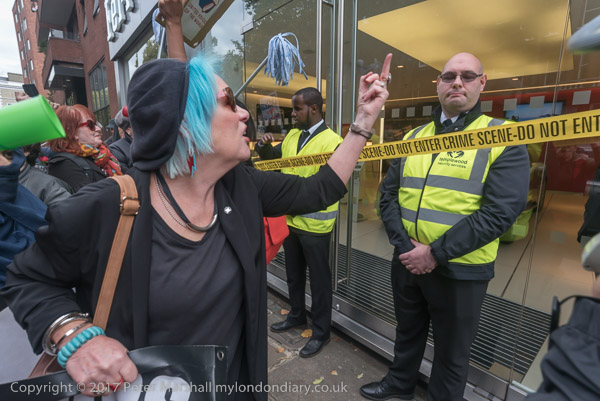
All of which has really nothing to do with the United Voices of the World (UVW) trade union protest against Kensington luxury car dealers H R Owen, except to point out that they live in a very different world to mine. A new Lamborghini apparently costs around £160,000 or more, which would take one of the showroom cleaners over 21,000 hours to earn, well over 10 years of full-time work. Small change of course for those with bankers bonuses.

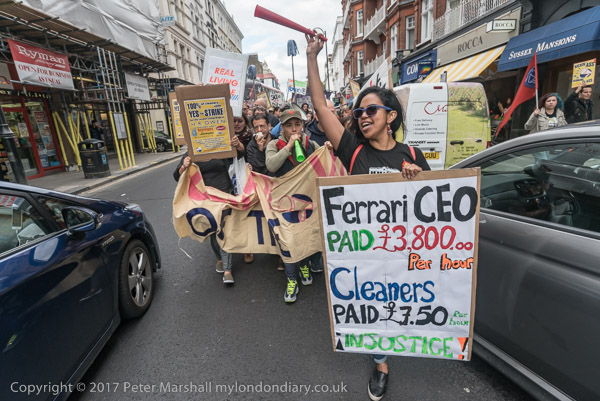
Angelica Valencia and Freddy Lopez keep the Maserati and Ferrari showroom further down the road spotless, for which they are paid £7.50 an hour. It’s a miserly rate, well below the London Living Wage which is calculated as the minimum needed to live on in London – and when this protest took place was £9.75 (in 2018 it went up to £10.20.) The Living Wage is 30% more than employers Templewood (backed up by the luxury car dealers who contract them) pay their cleaners. Things were even worse than that. Not only were they on poverty pay, but they were being required to work longer hours than they were paid to do and Templewood was making unlawful deductions from those minimal wages.

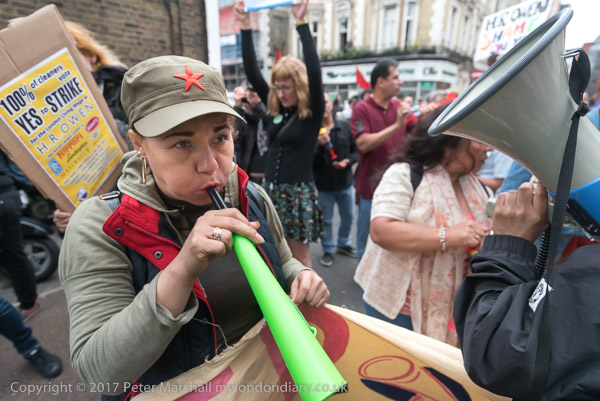
Angelica and Freddy joined the union and asked to be paid a living wage, but the employers response was to suspend the two of them without pay. So the UVW decided to take the employers to the courts and protest outside the showrooms. The protest was supported by other UVW members and friends from other groups, including Class War and the Revolutionary Communist group who have long supported various campaigns to get a living wage for London’s low paid workers. Whether or not you agree with some of their political views, they are prepared to get out and protest effectively on behalf of those treated badly by society.

And this protest helped, though it took another a month or so later to finally get the employers to see how ridiculous they were being, recognise their obligations and reach a satisfactory settlement, which led to a third planned protest being called off.

Of course I was pleased for Angelica and Freddy, but I had rather enjoyed photographing the two protests and was just a little disappointed not to be able to cover a third. But there were plenty of other protests, too many other companies large and small that still pay staff the least they possibly can and treat them badly.

Cleaners at luxury car dealers HR Owen
Continue reading Luxury Cars, Cheap Labour

NHS not Border Police

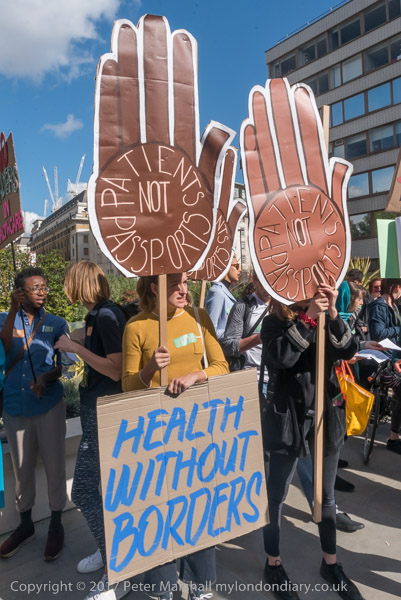
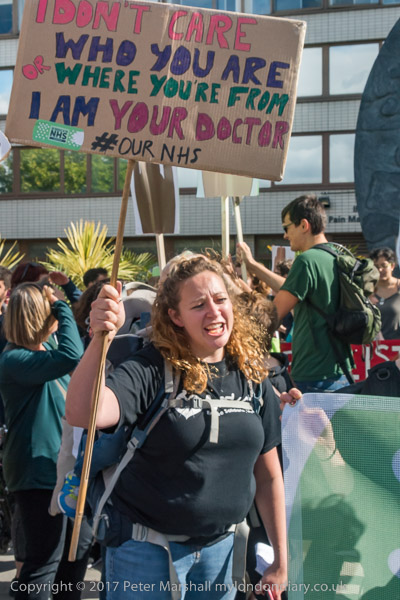
Being foreign isn’t a disease or an injury and to those of us brought up under a universal health system like the NHS, free at the point of use, it just seems wrong that doctors and hospitals should have an obligation to check someone’s immigration status when they come needing assistance. Yet since last October, a few weeks after this protest by medical staff and supporters they have been required to do so for anyone seeking non-emergency care will be required to prove they are entitled to free health service under the NHS and will be asked to pay for their treatment up front if they are not.

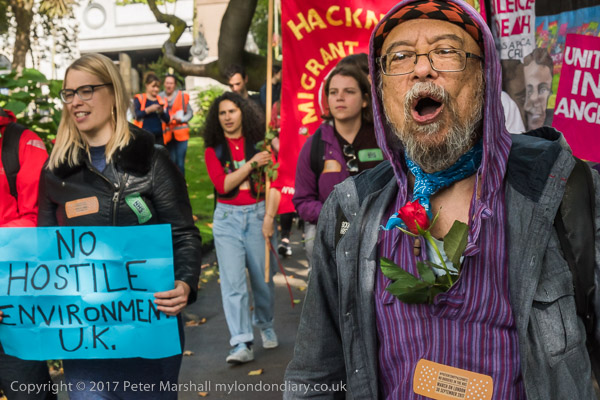
The change is all part of the government’s intention to ensure a ‘hostile environment‘ for anyone not entitled to be in the country, though it won’t of course affect the rich who pay for their private treatment – and they will in any case be welcomed here if they have sufficient funds to invest in the UK. There does seem to me something truly obscene about a system which welcomes the rich but hounds the poor.

The UK too is a country that believes in free trade and promotes it through various organisations. Again there seems to me a contradiction in promoting the free movement of goods but sets up great hurdles to prevent the free movement of people – except for tourism.

Roughly 10% of registered doctors and 4% of registered nurses in the UK are EU immigrants with slightly large proportions from outside the EU. Many who have migrated to work here are now British citizens, and a fairly large proportion of those born in the UK have parents who were migrants. As a frequent patient of the NHS I’m very aware of how dependent it is on migration to the UK, with so many of the staff I meet being from abroad. It seems rather inappropriate to ask these people effectively to police our borders.

The Patients Not Passports – No Borders in the NHS! protest was a slightly complicated one to photograph, as it had three separate blocs with different starting points, so I had to chose one of them. I met with the Migrants Welcome bloc, partly because I thought it might be more interesting and I knew some of those who would be there, and so was unable to photograph either the Maternity Care bloc or the Sisters bloc (I think Sisters as in Sisters Uncut rather than in the nursing sense) until the three groups came together in an undisclosed location.

Looking at where the three blocs were starting it was relatively straightforward to guess that our common destination might well be somewhere in the area of St Thomas’ Hospital, and we met with them just on the other side of the road, then walking into the garden area above the hospital car park for the joint rally. There were just one or two security staff who attempted to stop the protesters, but clearly stood no chance of doing so; either the hospital authorities (and police) had failed to notice the very public advertisements on social media for the protest or had decided only to offer a very token resistance. I suspect the latter as they will have appreciated the mood of their staff.

The protesters had decided that a very large banner would make a great photo opportunity to get press coverage, but unfortunately it was almost impossible to get the kind of result they had in mind – and at that point there were a number of security officers anxious to prevent us taking it. But the giant ‘Migrants Welcome Here‘ banner is really a difficult format to handle, being over ten times as long as it is high. I did manage to make a usable image, though the banner rather hides the rally behind it, and was rather pleased to catch a pigeon at almost exactly the right place before I was chased off the grass I needed to be on to take it with the 18-35 mm at its widest.

I had one other problem. Apparently there were some people on the protest who because of immigration issues requested that they were not photographed, and some wore small symbols to identify them. It isn’t practicable or even a sensible approach, and there is a very simple alternative if such people wish to take part in public protests (as they have every right to.) Which is to wear a mask or face-paint as a disguise. Police may sometimes ask protesters to remove masks, though not usually if they are clearly decorative, but photographers certainly won’t.

Apparently one such person appeared as a bystander in a couple of my pictures that are on the web site. I don’t know if he was wearing the ‘no photography’ symbol but from where I took the picture there was nothing to indicate he didn’t want to be photographed. It just isn’t possible for photographers to keep track of everyone taking part in a protest in this way.

By the time I had been told of the problem, one of those images had already been distributed around the world and it was too late to take any effective action. Other photographers who were at the event, including some from the major agencies, will also have taken pictures with him in the frame, and their pictures too will have gone out uncensored. But on my web site I have altered his image into a rather blurred generic figure. Like most journalists and photographers I’m opposed to such censorship, but this was a request from a friend and the presence of that person was not important to the picture. I felt unhappy to do so, but angry that I had been put into a position where it was necessary.

No NHS immigration checks

Continue reading NHS not Border Police

Senate House In House

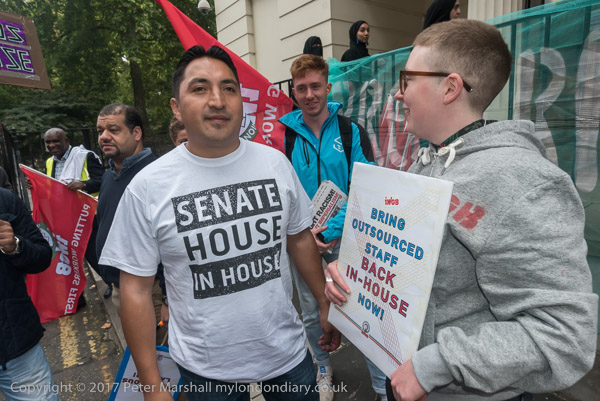
When security officers at London University were taken off the university payroll and instead employed by independent companies who tendered for a contract to provide their services to the university they were made a number of promises, none of which have been kept. One was that the pay differential between them and other workers would be maintained.  The workers and their union, the IWGB Independent Workers union say that since 2011 these differentials have been considerably eroded.

Although there is some theoretical protection when workers are transferred from one employer to another – the Transfer of Undertakings (Protection of Employment) Regulations, usually called TUPE, in practice these are often ineffectual and tougher laws and an easier process of enforcement is desperately needed.

Out-sourcing of services is a cost-cutting measure, but costs are only cut by reducing the overall benefits the workers receive and by increasing their workload. And worse, since out-sourcing usually brings in new layers of management and in profits being taken for the company contracted and its shareholders, this too has to be paid for by the workers.

Out-sourced workers get bullied, often by managers who, to cut costs, are also not particularly well paid and often lack the proper training, qualifications and skills needed to be good managers. Usually too there is skimping on equipment and materials, often endangering the health and safety of the employees.

Workers employed at the University of London, both those in the separate universities such as SOAS and Birkbeck and those in the central administration at Senate House have been involved in a long campaign to be taken back ‘in -house’ as University employees, and also for comparable employment conditions – pensions, holiday entitlement and sick pay – with those of similar directly employed staff.

They also want proper contracts, as many are now either on zero hours contracts or on similar arrangements which guarantee only a small number of annual hours, equivalent to around six or seven hours a week.

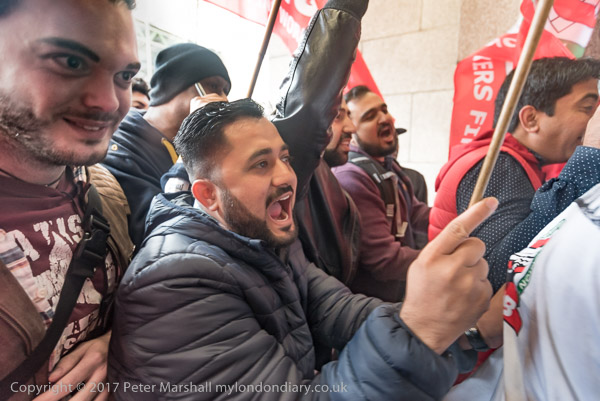
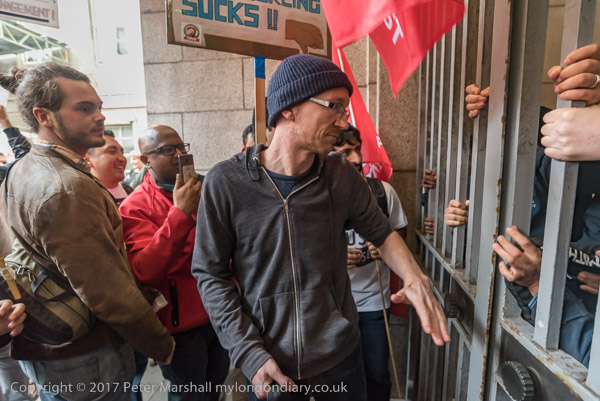
After protesting outside Stewart House, the protesters moved on to Senate House, where they were barred from entering by other security guards employed by the same company as many of the protesting security officers. There was perhaps a little element of a game about it.

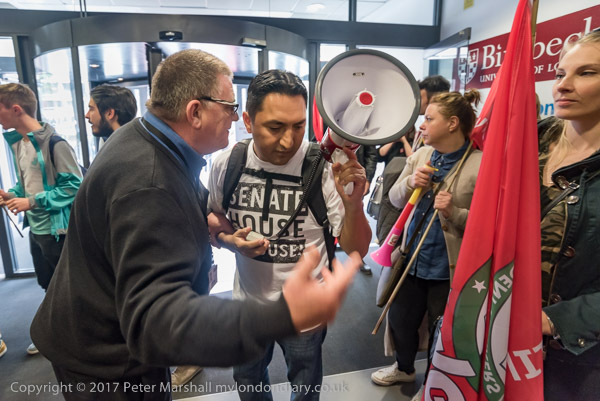
The protest then moved on and walked into the foyer of nearby Birkbeck College which had not been expecting trouble, walking past the one security office on duty there who argued with them but was in no position to stop them. They left after around ten minutes of noisy protest and returned for a final rally outside Stewart House.

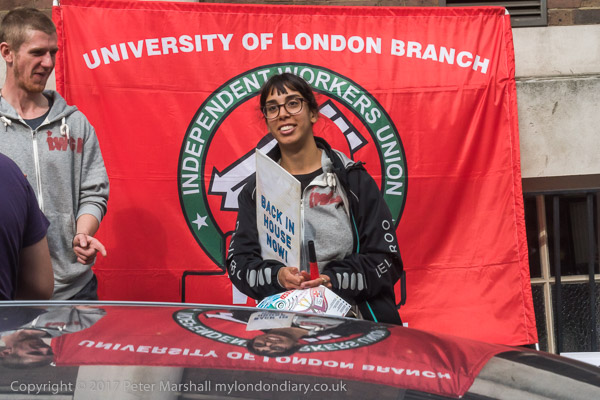
There was a car parked rather in the way of where the rally was taking place, and I saw the possibility of using a reflection in its roof in a picture after the IWGB banner had been placed behind.   It would have been easy to set one up, but that would have been unethical – I’m there to record events not to direct them – though many photographers would do so without a second thought.  But for me it was a matter of waiting and hoping that someone would step into just the right place and then rushing to take the picture. Fortunately they did.

End outsourcing at London University
Continue reading Senate House In House

A Russian Vivian Maier?

I think it does little service to “Leningrad’s lost photographerMasha Ivashintsova (1942-2000)  to call her a ‘Russian Vivian Maier‘ as the headline in Peta Pixel about her work does. The images in ‘Russian Vivian Maier’ Discovered After 30,000 Photos Found in Attic‘ bear no similarity to the work of Maier, nor do the circumstances of her life or the ‘discovery’ of her archive.  And fortunately, since they have been put on-line and into the ‘Masha Galleries‘ by her only daughter Asya Ivashintsova-Melkumyan there are very unlikely to be any of the legal shenanigans that have plagued the exploitation of the work of Maier by various parties.

Masha ‘s husband and daughter had moved to Moscow away from her when the marriage broke up around 1976, and the pictures (including some of the daughter) were found in 2017 by her daughter and her husband in the attic of the family home in house in Pushkin, Saint Petersburg where her mother had stored them.

Looking through the images both in the article and on the Masha Ivashintsova website and Instagram it is apparent that she was a very proficient photographer and the pictures also appear to be an interesting document of “the Leningrad poetic and photography underground movement of the 1960−80s”.  There is too a stylistic consistency absent from the work of Maier.

Of course we have so far seen only a very small fraction of her output, though perhaps more will emerge with an exhibition being planned this Summer in Vienna. It isn’t of course something that is going to change the history of photography, but I think it might well make a very interesting book or two – and possibly a rather interesting film.

I’ve long been of the opinion that their are many interesting collections of photographs in attics and often consigned to skips around the world, and its good to see one of them preserved and presented to the public.


Falls and files

Last Thursday I tripped over a cable while taking pictures and fell, landing on my right arm on grass in Russell Square, but wasn’t hurt and my cameras seemed OK. I hadn’t fallen heavily and the cameras seemed OK. But I couldn’t understand why I kept filling up cards using the D810; I was taking quite a lot of pictures, but not that many. Sometime later I remembered I had switched from my now usual 1.2x to full frame earlier in the day as I was using the fisheye and had forgotten to change back, and I switched the image size. Since I was now working on smaller capacity spare storage cards going down to 1.5x.

I still seemed to fill a CF card rather quickly, but thought I’d just got used to having 32Gb cards rather than these older 4Gb and 8Gb ones. But working on the pictures later in Lightroom I found that many of the images were not my normal raw files but TIFs. And a 7360×4912 px TIF is 106Mb, three times as large as my full-frame NEF files. Even switching to 1.5x, the tiffs are still 46.5 Mb. And since a typical 1.2x NEF (6016x4016px) is around 21 Mb, I was still using up space at over twice the normal rate.

Worse still, TIF files produced in camera are only 8 bit files, so image quality is reduced despite the larger file size, and the difference does show. though most of the TIFFs were perfectly acceptable. There were a few where highlight detail was burnt out that I think would have been recoverable on a raw file and I couldn’t quite get the images to match those the colour quality of those from the D750 still working on raw files. I cannot see any reason for having cameras able to produce 8 bit TIF files. I imagine it is a hangover from the early days of digital imaging, and that the marketing department have stopped common sense prevailing to remove this ‘feature’. There might just be a justification if the cameras could produce 16 bit files, but these would be truly huge – and wasteful as the sensor can only produce 12 or 14 bits.

Since they are only 8 bit files, I’m thinking I might convert all those TIFFS to high quality jpegs, just to save space on my computer storage.  There are over 300 of them taking up 21.5 Gb.

I’ve also been trying out working on manual shutter and aperture settings and allowing the cameras to alter ISO to get correct exposure. I’ve come to two conclusions. The first is that its great in normal daylight, usually giving a lower ISO than the standard settings that I would normally choose. But I’m not happy about using it in low light, as if the light falls below that which needs the maximum ISO you have selected for the shutter speed and aperture you have set the camera simply underexposes (and it will also over-exposure in the light is too bright for the minimum ISO and shutter and aperture you have chosen.)

And there is the problem of the main and sub-command dials, both of which can be inadvertently moved by fidgety fingers or with the main command dial possibly simply by knocking against clothing while walking. In normal use of the camera I seem to shift the main control dial most, and so on the D810 have used Custom Setting f9 to change the shutter speed to the sub-command dial, and then have put Custom Setting f7 onto the top of ‘My Menu’ and locked the aperture setting. You don’t seem to be able to lock the setting on the D750, so I have a little bit of black tape over that. It’s ons of several little ways I find the D810 a better camera.

This means I can easily change the shutter speed – when for example I’m photographing a faster moving subject, but cannot change the aperture without accessing the menu. If all my lenses had aperture rings I could use CS f9 to assign aperture to the ring only, but often I’m using lenses without an aperture ring.

It’s a pain having to go into a menu or peel back the tape to change the aperture, but I think I can live with that.  Generally I change aperture only when I’m thinking about depth of field and  for most of what I do there isn’t time for that, especially with no depth of field markers on modern lenses.  In good light I’ll mainly work around f5.6 or f8 and hope. If I forget to lock the aperture it’s too easy to find that I’m working at silly small apertures like f22 and ISO 12,800 when I should be at f5.6 at ISO 800. And at f22 it’s easy to underexpose even at ISO 12,0800.

So there are two advantages to changing to manual auto-iso mode. It beats simple use of auto-ISO settings, which result in too many pictures being taken at the lowest shutter speed you have set, rather than that you would be happier working at. So long as the light keeps in a reasonable range I avoid the occasional descent into huge under or over exposure with missed frames until I get time to review images, and rather than having to choose a relatively high working ISO for a session, when the light is there I’m getting higher quality with many images taken at lower ISOs.

So I’ll keep trying it out, and perhaps find other ways to improve what I’m doing, and to see if I can adapt the method to working in low light with and without flash.

A Year of the Ritzy strike

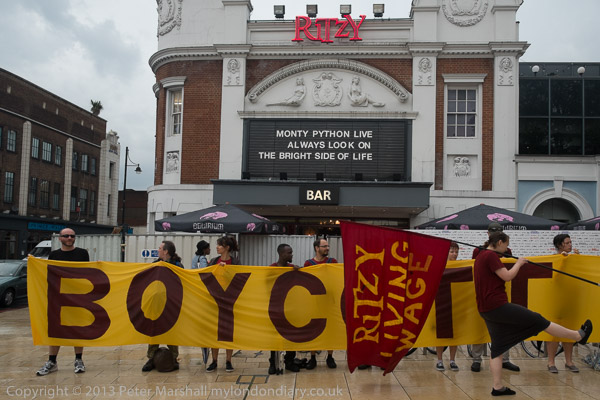
I’d rushed from the march to Finsbury Park to join the Ritzy strikers in Brixton, who were celebrating a year of striking for a living wage, though their campaign had began several years earlier, and I first photographed them outside the cinema in 2014.


Outside the Brixton Ritzy in July 2014

As I commented back then, “The Ritzy is the busiest and most successful art-house cinema in the the UK and can afford to treat its workers decently, but perhaps fear it will set a precedent for other workers in the Cineworld empire“. It is a large and highly profitable business, with a net income in 2016 of £82.0 million, but according to The Guardian (quoted by Wikipedia) 80% of its 4,300 staff are on zero hour contracts.

These workers are the victims not just of a greedy anti-union management who could easily afford employ their workers on proper contracts and to pay them a living wage, but of our anti-union governments, which have legislated to reduce the power of the unions and largely failed to make the laws we have about trade union rights enforceable and have not dealt with the zero hours loophole in contract law. And although we do have employment tribunals, too many employers still get away with the victimisation of workers for their trade union activities.

The strikers are members of BECTU, the leading union for the media and entertainment industries, which became a sector of Prospect at the start of 2017. It isn’t a union that has a reputation for militancy, and seems a little embarrassed by the activities of the Picturehouse workers and some of the groups that have supported them, including grass roots trade unions such as the United Voices of the World and the IWGB who were both at the Brixton rally and march.

I’d arrived as Poets on the Picket Line were performing, always interesting to listen too, but perhaps rather difficult to make particularly interesting still images. I took a few pictures while wondering if I knew how to use the video features of my cameras. I have made videos (and even in the long distant past ‘worked’ as an unpaid cameraman on a film, as well as making video recordings and real-time video editing on a campus TV network) but gave all that up after I stopped being a student and took up still photography.

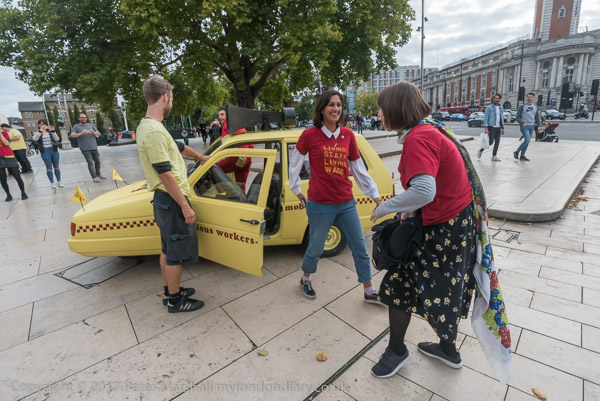
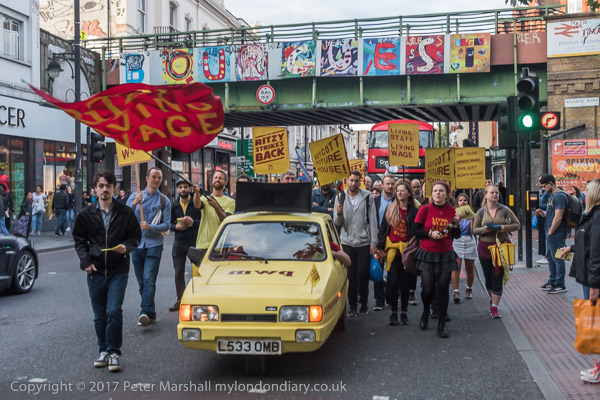
I was told there would be a big surprise coming, and it arrived in the form of the newly acquired ‘Precarious Workers Mobile’ bright yellow Reliant Robin. There were also a number of speeches from supporters to photograph as well as a presentation to mark the anniversary, including some from the UVW involved in a dispute with the London Ferrari dealers.

I’d taken quite a few pictures and succumbed to the wiles of a few friends who were going to a nearby pub, where I had an enjoyable pint of a locally brewed beer (it’s become impossible to keep up with the number of breweries in London – in 2010 there were only 14, but the latest figure is 74) before saying goodbye and leaving. My timing was immaculate, and as I reached the steps into Brixton Underground I heard the noise of a protest in the distance and rushed to the junction with Atlantic Rd to see the Ritzy strikers and supporters coming along the road led by the Precarious Worker’s Robin, and photographed them as they made their way back to the Ritzy along the Brixton Rd, before returning to the station to make my way home.
One year of Ritzy strike
Continue reading A Year of the Ritzy strike

Nine Photos

Nine photojournalists talk us through the story behind their favourite photos in a feature published by XCity+, a site I’d not heard of before which is produced by alumni of London’s City University, which recently had a rather confusing name change to City, University of London. Formerly the Northampton Institute, it has its base in Northampton Square, Clerkenwell, and was one of the CATs which given university status (part of Harold Wilsons “white heat of technology“) in 1966 as The City University, changing its name after becoming a part of the wider University of London (which boasts 18 constituent colleges and nine research institutes) in 2016.

It had always had a close connection with the City of London and the trades of that city, and it is perhaps surprising that it only formed its journalism department in 1976 offering a diploma in Newspaper Journalism, when it is less than a mile for any crow flying from Fleet St.

One of the photographers included is David Hoffman, and his picture from the 1983 Stop the City protest against globalisation, big business and the banks is a stunning image. But it is a little disappointing that the text that accompanies this – and the others is so short. The feature promises us more:

“we rarely have the full story. How were these photos taken, and why?

As the photographers talk us through their most powerful images, we are given a rare opportunity to see these pictures through their eyes.”

Fortunately in David’s case it gives a link to a much more detailed story about the image , both about the situation in which it was taken and how it was the vital evidence in a court case. Its also well worth going to his web site and seeing more of his work.

There are also links in the XCITY+ article to the web sites of the other 8 photographers.