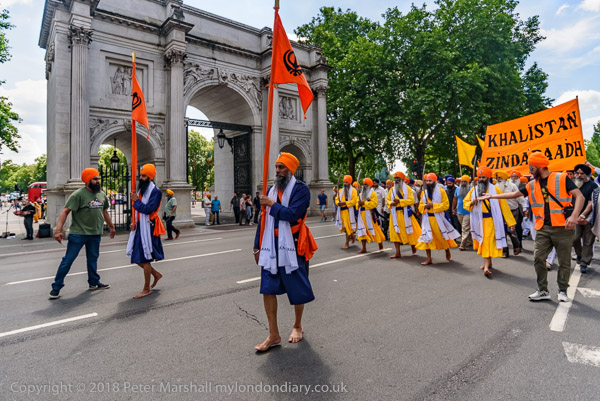
Remembering 1984

‘1984’ means different things to different people. For Google the the first 100 results are mainly about George Orwell’s novel, published in 1949 and set 35 years into the future largely in London in a post-nuclear war England which is in some respects rather chillingly close to what we now accept at normal.

Of course technology has advanced rather differently from that foreseen by Orwell, but we have come to take for granted something approaching the total surveillance, both from CCTV cameras in every shop and street and also through our willing participation in the internet and through the use of mobile phones and card-based payments. The tracking of our thoughts, movements and actions is less obvious than he envisaged but considerably more detailed, though largely carried out in the first instance by commercial organisations such as Google who monitor every click you make; though behind them sit the huge computers of GCHQ, sifting and analysing the whole of the internet. As you read this, Big Business as well as Big Brother is watching you!

But sinister though this sometimes seems, especially to some of my more tinfoil-hat wearing friends, it still represents more of a potential than an actual threat, used mainly to send us advertisements for things we have already bought.
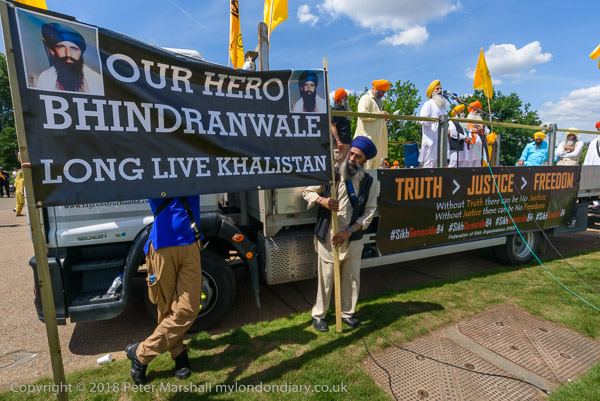
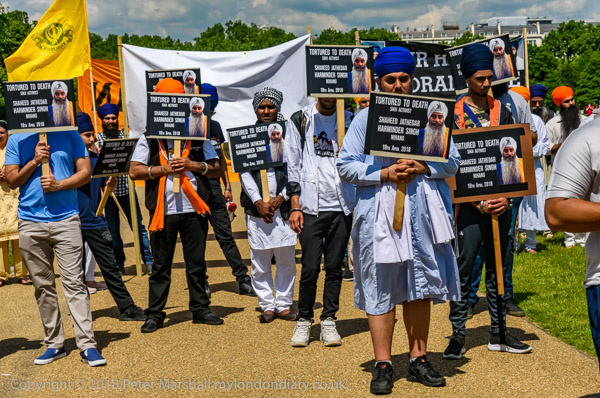
But for some people, 1984 has a different and far more sinister ring. Sikhs remember it as the year when India turned upon them, the Indian Army killing thousands attacking the Golden Temple complex and the Indian government spurring on mobs to continue the carnage after the assassination of Indira Ghandi at the end of October that year. The ‘Sikh Genocide’ which began at Amritsar was the second massacre in that city, the first being in 1919 when the British Indian Army opened fire on an peacefull protest in the Jallianwala Bagh Garden close to the Golden Temple, a key event in the rise of Indian nationalism that eventually led to independence and partition.

That partition of the Indian subcontinent by the colonial power at independence in 1947 was bound to result in a bad deal for the Sikhs, who were a small minority in the country and had no region in which they were a majority. They trusted the Indian National Congress and its promised more than those of the Muslims, but few of those promises were fulfilled. There are some problems for which there is no satisfactory solution and India in the 1940s was certainly one of them, though many would argue that better solutions could have been found. And given the current domination of India by Hindu nationalists, along with the long term problems of Pakistan, Bangladesh and Kashmir, it might be difficult to argue that Britain did much of a job back then.
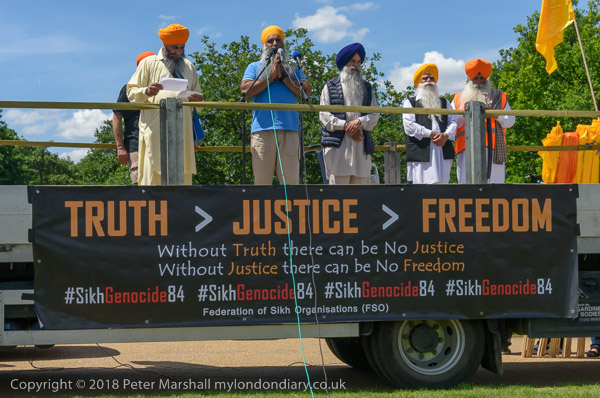
Though history is history and can’t be changed, it continues to reverberate, and the events of 1984 remain a vital issue for many Sikhs, including many who were not even born 34 years ago. This annual march has sometimes attracted the attention of the UK police, keen to crack down on the support for Babbar Khalsa, an international group which, according to Wikipedia, “wants to establish an independent country for Sikh religion called Khalistan, and uses bombings, kidnappings and murders to accomplish their goals” and is banned as a terrorist organisation in India, Canada, the EU, the UK, USA and Japan.
Of course many in the UK who support the foundation of Khalistan are against terrorism, and though there were speakers and banners calling for Khalistan this does not imply support for Babbar Khalsa and their activities in India or elsewhere.
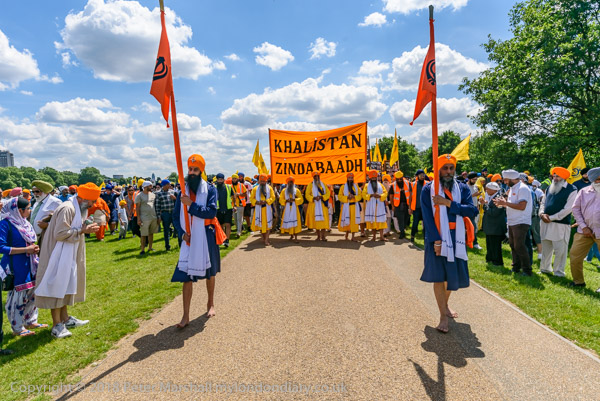
The march, with a large banner, ‘Khalistan Zindabaahd’, began by getting lost, failing to turn right as it left Hyde Park, led as usual by the standard bearers and ths five Khalsa with swords raised representing the ‘Five Blessed Ones’, who clearly had not been informed of the details of the route. The police who would normally have led them had not arrived to do so (those government cuts have meant much less policing of most protests) and the processsion ended up going around Marble Arch and then returning into Hyde Park to wait for the police to arrive and guide them. I think those leading the protest had come from Birmingham and were unfamiliar with the area.
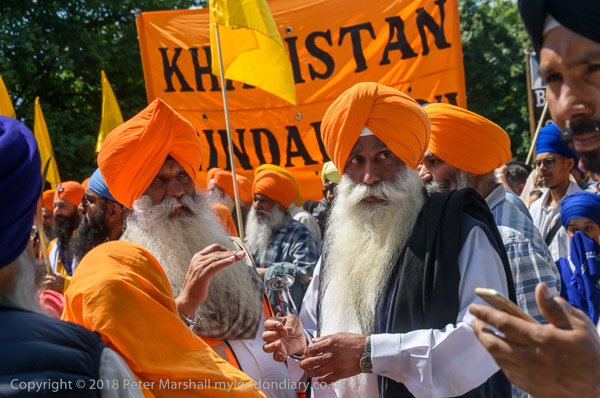
Eventually the march made a second start, going down Park Lane with the police in attendance, and I left them as they turned onto Piccadilly to march down towards Trafalgar Square for a rally.

______________________________________________________

There are no adverts on this site and it receives no sponsorship, and I like to keep it that way. But it does take a considerable amount of my time and thought, and if you enjoy reading it, a small donation – perhaps the cost of a beer – would be appreciated.

My London Diary : London Photos : Hull : River Lea/Lee Valley : London’s Industrial Heritage

All photographs on this and my other sites, unless otherwise stated, are taken by and copyright of Peter Marshall, and are available for reproduction or can be bought as prints.

To order prints or reproduce images

________________________________________________________
Internet wanderings

I’m often surprised by the Internet, or rather I should say by the World Wide Web, invented by Tim Berners-Lee, whose name though etched in my memory I was unable to recall in a pub quiz last night to my extreme annoyance. Both by what you can find out using it, and sometimes by what you can’t.

Currently, as some will know, most days I post a black and white picture taken in London in 1979 on Facebook, with a usually short comment on the subject matter. All of the pictures are on my London web site, but currently there are only brief captions, as in today’s example:


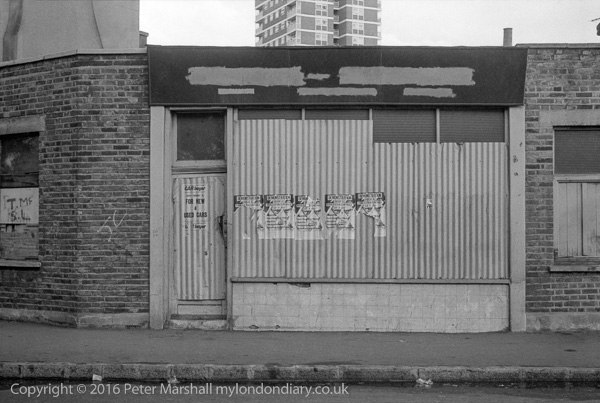
Disused shop, Hackney, 1979
21l-66: shop,, derelict,

Back in 1979 I took relatively few photographs on often long and protracted walks and kept few records; for me then the photograph was the record, and it was only a few years later that I began to keep something of a diary of my walks and to annotate the contact sheets of my films with street names and grid references.

When I wrote the web page I only had a vague idea about where I made this image – somewhere close to London Fields and not far from Broadway Market. That I now know where it was taken to within a yard or two is thanks largely to Google Street View, and the two buildings in the background, both of which appear in other pictures of mine.

Street View of course has its limitations. Where this shop stood is now simply a brick wall, and Street View only allows limited time travel, usually back to 2008, when the shop was long gone.  Its often impossible to get a view from exactly the place and angle you need, and it doesn’t share my predeliction for alleys and footways, with rare exceptions sticking to where a car can drive. It also has a very annoying habit of jumping inside shops where no-one wants to go, which greatly reduces its utility to the public if enriching Google from the owners of these premises.

But of course Street View is a remarkable asset, and one which has almost rendered some photographic projects unnecessary, as I commented in my 2014  post Bleeding London – re-Inventing Streetview?  It’s a resource I now often use when planning walks and visits to new locations.

The time limitation isn’t just confined to Street View. Most of the material on the web has been put there in the last few years, and there is relatively little information about the times before it existed. Various projects have put considerable efforts into digitising historical material and putting local history research into web sites, but much published material from the last century is still unavailable, either not digitised or hidden behind paywalls. Of course much is still copyright, and will remain so until 70 years after the death of its authors, and as a photographer I welcome that (although I am considering gifting my own work to the public domain on my death.)

The posters across the front of the shop are for a march from Hounslow West Station to protest at Harmondsworth Detention Centre on Saturday 21st July. A calendar on the web for 1979 confirms that the 21st of July that year was a Saturday, so these posters, despite their condition, were fairly fresh when I photographed them, probably on the 22nd or 29th July 1979.  But the small print at the bottom of them cannot be read, and I can find no record on the web about this demonstration.

I was surely interested about it when I took the photograph because I was living just a 20 minute bike ride from the immigration prison (I still live in the same place, but the bike ride takes me a little longer) and also because I grew up spitting distance from the starting point of the march.  But probably taking this photograph would have been the first I had heard about the march. Before the web, this photograph illustrates how information about most protests was shared, by fly-posting. Leaflets were handed out at other protests – as they still are – and in some busy inner London streets and markets, information shared at political and trade union meetings.

Left-wing newspapers were mainly sold at street stalls, again on some busy inner city streets, but often only shared details of the events of their particular faction. There were of couse newsletters of major national organisations such as CND and the Anti-Apartheid Movement and Peace News but most smaller demonstrations I often only found out about after the even when I happened to come across the posters.

This protest must have been in some of those printed sources, and as well as the posters there will have been flyers. At that time we still had a local press, and almost certainly the Middlesex Chronicle reporter will have been there covering the protest, even if, as today it will have been ignored by the National Press and broadcasters. But none of these sources about that July 21st protest is accessible via the web.

You can find many reports of more recent protests at Harmondsworth – including my own from my first visit there in 2006 (and more later) and also some information about the detention centres and reports from those held inside them. But little of this is from the first ten or fifteen years of the web or covers anything about the last century. It’s so easy to forget what things were like even relatively recently.

I put my first small site on the web back in 1995 (Family Pictures, still available, only slightly adapted to keep it working, but still with its typical mid-90s flatbed print scans), not that long after the first visual web browsers that would display images became widely available. Mosaic, running on Unix, appeared two years after the start of the web in 1993, when most of us were only using the Internet for e-mail and forum systems along with file transfer and rather odd things like ‘Archie’, all text-based.  Windows 3.1, which first really brought Windows to life had come a year earlier (and still seems to be used by parts of our rail network.)

But when I was making a living writing about photography on the web from 1999-2007 my problem at the start was that so little photography was available on the web. By the end of my tenure things where rather different, and the problem was that so much was there it was getting hard to sort the wheat from the tons of chaff.

______________________________________________________

There are no adverts on this site and it receives no sponsorship, and I like to keep it that way. But it does take a considerable amount of my time and thought, and if you enjoy reading it, a small donation – perhaps the cost of a beer – would be appreciated.

My London Diary : London Photos : Hull : River Lea/Lee Valley : London’s Industrial Heritage

All photographs on this and my other sites, unless otherwise stated, are taken by and copyright of Peter Marshall, and are available for reproduction or can be bought as prints.

To order prints or reproduce images

________________________________________________________
Elswick Kids

Beautiful work by the late Tish Murtha, (1956-2013), immediately after her return to her home in Elswick, Newcastle upon Tyne in the late 1970s after studying at Newport to is featured on Flashbak’s article ‘Elswick Kids‘. It is work that could only have been made by an exceptional photographer deeply rooted in the community and celebrates the freedom that kids still enjoyed then – something which I remember from my own childhood in a working class area on the fringes of London, but which by the time she made these pictures had largely disappeared in the more affluent south.

The article comes in advance of a Kickstarter campaign by her daughter Ella together with Bluecoat Press to publish ‘Elswick Kids‘ which launches at 10.30am on October 2nd 2018. Make a note in your diary now! Their previous collaboration was highly succesfull, with the limited edition of Tish Murtha’s ‘Youth Unemployment‘ selling out within three months, and I’m sure this volume will do as well. You can still buy the second paperback edition of Youth Unemployment, and there are also a number of Cafe Royal Books available.

You can see more about Tish Murtha and more of her work on the Official Website of Tish Murtha run by her daughter. A retrospective Tish Murtha: Works 1976-1991 is at the Photographers Gallery in London until October 18th 2018 and some of her pictures are also among the most interesting work in the Museum of London show ‘London Nights‘, which runs until 11th November 2018.

Also worth reading is an article on AnOther, The Forgotten Photographer Who Captured Britain’s Social Crises, by Belle Hutton.

Walking South London

We don’t always bother with Bank Holidays now.  They used to be a good day to take a relatively early train to go on a walk, paying the lowest fare rate, the ‘Super Off Peak’, but no longer. Rail fares for many of my journeys went up by around 30% at a stroke at the start of last year, when the train operating company here (now South West Trains) decided to start treating the weekends and Bank Holidays in exactly the same way as the working week for these discounted fares.

This means that if I want to travel ‘Super Off Peak’ I now can’t catch a train before the 11.29 and I can’t return home from central London (or Clapham Junction) between 4pm and 7pm when I would want to be coming home for a walk.  Instead I have to pay the extra for an ‘Off Peak’ ticket – just the same as on any other day in the year.  So unless there is some special event I want to go to on a Bank Holiday, there is no advantage at all in going out on one of them – and certain places are closed or more crowded than usual.

But on the late May Bank Holiday, Linda decided we should go out for a walk. She likes to walk in the country, while I’m an urban walker. So I compromised,  cunningly planning a walk that would take us through some of the woods and parks of South-east London.

We started at Falconwood Station, where almost directly across the road we could  join the walk through Shepherdleas Wood, ancient woodland in Eltham Park North, and through that to Oxleas Wood, climbing up the hill. We missed a turning here (possibly a way mark was overgrown or absent) but made our own way to the top, and then rejoined the Green Chain Walk to go down the path towards Jack Wood.  We missed a turning again – I’d assumed it would be clearly marked, and went too far down the hill. There are many more paths than are marked on the map, and we decided to take one that seemed to be roughly going west, and then take any likely turning up the hill. This led to a nice dead end where we had a short rest before turning a short way back and taking another path (as I pointed out to Linda, it might have helped had she remembered to bring the compass.)

By the time I was able to locate our exact position on the OS map, we were too close to Shooter’s Hill for it to be worth retracing our steps and possibly finding Severndroog Castle as intended. It would have been a disappointment in any case as it (and its café) is only open Thursdays, Fridays and Sundays.

So the next unusual building on the route was the water tower on Shooters Hill, now a private home. Our next park, shortly after this, was Eaglesfield Park, from where we made to Occupation Lane, which attracted me as I think it is part of an ancient route through the area – and looking out over it gives one of the best views of London. Or would have if it wasn’t for the haze. Good, clear views across London really need some heavy rain to clear the air, followed by sunshine, and today we just had some sunshine on the pollution.

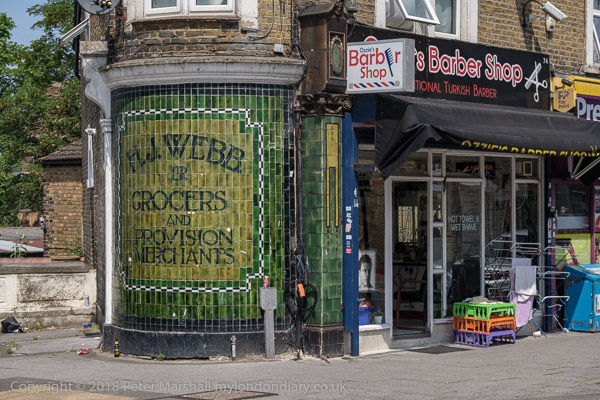
At the end of Occupation Lane we headed for the Bronze Age Shrewsbury Tumulus – a small grass-covered mound that is the only remaining one of seven in the area, the rest built on in the 1930s.  Next to it is Mayplace Lane, the continuation of the ancient route towards a ferry at Woolwich, and we followed this down to Herbert Road, with its assorted hairdressers and fast food shops. H J Webb, Grocers and Provision Merchants with a fine tiled sign is now one of several Turkish Barbers.

I think all sign of the ancient trackway has been lost north of here, and we turned west instead down Plumstead Common Road, which sweeps quite dramatically down into a valley and into Nightingale Place, an emphatically nightingale-free zone. Past the road junction and its obelisk for  Major Robert John Little, we made our way along Ha-Ha Road. Unfortuntely although the Major had offered living water, the council had cut off the pipes , from what would have been very welcome in the heat of the day.  Ha-Ha Road, isn’t a laugh but a rather long and boring stretch with a ha-ha ditch on its north side, though the whole point of the ha-ha has been lost by puttng a rather tall fence and hedge along the other side for most of its length.

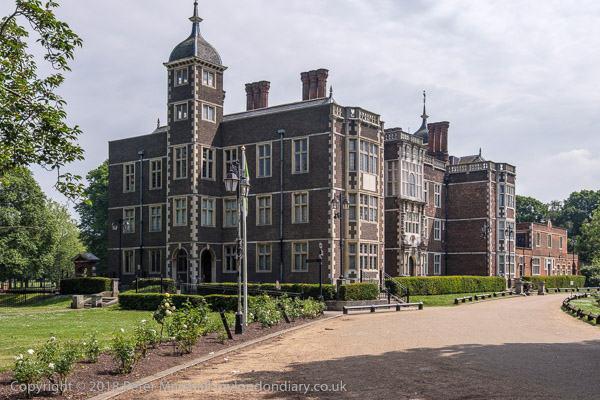
Another problem with the Bank Holiday, was that Charlton House – and again its Tea Rooms  – was closed; normally both are open Monday-Saturday and worth a visit. We sat looking at it beside the former public toilets as we ate our sandwiches, but at least were able to buy an ice cream in the park – where the seller told us he was there every day except Christmas Day.

Across one road from Charlton Park we were in Maryon Wilson Park, and from there across another road into Maryon Park, familiar to millions as a location for the iconic film ‘Blow Up’ with Daving Hemming as a thinly disguised David Bailey.

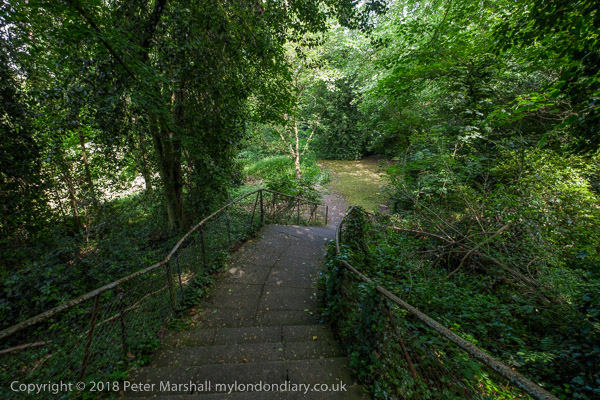
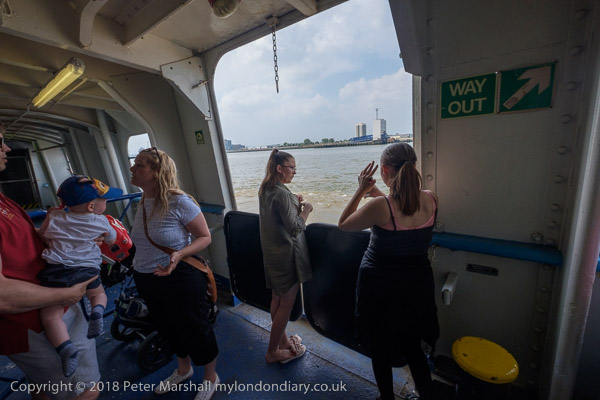
After going down the steps and past the tennis courts we left the park to walk an unneceesarily long way along dusty roads to the Thames Path, which took us to Woolwich and across by the ferry Ernest Bevin – one of the best value journeys in the capital to North Woolwich and King George V DLR station to start our journey home.

More pictures from the walk: Woolwich wander

There are no adverts on this site and it receives no sponsorship, and I like to keep it that way. But it does take a considerable amount of my time and thought, and if you enjoy reading it, a small donation – perhaps the cost of a beer – would be appreciated.

My London Diary : London Photos : Hull : River Lea/Lee Valley : London’s Industrial Heritage

All photographs on this and my other sites, unless otherwise stated, are taken by and copyright of Peter Marshall, and are available for reproduction or can be bought as prints.

To order prints or reproduce images

________________________________________________________
Knife crime

London is a safe city, with relatively low crime and absolutely no ‘no-go’ areas, despite the scare stories put out by some US right-wing personalities and ‘fake news’ web sites. The murder rate in London – at 1.8 per 100,000 people in the year ending March 31 2018 – is around half that of New York (though it did briefly overtake that city earlier this year) and less than all of the  US’s 50 main cities, which are led by  Detroit on  39.7, New Orleans on 40.4 and Baltimore with an astonishing 55.8, over 30 times the London figure. Even this is topped by St Louis at 65.8, though this still puts it well behind cities in Venezuela, Mexico and Brazil, with, according to Statista, Los Cabos and Caracas more or less tying for top place at 111.

Even so, London’s figure of over 100 murders so far this year, showing a considerable recent increase, particularly with around 60 mainly youths being killed by knives and around ten shootings are worrying, and every single death is a tragedy for the victim and family.

So I welcome London Mayor Sadiq Khan’s announcement of a ‘Glasgow’ policy based on a public health approach, which saw the rate halved in that city, and hope it will have the same effect in London. London’s knife killings are largely of young people, particularly of young black men and are often linked with violence between gangs, though not all the victims are gang members.

Both shootings and stabbings are often linked with drug trafficking, and the legalisation of cannabis and the return to a proper system of regulated use of heroin by registered addicts would almost certainly lead to a considerable reduction in these killings, as well as in the huge amount of petty crimes carried out by people to pay for the high-price illegal drugs they need. Years of evidence show that our present approach to drugs just doesn’t work – or rather only works for the organised crime that supplies the drugs.

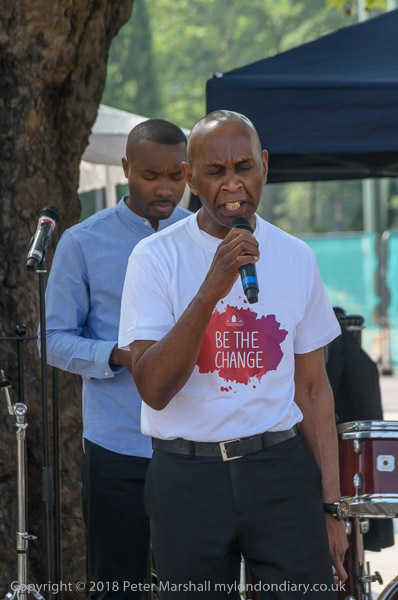
Problems with my train service meant that I arrived too late in Brixton to go the the 7th Day Adventist Church to photograph the ‘Be the Change’ march from there to Windrush Square. I tried to meet them on their way, but they took a different route to that I had thought most likely as it would have made the march more visible; by the time I had realised this and returned to the square they had arrived and the event there was beginning.

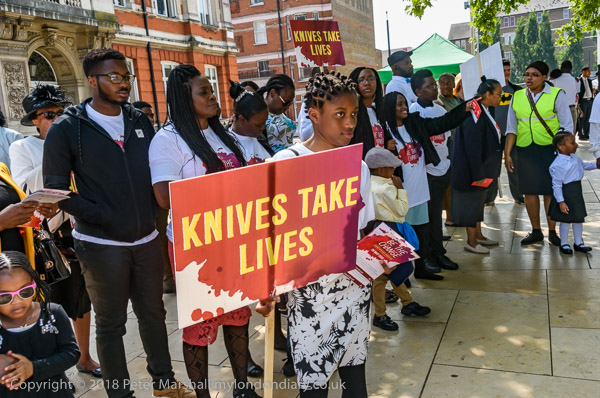
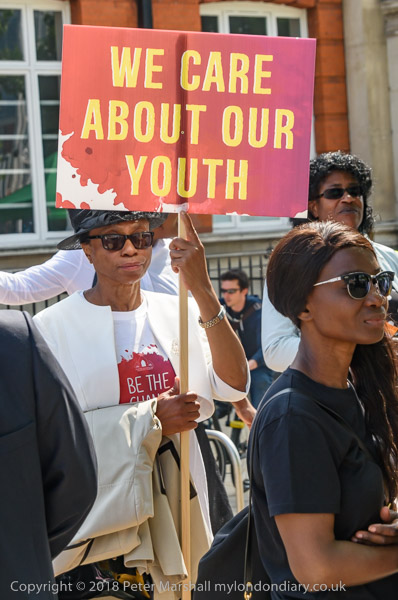
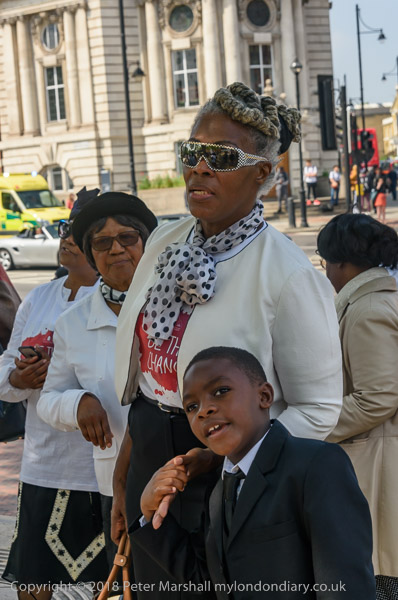
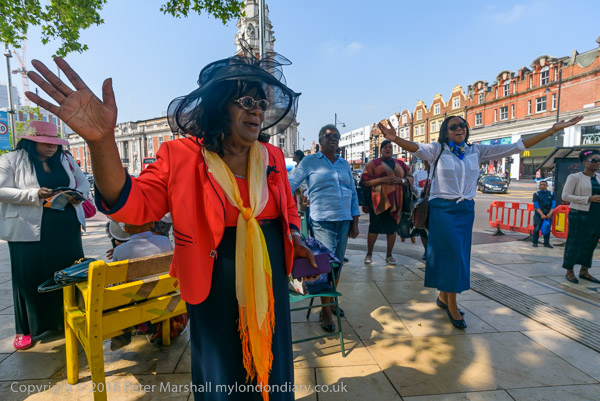
A gospel group sang, a preacher prayed and preached, there was more music and the congregation sang and danced, and there were placards ‘Knives Take Lives’, ‘We Care About Our Youths’ , ‘Be The Change’, ‘Knives Take Lives’ and ‘God Is Love’ , but spirited though the event was, it attracted little attention from the people of Brixton, and I think myself and a photographer friend were the only people there who would not normally be worshipping in that Brixton church, though a few walking past did turn and look as they walked.

While I’m sure the church is sincere and does good work, particularly among those families who attend, from what I saw at this event I think this  has little effect on the wider community. It needs wider initiatives such as that proposed by the Mayor – and changes in the way working-class communities are seen and regarded by the authorities – police, schools, councils and government etc – to produce the changes in society that would change lives for young people growing up poor and currently disaffected in cities such as London.

More pictures at ‘Be the Change’ Knife and Gun Crime.

There are no adverts on this site and it receives no sponsorship, and I like to keep it that way. But it does take a considerable amount of my time and thought, and if you enjoy reading it, a small donation – perhaps the cost of a beer – would be appreciated.

My London Diary : London Photos : Hull : River Lea/Lee Valley : London’s Industrial Heritage

All photographs on this and my other sites, unless otherwise stated, are taken by and copyright of Peter Marshall, and are available for reproduction or can be bought as prints.

To order prints or reproduce images

________________________________________________________
Last month in Hull

I had scheduled this post to appear on August 30th, but due to some WordPress glitch that didn’t happen – and I’ve only just noticed it. So I’m trying again.

At the end of July I went to Hull with Linda to celebrate  with the family and friends. We stayed there for four days which gave me time to take a few photographs too. You can see these now, in a ‘Hull Supplement‘ to My London Diary.

Hull Supplement


Anlaby Rd & Hessle Rd
Spring Bank, Chants & Newland Park


Wet Sunday Morning in Hull
A short Hull tour
Riding the Bridge


Hull Panoramas


Bankside Galley
Stoneferry, Wincolmlee & City Centre
Hull, Cottingham
Hull – Pearson Park & Beverley Rd


Hull – City Centre & Old Town
On the way to Hull

______________________________________________________

There are no adverts on this site and it receives no sponsorship, and I like to keep it that way. But it does take a considerable amount of my time and thought, and if you enjoy reading it, a small donation – perhaps the cost of a beer – would be appreciated.

My London Diary : London Photos : Hull : River Lea/Lee Valley : London’s Industrial Heritage

All photographs on this and my other sites, unless otherwise stated, are taken by and copyright of Peter Marshall, and are available for reproduction or can be bought as prints.

To order prints or reproduce images

________________________________________________________
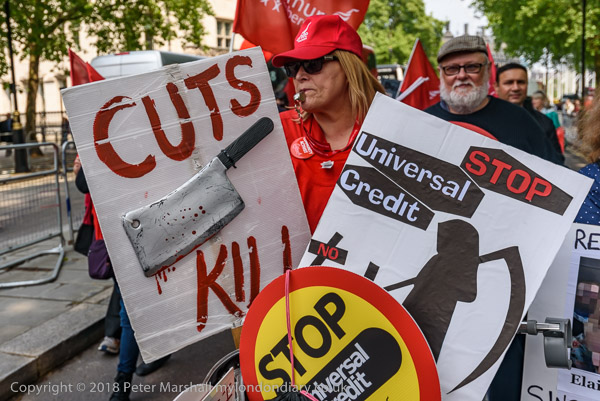
Seeing Red over Universal Credit

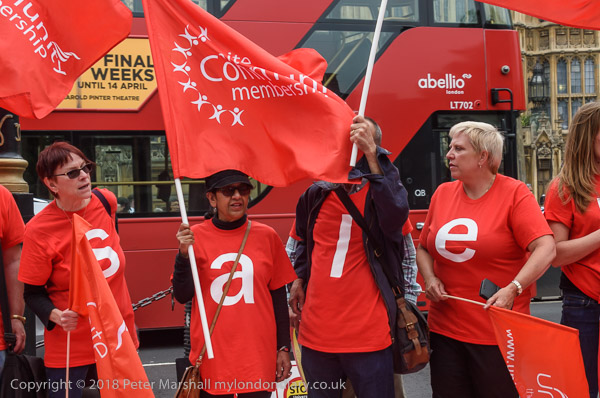
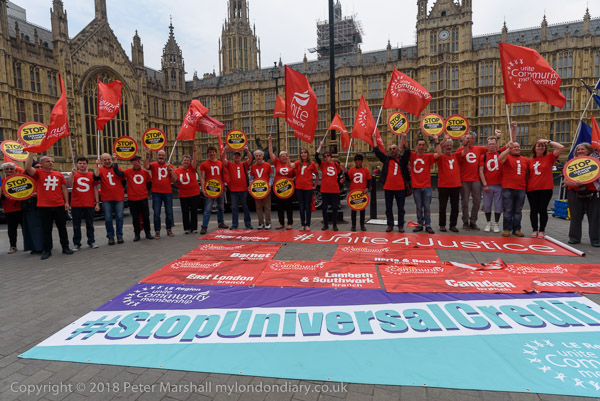
Those t-shirts reading ‘#STOPUNIVERSALCREDIT’ that I’d photographed earlier at Tate Modern were again on display outside Parliament later in the day, though there were some different messages before everyone got sorted out and in order, and I took advantage of this. Of course the full message does also contain a number of three letter words, ‘TOP’, ‘PUN’, and ‘RED’ as well as ‘EDIT’ (and I suppose some might count ‘UNI’.)

But even when it was all sorted out, I didn’t manage to make much of a picture, perhaps partly because there were other photographers crowding round which meant I wasn’t in the optimum place, but more because I didn’t really think there was a decent picture possible.

Red isn’t my favourite colour for photography, and I think is best used more sparingly. It seems somehow less subtle than other colours in its photographic rendition, and often needs a little darkening and ‘de-hazing’ to restore gradation. Fortunately not all those taking part were in red, nor were the banners.

Another problem with ‘#STOPUNIVERSALCREDIT’ for photographers is simply that it is 20 characters long, and the message itself will occupy a rather narrow strip across any picture. Banners are often rather long, and I seldom like to photograph them in their entirety from directly in front, preferring to work fairly close to one or other end, and gaining some interest from the people nearest to the camera.

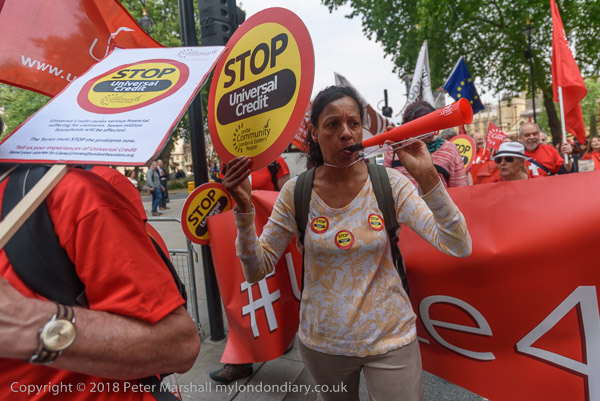
The march which followed, through Parliament Square to Caxton House was more to my liking in terms of photography, enabling me to hide much of the red and also to concentrated on some of the protesters.

The protest which followed in front of Caxton House was also photographically interesting, though the very limited space and crowding made it hard to work.

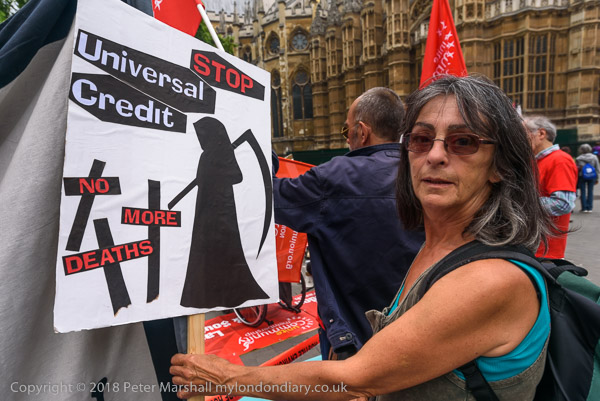
Universal Credit is almost universally recognised to be a disaster, causing a great deal of hardship – and even some deaths – among both the working poor and those who are unable to work. Delays in payment and reductions in benefits have led to many being evicted from their homes and a dramatic rise in people needing the support of food banks and the demand on street kitchens. The government are pressing ahead with the programme despite the growing evidence of its terrible consequences, with some ministers clearly gloating over its effects on the poorer members of our community.

Although the aim of simplifying and unifying the benefits system was laudable, Universal Credit was designed and is being implemented by people who simply are incapable of understanding how most ordinary people live with little or no financial resources. No money in the bank (if they have an account), no savings, no wealthy friends or family who can help them out if they are short at the end of the week or month.

It could perhaps have worked, had it been combined with a true living wage and a proper transition that didn’t leave people without money for weeks or months. But that would have needed more money to implement. It would also need a system that didn’t feel so obsessive about over-payment and possible benefit fraud. The rich who avoid or defraud the tax system on a huge scale get away with it most of the time, and the government makes surprisingly little effort to stop this (even admitting that in some cases they haven’t taken action as it would ‘damage the reputation’ of those concerned) and the losses there are hundreds or thousands of times greater than any loss over benefits. We have a benefits system – with excessive use of ‘sanctions’, taking away benefits for up to three years – that is clearly designed to publish the poor, and reports have shown to cause many deaths – according to some estimates one every 33 minutes.

More pictures at Universal Credit rally & march

There are no adverts on this site and it receives no sponsorship, and I like to keep it that way. But it does take a considerable amount of my time and thought, and if you enjoy reading it, a small donation – perhaps the cost of a beer – would be appreciated.

My London Diary : London Photos : Hull : River Lea/Lee Valley : London’s Industrial Heritage

All photographs on this and my other sites, unless otherwise stated, are taken by and copyright of Peter Marshall, and are available for reproduction or can be bought as prints.

To order prints or reproduce images

________________________________________________________
John de Prey’s Notting Hill

John de Prey‘s pictures of Notting Hill in 1971, made when he stayed for a few months with a friend in Powis Square in 1971, show some of the more interesting sides of daily life down the Portobello Road and elsewhere in an article in the International Times archive, and you can see more of his work on his Flikr site, serious but unabashed, though its a shame there is only one or two more from Notting Hill among the 150 in his ‘United Kingdom‘ album. Not that some of the other images aren’t of interest, though it would be nice to have more information with some of the pictures, including some taken by others.

Most of his other work is in colour and what broadly might be called travel photography, much of it from the Indian sub-continent, and of rather less interest to me. The Notting Hill pictures were I think made when he was fairly young and fairly new to photography and show an appealing freshness and directness.


I suspect I may be around the same age as de Prey, or perhaps a year or two older, but from a rather different social milieu, and it was a total lack of funds that meant I was only really able to start taking photographs seriously in my mid-twenties. And it was many years later that I first went to Notting Hill, though I think it had perhaps changed relatively little by 1987 when I took a few pictures there, including this one on the Portobello Road:

Back in the 1970s, Notting Hill to most people still meant the 1958 race riots and Rachman. The media were always keen to seize on any violent incidents, particularly around carnival and give them maximum publicity, and it was an area most Londoners avoided.

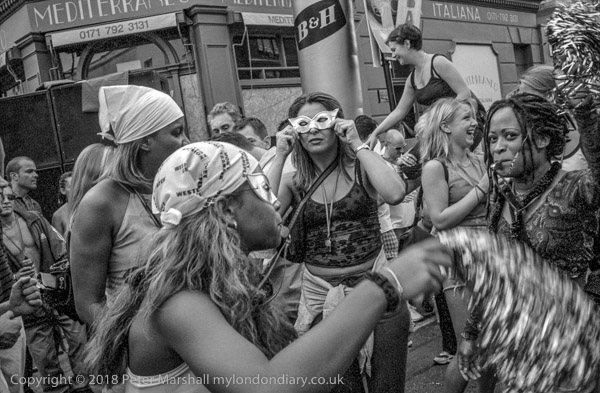
Now it is generally swamped by tourists, and many of the old shops and pubs have gone or been changed out of recognition. The main language I heard on the streets visiting there recently was Italian – and even some of those sitting begging on the streets had notices written in that language. The biggest change came of course with the 1999 film ‘Notting Hill‘, but for some years there had been increasing emphasis on Carnival as a spectacle rather than just the crime statistics. But even when I first went to Carnival back at the start of the 1990s there were people who told me I would get attacked and knifed and have my camera stolen and told me I would be mad to go.

It wasn’t of course true. Though like any large public event it makes sense to be careful and not to make life easy for pickpockets, and to be careful not to antagonise people. But for most people Carnival was a great day out and they came to enjoy themselves and were happy to be photographed – as I think you can see from the pictures in my ‘Notting Hill Carnival in the 1990s‘, still available at only £6 plus postage.

______________________________________________________

There are no adverts on this site and it receives no sponsorship, and I like to keep it that way. But it does take a considerable amount of my time and thought, and if you enjoy reading it, a small donation – perhaps the cost of a beer – would be appreciated.

My London Diary : London Photos : Hull : River Lea/Lee Valley : London’s Industrial Heritage

All photographs on this and my other sites, unless otherwise stated, are taken by and copyright of Peter Marshall, and are available for reproduction or can be bought as prints.

To order prints or reproduce images

________________________________________________________
Universal Credit at the Tate

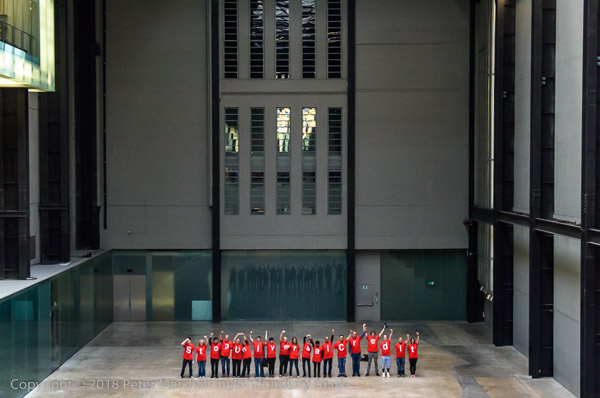
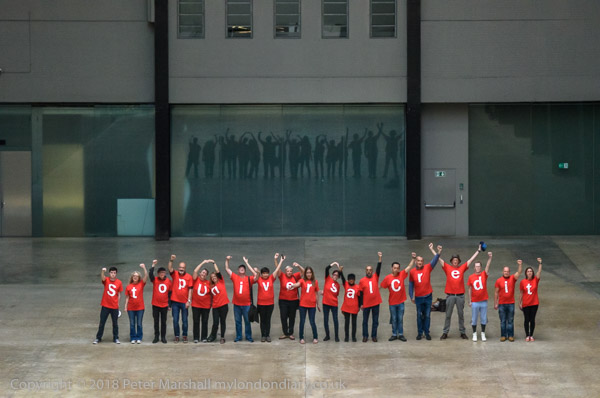
Sometimes space in photographs can be very important, and this picture of protesters in the Turbine Hall of Tate Modern in London is I think a good example. But it isn’t without its problems, and as this small reproduction shows one of them is that we really can’t read the message on the t-shirts unless the image is used on a rather larger scale.

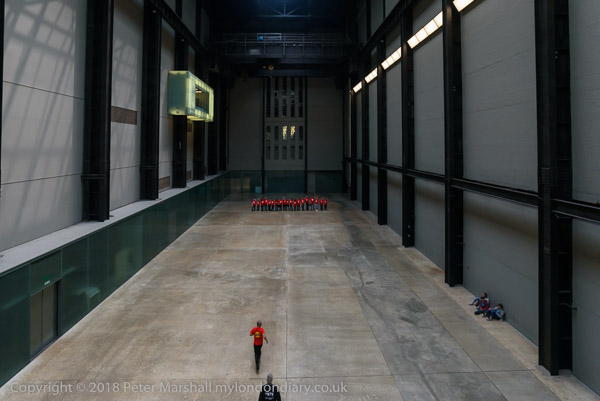
The picture is one of around a dozen taken of the group of protesters, and actually one of them is missing. In this picture it reads STOPUNIVERSALCREDIT and there should have been a ‘#’ at the left. But the ‘#’ was talking to and delaying the security man who was trying to stop the protest, and a later picture shows running to join the protest with security runinng after him.

I was standing on the bridge across the hall, I think at the same level as the horizontal beam along the wall at the right, and hoping that there were going to be no security officers trying to stop me taking pictures – and fortunately there wasn’t. And I was able to take a series of pictures before the security officer rather got in the way of the message, some of which were more legible in small reproduction.

As well as making the message more legible, the larger scale also makes the reflection on the rear wall stand out more, helped by a little massaging in post-production. I’ve also done a little tweaking to make the inside walls of the building more or less vertical as intended, which is a lot easier on the computer than when we had to tilt the easel holding the paper under the enlarger.

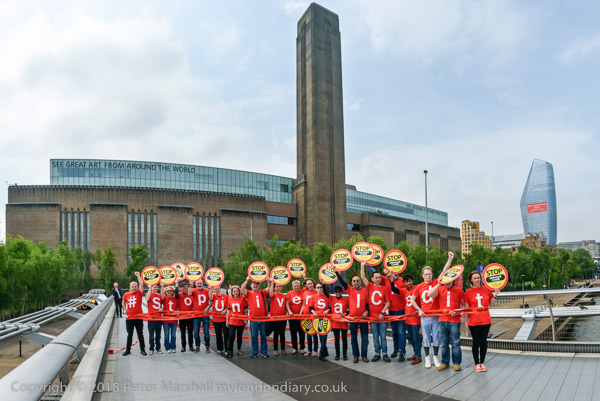
I’d started taking pictures of the group earlier, at the riverside outside Tate Modern, and we had to start with the protesters with their back to us as they didn’t have quite enough people to wear the full set. Then they managed to persuade a person (or was it two) walking by to make up the numbers for a full frontal image by the river and then on the Millenium bridge before a couple of late-comers made it. It needed the 16mm fisheye to get in the whole group on the bridge with the former power stationi behind them.

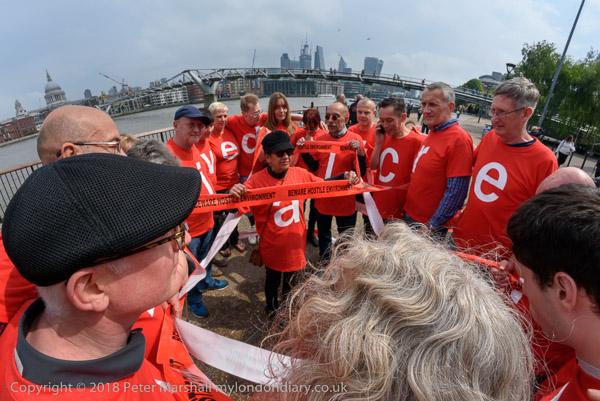
But I think the pictures I like most from the riverside are those where you can’t read the message at all, or only the odd bit of it – and the tape which says ‘Beware Hostile Environment’.

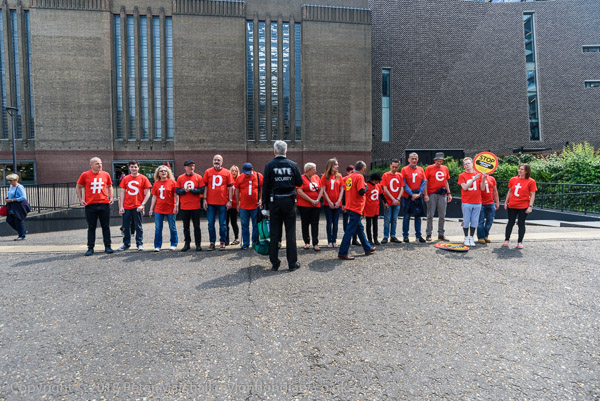
And there was even a role for that over-zealous security officer when the protesters went to pose on the tarmac outside the building and he came to insist that they go completely off the property. But the logo on his jacket enabled me to take a photograph showing clearly where the protest was taking place. I’ve put the image on the web without cropping, but should really have cropped the group tighter, taking out the woman in blue at the left and a little of the foreground.

Universal Credit is now pretty universally admitted to be a disaster, but the government is refusing to halt its roll-out, creating greater hardship to so many, leading to evictions and suicides as well as a huge degree of deprivation and misery. If we lived in a society that was truly just, Iain Duncan Smith would be in jail and the whole programme scrapped.

The action at Tate modern was a prelude to other protests in London and elsewhere on a day of action against Universal Credit, of which more later. But its also a set of pictures, a little over 30 in all, which show very clearly how I was working that day, about the closest I like to get to studio photography.

Universal Credit protest at Tate Modern

______________________________________________________

There are no adverts on this site and it receives no sponsorship, and I like to keep it that way. But it does take a considerable amount of my time and thought, and if you enjoy reading it, a small donation – perhaps the cost of a beer – would be appreciated.

My London Diary : London Photos : Hull : River Lea/Lee Valley : London’s Industrial Heritage

All photographs on this and my other sites, unless otherwise stated, are taken by and copyright of Peter Marshall, and are available for reproduction or can be bought as prints.

To order prints or reproduce images

________________________________________________________
Emerging Photographers

A nice piece in the New York Times, a paper that has used a great deal of good photography over the years, showcases the work of 12 ‘emerging photographers‘.

My own experiences working for the New York Times organisation were considerably less positive, working for an organisation they took over, I got fired from a job writing about photography and photographers because the editors they brought in thought my work was not commercial enough. I’d been hired to write about photography for professionals and collectors of photography some years earlier, but what the new editors wanted was something that appealed to a well off market in the USA that would appeal to advertisers. I had to stop using British spelling, stop writing long pieces, stop writing about foreign photographers, write everything for people who knew nothing about photography but had just bought a camera to photograph their kids, July 4th and thanksgiving… I should assume my readers knew nothing about photography but should convince them that if they bought the latest new camera it would make them a real photographer, up with the greats.

I’d built up a considerable following over the seven or so years I had written the web site, with photographers around the world reading my articles and writing to me. One article on the photographs from 9/11 got around a million hits in 24 hrs, and the audience figures generally weren’t bad – just as well as I only got paid by results. Though it turned out I and the other writers weren’t actually getting paid what we were promised, and a couple of years after I left I got a couple of thousand pounds more from a class action settlement.

All along I had been writing some things specifically for beginners and also for an American audience, but I also wrote and continued writing more serious articles as well. Using US spelling didn’t worry me, but there was too much I wasn’t prepared to compromise and dumb down on so after an uncomfortable few months I got fired. Which is really how this blog started.