Extinction Rebellion Funeral March

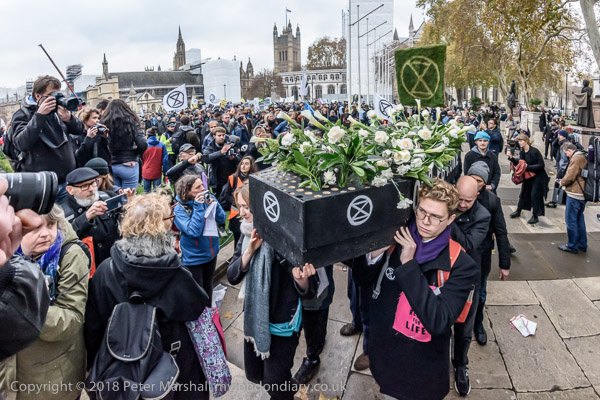
The coffin was carried off of the grass in Parliament Square and to the roadway in front of Parliament, where slowly the protesters formed up behind it. A short flight of steps at the back of Parliament Square enabled me to photograph it looking down and to show the large crowd in the square behind. Using the 16mm fisheye gave me a usefully wide angle of view (about 147 degrees horizontal) which meant including at left the lens of a photographer standing next to me at the top of the steps.
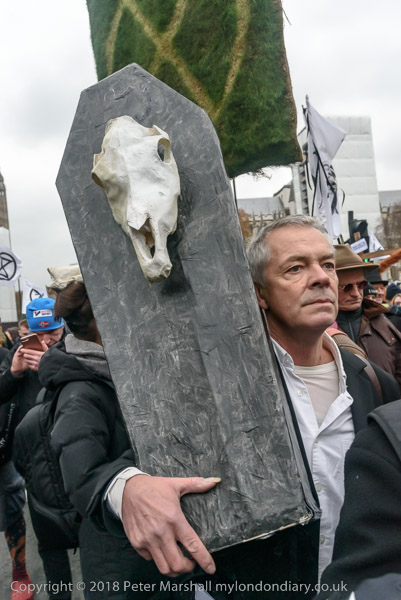
One man had brought a coffin of his own, complete with an animal skull, and another protester had a similar skull on her head, and there were plenty of other creative placards and artifacts. Others carried flowers. It was raining slightly as the march went up Parliament Street into Whitehall and many put up umbrellas, though I found none to photograph with slogans on them.
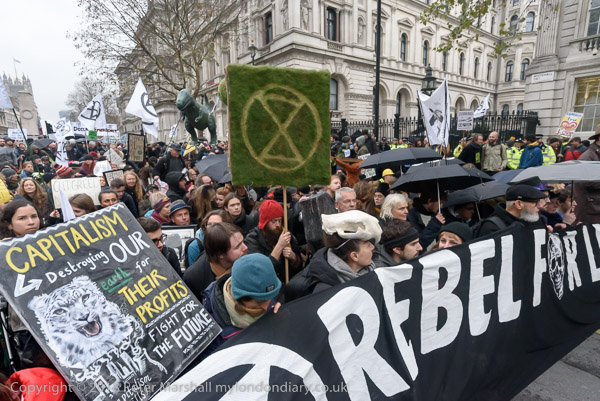
When the front of the funeral march reached Downing Street, there was a sit in for around 10 minutes, followed by some loud shouting of slogans as they got up and moved on.
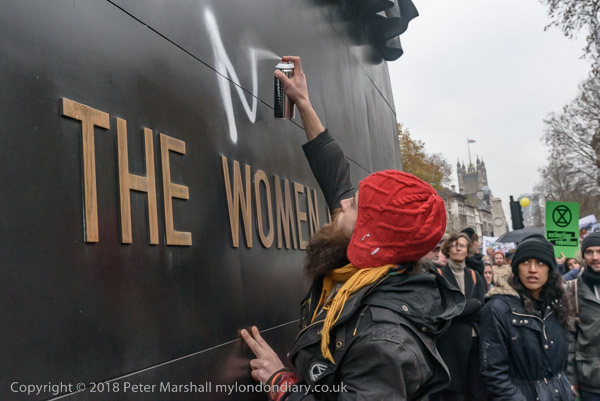
I let the front of the march go on and waited for others to pass, wondering if there might be other actions taking place in Whitehall. As I stood next to the memorial for the Women of World War II, a man got out a paint spray and began painting a slogan across it. He gets as far as ‘MOTHE’ and tries to write an ‘R’ as a police officer grabs him, and he is led away and arrested.
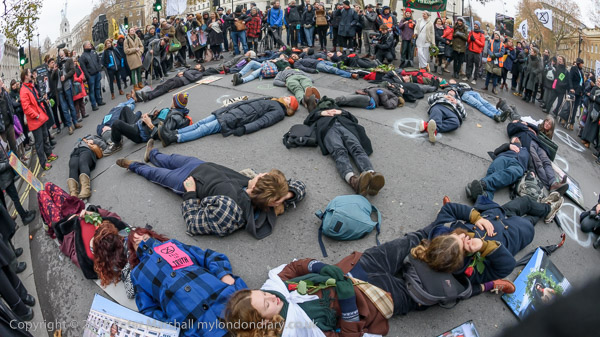
I turned back to the crowd still outside Downing St, and see they are standing around in a large circle round a circle of people lying on the ground. Inside them are other bodies making out the double triangle ‘hourglass’ symbol, completing the XR symbol, which has also been chalked or painted on the roadway in several places.  I held the 16mm fisheye as high as I could above my head and took a number of pictures. By using this on the D750 (rather than the D810 which has a fixed rear screen) and working in Live View I was able to swivel the rear screen and have a good idea of the framing. For once the curved horizon adds to the image. Unfortunately I forget to switch from ‘movie’ to ‘still’ mode in Live View, and so get a 16:9 frame rather than the normal ’35mm’ 1.5:1, an annoying feature of the camera.

Others are writing on the walls in Whitehall – and getting arrested for it. Many of those taking part in Extinction Rebellion are deliberately seeking to be arrested, working on the hope that large numbers of arrest give the protests a higher public profile and may prod the authorities into doing something about the problems.
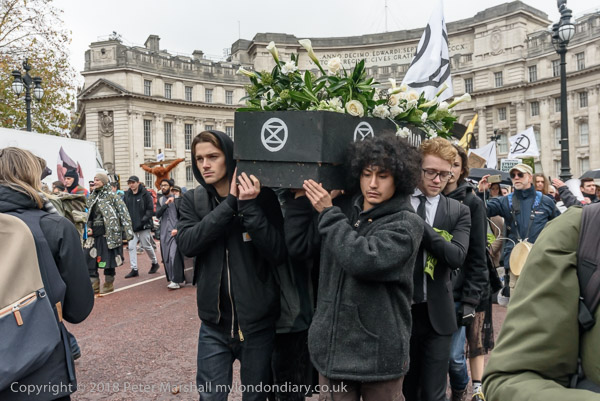
The front of the protest halted at the top of Whitehall, for me and the other protesters to catch up with them, before setting off under Admiralty Arch (now owned by a hotel company) and along the Mall towards Buckingham Palace. A few police try to stop them, but are ordered back to allow the protest to go through – and on to the next stage in the protest.

Many more pictures at Extinction Rebellion Funeral Procession.

______________________________________________________

There are no adverts on this site and it receives no sponsorship, and I like to keep it that way. But it does take a considerable amount of my time and thought, and if you enjoy reading it, a small donation – perhaps the cost of a beer – would be appreciated.

My London Diary : London Photos : Hull : River Lea/Lee Valley : London’s Industrial Heritage

All photographs on this and my other sites, unless otherwise stated, are taken by and copyright of Peter Marshall, and are available for reproduction or can be bought as prints.

To order prints or reproduce images

________________________________________________________
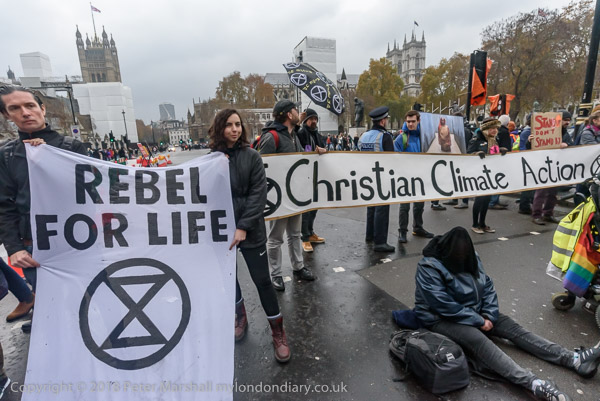
Extinction Rebellion burial thwarted

It was a big day for XR (Extinction Rebellion) which began with several groups blocking the roads around Parliament Square where a rally was taking place in the newly turfed centre.

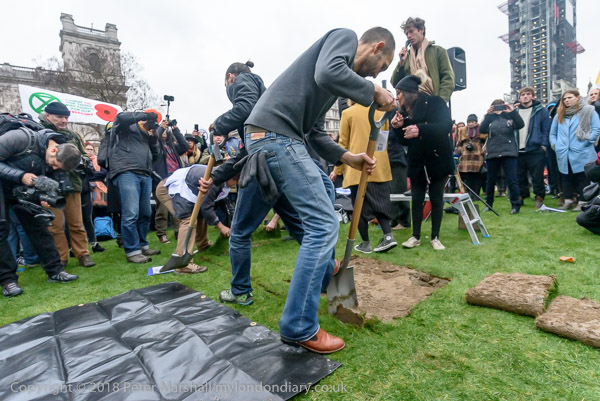
The XR ‘Declaration of Rebellion’ was again read by all, pointing out the failure of government and of “corrupted, inept institutions”  to take action, thus threatening our future, and declaring it to be “our duty to act on behalf of the security and well-being of our children, our communities and the future  of the planet itself“, and then there were speakers, singers, a flute player and more before it was time for XR to carry out a burial, with a black coffin, topped by lilies being carried by pall bearers into the centre of the square. The protesters formed a tightly-packed ring around the centre of the square and the grave-diggers brought in their spades and began work.

Unfortunately when they began digging, caerfully lifting the turf and putting it to one side, they found the turfing had been done on the cheap, and the ground beneath, compacted by years of feet and occasional heavier use, was like concrete, making digging almost impossible. No wonder too that the grass which had grown there previously had never shown much resilience, turning to mud after almost any slight footfall – as it will have had no roots below the top inch or so.

But the protesters care – and their intended digging out of a grave, which after refilling would almost certainly have been beneficial for the lawn – was for naught, as police forced their way through the crowd, trampling the carefully laid aside turves to pieces and further compacting the bared soil. It’s arguable whether or not the protesters were guilty of ‘criminal damage’, but the police certainly were.

Things got rather intense, with a great deal of forceful pushing and shoving by police and we were all packed together. Using the 16mm fisheye and the 18mm end of the 18-35mm lens enabled me to continue taking photographs, though at times it was difficult to lift a camera. The XR organisers tried to keep the protest going and calling for calm and for people not to be provoked by the police action.

I was right at the centre when I saw the coffin surrounded by police near the edge of the crowd, and it was had to get out of the crush, even though everyone was happy to let me through. I managed to rush around the outside of the crowd and then make my way in again towards the coffin.

More pictures: Extinction Rebellion Parliament Square

______________________________________________________

There are no adverts on this site and it receives no sponsorship, and I like to keep it that way. But it does take a considerable amount of my time and thought, and if you enjoy reading it, a small donation – perhaps the cost of a beer – would be appreciated.

My London Diary : London Photos : Hull : River Lea/Lee Valley : London’s Industrial Heritage

All photographs on this and my other sites, unless otherwise stated, are taken by and copyright of Peter Marshall, and are available for reproduction or can be bought as prints.

To order prints or reproduce images

________________________________________________________
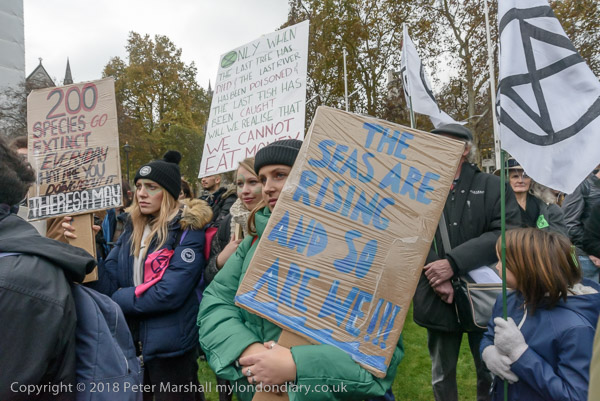
Police had surrounded and stopped the coffin being carried further onto the square, where they also apparenlty stopped a second attempt to dig a grave, though the crowd in the middle of the square was too dense for me to see or photograph this. For some minutes, everything came to a tightly-packed standstill until eventually XR decided the time had come for the next stage of their action.

Founders Day

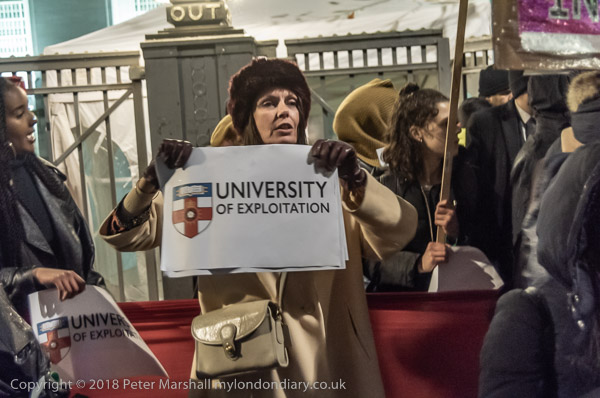
Workers protesting outside the University of London’s Senate House where Founders Day is being celebrated has become something of a tradition, and the IWGB (Independent Workers Union of Great Britain) were there again this November.

Banners and placards make the workers’ demands clear. They work for the university, keeping it running, and demand to be employed by the university, and not, as at present, by contracting companies that offer rock-bottom conditions of service and wages. They work in the university under conditions so poor that the university itself would not dream of being seen to impose – but is happy to turn its back when soemone else does it on the university’s behalf. There is no moral justification for London University’s position.

This is a dispute that has been going on for some years, both in various constituents of London University and in the central university administration, based on the Senate House, which is responsible for the Senate House, Halls of Residence and other aspects of the university. Among the workers who work for them but are employed by other are cleaners, catering staff, porters, receptionists and security staff.

It took over ten years of campaigning by SOAS Unison, along with staff at all levels and students, under the banner ‘One Workplace, One workforce’ to get the cleaners at SOAS University, next to the Senate House to be brought back in house. The campaign at the LSE, led there by the United Voices of the World was much shorter, and more recently, staff and Kings College (also in Unison) have also gained victory and are being brought in-house.

Even the University of London sees that it current position is untenable, but “continues to drag its feet over bringing workers into direct employment. They have announced that although recommending that workers be brought in-house this will be subject to “in-house comparator bids” and that it will not happen until 2020 or 2021. As the IWGB point out this is in great contrast to the response of Kings College and the LSE who have agreed to take their workers back in house.”

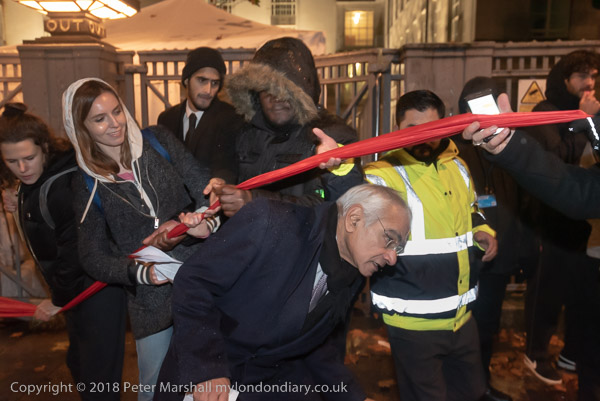
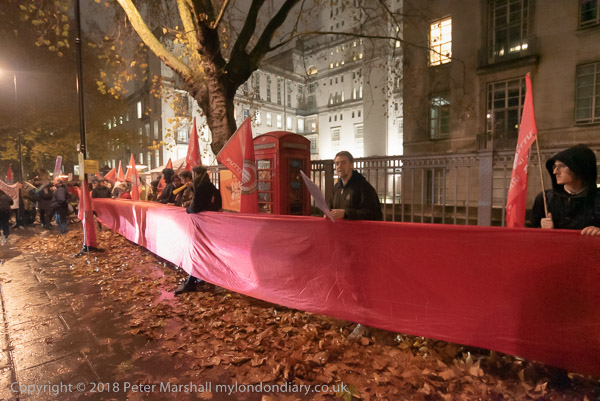
The IWGB brought with them a very long red banner – just a roll of red cloth – which they stretched out in front of the heavily guarded entrance to the Senate House. Police ensured it was possible for guests to walk around behind it to enter, but some iinsisted on a more direct route. There was a little pushing and shoving by security and police, with a little resistance by the protesters, but generally the atmosphere remained fairly calm.

But it was extremely noisy, with a sound system, and rather variable amounts of light, but always fairly low. After a handful of exposures at ISO3200, I change both Nikons to work at ISO 6400. Though this was reasonably satisfactory, with both lenses at full aperture and shutter speeds from 1/20s to 1/80s and mainly around 1/30th, quite a few images were blurred by subject movement even though most of the protest was fairly static. I made sure I took enough to get a reasonable number sharp. But I had to switched to flash when people began to try and get past the red banner and things became a little more active. I kept the camera at ISO6400, working with the camera set at 1/60s and still at full aperture to get a reasonable exposure of the background where the flash didn’t reach.

More at IWGB at London University Founders Day.

______________________________________________________

There are no adverts on this site and it receives no sponsorship, and I like to keep it that way. But it does take a considerable amount of my time and thought, and if you enjoy reading it, a small donation – perhaps the cost of a beer – would be appreciated.

My London Diary : London Photos : Hull : River Lea/Lee Valley : London’s Industrial Heritage

All photographs on this and my other sites, unless otherwise stated, are taken by and copyright of Peter Marshall, and are available for reproduction or can be bought as prints.

To order prints or reproduce images

________________________________________________________
Sardines?

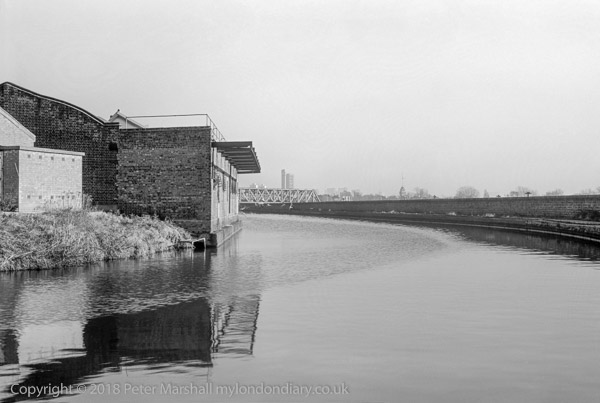
Recently I published the image above of the Grand Union Canal (Paddington Branch) I took in 1981 on Facebook, one of a series of posts I’ve been making most days over the past year or so from my early days of photographing London, and as usual wrote a few sentences about it – as follows:

Grand Union Canal, Willesden, 1981
26w-63: canal, bridge, reflection, towpath

The building at left is I think still there beside the canal, set some way back from Hythe Road in an area now all occupied by Cargiant, “officially the world’s largest used car dealership”. The bridge in the distance is Mitre Bridge, also known as Scrubs Lane Bridge, which carries the Overground line from Clapham Junction to Willesden Junction, as well as goods traffic onto the main West Coast line. The bridge gets its name from the angle at which it crosses the canal.

Just beyond the bridge on the north bank is now a small memorial garden to Mary Seacole, where I’ve sat to eat my lunch in the sun on several occasions, though it wasn’t there when I took this picture, as it was only opened around 2003.

Over the long wall to the right of the canal is a vast area of railway land to the north of Wormwood Scrubs.

I couldn’t at the time remember when I had been to that garden, but by coincidence I found out when thinking about writing a post here.  Checking through recent posts on some other photography sites, a new (and silly) comment to a post by A D Coleman led me to read a piece he had posted on the death of John Berger in 2017, On John Berger on Photography, earlier printed in Hotshoe in 2012. In it Coleman reveals how Finnish photographer Pentti Sammallahti managed to get dogs where he wanted them in his remarkable photographs.

I remember still how, when I first found this out (probably from reading the Hotshoe article, though I
have a memory of it happening when talking about the pictures hung in a corner of Paris Photo, and someone mentioning the two words “sardine oil”, perhaps someone else who had read Coleman rather than the photographer. It doesn’t of course change the photographs, but what had before seemed some magical power did become rather more prosaic.


Double-click to open the image twice the size – backspace to return

I thought of writing a post about this, but couldn’t remember if I had mentioned it before, so searched my posts for the word ‘sardine’, and got as the only result the post ‘Up Willesden Junction‘, written about a walk in February 2014, in which I wrote:

I sat on a bench to eat my sandwiches in the sun (it was surprisingly mild for London in February) in a small memorial park to Mary Seacole, a remarkable Jamaican woman who used the profits from her general store and boarding house in Jamaica to nurse wounded British soldiers in the Crimean war, as well as medical work in Jamaica, Cuba and Panama. The memorial park was created around the time of the bicentenary of her birth a few years ago here, close to where she was buried in St Mary’s Catholic cemetery in 1881. She has become a controversial figure in the debates over the construction and teaching of British history, with many feeling she was largely sidelined because she was black.

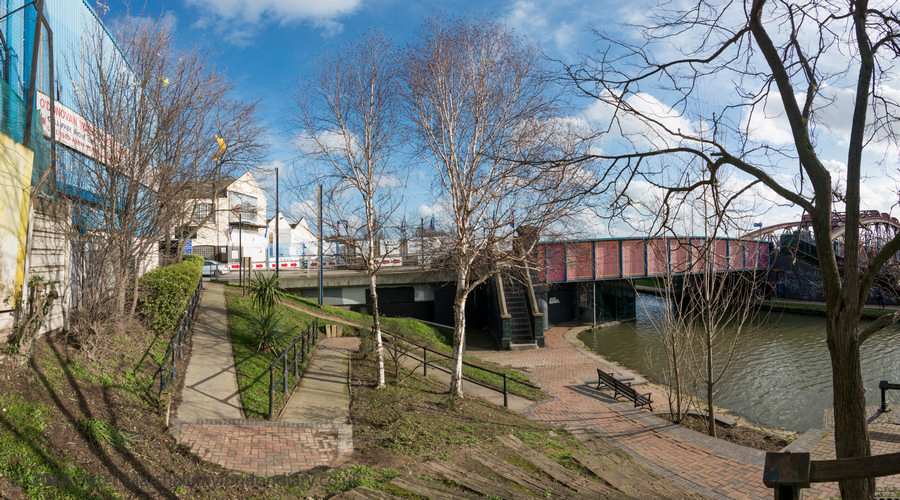
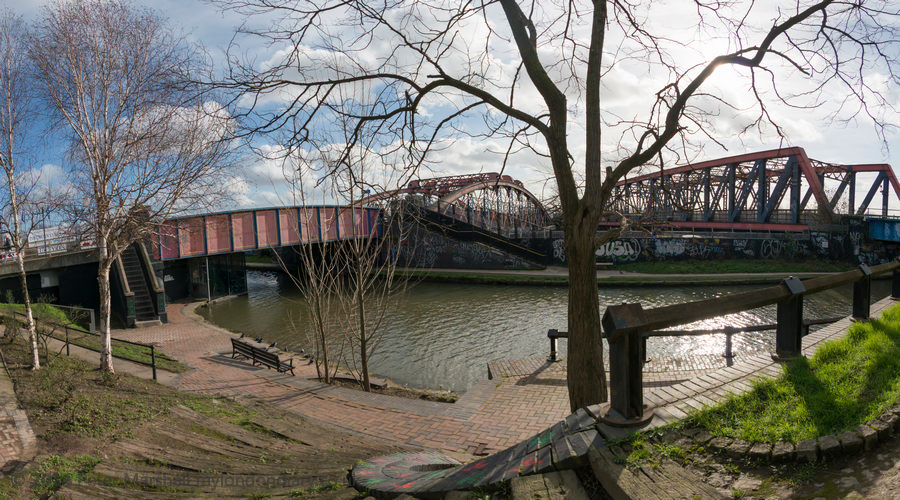
The picture above shows the Mary Seacole Garden, and there are more in the linked article on My London Diary, including this one:

The sardines weren’t in my sandwiches – unlike Sammallahti I stick mainly to cheese – Stilton, Camembert, Jarlsburg, Cheddar, sometimes with a little pickle or chutney, often with raw onions and always with tomato, with just occasionally ham or other cold meat we have in the house, and all I’ve ever managed to attract has been pigeons.

Sardines came into my post only about travelling on rush-hour trains, something I now try hard to avoid as my ageing legs obect painfully to standing, and the trains on my line have got even more packed, less reliable and the fares more expensive. Though the service from Richmond to Willesden Junction has improved greatly since it was taken from private operator Silverlink and became a part of London Overground in 2010.

______________________________________________________

There are no adverts on this site and it receives no sponsorship, and I like to keep it that way. But it does take a considerable amount of my time and thought, and if you enjoy reading it, a small donation – perhaps the cost of a beer – would be appreciated.

My London Diary : London Photos : Hull : River Lea/Lee Valley : London’s Industrial Heritage

All photographs on this and my other sites, unless otherwise stated, are taken by and copyright of Peter Marshall, and are available for reproduction or can be bought as prints.

To order prints or reproduce images

________________________________________________________
Sodden London

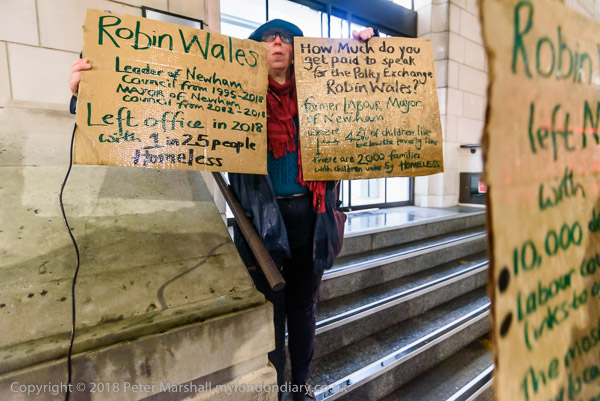
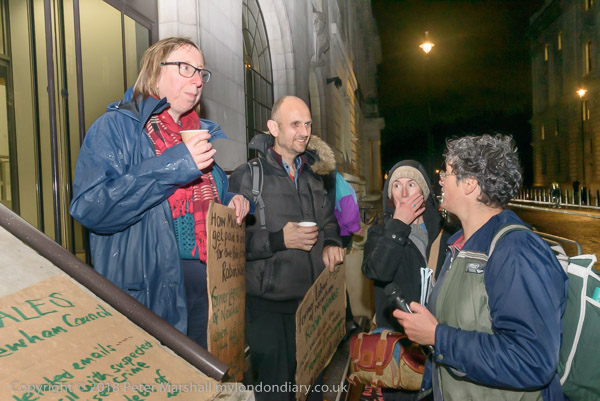
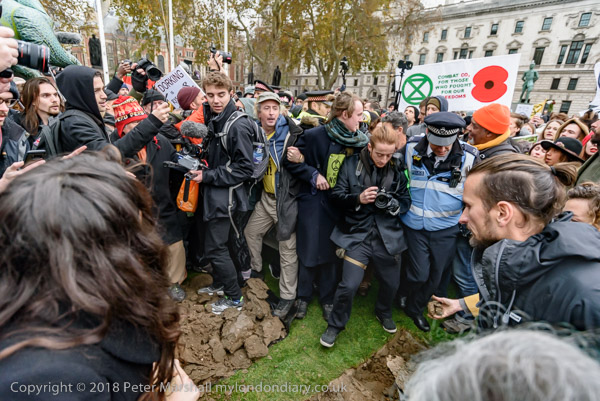
Monday 19th November was a night when rain almost stopped play, at least for me. I’ve seldom been as cold and wet when taking pictures.  Although rain had been forecast it came earlier than expected and was  heavier as I stood with a small group of protesters on a poorly lit central London street.

We were outside an office building which houses the centre-right think tank Policy Exchange where former Newham Mayor Sir Robin Wales now works and was speaking at a housing conference. I was with half a dozen supporters of Focus E15, the Newham-based housing protest group which waged a long battle with the Mayor and his housing policies.

What began with his decision to stop supporting a hostel for single mothers and children, forcing the housing association to give them notice of eviction, when they decided to stand together and fight to get themselves rehoused in London rather than dispersed to far-flung areas of the country in private lettings later turned into a much more widespread campaign for an end to social cleansing and decent treatment for those in social housing and others needing it.

Their fight gained national attention, newpaper articles were written about it, plays were written around it and the young women who led it invited to speak at conferences. The campaign continues, though now with a new Mayor in place and some slight changes in council policy, with its street stall every week in the centre of Stratford, a small community centre for meetings, films etc and occasional protests such as this, along with support for those with housing problems or threatened, as they were, with eviction.

As the pictures show, the protesters looked pretty bedraggled, and like them I was getting wet and cold. For once I put up my umbrella for some of the time while taking pictures, though it really needs a third hand. Though I now rely on autofocus almost all of the time, altering the focal length using the zoom ring really does need two hands and perhaps my framing was a little less good than usual. Because I was able to work close to the protesters, I didn’t feel any need to use a longer lens than the 18-35mm which I had on the D750, and all the pictures were taken with this. It’s also a lot easier to keep one camera dry than two. AL pictures were taken at ISO 6400.

It really was too dark to work without extra lighting, mainly supplied by using my cheap LED light, a 216 LED Neewer unit. It seems to now have a rather lower light output than it should and the AA batteries seem to lose power very fast. I’m wondering whether it just needs a better set of batteries or I should look at a more expensive replacement unit. It’s more flexible than the flash in that I hold it in one hand (on this occasion I had to put the umbrella down to do so) and so have some limited control over the light direction. Flash was more convenient as the Nikon SB800 fits into the hot shoe and I could keep the umbrella up. But it isn’t a great idea to use flash in the rain as it is at its most powerful on raindrops falling close to the camera, and some frames were unusable. About half the pictures were made using the LED and the rest with flash.

The people in the office took pity on us, and a man came out with a tray of hot tea, though a couple of the protesters refused on principle to accept any gifts from them, but I found it very welcome.

Focus E15 protest former Newham Mayor

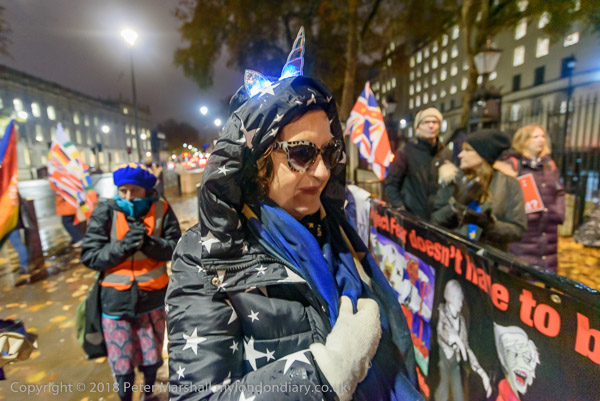
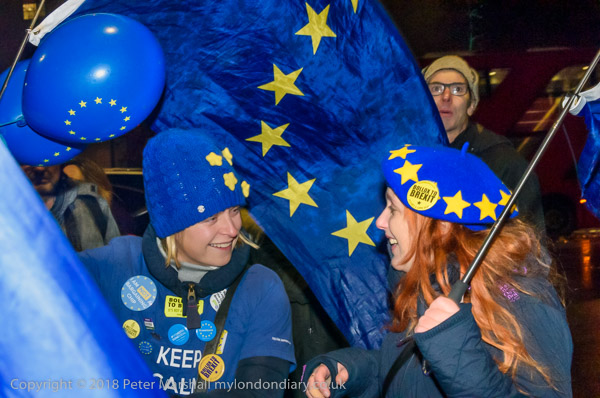
As I left the protesters and made my way the short distance to Downing St the rain eased off, and photographing the Stop Brexit protest there was considerably more pleasant. There was also rather more light, and I was able to take some pictures without any additional lighting uysing the D810.


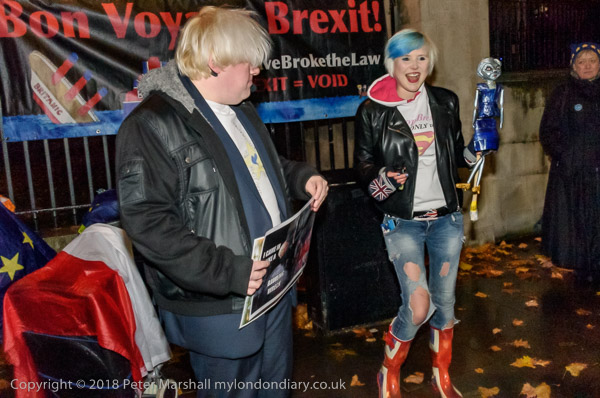
For the staged performance by Boris impersonator Drew Galdron and EU Supergirl Madelina Kay and a three person chorus, I mainly worked without flash, though subject movement and slow shutter speeds meant rather many were too blurred. I did make just a few exposures with flash to be sure of getting a sharp image, but felt a lot of flashing would have been rather annoying for both audience and performers.

The performance came to an abrupt end when we were told that people were about to leave Downing St after partying about Brexit with Theresa May, and everyone rushed across to protest. It was rather darker in front of the gates, so nearly all the pictures I made there were taken with flash as I rather liked the way it isolated the EU flags and berets against a darker background.

No10 Vigil says stop Brexit
______________________________________________________

There are no adverts on this site and it receives no sponsorship, and I like to keep it that way. But it does take a considerable amount of my time and thought, and if you enjoy reading it, a small donation – perhaps the cost of a beer – would be appreciated.

My London Diary : London Photos : Hull : River Lea/Lee Valley : London’s Industrial Heritage

All photographs on this and my other sites, unless otherwise stated, are taken by and copyright of Peter Marshall, and are available for reproduction or can be bought as prints.

To order prints or reproduce images

________________________________________________________
Unity Against Fascism and Racism

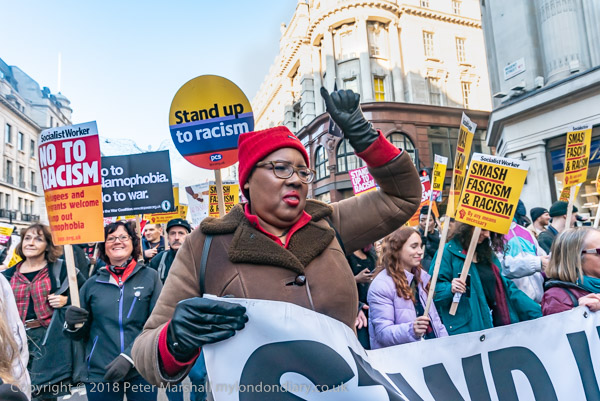
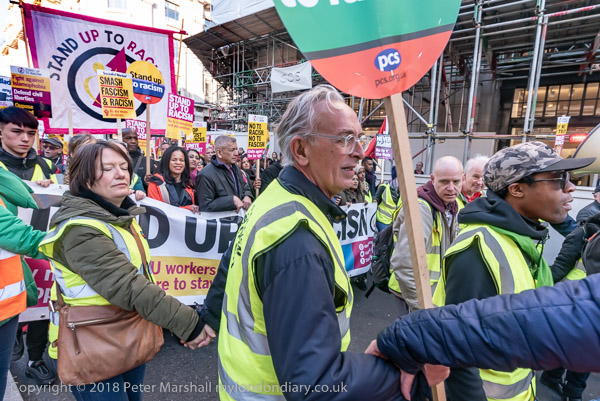
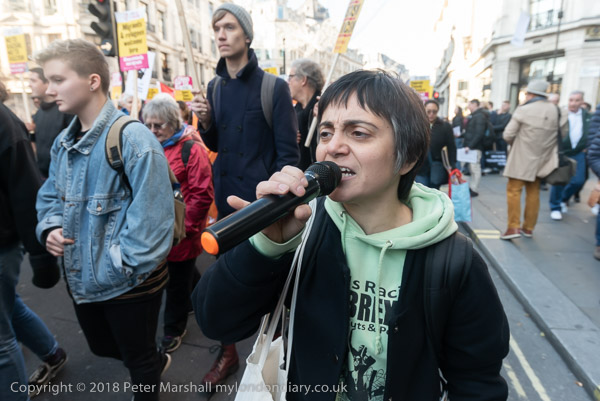
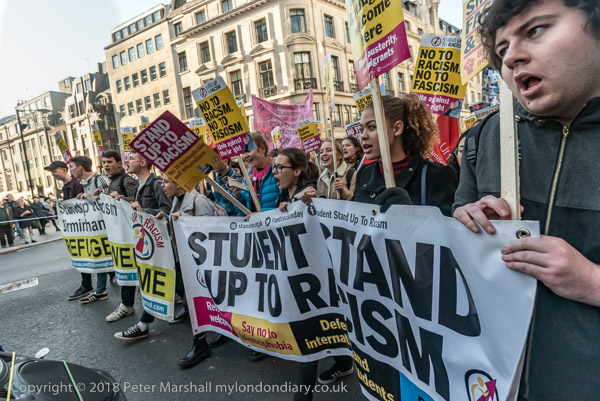
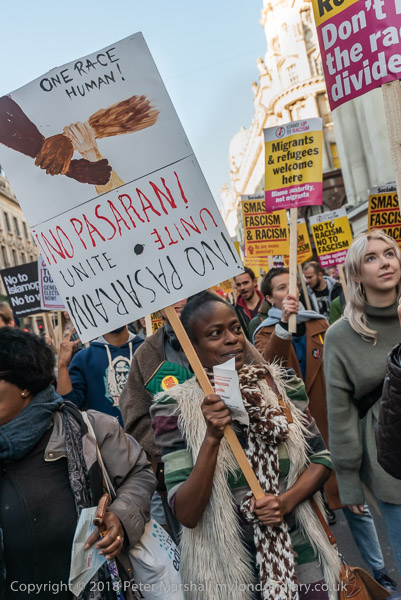
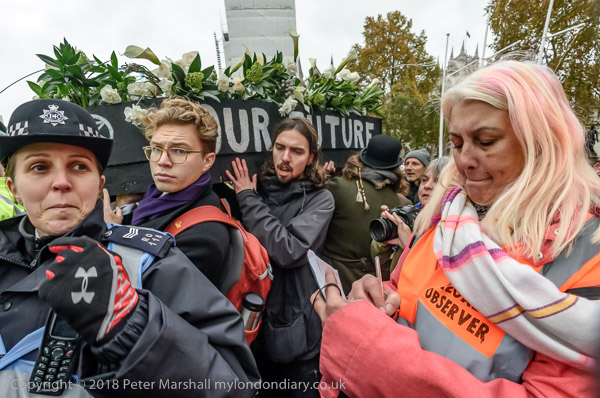
There are days when I’d like to be in two different places at the same time, with events I’d like to cover at the same time, and Saturday 17th November was one of them – though it was actually six places at the same time, with XR (Extinction Rebellion) blocking five bridges.

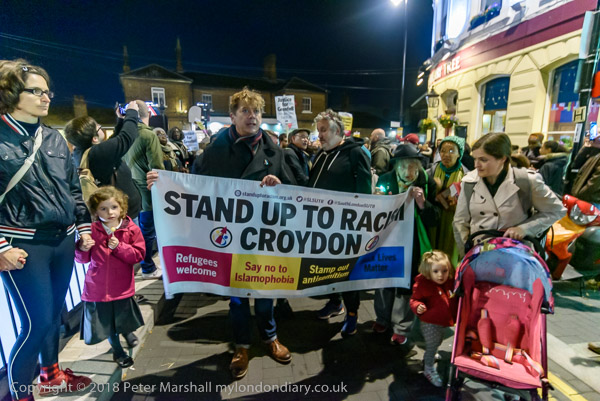
Well away from the river at BBC Broadcasting House, people were gathering for a march to show unity against racism and fascism, organised by Stand Up To Racism, co-sponsored by Unite Against Fascism and Love Music Hate Racism.

The march was prompted by the rising threat of Islamophobia and Antisemitism by far-right groups in the UK, particularly the several aspects of the Football Lads Association, with a level of support for fascism not seen in Britain since the 1930s. The rise of the FLA (or the DFLA – the D standing for Democratic, though it’s unclear what this means) and marches to ‘Free Tommy’ who was arrested for action that could have prejudiced a criminal trial of pedophiles but which hi-jacked the idea of ‘Free Speech’ have angered many as well as emboldening and encouraging others to commit anti-semitic and anti-Muslim acts.

Broadcasting House has become a popular starting place for marches, as well as a venue for protests outside in recent years partly because of the BBC coverage of some political events, but mainly for its lack of coverage of domestic protests. While those overseas often get well covered, any taking place in this country are usually ignored. Making them start outside the BBC where reporters and editors can’t help but notice them hasn’t actually increased the BBC coverage, but it does make clearer what side the BBC are on, and their policy of minimising coverage of any domestic dissent.

I got held up taking pictures on Blackfriars Bridge, waiting for something that didn’t happen, and despite running much of the way from there to Waterloo Bridge, by the time I was sitting on the tube on my way to Broadcasting House I realised the march would already have started. So instead I alighted at Piccadilly Circus and walked up Regent Street to meet it, not far south of Oxford Circus.

I stayed in roughly the same position as the march went past, moving back and forth and slowly down towards Piccadilly as I took pictures until the end of the march came in sight. With probably 10,000 people on the march, this took around 30 minutes before I could jump back onto the tube to go to Westminster. I went back onto the bridge and photographed things happening there for a while rather than go up Whitehall for the rally at the end of the march.

I had expected the march to be rather larger, more like the organisers’ estimate, but the protest taking place on the bridges possibly took a thousand or two away. But perhaps marches like this which attract little or no attention and seem to have no effect need to be rethought, with more imaginative protests like those by Extinction Rebellion taking their place.

Unity Against Fascism and Racism

______________________________________________________

There are no adverts on this site and it receives no sponsorship, and I like to keep it that way. But it does take a considerable amount of my time and thought, and if you enjoy reading it, a small donation – perhaps the cost of a beer – would be appreciated.

My London Diary : London Photos : Hull : River Lea/Lee Valley : London’s Industrial Heritage

All photographs on this and my other sites, unless otherwise stated, are taken by and copyright of Peter Marshall, and are available for reproduction or can be bought as prints.

To order prints or reproduce images

________________________________________________________
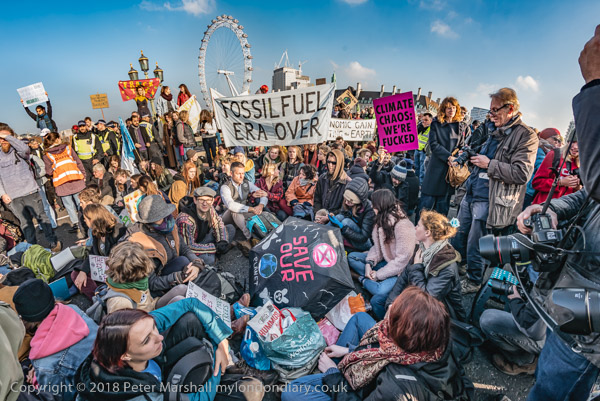
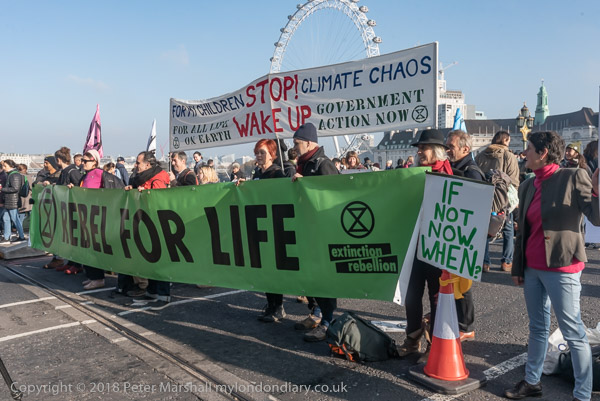
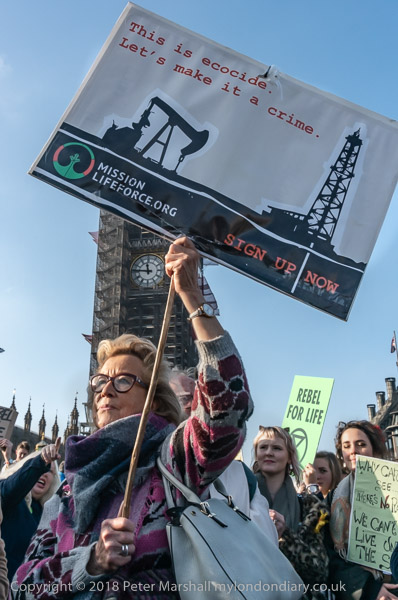
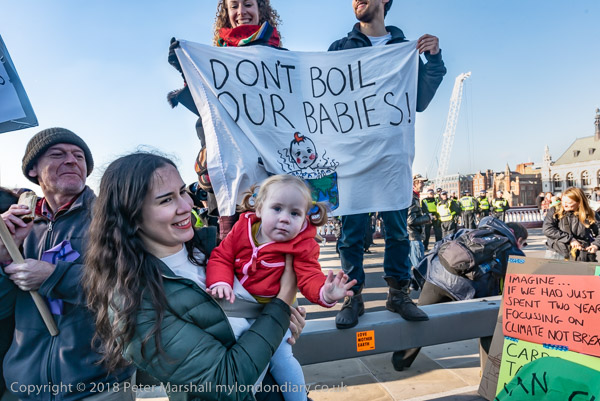
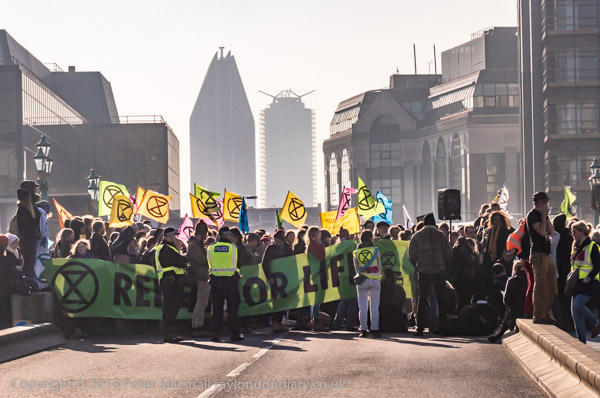
Five Bridges against Extinction

Unfortunately our mass media have failed to respond honestly to the major challenges we face in alomost every area of life. A provocative and controversial statement but one that appears to me incontrovertable, whether one looks at Brexit and our current problem over that, at inequality in our society and globally, at our housing crisis, and most obviously and most dangerously about the environment and the ecological crisis – the sixth global mass extinction which is rapidly approaching, though there may be legitimate arguments about the fine print.

The reasons for this failure are also fairly clear. Mass media that are largely owned and controlled by a tiny group of the ultra-wealthy and a public sector broadcaster that largely supports the status quo, with staff and board who are also part of a highly privileged few; don’t rock the boat is their mantra.

But unfortunately the boat is sinking fast, and even the extreme rich will soon find the same old way no longer works, though only too late to do anything about it, almost certainly for themselves and certainly for the rest of us. What used to be apocalyptic and dystopian is fast becoming the new reality.

So (I think) argue those behind Extinction Rebellion, and I think they are convincing, though exactly when we reach the tipping points and what these are may still be up for scientific debate. But beyond debate is that urgent change is needed – and that currently it is not even on the agenda. They want to get people to take notice, and know the media in general seldom cover protests taking place in this country, even if thousands come out on the streets. Something more is needed to get attention.

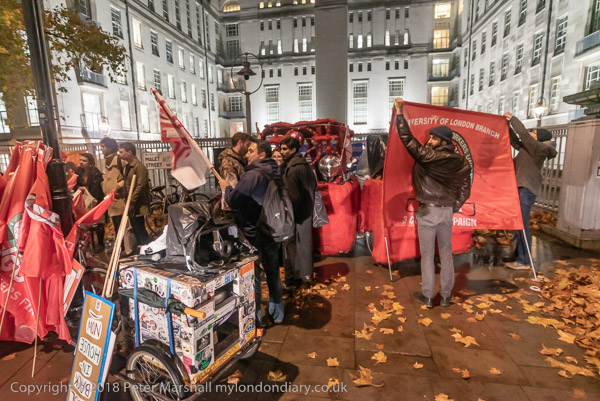
The answer they came up with was blocking five major bridges in central London. Previously they and activists trying to get action over air pollution in London (which causes almost 10,000 early deaths each year) have blocked roads and road junctions for short periods – around 7 minutes at a tiem, often repeated a few times after short pauses to allow traffic flow, with perhaps the most ambitious block by Stop Killing Londoners bringing the whole of Trafalgar Square to a halt. But holding the five bridges for most of the daylight hours took disruption to a different level – and did gain them some publicity.

London does of course have many bridges, but blocking the five central ones meant longish diversions, with no road crossing between Vauxhall Bridge and London Bridge. Of course the publicity tended to be negative, with some commentators almost comparing it to the end of the world – just what the protesters are hoping to prevent. And it was hard to feel anything but contempt for those who accused the protesters of being selfish for being prepared to be arrested to try to stop our mass extinction. It’s perhaps also worth remembering that sporting events including cycle races and the London Marathon cause even more traffic disruption on the days they take place.

I managed to photograph on four of the five bridges, which involved quite a lot of walking, though I did start by taking the Underground from Westminster to Mansion House and Southwark Bridge, the further downstream of the five, coming back to Westminster on foot via Blackfriars Bridge and Waterloo Bridge, and taking the tube from Embankment to cover a different protest on Regent St. By the time I’d returned to Westminster Bridge after that detour it was too late and I was too tired to attempt the fifth bridge, Lambeth Bridge, a short distance upstream. But things were still happening on the bridge.

Extinction Rebellion Bridge blockade starts
Extinction Rebellion: Southwark, Blackfriars, Waterloo
Extinction Rebellion form Citizens’ Assembly

______________________________________________________

There are no adverts on this site and it receives no sponsorship, and I like to keep it that way. But it does take a considerable amount of my time and thought, and if you enjoy reading it, a small donation – perhaps the cost of a beer – would be appreciated.

My London Diary : London Photos : Hull : River Lea/Lee Valley : London’s Industrial Heritage

All photographs on this and my other sites, unless otherwise stated, are taken by and copyright of Peter Marshall, and are available for reproduction or can be bought as prints.

To order prints or reproduce images

________________________________________________________
Notable women in photography

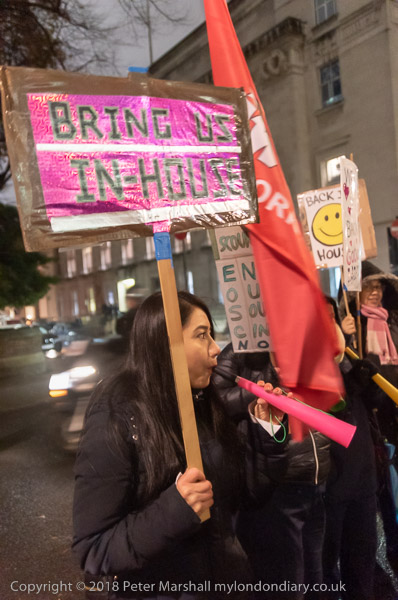
I have a couple of small reservations about the article by Australian photographer and writer Megan Kennedy, “9 Pioneering Women Who Shaped Photographic History” which makes an interesting contribution, particularly in introducing several photographers whose work deserves to be known more widely.

The first is about the phrase “shaped photographic history“, which I think is rather undervalued by its use here. How would photographic history have been different if it were not for the work of some of these women, interesting though it was? While it would be straightforward to make a case for some of the nine, I think it would be something of a problem for others. Of course all of us who publish or work or show it to others in some small way are a part of photographic history, but I think relatively few are pioneers who really shape it.

Putting that to one side, there are I think five in the list that over the years I have written about (unfortunately mainly in articles no longer available for contractual reasons), and about whom there is considerable information both on-line and in print, and the article would have been considerably more useful had it included links to some of these. It was after all published by the Digital Photography School which should be more encouraging to its students to dig further.

Of course for most of them resources are not hard to find (though the quality of some links highly ranked by Google is often poor), but here I’ll give just one link to each of them on Wikipedia which seems generally a good starting point:

Julia Margaret Cameron (1815 – 1879)
Mary Steen (1856 – 1939)
Imogen Cunningham (1883 – 1976)
Gertrude Fehr (1895 – 1996)
Trude Fleischmann (1895 – 1990)
Dorothea Lange (1895 – 1965)
Grete Stern (1904 – 1999)
Ylla (1911 – 1955)
Olive Cotton (1911 – 2003)

As a minor caveat I might perhaps question the choice of these particular nine women, when a good case could be made for so many others. But as Kennedy finishes her article:

“It’s impossible to cover the sheer number of women that have embodied the tenacity and creativity of a photographer’s spirit in a single article. With this piece, however, I hope to have encapsulated some of the resolves of the generations of women who have shaped photographic history. And although we aren’t all the way to achieving equality yet, thanks to the female photographers of the past and present, we’re a lot closer than we used to be.”

When I put together on line a ‘Directory of Notable Photographers‘ around 20 years ago (and highly debatable guide to those for whom further information was then available on the web) it included the following women photographers:

Abbott, Berenice
Arbus, Diane
Becher, Hilla
Bourke-White, Margaret
Cameron, Julia Margaret
Connor, Linda
Cunningham, Imogen
Dahl-Wolfe, Louise
Dater, Judy
Ewald, Wendy
Franck, Martine
Freedman, Jill
Gilpin, Laura
Goldin, Nan
Groover, Jan
Hahn, Betty
Henri, Florence
Heyman, Abigail
Iturbide, Graciela
Jacobi, Lotte
Kasebier, Gertrude
Kruger, Barbara
Lange, Dorothea
Levitt, Helen
Lestido, Adriana
Mann, Sally
Mark, Mary Ellen
Meiselas, Susan
Metzner, Sheila
Miller, Lee
Model, Lisette
Modotti, Tina
Moholy-Nagy, Lucia
Orkin, Ruth
Parker, Olivia
Post Wolcott, Marion
Rheims, Bettina
Sherman, Cindy
Spence, Jo
Stern, Grete
Tenneson, Joyce
Ulmann, Doris

Of course there were many other women I wrote about then and since,;  an updated list would include many more.

______________________________________________________

There are no adverts on this site and it receives no sponsorship, and I like to keep it that way. But it does take a considerable amount of my time and thought, and if you enjoy reading it, a small donation – perhaps the cost of a beer – would be appreciated.

My London Diary : London Photos : Hull : River Lea/Lee Valley : London’s Industrial Heritage

All photographs on this and my other sites, unless otherwise stated, are taken by and copyright of Peter Marshall, and are available for reproduction or can be bought as prints.

To order prints or reproduce images

________________________________________________________
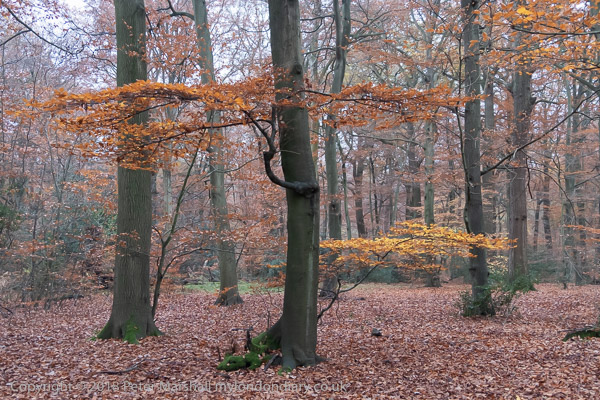
Late Autumn

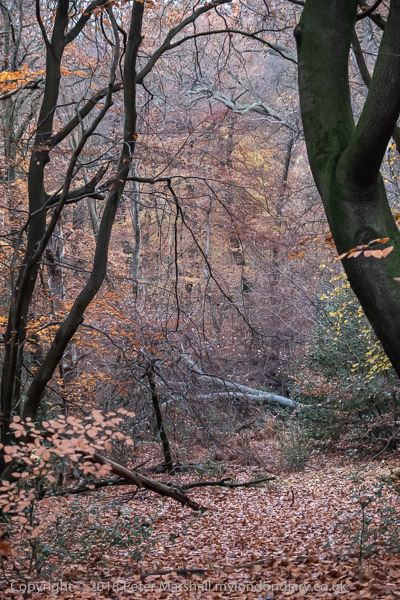
Back in the days of film I used to lock away (if only metaphorically, as the key to the cupboard is even longer lost) colour film in the Autumn months to ensure I didn’t waste it as the leaves changed colour. Though I plead guilty ot have taken pictures of autumn leaves, there didn’t seem to be any good reason to repeat the offence as it was a message I’d already stated.

Film cost money, soemthing which, back then, was usually in short supply, but while the marginal cost per frame of 35mm film was perhaps around 10p, for digital it is virtually zero. We pay up front in terms of camera, computer & software, and almost the only cost per digital image is for the storage medium, and with hard drives now at a few pence per gigabyte that is almost too small to calculate. Of course the total cost has to take into account the hardware and software, but each extra exposure you make reduces the cost per exposure.

Film – except in a few very specialised cases – is now simply an affectation, though people tell me it is making a resurgence. But if people want to waste time and money why should I stand in their way. You are welcome – but just don’t try to tell me there are any advantages. Its a hair shirt I’m happy for you to wear.

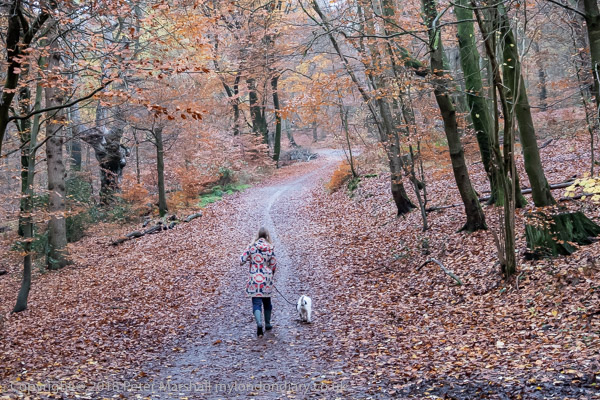
So when I went with some of my family to Burnham Beeches there was no real reason not to take pictures (though I certainly didn’t take any film.) Except perhaps that I didn’t find the subject matter particularly inspring in the way that walking down a city street might well be. Though to be honest I did manage to get myself fairly wrapped up in it, so that I didn’t notice the rest of my family wandering off and getting lost while I was taking the first of these pictures.

I’d told them that we needed to go the way I was going, but when I took my eye away from the viewfinder and looked around they had disappeared. I’d photographed the map at the infromation centre as we started our walk, so I knew exactly where I was, but they insisted on following a printed map for a walk that started elsewhere.

I wasn’t worried about them, or about meeting up again, as I knew they would eventually have to find their way back to where the car we had come in was parked, though it would take them rather longer than it would take me. I did try to phone them, but wherever they had gone there was no signal, and it was only half an hour later that we managed to get back in touch – and to go and find a pub for a meal.

There is a little more about the walk and a couple more pictures on My London Diary:
Burnham Beeches

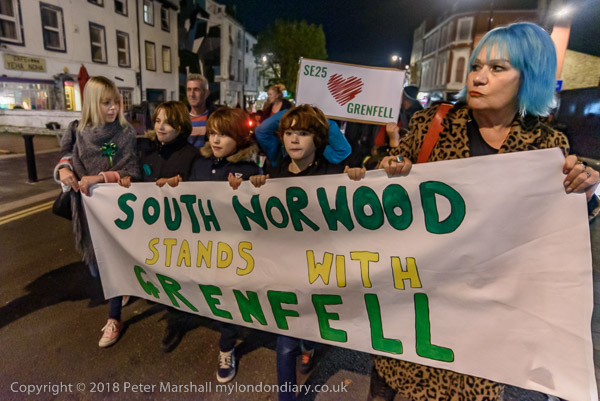
South Norwood stands with Grenfell

No one with any human decency will not have been disgusted when a video emerged of a fireworks party burning a replica of Grenfell Tower, complete with people shown trapped inside. Police investigated and made arrests, though it wasn’t clear what those responsible could be charged with. Sickening and offensive though their act was, it was not specifically targeted at a particular racial or religious group, though thought to be racist in intent and particularly directed at those killed who were Muslim, it was rather an offence against humanity and human feelings as a whole, but not covered by our hate crime laws.

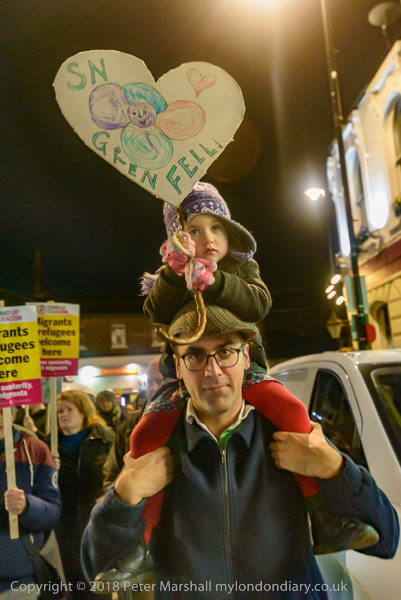
The event particularly shocked the people of South Norwood, where the party took place, and the South Norwood Tourist Board (an unofficial body which promotes the area, organising community events including tours and the setting up of a garden on waste ground beside one of its main streets) decided to take action over the sick event. As well as being local residents of South Norwood, at least one of the prominent members of the SNTB is a former resident of Grenfell Tower, and he and others have been involved with events aimed at getting justice over the fire.

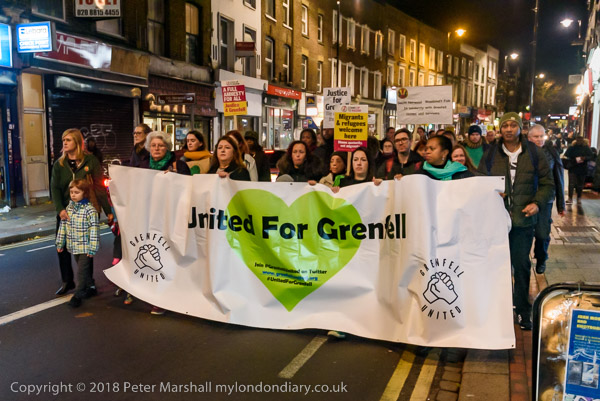
The SNTB decided to organise a march to show community solidarity with the people of Grenfell as well as there disgust at the burning of the effigy, contacting the Grenfell victims group, Grenfell United to gain their approval for a march in SOuth Norwood to be held at the same time as the silent march of remembrance in Notting Hill on the 14th of every month.

Several hundred came to the start of the march outside Norwood Junction station, mainly from the local community, but with others from some distance who had been shocked and saddened by the video which was posted of the burning model tower. The start of the event was shown live on ITV News with an interview with Jane Nicholl of the SNTB and Sandra Ruiz from Grenfell United who had brought one of their banners.

Notably missing from the march were any members of the South Norwood Conservative Club, to which several of those areested belonged; the club does not appear to have made any public comment condeming or disassociating itself from their behaviour.

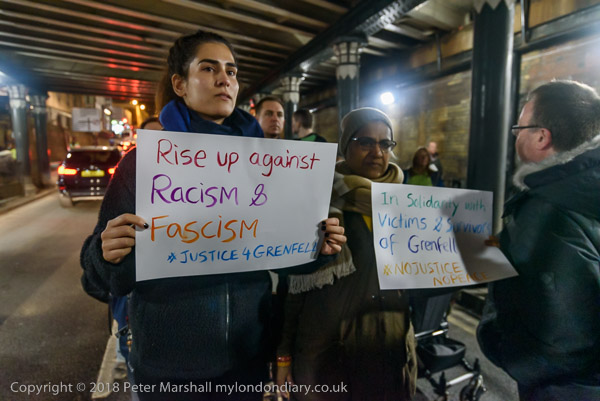
The march went in silence through the main streets of SOuth Norwood to a short rally outside South Norwood Leisure Centre where there were short final speeches from Jane and Sandra, before most of us went for a free cup of soup provided by the nearby The Portland Arms, and I went in for a drink with friends before catching the three trains to take me home.

South Norwood stands with Grenfell

______________________________________________________
There are no adverts on this site and it receives no sponsorship, and I like to keep it that way. But it does take a considerable amount of my time and thought, and if you enjoy reading it, a small donation – perhaps the cost of a beer – would be appreciated.

My London Diary : London Photos : Hull : River Lea/Lee Valley : London’s Industrial Heritage

All photographs on this and my other sites, unless otherwise stated, are taken by and copyright of Peter Marshall, and are available for reproduction or can be bought as prints.

To order prints or reproduce images

________________________________________________________