Swansong

Another blog ends, along with that of Lens I wrote about yesterday.

I was very sorry to read that David Secombe has written his last post for ‘The London Column‘, a blog I’ve occasionally read over the years and which has featured the work of several people I know, mainly photographers. It’s “Pictorial reports from the life of a city 1951 to now” began in 2011 and they make some interesting reading, featuring “contributions from some of the best writers and photographers from the past sixty years“.

Swansong, published a couple of weeks ago, but which I only came across yesterday, takes a look at the work of Marketa Luskacova, with her pictures from Spitalfields in the late 1970s and early 80s along with her earlier pictures of middle-European pilgrims and the villagers of Sumiac, a remote Czech hill village, both of which featured in her show which closed last Sunday at Tate Britain.

It’s a show I mentioned on >Re:PHOTO in February, though really only in passing, in a piece mainly about the anti-Brexit SODEM protesters. In it I wrote:

‘Finally arriving at Tate Britain I had to find the show, which wasn’t easy – the gallery does really need to look at its signage. Finally I asked one of the gallery staff who didn’t really know but gave me a map and pointed in roughly the right direction. The show does continue until May 12th 2019, so if you start now there is some chance of finding it by then.’

This was echoed at the start of Secombe’ post:

‘Anyone staggering out of the harrowing Don McCullin show currently entering its final week at Tate Britain might easily overlook another photographic retrospective currently on display in the same venue. This other exhibit is so under-advertised that even a Tate steward standing ten metres from its entrance was unaware of it.’

But Secombe goes on to write at some length about Luskacova’s work, around eight well-chosen examples, concluding with the statement “It seems appropriate to close The London Column with Marketa’s magical, timeless images.”

So far as I can recall, I’ve never met Secombe, though we share many interests and his ‘Blogroll’ is largely of web sites which I visit at least occasionally and I’m sure we must have at least occasionally found ourselves at some of the same places at the same time. I do hope that he keeps the site online, as there is much on it that remains of interest.

Keeping up a blog like ‘The London Column’ takes a lot of time and effort – as does this one, and even more so, My London Diary (a blog in spirit though all my own website code, started back when blogs were in their infancy) I’ve often thought about bringing both to an end, but while this still gets a few thousands of readers everyday it seems as useful a way of spending my time.
Right to Return

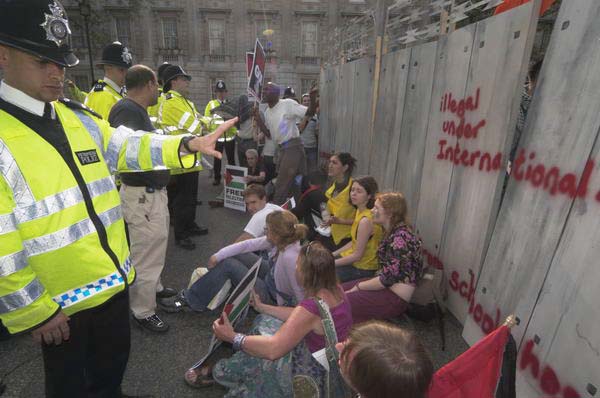
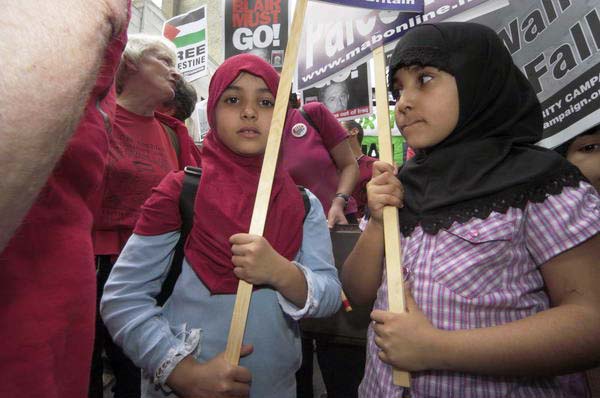
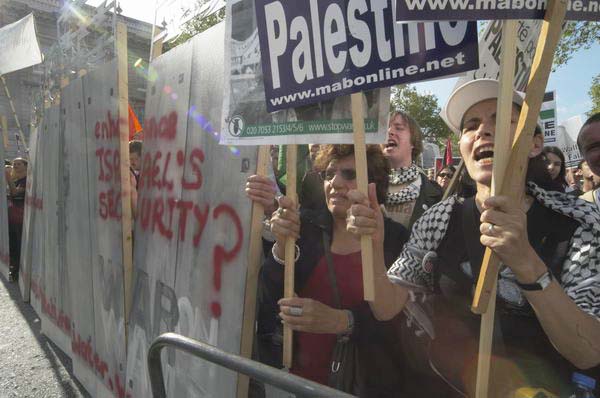
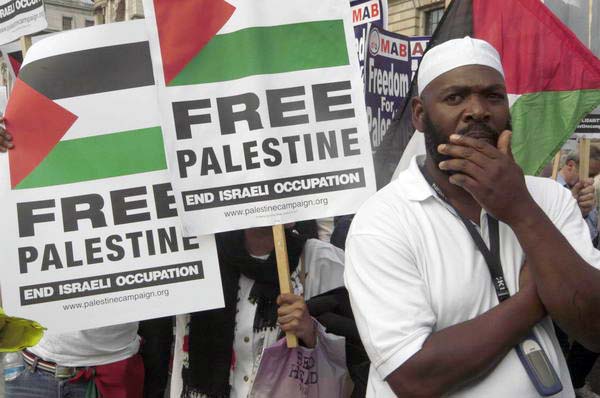
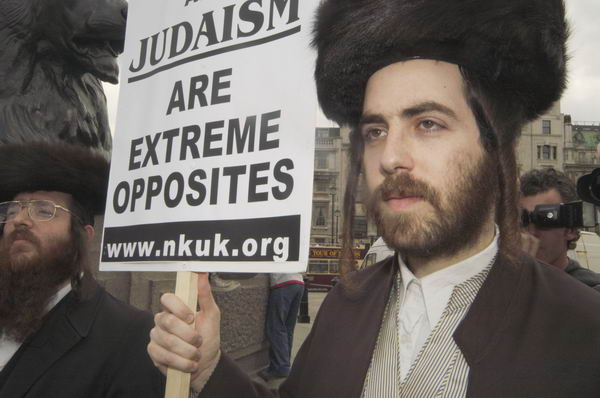
This Saturday I’ll be attending the National Demonstration for Palestine taking place in London, one of many demonstrations over Palestine I’ve attended over the years.

Unlike protesters in Palestine, those of us taking part in the London protest will not face live fire by Israeli Defence Force snipers, who as well as protesters, incluidng women and children, have also killed clearly identified journalists and medical staff, though there will probably be the usual small group of Zionists coming to shout messages of hate.

The pictures here come from the first year that I worked at a protest about Palestine using only digital cameras rather than film, in 2004. That year the protest highlighted the wall being built along the border.

Back in Palestine, the situation has got much worse since 2004, with much of Gaza having been destroyed, and a seige in place which prevents vital supplies coming in. Only last weekend hostilities erupted again, with rocket attacks from Gaza and Israeli air raids resulting in the deaths of at least 25 Palestinians and four Israelis. Among those killed in Gaza were a four-month old baby girl, two pregnant women and a 12 year-old boy.

Taking photographs of protests in London is of course a fairly safe occupation, but many photographers risk their lives to cover events such as the protests in Gaza.

Mustafa Hassona is a freelance photographer from the Gaza Strip, working with Anadolu Agency has been covering the weekly ‘Right to Return’ protests which have been taking place since May 30th 2018. You can see his remarkable work on Lensculture.


There are no adverts on this site and it receives no sponsorship, and I like to keep it that way. But it does take a considerable amount of my time and thought, and if you enjoy reading it, a small donation – perhaps the cost of a beer – would be appreciated.

My London Diary : London Photos : Hull : River Lea/Lee Valley : London’s Industrial Heritage

All photographs on this and my other sites, unless otherwise stated, are taken by and copyright of Peter Marshall, and are available for reproduction or can be bought as prints.

To order prints or reproduce images


Cold spell – no heating

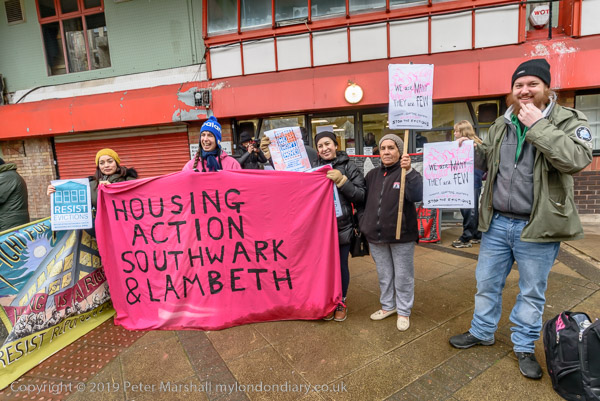
Southwark are perhaps the worst of London’s councils so far as their housing policies are concerned, though they face stiff opposition from others. But their demolition of the Heygate estate next to the Elephant & Castle is hard to beat for its combination of lies, total disregard for residents, loss of social housing, veniality and sheer incompetence and has been well-recorded on local blogs. It is a truly sad story for any local council, and particularly for a council dominated – as most of London’s councils are – by the Labour party, which currently holds 49 or the 63 seats with the only opposition being the 14 Lib Dems.

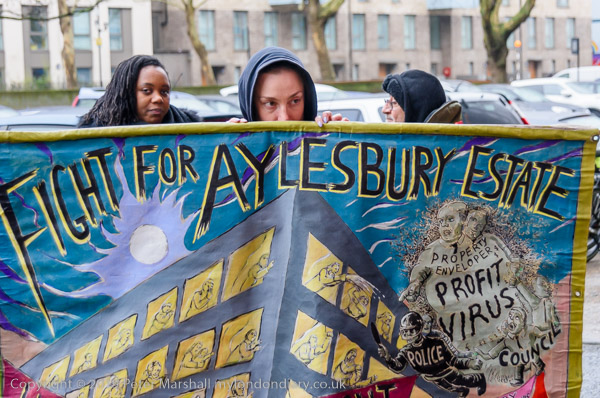
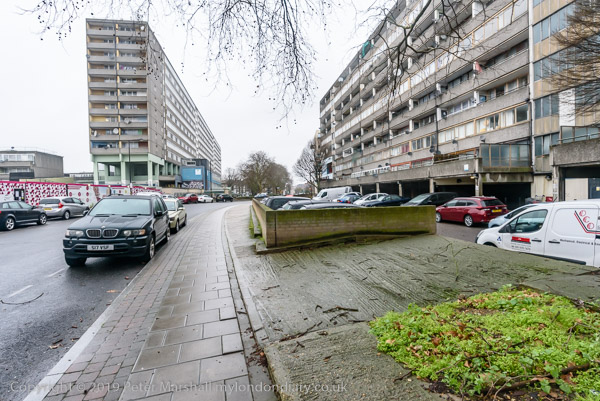
The Aylesbury estate is more or less immediately south of the former Heygate in Walworth, and is said to be the largest public housing estate in Europe, with 2700 homes built between 1963 and 1977. It contains a mixture of huge blocks like those in the picture below and much smaller and lower ones. Residents turned down a plan to pass the estate over to a housing association in 1999 and in a later ballot turned down Southwark’s plans for demolition, calling instead for the much cheaper minor works needed to refurbish each property up to modern standards.

Throughout the 1980s and 1990s Southwark Council had failed to carry out much necessary maintenance, and although the varied properties were generally well designed and built, the estate was allowed to deteriorate. Like the Heygate it was also used to house people with various problems including mental health and drug use and gained a notorious reputation, very much exaggerated by its use for filming a number of TV crime series.

The lack of proper maintenance has continued into this century, and residents feel it has worsened since the council made the decision to demolish the estate, parts of which have already been emptied and destroyed, to be replaced by properties at expensive market rents or the unaffordable ‘affordable’ rents at around 80% of market rates. Few of the Aylesbury residents can afford to take up any of the new properties, and are forced to move to the outer areas of London.

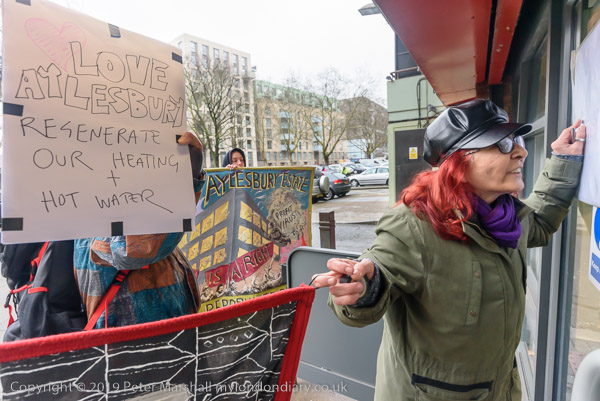
The Aylesbury was built with a central boiler house to run an energy-efficient district heating scheme. Because of the council’s failure to properly maintain this, there are repeated breakdowns in cold periods of winter such as that we had just been suffering. Residents either freeze or rely on expensive electric heating. One of those who spoke told how she had put £20 into her prepayment meter only for it to run out a day later; another told of having reported the heaters in her flat for six months without the council coming to maintain them.

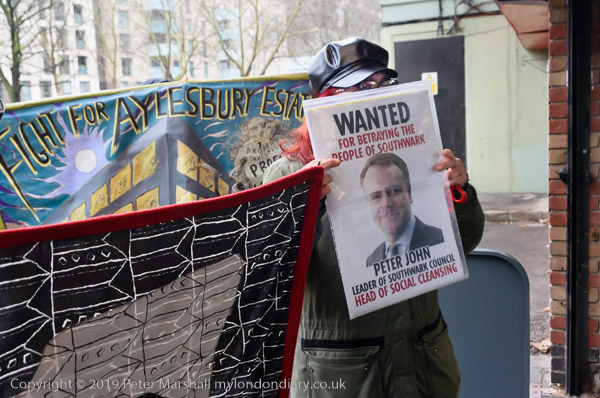
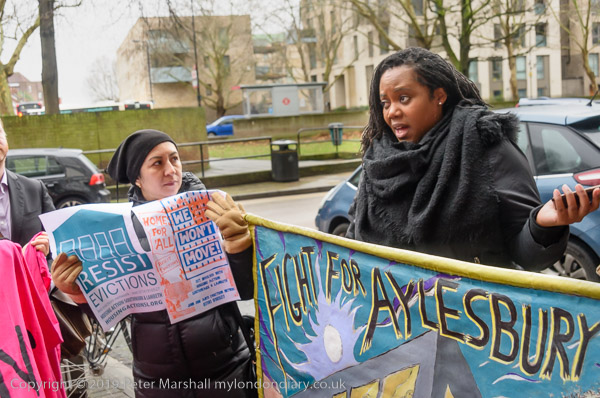
Residents are convinced that Southwark council have been purposefully neglecting their well built homes to justify the demolition of the estate and bully the residents out against a ballot result which called for refurbishment rather than demolition. They protested outside the local housing office for over an hour, calling for someone from the council to come out and speak to them. No one came out and security men prevented the protesters from going inside.

Southwark Council claimed in a statement to a regional TV programme which covered the protest that they were doing their best to keep the heating going, but no-one on the Aylesbury believes them.

More at Aylesbury residents protest lack of heating


There are no adverts on this site and it receives no sponsorship, and I like to keep it that way. But it does take a considerable amount of my time and thought, and if you enjoy reading it, a small donation – perhaps the cost of a beer – would be appreciated.

My London Diary : London Photos : Hull : River Lea/Lee Valley : London’s Industrial Heritage

All photographs on this and my other sites, unless otherwise stated, are taken by and copyright of Peter Marshall, and are available for reproduction or can be bought as prints.

To order prints or reproduce images


Black Day

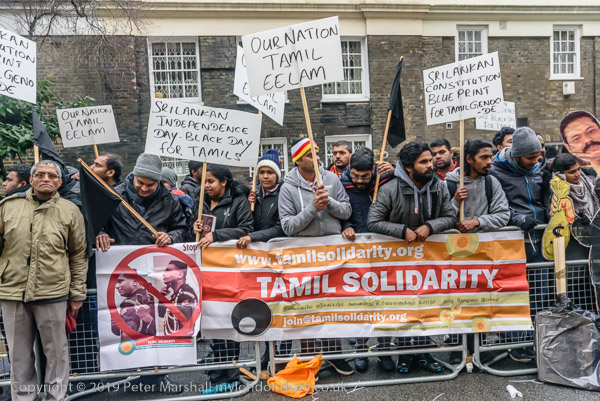
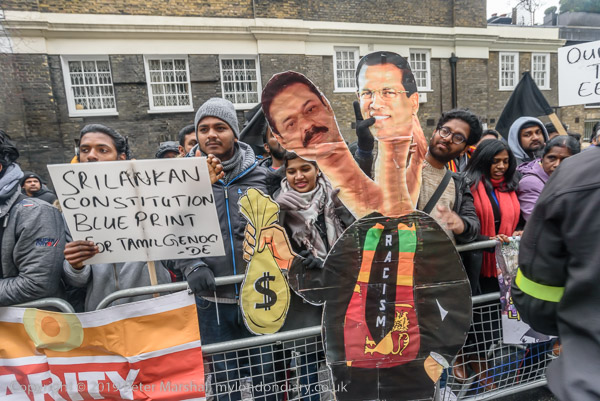
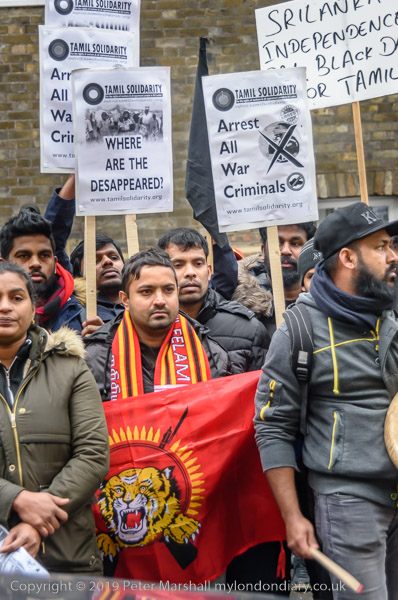
Tamils have little to celebrate on Sri Lankan Independence Day following their catastrophic defeat in the civil war, brought to an end after 26 years of fighting with the defeat of the Tamil Tigers in 2009.

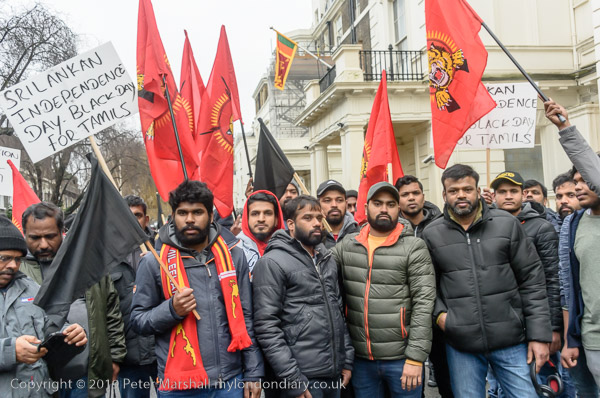
As a placard states, this is a ‘Black Day for Tamils’. Sri Lanka got its independence from British rule as Ceylon on 4th February 1948, with a government including prominent Tamil leaders. But in 1956 S W R D Bandaranaike became prime minister declaring himself “defender of the besieged Sinhalese culture” and made Sinhalese the only official language of the government greatly heightening the tension between the Sinhalese and Tamil communities, whose language and culture was under threat. When Bandaranaike tried to soften his approach to avoid the conflict, he was assassinated by an extremist Buddhist monk in 1959.

Increasing conflict between the two ethnic groups led to the formation of the Liberation Tigers of Tamil Eelam in 1976, calling for an independent Tamil state, Tamil Eelam, in the north and east of Sri Lanka. Intermittent clashes developed into a full-scale civil war in 1983. The LTTE as well as conventional fighting also carried out suicide bombings and assassinations and was designated as a terrorist group by many countries, including the UK, where it remains a proscribed organisation.

Since the end of the war efforts at peace and reconciliation appear to have been rather half-hearted, and attempts to bring war criminals to justice have been prevented by the Sri-Lankan government.

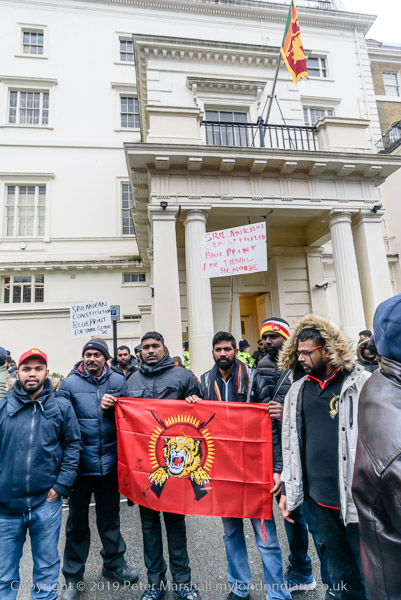
The LTTE adopted a flag showing a tiger jumping through a circle of bullets, with crossed black bayonets on a red background, with their name on it, and in 1990 a version of this without the English and Tamil text was adopted as the national flag of Tamil Eelam. Though banned in Sri Lanka it is widely used by Tamils at protests abroad, and though some feel its association with the LTTE makes it illegal in the UK, the police seem to be decided against attempting to take action which would probably fail in the courts.

It was a dull and damp morning in London, and I only stayed around an hour at the protest outside the Embassy in a Bayswater backstreet before leaving for another event in South London.


There are no adverts on this site and it receives no sponsorship, and I like to keep it that way. But it does take a considerable amount of my time and thought, and if you enjoy reading it, a small donation – perhaps the cost of a beer – would be appreciated.

My London Diary : London Photos : Hull : River Lea/Lee Valley : London’s Industrial Heritage

All photographs on this and my other sites, unless otherwise stated, are taken by and copyright of Peter Marshall, and are available for reproduction or can be bought as prints.

To order prints or reproduce images