Milton Rogovin

For images by Rogovin, open a new window on the Rogovin website while reading this essay.

New York Origins

Milton Rogovin‘s parents, Jacob and Dora, were Lithuanian Jewish immigrants; Jacob had arrived in New York in 1904 and Dora came the following year with their year old baby Sam, and they set up a shop selling household goods on Park Avenue in New York’s Harlem. Their second son was born in 1907, followed in 1909 by Milton. His first language and that of his family was Yiddish.

Business started to get tough after the First World War ended in 1918, and in 1920 the family and shop moved to Bay Ridge in Brooklyn, but Milton travelled in to Manhattan to attend Stuyvesant High School. From there he went on to Columbia University where he qualified as an optometrist in 1931.

By then the depression had hit, the family store had gone bust, and his father died of a heart attack four months before he graduated. Work as an optometrist in New York was hard to find and sporadic. In 1938 he moved to Buffalo to take a job there where there was more opportunity.

Politicisation

The depression and his own experiences, particularly the failure of the shop and his father’s death made him become politically active, and he helped to set up the Optical Workers Union in New York City. He continued his union activities after moving to Buffalo, losing his job there in 1939 when he picketed two of his boss’s offices.

He had met Anne Snetsky (later Setters) at a wedding in Buffalo in 1938, where they argued about the Spanish Civil War – he was highly concerned while she was then indifferent to the cause – and fell in love. They were to remain life-long lovers and comrades until her death in 2003.

With Anne’s encouragement and the support of the union, he decided to set up in practice as an optometrist on his own, on the edge of Buffalo’s deprived working-class Italian Lower West Side.

War Years

Anne and he got married in 1942, which was also the year Rogovin bought his first camera. Later in the year he volunteered to serve in the US armed forces, training as an X-ray technician before being assigned to serve as an optometrist. During his training he entered and won a photo contest at the training school with a picture of a waterfall taken on his new camera.

In 1944 he was posted to a hospital in Cirencester in the west of England, until the end of the war in Europe.

Back In Buffalo

After war service, he returned to Buffalo, where his brother (also an optometrist) had been keeping the practice running, and they worked as partners. He continued his political activities, becoming the librarian for the local communist party, as well as being active in the union, taking part in encouraging black voters to register and other political campaigns.

Mexico
Rogovin and Anne made their first visit to Mexico in 1953, where they met a number of left-wing Mexican artists and then and in subsequent visits over the next four years he made a number of photographs there.

He was by this time developing a greater interest in photography, showing pictures in the annual Western New York Exhibition at the Albright-Knox Art Gallery in Buffalo in 1954 and 1958.

Red Scare: “The Top Red in Buffalo”

Cold-war hysteria in America was growing, and in 1957 Rogovin was summoned to appear before Senator Joseph McCarthy’s House Un-American Activities Committee. Rogovin invoked his constitutional right to refuse to testify rather than cooperate in any way, but became the subject of various newspaper headlines which labelled him as ‘Buffalo’s Top Red.’

In the following months his business fell off dramatically; some who thought of themselves as loyal Americans wanted nothing to do with ‘Commies’, while others felt that they too might suffer from similar smears if they continued to associate with him.

Many photographers and other artists also suffered from McCarthyism. The New York Photo League, the most important and vital photographic organisation of the era – one that changed the history of photography and had many leading photographers as members (and to their credit others joined to try and protect it after it had been named) – was forced to close. Paul Strand chose to leave America and live in France to avoid the persecution. Any American who dreamed there could be a better and more equal future was open to attack.

Store Front Churches

Rogovin was left with time on his hands as the business collapsed. William Tallmadge, a friend and professor of music at Buffalo State University, was recording music at one of Buffalo’s Afro-American Holiness Churches and invited him to come along and photograph.

The experience decided him to dedicate his life to photography. Progressive political activities had become virtually impossible in Buffalo and he felt his “voice was essentially silenced, so I decided to speak out through photographs.”

After working with Tallmadge for three months, he continued to photograph in Afro-American churches in Buffalo for the next three years, learning the skills that he needed. He went on a two week workshop with Minor White, who showed him how to use the bare-bulb flash technique that he continued to work with for the rest of his career, and worked out how to photograph black faces in a way that achieved proper gradation with their darker skin tones.

White also gave him advice on shutter speeds, suggesting that rather than use 1/125th which had the effect of freezing the movement of his subjects, he should use a slower speed, perhaps 1/25th, which would give a slightly more dynamic quality where there was some movement.

His approach when photographing people was simple and straightforward. He would ask permission to take their picture, set up his camera on its tripod and let them decide how to pose. The only thing he would ask them was to look at the camera – he liked to see their eyes – as was perhaps natural for an optometrist. The camera meets the gaze of the subjects, giving his work a powerful directness.

Minor White was a great supporter of his work, and published pictures from the project in his magazine, Aperture, getting W E B Du Bois, one of the founders of the NAACP (National Association of the Advancement of Colored People) to write an introduction.

Family of Miners

Rogovin was not making money from his pictures at this time. Fortunately Anne was still able to carry on with her teaching in special education and support the family and his work, as well as helping him in developing his projects.

In 1962, they read about the problems in the coal industry and in particular for Appalachian miners, with declining production as the car industry leading to lower demand for coal. As well as increasing unemployment there were also the health problems faced from working under appalling, dusty conditions underground, with most or all eventually succumbing to silicosis.

A letter to the mineworkers union president got them an introduction to the union office in West Virginia, and during Anne’s summer break they travelled there to see and photograph the workers. They were to return for the next eight summers to continue the work.

In 1981 he began a larger project which he called ‘Family of Miners’, starting again in the Appalachians. The following year there was a show of his work on the store front churches and working people in Paris, and he came and photographed miners in the north of France, then in 1983, support from the Scottish miners union enabled him to photograph miners in Scotland.

In 1983, he received the W Eugene Smith Award for Humanistic Photography and was able to extend his work on miners to other countries, eventually including China, Cuba, Germany, Mexico, Spain and Zimbabwe

Neruda and Chile

On 1967, Rogovin sent a letter to the great Chilean poet, Pablo Neruda, requesting his help in producing a series of photographs of the people and the country with Neruda’s writing. Some of the pictures were published in the Czech Revue Fotografie in 1976 later the project was published as ‘Windows that Open Inward‘ including poems by Neruda.

Lower West Side

By 1970, Rogovin was deliberately cutting down his remaining work as an optimetrist to spend more time on photography. However it was not until many years later, around 1978, that he was able – with family support and his wife’s income – to give this up to be full time as a photographer.

His next major project began in 1972, when he decided to document the Lower West Side. The Italian population there when he moved to Buffalo had moved out to wealthier areas, and had been replaced by Puerto Rican and African-Americans. It was now an area with high levels of crime, drugs, alcoholism, prostitution and high unemployment.

At first people there were very suspicious of a white guy with a camera, regarding him as a spy sent by the police or other authorities. With the help of Anne, he slowly get to know people and gain their trust, enabling him to photograph them in their homes as well as in public.

When he took his Hasselblad and set it up on a tripod, he noticed that people came up to him and asked him how much it had cost. He took the hint and decided it would be more sensible to use his old Rolleiflex instead – and it was his preferred camera from then on, used for most of his best pictures.

The Rolleiflex – like the Hasselblad – has a focussing screen on the top of the camera, requiring the photographer to bow his head to look down at it. This reverent attitude towards the sitter contrasts with the more aggresive direct view, aiming at the person with an eye-level viewfinder. It reflected his attitude to those he photographed.

Three years of work in the Lower West side led to his first major exhibition, at the Albright-Knox Art Gallery in Buffalo. He organised a smaller show in the Lower West Side itself with buses to the gallery so that those he had photographed and their friends would see the work.

He returned to photograph there in 1984-6, at Anne’s suggestion producing ‘Lower West Side Revisted‘ which pairs these pictures with the work a dozen or so years earlier in diptychs. He managed to locate over a hundred people he had photographed previously – and found many had the pictures he had made hanging proudly on their walls.

Following his recovery from surgery for a heart problem and prostate cancer, again prompted by his wife he returned again in 1992-4, again photographing the same people thus producing some outstanding triptychs taken over a 20 year period, showing them at radically different stages in their lives. These produced the book ‘Triptychs: Buffalo’s Lower West Side Revisited‘ (1994.)

By 1997, cataracts in both eyes and fading sight forced Rogovin to sell his camera and shut up his darkroom. But being unable to photograph was too frustrating and he had surgery in 1999, which restored his vision, and he bought back his camera.

In 2000, with Anne and broadcaster Dave Isay, he returned to photograph in the Lower West Side for a fourth time. They managed to find 18 of his original subjects and photograph them to produce a series of ‘Quartets’. Isay had worked with photographer Harvey Wang, who produced the award-winning documentary short film ‘Milton Rogovin, The Forgotten Ones‘ (2003.)

Workers

In 1976, inspired by a Bertolt Brecht poem, ‘A Worker Reads History‘ he began to photograph workers at the steel mills and car factories around Buffalo.

A picture of a steel worker and child feeding ducks outside their home published in the Illinois Historical Society journal led him to extend his work. When he had photographed someone at work, he would go back with a print and a request to photograph them at home with their families. His workers are not just workers, not just a small cog in the machine of production, but people, individuals with their own lives outside of work.

In 1987, he returned to photograph these people again, now out of work, as steel production had ended in the area.

In 1993, his book ‘Portraits in Steel‘ was published, with interviews of the subjects by Michael Frisch.

Working Methods

Working with 120 roll film, Rogovin could make 12 images on a roll, and to keep costs down he usually fitted three or four people or groups onto each roll, taking only 3 or 4 frames for each of them.

He did all his own darkroom work, developing the film and them contact printing it to choose which of the frames to enlarge. The Rolleiflex (and Hasselblad) produce 6×6 cm negatives (actually around 56mmx56mm) making the contacts easy to assess. Normally he would chose at least one image of each person and print it carefully, dodging and burning as required to bring out the most from the negative, to make sure that he had a good picture to give to the subject.

The bare bulb technique is a good method of getting fairly even light in small rooms. As its name suggests, it uses a bulb holder with a bulb but no reflector, so that light is given out in all directions more or less evenly. Shooting as he usually did in small rooms, this produced in a lot of light bouncing from walls and ceilings as well as some direct illumination.

Special flash guns or slaves can be bought for bare bulb use, or you can get bare bulb effects from an ordinary flashgun by using an attachment – a large translucent bulb on the front of the flash. You do however need a fairly powerful flash as the light, being spread out is considerably less intense than with a normal directional flash.

Rogovin worked almost entirely in black and white. He decided that colour was a distraction that took people’s attention away from the subject and into thinking about the colour of the clothes or surrounding objects.

Colour would of course have added considerably to his costs and to the complexity of the processing and printing. Black and white is very much more straightforward to process and print yourself, while colour is generally best handled by machine rather than hand processing.

Influences on his Work

Although Rogovin was aware of documentary photography and was a friend of Paul Strand, as well as having respect for the work of photographers such as Lewis Hine, Walker Evans and Margaret Bourke-White, he has said that his major influences came not from photography but painting, and in particular the work of Goya and Kâthe Kollwitz.

It is perhaps hard to understand this, looking at the very photographic quality of his work. Of course the paintings may interest him more and inspire him to get out an make images, but the forms that these take are rather more clearly based on the photographic sources.

One particular film by Luis Bunuel, ‘Los Olvidados‘ (1950) did have an important impact, and is reflected not just in the title of his book ‘The Forgotten Ones’ (he liked it so much that he actually used the title for two books, the first in 1985, and then in 2003), but in a devotion throughout his working life as a photographer to photograph ordinary people rather than the rich and famous. In its concern for ordinary people and their often forgotten lives his work obviously resembles Bunuel’s film, but it lacks the surreal symbolism which is central to Bunuel’s vision.

Peter Marshall, 2007

Other web links on Milton Rogovin, some of which provided information for this feature:

Milton Rogovin web site
Library of Congress: Milton Rogovin
Luminous Lint – Milton Rogovin
N Y Times A Sympathetic Lens on Ordinary People
NPR: Milton Rogovin
Afterimage: Robert Hirsch Interview with Milton Rogovin
The Forgotten Ones (book – with pictures on line

Photographers’ Rights

When I was in Poland recently, I attended a meeting about the setting up of the Association of Polish Art Photographers, and my ears pricked up when there support for ‘Photographers’ Rights‘ was mentioned. I was a little disappointed to find out that they were largely concerned about copyright.

Copyright it a battle that photographers won many years ago, and our rights are generally clear and enshrined in international conventions, and even recognised in similar laws in most of those countries that have little truck with international conventions – such as the United States. Of course these are rights that need continual defence against rights grabs both direct by the big corporations and indirectly by them through the promotion of ‘orphan rights‘ and other similar proposals I’ve written about in the past.

Of course photographers often have skirmishes with individual organisations that use our work and somehow neglect to pay for the right to do so, and there are well-publicised cases of photographers who have made many thousands of pounds, often from just a few days of chasing up such abuse. Last year I made several hundred pounds myself, although mostly my work is used without permission by people with no funds to chase.

So copyright is essentially sorted, though vigilance is vital to keep it so. What interests me more are moral rights. Since I keep on coming across photographers who have no idea what moral rights are, I’ll explain them below, but unfortunately I have to start by saying that the UK 1988 Copyright Act, while introducing them, did so more or less to say that most publications – newspapers, magazines, yearbooks etc – could ignore them. News photographs were also specifically excluded from protection under the Act, and they do not exist for work which you did for which you were on a company payroll (but as with copyright will be yours if work was commissioned from you.)

Of course, where you are able to set a contract for the use of your work, such rights can be included in the terms of the contract, and certainly Magnum was set up in part to make sure that this was done.

Most Moral Rights, unlike copyright, also have to be asserted, by means of a suitable statement associated with the work – either on the work itself or in a contract or agreement for the use of the work (see below.) They also attach uniquely to the creator of the work during his/her life. Unlike copyright you cannot assign moral rights – although you can waive them by a written signed statement (read the small print on any contracts carefully, and cross out any such clauses if you can.) But while you are alive, no one else can claim them, whatever you sign. You can assign them in your will – and if you fail to do so, those you have asserted will automatically pass to whoever holds the copyright in your work.

So what are the moral rights that apply to photographers?

  • Attribution: the right to be identified as the maker of the work – to have your name clearly shown wherever and whenever the work is used.
  • Integrity / No Derogatory Treatment: the right not to have your work treated in a derogatory fashion – for example by cropping, distortion, additions or deletion.
  • No False Attribution: this right exists without the need to claim it, and covers the use of your name with work you did not create.

A further moral right which also concerns photographers is that of privacy. This restricts your use of pictures you have been commissioned by persons to produce which are of a personal or domestic nature. If you wish to show or use such commissioned work you should ensure you have written permission to cover your usage – a suitable model release.

IANAL – I’m not a lawyer – and if you want to use law you should take legal advice. But if you simply want to assert your moral rights, a statement such as ‘Peter Marshall asserts his moral rights as the creator of this work according to the Copyrights, Designs and Patents Act, 1988′ is probably sufficient.

Any newspaper will of course provide copious examples of photographs were the moral rights of photographers are ignored (and of course even though the law does not make them enforceable, moral rights still exist.) I’d like to see a concerted effort by photographers to get all publications to recognise at least some of the moral rights of the people whose pictures they use.

We should start by demanding attribution. When dealing directly with publications I always do so; some photographers I know have a policy of asking for a payment of twice there normal rate if work is not attributed.

I’d also like to see a campaign to attack a different mode of false attribution, where images taken by photographers are credited simply to agencies. Getty, Corbis, Reuters, Alamy etc never took a photograph, and, except with older work where the name of the photographer was not recorded, I’d like to see the photographer’s name always given along with the agency.

Bielsko-Biala

You have just missed one of the world’s best photo festivals (although the exhibitions remain open until Sunday.) I’m not actually sure I should tell you about it, because it was already standing room only for at least one session, and part of what makes it so great is it’s manageable size. If you all come for the next one it may not be the same!

I first heard of Bielsko-Biala when I was invited to show work at the first FotoArtFestival there in 2005. I hate to travel. I’ve even refused jobs on the grounds that I couldn’t get there on a Zone 1-6 London Travelcard. Before then I hadn’t been on an airliner since I was about 15 – and then only on a tour of the workshops at London Heathrow where my eldest brother then worked (and I suspect it was a DC-3.) I started taking my ‘carbon footprint’ (not that we called it that then) and energy use seriously in the late 1960’s, when I was “a friend of the earth before the earth had friends” or at least before the organisation was set up here in the UK.

Two names made me decide to bend my principles sufficiently to make the trip to Poland as well as sending work there. I wanted to meet Eikoh Hosoe and Ami Vitale.


Gunars Binde, Eikoh Hosoe, Ami Vitale and Peter Marshall. Photo by Jutka Kovacs

I also wrote about many of the other fine photographers I met there, including Stefan Bremer Gunars Binde, Sarah Saudek, Pilar Alabajar, Shadi Ghadirian, Lars Tunbjork, Bevis Fusha, Ali Borovali, Obie Oberholzer and Vasil Stanko for ‘About Photography‘, and although those features are no longer on line there, you can find them on the ‘Wayback Machine‘ along with those about photographers unable to come to Bielsko, such as Joachim Ladefoged and Boris Mikhailov, and Mario Giacomelli, who of course died in 2000. One curious feature of many of the pages on the Wayback machine is that my photograph is replaced by that of the current guide.

This year’s FotoArtFestival also brought a range of stars to Bielsko-Biala, including Sarah Moon, Misha Gordin and the author of one of the best-known histories of photography, Naomi Rosenblum. The outstanding show for me was Walter Rosenblum‘s ‘Message from the Heart‘ and I had the privilege of visiting it together with Naomi and his daughter, the film-maker Nina Rosenblum. A screening of her film about her father was another highlight, despite some technical problems. I was there to give a presentation, which included some of my own work as well as images by John Benton-Harris and others who have photographed on the streets of England.
At the moment I’m still exhausted from my trip there and the journey home, and still writing up my memories and processing the images I took there on my highly pocketable Fuji Finepix F31fd. Even though these are only jpegs, it is still worthwhile importing them into Lightroom and adjusting as if they were raw files. The difference can be astonishing, and it somehow seems to result in less degradation than similar processing in Photoshop or other image-processing software.

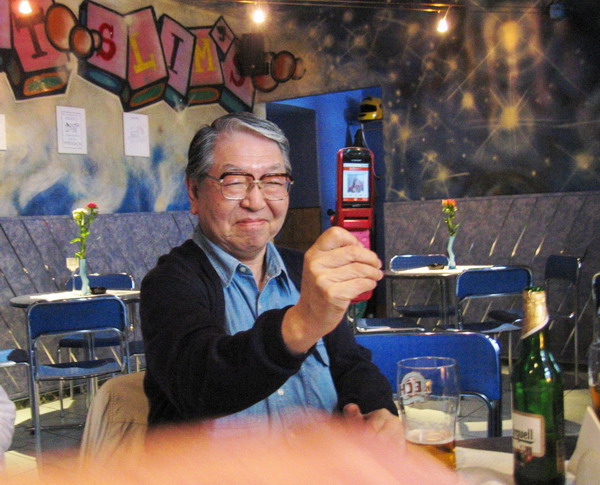
The F31fd may not be as good as the Nikon D200, but it is considerably easier to carry! And if a pink phone was good enough for Eikoh, then I think I can manage with it for things like this.


Eikoh Hosoe photographing in Alcatraz, Bielsko, Poland

Much more later!

Peter Marshall

Helen Levitt – Street Colour

Jim Casper‘s Lens Culture has long been one of my favourite sites, and each new issue brings much of interest. One of the highlights among the latest on-line issue is a set of 24 images, some in colour, by that doyenne of street photography, Helen Levitt, now in her 90s. Work by her from seven decades, starting in 1938, is on show at the Fondation Cartier-Bresson in Paris until 23 December 2007 (if you read French it is worth downloading the press PDF from the site.)

Levitt was a pioneer in the use of colour, with Guggenheim fellowships in 1959 and 1960 to explore its use in her work. Unfortunately most of these early transparencies were stolen by a curiously selective burglar (who apparently took little else) in 1970, and have not been seen since. But in 1974 she had the first showing of colour photography at New York’s Museum of Modern Art, ‘Slide Show‘, organised by John Szarkowski, some two years before William Eggleston‘s work was shown there.

Levitt is noted for not talking much about her work, but there are several interesting interviews on-line, including (as Lens Culture also mentions) a NPR feature with some clips of her talking.

More About Helen Levitt

You can see images by Helen Levitt on Lens Culture and at the links above. There are some further links to sources and images at the end of this feature.

Helen Levitt was born in 1913 in Brooklyn (many sources give the date incorrectly as 1918); in 1931 she quit school and started working for a portrait photographer in the Bronx, where she received a good technical grounding.

In 1935 she met and saw the work of Walker Evans and Henri Cartier-Bresson; Evans she thought was “brilliant” but Cartier-Bresson was a “genius”. It was their impact that decided her to become a photographer, and in 1936 she bought her first Leica. She went with Cartier-Bresson on at least one occasion as he photographed in New York. From him she saw that photography could be art, and determined that she would be an artist with a camera. This led her to spend time studying paintings in New York’s museums, learning from them lessons about composition, and the use of light which have a powerful influence on her work.

In New York, the prevailing tradition of photography was that of the New York Photo League, documenting the people of the poorer working class areas. Levitt also learnt from this and her subject matter was also the people of the working class areas of New York, particularly Spanish Harlem and the Lower East Side. Here in the late 1930s she found life still being lived in a vivid way on the streets, especially on hot summer days when it was too hot for anyone to stay inside. This was an era before air-conditioning and television, and she found the streets crowded with children playing who became her main subject and she photographed them with warmth and humour.

As well as the children themselves, Levitt also saw and photographed their drawings. In an age before the spray can, the streets and walls were filled with chalk drawings, often – as with modern graffiti – of striking energy and originality.

In 1938-9 she became assistant to Walker Evans, and also met the writer James Agee, who would later work with her on her first book, ‘A Way of Seeing’, not published until 1965. Unlike Cartier-Bresson, Evans believed strongly in the need to crop images to make stronger compositions, and Levitt learnt from his practice.
She went with Walker Evans when he was taking his series of subway portraits using a camera hidden under his coat, sitting with him so that he was less obvious. These pictures were only published as a book many years later, ‘Many Are Called‘ (1966.) In some of her own Levitt also took pictures of people who were unaware of being photographed, at times using a mirror device photograph at right angles to the direction in which she was apparently shooting. This was particularly important in some of her pictures of children playing, enabling her to capture images without distraction.

Levitt’s one major body of work away from New York was made when she went to Mexico in 1941. While there she worked as a film editor with Luis Buñuel. Cartier-Bresson had worked for a year in Mexico in 1933, and his pictures from there were shown in Mexico in 1935, and he had brought them to New York.

In 1943 she had her first one-person exhibition at the Museum of Modern Art in New York (M0MA), curated by Edward Steichen. Although she returned to street photography around 1950, her next solo showing at MoMA was not until over 30 years later, although her work was included in major group exhibits, including Steichen’s ‘The Family of Man‘.

In the years immediately after the war the Levitt and Agee worked together with painter Janice Loeb on the film, ‘In the Street‘, a documentary about everyday life made using a hidden camera on the streets of New York’s East Harlem. All three worked with film-maker Sidney Meyers on the Oscar-nominated documentary about a young African-American boy, ‘The Quiet One‘ (1948).

Two Guggenheim Grants, in 1959 and 1960, enabled her to investigate the use of colour transparency film in her work on the streets. Tragically the great majority of this work was stolen in a puzzling burglary in 1970, where apparently little else was stolen. But Levitt made new colour images to replace the stolen work, leading to a ‘Slide Show’, curated by John Szarkowski at MoMA in 1974, and published as a book in 2005.

In 1991, Levitt’s work was shown at the San Francisco Museum of Modern Art, and she received a Master of Photography award from the ICP in New York. Other retrospectives came at the The Metropolitan Museum of Art, New York, The Boston Museum of Fine Arts, and elsewhere, although it was the use of her pictures in the opening sequences of the 2001 Ken Burns PBS documentary ‘New York‘ that brought her work as “one of the great living poets of urban life” and of the people of New York to a wider audience.

Other Web References

Laurence Miller Gallery
The gallery have represented Levitt for many years.
Stephen Daiter Gallery

Slide Show: Powerhouse Books

Helen Levitt: 10 Photographs,
A lengthy and interesting essay by Thomas Dikant on her career through a detailed study of 10 pictures.

Review of ‘Here and There’ by Sarah Boxer – New York Times
May require registration.

East London Photography Festival: Photomonth

I’ve often written about the lack of photographic festivals in England, and so it is hardly surprising to find that now two come along together.

Photomonth, the East London Photography Festival is now I think in its fourth year, but this year it does seem to have taken off into something rather more significant. I’m not sure how many of the events I’ll get too, but one certainly not to mix is the show at Rich Mix on the Bethnal Green Road, where ‘East End Street‘ includes the work of Paul Trevor.

I first got to know Paul’s work through the magazine ‘Camerawork‘ produced by the ‘Half Moon Photography Workshop‘ set up by Wendy Ewald and based around the Half Moon Theatre in Alie St, just off Aldgate. (Later it morphed into Camerawork.) Indeed it was an exhibition in the theatre foyer there that first really took me into London, and started me photographing there. So you can really blame ‘My London Diary‘ on him!

Paul’s project with the ‘Exit Photography Group‘, ‘Down Wapping’ prompted me to visit Wapping and the group’s ‘Survival Programmes‘, looking at Britain’s inner cities in the late 1970s, is surely the most significant documentary project of the era in any country. Although all three photographers made significant contributions, it is pictures by Paul – such as the opening image of Mozart Street in Liverpool – that provide most of the real excitement in this great body of work.

This is the first show for which Paul has opened up his ‘Eastender Archive‘ although some images are already familiar. I’ve long regarded him as one of the best and most influential photographers in Britain at the time, and one whose work has never really received the attention it deserves from the public, although well-known by other photographers. Unlike some others of the time he hasn’t chosen to seek publicity and ride with the various trends to become the darling of the galleries and curators. But it does look as if, at long last, his work is beginning to get the attention it deserves.

Showing along with Paul is work by Stephen McLaren, who was one of the curators of the rather disappointing show of Contemporary British Street Photography at Photofusion last Summer (his own work was some of the more interesting in the show.) I was one of several photographers who told him that Britain had a great (and continuing) tradition in street photography – including the work of people such as Paul Trevor, of which he seemed at the time (and in the exhibition text) to be blissfully unaware. And when I’d told him, John Benton-Harris, who I think has personally contributed much to the street tradition here since he arrived from the South Bronx, took over and told him too!


London 1975, (C) Paul Trevor, from ‘Cities of Walls, Cities of People’

I showed a half a dozen pictures by Paul some years ago in Clerkenwell in the London Arts Cafe show Cities of Walls, Cities of People, which also included street photography by two old friends, Jim Barron (who sadly died not long after) and Paul Baldesare, although for that show I included some of my own urban landscape rather than street work.

Another familiar name to me is Anna Fox, who is giving the Photomonth lecture, talking on 8 November about her new publication, Anna Fox Photographs 1983–2006 (Photoworks/Impressions
Gallery), coming out in late 2007.

Altogether there are around 50 venues taking part in Photomonth, including Magnum, Host and others around Shoreditch as well as some further east. I have to say much of what is on offer doesn’t particularly excite me, but at least it does seem to be a proper festival in London, even if much of what is in it simply reflects the recent upsurge in photographic spaces in the area covered.

I hope to cover a few of the events in Photomonth over the next few weeks (some don’t start until November), though despite asking to be put on the press list and being promised information, somehow nothing has arrived.

One day, the photography establishment will realise that the web exists and is worth using. Just not yet. Even when I wrote for a site with hits per month in 7 figures it was often hard to get treated seriously as press.

Hereford? Another, rather shorter feature to follow in a few minutes.

Peter Marshall

Nan Goldin’s Mirror on Life

This article started as part of my lecture notes and was added to at the time of Goldin’s Whitechapel Gallery show in 2002, and later a version was published on the ‘About Photography’ web site I was then writing. It has been rewritten in 2007.

For copyright reasons, no images by Goldin are included here. At the end of the article are a number of links to her work on the web, as well as to some other articles about her and several of the other people mentioned here.

Life and Work

The division between photographers’ lives and their work is sometimes but not always important. That we now know a little more about the life of E J Bellocq, where once all we had were his enigmatic but often stunning images from the brothels of Storyville certainly has not altered the way I appreciate his work, and there remain many photographers who I admire but know little or nothing about.

Some of course have provided us much more. Edward Weston for many years wrote what he felt were his intimate thoughts in his day-books, and although he excised some names and passages with a razor blade before allowing Nancy Newhall to edit them, these published diaries still perhaps still tell us more than we need to know about his personal life, fascinating though it may be at times. What he thought about his work is really of more interest, although his writing sometimes seems too arty and full of pretensions to match the directness of his best and most direct camera work.

Weston’s relationships with women – Magarethe Mather, Tina Modotti and Charis Wilson Weston among others – were obviously a vital part of his life and had their impact on his work, which I tried to bring out in my features on him without going into the minutiae of his many relationships. But perhaps these aspects of his titillated his major biographer and others, and distracts them from his work, distorting distort their and thus our appreciation. Landscapes are less sexy than the nude even without the artificial spice of personality journalism, but they may be more profound.

An obsessive record

With Nan Goldin things are different; life and work overlap to the point of identity. As she writes in the introduction to her first book, published in 1986 “The Ballad Of Sexual Dependency is the diary I let people read.” Goldin wanted, or even needed, the camera to become part of her and to “obsessively record every detail” of her life.

Of course the camera can’t oblige. It only offers us glimpses, framed and caught with more or less skill by the person who directs it – and Goldin’s control as a director is remarkable. The glimpses depend on both the technology — lenses, angles of view, depth of field, the film etc — and the plans and decisions of the photographer. These together produce a view of what was there in front of the camera. Photographs are not simply ‘traces’ or some kind of objective replica, but objects that are produced from a particular viewpoint – moral, ethical and judgmental as much as spatial.

Relationships

The taking of a photograph is only one stage of a process. Goldin uses her pictures to tell a story, and in doing so creates her own story. The cover picture of ‘The Ballad Of Sexual Dependency’ (a cropped version of one of the slides from the sequence) shows two people on a bed. Brian, closer to camera, is turned away from it, looking out of the picture to the left. Sitting naked on the edge of the double bed, he smokes a cigarette, detached and apparently deep in thought. A flash to his left, roughly level with his face light it, and also casts the shadow of the brass bed head on the bare wall a few inches from it, as well as catching Nan’s face as she lies awkwardly, head on pillow watching him, anxiously. Her upper body is covered by a black robe from which only her left hand emerges, flat on the sheet, with watch and a gold wedding ring. A golden glow bathes the image, turning everything – Brian’s flesh, the wall – to shades of yellow, orange and brown, the colours of sunset. They are a couple together on a bed, but clearly separate, at different ends, he upright, she horizontal.

It is such a carefully crafted tableaux – and in the un-cropped original, even more clearly so. Looking at this we see how the position of the light draws our attention to the faces of the two people, lighting them and the pillow on which Nan’s head is uncomfortably resting, while casting a shadow behind her and on the lower part of the bed. We also see, staring out at us from the wall a repeat image of Brian, a photograph again with a cigarette, this time dangling from his lip as he gazes intently at camera. The gaze at the camera (and the photographer) in that photograph suggests a quite different relationship from the one we see being acted out in front of us.

As so often in Goldin’s work, this picture combines a remarkable detachment in the creation of the work with a total involvement in the scene she is taking part in. Goldin is always very much a part of her pictures, whether she appears in frame or not. Unlike Diane Arbus, who at times photographed a similar subculture very much as a tourist or an empathetic collector of rare and unusual species, Goldin did not stand and look in; if anyone is a voyeur it is us and not her.

For Goldin, the private – or at least a carefully organised part of it – has become public. This is a picture of a relationship that she had been in for some years and was apparently on the point of breaking up, but we also see that if you wanted to live in Goldin’s life you also had to play her games for the camera.

Death and ecstasy

The book ‘The Ballad of Sexual Dependency‘, (1986) (Ballad), was dedicated “to the real memory of my sister, Barbara Holly Goldin.” Nan Goldin was the youngest of four children in a very middle class family; born in Washington DC, her family soon moved to Maryland. Goldin at eleven was very close to her eighteen-year-old sister and knew about some of the problems she had in reconciling her sexuality with the attitudes of society, problems that led her to lie down on a railway track in front of a train. A few days after the shock of the suicide, and while she was still desperately mourning the loss of her sister, Goldin was seduced by an older man. Within that week she experienced both great loss and pain and was also “awakened to intense sexual excitement.”(Ballad) These two dramatic events shaped the future of her life and her art.

I find it difficult to imagine the position she was in, with these immense emotional pressures coming at an age when I was still in short trousers and being taught that sex was a Latin numeric prefix. Life was not without its traumas, but mine were less dramatic. Goldin was confronted in those sudden and tragic events with forces that most of us become aware of slowly over a period and evolve mechanisms to deal with or repress, and it is hardly surprising that the issues behind them have dominated her work. I don’t share her lifestyle or some of her attitudes, but I admire the honesty and clarity of her approach.

Goldin ascribes her need to take photographs to the death of her sister. The obsession with recording her friends comes from a realisation that although she remembered the things Barbara has said to her, she had lost “the tangible sense of who she was, what her eyes looked like” (Ballad) and she was determined not to let that happen again. Later when many of her friends were suffering from Aids, she had a feeling she could keep them alive if she photographed them enough. Of course what she could and has kept alive is a memory of them, but her photography has kept her alive also.

A new family

Fearing that she might too literally follow in her sister’s footsteps, Goldin ran away from home and its repressive attitudes at the age of fourteen to be able to live in her own way. She drifted through a series of foster homes, eventually ending up in a flat share with half a dozen other disaffected teenagers. These friends became a new family to her, and among them were two people who were to become her greatest friends, David Armstrong and Suzanne Fletcher.

It was here in the summer of 1972 she first took up still photography, although she had already experimented with shooting movies. Her first photographs – and her cine footage – were pictures of herself and her friends dressed up and with heavy make up, posing dramatically as the movie stars of their dreams. Armstrong was her favourite model – he was just discovering drag – and he also became a photographer.

She describes in ‘The Other Side‘ (1993) how when she first saw drag queens on the street in Boston in 1972 she immediately followed them and shot some Super 8 footage. A few months later, David Armstrong took her to ‘The Other Side‘, a drag club in Boston and introduced her to some. Aged 18, she moved in with a pair and was busy photographing them and their friends.

Fashion and Boston

Goldin decided she wanted to become a fashion photographer and that she would become famous by using the queens as models on the cover of ‘Vogue’. She enrolled in a photography evening class and had her first show in a basement in Cambridge, Mass the following year, with all her models attended the opening in drag. These black and white images are the basis of her series ‘The Boston Years.’

In 1974 Goldin moved out and went full time to study at the ‘School of the Museum of Fine Arts’ in Boston, She describes the pictures she took on the course as the worse she had ever done, but it was there that she began to develop the look for which she became noted, switching from black and white to colour, and moving from natural light to an almost exclusive use of flash. Until 1990 she used a 35mm SLR, shooting on transparency film and having this printed using the direct positive ‘Cibachrome’ process (now sold as ‘Ilfochrome Classic’, but still generally known by its older name.)

Cibachrome tends to exaggerate colour, producing highly saturated results which maximizes the apparent sharpness of transparency film. The kind of glow – often yellow or orange – that she gets in some of the pictures comes easily and naturally from this process. In 1990 she switched to working with Leica M6 rangefinder cameras. Some of her more recent work seems to show a more natural lighting effect, possibly through the use of more sophisticated flash equipment with larger reflectors.

Much has been talked of the ‘Boston School’ of photographers, including Goldin and David Armstrong along with Mark Morrisroe (1959-89), Philip-Lorca diCorcia, and Jack Pierson (although Goldin didn’t meet Pierson until 1985 in New York.) They were all of a similar age, moved to New York around 1980, had similar tastes in music and drugs and often photographed each other as well as mutual friends.

New York (and England)

After her art course, Goldin found it difficult to relate to many of her old friends and in particular the drag queens in the same way. She continued to photograph her life and the people in it, without really finding much she could really work with, taking pictures in Boston and travelling around.

In 1978 Goldin and some of her close friends decided to move to New York, where she soon began photographing in the bars and clubs. She also lived in England for a time in 1978-1979, where she photographed punks and mods. The pictures from London have a different feel; the clubs and music were harder, more masculine, more working class, and had little of the artsy chic and posing of New York.

The Ballad of Sexual Dependency

Goldin gave her first public slide show as a part of a celebration of Frank Zappa’s birthday at the Mudd Club, probably in 1980. The show and the audience featured many of those whose lives were to be exposed in her later work, including David and Suzanne as well as various New York East Side celebrities including the transsexual artist Greer Lankton and poet Cookie Mueller.

Soon the slide show was expanded and gained a musical sound track and the title title ‘The Ballad of Sexual Dependency’. It continued to evolve over 15 years, eventually containing around 700 slides and running around 50 minutes. The images showed her views on relationships between people – couples of various types – and the different ways in which both men and women constructed their gender roles. The book, published in 1986, had as its earliest image a rather conventional looking group of young people eating cake on the grass of the Esplanade in Boston from 1973 and the latest were from the wedding of her friends Cookie and Vittorio in 1986, but the current slide show includes some pictures up to 1989

Men & Women

Goldin had realised at an early age that she could form strong relationships both emotionally and sexually with both men and women. She and her friends were strongly aware of their gender and in various ways attempted to redefine it. She felt intensely both a need to be loved and a need for independent personal space. The idea of “the struggle between autonomy and dependency” was central to her life and her work in the ‘Ballad’, and it was a theme with almost universal appeal. Even many of the more conventional and stiff-lipped of us at times feel the constrictions of our position. Like her we need to be together but we want to be alone.

Watching the ‘Ballad’

The ‘Ballad’ doesn’t really have a story, being more a series of episodes or themes, announced by changes in the accompanying music. It’s both a celebration and an examination of a subculture crowded with mainly young people in 80s cool playing with drugs, gender, sex and each other. Those who shared her world felt that Goldin captured the essence of the times in that particular milieu. Watching the slides I often felt astonished that someone presumably in more or less the same state as those in the pictures (and often she was in the pictures and in quite a state) had managed to function to even make the work, let alone make it so precisely.

Fifteen years on, I still found it both powerfully moving and at times hysterically funny, though few others in the rapt audience with which I shared it at the Whitechapel Gallery – most of a more similar age to the people in the pictures – seemed to share my amusement. In an art gallery context it tends to get taken in silence as ‘great art’, something that there was little chance of in the Mudd club. Goldin made it to be entertainment as well as art.

Wild Women

There are a few funny bizarre pictures, but it was mainly the excruciatingly obvious juxtapositions of the soundtrack excerpts from blues, pop, rock, reggae and opera that make it hard not to laugh. Name an old, sad love song and it’s probably there, together with some more upbeat numbers such as the exultantly angry ‘Wild Women Don’t Have the Blues.’ The music ranges through Brecht and Dean Martin, Callas, Aznavour, James Brown and Marlene Dietrich to some deservedly unknown names from the 80s.

Technically it seemed amateur by modern standards, with slow slide changes and some annoying seconds of blank screen. There are also some slow fade effects apparently sprinkled with little rationale, reminiscent of low budget ‘audiovisual’ productions of the 1980s – exactly where it started. In a way it was a disappointment to go back for a second view a couple of weeks later and find it was much slicker, and I realised that the gallery had not noticed that one of the projectors had not been working on my first visit.

In fact it I think it still wasn’t working as it should, with some images too dim to see properly, and certainly looked amateur and inept compared to her later slide presentations. Some of the dupes used in the seemed rather poor, and had probably deteriorated over the show. Of course, with work shot over a period of almost 20 years, the originals will also show considerable differences with changes in film emulsions. But for gallery showing, transfer to a digital format would have great advantages.

The slide shows, and in particular the ‘Ballad’, are central to Goldin’s work, and the prints on the wall are in a sense secondary, which is difficult for galleries to comprehend – and the art world in general tends to see them as a rather inconvenient and hard to market irrelevance. The ‘Ballad’much is a work that deserves more care and professionalism from galleries.

What started as a diversion between sets in punk clubs became a cult and is now finally a museum piece. We first saw it in the UK at the Edinburgh festival, then a couple of years later at the Institute of Contemporary Arts (ICA) in London. The ‘Ballad’ is very much a work of its times, in its clothes, the artefacts and also perhaps the ideas, though some of these remain the material of best sellers. “I often feel“, wrote Goldin “that men and women are irrevocably strangers to each other … almost as if they were from different planets“, a sentiment that sums up several more recent popular psychology books. You can learn rather more from her pictures than you can from them.

Brian and Nan

One of the relationships that runs through the ‘Ballad’ is her own long term one with Brian (the man sitting on the bed in the picture described in the previous section.) It was a relationship that was to end shortly after the picture was taken, possibly in part because Brian had read some of her diaries, with Goldin battered and nearly blinded in Berlin in 1984. One of the most moving pictures in the sequence is a close head and shoulders portrait of her taken at her request by Suzanne Fletcher a month after the attack. It shows her facial bruises and a bloodshot part-closed left eye matching her bright red lipstick as she stares straight at the camera. This and similar images had an important function for Goldin, in persuading her that she should not renew her relationship with him.

Mise en Scène

Goldin’s work impresses by her ability to direct her subjects, to relive her and their lives for the camera as they live it. Some of the pictures are certainly snapshots, but most just look like snapshots, and demonstrate her ability to pick a suitable time and place and to set thing up exactly as she wants them.

She is truly a master (one can’t say a mistress without unfortunate connotations) of mise en scène. Even aspects that appear amateur – such as frames that are not sharp or are damaged by fogging or with strong colour casts are used deliberately to enhance the idea that these are part of a family album. I suspect the couple of reversed slides in the last performance I saw were genuine error rather than design, but they and the noise of the slide changes (along with some rather inept cross fades) all added to the impression of a private amateur showing in someone’s front room. Goldin’s family slides are absorbing to watch (we are all voyeurs at heart) but many like me will be glad to be only a visitor and to sit these events out in real life.

Drugs

After the break-up with Brian, Goldin became more and more addicted to drugs. Many of her friends were also beginning to suffer from continued abuse of their bodies by alcohol and drugs. It made things wors that this came at a time when many of her friends were dying from Aids, and she became involved in photographing a number of them, trying in her mind to keep them alive through photographer, but succeeding only in preserving them on film.

All By Myself

By 1988, Goldin she was in such a bad state that she decided to go into hospital to detox. But there they took her camera away and she didn’t know what to do. When she was transferred to a halfway house, she got her camera back and started to produce an intensive series of self-portraits, taken with available light.

These pictures, together with other self-portraits over the years were later to form the basis of another slide show, called ‘All by Myself‘, (1995-6), with an Eartha Kitt soundtrack. Some critics have found this too saccharine and kitschy. For me the interplay between the searing honesty of some of her pictures and the very different emotional tones and depth of the music makes this one of her most effective works. It’s certainly a piece that makes me warm to Goldin as a person rather than to simply admire her as an artist.

Aids and Memories

Goldin’s idea that her photography is very much a way of keeping memories of people alive is at its most explicit in several sequences dedicated to the memory of friends who have died from Aids, including ‘The Cookie Mueller Portfolio’, (1976-90), ‘Gotscho + Gilles. Paris’, (1992-3) and ‘Alf Bold Grid‘, that dominated her work in the early nineties.

Goldin has described how she first heard about Aids in 1981, when Cookie Mueller read an article about a new illness from the ‘New York Times’ to a group including Sharon, Cookie’s lover, David Armstrong and a few others. They all laughed it off, sure it wouldn’t affect them, but only the following year one of David’s lovers was the first of many friends to die from it.

Mueller, according to John Waters, the first to recognise her potential as a film actress (and director of her first film, “was a writer, a mother, an outlaw, an actress, a fashion designer, a go-go dancer, a witch-doctor, an art-hag, and above all, a goddess.” Born in 1949 in Baltimore, Cookie and became good friends with Goldin in 1976, and she photographed Cookie and Vittorio’s wedding in New York in 1986. The portfolio is a montage of pictures that follow Cookie from the fullness of her life to her corpse in the casket in 1989.

Gilles was her French art dealer. She photographed him with his lover while still in good health and then made a fine picture of the couple in hospital. Alf Bold was a German friend who also died of Aids.

Greer Lankton

Greer Lankton, (1958-1996), was born the son of a Presbyterian pastor and had a sex-change operation at the age of 21 in 1979.  She appears in many fine pictures by Goldin and was well known for her dolls and sculptural installations, including a life-sized doll of the famous fashion columnist and editor Diana Vreeland (1903-1989) who worked for both Harpers Bazaar and later Vogue (and discovered Andy Warhol.) Greer suffered from alcohol and drug addiction and anorexia. The section of pictures of her in ‘The Other Side’, is probably the most effective part of this book.

More of a Drag

In 1990, Goldin returned to photographing drag queens, photographing again in New York clubs. However, by this time the subject had lost its frisson. Drag was no a normal aspect of the scene, no longer an esoteric fringe, and such studies were now almost a standard subject for many if not all student portfolios. With a few exceptions, such as a fine action picture, ‘Jimmy Paulette on David’s bike. NYC 1991’ where her flash catches the two riders in centre frame against a blurred background, the results (also shown in ‘The Other Side’) were disappointing.

Tokyo Love

Her collaboration with the Japanese photography Nobuyoshi Araki was of considerably more interest. Araki is an extremely prolific photographer, who has also produced visual diaries for many years. Goldin met him in 1992, and returned in 1994 to work together on the book ‘Tokyo Love‘. Their work alternates throughout the book, mainly in double pages, but with some sets or four or six pictures. Araki contributes studio portraits of young adolescent girls who are in their first Tokyo spring.

Goldin’s work also looks at young people, but ranges more widely, with a great picture of the ‘Honda Brothers with falling Cherry Blossoms’ swirling like lilac snowflakes as they stand in the street, as well as many people in clubs, homes and elsewhere. Goldin found young Japanese who reminded her of a younger self, with the same attitudes, the same beliefs she had as a teenager. Like her they had “transcended any definitions of hetero or homosexual.” She found the project was like a journey back into an age of innocence, “before my community was plagued by Aids and decimated by drug addiction” (Tokyo Love.)

BBC Film

Goldin had started shooting movie film before she took up photography, and slide show works such as the ‘Ballad’ can perhaps be seen as a film shot as stills. In 1996 she worked with the BBC on a TV programm, ‘I’ll Be Your Mirror‘, shooting most of the interviews, including those with Gotscho, Sharon Niesp and her girlfriend, and Greer Lankton. Some of her own early footage from Boston years was also included.

In an interview for ‘Thirteen Online’ with Kathy High, she made clear that she was not happy with the way the BBC’s middle-class Oxford-educated director removed the film from reality, including scenes that would appeal to a British audience but did not represent how things had been. Bringing a 16mm film crew and lights into relatively intimate situations also falsified them, changing things completely from how she really lived and worked. To her disappointment, much of the footage she herself shot for the film – including almost all of that related to Aids – was never used.

I can’t help thinking that a film made with Goldin herself in charge would have had a far more lasting interest, and that the BBC missed a great opportunity in making a BBC film rather than getting a Goldin movie, which would have had a much greater interest. Their director may have made a ‘better TV programme’ with higher production values but this was at the expense of the rigorous realism and often-uncomfortable truth central to Goldin’s work.

She also found the concept of a film limiting, in that it is forever stuck at the particular state and point of time at which it was edited. With the ‘Ballad’ and other slide shows that she has updated them over the years. A year after the film was made, the lives of many of the people featured had changed – Greer for example was dead, but the film doesn’t change to reflect that.

More recent work

Goldin’s photography around the turn of the century fell into two areas. She has continued to work with couples, but has concentrated on photographing their more intimate moments, producing series of images including ‘First Love’, ‘French Family’, ‘The Boys’, and ‘Valerie and Bruno’. Pictures from these sequences, along with some others were combined in her slide sequence, ‘Heart Beat, 2001’, a passionate hymn to love, with a John Taverner soundtrack setting of the ‘Kyrie Eleison’ (Greek for ‘Lord Have Mercy’), part of the traditional Christian mass, performed with amazing vocal agility and intensity by Björk.

Goldin has also photographed scenes without people, including landscapes, interiors, skies, cityscapes, under the title ‘Elements’ (presumably a reference to Earth, Air, Fire and Water) which are often curiously abstract. A second series ‘Relics and Saints’ concentrated as its name suggests on religious imagery found in churches, grottoes and catacombs.

Working for Prints

In the ‘Ballad’, the slide presentation was clearly the primary work, with the prints and book illustrations allowing you to see the individual frames at leisure (some only flash briefly on screen.) Recently there has been a shift in the balance between prints and slide presentations with the prints becoming primary. Portfolios such as ‘Cookie Mueller’ used a grid of smallish prints, but her more recent work is uses sequences or groups of very large (1×1.5 metre) Cibachrome colour prints, and the projections using them appear secondary.

Goldin is one of a few well-known fine art photographers who have made some original prints available at affordable prices. At many of her shows she has sold limited edition moderately sized Cibachrome at a reasonable price (75UK pounds plus sales tax at her London show) with proceeds often going to Aids charities. She still remembers the times when she was hard up and interested in photography.

Conclusion

Thirty five years after her first Boston pictures, Nan Goldin is still photographing, still showing us how the world looks to her, letting us get inside, get insight into the life led by her and her friends. It is a remarkable body of work, even if occasionally I feel a little uncomfortable watching.

WEB LINKS

NAN GOLDIN

Artnet: Goldin’s story by Mia Fineman
Good feature with illustrations.


Centre Pompidou: Around Nan Goldin
Informative illustrated site from the Centre Pompidou (English version.)

ClampArt

Eight pictures by Goldin, including several self portraits

Culture Vulture: Fraenkel Gallery 2002
Review on ‘Culture Vulture’ of a show from 2002, illustrated by pictures from 1999 and earlier.

Digital Journalist: Goldin on Aids
Cookie at Vittorio’s casket, NYC, Sept 16, 1989 and ‘Cookie in her casket, NYC, November 15, 1989, with a link to a statement by Goldin.

Ikon Gallery
Six pictures by Goldin.

Stedelijk 1997
Pictures include Cookie’s Wedding and the Honda Brothers.

Tate Gallery
Six images available on line including ‘Greer and Robert on the bed, NYC (1982)’ and ‘Nan one month after being battered (1984)’.

Whitechapel Gallery: Nan Goldin – Devils Playground
Text and one images from her 2002 London show (also shown in Paris).

TEXT ONLY

Artforum:
Nan Goldin talks to Tom Holert (2003) A detailed interview on the 1980s.

Thirteen Online
Transcript of a telephone interview with Goldin about her BBC film ‘I’ll be your Mirror.’

Observer
Sheryl Garratt talks to Nan Goldin about love, survival and loss

OTHER WEB LINKS

Emotions & Relations
A ‘Boston School’ show in Germany. Nan Goldin, David Armstrong, Mark Morrisroe, Philip-Lorca diCorcia and Jack Pierson -text and two pictures.

Greer Lankton
A page with examples of her work.

Cookie Mueller Dreamland Gir
A site dedicated to the memory of this multi-talented woman.

David Wojnarowicz,
Friend and collaborator with Goldin who died from AIDS in 1992. Text and images.


Peter Marshall 2007
A Leading Photographer?

Like many photographers around the world, I’ve been following the story of the late Joe O’Donnell with some interest. If you’ve been on Mars or Venus, O’Donnell died at the age of 85 on Aug 9, and on Aug 14 the ‘New York Times’ published an obit under the heading “Joe O’Donnell, 85, Dies; Long a Leading Photographer.” Unfortunately, the two pictures included were taken by other photographers and much of the information within the article was incorrect. Similar obits appeared elsewhere, many relying on the NYT as their source.

I have to declare a particular schadenfreude at these events. As attentive readers will know, I wrote the ‘About Photography‘ site for almost exactly eight years until May 2007, establishing it as a major on-line resource on photography and for photographers, in particular dealing with the history of photography, with hundreds of short features and a considerable number of longer essays on leading photographers among the content.

After ‘About.com‘ was bought by the New York Times for a ridiculous number of millions (not that I saw a penny of it), new management came in, photography as we know it was out of fashion, and eventually I was out of a job. The suits decided there was more money in catering solely for beginners, and the presence of more advanced material (I also had plenty of good advice for new photographers) was deemed an off-putting ‘user experience.’

Not of course that the NYT would have dreamed of asking me for advice even when I was on the payroll, although in this case a single e-mail to me or indeed to almost anyone else in the photographic world could have prevented their gaffe.

The real scandal of this event is that the NYT obviously has no-one on their staff who knows that much about photography – or cares about it. Or even worse, since apparently from their ‘explanation’ published on September 16, both the writer and the night photo editor had certain doubts about aspects of the feature, that the NYT is happy to publish material it knows is questionable.

Even had it all been correct, the headline would have been more hype than reality – if he were a leading photographer we would all have known his name.

Stories and confusion 

We know many photographers (if not all) like to tell a good story, and seldom let the exact facts get in the way, though often there may be a kernel of truth. One of the greatest of all story-tellers was of course Robert Capa (who even invented himself and was a great photographer), but at least Capa knew which pictures he had taken.

O’Donnell in many cases probably didn’t, even at the time, and certainly not in the 1990s. He worked for 20 years for the United States Information Agency, and in those days photographers were largely anonymous. At some of the events he photographed there would be a whole crowd of photographers standing more or less in the same place and often taking more or less the same pictures. Films from a number of photographers were often developed together and it wasn’t that unusual for there to be disputes about who took which picture.

From around 1994, O’Donnell had suffered increasingly from dementia, and it seems likely that he actually believed the images were taken by him – and he copyrighted and tried to sell them. From some of the interviews he gave he obviously suffered from delusions. The fullest, most carefully researched – and most sympathetic account of the whole case I’ve so far seen is on the NPPA website.

John-John’s Salute 

One of the pictures falsely attributed to him was a Stan Stearns image of the young John-John Kennedy making a salute at his father’s funeral. There were 70 photographers present, all crammed into a small pen at some distance from the family. Although it has sometimes been said than Stearns was the only photographer to catch this moment, this was not the case – and it was of course also seen on TV. At least 4 of the other photographers took very similar pictures; what made his famous – as the NPPA feature makes clear – was an astute picture editor, Ted Majeski of UPI, who took a very small section – less than a twentieth of the frame – and put that on the wire as a separate image of the boy’s salute.

For the remaining 65 or so in the pen, this would have been an obvious opportunity not to be missed, although some may have had their view blocked by a marine. As yet it hasn’t been established whether O’Donnell was even present, but if so, he may well have take a similar image. What is certain is that neither he nor the USIA realised the potential of a cropped version at the time.

Hiroshima & Nagasaki 

O’Donnell did apparently take some rather remarkable images as a young man in Japan, visiting Hiroshima and Nagasaki while he was in the Marines as a photographer. He took two cameras with him, shooting on one for official use and keeping the pictures from the other for himself. He smuggled the films back to the US hidden in a photographic paper box and the family still have negatives and contact sheets.

Many years later O’Donnell became an anti-nuclear activist, and brought out his old pictures to show the horrors of nuclear warfare. The Smithsonian Institute planned to show some in 1994, but gave way to pressure from veterans groups who claimed they were too sympathetic to the Japanese – they were later published as ‘Japan 1945: A US Marine’s Photographs from Ground Zero (2005). Even among this work there was one image he claimed that was taken by someone else.

Japanese photographer Shigeo Hayashi had shot a panorama from a rooftop in October 1945. The print was confiscated by the US Authorities at the time, and probably ended up in the US National Archives. O’Donnell visited there in the early 1990s and is suspected of having stolen a number of unaccredited prints that he believed he had taken – probably also including those by other photographers which were shown as his work.

Moral Rights 

The whole story I think stresses the importance of photographers moral rights, almost entirely unheard of in the 1940s and 50s, and still often denied. Look at any British newspaper and you will almost certainly find most of the photographs are uncredited; even more annoyingly, images where the photographer is certainly known are often simply credited to an agency. Attribution should be made legally enforcable, with publications that print images where the photographer is not credited being required to publish a correction where it can be established who took them.

Copyright 

There are also issues of copyright in this case. O’Donnell claimed copyright on the images that he thought he had taken, presumably through registration at the US Copyright Office (what a shame that it still exists, despite Berne.)

Even if the pictures were actually his, images taken by employees in the course of their work for the government are not eligible for US Copyright. This appears to have escaped the notice of O’Donnell and the Copyright Office, just as it also seems often to do so for some of the mega-agencies, (and they also claim copyright on many images where it has long expired.)

Unlike O’Donnell, they cannot claim the excuse of dementia, and unlike them, there is little evidence that O’Donnell every made much if any money from his copyright fraud.

Peter Marshall

Lewisham 1977

I wasn’t at the battle of Lewisham in August 1977. For some reason I was away from London and so missed the events that took place. One of the best account of them – and some great images – is in the issue of Camerawork about the event, and it’s worth getting hold of a copy if you can. You can also read a great deal of detail – along with pictures and video etc – on the Lewisham77 web site.

Briefly, the fascist National Front tried to march from New Cross through the centre of Lewisham. Local people and socialists from all over London and further afield came to stop them – just as the East End had stopped Mosley in Cable Street in 1936.

The NF were demoralized and defeated – and so were the police. After the NF had been sent packing, the police turned on the socialists with unprecedented brutality – particularly be the Special Patrol Group. But the demonstrators fought back and with the youth of Lewisham, largely black, defeated the police.

There were many arrests, and it was the first time that British police used riot shields outside of Ireland. Lewisham Police station was partly trashed, and was later replaced by a new fortress, said to be the largest police station in Europe.

Lewisham High Street
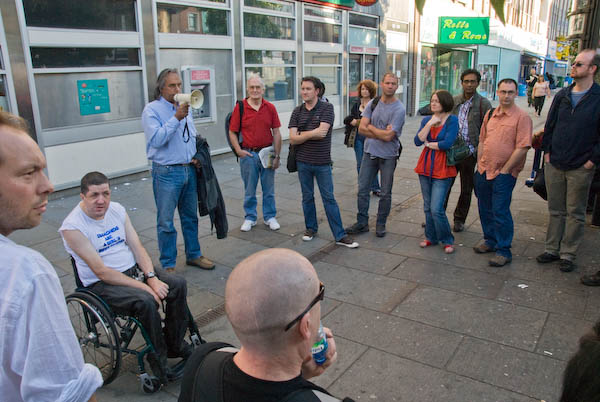
Batwinder Rana talks about the Battle of Lewisham in Lewisham High Street.

Last Saturday, as a part of ‘Lewisham’77’, a series of events organised by local historians and activists supported by the Centre for Urban and Community Research at Goldsmiths University of London and other groups held a commemorative walk from Clifton Rise in New Cross to Lewisham High Street, with some of those who were present recounting their experiences at key sites along the route. If you were there, Lewisham77 would like to record your memories of the event for a DVD and publication. Since it is now over 30 years after the event, you apparently no longer have to be afraid about revealing any illegal actions!

More pictures from the commemoration on My London Diary.

The Time of Her Life – Lesley McIntyre

I wasn’t sure whether to bother to go to Photofusion for the opening of their current show, but I’m glad I did. ‘The Time of Her Life‘ is a series of pictures by Lesley McIntrye of her daughter Molly, born in 1984 suffering from a muscular disability that was never properly diagnosed. At birth, doctors had thought she would only survive for a few weeks or months, but she was actually 14 when she died.

McIntyre had to devote her time to being a parent and was unable to continue her photographic career as she had hoped. Instead she began a detailed photographic record of Molly’s life, which she was determined should be as normal as possible. The pictures reveal a very full life, but only hint at the battles that lay behind this, fighting the discrimination against the disabled, insisting that her daughter be educated in a normal mainstream school.

The images are surprising varied given that they all feature the same subject, and give a very positive and life-affirming message. They have a realism that avoids pathos while giving us a warm and poignant portrait of Molly. The book ‘The Time of Her Life’ was published by Jonathan Cape in 2004 and is still available; it was Highly Commended in the John Kobal Book Award in 2004.

Of course openings are also a good opportunity to meet and talk to people, and not the best time to see the show, and it was good to meet old friends and make a few new connections. It wasn’t too hard to drink a few glasses of wine and a couple of beers too. The show continues until 29 Sept, and I hope to go back for a longer look. Photofusion photography centre is just a couple of minutes walk from both Brixton underground and overground stations, as well as many bus routes. When I photographed on buses for a transport project, Brixton was one of my favourite places to work, with lively bus queues and never long to wait for a bus. The gallery is just a few yards from Europe’s largest Caribbean food market, well worth a visit. John Gay (1909-99 – born Hans Gohler in Germany, he moved to England in 1933) , took some rather atmospheric photographs of it in the early 1960s.

Queens and Looking Glasses

My own notions about Queens are largely based on those of Lewis Carroll (an interesting photographer in several ways) in ‘Alice’s Adventures in Wonderland‘ and its sequel. Queens – like the Queen of Hearts in the Dormouse’s tale were apt to come out with “Off with his head!” at the slightest provocation.

So I was shocked to hear on the BBC News one morning this week, that photographer Annie Leibovitz had dared to tell the Queen to off her tiara, and surprised that her maj’s reported response was as mild as saying “I’m orf” (shouldn’t it have been “We are orf” or perhaps “One’s orf”? At the very least Annie would surely have ended up spending a night or two in the Tower of London.

So it came as no surprise to learn that the whole thing appears to have been an ill-advised publicity stunt, using a clever bit of cutting, or that, having carefully allowed the story to play to maximum effect, the big bosses of the Beeb were down on their knees grovelling for the royal pardon.

It’s a sad story. The BBC, and in particular its ‘World Service’, has a proud record that has led to it being a trusted around the world – and listened to in many situations, even at times and places when it was illegal. TV has of course its own needs to present constant noise and controversy, frenetic and demotic, that at times override sense and taste, and always sacrifices subtlety.

For those with a little knowledge of photographic history, there was a certain sense of the similar, remembering the famous image of Winston Churchill, taken by Karsh immediately after he had apparently snatched Winston’s trademark cigar from his mouth, and there was baby without his dummy glaring into the camera, apparently on the edge of bursting into tears.

At least Annie wasn’t said to have snatched the tiara – and once anchored by the Queen’s hairdresser this would probably have taken some doing (and headlines ‘Annie Scalps Queen’). The pictures she made aren’t bad, if perhaps not her best work. But good portraits don’t always arise from making your subject comfortable, and some well-known for the apparent psychological depth of their images have taken quite different approaches. Paul Strand is said to have told his subjects where to stand and then to appear to have ignored them, although obviously he was waiting for the expression or stance that he wanted.

I thought a little about this yesterday, when another photographer butted in (perhaps unintentionally) while I was setting up a photograph and proceeded to give all of the people in it clear and precise directions as to what to do. Well, it isn’t the way I like to work, though of course I do sometimes need to attract people’s attention, and I like to work with people and let them react to me and what I do, but not to direct them.

Peter Marshall