WARS from Magnum

There are an awful lot of photo-blogs around. I don’t have many links on the ‘blogroll’ of this site, mainly because I wanted to keep it simple and only link to sites where I often find interesting features. One of those carefully selected links just has to be Magnum‘s blog, and yesterday this announced a new set of four essays on its companion site, Magnum in Motion,”WARS – A series of four essays revolving around a common topic,” also to be published on ‘Slate.’

In 2006 Magnum in Motion interviewed Philip Jones Griffiths, almost beyond argument the greatest photographer of the Vietnam War, and at the start of his piece he makes the comment “Photographers are either mud people or sand people. I’m a mud person.” This was his response to people who asked him why he hadn’t covered the desert wars of recent years. More seriously he feels that photographers need to get the kind of perspective that comes from a detailed knowledge of the country and what was happening – as he set out to do in Vietnam. In his piece he gives an insight into what he set out do in his coverage of the war there, and his pictures give a real feeling about the country and the war, including the Americans fighting there, who he sees also as victims of the war.

[In Jones Griffith’s Magnum in Motion podcast, “Point and Shoot“, he talks about guns and his experiences, and attitudes to war, and it’s also worth listening to – you’ll find it – along with 35 others of interest on their podcast page. But the images are shown much more strongly in the ‘War’ presentation.]

Jones Griffith’s flip response on sand and mug acts as the starting point for presentations by three of the leading younger photographers who have covered recent conflicts. As Christopher Anderson points out, the younger generation of war photographers got sand wars rather than mud, whether they liked it or not. Paolo Pellegrin ‘s stark black and white images from Lebanon are perhaps more often from a ruined cityscape of rubble than either sand or mud.

Thomas Dworzak in Chechyna and Iraq has seen both, but the difference is more in the situation than the geology. In Chechnya he could usually go along with the rebels whatever they were doing – if he was brave enough , and he obviously was – but in Iraq “as a Westerner, there is no more access to the insurgent’s side” and he can only work with the Americans, photographing what they do in the country. He comments on the freedom he is given to take pictures – and that those things ‘off-limits’ are largely the kind of boring ‘high security’ places and briefings he has no interest in photographing. He became a photographer to show the injustice and inhumanity of war, and his pictures continue to do so, even if he may sometimes feel that what he is doing is in some sense “a middle-class, Western, boy’s game” as he can leave the war and go home to enjoy a very different world.

Déjà Vu?

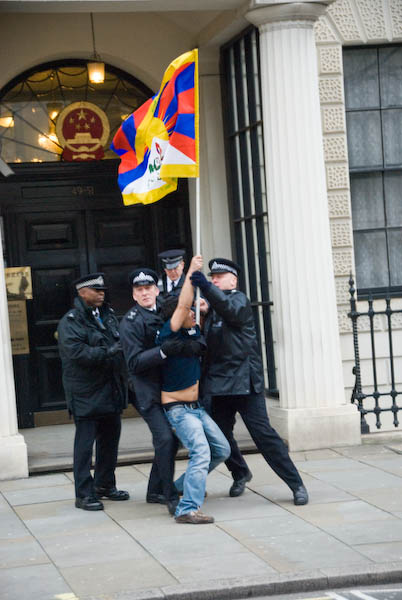
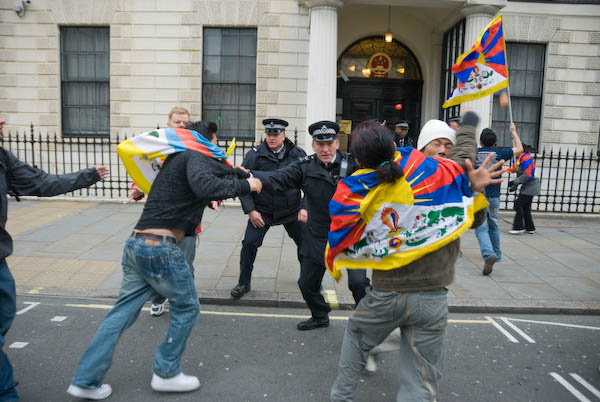
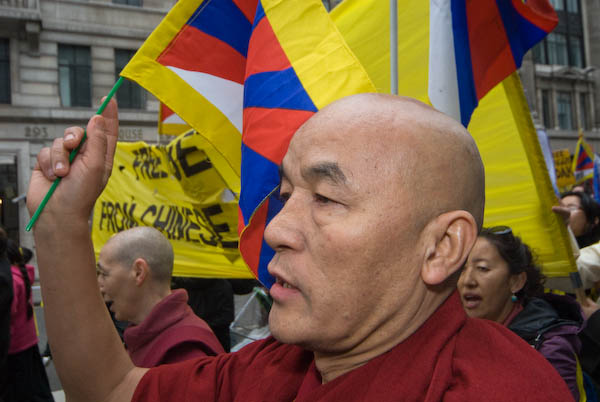
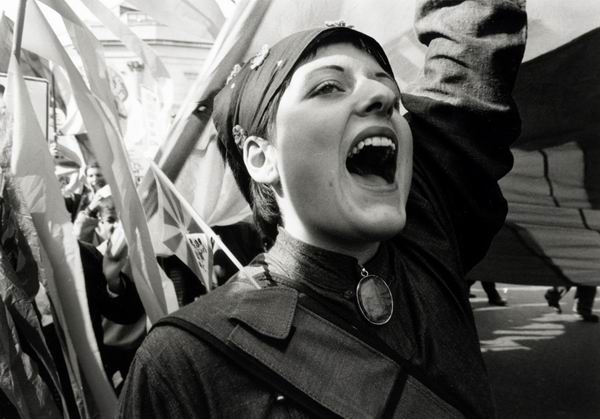
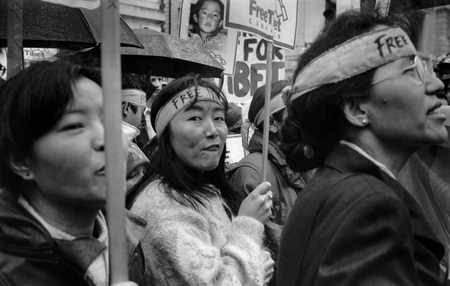
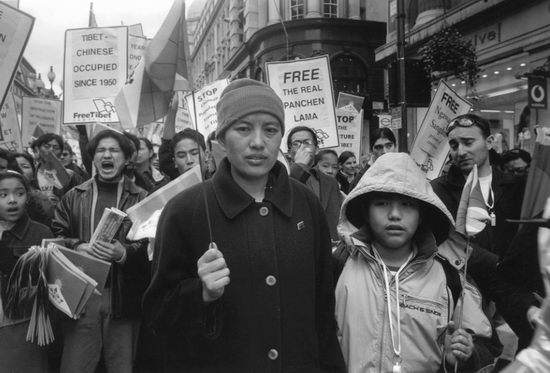
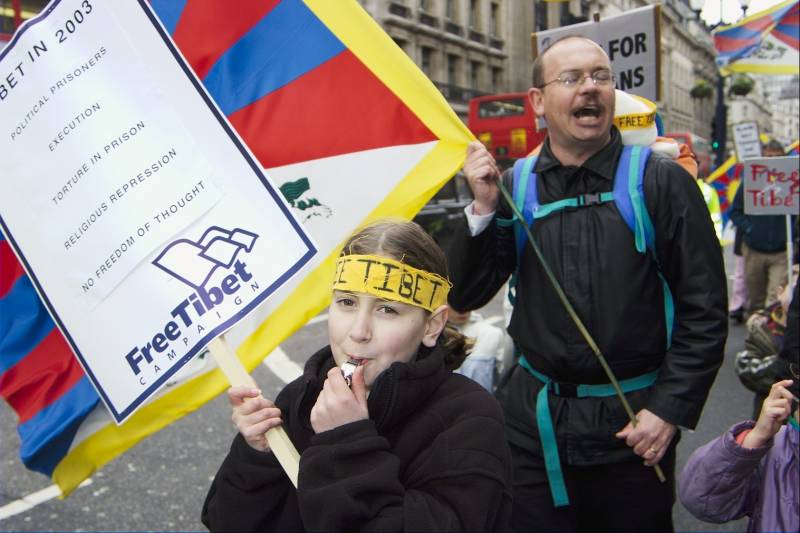
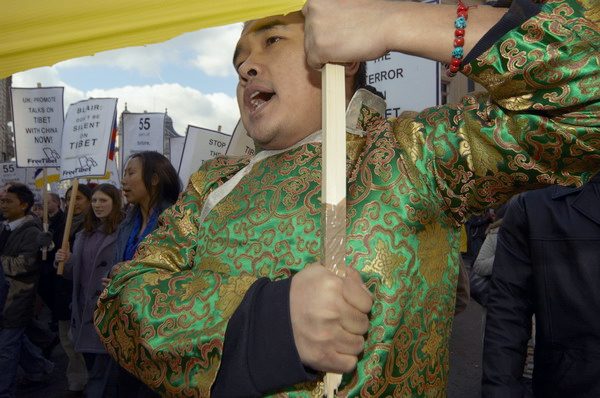
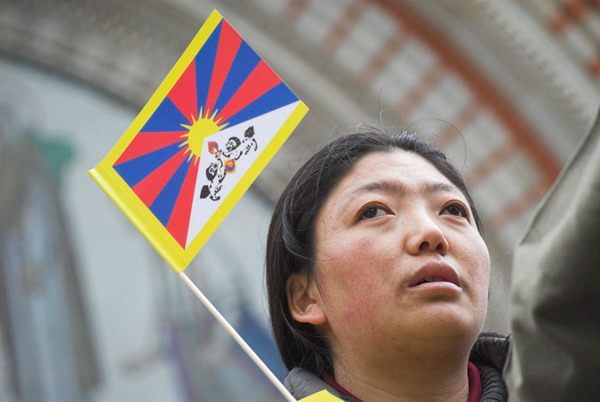
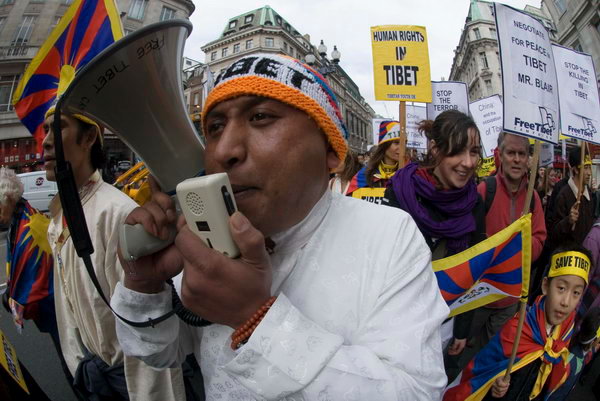
Saturday morning started for me opposite the Chinese Embassy, where supporters of a free Tibet were demonstrating on the 49th anniversary of the Tibetan uprising. I haven’t photographed there all of those 49 years, but it sometimes begins to feel a little like it, and this and the ensuing march through the West End certainly felt like watching a yet another repeat. All over again!


more 2008 pictures

Photographically it brought to mind two people, both in their different ways important teachers, although for me only at second-hand.

Alexey Brodovitch was art director of Harper’s Bazaar from 1938 to 1958, and among the photographers he nurtured there were Irving Penn, Richard Avedon and Hiro, while his classes in New York (and New Haven) drew Diane Arbus and Tony Ray Jones and a whole generation of New York based photographers. One of the many whose work you may not know well, but has a great web site with work from 60 years of photography is George S Zimbel.

Brodivitch used to insist to photographers “Surprise me!” and told them that if they looked into the viewfinder and saw something they had seen before not to take the picture.

The other person who came to mind was Garry Winogrand (and it was Zimbel who turned Winogrand on to photography), whose work has always interested me greatly. Again I never met him, though I’ve used film of him in teaching (and a piece in The Online Photographer last summer included links to a TV video on him from 1982 and the recollections of O C Garza who studied with him at the University of Texas in the mid 70’s – both well worth looking at.)

In the video, one of several comments by Winogrand is “You don’t learn anything from repeating what you know … in effect … so I keep trying to make it uncertain

Saturday with ‘Free Tibet‘, too many things seemed familiar and I had problems with making things uncertain as I struggled with what Winogrand described as “the battle of form versus content.” But too many of my images were merely safe – and as he also said, “Most everything I do doesn’t quite make it. Hopefully you’re risking failing every time you make a frame.” Perhaps as usual I wasn’t risking enough.

You can see more of my pictures from 2008 on My London Diary, as well as some from previous years:

Free Tibet: 2000

Free Tibet 2001


Free Tibet 2002


more 2002 pictures

Free Tibet 2003

more 2003 pictures

Free Tibet 2005

more 2005 pictures

Free Tibet 2006

more 2006 pictures

Free Tibet 2007

more 2007 pictures

Looks like I had a year off in 2004!

Peter Marshall 

Candid on Candids?

Bus, Peckham 1991 (C) Peter Marshall
Bus in Peckham, 1991 (C) Peter Marshall

A day or two ago someone asked on an on-line photography forum if anyone knew of a book on the subject of candid photography they could recommend, mentioning one publication they had already been given as a present. (I haven’t read it, but what looks to me a rather posed portrait on the cover didn’t inspire confidence.

My immediate response was to wonder what there was to write a book about, which perhaps wasn’t the most helpful of comments, although perhaps appropriate. On further thought what I would recommend is Ralph Hattersley’s ‘Beginner’s Guide to Photographing People‘, published in 1975, though it came out in the UK, published by Robert Hale Ltd, in 1979. (ISBN 0709174039)

It’s a work that I admire for starting with a discussion of the ethical basis of portraiture, and with a listing of some of the wrong and the right reasons for taking pictures of people, in a chapter on taking candid portraits. Later in the book there are chapters on how to make staged candid pictures and how to photograph strangers in the street – and that also starts with an examination of your motives.

Hattersley also does a pretty thorough job of the technical stuff, including lighting. Of course its a book written for photographers using film, but really digital hasn’t changed things that much, although some cameras at least provide new opportunities for shooting with the camera away from your eye.

The very term ‘candid photography’ has a dated feel to it. I immediately think of the 1930s ‘Mass Observation’ project and the splendid images of Humphrey Spender on the streets and in the pubs of ‘Worktown.’ If you have any doubts about the validity of working in this way, take a look at the way the Bolton Museums now give the work a proud place on their web site. As they write, “He used what was at the time cutting-edge technology in the form of an unobtrusive 35mm Leica camera.” In some respects the early screw Leica that he used was a better instrument than the later M cameras for this kind of work – where you don’t change lenses. It was smaller and less obtrusive, and I think the shutter was perhaps even quieter. Certainly much quieter than that on the latest digital Leica M8, and even the promised (and expensive) replacement will still be rather more noticeable.

Bolton’s weather also helped Spender, since he spent most of his time there wearing a mackintosh, keeping the camera hidden under this except when he was actually taking a picture. As they note, “He recalled that the occasional Boltonian would react angrily if they discovered him taking a photograph.” There was a feeling of being spied on – rather more rational then than under the Panopticon of security cameras that now track us through much of our lives. Spender himself they suggest “disliked the intrusiveness of his work” and the stress of documentary was one reason why he turned away from photography to painting and stage design.

I think photographers always have a responsibility to their subject, and especially so when you photograph people without their permission. I often take pictures I would not use, perhaps because I’ve caught a moment when they look distinctly peculiar (something some other photographers sometimes seem to strive for.) Or when photographing a flamenco dancer recently, the picture that caught the fleeting fraction of a second where her rapidly swirling skirt revealed rather more than intended. I perhaps see it as my job to try and see the picture as the people in in might see it years later in a book or museum rather than an immediate reaction.

One of the great projects of candid photography was made by Walker Evans, travelling on the New York City subway trains, often accompanied by his assistant Helen Levitt. Starting in 1938 he photographed using a Leica hidden under his coat, its lens poking out, making around 600 photographs. He had conceived the project with the help of his collaborator, writer James Agee – they were working together on the even more famous ‘Let Us Now Praise Famous Men‘, published in 1941 – and Agee in 1940 wrote a preface to the subway work. Although the pictures were finished in 1941, it was not until twenty-five years later in 1966 that ‘Many Are Called’ was published to accompany a show of the images from it at the Museum of Modern Art in New York.

While at the time the pictures might have been seen as an intrusion into privacy, the passing of time gives us – and any of the subjects – a different perspective. The work was published again in 2004 by the Yale University Press and the Metropolitan Museum of Art mark the 100th anniversary of the subway system, with new texts and also greatly improved reproduction of the images, thanks to new digital scans.

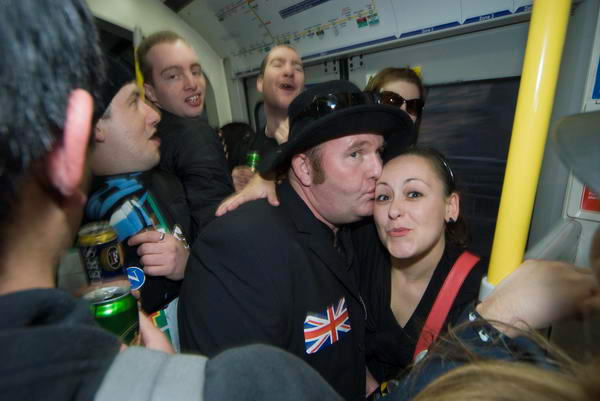
I was reminded only briefly of this work on Saturday, as I crammed into an underground carriage full of Kiwis out with a few thousand others for their Waitangi Day Circle Line Pub Crawl. This image, taken with a 12mm lens on a Nikon D200 may in some respects qualify as candid, but was certainly not made without the knowledge and willing consent of those shown.

New Zealanders celebrate Waitangi Day on the Circle Line Pub Crawl
(C) Peter Marshall, 2008

More pictures as usual on My London Diary. More about candid photography in other posts shortly – including Stream of Consciousness.

PGDB Shortlist: Jacob Holdt

Jacob Holdt‘s work is a slide-show of images he took while hitch-hiking across America as a penniless and trusting Dane from 1970-75. On his odyssey he met and befriended many, mainly from the poorer American underclass, both black and white (though mainly black), living with them. As he has often said, he was a wanderer, a vagabond (occasionally an image made me think of Gaylord Oscar Herron, a photographer of the same era with very different work – and like Larry Clark, from Tulsa) I though and not a photographer and took his pictures largely as a record of his travels with a cheap Canon Dial half-frame camera sent him by his family so he could show them what he was up to. Back in Denmark, he made a slide show, which became in great demand, and before long he was showing it to mainly student audiences across America and elsewhere, a career that has kept up for over 30 years.

This work has been available on the web for years, and I wrote about it and linked to it a few years ago in those days when I had an audience of millions. Last year his work was picked up by Steidl and published in a book, leading to this nomination.

Holdt obviously has a great deal of interest and empathy for the subject that he took on – the American underclass and its treatment by rich America. He has a great ability to get to know people and gain their confidence (and apparently still keeps in touch with many of those he photographed.) But much as I liked his work on the web I found the slide show at the Photographers Gallery hard to watch. It’s perhaps some measure that, having come in part way through the showing I found it very hard to be sure when I had got to the same pictures again, and I think watched another 10 or 15 of the 81 slides before I was sure I had seen one before.

Much of the problem for me is quite simply his photographic incompetence. Almost every picture I found myself thinking “if only…” There was this guy in a fantastic situation and if only he had taken a slightly different viewpoint or moment, or got the exposure closer to correct or had better lighting… Add to that some decidedly odd colour processing and rather small negatives, along with what appears to have been a deliberate immersion in dust and hairs. In a way it’s like citizen journalism, those fuzzy cameraphone images whose very lack of quality sometimes adds to their impact, the feeling that comes from them being records from someone who was really caught on the spot when the bomb went off. Powerful as they may be, I wouldn’t be happy if one of these scooped the World Press Photo Prize.

There is a programme at the gallery with his captions in running order, but it isn’t really good enough (and impossible for me to read in the dark.) What the slide show needs is his commentary, as well as more thought about the timing for different images.

For the book the images were made much more respectable, cleaned up, and some corrections made to the exposure, though some images are still clearly beyond the limits of the film. Together with the much smaller scale of the printed images, these changes make the work look much better in the book than in the slide show. The book is also I think better edited, although most of the pictures in the slide show are also in the book.

Several of the images shown included TV sets, but in one the screen appeared on the initial view to have a huge crack across it, sending my mind flying in a particular direction until I realised that it was only either a hair (or the image of a hair) on the slide. The interiors did make me recall the very different work of Chauncey Hare, truly one of photography’s forgotten figures, and his book ‘Interior America‘ whose work showed a deep spiritual despair at the centre of the nation. Unlike Holdt, Hare was a photographer, although after making the work in this book and ‘This Was Corporate America‘ (1985) he moved out of photography into taking more direct action as a co-director and therapist involved in a not-for-profit community-based business supporting those who have been abused at work.

Holdt tells a powerful story, and the pictures provide some good illustrations for it. On the web presentation he also makes use of pictures from other sources, including historical documents about slavery. He writes about his own pictures “I have never been interested in photography as art so very few of my pictures can stand alone“, and I think he is right. And whatever you think about photography and his work I think it would be beyond human ingenuity (even of such ingenious people as those on the jury) to justify his work as making any significant “contribution to photography over the previous year.” So perhaps he should be my hot tip!

Reality Crossings

I’ve just today got my copy of the Winter 2007/8 issue of ‘European Photography‘ magazine (no. 82 – the web site is out of date and still shows 81, another worthwhile issue, but on ‘Photography in Berlin’ as the current issue), which is devoted to the project ‘Reality Crossings’ shown at the 2nd Fotofestival Mannheim_Ludwigshaven_Heidelberg (FMLH for short) in Sept-Oct 2007. Unfortunately I wasn’t invited to be there, but from this magazine issue I think that ‘Reality Crossings‘ may well turn out to have been one of those significant defining moments in photography – like such shows as Szarkowski’s “New Documents” in 1967 or William Jenkins’ “New Topographics: Photographs of a Man-Altered Landscape” at George Eastman House in 1975. And although I didn’t see either of those shows, they changed photography and they changed my photography.

Reality Crossings was a much more diverse show than either of those I’ve mentioned, and the issue contains a photograph (or in some cases, several) and a short statement (mainly by the curator) about the work of around 66 photographers as well as introducing almost 20 videographers. You can see some of the work on the festival web site, (the link is to the English version). I’d recommend anyone with an interest in contemporary photography to both buy the magazine and to look at the work on the web.

Of course many of the photographers in the show will be familiar. They include several I’ve written about elsewhere, including Michelle Sank, Michael Ackerman, Christian Schad and Michel Tichy (as you can see, not all the work is contemporary) as well as a number already on my ‘to-watch’ list.

Of course a publication – or even an exhibition – with such a large number of voices has to be unsatisfactory in that it can only give the merest glimpse of what activates the various authors. It’s even rather an introduction than a manifesto, but, as the introduction by curator Christoph Tannert states, it is “based on realism as an outlook on life” and demonstrates “that courage is indispensable in the pursuit of truth.

He goes on to say “The documentary must be confronted with the psychedelic extravagance of the photographic eye, which also involves conjugating structures, reflecting on form itself.” This is a thought which resonates with me (and I think will do so with all fellow ‘post-street‘ photographers) and which reflects some of the spirit which has inhabited my own work, both in the post-industrial landscapes of ‘London’s Industrial Heritage‘ and in the web-centred profligacy of ‘My London Diary.’

Capa Treasure Trove

The discovery of Robert Capa‘s negatives from the 1930s, long thought to have been lost after he left them in Paris when he fled from the Nazis in 1939 is a remarkable piece of news, although rumours about their survival first began to spread around 1995.

Three flimsy cardboard cases containing around 50 tightly rolled nitrate base 35mm films of various lengths, in total around 3500 negatives, are now being investigated and catalogued by experts from the George Eastman House working for the ICP. Most of the strips are indexed in the lid of the box – and you can read many of these in the interactive graphic from the New York Times feature. Much of the story is told in the slide show there, and you can read more details in the article, The Capa Cache.

The negatives first came to light after a Mexico City film-maker inherited them from his aunt, whose father had been a general and Mexican diplomat stationed in Marseilles in the late 1930s, where he had helped Republican refugees to go to Mexico.

Capa had left his negatives with his darkroom manager, Cziki (Imre Weisz), another Hungarian, who took them to Marseilles, possibly hoping to flee to Mexico. But he was arrested and interned in Algiers (though he did later get to Mexico City, where he died in recent years.)

It took over ten years – and the efforts of curator Trisha Ziff – to persuade the film-maker and his family to make the collection public, and that the most suitable home for the negatives was the ICP, founded by Capa’s brother, Cornell Capa.

Some of his most famous images have already been located among the films, and more are likely to be found. Capa worked with his partner, Gerda Taro, until her death in the war, and the collection is likely to raise more issues about which of the images were her work, as well as possibly settling any remaining doubts about one of the most famous and controversial images in the history of the medium, Capa’s (or Taro’s?) “The Falling Soldier.

Garden Suburbs and Garden Cities*

From almost the start of photography, photographers have been recording the urban landscape. Thomas Annan, was commissioned by Glasgow City Improvement Trust to photograph the slums they were about to demolish. Roughly 40 of his pictures were published as carbon prints in a book in 1878, and with a few extra plates by his son, James Craig Annan, printed again as photogravures in 1900.

Similarly in Paris, Charles Marville worked for the city and other official bodies. As well as recording the buildings and areas that were to be demolished, he also made pictures of the new streets that replaced them. (You can also see a little of his work online at the Getty and MoMA as well as occasional prints at commercial galleries. (Unfortunately I can’t find a good French source of his images. There are 54 good thumbnails online at Scholarsresource but will need an account and payment to see larger images.)

In the early years of the 20th century, the great Eugène Atget was to cover similar territory, impelled by his own desire to record a French civilisation he saw disappearing, preserving this in his images which he sold to museums, artists and fans of ‘Old Paris.’

Although his work could always be seen in museums and collections in Paris (where I first came across it, at the Musee Carnavalet), it was for many years largely forgotten by photographers. In America, Berenice Abbott, who had bought the residue of his personal collection after his death, continued to publish and promote his work, but it was only in 1964 when she published the book “The World of Atget” that he began to be a significant influence on photographers in America and around the world – including myself. As well as the selection on Luminous Lint (link above,) there is a superb collection of almost 500 of his images on line at George Eastman House.

John Thomson, another fine Scottish photographer, is now best known for his book ‘Street Life in London‘, made with writer and socialist reformer Adolphe Smith, one of the earliest classics of photographic documentary, and published in 1877-8. The photographs were printed using the Woodburytype process, one of the first methods for the volume production of photographs – which were essentially carbon prints. Although his work was not urban landscape, the work – both pictures and text by both Thomson and Smith – was important in a campaign to get improved flood protection for the poorer areas of London.

Renovation in Bedford Park, 1987 (C) Peter Marshall

The Bedford Park estate, in the borough where I was born in West London, was started around the same time in 1875 and was the world’s first ‘Garden suburb’. Much of the property was in a sorry state of decay by the time I first knew it, in the 1950s, but it has since gone up considerably in the world. Most of the buildings were designed by architect Richard Norman Shaw, and it set a pattern for suburbs around much of the world, including many on a rather less grand scale.


Monk’s Orchard, a 1930s development, LB Croydon, London, 1995.
(C) Peter Marshall

The ideals of the Garden City movement were clearly stated at the turn of the century by Ebenezer Howard, who aimed to produce communities that were self-contained, carefully balancing housing, agriculture and industry, and combining the best of town and country living while avoiding their worse problems.


Cité Jardin in Stains, near Paris. (C) Peter Marshall, 2005.

England’s first environmental charity, The Town and Country Planning Association, was founded by Howard as the Garden Cities Association in 1899 (you can download a largish well-illustrated pdf of its centenary publication.) It still has the original aims of promoting well-designed homes in an environment on a human scale, and sustainable development. It also tries to empower people to influence the planning decisions that will alter their lives.


Brentham Garden Suburb, developed from 1901, Ealing, London, celebrates its 100th May Queen festival. (C) Peter Marshall, 2006

Howard’s was a utopian vision, deriving much from earlier utopias, probably including ‘News from Nowhere‘ written in 1890 by the great English socialist thinker and designer, William Morris, in which the idea of the garden plays a key role. In it Morris wakes up in a future England which is his dream of a better society, set at a date not far from the present day, and makes a journey into the centre of a rather different London, finding out on his way about the incredible changes that have occurred since his times.

In one of many answers to his questions about the new England, Morris is told that by the mid-twentieth century England had become “a country of huge and foul workshops and fouler gambling-dens, surrounded by an ill-kept, poverty-stricken farm, pillaged by the masters of the workshops.” Not quite the language I would use, but not entirely an inaccurate description.


Manor Gardens Allotments, demolished in 2007 for the forthcoming London 2012 Olympics. (C) Peter Marshall, 2007

The answer continues “It is now a garden, where nothing is wasted and nothing is spoilt, with the necessary dwellings, sheds, and workshops scattered up and down the country, all trim and neat and pretty. for, indeed, we should be too much ashamed of ourselves if we allowed the making of goods, even on a large scale, to carry with it the appearance, even, of desolation and misery.”

Morris was writing in 1890, significantly it was before the age of the car and plane, but his is a vision that does perhaps have some relevance to our current problems, although for various reasons – not least that we failed to have the socialist revolution of which he dreamed in Britain – it has yet to become true.

An effective response to our environmental challenge will require a radical shake-up of our political and economic systems, one that looks at sustainable lifestyles and the elimination of both wasteful production and wasteful consumption. Like Morris, I think it will require a far more local and people-centred approach. I think we also share the view that essentially it is shared ideas – culture – rather than the economic base that determine the evolution of our civilisation, although the twentieth century has provided a greater awareness of the finite limits within which these have to operate. As some of the placards I photographed recently put it, “There is no Planet B

Unfortunately, what came next after Morris was a twentieth century obsessed by ideas of growth and progress, increasing Gross National Product (whatever was being produced) and the motor car, which drove us all in this very different direction. Instead of carefully planned environments, we got roads and ribbon development along them, and urban sprawl, both entirely dependent on the car. Along with this came vehicle emissions, road deaths, decreased personal interactions, increased transport costs and more.

Continued in Under the Car

*NOTE

This post is one of a series based on the talk “Photography and the Urban environment” given by me at Foto Arte 2007 in Brasilia in December 2007. Previous posts in the series include ‘Under the Car‘ and ‘Architecture and Urban Landscape photography.’

Peter Marshall

Herbert Keppler

I never knew or met Herbert Keppler, (Burt to his friends) who died on Friday aged 82, but his work did affect my life. Born in 1925 he had a long career in writing about photography, and was editor and publisher of Modern Photography which was an important magazine for photographers in the UK as well as America. It was his love and knowledge of photography that led to that magazine publishing portfolios and features of many important photographers, both historical and contemporary, in the 1970s and 80s, including some finely printed examples, at least one of which still hangs in a frame on one of my walls.

Keppler also set up what was probably the first real test laboratory for camera and lenses to back up Modern’s reviews, which were so much more comprehensive and technically authoritative than any others, particularly than those we could read in the UK, where lab testing generally meant poking the lens out of the window and photographing a ship across the Thames.

Keppler was a man with high standards, and he set up a program for vetting mail order ads for Pop Photo, which led to the magazine turning away over $2 million in advertising, according to the obituary by Mason Resnick on the Adorama site.

Later, after 37 years at ‘Modern’ (he joined as Associate Editor when it started in 1950) he was persuaded to move to the more popular ‘Popular Photography’, where he put in another 20 years service, continuing to work more or less until his death. Many of us deeply regretted when ‘Modern’ was bought and closed down by ‘Pop Photo’ , but at least Keppler ensured that its technical content aspired to the standards set by that title, as well as continuing to promote high standards in mail order.

As you would expect, there is an extensive obituary on the Pop Photo site, with more material promised later.

Photo Histories

Some months ago, Graham Harrison contacted me about a new on-line photography site he was setting up, looking at photography in an intelligent way, and invited me to have a look at the preview site. I was impressed, and offered to write something, though as yet I’ve not got around to it. Perhaps later…

Photo Histories is now up for all to read, and the content so far is impressive, with a great interview with Philip Jones Griffiths, who talks about “why the ideals of the thinking photojournalist forged in the 20th century should not be sacrificed for the dumbed down culture of the 21st.” His ‘Vietnam Inc’ (1971) was one of the most important books of the era, and one that moved me and others powerfully when it came out – and is still a fine example of why photojournalism is important. I also have a great deal of sympathy for his views on the current state of Magnum which you can read in the interview. While others – including myself – have written about his work and its significance, this interview does add some insights into the work and the man who produced it – and has a nice picture of him by Harrison.

Another photographer I’ve also written about previously is Homer Sykes, whose self-published books Hunting with Hounds and On the Road Again I reviewed at some length. (You can download a pdf file of the Autumn 2002 issue of the LIP Journal where my review of On the Road Again appeared in print – and both – along with features on photographers Berenice Abbot and Brassai mentioned below – are probably available on the ‘Wayback Machine‘ or its mirror from About Photography.)

In Photo Histories there is another detailed interview with Sykes, as well as a interesting set of pictures ‘Unknown Homer Sykes : The English 1968 – 78‘.

I met Homer again earlier this year, when he was back photographing Swan Upping on the Thames for the first time for many years. You can see some of my pictures from the event at My London Diary, but surprisingly I don’t seem to have mentioned him. The two of us were the only photographers who ran along the river bank to record the Dyers and Vintners men raising their oars to salute the Royal uppers at the end of the day. I hope he got the exposure better than I did in the wickedly contrasting light. I left the D200 to sort it out and it didn’t.

Other features on Photo Histories include some on key books from the history of photography, including Berenice Abbott‘s ‘Changing New York‘ and ‘Paris de Nuit‘ with pictures by Brassai. Perhaps these were a little disappointing in not really dealing with the images, more with biography and background matters, but still useful introductions. Perhaps it might be a useful addition to have features about key images or sets of images from them as well.

Graham Harrison has of course worked for some of the big names in British publishing, and at the centre of Photo Histories is a section called by that same title, which includes an article (originally published on EPUK) about the first Press Photographer’s Year Expo held this summer. At the end is a footnote:

After the success of the Press Photographer’s Year Expo it was sobering to see Stoddart’s stills used with effect throughout the C4 TV documentary The Rise and Fall of Tony Blair credited to Getty Images only.

Moral rights – including that of attribution – are something that photographers still have to fight for. The Photo Histories section also has a very nice insider story by Brian Harris about working with the late Don McPhee during the 1988 US Presidential campaign.

As well as his main site, you can also see more of Graham Harrison’s work in ‘The Oxford Year,’ though in the two years this has been going he seems so far to have missed those swan uppers!

Paris Nudes

I’ve written in the past about the history of nude photography, and Paris was certainly one of the major centres of production of ‘academies‘, those early nude figure studies, ostensibly made for the education of artists, but in fact gratifying a rather wider section of the middle-class male population.

The exhibition ‘Books of Nudes: an anthology‘ at the MEP until 6 Jan, 2008, shows work from the astonishing collection of Alessandro Bertolotti of published nudes gathered over 30 years (and those unable to visit the show may be interested in the catalogue or the book, Books of Nudes, published by Harry Abrams, which is the English version – and rather cheaper.)

It is a splendid collection, and a book that might well go on Christmas lists for photographers – and those with an interest in the subject. But although it is a great source of material – particularly work by lesser-known photographers – I found the organisation and exhibition text less than satisfying.

The work is organised on a chronological basis, and this allows for a reasonably sensible grouping and analysis of work in the early years, but begins to fall apart early in the twentieth century. When it came to the section covering work in the period immediately after 1945, it is clear that it breaks down completely, lumping together work such as Bill Brandt‘s with work that I would dismiss as ‘glamour’ rather than nude. And things can only get worse.

I’ve always refused to write about or feature ‘glamour’ photography. To me it is just a dishonest sibling of pornography. Of course porn covers a very wide range of material, some of which truly disgusts me – and I think it is more than a matter of taste. So-called ‘glamour’ merely saddens me to think that there are some who find it glamorous. It is the artificiality I object to, not any nudity.

We each have our boundaries, and our interests. I’d be quite happy never to see another picture of a ‘celebrity’, with or without clothing. Although there was nothing in the show I’d want to see banned there was certainly some material which I think the show would have been better without.

But there is plenty there of interest, including fine work I’d not seen before, for example by Germaine Krull, as well as much by photographers I’m familiar with and have written about, including Man Ray, (select ‘Nude‘ in the Themes drop-down), Willy Ronis, Jan Saudek, (but not Sara) and many more.

Peter Marshall