Cornell Capa, 1918-2008

Cornell Capa, one of the last remaining of the classic generation of photojournalists who came out of Europe in the 1930s died in New York last Friday, May 23, 2008, aged 90.

Cornell was perhaps always overshadowed by his more flamboyant brother Andre, who re-invented himself in Paris in the mid 1930s as the ‘famous American photographer Robert Capa‘. When Cornell joined his brother in Paris in 1936, hoping to study medicine, he started working as a printer for Robert, and also for two of his brother’s friends, Henri Cartier-Bresson and David Seymour (Chim).

In 1937 Cornell moved to New York, and Robert helped him find a job in the darkroom of the Pix agency, and, in the following year, in the darkroom at Life magazine. He also had started taking pictures, and his first picture story was published in Picture Post in 1938. During the war he worked for the USAF in photographic intelligence and in 1946 joined Life as a junior photographer.

Cornell Capa joined Magnum in 1954, shortly after his elder brother was killed in Vietnam (another early Magnum member, Werner Bischof died on more or less the same day) remaining a member until his death and serving as president for four years.

After his brother’s died, Cornell was determined to keep the memory of his work alive and to continue to promote the kind of photography he had stood for, which valued human feelings and was dedicated to improving the human situation. He set up the International Fund for Concerned Photography, Inc.

The book and exhibition ‘The Concerned Photographer‘ which he edited in 1968 for the fund included work by Robert Capa and Werner Bischof, as well as Chim, Andre Kertesz, Leonard Freed, as well as by Dan Weiner who had been killed in a plane crash in 1959.

In 1974, Cornell foiunded the International Center of Photography in New York as a permanent home for the International Fund for Concerned Photography.

You can hear the voice of Cornell Capa in a short interview on NPR with Jacki Lyden, recorded in 1994. Much of his contribution to the interview is transcribed on the web page, but there is just a little extra about hearing it in his own voice.

You can also find an obituary in the New York Times and on the Magnum blog.

Because of the fame of his brother, it’s perhaps easy to overlook the fact that Cornell was himself a very fine photographer. While Robert Capa was certainly one of the best war photographers of his era, with iconic images such as that of the falling soldier from the Spanish Civil War and his grainy and distressed work on the beach on D-Day, a living testimony to his dictum “if you pictures aren’t good enough, you’re not close enough“, his younger sibling had a true gift for finding a different way to view things, something that stood out from the obvious.

New York in London

There is of course a sense in which a show like ‘The New York School‘, currently at the Michael Hoppen Gallery in London’s Chelsea, is bound to disappoint, and it is one that is heightened by the hype in the listings which describe it as “An overview of a period of intense photographic creativity from the Big Apple featuring the likes of Diane Arbus, Robert Frank and William Klein” (BJP)

It certainly isn’t an overview. Michael Hoppen is a commercial gallery and the contents of their show is determined by what can be found currently on the market and so offered for sale – only a couple of the works were without prices. It would be impossible to mount a real overview without the collaboration of various museums and collectors in lending work, and would require a considerably larger space. London saw a much better overview as the first half of the major Barbican show ‘American Images‘ in 1985 – and that just isn’t the kind of thing a commercial gallery can hope to match.

We can perhaps take “the likes of Diane Arbus, Robert Frank and William Klein” simply as sloppy journalism, in that the very point about these photographers was that they stood out as each having a particular view. There is a decent print of one of Klein’s better pictures in the show, but Frank and Arbus are poorly served by the couple of examples on offer, at least one of which should clearly have gone direct into the darkroom waste bin.

I went to the gallery not expecting a great deal, and in that respect I wasn’t really disappointed. There were however at least a couple of prints that interested, even moved me, including a fine photogravure of four men from the mid 1950s by Roy DeCarava (surprisingly not included in his fine volume ‘the sound I saw‘ although his second picture in the show, to me less interesting image of dancers is – and I think looks better in the book.) Unfortunately the lighting in the gallery gave maddening reflections – if you want to see the richly stygian ‘Four Men‘ at its best you should take a large black card along with you. I could only really make out two of them in the show.

One of a few Leon Levinstein pictures also caught my attention, although it perhaps lacked the kind of shock of his best work it did have a little of his characteristic directness.

Overall, by the time I’d been round the show – which does include some other pictures, particularly by Weegee and Louis Faurer, of at least some interest – I was beginning to think a more accurate title might have been ‘New York on a Bad Day’. Most of the photographers in it are deservedly well-known, but not on the basis of what was on show here. (I’ve never quite understood why people rate Ted Croner (1922–2005), an early Brodovitch student who he sent to photograph the city at night, and certainly what I saw here didn’t help.)

But as an overview, it simply omitted so many photographers whose work seems so central to the creative ferment stirred up by the New York Photo League and by Brodovitch in the period around and after the war. It was also perhaps rather defocussed by the inclusion of work from the city by two visiting British photographers, David Bailey and Neil Libbert.

Perhaps the good prints from the ‘New York School’ are all elsewhere, in galleries on on people’s walls, or, hideous thought, stashed in vaults by ‘investors’. Fortunately we are talking photography, and it is often best seen in books. One of the best overviews of what this show purports is still the catalogue of the Barbican show, ‘American Images‘ still readily available secondhand at a very reasonable price (ranging from 74p from one US bookseller, up to £65 elsewhere.)

Robert Rauschenberg: Photographs

Suffering today from the annual and unwelcome reminder of ageing (though the presents are nice) I got to thinking about Robert Rauschenberg, who died two days ago on May 12, aged 82.

As the New York Times obit by Michael Kimmelman says

“A painter, photographer, printmaker, choreographer, onstage performer, set designer and, in later years, even a composer, Mr. Rauschenberg defied the traditional idea that an artist stick to one medium or style. He pushed, prodded and sometimes reconceived all the mediums in which he worked.”

Although I have a book of his photographs (Robert Rauschenberg Photographs, Thames & Hudson, 1981, ISBN 0 500 54075 6) it seems to me that photography is the one medium about which this isn’t true, although of course he made considerable use of photographs in various mixed media works, both using his own pictures and solvent transfer prints from magazine images.

In the book Rauschenberg comments that he first took up photography as a young man, it was a “social shield“, covering up the perosnal conflict he felt “between curiousity and shyness“. In the interview published in the book with Alain Sayag, Rauschenberg says that while studying with Josef Albers (who he elsewhere said “was my best teacher, and I was his worst student“) at Black Mountain College in 1949 he became aware that he had to make a choice “I was serious enough or dedicated enough to know that I could not have at that point two primary professions“. Since at that point his photographic project “was to photograph the entire U.S.A., inch by inch” it’s perhaps good that he chose painting (later, in 1980-1, in his project ‘In + Out City Limits’, he did try to photograph at least parts of the country.)

Had Rauschenberg been as excited by other teachers at Black Mountain – perhaps Aaron Siskind or Harry Callahan, the history of art and photography would have been different.

Rauschenberg’s early photography was good enough for Edward Steichen to buy two of his prints – one a portrait of his friend Cy Twombly – for MoMA‘s photography collection – his first sale to a public collection.

The first group of pictures in the book are from the period when he had given up photography, and are perhaps the strongest, uncropped square format images with a strongly emotional content, although the often square-on approach to the subject and sensitivity to lighting carry suggestions of Walker Evans. His later work when he returned to photography (I think, from the evidence of the images with a 35mm SLR) in 1979-80 are more related to formal concerns and less personal, although many are still very interesting, concentrating largely on urban details. Many of them were from the project In + Out City Limits (1980-81) mentioned above, which was followed by other photographic projects, including Photems (1981/1991), and Chinese Summerhall (1982-83.)

Rauschenberg comments that for him photography is “a kind of achaeology in time only, forcing one to see whatever the light of the darkness touches and care” and goes on to state: “Photography is the most direct communication in non-violent contacts.”

Sayag asks him why he never crops, and gets this response:

Photography is like diamond cutting. If you miss you miss… You wait until life is in the frame, then you have the permission to click. I like the adventure of waiting until the whole frame is full.”

Rauschenberg was certainly a great artist, and had he devoted himself to the medium could also have become a great photographer.

Unfortunately very little of his photographic work seems to be available to view on the web.

Here is an example Untitled, ca 1952 though it is not in my opinion one of his more interesting images. There are also one or two fairly poor reproductions from In + Out City Limits: Baltimore, Los Angeles and a rather better exhibition poster for Los Angeles.

Who needs Oscars?

I have to admit to a certain feeling of ennui about the increasing number of awards for photography, especially so those that attempt to introduce something of the ridiculous commercial razzmatazz of the Oscars.

So I didn’t have very high hopes when I heard about the Sony World Photography Awards, especially when I learn they were to be held in Cannes. And although the Honorary Board members did include photographers Bruce Davidson, Elliot Erwitt, Martine Franck, Susan Mieselas and Martin Parr of Magnum, along with Nan Goldin, Mary-Ellen Mark, Rankin and Tom Stoddart. There are also some very well-known names in the other Academy members, along with a number of others whose photographic credentials are perhaps less credible. It was also a team lacking in international terms; far too many are from the UK and US, with only two from Asia, one from Africa and none from South America.

This week’s British Journal of Photography (some stories need a subscription to read online) has two interesting features on photographic competitions. One is about the SWPA (not to be confused with the WPA, which for all of us with an interest in photography is the Works Progress Administration), written by Su Steward (BJP editor Simon Bainbridge was one of the Academy, so perhaps she had to be even more careful than usual in what she wrote.) She gives an interesting view of the event and some of the problems, as well as commenting on the judging and winners, although the article has its own teething problem with a wrongly captioned image.

I did find it surprising, that after quoting the comment made over a Cannes Film Festival lunch that apparently kick-started the SWPA, claiming that there wasn’t “an Oscars for Photography” she failed to mention the “Lucies,” set up for that very purpose in 2003, when Henri Cartier-Bresson received the first Lifetime Acheivement Award. On the Lucie Award web site the front page quotes for Douglas Kirkland “The Movie Industry has its Oscars and the Photography Community has its Lucies.”

The 2007 Lucie Awards were:
Elliot Erwitt – Lifetime Achievement,
Kenro Izu – Humanitarian Award,
Ralph Gibson – Achievement in Fine Art,
Eugene Richards – Achievement in Documentary,
Philip Jones Griffiths – Achievement in Photojournalism,
Lord Snowdon – Achievement in Portraiture,
Deborah Turbeville – Achievement in Fashion,
Howard Zieff – Achievement in Advertising,
Heinz Kluetmeier – Achievement in Sports,
and the 2008 Awards will go to Richard Misrach, Josef Koudelka, Sara Terry: The Aftermath Project, John Iacono, Susan Meiselas, Visa Pour L’Image Festival, Herman Leonard and Erwin Olaf – with more details on the web site May 15.
I never attended the Lucie awards ceremony – despite being invited – partly because it didn’t seem my kind of event, but it surely deserves a mention in this context.


(C) 2007, Peter Marshall. Giacomo meets Max Kandhola

You can find more about the WPA event on its website – or buy the BJP. I’d just like to mention one of the winners, Giacomo Brunelli, who showed me his superb work at Rhubarb Rhubarb in Birmingham last year and I wrote about it for this blog, with a couple of examples, as well as introducing him to Luminous Lint.

Also in the BJP is an article first published on-line at Foto8 by two of the judges at the World Press Photo contest, ‘Unconcerned but not indifferent‘ by Adam Broomberg and Oliver Chapman. They lift the lid off the proceedings there and also question the role of photojournalism, particularly as “photographs rarely break the news these days” or at least those that do are largely the products of ‘citizen journalism’, the blurred impressions from the mobile phones of those caught up in the affair. (When I wrote a guide to the photographs of 9/11 – first on-line on 9/12 it received hundreds of thousands of hits – I commented on the immediacy of such coverage, highlighting some of the more powerful examples.)

The BJP adds a little to the debate by publishing a reply by this year’s World Press Photo of the Year winner, Tim Hetherington, who argues that photojournalism remains as relevant today as it ever was.

I’ve been meaning to write for some time about the re-launched “all-new” biannual Foto8 magazine. 180 pages of essential reading for anyone with the slightest interest in photojournalism. If you are reading this are aren’t already a subscriber you almost certainly should be.

Infinity

The New York International Centre of Photography (ICP) has been an important institution in photography since it was founded in 1974 by Cornell Capa – or rather even before that, when in 1966 he set up the International Fund for Concerned Photography to keep alive the kind of humanitarian documentary epitomised by the work of his brother Robert Capa and colleagues Werner Bischof, David “Chim” Seymour and Dan Weiner, all of whom had recently been killed. The ICP was set up as a home for the Fund, but since then has continued to develop, particularly with its expansion into new facilities in 1999-2001, which, among other things doubled its teaching space.

2008 is the 24th year of its annual Infinity awards, already announced but presented at a Gala ceremony next week. The Lifetime Acheivement goes to Malian photographer Malick Sidibe (b1935), who opened his studion in Bamako in 1962. His portraits have become very well known over recent years, and he won the Hasselblad Foundation International Award in 2003.

Another much younger African photographer I’ve written about previously is
Mikhael Subotzky (b1981) who gains the Young Photographer award. He was one of the more interesting photographers in PDN’s 2008 top 30.

Taryn Simon (b1975), whose work from An American Index of the Hidden and Unfamiliar was one of the more interesting shows at the London Photographers’ Gallery last year gets the Publication Award.

Canadian photofgrapher Edward Burtynsky , another photographer I’ve written about previously elsewhere, gets the Art award.

Bill Jay, winner of the Writing award, will be a familiar name to many in the UK, although he left here – having edited Album and more importantly Creative Camera in the time it emerged from Camera Owner. Ity was a crucial start, although the magazines best days were under the editorship of Peter Turner.

More British interest – though again from an expat – comes with Craig McDean (b 1964) who gets the Applied/Fashion/Advertising Photography award. Born in Middlewich, Cheshire, he got into photography with pictures of his rocker friends, moving down to London to work for i-D and The Face. He now lives and works in New York, and his fashion pictures have been in W, American, French, and Italian Vogue, Another Magazine, The New Yorker in campaigns for Armani, Gucci, Yves Saint Laurent, Hugo Boss, and Estée Lauder and many more.

Its a second Infinity award for American photojournalist Anthony Suau (b 1956) who gained the the Infinity Young Photographer Award in 1986, two years after he won a Pulitzer in 1984 for his pictures of the famine in Ethopia. He went on to add the World Press Photo in 1987 and the Robert Capa Gold medal in 1995 for his work in Chechnya, and now the Infinity Photojournalism award.

Suau has been a contract photographer for TIME magazine since 1991, and his Beyond The Fall (1989-99) is a 10 year photography project portraying the transition of the Eastern block starting from the fall of the Berlin wall. Based in Europe for 20 years, he now lives and works in New York City.

Diane Keaton, who wins the ICP Trustees Award is deservedly best known as the star of many films including Annie Hall, for which she won an Academy Award as best actress. She has always been passionate about photography and has published three books of her picrtures, starting with Reservations, a collection of photos of hotel interiors, published in 1980 (about which some reviewers also had reservations), as well as editing or co-editing several collections of vintage photographs.

May Comes in April

Climate Change seems to be noticeably with us, with the hawthorn around the local footpath in blossom for a couple of weeks – and the generally early flowering of the May actually made the news headlines last week.

Gathering the may is an ancient British custom, when young men and women went off together into the woods in the early hours of the morning, ostensibly to cut branches of blossom, bringing these back to decorate the houses in the village to mark the coming of Spring. Doubtless there was much drinking of ale proffered in return for the gift of the boughs, and not a few maidens and masters nipping back to the woods, but Henry Peach Robinson made it a rather less raucous event in his carefully constructed rural idyll, ‘Bringing Home the May’, made in 1862.

Robinson was one of the first masters of the constructed image, although it was Oscar Rejlander who had led the way with his ‘Two Ways of Life‘ in 1857. This was a dramatic combination print made from 30 negatives, whereas Robinson’s ‘May’ made do with only nine (you can see them on-line in this pdf, and a thumbnail of the final print here.) While such feats are now made ridiculously simple with Photoshop, he had to do things the hard way, printing each negative in turn onto the same sheet of paper, although the fact that he would have exposed each negative for long enough to produce a visible image rather than developing the paper made registering the images rather simpler. Few photographers in those days developed paper, almost all images were made by printing out – and many photographers continued to work in this way well into the 20th century.

Robinson and other photographers worked by combination printing largely for technical reasons. The most common use of the technique was to add an interesting sky to a print. Until close to the end of the 19th century photographic emulsions were sensitive only to blue light, and areas of blue sky were far denser on the negative than they should be, resulting in very pale or ‘paper white’ skies. ‘Sky negatives’ were made by giving several stops less exposure than was needed for the rest of the image – and many photographers had their favourites with fine cloud formations and used them on a number of pictures.

Robinson often – it not always – sketched out in detail how he wanted his pictures to be before he made his exposures, and it was doubtless easier to set up smaller parts rather than an overall scene. The people in his pictures were actors, models or friends and it might well be possible to use one of them in different roles in the same image – as Rejlander had done in his picture. The actual country people didn’t suit the idyllic view he wanted to give of rural life, they were doubtless too coarse, dirty and often disfigured, although he did aim for a certain authenticity, noting that country girls could easily be persuaded to sell their clothes for a few shillings.

Another important reason for working from multiple negatives was quite simply size. Almost all nineteenth century photographs are contact prints. To make a print the size of his ‘Bringing Home the May‘, approximately 40 x15 inches, would have needed a camera that took a plate that size. It was easier to work with something rather smaller and build up the final result.

If you really want to know all there is to know about H P Robinson, you may like to download David Lawrence Coleman’s 2005 dissertation, ‘Pleasant Fictions: Henry Peach Robinson’s Composition Photography‘ from the University of Texas, which includes some well-chosen illustrations at the end of its very informative text.

Looking at his pictures – which he regarded essentially as art – I find it hard not to think of advertising photography. But then I get the same feeling about most of the constructed photography that has appeared in galleries over the last 30 or more years, although the advertising sometimes seems less false.


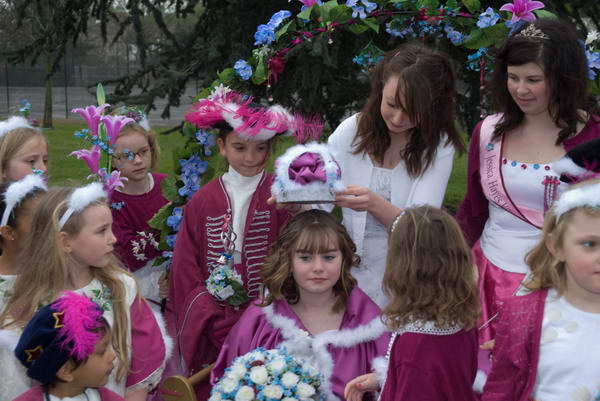
Crowning the Hayes Village May Queen, April 2008

Along with this image, Robinson exhibited another, entitled ‘May Queen’, which unfortunately I can’t locate on line. But other Victorian artists and writers took an interest in these traditional May festivities, and John Ruskin in 1881 established the May Queen ceremony at Whitelands College in Chelsea, the oldest recorded continuing May Queen event (Hayfield makes a claim to this, but despite an ancient tradition, it’s procession had to be revived in 1928, rather later than the start of processions at Brentham in 1906.) The Whitelands celebration survived the move of the college to East Putney and its incorporation into Roehampton University, although they now crown a ‘May Monarch’, alternating between sexes.


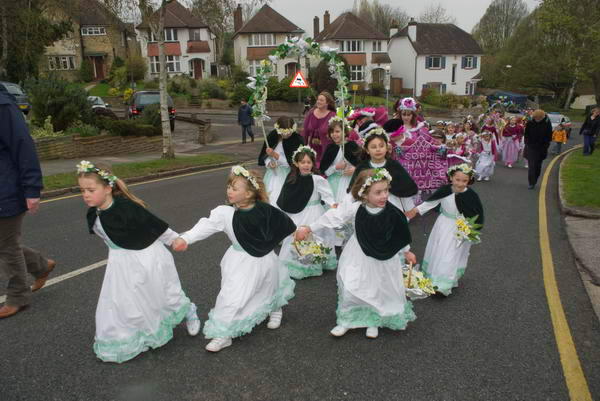
May Queen procession in Hayes, Kent, 2008

More pictures from last week’s Crowning of the Hayes Realms.

Reasons to Celebrate: Bilal and Bert

It’s always good to be able to celebrate things connected with photography, and today I’ve received a couple of pieces of good news.

Firstly, the US military have said they will release AP photographer Bilal Hussein today, two years and a few days after his arrest. As the e-mail from the Free Bilal committee stated, “It seems the nightmare will soon be over. Let’s just wait to see the photos and the video of our dear colleague truly free to celebrate.

Secondly a small cause for celebration in London SE1, where a public vote by more than 5000 local residents has recognised Bert Hardy (1913-95) as worthy of a blue plaque at his birthplace in Webber St, just a short walk from one of my favourite photographic suppliers, Silverprint.

Hardy is best known for his warmly human pictures of people, many of which from the period around the 1939-45 war appeared in Picture Post, and your can see over 20 from around the Elephant in 1948.

Hardy, who got a job at a nearby photo-processing plant on leaving school aged 14, was one of the first British photographers to work professionally with a Leica, starting by using it to photograph cycling events.

Editor Tom Hopkinson recruited him to work for ‘Picture Post‘, and his war pictures so impressed him that Hardy became the first photographer to get a byline in the magazine.

Hardy’s great asset for Picture Post was his ability to go anywhere and get on with the people he had to photograph, whatever their social background. He really was interested in people and his photographs show this.

He was called up and sent as a photographer to cover the armies advancing across Europe after the invasion, photographing the Rhine crossing and many other events. He was among the first allied soldiers to enter the concentration camps and photograph there.

After leaving Picture Post he did some advertising work and set up a photographic printing business, Grove Hardy Ltd, in Burrows Mews, Southwark.

You can now find many of his images on the web, as well as several pirate copies (not in the links below) of the short text I wrote about him some years ago!

James Hyman Gallery
Getty Images
Google Images

‘Bangladesh 1971’ at Autograph

I was surprised not to see more people at the press view of ‘Bangladesh 1971‘ yesterday, at Autograph ABP‘s superb new premises that opened last year in Rivington Place in London’s now-trendy Shoreditch.

Women preparing for battle prior to the crackdown of 25th March 1971
Photographer: Rashid Talukder, courtesy of Drik and Autograph ABP

Produced in partnership with Shahidul Alam and the Drik Picture Library (I was disappointed not to meet Shahidul, having corresponded with him over the years, and read his newsletters, but he was held up getting his visa for Croatia) this is in several ways an important show, and one that curators Mark Sealy of Autograph and Shahidul Alam can be proud of.

The show in the superb ground-floor gallery is of photographs, taken mainly by Bangladeshi photographers, of the events that led to independence for Bangladesh. One of the bitterest and bloodiest conflicts ever, many of the details are not widely known and still contested, and one of the aims of the curators was simply to provide a true account through photographs.

As they state, “For Bangladesh, ravaged by the war and subsequent political turmoil, it has been a difficult task to reconstruct its own history. It is only during the last few years that this important Bangladeshi photographic history has begun to emerge.” After showing here it is hoped that this exhibition will return to Bangladesh and become a part of a museum collection there. Although it is a show with considerable photographic interest, it is also one where the historical background is vital for fuller appreciation.

In an attempt to impose its will on the country the Pakistan army implemented the systematic killing of Bengali members of military forces, intellectuals and students, along with any other able-boded men they came across. Estimates of the number killed range from 200,000 to three millions (although an official Pakistan government investigation somehow arrived at a figure of only 26,000.) Similarly, estimates of the number of women raped during the atrocities cover range between 3000 and 400,000.

Over two million refugees fled from the army atrocities over the border to India. I also watched the film ‘Bangladesh 1971‘, part of the associated ‘Bangladesh 1971 Film Season‘ at nearby Rich Mix Cultural Centre, which includes powerful scenes from film made during the liberation struggle. We see refugees stepping through deep mud on their journey and of an old, near blind woman making her way by putting down a bamboo staff flat on the ground every few steps to find a route.

The 60 minute film, produced by a group at the Rainbow Film Society in Bethnal Green, describes the events in a clear time line, with footage of some of the key scenes also covered by the still photographs – and I think one or two of the featured photographers may be seen in it.

This show is politically important, and not just for Bangladesh, or the British Bangladeshi community- many of whom live in neighbouring Tower Hamlets – but also is very much relates to the British history of involvement in India since the days of ‘John Company‘, founded in 1600 “for the honour of the nation, the wealth of the peoples” of England, leading to over 300 years of colonial exploitation (in some respects little changed by independence in 1947.) The partition of India at independence was an unsatisfactory (and also extremely bloody) solution, and one which underlies the events of 1971.

US support of Pakistan, both through military aid and at the UN, also had disastrous consequences, and it would be good to see this show put on in the America. President Nixon even urged the Chinese (who also armed and supported Pakistan) to mobilise its forces on the Indian border, as well as sending the nuclear-powered aircraft carrier the USS Enterprise to the Bay of Bengal. Such support encouraged Pakistan to launch a ‘pre-emptive’ attack on India, and it was the failure of this followed by the rapid intervention of Indian forces against the Pakistan army in Bangladesh that brought the war for independence there to a speedy victory.

If I’ve spent too long on history and politics, it is because this show is in several respects an importantly political one (and if I have a criticism it would be that the exhibition needs to have more background material on display, including a time-line of the main events.)

But it is also an powerful show in terms of the actual photography – and also one that relates to the politics of photography. These are pictures taken by photographers from Bangladesh, several of whom deserve to be far more widely known. Although some of the images are important simply for what they show and in other respects are typical or even rather poor press images, there are also some outstanding pictures here. There are several very fine photographers among the dozen or so included here (and at least one excellent anonymous image) but the work of Rashid Talukder (b1939, India) and Abdul Hamid Raihan is outstanding.

Two Boys
Two boys stand among rocket bombs left by Pakistani army at the picnic corner in Jessore, Bangladesh. 11/12/1971
Photographer: Abdul Hamid Raihan, Courtesy of Drik and Autograph ABP

One picture by Raihan which stays in my mind is of a man standing in the ruins that were once his house. You can see it, along with another 32 of his pictures at Majority World, a “collaboration between The Drik Picture Library of Bangladesh and kijijiVision in the UK to champion the cause of indigenous photographers from the developing world and the global South.”

Talukder’s work is also striking, and in many cases not for the squeamish, with a startling picture of the discarded head of an intellectual along with bricks in a puddle, or the public bayoneting of a collaborator by guerillas. He also has a fine images of more peaceful events, including the release of a dove by Bangabandhu in 1973. Again you can see more of his work – over 90 images – on Majority World.

Drik, set up in 1989 by a small group including Shahidul Alam, its name the Sanskit for ‘vision,’ has pioneered the representation of photographers from the majority world, seeing it “vibrant source of human energy and a challenge to an exploitative global economic system.” It has very much challenged “western media hegemony“, promoting work from the majority world, running education programmes and setting up the first Asian photography festival, Chobi Mela.

The show – and the work of Drik – also raise questions about the future. We live in a rapidly changing world, one where India is fast becoming a leading power in the world economy, and also one where Bangladesh itself is under considerable threat from rising sea levels as a result of global warming.

The exhibition opens April 4 and runs until May 31, 2008. It is hoped it may also show elsewhere in the UK.

Rewriting Photo History?

I like to have a browse through the on-line auction catalogues of photography sales at Sotheby’s from time to time, if only to laugh at the prices that some people seem prepared to pay for some often pretty terrible photographs. Although all the prices seem extremely high these days, some often seem anomalously so, but this at times reflects the scarcity of works by some photographers.

Before photography moved into the art market – which really began in the 1970s – few photographers made many prints of any particular picture. Usually they only needed one or two, and if they made more it was often because they weren’t quite satisfied with what they were making and were trying to improve on the image, perhaps by fairly subtle changes in the dodging and burning.

Many of us spent hours in the darkroom tweaking until we were happy with what we saw, then washed all of the prints, including those we thought hadn’t quite made it, and went to bed leaving them hanging to dry, finding in the morning that we couldn’t see much difference between the final two or three attempts we had made. And given the price of photographic paper we often didn’t like to throw away those that weren’t quite the best either.

Strangely enough, the one thing that has probably increased the average number of prints of any successful photograph more than anything else is the idea of the ‘limited edition’. Photographers who before would have perhaps made only two or three prints started making 20 or 30, and in almost all cases, buying from a limited edition was virtually to guarantee that your purchase was less unique.

Of course there were photographers who did produce and sell large numbers of prints of some images, for example Ansel Adams. If you want to buy one (or several) of his images there are plenty going in the New York sale on April 8, although despite his mass production they are not that cheap.

Sotheby’s is a site that requires free registration if you want to access details or enlarged images rather than just the thumbnails. I use a special e-mail account for such sites rather than my normal personal account and I’d recommend everyone to do the same.

The sale on the previous day, The Quillan Collection of Nineteenth and Twentieth Century Photographs is a more interesting collection, not least because of an anonymous photogenic drawing of a leaf which Larry Scharf speculates may have been made by Thomas Wedgewood in the 1790s (or by his friend Humphrey Davy or another member of their circle such as James Watt.) This speculation – and it seems to be little more than this – has raised the expected price from the rather unremarkable image (Scharf calls it “extraordinary”) from a mere $100,000 to considerably more. When sold as an anonymous work at Sotheby’s London in 1984 it went for less than £400.

As an image, it seems a typical result from the kind of exercise that many beginners in the medium make. They find the results of their ‘photograms’ extraordinary too (and often fail to fix them properly.)  Indeed many of us have taught courses where students make their own light-sensitive paper using silver nitrate as a part of their science or photography education, producing results little different from this.

Here what matters is not the image but the artifact, and the critical thing about it is it’s date and who produced it. Scharf’s speculation is obviously not idle, and the details he produces about its possible provenance are interesting, but appear to rely at the moment on rather flimsy evidence, unless there is more than appears in his note on Sotheby’s site. It certainly isn’t something I’d gamble a fortune on – even if I had one.

Also on the 8th is a sale of pictures by Edward Weston that he gave to his sister, Mary Weston Seaman, along with 10 pictures by Brett Weston. There are quite a few Weston images new to me as well – one is an early (1917) pictorial image of her daughter – as some of his better known works. Early works by Weston are fairly unusual as after he adopted a modernist style he destroyed much of his earlier work. Does this make the pictures more valuable or should we agree with his opinion and disregard them?

Peter Marshall

Tibetans protest in London

Looking at the work by some of the great Magnum war photographers makes me realise more strongly than ever that I’m not cut out to be a war photographer. Cowardice is one reason, though anyone who doesn’t have a healthy dose of this in their make-up is perhaps unlikely to survive long. But I think that perhaps I’m rather to timid a guy for the job, and, as I got a reminder on Monday, too ready to panic under pressure.

I was photographing the Tibetan protest opposite the Chinese Embassy, timed to coincide with the Chinese government ultimatum to Lhasa protesters to give themselves up or face serious reprisals (whereas one suspects that anyone who did give themselves up would simply be beaten up, tortured, imprisoned and quite likely shot.)

I’d arrived rather late, having been taking pictures at Willesden Green and suffering a slight delay on the underground, so had missed the silence at 4pm but it probably wouldn’t have made a good photograph. It was certainly a very noisy even by the time I arrived, and I spent quite a while mingling with the demonstrators shouting at the embassy across the road, photographing with both a semi-fisheye and the ultra-wide end of the 12-24mm.

Where I wanted to be – and along with other photographers really needed to be was in the empty area just in front of the line of barriers in front of the protest. But that nice empty traffic-free area was being guarded by 3 policemen with orders not to let the press in, though I did sneak a couple of images from close to both ends.

Police like to keep things simple. Nice neat lines, two sides – cops and robbers , or in this case, cops and protesters. Despite those nice “agreed guidelines”, photographers are just a nuisance. I was just wondering whether to make a complaint to the officer in charge or just go home (it was around 5pm, the light was beginning to fail, and I’d had a long day, so the latter seemed preferable as although I think we should complain on principle, in practice it never gets you anywhere) when a Tibetan guy with a flag rushed across the road in front of me and made across the road for the door of the Chinese Embassy.

Tibetan Flag at Chinese Embassy

So of course I rushed after him, and got a shot – if from a little too far away – of him waving the flag as he was stopped by the four officers on duty. ISO 800, 1/125 at f4.8 – wide open – at 60mm (90mm equiv) on the 18-200. Almost sharp too.

Behind me I were other Tibetan youths who had knocked down the barriers and followed him, and I was able to get into better position as police and stewards tried to stop them.

Tibetans rush towards the Embassy

This is wide open at 18mm (27mm equiv), and 1/125 again, and sharp enough to read both officers’ shoulder numbers, and the little motion blur probably improves it.

There were a few decent frames in the chaos that followed, but looking back though the whole shoot I seem to have made too many exposures at the wrong time, got far too much camera shake (though of course some caused by being pushed in the crowd) and taken far too little thought. In a word, panic.

Fortunately there was enough left to make a decent story, or at least I think so – you can see it in My London Diary.

Of course other photographers also panic and get things wrong, though they may have considerably better reason to do so. Robert Capa on that D-Day beach had an incredible hail of unfriendly kinetic activity inches above his head, and its hardly surprising he didn’t raise it too much. I often wonder quite how much of the distress that lifts those images out of the norms of photojournalistic syntax into their powerful expressionism was the result of a quaking photographer rather than of the melting admiration of the unfortunate darkroom technician. When ‘LIFE‘ ran them in 1944 with a caption about the ‘immense excitement‘ of the moment making ‘photographer Capa move his camera and blur‘ it quite likely told a little of the story, although ‘excitement’ was probably not the most appropriate word. Capa after all was human, and like most of the rest of us would have been shit scared.