The Dear Leader and others

Christopher Morris‘s video sequence The Dear Leader seems largely to show what a good still photographer he is. The video itself is far too long and its soundtrack filled with rather too much portentous music (Emily by Philip Glass from the score for the film The Thin Blue Line and Evil Grade by John Kusiak, used in the film The Fog of War: Eleven Lessons of Robert S. McNamara, which also had a soundtrack largely by Glass.)

Essentially the movie seems a series of stills, to some of which the movement of the characters involved occasionally adds something, particularly in a lengthy shot of Bush speaking where what I assume are security men twitching in the right foreground supply the main interest. At other times it merely distracts, and there are also some downright boring long and fairly empty scenes where I longed for a single frame or even a more active pair of scissors.

I couldn’t help thinking what a shame he didn’t have his eye to the viewfinder of a still camera during some of these sequences,  still frames as yet can’t have the same quality (but of course it may not be long, esepcially with RED), but there are images that flicker through here that are stronger than some of those in his George Bush retrospective on VII, which does also contain a number of superb pictures.

You can see more of his feature stories ther by clicking on his name at the left of the   features page – unfortunately there doesn’t seem to be a direct link.

Among many other articles worth reading in dispatches is a letter from John Morris written on the occasion of Cornell Capa‘s death in May 2008, but also recounting something of the tragic loss of both Werner Bischof and Robert Capa in May 1954.

I found the video on ‘dispatches‘ from a link at FOTO8  and again  on VII you can also see the pictures from Morris’s  show  My America which was at the Host Gallery recently. Currently they are showing the work of British post-war industrial photographer Maurice Broomfield, a reminder of those times when Britain still had industry.

Paris and London: MEP & PG

Late yesterday I got back from a week in Paris, and one of the highlights of any trip there for a photographer has to be a visit to the Maison Europeene de la Photographie (MEP) .

I’ll write in more detail about some of the things I saw there in other posts, but what really struck me – yet again – was the complete difference in outlook between the MEP and our London flagship The Photographers’ Gallery (PG).

Of course we can hope that some things may change when the PG moves to more extensive premises shortly, but the biggest difference so far as photography is concerned is one of attitude. The MEP clearly believes in photography, celebrates it and promotes it, while for many years the PG has seemed rather ashamed of it, with a programme that has seemed to be clearly aimed at attempting to legitimise it as a genuine – if rather minor – aspect of art.  (It was something that worried photographers in the nineteenth century – but most of us have got over it by now.)

One important difference between the two spaces is that at the MEP you pay to see photography – 6 euros (3 for reductions) though Wednesday is something of a photographers’ evening as entry is then free to all. (A press card gets you in free at all times.) This charge doesn’t appear to put people off, and almost every time I’ve visited over the years I’ve had to queue anything from 5 to 20 minutes to get in. But it does make it a little more of an event to go there, and it does mean that the MEP has got to offer something people feel is worth paying for.


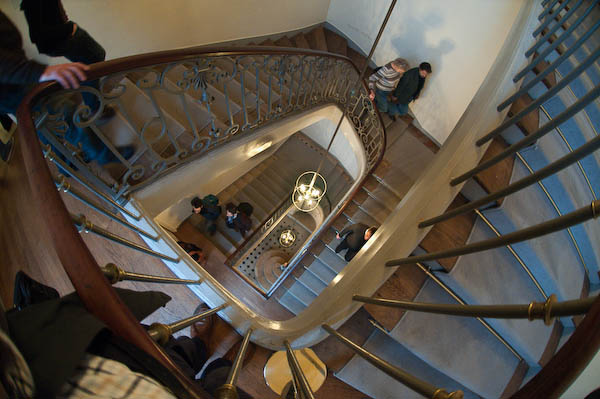
The staircase at the MEP

Of course the MEP does have a rather grand space with perhaps 3-5 times the size of the old PG, it also makes better use of it – at the PG half the space was usually largely wasted by being a coffee bar with a few pictures around the wall (and I think some other areas, such as the print room could also have been far better used.) And although I did sometimes enjoy meeting people in the cafe and having a coffee, I’d rather have been able to see a proper show and then pop across to the Porcupine or elsewhere to socialise (which of course I also did over the years.)

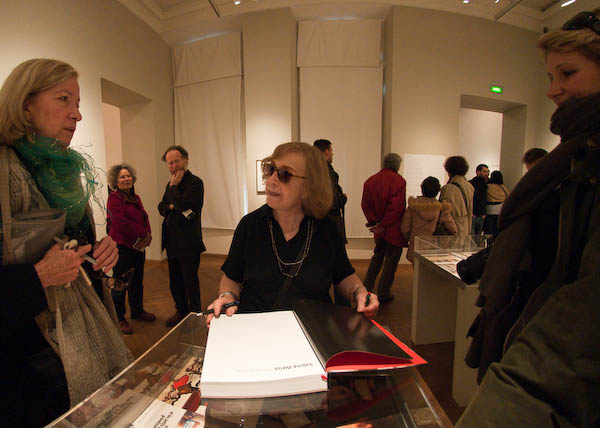
Sabine Weiss signs books in her MEP exhibition
Sabine Weiss talks to visitors and signs books at her MEP exhibition

This time, one floor of the MEP – perhaps around the total amount of exhibition space at the PG – was given over to a retrospective of the work of Sabine Weiss – which I’ll write about in another post. A Swiss-born photographer, she started her distinguished career in Paris and took arguably her best pictures there, so this was a particularly appropriate venue, although it would be nice to see this work in London too.

But one could also propose shows by a number of British photographers of similar stature who have so far been largely or entirely neglected by the PG. Not that I would want any gallery to be insular, but I feel major galleries do have a responsibility to promote work connected to their country and place, especially when like London and Paris they have played vital roles in the history of the medium.

Another floor of the MEP showed the complete photographic works of David McDermott and Peter McGough, two USAmerican artists who have made extensive use of various alternative printing processes (good salt prints, rather indifferent cyanotype and gum bichromates etc) as a part of an extensive lived re-enaction of life as late nineteenth and early twentieth century gentlemen. I don’t think they would want to be called photographers, but their work, as well as the interest of the processes concerned was witty and full of ideas, whereas some of the shows by artists at the PG seem very much one-trick ponies – including the last that filled the space adjoining the book shop.

Another, smaller space at the MEP covered the career of Turkish photographer Göksin Sipahioglu, who became ‘Monsieur SIPA, Photographe‘ after founding his agency when he came to Paris as a photographer in the 1960s.

Sipahioglu is a perhaps unfairly often thought of as a no-frills photojournalist who excelled at being there and getting pictures rather than for subtlety, but the work on show made me want to rewrite the lengthy piece I wrote about his work a few years ago.

Also showing in the MEP were a series of colour portraits  of artists in their studios by Marie-Paule Nègre, originally produced on a monthly basis for the Gazette de l’Hôtel Drouot to accompany interviews with the artists. While the theme is well worn, the images were well done and often had a freshness and interest. Which is more than I can say for Mutations II  / Moving Stills, a selection of videos made by European artists – part of the European Month of Photography – the short sequence of which I viewed had all the Warholian attraction of paint drying. However each did have its small group of apparently enthralled watchers.

Although of course curators play an important role in the exhibitions at the MEP (from a visit a year or two ago I recall an awesome show of the life of a single photograph by Kertesz) I get the feeling that photography at the MEP (and perhaps in France in general) is still very much based on the work of photographers. In the UK in the late 1970s the Arts Council made the fatal mistake of handing over the medium to curators and galleries, and we – as the PG evidences – are still suffering from it.

William Eggleston: Democratic Camera

Eggleston’s show of work (photographs and some video) from 1961 – 2008opens at the Whitney Museum of American Art, New York on Nov 7, and continues until January 25, 2009. After that it will tour in the US and at the Haus der Kunst in Munich.

On the Whitney site you can see a short trailer for the documentary film by Michael Almereyda,  William Eggleston in the Real World and there are also links to several newspaper and blog features and interviews.

Here’s a longer video on Youtube:

And for pictures go to Eggleston’s own site which has an impressive collection of his work.

8 Magazine

The latest issue , No 24, Autumn 2008, of 8 Magazine that thumped through my letter box recently is another bumper one with almost 180 pages, although thankfully for the health of the magazine, a few of them are adverts.  It’s not cheap, but given its size and contents I think is reasonable value at £44 for the two issues per year (UK, including postage – see the web site for subscription details and sixty preview pages.)

It includes eight features with some fine photography; the oustanding work to my mind was Kathryn Cook‘s on the legacy of the Armenian genocide, but I also very much liked Alvaro Ybarra Zavala‘s pictures of the FARC in Colombia. Features by Murray Ballard, Ilan Godfrey, Michael Donald and Andrea Diefenbach also very much caught my eye.

Obviously I disagree with some of the opinions expressed by the writers, but that’s good too, and there are plenty of other things here to stimulate or entertain. It was good to read Chris Steele Perkins on press photographers including images by Don McPhee, Dennis Thorpe and Neal Libbert, and even more so to read his review of David Mellor‘s book and exhibition “No Such Thing as Society.”

The main problem with this book is, as he says, its sub-title “Photography in Britain, 1967-87” which it so clearly is not (and a similar criticism could be and was levelled at the great Tate “How We Are: Photographing Britain” last year, not least on this site.)

Mellor’s show and book has the same limitations as the two collections on which it was based, that of the Arts Council and the British Council, both missing out on most of what was happening in photography in the UK at the time (and probably at all times.) Steele Perkins makes clear that Mellor failed to consult people such as himself and David Hurn who were at the thick of things and the book misses out – as the collections did at the time – on a whole new flourishing of photography in this country, both in the commercial sector with colour supplements and foreign picture magazines, but also in the independent sector which emerged in this period with many photographers working without the benefit of recognition or funding from official bodies.

No Such Thing as Society” is one of a number of attempts to rewrite the history of the era – an earlier example would be the ‘Camerawork Essays‘  – see the article by Paul Trevor and myself.

Milton Rogovin

I’m pleased to see that the work of Milton Rogovin is getting some attention at the moment, with a cover picture and excellent feature in last week’s British Journal of Photography (you need to be a subscriber to view the text by Bill Kouwenhoven in the issue along with just a single image) which was guest-edited by photographer Simon Norfolk), and now a mention in a Magnum Blog post by Alec Soth.

One of the many features I wrote for About.com – sadly no longer on line – was a lengthy feature on Rogovin. Written the year after he gave up photography in 2002, and at the time of his New York Historical Society show in 2003, and a few weeks after the death of Anne Rogovin, who had played an essential role in his work (his “life partner and comrade for sixty-one years“), in July 2003.

Photography in the USA was hit badly by the cold-war hysteria of the McCarthy years, which put an end to the New York Photo League and sent Paul Strand into exile in France rather than face investigation. These and related events were  blows which changed the direction of photography there, and not for the better. But in the case of Milton Rogovin, optometry’s loss became photography’s gain. In 1958 his business in Buffalo, New York evaporated after he stood on his constitutional right to refuse to testify and was named in the Buffalo papers as “Buffalo’s Top Red”.

Rogovin had been interested in photography for some years and had shown work in regional shows. Now, he felt his “voice was essentially silenced, so I decided to speak out through photographs.” A friend who taught music at Buffalo State College asked him to photograph a project recording the activities of an Afro-American Holiness Church in the east side of Buffalo, and when the music project ended after three months he continued to photograph in black churches for another three years. The work honed his technical skills, particularly in getting proper gradations on black skin tones.

In 1962, photography’s leading magazine, Aperture, edited by Minor White, published this Storefront Church series with an introduction by W E B Du Bois, a founder of the National Association for the Advancement of Colored People (NAACP).

Other long-term projects followed, with Anne Rogovin providing both inspiration for his work and money to keep the family as a special education teacher. ‘Family of Miners‘ started with nine summer vacations in Appalachia, but after he got the W Eugene Smith Award for Humanistic Photography in 1983, was extended to France, Scotland, Germany, Cuba, Spain, China, and Mexico and Zimbabwe.

But although he travelled the world, perhaps his best-known work came from Buffalo. Shortly after returning from a trip to Chile, where he collaborated with the poet Pablo Neruda in 1967, Rogovin decided to undertake a project in the inner-city Lower West Side. It took some time for him and Anne to gain the confidence of people there, and he switched from an Hasselblad to the battered Rolleiflex he would use for most of the rest of his work after he found too many people admiring his camera and asking how much it was worth! He kept things simple, with the camera on tripod and a bare-bulb flash, getting to know people and gaining their confidence before asking for permission to photograph them. His portraits were never posed, although he would ask people to look at the camera (eyes were central to both his careers), but he wanted them to present themselves – and he always made sure to go back and give them prints. He seldom took more than 3 or 4 exposures of anyone, even when photographing groups.

Twelve years after completing this first project on the area, at Anne’s suggestion, he returned in 1984 and managed to find a rephotograph over a hundred of these same people. Most had moved, and he only found many of them by standing on street corners with his box of pictures and asking if people knew any of them. Again she suggested he return in 1992, while he was recovering from a heart operation and prostate cancer and managed to find and photograph some of the people for a third time. Then in 2000, along with Anne and radio documentary producer Dave Isay, they managed to find photograph and interview at least eighteen of his original subjects.

In 1999, the US Library of Congress accepted 1200 of his prints, as well as negatives and contact sheets and related letters and documents (to see some his pictures in the collection, enter Rogovin into the search box and set to search in author/creator fields – the first page of results has few digitised images, but later pages do.) It was the first time for perhaps 20 years that such a large body of work had been accepted by the Library, an indication of the historic significance they attached to his work.

1968 Remembered

Actually I don’t remember too much of the sixties – I was a student for most of them and pretty involved in the events in Manchester which had some interest, although not at quite the same level as Paris, though we did have our demonstrations and of course occupied the university like everyone else.

Had I been taking photographs then I would at least have some aids to jog my memory, but I didn’t have the cash. I have just a few pictures, slides of girlfriends sitting in cherry trees or posing in front of stately homes, a few assorted black and whites, and a set of terrible grey and white wedding photos from what was my personal major event of 1968 (our honeymoon was in Manchester with a day trip by coach to the Lake District.)

But this year, 40 years on, has seen a great deal of time devoted to remembering the other events of 1968, and one of the most dramatic was of course the Soviet Army invasion of Czechoslovakia which brought an end to the ‘Prague Spring’. This was the first news event that a 30 year old Czech photographer covered, and he risked his life using his Exacta camera to produce an amazing set of black and white pictures. A year later these images, smuggled out of the country were published anonymously as it was thought they could endanger his life, and the 1969 Robert Capa gold medal for photographs requiring exceptional courage was awarded to that anonymous Czech photographer.

The following year, Joseph Koudelka, with a little help from Magnum and the British authorities was allowed to leave the country for England on a 3-month visa and not return when it expired.  The Magnum Blog has a set of 10 images from that 1968 invasion, as well as links to a set of 100 images from it as well as some of his later work.

A new book from Aperture features his pictures: Invasion 68: Prague, and his work will also be on show shortly in New York at the Aperture Gallery (Sept. 5 – Oct. 30, 2008) and Pace/MacGill Gallery (Sept. 4 – Oct. 11, 2008.)

Terry King at 70

Terry King
Terry King reads his poetry at his 70th birthday party

I was surprised to find that Terry King was approaching 70 when I got an invitation to his birthday party on Saturday.

I got to know Terry in the 1970s when we both went to meetings of ‘Group Six‘, a rather controversial group of the Richmond and Twickenham Photographic Society whose interests in photography were largely outside the world of amateur photography with its print battles and sunsets. At the time it was led by another photographer now well-known on the web, Vincent Oliver (then just Vince) whose photo-i web site is the only place to go for reviews of scanners and printers.

Later Terry took over the group, and together we organised a series of shows that got considerably more attention than the main society events, upsetting the committee and we had to set up as ‘Framework‘, an independent photography group outside of the amateur movement. Framework continued to organise shows for a number of years and among many UK photographers to exhibit with Framework were Terry King, Carol Hudson, John RT Davies, Derek Ridgers and Jo Spence. We also had a few foreign contributions.

But Terry is best known for his interest in alternative print processes and his personal work using them, particularly gum bichromate and the ‘Rex’ variations he developed for gold printing and cyanotype.

Around 30 years ago, I sat in a row on the left-hand side of a dimmed hall in Richmond listening to a lecture by a retired advertising photographer called Steinbock. On my right was Terry King and on my left, Randall Webb (much later to become the co-author with Martin Reed of ‘Spirits of Salts:  A Working Guide to Old Photographic Processes‘  London:  Argentum, 1999.) The small and rather tonally lacking gum prints which the lecturer put on display were not the first I had seen, but this was the first time I had seen a gum printer and been told with some detail how to make such prints.

The three of us went away, each determined to try the process. At the time I was a teacher of chemistry and photography, and liberated a couple of surplus jars of the potassium dichromate needed from our chemical store and gave one to Terry.

Later I helped Terry who had set up a course ‘From Wedgewood to Bromoil‘ so he could get paid while he tried out early photographic processes at the local adult education institute.  I got my college to pay my fees for the course and we spent a year of Saturday mornings with a few other keen students learning how to do pretty much the whole range of alt processes, with William Crawford’s ‘The Keepers of Light‘ as our main guide.

I found gum a pain to work with, especially when I tried tri-colour printing, and soon concentrated on other processes such as salt-printing, kallitype and platinum and palladium, teaching a few classes and workshops, but eventually my other photographic interests left no time alt printing.  In any case, once most alt printers had started to work from digital negatives I felt they may as well go the whole way and make inkjet prints.

Terry went on to develop his own individual approach to gum printing, producing many fine images (one of which normally hangs on my wall, and you can find some examples on his web site)  with this and other processes, as well as to run workshops that trained a whole new generation of alt photo printers in the UK, to organise the international APIS (Alternative Processes International Symposium) and various other events, as well as becoming Chairman of the Historical Group of the Royal Photographic Society.

Terry is also a poet, and in particular has produced many inspiring limericks. Long ago when he was a civil servant he used to compose at least one every morning on his train journey from Twickenham to Waterloo. The photograph shows him reading some short poems shortly before blowing out the candles on his cake.

Picture Paradise?

Some years ago when I wrote a feature for a web site on the early years of photography in  Australia (Australian Photography 1840-60)  and another on a fine twentieth-century Australian photographer, Frank Hurley, unfortunately neither currently available on line.

After publishing my piece on the early years, I received an e-mail from an Australian that berated me for not having written a full history of photography in that country. My reply basically but politely told him that I was a pom living in England, and if he wanted a history of photography in his country he should get off his backside, do some research and write it. A few years ago there was relatively little material available on line to enable me to do so if I had wanted to, and so far as I was concerned Australia was just one of around 195 countries I wanted to write about.  (Unfortunately this was 194 more than my then employers appreciated, and I only managed to mention something about photography in around 50 of these before they dispensed with my services.)

I don’t know how many of the pioneers I mentioned – Captain Lucas, George Barron Goodman, Douglas Thomas Kilburn, William Little, Norman and Heseltine, Schohl, Thomas Gill, ‘Professor’ Robert Hall, J W Newland, William Freeman, John Hunter Kerr, Robert Hunt and others – are included in what looks like a fine exhibition by the National Gallery of Australia, ‘Picture ParadiseAsia-Pacific Photography 1840s-1940s, but only Kilburn from that list appears in the 5 images on line covering the same period.

The show perhaps spreads it’s net too wide by including the Indian subcontinent – I wrote at around a dozen full-length features on India while only scratching the subject, as so many fine photographers from Britain in particular worked there in Victorian times.

It certainly is surprising not to see a single picture by the great early Indian photographer Lala Deen Dayal although he does get a mention in the accompanying essay. Several other photographers I’ve also previously written about, including Felix Beato and Samuel Bourne are represented by photographs, as too –  rather surprisingly, is Julia Margaret Cameron. Although a great photographer, the picture included serves to confirm the popular view that she did nothing of great photographic interest in her return to India, with all of her best work being made on the Isle of Wight, well outside the area of this show.

Lala Deen Dayal (1844-1905) is one of relatively few photographers to have been honoured by a postage stamp issue, and I was very pleased to receive a commemorative album from his great granddaughter who runs the web site about his work containing examples of the 500 Rupee stamp issued in November 2006. Few photographers can claim an edition of 0.4 million!

So although this is an interesting site and well worth a look, and does bring to our notice several photographers whose work until now has been (perhaps deservedly) fairly obscure, it isn’t really a balanced overall survey of photography in the region, and certainly fails to do Australia itself justice.  There is still time for that gentleman I corresponded briefly with to get his act together.

Pigeons Post


Detail from ‘Release of the Doves’ – see full image below

Pigeons were behind much of the dramatic increase in interest in photography in Britain as an expressive medium in the 1970s. It was the Coo Press, owned by Colin Osman, both a keen photographer and a photo historian, which provided the finance for ‘Creative Camera‘ magazine in the 1970s and the premises for the Creative Camera bookshop in Doughty St, where many of us made regular pilgrimage. (Osman had bought the magazine, then called Camera Owner and about to fold, for £1 in 1966) and the magazine, particularly with Peter Turner as editor and a great deal of advice – at least in the first place unsolicited and typically forthright – from Tony Ray Jones and some other photographers that edged at least a small section of British photography out of its comfortable and self-satisfied rut.

Behind me as I write is an almost complete set of that magazine, and on the shelves downstairs the annuals – including one with a set of three of my pictures, the first of my work published outside of the more strictly amateur magazines.


Town Meadow, Brentford, 1970s published in ‘Creative Camera Collection 5’.

(One of many paradoxes was that while those amateur magazines paid for photographs – at much the same rates as today – in Creative Camera you did it for love and prestige, as is still the case in some of the best photographic magazines, including Aperture.)

Camera Owner changed gradually into Creative Camera and continued to lose money, and it was the pigeon-fanciers who had probably never heard of it and certainly never read it who kept it afloat. Later, when Osman could no longer afford to subsidise his labour of love, the Arts Council took over the reins and drove the magazine into a cul-de-sac from which it only rarely ventured onto fertile ground. You can read the story in more detail (and doubtless more accuracy) on Roy Hammans’s Weeping Ash web site.

Once a year I photograph pigeons. Not for ‘Pigeon Breeders Gazette‘ or some other magazine, but as a part of the festival of Our Lady of Mount Carmel, the annual Italian festival in Clerkenwell, London (once known as ‘Little Italy’) where doves are released as a part of the event.

Last year I struck lucky as you can see from the detail – at roughly 50% full size at the top of this piece. Three pigeons took up a difficult to improve triangular formation as I pressed the shutter; it was superb choreography. I’d quickly moved into a good position for the picture as the clergy got ready to release the birds, but then it really was a matter of luck, as the pigeons generally head up into the air at great speed when released.

The full image below includes on the left hand edge ‘Our Lady’ looking down on the clergy and to their right some of the watching crowd (and I think the bus stop adds something, showing clearly it is London.
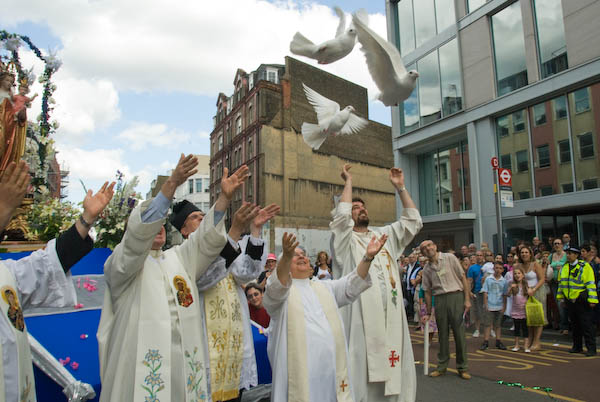

Release of the Doves, Procession in Honour of Our Lady of Mount Carmel, Clerkenwell, London, 2007. 

This year, however well I did I was never going to have the same luck, the doves were going to be something of an anticlimax, and so it proved. Either the pigeons were pesky or the priests who released them needed more training, for they failed to synchronise, and the birds only came together in the air a couple of hundred meters away.
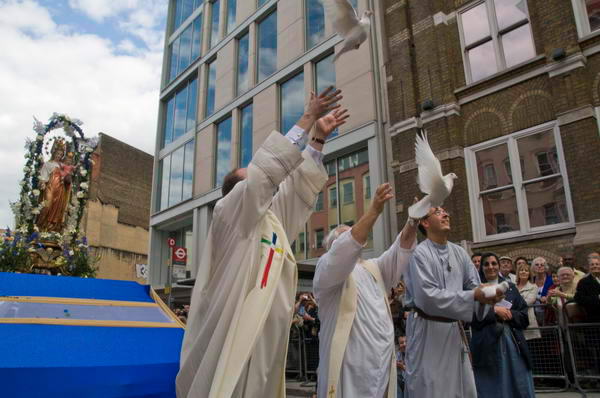

The best of 3 frames taken in around 0.5 seconds before the birds disappeared

The release of the doves is a part of the procession which has evolved considerably over the years I’ve photographed the event, but still I think lacks something. As a considerably lapsed Congregationalist it’s perhaps surprising to have to point out that the missing element is liturgy, an appropriate and religious combination of words and actions, where the priests are in charge.

A countdown by an over-intrusive photographer (not me!) just doesn’t fit the occasion, which would be better served by a blessing with the release of the doves on the closing ‘Amen.’ It might just unite priests, doves, photographers and the crowds.

More pictures from the event on My London Diary – including more frames with the doves.

As always, pictures here, unless otherwise stated are (C) Peter Marshall and are available for use as high-res files

Carolyn Drake wins Lange-Taylor prize

This is rather old news, not least because my server ate it when I posted it a day or two ago. I’ve been meaning for some time to write again about the work of Carolyn Drake, who, together with writer Ilan Greenberg is the winner of the 2008 (and eighteenth) Dorothea Lange–Paul Taylor Prize, one of the major awards for documentary photography.

The $20,000 prize from The Center for Documentary Studies at Duke University in Durham, North Carolina, USA, is given to encourage collaboration between photographers and writers in documentary work. Dorothea Lange is best known for her picture Migrant Mother and other images taken for the Resettlement Administration (FSA).

Library of Congress
from: Library of Congress Prints and Photographs Division Washington

Lange’s second husband was an agricultural economist and writer Paul Taylor, a professor at the University of California, Berkeley (they married in 1935) and together they made many field trips documenting rural America, and in particular poor sharecroppers and migrant workers. Lange got a Guggenheim in 1941, the same year that they published the seminal ‘American Exodus:A Record of Human Erosion‘ Later, in 1952, she was one of the founders of Aperture Magazine.

Carolyn Drake

lan Greenberg and Carolyn Drake’s project, ‘Becoming Chinese: Uighurs in Cultural Transition,’ looks at a rural Muslim community in a Chinese region, whose culture and language has been and is under severe pressure from the Chinese government.

Drake’s colour images (there are six on the Duke site and others in the links below) have an incredible freshness of vision, with sometimes a quite striking framing or angle of view. Sometimes it can be a challenge to decide exactly what we are seeing – as in a view ‘Oasis town, Turkmenistan‘ on the set of images on F-Stop #27 (Feb March 2008).

On Blueeyes you can see images from the Ukraine in Borderland, many of which too have a certain mystery as a face glooms out of the darkness at the edge of an image or a man is suspended in the branches of trees. Drake likes dramatic foregrounds, but there are also images that are largely about superb colour. She is also given to some powerful and dynamic composition, often getting away from a slavish adherence to the horizontal and using the cuttng edge of the frame to great effect.

Her other Blueeyes essay on the Lubavitch in Brooklyn is perhaps more carefully controlled but has some stunning images (they got her noticed by PDN for their Top 30 emerging photographers to watch in 2006)

You can also see a great deal of work on Carolyn Drakes own web site – perhaps the most intriguing for me was a set on a subject I’ve tried to look at myself, suburbia. I’m not sure where her ‘New Suburbia‘ series was shot, but I think it’s a place I’d avoid living.

Drake, who is based in Istanbul, is a member of Panos Pictures and you can see a perhaps wider range of her work on that site by clicking on her name on the photographers page.

One of the first articles I wrote when I worked for ‘About Photography‘ was about photographic competitions – and its major point was the obvious one that you won’t win if you don’t enter. I’m sure there were many more excellent entries for the Lange-Taylor prize, and it takes a lot of time to put together entries for this and other competitions. This wasn’t Drake’s first year of entry for the prize. It’s always a disappointment if you enter and don’t win the best thing to do is to pick yourself up and try to do better another time. Entries for the 2009 award are due in Jan 2009 and all the details are on the web site.