Jack London Photographer

As often happens, it was a feature on the New York Times Lens blog that set me thinking this morning , this time by Jonathan Blaustei, the ‘The Rarely Seen Photos by Jack London‘. It wasn’t the first time I had seen photographs by London, with a number of earlier article such as Spitalfields Life’s Jack London, Photographer, published a couple of years ago at the time that Tangerine Press and L-13 Light Industrial Workshop republished his classic study of London’s East End, The People of the Abyss including all all 80 original black & white ‘illustrations from photographs‘ of the first 1903 US publication.

Interesting though these are, the poor quality of the original reproduction (which I assume is faithfully reproduced in the republished version) perhaps makes it had to appreciate London’s qualities as a documentary photographer.

Those unfamiliar with London’s life and other works such as ‘The Call of The Wild’ (which I was intrdouced to at school many years ago) will find a good short biography in the Smithsonian Magazine marking the 100th anniversary of his death a few days ago. The feature does mention his photography but almost in passing, a surprising lacuna given the 2010 book Jack London, Photographer by Jeanne Campbell Reesman, Sara S. Hodson and Philip Adam, which used original negatvies from the California State Parks collection (and there is a Jack London State Historic Park) and the albums of original photographs in the Huntington Library Jack London collection (this has 200 images on-line but these don’t really represent his documentary work.)

The book includes images from the East End, where he dressed as a working man and lived with those he photographed and wrote about (an approach which later inspired George Orwell‘s 1933 ‘Down and Out in London and Paris‘ – though Orwell worked only in prose), his work as a war correspondent on the Russo-Japanese war for the Hearst press, the 1906 San Franciso Earthquake, sailing trips to the Hawaiian Islands, the Marquesas, Solomon Islands, and Bora Bora where he documented cultures he saw fated to disappear, and his final photographs of the 1914 Mexican Revolution two years before his death. You can read a review of the book by blogger Ron Slate.

This April The Daily Telegraph published a feature accompanying the release of a new book, ‘The Paths Men Take‘ by Contrasto Books which has 70 photographs from his four major photographic coverages, and more recently The Guardian got in on the act.

Unlike some other famous figures whose snapshots have been published in later years, London was clearly a serious photographer, taking over 12,000 photographs in his relatively brief career. He saw himself as a professional photographer and was taking his pictures to sell alongside his writing. He called his pictures ‘human documents‘ and while they lack the revolutionary and controversial power of his writing they bring to life the people and events that he photographed.  He died on his ranch, aged only 40, having suffered from many serious illnesses on his travels, including scurvy in the Klondike and various tropical infections on his voyages, as well as life-long alcohol addiction on 22nd November 2016.

Dannin on Magnum

I’m not sure that ‘“The Dannin Papers,” a series of Guest Posts by Robert Dannin, who served as Editorial Director of Magnum Photos from 1985-90′ actually tell us a great deal about photography, revealing as they are about some photographers, but at least for me the first piece, now on part 4 of 6 about his years with Magnum, based around an interview he gave to Russell Miller in 1995 is a highly entertaining series about the inner workings of the world’s best-known photo agency.

It is more than just gossip. More seriously it also shows up Miller’s book as a highly sanitised version of the truth, and I can find little in it that reflects the inside information that Dannin gave him when he was producing his ‘MAGNUM: Fifty Years at the Front Line of History’, as well as giving some insight into the inner workings of what would appear also to have been one of the world’s most dysfunctional organisations. Dannin gets 5 lines in the book, with a note of his resignation and a very pithy quotation of his reasons; Haiti, the first of three disasters which Dannin recounted to Miller in the current post, does not even feature in the book’s index.

Perhaps things have changed a little since then, and though there are still some fine photographers in Magnum, it no longer really deserves or enjoys the reputation it had back in the last century, with other agencies now encouraging much of the best photojournalism and Magnum sometimes appearing a little past its best-before date. When I started in photography it was every young photographer’s dream to become a Magnum member, but I think few harbour that aspiration now.

Killed by Roses


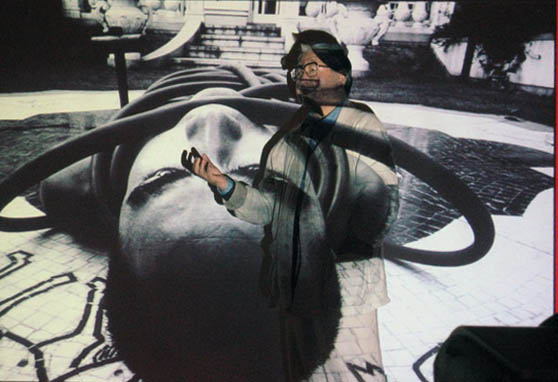
Eikoh Hosoe and one of his pictures from Ordeal by Roses

Today’s L’Œil de la Photographie with its article Eikoh Hosoe, Barakei A portrait of Yukio Mishima brought back memories to be of a few days spent in company with him and other photographers back in 2005 in Bielsko-Biala, at their first FotoArtFestival.


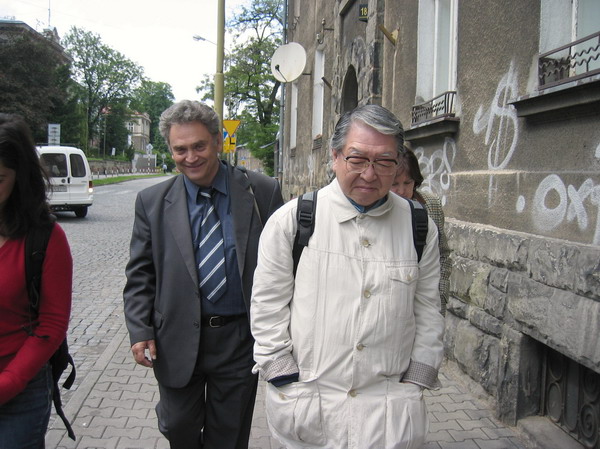
Eikoh Hosoe in Bielsko-Biala

It was a great privilege for me to be invited to show some of my urban landscape work from London’s Industrial Heritage along with such distinguished company as Eikoh Hosoe, Ami Vitale, Boris Mikhajlov and Malick Sidibe, as well as many rising stars and a few of those no longer with us, Mario Giacomelli, Inge Morath and Robert Diament, as one of 25 photographers representing 25 countries around the world.


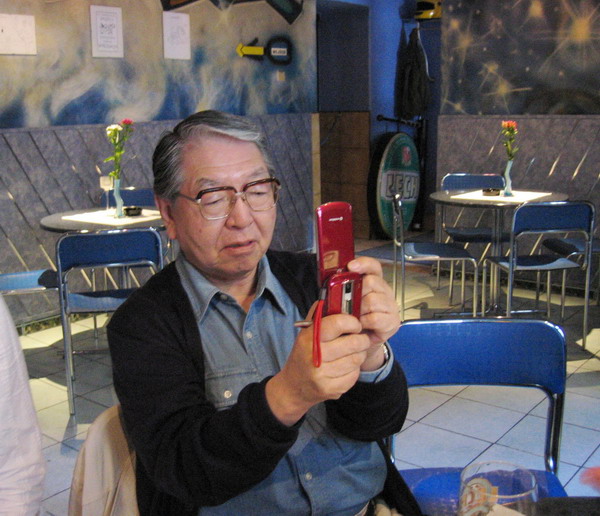
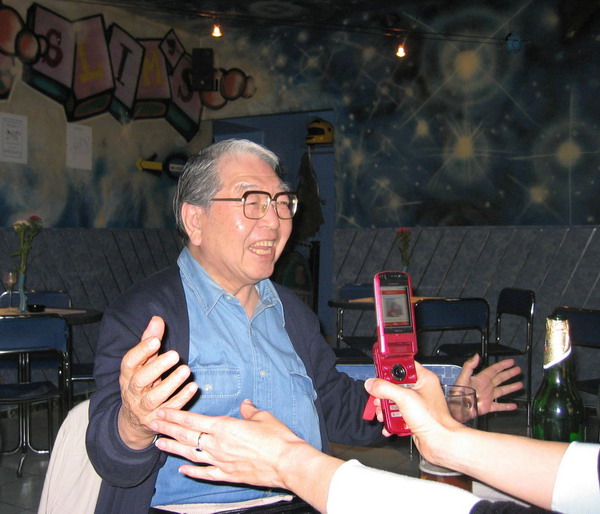
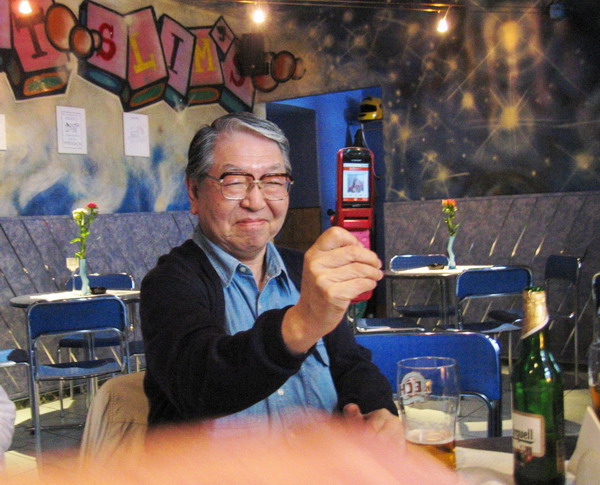
Eikoe Hosoe uses his pink phone camera

I’d travelled light to Poland, and had only taken a small digital pocket camera, a Canon Ixus. It was an excellent camera for the time, but in some of the dimly lit interiors I did find myself wishing I had brought a Nikon. But it was a small and pocketable camera, and I think did remarkably well all things considered. You can see more pictures I took with it on the trip in my FotoArtFestival Diary, along with some of one of my three talks there. As well as presenting my own work, I also gave presentations on the work of two great British photographers, Tony Ray Jones and Raymond Moore, and on the work of some of my London Friends, Paul Baldesare, Jim Barron, Derek Ridgers, Mike Seaborne and Dave Trainer.


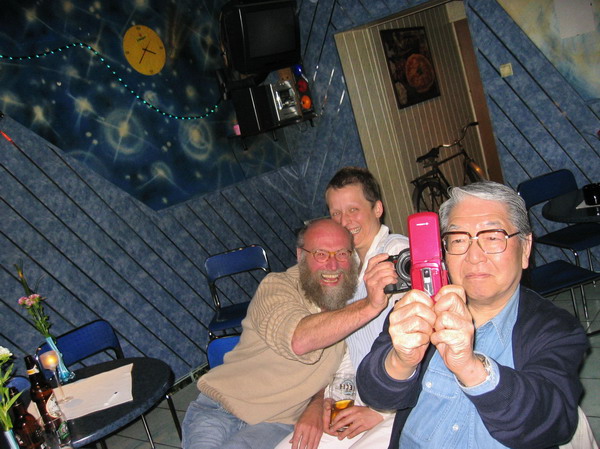
Eikoh Hosoe photographs me photographing him

What was remarkable apart from the photography was the atmosphere and camaraderie among the group of photographers there, some of the exhibitors and a few of their friends. Any ice between us had been broken at the press conference, which was enlivened by vitriolic attack on me as a British colonialist by one vodka-fuelled photographer as I got up to speak, enabling me to reply with a robust statement of some of my own political views and working class background, a family history of being screwed by that very same ‘elite’, ending up with us embracing each other – and going to a bar with most of the other photographers. Though I stuck firmly to my own resolve not to drink vodka, the beer was good.


Eikoh Hosoe

Hosoe was certainly the most distinguished of the photographers present, and probably too the oldest, and had a typically Japanese quiet reserve which was rather at odds with his photographic work. Though as some of these pictures show, by the end of the event he was very much one of us.


Eikoh Hosoe shows a picture on his pink phone

The ‘Eye of Photography’ feature accompanies a show of the work Bara-kei, (1961–1962) more often known in English as ‘Ordeal by Roses’, homoerotic images of melodramatic poses by the writer Yukio Mishima, one of Japan’s leading postwar writers, also a poet, playwright and actor as well as a nationalist who founded his own small right-wing student militia, the Tatenokai, taken in Mishima’s own house in TOkoyo. His work set out to break taboos and upset cultural traditions, with an emphasis on sexuality, death and political change, a delusion that led in 1970 to him with just four of his militia to perform a coup attempt to restore the power and divinity of the emperor, thought to have been a dramatic staging for his own ritual suicide with which it ended.


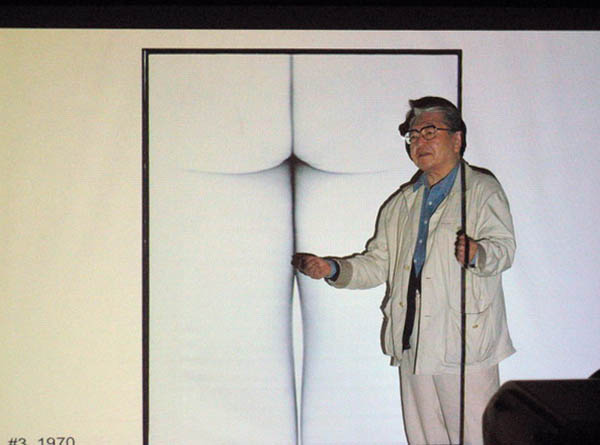
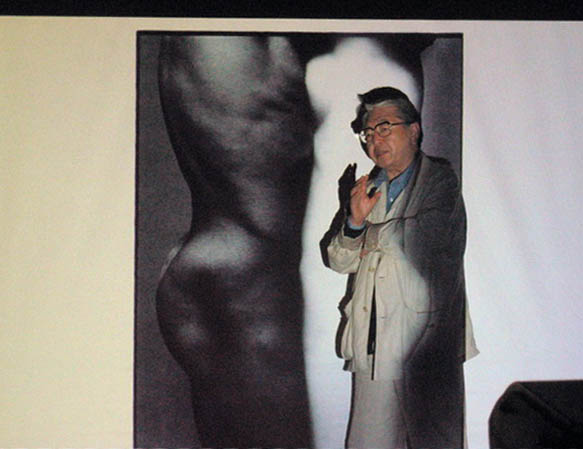
Eikoh Hosoe talks about one of his pictures

The Show ‘Barakei – Killed by Roses’ is at the Galerie Eric Mouchet in the Rue Jacob in Paris from today until December 23, 2016.


and another

You can see and hear him talking about some of his work in a video made for the Art Gallery of New South Wales.

There is a good selection of his work on Artsy – or you can search on Google Images. Although his work is on many gallery sites he does not seem to have his own web site. He has been the director of the Kiyosato Museum of Photographic Arts since its foundation i 1995. There is a nice piece on him, Eikoh Hosoe – Kamaitachi – From Memory to Dream by Rob Cook in The Gallery of Photographic History

Continue reading Killed by Roses

My First Day with a camera in London

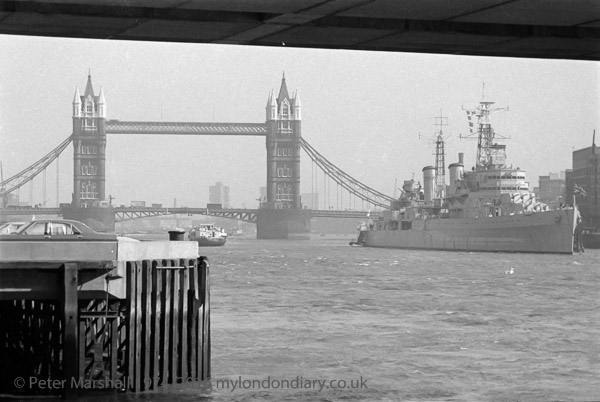
I find it hard to think back and imagine the first time I came to London with a camera, and have little memory of the occasion. What I do have is two contact sheets (and the corresponding Tri-X negatives) but the only information outside of the images are the file letters, 3k and 3l, probably assigned at a later date.

In my first few years of learning to be a photographer I tried to keep images from different types of subject in different files, and the ‘3’ seems to have been a general photography file, including sports, portraiture, theatre photography and more, with negatives and filing sheets at some point assigned the letters a-z in what now appears to be a fairly random order.

At the time I took relatively few photographs and didn’t feel the need for much of a system, though file ‘4’ seems to have been reserved for my pictures taken in Europe. Fortunately it wasn’t too long before I saw the error of my ways and began to file my black and white negatives in order of taking (or at least of processing) and, since April 1986, under the year and month of taking. Of course things are much easier with digital where everything comes with EXIF metadata.

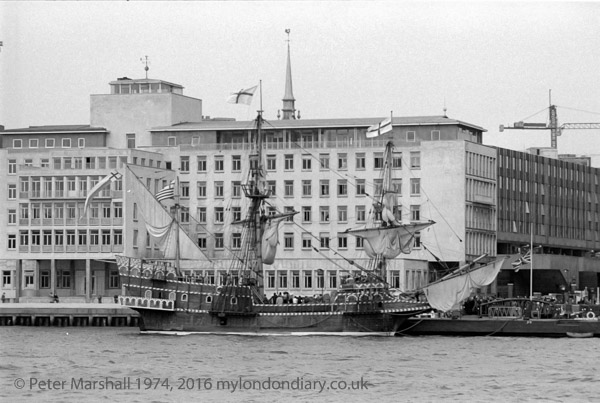
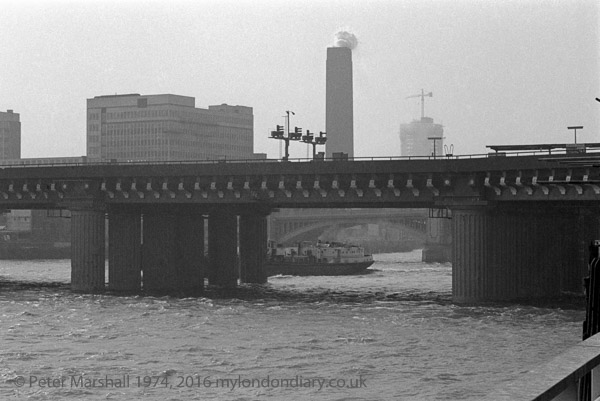
Probably anyone with access to a newspaper library would be able to fix the date more precisely, as several of the pictures show the remarkable ‘Golden Hinde II’, a remarkable reconstruction of Sir Francis Drake’s galleon in which he circumnavigated the globe from 1577-1580, moored at Sugar House Quay next to the Tower of London, with crowds waiting to board.

The ship, usually known as the Golden Hind, was launched in Appledore, Devon in April 1973, although its ‘maiden voyage’ was only made from Plymouth in late 1974. At some stage before this it came to London where I photographed it.

Around this time I had just bought an Olympus 35SP to replace one of two Russian cameras I had been using. It seems likely that these images were taken just a few days before this arrived, as the last 9 frames of the second film show this in various images, including one close-up of the viewfinder which shows the rather dull view from our first-floor Bracknell flat from which we moved in August 1974.

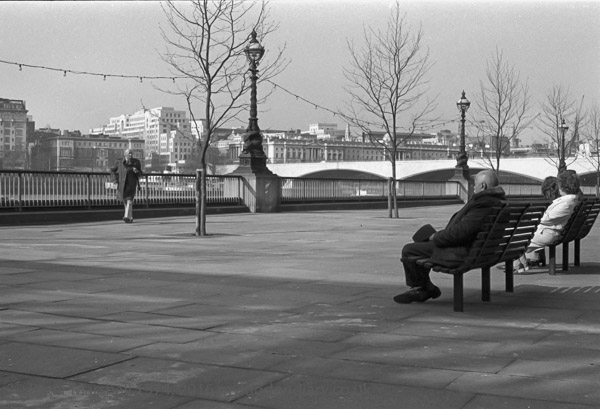
From the trees in several of the London images, they were clearly taken in winter, and so the pictures must date from either late 1973 or early 1974.

The pictures will have been made using a Zenith B, a sturdy, tank-like Russian SLR. The ‘B’ model came without the built-in exposure meter of the ‘E’ but was available with the superior 58mm Helios f2 lens (of pre-war German design) and on the page linked – where it is the fifth camera down – I see that the type I used is now “very rare to find”.

I will have been using a handheld Weston Master V exposure meter, which had a large selenium cell, and came with a curious white plastic ‘Invercone‘ to enable incident light readings. Made in Enfield in north London – or rather ‘Middlesex’, these were incredibly reliable, needed no battery and had only one real fault – the wafer-thin glass above the needle, which was easily broken as the meter dangled free from its cord around your neck. After several expensive repairs I cut and glued some rather thicker perspex on top of where the glass should have been.

As well as the ‘standard’ 58mm I also had with me another Russian lens, a telephoto, probably the 135mm Jupiter f4, copied from the Carl Zeiss pre-war Sonnar.

Photography with this equipment was rather slower than with modern cameras, but it was probably more the cost of film that kept the number of exposures made during the day to 49 – and explains why there are no real duplicate images. Two frames are hopelessly over-exposed, probably because I forget the need to manually stop down the lens to the taking aperture after focussing. Two are ruined by slight fogging, a consequence of loading film into cassettes from bulk with a bulk film loader to cut costs. One is sadly out of focus, rushing to get a picture, and a few seem rather ordinary – such as two pictures of St Paul’s Cathedral.

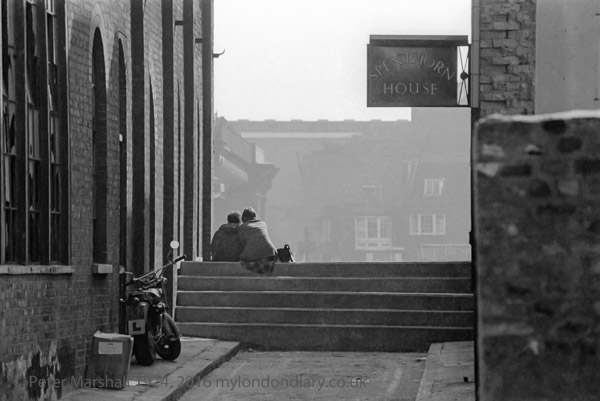
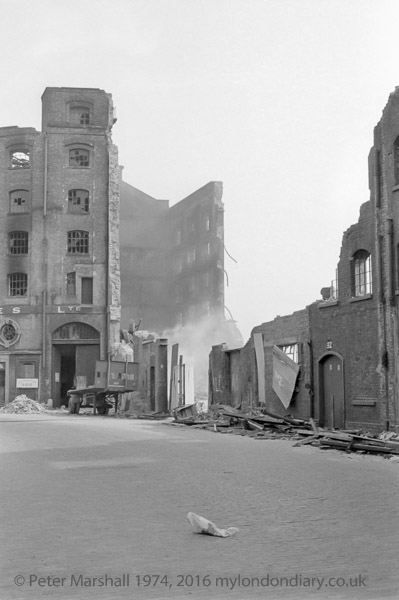
There are also no really great images, though most have some interest, some rather more than when they were made because of the changes since they were taken – little smoke now emerges from Bankside Power Station. But there was one picture which I think became very important to me, of warehouses being demolished on the riverside beyond St Katharine’s Dock, which is really the only one of these I remember taking, and which prompted me to begin to explore London’s disappearing docklands.

See these and the rest at My First Day with a camera in London.

Continue reading My First Day with a camera in London

Provoke

PROVOKE: Between Protest and Performance Photography in Japan, 1960–75 is an exhibition  at Fotomuseum Winterthur in Switzerland from today, May 28 until Auguest 28th, 2016 and includes work by works by Nobuyoshi Araki, Eikō Hosoe, Kazuo Kitai, Daidō Moriyama, Takuma Nakahira, Shōmei Tōmatsu and others less well known (and including some anonymous works) associated with the remarkable magazine ‘Provoke‘.

Perhaps the most remarkable thing about the magazine was that there were only three issues, published in 1968-9 which were then largely ignored, but it has come to be regarded as “one of the most important photographic publications of the 20th century.”

For many photographers in the UK, our first real encounter with post-war Japanese photography came at the ICA in 1979, with the exhibition ‘Japanese Photography: Today and its Origin‘, curated by Lorenzo Merlo of Canon Photo Gallery Amsterdam, brought us face to face with the work of Hosoe, and a few years later, in 1985, the Serpentine Gallery played host to Mark Holborn‘s ‘Black Sun: The Eyes of Four‘ which included Moriyama, Hosoe and Tomatsu. I think both shows appeared without any mention of ‘Provoke’, or at least I can find no reference to it in their catalogues.

For those of us unlikely to get to Switzerland for the show, there is always the book. A hefty 680 pages I’ve yet to bring myself to buy, though at around £40 through the discount sellers it seems a reasonable bargain compared to Steidl’s limited edition ‘The Japanese Box‘ of 2001 with its facsimile publication of Provoke and books by Nobuyoshi Araki, Daido Moriyama and Takuma Nakahira, copies of which are now offered for well over a thousand pounds.

Hidden Faces from Chile

One of the main reasons I began writing a series of articles about World Photography around 15 years ago was the strength and vitality of photography that I had seen coming from Central and Latin America, and I decided that as well as writing about various other countries around the world I would begin to tackle the countries of that continent in alphabetical order. It was a task I never completed, and I think the last country before I was sacked (at least in part because of a determinedly international approach which made it harder for my employers to sell space to US advertisers) was probably Mexico – which actually got several articles.

Other countries were much harder to find out much about, and one of the hardest was Chile, where I was able to find relatively little information then on the web, or in the libraries I had easy access to. It was the web that was vital, as I was writing for the web and needed to link readers to web sites they could visit to see photography.

Probably an important part of the reason for the lack of information was the human rights situation, particularly in the 1970s and 80s which my article mentioned. The show currently at the Maison de l’amérique latine in Paris until the end of April, Faces cachées: Photographie chilienne 1980-2015, is called ‘Hidden Faces’, and none of my research on the web led to any of the photographers represented in it. The article on the site is in French, but Google translate may help if you have problems with that. There is more information about the photographers and more images in the press release.

Lensculture has an illustrated feature on the show Hidden Faces: Chilean Photography, 1980-2015 with 9 pictures and text by Elizabeth Temkin, and also links to a documentary “La Ciudad de los Fotógrafos,” but once I found out how to turn on auto-generated subtitles made a little more sense, though at times they add an element of the surreal and some of the 1hr 20 minutes was lost on me.

Strand at the V&A

In the Guardian you can read I posed for Paul Strand, in which 73 year old Angela Secchi recalls the day when she was 9 and the photographer came into her native town of Luzzara  in Italy.

Her portrait was one of many that he made there for his book with writer Cesare Zavattini, Un Paese: Portrait of an Italian Village. It was Zavattini’s home town, but the two worked separately, and Strand’s guide to the town was one of the eight sons of one of the most famous family in photography,  The Lusetti Family, Luzzara, taken in 1953.

It has long been one of my favourite photographs, and Strand certainly one of my favourite photographers, though that doesn’t stop me being criticising some of his pictures. I’m not too enamoured of the portrait of Secchi, which, like quite a few of his others seems a little too contrived, wearing the oversize hat of her farmer father, put on her head by the photographer.

Of course Strand was a very fine portraitist, and doubtless there will be many of his better examples in the show, Paul Strand: Photography and Film for the 20th Century which is at the V&A in London from 19 March to 3 July.

This is a rare example of a great photographic touring show – organized by the Philadelphia Museum of Art in collaboration with Fundación MAPFRE and made possible by the Terra Foundation for American Art – coming to the UK, and is apparently the first major retrospective of his work in the UK since his death in 1976. I do remember the previous retrospective – and unlike the current V&A show – I was invited to the opening in Carlton House Terrace shortly before he died.

Strand was of course a communist, and worked with a number of others who shared his views; as Fraser MacDonald writes in his detailed essay Paul Strand and the Atlanticist Cold War on Strand’s fine book on the Hebrides, Tir a’Mhurain (1962).  You can also read my own far less scholarly account of the New York Photo League originally published in 2001.

Mario Cravo Neto

One of the minor disadvantages of living just outside London is the time and expense of getting to events taking place there. I have to make an effort to go to events such as tonight’s opening at Autograph of photographs by the late Brazilian photographer Mario Cravo Neto (1947-2009), and I just don’t have the time – and unless I’m up in London for other reasons its often hard to persuade myself to do so for openings. But I will certainly find time when I’m in London before the show ends on 2nd April 2016 to pay a visit to Rivington Place in Shoreditch, London.

One of the things I most enjoyed doing and which I thought was most important when I was employed to write about photography on the web was a series of articles of photography in various countries around the world, in part to get away from what appeared to be the assumption of many that the only important things happening in photography – at least since the start of the 20th century – were made in the USA. (Not that I neglected the USA, and I also wrote extensively about American photographers, particularly those involved in the New York Photo League, some of whom I felt were being forgotten.)

And although I wrote about photography in various countries around the world, in Europe, Asia, Africa and Australasia, the backbone of my series was the countries of Central and Southern America, which I tackled in alphabetical order. Brazil thus came fairly early in the series, which followed a fairly standard pattern, beginning with and introduction to the country and what I could glean about the early history of photography there (French-born inventor Hercules Florence living in the Sao Paulo region was apparently using a camera before that Mr Talbot at Lacock) and continuing on into the 20th century and ending with a short text about post-war and contemporary photographers. I wrote about around a dozen from Brazil, including this paragraph:

Mário Cravo Neto comes from Bahia, and his work incorporates references to the voodoo religion of that region, using indigenous people as actors holding objects often of ritual significance. He trained a sculptor like his father before turning to photography and his work shows a strong, tactile appreciation of texture.

It’s rather brief but to the point, though I might also have commented on the richness of both his black and white and colour work, but I did also make links to any web sites where his work could be seen, though in 2000 these were few. Things are rather easier now. There is a set on  Lensculture for the Autograph show, and an extensive web site on the Project ‘Black Gods in Exile’ with work by him and Pierre Verger, another photographer who featured in my article.

Vivian Maier – Digging Deeper

I was about to post this as a comment to my post last week, Vivian Maier Still in Hiding, but then I thought people often miss the comments, so instead this short post.

On yesterday’s Lens Blog I read a summary the first part of Digging Deeper Into Vivian Maier’s Past with the second instalment promised for today and probably there by now. Its a summary of a longer feature on the Vivian Maier Developed blog, where you can also read Part 2 – A Life in Pictures.

The researcher, Ann Markswho has no background in photography and started researching Maier only after seeing a documentary about her life — has learned a great deal about Maier’s family history“, some of which had also been uncovered by the sources in my previous piece.

It amplifies what was already known about her background, and the confirms the speculations about the closeness of her link with a photographer: “From early childhood, Maier spent a significant amount of time with a woman named Jeanne Bertrand, who worked as a professional photographer, as well as other positive female role models” and throws a great deal of light on what was a rather disturbed life. And I await today’s second part with interest.

What it won’t do is tell us any more about her as a photographer, and for that we will have to await detailed studies of the whole of her work – which appears to have been kept together by her tenaciously while she was able to do so – rather than the selected examples that we have so far seen. The second part does give some insight into how her photography developed, although unfortunately at least some of the illustrations there appear to be reproduced at the incorrect aspect ratio.

So far I remain unconvinced that she was anything more than a very capable and talented photographer able to imitate the styles of others. My question if there was a real photographic ‘Vivian Maier’ who had something distinctive to say remains unanswered.

Mendelsohn’s Balsall Heath

An article in The Guardian brought to my attention the work of American photographer Janet Mendelsohn, a Harvard graduate who in 1967 came to study with Stuart Hall and Richard Hoggart at the ground-breaking Birmingham Centre for Contemporary Cultural Studies. Forgotten for years, her work which she made use of photography as “a tool for cultural analysis” in a multi-racial area undergoing a radical transformation through immigration and dire poverty, was rediscovered when Kieran Connell, who was curating a show for the 50th anniversary of the centre, became obsessed by a photograph of hers on the cover of its 1969 annual report.

It took considerable detective work by Connell to find out more about the photographer, but when he finally managed to contact her sent back the request “Please take these photographs off my hands” and sent him a large box with several hundred prints and 3,000 negatives.

Some of these were from a project in the red-light area of Varna Road in Balsall Heath, and it is this series which is the basis of the newspaper article, as well as a forthcoming show at the Ikon Gallery in Birmingham (PDF press release here) and a free symposium at the end of January at Birmingham University with speakers including Magnum photographer Susan Meiselas, artist Mishka Henner, UCL History Professor Catherine Hall and curator and photographic historian Pete James.

One classmate of Mendelsohn’s at Harvard was film-maker Dick Rogers, (1944-2002) who also went to study in Birmingham with Hall and Hoggart for two years, after which he returned to Harvard to study on a Visual Education programme where he met his future wife Susan Meiselas.

Mendelsohn worked with Rogers on his first film, Quarry (1970). His best-known work, Pictures from a Revolution (1991) retraces Meiselas’s work on her photo essay ‘Nicaragua: June 1978-July 1979‘. In an earlier film, 226-1690 (1994) he used recordings left on his phone answering machine from her when there including one with a gunshot in the background.

Some of Mendelsohn’s work was shown last July in ‘The Ghost Streets of Balsall Heath‘ at The Old Print Works, Moseley Road, Balsall Heath as a part of the Flat Pack Festival.