Nan Goldin – Police swoop

A set of 100 photographs by Nan Goldin, owned by Elton John, were due to go on show at the Baltic Centre for Contemporary Art in Gateshead from 21 Sept until 6 January 2008. But presumably there are only 99 on the wall, as one image was taken into custody last Thursday and is being examined by the police and the Crown Prosecution Service, who are considering prosecution under the 1978 Protection of Children Act.

It is hard to see any sensible purpose that can be served by this action. Goldin is a highly admired photographer whose work has been shown in galleries around the world. She herself had a tough childhood, suffering abuse and running away from home at 11 after the suicide of her sister. Her work has always reflected her lifestyle – a mirror on her life.

Some years ago I wrote: “I find it difficult to imagine the position she was in, with these immense emotional pressures coming at an age when I was still in short trousers and being taught that sex was a Latin numeric prefix. Life was not without its traumas, but mine were less dramatic. Goldin was confronted in those sudden and tragic events with forces that most of us become aware of slowly over a period and evolve mechanisms to deal with or repress, and it is hardly surprising that the issues behind them have dominated her work. I don’t share her lifestyle or some of her attitudes, but I admire the honesty and clarity of her approach.”

What the police have seized is a photograph, which, according to The Telegraph,  shows “two young girls, one sitting down with her legs wide apart”. I don’t know anything more about it and the circumstances in which it was made, although I have seen a great deal of Goldin’s work. Much of it has been published – and this may well be an image that is widely available in bookshops here and elsewhere.

The Telegraph states that she “is well known for her shots of young, semic-clothed girls” which is both incorrect and entirely misleading. Young semi-clothed girls may appear in her work, but so far as I’m aware, have not been a major pre-occupation; what appears in her work has usually been what appears in her life. Most of the people she has photographed has been her friends and she has rather more often been a victim than an abuser.

Child abuse is a serious problem and minors need protection, but I would be very surprised if the children involved in this image were being seriously abused or were in need of the protection of the Northhumbria police. What I am sure of is that police time could be better employed investigating the real abuse of children (and other crimes) that will be occurring in Gateshead while they waste their time on this case.

The law has a long history of making itself an ass over art, and this looks very much like another episode in that ongoing saga. The publicity of course will not be doing the Baltic Centre for Contemporary Art any harm, (and here I am adding to it,) which could well be why one of the assistant directors there called them in.

You can read a lengthy feature on Nan Goldin on here this blog

Peter Marshall

Lewisham 1977

I wasn’t at the battle of Lewisham in August 1977. For some reason I was away from London and so missed the events that took place. One of the best account of them – and some great images – is in the issue of Camerawork about the event, and it’s worth getting hold of a copy if you can. You can also read a great deal of detail – along with pictures and video etc – on the Lewisham77 web site.

Briefly, the fascist National Front tried to march from New Cross through the centre of Lewisham. Local people and socialists from all over London and further afield came to stop them – just as the East End had stopped Mosley in Cable Street in 1936.

The NF were demoralized and defeated – and so were the police. After the NF had been sent packing, the police turned on the socialists with unprecedented brutality – particularly be the Special Patrol Group. But the demonstrators fought back and with the youth of Lewisham, largely black, defeated the police.

There were many arrests, and it was the first time that British police used riot shields outside of Ireland. Lewisham Police station was partly trashed, and was later replaced by a new fortress, said to be the largest police station in Europe.

Lewisham High Street
Batwinder Rana talks about the Battle of Lewisham in Lewisham High Street.

Last Saturday, as a part of ‘Lewisham’77’, a series of events organised by local historians and activists supported by the Centre for Urban and Community Research at Goldsmiths University of London and other groups held a commemorative walk from Clifton Rise in New Cross to Lewisham High Street, with some of those who were present recounting their experiences at key sites along the route. If you were there, Lewisham77 would like to record your memories of the event for a DVD and publication. Since it is now over 30 years after the event, you apparently no longer have to be afraid about revealing any illegal actions!

More pictures from the commemoration on My London Diary.

Bad Press?

Yesterday I was out covering protests against the arms fair taking place in East London as a freelance photographer. I wasn’t commissioned but I hope to sell some of the pictures through the libraries I place work with as well as possibly direct from my own ‘My London Diary’ web site where they will be posted shortly. I’ve also already contributed a couple of short reports to ‘Indymedia‘ on both the march by the ‘Campaign Against the Arms Trade‘, here passing down the Barking Road,

CAAT March on Barking Road

and the Space Hijackers, who hired a tank (or at least some similar military vehicle) to take

CAAT March on Barking Road
themselves to the event after the police had stopped their own real tank. In the picture it has just arrived and stopped outside the main vehicle gate of the arms fair.

Like most news photographers, I have a press card. On the back of mine it says “The Association of Chief Police Officers of England, Wales and Northern Ireland and the Association of Chief Police Officers in Scotland recognise the holder of this card as a bona-fide newsgatherer.

A few months ago a joint working party of police and journalists came to an agreement over guidelines for relations between the press and police, recognising the need to allow proper access to events and cooperation between police and those carrying the card.

Unfortunately although the Chief Police Officers may recognise the card – and have read the guidelines, too many officers lower down haven’t. Yesterday, when asked at one point to show my card, I was even told it wasn’t a real press card and the officer concerned wouldn’t recognise that I was press. Last year I took a picture of a fellow photographer and union member having a similar confrontation:

In his case, the police held him inside a cordon for 20 minutes although several colleagues showed their own cards to make it clear his was genuine. I was lucky in that I was just threatened with arrest if I didn’t stop arguing and get back on the other side of a police line. So I did as I was told despite being rather worked up. Unfortunately although I told him I was taking his number I was so agitated that I forgot it before I could write it down, so I can’t make a formal complaint. I thought I had it on a picture, but it isn’t visible.

I’ve lost count of how many times I’ve been threatened with arrest for just trying to do my job. I don’t think I’m getting any special treatment, and other photographers who photograph similar events suffer in the same way. Mostly I get on well with police, and they are sometimes very helpful, and of course I recognise that they often have a difficult job.

In handling demonstrations such as this by the Space Hijackers, they do seem to me to make the job more difficult for themselves by deliberately provoking the demonstrators, often moving them – as they did me – for no good reason and imposing arbitrary restrictions. The continued and over-aggressive photographing of people also raises the temperature and can be of little real use – they must by now have several thousand images of me on record.

Police photograph partying demonstrators
Demonstrator and police photographer

I go to events aiming to record what happens, to tell the story – as I see it – using my camera. I like to think of my camera (and flash) spreading a little light on what is happening, and making it known to a wider audience.

Some police – not all, but too many – seem to want to keep things private. They would prefer the press didn’t come along to demonstrations, or at least stayed in a nice neat area somewhere under police control. They think of those of us who cover such events and interact with the protesters as ‘bad’ press.

More pictures from both events on ‘My London Diary’ shortly.

Peter Marshall 

Peckham Rising

The Sassoon Gallery is a nicely converted space in a railway arch under Peckham Rye station (train or bus is much the best way to travel there), in an enclosed yard which is reached by walking through a bar, Bar Story, in Blenheim Grove.

Peckham Rising is only on show until 9 Sept, so get there fast (open noon-6pm.) It is a show curated by Paul Goodwin, a research fellow at the Centre for Urban and Community Research at Goldsmiths in nearby New Cross, as a part of his ‘Re-visioning Black Urbanism’ project. It includes work by three artists, photographs by Thabo Jaiyesimi and Daniele Tamagni and a sound piece by Janine Lai.

Installaion - Thabo Jaiyesimi
Thabo Jaiyesimi’s work on the gallery wall

Thabo’s series of eight images taken on the streets explore some of the issues and cultural richness of the area, often using vivid and emotional colour. A sign for housing in front of a locally notorious block of flats, shop fronts making the link to Nigeria, and another image with a black woman making a phone call tell of the distant roots of many in the area. A crowd bustles in front of the bus from central London, a black woman in a white coat pulls her shopping trolley in from of a bright orange wall and a telephone carrying a advert for the 2005 film ‘Get Rich or Die Tryin’, a partly autobiographical movie in which Curtis “50 Cent” Jackson as ‘Marcus’ plays a drug dealer who aspires to be a professional rapper.

(C) Thabo Jaiyesimi
Image courtesy of Thabo Jaiesimi

For me the most interesting image was one taken on the recent protest against gun crime in Peckham. Thabo’s flash lights up a pink glove pointing at the poster on a man’s chest reading “MURDER £20,000 reward”. The black girl’s finger points as she reads the smaller print, but reads like a gun. You can see more of his work on his web site.

Installation - Daniele Tamagni
Daniele Tamagni’s work on the wall

I talked to Italian photographer Daniele Tamagni about his work in Peckham, and he showed me a newspaper feature on his previous show of pictures taken in black churches in Peckham. The large image from this project on show at the Sassoon was an extremely striking picture, a sea of white-robed figues with a woman in the foreground coming towards the photographer cradling a baby. The only white face in the image, carefully framed between the figures, is a statue of Jesus, arms outstretched on the wall at the front of the church behind the people.

Although there were a number of interesting images in his work, overall I found the selection too disparate, and at the same time too small to represent the multiplicity of Peckham. I would much rather have seen a more focussed display of his work – such as that on the churches or another project Tamagni has done on hairdressers in the area.

Listenitng to the sound piece by Janine Lai
Listening to Janine Lai’s sound piece

The voices recorded by Janine Lai, who works at Peckham Library presented an interesting kaleidescope of views from Peckham residents, although I found the presentation difficult to follow, trying to listen to two people at a time. It will also doubtless work rather better during the rest of the show than at the opening, with only three sets of headphones available. Perhaps for the opening it could have been put through a loudspeaker?

Perhaps the hardest part of the show for me were the texts by the curator, Paul Goodwin. In so far as I could understand the rather obscure language that is apparently a prerequisite for academic credibility, I think that he seemed to be promoting a rather uni-dimensional view of Peckham that is as limiting in its different way as the media stereotypes which he seeks to confront.

But Goodwin’s intention is, at least in part, to promote dialogue, and both the show and the lively ‘Peckham Regeneration debate‘ that took place during the opening showed a more cosmopolitan Peckham than emerges from the apparently simplistic viewpoint of black urbanism. It is an interesting show, although I’m not quite sure why, according to ‘Myspace‘ it is Female and 47 years old!

The Debate
The Peckham Regeneration debate – a contribution from the floor

You can see more of my pictures from the opening, (shot with a Leica M8 and a 35mm f1.4 lens that can almost see in the dark) on ‘My London Diary‘ shortly. They include images of the speakers at the debate, more of the installation and some pictures of the photographers I met at the show.

Footnote
The Sassoon name is one with an interesting Peckham connection. The Sassoon family were Sephardic Jews, descendants of King David, and were some of the first Jewish settlers in Bagdhad, where they became courtiers and wealthy businessmen. But it was only in the nineteenth century that David Sassoon established a great empire trading with India and the Far East, and sent one of his son’s to open a small outpost in London in 1858. After his death, the family, sometimes referred to as the Rothschilds of the East, largely moved to England.

In 1932-3, the incredibly wealthy widow of Meyer Elias Sassoon, Mozelle Sassoon, engaged architect Maxwell Fry to build Sassoon House, his first modernist work, a still striking block of working class flats in St Mary’s Road, Peckham, as a gift to the Pioneer Housing Trust in memory of her son, R E Sassoon.

(C) 2007, Peter Marshall
R E Sassoon House, Peckham. (C) Peter Marshall, 1989, 2007

Mozelle was the great aunt of Siegfried Sassoon, although he first met her in 1914 when he was in his late 20s. His artistic talent probably came mainly from his mother’s side, where hordes of the Thornycroft family – including many talented women, were well-known as sculptors and painters in the 19th century – as you go over Westminster Bridge you pass Thomas Thornycroft’s ‘Boadicea and Her Daughters.’ But probably the best-known Sassoon now is hairdresser Vidal, who, so far as I know, is without links to Peckham (although his Greek-born father’s family had its origins in Iraq) and was born in poverty in Whitechapel.

Peter Marshall

Around Heathrow

This morning I rode to Southall on my push bike, the 1957 vintage Cinelli that was my best birthday present ever when I was 13. It was a real racer, and had spent the previous season being pounded over the cobbles of Europe by a guy who got himself a new road machine every year.

Now, like me, its a lot older and in a pretty sorry state. Wheels almost twice as thick and tyres several times fatter when I got fed up with mending punctures in thin racing tubulars and indignities such as a carrier and pannier, not to mention rust, scratches, some rather careless paint jobs and a ton of greasy hardened on dirt.

It still rides fairly well and gets me places, but is the kind of bike you can leave on the street almost anywhere and expect to find it there when you come back. I do usually lock it, but more for my own peace of mind rather than thinking that anyone might otherwise take it away.

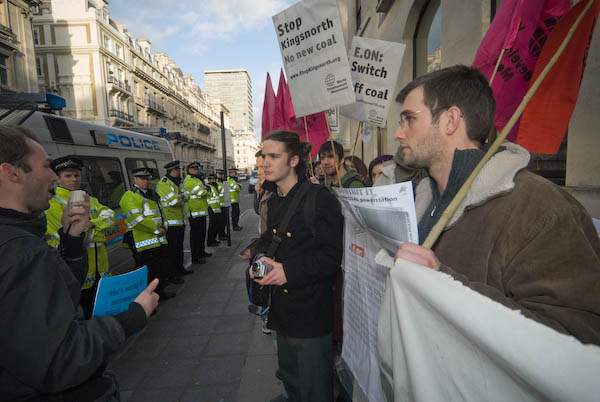
Cycling through light rain along the edge of the airport at Hatton Cross I saw two police standing in the refuge at the cross-roads. I think they only bothered to stop me because they were bored – there were really very few people around at half past ten on a wet Sunday morning.

Are you going to join the climate camp I was asked, and I replied no, I was on my way to Southall to photograph a religious procession. And since I carry a UK Press Card, supposedly recognised by “The Association of Chief Police Officers of England, Wales and Nothern Ireland etc” I got it out to show them. I thought that should have been enough, but they decided to go through the whole business of taking my details and searching my bags etc.

The two officers were at all times polite – and we had a reasonable and pleasant enough conversation, and it relieved their boredom a little, while only holding me up for around five minutes. But I don’t like the process and it seems like something from the kind of police state I don’t really relish living in. It also seems to make a mockery of the Press Card, which should serve to identify me and gain the cooperation of the police.

Police Search form

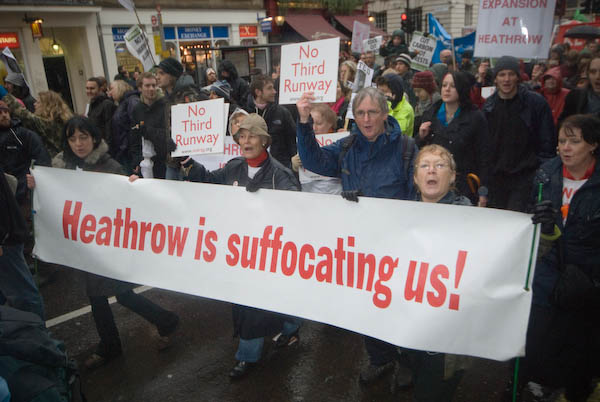
After I’d been to Southall, I had to cycle back past the airport again, and this time went along the A4 which runs along the north side of Heathrow. Parts of it were swarming with police, and I did photograph a few of the demonstrators (and a proud mother.) I was pleased to see them too – it really is time that we got rid of Heathrow, built by deception in the wrong place 60 or so years ago.

Demonstrators and Mother

A little further on a stand-off was developing around some BA offices, but things didn’t look promising for the demonstrators. The place was buzzing with photographers and film crews and I decided I wasn’t going to get anything different to the crowd, so I moved off down the road to see if anything else was happening. I met a few more small groups of demonstrators coming along the road:

Demonstrators and Police

each group accompanied by a police van. The police were for some reason making a big fuss of photographing the clown army. They still haven’t learnt that the best tactic with clowns is to ignore them – unless they actually commit a crime.

Clown Army

I’d seen enough to be fairly sure that nothing much was likely to happen along the A4, and I checked out BA’s Waterside HQ. There they had police horses and a lot of guys in their black fighting gear wandering around the grounds with absolutely nothing to do. I didn’t stop to give them another chance to harass a photographer.

I couldn’t be bothered to try the other side of the airport, where more might be happening (it was, as I later heard on the news), and came home.
There will be a few more pictures from Heathrow on My London Diary shortly. And some rather more interesting images from Southall.

Saffers Against Crime

Last Saturday I photographed a march in the centre of London. Nothing unusual in that, but this march was different in that it was made up almost entirely of South African expatriates living in this country. It’s also attracted criticism both from some South Africans living here, and also from back home.
(C) Peter Marshall, 2007
This quote from Mandela was carried at the head of the march.

The march was against crime and in particular violent crime in South Africa and in support of the South African Police in their fight against crime. It was organised by a group called ACT4SA, ‘Against Crime Together For South Africa’.

In May this year, a group of young ‘Saffers’ in the UK were appalled to hear that one of their friends, Mark Joubert, had been murdered in a Durban restaurant. His death was one of many, the figures showing around 50 murders in the country every day, but it was one that aroused particular attention both in Durban and here. Working through the Facebook Saffers network they belonged to, they decided to organise this protest march in London. Hundreds promised their support, and on the day perhaps around 600 or 700 turned up and marched.

Before the march there were a number of comments by bloggers and others, mainly suggesting that if they wanted to do anything to help in South Africa they should start by going back there. At least one SA police chief went public saying that he didn’t need this kind of support.

The marchers, mainly young white South Africans, many here working in IT, were obviously sincere and concerned. It was a well-ordered march and the two speeches, one by one of the organisers and a second by Shannon Joubert, the sister of the murdered man, were positive about the need for South Africans in all communities to work together so that every South African would be able “to feel secure in his own home, to feel save in the cities, towns and rural areas… to travel to work, to school and other places without danger.” (Nelson Mandela)

(C) 2007, Peter Marshall
The march paused for a few moments opposite South Africa House

Unfortunately you don’t have to look very far at all to find sites where racist discussions are latching on to this protest, suggesting linkups with the British National Party and full of overt racist statements and language that we no longer allow in polite discourse.

The ACT4SA march was led by a banner shown above quoting Nelson Mandela, but the discussion of it on one web site i visited seemed largely concerned with racist and personal attacks on him and other black South Africans.

While I’m sure the organisers of ACT4SA worked from quite different motives, they will need to put in a great deal of work – especially to enlist support from more black South Africans – to stop their efforts being hi-jacked. The fight against crime in South Africa also has to me a fight against the racism which still seems endemic among many.

(C) 2007, Peter Marshall
I didn’t take any great pictures of the event, though overall they do give a good idea of what it was like. You can see them as usual on My London Diary.

Fourth of July Celebrations

This morning I woke up to the news that Alan Johnston had been released in Gaza, and thought it was great that I had something to celebrate on the 4th of July. Other than getting shot of those troublesome colonials in America of course. Having spent 8 years writing for an American-owned web site (in recent years About.com has been a part of the New York Times) it was a relief to think I could write without having to keep American festivals and feast days in mind.

Although the site had many thousands of visitors from around the world, those from the USA were in a majority, and my non-American sensibilities were a problem so far as the management were concerned, though probably less of a problem than my interest in photography.

Our pleasure at the release of one brave journalist should not make us forget the others who are still in captivity – including Bilal Hussein, an AP photographer who now been held by the US military in Iraq for 448 days without being charged. You can sign a petition for his release at the ‘Free Bilal’ web site4:

According to an IFJ press release, at least 82 journalists have been kidnapped in Iraq. Of those, 28 have been killed and six are still being held, though I don’t think there statistics include people held by the US and other occupying forces
Of course many have been killed. This year so far, up to 4 July, at least 87 journalists have been killed, many of them photographers. Most – appropaching half – have died in Iraq. You can read the details, and the figures for earlier years at the News Safety Institute.
Photographers (still or video) are very much exposed and at risk, becuase they can’t work without putting their heads up above the parapet and actually confronting the motif. There are plenty of stories of people who’ve made their start in photography by picking up a camera and rushing out to cover a war, but we seldom tell of those who went out and met an early death without becoming famous. Of course many of those who did get started like this in the old days had some military training or experience, if only through national service.

Wars and many other situations are now more dangerous. Old ideas about respecting the freedom of the press and the right to report often no longer apply in modern conflicts; you are thought to be on one side or another, often because of your nationality rather than your views. With the Internet (and for photographs, the ubiquity of digital cameras) groups no longer need the press to get their views across in the old way.

If anyone is thinking of working in any hostile situations, it is vital to take advice and to get proper training. You might start by reading the book ‘A survival guide for journalists’, published in 2003 by the International Federation of Journalists, available as a PDF file.

Peter Marshall

Laburnum Street

Even if you’re a Londoner, you probably don’t know Laburnum Street. Haggerston has never been the most glamorous area of Hackney, itself on many measures one of the more deprived areas of the country. Even the artist-led regeneration that has brought Shoreditch, Hoxton, Bethnal Green and elsewhere back onto the map of London hasn’t quite got to Haggerston yet, although there are a few studios around in old industrial buildings.

It’s an area with quite a lot going for it. Walking distance from the city. A canal, with an increasing number of desirable waterside properties being built. A new city academy rising. The large Suleymaniye Mosque on the corner. And plenty of other new developments not far away. But for the moment its most interesting features are the lively and very ethnically mixed people who live in the area, and (C) 2007, Peter Marshall, long neglected by Hackney Council, closed without notice in February 2000, and the subject of a lively local campaign to see it re-opened.

(C) 2007, Peter Marshall

The pool is a listed building, and English Heritage want it retained as a pool, as do the locals. Hackney Council have worked on feasibility studies which include a 25 metre pool together with other uses for the west side of the site, and the pool campaign have added their ideas to these proposals through a people’s consultation. The plans for the future are there, but not the £21 million to put them into practice.

(C) 2007, Peter Marshall
This was the only pool open for the street party

The first Laburnum Street Party was organised in 2004 to celebrate the 100th anniversary of the pool, and to raise the profile of the campaign for its re-opening. I went to photograph the third party in 2006, and was pleased to have one of my pictures used as the main image on the flyer, poster and programme for this year’s party.

This year the event was bigger than ever, and attracted more sponsorship. There were around 75 street stalls of various types, including food, bric-a-brac and various informational stands. Two stages with performances of very different types and a childrens street parade, following workshops organised by Lucia Wey of Mush Arts, who I first met photographing the 2004 Shoreditch Parade. Free canal boat trips and various kids activities. So much going on that I could only photograph a small part of it, and was sorry to miss some of the acts I’d been looking forward to.

(C) 2007, Peter Marshall

Of course there were many other photographers there, as well as several film makers, including Dan Edelstyn whose hilarious film (with Hilary Powell) on the Olympics I mentioned here a week or so ago in More than the Olympics.

The weather was fairly kind to us, just a few minutes of heavy showers around lunchtime, and then some sun, and we made hay. Too soon it was time for me to go home.

More pictures from Laburnum Street Party 2007 on My London Diary shortly.

Pride & Climate Change

London carries on, despite the terrorist threat with two car bombs left close to gay nightclubs which fortunately failed to explode early on Friday morning. Saturday’s Pride Parade was much the same as last year, and if there were more police present, it was only noticeable in the several groups of officers actually taking part in the parade.

Despite the publicity and high figures given in the media (which perhaps relate to the whole festival) the Pride parade itself is now a relatively small event, a fraction of the size of the major political marches that make their way through London largely unreported by the press perhaps half a dozen times a year, although considerably more organised and more colourful. It seems to attract considerably fewer marchers than it did a few years back, with many more simply turning up for the events in Trafalgar Square and Soho.

Ten years ago, taking part in the Pride march was an important personal and political statement for many, sometimes marking their going public about their sexuality. Now it’s largely a fun event, although a few individuals and groups still attempt to get a more serious message across.

Much of the event has now settled into a pattern, with many of the same floats and costumes as in previous years, but there are some changes, and I tried to concentrate on these. Its an event where it is hard to get away from the stereotypes, because so many of those taking part embrace them whole-heartedly.

Pride 2007 (C) 2007, Peter Marshall
Many, especially from minority ethnic groups, use Pride as an occasion to stress their British identity as well as their gay identity

I seldom pose people for pictures, but at Pride, everything is a pose. Certainly as soon as people see a camera, most play to it, and its a game you can’t avoid, something you need to work with. Getting below the surface is often a problem, but at least the surface often fascinates.

What was new was ‘Bird Pride’, describing itself as a “Queer Femme Carnival”, organised by the Bird Club, whose aim is to “celebrate femininity on the queer scene”.

Pride 2007 (C) 2007, Peter Marshall
Bird Club ‘Specialist Warblers – Femme invisibility, so last YEAR’

More pictures from the Pride march on My London Diary shortly.

The two car bombs were on the route of the parade, and there were rumours that it was a badly failed attempt to attack the parade itself, but they didn’t appear to have put the marchers off. The crowds watching the event in Oxford St did seem rather lighter than normal for a Saturday, but this could have been more a matter of the weather, light rain interspersed with heavier downpours, which at times made taking pictures tricky, but some of the best opportunities were in pouring rain.

Photographing in the rain is a problem. In the old days, mechanical cameras such as my old Leica M2 carried on almost whatever hit them, and the standard lens at least had a lenshood that was a fairly effective rain shield. Keeping it under your coat when not in use, and an occasional wipe with a handkerchief kept you going through rain, hail and snow.

Digital cameras are more of a problem. I gave up on the Nikon D70 as unsuitable for London weather, but the D200 is much hardier. My main problems are with lenses. Larger filter sizes, more glass – in zooms in particular – mean more rain drops and more condensation inside lenses with changes in temperature and humidity. Zoom mechanisms pump in damp air, and also draw in moisture from the damp lens barrel. Increasing use of wide angle lenses is also a problem, as their lens hoods offer little or no rain protection – and the same is true of zoom lenses that start at wide angles.

Nikon’s 18-200mm VR lens is a great and very flexible lens, but becomes useless when there is even a hint of moisture in the air. Sensibly, I’d left it at home and was shooting with a Sigma 18-125 which holds up rather better. The Sigma 12-24mm has the problem of a large front element open to raindrops, but if you can keep it clear, also works well in wettish conditions. Handkerchiefs aren’t really a good idea, and in a special, otherwise unused pocket of my jacket I had a large, clean microporous cloth that saw frequent use to wipe both glass and other surfaces of lens and camera.

Sometimes I’ve improvised a plastic cover for camera and lens from a suitable bag, but such things get in the way. But these – or specially made camera rainwear – can keep you shooting in really bad weather. Unfortunately they don’t stop condensation inside the lens, which is often a problem – and all you can really do is wait for it to clear, or change lenses. ‘Pumping’ zoom lenses can sometimes help.

I decided I couldn’t face more rain to photograph the Pride rally in Trafalgar Square or the cabaret performances elsewhere, and in any case I had a mermaid to photograph.

Rising Sea Levels (C) 2007, Peter Marshall
Lucy warns about the perils of global warming – her arrow indicates sea level in 2012

The climate change event was designed as a reminder to Gordon Brown that this is still the most urgent problem we face. Without a planet that is livable on, none of the rest will matter. So far the politicians have largely stayed on the edge of the pool, hanging on to ideas of technology or carbon offsets to avoid taking the real action that is needed, talking about cuts in carbon dioxide emissions while these continue to rise.

Effective action is vital, before it is too late (and we hope it is not yet too late.) Energy saving that means more than turning off the odd light or buying a more fuel-efficient car.

More pictures on My London Diary now for Pride and Climate Change Rally
Peter Marshall

More than the Olympics

Yesterday I was fortunate enough to watch what may well be the best film to be made on the Olympics. ‘The Games‘, a 15 minute colour HDV film from Optimistic Productions by Hilary Powell and Dan Edelstyn is an at times hilarious staging of an alternative and surreal Olympics filmed on the unreconstucted Olympic site, with a hand-picked team of ‘athletes’ taking part in steeplechase, hurdles, synchronised swimming and more. It starts with flaming torches and ends (more or less) with an awards ceremony. Catch it if you can.

We’ve all heard how the London Olympics is to play a vital role in the regeneration of east London, although I don’t think anyone has yet come up with any remotely credible explanation of how shutting off and concreting over large areas of land currently open for recreational use and producing large and largely unwanted sporting facilities is going to help that much.

There may be some limited infrastructure improvements, although much of those were already on board from the Channel Tunnel Rail Link, with its new Stratford International station. Most of the claimed new housing and some other facilities claimed for the Olympic effect were also already on the way as a part of the Stratford City redevelopment, described as “the most ambitious development within the M25.”

But London 2012 is here and we have to hope for the best, even if it may be madness to expect that to be very much, though we can hope that a few crumbs will fall in appropriate directions. At the moment there is only the pain, as local businesses are forced out of the area and jobs and recreational and sporting facilities are lost, as well as access being restricted. All around the site, high blue fences are being erected to keep us out from July 2. Of course some areas have long been blocked off and well-used paths have already seen lengthy closures for work associated with the games. But the loss of Carpenters Road and Waterden Road in particular will cause considerable local transport problems.


Fences being put up around the Greenway, which should be reopened shortly.

You can see some more pictures from the area taken last Thursday on My London Diary.

Despite all the publicity, the Olympic area is only a small and relatively insignificant part of the regeneration of East London, and a relatively minor contribution to Stratford City. Close by are other large and important projects, in particular at Canning Town and the Royal Docks. The former Pura Foods factory in a loop of the Lea has now been reduced to rubble, and plans for a mixed-use development are close to agreement, with some 1,800 homes, a primary school, shops and more. On the other side of Victoria Dock, planning approval was obtained recently for the Silvertown Quays site, with 5,000 residential units, shops, offices, workspaces, community facilities including a primary school, restaurants and bars and other leisure facilities. This also includes a vast aquarium project, Biota!, in collaboration with London Zoo.

Victoria Dock, SE
Silvertown Quay site and Eastern Quay. The Millenium Mills are to be converted to flats.

West Silvertown already has the Brittania Village development and Eastern Quays, as well as stations on the DLR North Woolwich extension, the Thames Barrier Park and flats at Barrier Point. Two further key sites, Minoco Wharf and Peruvian Wharf are likely to be re-developed before long, although arguments still continue, particularly around the continued industrial use of Peruvian Wharf, and there are more prime riverside sites still to be redeveloped, as well as considerable redevelopment that has already taken place to the east of the Barrier Park, with again more planned.

This afternoon I’m leading a tour around the area, probably in pouring rain. Shortly I’ll post a link to an on-lilne version of this which I hope will encourage others to visit this fast-changing area. It will perhaps take your mind off the Olympics.