The Year in Pictures

James Danziger is a well known name in photographic circles, having opened a New York gallery in 1989 and now running Danziger Projects in New York’s Chelsea. So the start of a new blog, The Year In Pictures, in which he promises to write about pictures that have captured his imagination is welcome news. One to bookmark or add to your blog feeds.

My favourite among his postings so far is a piece on Milton Rogovin, entitled ‘The Pursuit of Happiness’ where he publishes a great image from 1973 of Lower West Siders Johnny Lee Wines and Zeke Johnson, along with 4 unpublished and previously unseen shots of Johnny from the same day, and another of his “favorite pictures that blends happiness, romance, and a certain bashfulness” by Malick Sidibe.

Great, I thought, and wouldn’t it be nice to link to my feature on Milton Rogovin. Then I remembered that was no longer on line (or at least only in the Internet Archive), so I wrote a new and revised version, correcting a number of mistakes and adding some new material. Rogovin is a really fine documentary photographer, and incredibly only really started serious photography when he was in his late 40s. He finally retired in 2003, the year when his wife, comrade and muse Anna Rogovin died, and the family are now preparing to celebrate his 98th birthday next month.

This year marks a significant anniversary for Rogovin. It was 50 years ago, in 1957, at the height of the great American Cold War paranoia, that he refused to answer the questions of the House Committee on Un-American Activities and was pilloried by the Buffalo Evening News as “Buffalo’s Top Red”, and harassed by the FBI. 50 years in which he continued to live his courageous belief in the dignity of humanity and the inherent worth of people, channelling his efforts into photography. 50 years over which America changed from regarding him as a national enemy to accepting him as a national treasure, when in 1999 his negatives, contact sheets and around 1300 prints were archived by the Library of Congress, the first living photographer to be honoured in this way since the 1970s.

Milton Rogovin

For images by Rogovin, open a new window on the Rogovin website while reading this essay.

New York Origins

Milton Rogovin‘s parents, Jacob and Dora, were Lithuanian Jewish immigrants; Jacob had arrived in New York in 1904 and Dora came the following year with their year old baby Sam, and they set up a shop selling household goods on Park Avenue in New York’s Harlem. Their second son was born in 1907, followed in 1909 by Milton. His first language and that of his family was Yiddish.

Business started to get tough after the First World War ended in 1918, and in 1920 the family and shop moved to Bay Ridge in Brooklyn, but Milton travelled in to Manhattan to attend Stuyvesant High School. From there he went on to Columbia University where he qualified as an optometrist in 1931.

By then the depression had hit, the family store had gone bust, and his father died of a heart attack four months before he graduated. Work as an optometrist in New York was hard to find and sporadic. In 1938 he moved to Buffalo to take a job there where there was more opportunity.

Politicisation

The depression and his own experiences, particularly the failure of the shop and his father’s death made him become politically active, and he helped to set up the Optical Workers Union in New York City. He continued his union activities after moving to Buffalo, losing his job there in 1939 when he picketed two of his boss’s offices.

He had met Anne Snetsky (later Setters) at a wedding in Buffalo in 1938, where they argued about the Spanish Civil War – he was highly concerned while she was then indifferent to the cause – and fell in love. They were to remain life-long lovers and comrades until her death in 2003.

With Anne’s encouragement and the support of the union, he decided to set up in practice as an optometrist on his own, on the edge of Buffalo’s deprived working-class Italian Lower West Side.

War Years

Anne and he got married in 1942, which was also the year Rogovin bought his first camera. Later in the year he volunteered to serve in the US armed forces, training as an X-ray technician before being assigned to serve as an optometrist. During his training he entered and won a photo contest at the training school with a picture of a waterfall taken on his new camera.

In 1944 he was posted to a hospital in Cirencester in the west of England, until the end of the war in Europe.

Back In Buffalo

After war service, he returned to Buffalo, where his brother (also an optometrist) had been keeping the practice running, and they worked as partners. He continued his political activities, becoming the librarian for the local communist party, as well as being active in the union, taking part in encouraging black voters to register and other political campaigns.

Mexico
Rogovin and Anne made their first visit to Mexico in 1953, where they met a number of left-wing Mexican artists and then and in subsequent visits over the next four years he made a number of photographs there.

He was by this time developing a greater interest in photography, showing pictures in the annual Western New York Exhibition at the Albright-Knox Art Gallery in Buffalo in 1954 and 1958.

Red Scare: “The Top Red in Buffalo”

Cold-war hysteria in America was growing, and in 1957 Rogovin was summoned to appear before Senator Joseph McCarthy’s House Un-American Activities Committee. Rogovin invoked his constitutional right to refuse to testify rather than cooperate in any way, but became the subject of various newspaper headlines which labelled him as ‘Buffalo’s Top Red.’

In the following months his business fell off dramatically; some who thought of themselves as loyal Americans wanted nothing to do with ‘Commies’, while others felt that they too might suffer from similar smears if they continued to associate with him.

Many photographers and other artists also suffered from McCarthyism. The New York Photo League, the most important and vital photographic organisation of the era – one that changed the history of photography and had many leading photographers as members (and to their credit others joined to try and protect it after it had been named) – was forced to close. Paul Strand chose to leave America and live in France to avoid the persecution. Any American who dreamed there could be a better and more equal future was open to attack.

Store Front Churches

Rogovin was left with time on his hands as the business collapsed. William Tallmadge, a friend and professor of music at Buffalo State University, was recording music at one of Buffalo’s Afro-American Holiness Churches and invited him to come along and photograph.

The experience decided him to dedicate his life to photography. Progressive political activities had become virtually impossible in Buffalo and he felt his “voice was essentially silenced, so I decided to speak out through photographs.”

After working with Tallmadge for three months, he continued to photograph in Afro-American churches in Buffalo for the next three years, learning the skills that he needed. He went on a two week workshop with Minor White, who showed him how to use the bare-bulb flash technique that he continued to work with for the rest of his career, and worked out how to photograph black faces in a way that achieved proper gradation with their darker skin tones.

White also gave him advice on shutter speeds, suggesting that rather than use 1/125th which had the effect of freezing the movement of his subjects, he should use a slower speed, perhaps 1/25th, which would give a slightly more dynamic quality where there was some movement.

His approach when photographing people was simple and straightforward. He would ask permission to take their picture, set up his camera on its tripod and let them decide how to pose. The only thing he would ask them was to look at the camera – he liked to see their eyes – as was perhaps natural for an optometrist. The camera meets the gaze of the subjects, giving his work a powerful directness.

Minor White was a great supporter of his work, and published pictures from the project in his magazine, Aperture, getting W E B Du Bois, one of the founders of the NAACP (National Association of the Advancement of Colored People) to write an introduction.

Family of Miners

Rogovin was not making money from his pictures at this time. Fortunately Anne was still able to carry on with her teaching in special education and support the family and his work, as well as helping him in developing his projects.

In 1962, they read about the problems in the coal industry and in particular for Appalachian miners, with declining production as the car industry leading to lower demand for coal. As well as increasing unemployment there were also the health problems faced from working under appalling, dusty conditions underground, with most or all eventually succumbing to silicosis.

A letter to the mineworkers union president got them an introduction to the union office in West Virginia, and during Anne’s summer break they travelled there to see and photograph the workers. They were to return for the next eight summers to continue the work.

In 1981 he began a larger project which he called ‘Family of Miners’, starting again in the Appalachians. The following year there was a show of his work on the store front churches and working people in Paris, and he came and photographed miners in the north of France, then in 1983, support from the Scottish miners union enabled him to photograph miners in Scotland.

In 1983, he received the W Eugene Smith Award for Humanistic Photography and was able to extend his work on miners to other countries, eventually including China, Cuba, Germany, Mexico, Spain and Zimbabwe

Neruda and Chile

On 1967, Rogovin sent a letter to the great Chilean poet, Pablo Neruda, requesting his help in producing a series of photographs of the people and the country with Neruda’s writing. Some of the pictures were published in the Czech Revue Fotografie in 1976 later the project was published as ‘Windows that Open Inward‘ including poems by Neruda.

Lower West Side

By 1970, Rogovin was deliberately cutting down his remaining work as an optimetrist to spend more time on photography. However it was not until many years later, around 1978, that he was able – with family support and his wife’s income – to give this up to be full time as a photographer.

His next major project began in 1972, when he decided to document the Lower West Side. The Italian population there when he moved to Buffalo had moved out to wealthier areas, and had been replaced by Puerto Rican and African-Americans. It was now an area with high levels of crime, drugs, alcoholism, prostitution and high unemployment.

At first people there were very suspicious of a white guy with a camera, regarding him as a spy sent by the police or other authorities. With the help of Anne, he slowly get to know people and gain their trust, enabling him to photograph them in their homes as well as in public.

When he took his Hasselblad and set it up on a tripod, he noticed that people came up to him and asked him how much it had cost. He took the hint and decided it would be more sensible to use his old Rolleiflex instead – and it was his preferred camera from then on, used for most of his best pictures.

The Rolleiflex – like the Hasselblad – has a focussing screen on the top of the camera, requiring the photographer to bow his head to look down at it. This reverent attitude towards the sitter contrasts with the more aggresive direct view, aiming at the person with an eye-level viewfinder. It reflected his attitude to those he photographed.

Three years of work in the Lower West side led to his first major exhibition, at the Albright-Knox Art Gallery in Buffalo. He organised a smaller show in the Lower West Side itself with buses to the gallery so that those he had photographed and their friends would see the work.

He returned to photograph there in 1984-6, at Anne’s suggestion producing ‘Lower West Side Revisted‘ which pairs these pictures with the work a dozen or so years earlier in diptychs. He managed to locate over a hundred people he had photographed previously – and found many had the pictures he had made hanging proudly on their walls.

Following his recovery from surgery for a heart problem and prostate cancer, again prompted by his wife he returned again in 1992-4, again photographing the same people thus producing some outstanding triptychs taken over a 20 year period, showing them at radically different stages in their lives. These produced the book ‘Triptychs: Buffalo’s Lower West Side Revisited‘ (1994.)

By 1997, cataracts in both eyes and fading sight forced Rogovin to sell his camera and shut up his darkroom. But being unable to photograph was too frustrating and he had surgery in 1999, which restored his vision, and he bought back his camera.

In 2000, with Anne and broadcaster Dave Isay, he returned to photograph in the Lower West Side for a fourth time. They managed to find 18 of his original subjects and photograph them to produce a series of ‘Quartets’. Isay had worked with photographer Harvey Wang, who produced the award-winning documentary short film ‘Milton Rogovin, The Forgotten Ones‘ (2003.)

Workers

In 1976, inspired by a Bertolt Brecht poem, ‘A Worker Reads History‘ he began to photograph workers at the steel mills and car factories around Buffalo.

A picture of a steel worker and child feeding ducks outside their home published in the Illinois Historical Society journal led him to extend his work. When he had photographed someone at work, he would go back with a print and a request to photograph them at home with their families. His workers are not just workers, not just a small cog in the machine of production, but people, individuals with their own lives outside of work.

In 1987, he returned to photograph these people again, now out of work, as steel production had ended in the area.

In 1993, his book ‘Portraits in Steel‘ was published, with interviews of the subjects by Michael Frisch.

Working Methods

Working with 120 roll film, Rogovin could make 12 images on a roll, and to keep costs down he usually fitted three or four people or groups onto each roll, taking only 3 or 4 frames for each of them.

He did all his own darkroom work, developing the film and them contact printing it to choose which of the frames to enlarge. The Rolleiflex (and Hasselblad) produce 6×6 cm negatives (actually around 56mmx56mm) making the contacts easy to assess. Normally he would chose at least one image of each person and print it carefully, dodging and burning as required to bring out the most from the negative, to make sure that he had a good picture to give to the subject.

The bare bulb technique is a good method of getting fairly even light in small rooms. As its name suggests, it uses a bulb holder with a bulb but no reflector, so that light is given out in all directions more or less evenly. Shooting as he usually did in small rooms, this produced in a lot of light bouncing from walls and ceilings as well as some direct illumination.

Special flash guns or slaves can be bought for bare bulb use, or you can get bare bulb effects from an ordinary flashgun by using an attachment – a large translucent bulb on the front of the flash. You do however need a fairly powerful flash as the light, being spread out is considerably less intense than with a normal directional flash.

Rogovin worked almost entirely in black and white. He decided that colour was a distraction that took people’s attention away from the subject and into thinking about the colour of the clothes or surrounding objects.

Colour would of course have added considerably to his costs and to the complexity of the processing and printing. Black and white is very much more straightforward to process and print yourself, while colour is generally best handled by machine rather than hand processing.

Influences on his Work

Although Rogovin was aware of documentary photography and was a friend of Paul Strand, as well as having respect for the work of photographers such as Lewis Hine, Walker Evans and Margaret Bourke-White, he has said that his major influences came not from photography but painting, and in particular the work of Goya and Kâthe Kollwitz.

It is perhaps hard to understand this, looking at the very photographic quality of his work. Of course the paintings may interest him more and inspire him to get out an make images, but the forms that these take are rather more clearly based on the photographic sources.

One particular film by Luis Bunuel, ‘Los Olvidados‘ (1950) did have an important impact, and is reflected not just in the title of his book ‘The Forgotten Ones’ (he liked it so much that he actually used the title for two books, the first in 1985, and then in 2003), but in a devotion throughout his working life as a photographer to photograph ordinary people rather than the rich and famous. In its concern for ordinary people and their often forgotten lives his work obviously resembles Bunuel’s film, but it lacks the surreal symbolism which is central to Bunuel’s vision.

Peter Marshall, 2007

Other web links on Milton Rogovin, some of which provided information for this feature:

Milton Rogovin web site
Library of Congress: Milton Rogovin
Luminous Lint – Milton Rogovin
N Y Times A Sympathetic Lens on Ordinary People
NPR: Milton Rogovin
Afterimage: Robert Hirsch Interview with Milton Rogovin
The Forgotten Ones (book – with pictures on line

Prix BMW – Paris Photo

At the centre of Paris Photo, (PP), is a stand displaying a car. Given that BMW are an official Paris Photo partner and provide the BMW-Paris Photo prize, I imagine it was probably a BMW, but it looked pretty boring to me.

Personally I’d like to see ban on cars in cities. For London we could use the M25 as a giant car park (it sometimes gets like that) and set up decent public transport within it. Perhaps this might even include some electric taxis and electric self-drive vehicles – perhaps at ranks like those bikes in Paris for London Oyster card users, though I think I’d favour extensive light rail links to some more central locations.

I sold the first and only car I owned in 1966, though I have occasionally hired one in the years since then. Despite what manufacturers like BMW would like us to think, there is no such thing as a ‘green’ car – running on hydrogen or not. Green ‘vehicles’ are pedal powered.

I still ride the bike given me by my eldest brother (long dead) for my 13th birthday, though almost everything except the frame and handlebars have been replaced over the years. And one of my most useful photo accessories is a Brompton, a folding bike I can carry on trains and tubes. It gets you to locations without fuss or parking problems, and also is handy to lean against walls and stand on to look over them.

I’m definitely not a car person. Though I hardly think that’s why I found the entries to the 2007 BMW – Paris Photo Prize so disappointing. The competition is limited to works by living art photographers entered by the galleries taking part in PP, and apparently 60 works were submitted from the over 80 galleries.

The 16 short-listed works were on show in a spacious gallery area on a large doughnut-shaped dais at the centre of PP, and I found the selection as a whole depressingly poor. The 2007 theme was “Water, the Origin of Life” and even works by photographers I usually admire seemed to lack inspiration. Indeed, for several of them, “pedestrian” was the word that came into my mind for their interpretation of the theme.

The jury included Jacqueline d’Amecourt, curator of the Lhoist Collection based in Brussels, Vince Aletti, photography critic of the New Yorker magazine, Charlotte Cotton, now in charge of photography at LACMA in Los Angeles, Roberta Valtorta, director of the Museum of Contemporary Photography in Cinisello Balsamo, Milan, photographer Massimo Vitali and two guys from BMW. They didn’t come to the same conclusion as me, but at least they avoided choosing of the more boring works.


Jitka Hanzlová, Untitled (Hungry fishes) from the series the cotton rose , 2004, Kicken (Berlin)

Czech photographer Jitka Hanzlová (b 1958) who lives in Germany was the winner of the 12,000 Euro prize. Her image wasn’t my first choice, but it was certainly one of the better entries.

Climate Camp

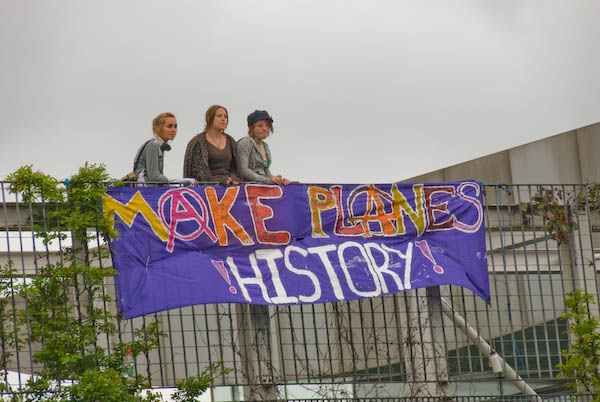
I regret not going to the Camp for Climate Action at Sipson, near Heathrow in August. Partly because I was busy with other things – no real excuse when its our only planet at risk, but also because I found the anti-photographer rhetoric put out by some of the organisers upsetting. (And of course I was there in 2003.)

Fortunately others did go and make a fine record of what went on, which was on show at The Foundry in Shoreditch last week and closes today (Sunday Nov 3.).

You can see the exhibition online and as well as the pictures, there is also some thought-provoking text about the camp, and the police reaction to it. It is important to understand that those taking part were doing nothing illegal in holding a camp and enjoyed a great deal of support from local residents.

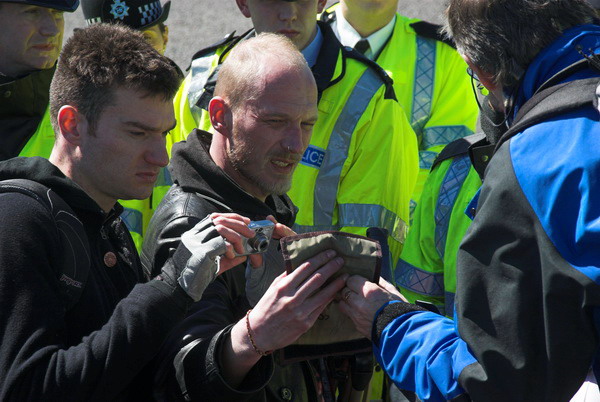
Almost all of the disruption in the area over the week was caused by the police activities, which seriously disrupted life for those living in the area as well as the campers, as well as resulting in some delays for those flying from Heathrow. The whole policing operation – and I wrote a little about my experience of it in August – was totally out of proportion to any likely threat from those at the camp.

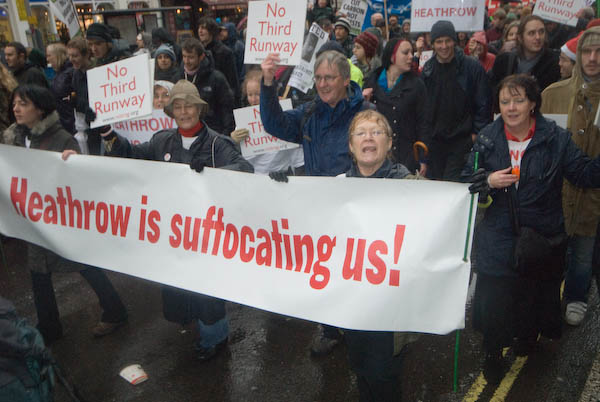
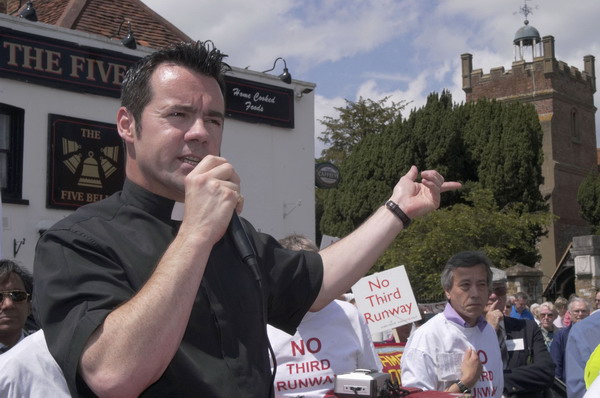
The decision to go ahead and build a third runway at Heathrow will almost certainly be viewed by history as the most criminally irresponsible act of the Brown government. The industry is already taking it for granted that it will go ahead. I think it is also likely to lead to the largest direct action campaign ever seen in this country – and it may even end up being Brown’s ‘poll tax’. The police were perhaps just getting in a bit of doubtfully legal advance practice.

My congratulations go to Mike Russell, Kristian Buss, Gary Austin, Jerome Dutton, Adrian Arbib, Amy Scaife and Mike Langridge for their pictures, Jody Boehnert for the exhibition design and Mike Russell for the web site.

Still on show at the Foundry (Great Eastern St, London EC2A 3JL) until Sun Nov 11 are images from the G8 events in Rostock by Paul Mattsson and Guy Smallman.

China, Burma protests

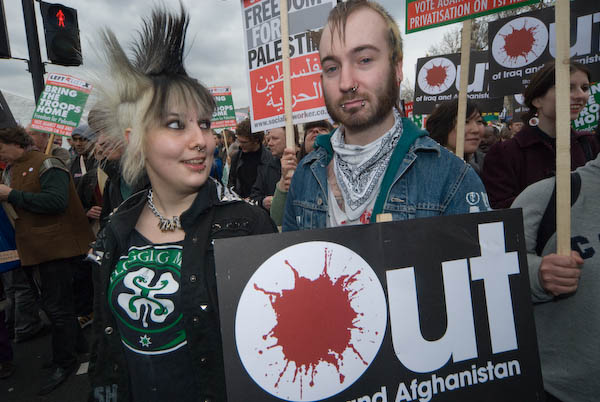
In the gloom and rain of last week I photographed two protests in London connected with China, which seems to be making just about everything we use now. Wednesday was the anniversary of the confinement of Aung San Suu Kyi, 12 years under house arrest in Burma. Around a hundred people turned up opposite the Chinese embassy in Portland Place for an hour’s vigil – as the Burmese regime depends on Chinese support. Then they walked along to the Burmese Embassy for a further protest. I left them there, although they were to continue to Parliament Square for a candle-lit vigil.

It was a tough event to find ideas for photographs beyond the obvious – masks and monks. The Global Human Rights Torch Relay the following day was more promising, but the weather wasn’t – a fairly steady light rain for much of the time. This called for the 2008 Olympics to be moved from Beijing as the Chinese human rights abuse is not compatible with the Olympic ideals – as too had some of the placards – like the one above – on the previous day.

The torches certainly added a little colour and the ‘Greek Goddess’ was attractive even if she didn’t look particularly Greek. But I had problems – perhaps due to the rain – when my flash started to behave erratically. Nikon’s flash – especially with i-TTL units such as the SB800 is one reason to prefer Nikon to Canon, though the full-frame Canon 5D works so well at high ISO you might choose it and work by available light.

But even the D200 can do pretty well in low light compared to film:

This was at the candlelit vigil opposite the Chinese embassy, and I think the semi-fisheye effect works well for once.

Peter Marshall

Equiano

Olaudah Equiano (1745-97) was certainly a remarkable man, and one whose name deserves to be remembered this year along with William Wilberforce, Thomas Clarkson and the others who helped to bring about the end of the transatlantic slave trade in 1807. His life was an incredible story both of adventure and of a man who managed to work his way out of slavery and become a successful businessman and best-selling author. Although born Olaudah Equiano, he was renamed Gustavus Vassa (after a Swedish noble) by the British naval captain who bought him in 1757, and used that name for the rest of his life.

Equiano took part in many adventures and various schemes including those to resettle Africans in Sierra Leone, and also formed ‘The Sons of Africa’, probably the first organised black political group in England, who campaigned against slavery through meetings, letters and articles, as well as being active in the English radical left.

But Equiano is also a great mystery. Despite the best-selling autobiography that did much to promote the abolitionist cause, there is still considerable doubt about the actual place and circumstances of his birth. And although his death made the newspapers at the time, there is no record of where he was buried, and little seems to be known about the details of what happened to his estate. His English wife, Susan Cullen, died in 1795, and his elder daughter a few months after him in 1897 , but when his only surviving daughter, Johanna Vassa, reached the age of 21, she inherited the large sum for the time of £950. His will is in the National Archives.

Equiano disappeared without trace, and for many years his contribution to the movement was also largely forgotten, but in recent years much research and several books have brought his memory back to life. Joanna Vassa (as she is more normally known) lived until 1857, marrying Congregational minister Henry Bromley in her early twenties.


People gather around the grave of Joanna Vasser as Arthur Torrington talks.

Arthur Torrington OBE, the secretary of the Equiano Society told us much of the story of the man and his daughter as he led a short conducted walk to her grave which was re-discovered in Abney Park Cemetery in 2005 in a badly damaged and overgrown state. It has now been cleaned and restored and parts of the inscription can be made out. Joanna, her husband and the second wife he married after her death were all buried in the same grave. There is no record known of any children from the marriage.


JOANNA, HENRY BROMLEY and VASSA can clearly be read on the gravestone, though some other words are vague.

More pictures on My London Diary

North London Against Gun and Knife Crime

I hope that most north Londoners are against gun and knife crime, but relatively few turned up to express this at the march starting from Clapton Pond at noon on Sunday, but this is just the start of a campaign by Communities Against Gun and Knife Crime, and one in which I can only hope they will have some success.

Clapton Pond is a location curiously missing from modern maps – not marked on any of my several street atlases or the Ordnance Survey, but popular on the fronts of buses, and you can hardly miss the pond as you walk, ride or drive past.

It’s probably safest not to stop, as this is Hackney’s notorious “murder mile” along the Upper and Lower Clapton Road. Drug-related crime rose to levels in 2002 that led one of the senior consultant surgeons from nearby Homerton Hospital to go and study techniques used to treat stabbings and shootings in South Africa’s most dangerous township, Soweto – where statistically the crime rate was lower. In 2006 it was reported as having a murder on average every two weeks.


Chimes nightclub, a few yards from the start of the march, was forced to close following a murder outside – the last of a number of incidents there – in Jan 2006

Unlike the similar march in the London Borough of Brent, in north-west London, this does not appear to receive support from the local authority (it covers two, starting in Hackney and finishing in Haringay) or from the Metropolitan Police, although they were of course on hand for traffic control.


Marchers prepare to move off

The march was organised by CAGK, Communities Against Gun and Knife Crime, one of whose members has had one relative shot and two stabbed. Less than a hundred marchers started on the march from Clapton Pond, but by the time it had reached its destination for a rally at Tottenham Green, I’m told the numbers had more than doubled (I had left to photograph elsewhere.)

I hope they get more support for the meeting later this week, and gain support for their positive policies to cut down crime – in particular providing activities, education and real jobs that provide hope and a future away from crime for youth in the area.


The march starts.

More pictures

Peter Marshall

Stop the War, Allow the Demo

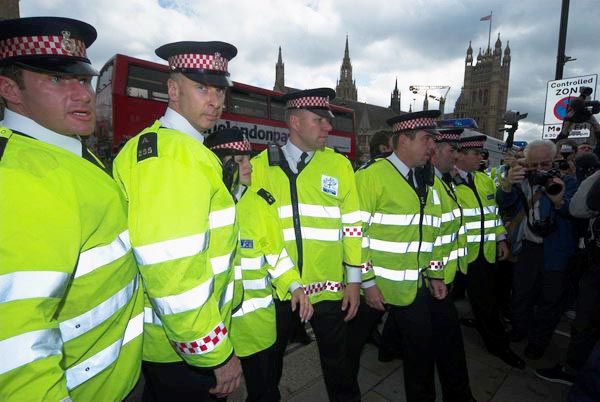
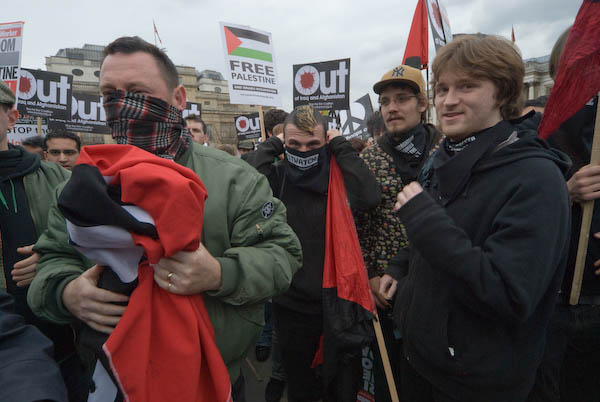
This year Britain’s members of parliament were welcomed back from their summer hols by a demo organised by ‘Stop the War’ and CND. In a masterfully inept move, the Met police, doubtless pushed by Downing St, brought out and dusted off legislation passed in 1838 against the Chartists, then seen to be threatening civilisation as the rich and powerful enjoyed it.

Nothing could have boosted the demonstrators more than a ban on marching, and the numbers who turned up in Trafalgar Square for the rally would have made a ban impossible to implement short of mass arrests and Burma-style draconian measures.

An hour or so before the rally, the police/government had to back down, giving the demonstrators permission to march as far as Bridge Street, just short of Parliament Square.

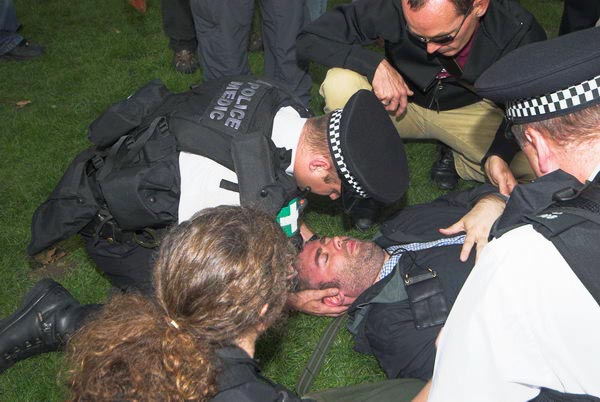
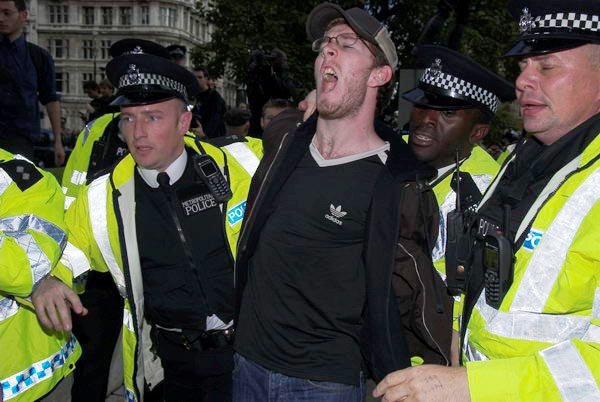
In the end the had to back down further, allowing the marchers bit by bit access to Parliament Square and eventually at least some were allowed to go to their final goal and lobby their members of parliament. Some of the police were obviously rattled by this climb-down and took it out rather by harassing the photographers, trying to prevent them from photographing the march as it moved down Whitehall, and I was almost knocked flying by a firm shove as I was walking backwards, camera to eye. Another officer put out an arm to stop me and apologised.

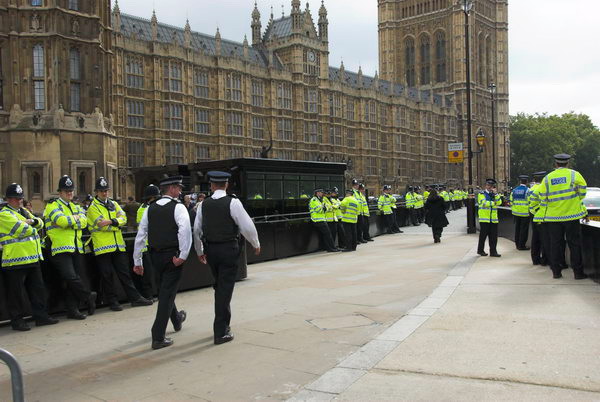
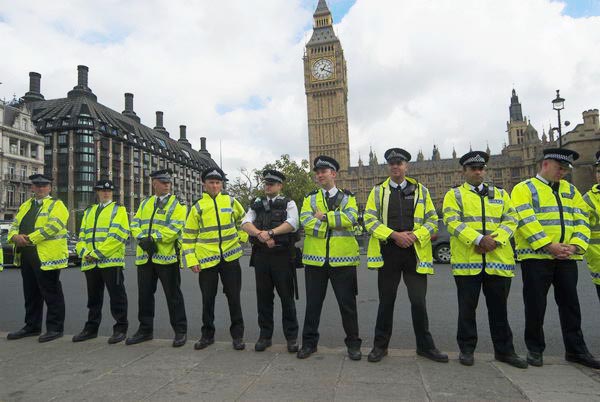
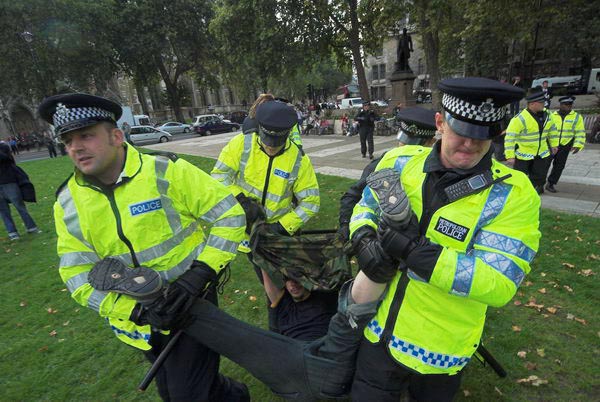
Police then kept the marchers penned up around the square, either in Parliament Street or in front of Brian Haw’s pitch in the square itself, and some conflicts seemed more or less inevitable, and few were surprised when there was a sit-down in the middle of the traffic junction that police were trying hard to keep open.


Frustrated marchers sit down in the middle of the traffic junction

Sensible policing would have taken the march through the area as quickly as possible, stopping the traffic for the march to pass, and moving it on to College Green or Victoria Gardens, where the organisers might have made some further speeches before an orderly dispersal. Trouble-makers would then have been relatively isolated and much simpler to police.


A  popular sentiment!

The event dragged on a long time, and the sky began to get very gloomy and threaten rain. I’d photographed the sit-down, but nothing else seemed to be happening. So I – and some of the other photographers – decided it was probably time to go home.

No sooner had we left the scene than the police sprang into action, forcibly removing the demonstrators from the roadway. Many moved onto the square itself, pushing down and piling up the barriers that were erected to prevent access to it some weeks ago. I missed taking pictures of this, but you can’t be everywhere all the time.

The event was at least handled a little better than ‘Sack Parliament‘ that met returning MPs last year. Then one of my colleagues was hospitalised by the police (he is taking them to court) and there were many more arrests, even though there were relatively few demonstrators.

Many more pictures of course on ‘My London Diary

Peter Marshall 

A Busy Weekend

I’m about to set off for another busy day on the streets of London, although this one is a little different, as this afternoon I’m in Bethnal Green not to take photographs but to lead a tour with the author of ‘The Romance of Bethnal Green‘ (ISBN 9781901992748), Cathy Ross. Its a book I’m proud to have my name on the cover too, “with photographs by Peter Marshall“, and as well as providing 16 of my own images, I also worked on the pictures from local history and other sources, several of which were terribly printed and required considerable rescue in Photoshop.

Of course I do hope to take a few pictures here and there, and more tomorrow – as usual. But last weekend, as you can see in My London Diary, was a particularly busy one. Last Saturday I took part in the London march, part of the Global Day of Action on Burma, and was particularly pleased to get pictures of some of the monks in front of the Houses of Parliament.

I left the monks after they had tied ribbons to the gates of Downing St, to photograph a walk organised by Yaa Asantewaa and Carnival Village to commemorate 200 years since the abolition of the slave trade – and illustrate some of our history since then, a part of this year’s Black History Festival, before returning to Trafalgar Square for the end of the Burma rally.

Sunday saw me photographing both the annual Al Quds (Jerusalem) Day march, and also a counter-demonstration by those who see it as an event entirely designed to bolster the cruelty of the hard-line Islamic regime in Iran. I think the truth is a little more complex, and various groups participate in the event for different motives, although of course the event was founded by the Ayotollah and is supported financially by Iranian government-backed agencies.

That there are sickening abuses of human rights in Iran under the name of Islamic law is too beyond doubt.

And then on Monday I was back in London taking pictures again of the ‘banned’ ‘Stop the War’ demonstration. But more about that when I get back from today’s work.

City People

If you are at a loose end in London tomorrow night (Thursday October 4) why not come along to The Juggler in Hoxton Market, where the London Arts Cafe show ‘City People‘ has its opening (it continues until October 26.) Curating a show is one way to make sure you get your pictures included, and four of mine are on the wall.

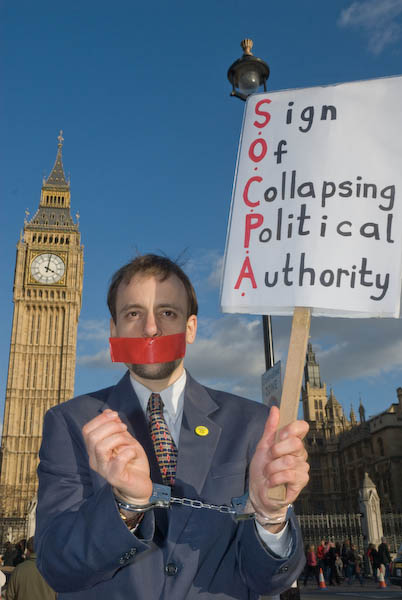
I decided to show four pictures taken in the same place, Parliament Square. In 2005, our New Labour government decided that Brian Haw’s ongoing demonstration looked rather untidy and embarassing in Parliament Square, it was a continual and unwelcome reminder of the great blunders they had made over the Iraq invasion. So they decided to add a bit to the ‘Serious Organised Crime and Police‘ bill that was going through at the time. But rather than a clause that directly said “Sod off, Brian” they brought in a blanket need for demonstrations in a wide area around Parliament needed to give 7 days notice and get permission from the police.

Unfortunately, the 2005 SOCPA act ended up causing rather more trouble than it was worth. It didn’t shift Brian, at first because careless drafting meant it didn’t apply to him, and then, even when a judge was found to say it did (because they had meant it to), the police found that his protest was still allowed, as the law made an exception for individual demonstrators (although the police could impose some conditions to restrict them.) Then comedian Mark Thomas came up with the brilliant idea of mass lone demonstrations (and one day there were over 2000 such events in the area.) Perhaps his best one was a demonstration against the wasting of police time.

So Parliament Square has ended up being a much more important focus of dissent, including at times – usually in the middle of the night – some rather nasty attacks by police (and off-duty police in plain clothes) on Brian Haw and others. Unfortunately I’ve not been around to record these, but I have photographed many other events there in recent years, including these 4 in the show:


The Space Hijackers challenge MPs to a cricket match (May 1. 2005)


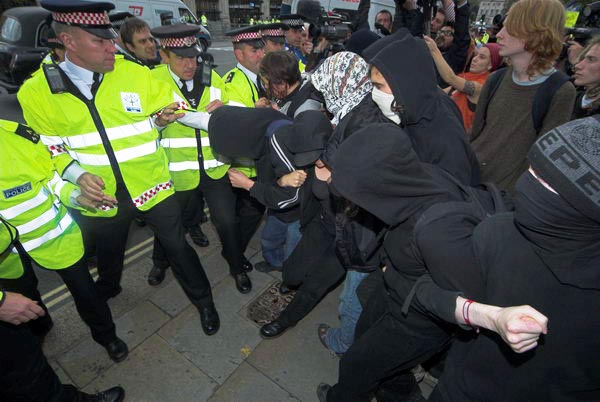
Police v Anarchists, Sack Parliament, Oct 10, 2006

Brian Haw
Brian Haw: “Find Your Courage; Share Your Vision; Change Your World” (Dan Wilkins)


No Trident Replacement. March 14, 2007

There is one other photographer in the show, Paul Baldesare, along with various paintings and drawings, providing an interesting mixture of methods and viewpoints.


Borough Market, Paul Baldsare.

My pictures have ended up being rather more topical than I expected. Tony Benn, President of ‘Stop the War’ wrote to the Home Secretary on Monday following the announcement of a ban on the proposed march from a rally in Trafalgar Square to the Houses of Parliament on Monday October 8 under the 1839 Sessional Orders legislation. Benn states that he and others intend to defy the order by marching along Whitehall to lobby members of Parliament and call for an immediate withdrawal from Iraq. I hope to be there again taking pictures.

Peter Marshall