‘Page 3’ on the way out?

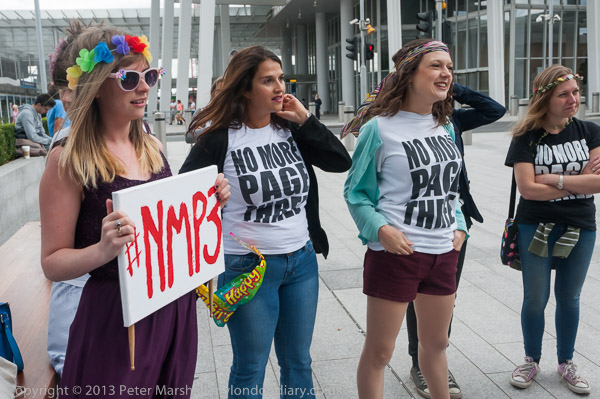
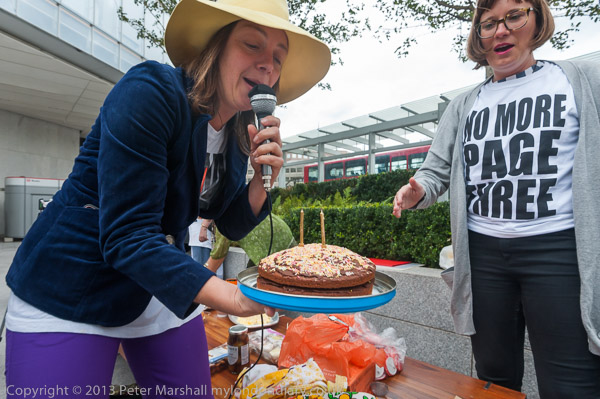
Five months ago, in August 2014, I photographed the second anniversary party of the ‘No More Page 3‘ campaign, held on the courtyard outside the new offices of News International facing London Bridge Station. A  few weeks later I wrote about it on this blog, in the post ‘No More Page 3‘.

In the news today, there were reports that The Sun has abandoned its practice of publishing these ‘topless’ images daily on the page, and in today’s issue the spot was occupied first by a couple of women  in bikinis running along a beach in Dubai, though later editions apparently displaced them with the story of the death of a long-running Coronation Street soap star. Something which is news, if not news that I have any particular interest in, having last seen the programme before she joined it 43 years ago.

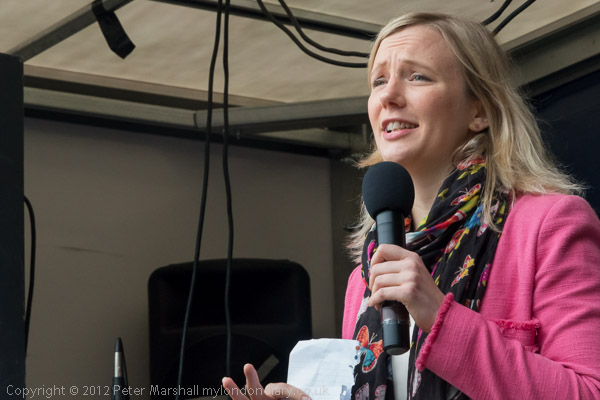
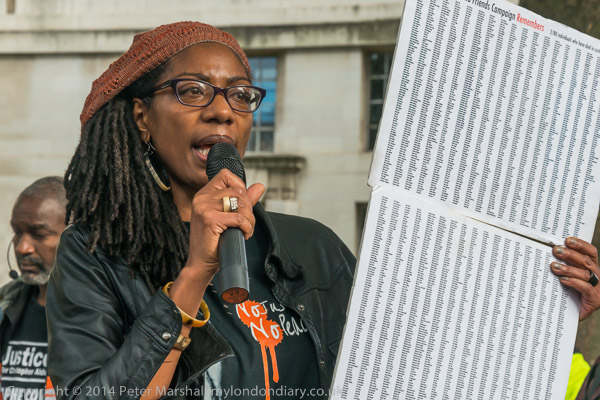
What was interesting this morning was to hear the BBC’s  tame media commentator talk about this without mention of the campaign which was undoubtedly what prompted newspaper owner Rupert Murdoch to consider dropping the daily feature and to finally order its demise. It was left to a woman MP also taking part, Stella Creasy to mention them, after which he rather grudgingly admitted that ‘No More Page 3’ might have played a small part.  ‘Like’, I thought, ‘it wouldn’t have happened without them.’

Stella Creasy, Labour MP for Walthamstow speaks at an anti-racist event in 2012

It’s hard not to conclude that there is a conspiracy to play down the role of protests in promoting change. People often tell me it changes nothing, but it is perhaps the only way most ‘ordinary people’ can influence events. I do believe that it is important to vote (and vital to vote for the right people) but it’s even more important to get out there on the street with banners and placards, and to organise and sign petitions.

Of course, protest does often become respectable in long retrospect, and its importance can even become overstated. Slavery still continues despite the valiant efforts of Wilberforce and the abolitionists, and the racism that underlay it is perhaps now on the increase.

So far, the ‘Page 3’ success – not yet confirmed by The Sun, but reported by another Murdoch mouthpiece – seems a very partial one.  A step in the right direction to a newspaper which publishes pictures of women simply because they are making news.

Continue reading ‘Page 3’ on the way out?

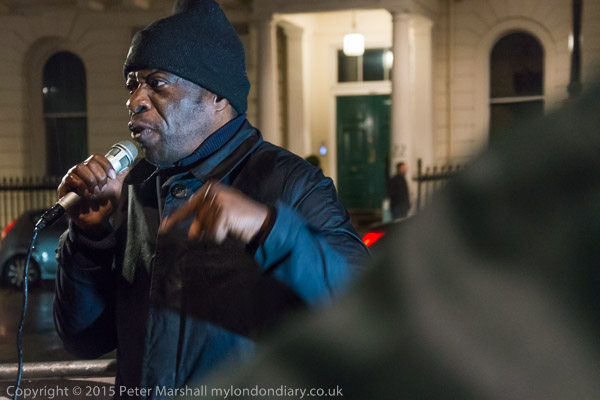
Pegida Problems

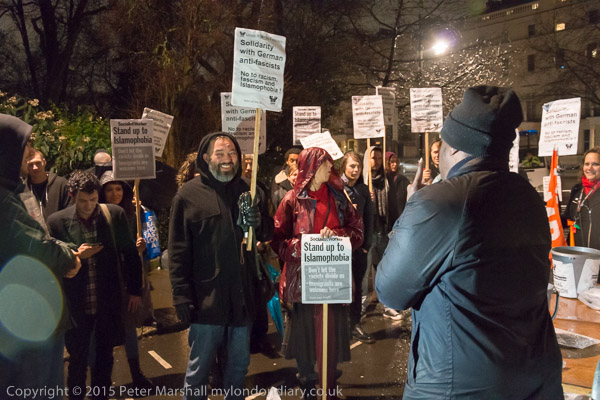
It was a dark, damp night, with fluctuating rain, occasionally slackening to a standstill and at other times almost filling the air with fine drops, so fine it was deceptive, hardly appearing to be raining, but soaking everything and looking down I saw streams of water flowing across the barrel of my lens as it stuck out from my coat.

Any sensible person would have taken one look at the weather and decided they had better things to do than hanging around on a street corner as we were on the corner of Belgrave Square, in a dark area penned off by barriers, and most of those who had signed up for the event on Facebook had clearly come to that conclusion.

And it was dark. There were lights across the road, but even the bare winter trees of the square seemed to create an area of shadow. A small group of photographers chattered gloomily, one saying “they don’t tell people about this at media school”; standing in the cold, dark rain certainly is a less glamorous side of being a photographer.

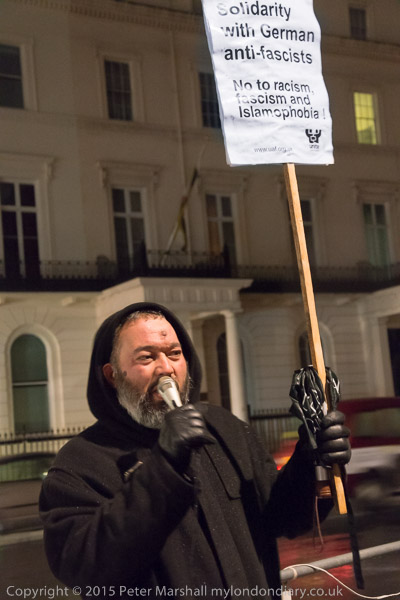
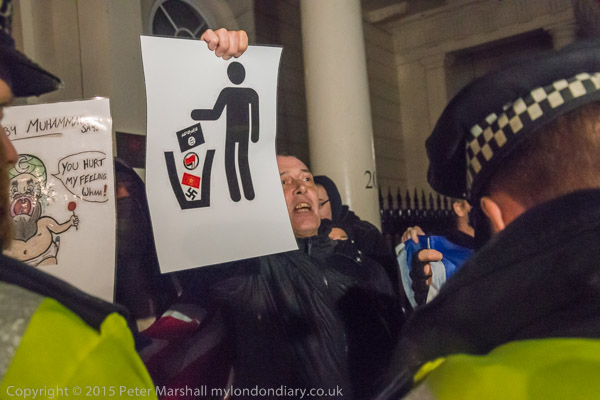
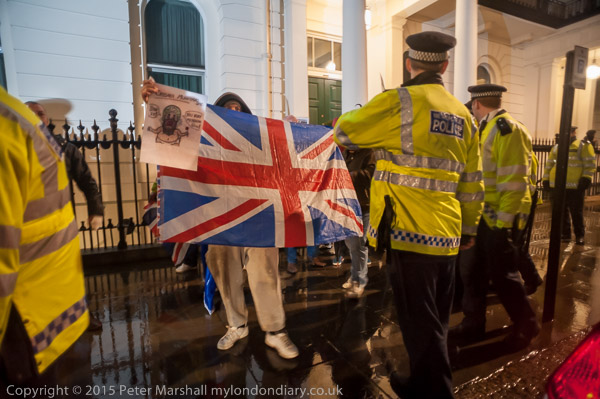
I don’t like working in the dark. I don’t really have the best equipment for it, with no fast lenses for the Nikons, and good though the Nikon flash system can be, in the wide outdoors flash is seldom a good answer. Suddenly there was something to photograph, a man carrying a Union Flag walked past the Unite Against Fascism pen and started shouting insults as police came to move him on.

I rushed to the scene, framed and pressed the shutter release and absolutely nothing. It was too dark for the lens to focus. Just what focus assist is designed for, but Nikon thoughtfully disable it just for those occasions when it’s most necessary. Or at least only let you use it if you are using single-servo (S) focus mode AND you are either using auto-area AF OR have the centre focus point selected in other modes.

I fiddle with the camera in the dark, but before I’m able to solve the problem the guy has been led away to a pen 50 yards down the road where a few other right wing extremists are being looked after by police.

It isn’t the only problem I have with the D700. A few minutes later when I’ve been taking pictures using manual exposure, 1/30s at f2.8, I hear it making a rather more lengthy exposure and find it has altered the ISO to 800 from the 3200 I had set, and changed mode and set the aperture to f32. Clearly it is suffering from mad camera disease. I fiddle with it a bit more and find I do have auto-ISO set, which doesn’t account for the rest of the changes, but the camera begins to work more sensibly when I turn this off. I think it’s probably suffering from old age, I will have been using it for six years next month, and has taken over 370,000 pictures (according to the EXIF data) well over twice the minimum rating of 150,000. Probably it’s due either for an expensive service or replacement. As it has a few other peculiarities perhaps a replacement would make more sense. You can get a D700 in good working order with a reasonably low shutter count but some cosmetic damage for under £500, but probably it’s time to upgrade.

If the camera is now doing its best, with the SB800 attached the system is still playing a few tricks, with seemingly random exposures, and I more or less give up on the flash. There is occasional and rather unpredictable light from several people using video lights on their cameras, often a real nuisance as I have to keep moving as it shines direct into my lens, but at times giving me some dramatic lighting (though of course very flat for those who are supplying it.)

I have the camera set to ISO3200, but also have the exposure compensation at around -2 stops. Working without considerable compensation gives results that are just too bright – and can end up looking as if they are taken in daylight rather than at night. Despite the compensation I think the results are what you would expect at in terms of image noise from ISO3200.

Much of the time, having set the ISO and compensation I actually work using manual exposure in any case, taking no notice of what the camera meter indicates but looking at the image on the camera back and in particular the histogram. I kept wishing I was using the Fuji XT-1 because I think the electronic viewfinder would be better than an optical one; the Nikons do have ‘Live View’, but it’s clunky and you only see it on the camera back, and I find unusable for taking still images of action. The faster lenses for the Fuji would also have been useful. But my XT-1 body is currently in for servicing.

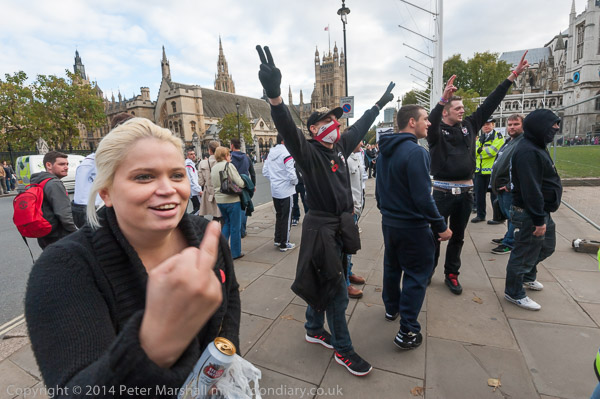
The video lights  of several people working with video let me work without flash when the small group of right wingers (they seem to come from the various overlapping groups I’ve photographed before – EDL, South East Alliance, NF, Casuals United, Golden Dawn… and for this occasion some at least of them have called themselves UK Pegida.

Police led them off from the embassy and took the street leading towards Victoria Station. I thought about following with them and taking more pictures, but decided I’d had enough, and walk off in a different direction to get a bus, while the UAF vigil continued.

The following afternoon a friend of mine showed me a cheap LED light – under £30 –  he has bought that seems considerably more powerful than those I’ve previously tried – as the more expensive models used by the videographers clearly are too. I’ll perhaps give one a try – and report back later.

More about the event at Solidarity with German anti-Pegida – and more pictures.

Continue reading Pegida Problems

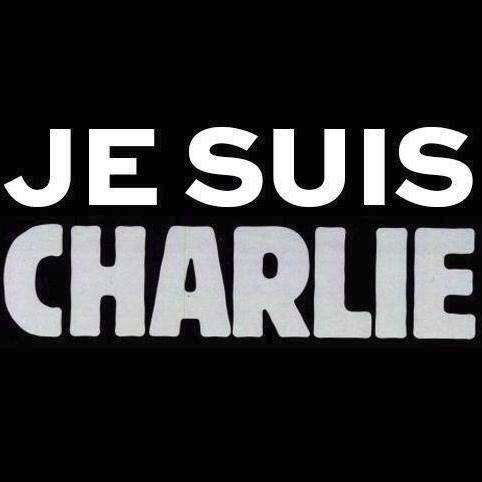
#JeSuisCharlie

charlie-1
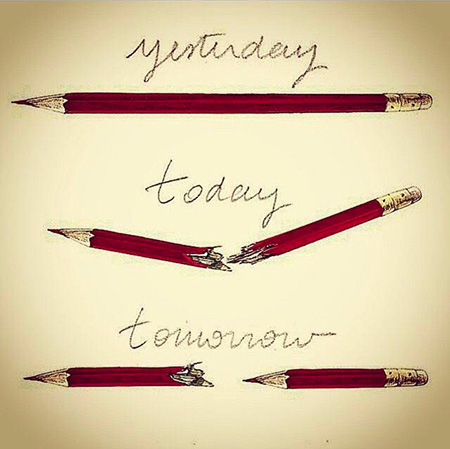
Shared from Facebook – image by Lucille Clerc

By the time I heard the details of the protest in Trafalgar Square last night over the shooting at Charlie Hebdo it was a little late for me to drop what I was doing and get there, though this morning I regret my absence. I should have been there, at least with a pen if not with a camera.

It isn’t a matter of religion, but one of humanity. Something that we can all abhor, whether we read the Quran, the Bible or other religious texts, or are agnostics or atheists.  You, like me will probably have read many of the comments about the attack from people around the world, so I’ll only quote two of them. On the radio this morning I heard a leading Muslim scholar Tariq Ramadan being interviewed, and his comment (also on Democracy Now!) was “This is just a pure betrayal of our religion & our principles”  and my own union statement ends “Supporters of free speech and civil liberties must stand together with governments to condemn this act and defend the right of all journalists to do their job without fear of threats, intimidation and brutal murder.

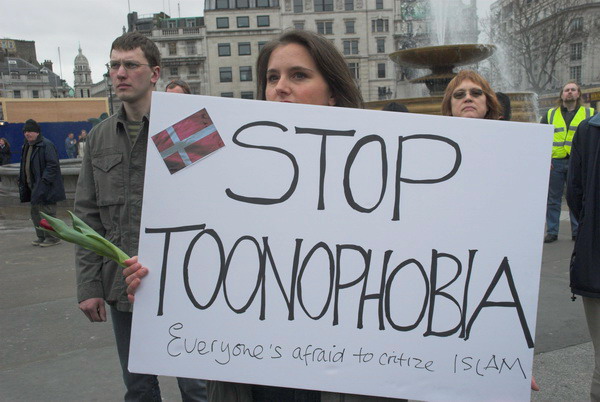
The news of the killing took my mind back to 2006 and the protests then against the publication of cartoons by a Danish magazine.

Of course I respect the right to peaceful demonstration, but the call for ‘global civility’ steps over my right to free speech once there is any suggestion it should be imposed.

The following month I was back in Trafalgar Square, photographing a protest to ‘protect free expression’ at which some of those present held up placards containing some of the Danish cartoons – which were republished in France by Charlie Hebdo in 2005.

Charlie Hebdo was certainly not afraid to criticize Islam. Or Christianity or any other religion or politicians of all colours or anything else, but I’m sorry to have to admit that I censored some of the images that I took on that day to avoid offending people, blurring the cartoons. I should not have done so and will not do so again.

I hope that all journalists and publications around the world will stand up and be counted on the side of freedom of speech (though I know there are some countries where this is not possible.) Some will be holding a short silence at 11.00 am today (when I’ll join them and post this), and many newspapers have published cartoons about the shooting – including some of those from Charlie Hebdo that offended the killers. Perhaps we should name January 7 ‘Charlie Hebdo Day’ and make it an annual celebration, publishing their work again.

I hope too that Charlie Hebdo will continue, and continue to offend people of all faiths and none. And I certainly have no time at all for those who try to blame the victims rather than the perpetrators.

charlie-2
from Charlie Hebdo

Continue reading #JeSuisCharlie

Read Democracy Now


John Hilary, Executive Director of War on Want and author of The Poverty of Capitalism

One thing that recent events have made clear is that our establishment does not play fair. We may officially laud our great traditions of freedom and justice and the rule of law and be given to thinking of Britain as the mother of democracy, but underneath this veneer is a system by the rich for the rich, who when they see their interests in any way threatened are prepared to lie and cheat in any way possible to protect those interests.

We’ve seen it revealed a little in the content of the Wikileaks and the curious treatment of Assange and later Snowden, in the snooping of GCHQ and the malware they have introduced into some major computer systems, and, at a more local level in the responses to the relatively trivial scratchings of the Occupy movement, most recently over Christmas over the ‘Love Bank’ on the Charing Cross Road, when police defied a High Court order openly obtained by the protesters while enforcing two obtained by a rather doubtful and secretive company.

And we saw it too in October, with the excessive over-reaction to a smallish group of people who came to debate and hold workshops on a neglected area of grass in the middle of Westminster. I’ve long regarded Parliament Square as a national disgrace, in a World Heritage Site, surrounded by some truly iconic buildings, for many years it was only possibly to access by taking one’s life in one’s hands and dashing across three or four lanes of rather unpredictably moving traffic.

Even now, the access to the central square is poor, and those who don’t know the traffic lights and lanes well – including the many tourists who come there – often find themselves having to run for their lives as they try to get on or off it. We should long ago have had a great competition for the redesign of the square, which could well have incorporated suitable anti-terrorist measures for Parliament in a far less obtrusive and even attractive way than the ugly black metal structures the currently impede movement by visitors around Parliament.

For more than ten years, the front of the square was enlivened by the presence of one man, peace protester Brian Haw, who, along with a few friends kept up a constant presence their as a reminder of the human results of some of the policies pursued by the Parliament opposite. It wasn’t always a pretty sight, though it – or rather a reconstruction of it – did for some months occupy space in the Tate Gallery – but it was always thought-provoking, perhaps why it upset our establishment so deeply. They ordered the police to bend existing laws and carry out raids on the small camp, even drafted a law almost entirely aimed at Haw’s removal (though they made a mess of it), made numerous arrests, sent round thugs and variously otherwise persecuted Haw and his fellow protesters. After stress and cancer killed Haw, they continued the persecution against Barbara Tucker, who came close to death after they removed her ‘sleeping equipment’ and protection against the winter weather.

There must be something more than meets the eye about Parliament Square. I have a small suspicion that there is something under that always poorly kept grass that we don’t know about, some secret bunker or dark and grisly secret that our authorities are in constant fear might be discovered by anyone staying there overnight. Though having once spent a rather uncomfortable night on a bench there (they have now removed them all in case anyone should follow my example) I can assure you that neither Churchill nor Mandela come alive at dead of night and walk around.
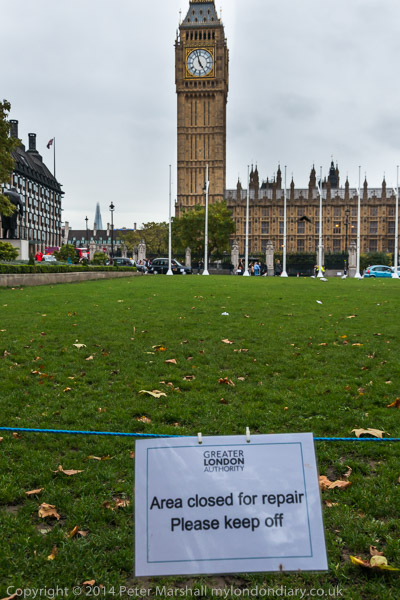
A day before the event was due to begin, the grassed area of the square – which had been neglected all year – was roped off and notices put up by the Greater London Authority (GLA) ‘Area closed for repair – Please keep off’. It was a notice that fooled no one, and there was not even any attempt to make it in the slightest convincing by having any groundsmen or gardeners working there. A month later, well after police boots had churned up the muddy surface thoroughly I could see no indications of any action to repair the area.

The policing at the start of Occupy Democracy was not particularly unreasonable, although police liaison officers did hand out notices about the unreasonable Parliament Square Garden Byelaws 2012 and Section 143 of the Police Reform and Social Responsibility Act, which make it a criminal offence to use “any amplified noise equipment”, to erect  or use tents or other structures designed or adapted for the purpose of facilitating sleeping, or to bring into or use any sleeping equipment in the square for the purpose of sleeping overnight.
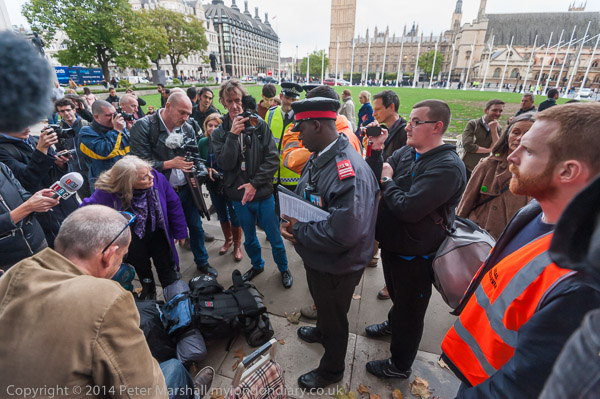
Where things started to go wrong at the beginning was when the private security guards who are provided by a company who have a contract with the GLA – misleadingly titled ‘heritage wardens’ – began telling police they should start taking rucksacks and sleeping bags from people in the square, even though at that point they were not attempting to use them in the area. And that police, rather than behaving as they should and deciding for themselves whether an offence was being committed, simply acted as the enforcement for the warden’s whims.

People rightly objected, argued and peacefully resisted – and eventually, for the moment, the police backed off, and the entirely peaceful event took place – and was still proceeding an hour or to later when I left for home.
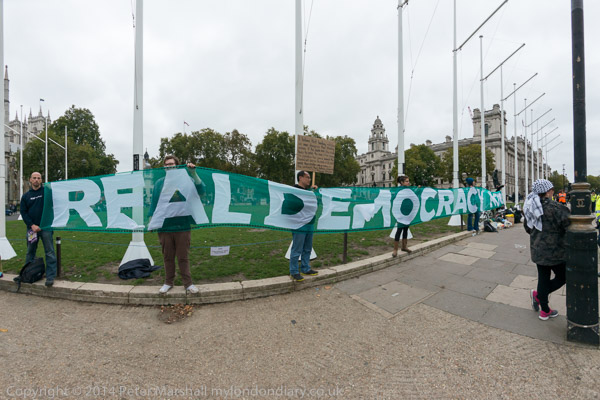

The next morning when I arrived, people were still on the square, some having spent the night not on the main grass area but on some areas around the edges, following some negotiation with police. People were still more or less keeping off the main area of the square, and most had left to join in the large TUC ‘Britain Needs A Pay Rise’ march, with a small group holding banners and placards and chalking on the pavement facing the Houses of Parliament.

I returned after watching the march leaving the Embankment  – it took over and hour for everyone to start on their way to Hyde Park, and went back to Parliament Square. Soon things began to heat up a little, especially when a Heritage Warden and Westminster Council officials attempted to seize a small amplifier playing music that some protesters were dancing to.
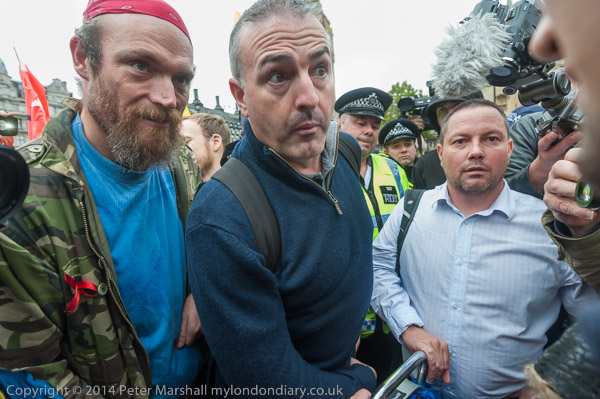

Martin Tuohy Senior Westminster Warden at Westminster City Council and another council employee grab the system

Although the bylaws prohibit “any amplified noise equipment”, it isn’t something that is generally enforced in the area and certainly not against groups that are causing no problems – as in the case of these dancers, who were unaware of the prohibition. Eventually after much argument, police intervened with the council officials and the people concerned were told to take the equipment away and not bring it into the square.
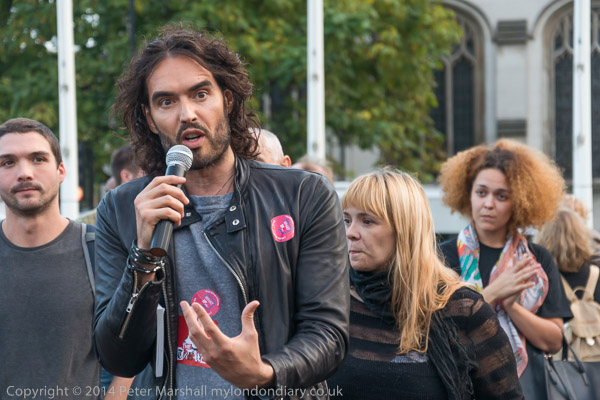

Russell Brand speaks in Parliament Square

Around half an hour later, the main group of protesters arrived, and simply ran onto the square in numbers sufficient to make it impossible to stop them. A rally then began with speeches by Labour MP John McDonnell, Occupy’s George Barda, environmentalist Donnachadh McCarthy, Russell Brand and others, while more and more police arrived and stood in blocks of twenty in various positions around the square, apparently just waiting for the order to charge. One large group of officers in blue caps seemed very much to be looking forward to a fight.
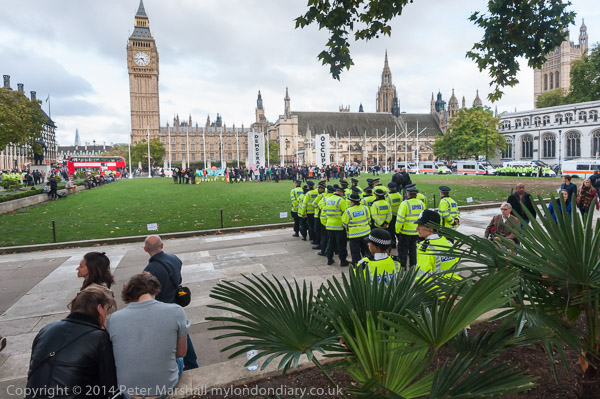
To my surprise, nothing happened. At least not while I and the rest of the press were there in force (particularly as Russell Brand was there. Suddenly I saw the officers getting into their police vans leaving the square. Where there had been perhaps 200 officers, there were now around 20.

When I left (to go to a protest elsewhere) the rally was continuing. I expected the police to take action in the middle of the night to try and remove the protesters from the grass area.

You can see more pictures from the Friday Evening and Saturday at Democracy Camp starts with rally and Democracy Camp takes the Square.
Continue reading Read Democracy Now
Banner Drops

I’m never sure that ‘Banner Drops’ are ever really worth the effort. Used by protesters as a dramatic device, displaying a banner on some iconic building they may sometimes help to draw attention to a cause,and do seem to be reproduced far more often than they deserve. I suppose they are a simple idea and the editors who choose the images seem generally to be pretty simple.

I suppose the first essential is to choose an iconic location, either for the actual display of the banner or as a background. Tower Bridge yes, Chiswick Bridge probably not. Unless perhaps it is somewhere related to the protest; Trenton might have saved himself a few months in the Scrubs by doing a banner drop there rather than jumping in and swimming on boat race day. And while it certainly wouldn’t have got him quite as much press, there would have been fewer negative comments and no vindictive establishment judge.

Obviously the practicalities of actually displaying the banner are important, but also to be taken into account are the problems of photographing it. The event isn’t really the actual dropping of the banner, but the press pictures and TV footage of the banner in situ.
Nikon D800E, 16mm fisheye

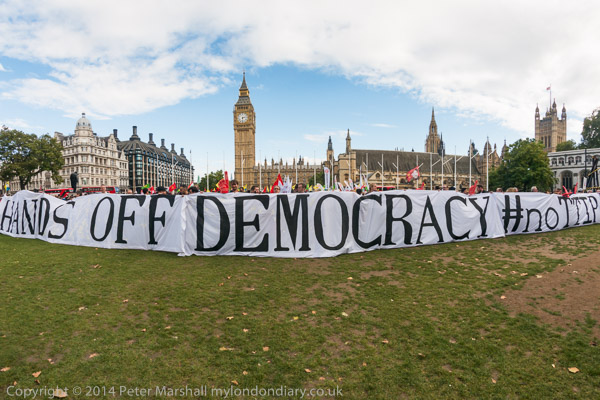
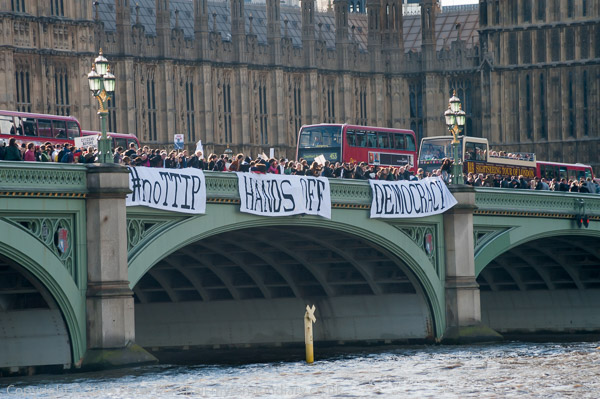
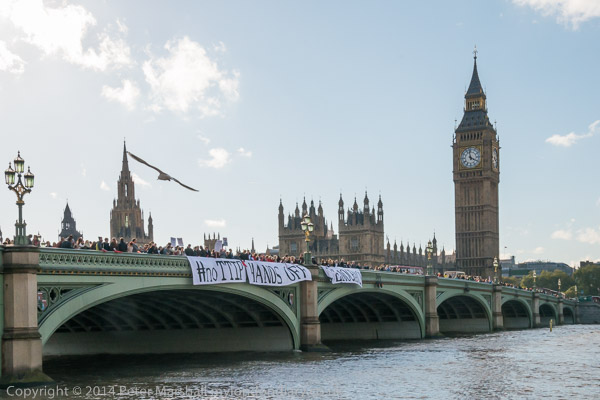
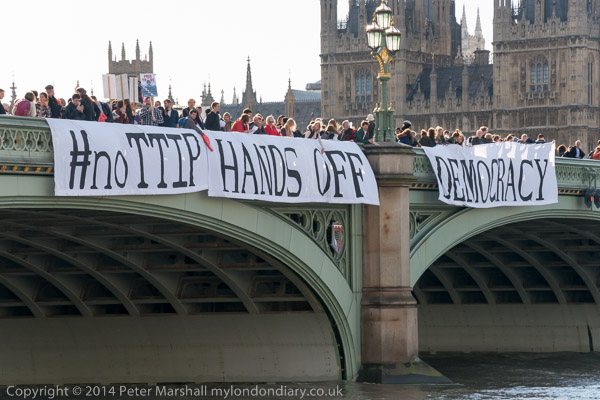
I’d photographed the three banners that made up the message ‘#noTTIP‘ ‘Hands Off‘ ‘Democracy‘ earlier on Parliament Square. They spread more or less across its full width and it was hard to get the whole message in, and even harder to get the whole area between camera and banners clear of people.

When they took the three banners onto Westminster Bridge, I realised I needed to run to get the picture I wanted. None of the photographers knew exactly where the message was going to end up (and certainly not the people taking it onto the bridge.) We ran across the bridge, and then through the crowds of tourists on the riverside walk in front of the former GLC building. I kept on until I was in a position I thought would work best, perhaps a couple of hundred yards downstream of the bridge.

Nikon D700, 250mm

The first position was in some ways the best, with a long lens I was able to get the message clearly

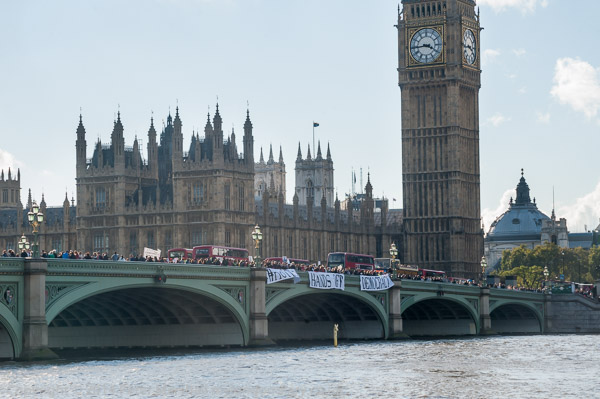
Nikon D700, 100mm

or take a wider view showing that very recognisable clock tower behind it. There were however two problems. Firstly the light, with the sun shining brightly just out of frame; flare and ghosting were hard to avoid, and because of the position of the sun it wasn’t really possible to get the wider view including the top of Big Ben’s tower. It didn’t help that I’d stupidly left the lens-hood of my 70-300 on the desk at home (the only time I’ve forgotten it), but I would still have needed to use my left hand to flag the sun and avoid excessive flare, while waiting for the moments when the wind eased off and the banners stopped fluttering up and came to rest going down from the parapet.

But the real problem was that some photographers hadn’t run far enough, and couldn’t really read the message, and were phoning for the banners to be moved further across the bridge. So before I really got the image I wanted, those banners were on the move.

Nikon D700, 70mm

The glare from the river was really making things difficult, but I took another picture and liked the seagull at the top. But then they were on the move again.

Nikon D800E, 105mm – 157mm equiv
and the #noTTIP had disappeared….

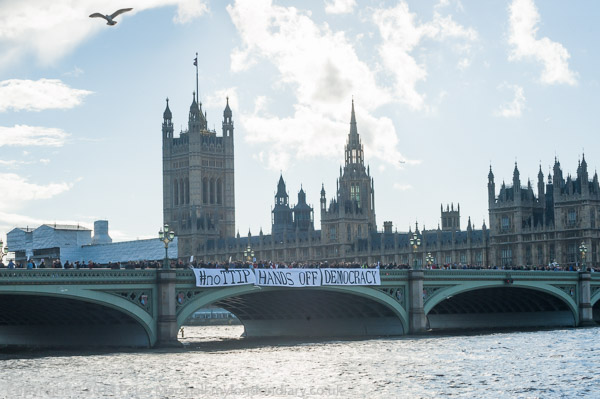
Nikon D800E, 34mm – 51mm equiv

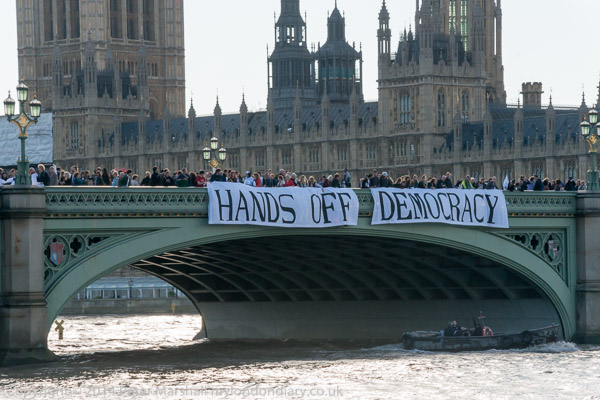
To reappear in yet another position, and again a gull made the picture more interesting for me. Possibly I might crop a little off the top and right of the image, but I like the lamps at the left and the string of people across the bridge. Again I couldn’t move the frame any more to the left as the sun was just out of picture at top left – and that area of sky needed quite a bit of burning to get any tone. The image is essentially uncropped, though I think I’ve probably corrected the verticals slightly. But the main problem with the picture is that the wind has blown the word ‘Democracy’ to make it more or less illegible.  So here’s a final image that puts across the message more clearly:

Nikon D800E, 105mm – 157mm equiv
And it is a vital message. TTIP is a commitment to a corporate future, one that gives free rein to the giant corporations to run the world their way and for the interests of the wealthy. Democracy may not be too healthy in this country, with the two major parties (an UKIP) largely supporting corporate interests, but at least there is some hope, with just a few of our politicians still championing the needs of the people as a whole.

You can see just a few more pictures of the banner drop at #NoTTIP – Banner Drop, and a few of the protest that led up to it in #NoTTIP – Hands off our democracy, though I was also busy with other events. There is more about TTIP (and its Canadian version CETA)  on My London Diary at CETA (TTIP) Trade Deal and CETA Trade Deal Threat to Democracy.

Continue reading Banner Drops

Epiphany


Re-enactment of the 1661 revolt goes up the steps of St Paul’s Cathedral – but didn’t enter and seize it

OK, I know I’m early (for once.) Advent doesn’t end for a couple of days and Epiphany comes after Christmas on January 6th. But Epiphany the 37 minute film is here now and for free! Unlike The Interview there have been no death threats and no mysterious hacking, as the ruler who its plot tried to get rid of has been dead rather a long time, though the people the film celebrates did come to a very nasty end, with a number of them being publicly hung, drawn and quartered after their 3-day uprising in London was brutally put down.

Director Suzy Gillett has decided to give us a Christmas present, and a year after it was completed,and after several screenings this 36 minute epic is now free to share.

The cast includes a number of people I know and have photographed at other events, in particular from Class War, and the subject comes from one of the more interesting periods of English history, perhaps the last era when we really had really interesting times.


Ian Bone holds a framed print of Thomas Venner leader of the Fifth Monarchists

The seventeenth century got off to a good start in 1605 with Guy Fawkes, by 1620 things were so bad that the Pilgrim Fathers sailed to America, then in 1642 a few years of Civil War, after which in 1649 we did the only sensible thing we’ve ever managed to do too our royal family, beheading the king. Unfortunately Parliament turned down the ‘Agreement of the People’ and we ended up with a dictator, Cromwell. After his death, people thought a king would be a better idea, and we had the Restoration in 1660. Actually it didn’t work out too well (except for Charles II, the ‘Merry Monarch’ who had innumerable mistresses and acknowledged 14 of his illegitimate children) and when his brother and successor tried to make us all Catholics it was time for change again – and our so-called ‘Glorious Revolution’ of 1688, truly a missed opportunity as it brought a replacement Protestant King from Holland.


Probably carrying axes and a pike was banned in the City of London after the 1661 Fifth Monarchist outrage

With that background, here is Suzy’s text about Epiphany from Vimeo:

Epiphany is about the rise and fall of the mystics and anarchists of the English Revolution. The Fifth Monarchists stood up to the restoration of the Monarchy in 1661 and were hung drawn and quartered for their efforts.
The Muggletonians lasted for 300 years, keeping a low profile they had their own religious beliefs that successfully continued until well after the restoration of the Monarchy.
Celebrating these little known political and religious sects of the English Civil War, a collective of people made a re-enactment of Venner’s uprising on the 6th January where he marched into the city to St Paul’s fighting off the army in a hopeless battle.
Incarnated by contemporary anarchists, Ian Bone and Martin Wright.


On the steps of St Paul’s Catherdral. The girl with the pike is a great-grandaughter of the last Muggletonian

I became involved with the film when I went to photograph the re-enactment, not at the time realising I was going to become a very small part of the film. Most of the time I managed to keep out of the way of the cameras, but there are three scenes in which I appear in fleeting glimpses. You can see my pictures from the making of the re-enactment at Epiphany Rising Against King.


Ian Bone holds up the picture of Venner on the steps of St Paul’s

Only one of the pictures in this post appears in the selection on My London Diary, and that is developed slightly differently.

Continue reading Epiphany

Umbrella Revolution

No, I didn’t get to Hong Kong, but like so many protests around the world, it also came to London, with a little help from the National Campaign against Fees and Cuts, who organised the protest at the Chinese Embassy on 10th October.

It was the last of four stories I covered that day (and I found time to do a few urban panoramas too – which you can see with the other stories on My London Diary) and in some respects the most interesting. But it was probably well after midnight by the time I had finished uploading the earlier stories and was working on the post processing of the final event. Which is perhaps why one of the pictures I uploaded was just a little strange:

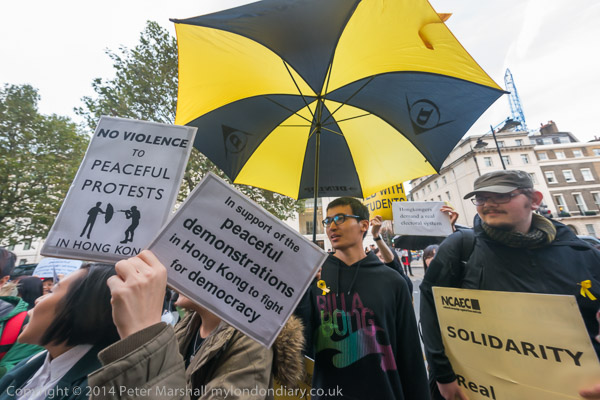
As is probably obvious, this suffers from a rather nasty case of extreme distortion, though perhaps that makes the yellow and black umbrella stand out even more.Here’s the image that I intended to post:


D700, 16mm fisheye, ISO 800, 1/80 f5.6

It still looks a little distorted, and the verticals are converging, though that isn’t necessarily a bad thing.

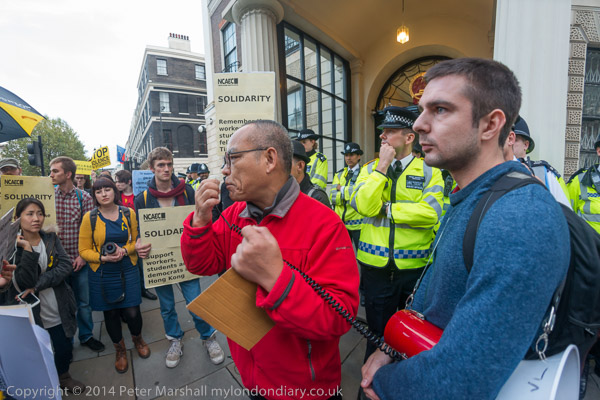
I’d made the original picture from which both these were derived using the Nikon 16mm fisheye, chosen mainly because I was in a very crowded situation on the pavement in front of the Chinese embassy and unable to move any further back from the subject.  I’d wanted both the umbrella and the messages on the poster, with the ‘No Violence to Peaceful Protests in Hong Kong’ at the left- with another umbrella and, at the right  the word ‘Solidarity‘. The text on placards is very important when photographing protests (something I learnt rapidly from the first editor I took my pictures to), and something you always need to be aware of in all images, as legible text always alters the way that we see images.

I usually process the images from the 16mm using either the Fisheye-Hemi plugin, PtGui or occasionally Photoshop’s ‘Adaptive Wide Angle’ filter.  The first two are rather simpler to use and more or less automatically convert from fisheye to a cylindrical perspective, straightening the verticals and reducing the curvature of objects at the edges of the frame. Fisheye-Hemi has just 3 options, depending on the type of fisheye lens you have used (circular, full frame or partial), while PtGui gives greater flexibility.  Photoshop’s own filter enables you to straighten any of the lines curved by the lens, but to do a great deal of work usually involves losing a lot of the image, and I usually end up getting some very funny curves indeed and deleting the results.

Somehow I have used Fisheye-Hemi twice on the top image, not a good idea. While the edges oft he placards and the crane at right are more or less straight in the lower picture, they have become curved in the opposite sense to the original in the upper image in a kind of extreme pin-cushion distortion.

Another pair of images perhaps gives a clearer view of what Fisheye-hemi does:


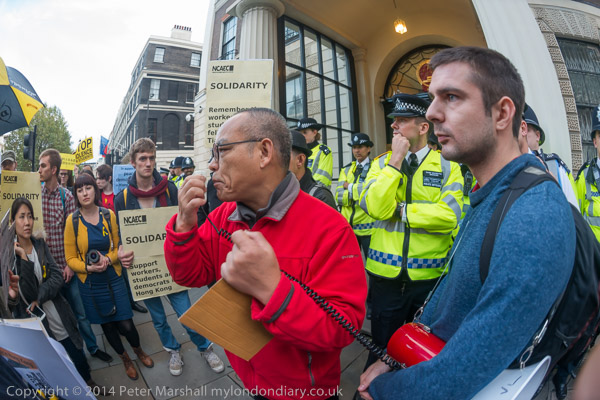
D700, 16mm fisheye, ISO800, 1/60 f5

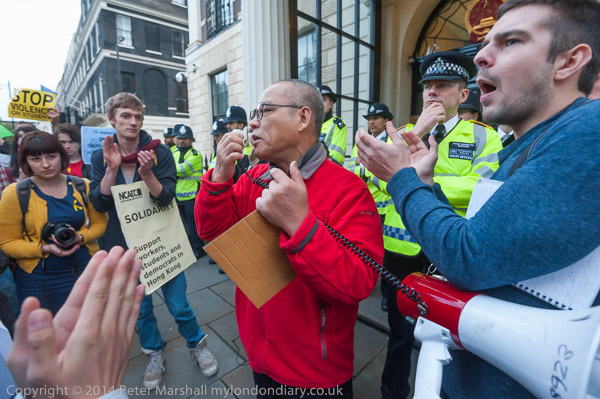
The protesters were crowded around the doorway of the Chinese embassy – much to the annoyance of the police, who like to keep protests to the opposite side of the road. I am very close to the speaker and the man at right who I could reach out and touch. In the upper images there is very clear curvature close to the edges, particularly  noticeable in the pillar of the doorway at the extreme right of the image, but also in the other building in the background and in the woman at the left of the frame.

Fisheye-Hemi has more or less straightened the verticals of the architecture and made that woman look fairly normal. You can also see that the centre points of all four sides show identical subject matter – at left the word ‘Solidarity’, at top centre the top of the pillar, at right a police officer’s ear and at bottom centre the lower edge of that red jumper (I’ve cropped the lower image very marginally to remove a little distraction, which is why there is very slight less of that officer’s face.)

There is also a little part of the image missing at the corners, something you need to be aware of when taking pictures, but it isn’t really a great deal. Because you keep those four edge centres the viewfinder image remains a pretty goo way to frame the image.


D700, 16mm fisheye, ISO 2500, 1/160 f5

Here’s another image taken a few minutes later when people were applauding.  I’m pretty sure my shoulders were touching those of the guy whose hands appear at the left of the image.


D700, 16-35mm at 22mm ISO 2500 1/160 f5

Here’s another picture of a different speaker taken from more or less the same position but with a different lens. It’s an ultra-wide view, with the 16-35mm at 22mm, which gives a good idea of how close I really was to the speakers – and I couldn’t move back because of the crowd.


D800E, Nikon 18-105mm DX, 62mm (93mm equiv) ISO 1000, 1/60 f7.1

Later I moved a little to the side and was able to work with a longer lens. I could even work from a distance where I could use a more normal ‘portrait’ focal length, in this case 93mm equivalent using the 18 – 105mm.  By this time the light was getting low and I was needing flash to brighten up the ambient.

More pictures from the event at Solidarity with the Umbrella Revolution.
Continue reading Umbrella Revolution

October 2014

October 2014 I think probably set several records for ‘My London Diary. At a month and 11 days it’s probably the most I’ve been late in updating a month after it has ended, and the reason for that, at least in part is the record number of sets of photographs – almost reaching 50.  Not all of protests, but it is the increasing storm of protest that is making me so busy, and seems unlikely to slacken for a while, as increasingly anger over the effects of government policies rises. Not that it is just the current government – the problems related to housing and the increasing gulf between rich and poor, the failure to subject the police to proper governance etc reflect the failures and priorities of previous governments – at least back to Thatcher – and an increasing dysfunction of democracy itself.

The protests also reflect increasing tensions around the world – Kobane, Hong Kong, Iran, Palestine  – and major global issues including climate change.  I’m pleased that I’ve also found a little time – often in the gaps between a couple of protests on the same day – to continue occasionally with some of my other photographic interests.

October 2014

Wet night at Poor Doors
Biofuel picket Green Investment Bank Birthday


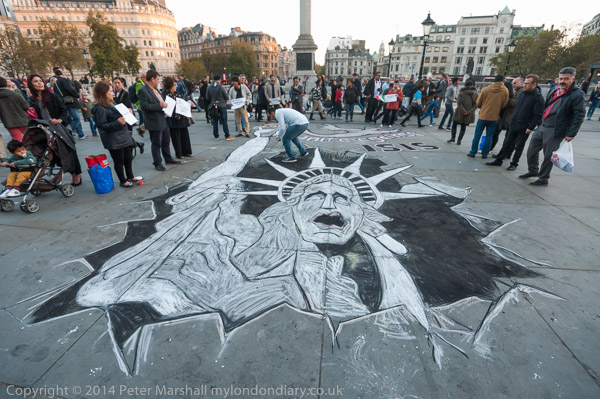
Kobane – Unite against Isis Drawing
Fair Fares Petition
Democracy Camp Saturday


EDL Visit Democracy Camp
Acid Attacks on Women in Iran


United Friends & Families March
Democracy Camp a Week Old


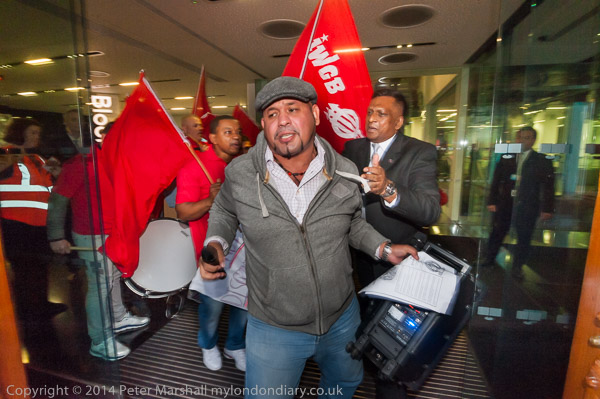
Cleaners protest at Bloomberg
Palestine – another HP protest
Musical Poor Doors


Democracy Camp – Poet Arrested
Canary Wharf & Westminster Tube
End UK shame over Shaker Aamer
DPAC High Court Vigil for ILF
Candlelit vigil for Justice for Ricky Reel
Democracy Camp Fenced Out
Staines march for flood victim Zane
Poor Doors Saturday Night Special
Procession of the Blessed Sacrament
Britain Needs A Pay Rise
Democracy Camp takes the Square
Democracy Camp starts with rally
Spoof shock U-turn by Boris on Housing
Ban on Family visits to Palestinian Prisoners
Art Not Oil Rembrandt Against Shell


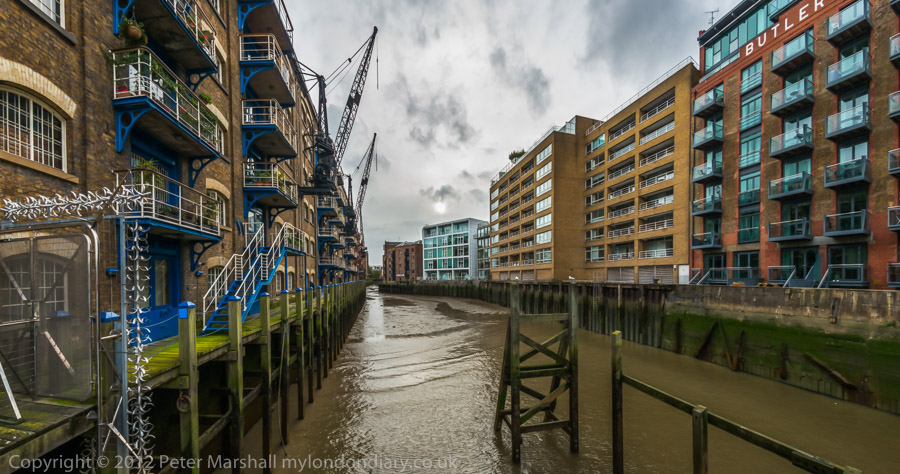
Bermondsey Thames Panoramas
CPOs for Southwark Councillors
Class War Poor Doors Week 12
London Transport Museum Arms Protest
Thorpe Walk
Support the Defenders of Kobane
#NoTTIP – Hands off our democracy
#NoTTIP – Banner Drop
Global Frackdown at HSBC


Solidarity with the Umbrella Revolution
Palestine protest at Hewlett Packard
City Panoramas
Free Ghoncheh Ghavami – SOAS action
Solidarity for Care UK Strikers
Deptford to Greenwich
Poor Doors Musical Protest
Unstone Grange & Chesterfield
Hull and Hornsea
Hull at Night


Class War Poor Doors Week 10

Altogether I think there are over 1900 of my pictures on-line from October. Now to get to work on November

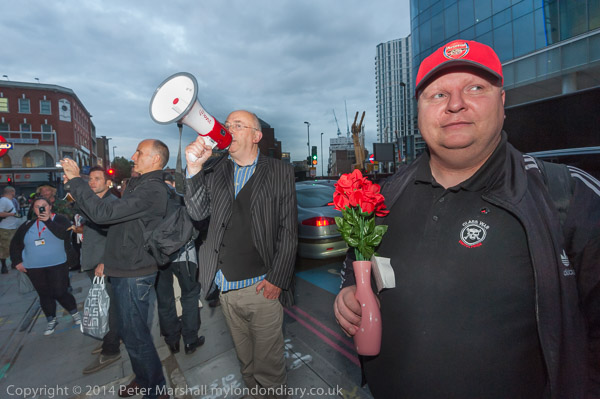
Class War and Poor Doors

As I write this post at the end of November, Class War has just suspended its series of protests about separate doors for the rich and poor residents of One Commercial St.  They have in the last week declared a ‘truce’ as the new owners of the  building have expressed a desire to resolve the situation, with a meeting of the interested parties which hopefully will result in all residents being able to enter on the main street, rather than those on the ‘poor’ side having to go down the side alley.

People often tell me that it isn’t worth protesting, that protests never acheive anything, but that simply isn’t true. Of course not all protests are successful, but many do make a difference. If it had not been for the protests over a ‘third runway’ at Heathrow, we would now be fighting against plans for a fourth runway and Terminal 6 or 7; if it hadn’t been for the protests of UK Uncut, tax avoidance would not have become an issue. Protests seldom manage to wave a magic wand, but they often do effect changes in the ways that issues are seen and debated, cultural changes that alter  the course of events.

One Commercial St isn’t in itself that important. One block of many similar blocks springing up across the UK, and of course particularly in London. An exemplar of the trend towards social segregation which is accompanying the increasing financial gulf between rich and poor in this (and many other) countries. Class War’s stand here is one of principle rather than about the particular, and whatever the final outcome in this building, it has put the issue firmly on the political and media agenda.

Housing has become a major issue, and it has largely done so not because of the obvious and often desperate problems many face, not through the dedicated lobbying of charities and the research of academics, certainly not by the largely spineless approach of Her Majesty’s opposition (who through some Labour dominated councils are very much a part of the problem) but because of the work of grass roots activists such as Class War, Focus E15, New Era and others.

At first these kind of activities are only reported in social media and by alternative news media. Posts on Facebook and Twitter, articles in blogs and on campaigning web sites. Gradually they begin to surface in more major media outlets. I’m not a great fan of Russell Brand, but I was pleased to see a few weeks after the events in these pictures to meet John Rogers (who I met some years back when we both featured in the London International Documentary Festival)  filming at a later Poor Doors protest for Russell Brand’s Trews Reports (which have also recently covered  Focus E15 and New Era.   If you have any interest at all in London you will find some fascinating videos on his YouTube page – I particularly recommend his full length documentary The London Perambulator, a full-length documentary film.)

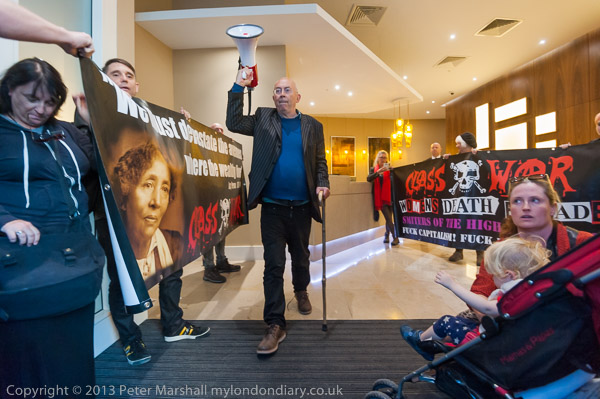
Back to September 24th, and Class War Occupy Rich Door, a night that marked a hotting up in the battle between protesters and the Redrow staff of the building over the rich door. Before there had been tussles with the protesters attempting to  hold the door open  when residents entered or left during the protests, but this week something different happened.

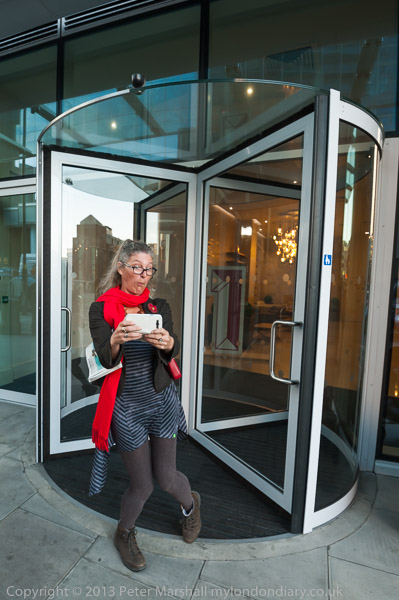
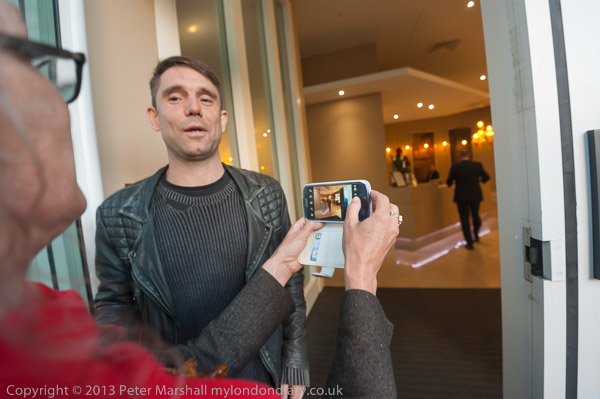
Perhaps it was the presence of Marina Pepper, Class War’s candidate to stand against Iain Duncan Smith in his Chingford Constituency, at the protests for the first time and posing above in the always locked revolving door that led the building manager to simply walk away when a protest put his foot in the door to hold it open. But whatever the reason, the open door seemed an invitation to walk inside, and the protesters, after a few moments shock at seeing it made so easy, simply walked in and made themselves at home.

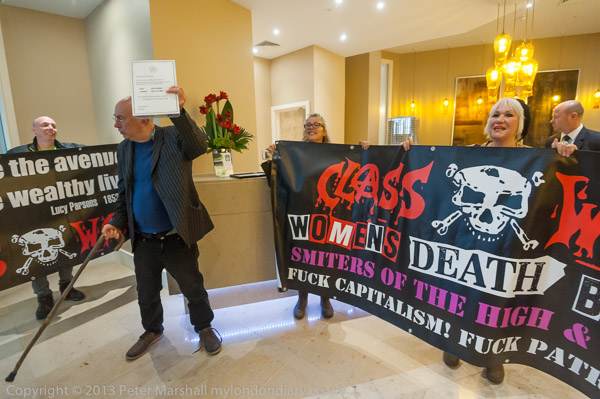
The building manager called the police, but for the moment the protesters were in the foyer and Ian Bone is holding up a framed notice from the desk with details of the 24 hour phone lines to the Concierge in the building – and comparing that with the broken entry system on the poor door in the dimly lit alley. In front of him is the walking stick he now relies on, and behind him on the desk a vase of flowers. As often, while speaking, he was flourishing his stick, sometimes rather wildly.

At some point in the next few minutes, walking stick and vase connected, either by accident or design, and that vase crashed to the floor and shattered. The noise startled me, and it seemed to startle Bone too.

It took eleven minutes for the police to arrive, and they came in and one chatted with the protesters while another went with the building manager into his office. Soon more police arrived, and after I’d gone outside to photograph them at the rich door, prevented me going back inside again. Eventually the police got the building manager to tell the protesters to leave and then the police threatened to arrest them for aggravated trespass if they didn’t go, and after being inside for 20 minutes they left in a jubilant mood.

The protest then continued as usual on the pavement outside, with one rather odd incident when a man began to shout loudly that no one was prepared to answer his question, which he had apparently asked some of those holding one of the banners. He continued to shout this loudly for some minutes, while refusing to tell everyone who was asking him what his question was. Police tried to get him stop shouting and leave, but without success, and he ended up arguing with a small group of protesters. It was only at the following week’s protest that I talked to them and found that he felt that people should be protesting about rights for men.

His intervention prolonged the protest for a few minutes, during which more police arrived including a van. As Ian Bone turned to leave, a police officer stood in his path, and soon he was surrounded by others and after a short argument he was told he was going to be arrested for breaking the vase and taken to be searched by the back of the police van before being driven away. The following week he said the vase had cost him seventy quid.

Photographically the light inside the building was a little on the low side, and I had some problems with depth of field and blurring due to subject movement, even working at ISO 2000 and a little above, with typical exposures around 1/80 f4.  In the few minutes I was able to move freely in and out of the building I didn’t always have time or remember to change the settings to cope with the very different lighting. In situations like this, where I’m conscious that at any moment I could be asked to leave, I tend to take too many pictures and not think enough about them.

I wasn’t asked by the building manager to stop photographing, though had I been I would probably have told him that I thought it was in the public interest and continued.  But I do tend not to use flash, as that does remind security people that I am taking pictures, and I didn’t do so. The pictures were almost certainly better for it.

At the end of the protest, when Bone was being stopped and arrested, it was beginning to get dark. But it wasn’t too dark – the image above at ISO2000 was taken at 1/60 f9. I needed to stop down for the depth of field even at 18mm (27mm equiv) on the 18-105mm. The main problem as always in such situations was getting to the right place, with both so many other protesters and also the police getting in my way. My thanks to Constable Merrick on the right of the picture for not interfering with me or trying to stop me getting a picture – too often police officers seem to think it part of their job to prevent photographers working.

More at Class War Occupy Rich Door.
Continue reading Class War and Poor Doors

Focus E15


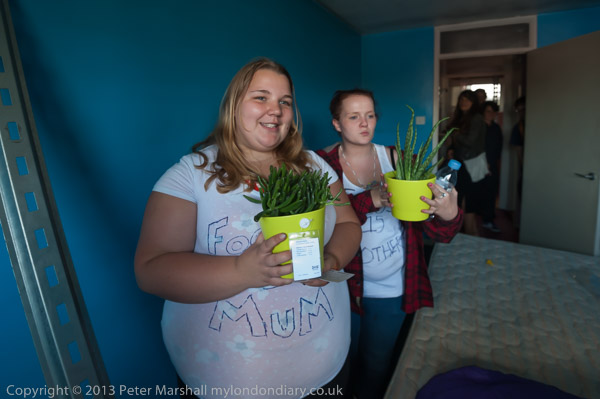
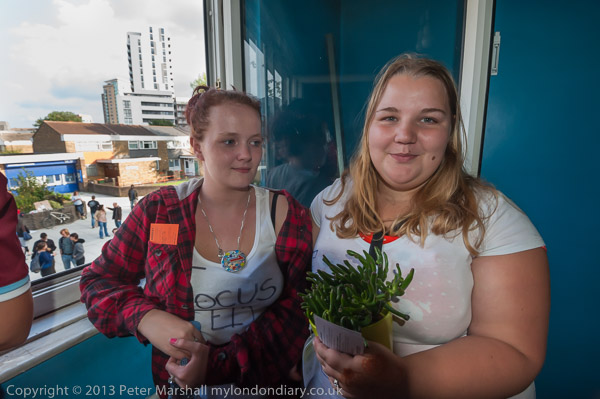
Jasmine and Sam of Focus E15 Mums hold the pot plants they have been given for moving into the Carpenters Estate flats

Housing is fast becoming a really major issue in the UK, and particularly in London, where property prices and market rents have risen so much that most of those who work there can no longer afford to live there. The current minimum wage is £6.50 per hour,  which works out to roughly £1050 per month for a typical worker without overtime. Those who get the London Living Wage are a little better off at around £1400 a month. Newspapers have recently been reporting on the tenants of the New Era Estate, a fairly typical inner London estate, currently paying rents of around £600 per month who are threatened with a rise to ‘market rents’ of around £2400 per month.

People may qualify for the misnamed Housing Benefit, (it’s really more a benefit for landlords), but the benefits cap introduced by the government (including an overall benefits cap of £500) make this totally inadequate in London. The only viable solution to the problem of keeping London running is a crash programme to build low-rent social housing, but neither of the major political parties is seriously proposing this, and while there is considerable building taking place in London, the vast majority of it is high rent private properties, many of which are being bought by overseas investors. Some simply leave them empty while property values soar, others rent them out to companies for employees here on short-term visits or as holiday lets.

Some Labour councils are among the worst offenders in this process, getting rid of social housing and profiting from sales to developers. Some have even made a mess of this, with Southwark Council reported to have lost millions in the costs of emptying the Heygate estate came to more than the bargain deal the developers made. Of course some individuals – both on the council and the developers – do nicely out of these schemes.


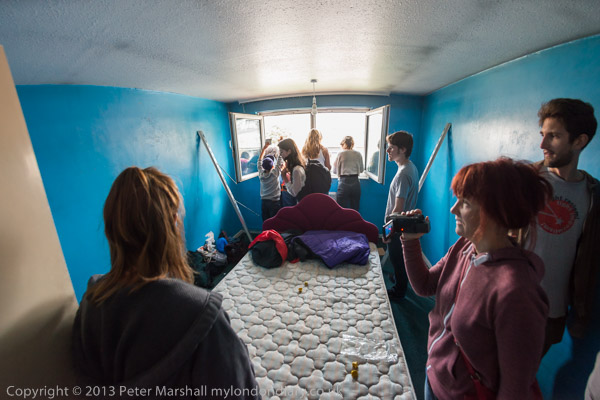
Jasmine and Sam in one of the Carpenters Estate flats while the Focus E15 MumsFirst Birthday Party continues outside

Newham Council, 100% Labour and with an elected Mayor have for ten years been trying to empty out and sell the Carpenters Estate, next to the centre of Stratford with its excellent transport links. It is truly a prime site, but unfortunately an earlier Labour council which had the interests of the people of the area in their heart built a well-planned council estate on it.  One that people liked living in, and despite ten years of harassment, that some are still living in.  In a borough with one of the worst housing shortages – and particularly of social housing – some properties there in excellent condition have been boarded up and empty for ten years.

Newham is also where one of the most vital campaigns over housing has been taking place, led by young mothers from a hostel for which the council decided to cut the funding to the housing association for a little over a year ago. The mothers, with some help from political activists, decided to make a stand together and fight, forming the Focus E15 Mums campaign.  They refused to move away from London to be rehoused in Birmingham or Hastings or elsewhere, away from jobs, family and support systems as the council suggested. They set up a weekly protest stall on the high street every Saturday, protested at the housing association, at the council and elsewhere, and turned the insights they developed from their fight into a more general ‘housing for all’ protest against what they had come to realise was a policy of ‘social cleansing.’

I’m pleased that I’ve been able to photograph some of their protests and help through my pictures in gaining public attention to their fight, though I regret not having done more – but there are so many calls on my time. I was sorry, having been there to take these pictures of their re-occupation of a block of four flats at the centre of the Carpenters Estate, not to have found the time in the following couple of weeks to go back and record some of the events they staged there in what was always intended as a short-term occupation of the properties.

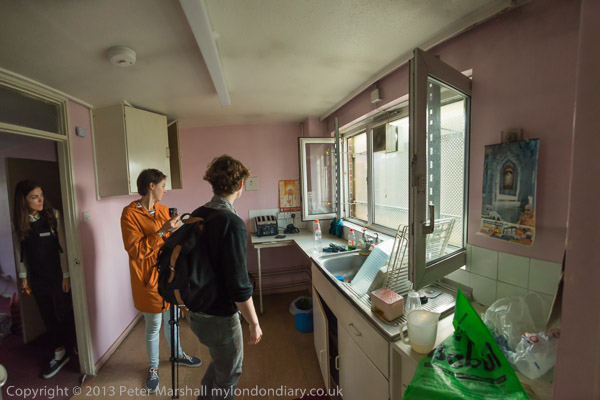
Photographically it was a little tricky in that there was little light inside the flats, and not enough for the pictures I took as I first went inside them, in the hall and on the stairs. Most of the metal grilles were still in place, with a little light coming through the pattern of holds in them, but parts were still very dark.

I’d anticipated this, and together with the knowledge that I’d be in a crowded and confined space had switched to the 16mm f2.8 while waiting to go inside – it was a long wait and I’d had plenty of time to think about it.  One thing I often feel the lack of with my Nikon cameras is fast lenses. Back when I was using film one of my favourite Leica lenses was the 35mm f1.4 (it had cost me about a month’s salary when I bought it second-hand around 1980.)  That aperture makes it 8 times as fast (3 stops) as the 16-35mm f4 Nikon lens.

The two fastest Nikon lenses I own are the 16mm f2.8 fisheye and the 20mm f2.8 – and I’d left the latter at home. For many purposes not having fast glass doesn’t matter – particularly when we can know work at ISOs that were not viable in the days of film. You get the same shutter speed with an f4 lens at ISO 3200 and an f1.4 lens at ISO400.  But this was a time when the f1.4 at ISO 3200 would have been rather better.

It doesn’t matter so much when your subjects are static. Even handheld with wide-angle lenses its quite possible to get sharp results at half a second – just not every time. The 16-35mm has image stabilisation, but I’m unconvinced it is of much significance with wide angles, though it certainly helps on longer lenses.

As we went in it was also quite crowded and the physical size of the 16-35mm can be a problem – the 16mm fisheye is a nicely compact lens.  Once we got into the actual rooms things were easier, and I was able to take pictures with both the 16mm and the 16-35mm, and to lower the ISO, even down to ISO800 for some pictures.

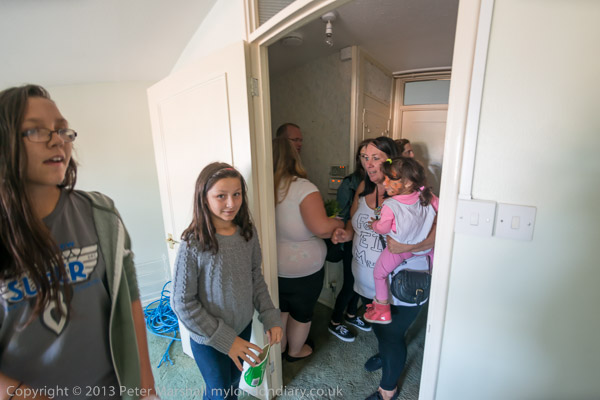
This was one of my favourite interiors, taken with the 16mm fisheye, processed with the Fisheye Hemi plugin to make the vertical and near-verticals more or less straight.  The woman at the left looking into the room is in the darker corridor, but lit be light through the doorway (with a little help from Lightroom.)  Stopped down to f5 makes everything sharp (the near objects at right just slightly less so), and even at ISO 2500 the quality is pretty good. Of course noise reduction, removal of chromatic aberration and fringing in Lightroom help. At 1/100th second there is perhaps just some very slight blurring of parts of the people as they look around, something that I like. On the original it is easy to zoom into the image and read the year 2014 on the calendar on the far wall.

When the protesters moved in they found the flats in good order, and the water was still connected. The council soon turned it off after the occupation began. The picture above shows one of the perils of using the 16mm fisheye – and that large 16-35mm on the camera hanging down from my neck with its lens hood intruding into the image.

September 21st, when I took these pictures, was the second day of the London Open House Weekend (a week later than the rest of this country) so although it hadn’t been listed in the official catalogue, this was of course the Focus E15 Open House Day and there are many more pictures both of the party and the occupation of the flats in My London Diary.

Continue reading Focus E15