Junior Doctors

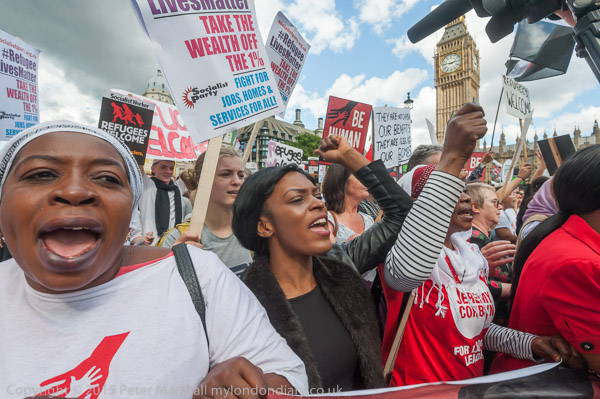
There is certainly something very wrong in the state of England at the moment, and the junior doctors dispute with Health Minister Jeremy Hunt epitomises it. When a government minister resorts to misusing statistics and lies on such a grand scale it should inevitably lead to resignation, but Hunt – like Iain Duncan Smith – seems to get away with it, supported by the BBC (over-anxious about its licence) and the rest of the media, whose proprietors, like the government itself, are rubbing their hands at the thoughts of the rich pickings from private health care as they gradually privatise the NHS.

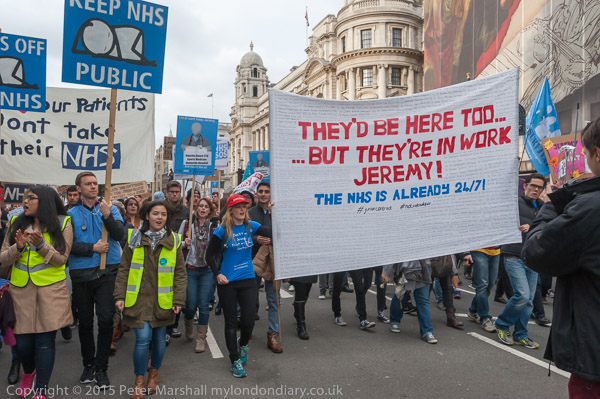
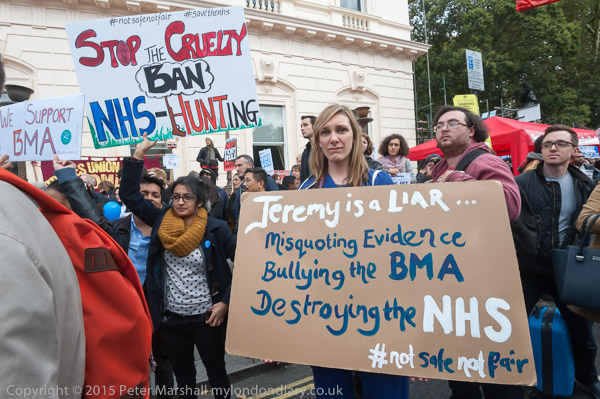
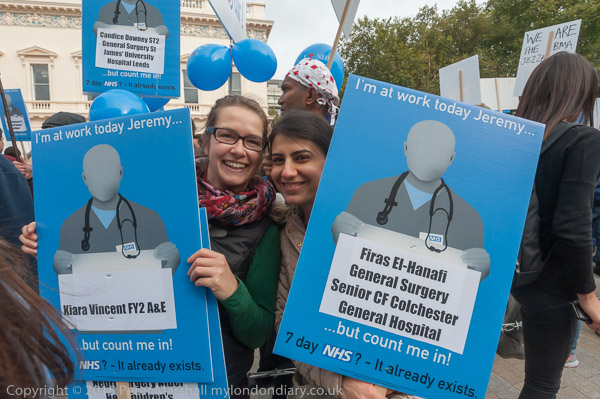
But while I despair at the actions of the Tory government (and Labour don’t have much of a record at the moment, though perhaps things may change) I have been truly heartened at the response of the junior doctors, who almost to a man and woman have taken a stand against the imposition of a new contract. The strength of their opposition isn’t because of the money or even working hours – most already work unsocial hours and  there were many placards to show that colleagues were unable to attend because they were at work on a Saturday – but because doctors working in the NHS want to see it kept as a service dedicated to the public good rather than working for private profit.

Of course money and working hours are important. Already many junior doctors live highly disrupted lives with overnight and weekend working on a regular basis – because the NHS is already a 24/7 service, particularly for the junior doctors. For those whose partners are also working in the NHS it can be something of a nightmare, especially for those who have children.

Junior doctors are not really ‘junior’ and may remain junior doctors for many years after completing their initial medical training, working their way to becoming consultants. It’s a demeaning term, perhaps deliberately so, and one I think they and the BMA should refuse. They are doctors, hospital doctors rather than GPs.

Supporting the junior doctors at the protest consultants, GPs, nurses and other health professionals, all of whom realise that the future of our NHS is at stake. They see the injustice and the lies and realise that many or most of them are going to face similar demands from our corrupt government if it manages to get its way with the junior doctors.

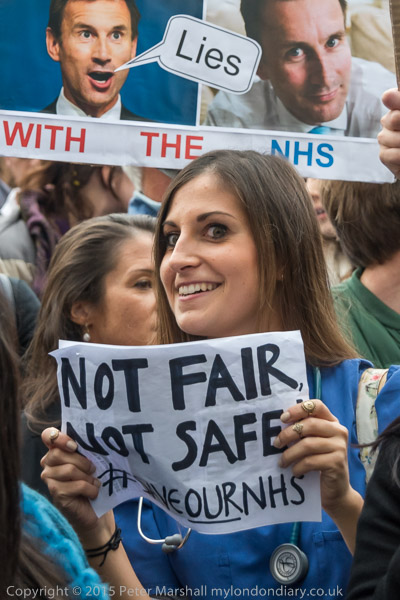
Photographically it was a fairly straightforward event to cover, with most of those taking part being keen to be photographed, and was distinguished by the range and invention of the hand-made placards and posters that some of the doctors and others had brought, as well as those produced by the campaign with details of colleagues supporting but unable to attend. As usual when working in crowds, the 16-35mm was invaluable, and used for all of the pictures above, with the 28.0-200mm being mainly used where I wanted to isolate a single figure – as in the image below of one of the leaders of the protest holding a poster ‘Not Fair, Not Safe. #saveourNHS’, taken at 1/250 f6.3 ISO 1600 at 75mm with the Nikon D810 in DX mode – so a 112mm equivalent.

I focused on her eyes, and tried to be sure that Jeremy Hunt at to top left with a speech bubble saying ‘Lies’ was still clear. It worked better than I expected at f6.3, perhaps with a little help in post-processing, adding a little local contrast, clarity and sharpening. It has to be basically there when you take the picture, but a little dodging and burning etc can help. Though Reuters wouldn’t approve!

More pictures at Junior Doctors protest to save the NHS.

Continue reading Junior Doctors

Middle East Problems

London has long been a city which has welcomed people from across the world including political refugees and the protests that I photograph here reflect conflicts from around the world, at the current time particularly the events in the Middle East. It was of course our geopolitical meddling in the era of the British Empire that played a large part in setting up most of these continuing problems, and more recently as poodle to the spectacularly incompetent USA in bringing some of the pots to boil. Along of course with some help from the other Western nations, including Germany, France and Russia, all fighting for a share of the spoils.  Back in the past it was a very profitable business – as the huge late Victorian and Edwardian banks and offices in most of our cities provide solid evidence of the success of our exploitation.

We picked winners and losers; drew straight lines on maps and generally supported despots, overlooking their crimes. Among the losers were the Palestinians and the Kurds, and in October both were out protesting on the streets of London.

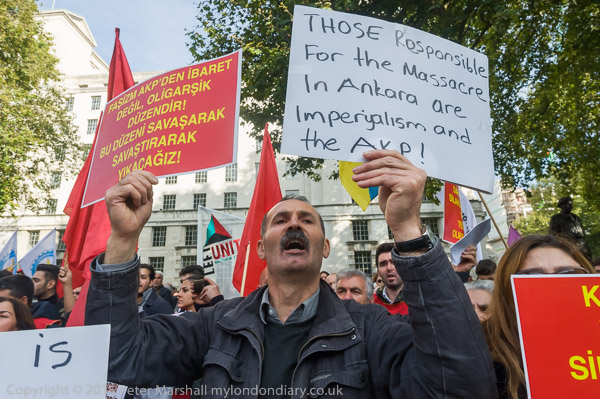
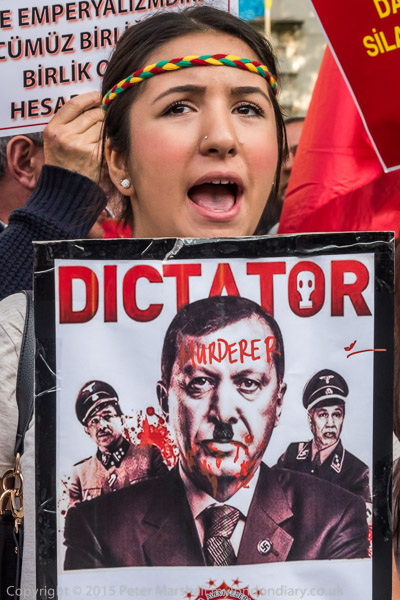
Kurds were protesting against the bombing of a peace protest in Ankara which killed 130 people, mainly young activists, blaming Turkey and President Erdogan for the massacre. Kurds living in Turkey have long been a persecuted minority, with persistent government attempts to eradicate their culture and language.  Many of them want their own nation, Kurdistan, which would also include Kurdish areas of Syria and Iraq, and back the PKK and its leader Abdullah Ocalan, held in a Turkish jail for since his arrest with the help of the CIA in 1999. In recent years the Kurds have been trying to make peace with Turkey, but since Erdogan and his AKP party did well in last year’s elections, they have been clamping down on all opposition in the country. The protesters describe Erdogan as a fascist dictator.

The protest received support from a wide range of groups, including some from the British left.  More at Ankara peace protest bombing.

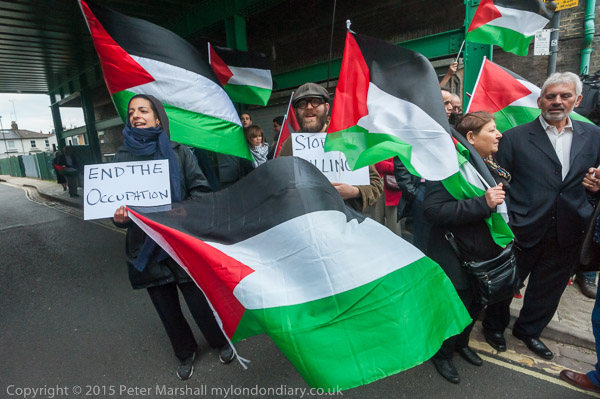
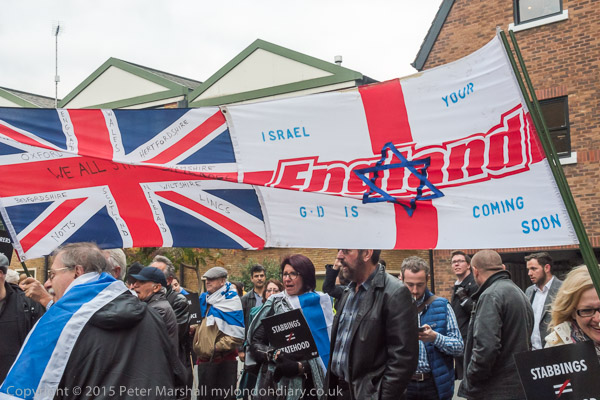
A couple of days later I was outside the Palestinian Authority UK Mission in Hammersmith where the Zionist Federation had come to stage a protest against the stabbings of Jews in Israel and groups supporting Palestinian resistance to Israeli occupation and terror had come for a counter-protest condemning all violence in the country.  Police kept the two groups over a hundred yards apart, though just within sight of each other.  More pictures of both at Zionists and Palestinian protests over killings.

At the time I wrote:

Loud public address systems meant they could at least hear some of what the others were saying. But it was clear that those supporting Israel were deaf to what the Palestinian supporters were saying, with Professor Manuel Hassassian, Palestinian ambassador to the UK quite clearly condemning the violence on both sides and down the road a speaker making as his main point the ‘fact’ that the Palestinians refused to condemn violence against Jews.

Both groups of protesters were predominantly Jewish, and the pro-Palestinian protest had been called by Jews for Boycotting Israeli Goods along with other Jewish groups, while some extremist right-wing Christians had come to support the ZF.

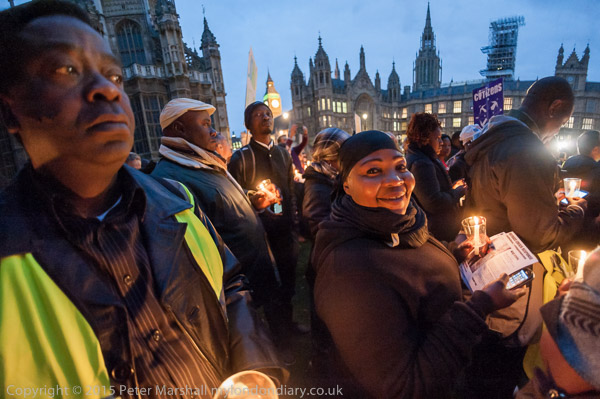
From Hammersmith where the stand-off was continuing, I took the tube to Westminster, for Citizens UK Vigil for more Refugees ,  a candlelit vigil at Parliament calling for 1000 Syrian refugees to be resettled in the UK before Christmas and 10,000 a year for the next 5 years.

The vigil was in Old Palace Yard opposite the Houses of Parliament, and I often find it just a little frustrating that it is almost impossible to see that most obvious and iconic symbol of Parliament, the clock tower of Big Ben from that location. But working in the middle of the crowd I did manage to have it just visible, floodlit at top centre of the image above.

I made the image by available light – almost entirely from the candles. Parts of the protest were lit up by powerful floodlights for video, but these created problems for me with a very different colour temperature to candlelight. Using the D700 at ISO 3200 and 1/40s f2.8 with the 16mm Nikon fisheye gave a rather underexposed result that needed some work in post-processing – along with the use of my usual plugin to ‘defish’ the image to a cylindrical perspective. The ultrawide lens is great for working inside crowds, though it was a little difficult to move around particularly with people holding lighted candles.

Continue reading Middle East Problems

Protest at Court


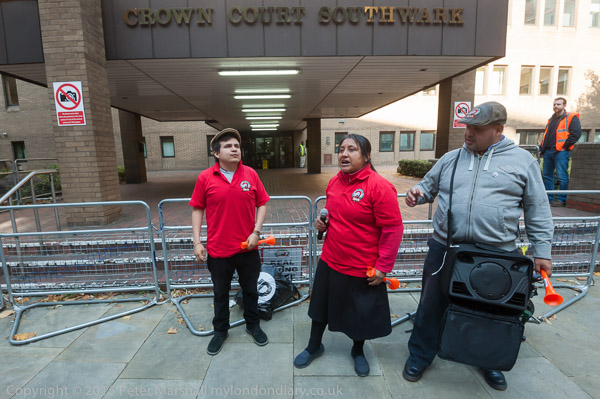
Signs at the front of the court prohibit photography

I always feel a little uneasy at photographing around courts. In the UK you are not allowed to photograph inside courtrooms during trials, and photography is not generally permitted on the court property. The Supreme Court, perhaps because it has been set up more recently in the former Middlesex Guildhall is an exception, though not one I’ve yet taken advantage of, allowing photography generally throughout the building except in courtrooms that are sitting on the day of your visit.

At Southwark Crown Court, things are even more restricted, as not only is it illegal to photograph on the court precinct, but the area around the court is one of the increasing areas of privately owned space in London, ‘More London‘, whose security guards will prevent you from photographing on the actual roadway outside the court or on the opposite pavement. You are restricted to the actual pavement in front of the court, though I did take a few pictures before getting told I was not allowed to by ‘More London’ staff.


‘More London’ security came and told me I could not photograph here after I took this picture

Generally, ‘More London’ prohibit or control photography over most of the area between Tooley St, the River Thames and Tower Bridge, including outside City Hall, though they generally have the common sense not to try and enforce this for protests outside City Hall itself – and most photographers would tell them to get lost if they tried. There is generally a very clear public interest involved and police would almost certainly avoid taking any action.

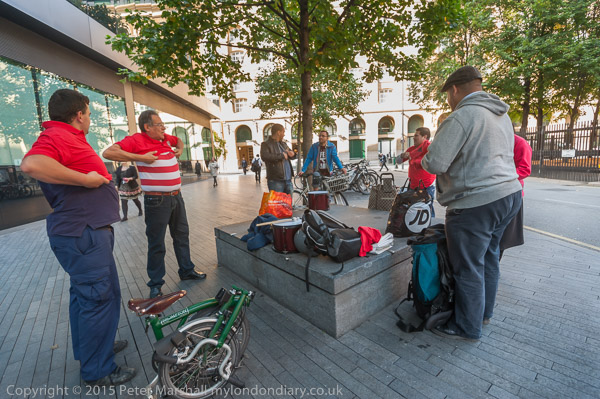
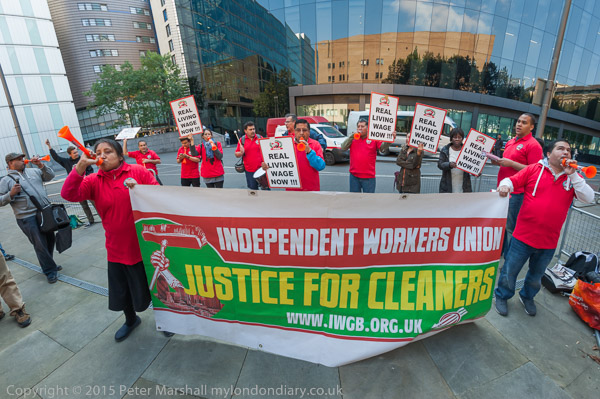
The pavement is reasonably wide, but much of it was taken up by the Independent Workers (IWGB) cleaners union protesting for a living wage and an end to bullying and intimidation for the workers, employed by Mitie, who clean the court; protesters are subject to similar prohibitions to photographers and the three photographers present were sharing the space with the protesters. I was pleased to have the 16mm fisheye in my camera bag, its wide angle of view making it possible to photograph in very limited spaces.

This is one of several images that were only possible using it – I would have had to stand on the court premises without it – and that was not allowed (though I might have just briefly got away with it.)

It also let me take this picture without encroaching on ‘More London’s roadway – well I might have had just one foot on it. But useful though it is, it does give some problems, even after making use of the Fisheye-Hemi plugin or other software to straighten the verticals. The curvature of the horizontals can still annoy; it is possible to convert to rectilinear perspective (and Lightroom will do so by default), but you can only do this by sacrificing much of the very wide angle of view that was the reason to use the fisheye in the first place.

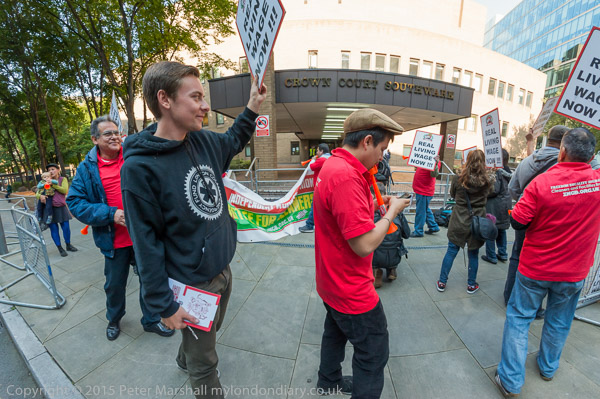
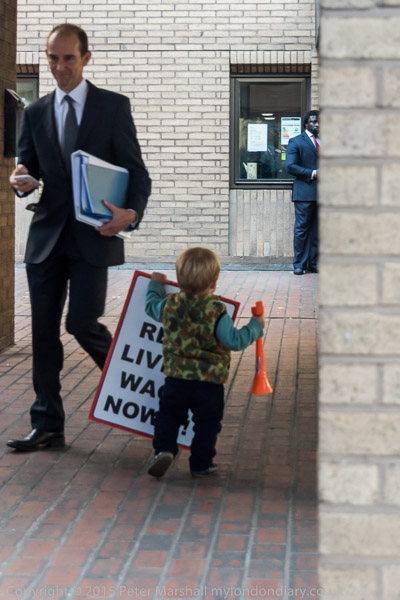
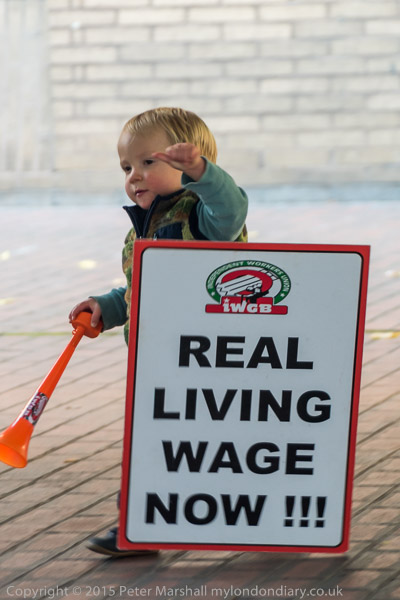
Protests, like photography, are prohibited in the court’s precincts, but not all the protesters respected this, with one marching up the steps clutching an IWGB poster ‘Real Living Wage Now!!!’. But unfortunately he soon dropped it…

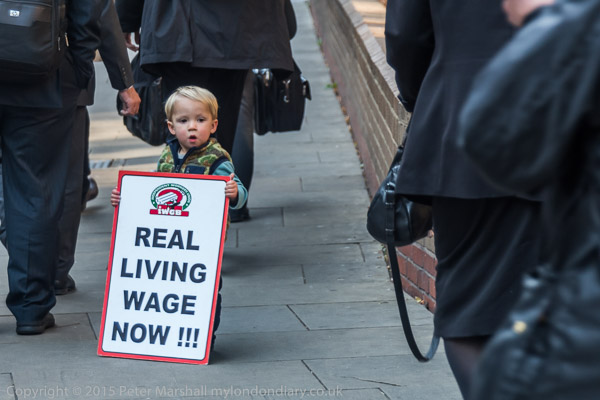
Undaunted, later he was protesting for a living wage for the cleaners on the pavement as a group of lawyers walked by.

More on the protest and more pictures at IWGB Cleaners protest for Living Wage.

Continue reading Protest at Court

Nigeria and Shaker

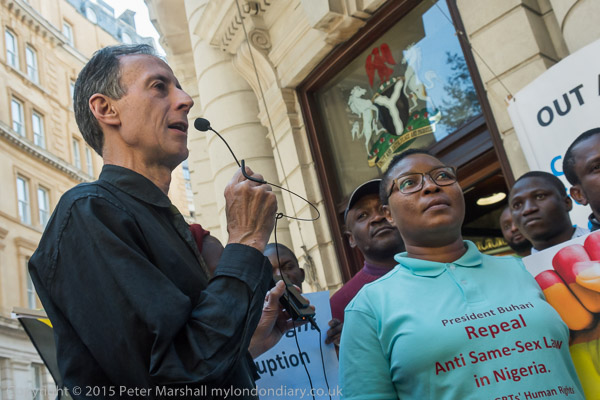
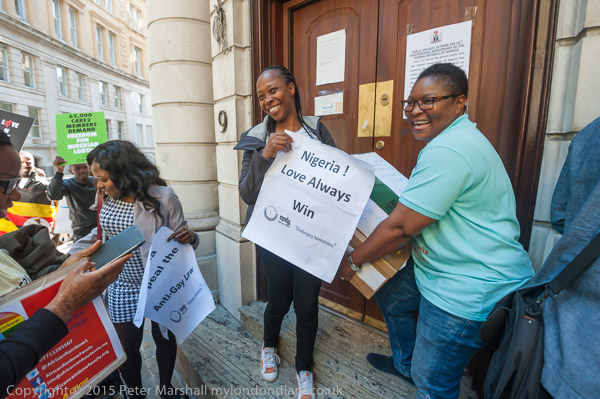
I have to admit I got the story slightly wrong when I first uploaded Repeal Nigeria’s anti-LGBTI laws, thanks to mis-reading the press release that was sent to me by the Peter Tatchell Foundation. Although what I think were the main details about the protest- the who, what, where, when and why – were correct, I hadn’t correctly identified the organiser of the protest, at least not in the text, as Nigerian lesbian activist Aderonke Apata, wearing a green top in the picture above with the message ‘President Buhari Repeal Anti Same-Sex Law in Nigeria –  Respect LGBTs’ Human Rights – Freedom for LGBTs in Nigeria – African Rainbow Family.’ It was a sweat-shirt that was almost a press release in itself, and rather too wordy to make a good photograph.

My initial text had given credit to two other groups taking part, Peter Tatchell with members of his Foundation and the Out And Proud Diamond Group. There were also people from Care2, whose petition had gained 65,000 member signatures along with a second Causes petition with over 8,000.

The pictures I think tell the story of the protest quite well, and certainly show Apata’s leading role in the protest. The image at the top was quite tricky to make, partly because of strong sunlight flaring around the corner of the embassy; Peter Tatchell’s head conveniently acted as a ‘flag’ to block much of this, though needing quite considerable ‘antiflare’ treatment in post-processing. As well as including Apata with some helpful cropping of her shirt’s message to the purpose of the protest ‘President Buhari Repeal Anti Same-Sex Law in Nigeria’ I wanted the arms of Nigeria which are in the top of the Embassy door behind her.

A little post-processing was also needed to make those more clear in the final result – reflections in glass are always less distinct in camera images than to our eyes, which perform some pretty sophisticated processing beyond the capabilities of Lightroom which enable us to separate surface from reflection, in part involving distance perception which almost disappears in the camera image.

Things turned a little to farce when the protesters attempted to deliver the petition. During the protest people had been taking deliveries in through the front door and coming out. Ringing on the bell got little response – except perhaps a voice saying that no one was in. The protesters went to the door where people were still entering and leaving around the side of the building – and were told by the security staff they should take the petition to the front door.

They then tried the middle door – but again could get nobody to take it, and went again to the front door.  I had to leave them to go elsewhere  as they were deciding to leave the boxes on the step.


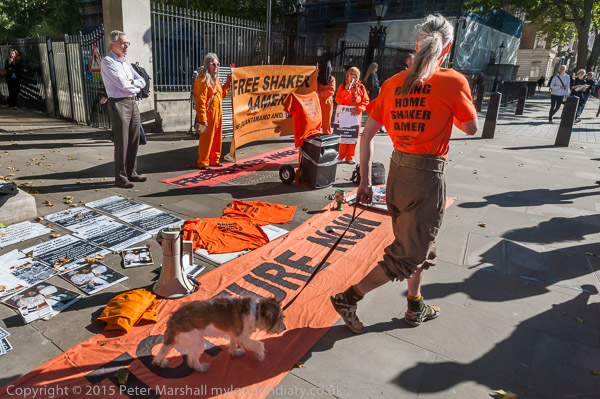
A short distance away something of a celebration was taking place opposite Downing St after news had at last been given of Shaker Aamer’s eventual release from Guantamo. ‘Bring him back Now’! the protesters shouted; after all he had been cleared for release back in 2007, and had been held without charge or trial there since St Valentines Day 2002.

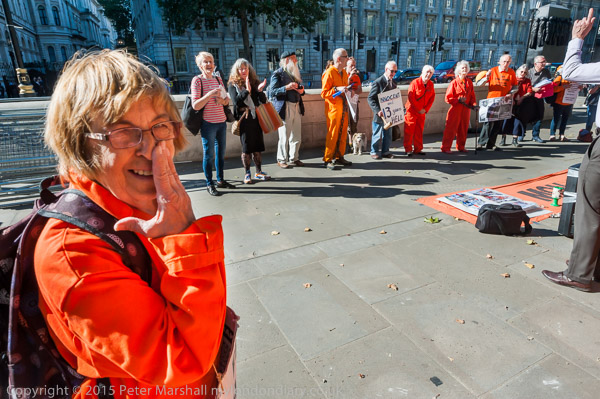
The supporters of the Save Shaker Aamer Campaign, whose Chair Joy Hurcombe I caught hiding her embarrassment in the image above as she was being introduced, were overjoyed at the news – and at getting back the lunchtimes every week they have spent standing in a vigil at Parliament every Wednesday it is in session, are still very much aware of the need to keep up protest for the roughly a hundred detainees still held there who have no UK connection. Monthly protests by the London Guantanamo Campaign – which many of them also attend- will continue at the US Embassy until all have been released.

The protesters were also aware that part of the delay in releasing Shaker is to give right wing pressure groups – like the Henry Jackson Foundation – time to spread misleading lies about him, including entirelyunrelieable ‘evidence’ obtained under torture. There was never any real evidence to hold, charge or try him. Many in the media will also help in spreading rumours and falsehood in an attempt to counter the stories that Shaker is expected to tell about what actually happened to him in Guantanamo and the complicity in his torture of both US and UK security agencies.

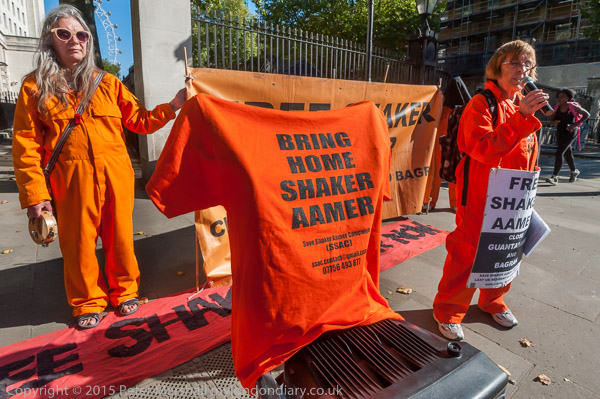
But photographically my problem was in photographing a man who was absent but at the centre of these events. There wasn’t even the giant inflatable Shaker from some earlier events – it was at a protest taking place the same day outside the White House.  It was solved when one of the protesters put a new ‘Bring Home Shaker Aamer’ t-shirt on the trolley carrying the sound system. Its bright colour and curve around the handles, helped by a little wind almost made it float in the picture, like Shaker Aamer’s ghost. At least in my imagination.
Continue reading Nigeria and Shaker

Making Pictures

I remember talking with one of the UK’s leading advertising photographers perhaps 30 years ago about the problems of working with advertising directors, and how they would often present him with briefs that were quite impossible to shoot, requiring him to be pointing his camera in opposite derctions at the same time, combining views from very different places or those taken with and ultra-wide and a super-telephoto. Things which had been easy on the AD’s sketchpad were not always so simple in reality. Sometimes, thanks to the superb skills of London’s retouchers in those almost entirely pre-digital days, things could be achieved using multiple exposures, but often what really earned him his money was the long slow business of getting the AD to believe that what was achievable in camera was really what he had wanted after all.

It isn’t a problem I’ve ever had to deal with (though I have a few times been asked by editors for the impossible) but I do often find myself struggling over the tension between recording events in an accurate fashion and producing interesting pictures – although of course trying to combine the two.

I try to avoid the ‘newspaper cliches’ which often involve setting up an attractive person (or better still a ‘celebrity’) with an obvious prop – and of course will not set up such pictures, though I have sometimes taken advantage of them when set up by others – though with a caption that clearly indicates their nature and generally looking for a different view. At some protests where the organisers know me I’ve been asked for advice on what photographers would like, and have always been reluctant to give more than the most general of suggestions, perhaps about setting up something in the shade or with a particular building such as the Houses of Parliament in the background. I’m there as a journalist and not an organiser.

Protest organisers often come up with ideas that don’t seem to translate well or easily into images, and many pictures of protests reflect this. It’s seldom the organised picture opportunities that produce interesting images, though picture editors seem often to prefer these.

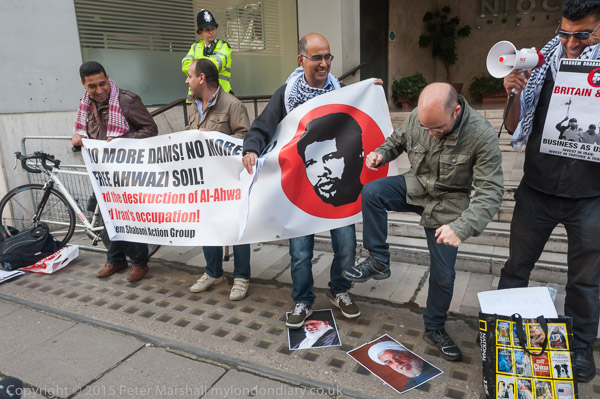
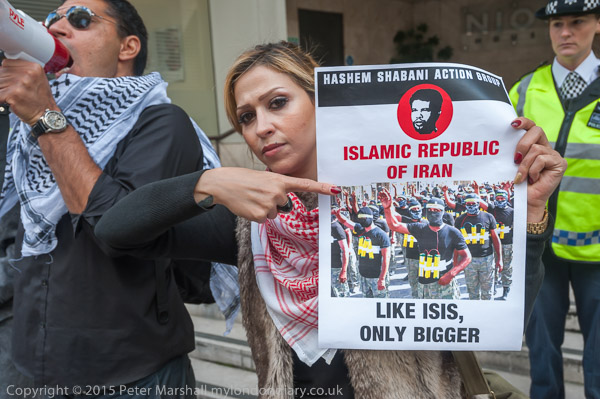
But sometimes a little action makes things spring to life, as when the Hashem Shabani Action Group began to stamp on photographs of Iran’s Supreme Leader Ayatollah Ali Khamenei, or a woman points her finger accusingly at the poster she is holding comparing the Islamic Republic as ‘Like ISIS, Only Bigger’.

There were a few other little moments I caught at this protest that amused me, including one of a man rushing late to the AGM of the British Iranian Chamber of Commerce putting on his tie as he runs around the end of the protest.

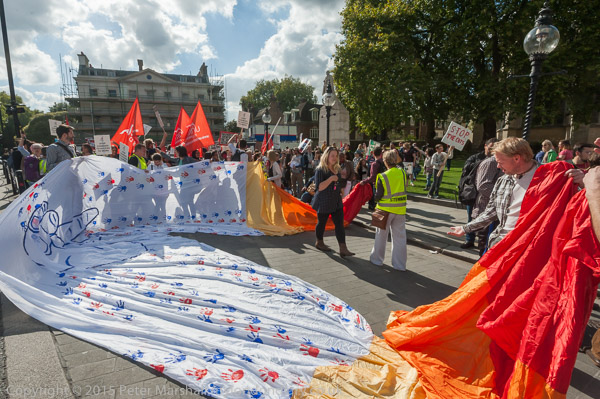
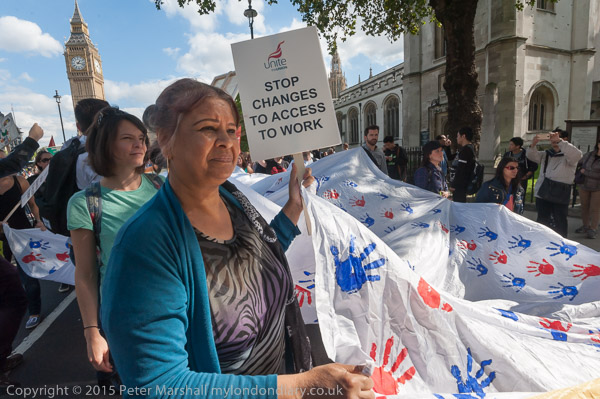
The huge banner covered with red and blue hand-prints carried horizontally by supporters of British Sign Language at the protest by deaf and disabled people and their supporters at the cutting of the DWP’s Access to Work scheme was also something of a challenge. I’d liked the way it showed the shadows of the people standing behind it and taken quite a few pictures as they got ready to march. Later I’d tried to catch it with Big Ben in the background as the marchers went down the side of Parliament Square, but wasn’t really happy until Big Ben was almost out of sight.

I left the Access to Work protesters to rush off to Grow Heathrow at Sipson, where the Harvest Festival celebrations included an open meeting on the expansion of Heathrow. Its only a few miles – across the airport – from where I live and something I’ve been involved with since birth. Long before that we had more sense, and in 1920 closed down London’s first commercial airport – on Hounslow Heath just a few yards from where my father used to live – because there area was too often subject to fogs, and Croydon became the site of London’s Airport. We managed to close that too in 1959, though meanwhile London Airport had come back almost to Hounslow with a huge airport across the orchards, farms and market gardens of Heathrow, using a wartime emergency requisition order to avoid any public inquiry – which might well have ruled against it.

By 1966 questions were being asked in Parliament calling for the closure of Heathrow, and several commissions and inquiries have been set up since, most recently the Davies commission, which cunningly sifted out the most suitable alternatives before going on to its final detailed considerations.

This was also a discussion in which I took part, asking several questions and making a few short contributions which perhaps went past journalistic objectivity. Discussions are seldom easy things to take lively images of, and I was quite pleased with what I managed to show both of that discussion and of Grow Heathrow, though I was disappointed not to have time to stay for the free six course vegan meal.

My Valentine

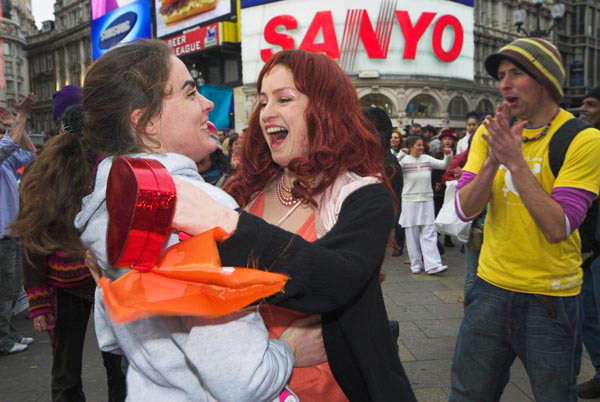
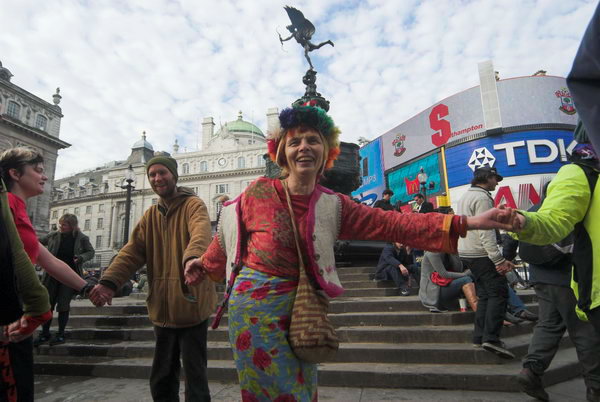
I’m sorry that I won’t feel well enough to attend the Reclaim Love Valentine Party I’ve been to at least a part of every year’s celebration since 2005, when Venus Cumara organised it around the statue of Eros for the first time (the previous year that I’d missed it had been in Trafalgar Square and I was in Paris.)

We were back there in 2006:

And for a rather smaller event in 2007 without Venus:

But Venus was back and spraying love around the area in 2008:

2009 was another good year,

And 2010

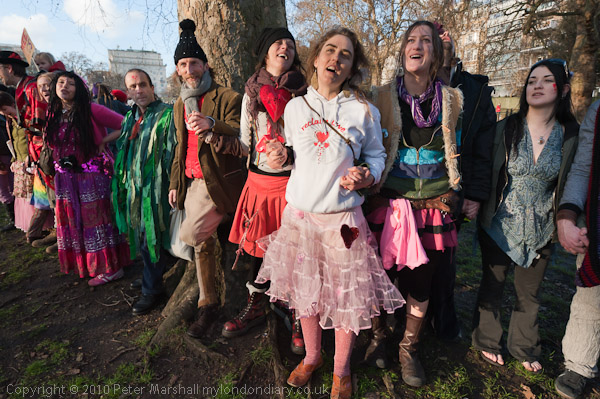
In 2011 Venus took everyone – around 250 people – to the ring of trees in Green Park and the police were not amused.

I left early in 2012 when torrential rain threatened to flood my cameras, but not before joining in the fun and taking quite a few pictures

I was late for the party in 2013 having been with friends who were blocking Whitehall but not too late:

And in 2014, things seemed to start rather slowly but I was sorry I had to rush away:

Last year was another good year:

and I’ll be sorry to miss this year’s event, but I probably shouldn’t go a spread my germs to everyone even if I do feel fit enough to make it.

But I’ll miss the ‘bands, dancing and a “Massive Healing Reclaim Love Meditation Circle beaming Love and Happiness and our Vision for world peace out into the cosmos“. We could certainly do with peace and should I make a miraculous recovery I’ll be there with the rest at 6pm in time for the World Peace Meditation at 6.30pm chanting ‘May All The Beings In All The Worlds Be Happy & At Peace’.

Continue reading My Valentine

Housing protest – Focus E15

It’s cold and wet in London today, and I’m suffering a little from a chest infection which means I can’t walk around carrying my camera bag – but otherwise I would be photographing a housing protest. Instead I’m writing about one I did cover on a much nicer day last September.
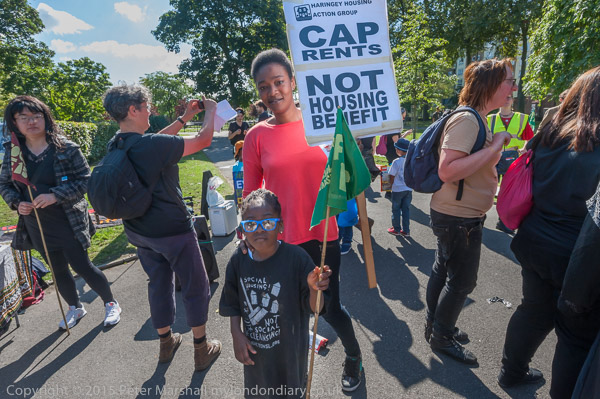

D700 16-35mm at 20mm, 1/400s, f/10, ISO 640,

Housing is an issue that has become vital in the UK and in London in particular, where overseas investment in property has caused house prices to rocket. Of course houses have long been too expensive here for most people to own, at least in the posher areas of the city, but now that has become true even in what were the most run-down and cheapest areas.

Back in Victorian times, the wealthier parts of the society realised that the poor had to have homes, and set up various companies and charities to provide accommodation for the ‘working poor’, some on a commercial basis and others charitable, but all genuinely philanthropic in design. Later, the London County Council and local borough councils built large estates of council housing, again at rents which the poor could afford, and a huge expansion of London between the wars provided affordable housing to rent or buy for the growing middle classes.

Slum clearance continued after the second war, with councils still managing to build large areas of council housing, and with the establishment of a ring of new towns outside London, one of which I began work in as a teacher in 1970, living in what was then for me a grand new flat at a reasonable rent from the development authority.
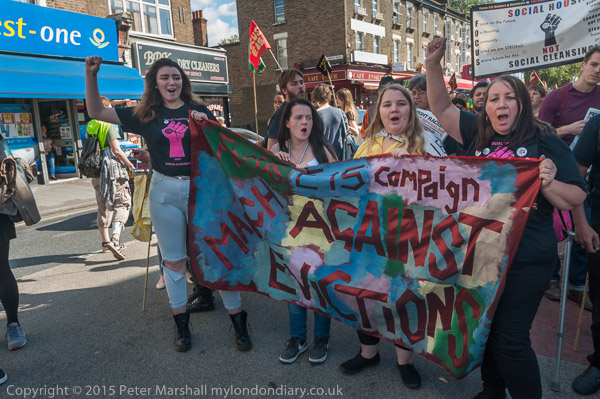

D700, 16-35 at 29mm 1/320s, f/9, ISO 640

Since then, things have gone downhill. Successive governments have prevented the building of council housing in different ways, but the real blow to social housing was the ‘right to buy’ introduced by the Thatcher government.  In itself the encouragement of people to own the property they lived in was perhaps not a mistake, and was certainly popular with many who took the generous discounts, but as a housing policy without an accompanying commitment to replace the loss of social housing it has been disastrous.

It was too both a symptom and a cause of a growing polarisation in society, an ‘I’m alright Jack’ policy which reflected an end to empathy for the poor and feelings of community. Politicians – whether Tory of New Labour – were in it for what they could make and now longer to serve.

In recent years things have become even worse, with local authorities increasingly finding it impossible to meet even their statutory responsibilities for housing. One of the places where this came to a head was in Newham, where the council decided to stop funding for a hostel for young women with children, threatening eviction and offering them rehousing in distant areas of the country, away from jobs, families and other support. Unlike others, the residents of the Focus E15 hostel in Stratford decided to fight.

Their campaign is one I’ve followed and been impressed by, not just for what they have achieved for themselves, but more for the effect it has had on other groups also fighting for housing justice, bringing together a large number of them from around the capital and helping to raise a much greater awareness of the problems faced by so many. Their ‘Housing for All’ campaign is out on the street in Stratford every Saturday.

Saturday 19th September was the second anniversary of their campaign. They had marked their first birthday by an occupation of a block of four flats on the nearby Carpenters Estate, which Newham council have been emptying of tenants and leaseholders over the last ten years. One of the flats – all well-built and in good condition – still had the 2004 calendar left on the wall when the previous residents left.
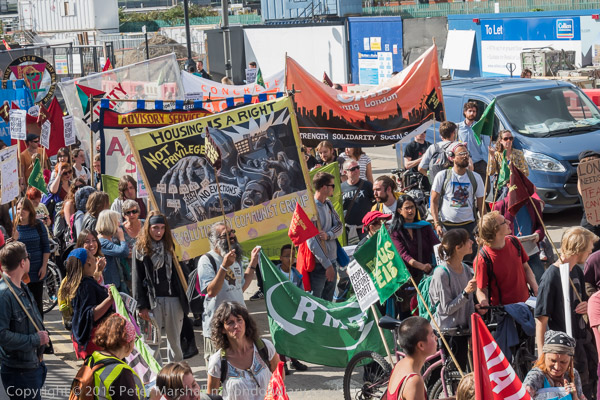

D810, 28-200 DX at 50mm(75mm) 1/500s, f/11, ISO 800,

Like many council estates, the Carpenters was well-designed and well-built – London councils employed many of the country’s leading architects and planners. It had probably been kept up better than most though like most post-war estates was in need of a little refurbishment to meet changing standards. It was popular with tenants – and still is with those who have managed to remain.

But it occupies a relatively large area of land that is now worth a fortune. Council planners generally worked to relatively low densities, whereas new private developments (often now by housing associations) can cram in several times the number of ‘units’ for sale or rent at high prices. And while most such developments start off with a promise to provide a small proportion of ‘affordable’ properties, they often manage to cut that dramatically before completion.

‘Affordable’ properties are of course not affordable for the great many Londoners who are on the minimum wage or even the London Living Wage. Few are even affordable to, for example, the teachers that London needs, paid at several times that.

The latest housing bill takes this idea to heart and all council and former council sites are likely to be listed as ‘brownfield’ sites ripe for development. It can only be seen as a deliberate attack on all remaining social housing for the benefit of wealthy property developers.

The day’s events began with a rally in Stratford Park, with an open mike for speakers for groups from all over London to talk. At Focus E15: Rally before March there are some pictures and a list of over 40 groups supporting the march – and I’m sure I will have missed some.

The Focus E15: ‘March Against Evictions’ set off and walked around the centre of Stratford, along the large one-way system around the large shopping centre, past the bus station, rail station and entrance to Westfield. One of the groups opposed to the increasing gentrification of London is of course Class War, and as the march got to a large branch of estate agents Foxtons, they peeled off and rushed inside with their banner, and I followed them.
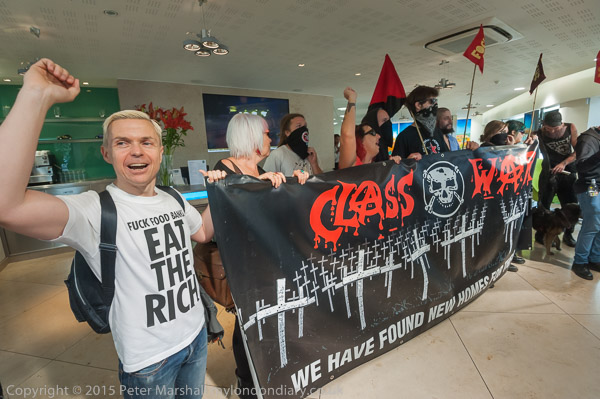

D700, 16-35mm at 16mm, 1/250s, f/8, ISO 2,500

Class War Occupy Stratford Foxtons: Police soon blocked entry to the shop, keeping most of the marchers on the street outside. Those inside were well-behaved, careful to cause no damage, and after around ten minutes left voluntarily to continue the march.
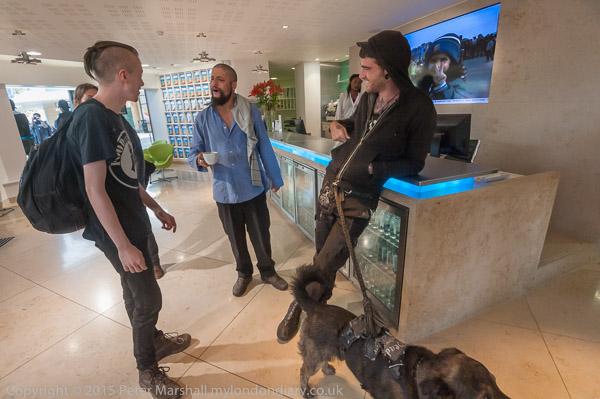

D700, 16-35mm at 16mm, 1/250s, f/8, ISO 2,500

The march stopped briefly outside Newham’s Housing Office, Bridge House on Stratford High St to put up banners and talk to marchers. The Housing for All campaign have supported a number of people at interviews here, often managing to get the authority to find housing in or close to the borough after they have been told they would have to go to Hastings, Birmingham or elsewhere.

From there it was a short walk to the Carpenters Estate and the Focus E15: Anniversary of Carpenters Occupation party in front of the block that they occupied for a couple of weeks a year ago. Those four flats now have new tenants, but only 28 of around 400 empty properties have been relet, and Newham is still trying to clear the estate.
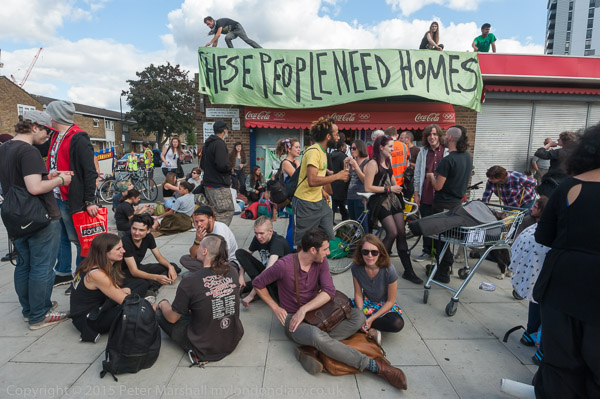

D700, 16-35mm at 19mm, 1/400s, f/10, ISO 640

It was a good afternoon for a party and there were speeches and music and a release of grey balloons representing the many homeless and evicted people across London.

But I didn’t stay long, as I’d been on my feet too long and my legs were beginning to ache and I left as soon as the balloons had been released.
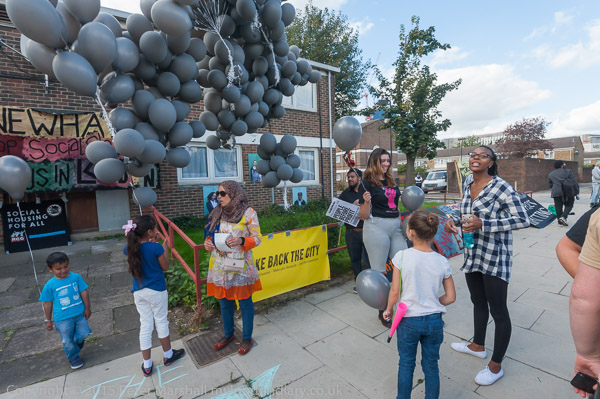

D700, 16-35mm at 16mm, 1/320s, f/9, ISO 640

Continue reading Housing protest – Focus E15
Refugees Welcome

September 12 was an important day in British politics, possibly a turning point we will look back on, the start of a new era on honesty and straightforwardness, though we still have a while to wait to see if a decent and principled man can survive as leader of his won party for long enough for the electorate to be allowed to pass their judgement. It certainly won’t be easy, with not only the Tories and most Labour MPs keen to preserve the status quo, along with the entire mass media baying against him. But even though our newspapers have recently been judged as the most right-wing in Europe, if he begins to look as if he may win, some will change their tone. Its always more profitable to be on the winning side, even if it rather sticks in your throat to be so.

My main concern on September 12 was not however with the Labour Party leadership – in which I didn’t have a vote, never having got over being thrown out of the party as a member of a Labour student organisation that was ‘proscribed’ back in the 1960’s, although I did briefly photograph one of the victory parties – and wrote about it here earlier.


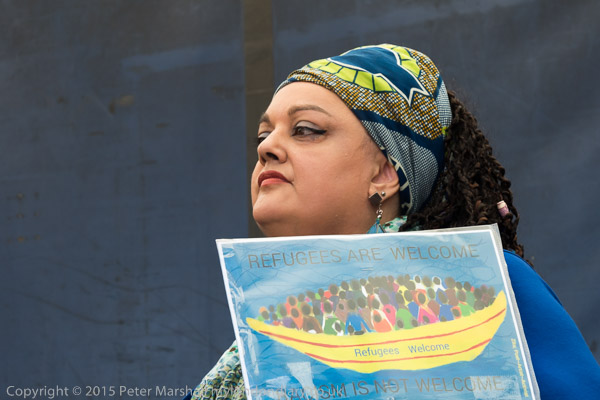
Zita Holbourne of BARAC with one of her artworks showing a boat full of refugees

Also taking place was one of the larger protests that London has seen for a while, the Refugees Welcome Here national march. The plight of refugees, mainly fleeing from war-torn Syria and other areas of conflict and making their way across the Mediterranean, facing hardship and death had captured the attention of the British people.

It was of course the pictures and videos and stories on TV in particular, but also on the press that had made us aware and awakened our concern. The stories were dramatic and shocking enough to gain extensive coverage, enough to overcome the continual drip-feed of anti-refugee propaganda which usually fills our media. The continued and systematic use of the words ‘migrants‘ and ‘immigrants‘ rather than ‘refugees’ or ‘asylum seeker’s, the ridiculous, sloppy and inaccurate use of the term ‘illegal immigrant‘ (or even the shorter ‘illegals‘) and the hysteria whipped up over migration statistics and stories which should be about the failure of our government to provide support for local authorities where these people settle rather than blaming them.

Then we have a whole raft of racist legislation – the setting up of prison camps like Yarl’s Wood and Harmondsworth – and raids on shops, offices, restuarants, stations and streets by ‘border police‘.

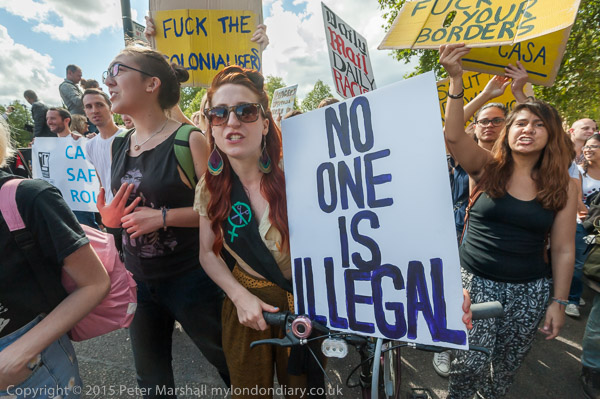
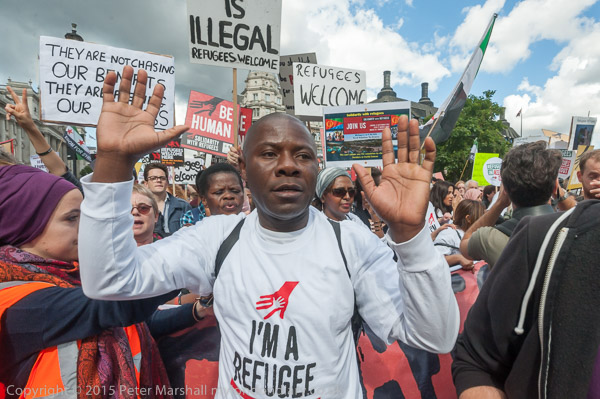
Although tragedies reported by the media brought a positive response from the British people, our government was largely unmoved. As I wrote “More than 50,000 people of all ages from across the UK marched through London to show their support for refugees facing death and hardship and their disgust at the lack of compassion and inadequate response of the British government.”


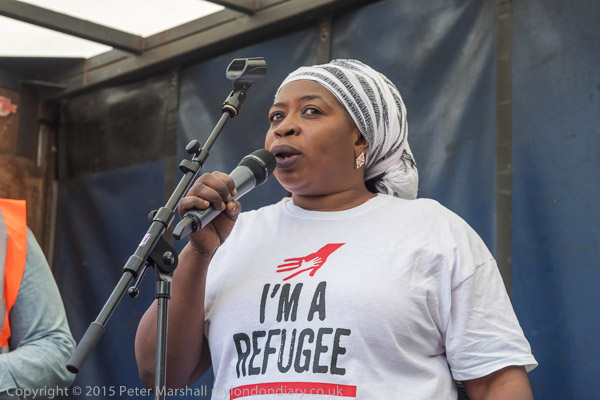
Maimuna Jawo a refugee from Gambia and from Women for Refugee Women wearing an ‘I’m a Refugee’ t-shirt left Gambia to avoid having to take over when her mother, the local FGM ‘cutter’, died.

Before the march there was a rally and I photographed all of the speakers – including the Liberal Democrat leader, London’s MEPs for the Green Party and Labour, and representatives from various groups concerned with refugees. Two of the speakers, Zrinka Bralo of Citizens UK a
and Maimuna Jawo of Women for Refugee Women had come to this country as refugees.

I photographed the front of the march, and walked with it for a few hundred yards before stopping an photographing others as the march streamed past, filling the wide carriageway of Piccadilly. It took an hour to pass me by and then I rushed to the tube to get to Westminster, one stop away, where the march was heading. I arrived just before the front of the march, which must have been around a mile long.

I took a few pictures as the front of the march went in front of the Houses of Parliament, and a friendly steward let me in to the area in front of the banner, but I had to work very close to it as otherwise there were too many people in the way. I’d have liked to have the banner clear to read, but it wasn’t possible.

Another rally was starting, along with some celebrity speakers, but I decided I was too tired to cover it and sat down for a few minutes to eat a late lunch on a wall on the other side of Parliament Square as the square filled up. By the time I left it was pretty full, with people still coming in – and many others like me deciding it was time to go home.

Rally Says Refugees Welcome Here
Refugees are welcome here march
Refugees Welcome march reaches Parliament

Continue reading Refugees Welcome

Arms Fair

Looking back on a busy few days in September when activists protested against the DSEi arms fair held in East London.  When you see reports of wars, atrocities and killing around the world, there is a very good chance that at least some of the weapons involved will have been sold at this event, which is said to be the largest arms fair in the world which takes place here every two years.

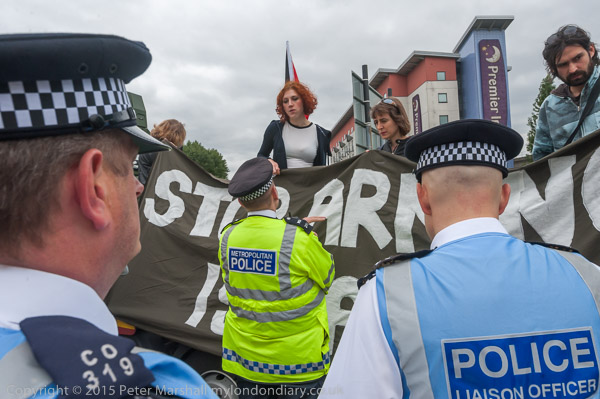
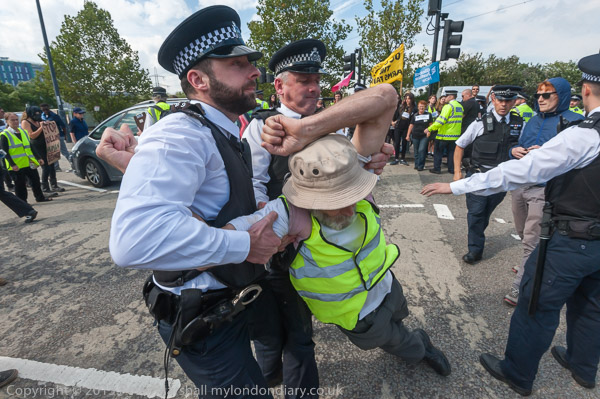
In the week before the arms fair took place, activists held a number of protests and tried to stop lorries bringing exhibits to the arms fair. The first day of protests. DSEi Arms Fair protest Israeli Arms Sales, concentrated on the sale of arms to Israel, and the sale of arms by Israeli companies who trade on the fact that these arms have been ‘battle tested’ in the various attacks on Gaza.  In my picture police talk with protesters who have stopped a lorry carrying a military vehicle and climbed on to it. Eventually police persuaded the protesters to allow the lorry to continue.

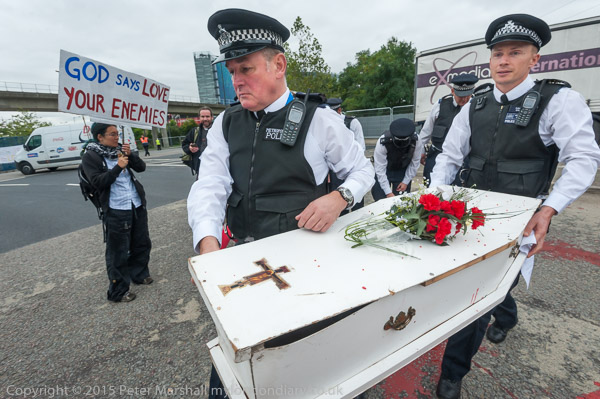
The following day was a day led by faith protesters with a DSEi: Pax Christi Vigil which was followed by a Catholic Workers Funeral

procession and service, which ended with them occupying the road to stop traffic. They continued to block the road for quite a while until police finally forced them to the pavement, with officers picking up and carrying the mock coffin.

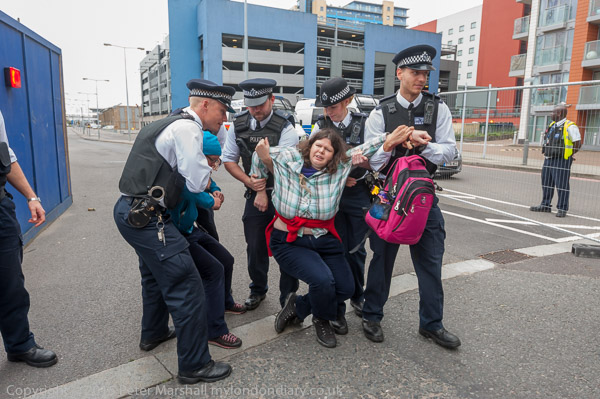
Later that day a small group of Christian campaigners, Put Down the Sword, made their way to the other entrance to the former dock site including the centre where the arms fair was being held and blocked all traffic for around an hour before police finally dragged them away.

I couldn’t attend every day of the protests at DSEi, as other things were also happening that week in London, but three days later returned for Refugees Welcome, Arms Dealers NOT, where protesters dressed as and alternative Border Force again moved onto the road and stopped traffic going into the arms fair, moving back to the road a number of times after police dragged them off.

Of course, these actions didn’t prevent the arms fair, and attracted very little attention in the mass media – arms sales are big business and big businesses fund much of our media through advertising for their less lethal products. But they did make clear the opposition many feel to the arms trade and the way it profits from the conflicts that it fuels around the globe.

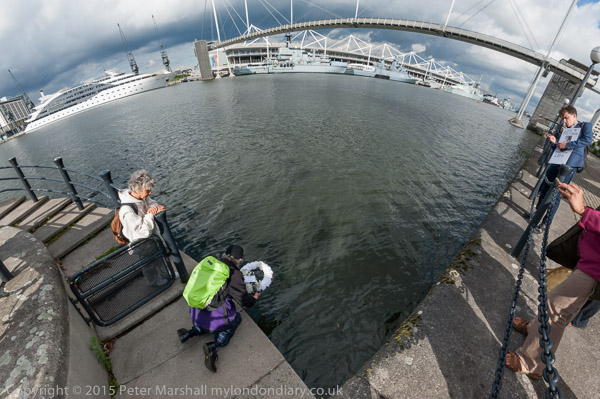
While the arms fair was taking place there were further protests. As on previous occasions local people opposed to it organised a procession to lay a Wreath for Victims of the Arms Trade. There is high security around the actual event, and the bridge across the dock is closed and the group walks in procession around to a point on the opposite side of the Royal Victoria Dock to lay the wreath on the water.

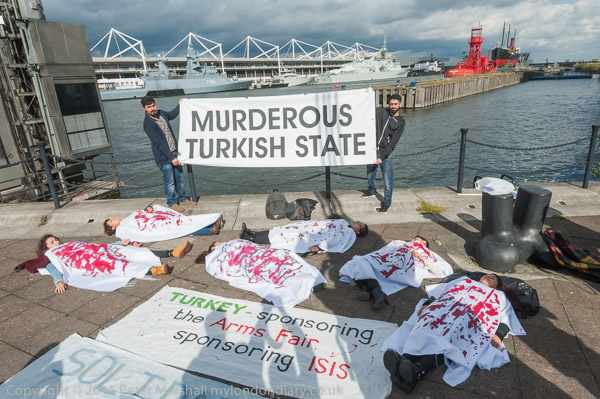
Also on the same afternoon, a group of Kurds came on the same route to say Stop arms sales to Turkey and some dressed in fake blood-stained white shrouds staged a die-in on the dockside opposite the fair, in view of those attending and visiting the naval display in the dock.

The Kurds say that Turkey sponsors ISIS both by turning a blind eye to its military operations against the Kurds and active support in supplying arms and refining and smuggling large exports of oil from ISIS held oil-fields that bring millions in to fund them.

Continue reading Arms Fair

Mendelsohn’s Balsall Heath

An article in The Guardian brought to my attention the work of American photographer Janet Mendelsohn, a Harvard graduate who in 1967 came to study with Stuart Hall and Richard Hoggart at the ground-breaking Birmingham Centre for Contemporary Cultural Studies. Forgotten for years, her work which she made use of photography as “a tool for cultural analysis” in a multi-racial area undergoing a radical transformation through immigration and dire poverty, was rediscovered when Kieran Connell, who was curating a show for the 50th anniversary of the centre, became obsessed by a photograph of hers on the cover of its 1969 annual report.

It took considerable detective work by Connell to find out more about the photographer, but when he finally managed to contact her sent back the request “Please take these photographs off my hands” and sent him a large box with several hundred prints and 3,000 negatives.

Some of these were from a project in the red-light area of Varna Road in Balsall Heath, and it is this series which is the basis of the newspaper article, as well as a forthcoming show at the Ikon Gallery in Birmingham (PDF press release here) and a free symposium at the end of January at Birmingham University with speakers including Magnum photographer Susan Meiselas, artist Mishka Henner, UCL History Professor Catherine Hall and curator and photographic historian Pete James.

One classmate of Mendelsohn’s at Harvard was film-maker Dick Rogers, (1944-2002) who also went to study in Birmingham with Hall and Hoggart for two years, after which he returned to Harvard to study on a Visual Education programme where he met his future wife Susan Meiselas.

Mendelsohn worked with Rogers on his first film, Quarry (1970). His best-known work, Pictures from a Revolution (1991) retraces Meiselas’s work on her photo essay ‘Nicaragua: June 1978-July 1979‘. In an earlier film, 226-1690 (1994) he used recordings left on his phone answering machine from her when there including one with a gunshot in the background.

Some of Mendelsohn’s work was shown last July in ‘The Ghost Streets of Balsall Heath‘ at The Old Print Works, Moseley Road, Balsall Heath as a part of the Flat Pack Festival.