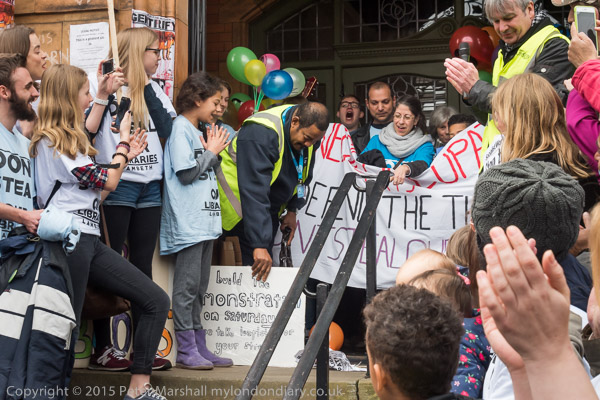
Grossman & the Photo League

Around 15 years ago, I wrote a series of articles and short notes about what was still then a very much overlooked part of American photographic history, but which is now referred to as ‘New York’s famed Photo League‘. An organisation that was destroyed by McCarthyism as ‘anti-American’ it remained largely outside the pale until this century, and I was pleased to be able write about it and to mention some of the photographers still alive and working who learned and developed their craft there, largely under the critical eye of Sid Grossman (1913-1955). I’ve mentioned it before on this site, including two posts with the same title, The New York Photo League where I quote from my 2001 article, and a longer version here.

You can get some idea of the critical blind-spot by reading the lengthy introductory essay by Gerry Badger to the 1985 Barbican show ‘American Images: Photography 1945-80’ which relegates Grossman and others to what is essentially a footnote to the later work of Robert Frank and the Photo League to an introductory sentence to the work of Aaron Siskind which makes clear that his importance as a photographer was due to breaking away from his early work with the League on Harlem Document.

Although none of Grossman’s work appeared in the Barbican show, that the work of several others involved in the Photo League does probably owes itself – as did much of the show – to the ideas and graft of John Benton-Harris, a native New Yorker who studied with Alexey Brodovitch, and who grew up with the work of the Photo League photographers and their successors and their views of his city.

As his artist page at the Howard Greenberg Gallery states, Grossman, who had founded the Photo League with Sol Libsohn in 1936, “had a tremendous influence on a large number of students who studied with him including Weegee, Lisette Model, Leon Levinstein, Ruth Orkin, Arthur Leipzig, Rebecca Lepkoff and numerous others.”

The main show at the Howard Greenberg Gallery in New York until Feb 11, 2017 is the “first solo exhibition in 30 years to explore the legacy of Sid Grossman” and the exhibition also includes “a small selection of work by some of Sid Grossman’s students including Rebecca Lepkoff, Leon Levinstein, Marvin Newman and Ruth Orkin.” Also showing at the gallery is a “companion exhibition with work by Sy Kattelson, a student and close friend of Sid Grossman.

Last September, Steidl co-published with Howard Greenberg Gallery ‘The Life and Work of Sid Grossman ISBN, 9783958291256′ with a biographical and critical essay by Keith F Davis, the first comprehensive survey of Sid Grossman’s life and work, with over 150 photographs “from his early social documentary work of the late 1930s to the more personal and dynamic street photography of the late 1940s, as well as late experiments with abstraction in both black and white and color.”

Whose Streets? Our Streets!

My thanks to writer on the New York Times Lens Blog for pointing out the exhibition ‘Whose Streets? Our Streets!‘ currently taking place at the  Bronx Documentary Center until March 14, 2014, but more importantly for most of us, on-line.  Curated by photo editor Meg Handler  and historian Tamar, it features work by 38 photographrers, including a few familiar names.

But as Handler says in the Lens feature, few of the pictures  were widely seen when they were taken; “It used to be, you’d show your contact sheets to a couple of your friends and that was it,” she said. “They’d rarely get seen.”

Handler goes on to say that the freedom of movement for photographers ended in 2002, but she continued by saying that any demonstrator with a phone can now project images to the world almost as the events are happening.

I’m not sure how different things are in New York to here in London, but here there is certainly no shortage of photographers covering protests, and while it’s obviously true that protesters with smart phones now tweet and post images as events take place, this is a rather more recent phenomenon.  When I first got a mobile phone, a little after 2002, like most at the time it didn’t have a camera, and it was only at the end of that decade that phones with cameras began to be widespread.

Things did change around 2002. Photographers got digital cameras – like the Nikon D100 I bought towards the end of the year. A few professionals had used them earlier, but mainly in more lucrative areas than photographing protests. For a few years after most of the photographers at demonstrations here were still using film – and I continued to use both film and digital for several years.

Back then, unless you had something that was startling news, you took your pictures, came home, developed film, looked at the contacts, maybe made a few prints and took them to the agency a day or week or more later. If you though you had something special, you would phone a paper and if they were interested take them the film to rush through for the next day. Staffers would of course take in their films – and most of the protest pictures published were from photographers on the staff of the major agencies and papers. They only bothered to attend major events, and seldom stayed for more than a quick photo-op.

Photographers who really covered protests were a different breed – and it shows in the pictures in the Bronx show. Here – as there – some worked for the left-wing magazines and small circulation newspapers – such as Mike Cohen who gave me advice at times when we covered protests and whose work appeared regularly in the Morning Star, Socialist Worker and Searchlight, which also regularly featured pictures by David Hoffman, a photographer who some on the extreme right confuse me with and I get a share of his abuse along with that really intended for me.

The other thing that has changed and encouraged more photographers to cover events is the growth of online photo agencies that have little or no bar to submissions. Sites like Demotix (bought out and closed down a year ago by the Chinese to end its competition with Getty) encouraged people to put much unfocussed (often literally as well as metaphorically) photography online – with many more people becoming photographers, and a few of them producing work at least as good as that of the professionals who disparaged such sites. And of course there are professionals around the world who now contribute to such on-line agencies.

The freedom of movement all ended in 2002,” states Handler, but here protesters have often managed to avoid being penned by police, and except for those on the extreme right and some anarchists, protesters have largely remained on good terms with most photographers.

So we have more photographers than ever taking pictures at protests, although no more pictures are being used. Many that do appear are pretty poor because what matters most is not quality but getting the images in first, with many photographers rushing into a corner before a protest has even started to file some pictures. It’s a race I refuse to take part in, but then I’m in no danger of going hungry or getting evicted if my pictures don’t make the news. Like those photographers in the Bronx show I’m more interested in telling the stories – but at least now I can get them out on Facebook and My London Diary even if the newspapers don’t pick them up.

Another big change is of course the move to colour that came with the move to digital. There are rather more colour pictures in the Bronx show than I would expect from any similar UK show of the same era, but it is still black and white that dominates. Now using black and white is largely only an affectation practised by a few largely younger photographers hwo have never really learnt how to use it, other than clicking on a button in Lightroom or other software.


Axe Drax Again


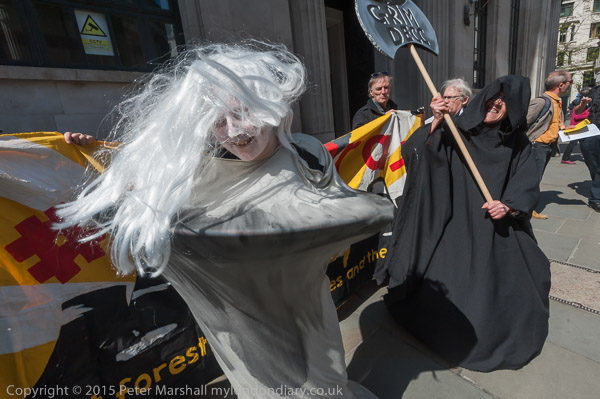
The ‘Grim DECC’ attacks a Drax cooling tower with his axe

Some protests are rather drab, with little visual material to work with, which can make for a hard time for the photographer. I like the challenge of photographing people, and there are always people to photograph, but the problem is to get those people to visually express something about the protest. Unless of course they are celebrities, names the papers lap up and will publish almost any picture of- though sometimes they are inundated with pictures of them and even if your photographs are better than the rest, the chances of an editor even looking at yours are small.

Celebrities aren’t any more interesting to me than the next guy, though some people are more interesting to photograph than others. Including some well-known people, though others don’t impress me, particularly some women who hide their faces behind a heavy mask of makeup which robs them of life. Protesters – and most people I watch avoiding eye contact when I’m sitting on the tube – are generally more interesting.

I’m often surprised at how poor some of the pictures of people we see in the press are. And I don’t mean the amateur snapshots which might be the only available image of a murder victim, but the work of professional photographers. Of course editors sometimes deliberately pick bad pictures because they make the subjects look bad. The kind of images that I usually don’t bother to import onto my computer and disappear when the card is formatted ready for the next day’s work.

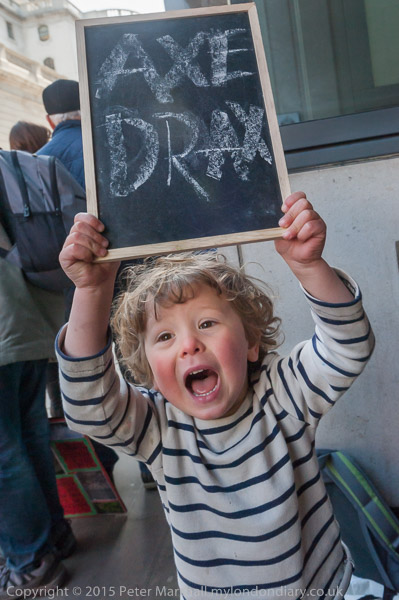
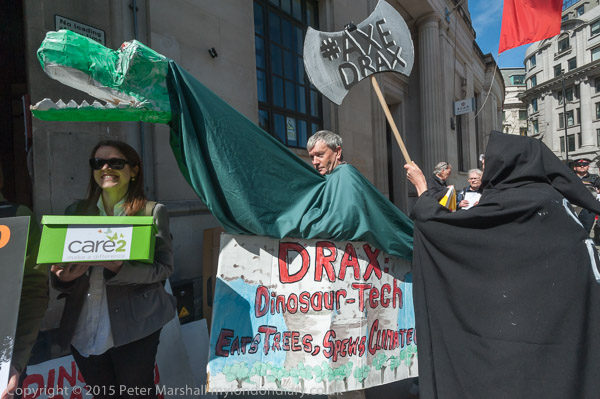
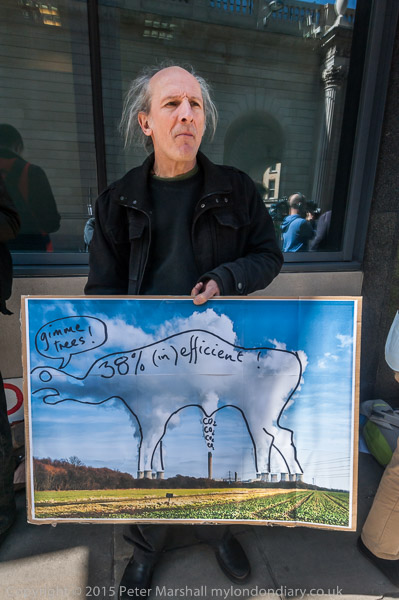
Axe Drax presents a different challenge, with an embarrassment of symbols – a Draxosaurus, a cooling tower and a grim reaper with his ‘Grim DECC’ axe, and some splendid banners as well as the people. I’ve photographed the Draxosaurus a few times now, and I think I have not yet managed to get a good picture – and I do wonder how many people who see it understand what it is about. The cooling tower is much better, though sometimes hard to see it is a cooling tower in photographs, and the Grim Reaper is fine if rather hard to see where he fits in – and the DECC is certainly not attacking Drax or its cooling tower, rather cosseting them – it’s axe is reserved for green initiatives.

Drax is about dirty coal and environmentally unfriendly biomass – which is benefitting from green subsidies, while genuinely green developments are getting sidelined. It’s about huge CO2 emissions, the devastation of large areas of Colombia with open-cast mining. And while I may get some interesting images, it sometimes feels like I’m trying to write a story in English with only a Cyrillic font.

Physically it’s also difficult space to work in, with a narrow pavement in front of the Grocers Hall with a fairly steady stream of pedestrians. The City of London police keep telling me not to obstruct the pavement most of the time I’m taking pictures – and object when I stand – as they are – in the gutter. For quite a few of these pictures I not only had to look to see the subject, but also to see when the police had turned away and I could get into a suitable position.

It’s actually inevitable that this pavement will be somewhat obstructed – and it would be sensible and cause little obstruction to road traffic, which isn’t particularly heavy and gets held up by the traffic lights anyway – to put down a few cones to give a yard or so more to allow free movement along the pavement for pedestrians. And to get those officers off my back. There probably is a limit to the number of times they will warn me I’ll be arrested for obstructing the pavement before they really do, and I think on this occasion I came pretty close – despite being careful not to actually get in the way of people who were walking past.

More pictures at Drax AGM Biomass opposition and more about the campaign on the Biofuelwatch web site.

Continue reading Axe Drax Again

Top Shop & John Lewis


Outide Topshop in the Strand as the protesters leave

The United Voices of the World may be a small union, but it is getting a pretty big reputation for taking on some of the best known names for their poor employment practices. Their planned protest at Harrods tomorrow against the company paying low wages and stealing tips from those who work in the restuarants in the store has made the papers and even the BBC, who usually turn a blind eye to protests. Other big names they have taken on include the Barbican Arts Centre, John Lewis and Topshop, as well as some leading companies in the City of London.


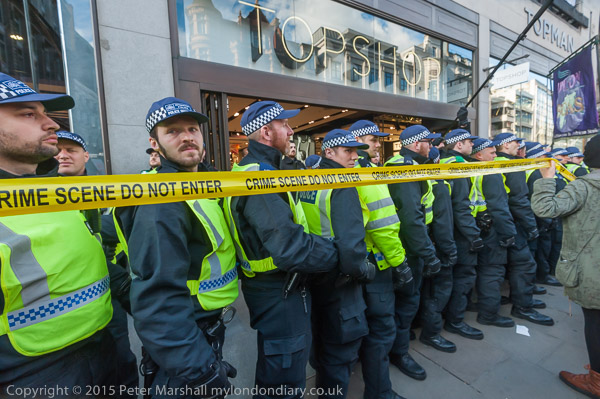
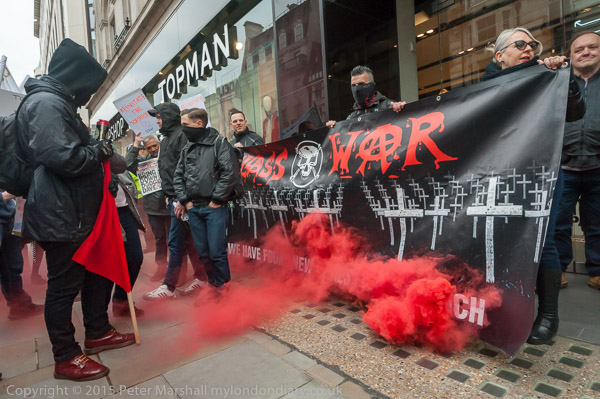
Outide Topshop Oxford St after police have assaulted protesters Class War brought out Crime Scene tape

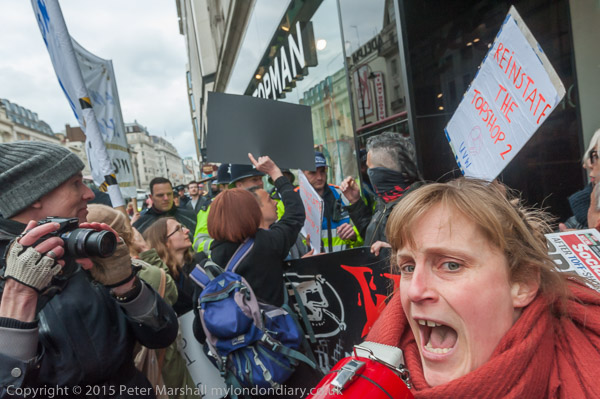
When the cleaners who work inside Topshop protested peacefully to be paid the London Living Wage, cleaning contractor Britannia reacted by suspending (and later sacking) two of them – the ‘Topshop 2‘. The UVW accuse Brittania of systematically victimising, bullying and threatening cleaners and Topshop  of refusing to intervene although they are working in their shops.


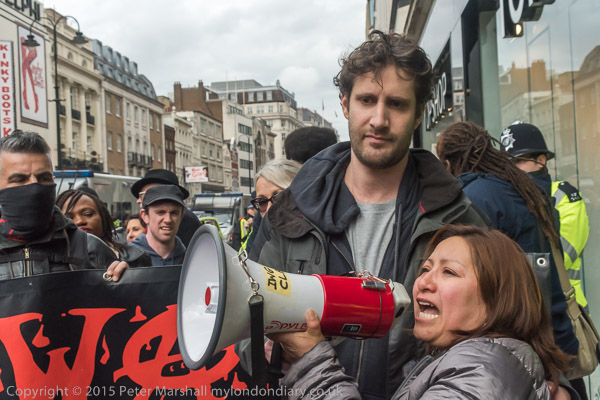
Susanna, one of the ‘Topshop 2’ speaks in the Strand

The UVW, a grass roots union run by the workers, have gained the support of other groups involved in similar struggles to get a living wage for London’s low paid workers, many of whom are migrants. London only runs because of the essential work carried out by these and other low paid workers, many of whom have English as a second or third language and have qualifications which are not recognised in this country. As well as taking action to protect their members and improve pay and conditions, unions such as the UVW, CAIWU and IWGB also run English and other classes for their members.

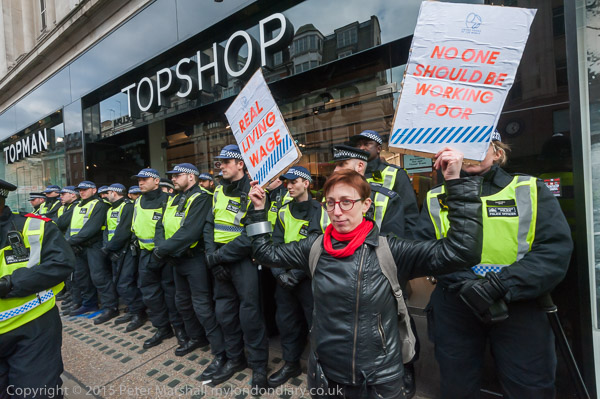
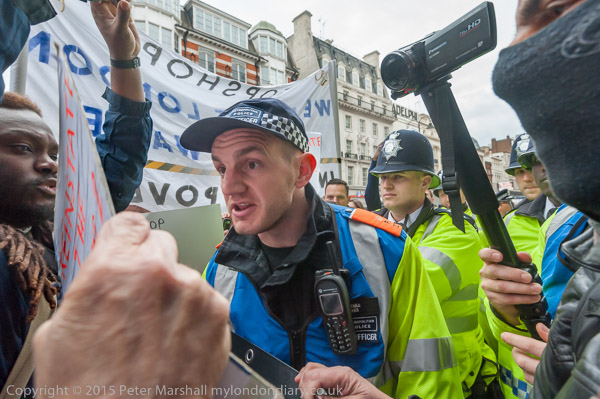
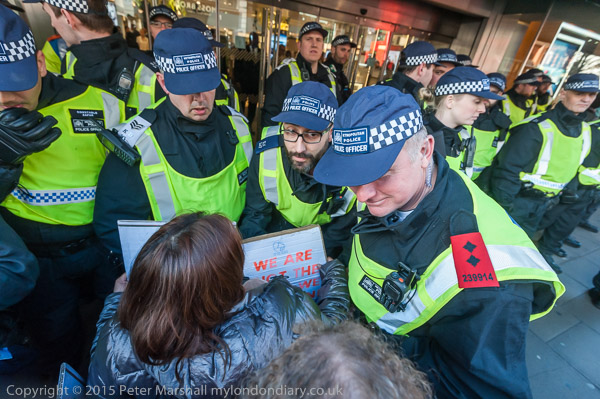
As the pictures show, a large force of police had come to protect the shops, at first in the Strand and later they moved with the protesters to the Oxford Street Topshop, though the protesters were keen to point out that they should instead by arresting Philip Green,  the chairman of Arcadia Group which includes Topshop (along with Topman, Wallis, Evans, Burton, Miss Selfridge, Dorothy Perkins, and Outfit) for his activities in disposing of BHS, and certainly  not protecting a business that avoids paying the taxes which pay for the police.

One of the groups supporting the UVW at the protest was Class War, and there where other anarchists and left groups present, but the protest was peaceful and orderly, with just a little friction as police tried to move the protesters away from the shop entrance – which they then proceeded to block themselves.

After the protest had continued for some time, the protesters marched away and up to the Oxford St branch, close to Oxford Circus, with the police following. Outside there, the police got rather more physical, and I was pushed back with excessive force while taking pictures, and protesters – some of whom were pushing police, but others who, like me were simply standing close – started to get thrown bodily away, some of them hitting me as I now stood a few feet further back.

It was then that Class War got out their ‘Crime Scene Do Not Enter‘ tape and stretched it out in front of the line of police who had been assaulting the protesters.

Later, when the protesters moved along first to briefly block Oxford Circus and then to protest against John Lewis, a police officer threw Susana, one of the Topshop 2, to the ground. Fortunately she was not injured, but the protesters were incensed, and finally after an angry confrontation with UVW’s General Secretary Petros Elia, the officer concerned was forced by the senior officer to apologise to her for his inappropriate use of force. It was something I’ve never seen happen before, and surely a sign that the police recognised they had gone too far.

UVW Topshop 2 protest – Strand
UVW Topshop & John Lewis Protest
Continue reading Top Shop & John Lewis

Health, homes, jobs & education

One of the things that I learnt from my friends who photographed English carnivals, and who I went out with to them for a number of events was that photographically speaking they were more or less over by the time they had started. As the carnival set off, we would turn away, hopefully to a nearby pub, our job done. Sometimes we might return to take pictures at the end of the route.

It’s often the same with protest marches, though these days I less seldom get down the pub, but often find other things to do as the march makes its way through the streets.  With large marches, I’ll often photograph the start moving off, then stay in place or walk backwards photographing the rest of those waiting to start marching. Then as the last marchers start I’ll take the tube to the final destination, hopefully arriving in time for the start of the rally.

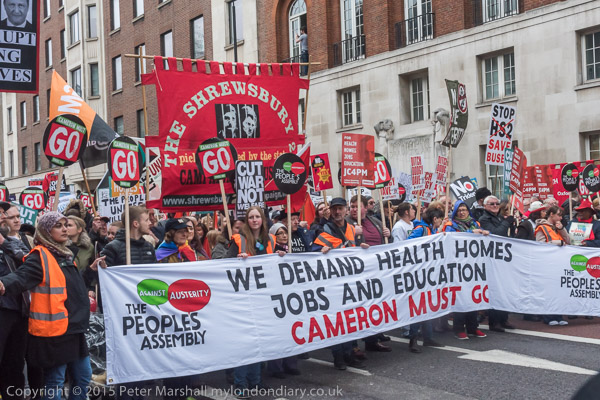
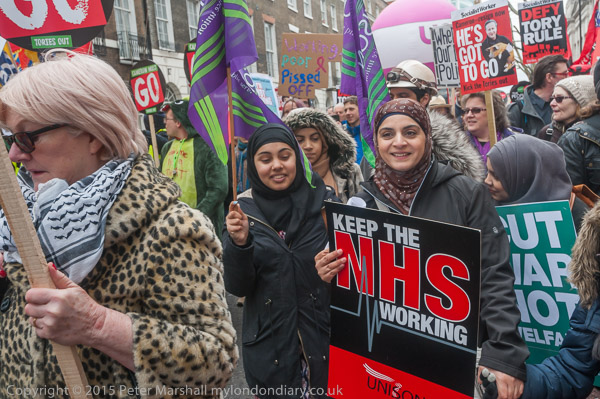
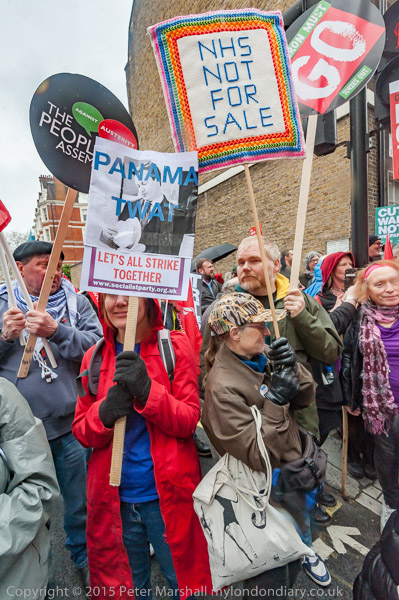
Situations are more varied and people are closer together while waiting to start, giving more interesting scenes to work with, but for the People’s Assembly march Against Austerity, Goodge St was just so packed it made movement and photography very tricky. The pictures I was able to make come mainly from the less crowded edges of the roadway.

The march brought together many different issues that have arisen or been made worse by the government cuts, and included people from virtually all the campaigns I’ve photographed over the years of austerity, along with others from around the country. Only missing were some of the minority ethnic groups and the anarchists who felt that people should be acting rather more directly than walking in an orderly fashion to Traflagar Square, listening to a few speeches and then quietly going home.

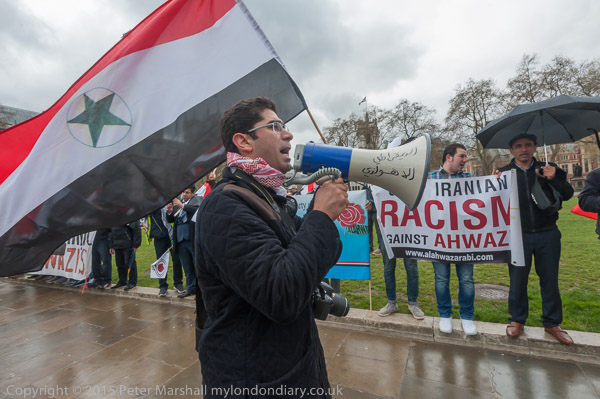
This time I gave up waiting for the march to start, as it was held up by police getting the route clear. And held up more. I’d intended to rush to the tube as it started to meet another group of protesters, Ahwazi Arabs who were to stage a protest in Westminster, close to Trafalgar Square where the People’s Assembly march was to finish, so I could go on to take pictues at the rally at its end. I was just a little late for the Ahwazi event, but met them as they marched down from Downing St to Parliament Square.

After photographing the Ahwazi I walked up to Trafalgar Square as the start of the People’s Assembly march was arriving, in time to photograph the people who were gathering there. Many of the marchers didn’t make it to the rally (and the pubs around got pretty full) but there was still a large crowd in the square to listen to speeches.

It was a well-organised event for press coverage, with space for us to move around in front of the crowd, and with a stage for the speakers we could move around and mingle with those waiting to speak.

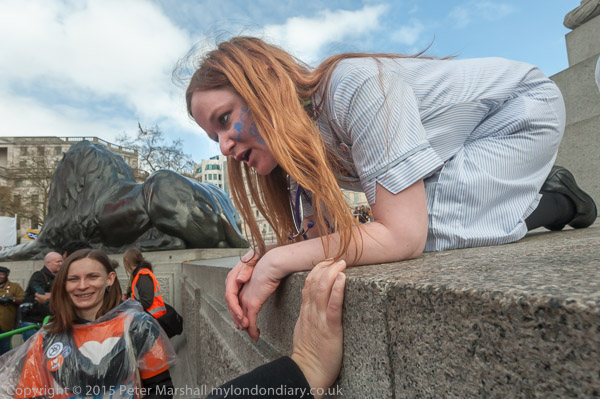
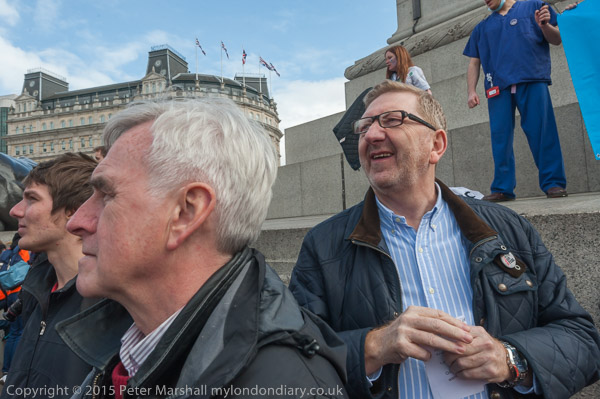
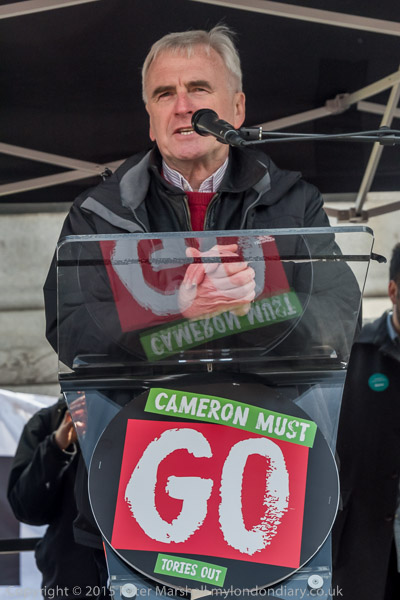
I particularly liked my pictures of Danielle Toplady, one of the student nurses leading the ‘Bursary or Bust’ campaign against the axing of NHS student bursaries apparently impersonating one of the Landseer lions, but just couldn’t quite get the right angle to include Green Party leader Natalie Bennett she was talking with (and whose hand is in the foreground), and I was also pleased to find Shadow Chancellor John McDonnell standing next to Len McCluskey General Secretary of Unite.

The speeches too gave plenty of opportunity to photograph both of them and the others, though the roof over the stage was rather distracting – even after I’d burnt down the prominent struts.

The perspex lectern was also interesting, and I tried hard to include it and the reflections it gave in various ways in the images.

I felt quite pleased with my work, but rather tired by the time the rally had more or less finished – but I knew I had more to do, much though I would have liked to put my feet up and relax. It was to be a long day.

Homes, Health, Jobs, Education Rally
Ahwazi protest against Iranian repression
March for Homes, Health, Jobs, Education
Continue reading Health, homes, jobs & education

Greed and the Homeless

As I collapse into bed I often think of those unfortunates who have nowhere to sleep at night. I certainly would not last long on the streets, and would soon be either dead or in hospital, or perhaps under arrest and in jail if I became desperate enough to steal food or break into premises.

Like many others, I appease my feelings of guilt by the occasional charity donation and also try to publicise the terrible injustices that lead people to become homeless and protests aimed at improving things. We live in a wealthy society where no one should go homeless or lack food, and I would be much happier if more of the tax I pay went towards making sure these things didn’t happen rather than being wasted on vanity projects such as Trident replacement.

The basic reason why people freeze and starve is simple. Greed. In particular the greed of the rich and wealthy. It’s greed that leads to tax evasion and tax avoidance. Greed that drives legislation such as the Housing Act, which will result in thousands more without homes. Greed that leads to the privatisation of publicly owned services such as the NHS, and so on.

We have become a nation ruled by the greedy and in which many see greed as positive, particularly among the greedy. We have a cabinet of millionaires if not billionaires, and while enterprise is a positive attribute, enterprise simply to pile up riches is simply greed.

Inequalities in society are greater than ever, with company bosses often being paid more than a hundred times the average worker – and several hundred times that of the lowest paid. This income gap is higher in the UK than most developed countries and is growing fast – despite research which indicates that CEOs actually contribute relatively little to their companies success. They get more many because they can get more money and they are driven by greed.

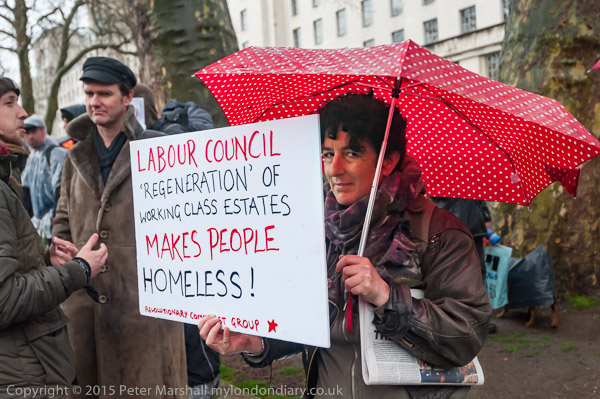
While many in work still need the support of food banks – the real growth success of the Tory government – it is those out of work and on benefits that have suffered most from the greed of our leaders. Of course it isn’t just Tories who suffer from rampant greed, though theirs is spiced with a liberal amount of class prejudice and Iain Duncan Smith idiocy. Labour councils still run many boroughs and many are cosying up with developers to sell off social housing for redevelopment, with some councillors lining up lucrative jobs for themselves – but at the expense of the people they are meant to serve.

Of course there are many who go into political parties with the best of motives – even Tories. But they go into organisations with an institutional bias and few have the ability to withstand becoming corrupted by it – and the very few who stand up against it risk being marginalised or expelled. The Labour Party is in a mess at the moment because those controlling the party expected Jeremy Corbyn to be humiliated in the leadership election but the membership overwhelmingly backed him. But they continue to plot his removal and to frustrate attempts to bring in the policies which won him the leadership vote.

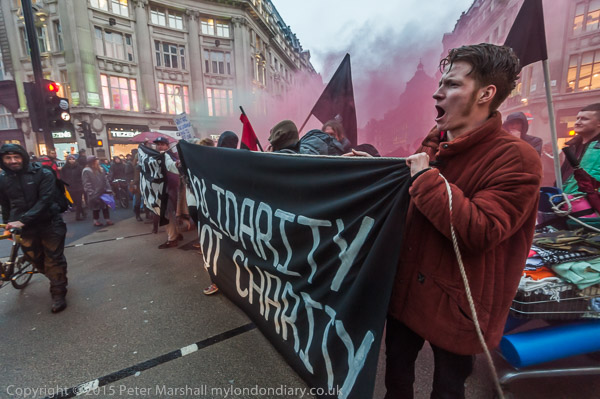
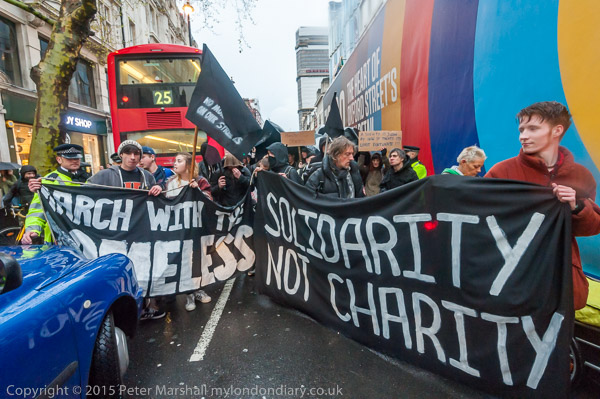
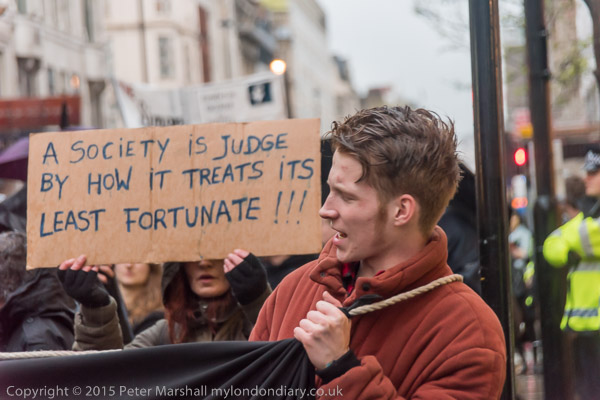
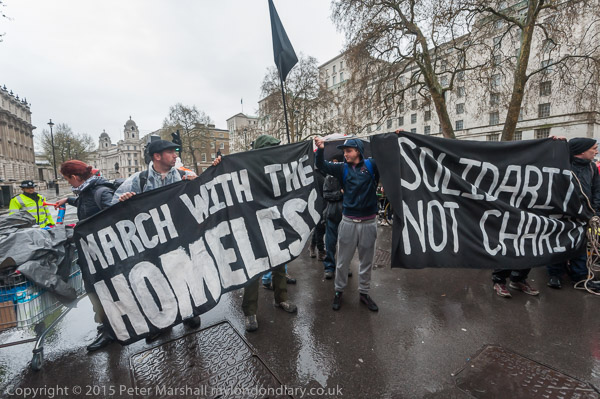
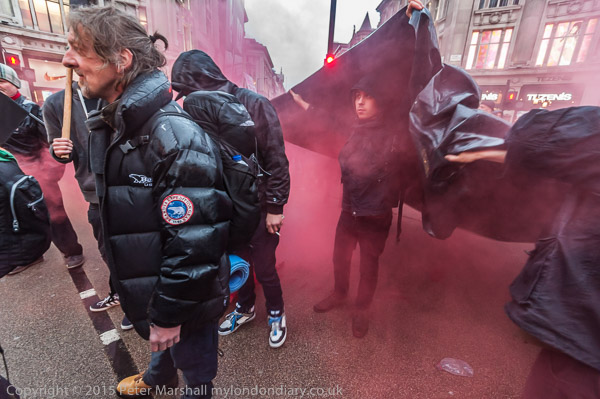
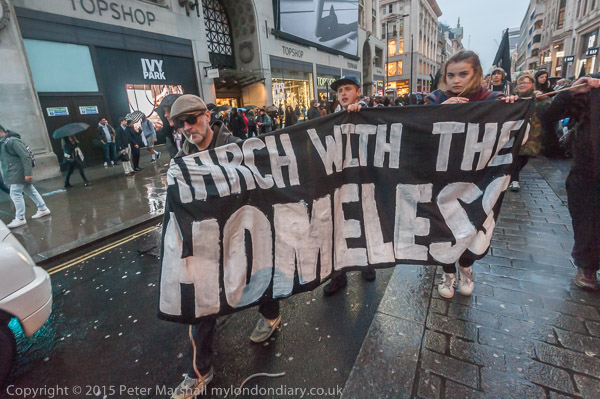
Groups like Streets Kitchen, who organised this protest, do a great job of feeding the homeless – at a time when various councils – Tory and Labour – around the country have been trying to make it an offence to give people food or to be homeless, rather than offer the kind of support people need, or change policies to stop them being forced onto the streets. But Streets Kitchen also realise the need to protest with the homeless for the kind of political changes that are needed. They offer, as the banners say ‘Solidarity Not Charity‘. And they need donations.

Unfortunately we do need Food Banks which have truly kept many alive, giving out millions of food parcels to those without the money to buy food, referred to them by government agencies and charities. Mostly they need food because the DWP has stopped their benefits (often for trivial reasons as staff struggle to meet their targets for handing out sanctions) or because the DWP has made mistakes or is taking weeks or months to process their claims. But while food banks offer respite, their failure to adress the politics that make them needed actually defuses the crisis, lets the government off the hook.

Filmmaker Paul Sng, co-director of Sleaford Mods: Invisible Britain, recently tweeted:

Paul Sng @sng_paul
More than 8000 slept rough on London streets during 2015/16, a figure that’s nearly tripled over the last decade. How is this a golden age?

As a nation we should be hanging our heads in shame – and be on the streets demanding political change.

More pictures at Streets Kitchen March with Homeless

Hull, City of Culture


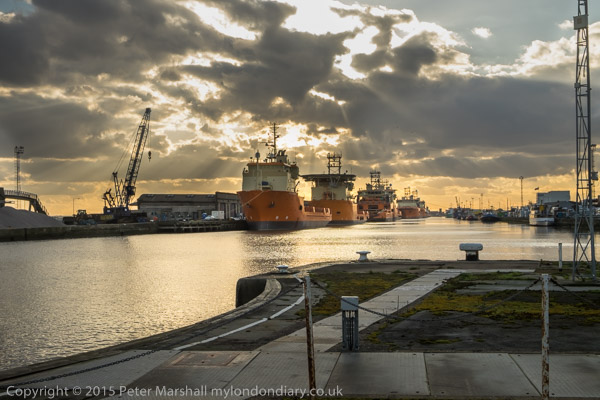
Albert Dock, 2015

Sitting 200 miles away my thoughts this morning are on Hull at the start of its year in at least something of a spotlight as the UK 2017 City of Culture.

Hull is for me a place of many fond memories and admiration for the city and its people. My first visit, coming to the city across the country from Manchester was full of trepidation at the prospect of meeting my future in-laws, but it was a place where I soon felt at home. Hull was not quite another country, although the long straight stretch of track from Selby seemed long enough to take us to one, but it did then seem a kind of time travel, back to the country of my childhood. As I wrote a few years later, I left Manchester in 1965 and the train drew in to Hull Paragon in 1955.

The station name embodies some of my feelings, which were not meant negatively. Hull was in many ways still living in a past age, but one where many of the positive values that were being lost elsewhere were being preserved. It was a working class city where some of the vices of class snobbery and greed were far less rampant.


Ferens Art Gallery, City Hall and Queen Victoria, 2014

It was almost 10 years after that first visit, for various reasons – including poverty – before I began to photograph the city. By then, much had changed, both in my personal life and to the city, devastated by Iceland and the cod wars, by containerisation in the docks, and, a little later with the boot cruelly turned by Thatcher.


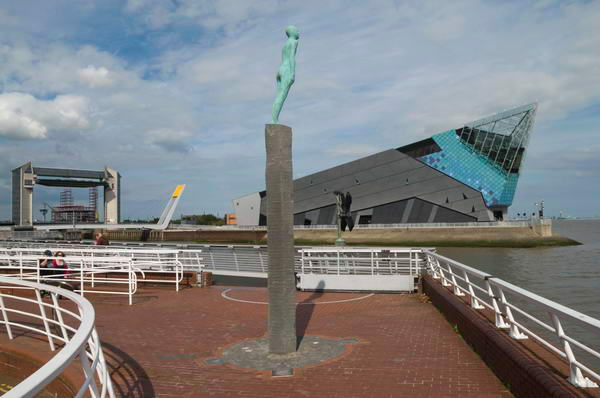
The Tidal Barrier, sculpture and The Deep at the mouth of the Hull, 2008

It got little thought and little help from successive UK governments – though Barbara Castle had earlier given them the Humber Bridge, largely redundant by the time it opened in 1981 – but has benefited in a large way from European funding (perhaps some compensation for the pounding the city took from the Lutwaffe, largely unreported during the war when Hull was seldom if ever named in the news other than as ‘a north-east city’), which makes the prospect of Brexit challenging.


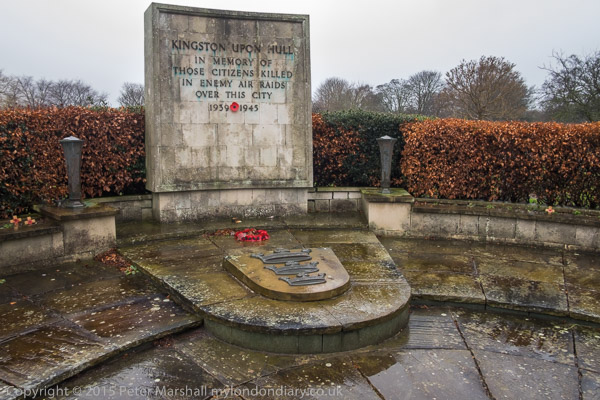
A war memorial to civilians killed in the bombing, 2016

Hull continued to impress me in some ways and depress me in others, and both aspects were I think reflected in my project ‘Still Occupied’, exhibited in Hull in 1983, and in my later photography of the city, though my visits are now much shorter and less frequent. The warmth of the people, and a true Yorkshire rugged individuality; the city too seems to have rediscovered some of the heritage which in the 70s its council seemed reluctant, even embarrased, to acknowledge.


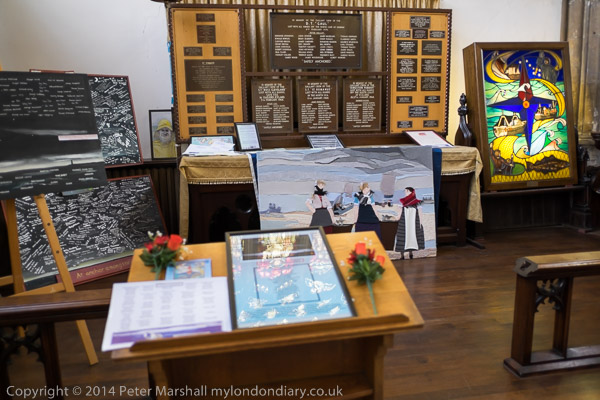
Memorials for fishermen lost at sea in Hull’s splendid parish church – for some reason never granted cathedral status, 2014. Could the Chuch of England be snobbish:-)

Hull was always a working class city, and its cultural life, far more open than that of larger and more class-stratified cities remains and have been refreshed. It remained a city where the people made their own culture, in living rooms, cultural organisations and societies, pubs and clubs, as well as welcoming visiting artists at its theatre and municipal hall, while elsewhere so many more simply slumped in front of the TV.  The strength of its year as city of culture will be far more in its home-grown events rather than the more prestigious performances by celebrated artists that will make the headlines – and bring in cultural tourists.


Footbridge over River Hull, 2014

Hull is worth a visit any year, to walk along by the River Hull and visit the Old Town, in part cruelly isolated from the rest of the city by Castle Street, the dual carriageway A63 which seemed designed to cut off the modern city from some of its past. Worth visiting for its fine free museums, and the art gallery, reopening after a long refurbishment. On my last few visits the city has been in turmoil with pavements dug up and various alterations. I do hope it isn’t too much cleaned up, too sanitised; along with the dirt it would be too easy to lose too much of its character. Like most things, it’s best seen warts and all.


River Hull, 1977
I’ve shared my own small contribution to the year celebrating Hull before on this blog, my new web site Hull Photos, hullphotos.co.uk. Shortly after I finish writing this post I’ll put up today’s picture to mark the official opening of the site and the start of the year of culture – with at least one more picture to come for every day of the year the Hull enjoys as UK City of Culture. But Hull is a city of culture every year.
Continue reading Hull, City of Culture

Tips and Vauxhall

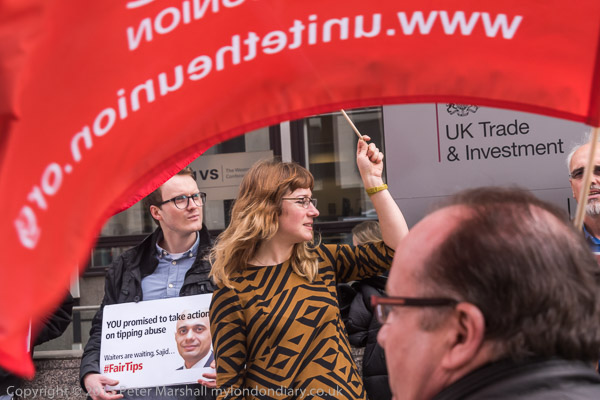
Thursday April 14th was such a nice day I might have gone out taking pictures just for the joy of a walk in fine spring weather, or perhaps simply enjoyed a bike ride around some of the outskirts of London. But in my diary was a protest by the Unite Hotel Workers outside the Dept of Business, Innovation & Skills which meant a trip into London.

I’m not in favour of tipping. I’m happy to pay the rate for services that others provide, and when I’m providing services for others expect to perform to the best of my ability. Tipping is something which I think demeans those who depend on it and a practice I’d like to see outlawed. Just like other forms of bribery.

But while it – and ‘service charges’ still exist then these monies should go to the people who provide the service, and not simply as just more cash to the employers.  And this is what minister Sajid Javid promised, mandatory rules on tipping in hotels and restuarants that give 100% of tips to staff. The protest was taking place to remind him of that promise, which he has failed to implement.

I like the picture above partly because it has everything in it – the minister’s picture with a statement of his promise, the sign at right that shows where the protest was taking place and the Unite flag.  I like too hte dynamism of the flag – and the hair of the Unite activist at the centre of the image.  It isn’t perfect by any means (and I don’t like ‘perfect’ pictures) but a scene where I realised the possibilities and then spent several minutes and rather a lot of exposures to get a picture that worked, at least for me. You can see a few of my other images at Make Tips Fair.

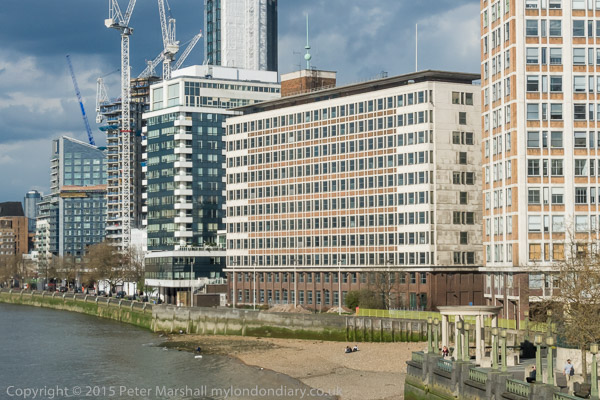
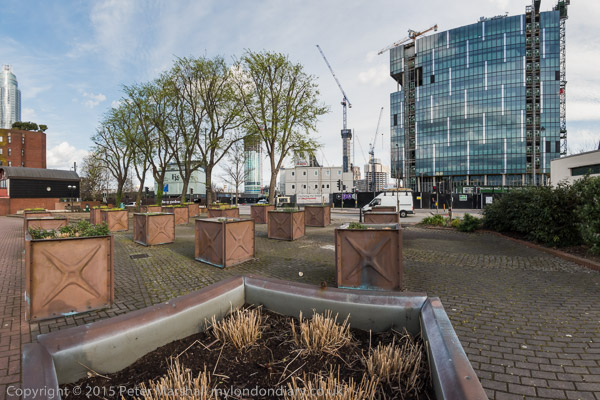
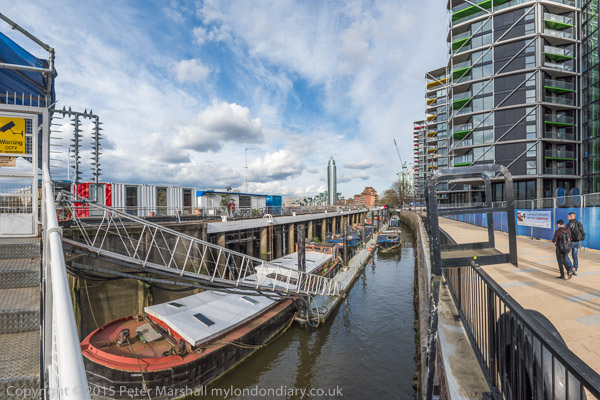
Since I was coming to London for just one fairly short protest it was an opportunity to do something else I’d been meaning to photograph for a while, in a walk around London’s largest current development area, Vauxhall/Nine Elms/Battersea, indentified back when Ken Livingstone was Mayor as a major ‘opportunity area’.

Progress on its development was slow for some years thanks to the financial crash, but for some time I’d been watching the site and taking occasional pictures, particularly of the new US embassy being built there, as my train took me past on the way to Waterloo.

When I’d walked past on my way along the Thames path back at the start of 2014, there was relatively little to be seen happening apart from a few blocks of new riverside flats, but two years later it was very different. There were now people living in some of those flats, and more new blocks were going up.

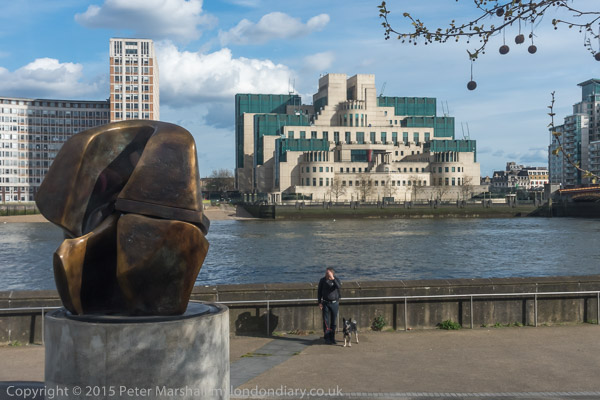
Vauxhall seems always to have been a location that has attracted some particularly poor architecture, with the 1960s drab blocks built despite their prominent position on the river not far from Parliament and contirbuting to the Duchy of Cornwall’s coffers.

I’m no great fan of the MI6 building either, though it does have a certain appealing inappropriate oddity.  I’ve always suspected the architect had prepared the initial drawings as a joke and that no-one was more surprised than Terry Farrell when they were given the go-ahead.

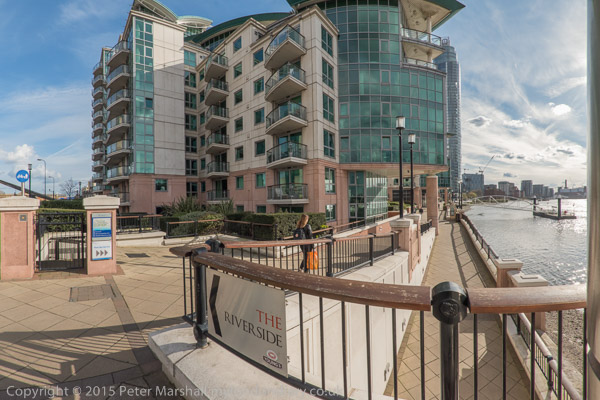
And on the other side of the road is St George Wharf, with the distinction of having twice won the Architects’ Journal’s ‘Worst building in the world’ award.

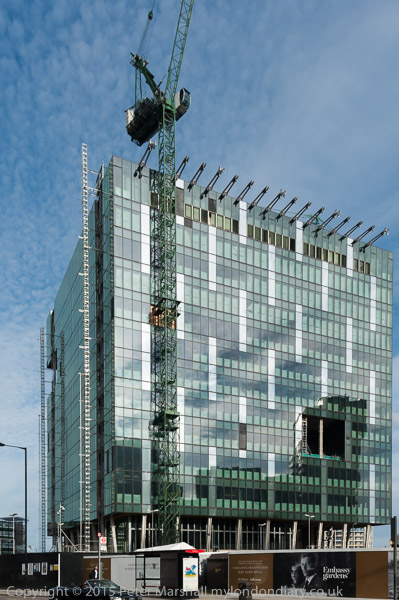
At least the new US Embassy building – in an unfinished state – looks to be less of an eyesore than the current fortress in Grosvenor Square, surely one of London’s uglier buildings despite its distinguished architect. And perhaps by having a moat will be able to avoid the heavy secuirty fence, though doubtless there will still be the armed patrols. It will be a little handier for me to photograph the many protests it will continue to attract, just an easy walk from Vauxhall Station.

The largest part of the development is still inaccessible to the public and to the passing photographer, but generally appears to be fairly mediocre in design. It will I suspect on completion also be a large addition to London’s growing private public space where photography is not allowed.

Vauxhall and Nine Elms

Continue reading Tips and Vauxhall

Travelling times

I should ride my bike more. Not just because exercise is good for you, but because it really is the most reliable way to get around in Central London. Traffic is bad, and getting worse, and many times this year I’ve found myself sitting in buses that are hardly moving, wondering whether to get off at the next stop and walk to get their quicker.

One problem is that it is rarely possible to get off the bus until it reaches a bus stop – and that can sometimes take ten minutes if you come across a real snarl up. Bus drivers are not allowed to open bus doors except at stops, though occasionally will let passengers leave by the front door opposite the driver where they have better vision if it is safe to do so.

Most buses too have an emergency lever to open the normal exit doors, and sometimes passengers get frustrated enough to make use of this. I haven’t yet done so myself, but several times have taken advantage of it when others have done so.

It’s particularly galling for those of us old enough to have spent time travelling on the old Routemaster and other now vintage buses with their open rear platforms, enabling you to leave and enter the bus anywhere and at any time. There were a few accidents, but in general Londoners managed to arrive in one piece. One of Boris’s minor disasters among many as London’s mayor was his new Routemaster bus, which traded on the name but otherwise had few of the traditional features.

One of them was a two-person crew, one driving and the other looking after the passengers, but that second person was soon phased out – and the open platform at the back replaced by sometimes rather crude automatic gates – there are at least two designs, one of which regularly savages unwary tourists waiting to descend.

There are other faults too, and even with improvements to the air conditioning you can still get cooked in warm weather. There are still a few of the old Routemasters around on a route heavily used by tourists and travelling on those reminds me of how much generally bus design has improved, with a far smoother ride, but at least you are not trapped inside. But Boris’s ‘blunderbus‘ stays with us after he has gone on to be a rather curious and undiplomatic Foreign Secretary.

But on April 9th it wasn’t a bus that let me down but one of London’s suburban trains, both running late. It’s something I also blame on the politicians, particularly Mrs Thatcher, whose vendetta against the GLC robbed us of effective London-wide government in 1986, and carried out a nonsensical privatisation of the whole British rail system. My train into Clapham Junction run by a private company was held up by signalling problems and I missed the connection to the Overground service which took me within walking distance of the Carnegie Library and I arrived almost half an hour after I had planned.
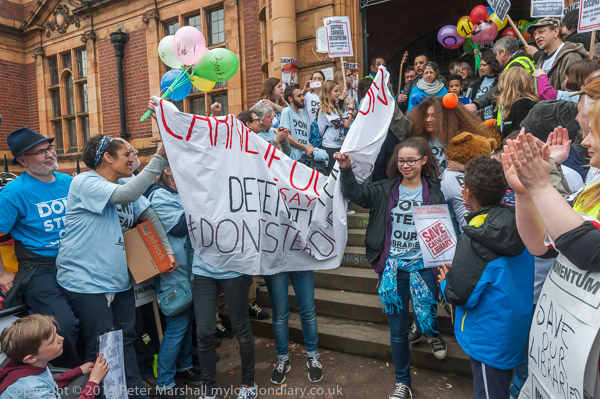
Fortunately I was just in time for the last speeches before the occupiers emerged to cheers and applause from the large crowd which filled the street outside – as you can see at Carnegie Library Occupation Ends.

A bike would not have solved my travel problem on that journey, as I would still have been held up on the first train, but it would have got me there a little faster after that. And barring accidents and punctures a bike is the most reliable form of transport, and the almost always the fastest in central London, with traffic only slightly slowing you down, even if as I almost always do, you stop at red lights.

But there are problems. The library would have been fine – just lock the bike to a nearby lamp post and get on it afterwards, but covering the march that came afterwards – March to Save Lambeth’s Libraries would have meant walking with it taking pictures and then returning to pick up the bike before going on. As it was I went with the march until just after it passed a railway station on another line before getting a train back into the centre of London – just a little faster than I could have ridden.
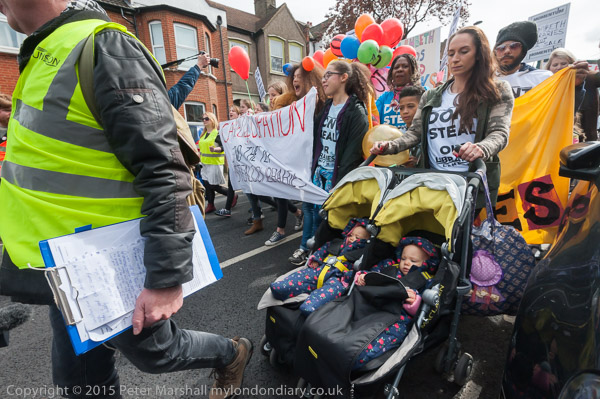
The main problem is simply carrying my kit. I’ve tried using a back-pack, which would be OK on a bike, but I don’t find it too convenient, and prefer my old shoulder bag. I can’t cycle with it on my shoulder, it’s too large to fit in a pannier. I’d need to have a bag which would double as both a back-pack and shoulder bag to keep me happy, and I’ve yet to find one suitable.

Trains (and buses) do have one advantage – and one that links with the protest I was photographing in Lambeth – that you can read on them. I never travel without a book in my bag. More seriously, libraries were vital to me when I was young, and I doubt if I would ever have got to university without my local public library and the books I was able to borrow and read. And it was there that I also developed my interest in photography, reading every week the Amateur Photographer magazine that we certainly could not have afforded to buy.

But I suppose the point of these ramblings, jogged in my mind by looking at my work on April 9th is that days like this are almost as much about ‘logistics’ as about photography. Starting with a list of events in my diary, working out which ones I intend to cover and how to get from A to B to C… Of course some things are clearly impossible, as you can’t for example be in Stratford and Hammersmith at the same time.

I often spend an hour or two on the Transport for London Web site and looking at maps planning the next day’s events. Its ‘Journey Planner‘ isn’t entirely reliable and often you need to break down a journey into several stages to get it to return the best result from public transport. Sometimes it misses the obvious or seems to have something against certain bus routes, but it’s usually a good starting point.

But using a bicycle, particularly a folding bike like my Brompton which you can put on a train or tube any time of any day would often both simplify journeys and speed them up. I ought to get myself sorted out and use it more.
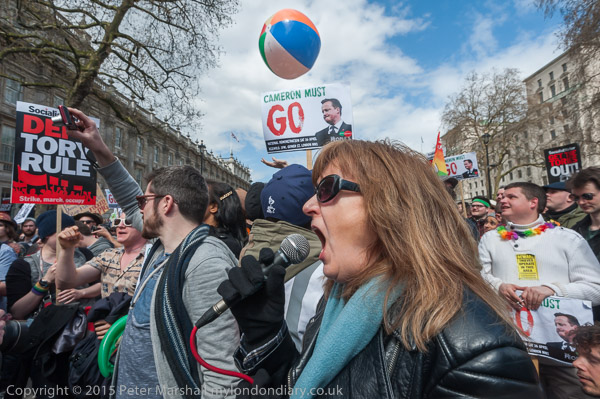
I left the libraries march close to Loughborough Junction and a train and a tube took me to Westminster and Downing St, where a couple of thousand people were partying on the street and calling for the prime minister, David Cameron to resign. Cameron must go! This followed the leaking of the ‘Panama Papers’ revealing some rather dodgy financial affairs about a great many of the rich and powerful, which since then have been largely, as usual, swept under the carpet. Eventually, but for different reasons, Cameron did go, but as I told some of those I was photographing, changing the Tory in charge isn’t going to make things any better.
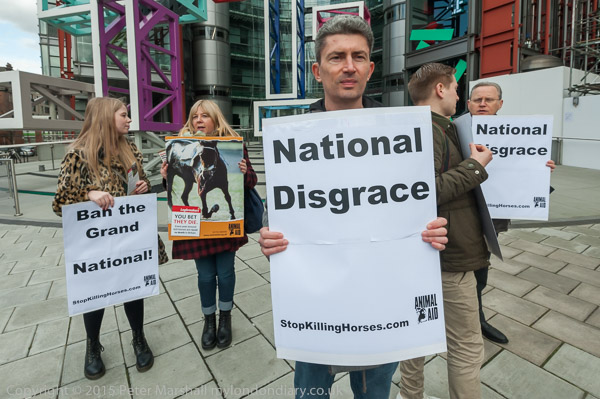
Next stop was around a mile away, rather appropriately on Horseferry Road outside the Channel 4 building, against the cruelty to horsed in races such as the Grand National which they were broadcasting that afternoon. It does seem to me an unneccessary cruelty, with four horses already having died at this year’s Aintree meeting, though I do think there are many more important issues to protest against, both so far as animal rights are concerned and also human rights. This fitted in well with my movements for the day, but I wouldn’t have gone out of my way to photograph it. And rather fewer people than expected had arrived to protest – probably fewer than were watching the race in the average betting shop. Stop Grand National horse slaughter
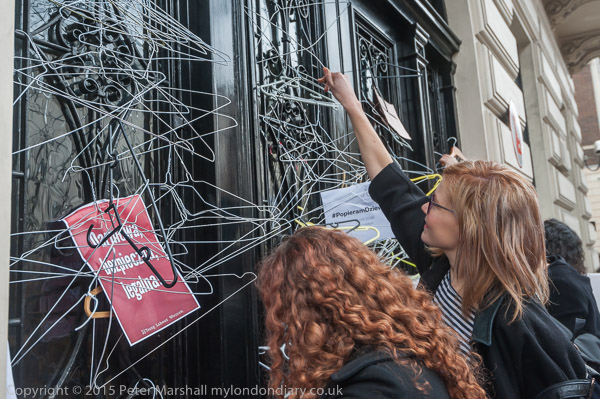
It was then a short walk to Victoria station and the tube to Oxford Circus, from where I walked north up Regent St and on to Portland Place and the Polish Embassy. Though quite a fast journey it would have been faster by bike, but I arrived as people were hanging hundreds of wire coat hangers on the Embassy door, having I think missed some speeches beforehand. Which since they were probably mainly in Polish was probably not a bad thing.  Among the wire coathangers were a few plastic ones, which would not have been of much use to the back-street abortionist, but otherwise the symbolism of this protest against plans by the Polish government to  outlaw abortions except in very limited circumstances was pretty clear.

The protest in London involved a few hundred, mainly women, but reflected much larger protests in Poland – which did eventually suceed in getting the law dropped.  Don’t Criminalise Abortion in Poland
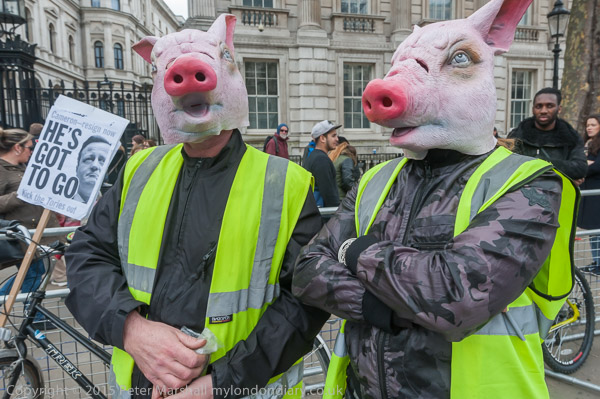

Then it was back to Oxford Circus and Westminster on the tube to return to Downing St, where the Party against Cameron was continuing, though on a rather smaller scale than earlier in the day. It had developed into rather more of a street party, less fluffy and more hard-core, mainly gathered around a bicycle-hauled sound system, and with a rather greater emphasis on Carmeron’s Bullingdon initiation pig-related activities.

Perhaps surprisingly the police seemed happy to simply watch the event rather than exercise their frequent obsession with traffic flaw and try to clear the street.  I wasn’t sure whether this merely reflected a sensible decision based on the available resources or perhaps an expression of their own views against our current government, which they feel has treated them badly in various ways. Of course the main villain so far as they are concerned is Theresa May, then Home Secretary and now the replacement for Cameron.
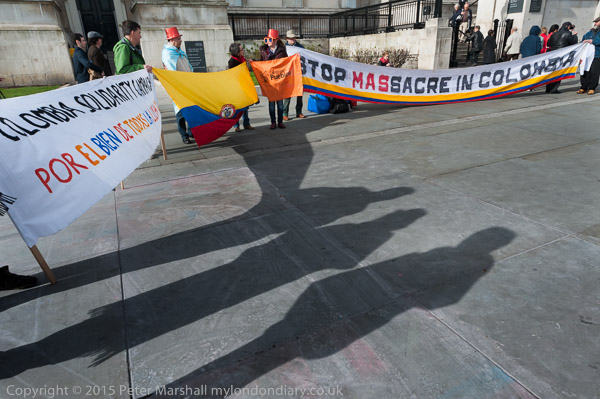
Finally it was just a short walk to Trafalgar Square, where in front of the National Gallery, Colombians were protesting against political persecution. End Killings in Colombia seemed to call for something a little more than just people holding banners and I tried to make use of some of the long shadows that some of the protesters were casting to provide a more sinister view.

Steps in the corner of Trafalgar Square then took me down to the Bakerloo line platforms for the two stops to Waterloo and my train home.

Continue reading Travelling times
Naked Greed

Long ago I turned down the chance of working in the pharmaceutical industry. I was then a graduate chemist and one of the reasons I had been attracted to chemistry was the potential for developing new drugs that would benefit humanity. But what I saw and heard when I went for an interview with one of the leading drug companies made me walk out of the door.
Drug companies justify the high prices they charge for drugs by talking about their huge expenditure on research to develop new drugs and testing them, and the sums involved are indeed large. But still less than the amounts that they spend on marketing and trying to get their drugs prescribed – even in some cases if they are not particulary effective or appropriate.
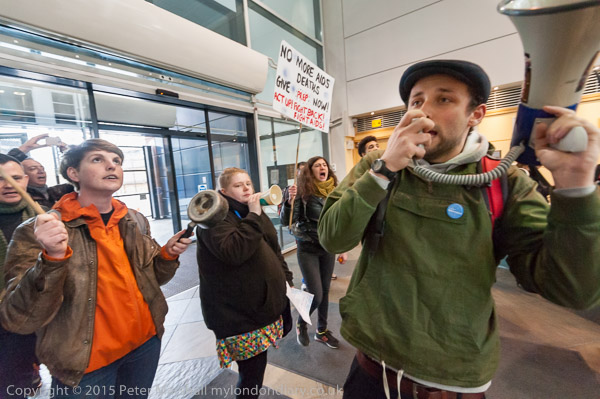
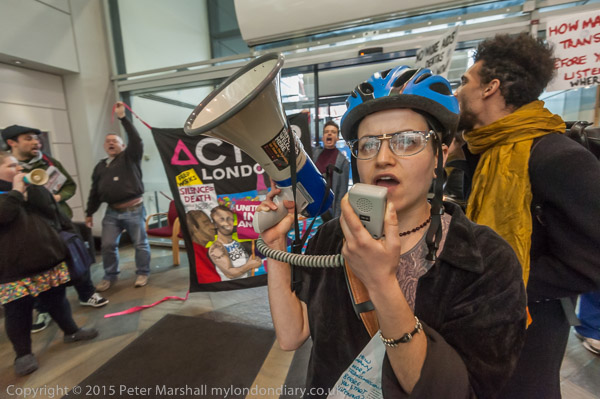
At the end of March and the start of April this year I photographed two protests by Act Up London involving medical drugs. The first was largely directed at NHS England who were refusing to accept that they should pay for PrEP, a pre-emptive treatment against AIDS, and trying to get local authorities to pick up the tab. They also announced a two-year pilot study into the use of the drug Truvada®, marketed by Gilead.

Truvada contains two drugs, Emtricitabine which was discovered in 1996 at Emory University in Atlanta and Tenovir, first made at the Academy of Sciences of the Czech Republic and patented in 1984, though it needed research by Gilead and others to produce a derivative that was readily abosorbed – and this was approved for use in the USA in 2001.

Gilead has had a long period to recoup the costs of their research, but they are still charging premium prices for both PrEP (Truvada) and for other drugs such as Harvoni, an effective treatment for Hepatis C. A month’s supply of Truvada costs the NHS £355, while a generic alternative – effectively the same – would cost a fiver. A 12 week course of Harvoni costs the NHS around £39,000, while there are various ways to obtain a generic alternative (made in Bangladesh, India or Australia) for less than £2,500 for the same course – around a sixteenth of the cost.

The protest at NHS England – next to the Bakerloo line Elephant & Castle terminus – was pretty conventional, with a short rally outside after which protesters rushed in past security and made a noisy protest inside until police arrived and they left to continue their rally outside.

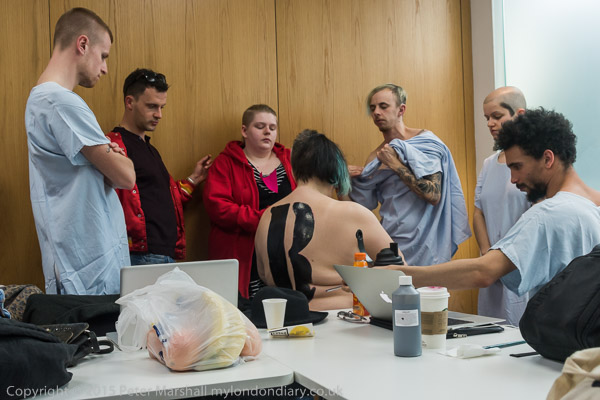
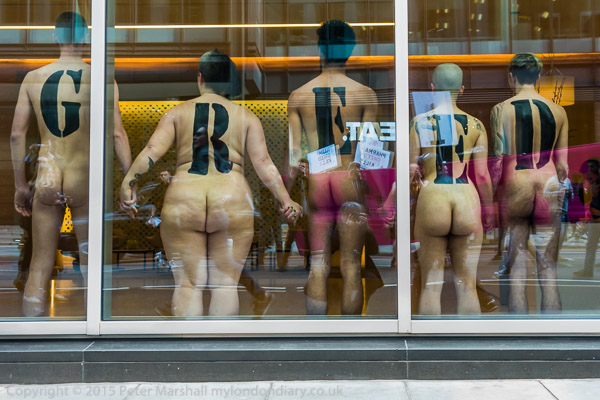
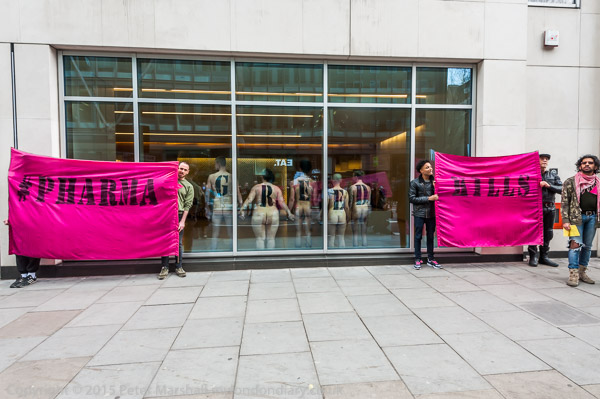
At Gilead’s offices on High Holborn it was a different story, with the protest being kept secret and preparations being made a short distance away before walking to the location, where a group of five protesters walked inside and stood in the window, dropping the gowns they had worn on the way there to stand naked with large painted letters G R E E D on their backs.

Photographically it was rather tricky, as the glass reflected too much light. I hadn’t known in advance what form the protest would take. I don’t think a polarising filter which is often used to cut reflections would have helped as it really needed to be photographed ‘head on’ when they make no difference. Although I don’t usually direct people I’m photographing I did go inside the office and ask the five to move right back as close as they could to the glass, which did make them a little more visible, but the image owes rather a lot to Lightroom and work on the bodies to bring them out.

The full image that the protesters wanted – the five naked bodies spelling out ‘GREED’ with the two banners, one each side reading ‘#PHARMA’ and ‘KILLS’ presented another insurmountable problem, that of aspect ratio. As you can see there were large areas of fairly empty space both above and below that line reading #Pharma Greed Kills. It would have made a picture with an aspect ratio of 4 or 5:1 rather than the 1.5:1 I was using.

Act Up invade NHS to demand PrEP
Act Up protests Gilead’s naked greed
Continue reading Naked Greed