The Salgado Effect

Like me you have probably seen the set of pictures by Kevin Frayer published by The Guardian Documenting the Rohingya refugee crisis – in pictures.

They are a powerful set of pictures and I have a great deal of admiration for the photographer having gone to document the situation and managing to photograph scenes such as this. But I also found myself feeling a little uneasy at certain aspects.

I think I remember years ago Don McCullin discussing the dangers of aestheticising scenes of violence and death, I think in relation to working in Biafra. Obviously we need to produce powerful images using the tools at our command, but there comes a point where making pictures out of scenes conflicts with showing the brutal realities.

I’m also a little disturbed by the use of black and white rather than colour in these and many other sets of images, the huge majority of which are actually made in colour. Perhaps Frayer worked in black and white either on film or on that Leica M Monochrom but the images have a look that owes much to software. With many photographers conversion to black and white is simply an affectation that makes them think their work is more documentary, or perhaps reflect their admiration for the work of photographers such as Salgado (whose work sprang to my mind looking at some of these pictures), Frayer (or his post-production team) certainly take full advantage of its possibilities, much too full for my taste.

Photographers have long taken advantage of the possibilities offered in the production of their images, whether in darkroom or with Silver Efex. Where would Gene Smith’s Spanish Wake be without the hours (and the ferricyanide and whisky) in the darkroom? But as Horacio Fernández comments on this image, the selection of pictures for Time’s 1951 Spanish Village essay (one of the landmarks of photojournalism) were made “paying more attention to beauty and emotional meanings than to information and political commentary.”

Of course, as Smith said, “The honesty lies in my—the photographer’s—ability to understand…I will retouch.” And we all do to some extent. Some of my pictures have a little help from Lightroom’s ‘Clarity‘ brushed delicately on faces or elsewhere (though mainly I work rather less aggressively with a little added exposure and contrast – it’s something that has enabled me to largely move away from using fill-flash.) But in these images it has been applied with a shovel not to enhance what was there but to create a deliberate and to my eyes un-photographic effect. Some of these images are well onto the way to becoming film posters for the crisis rather than exposing it to the world.

In How not to photograph the Rohingya genocide in the making… Suchitra Vijayan examines these pictures and also features a lengthy YouTube video of a talk with writer Maaza Mengiste, Unheard of things – the vocabularies of violence. I’ve not listened to all 88 minutes, but it is worth starting as I did at 38:10.

And here’s another set of photographs – also in black and white – of the crisis. Less dramatic, less aestheticized, less post-produced but I think that Greg Constantine work is somehow more real and tells the story better. And there are other pictures both black and white and colour that do so too.

International Women’s Day 2017

The Socialist Party of American organised the first Women’s Day to take place on March 8th, although theirs was a ‘National Women’s Day‘. The idea of an International Women’s Day was adopted by the 1910 International Conference of Socialist Women and in 1911 it was celebrated on March 8th in United States, Switzerland, Denmark, and Austria but in Germany and elsewhere of March 19th. It was not until 1914 it was adopted worldwide. In London on March 8th 1914 the Suffragettes marched from Bow to Trafalgar Square.

Universal female suffrage was the main demand of those first marches, but they also had a whole range of other demands, including labour laws to guarantee women’s rights, free social childcare and education, equal treatment for single mothers, international solidarity and the overthrow of capitalism.

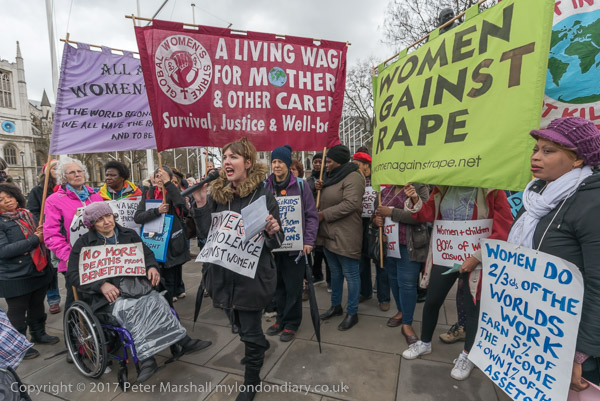
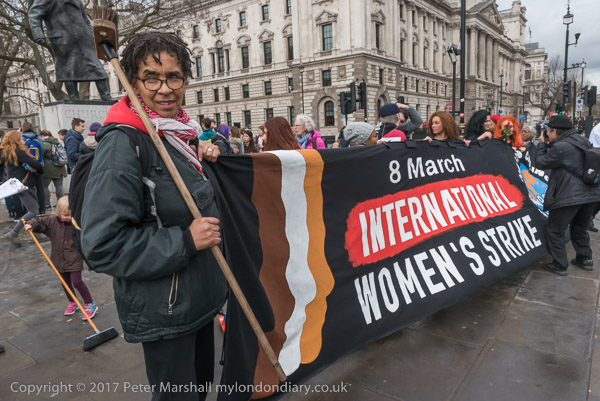
A protest in Parliament Square March 8th – also Budget Day – by Global Women’s Strike in solidarity with the International Women’s Strike (IWS) taking place in 46 countries was firmly in this tradition, and there were contributions from groups supporting women, including the victims of domestic violence, the disabled and the victims of family courts. Later they went on to hold a vigil on the steps of St Martin-in-the-Fields in solidarity with the farmers of the Southern Peasant Federation of Thailand, many of whom are women.

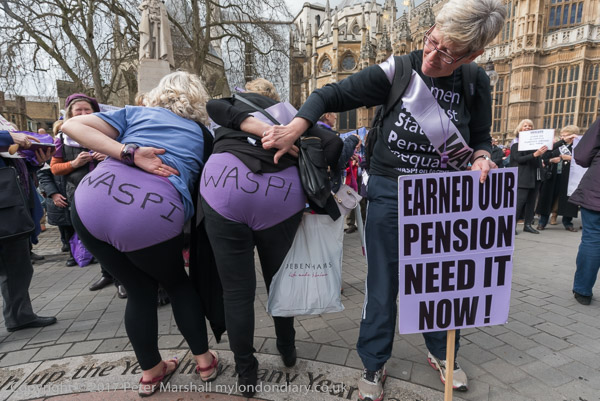
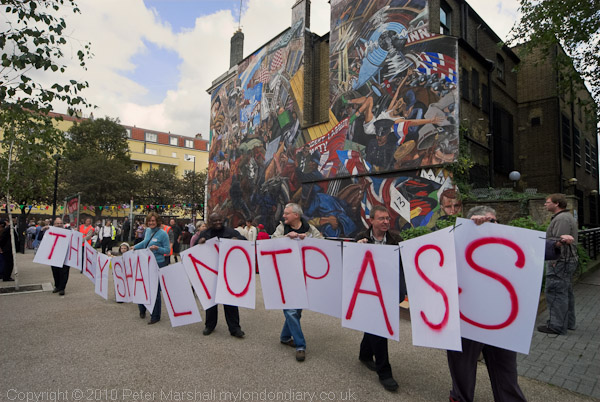
A short distance down the road, Women Against State Pension Inequality – WASPI – held a rally against the changes in the state pension scheme which are unfair to women born in the 1950s. Although the effects of the The 1995 Pension Action Act which set out the plan to equalise the pension age for men and women were well publicised, little warning was given when the 2011 Pension Act accelerated the process for this and for raising the pension age, and there was too little time even for those women approaching pension age who realised what was happening to make alternative plans.

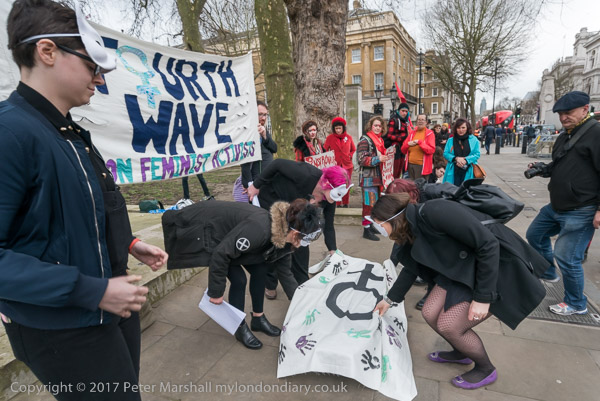
Later in the day opposite Downing St Fourth Wave London Feminist Activists staged a protest against the unjust, ideologically-driven cuts to public services that are disproportionately felt by women, and also against the way that International Women’s Day despite its socialist roots has been appropriated with the media giving extensive coverage to corporate events concentrating on getting more women in boardrooms and other highly paid jobs.

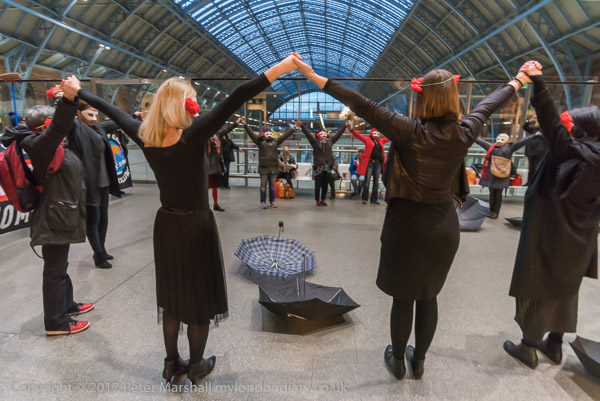
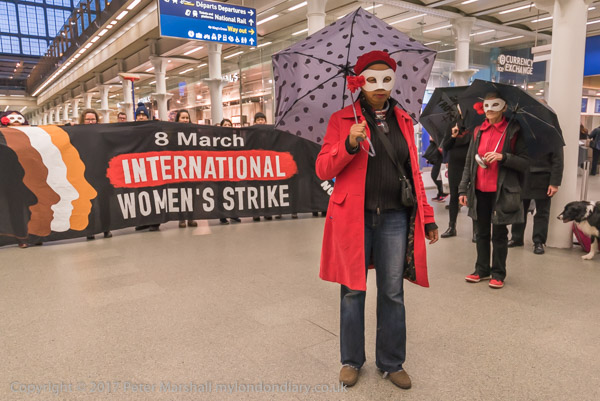
I ended my day with London Polish Feminists and Global Women’s Strike (again) at St Pancras for an International Women’s Day flash mob at St Pancras International in solidarity with women in 46 countries taking part in the International Women’s Strike. It was a colorful event, and the colours were black and red – clothing, umbrellas, masks and flowers – choreographed by the Polish feminists. After a rehearsal in the station foyer the group went down into the concourse and gave a performance there.

They had apparently requested permission for the event, but when it was refused decided that they would go ahead in any case. Police came to talk with them but didn’t stop it.

More from all of these events – and a rather curious Russian gesture which perhaps reflected a more misogynistic attitude to women:

From Russia With Love
International Women’s Strike
Vigil for Thai Farmers
Death By A Thousand Cuts
WASPI at Parliament

Continue reading International Women’s Day 2017

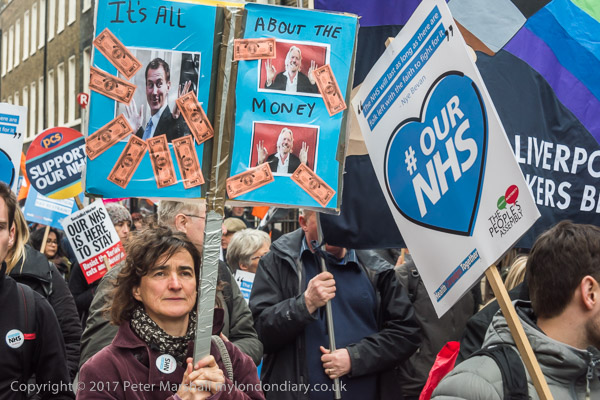
Save Our NHS

It’s never easy to estimate the size of large marches, though sometimes I try. With small marches you can simply stand on the side and count as people walk past, but this gets tedious with more than a few hundred. Even on fairly small marches it soon becomes impossible to actually count every person, as sometimes people are in crowded groups, hard to actually be sure you see everyone, and I have to estimate groups of ten as they move past, but probably my count is withing a few percent of the total.

With large marches a different approach is needed. I try and pick a typical section of the march and take a count for a minute. And then use the time it takes the march to go past a particular place somewhere in the middle of the route. Some marches have large gaps, and an allowance has to be estimated for that. Using methods like this I’d hope to be somewhere in the right area, and unlikely to be more than perhaps 25% out. So if around 500 people go past in a minute, and the whole march in around an hour, then there were roughly 30,000 taking part – as was the case for this march.

Once it used to be good enough to average out the estimates from the organisers and from the BBC, or perhaps just double the police estimate, but the police seem to have stopped giving out their numbers and the BBC and march organisers have both become completely unreliable – and the BBC hardly notice most marches.

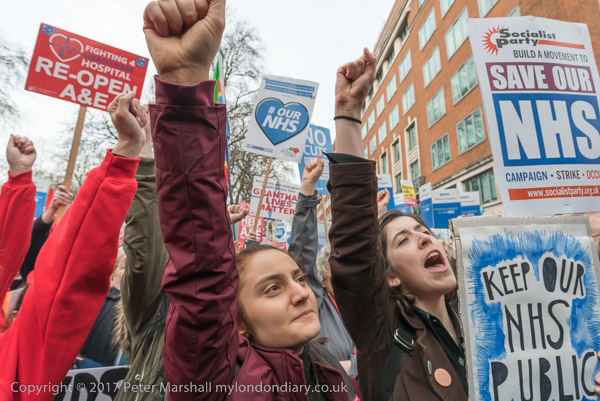
The Save Our NHS march was certainly a large one, certainly one of the largest if not the largest so far this year, but the organisers’ claim of 250,000 was unbelievable. Making exaggerated claims is I think counter-productive and undermines the credibility of the event and the claims, which is unfortunate.

This was a very large march, and one that reflects a huge degree of public support – though unfortunately many are not aware of what is happening to the NHS. Of course there are reports about the state of the NHS in the media, but they seldom do more than report its failings and seldom examine the reason behind them. The privatisation of services has been taking place for years now, with private healthcare companies taking over the simpler aspects of the NHS that are easy to profit from – and whose low costs used to offset the more complex and expensive treatments, but relatively little of this has been made clear in the media.

The increasing use of agency staff too, and the financial implications of that has failed to get the attention it deserves, despite the terrible financial drain it represents (as does huge amounts spent on largely unnecessary fees for consultancy.) It’s only very recently that public debate has begun to recognise the terribly corrosive effect of PFI contracts – started under John Major but largely negotiated under New Labour – has had, something which those in the NHS and activists have been aware of and calling for government action over at least since the financial crash completely changed the environment under which they were agreed.

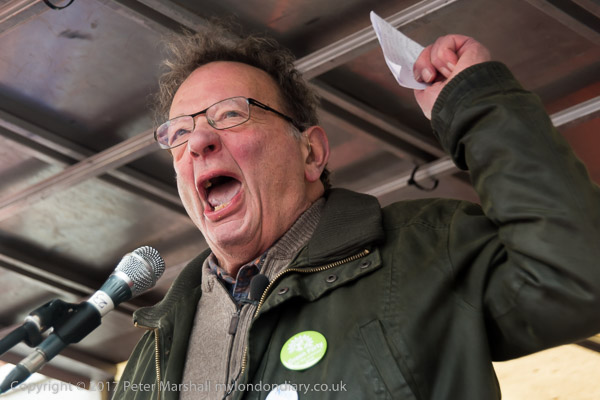
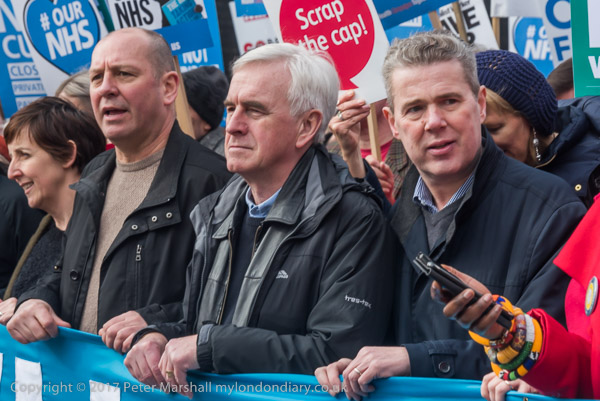
There had been a rally at the start of the march which I’d photographed some of the more interesting speakers, including Green Party Health spokesperson Larry Sanders (Bernie’s brother) above, and there was to be another at the end in Parliament Square, but I didn’t make it there. Doubtless there would have been speeches from political and trade union leaders – Jeremy Corbyn, John McDonnell, Len McCluskey and someone from showbiz, but I’d had enough when I reached Trafalgar Square. Plenty of others would be photographing the speakers and I was tired and didn’t feel up to facing the scrum.

I’d already taken a great many pictures – some great placards and posters and many interesting people. You can see quite a few of them at Save our NHS March.

Continue reading Save Our NHS

£50 Lottery

Although it’s for a good cause, I probably won’t be buying one of the 1,250 tickets available matching the number of postcard-sized photographs showing from 12th- 25th October at Theprintspace in Shoreditch. Though it would mean getting a unique print will be an edition of one with a signed certificate of authenticity I’m not sure what I would do with it, and although there are some excellent pictures in those I’ve so far seen, there are also a number I certainly wouldn’t like – and this is a lottery.

But I also don’t like the idea of limited editions of any size in photography. I’m happy to get photographs from other charities I donate to, but they come in mass-printed magazines and handouts that, after reading and appreciating I happily recycle. But I’d find it hard to put a limited edition print in the rubbish, and feel if I intended to sell it on eBay that maybe it isn’t charity but a money-making exercise.

Of course The Hepatitis C Trust is a worthy cause, and their aim to eliminate Hepatitis C from the UK by the year 2030 deserves support. And if this exhibition encourages more people to donate £50 its a good thing, but somehow it just doesn’t feel my thing. I kind of hope it is yours, which is why I’m writing about it.

I read about Photography on a Postcard today on It’s Nice That, an organisation that “believes passionately that creative inspiration is for everyone” and publishes on the web and in print and organises events including a monthly Nicer Tuesdays in Bethnal Green, London.

I’d also read about it earlier on the British Journal of Photography, which has a longer article with more pictures, but which rather put me off the idea of buying a ticket.

I can’t find anything about it on Theprintspace web site, though I’m sure it will appear their shortly. I’ve several times used them to make prints and always been satisfied with them and the prices are pretty keen, though not the cheapest. You can actually buy three of my Bow Creek prints from the Cody Dock show through them, though rather more expensively than the postcards – but they are larger prints.

You can see all the photographers and around half of the cards (some photographers donated several images) at the Photography on a Postcard site, where you can also buy your £50 lottery ticket. The computerised draw is on on Monday 30 October.

Perhaps I might…I think I’ve almost persuaded myself. But don’t delay as I’m sure the tickets will sell out soon – probably by later today after I publish this!

Bow Creek

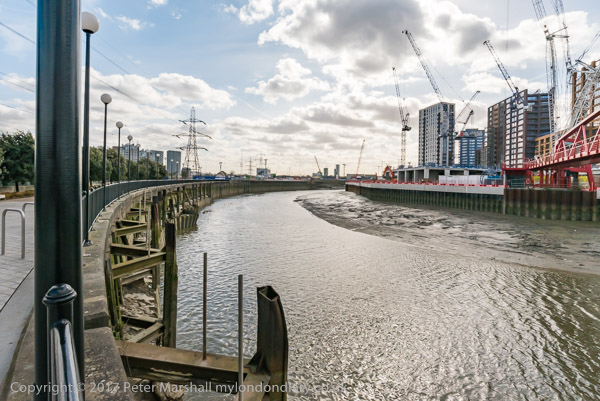
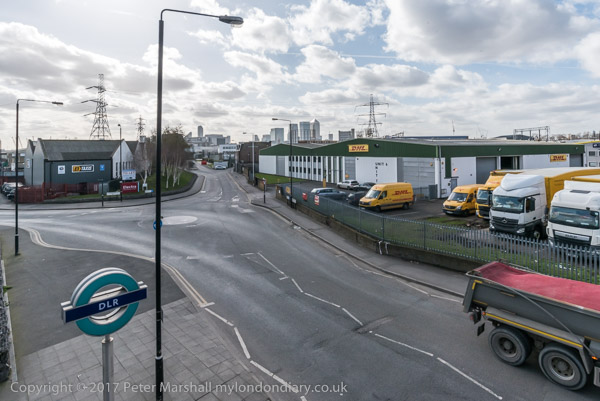
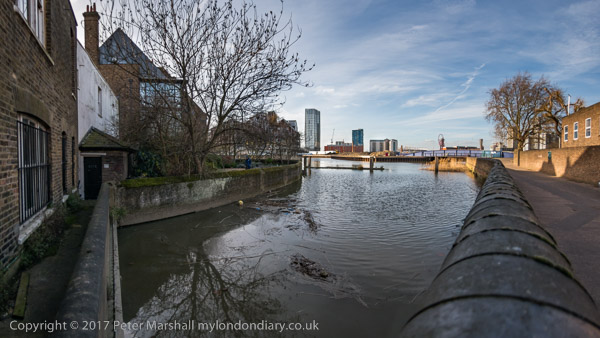
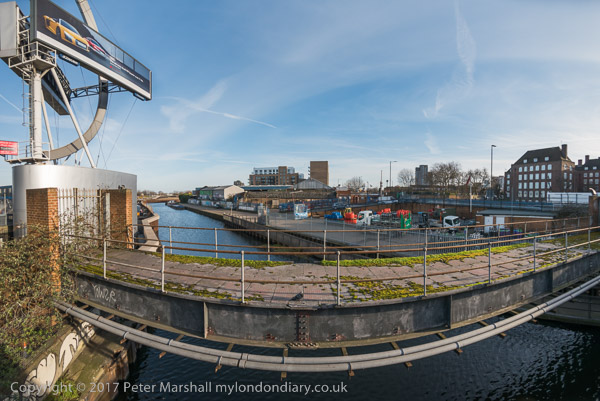
March 2nd I was going to see people at Cody Dock on Bow Creek, but it was such a nice day that I decided to go early and walk there from Canning Town and afterwards to walk to Stratford. Things didn’t turn out quite like that, as the bridge over the DLR I’d hope to walk across was firmly barred and this meant a longish detour.

I’d hope also to be able to walk beside the creek from the East India Dock Rd, where a path exists along much of the way, but again there was no access, and time was getting short, so I had to go back to Canning Town and take the DLR to Star Lane to get to my meeting on time.

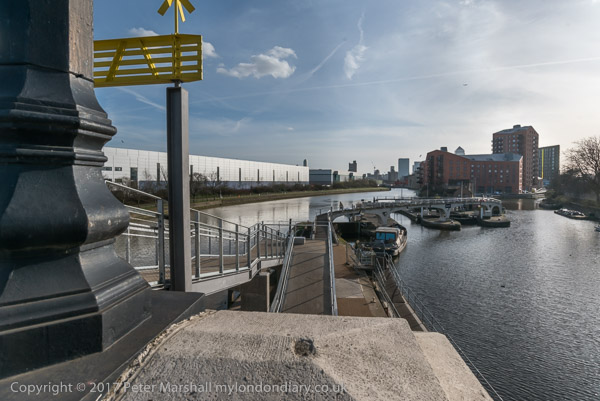
Paths beside Bow Creek seem to pose special problems. There was a path next to Canning Town Station for over 20 years before the access to it from Canning Town was finally opened up, and that closed bridge I wanted to use had been closed for many years too, opening only for a brief period. The walkway from Canning Town still ends a few yards south of the station entrance, but had been planned to take you all the way down to the Thames at Trinity Buoy Wharf, with the aid of a new footbridge. But money ran out, the bridge was never built and Crossrail works still block the path.

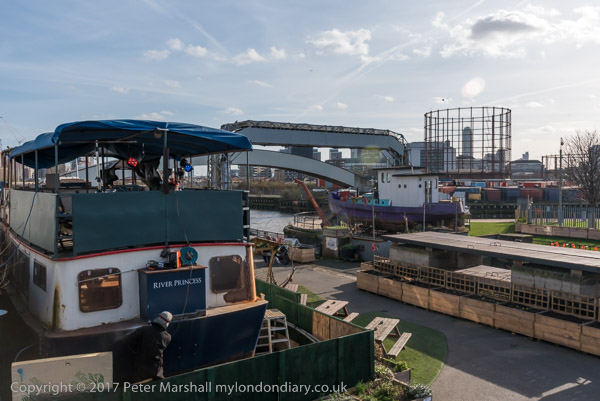
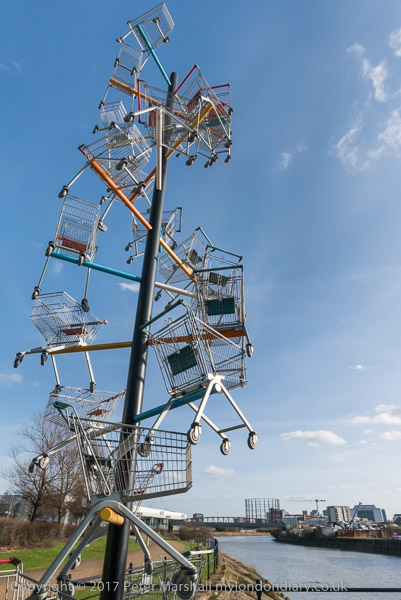
At Cody Dock, the path south is still blocked, though it is already laid out, and it would be possible if rather dangerous to climb around to get onto it. But one of the bonuses of the development of Cody Dock is that it is now possible to walk north from there along what was previously a path that came to a dead end. My route here is a part of East London’s sculpture trail, roughly following the Greenwich Meridian, ‘The Line’, a splendid initiative but which would be a much better walk if it could include a further length of path alongside Bow Creek.

It’s thanks to Cody Dock too, that the path south from there will hopefully soon be open (if it isn’t by the time you read this.) They proposed and helped negotiate this rather more obvious route rather than the much more expensive earlier plans for a new footbridge and a path through the former gasworks site on the opposite bank – which again fell through for lack of cash.

Further north, there was one long awaited improvement now open, with a ramp leading down from the bridge at Twelvetrees Crescent. Previously the route here required a detour alongside the busy approach road to Blackwall Tunnel, where the traffic fumes can be cut with a knife.

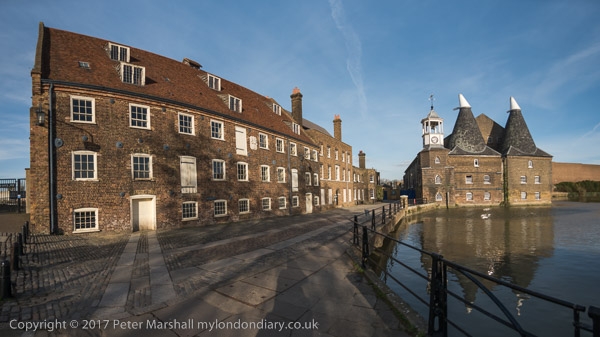
I’m still surprised to come across Londoners who don’t know of London’s most important industrial heritage site at Three Mills. The Grade I listed House mill may only be an eighteenth century building, but a mill here was in operation at the time of the Domesday book and this is not only the earliest recorded example of a tide mill but is thought to be the largest surviving tidal mill in the world. The Three Mills complex is also of some more recent historical import, as it was here in Nicholson’s Distillery that Chaim Weizmann set up a pilot plant for an improved fermentation method to produce acetone, vital for the production of cordite, on an industrial scale.

Weizmann’s contributions to the war effort were important in gaining the support from the UK government for his Zionist proposals, and were almost certainly an important factor behind the Balfour Declaration of 2nd November 1917 – and certainly Lloyd George was clear abou this in his later War Memoirs, though some historians are rather sniffy about it, and there had been lengthy series of meetings and talks before. The final draft of the declaration stated:

“His Majesty’s Government view with favour the establishment in Palestine of a national home for the Jewish people, and will use their best endeavours to facilitate the achievement of this object, it being clearly understood that nothing shall be done which may prejudice the civil and religious rights of existing non-Jewish communities in Palestine, or the rights and political status enjoyed by Jews in any other country.”

Weizmann, who had been a leading Zionist since the era of the first Zionist conference in 1897, became the first President of Israel in 1949, having previously been Chairman of the Provisional State Council of Israel since the previous year, and continued in office until his death in 1952.

The water was high behind the mill and their were warnings of floods, but fortunately I was able to make my way to Stratford High St without getting my feet wet. I walked down to the Lea Navigation, where I took my first pictures of the Lea many years ago.

After walking around the area a little, I made my way back along the High St to the DLR station, returning to the East India Dock Road to take some pictures here I had not had time for in the morning. By now the sun was very low in the sky, and this made working difficult.

You can see more pictures from my walks on My London Diary

Bow Creek & Canning Town
Cody Dock
Leawalk to Bow Locks
Three Mills & Stratford

Continue reading Bow Creek

Cable St & Bermondsey

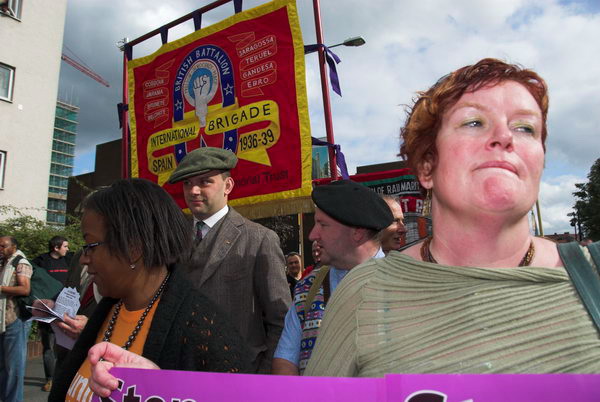
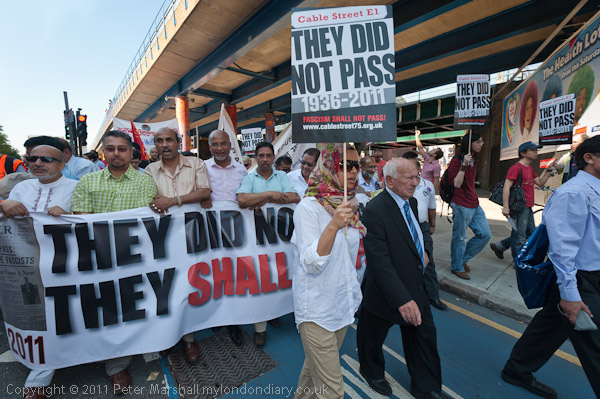
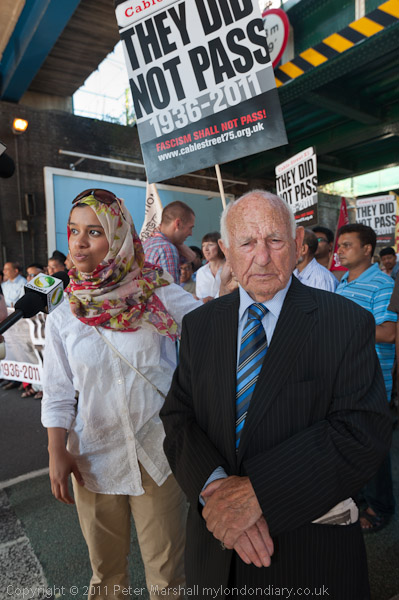
I meant to write yesterday about it being the 80th anniversary of the Battle of Bermondsey, probably an even greater street fight against the fascists that took place a day before the first anniversary of the Battle of Cable St, and perhaps more decisive.

Although we celebrate Cable St as a pivotal moment in the fight against Fascism, as historian Daniel Tilles points out it was actually followed by an increase in membership and support for the fascists in the East End, an an increase in anti-semitic propaganda and physical attacks on Jews.

You can read a newspaper report of the battle in an Australian newspaper online, as well as a blog post The Battle of Bermondsey by Lydia Syson, and it is also mentioned in a more general article with the lengthy title British Union of Fascists and the East End battles that ensued, a history worth revisiting.

I think many might question the conclusion that Tilles draws from the events, suggesting that the kind of street activism represented by both Cable St and Bermondsey is counter-productive. We can after all only speculate on what the consequences might have been had the two marches by Mosley been unopposed or met by entirely peaceful protest rather than stopped. Fascism at the time was clearly on the rise and backed by many in the British establishment and perhaps needed to be fought both on the streets and by more moderate methods which he suggests were more effective.

But it was international events which were eventually decisive both in making clear the true nature of the fascist threat and a war far more violent than street resistance that brought a more decisive end to fascism, though it lingered on after the war it was clearly a sad and broken movement.

Of course it never entirely went away, with various lunatic fringe organisations over the years, more recently in groups such as Britain First and the EDL that I’ve photographed. And it would I think be hard to argue that the kind of active on-street opposition to these groups by Unite Against Fascism and Antifa generally has acted as a recruiting sergeant for them.

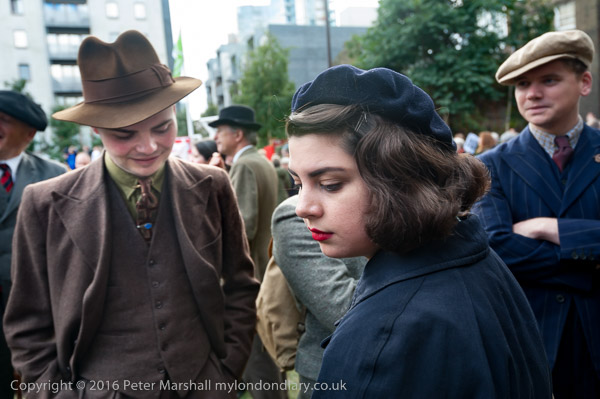
My pictures are of the Cable St anniversary events in 2006, 2011 and 2016 and you can see more on My London Diary:

Cable St 70th anniversary -2006
Cable St 75th anniversary – 2011
Battle of Cable Street 80 Rally
Battle of Cable Street 80 March
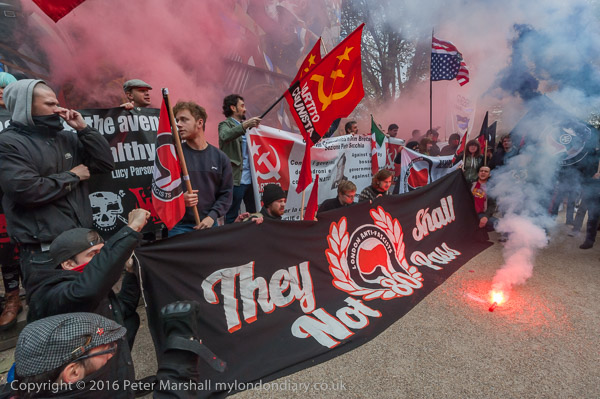
Black bloc rally at the Cable St Mural

Continue reading Cable St & Bermondsey

Business as Usual

One of the reasons I post here about my work on My London Diary earlier in the year is to check up on that web site. In some ways its a rather primitive site, a throw-back to the early days of the web, entirely hand-coded, though usually with the aid of an ancient version of the best WYSIWYG software, though now that outdated description ‘What You See Is What You Get’ no longer really applies, and what I see when I’m writing the pages is very different to the web view.

I first designed the site back in 2001, and even then it was somewhat archaic, reflecting my views on simple web design at at time when flash bang and wallop was infecting the web, largely running on our relatively slow connections that weren’t ready for it. Designing image-loaded sites like this that were reasonably responsive was something of a challenge, and needed relatively small images carefully optimised for size, with just a small number on each page.

Although the site still has the same basic logical structure, times and the site have changed a little to reflect the much higher bandwidth most of us now enjoy, with several re-designs and many more images per page, as well as slightly larger and less compressed images. Size is now more a problem of controlling use (or abuse) of images than download time, and new images are now always watermarked, if fairly discretely. The latest small changes in design have been to make the pages ‘mobile friendly’ without essentially changing their look.

I suspect that My London Diary is one of the largest hand-coded sites on the web – with over 150,000 images on over 10,000 web pages. But the simple site design means the great majority of the time involved in putting new work online isn’t actually the web stuff, but editing the images and writing the text and captions, so there is little incentive for me to move away from hand-coding.

But I’m not really a writer of web sites (though I have quite a few as well as My London Diary) or this blog but a photographer and though My London Diary is important in spreading my work and ideas, it has to fit in with that. Often the web site gets written late at night or when I have a little time to spare before rushing to catch a train, and often I have to stop in the middle of things to run to the station – or fall asleep at the keyboard. So while in theory I check everything, correct my spelling and typos, make sure all the links are correct and so on, there are always mistakes. And just occasionally my ISP has something of a hiccough and puts back an earlier version of a page or loses or corrupts an image (though they deny it.)
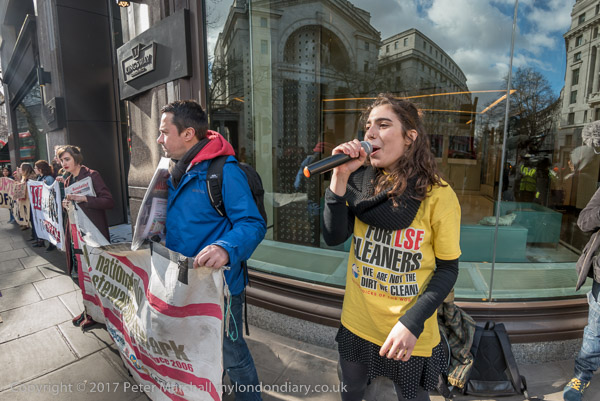
This morning I opened the pages on End homophobic bullying at LSE , the first protest I covered after returning from Hull, only to find I’d not put any captions on them, not even adding the spaces between pictures for them to go in. So before I started to write about them I had work to do.

Otherwise I might have had more to say about the pictures. Yet again how useful the fisheye can sometimes be, or about reflections in pictures or to fulminate against homophobia, the failure of LSE management to live up to the pricinciples the instituion espouses, the inherently evil nature of out-sourcing and the need to treat everyone with dignity and respect and to pay a proper living wage. But today you can relax and take that as read.

The pictures are workmanlike, they serve a purpose, do the job, but it wasn’t one of my better days. Dull weather perhaps didn’t help, but sometimes the magic just doesn’t happen. The following day was perhaps a little better (I’ll let you decide) and certainly much busier, with pictures from five events.
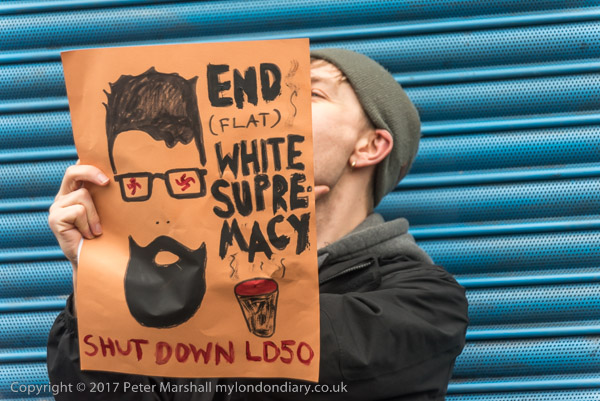
I started with Shut race-hate LD50 gallery, a crowd outside the place which they say “has been responsible for one of the most extensive neo-Nazi cultural programmes to appear in London in the last decade” ,  but didn’t really offer a great deal to photograph. The gallery itself was on the first floor above  a shuttered shopfront, and had clearly had a brick through a window, and there were a couple of arguments outside, but mainly it was scattered people standing in small groups on the street.
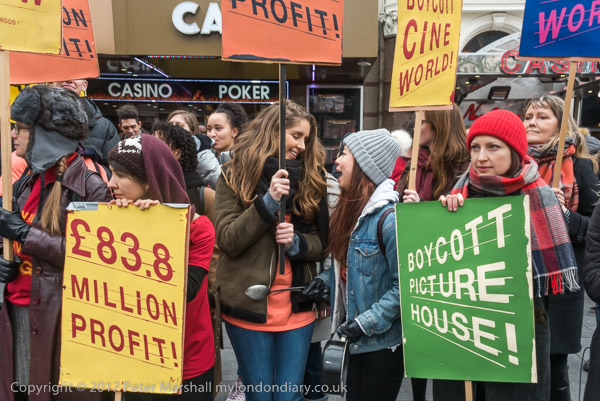
Trying to do too much, I arrived late and left early for the Picturehouse recognition & living wage protest in front of the Leicester Square Empire.  There’s a pleasant symmetry in the picture above, but I missed the scrum later when Jeremy Corbyn arrived to give his support.

It’s always difficult to know when to leave (or arrive) at events, and photographers spend many hours standing around waiting. But I’m impatient by nature and sometimes miss things. Other times I find a place to sit and read a book, and if its a decent book have been known to miss the action.
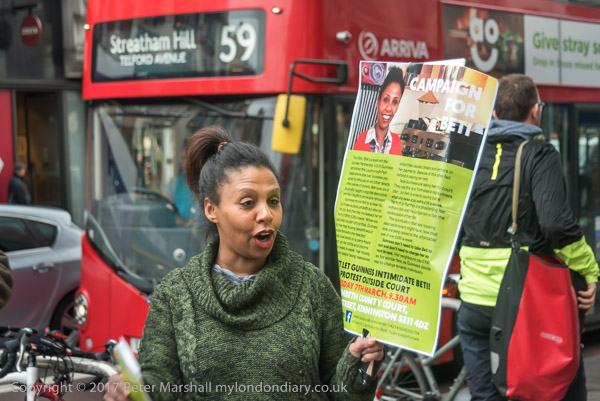
But I was in Brixton, meeting Beti, a victim of gentrification and social cleansing, not in her case by one of the mainly Labour London councils but the Guiness Trust, formed by a great-grandson of the brewery founder in 1890 to provide affordable housing and care for the homeless of London and Dublin and now as The Guinness Partnership owning 65,000 homes in England.

Betiel Mahari lived in one of these with her family on the Loughborough Park Estate in Brixton for ten years, paying a ‘social ‘ rent but was never given a secure tenancy. Guiness demolished her flat in 2015, giving her a new flat a few miles away in Kennington – but at a hugely increased ‘affordable’ rent, going up from £109 per week to £265.  The move meant too she was unable to keep her full-time job as a restaurant manager, and is now on a zero-hours contract as a waitress and facing eviction as she cannot pay the increased rent.  DWP incompetence meant that her benefits were suspended completely for three months (and on zero hours contracts the benefits have to be re-assessed every three months in any case) and Guiness were taking her to court over rent arrears.

The case was heard around 10 days later and as thrown out by the judge who ordered the Guiness Partnership to pay Beti’s court costs, but the struggle to get this rapacious ‘social’ Landlord to treat her and others in similar straits continues. I was pleased to be able to support her, though not entirely happy with the pictures at Stop Unfair Eviction by Guinness, which also include some of Brixton Arches.

I arrived back in Westminster just in time to meet the Khojaly marchers coming down Whitehall to end their protest in front of Parliament.  Few of us will remember the massacre on the night of 25-26 February 1992 when Armenian forces brutally killed 613 civilians in the town of Khojaly, including 106 women and 83 children, but the name Nagorno-Karabakh  may prompt some memories. In 25th anniversary of Khojaly Massacre I try to give a little background to the still unresolved situation.
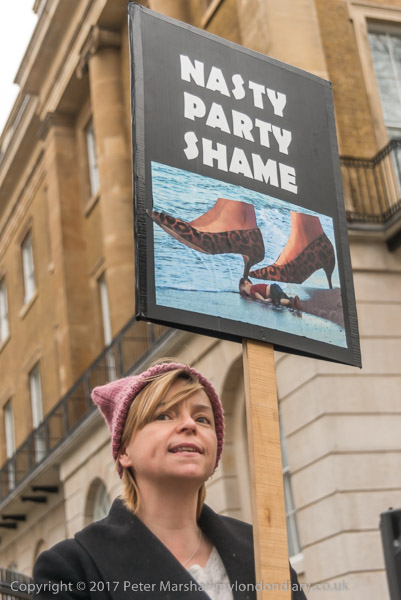
But I was on my way to an event marking the shameful failure of Theresa May and her government to take the action demanded by Parliament to bring the great majority of the refugee children stranded at Calais and similar camps into this country. By passing the Dubs Amendment, Parliament made its view clear and it reflects a failure of our constitution that there seems to be no legal mechanism to force the Tory government to carry this out. This is truly a stain on our country’s history and May and her cabinet deserve to be behind bars for this crime against humanity.

Dubs Now – let the children in

Continue reading Business as Usual
More Hull

There really is so much to see and do in Hull, though the city is not so huge as to feel unapproachable, as can sometimes be the case with London. Most of what is more interesting is within walking distance of the city centre, and what isn’t is largely a short bus ride away.

Though there are parts of Hull that are rather cut off, particularly by the A63, a busy major trunk route that was pushed through south of the city centre with little or no regards for the movement of local people. It was of course necessary, but while other cities might have got a by-pass, Hull got a through-pass.

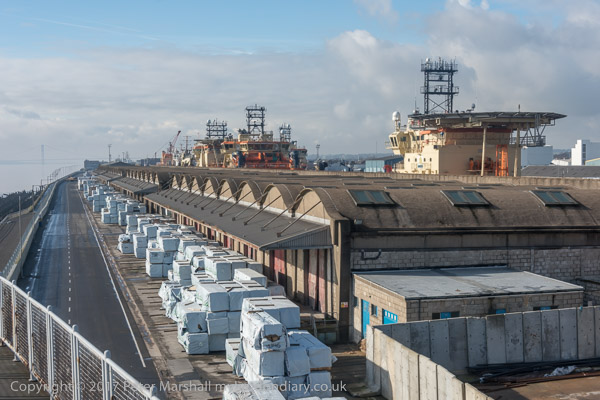
It went partly through former dock areas but split the old town in two, cutting off its southern tip, with its marina, wholesale vegetable trade and the redundant pier, none of which were greatly valued by the authorities responsible. There were plans for a wide pedestrian overbridge in time for Hull2017 to give easy access to Hull’s new leisure area but this never happened. Getting across on foot requires a lengthy wait at one of a couple of pedestrian crossings, or a longer walk around to the one road that goes under the A63 where it rises to cross the River Hull.

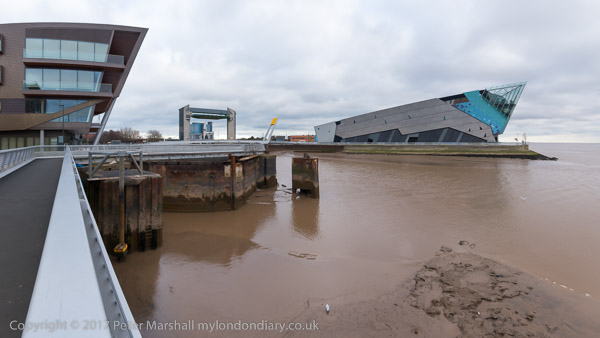
But it does mean that it is much easier for visitors to get to Hull’s most popular tourist attraction, The Deep. Worth a visit if only to go to the cafe, where you can climb the stairs to the upper level viewing area. You don’t have to pay and can walk past the queues, and though I can’t recommend the food, at least it isn’t silly expensive like at many tourist attractions.

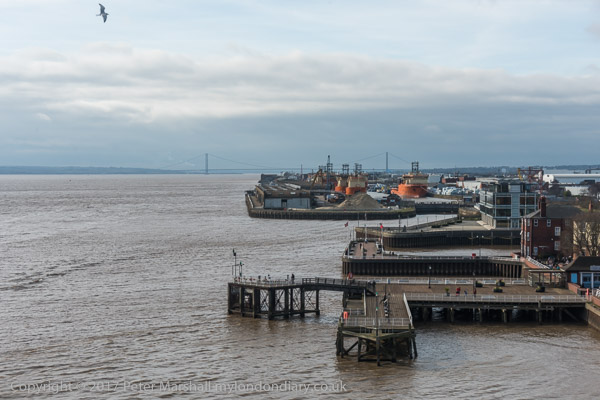
Mostly you will be looking through glass, and it can’t be easy to clean so your vision will be slightly impaired, but you will be spared the wind and rain. It was quite blustery on the small outside area, and the view is a little limited, but does give a splendid view of the Western Docks.

The Deep

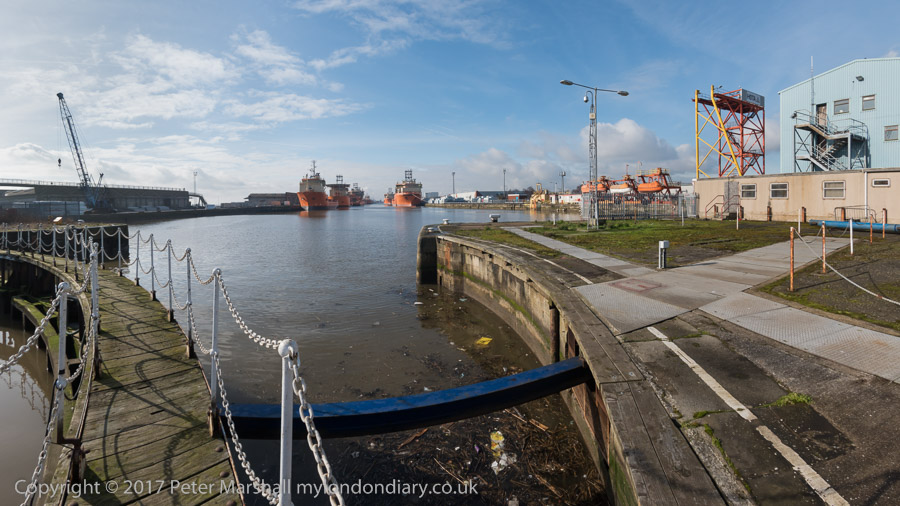
But better still you can visit these on foot, taking a few steps along the Trans-Pennine Trail, my favourite Hull footpath. If that rather flimsly looking lock gate puts you off, there is a much more solid structure as an alternative at the East end of the lock, and from either you go up onto the rooftops of the Riverside Quay.

Albert Dock

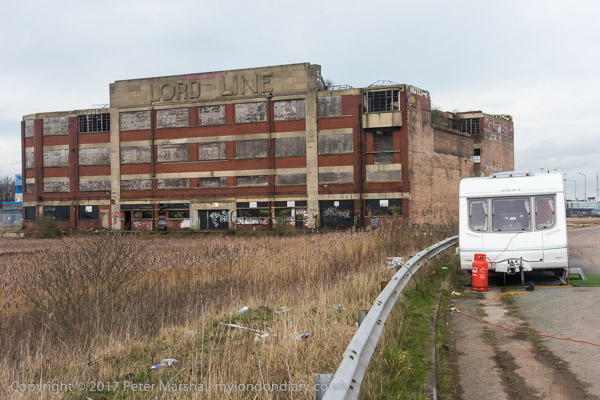
Walking along there, or taking the bus out along Hessle Rd to West Dock Ave and then finding the rather well camouflaged path under the railway and Clive Sullivan Way (that A63 again) will take you to the remains of the former fish dock, St Andrews Dock.

This is another site of failed plans, and you many need to hurry as there are applications for the demolition of the unlisted Lord Line building, and probably designs on getting rid of the two listed buildings close by.

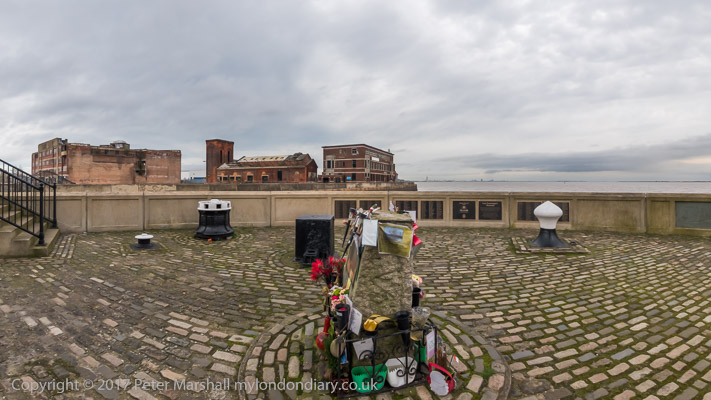
On the ‘bullnose’ at the former dock entrance is one of several memorials around Hull to fishermen, many of whom sailed away and never returned. Even in recent times deep sea fishing was a dangerous occupation, though made a little safer by the protests of one of Hull’s heroes recently commemorated in a Hull mural, Big Lil, who led a fight to get radio operators on every voyage. A short walk further west there is now another memorial.

St Andrew’s Dock

You can see more of the pictures I took on this trip in the ‘Hull Supplement‘ on My London Diary.
Continue reading More Hull

Finsbury Park Again

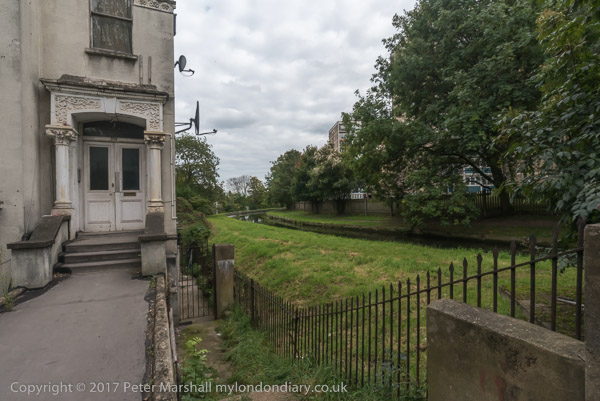
I walked past the New River on what seemed a long march on Saturday, against the London Borough of Haringey’s intention to give away a couple of billion pounds of public property to a rather doubtful Australian property developer. It’s a course of action that should be criminal, but unfortunately our laws are seldom written to protect the rights of ordinary people, many of whom will lose their homes as a result.

Haringey’s plan, being pushed through by a small group of Labour councillors and officials is unusual only in its scale; one poster being carried on the march listed over a hundred council estates in London that Labour councils either have or intend to hand over to private developers (who now include housing associations) with an almost complete loss of truly affordable social housing, a process they call ‘regeneration’ but which is more accurately described as social cleansing. It’s really long past time the Labour party put it’s house and its housing policies in order.
Of course local government in the UK has always been rife with corruption, a curious mixture of public service and private gain, with the private interests of councillors and their relatives often profiting from public decisions. It was doubtless so in the Victorian era, though at least then it was tempered by a great deal of municipal pride which provided some fine public buildings – and more recently at least in some areas by the building of flagship council estates, like the Heygate in Southwark and Central Hill in Lambeth which I’ve written about here in the past.

And back then there was perhaps some satisfaction for those people thrown out of their homes with nowhere to go in the feeling that those responsible might eventually get their just reward in the fires of Hell, whereas nowadays they are more likely to end up on hefty expenses in the House of Lords.

But more of that in a later post, after I’ve put the picture from the march onto My London Diary, currently stuck somewhere in early August.  But walking along the street I suddenly remembered I’d been here before.

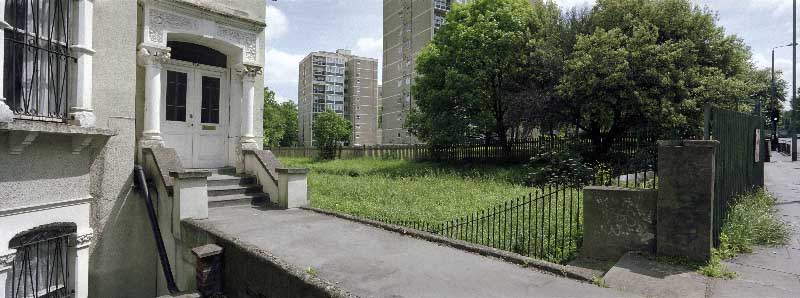
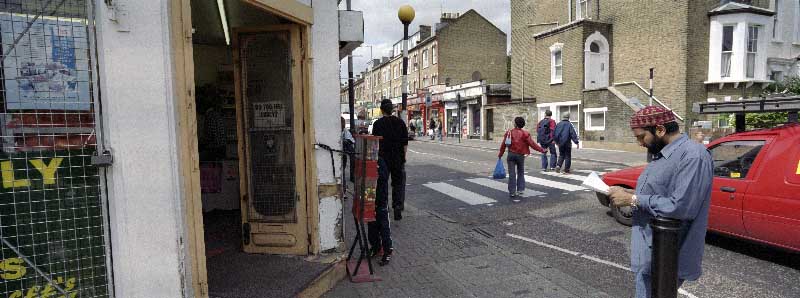
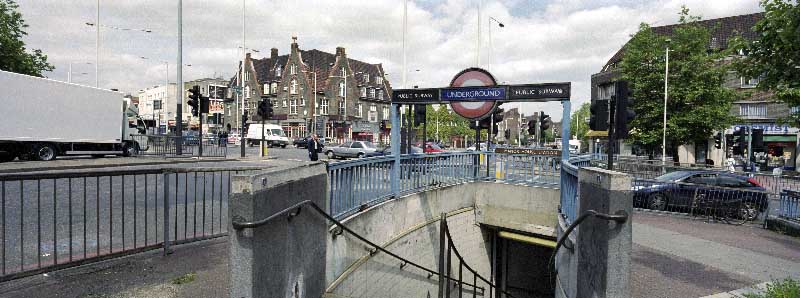
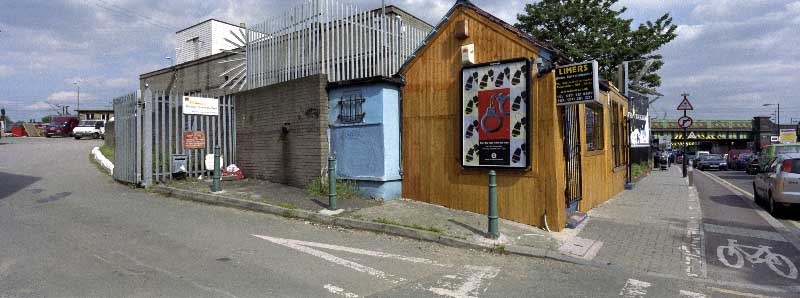
Back in 2002, I was busy with my Hasselblad X-Pan in and around FInsbury Park, having recently acquired the 30mm lens which changed it from a panoramic format camera into a true panoramic camera. There seemed to me to be little point in using the camera with the standard lens, although the larger negative (24mm high and 65 mm wide) did produce medium format quality on 35mm film. The 30mm f5.6 gives a horizontal angle of view of 94 degrees, about the maximum that makes sense with a rectilinear perspective, with any larger angle of view the elongation of subjects at the image edges becomes unbearable.

If you are wondering, the 45mm is roughly equivalent ot a 25mm lens on a 35mm full-frame camera, while the 30mm equates to 16.7mm. And while I’ve used wider full-frame lenses, including the remarkable Sigma 12-24mm zoom, anything less than 16mm is almost always better done with a fisheye.

Most of the 36 images on the Finsbury Park mini-site were taken using the 30mm lens, which came with its own viewfinder, and a filter to even out exposure across the frame. Although the centre of the film when focused at infinity (as all these pictures probably were) was only 30mm from the film, the extreme edges are almost 44mm away, and receive slightly over a stop less light, though lens design probably makes the difference even greater. With colour negative film the centre spot filter was essential, though you could use the camera for black and white without and compensate in the darkroom.

One of the images from this set, of the New River, won a small competition and now hangs on my bedroom wall, though it wasn’t my personal favourite of the set. On Saturday I didn’t quite make the march as far as Finsbury Park. Photographing a march is considerably more physically tiring than simply walking, involving a lot of hurrying to and fro, a little climbing on walls and too much walking backwards, and I also find it mentally tiring, and buy the time we reached Manor Park I needed to rest.

More panoramas from Finsbury Park though the print prices are rather out of date.

Continue reading Finsbury Park Again

Culture Calls

Looking back at around 15 years of My London Diary I’m very much aware that the main focus of my photographic work has shifted from a broader cultural perspective towards the more narrowly political. In part the reasons for this have to do with changes in society and the outside pressures and the great increase in grass roots political activity over those years, and in part they reflect changes in my own political perceptions.

First there was the increasing frustration with the failure of a Labour government to put forward Labour policies, continuing basically Thatcherite policies under Blair and then Brown. Then we had the remorseless austerity of the coalition and and Cameron years, before the national interest was sacrificed to Tory in-fighting with the Brexit referendum. Now we see a weak and failing adminstration dedicated to following not the will but the whim of the British people who voted on the promise of the unobtainable .

Of course it isn’t only British issues. The UK and London in particular has always provide a stage for protests for and by the world, in part because of the involvement of this country around the world, probably greater than ever in these post-Empire and post-Colonial days thanks to the devious antics of the City and companies based here.

And thinking about some of the events I used to photograph I perhaps feel I’ve said all I have to say about them. Delightful though it is to photograph – for example – Vaisakhi, I rather feel I’ve taken enough pictures and covered enough of what is essentially the same festival every year. But whatever the reasons, these days I seldom cover the religious and other cultural events which once took up much of my time.

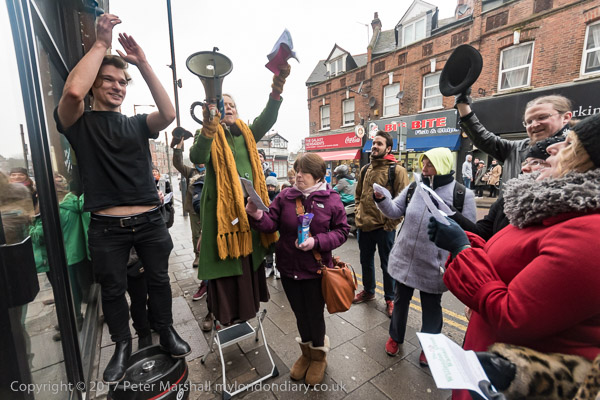
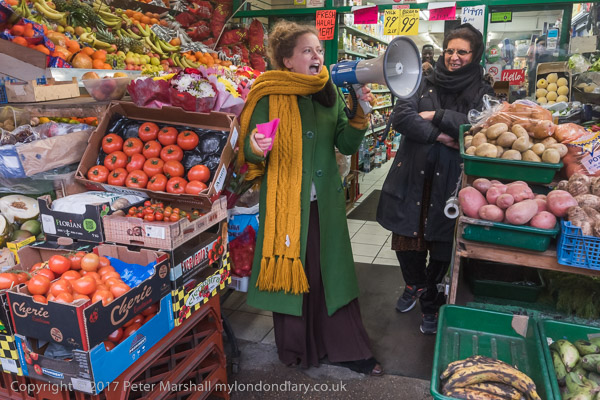
I wouldn’t have bothered to cover the Willesden Green Wassail if I hadn’t had a message from the organiser inviting me to do so.  I’d enjoyed photographing it back in 2014,  and had nothing essential in my diary for that day, so decided to make the journey to photograph it another time. And I enjoyed it again.

Willesden is an interesting area, a part of London that seems very happy with being multicultural, with a borough, Brent, which until hit by the cuts was very intent on celebrating the various festivals of its different groups.

It’s also an area served by a great number of small shops, helped by lower rents than in many areas of London – though this is beginning to change as gentrification creeps in, if more slowly here than in much of London.

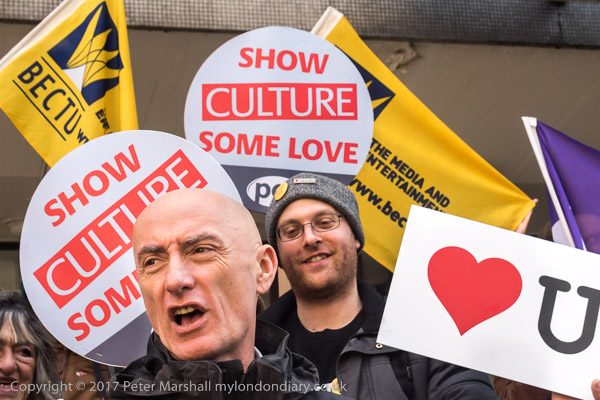
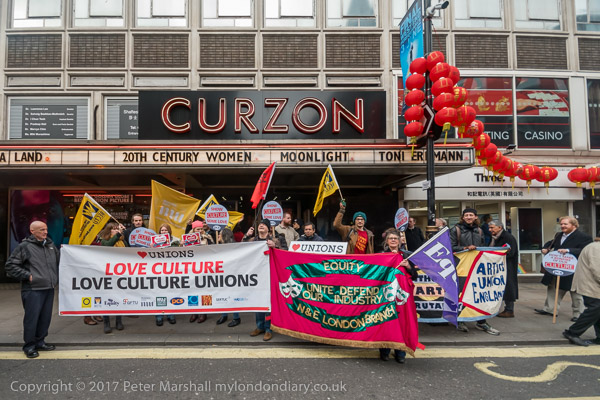
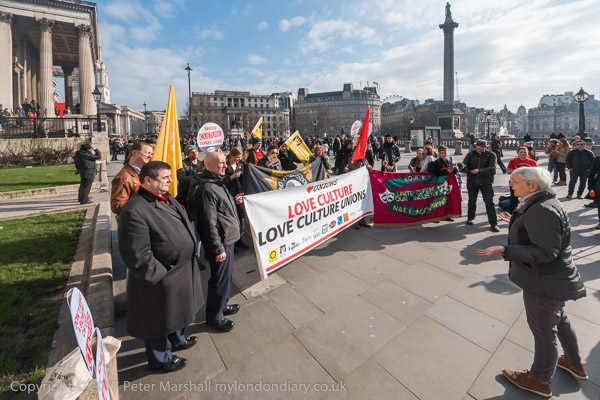
A couple of days later came a more political event around culture, organised as a part of a week of actions by trade unions and celebrating some of our cultural institutions and those union members who work in them.

Although our culture celebrates the stars – and rewards them with often astronomical salaries for doing usually what they love to do – and a few months later the BBC was forced to reveal how much it pays its highly paid staff, some of whom clearly don’t deserve it – these stars depend on many others who work in the industry, including some on or close to the minimum wage, and in London in particular below the living wage.

Our tour reminded us of some of these, particularly the workers for Picturehouse, and the continuing fight by those at the Ritzy, in Hackney and elsewhere who are still fighting for a living wage in an industry that makes billions and rewards the stars extravagantly. And in our great public galleries staff are increasingly being replaced by out-sourced workers on low pay, minimal conditions of service and little or no job security. Management are pinching pennies from those who can least afford them, while those at the top get fat salaries – and yachts as leaving presents.

Show Culture some Love
Willesden Green Wassail

Continue reading Culture Calls