XR’s Garden Bridge

While Boris Johnson wasted many millions of public money as London Mayor on a crazy project for a garden bridge across the Thames where no-one wanted it and it fortunately came to nothing, Extinction Rebellion provided one for free for a few days .
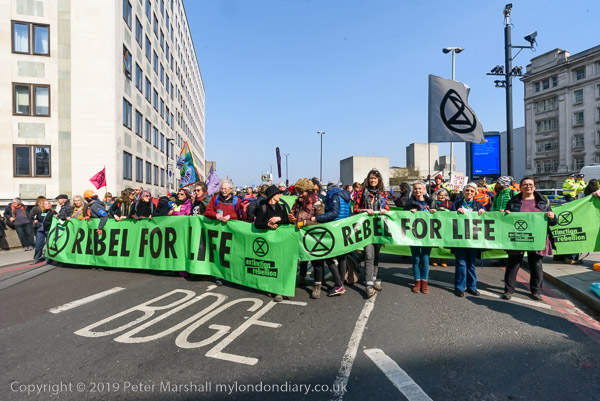
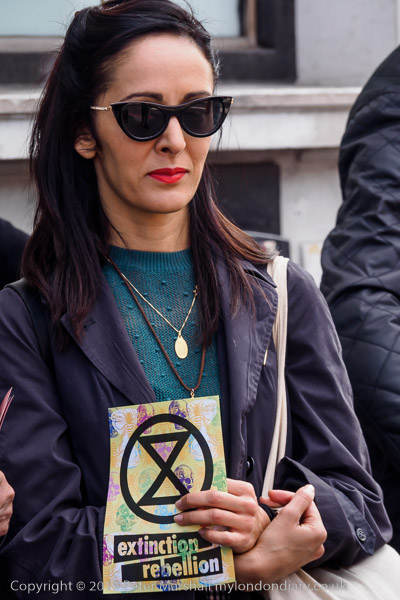
It helped that they didn’t actually have to build a bridge, but just took over an existing one, Waterloo Bridge, closing it to traffic. This did cause a certain amount of disruption, and doubtless inconvenienced some people, but it, together with their other actions around London, did serve to put the issue of climate catastrophe – and the very real threat of human extinction unless people across the world take radical action – into public consciousness.

It was a minor inconvenience for me, as found myself having to walk around London rather than sit on a bus rather often during the week, though fortunately the tube was still working. But were I a transport planner for London, I think that at least one of London’s bridges – though probably not this one – would be permanently pedestrianised. We have far too much traffic in central London, causing far too much pollution – and thousands of early deaths – and the congestion charge hasn’t solved the problem.

It was very pleasant to be able to walk across the bridge past the trees and plants, or to sit for a few minutes in the sun and listen and watch the activities taking place on the bridge. And the air there certainly felt cleaner, once you were on the bridge and away from the traffic jam south of the river.
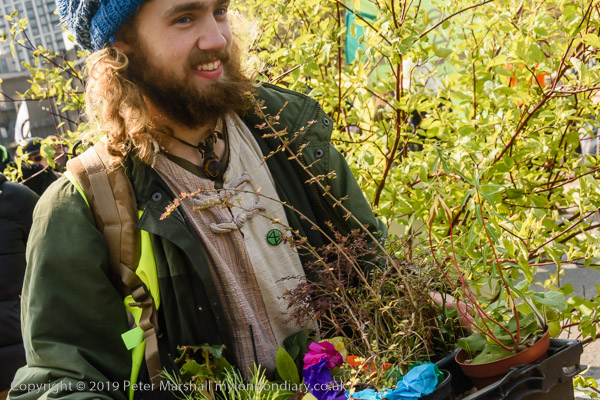
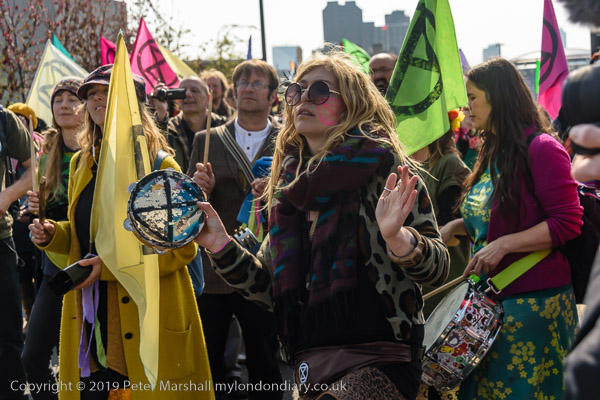
Many of those on the bridge had travelled up from the country, and had brought a little of it with them. Some had even walked all the way from Cornwall. Extinction Rebellion has certainly gained a great deal of support, if largely from the kind of people who will go to public meetings and listen to their speakers. Most could be labelled middle class, though not mainly the comfortable and affluent high-consuming middle class, but largely those in low-paid occupations; teachers, social workers, health workers were I’m sure all over-represented.
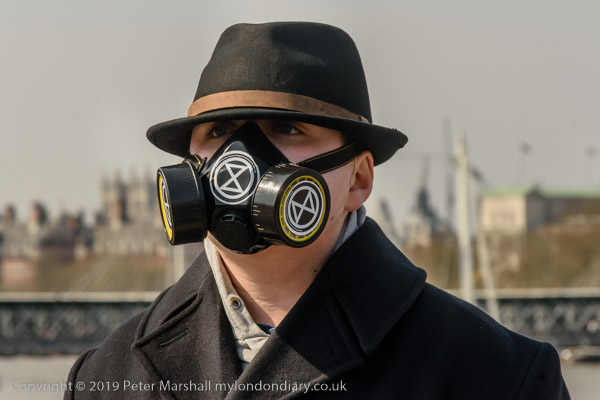
XR has developed from the activities of groups like ‘Stop Killing Londoners’ whose protests against air pollution in the city I’ve photographed from their start, working on the ideas of Roger Hallam on non-violent protests and people being prepared to be arrested (as I photographed him being arrested at the LSE in a protest for the cleaners there.)
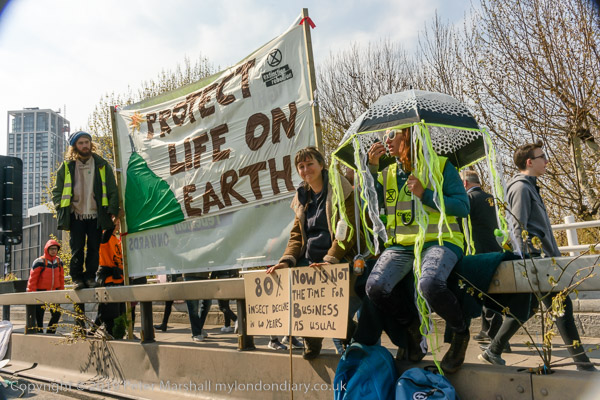
There were arrests at the ‘garden bridge’ but on the couple of occasions I visited police just watched and occasionally took notes. XR’s attitude to the police and their policy of encouraging people to be arrested has been much criticised by others, and they appear to have little regard for the problems it may cause and have under-estimated the support needed. But these are desperate times and rather than carping perhaps the critics should be showing an example by launching their own, more effective actions – but there is little sign of that happening. XR certainly isn’t a perfect game, but it has little competition.

More at Extinction Rebellion Garden Bridge


There are no adverts on this site and it receives no sponsorship, and I like to keep it that way. But it does take a considerable amount of my time and thought, and if you enjoy reading it, please share on social media.
And small donations via Paypal – perhaps the cost of a beer – would be appreciated.

All photographs on this and my other sites, unless otherwise stated, are taken by and copyright of Peter Marshall, and are available for reproduction or can be bought as prints.
Up the Elephant

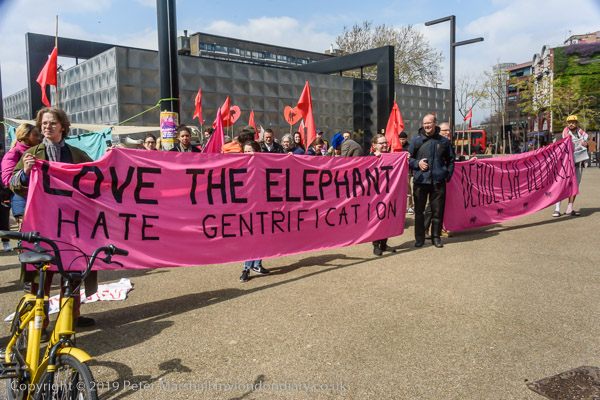
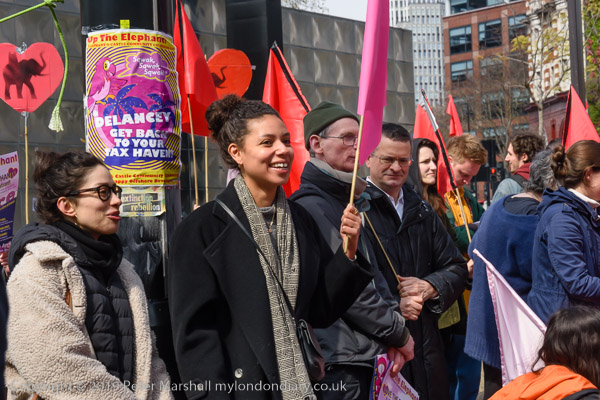
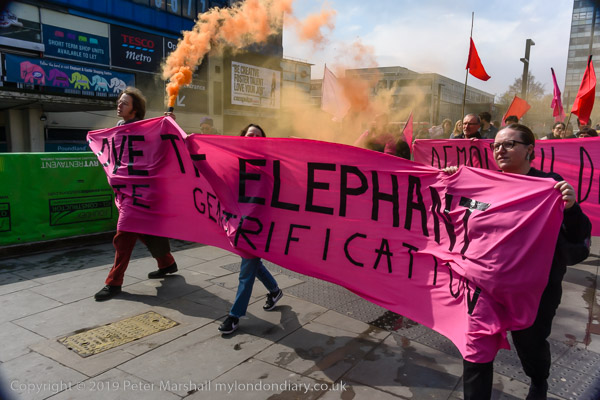
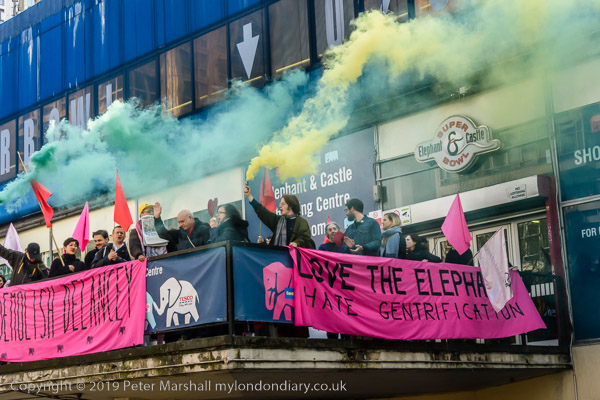
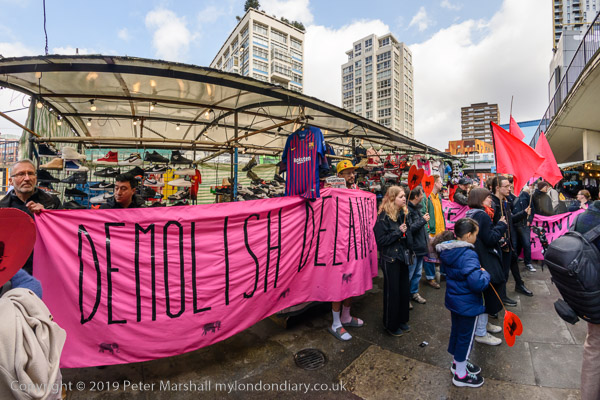
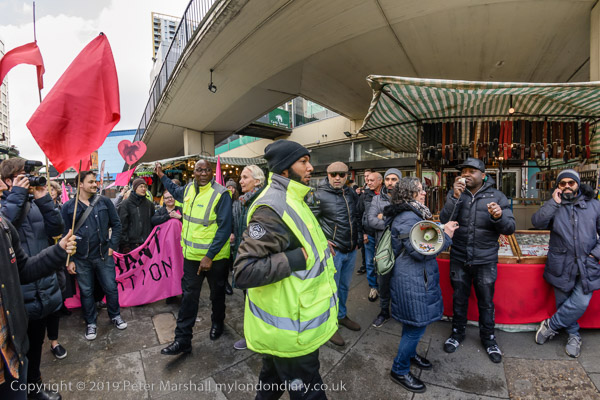
A quick trip on the Bakerloo line took me from elephants in Cavendish Square to the Elephant, where Southwark Notes, Latin Elephant and Up the Elephant were holding their Love the Elephant Street Celebration.

For generations the Elephant & Castle has been a lively South London hub, its nature changing over the years. The country’s first shopping mall was built here in 1955 on the site of a bomb-damaged estate, and while showing its age is still more interesting than most, and one that both reflects and caters for the local community, increasingly Latin-American, as well as largely older bingo-playing local residents.

Shopping malls are generally pretty soulless places, and on going inside you transition from whichever town or city you were into some strange limbo of franchises and chains. The few with a little more character are some of the older ones, usually incorporating market traders and other small local businesses, while the more recent examples have little to offer except the same as every other more recent mall.

Virtually the only reason I ever enter them is to search for the public toilets most offer, which usually involves a long trek following often confusing signage designed to take you past every retail outlet en-route.

Not of course that the Elephant shopping centre is perfect, far from it. It is certainly showing its age and needs improvement, and it has been deliberately run down by its owners to promote the redevelopment.

But campaigners say it should be redeveloped with the local community in mind while the developers Delancey working with Southwark Council and the London College of Communications, seem largely concerned with maximising their profits from the scheme.

Years of campaigning by local community groups has resulted in some minor improvements to the proposals – including more social housing, though it remains to be seen if this will actually happen.

Although the plans were finally approved last December, the campaing goes on, to keep the shopping centre alive until it is demolished and to get fairer treatment of the existing traders. Some have been promised space in the new development, but sometimes only a small fraction of their current area, and the campaign want all to be made offers on a ‘like for like’ basis, with an increase in the relocation fund.

More at Love the Elephant.


There are no adverts on this site and it receives no sponsorship, and I like to keep it that way. But it does take a considerable amount of my time and thought, and if you enjoy reading it, please share on social media.
And small donations via Paypal – perhaps the cost of a beer – would be appreciated.

All photographs on this and my other sites, unless otherwise stated, are taken by and copyright of Peter Marshall, and are available for reproduction or can be bought as prints.


Against Extinction

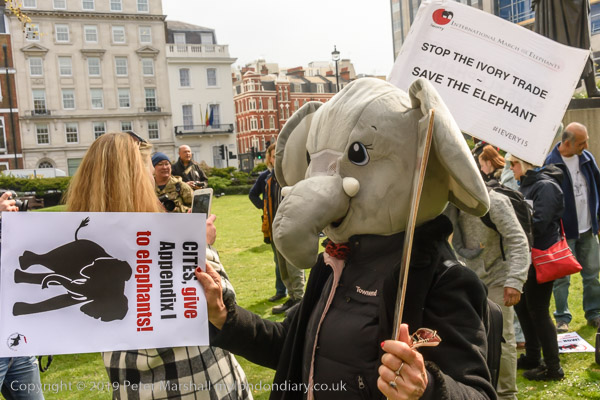
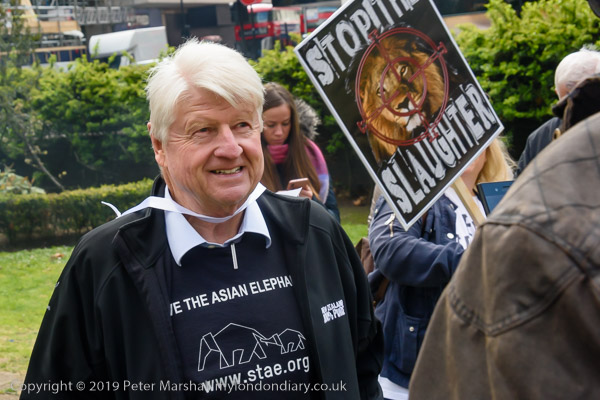
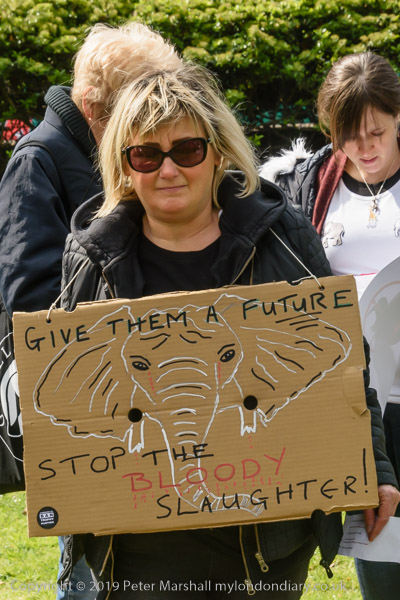
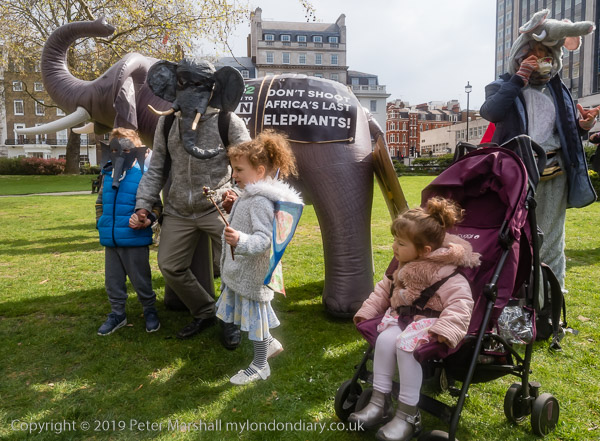
Elephants were in Cavendish Square again today, along with Stanley Johhnson and others mainly from the Tory conservation movement.

Some of the elephants were live, but only in human form, in grey suits with large heads with trunks and tusks, but there were many more on posters . They had come to Cavendish Square as a part of the 2019 Global March for Elephants and Rhinos and were to march to a rally to Downing St.

There were rather few of them, making me think that the Conservative conservation movement is also in danger of extinction, but perhaps more reflecting a wish not to be associated with the much wider and larger animal rights movement whose radicalism I think they find disturbing.

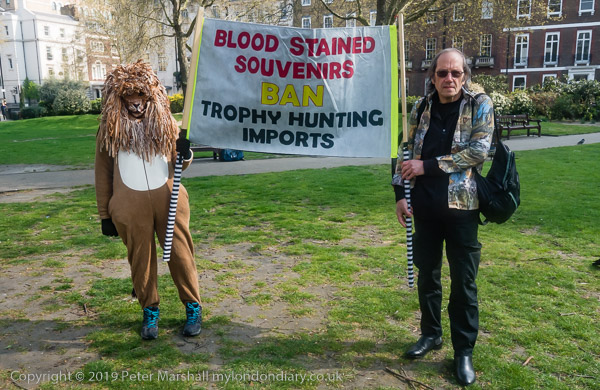
Of course it is a good thing to work through official bodies such as CITES, where some of them are fighting to get greater protection for elephants and to prevent attempts to downgrade protection of endangered species or reopen trade in ivory and other body parts. But it would be good to have a protest that represented the support of a much wider movement for this – even if some of them are also against fox hunting and the badger cull and other activities some Tories hold dear.

There is very wide support for animal welfare and animal rights across the virtually the whole of the UK population (sadly rather more than for human rights) and this protest seemed absurdly sectional. There could have been thousands out on the streets calling for  a ban on the import of hunting trophies of endangered species to the UK and not just a small and slightly sad group creeping along the pavement.

Fortunately the atmosphere was calmer than at a similar protest a few months previously when the papparazzi turned up to photograph Boris Johnson’s girl-friend. She wasn’t there, so nor where they and there was no mad ruch pushing people and other photographers out of the way. But of course this also meant that there was none of the full-page coverage that the earlier protest got. Probably just a bored editor spiking the story as not being news.

More at Against extinction and trophy hunting.


There are no adverts on this site and it receives no sponsorship, and I like to keep it that way. But it does take a considerable amount of my time and thought, and if you enjoy reading it, please share on social media.
And small donations via Paypal – perhaps the cost of a beer – would be appreciated.

All photographs on this and my other sites, unless otherwise stated, are taken by and copyright of Peter Marshall, and are available for reproduction or can be bought as prints.
To order prints or reproduce images


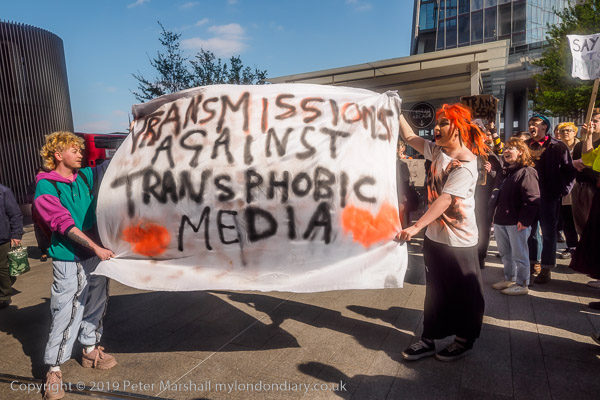
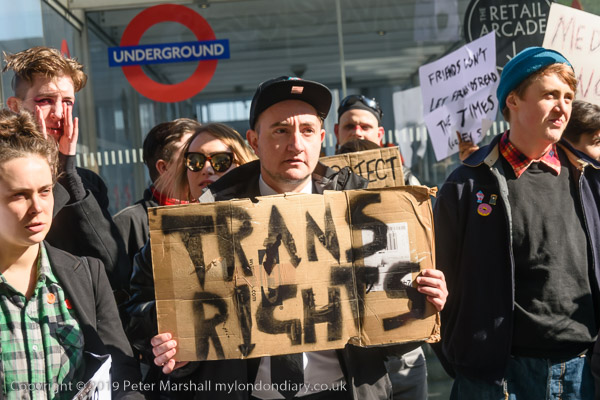
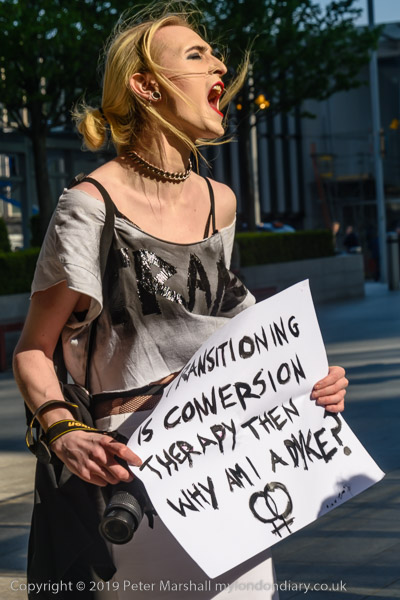
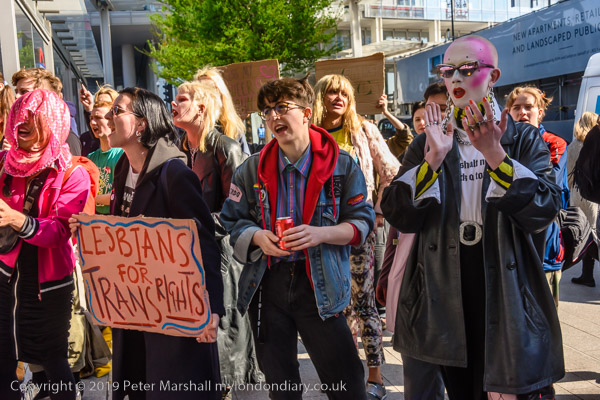
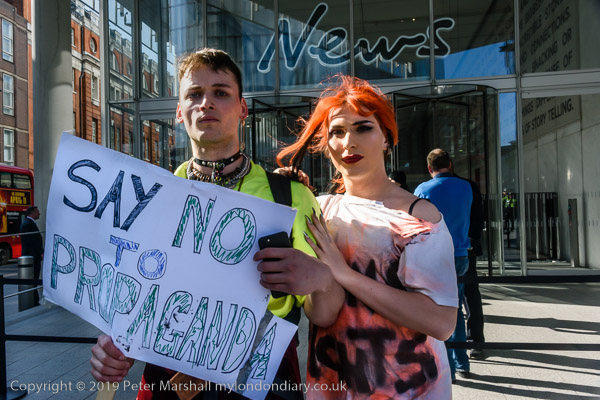
End Murdoch’s Transphobia

Campaigners from Transmission, a group supporting the rights of trans people, came to protest outside the offices of The Times newspaper against their publication of transphobic articles.

The protest came after articles were published written by Lucy Bannerman criticised the work of the Tavistock centre, which runs the country’s only NHS gender identity service.

In a statement published the same day as the article, the centre strongly rejected the claims made in the article and stated:

The Service always place a young person’s wellbeing at the centre of our work and have a clear position of independence from outside lobby groups on all sides of the debate.

and

A recent Review into the Service found no immediate issues relating to patient safety and no overall failing in approach. It did make recommendations to further improve the Service, these will be implemented over the next 12 months building on the work of the Service to date. 

You can read the full statement at https://tavistockandportman.nhs.uk/about-us/news/stories/gender-identity-service-times-8-april-2019/

This is not an isolated article and the same journalist has previously written unfavourably and inaccurately about trans charity Mermaids and has suggested ostracising trans athletes for competing in sports.

In a court case in which a transgender activist was convicted of assault, Bannerman tweeted unfavourably on the judge correcting witnesses who deliberately referred to the defendant, a trans woman as ‘he’. As was pointed out in a comment on her post, you would expect a judge to challenge racist or homophobic language and it should be no different for transphobic language.

Bannerman appears to have aligned herself with what are commonly known as ‘trans-exclusionary radical feminists’ or ‘TERFs’ for short. Its a description they don’t like, though it appears descriptive rather than derogatory. I’m unaware of any other satisfactory description which clearly distinguishes them from the wider feminist movement which is supportive of transgender women.

Terfs have a record of disruption which although it does not endorse the use of violence against them certainly makes it more likely as it enrages others. Last year they gained the opprobrium of virtually the entire gay community by hi-jacking the start of Gay Pride – a very diffferent reaction to a similar take-over the previous year by migrant gay communities which was applauded by all except a few of the establishment. They also caused chaos at the Anarchist Book Fair, leading to its cancellation this year.

Propaganda like Bannerman’s articles can only appear in The Times because it reflects the views of the editor and more importantly the proprietor of the paper, Ruper Murdoch.

More pictures at Times end transphobic articles.


There are no adverts on this site and it receives no sponsorship, and I like to keep it that way. But it does take a considerable amount of my time and thought, and if you enjoy reading it, please share on social media.
And small donations via Paypal – perhaps the cost of a beer – would be appreciated.

All photographs on this and my other sites, unless otherwise stated, are taken by and copyright of Peter Marshall, and are available for reproduction or can be bought as prints.
To order prints or reproduce images


Tottenham

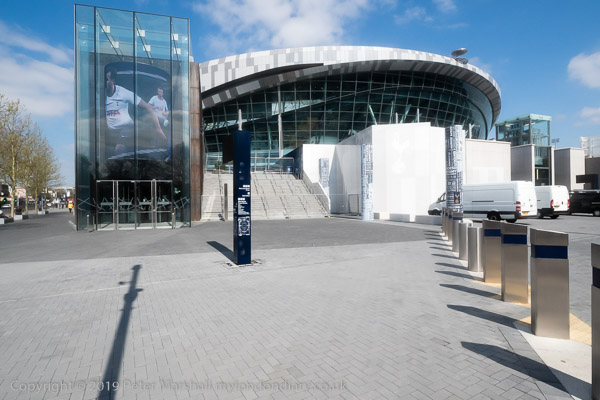
Since I was going to photograph a protest in Tottenham, a part of north London I don’t often get to, I thought I’d take a look at the new stadium there. I’m not a Spurs fan, nor of any other team, though I do still occasionally read the reports on Brentford’s matches in one of our free local papers with a little amusement. Although I was keen on sports when young and played in my areas leading under-11 football team – two of whose members went on to play for Brentford and one for Chelsea – and continued to compete for my school and several teams at football and rugby while a student, I’ve always considered watching sport – either live or on TV – a waste of time.

The new stadium looks fine, though I didn’t have time to investigate it beyond a few quick snaps. But what really gets me annoyed is that the club want to change the name of nearby White Hart Lane station (in White Hart Lane) to Tottenham Hotspur, and that TfL are more than happy to oblige in this annoying piece of corporate branding and pocket £14.7m for doing so. TfL’s job is to run a transport system, not to provide publicity. I will also feel rather disappointed if Spurs fans accept the name change for the ground and stop calling it White Hart Lane.

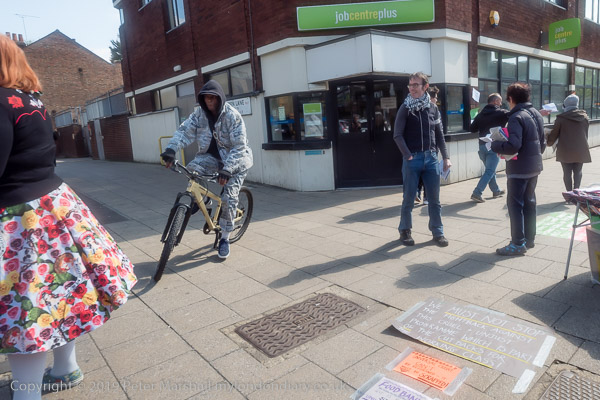
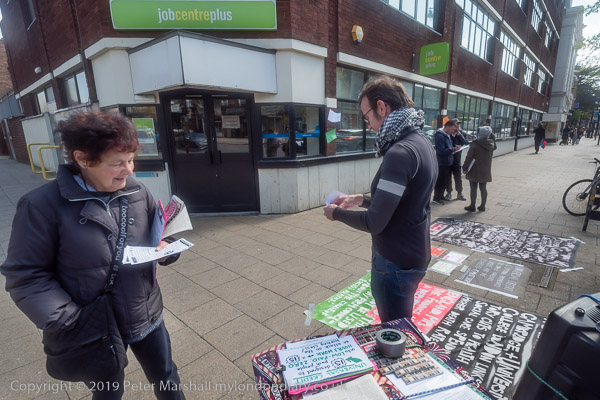
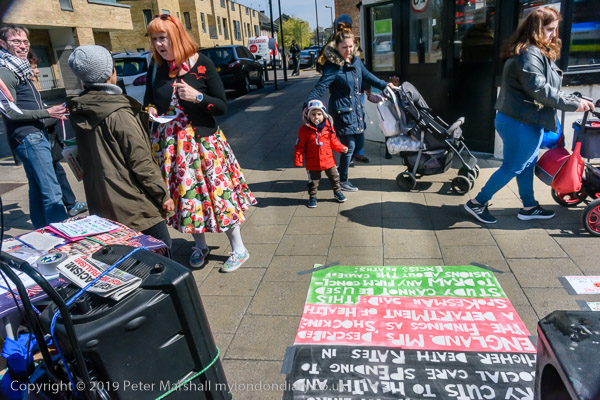
The protest outside the Tottenham Job CentrePlus was a small one, taking place on a Thursday lunchtime, and organised by the Revolutionary Communist Group, a relatively small left-wing organisation, but about a major issue, Universal Credit. Although some of its aims to simplify the benefits system are laudable it has been clear from the start that there were huge problems in the implementation, and that the whole scheme has simply not been properly designed. Add to that some political interference to cut costs and the whole thing is a disaster.

Much of the problem is I think that the scheme was designed by well-off and well-connected people who have little or no appreciation of how those affected live. The kind of people who, if they are a little short of cash at some point can sell a few things (perhaps some of their investments or the second or third house), get a loan at a relatively low interest rate from a bank or ask friends or family to tide them over.

Waiting a five weeks (or rather longer) for their money would not be a problem for them, but for those who are dependent on benefits it can be a disaster. It is a public disgrace that we need food banks, but UC has been a major factor driving the huge increase in people who have to use them – or starve. The other major factor driving people to them has been benefit sanctions, with people losing benefits often for trivial or even made-up reasons so that DWP staff can meet the targets set for them, leaving people with no resources on which to survive for months or even years.

Many too have become homeless for the same reasons, evicted because they cannot pay the rent. And far too many have died. It’s a scandal and one that attempts to draw public attention to and organise opposition I think deserve support, whoever organises them. It’s a pity that the sectional nature of left-wing politics means that the RCG seldom gets much support from people outside its own group for protests such as these.

As a photographer, small protests such as these present something of a challenge to make them newsworthy. As much as possible I try to cover them in a way that brings out the issues, perhaps as reflected in posters and banners, and also to produce images with some visual interest.

Scrap Universal Credit Jobcentre protest
Tottenham and Spurs


There are no adverts on this site and it receives no sponsorship, and I like to keep it that way. But it does take a considerable amount of my time and thought, and if you enjoy reading it, please share on social media.
And small donations via Paypal – perhaps the cost of a beer – would be appreciated.

All photographs on this and my other sites, unless otherwise stated, are taken by and copyright of Peter Marshall, and are available for reproduction or can be bought as prints.
To order prints or reproduce images


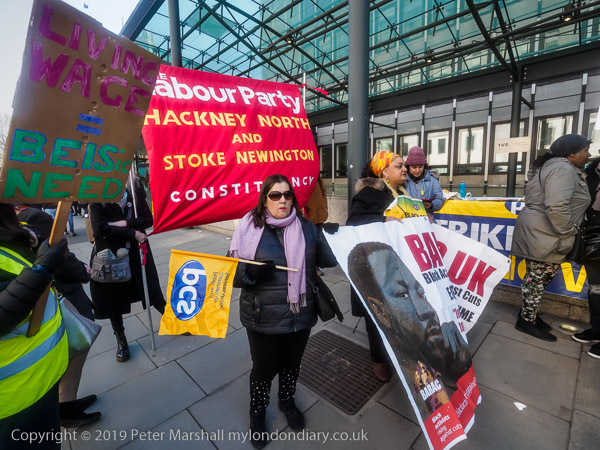
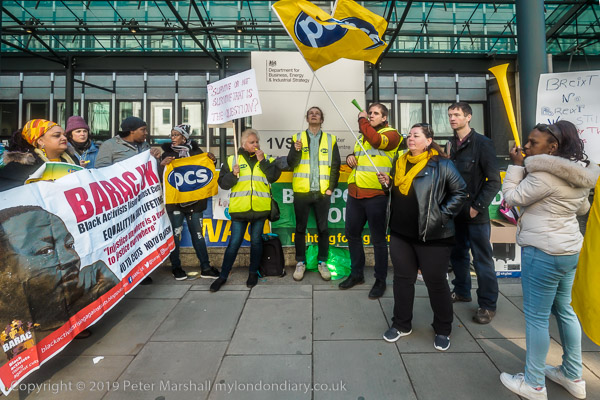
BEIS outsourcing protest

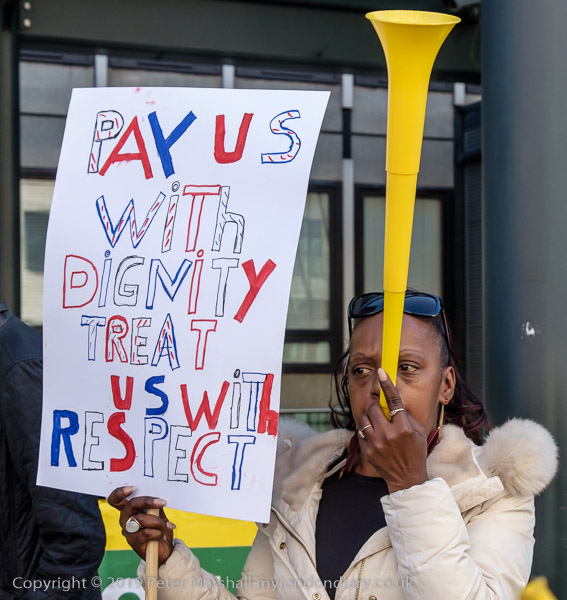
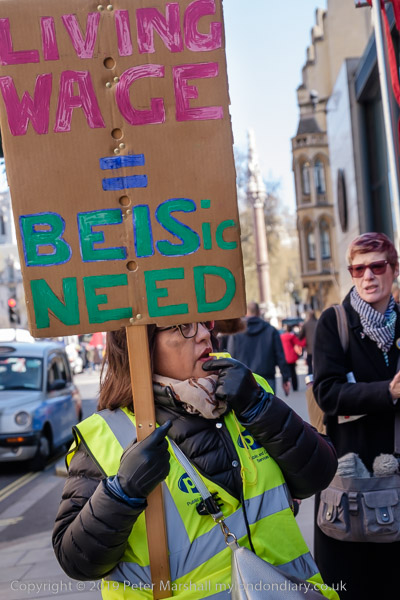
One of many promises made by leading members of the Labour Party is that when they come to power they will put an end to the scandal of out-sourcing, which enables employers to retain the veneer of respectability while having workers engaged on key roles in their workplaces employed on wages and conditions that amount to exploitation.

Probably even Greg Clark MP, the current Secretary of State for Business, Energy and Industrial Strategy, would not stoop to employing staff on the wages and minimal conditions of service that catering and other workers at BEIS receive, and with the kind of management practices that outsourcing companies use to make a cut-price bids for contracts.

The workers at BEIS are fortunate to be supported by the PCS BEIS London and South branch; too often the major unions have failed to show much concern for the lowest paid workers, other than over them paying their union fees. Too often they have shown themselves more concerned about pay differentials and prepared to reach agreements with managements that fail to protect the interests of workers on low pay, a situation that has led to the growth of a number of small active grass-roots unions, often attacked by the traditional unions for ‘poaching’ their members as well as for their militancy.

Of course there are a number of branches of major unions who have fought for low paid workers, both their members and also others in their workplaces. At BEIS the PCS have shown how unions should behave to support low paid workers, and have also worked together with grass-roots trade unions at other government workplaces to coordinate actions.

The dispute at BEIS (and another at the Foreign and Commonwealth Office) are continuing, and it seems to be one the government are fighting more as a matter of supporting the principle of being free to exploit your workers than a matter of economics. It seems to be also one where ministers are happy to break the law, in May and June agency workers were brought in to cover the work of strikers in contravention of the Conduct of Employment Agencies and Employment Business Regulations of 2003.

The workers have had enough. Tomorrow lunchtime, Monday 15th July catering workers and cleaners “will walkout in the first EVER indefinite strike action in Whitehall. They down tools and say “we’re not coming back til you pay up!”.

More at Living wage at Dept of Business.


There are no adverts on this site and it receives no sponsorship, and I like to keep it that way. But it does take a considerable amount of my time and thought, and if you enjoy reading it, please share on social media.
And small donations via Paypal – perhaps the cost of a beer – would be appreciated.

All photographs on this and my other sites, unless otherwise stated, are taken by and copyright of Peter Marshall, and are available for reproduction or can be bought as prints.
To order prints or reproduce images


Against the Sultan

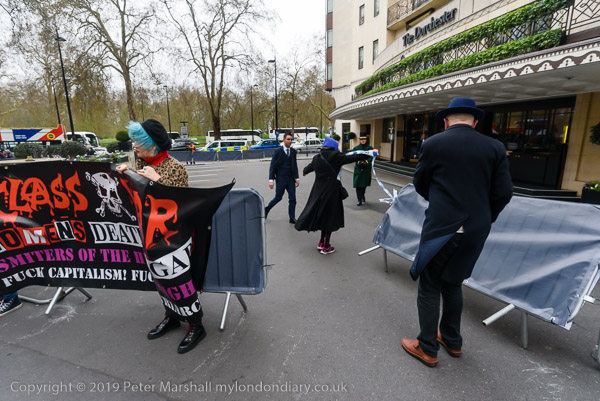
I got to the protest rather late because I stopped on the way to meet the people from Class War who were going to attend the protest. Of course they were in a pub, and the pub they had selected to meet was quite a walk from the Dorchester Hotel outside which the protest was taking place.

It took a while to finish our drinks and to get moving, and eventually I gave up waiting for them, especially when some decided they needed to get a bus., though it was only half a mile to walk. I left with one of the more active members and we hurried, getting there in well under ten minutes.

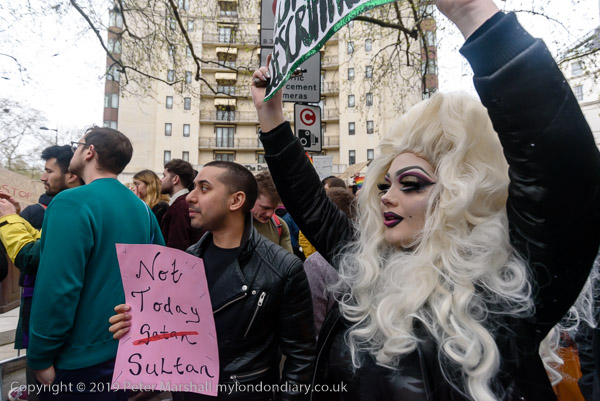
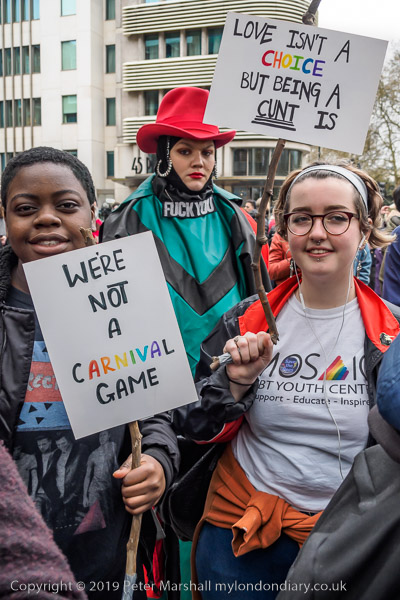
The ruling by the Sultan of Brunei to make stoning to death the sentence for gay sex, adultery and blasphemy had enraged people around the world, and protests were planned in many cities outside the luxury hotels he owns, including the Dorchester Hotel in London’s Mayfair.

There was a large crowd of protesters, but at some distance from the hotel entrance, on the pavements of the minor street that runs around the front of the building and its large yard which allow taxis to drive to its doors. There really wasn’t enough room for protesters on the pavements, but police were trying to keept the roadway clear, arguing with protesters who were reluctant to move.

Although I was over half an hour late for the start, I was still in time to photograph the two major speakers, Shadow Foreign Secretary Emily Thornberry and human rights activist Peter Tatchell, as well of course as many of the protesters and their posters and banners.

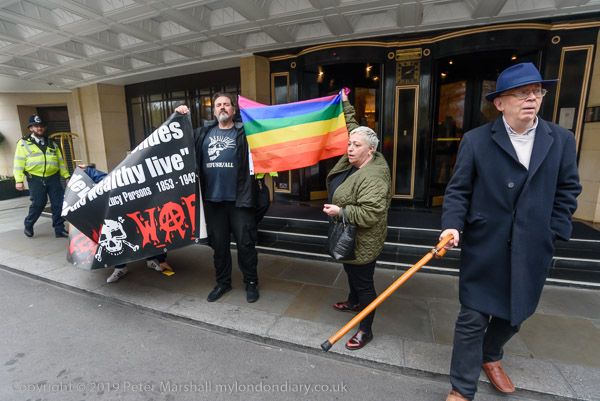
Class War turned up with their two banners almost half and hour after me, and for a while stood with them on the roadway (which the police by this time had given up the impossible task of keeping clear.) Their late arrival was probably timed to ensure they missed the speeches.

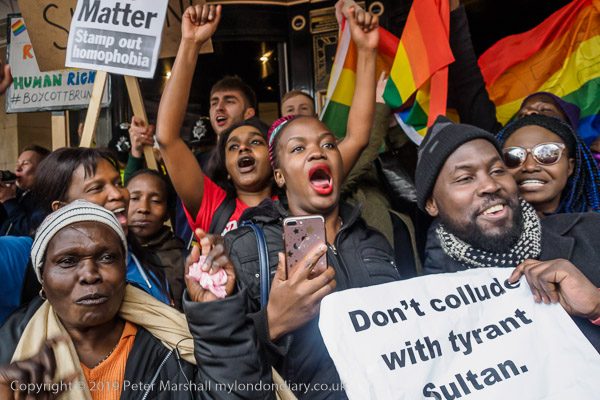
After standing for a few minutes holding the banners, Class War sized up the situation decided it was time for some more definite action. They pushed aside the barriers around the hotel yard and with the ‘Women’s Death Brigade’ banner led a rush past police and security to protest on the steps of the hotel.

They shouted for the others to follow them, and a few came immediately. Eventually most of the rest of the crowd joined them for a long and noisy protest on the steps of the hotel. There were a few arguments with police who came to stand in front of the doors, but no arrests before I left three-quarters of an hour later.

Many more pictures at Brunei Sultan gay sex stoning protest


There are no adverts on this site and it receives no sponsorship, and I like to keep it that way. But it does take a considerable amount of my time and thought, and if you enjoy reading it, please share on social media.
And small donations via Paypal – perhaps the cost of a beer – would be appreciated.

All photographs on this and my other sites, unless otherwise stated, are taken by and copyright of Peter Marshall, and are available for reproduction or can be bought as prints.
To order prints or reproduce images


Unfair treatment of private hire drivers

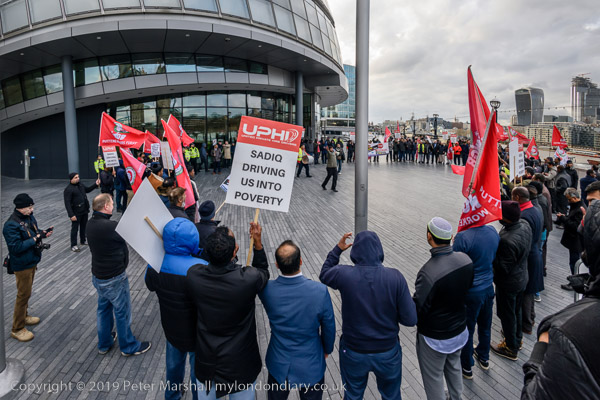
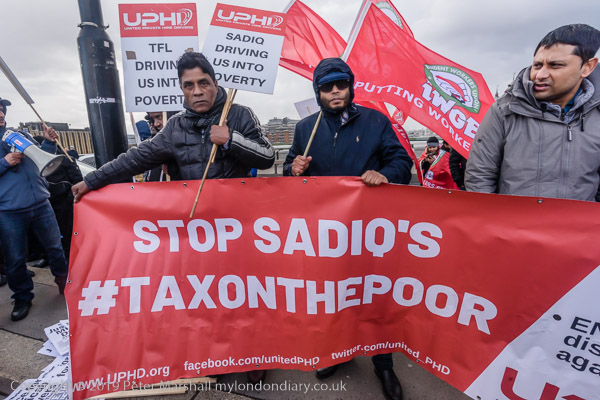
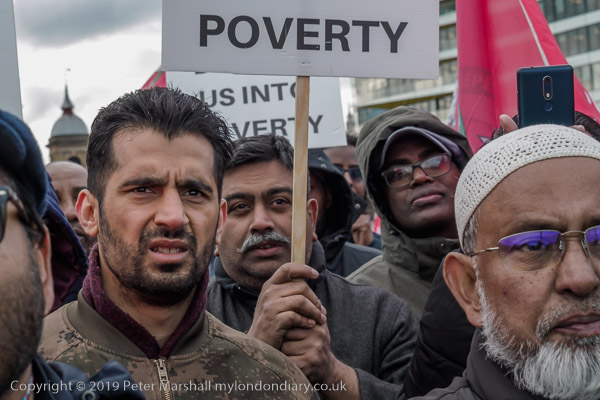
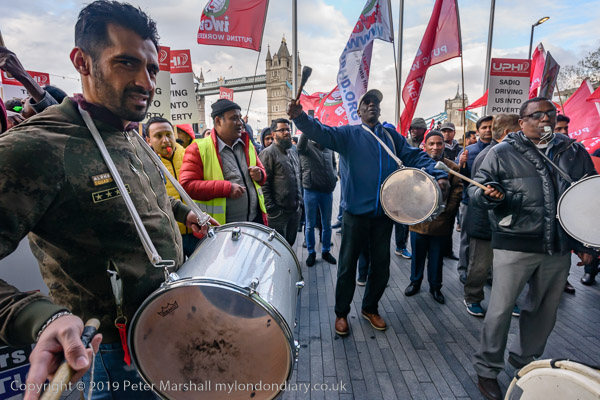
Rather than write something myself about the discrimination by Transport for London making private hire drivers pay the London congestion charge to accompany some of my pictures from the protest by them at the start of April, I’ve decided to quote some of the statement made last week about their High Court case which begins today:

The Independent Workers Union of Great Britain (IWGB) will be arguing at the High Court on 10 and 11 July that Mayor of London Sadiq Khan’s decision to introduce a congestion charge on minicabs discriminates against and breaches the human rights of a mainly BAME workforce.
The IWGB is seeking a judicial review of Khan’s decision to introduce the £11.50 charge on the grounds that it is a case of indirect discrimination under the Equality Act. The charge is being imposed on a workforce that is mainly BAME (94% of London’s 107,000 minicab drivers are BAME according to TFL), while black cab drivers, who are mostly white, continue to be exempt.

This policy is also in breach of a number of articles of the European Convention on Human Rights that cover discrimination, property rights, right to a family life and ability to carry out a profession.
The IWGB has assembled a legal team which includes renowned discrimination barristers Ben Collins QC,Nadia Motraghi and Tara O’Halloran of Old Square Chambers, and TMP Solicitors founding partner Jacqueline McGuigan.

The IWGB has proposed a number of alternatives to this policy, including a cap on the total number minicab driver licenses, a levy on minicab operators such as Uber and Viavan, and the enforcement of worker rights by Transport for London (TfL).

Discrimination also runs throughout London’s enforcement regime. The most recent figures released by TfL show minicabs are almost three times as likely to be stopped by enforcement officers as black cabs, despite the fact that TfL’s own statistics show that on average minicabs are more compliant than black cabs.

You can read the rest of this statement, including quotes from some of the drivers on the IWGB web site: London congestion charge discrimination claim to be heard at the High Court 10 & 11 July

More of my pictures from the April 4th protest at Private hire drivers protest congestion charge.


There are no adverts on this site and it receives no sponsorship, and I like to keep it that way. But it does take a considerable amount of my time and thought, and if you enjoy reading it, please share on social media.
And small donations via Paypal – perhaps the cost of a beer – would be appreciated.

All photographs on this and my other sites, unless otherwise stated, are taken by and copyright of Peter Marshall, and are available for reproduction or can be bought as prints.
To order prints or reproduce images


Brixton Barclays

Although my memories of the 1960s are far from clear, I’m fairly sure that the first protest I ever took part in, back when I was a student in Manchester was outside a Barclays Bank branch not far from the university in 1964. Then we were protesting against its support for Apartheid in South Africa, and stood outside handing out leaflets and calling on customers entering or leaving to move their accounts. At the time I think almost all banks were more ethical than Barclays.

A few years later, in 1969, students in the UK began the wider Boycott Barclays campaign, which became widespread and continued until after Barclays eventually sold their South African subsidiary in 1986. By then many people and organisations across society had withdrawn their accounts from Barclays causing them a loss of deposits estimated at around £6 billion a year and the number of new student accounts taken out each year had roughly halved.

It’s hard to understand why Barclays held out so long, allowing political and ideological positions to override a clear financial case for changing their policies, and disappointing that a business which had its roots in Quakerism was seen to become one of the dirtiest of banks. Perhaps as one of the largest transnational businesses in the world it simply decided it was not going to allow itself to be told what to do by protesters. But eventually it had to change.

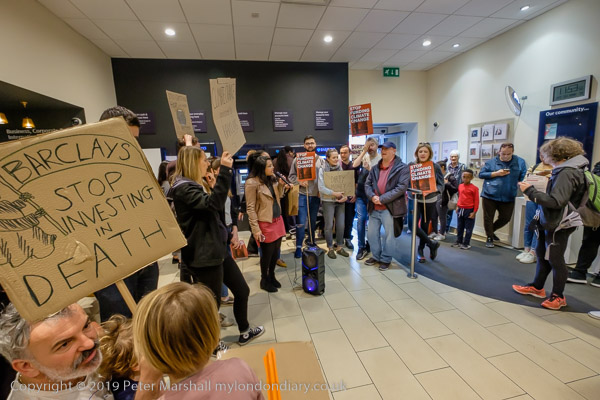
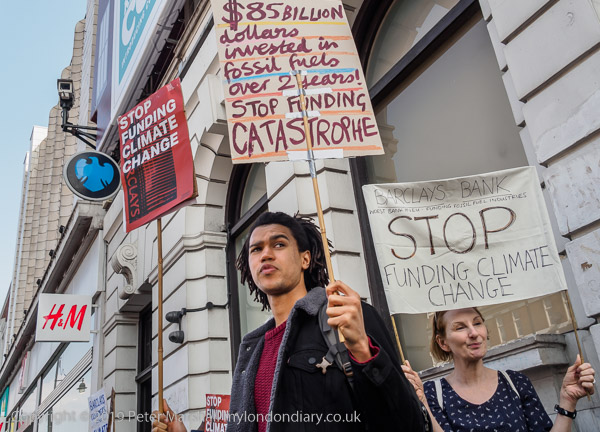
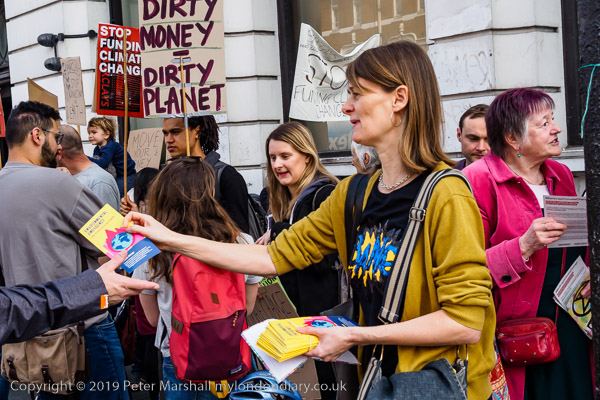
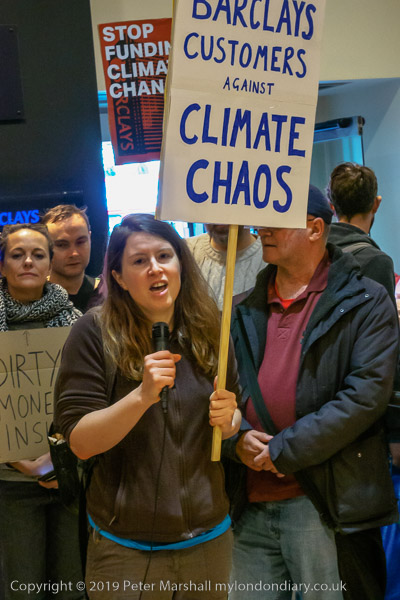
Barclays is now under attack again for its support of fossil fuels and in particular of fracking, having invested more the $30bn in climate-wrecking fracking schemes, making it by far the worst bank in Europe. To have any chance of avoiding disastrous global warming we need to drastically cut the use of coal, oil, petrol and gas and other carbon-containing materials as fuel. Fracking not only produces dirty fuel, it also leads to extensive pollution of water sources and earthquakes; it has been banned in Germany, France, Ireland and Bulgaria in the EU and in other countries, provinces and states around the world, with further bans seeming likely.

After protesting on the busy main street in front of the Barclays branch for around an hour, the protesters held a short protest inside. They were asked to leave and agreed to do so after a few short speeches which made their position clear.

More at Climate Protest at Barclays Bank


There are no adverts on this site and it receives no sponsorship, and I like to keep it that way. But it does take a considerable amount of my time and thought, and if you enjoy reading it, please share on social media.
And small donations via Paypal – perhaps the cost of a beer – would be appreciated.

All photographs on this and my other sites, unless otherwise stated, are taken by and copyright of Peter Marshall, and are available for reproduction or can be bought as prints.
To order prints or reproduce images


Friday Diary

I had three events listed in my diary for 29th March, but for some reason, although I took the train to London, I only photographed one of them. Perhaps it was the weather, or just that I got tired and went home. But I think it was more likely that I just thought I’d done enough for the day before the last two things started.

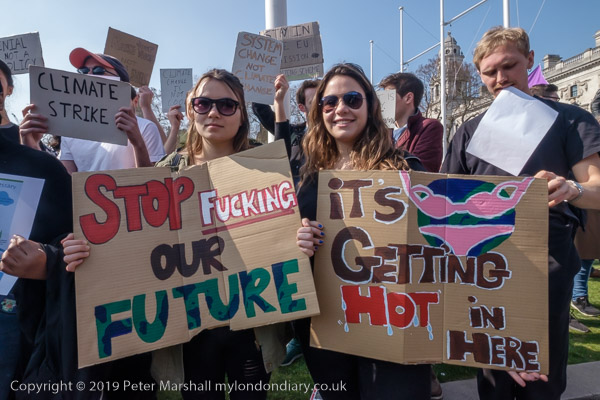
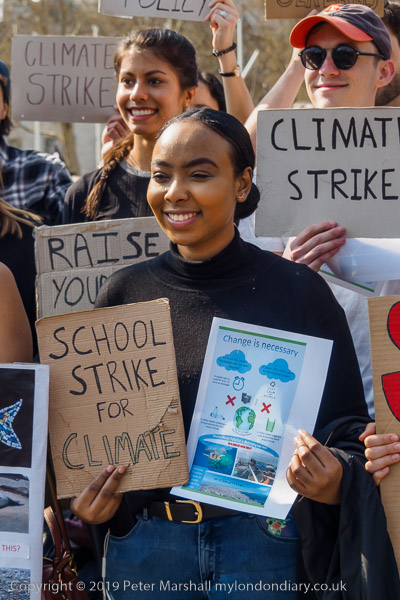
I had after all already photographed three protests, if not the three I had come up to London for. One I hadn’t bothered to put in my diary was a regular thing, a Fridays for Future climate protest inspired by 15-year-old Swedish schoolgirl Greta Thunberg. I photographed the first of these last October, and although there have been some big Friday school students protests since, the regular events have not really grown.

I was probably feeling pretty fed up. Although the Brexit protest hadn’t been anything like as huge as the organisers appear to have expected, I do find most Brexiteers rather depressing. Of course people voted to leave for a whole number of reasons, some of which make at least some sense, the kind of people who come to protest appear largely delusional and racist, convinced that Brexit will restore the British Empire and put foreigners, particularly black foreigners, back into their place both literally and metaphorically.

Migration to this country over my lifetime (and I was born some time before the Empire Windrush berthed at Tilbury) has revitalised our culture, giving us greater variety, most obviously in our diet, but across the whole spectrum. And it wasn’t migrants that took our jobs, but migrants who provided the workforce needed for a post-war recovery, to keep essential services like the NHS and transport running. It wasn’t migrants or Europe that took away large sections of manufacturing industry but overseas competition and government stupidity.

And again it was Thatcher whose policies greatly reduced the supply of low cost social housing, with ‘right to buy’ removing homes from councils that were largely after a few years recycled into the hands of people wealthy enough to profit from a disastrous rise in ‘buy to let.’

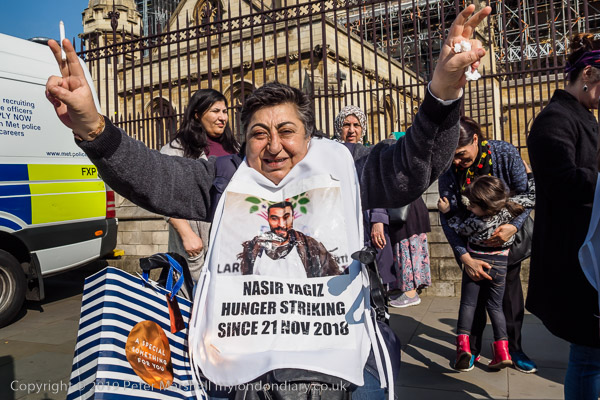
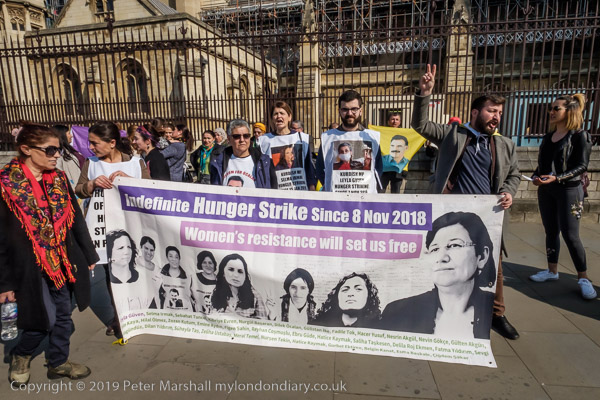
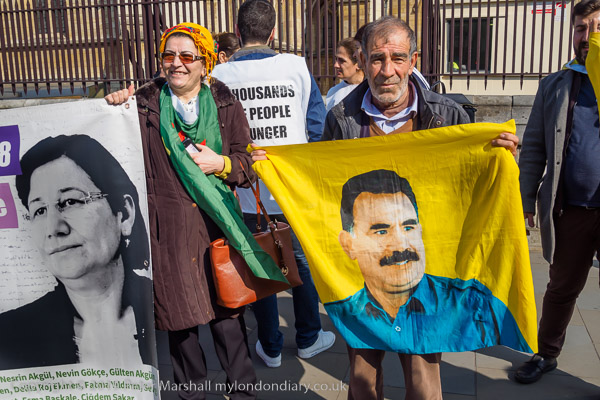
The last of the three events came as a surprise, when some of the Kurds I had photographed a few weeks earlier supporting Kurdish hunger strikers turned up to protest again outside parliament. The hunger strike by HDP MP Leyla Güven  began in early November; kept alive by sugary and salty drinks and vitamin B she was then on her 142 day of protest – eventually ended on 16 May after the authorities ended the isolation of Abudullah Ocalan in prison.

Kurds support hunger strikers
Fridays for Future climate protest


There are no adverts on this site and it receives no sponsorship, and I like to keep it that way. But it does take a considerable amount of my time and thought, and if you enjoy reading it, please share on social media.
And small donations via Paypal – perhaps the cost of a beer – would be appreciated.

All photographs on this and my other sites, unless otherwise stated, are taken by and copyright of Peter Marshall, and are available for reproduction or can be bought as prints.
To order prints or reproduce images