2016 Books

I don’t like to look too much at the annual posts on many sites about ‘Photography Books of the Year‘, not least because if I spend too much time reading them I will invariably find some I feel I really need to buy.  And while I could usually afford to do so in terms of cash, I just do not have the space. Virtually every room in my house now has its shelves of photography books (and there are some in the loft) and there is just no room for any more. (We do have a few non-photography books too, but they are well in a minority.)

So over the past few years I’ve adopted in fairly strict rule. I only buy books by photographers I know. I’ve stopped asking for review copies some years ago too, though I won’t review books from PDFs – unless they are being published in that format – it just isn’t the same. I’m still pleased when people give me books, and I’ll try and find room for them, but I’ll really have to find something I already have that I feel I can do without to give away or at least move up to a box in the loft.

I’ve already posted about my book of the year – and a very thick one that I have bought – Provoke. I needed it for a talk I was writing, but I still haven’t found a place for it, and it’s in a pile of stuff on the carpet behind me.  I see in my guilty sneaked glimpses that it has featured in some other people’s lists too.

Currently I’m sitting on my hands and thinking about hiding my credit card after having taking a peek at the recommendations by Elizabeth Avedon, at least some of which seem more to my taste than most, Part 1 and Part 2.

I see at the right of her pages it has a counter recording ‘PEOPLEVIEWS’, which stood at 1,863,069 when I visited. I don’t have such a counter on this site, but I can get some statistics from my ISP, though I don’t know what a ‘Peopleview’ is.

At the moment I can only get statistics for the past 18 months, from 1st July 2015, although the site has been running since December 2006. Last year, 2016 >Re:PHOTO had 1,558,105 page impressions by 372,417 visitors.

The numbers fluctuate a bit through the year, with August and December being my best months last year, each average over 5500 page views per day. I suspect that I wrote more posts in these months and more people have time to read them because we have some holidays from work. Anyway, thanks for reading!

Health, homes, jobs & education

One of the things that I learnt from my friends who photographed English carnivals, and who I went out with to them for a number of events was that photographically speaking they were more or less over by the time they had started. As the carnival set off, we would turn away, hopefully to a nearby pub, our job done. Sometimes we might return to take pictures at the end of the route.

It’s often the same with protest marches, though these days I less seldom get down the pub, but often find other things to do as the march makes its way through the streets.  With large marches, I’ll often photograph the start moving off, then stay in place or walk backwards photographing the rest of those waiting to start marching. Then as the last marchers start I’ll take the tube to the final destination, hopefully arriving in time for the start of the rally.

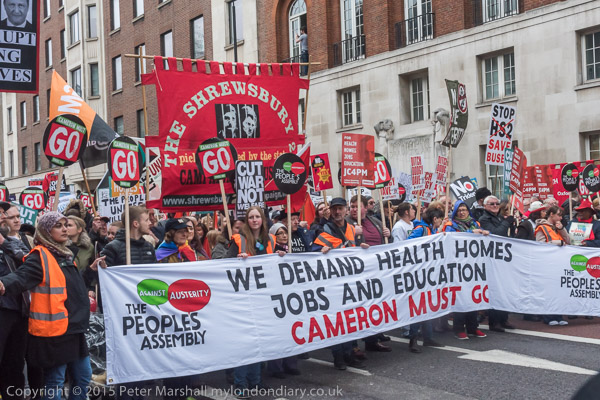
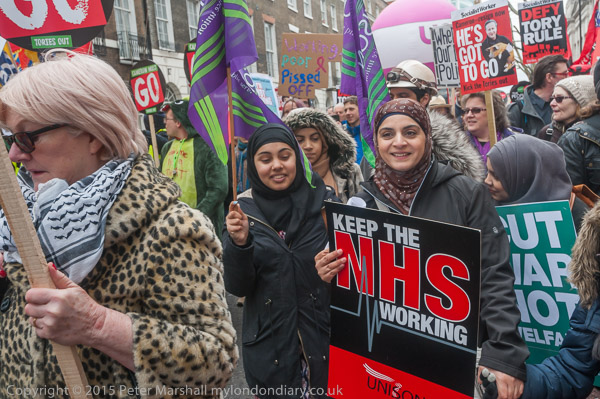
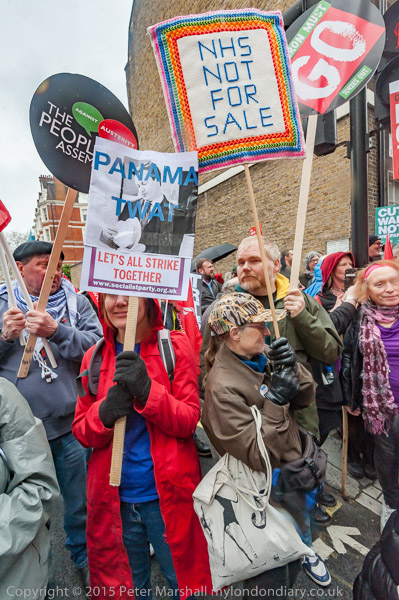
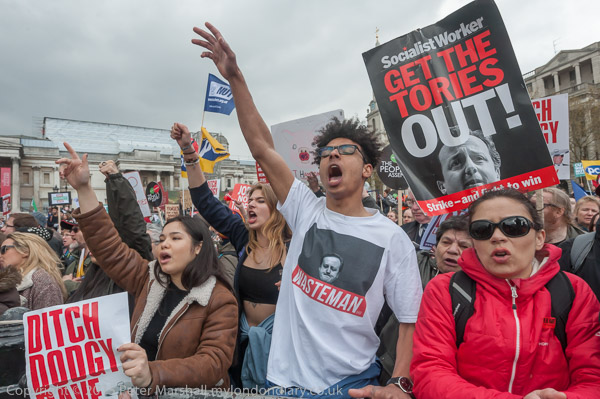
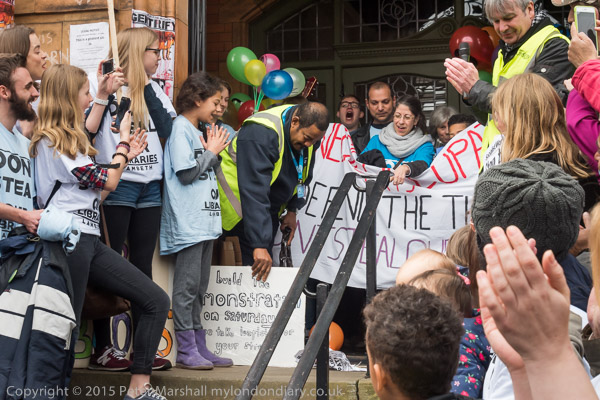
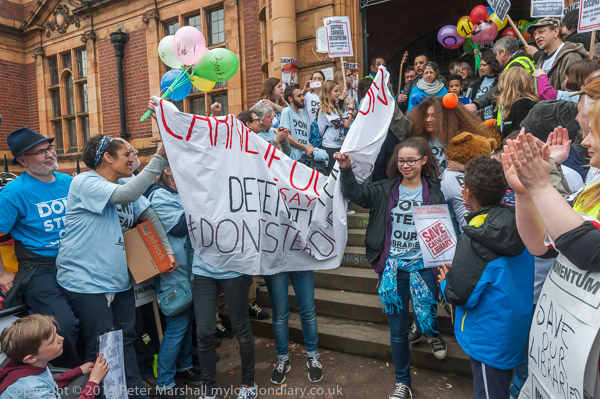
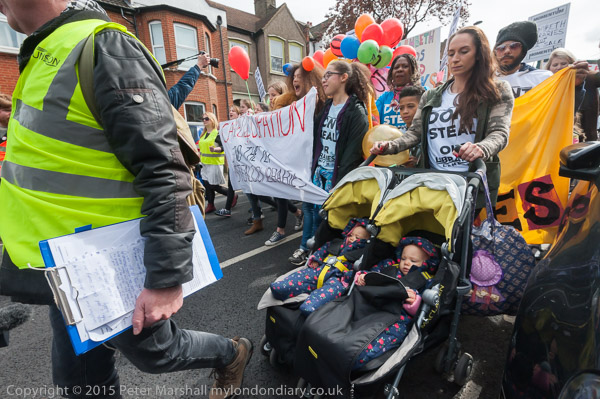
Situations are more varied and people are closer together while waiting to start, giving more interesting scenes to work with, but for the People’s Assembly march Against Austerity, Goodge St was just so packed it made movement and photography very tricky. The pictures I was able to make come mainly from the less crowded edges of the roadway.

The march brought together many different issues that have arisen or been made worse by the government cuts, and included people from virtually all the campaigns I’ve photographed over the years of austerity, along with others from around the country. Only missing were some of the minority ethnic groups and the anarchists who felt that people should be acting rather more directly than walking in an orderly fashion to Traflagar Square, listening to a few speeches and then quietly going home.

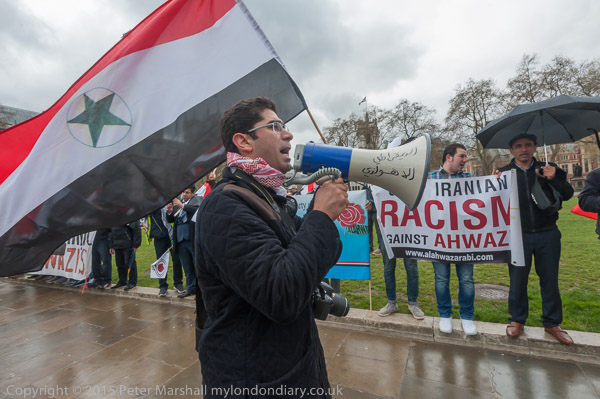
This time I gave up waiting for the march to start, as it was held up by police getting the route clear. And held up more. I’d intended to rush to the tube as it started to meet another group of protesters, Ahwazi Arabs who were to stage a protest in Westminster, close to Trafalgar Square where the People’s Assembly march was to finish, so I could go on to take pictues at the rally at its end. I was just a little late for the Ahwazi event, but met them as they marched down from Downing St to Parliament Square.

After photographing the Ahwazi I walked up to Trafalgar Square as the start of the People’s Assembly march was arriving, in time to photograph the people who were gathering there. Many of the marchers didn’t make it to the rally (and the pubs around got pretty full) but there was still a large crowd in the square to listen to speeches.

It was a well-organised event for press coverage, with space for us to move around in front of the crowd, and with a stage for the speakers we could move around and mingle with those waiting to speak.

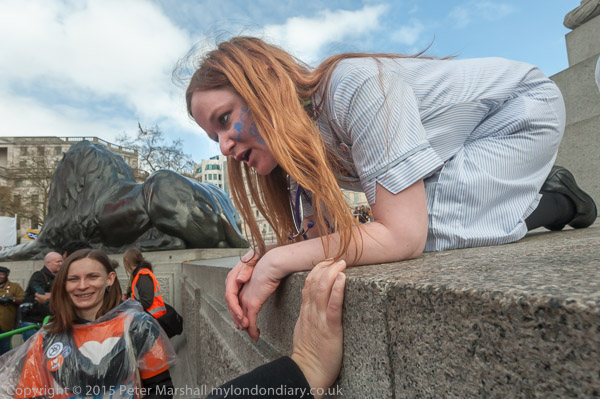
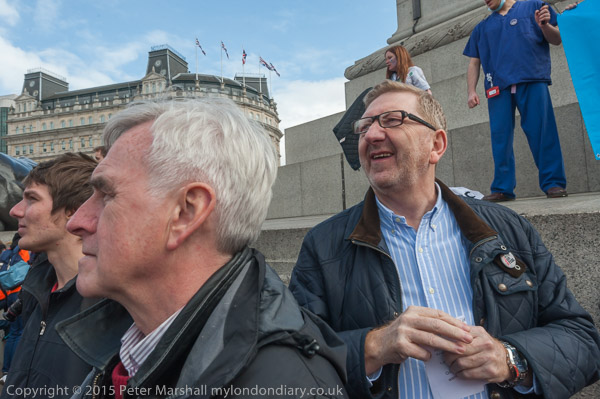
I particularly liked my pictures of Danielle Toplady, one of the student nurses leading the ‘Bursary or Bust’ campaign against the axing of NHS student bursaries apparently impersonating one of the Landseer lions, but just couldn’t quite get the right angle to include Green Party leader Natalie Bennett she was talking with (and whose hand is in the foreground), and I was also pleased to find Shadow Chancellor John McDonnell standing next to Len McCluskey General Secretary of Unite.

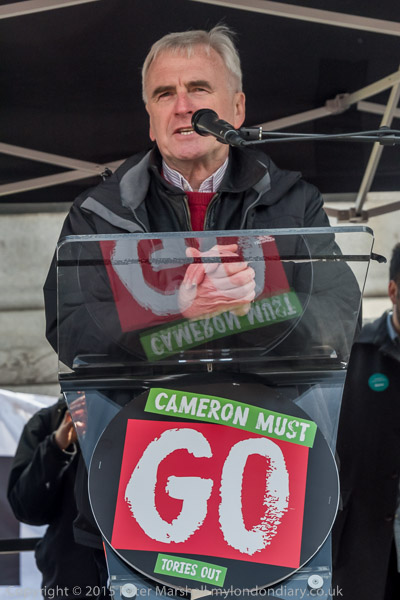
The speeches too gave plenty of opportunity to photograph both of them and the others, though the roof over the stage was rather distracting – even after I’d burnt down the prominent struts.

The perspex lectern was also interesting, and I tried hard to include it and the reflections it gave in various ways in the images.

I felt quite pleased with my work, but rather tired by the time the rally had more or less finished – but I knew I had more to do, much though I would have liked to put my feet up and relax. It was to be a long day.

Homes, Health, Jobs, Education Rally
Ahwazi protest against Iranian repression
March for Homes, Health, Jobs, Education
Continue reading Health, homes, jobs & education

Berger & Mohr

This morning the media is full of tributes to John Berger, and in particular his 4 episode TV series which I watched back in 1972, Ways of Seeing. You can now view these on Youtube (start with Part 1 and the links to the other parts will appear.)

But although I listened to a discussion about him on Radio 4 there was no  mention of his long collaboration with Swiss documentary photographer Jean Mohr, and in particular what is perhaps a rather better thought out book they produced together,  Another Way of Telling (1981), recently republished in a new and improved edition by Bloomsbury. You can read Berger’s essay ‘Appearances‘ photocopied from the 1982 US edition as a PDF online, but that misses the real feeling of the work, which needs to be taken as a whole.

Ways of Seeing‘ also came out as a Pelican original, and the book is rather better than the TV programme if you want to think about Berger’s work and ideas, which were not universally accepted. ‘Art-Language‘ in 1986 (Volume 4 Number 3 October 1978) was 123 pages of criticism of the book, much of it worthy of consideration.

Mohr’s first published collaboration with Berger was the book A Fortunate Man: The Story of a Country Doctor, first published as a hardback in 1967 (I bought it a few years later) and re-issued by Canongate Books in 2015. The new edition, as Rick Poyner points out has the advantage of much improved modern reproduction (though the more detailed images are less dramatic), but in several respects its design unfortunately fails to match the sensitive work in the original by Gerald Cinamon, which contributed greatly to its success in combining photographs and text.

On Mohr’s web site – if you select  ‘Itinéraire’ (or ‘Route’ if you view the site in English) you can browse through the  content of his CD “Journey of a photographer Jean Mohr” published in 2000 by  l’Association Mémoires de Photographes. As well as 1200 photographs, there are also texts, videos, interview and more.

As well as the collaboration with Berger – other books include Art and Revolution, (1969) A Seventh Man, (1975) and At the Edge of the World, (1999) – Mohr is well known for his images of Palestinian refugees, which began with a commision for the International Committee of the Red Cross in 1949 and continues through the years – including another ICRC assignment in 2002. His After the Last Sky: Palestinian Lives (1986) includes a poetic meditation on Palestinian identity by the late Edward W. Said in response to his pictures.

2016 Yunghi Grant awards

One Facebook group I’ve belonged to for some time is an invite only group with almost 5,000 members, The Photojournalists Cooperative, a confidential discussion forum where we can discuss photography related issues, largely on the business side of photography, in private. But what is no secret is that this group was created by Yunghi Kim, a photographer who has been with Contact Press Images for over 20 years.

Like all photographers Kim has her pictures taken from the web and used without permission, but she has been more diligent than most in chasing up these copyright infringements. A little over a year ago we read (and you can read it on Photoshelter) the she was to donate “$10,000 to create ten one-time grants of $1,000″ with money that she has received “from fees recovered from unauthorized use of my work”. You can read more about her and the grants in I Wanted To Protect Myself, and I Wanted To Empower Other Photographers on Vantage.

American Photo in January 2016 published a fine article, Yunghi Kim on Intimacy in Photojournalism by Hannah Smith Allen illustrate by some of her powerful images, and you can see more of her work on her own web site and she is also on Facebook.

Kim apparently got back enough from copyright infringements to continue the grant into 2016; entries closed on 20th December and another group of awardees was announced on Christmas Day, and I read about them on PDN Pulse a couple of days ago with a link to the announcement on Kim’s blog which gives some information – and of course a great image – from each of them. On it she writes:

We thank all those who submitted entries to this year’s grant; it was difficult to narrow it down to ten. Jeffrey Smith and I feel privileged to read everyone’s stories and proposals, and are heartened to see that there is really strong editorial thinking and story development even as funding resources become more challenging each year.

I am immensely proud of all the entrants of this grant: committed photographers who are a part of our photojournalism community, all doing meaningful work as best as they can manage, often under difficult circumstances. My life has been enriched by being able to help in a small way.

The submissions are selected by Kim “in consultation with Jeffrey Smith director of Contact Press Images. Decision-making is inherently subjective. Please no complaints.”

The grants are a wonderful initiative by Kim, and a great example of a photographer showing her concern and love for the medium and what it can achieve.


Travelling times

I should ride my bike more. Not just because exercise is good for you, but because it really is the most reliable way to get around in Central London. Traffic is bad, and getting worse, and many times this year I’ve found myself sitting in buses that are hardly moving, wondering whether to get off at the next stop and walk to get their quicker.

One problem is that it is rarely possible to get off the bus until it reaches a bus stop – and that can sometimes take ten minutes if you come across a real snarl up. Bus drivers are not allowed to open bus doors except at stops, though occasionally will let passengers leave by the front door opposite the driver where they have better vision if it is safe to do so.

Most buses too have an emergency lever to open the normal exit doors, and sometimes passengers get frustrated enough to make use of this. I haven’t yet done so myself, but several times have taken advantage of it when others have done so.

It’s particularly galling for those of us old enough to have spent time travelling on the old Routemaster and other now vintage buses with their open rear platforms, enabling you to leave and enter the bus anywhere and at any time. There were a few accidents, but in general Londoners managed to arrive in one piece. One of Boris’s minor disasters among many as London’s mayor was his new Routemaster bus, which traded on the name but otherwise had few of the traditional features.

One of them was a two-person crew, one driving and the other looking after the passengers, but that second person was soon phased out – and the open platform at the back replaced by sometimes rather crude automatic gates – there are at least two designs, one of which regularly savages unwary tourists waiting to descend.

There are other faults too, and even with improvements to the air conditioning you can still get cooked in warm weather. There are still a few of the old Routemasters around on a route heavily used by tourists and travelling on those reminds me of how much generally bus design has improved, with a far smoother ride, but at least you are not trapped inside. But Boris’s ‘blunderbus‘ stays with us after he has gone on to be a rather curious and undiplomatic Foreign Secretary.

But on April 9th it wasn’t a bus that let me down but one of London’s suburban trains, both running late. It’s something I also blame on the politicians, particularly Mrs Thatcher, whose vendetta against the GLC robbed us of effective London-wide government in 1986, and carried out a nonsensical privatisation of the whole British rail system. My train into Clapham Junction run by a private company was held up by signalling problems and I missed the connection to the Overground service which took me within walking distance of the Carnegie Library and I arrived almost half an hour after I had planned.

Fortunately I was just in time for the last speeches before the occupiers emerged to cheers and applause from the large crowd which filled the street outside – as you can see at Carnegie Library Occupation Ends.

A bike would not have solved my travel problem on that journey, as I would still have been held up on the first train, but it would have got me there a little faster after that. And barring accidents and punctures a bike is the most reliable form of transport, and the almost always the fastest in central London, with traffic only slightly slowing you down, even if as I almost always do, you stop at red lights.

But there are problems. The library would have been fine – just lock the bike to a nearby lamp post and get on it afterwards, but covering the march that came afterwards – March to Save Lambeth’s Libraries would have meant walking with it taking pictures and then returning to pick up the bike before going on. As it was I went with the march until just after it passed a railway station on another line before getting a train back into the centre of London – just a little faster than I could have ridden.

The main problem is simply carrying my kit. I’ve tried using a back-pack, which would be OK on a bike, but I don’t find it too convenient, and prefer my old shoulder bag. I can’t cycle with it on my shoulder, it’s too large to fit in a pannier. I’d need to have a bag which would double as both a back-pack and shoulder bag to keep me happy, and I’ve yet to find one suitable.

Trains (and buses) do have one advantage – and one that links with the protest I was photographing in Lambeth – that you can read on them. I never travel without a book in my bag. More seriously, libraries were vital to me when I was young, and I doubt if I would ever have got to university without my local public library and the books I was able to borrow and read. And it was there that I also developed my interest in photography, reading every week the Amateur Photographer magazine that we certainly could not have afforded to buy.

But I suppose the point of these ramblings, jogged in my mind by looking at my work on April 9th is that days like this are almost as much about ‘logistics’ as about photography. Starting with a list of events in my diary, working out which ones I intend to cover and how to get from A to B to C… Of course some things are clearly impossible, as you can’t for example be in Stratford and Hammersmith at the same time.

I often spend an hour or two on the Transport for London Web site and looking at maps planning the next day’s events. Its ‘Journey Planner‘ isn’t entirely reliable and often you need to break down a journey into several stages to get it to return the best result from public transport. Sometimes it misses the obvious or seems to have something against certain bus routes, but it’s usually a good starting point.

But using a bicycle, particularly a folding bike like my Brompton which you can put on a train or tube any time of any day would often both simplify journeys and speed them up. I ought to get myself sorted out and use it more.

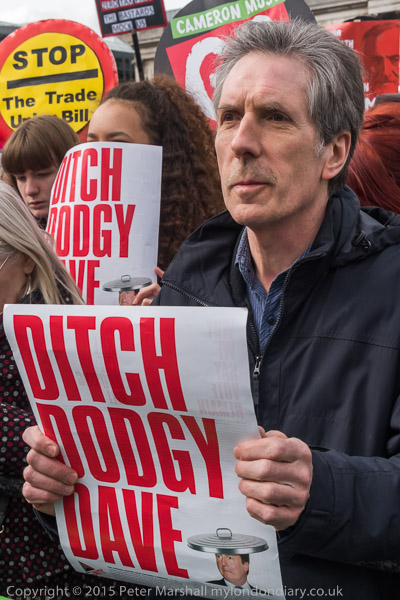
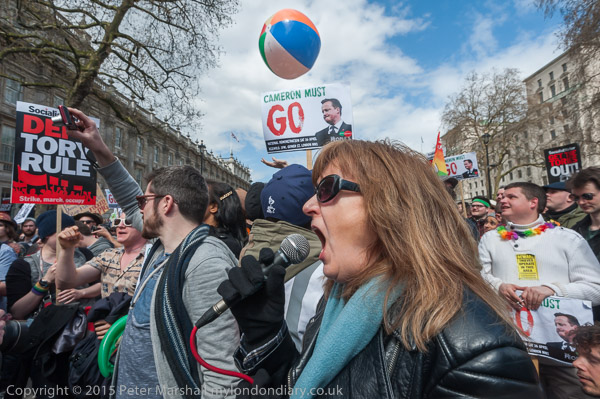
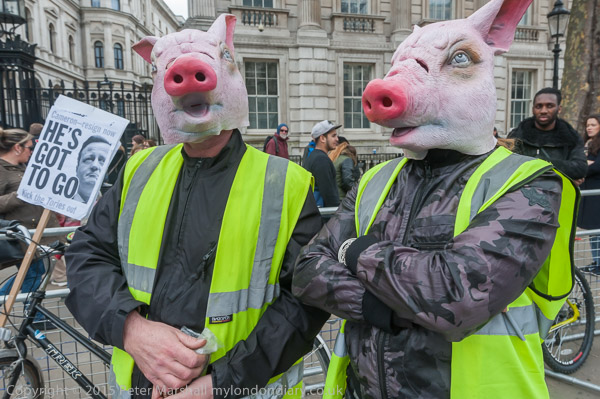
I left the libraries march close to Loughborough Junction and a train and a tube took me to Westminster and Downing St, where a couple of thousand people were partying on the street and calling for the prime minister, David Cameron to resign. Cameron must go! This followed the leaking of the ‘Panama Papers’ revealing some rather dodgy financial affairs about a great many of the rich and powerful, which since then have been largely, as usual, swept under the carpet. Eventually, but for different reasons, Cameron did go, but as I told some of those I was photographing, changing the Tory in charge isn’t going to make things any better.

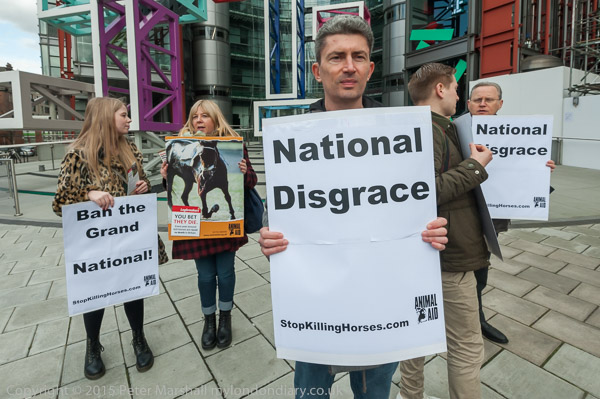
Next stop was around a mile away, rather appropriately on Horseferry Road outside the Channel 4 building, against the cruelty to horsed in races such as the Grand National which they were broadcasting that afternoon. It does seem to me an unneccessary cruelty, with four horses already having died at this year’s Aintree meeting, though I do think there are many more important issues to protest against, both so far as animal rights are concerned and also human rights. This fitted in well with my movements for the day, but I wouldn’t have gone out of my way to photograph it. And rather fewer people than expected had arrived to protest – probably fewer than were watching the race in the average betting shop. Stop Grand National horse slaughter

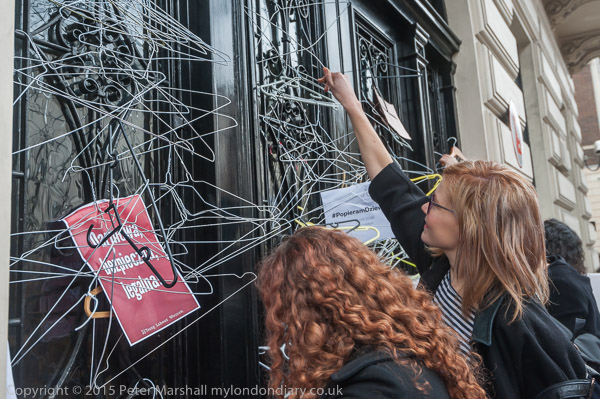
It was then a short walk to Victoria station and the tube to Oxford Circus, from where I walked north up Regent St and on to Portland Place and the Polish Embassy. Though quite a fast journey it would have been faster by bike, but I arrived as people were hanging hundreds of wire coat hangers on the Embassy door, having I think missed some speeches beforehand. Which since they were probably mainly in Polish was probably not a bad thing.  Among the wire coathangers were a few plastic ones, which would not have been of much use to the back-street abortionist, but otherwise the symbolism of this protest against plans by the Polish government to  outlaw abortions except in very limited circumstances was pretty clear.

The protest in London involved a few hundred, mainly women, but reflected much larger protests in Poland – which did eventually suceed in getting the law dropped.  Don’t Criminalise Abortion in Poland


Then it was back to Oxford Circus and Westminster on the tube to return to Downing St, where the Party against Cameron was continuing, though on a rather smaller scale than earlier in the day. It had developed into rather more of a street party, less fluffy and more hard-core, mainly gathered around a bicycle-hauled sound system, and with a rather greater emphasis on Carmeron’s Bullingdon initiation pig-related activities.

Perhaps surprisingly the police seemed happy to simply watch the event rather than exercise their frequent obsession with traffic flaw and try to clear the street.  I wasn’t sure whether this merely reflected a sensible decision based on the available resources or perhaps an expression of their own views against our current government, which they feel has treated them badly in various ways. Of course the main villain so far as they are concerned is Theresa May, then Home Secretary and now the replacement for Cameron.

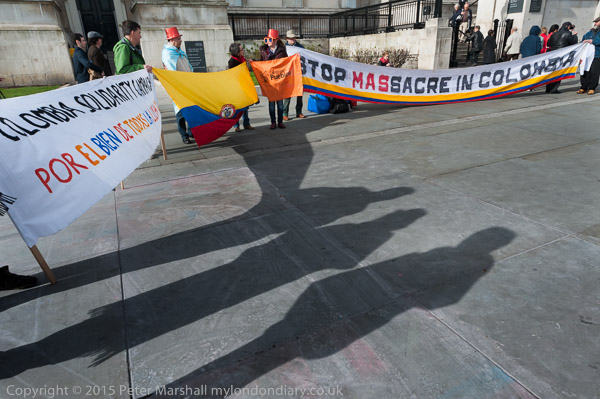
Finally it was just a short walk to Trafalgar Square, where in front of the National Gallery, Colombians were protesting against political persecution. End Killings in Colombia seemed to call for something a little more than just people holding banners and I tried to make use of some of the long shadows that some of the protesters were casting to provide a more sinister view.

Steps in the corner of Trafalgar Square then took me down to the Bakerloo line platforms for the two stops to Waterloo and my train home.

Continue reading Travelling times

Naked Greed

Long ago I turned down the chance of working in the pharmaceutical industry. I was then a graduate chemist and one of the reasons I had been attracted to chemistry was the potential for developing new drugs that would benefit humanity. But what I saw and heard when I went for an interview with one of the leading drug companies made me walk out of the door.

Drug companies justify the high prices they charge for drugs by talking about their huge expenditure on research to develop new drugs and testing them, and the sums involved are indeed large. But still less than the amounts that they spend on marketing and trying to get their drugs prescribed – even in some cases if they are not particulary effective or appropriate.

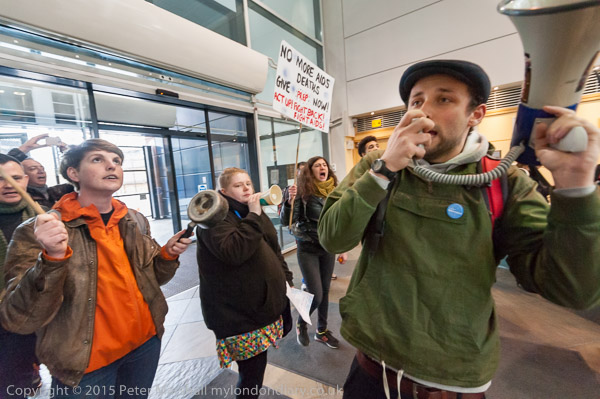
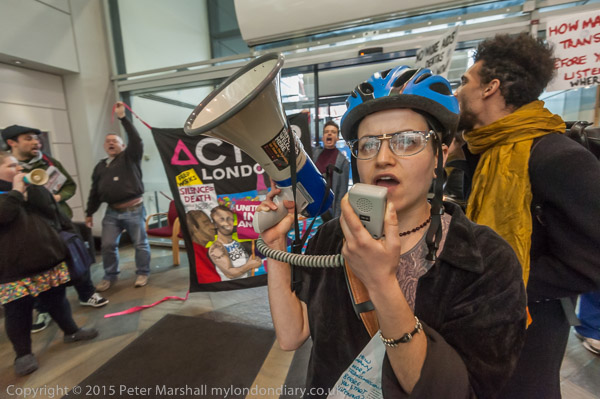
At the end of March and the start of April this year I photographed two protests by Act Up London involving medical drugs. The first was largely directed at NHS England who were refusing to accept that they should pay for PrEP, a pre-emptive treatment against AIDS, and trying to get local authorities to pick up the tab. They also announced a two-year pilot study into the use of the drug Truvada®, marketed by Gilead.

Truvada contains two drugs, Emtricitabine which was discovered in 1996 at Emory University in Atlanta and Tenovir, first made at the Academy of Sciences of the Czech Republic and patented in 1984, though it needed research by Gilead and others to produce a derivative that was readily abosorbed – and this was approved for use in the USA in 2001.

Gilead has had a long period to recoup the costs of their research, but they are still charging premium prices for both PrEP (Truvada) and for other drugs such as Harvoni, an effective treatment for Hepatis C. A month’s supply of Truvada costs the NHS £355, while a generic alternative – effectively the same – would cost a fiver. A 12 week course of Harvoni costs the NHS around £39,000, while there are various ways to obtain a generic alternative (made in Bangladesh, India or Australia) for less than £2,500 for the same course – around a sixteenth of the cost.

The protest at NHS England – next to the Bakerloo line Elephant & Castle terminus – was pretty conventional, with a short rally outside after which protesters rushed in past security and made a noisy protest inside until police arrived and they left to continue their rally outside.

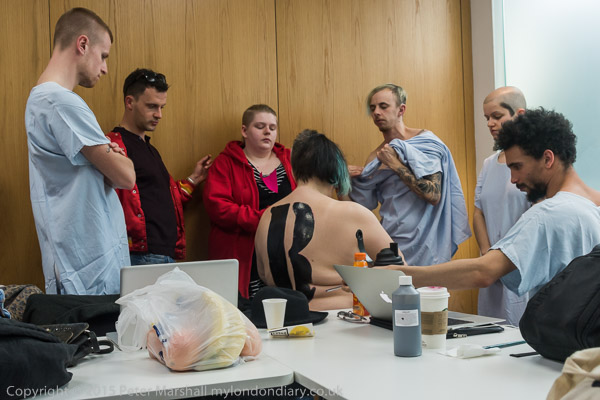
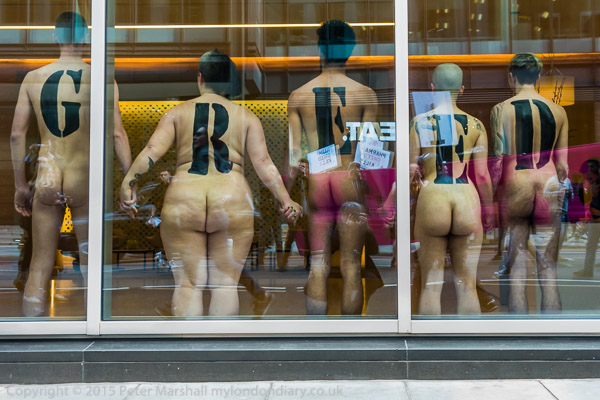
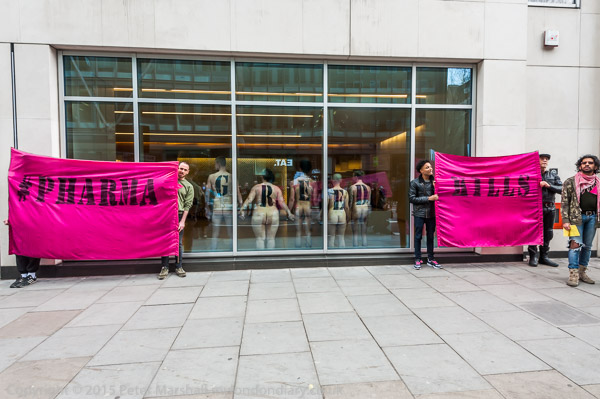
At Gilead’s offices on High Holborn it was a different story, with the protest being kept secret and preparations being made a short distance away before walking to the location, where a group of five protesters walked inside and stood in the window, dropping the gowns they had worn on the way there to stand naked with large painted letters G R E E D on their backs.

Photographically it was rather tricky, as the glass reflected too much light. I hadn’t known in advance what form the protest would take. I don’t think a polarising filter which is often used to cut reflections would have helped as it really needed to be photographed ‘head on’ when they make no difference. Although I don’t usually direct people I’m photographing I did go inside the office and ask the five to move right back as close as they could to the glass, which did make them a little more visible, but the image owes rather a lot to Lightroom and work on the bodies to bring them out.

The full image that the protesters wanted – the five naked bodies spelling out ‘GREED’ with the two banners, one each side reading ‘#PHARMA’ and ‘KILLS’ presented another insurmountable problem, that of aspect ratio. As you can see there were large areas of fairly empty space both above and below that line reading #Pharma Greed Kills. It would have made a picture with an aspect ratio of 4 or 5:1 rather than the 1.5:1 I was using.

Act Up invade NHS to demand PrEP
Act Up protests Gilead’s naked greed
Continue reading Naked Greed

Panoramas and Cigars

In my extreme youth I was a Brentford fan. Not that I ever went to a match at Griffin Park, though I think three of the under-11 team I played for went on to start professional careers there – and one of them stayed there until he retired a few years ago. I wasn’t a star player, and I think was sometimes the only player who didn’t manage to score when we thrashed some other teams 30, 40 or 50-nil (I think sometimes the ref lost count.) Even the goal-keeper sometimes put one in the opposite net, though at left or right back I could claim some credit for the nil on the other team-sheet, by fair means or foul.

But my attraction to Brentford was not just the football, but the romance, perhaps a strange word, but there was and still is something special about the place. It was always a thrill in my young days to take a trip on the bus along Brentford High St, though it was often too high, with the ammonia and tar of the gaswords sometimes almost overpowering, but visually too there was sometimes if you were fortunate the sight of a huge wall of re-hot coke as a furnace was opened and it cascaded down to ground level. I don’t know how many times I saw this, but it engraved itself indelibly on my memory.

I think too my father may have taken us on days out, perhaps even bank holidays, not just to Kew on the bus through Brentford, but to walk along the Grand Union Canal, which enters the Thames here. Even now, many years later and long after the end of commercial traffic on the canals and the turning of Brentford Dock into a private housing estate, much still remains of the backwaters and streams of the River Brent between the high street and the river, hidden away from the casual visitor, but much more open to the public than when there was far more riverine commerce and only a few footpaths open.

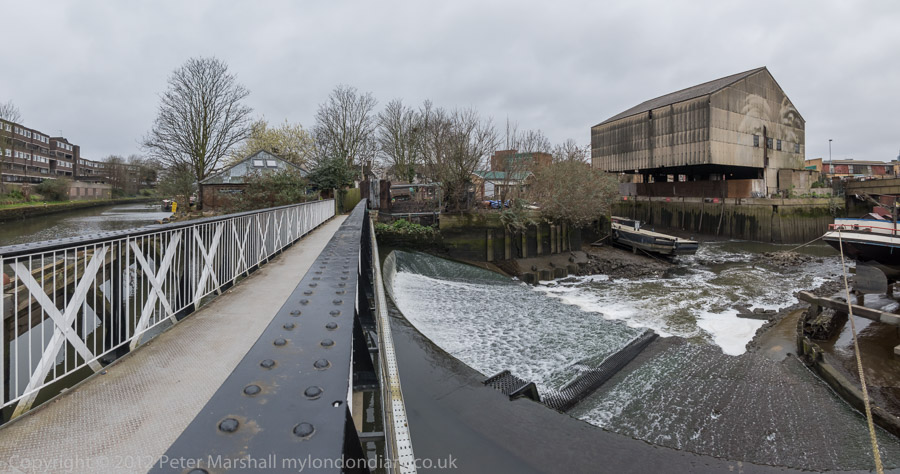
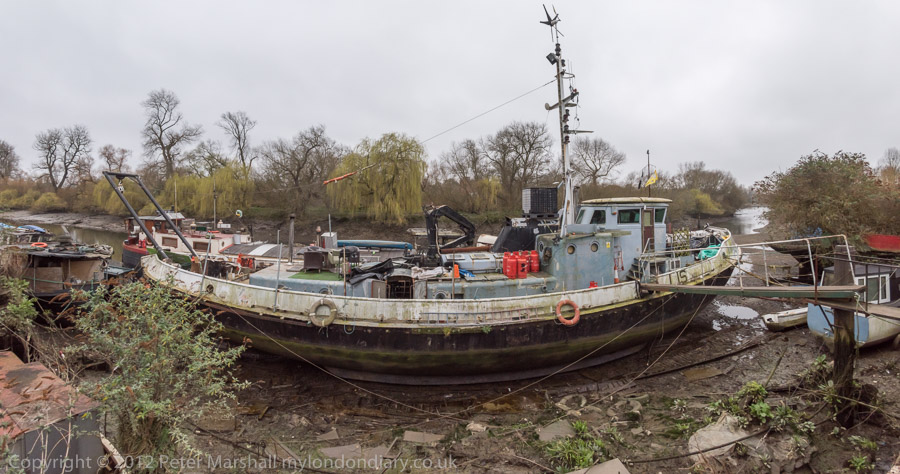
The opening up of the riverside hasn’t been altogether positive, with large blocks of offices and flats destroying some of the unique atmosphere, replacing it with an identikit blandness, but a little of the charm remains, as I hope you can feel from these images.

I’ve written a little previously about the later stages of the walk that took use from Kew Bridge through Brentford to Isleworth and Mogden during last Easter’s holiday. This was a photographers’ walk rather than the normal family route-march where I keep finding myself having to run to catch up the others striding 50 or more yards ahead after I’ve stopped to make a picture. We wandered back and forth, explored dead ends and different views, took our time and our pictures.

I’d come this way a dozen years earlier, working with the Russian swing-lens Horizon panoramic camera as well as the Hasselblad X-Pan fitted with the 30mm lens, on a slightly misty New Year’s Eve in 2003, and I was interested to see both how things had changed and how different things looked using digital rather than film. Of course I don’t have a swing-lens digital camera – which would need a curved sensor, but was using software to produce a similar result from full-frame 16mm fisheye images.

One big difference is that I haven’t yet got around to either printing or scanning more than one or two of those colour negatives that I took in 2003, while the digital files were very quickly processed. At least I have developed the film, though I still have a few rolls waiting to be done from around 10 years ago that somehow I’ve never got round to. I did send a couple of batches off to be processed a year or so ago, but haven’t yet got around to finishing the job.

So far as I can see from the negatives, the results from digital are very similar, except that they have a significantly greater field of view. One big advantage fro digital is the wider vertical field, which if you want a panoramic format such as the 1.9:1 I’ve used here, gives you considerable freedom as to where to place the horizon. With the two film cameras I was using the horizon was always central as the cameras have to be kept level to avoid a curved horizon.

The camera used for these pictures was the D810, and the images are 7360×4912 pixels – 36Mp – before cropping to panoramic format. While the orginal RAW files are a reasonable 35-40 Mb (Nikon compression does a great job) changing the perspective results in a 16bit Tiff file of over 210Mb which rather eats up disk space. But that 7360 pixel width means high quality prints at up to 25 inches wide, similar to what is possible from film with images 56x24mm or similar.

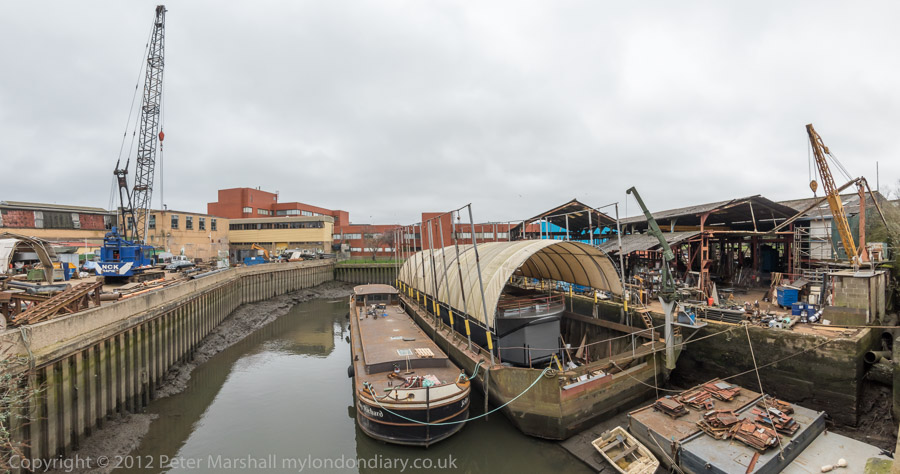
Since the images use the same ‘cylindrical’ perspective the compositional problems are much the same, and the main problem is with ‘cigarring’. Images taken face on of any large rectangular subject show this typical shape because the ends of the block are further from the camera than the middle. A couple of the images in Riverside Brentford Panoramas including the boat above show this too strongly for my taste. There are several different types of perspective that can be used other than the straightforward cylindrical which can reduce this effect – such as the Vedutismo applied here by PtGui.

There is a marked improvement, but it does over-emphasize objects at each end of the frame and isn’t always the best choice.

Continue reading Panoramas and Cigars

Black Magic

I’ve sometimes rather laughed Magnum’s ‘Square Print Sales’, with their postcard-sized signed prints being sold at $100 when you could buy well-printed books with many prints by the same photographers (and sometimes at least as well printed) for rather less. And perhaps been amused by images advertising the sale which showed those same images at 4 times the size. I’ve nothing against people collecting postcards, and I have a few myself, but most cost me 20p or less – and I’ve given hundreds if not thousands of my own work on them away.

Visiting to galleries and auction houses, I’ve often seen prints for sale for thousands of pounds that were inferior in quality to the reproductions of the same images in books. Sometimes it is worth remembering that – with a few rare exceptions – in photography we are always dealing in reproductions, and one of the joys of our medium is its essentially infinite reproducibility.

But of course photographers have to earn a living – and selling prints for thousands or millions is what keeps some art dealers in their lives of luxury.

But Magnum Distribution are now selling Matt Black‘s ‘The Geography of Poverty – Heartland‘, a set of eight 8×10″ prints in an envelope with some documentation for what seems a reasonable price of $249.00 They are in a limited edition, but 100 copies seems a fairly reasonable number, and more than I’ve sold of any unlimited edition print.

The 8 prints are digital C-type on Fuji Crystal Archive Matte paper, which would perhaps not be my choice for black and white prints, and rather more suited to colour images. But certainly you can make good black and white prints this way, though I would generally prefer good inkjet prints (which I imagine is what Magnum’s ‘museum quality’ square images are.)  Perhaps Black prefers the Fuji paper – the cost difference between C-types and inkjet is small – the pro lab I sometimes use charges around 30% more for inkjet.

It’s an great project by Black, who I think is one of the more promising new Magnum photographers for some years, and you can see more at MSNBC, where the presentation and text by Pulitzer Prize-winning journalist Trymaine Lee produce a work of outstanding quality. You can also see more of his work on his own web site and on Magnum, where he became a Magnum nominee in 2015. You can also follow him on Instagram, where he was Time’s Instagram photographer of the year in 2014. There is also a signed Geography of Poverty Newsprint issue for sale which seems to me rather poor value at $45. I have a number of such newpsrint publications now, and they usually end up in the recycling, as they hardly seem worth keeping.

I won’t be buying either that or the set of 8 images. Although I admire the work, I wouldn’t want to hang the 8 images on my wall, nor do I have the space to do so. And I have far too many prints  – my own and others – already hidden away in envelopes, tubes and boxes that never get looked at.

Time’s 100

I may have mentioned Time’s 100 Photos before, their collection of ‘The Most Influential Images of All Time‘, with ‘the stories behind 100 images that changed the world, selected by TIME and an international team of curators‘. If not, it’s an oversight on my part.

It’s certainly a list containing some remarkable images, and a number that it would be hard to criticise their inclusion, though my own personal choices would be mainly different – and with less of an American (that is USA) bias. There are a number of images I simply don’t recognise among the many more familiar, which either says something about me or something about them, and also some pictures where I might have selected another image from the same photographer or event.

There is some interesting text about each of the images, and for some further images or a video. The videos, 20 of them are also listed on a separate page and I have to admit to not watching all of them, and to skipping briefly through some others.

But one I paid more attention to than most is the one that brought me back to this site, from a link on Rob Haggart‘s A Photo Editor blog. Untitled (Cowboy) Photograph by Richard Prince is I think the longest of the Time videos at around 15 minutes. It includes some fairly lengthy scenes of Prince talking about his appropriation of the Marlboro adverts, as well as comments and images showing some of the team of photographers who made the pictures as ‘work for hire‘, and some experts from the art world.

One of the more fascinating aspects is that Prince introduces (at around 9.04) the 1949 Leonard McCombe essay in Life,  Cowboy, which was the inspiration for the Marlboro campaign.

I ended up thinking I would have liked to see more about how the original images were made, and that the actual Marlboro adverts were generally more interesting as cultural artifacts and as images than Prince’s selections from them.

This case differs from some of Prince’s other image thefts in that none of the photographers concerned has any copyright in the images, which are not – as Prince states he thought when he made them, in the public domain, but the intellectual property of Marlboro.

Capa and Margaret Bourke-White both get a couple of images into the collection – and you can probably guess which two. The texts which accompany both the Capa images are severely misleading, as too is the video in which John Morris talks about the D-Day image and his part in it.

The commentary on the ‘Falling Soldier‘ states that in the 1970s:

‘a South African journalist named O.D. Gallagher claimed that Capa had told him the image was staged. But no confirmation was ever presented, and most believe that Capa’s is a genuine candid photograph of a Spanish militiaman being shot.’

It’s a belief that now only those who pride themselves on being ill-informed and dismissing the evidence and research can hold to. If Time’s comment is true then there are plenty of flat-earthers in photography.

Conscientious Picks

The annual Conscientious Portfolio Competition is in some ways an ideal photographic competition, though I’m not generally a great fan of competitions. The annual competition is free to enter (but you will have to wait until late next year – this year’s deadline was 31 October 2016, 11:59pm ET.)

As Conscientious founder and editor Jörg M. Colberg writes:

I don’t believe in “pay to play.” Everybody needs to have the same fair chance. This is why the eventual winners are selected blindly, mimicking blind auditions: the judges get a set of photographs (and nothing else), with the names of the artists encrypted.

As well as being free, its also easy to enter. You simply start by sending an e-mail  with the address of your the web site with the project is on, and which of the projects there you are submitting.

It’s also a very personal view, with no pretention that this is some kind of industry consensus. You go through to the next round if Colberg sees yours as one of the 25 projects he finds of most interest. Then comes the final, where he and two others with experience in working with photographers – for this year Emma Bowkett and Felix Hoffmann, one a director of photography and the other a curator – each make there own personal pick of one project from the 25 in the pool.

There could be one, two or three winners, depending on whether they make the same or different choices. But the contest is run to try and create a level playing field. At this second stage each of those selected sends in 10 jpeg images at the same size which are then presented without the name or CV of the photographer:

Having a second round is based on the idea of making everything as equal as possible. With uniform file sizes, fancy websites won’t be able to beat out simple ones. With a special naming convention for the jpegs (which will hide the full names), the winner(s) will be solely chosen based on the quality of the work.

The prize is simply exposure, with the winners winners each having their work featured on Conscientious, one of the best-regarded photography websites, “in the form of an extended conversation”. This is a contest for ‘emerging photographers‘ and this will certainly be worthwhile and lead to coverage elsewhere. They might even get a mention on >Re:PHOTO :-)

The three winners this year have just been announced, in CPC 2016: The Winners, and I have to say that I find one of them rather more interesting than the other two. Readers will probably be able to guess which. There are links to their web sites on the page, and Colberg also tells us that of the 26 winners selected in 7 years, exactly 13 have been women and 13 men.

It isn’t an ideal competition, but for me beats most others in the way that it is organised. The one big change I’d like would be to have all the selectors being photographers rather than curators or employers of photography or critics. But that’s a view that reflects my strongly held belief that it is our medium and not theirs.