Hackney Women against D V


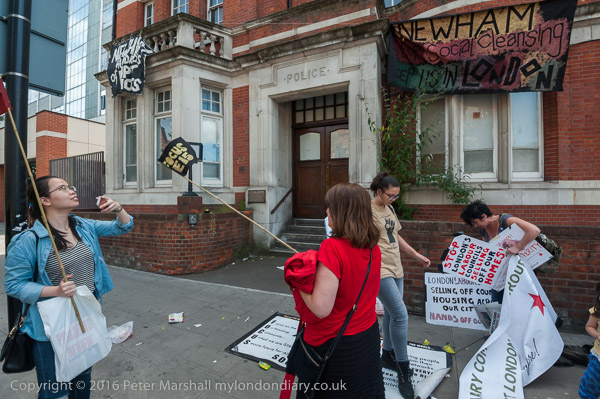
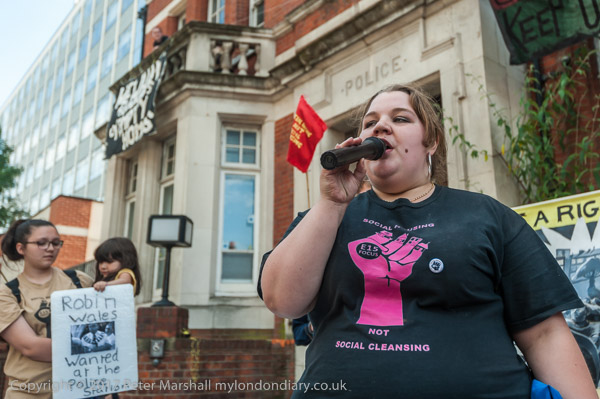
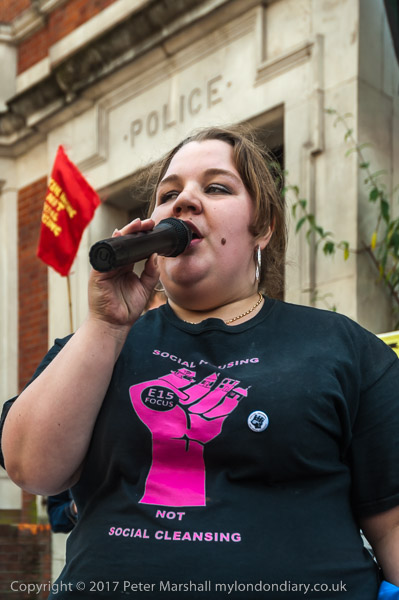
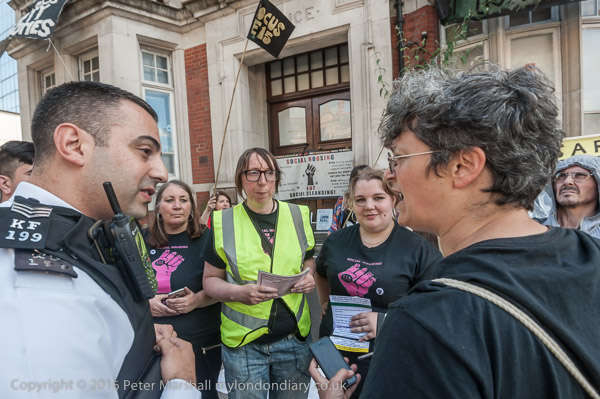
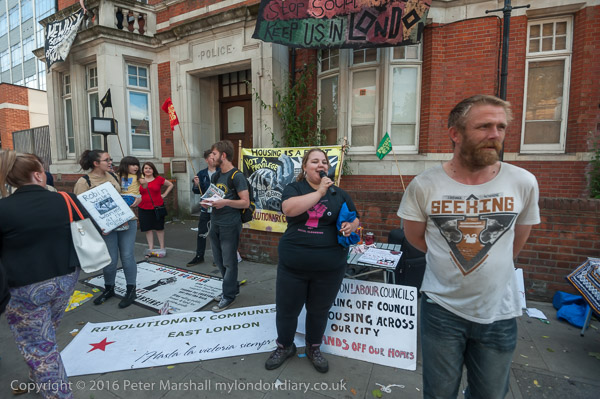
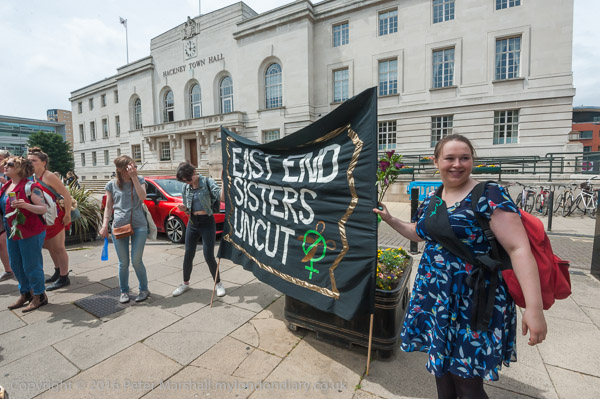
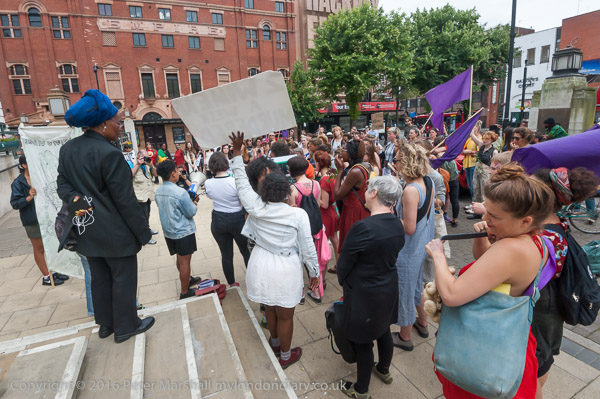
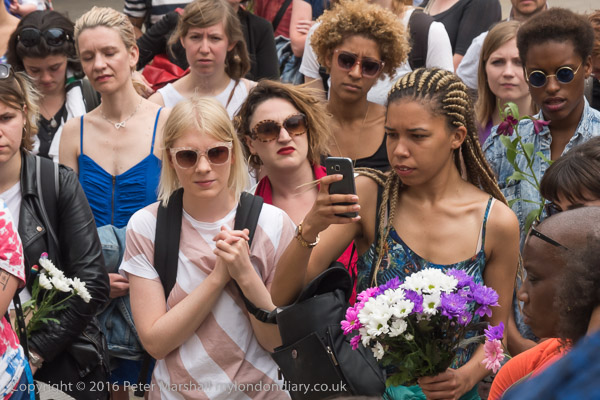
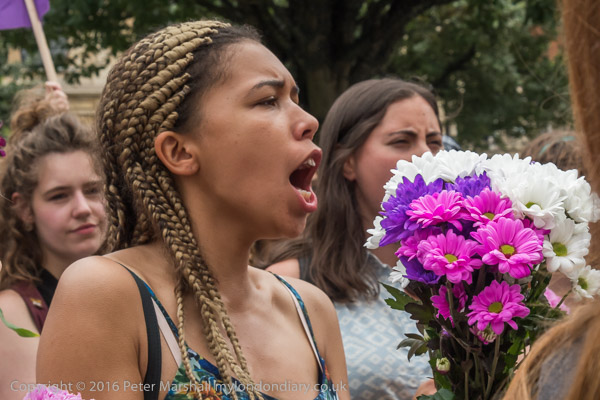
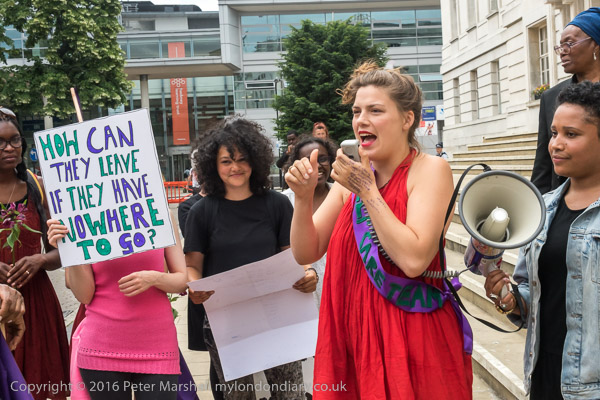
It was the first event of East End Sisters Uncut and a protest against domestic violence and the failure of Hackney Council to take the problem seriously – 60% of women who desperately need a refuge are turned away as there is no room for them.

I didn’t know any of the women who were there are the start and felt just a little awkward photographing at a women-only event, though I don’t think I really needed to be. But I like to blend in and photograph form inside the protest, and it just felt a little uncomfortable. Though I think it was entirely within my naturally very shy mind. People sometimes laugh when I admit I find it very hard to take photographs, but it’s true. And some days, some events, I never quite manage to overcome that shyness. There is always an initial barrier I have to overcome, and there have even been a few rare occasions on bad days when I’ve turned around and walked away rather than take pictures.

Once the protest really started things were easier, though I did have some arguments with the two women who sere security guards on the steps of Hackney Town Hall. These look and feel to me like a public place, but they were being policed officiously as private property, and although they were not in use and empty they insisted I move off from them. Hackney hire out parts of the town hall for weddings and they use the steps for wedding photographs, but there was no wedding there at the time- and I would have kept out of the way had one emerged.

I argued a bit, and took a few pictures before moving off them, but perhaps I should have stuck up more for my rights. But the protesters had moved off them when they were told they had to, and though I was annoyed, it was more important to photograph the protest rather than make my own protest.

And of course I wanted to get in closer to the people who were taking part in the protest and take their pictures. It’s always good to get images from different viewpoints, and I like ot keep my eyes open for places where I can look down on events, but the really good pictures usually come from getting down and getting close.

Although the steps were fine so far as I was concerned, increasingly I do have problems with climbing up on anything less solid. Where I used to climb on top of all sorts of street furniture to photograph from a higher viewpoint, I now have to chose more carefully, looking for places that are really solid and where I have something firm to hang on to. Stand on a wall or a box without support and I begin to shake uncontrollably, getting blurry images and in danger of falling. I think I’ve always had slight problems with balance, but in recent years it has got far worse.

It didn’t look as if much was likely to happen, everything was very quiet and ordered and there seemed to be a number of speeches coming, and I decided I could leave to go to other events that day.

This was something of a mistake, as not long after I left things rather kicked off. The protest took to the steps I’d been ordered off earlier, and set of flares and protested noisily before going off to occupy a flat nearby in their protest against the failure of Hackney Council to take seriously the need to provide refuges for women who have to leave homes because of domestic violence. They set up a flat as a refuge and kept it going for several weeks before they were evicted.

I should have talked to some of those organising the protest and found out what was happening, but the event was running rather later than I’d hoped and I was keen to be elsewhere. I should learn, as too often I try to do too much.
Continue reading Hackney Women against D V

Awesome!

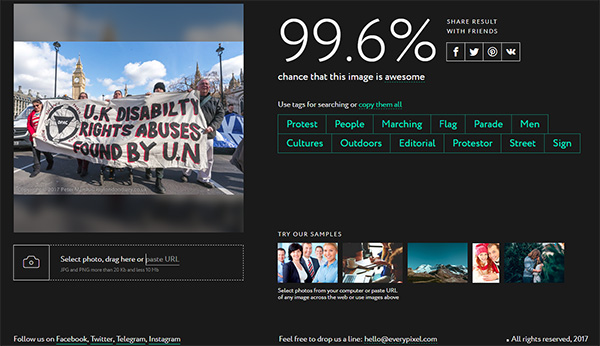
There is, according to the Everypixel Aesthetics Test, a 99.6% chance that my picture uploaded to their test page below is awesome:

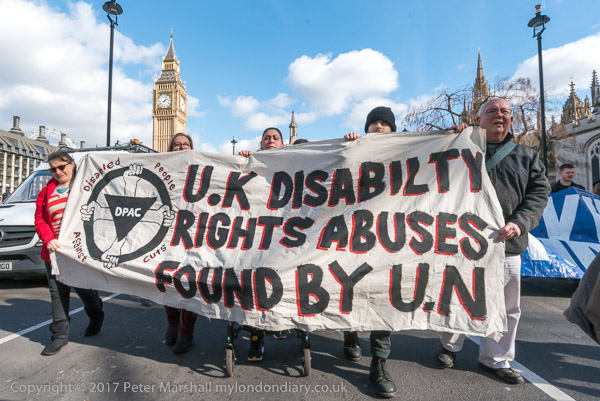
Well, actually it isn’t, just a rather ordinary image, typical of many that I take. Publishable? Yes, and fairly nicely done, but certainly not awesome. Here it is rather larger so you can judge for yourself:

It’s clear, leaves no doubt about what it is – spells out in the banner who the group is carrying it and why they are protesting.  And they are obviously marching down a street in London as I caerfully took it with ‘Big Ben’ in the background. You can see too that it is part of a larger demonstration as there is another banner to the right. Clearly the people are actually walking along a road – except for one in the middle – and you see the wheels of her wheelchair.  It’s competent, even precise (if rather hurriedly processed)  but awesome? No.

I tried out the 14 images currently on the front page of my website My London Diary, on the test page, and the results were interesting, with this image getting the highest score, though there were others that ran it close.  And one that I rather like that only scored around 25%.

Clearly the algorithm used to set the scores needs some more work, and I doubt it will ever be able to spot the awesome, though it might well be able to weed out the truly hopeless. And when I hear some picture editors get sent 50,000 images a day that could certainly be useful.  There is a disclaimer on the page, which admits it isn’t really – despite the name – makeing aesthetic judgements at all. It states:

Surprised by the result? This service doesn’t measure the coolness or beauty of a person or any object in a photo. It cares only about technical parts like brightness, contrast, noise and so on. Service doesn’t dedicate for historical photos, illustrations or 3D visualizations.

What is surprising – and perhaps even at the currrent basic level useful is the ability to generate keywords from the visual content. This is perhaps a fairly simple image, and some of the others I tried were a little more impressive, but here is the algorithm-generated list for the image above:

Protest, People, Marching, Flag, Parade, Men, Cultures, Outdoors, Editorial, Protestor, Street, Sign,

It isn’t 100% accurate – but then neither are my own hand-crafted keywords for images, particularly since time constraints often mean I’ll synchronise a list across a whole set of images, and only fine-tune them for individual images if I have time later.  Obviously this list doesn’t have any of the more specific keywords I’d find essential, but only because the agency I place most pictures with doesn’t make sensible use of captions for searching its image library.

Writing good captions is essential – and the old rules still hold, though so many images on the web and on many sites selling images are full of images are lacking. But captions for photographs to go in an online library are not the same as captions that will be used when an image is printed in a newspaper, magazine or book.

One of the old and good rules about captions in printed material is not to state the obvious. But to be computer searchable image captions need to include the obvious as they will generally be read without the image when searches are conducted. And while you may send a batch of images and feel you don’t need to mention some piece of information on every one, you have to remember that searchers – machine and human – are often going to see just a single one of them.

The 5 W’s remain essential:

  • What
  • Who
  • Where
  • When
  • Why

and sometimes there is a How worth adding.

Something like Everypixel or an enhanced version of it, taken together with software that could parse captions to generate keywords from them could make assigning keywords unnecessary. Actually computing power is now such that there is no reason not to search captions and give them greater significance in searches. After all, any editor likely to want to use that picture above would be looking for a generic ‘Protest’  but would be interested in a protest about ‘disability rights’ or the UN and UK disagrement or the organisation named on the banner or some other specific. And those would be in the caption but are not in Everypixel keywords.

Going further down the Everypixel web page we find that they actually – despite the disclaimer above – make the claim that their ‘Heartless algorithm‘ has  ‘learned to see the beauty of shoots in the same way as you do‘ because it has been trained using Artificial Intelligence techniques on a sample of images provided for them by ‘designers, editors and experienced stock photographers‘.  My short test on the site suggests to me that there is still a very long way to go.

I rather hope it does work, as they suggest it might be used for ‘intelligent image curation‘, giving high-scoring images a higer ranking in search results, and I think I would generally benefit from this. I’m often apalled at the poor quality images used by the press when I know that much better and more appropriate images by myself and others are available if only those resonsible for finding images had done a better search.

But I’m just a little worried about it being used to weed out low-scoring images. I suspect it would eliminate all of the most creative and unusual pictures along with the rubbish. It does give some scores in the 20% range to some of my favourite images.

But I’m pleased to say that sometimes I agree with the software!

Continue reading Awesome!

London Mix

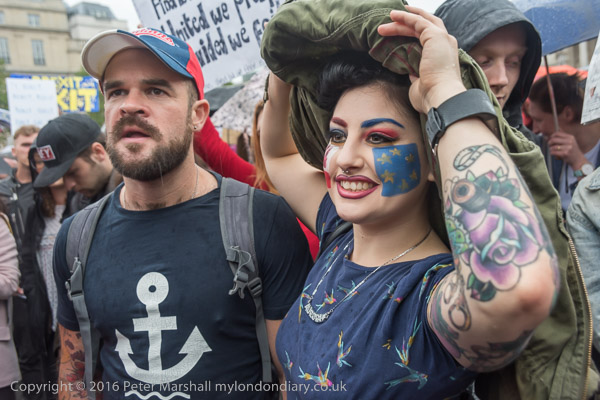
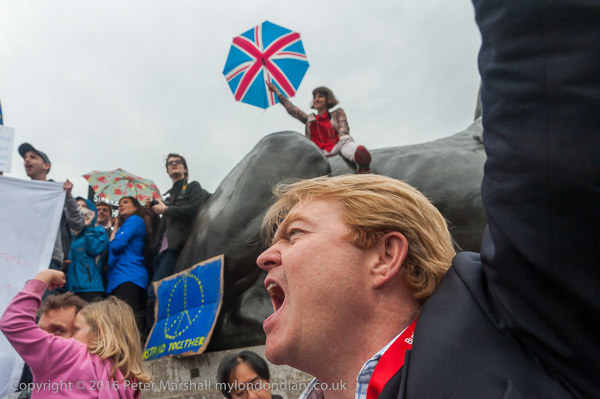
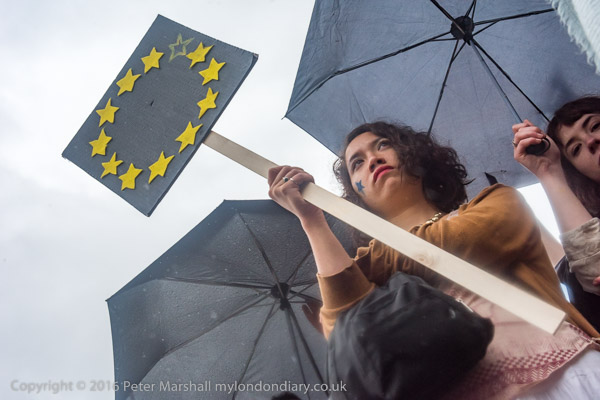
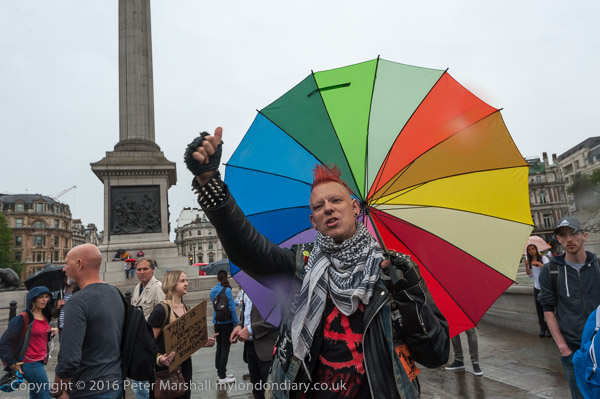
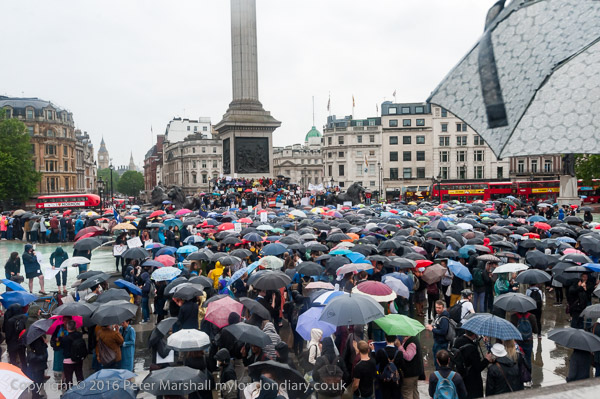
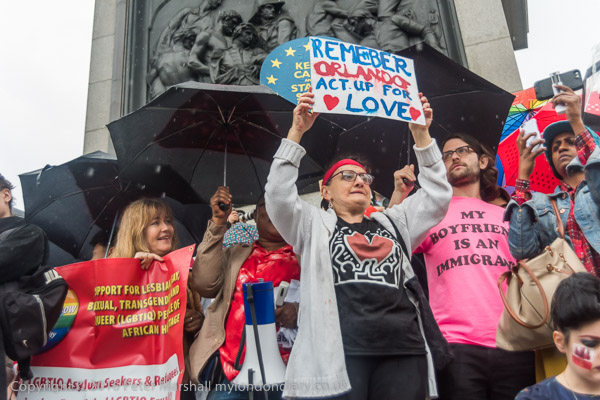
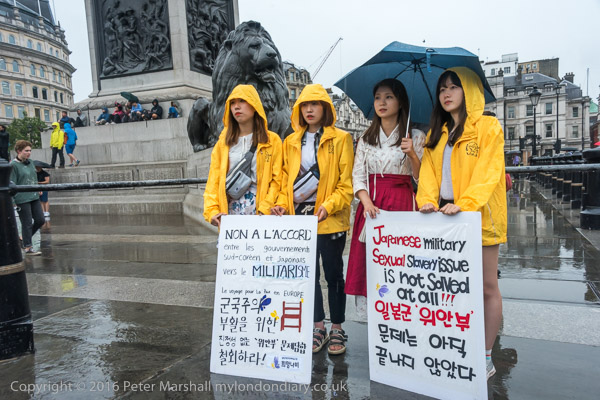
Some days there are just too many things happening in London. Well all days there are, but I mean too many things that I have access to and am trying to photograph, and June 28th last year was one of them. And in the early evening there were three protests occurring simultaneously in the same area of Trafalgar Square and to make things worse it was raining steadily and fairly intensively.

Rain isn’t necessarily a bad thing for photographers, and umbrellas can offer some visual interest – I once published an article ‘The umbrella in photography’ looking at examples by a number of photographers including Kertesz, though I have to admit I’ve probably seen more than enough pictures made through rain-drenched windows to last several lifetimes.

But umbrellas in crowds are something of a problem. Unless you have an assistant holding a large one over your head, they become pretty impossible to use when using a camera. If you are alone in plenty of space and there is little wind it can be manageable to hold one tucked under your left arm and held up by your wrist as you hold a camera to your eye, but this becomes untenable in crowds, as you get buffeted by other brollies and yours will uncontrollably poke other people in their eyes.

Working without one, you get wet. Wetter than just the rain would make you, as those other umbrellas around direct the rain they protect the holders from onto you, and unless you are wearing a hood, unerringly down the back of your neck, making you sodden from inside your clothing. In winter I wear a good waterproof jacket with an integral hood, but even an expensive ‘breathable’ coat becomes unbearably hot in summer.

Cameras too suffer from water. Even those that are ‘weather-sealed’ will slowly drown, but lenses generally go first. You can keep wiping the front surface with a chamois or microfibre cloth (and I often walk around holding one in front of the lens), but you do have to remove it to make the exposure. Zoom lenses which alter their length pump moisture into their interior as you alter the zoom, and even those that only move internal elements had something of the same tendency. Something that seldom gets a mention in the manuals is that lens hoods, at least with telephoto lenses, are at their most useful in keeping the rain off.

I do have a kind of plastic raincoat for my camera, but its a real pain to use, and though it diverts the rain (except from the front lens surface) it doesn’t stop the moisture. Usually I put one camera away in my bag to keep dry, and keep the other under my jacket as much as possible – though that does mean leaving my jacket rather open so the rain (and those brolly drips) can enter too.

And when the lens clouds over due to condensation on its inner elements, I take the other camera out of the bag and work with that. Until it goes too. Usually I’ve at least one more dry lens in the bag to change to, though that may mean I end up taking far more pictures than I really should on the 16mm fisheye.

When all my cameras, lenses and clothes are sodden, its time to give up and go home. Though at such times I always remember what my father used to tell us kids when we complained about getting wet, ‘You’ve got a waterproof skin’.

You can read what the protests were about and see more pictures on ‘My London Diary’:

Act Up for Love
London Still Stays

The third protest was a group of four women protesting over the agreement between the South Korean and Japanese government over ‘comfort women’, the Koreans used as sex slaves by Japanese soldiers in the second Worlad War – and I only used the one picture above.

Continue reading London Mix

Brexit shock

The Brexit vote came as a shock to most of us, not least to David Cameron who had planned the whole referendum as a way of keeping his even more right wing chums in Parliament quiet, certainly the biggest political mistake so far of this century. Though it was one which his colleague who succeeded him seems determined to worsen by refusing to make the kind of compromises over our divorce from Europe that might have made the split bearable.

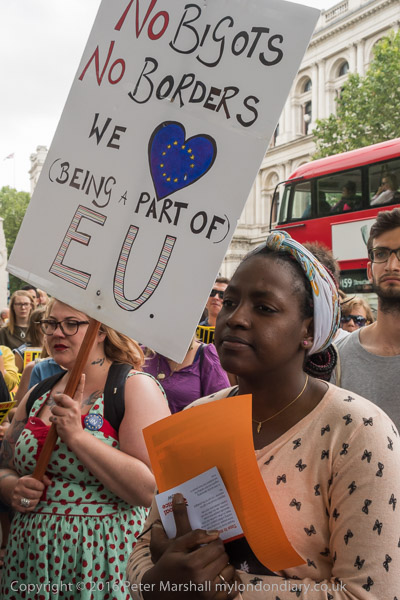
The referendum result, although it confounded the media and the opinion pollsters, didn’t come as a huge surprise to those of us who had been following the campaign, and in particular the way it had been reported in the media, and in particular the BBC. While we had seen for years a hate campaign against Europe and migrants in the whole of the popular press, it was rather a shock to us that the BBC made such a determined effort to promote Nigel Farage and his delusional opinions (along with his mates from the Conservative Party) in the run up to the vote.

There were of course some at the BBC who tried to present the facts rather than the UKIP spin, but they seemed to have little effect on the news coverage, which gloried in reporting the ridiculous lies of the Leave campaign as if they made any sense, while failing to report at all much of the more sensible aspects of what was overall a rather lacklustre Remain campaign.

One contribution to this BBC failure was of course their continuing campaign to belittle Jeremy Corbyn, whose many appearances around the country arguing Labour’s nuanced campaign to remain in the EU hardly got a mention. But as on some other issues, BBC ideas about ‘balance’ also prevented a truly unbiased coverage – as when they give equal prominence to the views of those few climate sceptics as to the huge majority of scientific evidence for the man-made contribution to climate change.

So while the fairly narrow vote to leave the EU came as a shock, it was hardly a surprise, and its consequences almost certainly disastrous. That such a small majority should lead to such a momentous decision still seems an unbelievable idiocy on Cameron’s part to many of us. It should have been made clear when the vote was set up that a simple small majority would not be binding on the government.

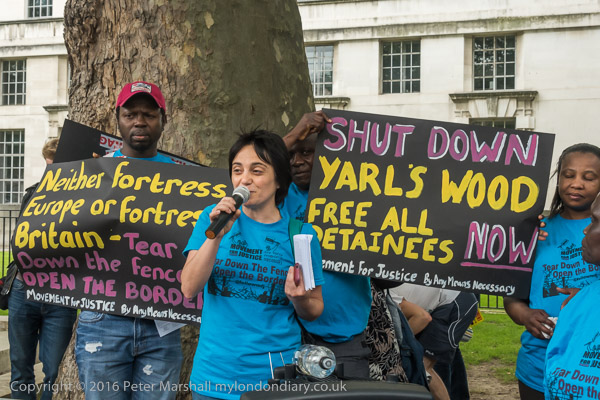
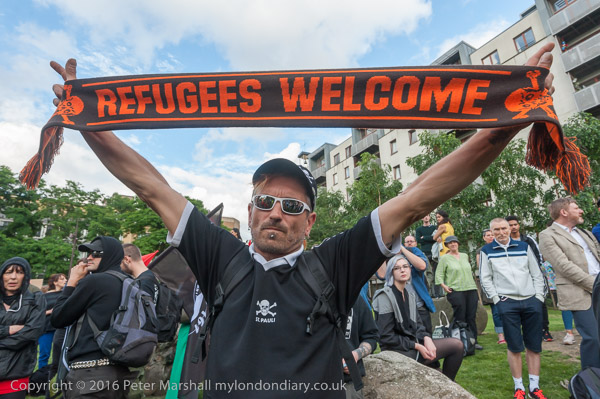
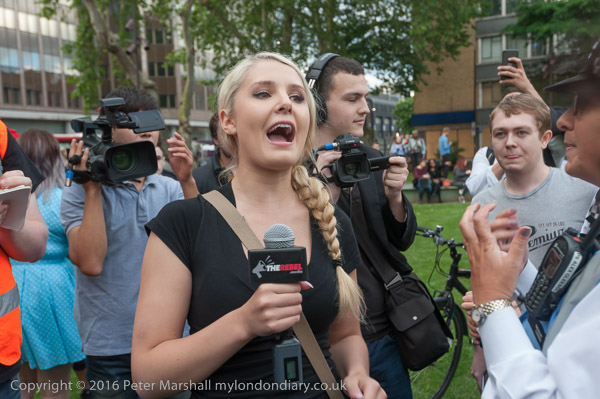
Defend All Migrants was a reaction to this shock, and it was one that brought home to me the reality of ‘Fake News’, seeing an ultra-right US ‘news’ site operating at first hand. Their team at the protest had clearly not come along to report on the event, but to try and provoke a reaction by the way they behaved and the questions they asked.

While it might have been more sensible for the protesters to have ignored them it was actually inevitable that they would provoke some reaction – which was why they had come there. And as usual when trouble-makers try to protest and stir up the situation, eventually the police strongly advised them to leave. I’m not sure if they actually escorted them out of the park, but I’m fairly sure they would have done if they didn’t go without an escort.

Behaviour like this by people who pose as journalists but are really political activists threatens all of us who work as journalists. I was disturbed that some colleagues took the side of these fake reporters whose activities are a real threat to the freedom of the press. Those of us who were there as genuine journalists faced no problems in reporting this event, but when people come along posing as journalists and acting provocatively it makes our job more difficult.

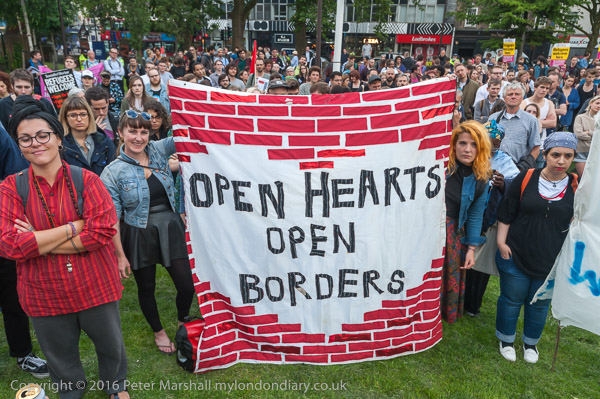
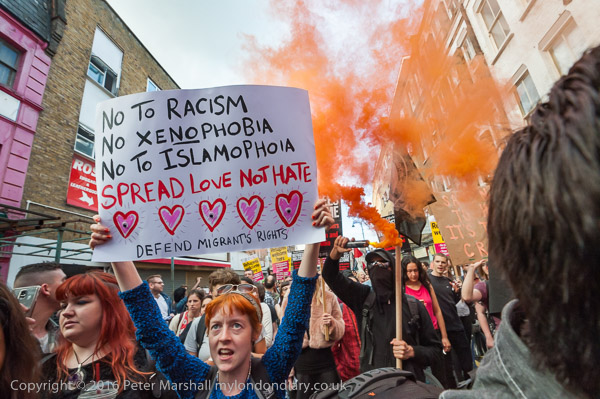
The rally proceeded and it was good to hear speakers from a wide range of organisations, all speaking up to defend migrants at a time when many were coming under attack after the vote to leave the EU – which had been widely seen as a way of cutting down migration to the UK. It isn’t likely to have a great effect on levels of migration, as we will still need people to come here to staff our hospitals, to work in old peoples homes, on our building sites, as agricultural workers etc – to do all the jobs that there are not enough people here qualified or willing to do.

And we will still have refugees seeking asylum, particularly while this country and companies based here encourage, fund and take part in perpetuating war and famine in countries around the world.

After the rally, many of those present took part in a march, which was to go to News International, home of The Sun and The Times, both of which have spread lies and scapegoated immigrants. As I wrote in a caption, ‘Murdoch hates Europe because unlike UK governments they don’t do what he tells them.’

Although it’s destination was clear, the route the marchers took certainly wasn’t, and those leading it turned down a side street on seeing more police ahead, and then got rather lost. There was much looking at maps on phones by those at the front and I began to wonder if they would ever find their way or keep wandering through the back streets of the city for ever.

I knew exactly where I was and decided I had walked far enough and was beginning to get hungry. When the march turned to the north, walking in exactly the opposite direction to its destination I decided I’d had enough and caught a bus for the station and my train home.

Defend All Migrants

Continue reading Brexit shock

She was ready

Benjamin Chesterton on his Duckrabbit blog posted last Sunday “She was ready and actually pushed the tweet button” about a series of pictures by Welsh photographer Dan Wood who “discovered photography through skateboarding” in 1995 and is a member of the Artist Collective: Document Britain which I have to admit I’ve never heard of before.

Duckrabbit writes about Wood’s ‘Shoot the damn dog‘, a project on his wife’s struggles with depression, post-natal depression and makes his point so well that I’ll leave you to read it. And when he asked Wood how she flet about him publishing the work, the reply he got from the photographer was that 3 years after he made the work, “She was ready and actually pushed the tweet button”.

On Lensculture you can read an interview with Wood about the project he began in 2013 ‘Suicide Machine‘ after the town where he lives, Bridgend, was named as having an unusually high suicide rate, along with a set of images of those who live there from his book of the same name. They were taken on his Hasselblad 500CM using colour film, and Wood still sees film as central to the way that he works: “it’s always been about film for me: shooting, developing, printing, scanning, the cameras, I love it all, especially the pace in which you work.”

You can see more of his work on his own web site, including both black and white and colour work, much based on Wales, but also elsewhere.

Street talk

Thomas Stanworth asks Is Street Photography Killing Itself?, and gives an excellent summary of some of the reasons why so much of it is boring and pointless, along with many images culled from the web to support his case. It’s an article that will probably be reacted to with some forceful comments, particularly from those who either haven’t bothered to read it or who have failed to understand it.

Personally I’ve never been convinced ‘street photography‘ was ever alive. I’ve written a little before about it and my feeling that it is not a real or useful category, something which I think becomes entirely obvious if you read it’s ‘bible’, Westerbeck & Meyerowitz’s ‘Bystander. Fortunately almost none of those whose work is in its pages considered themselves as a ‘street photographer’; they were all taking photographs on or from the streets – as opposed to working in a studio – but they all went on to those streets with particular ideas and stories they were interested and involved in photographing.

The problem with most so-called ‘street photography’ I see now is simply that it is vacuous. Stanworth uses a lot of examples and explains the point well, and there are a couple of sentences in the middle giving a little advice to those who must be street photographers that I think really the crux:

“However, just engaging in the subject of photography helps. Learning a little more about yourself helps. Learning about the people and environment around you and your thoughts and reactions to it helps. The sad truth is that most of our effort in photography amounts to nothing.”

‘Street photography’ in general is, as he said, seen as ‘cool’. It is generally cool in that it is unengaged, using a small ragbag of tricks to produce images as deep as the average street puddle.

In his final sentences Stanworth again makes his views clear:

“And here we are back to the supreme importance of relationships, expression and connection. Without these things, both just become repetitive, predictable acts that lose their lustre.”

For a quite different piece of writing by Stanworth, I’ve also been reading his review of the Fuji X100F on his Photofundamentalist blog. It’s very much a photographer’s review rather than the technical tour-de-forces that sites such as DPreview.com offer, and one that complements their work well.  It makes me think I really ought to buy one, though having also read his view on the Ricoh GR I think I might find that more useful – if I can live without an optical viewfinder, though there is a rather expensive external accessory that will fit in the hot shoe.

His photography is also worth a look.

Cleaners deserve a living wage

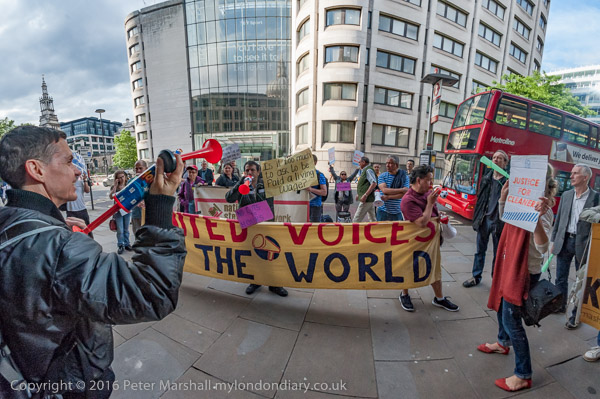
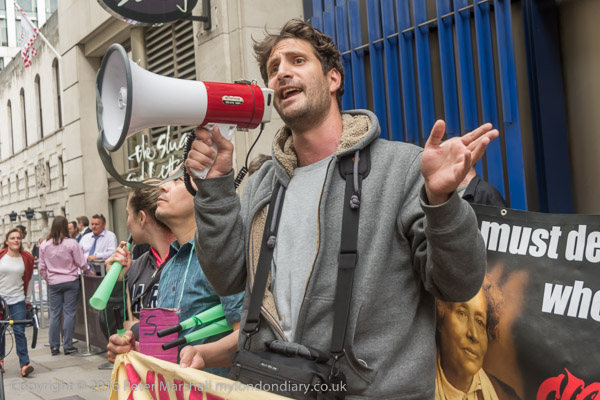
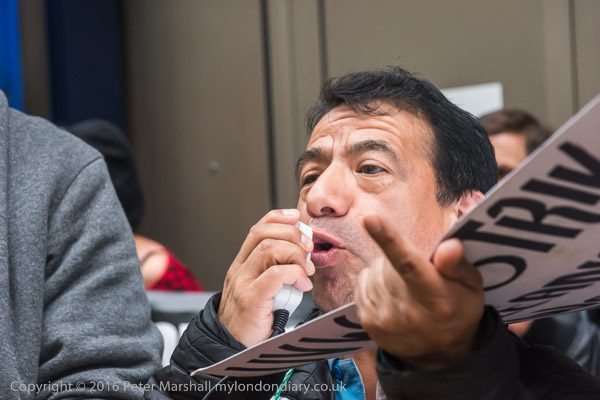
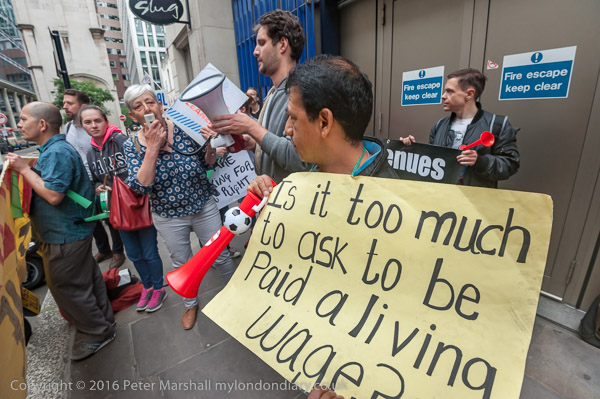
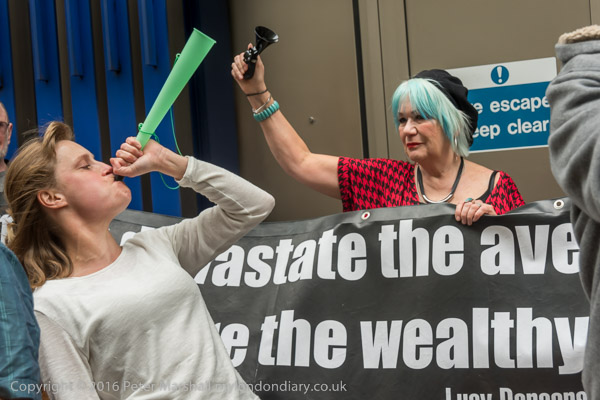
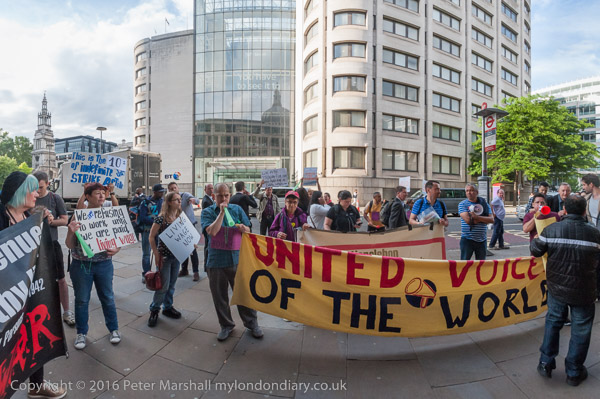
I rather like the effect of the diverging verticals in this image, though its something I try to use sparingly. But it seems in this image to lead the eye down to the subject in the centre of this ultra-wide image, Cleaners from the United Voices of the World union protesting for a living wage and for fairness in the way they are treated by their managers on the 10th day of their strike.

As a documentary photographer and a journalist I hold dearly to the principles of recording events accurately; our work has to retain its integrity to be of any worth. That does sometimes require keeping a certain distance, needing to be careful not to interfere in the events I’m photographing. But although that means I won’t hold the banner or blow the horn, it doesn’t mean that I don’t have a point of view, and any set of photographs is to a certain degree subjective.

I wouldn’t be here photographing this protest if I didn’t think that all workers have a right to proper treatment and a living wage, and that it was important. Our major media outlets don’t think strikes and protests like this are news and are unlikely to publish my pictures, but I disagree.

It is a dispute that involves issues which are vital about how we live together, issues of fairness and equality, and ones that are brought sharply into focus here, at the centre of one of the world’s great financial centres, the City of London, by the naked greed of some of the wealthiest people and companies in the world.

And the response of the employers to the cleaners claims for a decent wage and proper treatment? To take them to court and try and get an injunction against them striking, probably spending as much or more on that as it would have cost to come to a sensible settlement.

The court made things worse, although turning down the injunction against striking, by imposing conditions on picketing (a practice already well covered by law) but also by imposing legal costs on the cleaners’ union which were actually greater than the total assets of the union, a grass roots organisation totally funded by the subscriptions its low paid members.  It was a striking demonstration of how our legal system, despite its ideals, is a system for the rich and institutionally biased against the poor.

At the end of the protest outside the offices at 100 Wood St (at a distance carefully measured to meet the terms of the injunction) the cleaners and supporters marched off to protest outside the office of the building management company CBRE, the largest commercial real estate company in the world, who manage the building for the richest man in Europe, Amancio Ortega (and the companies whose offices it houses include Schroders and J P Morgan) though the dirty work of managing the cleaners badly and paying them poorly is outsourced to a small cleaning company.

It got rather crowded around the entrances to the CBRE offices, which is where the full-frame 16mm fisheye came in useful (corrected as usual with Fisheye-Hemi.) When I’m using it for landscape or architecture I usually take great care to keep the lens upright, where I work with it using the built in markers of the D810, when small triangles at centre right and centre bottom of the frame show you have the camera straight and level, but there isn’t the time or need to be so precise when photographing protests, and the D700 used for these pictures lacks this feature.

UVW Wood St Strike Day 10

Continue reading Cleaners deserve a living wage

Ripper Facade

Class War, London Fourth Wave Feminists and many more including local residents and Tower Hamlets council were all appalled when the shop that had been given planning permission to open as a museum celebrating the women of London (and for which a number of people had given services without charge in aid of a good cause) turned instead to be a tacky tourist attraction romanticizing London’s most celebrated killer of women, Montague Druitt, whose body was fished out of the Thames on December 31, 1888, better known as ‘Jack the Ripper’.

Since there could be no trial, although police at the time were apparently convinced enough to abandon their inquiries, an industry has grown up around various theories as to the murderer’s true identity with almost every prominent Victorian male being put under the spotlight.

One American crime novelist who believes artist Walter Sickert was the man responsible even went to the extremes of spending £2 million buying 32 of his paintings – and attracted the opprobrium of the art world by destroying one of them – in her unsuccessful efforts to find any evidence that would impress even the most gullible juror. But efforts such as hers have certainly stoked interest in the case.

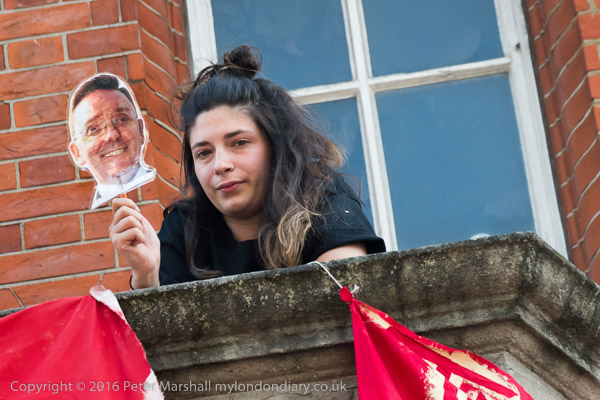
The man hoping to make money out of the prurient interest in this series of horrific crimes against innocent women by promoting speculation as a tourist attraction is Mark Palmer-Edgecumbe, and although he has been present during some previous protests, this time he only appeared on the mask worn by one of the women, leaving two female staff to run the shop.

Rip Down the Ripper Facade! came after Tower Hamlets Council refused planning permission for its facade and shutter, and since it was still unchanged, Class War’s fearless Womens Death Brigade came along with the tools to take it down – or at least an inflatable hammer.  Their other armaments were stickers, which were soon liberally covering the windows.

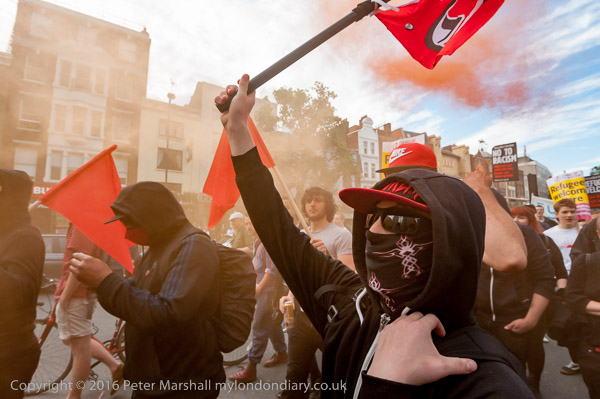
The feminists came armed with posters and wearing cat masks, and some hooded characters in black arrive with a smoking red flare, which rather got in the eyes of police and this photographer.

I like to work as close as possible to those I’m photographing, usually working around the wider end of a 16-35mm zoom.  But when smoke fills the air, it also obstructs the light as well as your lungs, and you really need to move back.

The worst damage that the facade actually suffered at this protest was when an egg or two was thrown at its sign – and again I got just a little splattered as it splashed off.  Mostly the protest remained good natured, though with a lot of noisy theatre.  Stickers generally peel off without damage, and egg can be washed off.

Despite that, two people were arrested and charged with criminal damage, though I have no idea what this damage was. The charges against one of them have been dropped, but the second prosecution is continuing.  The ‘museum’ appealed the planning decision – and lost. They are to be allowed to keep a small hanging sign, but have already had to take down the illegal signage and have until 31 May to remove the unauthorised shop front and roller shutter.

Rip Down the Ripper Facade!

Continue reading Ripper Facade

PDN’s 30 to watch

Perhaps I’m getting old, but this year’s PDN 30 seem to have less to offer than in most previous years. Well, of course I’m getting old, but while there is a great deal of very competent photography by all of those in the list, there was little that made me really think I was seeing something new and different, and rather a lot that made me think I’d seen stuff like this before.

Those that interested me most on an admittedly quick run-through were Souvid Datta, Yuyang Liu, Yael Martinez and Xyza Bacani. Though if I take another like I expect I might find others.

You can of course look back at previous years PDN30 choices and decide for yourself if you think this year’s crop is a vintage one or not.  While being picked for the list is certainly a great honour and I’m sure has helped all of them in their careers there often seem to be relatively few who have really become well-known in photography.

There are of course different areas of photography, and many countries around the world. PDN relies on nominations for the list, and while not entirely from the US, the list of those who nominated this year is certainly dominated by those working for American magazines and organisations. As you would expect from Photo District News, which got its name from New York City’s photo district along lower Fifth Avenue; though it rapidly expanded to other American professional photographers and others in the business it’s base remains in New York.

WPP Fake News Controversy

As now seems to be usual, this year’s WPP awards are mired in controversy, this time over the award to Iranian photographer, Hossein Fatemi of the second prize for his long-term project titled ‘An Iranian Journey.’ The same project also won Fatemi  the 73rd POYi World Understanding Award, and it was the responses that Ramin Talaie received following this that made him begin an investigation into Fatemi’s work.

Talaie writes that he “was flooded with individuals claiming to have helped or witnessed Fatemi stage his subjects for this project. Others claim Fatemi had plagiarized their work and in some cases even copied images frame by frame.” and so  “Over the following months I began compiling testimony and evidence and started verifying sources, locations, website and other information.

You can (and should) see the evidence in his post 2017 World Press Photo Awards Fake News, and he supplied that same evidence to the WPP along with details of his sources. The WPP appointed  Santiago Lyon, former director of photography at The Associated Press to investigate, and have now concluded “there was not sufficient evidence to declare a clear breach of our contest entry rules.

Looking at the evidence it is hard to see how that conclusion was reached, and it reflects badly on the WPP as well as one of the finest agencies around, Panos, that they have not yet taken action against Fatemi.  It isn’t necessarily wrong to stage images, and as Talaie states, it would be impossible to take many of the pictures in the essay without staging them, but it goes completely against our understanding of photographic ethics to then present them as ‘news’.

Plagiarism is a more difficult case to assess, and many of us end up taking similar photographs to other photographers when we were working in the same place at the same time. The examples given are perhaps more about a breach of trust between Fatemi and the photographers he was at the time working for. There also seem to be clear breaches of trust with some of those he photographed, who he assured that the pictures would not be made public. It also seems clear that some of the captions are deliberately misleading, ‘sexed up’ to make the pictures sell in a way that is completely unacceptable.

Talaie concludes his article with the comment:

Also there is simply not enough debate and discussions about ethics and ethical journalism in the Middle East. People learn how to make films and take pictures in Iran, but they do not always learn about ethics.