Cleaners at Mace

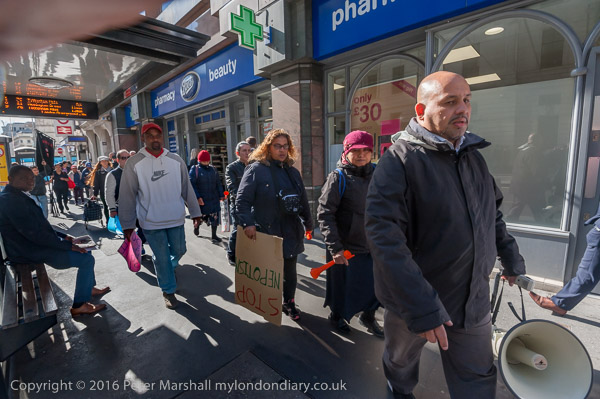
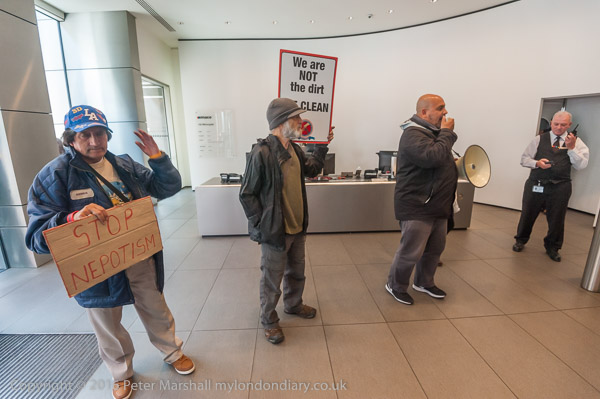
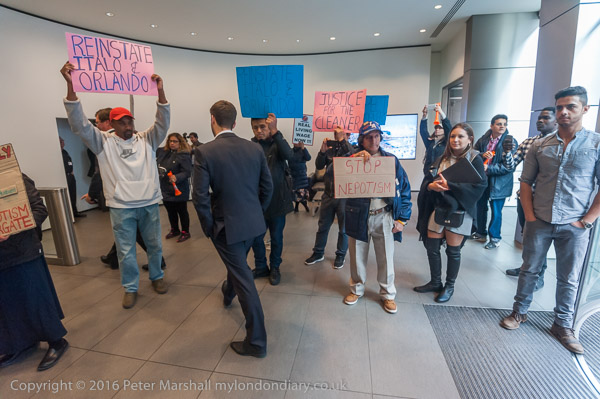
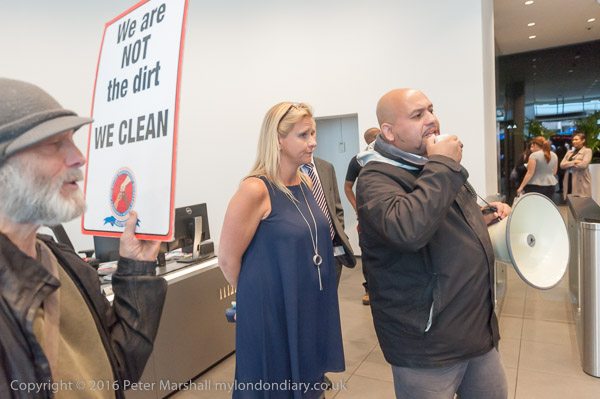
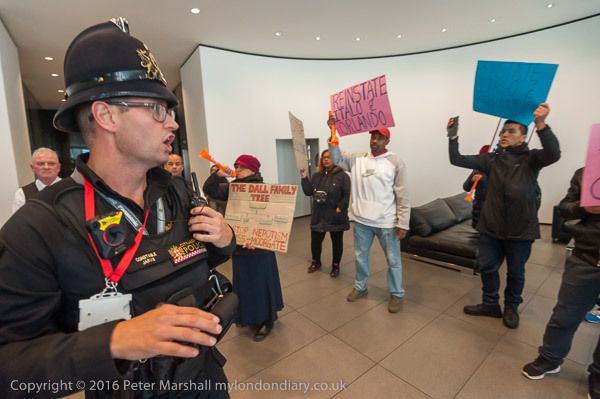
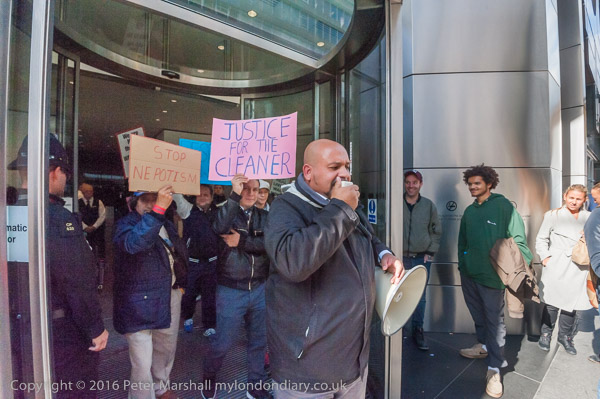
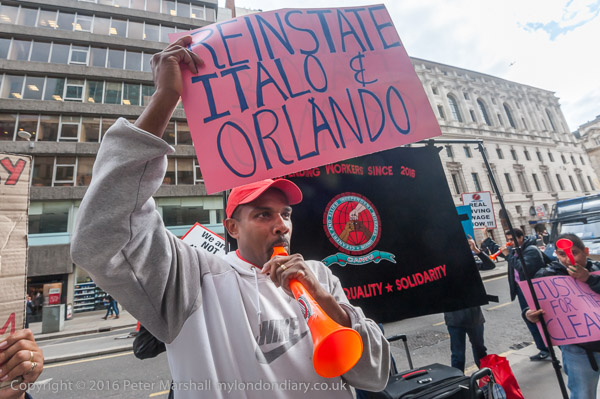
There are always a number of things on my mind as I photograph protests by low-paid workers such as the cleaners protesting at a workplace. Obviously there are the reasons for the protest  – and if I didn’t feel they were justified I wouldn’t be there. Often, as on this occasion the workers have a number of greivances. They say the employer, Dall Cleaning Services had promised to pay them the London Living Wage,  and then had sacked two cleaners and increased everyone else’s workload  to keep their costs down, and that these sackings had been without notice or proper procedures.

While these sackings could be taken to a tribunal, where in all probabilty the workers would win their case, going to tribunal takes a long time  and has now been made an expensive process, with costs calculated by the Tory government to be high enough to make it virtually impossible for the ordinary worker. One of the advantages of belonging to a trade union is that they can usually afford to take cases like this to tribunals and also supply trained legal support. But the changes in the law have made it much cheaper and faster to try to settle such matters by protests and strike.

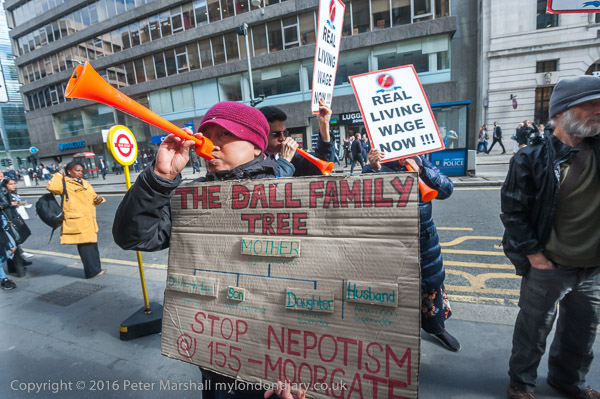
Here the workers were also complaining about the Dall’s management, in the workplace , dominated by members of one family, whose members working there were treated better than the other workers. They want an end to nepotism in the workplace. It’s something that should be policed by Dall’s higher management but the cleaners say their complaints are simply ignored.

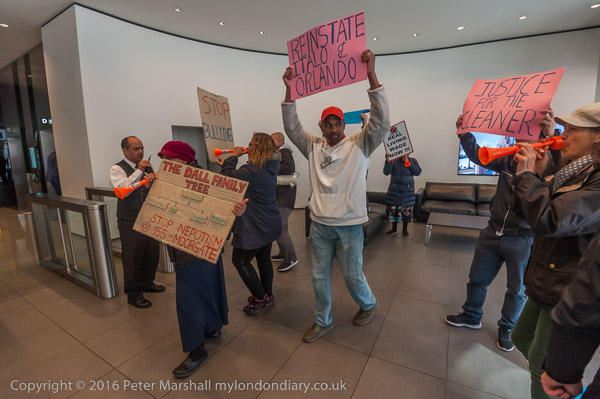
But I’m also thinking about my legal rights. On the street there are few if any restrictions on photography and on publishing as news coverage. But it seemed likely that the IWGB would manage to enter the foyer of the Mace offices. The position on private property is less clear, but certainly, unless I was specifically asked to stop taking pictures by a person I was convinced represented the owners of the building I intended to photograph the event.

I hang back slightly as the cleaners rush in, but after the first two or three have gone past any security at the entrance, follow in with the others. It certainly is no part of my job to actually force an entrance in any way, but if there is an open door from the street I’ll happily walk through it.

Fortunately no one asked me to stop taking pictures, and knowing that it was likely they would be going inside the building I’d remembered as we went towards it to increase the ISO  setting on both my cameras. Because there would be less light and there was a possibility of some action taking place I’d set both cameras at ISO2000 or ISO2500.

It’s an important advantage of the D810 that it has an ISO button on the dial at the top right of the body, and pressing it displays the ISO in the top panel, where its a simple matter of turning the command dial to alter it, and the same is true of the D700 with which I took all of the pictures I’ve actually used in this post.

With the D750 I now use you need to go into the menu, though I make things easier by putting the ISO on the user menu, along with other items I’m likely to want while working, and making sure to enter the User Menu before starting taking pictures.

I could rely on auto-ISO, which I actually usually have turned on, but for this to be really effective you have to select a fairly high shutter speed as the minimum speed at which the ISO increases. With a lens like the 28-200 zoom there is really no sensible choice. I’d be quite happy with 1/30th at the wide end, but at the long end I’d want 1/250th or faster. It would be nice if Nikon would allow the camera to apply the 1/focal length rule – and better still if it allowed you to choose from various fractions or multiples of this. All of the pictures in this post were made with the 16-35mm f4, though I was also using the 28-200mm.

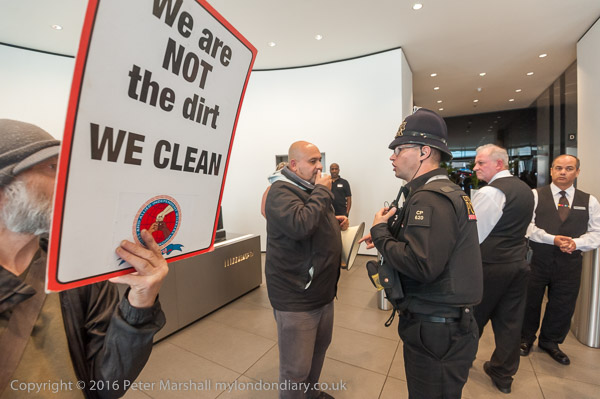
Inside occupations such as this it is difficult to work sensibly, in part because you never know how long you are likely to get to take pictures. I try not to simply dash off pictures but to get images that have something to say about the particular protest, looking for elements that identify the company concerned or make clear why the workers are protesting.  I also make a conscious effort to vary my viewpoint and angle of view to provide a variety of images.

An element of farce was introduced when the police finally arrived, a single officer who clearly didn’t really know what to do. After failing to get a great deal of attention from Alberto Durango who was leading the protest, he stepped aside and called for help.

As usual the protesters left in an orderly fashion when they felt they had made their point – and that the police might start to arrest them for aggravated trespass should they remain, and the protest then continued on the pavement.

Protests like this, that make clear how badly the cleaners who clean the Mace offices are treated and embarrass them as they would any respectable company, and usually lead to pressure being put onto cleaning contractors, all of whom seem out to give their staff little or nothing more than the bare legal minimum conditions and to employ management who just aren’t up to the job.

In this case I don’t recall the details, but it wasn’t long before  a further protest was called off as a satisfactory settlement had been reached.

You can see more of the pictures I took at this protest by the IWGB (Indpendent Workers of Great Britain) on My London Diary at Cleaners demand ‘End Nepotism’.

Continue reading Cleaners at Mace

Heathrow Again

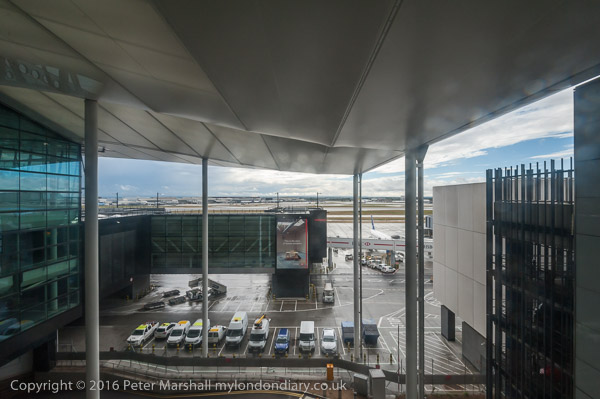
I don’t like airports and air travel. As someone with a sensible level of concern about the environment I try hard not to fly – and managed to avoid doing so until I was sixty. Since then I’ve flown on I think 8 occasions, mainly when I’ve been invited to talk or exhibit photographs overseas, and where there was no real alternative.

I’m obviously not a great traveller, though I have been to quite a few parts of the United Kingdom over the years, but there is still so much that is new here that I’d like to explore. And even in London I occasionally still find parts I’ve not visited.

Airports like Heathrow seem designed to generate the maximum unease amongst those passing through, and are designed largely to sell goods to those passing through rather than to transfer passengers in an efficient manner from entrance to plane and vice-versa. I’ve travelled through a few smaller airports which do just that, where you can get off a plane and be taking a bus or taxi away in just a few minutes – and you can catch one with only a short queue to go through a security check and just a few minutes waiting. No huge shopping areas and extended periods to wait in them.

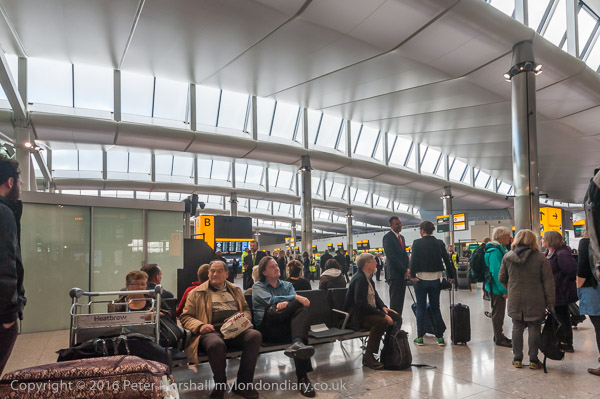
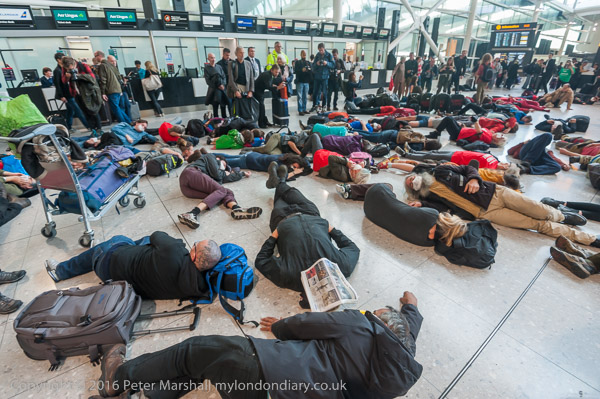
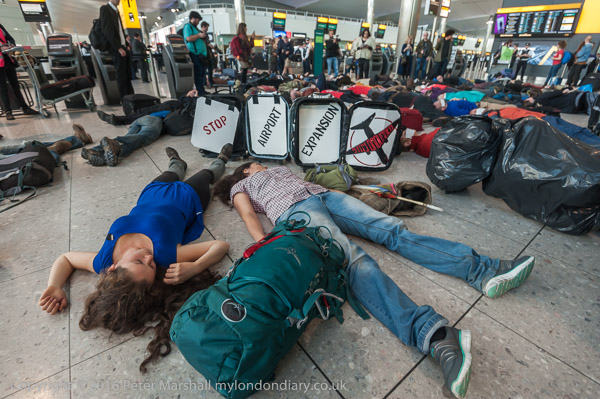
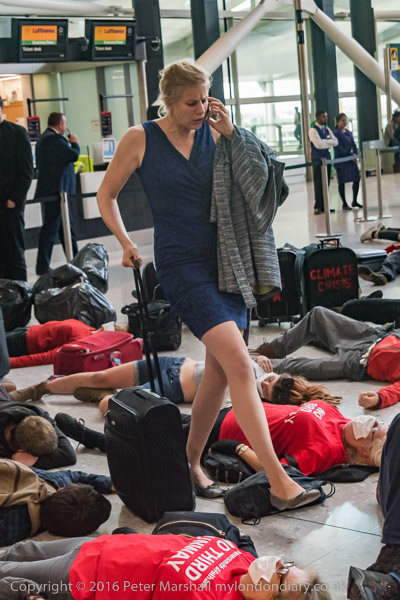
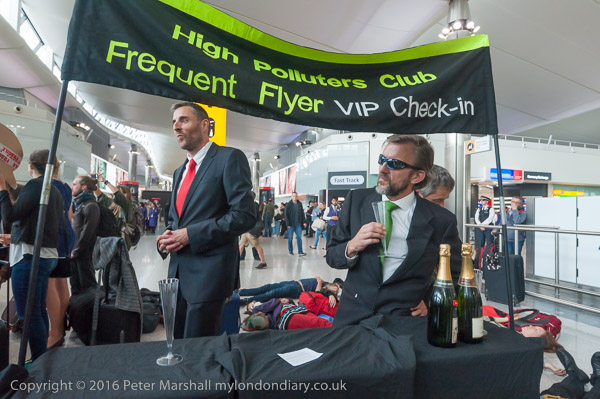
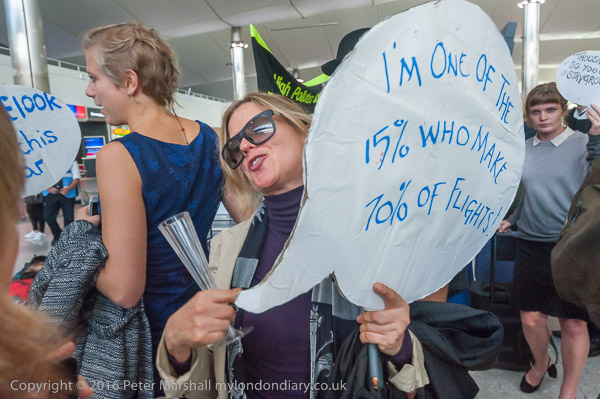
Reclaim The Power’s #StayGrounded protest made some of the issues clear, though perhaps not to all the travellers passing through Terminal 2, who probably couldn’t see the speech bubbles with things like “I’m one of the 15% who make 70% of all flights” and probably didn’t see or appreciate the ‘Frequent Fliers’ stepping over the ‘dead’ on the ground to get to the ‘High Polluters Club Frequent Flyer VIP Check-in’. And relatively few would have heard the speeches.

Photography – and of course video – is vital in getting the point of protests, particularly onrd like this which have a narrative across to an audience. And to a wider audience than those few members of the public who actually experience it. Of course the highest numbers see them through TV and newspapers, and this protest did make some of them even on the channels which like to ignore or minimise protest, but many too see them through social media. Even web sites and blogs like this have thousands of readers each day.

Air transport – for goods and people – is expensive and essentially wasteful. It creates pollution and wastes resources and is an important factor in climate change. We need to look not at ways to increase it, but ways to cut it. Some of its popularity is because of huge subsidies that currently encourage it, and those need to be removed.

Our recent election in the UK has perhaps served largely to show that we need a better voting system, that more accurately reflects the views of the British public. I welcome too the fact that it has brought out more young people to vote, and that a significant number of voters have begun to see through the media lies about Corbyn. As someone – not a Labour Party member – who had been saying since he became party leader that he represents Labour’s only chance of being elected to govern in 2020 I think the Labour vote shows I was right. Certainly he is the only Labour leader who could win if there is another election soon (and its highly likely.)

And until we do have another election the good news is that the vote needed for the expansion of Heathrow is unlikely to go ahead in this Parliament, which is good news for those of us who live in and around London, for the nation and for world climate.

I had been worried on my way to the protest that airport security might make photography difficult, but I had no problems as they stood back and watched, stopping the protesters from going into the security area and directing passengers in alternative ways to avoid being held up by the protest. The protesters too had obviously decided against any confrontation here, which was, for example why all the plastic champagne glasses of those ‘high polluting frequent flyers’ were filled only with air to abide with the bylaws.

You can see the whole story of the protest – which ended in singing and dancing – at Heathrow flashmob against airport expansion.
Continue reading Heathrow Again

Strong Women

I’m not sure how much it reflects on me and the entirely sexist world I was brought up in back in the days of the fifties. Even in the sixties when I became politically involved, many still regarded the role of women to be to darn the socks of the revolutionary man. Though I hope I didn’t share that view, but I’m sure there are still traces of that prehistoric past in my make-up. And it still surprises me a little how many of those that I photograph and admire as political activists are women. I’ve not made any accurate census, but so many of those who first come to mind are women, and many of my favourite images are of women.

But perhaps I just like women. They often seen far more sensible than men. Photographing people isn’t just a technical thing, and it works better at least for me when there is a certain rapport or at least empathy. But perhaps I’m straying into sensitive territory and will find gender police of various sympathies swooping down on me talons outstretched (surely a sexist metaphor but what metaphors aren’t.)

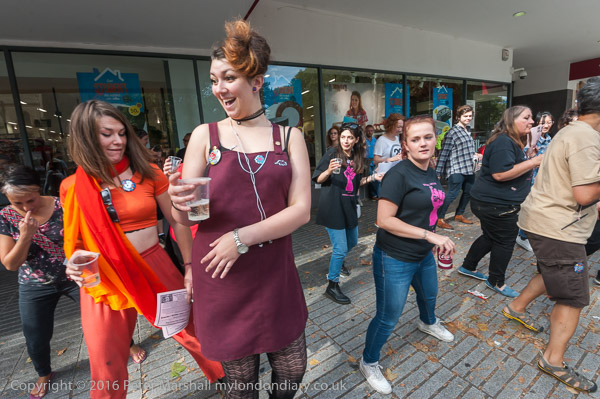
On Saturday 24th September last I photographed three protests which were or seemed to be dominated by women (and the fourth, Release the Craigavon Two would perhaps also at least seem that way from my pictures.) Focus E15 started as a group of unmarried mothers in a council funded hostel under threat of eviction who got together and decided to fight to be rehoused in London, and were celebrating three years working together on a campaign which has widened into one fighting for proper housing for all and an end to social cleansing, particularly in their own entirely Labour borough of Newham, but also more widely.

The celebration took place on the wide pavement at Stratford Broadway where they hold a weekly street stall, and there was music and dancing and it was one of the few protests at which I’ve been handed champagne, which still tasted pretty good from a plastic cup. Almost all of the speakers at the rally were women, and so were most of those taking part.

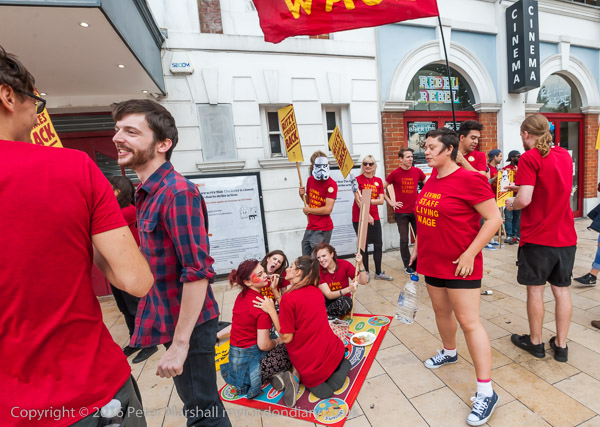
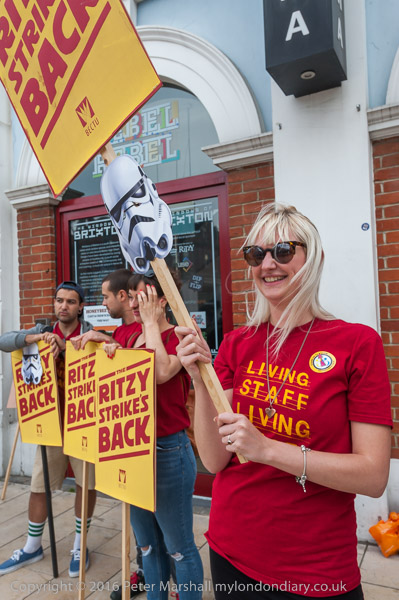
From Stratford I made my way to Brixton, where Ritzy Cinema workers, men and women, were striking for a living wage. There were rather more women than men visible, and rather more of the men seemed to be hiding behind some large masks.  The picture above was a slight disappointment and would have been better, but as I was carefully framing it, another photographer walked into the frame at the right hand side, spoiling the composition. I’ve cropped him out but had to lose a little more too, and though I still like the picture, I can’t look at it without thinking of the one that I just missed.

Of course I did photograph the men too, and there are one or two decent pictures starring them, but in general it is those with women in the lead that are most interesting. Judge for yourself at The Ritzy’s Back for a Living Wage.

My final protest of the day was at the Polish Embassy, called by Polish Feminists against the introduction of new laws outlawing abortion  proposed for Poland  in solidarity with the 5th annual March for Choice in Ireland against the strict anti-abortion laws there condemned by the UN as ‘cruel, inhuman and degrading’.

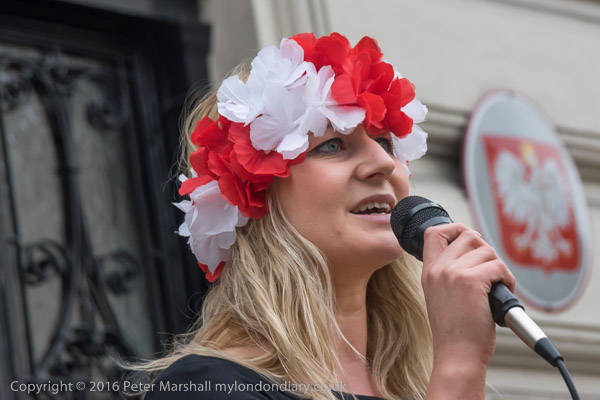
The colours of the head dress of this woman speaking are of course those of the Polish flag, and I carefully positioned myself to get the Polish eagle on the Embassy frontage  to her right. It wasn’t possible to get enough depth of field for this to be sharp, but I stopped down as much as I could under the lighting conditions.

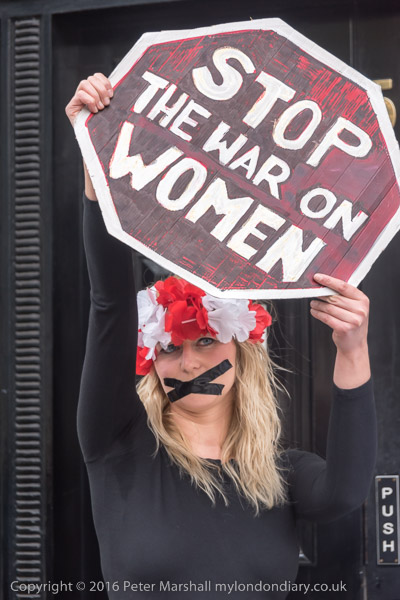
This was a ‘black protest’ with many of those taking part dressed in black, and the black doors of the embassy made a good background, though careful exposure and a little help in post-processing made the figures stand out better. I wasn’t ‘directing’ the woman holding up this octagonal placard, and it took a little patience and luck to get the framing I wanted.  And although the verticals were quite close to vertical as I took them, a little massaging in Lightroom was needed for the final image. Some agencies would not approve, but this was what I saw and tried to achieve when I was taking the picture and I’ve no qualms about using a little electronic help in this way.

Of course I took other pictures, but given the nature of the protest they too were mainly of women. You can see some of them at Polish Women’s ‘Black Protest for Choice’.
Continue reading Strong Women

Deeper, Stronger…

I’ve not before come across David du Chemin, but his 3 Shortcuts to Deeper, Stronger Images expresses well many of my own thoughts and teaching about photography.

Its worth reading what he has to say about them, but the 3 shortcuts are:

Study Photographs Not Cameras.
Focus Your Attention, Not Just Your Lens.
Expose Your Soul, Not Just Your Sensor.

I feel happy about spilling the beans here, because although they give you the gist, you really need to go and read his piece to fully understand what he means.

Of course it isn’t novel. Strikingly similar to what I tried to deliver to students in my 30 or so years of teaching – and of course many others. And if you want to know more you can also read duChemin’s new book,  The Soul of the Camera ,which has its own web site where you can download some sample material.

I do have a few minor quibbles, not least that cameras don’t have souls, though some of mine definitely do have a perverse character of their own – and one that changes the camera settings when I’m not looking. I also wonder how someone can stretch out what is basically a fairly simple idea into around 25 chapters and 250 pages.  But what I’ve seen is good advice and could certainly be useful to some, though others might find it better to just get out there and do it.

This, I find, is only one of a number of books that duChemin has written, one or two of which have titles that do a little suggest the kind of learning tricks approach he denigrates. But rather than buy his books you might also be better off buying and studying those of the great masters of photography. And if your bookshelf is already stuffed with well-thumbed copies of the works off Edward Weston, Walker Evans, Gene Smith, Cartier-Bresson and the rest you probably don’t need this one!

The Strange Case of Souvid Datta

A few days ago I posted about the controversy over the use of a picture of child prostitution being used to promote a Magnum photo contest on the web site Lensculture, brought to my notice in a post on the Duckrabbit blog.

Since then more has appeared about the photographer concerned, with Petapixel posting Photographer Souvid Datta Appears to Have Plagiarized Mary Ellen Mark, a story which came to light after Shreya Bhat of Bangalore, India read a report in Petapixel, who like me had picked up and commented on the original post from Duckrabbit.

Bhat is a great fan of photographer Mary Ellen Mark, and also very familiar with the subject matter and in 2014 was a social worker in the Indian red-light district of Sonagachi. So she had a great interest when in 2014 the Huffington Post published a feature on Dattas’s higly acclaimed series documenting sexual violence among sex workers and children in that Indian red light district, ‘In the Shadows of Kolkata‘. She noticed that one of the women in a picture had actually been taken not from life but from an image published in Mark’s fine 1978 book ‘Falkland Road‘ with the caption ‘Transvestites getting dressed in a courtyard. Falkland Road, Bombay, India.’

After reading the Petapixel post Bhat contacted them with this astonishing revelation – and the pictures in their post leave no room for doubt. It remains to be seen if this is an isolated case of cheating, or if once people across the world of photography start to look critically at Souvid Datta’s pictures they will come up with more instances. Petapixel describe it as plagiarism but I think a better term might be fraud. If you attempt to look at Souvid Datta’s web site at http://souvid.org/, you now only get the message ‘This page is password protected‘ rather than being able to access his pictures. ‘In the Shadows of Kolkata’ was available on the site last year, and the removal of this and his other pictures is highly suspicious. Petapixel say his Facebook and Twitter were also taken down after they contacted him asking for a response to the allegation.

As Petapixel states, Datta’s work has gained many prestigious awards over the years, but this puts all of them in doubt. Did he cheat in those other images? Will more cases like this emerge? It reminds me very much of drug-taking in athletics and cycling, and while it would probably not be sensible to call for awards other than those which include plagiarised images to be removed, perhaps we should consider ‘life-time bans’ for abusers in photography too.

Already PetaPixel has posted an update, linking to a Facebook post by documentary photographer Daniele Volpe, about two of his pictures being posted by Datta as his own.

FURTHER UPDATE

The latest development – published as I was finishing writing the above is that Datta has admitted his guilt in an interview with Olivier Laurent on Time Lightbox, and trying to explain his actions. Frankly I think he is in the wrong job. Datta was educated at Harrow School, one of the UK’s two top public schools, going on to study at University College London (UCL) and spending 3 months as an intern at Magnum. None of these venerable institutions seemed to have trained him in basic honesty and integrity.

Lensculture & Child Rape

I’ve long been a supporter of Lensculture, which has done a great deal to popularise and support photography and educated photographers in the history and scope of the medium over the years and its editor Jim Casper is a friend I’ve met on many occasions. It’s sad to hear of the incredible mistake made by the site in promoting the Magnum Photography Awards, and I’m sad at feeling I have to write this. And I’m finding it hard to do so.

Although I often look at the site and see its Facebook posts I didn’t see this myself, as I long decided that competitions with high entry fees are something of a racket – and I get frequent mailings from a number of sources about them and simply delete or scroll quickly down when I see them.

This Magnum contest is a cut above some of the others which are pure money-making exercises for those who run them, but with fees of $20 for a single photo still seem to me something of an expensive vanity for most who enter, though for $50 or $60 (which covers 5 single photos or a set of up to 10 respectively) you do get a submission review which offers “constructive feedback on your photography plus recommendations for improving your practice” from “over 100 of the top photo editors, educators, portfolio reviewers, curators, and other industry professionals“. You can see some of these on the web site and decide if you think they are worth the money – you still have some days to make an entry – until May 16th. You can also get a free download of over 60 pages of advice from Magnum photographers; it’s title ‘Wear Good Shoes‘ is advice which I gave for free in a magazine interview many years ago.

Looking through a few of the reviews I feel they might be of some use to some photographers. But if you are a photographer the best advice is to get to know other photographers, and you will probably get a greater insight from passing your pictures around with them in the pub or café. You’ll certainly get far more (though at greater expense) from going to a good workshop if you can find one – I was fortunate to be able to attend a number with Paul Hill and Ray Moore and others at Paul’s Derbyshire Photographers’ Place in the 1970s.

Perhaps I was fortunate to get to know a number of good photographers fairly early in my life as a photographer, and we set up regular meetings where we would bring our current work and discuss it – something we could do rather more openly and honestly because we were friends than it’s possible to do in commercial setting such as this competition or portfolio reviews. A few photographers couldn’t take it and went off in a huff when people called a spade a spade (or sometimes an effing shovel) but they were generally those whose work was weakest and the exercise certainly helped those of us who stayed to improve. Of course I didn’t always agree with the criticism of my own work, but I tried to understand it and often went away determined to create more work to prove my critics wrong.

I was fortunate too that many established photographers were then happy to spend a few minutes looking through the work of me and other young(ish) photographers and give me their opinions, and gallery owners and editors too, without having to book and pay for portfolio reviews.   But while some like me regret the commercialisation that has taken place in photography and the relations between photographers (and its partly because of the sheer number of people who think of themselves as photographers now, particularly with the coming of digital) this isn’t that which the controversy against Lensculture & Magnum over the contest is about.

Quite simply, what has shocked many photographers is the use of a photograph of child rape to advertise the contest – and a picture in which the victim of the crime is clearly recognisable. It’s a picture – and a project that raises severe ethical problems, and one which certainly should not have been used in this context. It has now been taken down – apparently after the photographer who took it complained, saying he specifically told LensCulture not to use it.

You can read more about it in a post by Benjamin Chesterton on his Duckrabbit blog. I hadn’t read this blog post when I found the story – along with outraged comments by some photographers I admire – on a private Facebook group. I share that outrage.

Magnum Capa

As regular readers will know, I’ve followed with interest the long series of investigative articles by A D Coleman and his team of co-workers ferreting out the truth about Robert Capa’s D-Day pictures. There are after all few more iconic photographic images than Capa’s grainy and blurred US soldier in the surf of Omaha beach, and the story surrounding it must thus be of great interest in photographic history.

So while to learn about the whole nest of stories that have been deliberately built up to hide the facts came as something as a shock (even though its central story of the darkroom mishap had never been believable) it was good that at last we were getting to the true story. And while it isn’t always one that reflects well on Capa, it doesn’t alter my assessment of him as a photographer.

The latest instalment, Alternate History: Robert Capa on D-Day (32), does include a mention of my post here, A Capa Controversy, and describes it as “thoughtful, balanced, and closely attentive to the specifics.”

Mostly it looks at the recent re-publication on the Magnum site of D-Day and the Omaha Beach landings, a chapter from the 2004 book ‘Magnum Stories‘, edited by Chris Boot, which begins in a bad way with the sub-head declaration “The only photographer landing with the first wave on Omaha Beach, Robert Capa’s iconic photographs provide a unique documentation of the event“.

It’s hard to make a great deal of sense out of some of the introduction to a lengthy quotation from Capa’s own ‘Slightly Out of Focus‘ story of D-Day, although it does remind us that Capa’s book was written “with film rights in mind” and that on its rear cover Capa tells readers that he has allowed himself to go “slightly beyond and slightly this side” of the truth. His was a radically different approach to Gene Smith’s ‘Let Truth be the Prejudice’.

Of course it’s impossible to know exactly what happened on D-Day, though there are some other relevant eye-witness accounts, but I think that we can be sure that “my friend Larry, the Irish padre of the regiment, who could swear better than any amateur” and the “Irish priest and the Jewish doctor” are simply a part of the Hollywood treatment rather than Omaha beach, along with much of the rest – and that Capa took only ten or eleven of the 106 pictures he mentions.

My other complaint about the Magnum chapter is that by mixing pictures taken by Capa before leaving for France and with others from after he left Omaha beach along with half a dozen of the 10 images it attempts to mislead readers as to his actual work on D-Day, though careful attention to the captions would probably clarify things for the careful reader.

As Coleman says, Capa remains an important asset to Magnum, who offer “second- or third-generation derivatives” of two of his D-Day pictures at $3500 each which he describes as “nothing more than posh, high-priced posters.” Copyright normally extends only to 70 years after the artists death, so unless Magnum have some way to extend their monopoly, others could market such prints from 2024.

Of course it goes beyond this. Capa was the driving force behind the foundation of Magnum and something of a deity so far as the organisation is concerned. I’m not quite sure what “he created a narrative myth for Magnum too that has helped propel it over more than half a century” means, if anything, but I think it is more religious dogma than rational thought.

Something completely different?

Most new cameras that are announced are pretty much the same as our old ones, though the marketing guys would like us all to get all excited about a few more mega-pixels or slightly faster autofocus and other minor improvements, many of which we will never use. And often we fall for it and spend our cash on the latest model, hoping it will in some way revolutionize our picture-making.

Of course all these improvements do add up over time. The Nikon D810 I now use is significantly better in so many ways than my first digital SLR, the D100 in 2002, with its small, dim, viewfinder and its 6Mp sensor. But by the time they brought out the D200 or D300, Nikon had more or less sorted out the major issues, though they tempted me with full frame in 2008 and I upgraded to the D700 the following year. Nikon had actually said for some years that we didn’t need to have full-frame for digital cameras, and essentially they were correct for pretty much all I do – the main advantage is a little more light into the viewfinder, though often I work in DX format as I like being able to view outside the frame – an advantage the Nikon marketing department keep quiet about.

Incidentally, this is a feature that works better on the D810 (and 800) than on the D750. With the D750 you see the viewfinder frame, but it is easier to ignore, especially in the heat of the moment when what you see gets exciting, and I’ve several times framed and taken what I think would have been a great image, only to find later that I’d actually lost half of it and only taken the central part. With the D810 there is some esoteric combination of custom settings (don’t ask me – search in your manual) which allows you to grey out the non-image area of the viewfinder. You can still see the area outside the picture, but it’s very obvious it isn’t a part of the picture.

But there haven’t really been any great advances. I’d still be using the D700 if it hadn’t gone legs up after a little over 520,000 exposures (not bad as it was only rated for 150,000.) It does have a few other minor faults, but it’s still sitting on my desk waiting for me to bother to get an estimate for repair, though I’m convinced it will be beyond economic – along with my 16-35mm f4 lens.

Over the years I’ve read about several new cameras that claimed to be truly revolutionary, and the latest is the Light L16. When I first read about it around a year ago I was frankly a disbeliever, and certainly not convinced enough to risk the thousand dollars or so to back the campaign and get an early camera. The video on its web site explains the concept, with 16 lenses with focal length equivalents of 28 to 150mm, using 10 of them each time you take a picture and digitally combining their images. They promise this will give ‘DLSR quality’ equivalent to using 28 to 150mm lenses from a package the size of a rather fat smartphone.

The camera will produce 52Mp images and will enable you to choose focus and depth of field after taking the picture. I remain more than a little sceptical, but cameras should soon be going out to those who pre-ordered and are expected be on sale to the rest of us towards the end of the year. If it lives up to their expectations, they may be correct in their claim it will be the most significant advance in camera technology since the first Leica. Just a shame they don’t have a wide-angle version!

Police Station Occupied

Sometimes I look at the pictures long after an event and realise with a start that I forgot or failed to see what would have been an obvious picture, and in this case, when Focus E15 briefly occupied a police station, it was a good, clear image using the sign above the door which read ‘POLICE’. It is visible in a number of pictures, but clearly I hadn’t managed to take one that really made good use of it.

Of course it may not have been that I hadn’t wanted to or even tried. Sometimes I can see possibilities, but they don’t happen spontaneously – and it goes completely against my principles to set things up. Looking through the 45 or so images on-line in Focus E15 Occupy Police Station it seemed fairly clear that I was aware of the sign and I wondered why I hadn’t managed to make better use of it.

So I went back to my backup of the day’s work on my NAS, a Drobo 5N that sits to my right, and went through the pictures for the day – around 330 of them. So many have that sign in them that it was clear I was trying hard to include it, but didn’t manage to do so well enough to for  those pictures to make the web page. People just didn’t stand and set up things in the right place. Perhaps the best attempt was the image above, though it might be better had I taken it in portrait format – like this:

but I can see why I chose not to use this, as it definitely isn’t a flattering angle for Jasmin Stone. And while I don’t set out to flatter I try to present people well.

I can also see other images in the set that are on-line that I’ve framed to get that word in, notably where a police officer comes to talk with the protesters:

but at the critical moment, where the expression on the officer’s face and those of the protesters are at their most interesting, one of the protesters waves a Focus E15 flag in front of that word.  I can almost feel myself shouting ‘CUT!’ and saying ‘OK, lets run that scene again, and this time can we keep the effing flag to the left of the doorway’, but this isn’t a film set, and I’m not a director.

It is there in my favourite frame from the set, but rather in the background, but I’m fairly sure that would be why I was standing where I was to photograph Jasmin speaking. It was slightly tricky to take pictures, as it was a busy road and the pavement isn’t particularly wide, and there was a steady stream of people walking past as the annual Newham show was taking place in the park down the road.

Of course this wasn’t the only thing to photograph. This was the pavement outside and the occupation was taking place up above, not quite inside the building, but on the balconies.  Here’s just one picture of that, with one of the ‘occupiers’ holding up a ‘selfie stick’ which E15 produced so that people could pose with Robin Wales, the feudal Labour Mayor of Newham who features in their posters as ‘Robin the Poor’ and who had to apologise for his arrogant and rude behaviour to Focus E15 at a previous ‘Mayor’s Newham Show’ – not a previous Mayor’s show, but a previous show – the Labour Party machine in Newham, essentially a one-party state – runs the voting to ensure that no-one but Robin from the party can stand as mayor.

I’ve written a longer than usual article about the afternoon and Focus E15’s campaign at  Focus E15 Occupy Police Station where you can view my selection of pictures from the afternoon.
Continue reading Police Station Occupied

More Brexit

It remains difficult to see anything positive coming out of our vote to leave Europe, and it seems to have brought out a number of the worst sides of parts of the British public, with an increase in racist attacks and bullying. Another Europe is Possible hosted a rally opposite Downing St against this climate of fear and hatred after the Brexit vote, calling for an end to scapegoating of migrants and Islamophobia.

Its long seemed irrational to me to allow the free movement of capital but to restrict the movement of people; if the market is a good enough mechanism for one it should be for all, though perhaps we might be better with a certain amount of planning and intervention in both. But certainly we don’t need the kind of draconian measures that the UK currently takes against migrants in general and refugees and asylum seekers in particular. The contribution that migration has made both economically, in maintaining essential services and in broadening our culture during my lifetime has been enormous and a genuinely free press would welcome and praise it – and politicians would then not be able to stir up the kind or racist and xenophobic responses that were behind many of the votes to leave Europe.

I arrived as Anna from Movement for Justice was speaking about the terrible injustice and maltreatment of asylum seekers in our detention prisons such as Yarls Wood, and photographed her framed by MfJ posters; a still image doesn’t tell us what anyone was saying, but the posters make MfJ’s arguments clear.

Of course we can’t ignore the Brexit vote, close though it was, but it is still worth fighting for the kind of Brexit it is going to be, keeping up the pressure on Theresa May (and her possible successors) not to throw out the baby with the bathwater as they currently seem determined to do.

Another of the speakers as Syrian activist Muzna Al-Naib, urging the UK to take action over the atrocities of the Assad regime and to offer real support to the Syrian people and to offer refuge to more than the small handful of Syrian refugees that have already managed to come to the UK –  largely despite the efforts of our government.  Her’s was a message that called for love and for unity of peoples and again a banner on the barrier she was speaking behind seemed appropriate.

The Europe, Free Movement and Migrants protest ended with many of those present leaving to go to the Green Park Brexit Picnic,  and while many marched there, I took the tube. The picnic had been advertised as an opportunity for people to come together and debate the future under Brexit, though the great majority of those attending were obviously still feeling upset and cheated over the result of the vote obtained by an essentially dishonest campaign.

Those at the picnic were splitting up in to small groups to debate various aspects of the future as I arrived , some very small like that above, which seemed to me to be seceding into a small island of Europe in the sea of grass, and others considerably larger, circles with perhaps 20 or 30 or 40 people, and they were getting down to some sensible, organised and at times fairly heated discussions.

One group stood out, Brexit supporters who had come to counter the protest with their own ‘picnic for democracy’ organised by Spiked magazine calling for ‘Article 50’ to be invoked ‘NOW!’ They stood out in several ways, not least the number of empty cans and wine bottles and it was clearly in that respect a rather better party than the rest. I started to photograph them and got sworn at and threatened by one or two people who recognised me from right-wing protests I had photographed, but then they found a new outlet for aggression as the march from Downing St arrived with posters against Brexit and were joined by people wearing t-shirts with the message ‘Spread Love Not Fear’ and calling for ‘Hugs for Immigrants’ rather than hate.

There was some angry name-calling and posturing, but people from both groups came across and tried to calm things down, and stopped what had seemed an inevitable fight from developing.  The shouting had attracted the TV crews covering the event, and there was then a little largely good-natured jostling to get greater coverage from the cameras.

Having taken my pictures, I moved a few yards away and sat down to eat my own rather late sandwich lunch, after which as things seemed to have calmed down I decided to leave to cover another event.

Continue reading More Brexit