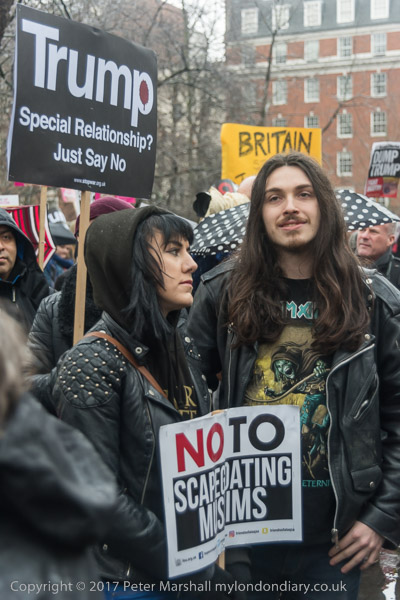
Bangladesh and Harrods

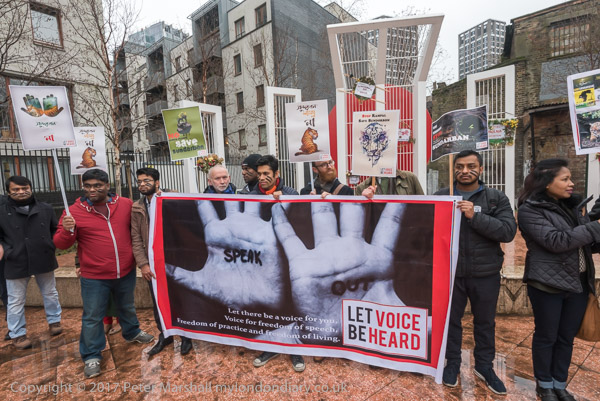
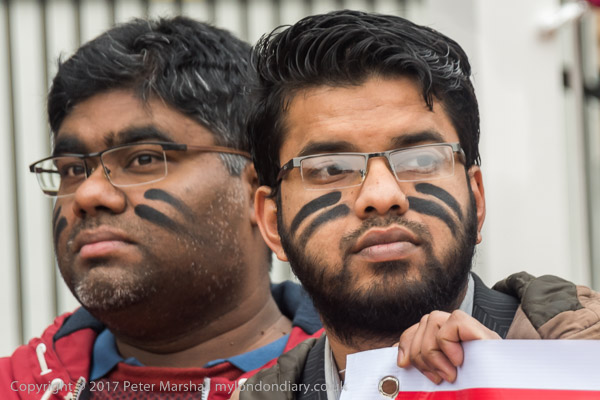
My New Year’s Resolution to take things a little easier this year started well and it was not until Saturday 7th January that I picket up a camera with intent, traveling to Whitechapel in the East End, the centre of London’s Bangladeshi community, for the London event in a the global day of protest to save the Sunderbans, the world’s largest mangrove forest.

I’ve never been to Bangladesh, though in the past I’ve been invited and we now have parts of our wider family there through my son’s marriage last year. But it would be a very long way on a bicycle and I really would have to have some vital reason to justify the environmental cost of flying there.

The Sunderbans protest was all about the environment, and the loss of a unique habitat and the species it supports, including the Bengal Tiger, threatened by the development of a coal-fired power plant on its northern edge at Rampal. The development would be disastrous for this fragile ecosystem, and also another nail in the coffin of our world as a whole, increasing the production of greenhouse gases and reducing an important area for their absorption.

It’s difficult for me to understand why anyone should want to build a coal-fired poor station in an area with such a abundant supply of solar energy, with the cost of generating electricity from this falling at a huge rate. If it goes ahead by the time it is built it will be outdated technology – but of course the same will be true about our own fearfully expensive white elephant under construction at Hinkley Point.

More at Save the Sunderbans Global Protest.

The journey from Whitechapel to Harrods was from one side of London to the other – East End to West End – and to very different issues, though I suppose still at base about the greed of the wealthy, who profit from wrecking the environment and also from stealing the waiter’s tips.

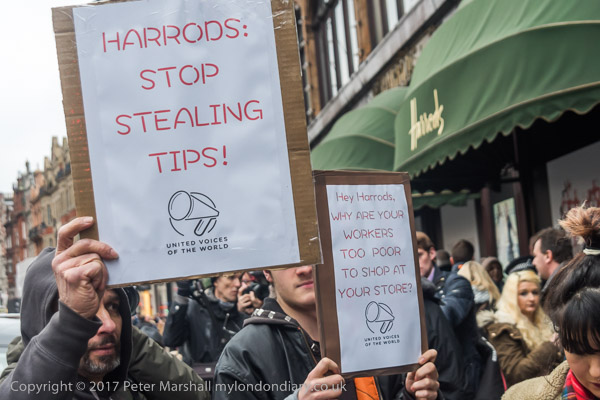
United Voices of the World were protesting outside Harrods on behalf of the many waiters who are paid on or a few pence above the minimum wage in an establishment that caters for the ultra-rich. When these diners leave tips for the waiters they expect them to go to to the waiters and catering staff – but much of them instead was going to swell the profits of the owners, probably the richest family in the worlds, the Qatari royal family.

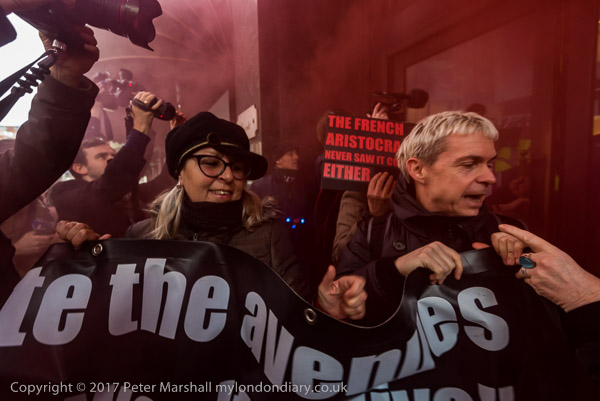
The action by the UVW was supported from its inception by Class War, who turned up with a couple of banners and helped to make the protest even more noticeable. It was perhaps the reputation of Class War that aroused a huge reaction from the police and the interests of some of the press, and the policing was really at extreme levels, with officers on all sides of the block containing the store and vans parked in all the side-streets around, considerably outnumbering the protesters. Harrods too seemed to have a large number of extra security officers on duty inside the store.

Officers came and told the protesters that if they entered the store to protest they would immediately be arrested for aggravated trespass. Some had already gone inside earlier, hiding leaflets about the protest in places where customers and staff would find them later, and had left undetected.

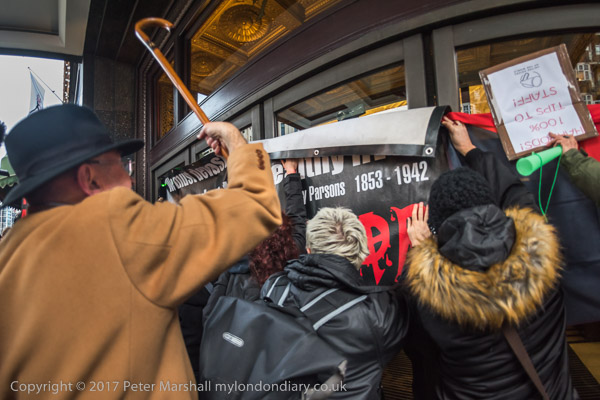
Class War’s methods were more direct, though largely street theatre rather than posing any real threat to property. There was a struggle to open the main doors, and to cover them with their banner to stop those inside filming the protesters, but mainly a lot of shouting and dancing.

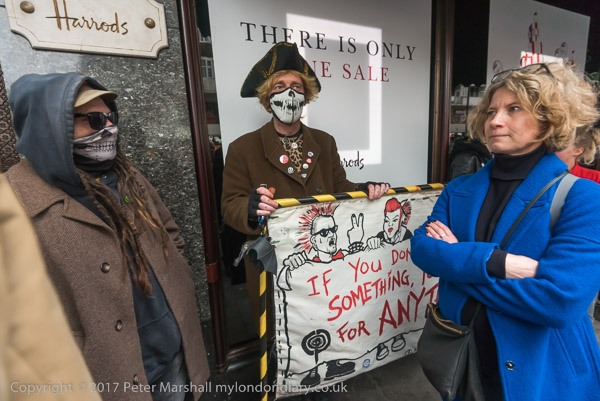
And there was very much a clash of cultures, which seemed to me to be summed up by the expression on the face of one well-dressed woman on seeing some of Class War’s more distinctive characters.

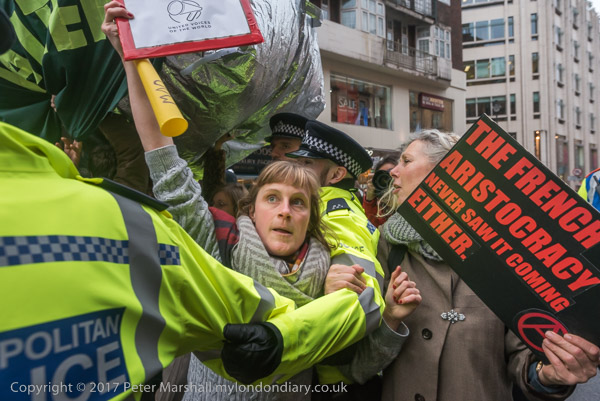
The protesters moved off the pavement onto the Brompton Rd in front of the store and were intending to march around the block, but police surrounded them and kept them blocking the road for some time, urging them to go back onto the pavement when they would probably have moved away much more quickly. Eventually the police gave up pushing and threatened to arrest anyone who stayed in the road and the protest moved back to block the pavement. One woman standing on the curb was arrested for arguing with the police that she was on the pavement, and a few minutes later police snatched another who they accused of letting off a smoke flare earlier.

The protesters moved to a wide pedestrian are at the corner of the building for a short rally and then brought the protest to an end, and people, including myself left. Later I heard that as the UVW was packing up police came and arrested four of them including the UVW General Secretary Petros Elia. They were kept in cells at Belgravia police station for up to 18 hours before being released without charge (though the guy accused of letting off a flare apparently accepted a police caution) but on police bail with a condition that they were not to go within 50 metres of Harrods.

These arrests of trade unionists seemed a clear abuse of police powers and a clear demonstration of whose side the police were on. I commented at the time:

It appears to be a deliberate abuse of the law to try to stop protests at Harrods – however legitimate these may be. Harrods and their owners, the Qatari royal family have many friends in high places including the Foreign Office and presumably these were able to put pressure on the police to take action against the protesters.

Many more pictures at: Harrods stop stealing waiters’ tips.

Continue reading Bangladesh and Harrods

M4-15

People often say things about it being a nice day to take photographs when its bright and sunny with a clear blue sky, but such days, welcome though they are for other reasons, especially in winter, are ones that photographers dread, with sun from a low angle, deep shadows and ridiculous contrast.

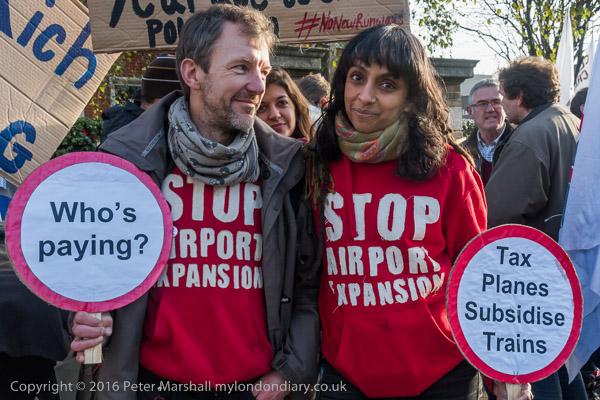
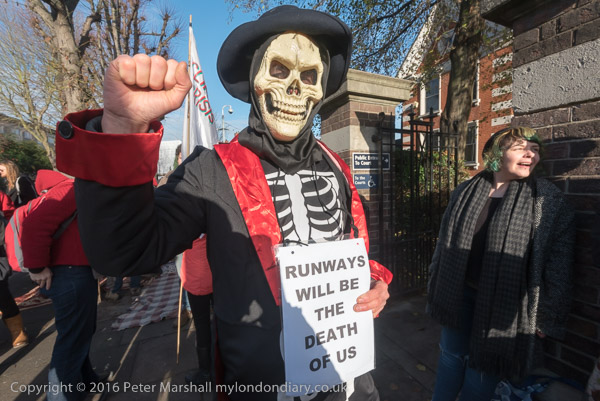
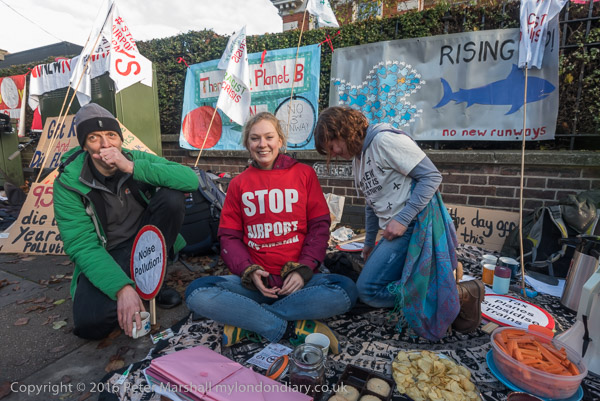
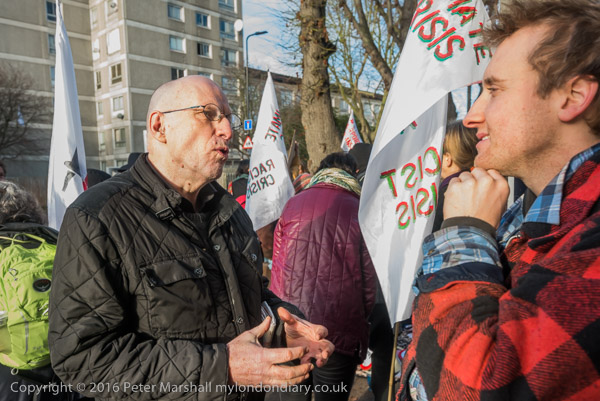
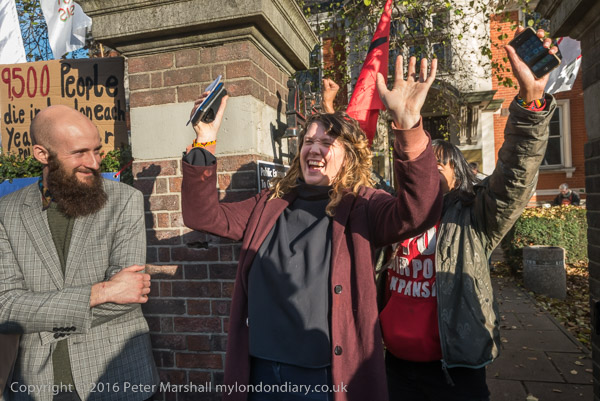
And December 22nd was one of those days, and I left home knowing things were likely to be tricky as I walked to the station. The trial of the Rising Up “M4-15” who had blocked the motorway spur into the airport in a protest against Heathrow expansion was taking place at Ealing Magistrates Court, and a protest in solidarity was starting there rather early in the morning.

I seldom do early mornings. For me its one of the perks of being my own boss and doing what I like to have a reasonably leisured start to the day, and in any case catching an early train doubles the fares. I decided arriving a little after 10am would be plenty early enough, and although the protest had been going for a while I hadn’t missed anything of importance. Many of those coming to the event had made a similar assumption too.

While there were a few things to photograph, the event only really got going later, and like almost everything to do with courts there was a lot of waiting around. And waiting around.


John Stewart’s head could have done with a little less exposure

You can see my problems with the light in a few pictures. Some of them could have been solved by using fill-flash, but others it would have created worse problems, so although I’d had the flash in my bag I hadn’t used it. There are some situations where the flash creates a very different atmosphere and this event, largely very informal, was one of them.
I like to keep things technically as simple as possible when I’m taking pictures, and the Exif data on every picture I took reads Mode: P, Meter: Matrix, No Flash, Auto WB. It’s mainly amateurs who express surprise that I usually work using Program mode, but it works and the dial under my thumb lets me chose a faster speed or a slower one for a wider aperture should I think it necessary. 99% of the time it gives the result I want without my having to pause and think about it.
Nikon’s matrix metering is pretty good too, though I usually have a third of a stop underexposure set to keep a little more of the highlights, I should probably have made that two or even three thirds for the high contrast light, as just occasionally I lost important highlights. Shadows don’t matter much as there is always more you can dig out from the RAW file in Lightroom.
I do sometimes use spot metering (or at least what Nikon call spot.) Back in the days of film I used it most of the time, both the spot metering of the Olympus OM system (surely the OM4 remains the best camera of all time for exposure metering) and also a handheld spot meter, because you needed to be precise, especially with transparency film, and even with black and white I enjoyed placing the key value on the Zone where I wanted it. But spot metering requires you think about it, and when you forget to change back to matrix produces some very uneven results, as I’ve too often proved.

Technically, digital cameras are almost certainly more clever than I am and, so long as you keep the highlights, allow you to play almost infinitely back on the PC with print exposure and contrast. I’m happy to put the camera on P and do that stuff while I concentrate on content and framing. As I’ve often joked, ‘P’ stands for Professional.

Eventually the 14 defendants had to go into court and those of us who didn’t want to go in with them were left standing outside. I don’t like having to hand all my camera gear over so I stayed out. And waited.

Not for all that long, as courts break early for lunch, and the defendants came out and some spoke. They were in good spirits as they felt things had gone well for those who had pleaded guilty but whose solicitor had been allowed to make clear that they were “but only guilty of standing up to climate injustice”.

I’d been hanging around long enough and left when they went back into court and only heard the verdict and sentences later in the day. The 12 who pleaded guilty were all given ‘conditional discharges’, and had to pay £20 victim surcharge and £85 prosecution costs. The cases of the two who had pleaded ‘not guilty’ were adjourned. The Daily Mail clearly didn’t like the verdict, but would probably not have been satisfied with anything less than them being hung, drawn and quartered.

See more at Heathrow “M4-15″protesters at court

Continue reading M4-15

Yarls Wood 10


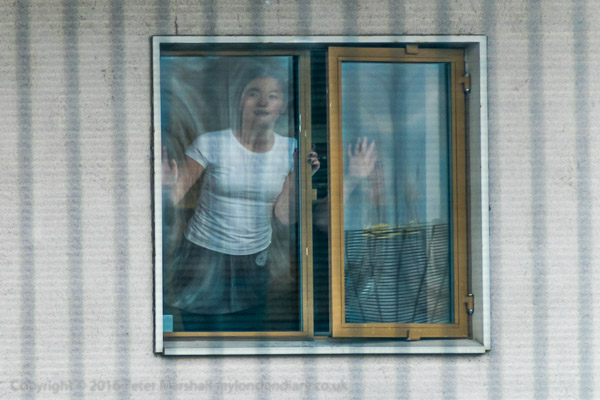
Detainees inside who could get to the windows welcomed the protest

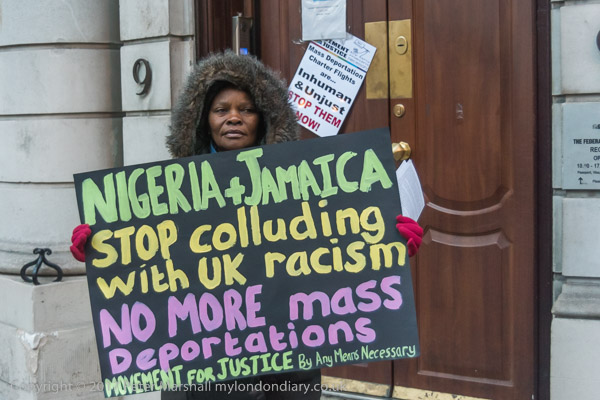
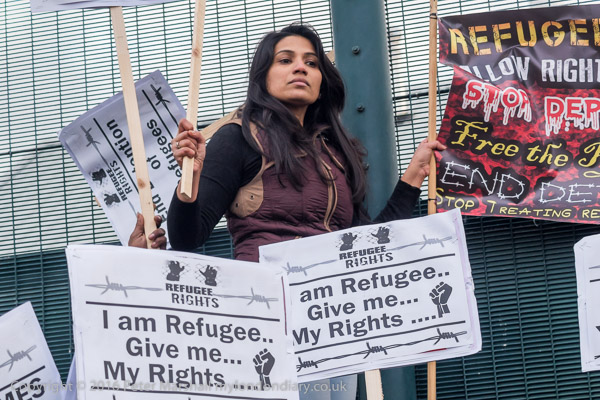
Nothing expresses the racist and and oppressive state of our country more obviously than our immigration detention centres and the whole state apparatus for harassing asylum seekers and refugees. People fleeing violence and persecution, often rape and attacks flee to the UK and are greeting with a Home Office wall of disbelief. While in our legal system you are innocent until proved guilty, for migrants the system works in reverse; the Home Office assumes that they are liars and cheats unless they can produce evidence to prove their claims – and evidence is often impossible to provide.


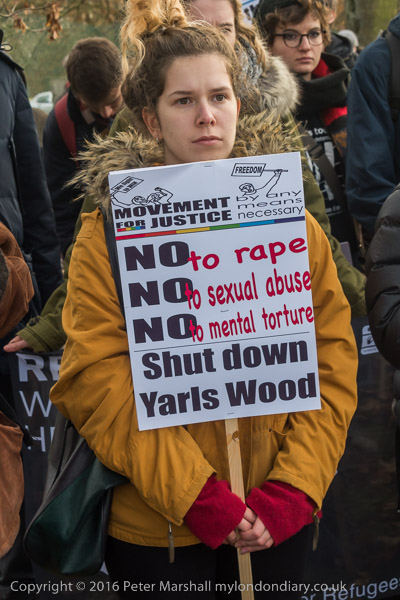
Detainees in Yarl’s wood are subjected to rape, sexual abus and mental torture

Routinely gay asylum seekers are told they are not gay – and sent back to countries where they will face danger and violence because they are gay, Some have to go into hiding, others commit suicide rather than return or after they arrive home.

Others who came here when young or even may have been born here are told they have no right to be in this country – and are sent to countries they may never have been in and where they have no families or friends, removing them and splitting up families living in the uk.

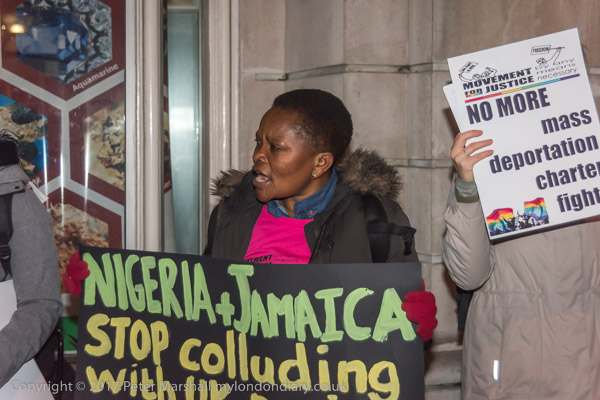
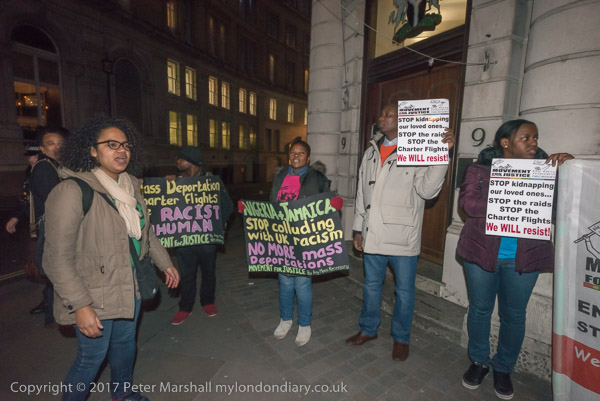
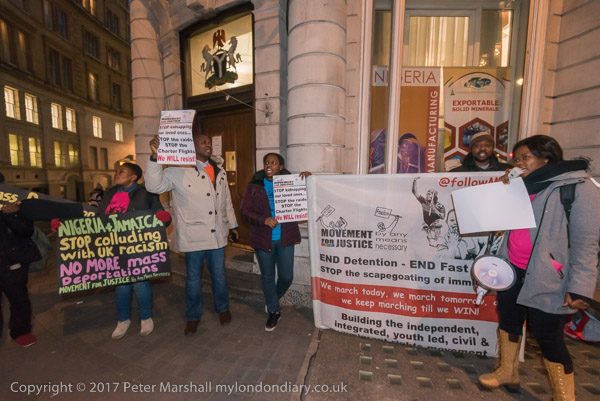
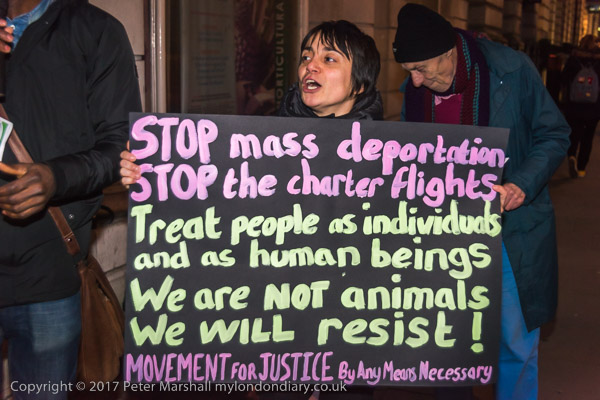
Increasingly under Theresa May and now Amber Rudd as Home Secretary it has become simply a numbers game, trying in any way possible to cut down the number of migrants without regard to personal circumstances or hardship, using mass deportation charter flights to send people to Nigeria and elsewhere, including many whose asylum claims are still being processed.


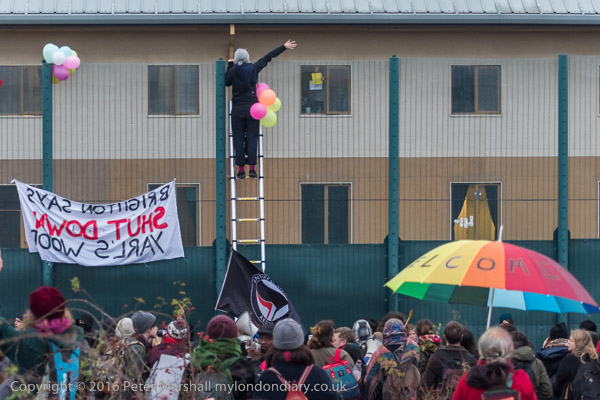
People climb up to show placards and balloons and speak to the detainees

Our immigration prisons are now officially called ‘removal centres’, although many who are held in them will have a legitimate right to remain here. The name change reflects the aim to remove them – whether or not they will be able to prove a right to remain, as many still do.


Refugees to the UK are refused their rights in centres such as Yarl’s Wood

The protest on December 3rd was the 10th at this remote centre in Bedfordshire organised by Movement for Justice, and I think the ninth I’ve attended to photograph. It’s a journey of several hours, made easier on the protest days by a coach provided by MfJ from Bedford Station. Most of those held are effectively cut off from their friends and fellow migrants by the length of the journey and its cost – as most migrants live in urban centres and are poor if not destitute. MfJ also organise coaches from London, Birmingham and further afield for the protests and make it possible for refugees and others short of funds to make the journey. Otherwise it means an expensive train journey to Bedford followed by an over five mile taxi ride from the station.

I don’t cover events like this for the money – and seldom make enough to cover my costs from them – but because I think it important to record what is happening in our society and to make people aware of the issues and I want to do what I can to make that happen. I think the same is true for many of the other photographers there taking pictures.


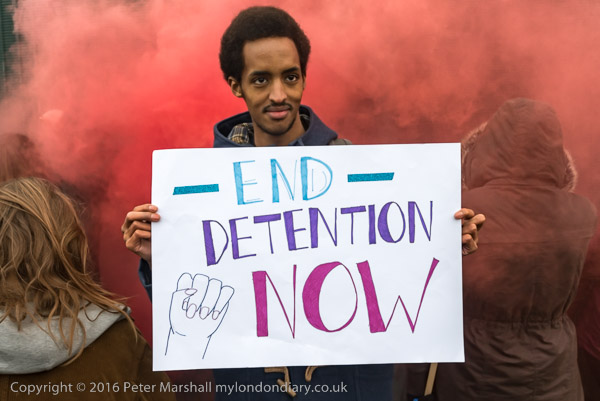
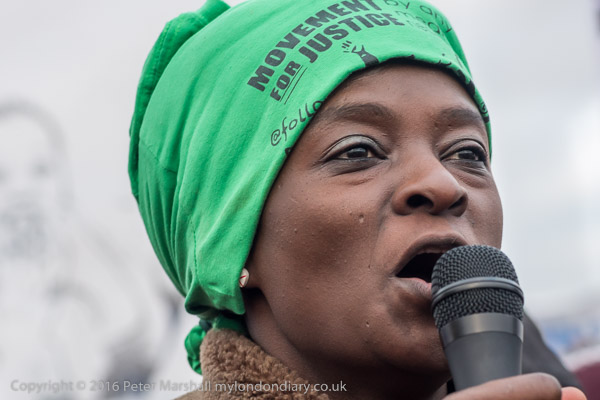
Movement for Justice has led the fight to end immigration detention

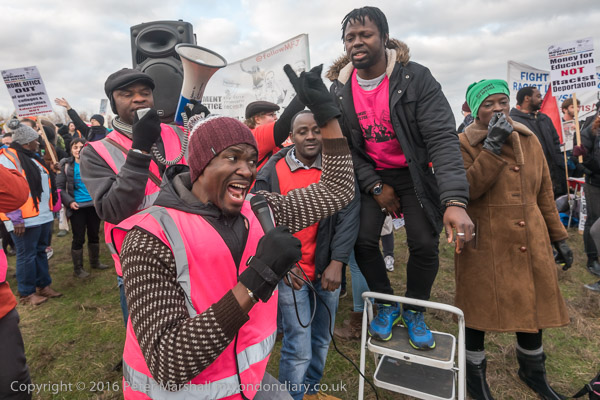
Many of those who spoke – and could be heard by those inside the prison – were people who had spent time inside Yarl’s Wood or other detention centres. And a few inside were able to speak from inside using mobile phones – one of the few privileges detainees have over those in our normal prisons. These are prisons in all but name, but with the difference that none of those held knows what will happen to them. Some have been held for weeks, others for years, and many find themselves being taken from them and put on a flight home. Now these are mainly special chartered flights after passengers on regular flights objected to the forcible restraint of detainees on them, at times refusing to let the flights take off, clearly recognising the inhumanity involved.

These detention centres are also a threat hanging over refugees and asylum seekers living in our communities, who have to attend regularly to reporting centres. Every time they go it for these routine appointments they know they may be leaving in transport direct to Yarl’s Wood or another removal centre – sometimes returning from where they have previously been released. Inside these centres, run by private firms such as Serco, they are routinely refused their rights, bullied and poorly treated. Some have died because they have been refused medical treatment, others have been sexually abused.

These centres are a national disgrace, and a quite unnecessary punishment for those who have committed no crime and pose no threat to our society. They make it harder for the claims of those inside to be furthered and justice to be obtained. Any humane government would close them down and offer real help and support to asylum seekers in their place.

I took a great many pictures of the protest, and you can see a selection of them on My London Diary, as well as read a short account of the day in Shut Down Yarl’s Wood 10.
Continue reading Yarls Wood 10

Class War

I always like photographing protests by Class War. Although they are a small group (though sometimes quite large numbers join with them them) their protests are often very effective in raising issues, and are often unpredictable. The protests are always interesting, both because many of them have interesting views which they share freely and often amusingly, but also because of a sense of theatre.

Generally too there is some visual interest which a photographer can work with, with some excellent banners and posters. And they believe in having fun with their serious politics.

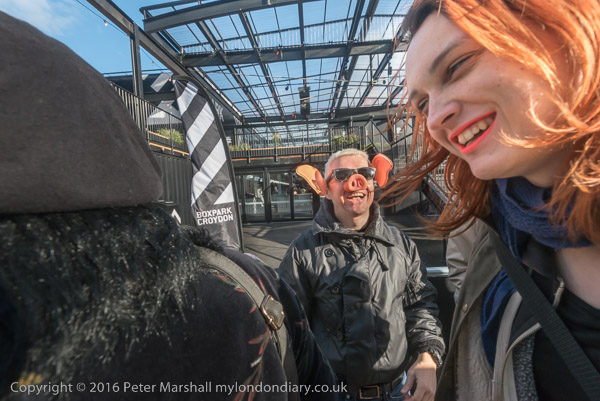
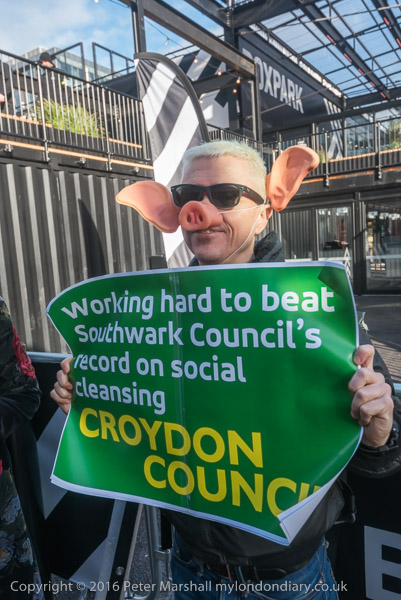
Their confrontational style also tends to make for good pictures, though at Croydon Box Park this was somewhat mollified by the owner coming down and having a serious talk with them, agreeing with much of what they were saying about the gentrification of Croydon and inviting them to come and have a talk later. Though there was more of a confrontation later when they spotted the BBC developers’ apologist Mark Eaton making his way into a meeting.

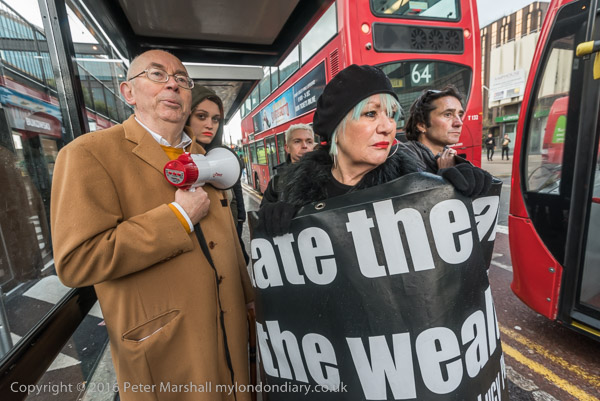
The heavy showers also dampened the atmosphere a little, sending us all into a nearby bus shelter. Later the large banner with its quotation from US anarchist Lucy Parsons showed its worth as those holding it carried it held over their heads to keep off some driving rain.

I had my own small confrontation too. As I note in the caption for the picture above, “The only possible response when someone says ‘You can’t photograph me’ is to photograph them.”

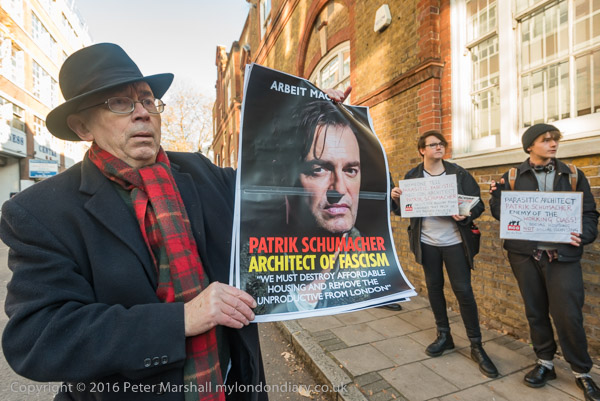
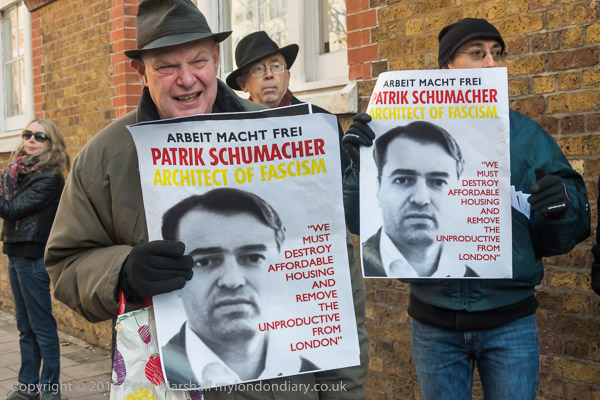
A week later I met up with Class War again, this time protesting against architect Patrik Schumaker of Zaha Hadid Architects, who had talked at a conference in Berlin about getting rid of social housing and public space in cities. The posters from Class War carried what was apparently a quotation from his presentation, “We must destroy Affordable Housing and remove the unproductive from the capital to make way for my people who generate value

It was a chilling sentence, with clear similarities to the thinking and actions of the Nazis, and brought condemnation from a wide range of those concerned with human rights and equality, and housing campaigners in particular.

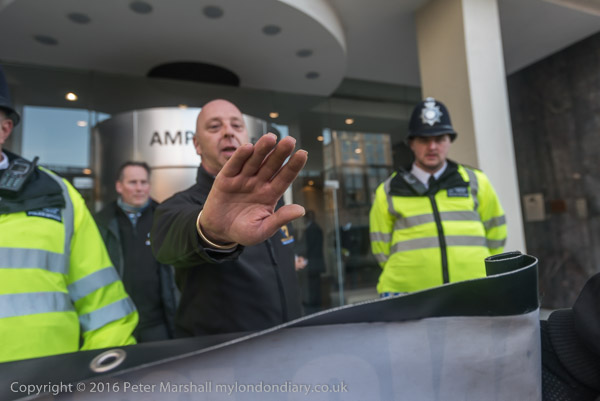
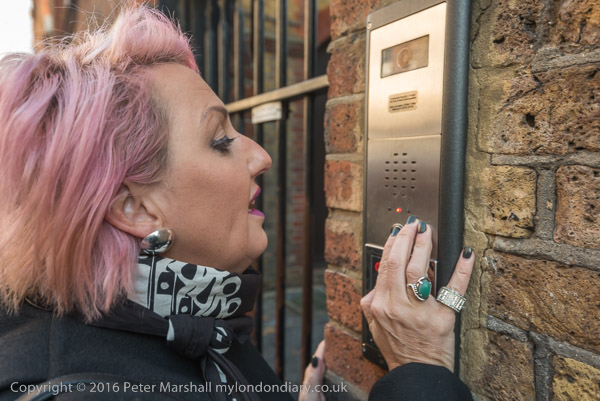
Schumaker’s views were not shared by all architects, and Class War received a message of support from one of those working under Schumaker. Not surprisingly their attempts to make contact with him through the entry phone at the gate and an invitation to come out and discuss the issue were met with no success.  There were extra security guards at the entrances, and even Lisa McKenzie couldn’t charm her way in.

Joining Class War in the protest were others from the London Anarchist Federation and the Revolutionary Communist Group, who also favour a similar kind of direct action and often cooperate at protests.

More text and pictures:

Class War Croydon ‘Snouts in the trough’
Class War protest ‘Fascist Architect’

Continue reading Class War

Down with Arsenal!

I hate the idea of Arsenal. I don’t mean the north London football team, which has always seemed to me one of the more acceptable London teams to support, though if I retained any interest in the game I’d more likely go to QPR or Brentford, the latter a team that several of my team mates when I played under-11 football in the cub league ended up at. But I wasn’t one of the stars of the side and even on the good days when we scored 40 or 50 goals in a match I seldom strayed goal-wards but stayed was left back in my own half. Though I was reasonably lethal to the opposing forwards and we seldom if ever let a goal in.

Arsenal, the intelligent camera assistant is a little device that sits on top of your camera and thinks for you, currently on Kickstarter. I watched one of the videos on the site and was appalled.

I don’t think I’m being a Luddite when I say that ‘I hate the idea of Arsenal.’ It represents the apotheosis of all that is wrong with photography on Flikr and other web-sharing photo sites, reducing the medium to a mechanism for making pretty pictures. Decorative wall art.

I’ve nothing against some of the automation that Arsenal offers (though I’m not convinced it will entirely provide.) It would be good to have something that makes it easy to get the right depth of field – something that was easy when we used manual focus and prime lenses with depth of field scales, but the switch to auto-focus and zoom lenses has made largely guesswork.

But when it comes to using a databank of pictures to decide how to come up with the best treatment for a particular scene this seems to be a certain recipe for the kind of dreary uniformity that distinguishes much of those pretty pictures that attract thousands of on-line ‘likes.’ And also occupy a certain section of the art photography market.

I used to confuse students by telling them that ‘photography isn’t about making pictures’, and I think this device illustrates well what I meant it wasn’t. Photography for me is about having something to say and finding a way to say it effectively. And that means trying to say it in a different way, not how other pictures have done it, though that isn’t easy. The pictures that are best have an element of visual surprise and don’t correspond to rules or stereotypes.

Arsenal sits on top of the camera which sits on top of a tripod, which to me is generally a basic mistake in taking photographs. There are some highly specialised areas where a tripod is needed, but only a very small percentage of good photography is make using one. If you want to do time-lapse photography I think ‘Arsenal’ would be a good buy. But if you want to use an 8×10″ – which admittedly is a little tricky hand-held – you won’t find Arsenal able to cope.

Way back in the 1890s, Kodak and art photographers such as Alfred Steiglitz liberated the camera from the tripod in many areas of photography, and advances in materials and equipment in the roughly 120 years since has meant that cumbersome appendage is seldom needed.

John Morris 1916-2017

Many words have been written and said about the photo-editor John G Morris who died last Friday, 28th July 2017, and he has obviously played a large role in photography over so many years. Probably the most widely read of the obituaries is by Andy Grunberg in the New York Times, and although excellent in many respects it is a shame it was not more carefully brought up to date after being retrieved from the ‘morgue’ where it had been lying for some years in waiting for Morris’s death.

His was a long career as a photo-editor, working for some of the greatest names in photographic publishing – Life,  Ladies’ Home Journal, The New York Times, The Washington Post, National Geographic and Magnum Photos.

His was a career in which he undoubtedly recognised the power of a number of images which subsequently became iconic. Although we now can be sure that the legend that he wove around Capa’s actions on D-Day was almost entirely false, he saw the power of one of the 11 frames that Capa exposed which many editors would probably have rejected out of hand for being unsharp – and it was an image that was only more widely recognised for its expressive potential quite a few years later. Had Morris told the truth about it and given the facts that the investigation by A D Coleman and his team have made clear, the image might have been published and long forgotten.

Again, while working for the New York Times, it was Morris who recognised the power of two of the iconic images from Vietnam, and fought to get Eddie Adam‘s picture of a summary execution of a suspected Vietcong by a Saigon police chief on the front page, and fought the paper’s ‘no-nudity’ policy to get  Huynh Cong (Nick) Ut‘s image of a naked young Vietnamese girl fleeing a napalm bombing raid published – again on the front page.

It was Morris too who invited W Eugene Smith to join Magnum following his break-up with Life, and apparently suggested him (after Elliot Erwitt had turned it down) for an assignment to photograph Pittsburg – which almost ruined Magnum financially after Smith turned what had been meant as a three week assignment into a year working on what he believed to be his ‘magnum opus’, though it only really got an adequate publication as ‘Dream Street: W. Eugene Smith’s Pittsburgh Project‘ in 2001, 23 years after Smith’s death.

A D Coleman in Alternate History: Robert Capa on D-Day (36): John G. Morris Dies (Update) has written about some of the obituaries for Morris, including the New York Times one, pointing out some of their many errors. Its also worth reading the comments on his piece, particularly one by Robert Dannin, who calls the story that Morris made up “nothing more than an unprofessional excuse to conceal his apparent embarrassment at Capa’s work on the Normandy beachhead.”

It’s perhaps a little harsh. I can imagine Morris’s immediate shock on looking at the processed film and seeing only 11 images. And then looking a little more closely and seeing that those eleven were all blurred. A little fabrication to protect his friend’s reputation would be understandable. But to invent such an elaborate story and to keep up the deception for as long as Morris and Capa did was clearly unacceptable – and something of a stain on the reputation of both.

Morris was obviously a man who cared about photography and cared for photographers – and you can read a tribute to him by one of those he helped and was a friend to, Peter Turnley, on The Online Photographer. We can remember him for that and should also put the record straight over Capa’s D-Day pictures.

Another Night

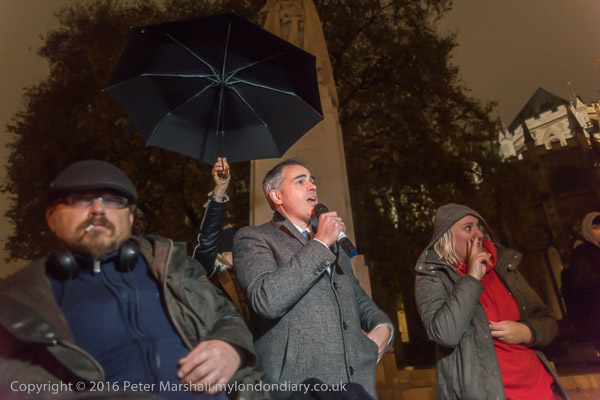
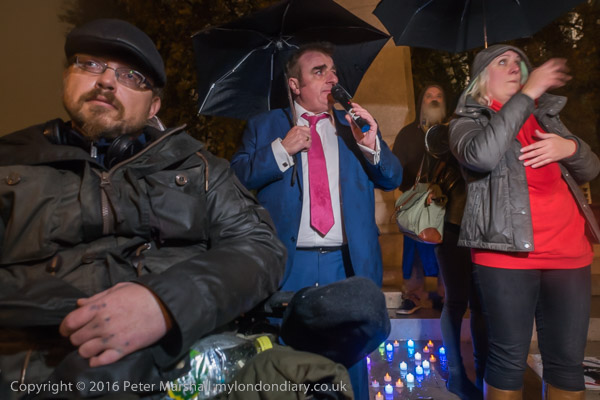
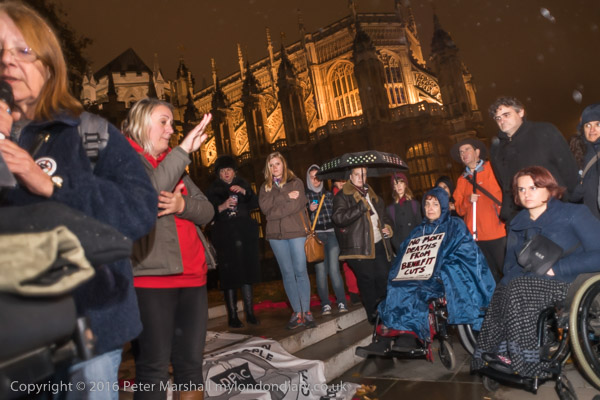
The following evening I was out again taking pictures of a protest, this time in Westminster at Old Palace Yard, opposite the Houses of Parliament. It’s a gloomy place at night, and even worse it was raining.

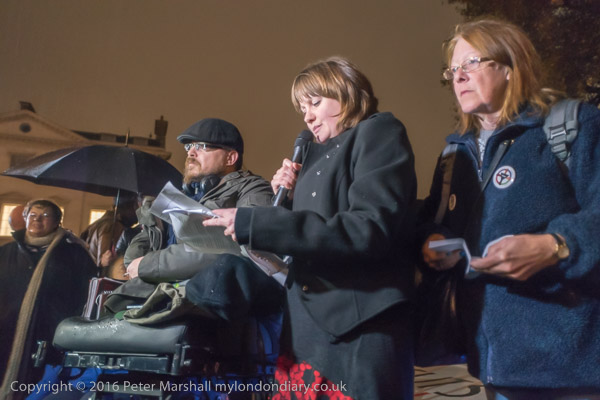
At times the rain was light, even almost stopping. Then it would poor down. I felt sorry for the protesters, from Disabled People Against Cuts and Black Triangle, including many in wheelchairs, though I think most had decent waterproof clothing and a number also umbrellas.

Of course I had an umbrella too, but it is seldom practical to use one when taking pictures – unless you have an assistant to hold it – and also I needed to work most of the time in a very restricted area between a ring of wheelchairs and the speakers, much of the time in a kneeling position so as not to impede the view of those sitting in the chairs. Occasionally sitting on the damp paving stones. Working with a micro-fibre cloth held on the lens filter, taking it away to take a picture, then wiping and covering up the lens again.

Most of these were taken with the LED light source, with a couple at the start of the event when there was still some weak light from the sky without any added light. Another photographer was videoing the event, and sometimes his LED video light lit up part or all of the scene for me – though other times it shone directly towards me and made taking pictures more or less impossible. I did take a couple of pictures with flash, but in rain it gets to be pretty useless, lighting up the rain drops and giving odd spots across the picture. With exposures around 1/15s to 1/60s spots of rain don’t show up except sometimes as streaks – which look very much like rain. But with the slow shutter speeds and probably a certain amount of shivering from me quite a few of the exposures were blurred even when there were no raindrops on the lens, and quite a few frames were unusable.

I also discovered one of the problems of the Neewer CN-216 LED light. It doesn’t have a battery cover – or at least mine doesn’t, and at one point after it got a slight knock, all 6 batteries fell out and rolled across the wet paving stones. Fortunately I and some of the other people around managed to pick them up, but now I put a length of masking tape across them and the back of the unit after replacing the batteries.

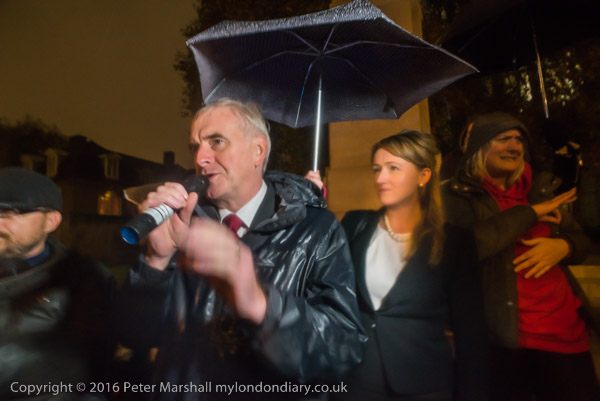
As the evening went on the rain worsened. There was quite a long list of speakers, including the Shadow Chancellor John McDonnell, for whom the heavens opened pretty drastically. Fortunately he had brought fellow Labour MP Rebecca Long-Bailey with him to hold an umbrella. They and other MPs came out from the debate on government plants for a cut in Employment and Support Allowance, despite a UN report condemning the ‘grave and systematic violations of disabled people’s rights’ which had resulted from the UK government welfare reforms..

It was really an evening that called for an underwater camera, or at least an underwater housing. I do carry a cheap plastic bag affair in my camera bag, but find it such a pain that I hardly ever use it. Fortunately I managed to keep the cameras under my coat much of the time, though having the front of it open to do this meant I did get rather wet. I was cold too, and very pleased when I could pack up and go home.

I wasn’t particularly happy with my work at this event – and so many of the images were ruined – but under the circumstances I felt I’d done a decent job to get any results at all. You can see more at End Discriminatory Welfare Reforms.
Continue reading Another Night

Night Work

I don’t often photograph the Tower of London, but it would, I thought, a nice background for a picture, something that says ‘London’, and I went to the protest being held outside the Tower against the European Custody and Detention Summit being held there hoping to use it in my pictures.

Unfortunately the protest was taking place in the early evening and this was November. There were groups at two locations, one on Tower Hill, where there was a view of the Tower behind the protesters, and a second down below Tower Bridge, where there wasn’t really a much of a view of the bridge and the Tower was completely out of sight.

I’d taken two light sources with me, the Nikon SB800 flash, and a cheap LED light, the Neewer CN-216, which has an 18×12 array of small LEDs  – 216 in all, hence the model number. It takes 6 AA cells, which adds considerably to its weight and will just about fit in a large jacket pocket. The flash, with only 5AAs is a little smaller and lighter.

Knowing it would be dark, I’d also packed the Sigma 24-70mm f2.8 and the two pictures above were both taken using this on a Nikon D810. I had the camera on shutter priority and both images were taken at 24mm, using the camera in full-frame mode at 1/50s and f2.8  – but there the simiilarities end. One used the flash at ISO 1,800 and the other the LED light at ISO 6400. Though it seems bright, those LEDs don’t really put out that much light.

I’ll leave it to you to decide which was which. The differences are easier to spot on the 7,360 x 4,912 pixel images, but after processing – including noise reduction – in Lightroom was less than I expected, and looking through the whole set at full screen size my guesses as to which used flash and which were LED where often wrong.

Both are relatively small light sources and so suffer similar problems with light falling off at roughly the square of distance, and I worked a little more ‘head on’ to groups than usual when I could to avoid too much having to dodge and burn in Lightroom.  One advantage of the LED was that I was able to hold it at arms length from the camera – much trickier with flash – and see the results of angling it away from closer subjects. The higher ISO I used with the LED meant that ambient lighting contributed more to the LED lit images and probably I would have been better using ISO 6400 with the flash as well. But I was worried about image quality, though it turns out I need not have been.

Increasing the ISO to 3200 for the wider group, taken with flash and using a Nikon 20mm f2.8  at 1/30s, f/2.8 on a Nikon D750 gave a good balance.

Down below Tower Bridge there was a little more light and I used the flash very little, relying on the LEDs for most pictures, though in some areas there was enough light from the street lights to make them the main light source.  The view of Tower Bridge in some of the pictures isn’t instantly recognisable.

I did have a few problems with fiddle fingers, and working in  S – shutter priority – mode does mean you get underexposure when you push the control dial in the direction of higher shutter speeds. With flash too the exposure drops – though with Auto FP High Speed Sync you no longer get just a fraction of the frame exposed. Fortunately Lightroom can cope with considerable underexposure if – as I do – you shoot RAW images.  And ISO settings don’t really have a great deal of meaning.

In low light conditions you also get problems with slow shutter speeds and subject movement, as well as camera shake. None of the lenses I was using has image stabilisation but it would have been of little or no help. But you do need to make a lot of exposures and to have a little luck.

More pictures of this protest by the Reclaim Justice Network which includes prison activists, refugee solidarity groups and anti-arms trade campaigners against this trade fair for  major arms companies, security companies, prison builders, and others profiting from expanding and privatising the criminal justice system at Custody Summit at the Tower.

Continue reading Night Work

Hugh Edwards

As friends including regular readers of these posts will know, I don’t generally have a very high opinion of curators – except for a few that I’ve known and have worked with. Too many have put on shows that server largely to illustrate their lack of knowledge and real interest in the medium and are clearly concerned only with building their own careers. And far too often money that would be better spent on photography and photographers goes into their pockets and into creating fancy displays which might enhance their reputation but often take away attention from the work presented.

But of course there are exceptions. Actually quite a few of them, including the obvious ones like John Szarkowski. Many of the best have been, like him, photographers and have had a real appreciation of the medium.

Thanks to a recent post Hugh Edwards: Unknown Icon by Kenneth Tanaka on The Online Photographer, I have now been made aware of another fine curator. Edwards (1904–1986) was Curator of Prints, Drawings, and Photography at the Art Institute of Chicago, where he had already worked for 30 years, for his last 12 years there from 1959-70, during which time he organised 75 exhibitions, as well as regularly showing new acquisitions.

This was an important time in the evolution of photography, and one in which Edwards played an major role, giving Robert Frank his first American museum exhibition in 1961 and promoting many emerging photographers as well as building up a fine study collection of work by nineteenth and twentieth century masters. And his contribution is finely and extensively documented in the web site on him and the photography he championed and bought for the Art Institute collection by photography curator Elizabeth Siegel and a team of researchers.

Photography was one of his many interests; David Travis, Curator and Chair of the Department of Photography from two years after Edwards retired until 2008 writes about him at some length and remembers the rare and memorable evenings at his home when he would show his own colour slides made at “a roller skating rink in Harvey, Illinois”. In in a letter to Frank, Edwards wrote “I ran away from ‘culture’ and accelerated education to spend all my evenings in a large skating rink on the outskirts of Chicago for five whole years. There were many wonders there and I used to wish someone would catch them so they could be kept. Then I found your book and saw you had done it.” Travis comments that having seen Frank’s work “published, Mr. Edwards felt his own mission as a photographer could end.”

Those who can make it to Chicago can see the extensive show at the Art Institute also curated by Seigel, The Photographer’s Curator: Hugh Edwards at the Art Institute of Chicago which runs until October 29th 2017. But otherwise the web site is a fine tribute to an amazing curator and his legacy.

D-Day Wrap

Something which I meant to acknowledge earlier but slipped my mind after I read the post was the announcement by A D Coleman, ‘It’s a Wrap‘ marking the official end of “our team’s deconstruction of the myth of Robert Capa’s D-Day experiences and the subsequent fate of his negatives“.

The end came exactly three years after the investigation began with the publication of photojournalist J. Ross Baughman’s critique of the TIME video celebrating the 70th anniversary of Robert Capa’s D-Day photographs, and included further contributions from Baughman as well as from photo historian Rob McElroy and combat veteran and military historian Charles “Chuck” Herrick as well as Coleman’s own major contribution.

During its course it also referenced the work of others on this and related matters such as Capa’s ‘Falling Soldier’, and included a number of other guest posts, including one by Jim Hughes who in 1986 was the first to publicly challenge the Capa D-Day myth (and his review was quite probably the origin of my own total scepticism about the alleged ‘darkroom disaster’.)

It has been a remarkable series of posts, and quite rightly has received awards and nominations, and has changed entirely our view of one of the best-known events of photographic history, but also shed light on how that history is manufactured and by whom. History isn’t just facts, but a point of view (rather like any photograph) but in this particular case we know also know that much of what was claimed as fact is in fact fiction.

Of course we always knew that Capa was himself an invention, and a great inventor of stories as well as someone who photographed them powerfully. But even when we know more and can dismiss the embroidery the image remains. Of course like all photographers Capa took many weak images, some of which have found their way to gallery walls and books but there certainly remain enough to sustain his reputation.

We will still look at his pictures and be moved by them even when we know that the captions may be unreliable and some events may have been staged. And Capa did certainly put his life at some risk – even if rather less than he made out – on D-Day and probably more so on various other occasions, and of course later paid for the risks with his life, stepping on to a landmine in Indo-China. And his advice “If you’re pictures aren’t good enough, you’re not close enough” is still worth remembering.

Although officially the end, it certainly isn’t, and Coleman gives a number of areas that he or others will pursue, both about D-Day and Capa’s other work, and more widely in a critical look at the medium’s institutions, particularly the ICP.

Coleman states he considers “the basic research complete and the case effectively proven” and is “developing this material into a book, an exhibition, and a multimedia piece” about which he will give occasional progress reports, but apart from this unless there are some unforeseen discoveries or unpredictable surges of interest there will be no further posts in the series. I hope the exhibition will tour to some of the more prestigious institutions both in the USA and Europe and will perhaps help to end the promulgation of the myth.

Coleman concludes his piece with a comment on a New York Times article by Geoff Dyer, a man who writes about photography and who prides himself on not being a photographer; “I don’t just mean that I’m not a professional or serious photographer; I mean I don’t even own a camera” (in ‘The Ongoing Moment’ a book given me by someone who had probably read on the previous page “I suspect, then, that this book will be a source of irritation to many people, especially those who know more about photography than I do.” It was, though I’ve never managed to read to the end, always throwing it down in disgust at some idiocy within minutes of picking it up.)

Dyer’s ignorance clearly extended to never having heard of the doubts about Capa’s D-Day legend (despite a previous feature in the newspaper for which he was writing) and he writes “we know the precise historical moment they depict, what happened before and after, the reasons the pictures are so blurred” a statement untrue in every detail.

As Coleman comments “This uninformed balderdash of Dyer’s exemplifies the lamentable condition of writing about photography today. If you wonder why I have persisted with this investigation, consider Dyer’s elegantly phrased but fact-free nonsense a sufficient answer.”

It’s a Wrap