My London Diary 2006

I’m not sure whether to be annoyed or amused or what to find that my book 2006: My London Diary, published on Blurb in 2012 is now available for ‘free’ download from a Russian web site in various formats and has so far apparently been downloaded 21,407 times. Which I think is over 21,000 more than I’ve actually sold copies to.

What I do know is that my profit from those downloads comes to exactly zero. This isn’t the first time that I’ve found one of my books available in this way and I think a diligent search would reveal more sites making offers of this kind, but its an area of the web that often makes my security software pop up warnings and suggest I get out of there without delay. And I certainly wouldn’t dream of downloading anything from the particular site, which also demands some kind of membership fee to use its download services.

2006: My London Diary costs £6.49 for a legal ‘Instant PDF’ download from Blurb, who take about three-quarters of that for themselves but I still get a reasonable payment. Of course even if the 21,407 is an accurate figure I haven’t actually lost the £35,000 or so that this number of legitimate sales would have provided, as only a very much smaller number if any would have considered a purchase rather than a free download and my real financial loss is most likely in two rather than three figures.

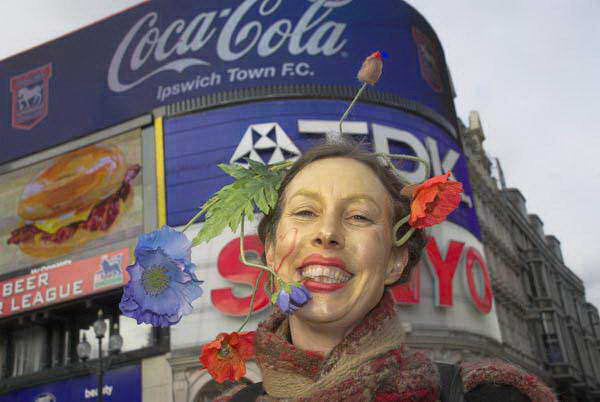
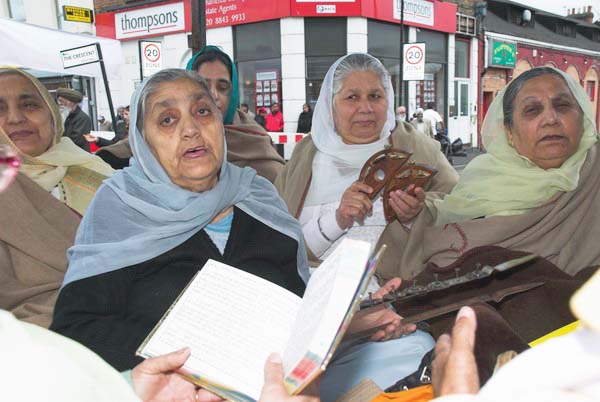
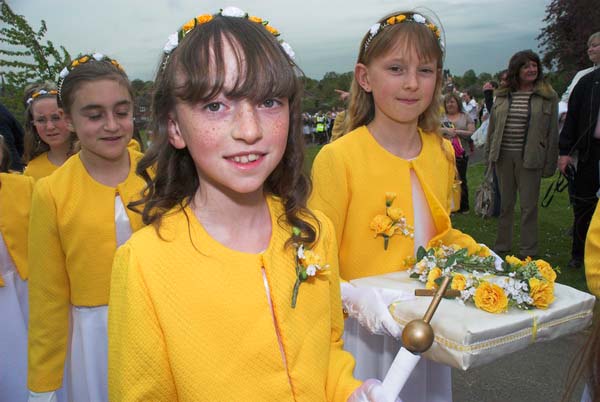
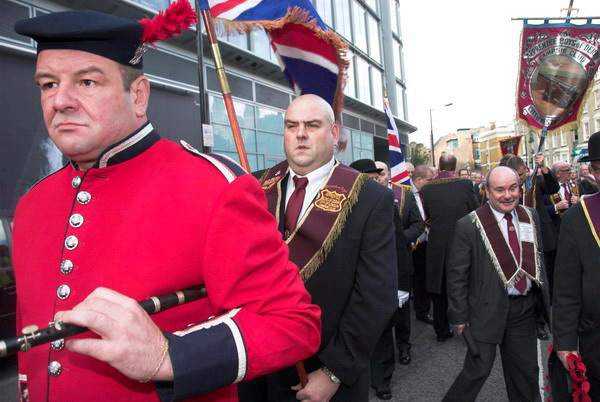
Back in 2006 when I took these pictures, DSLRs were a little more primitive than now, and so was the software for processing RAW files. But the Nikon D200 I was then using – bought immediately it became available in December 2005 – was perhaps the first really decent digital camera I owned, a real step up from the D100, particularly so far as the viewfinder was concerned – and with around twice the file size. Though its 10.2Mp sensor is small by recent standards it was really enough for almost all purposes. A couple of years later I updated to the D300, also a significant advance.

Head and shoulders above other RAW processing software at the time was Pixmantec’s Rawshooter image processing software which I used for developing these images. Adobe couldn’t match it, so in June 2006 they bought it out and slowly used its technology to bring Lightroom up to scratch. For the book I reworked all of the pictures in the latest Lightroom at the time, Lightroom 3.5, but still ended up using many of the Rawshooter files.

There are a few images in the book I’d do a little differently today, and I would probably also make a slightly different choice of images. But it was tough. My initial selection from the roughly 6000 images I’d published on the web was around 3000, and I had to cut that down to around 70 for the book, to keep within the 80 page format I wanted to publish.

It’s still a good cross-section of my work from that year, and I was happy to have a copy of it in one of our major collections – and they also have a CD with most or all of the 6000 from that year.

The book is still available on Blurb, though the print version (softcover only) is a little expensive at over £33, and Blurb’s delivery fee adds a ridiculous amount. I alway recommend the PDF version, but should you want a hardcopy then buy directly from me and save considerably – I still have a few copies at £25 + £2p/p – details are here.

One small satisfaction from that Russian site, apart from knowing that 21407 people have bothered to look at my work, is that the book gets a rating on the site of 8.5/10 – which doesn’t seem bad.
Continue reading My London Diary 2006

The Salgado Effect

Like me you have probably seen the set of pictures by Kevin Frayer published by The Guardian Documenting the Rohingya refugee crisis – in pictures.

They are a powerful set of pictures and I have a great deal of admiration for the photographer having gone to document the situation and managing to photograph scenes such as this. But I also found myself feeling a little uneasy at certain aspects.

I think I remember years ago Don McCullin discussing the dangers of aestheticising scenes of violence and death, I think in relation to working in Biafra. Obviously we need to produce powerful images using the tools at our command, but there comes a point where making pictures out of scenes conflicts with showing the brutal realities.

I’m also a little disturbed by the use of black and white rather than colour in these and many other sets of images, the huge majority of which are actually made in colour. Perhaps Frayer worked in black and white either on film or on that Leica M Monochrom but the images have a look that owes much to software. With many photographers conversion to black and white is simply an affectation that makes them think their work is more documentary, or perhaps reflect their admiration for the work of photographers such as Salgado (whose work sprang to my mind looking at some of these pictures), Frayer (or his post-production team) certainly take full advantage of its possibilities, much too full for my taste.

Photographers have long taken advantage of the possibilities offered in the production of their images, whether in darkroom or with Silver Efex. Where would Gene Smith’s Spanish Wake be without the hours (and the ferricyanide and whisky) in the darkroom? But as Horacio Fernández comments on this image, the selection of pictures for Time’s 1951 Spanish Village essay (one of the landmarks of photojournalism) were made “paying more attention to beauty and emotional meanings than to information and political commentary.”

Of course, as Smith said, “The honesty lies in my—the photographer’s—ability to understand…I will retouch.” And we all do to some extent. Some of my pictures have a little help from Lightroom’s ‘Clarity‘ brushed delicately on faces or elsewhere (though mainly I work rather less aggressively with a little added exposure and contrast – it’s something that has enabled me to largely move away from using fill-flash.) But in these images it has been applied with a shovel not to enhance what was there but to create a deliberate and to my eyes un-photographic effect. Some of these images are well onto the way to becoming film posters for the crisis rather than exposing it to the world.

In How not to photograph the Rohingya genocide in the making… Suchitra Vijayan examines these pictures and also features a lengthy YouTube video of a talk with writer Maaza Mengiste, Unheard of things – the vocabularies of violence. I’ve not listened to all 88 minutes, but it is worth starting as I did at 38:10.

And here’s another set of photographs – also in black and white – of the crisis. Less dramatic, less aestheticized, less post-produced but I think that Greg Constantine work is somehow more real and tells the story better. And there are other pictures both black and white and colour that do so too.

MOMA Clearout

If you have rather more than £50 to spare and feel like indulging yourself, then the news (from PetaPixel) that MOMA is having a clear-out sale of prints it no longer needs may come as good news.

Over 400 prints are up for sale, mainly on-line through Christies – and you can browse the lots on-line, though the news has come a little late as by the time you read this the auctions for the October sales will probably be over. The site lists the schedule for the sales:

October 2017
MoMA: Pictorialism into Modernism
MoMA: Henri Cartier-Bresson

December 2017
MoMA: Women in Photography

January 2018
MoMA: Garry Winogrand
MoMA: Bill Brandt

April 2018
MoMA: Walker Evans
MoMA: Tracing Photography’s History

The 400 pictures includes some of the better-known images by many of the photographers included, and the prices are likely to be high. But its a good opportunity to view a great set of images on-line.

And if, like me, you can’t afford to bid for ‘HENRI CARTIER–BRESSON (1908–2004) Behind the Gare St. Lazare, Paris, 1932’ for which, as I write the current bid is USD 35,000 (£27,741) then you can console yourself with the thought that its actually much better to own a whole book of his pictures, such as ‘The Decisive Moment‘, republished in 2014/5, which you can still buy on the web for a little over £100 including postage. Or if that is beyond your budget, you can buy the perfectly adequate though not quite as desirable Photo Poche or Aperture volumes of his work secondhand for little more than a fiver.

£50 Lottery

Although it’s for a good cause, I probably won’t be buying one of the 1,250 tickets available matching the number of postcard-sized photographs showing from 12th- 25th October at Theprintspace in Shoreditch. Though it would mean getting a unique print will be an edition of one with a signed certificate of authenticity I’m not sure what I would do with it, and although there are some excellent pictures in those I’ve so far seen, there are also a number I certainly wouldn’t like – and this is a lottery.

But I also don’t like the idea of limited editions of any size in photography. I’m happy to get photographs from other charities I donate to, but they come in mass-printed magazines and handouts that, after reading and appreciating I happily recycle. But I’d find it hard to put a limited edition print in the rubbish, and feel if I intended to sell it on eBay that maybe it isn’t charity but a money-making exercise.

Of course The Hepatitis C Trust is a worthy cause, and their aim to eliminate Hepatitis C from the UK by the year 2030 deserves support. And if this exhibition encourages more people to donate £50 its a good thing, but somehow it just doesn’t feel my thing. I kind of hope it is yours, which is why I’m writing about it.

I read about Photography on a Postcard today on It’s Nice That, an organisation that “believes passionately that creative inspiration is for everyone” and publishes on the web and in print and organises events including a monthly Nicer Tuesdays in Bethnal Green, London.

I’d also read about it earlier on the British Journal of Photography, which has a longer article with more pictures, but which rather put me off the idea of buying a ticket.

I can’t find anything about it on Theprintspace web site, though I’m sure it will appear their shortly. I’ve several times used them to make prints and always been satisfied with them and the prices are pretty keen, though not the cheapest. You can actually buy three of my Bow Creek prints from the Cody Dock show through them, though rather more expensively than the postcards – but they are larger prints.

You can see all the photographers and around half of the cards (some photographers donated several images) at the Photography on a Postcard site, where you can also buy your £50 lottery ticket. The computerised draw is on on Monday 30 October.

Perhaps I might…I think I’ve almost persuaded myself. But don’t delay as I’m sure the tickets will sell out soon – probably by later today after I publish this!

Business as Usual

One of the reasons I post here about my work on My London Diary earlier in the year is to check up on that web site. In some ways its a rather primitive site, a throw-back to the early days of the web, entirely hand-coded, though usually with the aid of an ancient version of the best WYSIWYG software, though now that outdated description ‘What You See Is What You Get’ no longer really applies, and what I see when I’m writing the pages is very different to the web view.

I first designed the site back in 2001, and even then it was somewhat archaic, reflecting my views on simple web design at at time when flash bang and wallop was infecting the web, largely running on our relatively slow connections that weren’t ready for it. Designing image-loaded sites like this that were reasonably responsive was something of a challenge, and needed relatively small images carefully optimised for size, with just a small number on each page.

Although the site still has the same basic logical structure, times and the site have changed a little to reflect the much higher bandwidth most of us now enjoy, with several re-designs and many more images per page, as well as slightly larger and less compressed images. Size is now more a problem of controlling use (or abuse) of images than download time, and new images are now always watermarked, if fairly discretely. The latest small changes in design have been to make the pages ‘mobile friendly’ without essentially changing their look.

I suspect that My London Diary is one of the largest hand-coded sites on the web – with over 150,000 images on over 10,000 web pages. But the simple site design means the great majority of the time involved in putting new work online isn’t actually the web stuff, but editing the images and writing the text and captions, so there is little incentive for me to move away from hand-coding.

But I’m not really a writer of web sites (though I have quite a few as well as My London Diary) or this blog but a photographer and though My London Diary is important in spreading my work and ideas, it has to fit in with that. Often the web site gets written late at night or when I have a little time to spare before rushing to catch a train, and often I have to stop in the middle of things to run to the station – or fall asleep at the keyboard. So while in theory I check everything, correct my spelling and typos, make sure all the links are correct and so on, there are always mistakes. And just occasionally my ISP has something of a hiccough and puts back an earlier version of a page or loses or corrupts an image (though they deny it.)
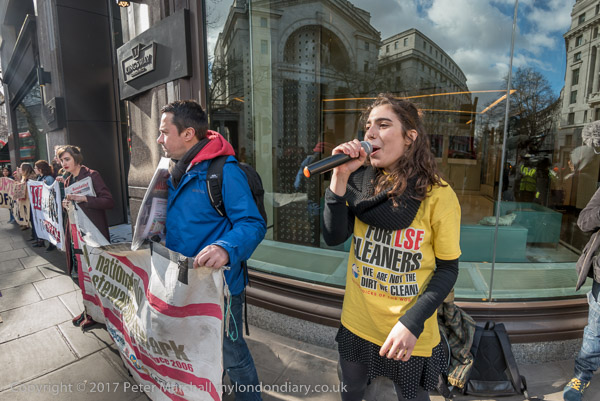
This morning I opened the pages on End homophobic bullying at LSE , the first protest I covered after returning from Hull, only to find I’d not put any captions on them, not even adding the spaces between pictures for them to go in. So before I started to write about them I had work to do.

Otherwise I might have had more to say about the pictures. Yet again how useful the fisheye can sometimes be, or about reflections in pictures or to fulminate against homophobia, the failure of LSE management to live up to the pricinciples the instituion espouses, the inherently evil nature of out-sourcing and the need to treat everyone with dignity and respect and to pay a proper living wage. But today you can relax and take that as read.

The pictures are workmanlike, they serve a purpose, do the job, but it wasn’t one of my better days. Dull weather perhaps didn’t help, but sometimes the magic just doesn’t happen. The following day was perhaps a little better (I’ll let you decide) and certainly much busier, with pictures from five events.
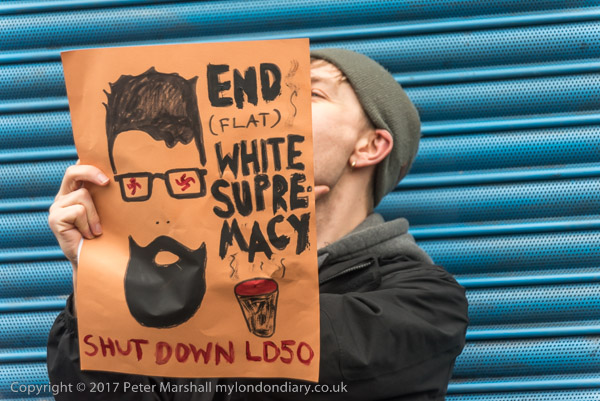
I started with Shut race-hate LD50 gallery, a crowd outside the place which they say “has been responsible for one of the most extensive neo-Nazi cultural programmes to appear in London in the last decade” ,  but didn’t really offer a great deal to photograph. The gallery itself was on the first floor above  a shuttered shopfront, and had clearly had a brick through a window, and there were a couple of arguments outside, but mainly it was scattered people standing in small groups on the street.
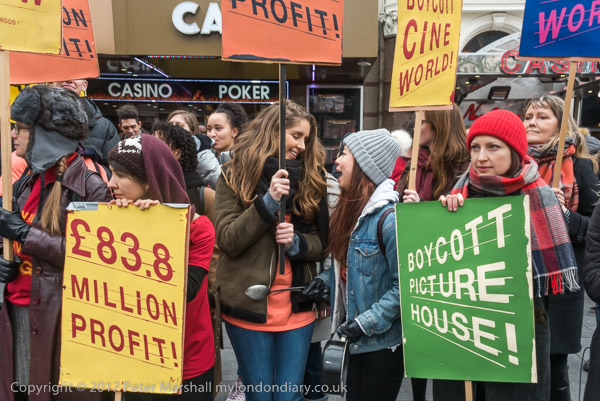
Trying to do too much, I arrived late and left early for the Picturehouse recognition & living wage protest in front of the Leicester Square Empire.  There’s a pleasant symmetry in the picture above, but I missed the scrum later when Jeremy Corbyn arrived to give his support.

It’s always difficult to know when to leave (or arrive) at events, and photographers spend many hours standing around waiting. But I’m impatient by nature and sometimes miss things. Other times I find a place to sit and read a book, and if its a decent book have been known to miss the action.
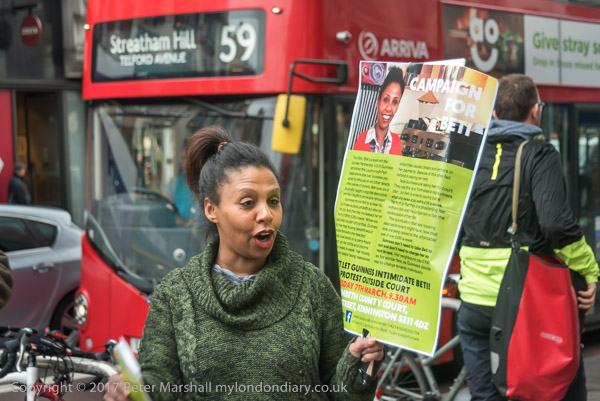
But I was in Brixton, meeting Beti, a victim of gentrification and social cleansing, not in her case by one of the mainly Labour London councils but the Guiness Trust, formed by a great-grandson of the brewery founder in 1890 to provide affordable housing and care for the homeless of London and Dublin and now as The Guinness Partnership owning 65,000 homes in England.

Betiel Mahari lived in one of these with her family on the Loughborough Park Estate in Brixton for ten years, paying a ‘social ‘ rent but was never given a secure tenancy. Guiness demolished her flat in 2015, giving her a new flat a few miles away in Kennington – but at a hugely increased ‘affordable’ rent, going up from £109 per week to £265.  The move meant too she was unable to keep her full-time job as a restaurant manager, and is now on a zero-hours contract as a waitress and facing eviction as she cannot pay the increased rent.  DWP incompetence meant that her benefits were suspended completely for three months (and on zero hours contracts the benefits have to be re-assessed every three months in any case) and Guiness were taking her to court over rent arrears.

The case was heard around 10 days later and as thrown out by the judge who ordered the Guiness Partnership to pay Beti’s court costs, but the struggle to get this rapacious ‘social’ Landlord to treat her and others in similar straits continues. I was pleased to be able to support her, though not entirely happy with the pictures at Stop Unfair Eviction by Guinness, which also include some of Brixton Arches.
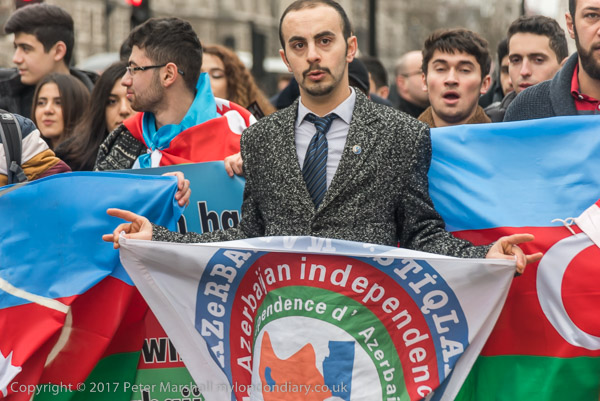
I arrived back in Westminster just in time to meet the Khojaly marchers coming down Whitehall to end their protest in front of Parliament.  Few of us will remember the massacre on the night of 25-26 February 1992 when Armenian forces brutally killed 613 civilians in the town of Khojaly, including 106 women and 83 children, but the name Nagorno-Karabakh  may prompt some memories. In 25th anniversary of Khojaly Massacre I try to give a little background to the still unresolved situation.
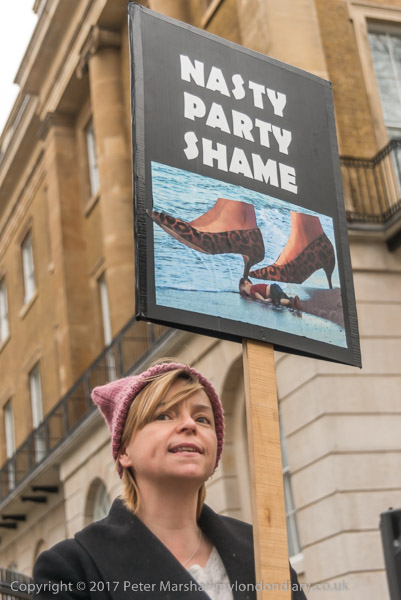
But I was on my way to an event marking the shameful failure of Theresa May and her government to take the action demanded by Parliament to bring the great majority of the refugee children stranded at Calais and similar camps into this country. By passing the Dubs Amendment, Parliament made its view clear and it reflects a failure of our constitution that there seems to be no legal mechanism to force the Tory government to carry this out. This is truly a stain on our country’s history and May and her cabinet deserve to be behind bars for this crime against humanity.

Dubs Now – let the children in

Continue reading Business as Usual
Finsbury Park Again

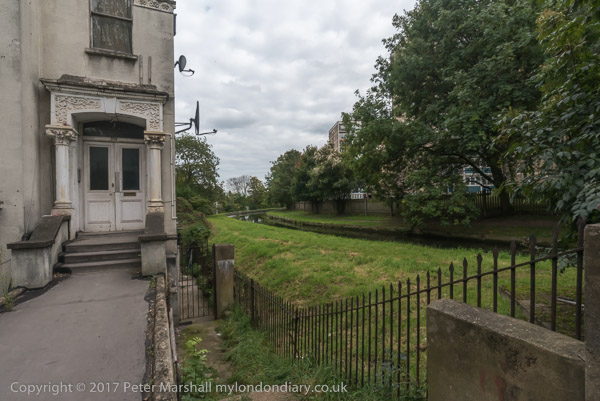
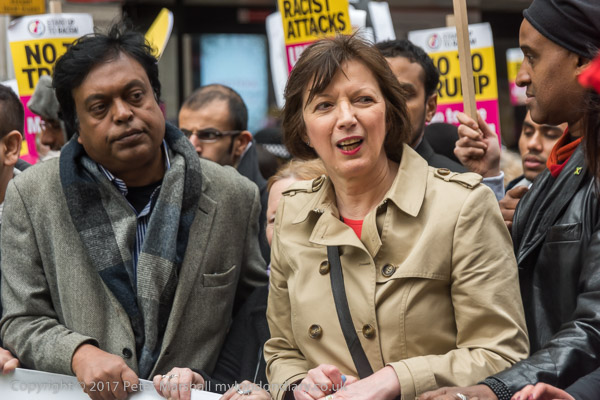
I walked past the New River on what seemed a long march on Saturday, against the London Borough of Haringey’s intention to give away a couple of billion pounds of public property to a rather doubtful Australian property developer. It’s a course of action that should be criminal, but unfortunately our laws are seldom written to protect the rights of ordinary people, many of whom will lose their homes as a result.

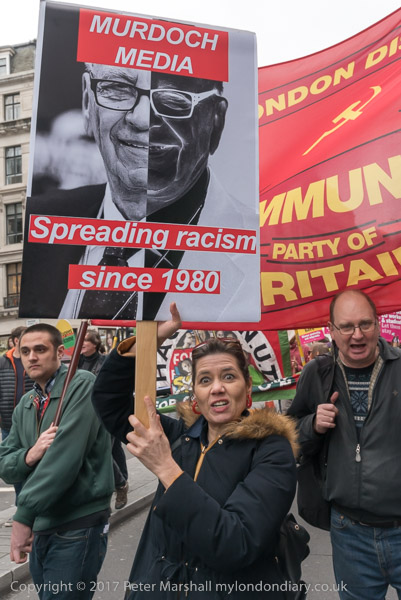
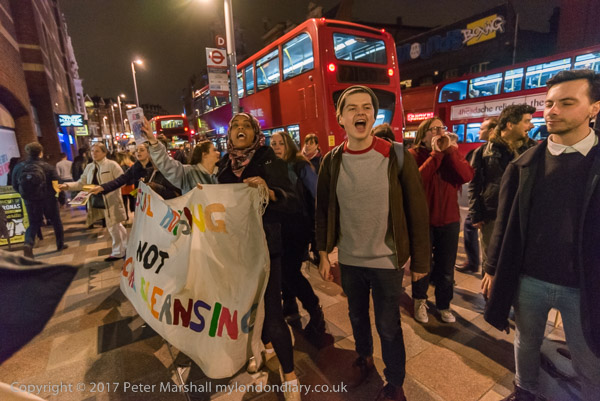
Haringey’s plan, being pushed through by a small group of Labour councillors and officials is unusual only in its scale; one poster being carried on the march listed over a hundred council estates in London that Labour councils either have or intend to hand over to private developers (who now include housing associations) with an almost complete loss of truly affordable social housing, a process they call ‘regeneration’ but which is more accurately described as social cleansing. It’s really long past time the Labour party put it’s house and its housing policies in order.

Of course local government in the UK has always been rife with corruption, a curious mixture of public service and private gain, with the private interests of councillors and their relatives often profiting from public decisions. It was doubtless so in the Victorian era, though at least then it was tempered by a great deal of municipal pride which provided some fine public buildings – and more recently at least in some areas by the building of flagship council estates, like the Heygate in Southwark and Central Hill in Lambeth which I’ve written about here in the past.

And back then there was perhaps some satisfaction for those people thrown out of their homes with nowhere to go in the feeling that those responsible might eventually get their just reward in the fires of Hell, whereas nowadays they are more likely to end up on hefty expenses in the House of Lords.

But more of that in a later post, after I’ve put the picture from the march onto My London Diary, currently stuck somewhere in early August.  But walking along the street I suddenly remembered I’d been here before.

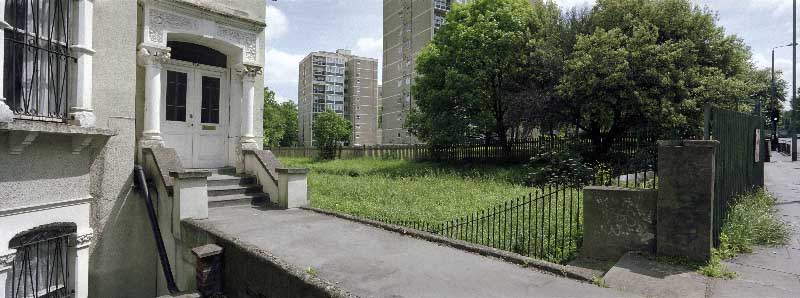
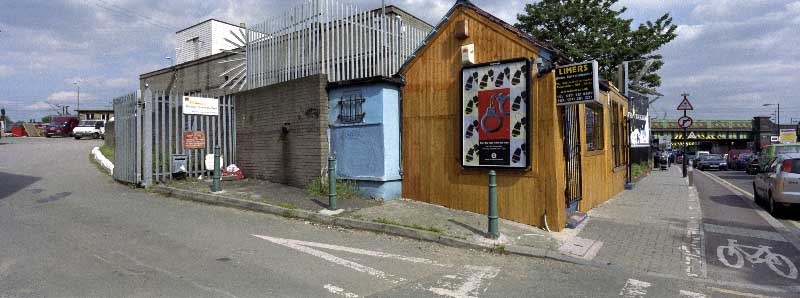
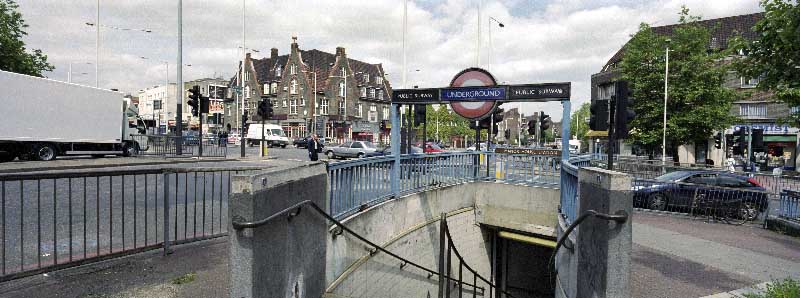
Back in 2002, I was busy with my Hasselblad X-Pan in and around FInsbury Park, having recently acquired the 30mm lens which changed it from a panoramic format camera into a true panoramic camera. There seemed to me to be little point in using the camera with the standard lens, although the larger negative (24mm high and 65 mm wide) did produce medium format quality on 35mm film. The 30mm f5.6 gives a horizontal angle of view of 94 degrees, about the maximum that makes sense with a rectilinear perspective, with any larger angle of view the elongation of subjects at the image edges becomes unbearable.

If you are wondering, the 45mm is roughly equivalent ot a 25mm lens on a 35mm full-frame camera, while the 30mm equates to 16.7mm. And while I’ve used wider full-frame lenses, including the remarkable Sigma 12-24mm zoom, anything less than 16mm is almost always better done with a fisheye.

Most of the 36 images on the Finsbury Park mini-site were taken using the 30mm lens, which came with its own viewfinder, and a filter to even out exposure across the frame. Although the centre of the film when focused at infinity (as all these pictures probably were) was only 30mm from the film, the extreme edges are almost 44mm away, and receive slightly over a stop less light, though lens design probably makes the difference even greater. With colour negative film the centre spot filter was essential, though you could use the camera for black and white without and compensate in the darkroom.

One of the images from this set, of the New River, won a small competition and now hangs on my bedroom wall, though it wasn’t my personal favourite of the set. On Saturday I didn’t quite make the march as far as Finsbury Park. Photographing a march is considerably more physically tiring than simply walking, involving a lot of hurrying to and fro, a little climbing on walls and too much walking backwards, and I also find it mentally tiring, and buy the time we reached Manor Park I needed to rest.

More panoramas from Finsbury Park though the print prices are rather out of date.

Continue reading Finsbury Park Again

Flares at King’s

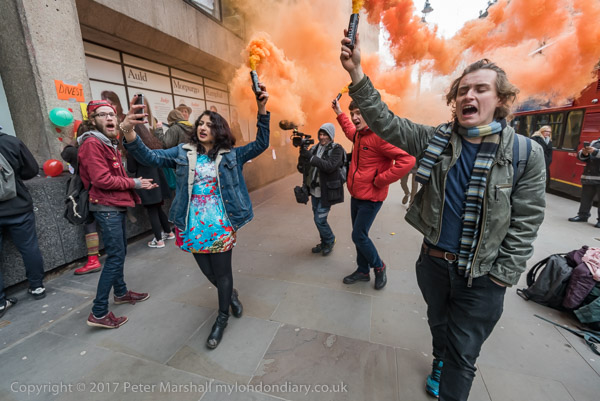
Photographing people holding flares is something of a hit or miss thing, with rather a lot of unpredictable behaviour. There are the people holding the flares, and protesters movements are often fairly unpredictable, but smoke is also peculiarly so. And if you actually get in the smoke, camera exposure metering gets pretty unhinged too and it can also be difficult to focus.

Though I usually like to get as close as possible for most of my pictures (though I know it often pays to stand back a little for a wider view) it seldom works to get too close to people holding smoke flares – and can be quite uncomfortable too. The smoke isn’t good for the lungs or the eyes and has an unpleasant smell, and very close contract can result in burns and stains on clothing that are hard to remove.

It isn’t I think illegal to set off smoke flares, although police and government web sites state it is. The relevant law is clear that it is only an offence “if in consequence a user of the highway is injured, interrupted or endangered” and I think that would be hard to show in this case. But of course, I’m not a lawyer.

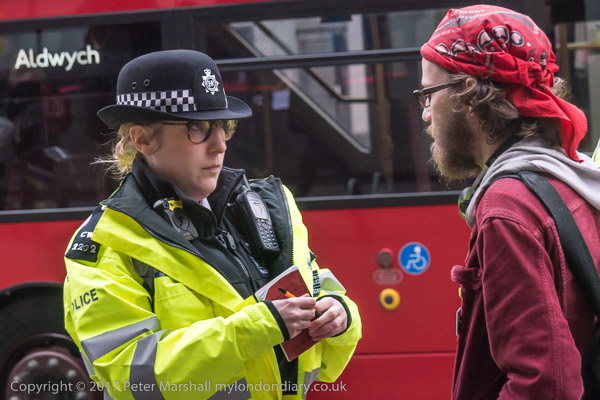
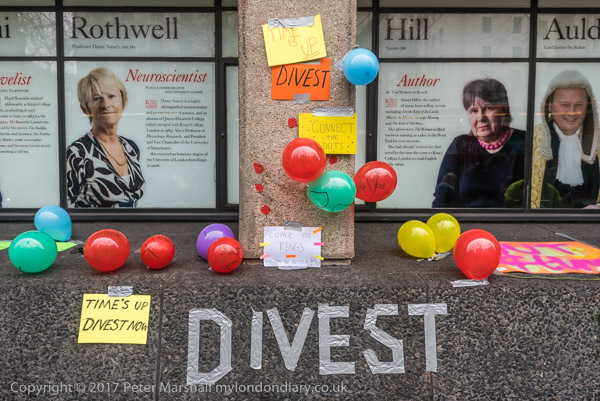
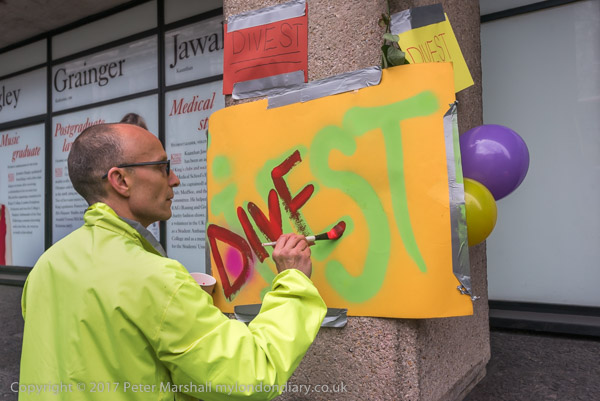
Another case where laws are often invoked against protesters is for the use of chalk and other easily removed markings on roadways, pavements and walls. Police during this protest talked with and asked for names and addresses of some of those who painted with chalk on the wall of King’s College. It’s had to prove ‘criminal damage’ when a simple wipe of a damp sponge – or even the rain – will remove it, though at least one protester was convicted for this a year or two back at the University of London Senate House – and a specialist cleaning company apparently got paid hundreds of pounds for a few seconds wielding a damp rag.
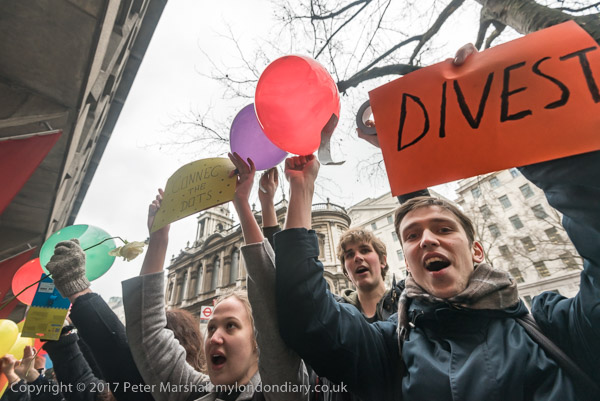
The organiser of this protest, PhD student Roger Hallam had been suspended for writing “Divest From Oil and Gas Now. Out of Time!” in spray chalk at an earlier protest, and in response at this event there was a great deal of displaying messages by other non-permanent methods, as well as a few who chose to deliberately paint washable coloured dots.

There is so far as I’m aware no law relating to the use of balloons on the public highway, and the protesters took full advantage of this. It was just a little difficult to photograph the long line, and space was limited between the wall and he protesters as they moved to tape them onto it.

The aim of the protest was to persuade King’s College to end its investments in fossil fuels and switch to investments in renewable energy,  part of a London-wide divestment  campaign.

More at King’s College Divest Oil & Gas Now!

Continue reading Flares at King’s

Trump & May

Mobile phones are a mixed blessing. I don’t like the thought that your every movement can be tracked whenever you carry one, though it was very useful when I left mine on a bus earlier this year – and was able to watch it slowly moving along the map towards the depot, from where a couple of days later I collected it. But as a journalist I don’t like the idea that the police can now track my movements – and would like it even less if I was working in some foreign countries.

And on my recent holiday it was great to be able to see my own position on the OS map I’d bought and downloaded to the phone, something I used far more than the paper copy. This year, rather unusually I didn’t get lost at all.

But being available for people who know your phone number to contact you at any time – or at least when your phone is switched on and has battery – is not always a good thing. Though much of the time when I’m actually working there is too much noise for me to hear (or notice a vibration) from the phone in my pocket.


Dawn Butler MP

At lunchtime on 4th Feb I was more or less at the front of a densely-packed crowd in front of the US embassy, in a good position to photograph the speakers at a rally calling for Trump to end his Muslim ban and for May to withdraw the invitation to a State Visit here. It was at a quiet moment in the proceedings when a refugee poet was reading one of her works that I heard a faint ringing and answered the call.

It was my wife, and she was locked out as the lock on our back door would not open with her key. And she wasn’t well, or I might have stayed to finish the job before making the fairly long trip home, but I began walking to the bus stop as I talked to her, abandoning the protest. An hour and a quarter later I found my key didn’t work either, but fortunately I had the keys to the front entrance which did. More bad news was that we needed a locksmith who came, couldn’t open the lock and had to use a jemmy and then an angle grinder to cut through the lock and fit a new one. It wasn’t cheap.

Fortunately I’d already taken enough pictures to file a decent story, including probably the two most important speakers, Brent Labour MP Dawn Butler, shadow minister for diverse communities before she resigned to vote against the Brexit Bill and NUT General Secretary Kevin Courtney, and plenty of the protesters and their placards – it was a protest that brought out wit and obscenities – so I was able to file a decent story, though I had to miss the march to Whitehall and the further rally there.

It’s often the case with marches than the best opportunities for pictures are before they start, when people are often more closely packed and a little less organised. Back when I photographed some carnival processions with a few of my photographer friends we would usually pack up and go the the pub as the procession began. And for many of the longer political marches in London don’t walk the whole way.

Taking photographs means a lot of walking backwards as well forwards, going too and fro, and is considerably more tiring than simply marching. And as I usually want to cover marchers at the back as well as at the front (and those in-between) with large marches I try to find a convenient point to take the tube to the destination.

I often see other photographers standing around talking with each other before a protest starts, and while I like to be sociable (and often we have useful information to exchange) I sometimes feel they are missing opportunities and will leave them and get on with the job. And at some marches there are some photographers who only photograph the people carrying the banner at the front and just walk ahead of this all the way. It’s seldom a place to get the most interesting pictures.

And a small note to event organisers. A red roof to the stage is not a good idea. It really doesn’t provide a good background and it bathes the speakers in red light which isn’t flattering. Please chose a fairly neutral colour, perhaps a light or mid grey.  18% would help with our exposures!

More pictures at: No Muslim Ban, No State Visit.

Continue reading Trump & May

Trump, Trump

There is a particularly Stygian gloom in front of the US Embassy, as if by some secret technology they are able to extract light from the area for when protests are taking place, but the under-exposure of the image above was more down to my fidgety thumb, always a problem when I work in shutter priority mode. I’d set the shutter speed to 1/60 when I gave up working without flash, but gradually the setting had been nudged up as I walked around taking pictures. While I was still using flash, or in areas where there was movie lighting it wasn’t a problem and things looked fine on the camera back when I bothered to check. The frame before this one was exposed at 1/400th f4, and while the background is dark, the foreground figures are well exposed (a little too well) by the flash.But for this I needed the shadow, and so off went the flash and I took the picture by ambient light; 1/400th at f4, ISO3200. Of course I usually deliberately under-expose at night – it doesn’t look dark otherwise, but this was another three stops less, and three stops too far. When I saw later what I had done, Charlie’s comment below the red button he was carrying seemed rather apt.

Even with a lot of noise reduction and burning and dodging it really is just a little too far out, though I could probably improve a little. You can see the purple that covers highly underexposed shadow areas in quite a few areas of the picture, and further retouching could reduce this, as well as apllying some more local noise reduction in some areas.

It was the night of President Trump’s inauguration and there didn’t seem to be a great deal of celebration going on at the Embassy, but the was a sizeable crowd protesting outside – and more in Trafalgar Square where I went later.

Perhaps the poster this woman in pink was holding up in the flower beds in front of the embassy, ‘Dear Queen, We’re Sorry. Take Us back? Love, An American‘ was rather widespread.

There were some speeches, and a large crowd gathered around the tented platform from which they were being made. But a strong fluorescent tube light just behind the speakers head made trying to photograph the speakers unrewarding, and the posters seemed more eloquent. Many in the crowd probably thought so too, or perhaps it was just too crowded to get near enough to hear, but they spread out over a wide area in front of the embassy – the booth from which speeches were made was out of the picture above to the left.

Here’s another picture of Trump, Trumping thanks to Charlie X. The speeches were still trundling on when I left to see what was happening in Trafalgar Square, where a protest had also been called.

The answer when I arrived was not very much, though there was a giant orange Trump head and groups of protesters rather scattered around the square, with Heritage wardens telling them they were not allowed to protest there. The protest there had not really begun, and I decided I’d had enough and left.

Later I heard that things did get going some time after I went home, and that there had been several arrests after protesters had come under an unprovoked attack from the police.

Crowds protest Trump’s Inauguration
F**k Trump
Continue reading Trump, Trump

Nigerian Flights

On Wednesday Jan 11th I joined Movement for Justice at their protest outside the Nigerian High Commisison in Shaftesbury Avenue, always one of London’s gloomiest streets, lined with tall buildings and large trees. Darkness was falling anyway as the protest began in late afternoon, and I set the D810 on Auto ISO with a minimum speed of 1/100th to take some pictures without flash. Working with the 28.0-200.0 mm f/3.5-5.6 lens the pictures were taken with the lens wide open and then the ISO went up to 4500 and then my maximum setting of 6400 and then the shutter speed began to drop. When it arrived at 1/40th I decided I had to use flash as these protests are fairly lively events.

I kept the ISO fairly high, generally around ISO2500 to keep a decent amount of exposure in the background and avoid a typical bad flash look, and changed to shutter priority (Nikon’s flash gets some crazy ideas in P mode, using the ISO setting to stop down the lens, which to me makes absolutely no sense.) I began with a shutter speed of 1/160, but as usually happens that slowly crept up as handling the camera jogged the main control dial.

On the wideangle images taken with the D750 and the 16.0-35.0 mm f/4.0 I’d forgotten to move the dial from ‘P’ to ‘S’ with the result that the first few images I took were at f11 (see above) and gave a typical background gloom with closer figures far too light. I could compensate partly by some burning in with the RAW files in Ligthroom, but it wasn’t ideal.

Fortunately I soon noticed the error and switched to working in A, aperture priority, mode. With the wide angle I’m less worried about shutter speed and decided I would get sufficient depth of field working more or less wide open, occasionally taking it down a half a stop or so. The 16-35 is a good performer wide open, but improved by just that little stopping down.

The Home Office arranges charter flights to Nigeria every couple of months, and to help with its figures isn’t fussy about who it decides to forcibly deport. Many are people who have been in the UK for most of their lives, with parents, partners and children here, as well as students who have not yet finished their courses, some are still in the course of making their claim for asylum, others people with serious health problems and carers for elderly and disabled relatives and some those who will face violence on their return, particularly if gay.

People don’t matter to the Home Office. They are just numbers in their racist ‘numbers game’.  The protest called on Nigeria to refuse to accept these flights

End Deportation Charter Flights to Nigeria

Continue reading Nigerian Flights