Thursday Lates

I hate the early nights we have at this time of year, when sunset comes to London at around 15.52 and so many things, including most protests take place in twilight or darkness. So I look back with some warmth at my diary for May 25th, when the sun only set at 9pm, giving me some colourful sunset skies to watch from the train window on my way home.

Photographers notice the light more than others, or at least we should, though on some winter days I’ve been caught out by the falling light and only realised too late that my shutter speed in some auto mode has dropped far too low giving an unwanted motion blur to my subjects, often only noticeable when I zoom into the image. Viewing the whole image on the camera back can seem sharp even when images are unusable.

The answer I’ve now adopted on the Nikons is auto ISO. Working in Program mode and setting the minimum shutter speed to perhaps 1/100th and the maximum ISO to 6400 or even 12,800 more or less guarantees usable results except at more extreme focal lengths. Once I realise its getting dark, or have a need for flash or greater depth of field or stopping faster movements I’ll change the settings, but until then I find this works. The Nikons have an Auto setting for the minimum shutter speed, which takes into account the focal length of the lens, and does allow you to choose different settings, faster or slower, based on this, which sounds useful, but I think fails with moving subjects, where the fixed speed seems to work better.

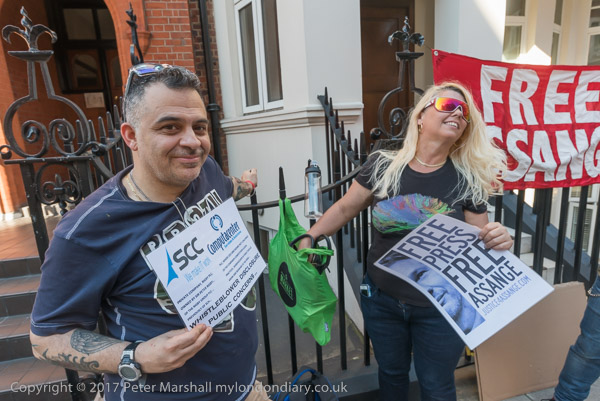
But back in those longer days, I had no such problems. I started work at 4pm – which at this time of year is just after sunset, but towards the end of May was bright sunlight outside the building behind Harrods which houses both the Ecuadorian and Colombian embassies. A small die-hard group of supporters of Julian Assange was outside as they had been on so many occasions over the almost five years he had been holed up in there. His continuing detention is a monument to the stubbornness of Theresa May, but it is a pointless act which has cost us millions and harms us diplomatically. He should have been allowed to leave for Ecuador when granted immunity there.

Grant Assange Safe Passage


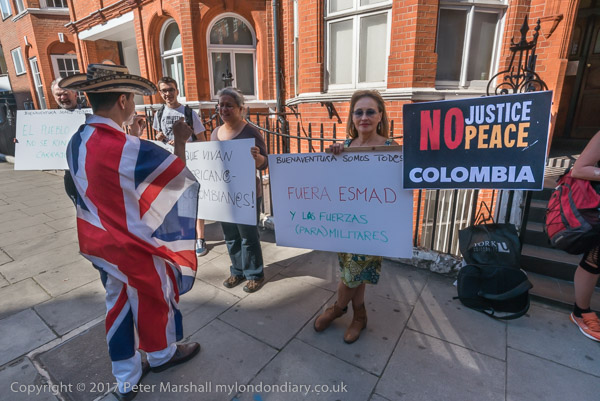
Protesting on the same pavement – and with some overlap both physically and in terms of people – were the Colombian Solidarity Campaign, demanding that the Columbian government end the use of force against the people of Buenaventura and instead tackle the social, economic and ecological problems that have led to the civic unrest there.

Photographically my problems were mainly that half of the protest was in bright sun and half in shade, giving a huge dynamic range. Even with careful exposure this still requires considerable post-processing to reveal shadow details and tone down the brightly lit areas.

Timing was also a problem, and although the protest was due to begin at 4 pm,  people only began to drip in slowly some time after that – and I had to leave before the event had really got going. South American time, as I learnt when I visited Brazil some years ago – is a rather different concept to English time.

Lift the Siege of Buenaventura

Axe the Housing Act were rather more punctual for their protest intending to make housing an issue in the snap general election which was taking place, thanks to a moment of madness on the Prime Ministers walking holiday.  Labour were still in disarray, with its centre and right MPs refusing to accept the zeitgeist that had moved the party membership to elect Jeremy Corbyn and were still acting like spoilt children who had lost their toys and encouraged and supported  by a Tory-dominated media were determined to undermine him in any way possible with a series of smears,  lies, coup attempts and party machinations.  Had they accepted defeat with any grace and got down to work for the party rather than for their own interests the election would never have been called, as Labour would have had a massive lead in the opinion polls.

But we had an election, and housing despite the effects of protesters which have put it on the political agenda, never became a major issue.  It’s an area where Labour still has a great deal of work to do, with many Labour councils still busy demolishing council estates and cosying up with private developers despite a new direction from the leadership which at the party conference a few months later called for policies based on housing people rather than realising asset values. Its a battle still to be fought, let alone won. Although the protest was called a vote for decent, secure homes this wasn’t generally a choice on our ballot papers.

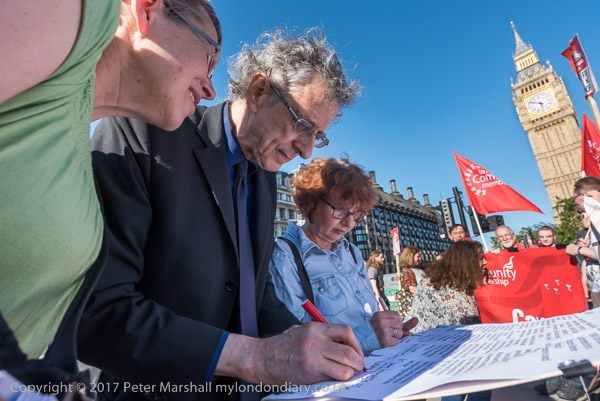
The picture above shows Piers Corbyn (Jeremy’s elder brother) signing the poster-sized letter which the protesters were to deliver to Downing St, and the sun is still bright at ten to six, a time when now we would have passed through civil twilight and nautical twilight and be about to move from astronomical twilight into full blown night time.

Vote for decent, secure homes

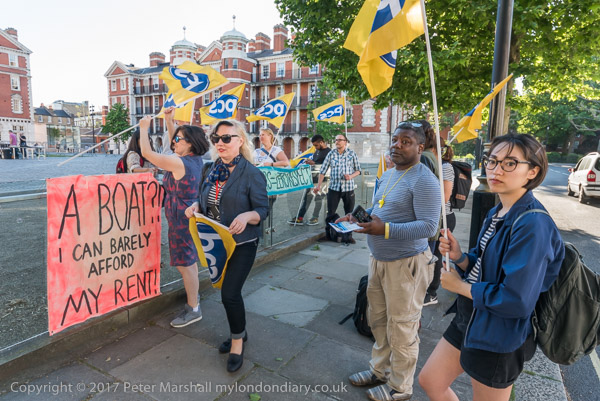
I left the housing protesters as they left for Downing St and walked down to Tate Britain, where the PCS Culture Group were to picket the leaving party for retiring director Nicolas Serota. Staff there, many of whom are on zero hours contracts with lousy conditions from Securitas and are paid on or close to minimum wage – much less than the London Living Wage and something the Tate could not dare to justify for anyone it directly employed were asked to contribute to a leaving present for him of a sailing boat – and of course were not invited to his leaving party.

Instead they launched their annual Golden Boat Awards, naming Serota as the first recipient for his services to the cause of privatisation, casualisation and low pay at the Tate. They demand an end to this cheapskate use of facilites companies to provide staff who should be employed directly with acceptable conditions and pay.

It was around 7pm when I left the Tate, still two hours before sunset.

Golden Boat Award for Serota

Continue reading Thursday Lates

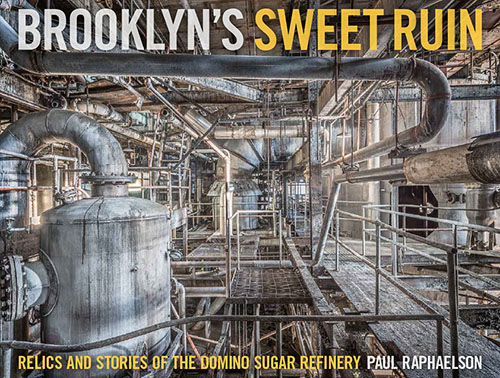
Brooklyn’s Sweet Ruin

Sixteen years ago, with Mike Seaborne, who was then both a photographer and Senior Curator of Photographs at the Museum of London, I agreed to set up a web site dealing with one of our great shared interests, photography of the urban landscape. I had some web space for it, wrote the site registered the domain urbanlandscape.org.uk in December 2001 and the site was online for the start of 2002, with pictures by Mike and myself.

It was never our intention that the site should be limited to just our own work, and from the start there was an invitation to submit work, both photographic essays and theory, that fitted our ideas of urban landscape photography, and I tried hard to include some definition of what we were looking for.

As well as the ‘contribute’ page which was a part of the original site, which began with the message:

We welcome critical essays on urban landscape and small bodies of urban landscape work by photographers, although we are unable to offer any payment.

and continued to give some details, at the start of the following year I added another page, which attempted to explain my definition of urban landscape, with some example images.  We had added a few of the many submissions Mike and I had received, but far too many were just from people who made pretty pictures in the urban environment without any real intention to say anything about the city.

But there have been other submissions over the years which have have given us a great thrill to receive and one of earliest of these was by Paul Raphaelson, whose work ‘Wilderness‘ we added to the site in 2005.

So I was delighted to get an e-mail from Paul a day or two ago announcing his new book, Brooklyn’s Sweet ruin.

Books

You can see some of the pictures from this project on Paul Raphaelson’s web site, along with more of his work, and they appeal to me greatly. I’ve long had an attraction to decaying former industrial sites – which you can see in some of my own work both on Hull and in London’s docklands and estuary – and Paul’s images have a clarity and elegance that I admire, along with some fine colour. I’ve not seen the actual printed book, but it appears to be a fine publication, available from Amazon through various UK suppliers.

Both Mike Seaborne and I have moved on considerably since we set up the site, and although it is still on line and still open to new contributions, we haven’t really been keeping it up to date. As readers of this blog will know photographing protests around political issues have been engaging much of my time, and this year I’ve been putting another image from my work in Hull in the 1970s and 80s on line every day as a contribution to Hull’s year as UK City of Culture both on the Hull web site and on Facebook. Next year as well as adding some more images on the Hull site I also hope to put a new site about my work on London Buildings from 1986-2000 on-line, most of which has not previously been published.

LSE Cleaners Strike for Equality

As a photographer I see it as my role to record events and not to set them up, but sometimes that does mean not quite getting the pictures that I would like. But I think it vital to place integrity above impact, though of course I work hard to make pictures that tell the story as best I can.

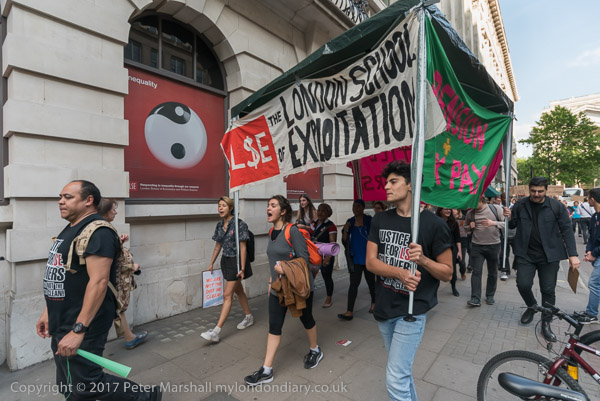
I’d earlier walked several times past a poster in one of the many street-facing windows of LSE buildings which celebrated the LSE’s record in fighting inequality, and thought it was one which spoke to the central theme in the dispute between the cleaners and the LSE, and thought it would be good to use it in a picture.  So as students marched past holding the appropriate banner I tried, but rather failed as you can see above.  The marchers were walking quite fast and there were a number of parked bicycles at my right that made it difficult to get into exactly the right position, and I was a foot or so too far back to keep ahead of the banner by the time I could take the picture.

Had I been setting this up I would have had a second chance – and more, but the moment had gone as soon as I pressed the shutter. It would have been nice to have had the letter ‘I’ at the start of the word ‘Inequality’, to have got the gut carrying the rear pole of the green banner to move a little to the right, to have moved a little to my right and framed the poster and the banners a little more tightly…  But that would not have been how it happened.

Of course there are some posed images in my set LSE Cleaners strike for equality on My London Diary. But they are pictures that those taking part set up and posed themselves in, not ones that I imposed on them.  Sometimes other photographers do set up pictures and I sometimes also photograph these, though I try to make clear in the caption with phrases like “pose for photographs”. But generally I photograph things that happen as they happen, though of course I impose my own order on them. Though I do like a bit of chaos, which can help to get away from the clichés.

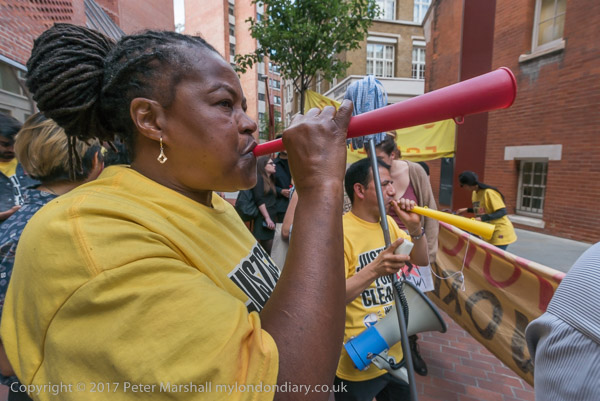
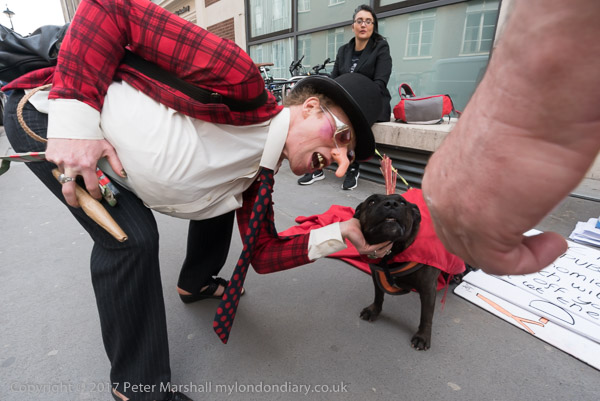
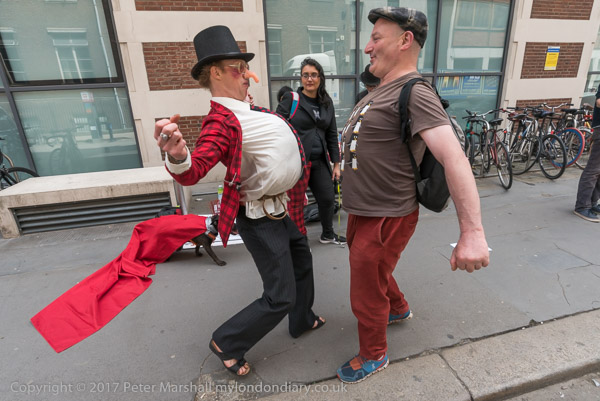
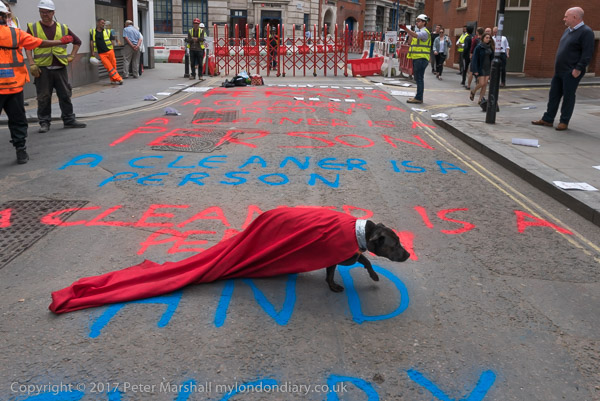
There was perhaps a little more chaos two weeks later when ‘Life Not Money at the LSE’ staged a somewhat surreal happening in the cleaner’s support. Though perhaps my rather deadpan description at End Gross Inequality at the LSE does it little justice:

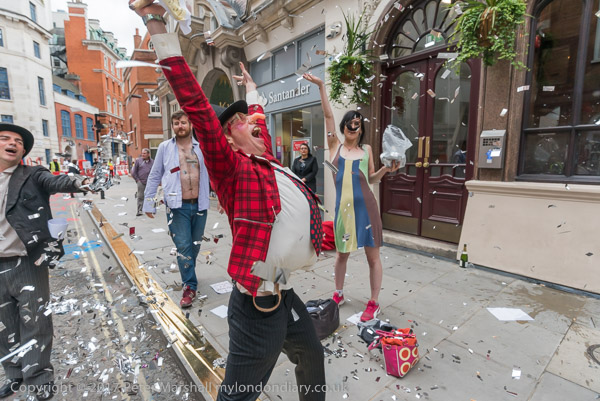
The group sprayed chalk slogans on the road chanting ‘London School of Exploitation’ in a wide range of silly voices and then performed a short play in which a character playing the LSE director tore the shirts off the backs of several cleaners and boasted about his huge and rapidly rising salary.

The tall buildings surrounding Portugal St created a rather eerie echo as the players chant loudly ‘London School of Exploitation’ in a range of silly voices, and the interruption of proceedings by a cement mixer and a man on some kind of cherry-picker (what a useful photo accessory that would be) somehow added to the event. But I did feel it was one event where sound and movement would have helped, though I think it would have needed a team with several cameras to film it adequately.

It wasn’t too easy to follow the finer details (such as they were) of the playlet that ended the performance, with several cleaners having the shirts stripped off their back by the ‘LSE Director’, a little rogering and a lot of tinsel, but I did my best.

LSE Cleaners strike for equality

End Gross Inequality at the LSE

Continue reading LSE Cleaners Strike for Equality

On and Off Photography

Back in the late 1970s when there seemed to many of us that their was a least a glimmer of a photography culture emerging in the UK that might support serious photographers, thanks to the efforts of Creative Camera, the Arts Council  and a few people in education, particularly in the Midlands, including Paul Hill and Ray Moore, we suffered a huge academic land grab which more or less snuffed out that fledgling. Creative Camera degenerated, the Arts Council altered course and many photographers were relegated to obscurity.

Photography was largely sacrificed on the altar of academic respectability, becoming subservient to the word, being relegated to what many saw as its rightful subservience in our logocentric culture. You want a degree you’ve got to read learn a secret language to read deliberately obscured texts and write pretentious essays, never mind the pictures.

The flagship of this enterprise was a curious work, On Photography by Susan Sontag, which came at the top of every degree course reading list. My own copy of this 1977 best-seller soon got into a sorry state from being thrown down at its more ridiculous sentences, its margins annotated with my explosions at her ignorance and misunderstandings, her half-digested regurgitations from earlier sources.

It did make rather a good television programme, which I had recorded and watched several times, and felt to be far superior to the book, not least because in it her thoughts became tied to actual examples, the particular rather than the generalisation.  And perhaps because of the work of a better editor than at her publisher and the more limited canvas available.

It was a book that spawned more books, but never provoked any photography of significance, that led to a whole school of academia that treats photographs as just an abbreviated list of the objects and events they depict, largely dismissing the aspects that make photography an vital and visual medium.

We no longer simply looked at photographs, no longer experienced them, but in that oh so reductive usage, we ‘read’ them. Not that reading photographs can’t give us valuable insights – and it was always a part of looking at them – but it is only a partial exercise, and the visual, expressive, aesthetic aspects were generally dismissed as unworthy of study.

On Photography is a book that should only appear on reading lists for students with a health warning, and one of the best health warnings is provided by an article recently resurrected by A D Coleman, Susan Sontag: Off Photography, originally written by him in 1979 but not published until 1998. In his introduction to this republication, Coleman notes:

Sontag subsequently acknowledged that photography was not her real subject and had simply served her as a convenient whipping boy, and — in Regarding the Pain of Others (2003) — she eventually retracted most of what she’d had to say in her original diatribe.

Regarding the Pain of Others is certainly a far better book about photography, and the photography of war in particular, but I don’t recall ever seeing it on the reading lists for photography students. Perhaps it should be, replacing her ‘On Photography‘.


f8 and Be There, plus …

f8 and Be There‘ is a famous quote attributed to ‘Weegee‘, the New York press photographer Arthur Fellig whose brutal flash-lit exposures documented the seedier side of the city’s life and crime in the middle years of the last century, and is often quoted as the maxim for photojournalists and street photographers.

Weegee got to many crime scenes before the police, not because he used a Ouija board as the nickname implied, but at first because he hung around in the Manhattan Police Headquarters and watched the teletype, rushing out to take photographs when a crime report came in. He started without any police permit, but from 1938 because he was the first journalist to get permission to have a police-band short-wave radio, which he kept in the boot of his car along with portable darkroom facilities. He would get to the location, rush in with his 4×5″ Speed Graphic camera and bulb flash, take a picture, develop and print the sheet film, stamp the back with ‘Credit Photo by the Famous Weegee’ and have it at the newspaper or agency hours before other photographers.

Despite the quote, Weegee seldom if ever worked at f8. You needed greater depth of field for his work, and he would generally have his camera set at f16, with the focus at 10 ft and the shutter speed of 1/200th, probably the fastest speed to synch the flash bulbs with the lens he used. It worked, and he didn’t have to think about technique, just get in the right place and press the button.

Of course not everything needed to be done at such a rush, and despite the impression of naked emergency given by the flash and the often slightly dynamic framing, as with other newspaper photographers many of his pictures were posed. He was a photographer who knew what he wanted and made sure he got it.

Photojournalist‘ is an overused term in photography, as too is ‘street photography‘and I don’t think Weegee was either, but essentially a news photographer. His work was certainly effective and his simplified technique worked well.

Much of the time many professional photographers now use the ‘P’ setting on cameras, often derided as for amateurs and newbies (including by me in years long past.) It generally works well and enables you to concentrate on framing and content and let the camera get the exposure more or less right. And should you need a faster shutter speed or greater depth of field a control dial is there under your finger or thumb to give it – and automatically adjust the other exposure parameters (these days we can use shutter, aperture and ISO) to retain correct exposure in P* mode. Though should you be using flash (other than for fill), S seems to be a better choice, at least with Nikons.

‘f8’ simply means the technical side of making an image, not the literal aperture, though I often do work at f8, though in winter more often at f4, or whatever the maximum aperture of my lens is, stopping down one or two stops if light allows – or for greater depth.

‘Be There’ is of course a sine qua non, but it isn’t sufficient. To make good pictures you have to be in the right position – sometimes with almost millimetric precision, with the right lens and the right framing. Often there will be dozens of photographers at an event, but only one will get a great image. Even good photographers take plenty of pictures that are marketable without being of any great merit, and many feel that if they get paid that’s all that matters. It’s one area where I find myself in agreement with Ofstead; when taking pictures, ‘satisfactory‘ isn’t good enough.

But ‘f8 and Be There’ still isn’t enough, though it may make for the financially successful newspaper photographer – so long as they can also get the pictures in before the next photographer. Perhaps the word I’d choose to add is ‘attitude‘. It’s what you need to have to know which is the right place, the right framing and the right moment, even if you may not always be able to catch it (for that you usually need a little luck as well.) Unless you have a point of view how can you know how to express it through your pictures?

Though it may well not help you financially. When Kertesz went to the USA in 1936 attracted by an offer from the Keystone agency, the editors complained his images “speak too much” and they soon parted company. In his pictures Kertesz said he interpreted “what I feel in a given moment, not what I see, but what I feel.”

You can see some of the best of last year’s press photography in London now at the Royal Festival Hall, where the 2017 World Press Photo Exhibition is on show – free to view – until 20th November 2017.

Exploiting Terror

I don’t like photographing the extreme right, though I think it is important to document their activities, as well as those that go out onto the streets to oppose them. But their attempts to exploit the reprehensible attacks by a few deranged terrorists on people on the streets of London for their Islamophobic agenda I find particularly depressing and distasteful.

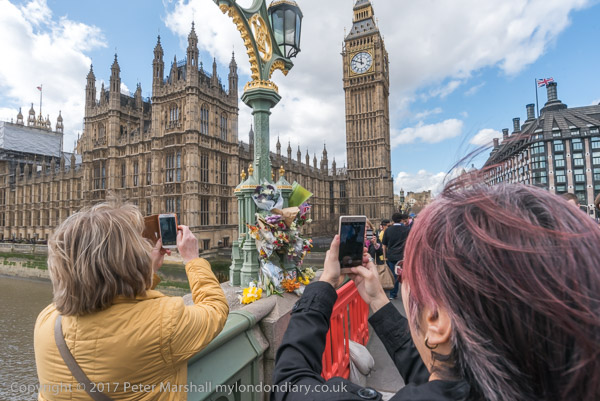
Londoners had made their feelings clear, both in the flowers on Westminster Bridge and in Parliament Square, and in the vigil the day after the Westminster attack in Trafalgar Square in which all communities in our city – including many Muslims – took part.

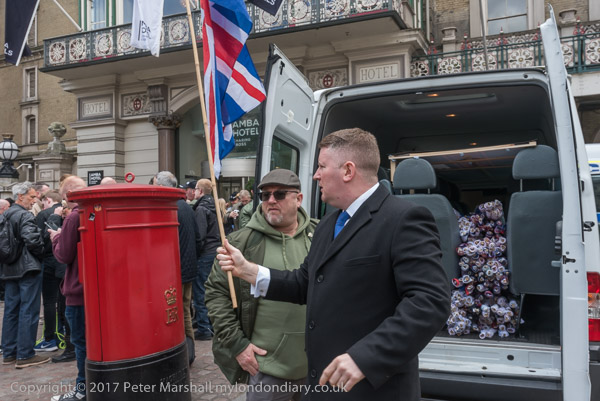
Britain First have a record of insulting Muslims, of making a nuisance of themselves in mosques and more. Their deputy leader was found guilty of religiously aggravated harassment and fined £2000 for abusing a woman simply because she was wearing a hijab, and their leader jailed for eight weeks for breaching a High Court ban on his entering any mosque in England and Wales.

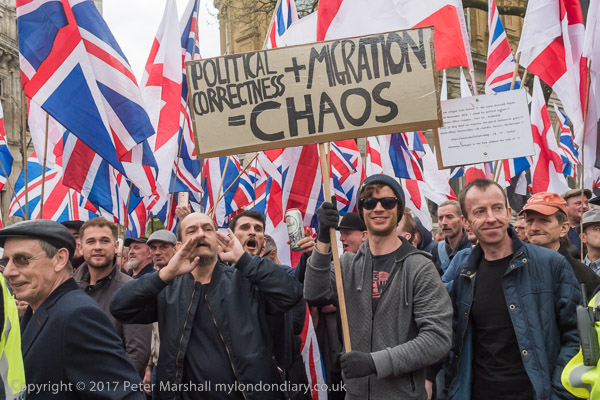
Behind the banner at the front of their march was a man carrying a ‘Knights Templar’ flag, an organisation including a number of former BNP members with strong links to European neo-Nazi and extreme right groups including the self-styled paramilitary Shipka Bulgarian National Movement and a banned Hungarian group.

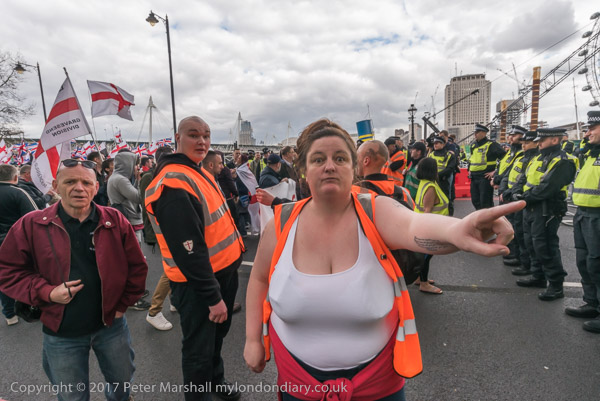
But it is too easy to take dramatic pictures full of flags of Britain First – and leader Paul Golding arrived with a van full of them, though a few others had brought their own.

I found the rally upsetting, and in particular its misuse of Christianity, which did make me wonder how many of those present would be in church the following day. Certainly there was no Christian charity or message of love on display, and I think there would be vanishing few sermons preached in churches that would have been acceptable here.

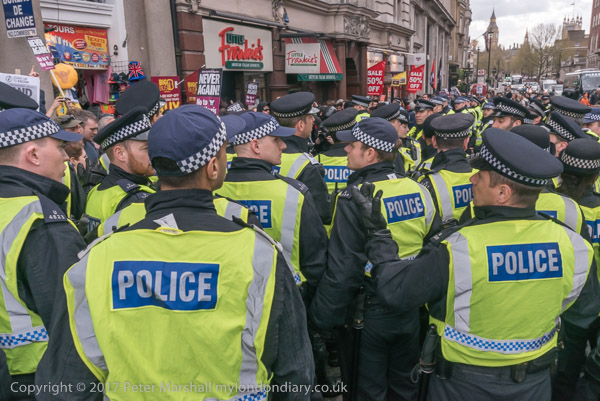
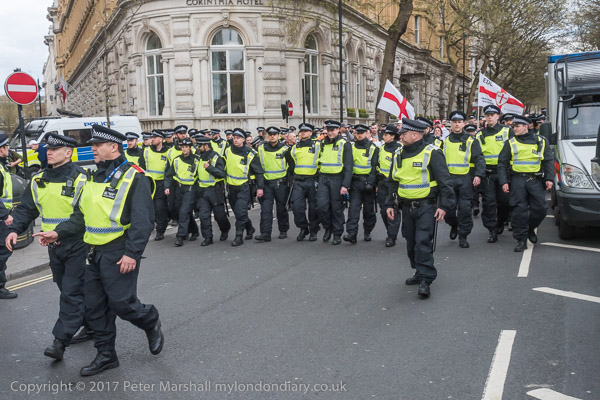
Also out on the streets were the EDL, though they met at the Wetherspoons on Whitehall – and I photographed the police actually forcing them back into the pub as the anti-fascists were being rather heavy-handedly escorted away from the area on the opposite side of the road. At one time one group of police was trying to push them down Whitehall while another group of officers attempted to stop them, and a few protesters got rather badly squashed in the middle. It was rather a muddle, and there were a few arrests and at least one photographer assaulted by police. I got just a little pushed around but tried hard to keep out of the way.

Eventually police did manage to escort the few EDL supporters down for a rally close to where Britain First were holding their rally. For some reason they didn’t want to be photographed, and one of their stewards insisted I leave – and made a complaint about me to the police.

I didn’t have any time for the officer who came to speak to me, reminding her of the MPS Guidelines which clearly state “Members of the media have a duty to report on incidents and do not need a permit to film or photograph in public places. Police have no power or moral responsibility to stop them filming or photographing incidents or police personnel” and saying it was none of her job to run around for the EDL.

So I took my pictures and then left, hoping to be able to take some more pictures of the anti-fascist, but because of the police barricades it took rather a long walk to get to them, and many had left by the time I arrived. But it was good to be back again among people who were happy to be photographed.

More at:
UAF protest extreme right marches
Britain First & EDL exploit London attack

Continue reading Exploiting Terror

Against Terror

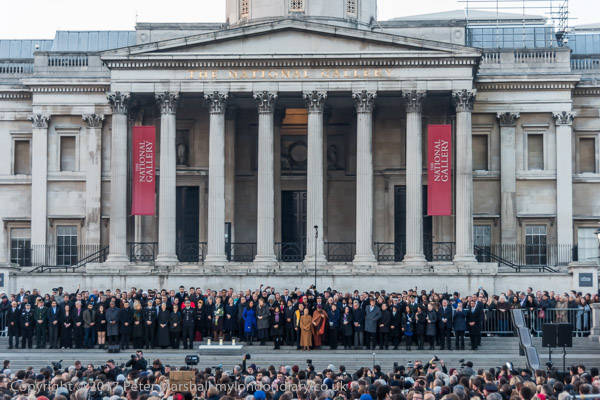
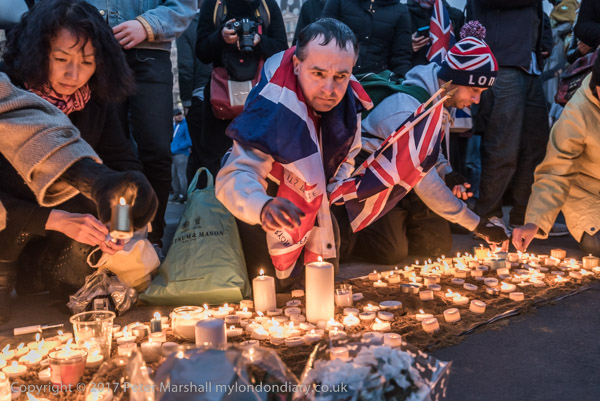
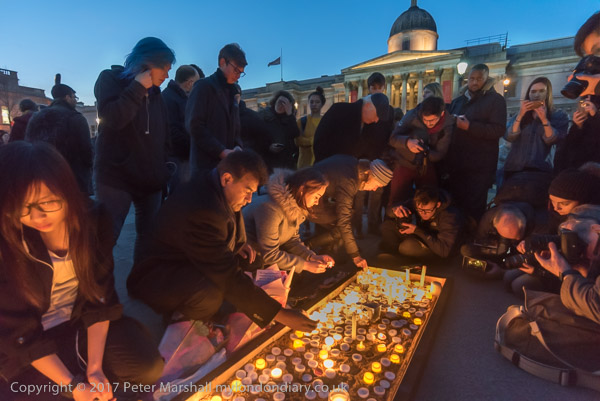
When I arrived for the Vigil Against Terror called by London Mayor Sadiq Khan as it was about to start, Trafalgar Square was already fairly packed and I was unable to get to the press enclosure closer to the mayor in time.

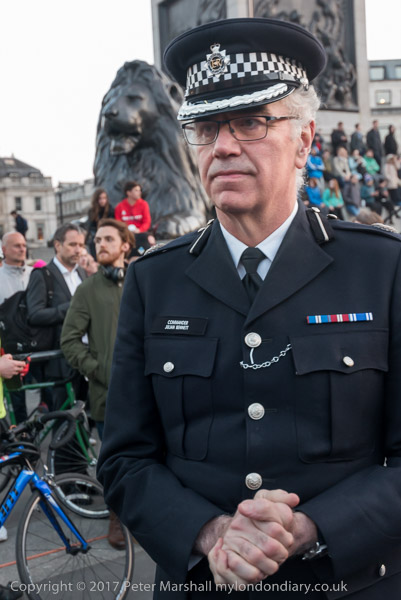
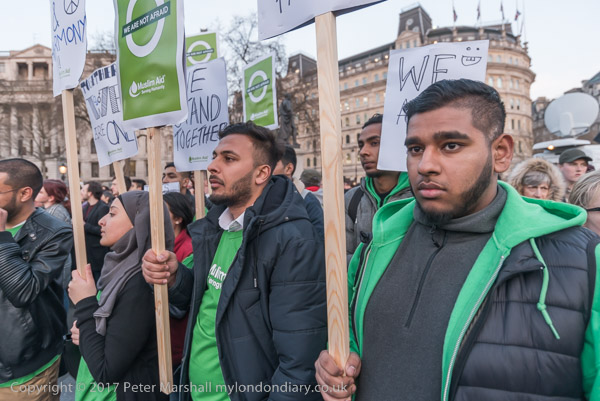
Or at least I wasn’t particularly inclined to do so, as my interest in the event wasn’t to photograph the Home Secretary, the Mayor or the police chief who were there to speak and light the main candles, but in the crowd and the people of London who like me had come to “show their respect for those killed and injured in yesterday’s terror attack and to insist that Londoners will not be cowed and stand together against hatred and division.”

So my only picture of the official speeches included in the set I sent off was the distant view at the top of this post, and it was something I only really took for the picture agency rather than myself. Taken from a platform inside a second press space at the base of Nelson’s Column I also made some rather tighter views than this which was taken with the 28-200mm at 85mm (in DX mode – so equivalent to 127mm) but the wider view seemed more appropriate.

The light was falling fast and this was one occasion where a faster lens like the weighty telephotos many of the other photographers around were aiming would have been more appropriate. But even if I had one, I would just have got more or less the same images as all those other photographers who were taking turns on the steps – and where’s the point in that?

I left the pen and made my way through the crowd, which was less tightly packed at the end of the square away from the steps. Once the official proceedings had finished it became easier to move around.

I did spend some time tightly packed together with other photographers taking pictures of people lighting candles, but moved away fairly quickly to go elsewhere.

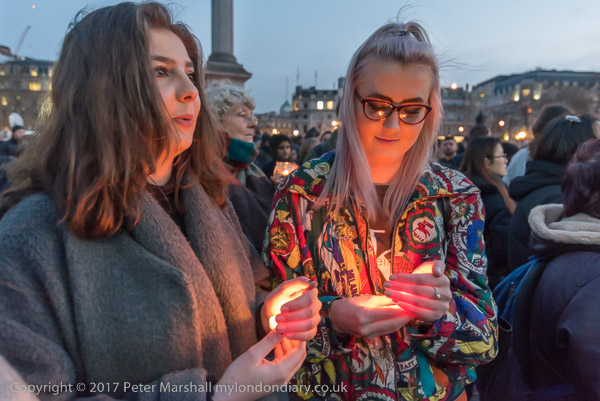
It was getting pretty dark, and although hundreds of candles make a pretty good light source, the extremes between the light of the actual flame and the gloomiest of shadows were too much for any film or sensor. While in some images it was possible to retain detail in the candle flames, particularly when only one or two candles were involved, I couldn’t manage to do so with some of the wider views.

Despite its technical faults, his final image here – and one of the last I took before leaving the vigil – was I think the only one that was used at least in the few days immediately following the vigil.

Vigil against Terror fills Trafalgar Square

Continue reading Against Terror

Anti-Racism Day


The TUC’s Frances O’Grady was among those holding the main banner

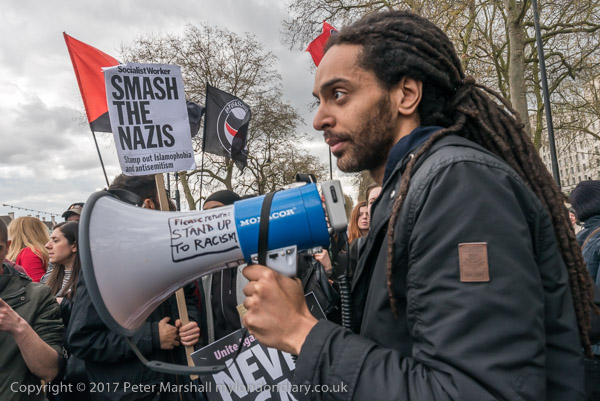
Stand Up To Racism manage to involve a wide range of other organisations in the March Against Racism they organised, including many trade unions and some Muslim groups, and the march and rally on March 18th was one of the larger to take place in London this year. I’m not sure how many the organisers claimed, but I reported ‘tens of thousands’.

As well as sheer numbers, it was also apparent from the many hand-made posters and placards that this is an issue on which many people feel strongly and realise that the situation is a critical one, with both Theresa May and Donald Trump promoting racist measures against immigrants and in particular Muslims, and much of the press promoting hysteria against Islam and against Europeans who have come to live here, as well as a general xenophobia.

Looking at my coverage of the event in Thousands March Against Racism it is clear that I was greatly attracted to the posters and placards, though I also photographed many of the speakers at the rally before the march. There was a larger rally at the end of the march, but like quite a few of the marchers I was pretty tired by the time we reached Parliament Square and didn’t stay for it. I decided I’d taken enough pictures – and you can see well over a hundred of them on the web site.

Of course not everyone in the country shares the views of the marchers, and there was an organised counter-protest by the extreme right ‘Britain First’ who stood behind a large crowd of police at Piccadilly Circus and shouted insults at the passing marchers, many of whom shouted back, although stewards tried to hurry them on. But that small group were outnumbered by a factor of roughly a thousand to one.

There were so many good posters that it was difficult to know which to leave out, and impossible to do justice to them here. Quite a few were rather lengthy and I’ve chosen some of the more visual; a placard isn’t the best place for an essay.

Long texts also present a small problem on the web site, where I like to pick out and put at least some of the text from the banners and placards etc as text on the site, allowing for it to be found in searches.

Thousands March Against Racism

Continue reading Anti-Racism Day

Theatre of Protest

The Lung Theatre ‘E15’ march to BAC was a slightly unsettling event, both protest and theatre, in which I was both photographing an event and playing a photographer photographing an event, along with protesters, most of whom I knew at least slightly, and some I had photographed before at many events and among them the performers from Lung Theatre.

Lung Theatre’s ‘E15‘ is ‘verbatim theatre‘, using the actual words of housing protesters, largely from Focus E15, but also from Sweets Way and elsewhere in a theatre performance, and their run of several weeks at the Battersea Arts Centre was beginning that evening.

The ‘protest’ was an opening event – and I suppose could be called a ‘publicity stunt’ though there were protesters there handing out leaflets about housing in London and publicity for their future protests. It was perhaps a little displaced as these were not in Battersea  but across the city in Stratford, but similar things are happening in all the boroughs across the capital – and indeed in other cities.

All protests – and perhaps in particular those organised by groups like Focus E15 – have an element of theatre, and this certainly looked and felt and was a protest as it handed out leaflets (including those about the theatre performances), held banners and spoke and chanted about housing issues outside Clapham Junction station (which is of course in Battersea) before the short march up the road to the theatre. And like all the best protests it took the road for the march.

I did have some problems taking pictures. The street outside the station is very crowded and rather dark where the protesters had chosen to stand,  though with quite a lot of light of various colours spilling from some shop windows – and in some areas of the protest this was useful. Lavender Hill up which they later marched seems very poorly lit for a major road.

For the static protest I worked without flash at ISO6400, I think mostly on auto-ISO with the limit set at that ISO. I was working in Shutter priority mode, setting speeds mainly of 1/100 or 1/125th, but my usual finger fiddling problems meant I made a few exposures at higher shutter speeds – like 1/500th or even faster –  which at full aperture resulted in several stops of underexposure and a few of the noisiest images I’ve ever used – perhaps exposed at ISO51,200.

Lightroom can do a reasonable job at producing an image out of more or less nothing, but there are limits. When you push images you also get the shadow changing from black to a deep mauve which needs a little local application of a tint to try and neutralise. And in lighter even areas such as the grey of the road surface you can see some purple patches. Mostly I just deleted these vastly underexposed images, but in a  few I felt the problems gave a strong graphic effect and retained them.

Once the march started, I had to switch to flash as there was just too much movement. Again I kept to high ISOs to record some of the street further from my flash.  As so often, I had problems with flash; Nikon’s flash system is great and always works when I test it, but somehow in the heat of the moment it sometimes refuses to play the game properly. It’s probably me rather than the machine, and just shows that while the system is great it isn’t foolproof!

Although I was invited to see the show that evening I was keen to go home and eat and work on the pictures, and it was not until a couple of weeks later that I actually did so, having been invited to sit on a panel discussion at the end of the performance about the role of the arts in protest, along with fellow panelists, theatre director Max StaffordClark,  Guardian journalist Dawn Foster and comedian Jeremy Hardy.

I seldom speak in public, much preferring to write where I can consider my thoughts at greater length and try and chose the correct word, but I was more on my home ground that the others and my stern critic in the audience felt I had done pretty well, though Jeremy did get more laughs.

Lung Theatre ‘E15’ march to BAC

Continue reading Theatre of Protest

Women Rise and Fukushima

The Million Women Rise annual march through London against male violence is an all-women event, with several thousand of them marching in the centre of London. On occasions a few men have crept in, but it is fairly decisively a women’s event, and this sometimes presents a few problems for a male photographer. There have been a few women on past marches who have made clear they object to being photographed by a man, and on some occasions stewards shouted at me when I have put as much of a toe on the road, although mostly they are more welcoming.

Of course I – and any others of the public – have the same right to be on the road as the marchers, but I have no wish to offend anyone. It does rather make it difficult to work as usual, as I often want to take most of my pictures close to people inside the protests. The great majority of those taking part clearly in this march want to be photographed and have no problems with me getting into a suitable place to do so. Some were women who knew me and who I’ve photographed before.

But I took many more of these pictures from the sidelines than I would normally have done with other marches, although before the march started the street the march gathered in was full from wall to wall and I had to be in the middle of things. But once the march started I more or less kept to the pavement while the march went along the road, and I took relatively few pictures, or at least relatively few that were usable.

Of course I deplore male violence against women, like the marchers. In particular domestic violence is a huge problem, and mainly it is men who are violent and women (and sometimes children) their target. And the main sufferers in wars are women and children. I’ve supported the march and have given the organisers pictures in the past when requested to use in their publicity. But I probably gave up rather earlier than I would have on some other events, and decided against going to photograph the rally at the end of the march in Trafalgar Square. It isn’t possible to be in two places at once, but I was doing my best to cover two separate events both taking place at the same time in slightly different parts of London.

Before going to Million Women Rise I had photographed the start of a march from the Japanese Embassy on the sixth anniversary of the Fukushima nuclear disaster, and had left them shortly after they passed the Ritz on Piccadilly to rush up to Oxford St and photograph the start of the women’s march. And as the end of that march passed Bond St station I left them and took the tube to photograph the anti-nuclear rally opposite Downing St.

Million Women Rise against male violence
Fukushima anniversary challenges nuclear future


Continue reading Women Rise and Fukushima