Lunatic photographers

It’s almost a week since I last wrote a post here, and I’m rather scratching my head to say why. I have perhaps been a little busier than usual, starting with the funeral of the father of one of my friends, where I was appointed official photographer. This isn’t something I’ve done before, and although I did a decent job at the wake, I didn’t feel I really did a job of the actual funeral, too many inhibitions showing themselves.  It would have been easier had it been a burial rather than a cremation, and I found myself very much a mourner rather than a photographer.  The pictures I did take I’ve given to the family, and have decided not to share in public.

Since then I’ve photographed several protests, one very large and some quite small, but all taking time, both to attend and to edit and file work, and I’ve made a resolution to try and keep My London Diary up-to-date – so you can already see the pictures I took yesterday there. Today I’m having some time off because of a minor health problem, though tooth-ache never feels minor. I had to rush to my dentist for an emergency patch-up yesterday, though it will require rather more painful work at a later date, and have time to write now because I’ve had to cancel a couple of things in my diary. Though being still tanked up on pain-killers and feeling a little unsteady probably isn’t the best state to be in charge of a keyboard, it does take my mind off my symptoms, and I started my day looking back at some of the things online I’ve missed over the past few days.

Judging from the pictures I’ve seen on Facebook and elsewhere, one of the biggest photographic events I’ve missed in the past few days was the “super blue blood moon” of January 31st, described by the Telegraph newspaper as a  “a once-in-a-lifetime event“. Except it wasn’t. I saw the moon rising through my window and there was really nothing special about it, and I didn’t bother to pick up my camera. It was the same old moon, a little brighter than sometimes, thanks largely to a clearer than usual atmosphere here, and exactly the same colour as usual.

Of course, London wasn’t the right place to photograph it, as the eclipse which did give it that blood-red colour was over well before the moonrise here. Which didn’t stop a number of photographers from producing (and the papers and web publishing) nice orange or red sunrise pictures, which of course owed more to our atmospheric pollution and perhaps a little Photoshop than the moon.

You can read a long account and watch a video on Peta Pixel of how Michael Tomas  took a series of these pictures showing a moon rising through the skyline of central London 10 miles away from a hill in Richmond Park with a 1000 mm lens, though I have to tell him he didn’t shoot a super blue blood moon, as he was several thousand miles away from a blood moon, with the total eclipse starting at 12.52 and ending at 14.08 and moonrise in London being at 16.55, almost three hours later, and three quarters of an hour after the end of even the penumbral eclipse (which is almost impossible to see.)  It’s still an interesting image and got a remarkable amount of exposure. Though I feel rather sorry for him for thinking this makes it the best photo of his life.

It wasn’t even a true ‘blue moon’, as Diamond Geezer points out in his daily blog for 31st January, the blue moon a name given to the third moon in a single season which had four moons rather than the normal three. On this definition there are no blue moons in 2018, but we do get one on May 18th 2009. But a journalist in 1946 got it wrong, and journalists have been getting it wrong ever since, calling the second moon in any month a blue moon. We get our next one by this definition on March 31st this year.

And it was hardly a ‘supermoon’ either, though it was a little larger than usual (5.9% according to the Hermit Eclipse web site).  The actual perigree (closest approach) was a day earlier. Visually these differences are hardly visible.

Lunar eclipses happen quite frequently – there is a good one due on 20th July 2018, where the total eclipse should be visible at moonrise in London at around 9pm.

But it is instructive to compare Tomas’s real image with the many Photoshopped ones that appear, notably that by Peter Lik, which has been the subject of much discussion, including on FStoppers, but also posted on Peta Pixel. Clearly this is a composite image and the fact that an identical image of the moon appears in another of his pictures makes this beyond doubt.  Perhaps the most mystifying aspect is that only 75% of those who voted in the accompanying poll were sure it was made in Photoshop, though I suspect the other 25% hadn’t watched the video or read the article in any detail.

Lik’s work is obviously very commercially successful, though few believe that his claim to have sold a single copy of a print for $6.5 million in 2014 to be anything more than a publicity stunt, he certainly makes a small fortune providing expensive decor, enough to employ a small team of people working on his images in Photoshop; two of those taking part in the FStoppers discussion revealed that a former employee had hold them he had spent an entire seven days working on one particular image. People could paint these things from scratch in less time than that.

But in the end I don’t have much interests in how Lik’s images are produced; they are simply not worth bothering with. I fail to see anything of interest in them, bad paintings produced with a little aid from a camera and rather more from software, clichés that lack any sense of reality and any meaning.

Another Stop Killing Londoners

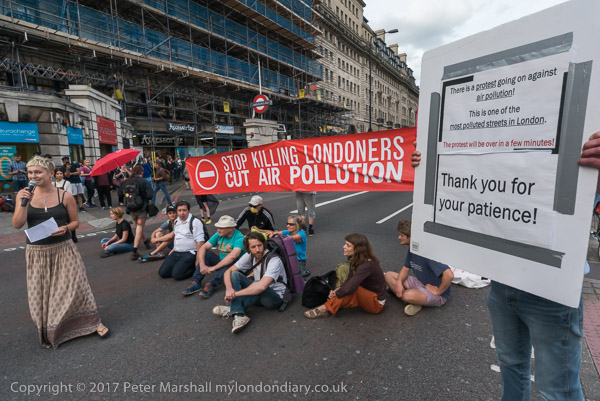
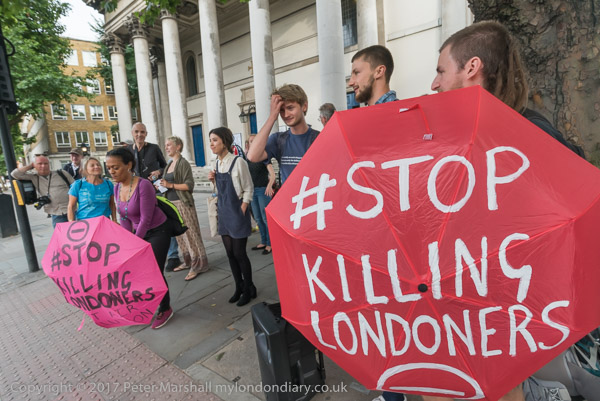
Rising Up’s Stop Killing Londoners group (SKL) continued its series of protests against the dangerous level of air pollution in London by a couple of brief road-blocks on one of inner London’s busiest roads the Marylebone Rd, beginning with one at the Baker St junction as many workers were making their way into the station on a Friday evening.

SKL protests are designed to get as much publicity as possible while causing only minimal inconvenience to the public – who like them are at great risk of lung conditions and early deaths because of excessive pollution levels in London air, especially around busy roads such as this. Those taking part include people who had campaigned for years to try and get some action over air pollution, but with very little effect, and they feel that protests such as this will embarrass London’s mayor into taking action – both through coverage in press, radio and TV and in particular if they get arrested and taken to court.

Actions were timed for the early evening partly because there is more traffic on the roads at the rush hour, but also for the very practical reason that most of those taking part are at work during the day time. Later SKL also organised a number of early morning protests before going to work, and I was unable to cover these because of the problems of getting up and travelling in to London in the early morning.

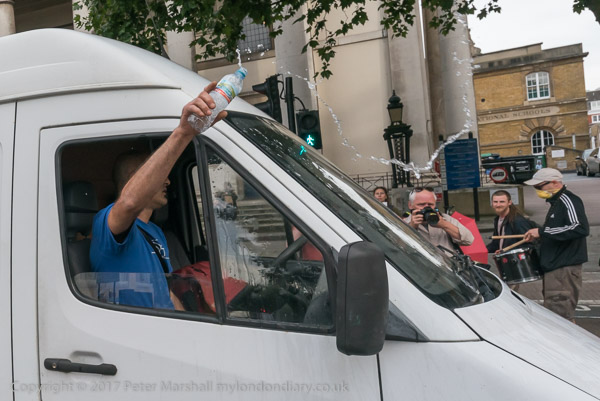
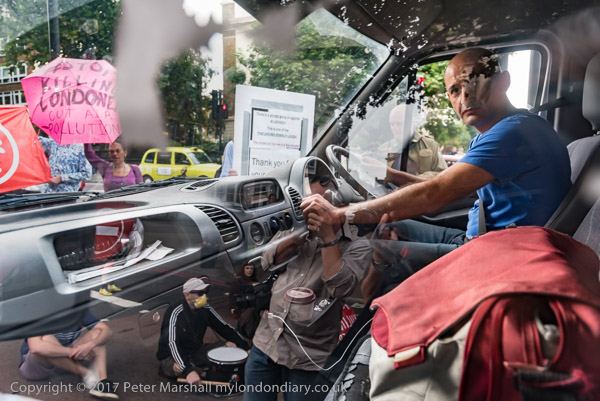
The kind of short hold-ups that SKL protests involve are not unusual on London streets. Any minor accident will cause longer stoppages and road works or building work often lead to much longer queues.  Both through posters and over the PA system they try to let motorists know that they will not be held up for more than a few minutes, but despite this a few drivers get very irate. One on this occasion even tried to use his white van to push the protesters out of the way, and when it became clear this was not going to work threw water from a bottle over them  – and over me as I took his picture.

I usually try not to involve bystanders in my pictures and to concentrate on those taking part in the protest, but once this guy had tried to drive through the protesters (and me) I decided he was fair game. I rather liked the image with reflections through the van window, though perhaps it is too fussy and too arty for editorial use. It did take a lot of work in Lightroom to bring out the different areas of the picture and even out the lighting, and some have thought this was a multiple exposure. It is a single exposure with my camera close to the van window, using the view inside the cab, the reflection in the window and the view through the cab and the front and opposite side window.

As often when unexpected things happen I was a little caught out when he started throwing water at the protesters, with a shutter speed that was more suited to the relatively static protest than action, and quite a few pictures were rather too blurred. And it isn’t easy to keep your camera steady when things start to get thrown at you.  So I only got the picture of him point the bottle at me and instinctively ducked out of the way.

Stop Killing Londoners road block
Continue reading Another Stop Killing Londoners

Should you work for free?

I think I’ve written often enough about my own attitude to providing photographs for free. I share a great deal of my work on Facebook and on the web, where as well as putting current work on My London Diary I also have extensive web sites on Hull, on London, Paris and on the River Lea, as well as several others and a number of smaller sites. I’ve also contributed work to various other sites, including Fixing Shadows, one of the earliest of photography web sites – still on line – and many more.

I’ve also provided photographs free of charge to many groups I’ve photographed for their own use, and generally am prepared to do so for campaigns or organisations that have no paid staff. But groups or organisations that can afford to pay people to work for them I’ve always demanded should pay me for my work as well, particularly if they are making money from publishing it.

With small charities, campaigning groups and educational projects I quote at a considerable discount on my commercial rates, but still feel it important that I’m paid. Not so much because I need the money (though photography is an expensive habit and I couldn’t do all I do without it generating some income) but because giving my work away would be unfair to all my colleagues. It isn’t easy to make a living from photography, and harder still to make one from work which I think worthwhile and important.

Today I’ve read two rather different articles about working for free. One in Peta Pixel, by Gil Wizen, Why I Rejected Your Request for Free Photos, and the second, linked in one of the comments to that piece, an opinion piece of Digital Photography Review, What I’ve learned after sharing my photos for free on Unsplash for 4 years by Samuel Zeller.

Wizen’s article is a pretty much straight down the line NO, with an explanation why and some illustrations of unreasonable attitudes, though he does describe one exception to his rule. Zeller’s is more interesting in his discussion of changes in the web landscape as well as of how contributing images to a site which shares them free can contribute to building a career.

A photographer choosing to share some images (as I do on the web) is quite different from other people deciding they would like to use your work for free. Unsplash does seem to offer a significant amount of exposure in a way that few if any of the proposals that people and companies who have hoped to use my pictures for free would have provided. It is a platform on which you can advertise yourself as a photographer, paying for it in pictures rather than cash, and for some photographers and some kinds of work it may be appropriate to do so. Though not I think for me.

Barts – NHS vs Serco (and PFI)

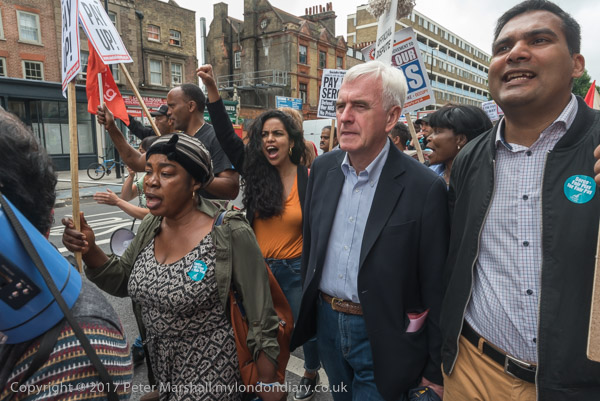
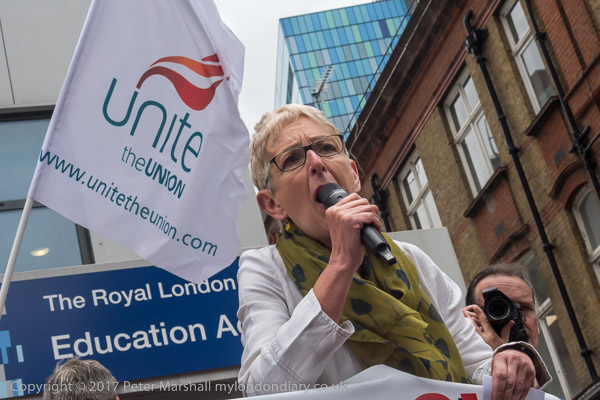
The rally and march from the Royal London Hospital to Mile End Hospital has a new relevance with the recent collapse of Carillion, which has brought new attention to the problems of PFI and of out-sourcing of facilities that are at the root of the problems at Barts Health Trust. One of the speakers at the rally – seen on the march in the picture above – was Shadow Chancellor John McDonnell, whose criticisms of both of these problems have received considerable airing in the last few days, though of course he has been making them for a very long time.

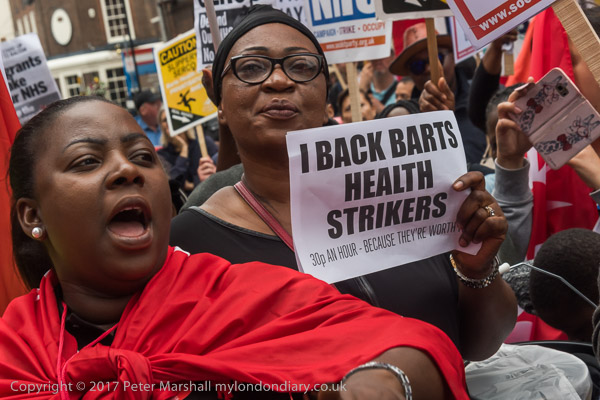
The dispute was between the cleaners and porters of Barts Trust who are members of the Unite Union and had been on strike for five days, demanding an increase of 30p per hour in line with inflation and cost of living increases . The strikers voted 99% in favour of strike action, their militancy because of the actions of Serco, whose first action when they took over the contract was an attempt to take away their paid tea breaks.

Serco were forced to back down over that by concerted action, but the cleaners still accuse Serco of increasing stress and workload with a climate of bullying, intimidation and fear and a failure to set up procedures for reporting problems with facilities. And they say that Serco have acted illegally during the strike by  bringing in agency workers with inadequate training to replace them, resulting in insanitary conditions in the hospital.

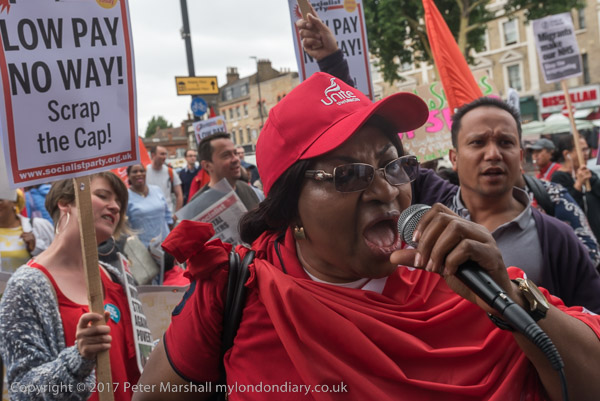
I took a number of pictures of Unite’s Gail Cartmel at the event but particularly like this one of her speaking, which shows something of her dynamism. It also includes in the frame some key elements – the Unite flag (and flags are always problematic for photographers, seldom behaving as we want them at the right time so they can be read), the inbuilt caption ‘The Royal London’, and both some of the hospital’s Victorian building at right, as well as at top centre the new PFI-built hospital which has crippled the Bart’s Trust with a huge debt –  £2.4m per week in interest payments – under a disastrous New Labour deal.

It was hard to chose just one of the pictures of the strikers to put in here, and I chose this  particular image partly because it seemed to show something of their determination, but also for the poster which explains what the image and the dispute is about, “30p an Hour – Because They’re Worth It”, and the crowd of placards behind.

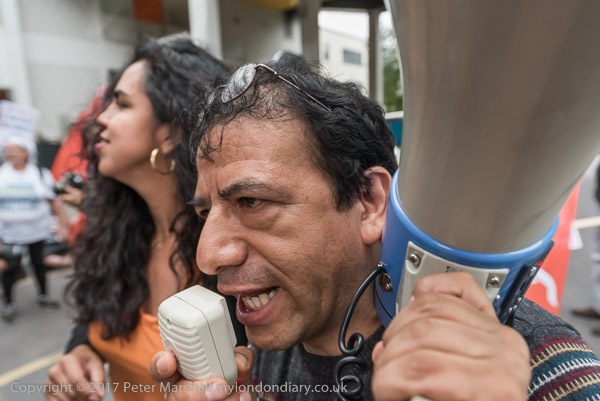
And although this dispute involved one of our big unions, some of the most vocal support at the rally and on the march came from other cleaners, particularly in the United Voices of the World. Victor Ramirez, a cleaner from the UVW spoke at the rally and was among the leaders of the march, with his spirited contributions in Spanish being translated by Claudia from the UVW behind him in this picture – and marching behind John McDonnell in the top image.

Barts NHS Cleaners march against Serco

Continue reading Barts – NHS vs Serco (and PFI)

Peak Design Fault?

Last year I needed a new camera strap. Well no, really I didn’t but one of my straps had broken and I found myself walking around holding one of my two cameras in my hand all afternoon. I couldn’t really complain about the strap breaking as it was probably over 20 years old having seen out the life of at least half a dozen cameras. Each of which had come in a box with a strap inside, most of which are probably somewhere in my loft.

But I seldom use the straps that come ‘free’ with the camera, and certainly not for the cameras I work with. Most of them must have added at least 50p to the overall cost of the package, and tend to feel like that. My favourite neck strap for a heavy DSLR (though I started using them with SLRs) is still the Optech Pro Strap with its nice wide neoprene cushioning which means you hardly feel the weight – and once I started using this I no longer had an aching neck at the end of the day’s work.

But good though it is, you can’t really use two of them at the same time – though they do sell special rigs for the purpose, a double sling and a dual harness – I really didn’t like the look of these. Functional they doubtless are, but there was something about having to be strapped into a rig that didn’t appeal to me.

So I looked around for alternatives and read the reviews. Some straps were clearly for the fashion conscious, to go with expensive leather cases (and I never before realised how expensive these could be) and it was easy to dismiss these. Others had the kind of narrow belting that slowly beheads you from behind as you work, but there were a few that seemed worth a try, and in particular the Peak Design Slide. This would keep my second camera at my side, well out of the way of the one on my Optech strap carried high on my chest, but enable me to quickly bring it up to my eye. So I ordered one, and have been using it for quite a while now, and am generally fairly pleased with it.

The strap attaches a little differently to a normal neck strap with special short quick-release anchors which are left in place on the camera. The web site and packaging shows these fitting directly onto the lug on the camera body, and while this was never going to work with the anchors that came with my slide, the latest design has thinner and stronger cords which can be pulled through the hole with a strong thread, It is a neater solution than using the normal split rings supplied with the camera, and avoids any possible damage to the camera body. You can also buy extra anchors making it a ten-second job to switch the strap from one camera to another, and it is equally fast to change from the Slide to a wrist strap from the Peak Design range.

There are two ‘quick adjustment’ sliders on the slide, to allow rapid adjustment of the length of the strap, and it is about these – or at least one of these – that I find Peak Design’s design at fault. They show a diagram with the rear adjust being used for “long term adjustment based on body type and preference” while the front adjuster is designed for “quick adjust”. But the two adjusters are identical and neither has a lock.

The consequence of this is that whenever I use the strap for any length of time, both adjusters end up at the bottom and the camera gets to hang rather closer to my knees than my waist, which is something of a nuisance. Yes, it is ease and quick to adjust, but when I’m busy working the last thing I should need to do is to fiddle with my camera strap. I want to firmly set the maximum length of the strap around 6 inches shorter but Peak provide no way to do this.

They rightly say that the strap resists a sharp pull without changing length, but somehow – perhaps by being knocked by my camera bag or just by the normal movements of my legs and body and the sliding up to my eye to take pictures which cause them to slowly creep, the adjusters inevitably work their way down.

My part solution to this problem involves using a safety pin which prevents movement of the rear adjuster, but a fudge like that shouldn’t be necessary with a high price product like this, and safety pins do sometimes come undone. When I’m sure I know exactly the length I want I’ll perhaps put a few stitches in.

It wouldn’t be difficult to design a rear adjuster than locked more firmly in place, and keeping the current front adjust would retain the quick adjustment that is a part of the design philosophy. A quick Google shows me I’m not the only one with this problem, and people have written to the support page asking how they can prevent it happening. They get told it is a part of the design, but like me I’m sure the questioners regard it as a design fault.

So while I’m generally happy with this, and have just bought another Peak Design product, a wrist strap (Cuff) for my newly acquired Fuji X-E3 (a detailed review here), it does seem to me that the company should perhaps stop spitting in the face of customers and rethink on that rear adjuster.

More about the X-T3 later. I’ve been quite excited about it, as it seems to have fixed most of the niggles I’ve had with previous Fuji-X cameras. It seems far more responsive than the X-T1, focusing faster with all my lenses and not yet leaving me waiting when I want to take a picture. I’ve just sent the X-T1 in for repair – again – so I can’t directly compare the two, and I’m still working my way through the manual – some settings are rather hard to find and understand – but the only thing I’ve found less impressive so far is the slightly smaller viewfinder. I suppose the big difference is the fixed back, but if you can live without that then I think the X-E3 is the best in the current Fuji range. Of course an upgrade to the X-T2 is rumoured for later in the year, so things may change.

So far as straps are concerned, if you only carry one camera and are still using the neck strap that came in the box, I’d highly recommend the relatively small cost of an Optech Pro, which will almost certainly get rid of those neck pains and headaches at the end of a long day at work. But I’ve grown to like using a sling strap with the camera resting on my right hip as an even more functional and relaxing way to carry a camera. If you are above average height (or girth?) the Peak Design Slide may be the right length for you, but until they fix the creep problem for the rear adjuster I’d hesitate to recommend it for those of average and below size. There are many other sling straps available at a wide range of cost – from around £2 to £150 – including one that looks very similar to the Peak at around a tenth of the cost though clearly without the same quality of finish and probably of materials. I’d hesitate before entrusting a camera and lens costing £2000 or more to some of them.

Facebook

I often feel like mounting a one-person protest outside Facebook, which so often seems to be misbehaving in some way or other. It messes up my posts and hides the posts of many of my friends from me, so often I only find out about things too late. Of course it isn’t all Facebook’s fault, and I’d like to see a complete ban on all the automated software that people use to post to Facebook that clutters it up with so much rubbish. Perhaps one of those checks to show your were not a robot on every post would be annoying, but it would make Facebook much more useful for users, if not for marketing.


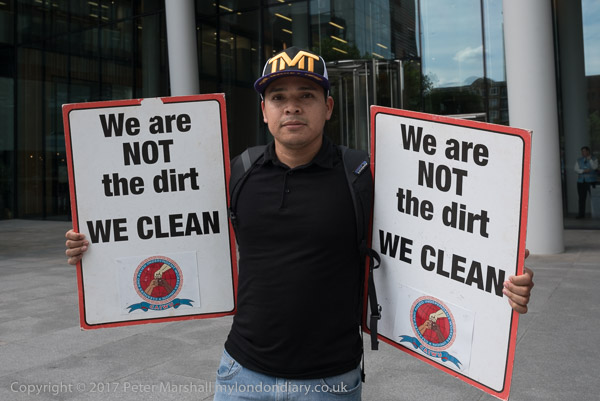
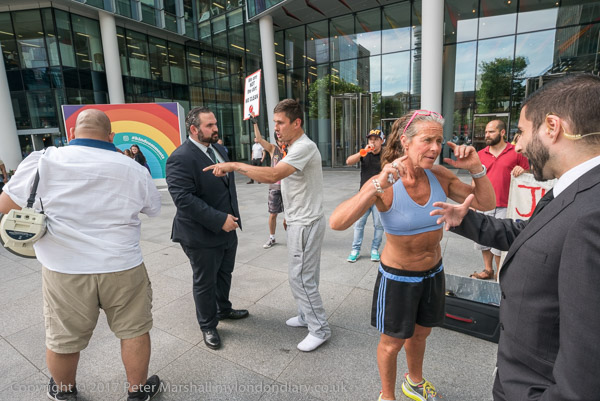
Men from company that employs the cleaners at Facebook watches me as I photograph them watching the protest

But my frustrations with Facebook are nothing compared to those suffered by some who work in their offices, though the cleaners are not actually employed by Facebook; as I point out on My London Diary:

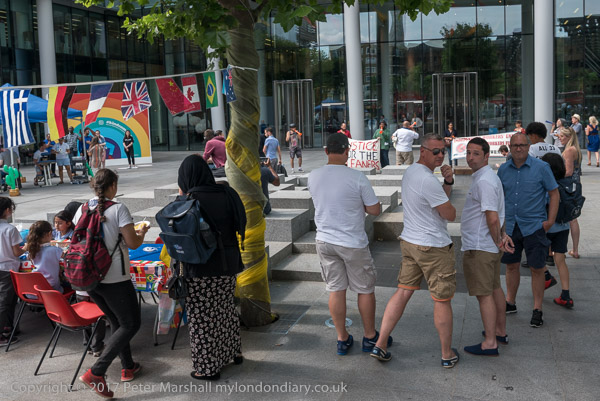
There are two redundant levels of management at these offices; rather than employing cleaners directly, Facebook uses the property management company JLL who in turn use Peartree cleaning services to employ the cleaners; money which should go to the workers goes to these unnecessary levels of management and profit.

People often talk about the greater efficiency of outsourcing, but it is a myth. It isn’t greater efficiency but a lowering of standards, almost always of the actual services delivered but invariably of the conditions of employment of the people who actually do the work.  Companies that claim to be ethical employees with good conditions of service – pensions, sick pay, holidays etc – seem happy to give contracts to companies that employ for people who work for them, providing services at their workplaces which have minimal concern for their employees and provide only the basic minimum possible under our laws, often combined with poor management practices – bullying, discrimination etc – and a failure to properly engage with trade unions, often attempting to prevent union organisation by victimisation.

Both the Grenfell disaster and the failure of Carillion have exposed some of the problems caused by the contracting out of services – with level after level taking their unfair share and problems in communication. If Facebook employed their cleaners they would know what was happening, would ensure fair processes and conditions and not be able to say it was none of their business, denying responsibility for people who keep their business working.

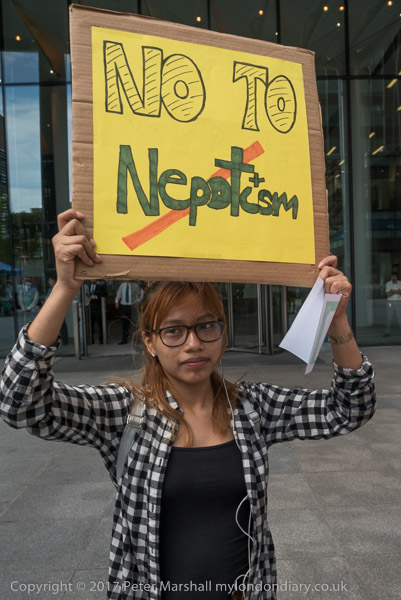
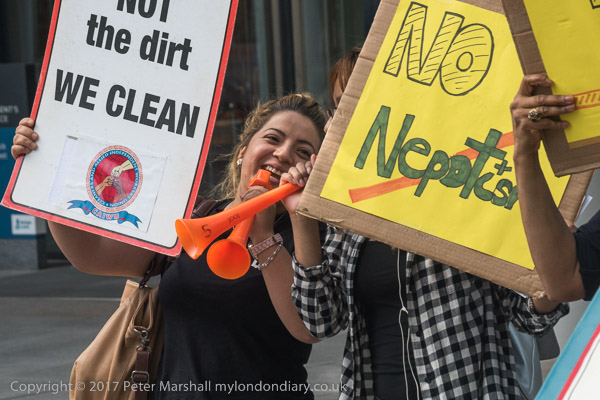
The protest was organised by the Cleaners and Allied Independent Workers Union (CAIWU) who say managers on site are guilty of racism, bullying and nepotism and who are also demanding to be paid the London Living Wage. At the end of the protest CAIWU organiser Alberto Durango talked briefly with Peartree’s commercial director Stuart Conroy who had been in a group watching the protest and there seemed to be some hope that a dialogue might emerge.

The protest took place in one of London’s now many privately owned public spaces, and I was pleased that the security there actually intervened when a couple of people tried to interfere with the protest.

The CAIWU had agreed with them that the protest would be a short one so as not to interfere greatly with a community event that was taking place. Photographers I know have been stopped when taking photographs in this area, but I and others covering the protest were not approached – nor have I been at other protests in this area.

Cleaners protest at Facebook HQ

Continue reading Facebook

Siege of Haringey

Housing has been an issue very high on my agenda for some time, though I’m fortunate enough to own my own house, I can still remember the days when things were different, and the sometimes frantic search for somewhere to live when I was a student. I spent my first year in a hall of residence, but then moved out into flatland along with two of my former schoolfellows. The first place we found was just one very large room on the first floor of a Victorian house that had been marginally converted, and we spent a term there. I think I was the lucky one who got the single bed while the two others shared a double.

The place had a large open staircase up its three storeys and we were sometimes disturbed by noisy footsteps going up and down it and pretty well all hours of the night. We soon found out that the fairly demurely dressed young woman in another room on our floor made her living from the many men who paid her relatively short visits from early evening to late at night, and that the older and brassier woman from the ground floor who came every Friday to collect the rent shared a similar occupation. And there were a few rather embarassing moments when I was the only flat-dweller in when she came to collect and seemed to want rather more.
We began to look for better accommodation, searching through the Manchester Evening News and phoning any likely looking adverts or rushing to them where there was no phone number. We found a very nice place in a quiet part of North Manchester, just what we wanted and a reasonable rent, but having shown us around the woman asked said to us “But you’re not Jewish are you – I’ll have to ask my husband” and promised to let us know. We weren’t Jewish and we never heard. Finally we did find another flat, rather more poky, on the first floor of a house on the edge of Moss Side, and spent the next two terms there before hearing of a rather better place some third years were leaving from in Dickenson Road which we snapped up. Unlike the earlier two this was a real student flat, with a landlady living on the ground floor who always had students (though I hope most were quieter than us) and was often pleased to make us tea and tell us some often fascinating stories about her youth when she had been a secretary to Lloyd George. I only wish I had written them down.
The following year, after 6 months as an industrial chemist, I returned to Manchester and was again looking for accommodation, this time on my own. The first room I found, in an Irish house in Fallowfield looked OK, but after my first night I found I was covered in red bumps where the bed bugs had found warm flesh. I bought some powder that was supposed to kill them, but I think it just made them more vigourous and multiply. I gave my notice and moved out at the end of the week to a Polish house in Rusholme that served for the rest of the year until I could get a place in university accommodation. The Poles were friendly at it turned out fine, though the glass of Polish spirit I was handed every Friday night when I went to pay the rent was near lethal.

My first two years of married life were spent on the top floor of a terraced house off Platt Lane. The rent was reasonable, but the gas and electricity meters swallowed coins at a huge rate, with great profit to our landlord. Draughty sash windows made it a truly chilly place and we plugged the gaps with plastic bags and bought a paraffin heater, the damp from which brought the wallpaper falling off the walls. And first thing when we moved in was to get rid of the several inches of congealed fat on the bottom of the cooker. But it served us well for the next two years and I was sorry to move away, especially as the next flat we found, in Leicester, was rather worse. It was there I had to break the ice to wash, and began to grow a beard because it was too cold to shave.
But from there I went to work in a New Town, with a two-bed flat from the housing corporation at a social rent and a really decent sized living room and the luxury of built in heating. But we wanted to move nearer to London and industrial action including strikes by teachers led to the 1974 Houghton report and a considerable rise in teachers’ pay; together with a promotion to Head of Department it meant there was a short window when I could afford to buy a house, and we took the opportunity and have lived in it since. Other colleagues who made similar purchases at that time have moved and ‘traded up’ and now have properties worth several times as much, but we like it here, so why move?

In many ways we would have preferred to live in social housing. Its a system that works and can provide quality housing at much lower cost than the private sector. But government after government of both parties have found ways to take money out of the system. The Tories are keen to destroy it and to make profits for private enterprise, and much of Labour is the same, though with a greater delusion that somehow this is in the public interest, holding to this even as they trouser the proceeds.

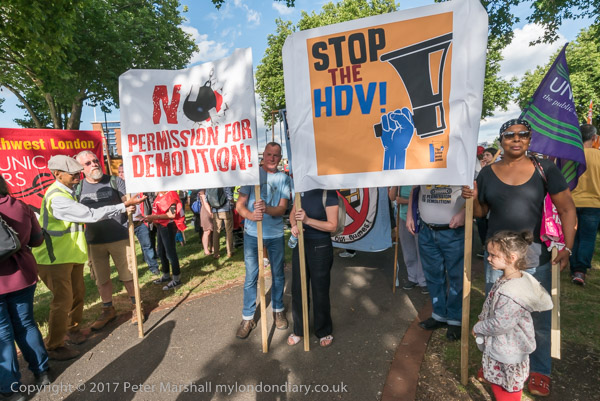
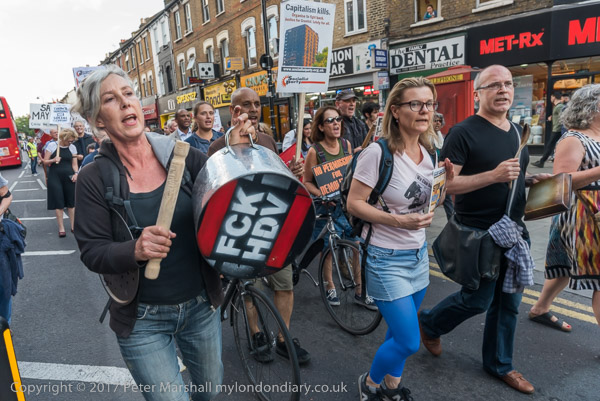
The Haringey Development Vehicle, or HDV, looks at those large, well planned council estates, with large amounts of green space between the buildings (which still achieved high densities) and sees it just as acreage, ripe for development with large numbers of high market price units with the odd sop of unaffordable “affordable” housing. It’s perhaps unfortunate that there are some people currently living there, homes and communities, but CPOs, minimal compensation and vague promises that will never be kept will soon deal with that. And £2 billion of public property is gifted to the developers who will doubtless find various ways to reward those benefactors generous with what they do not own.
It should be criminal, but we don’t generally have laws against the kind of crimes that make the rich wealthier, which is after all how those who make the laws – and particularly the monarchy and aristocracy – got where they are.

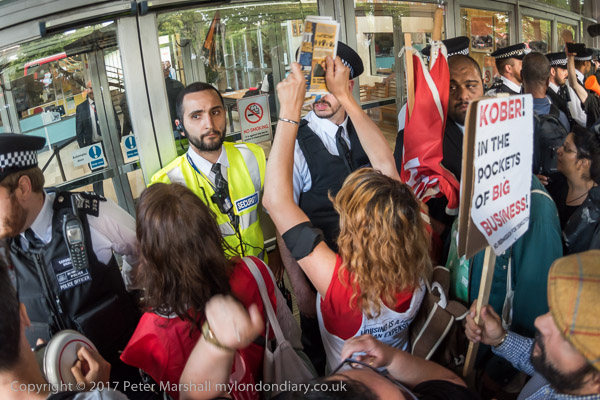
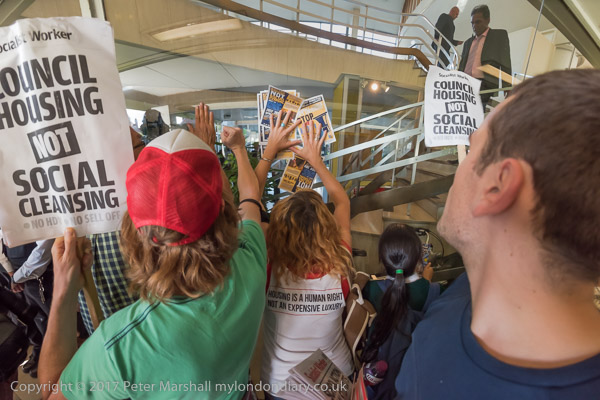
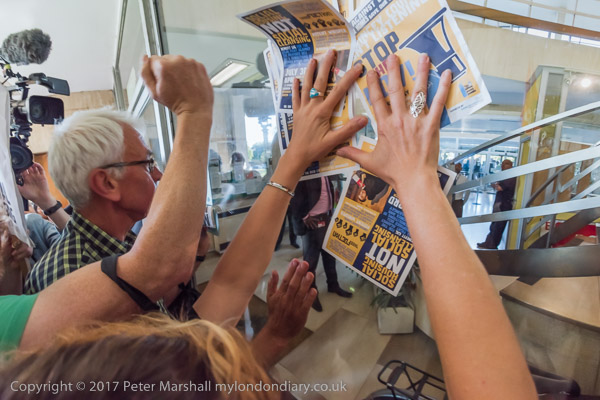
You can read about what happened when the march reached the council offices, and you can see it in the pictures. Technically there were a few problems as the light was getting a little low, and there was a lot of crowding and movement. It was hard to get to the right place, and hard to keep the camera still while taking pictures. Once again it was a situation where the 16mm fisheye proved its worth. I had been taking pictures of people behind the barriers in front of the council offices at ISO 800 when the rush to the doors began, and had to climb over a railing to get rapidly near the doors rather than take a longer route around. Around the entrance was a dense, surging crowd, in the middle of which I needed to increase the ISO and make some lens changes.

I began photographing with the 18-35mm on the D750, changing the ISO to 3200, then decided I needed a wider view and put the 16mm fisheye onto the D810. It also has the advantage at f2.8 of being a faster lens. Unfortunately it was only after taking a few images, some of them rather blurred, that I realised I had left the ISO at 800, and needed to increase it. I soon spotted another mistake too; I’d been using the D810 with my 28-200 telephoto in DX mode (makeing it a 42-300 equivalent) and had left it in DX mode rather than switch to FX. When things really happen suddenly like this it is hard to get everything right.
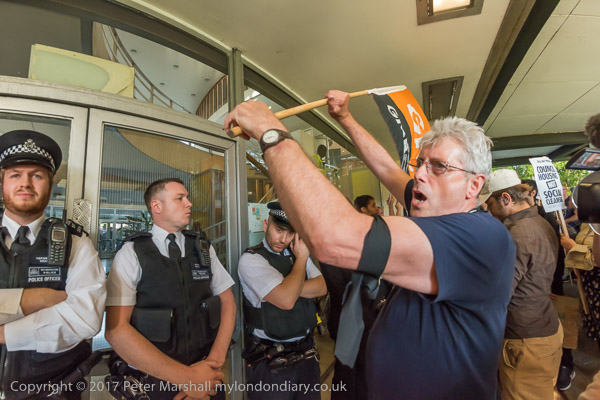
Things calmed down a little and I suddenly saw that some of the protesters were heading for the back of the building and rushed to follow them. Soon I was standing against a huge glass window there feeling it flex around half an inch or more as the protesters attacked it, and at first I stood back a few inches to avoid the movement shaking my camera before deciding there was a good chance it would shatter and I wasn’t in a good place. I rapidly moved back a couple of meters, just as the police rushed in from the front of the building and formed a line across the front to stop protesters trying to break it down. I did feel a little relieved.

Those inside the council offices were still looking very worried, but the police stood their ground but sensibly didn’t try to take much action as they were greatly outnumbered, and the situation slowly settled down, with a rally with speeches taking place on the steps at the front of the building. Inside the council meeting continued, though they would have been very aware of the strength of feeling being demonstrated outside. Not all of the councillors had managed to get into the meeting, and there were a few protesters inside who were unable to leave, but it seemed clear that there would be little else for me to photograph and I left for home.

Council meetings now are largely a matter of rubber-stamping the decisions already taken by a very small group of cabinet members, with little real attempt at discussion, and I’m told that this was the case, with the plans passing through to the next stage. There will of course be further protests, as well as attempts to challenge the decision in the courts, and it seems likely that a number of councillors backing the HDV will lose their seats in the May elections, though this may be too late to stop the plans.

Haringey Residents protest housing sell-off

Continue reading Siege of Haringey
The Conversation

I’m often critical of the BBC, and they way they promote an establishment view in many of their news programmes, often failing to report or minimising stories which would embarrass the government and, as academic studies have demonstrated beyond reasonable doubt, being extremely biased in their treatment of trade unions, Jeremy Corbyn and class issues generally.

It is a very middle-class institution, and employs too many people as commentators who come from highly privileged backgrounds (with private education and Oxbridge), but does produce some excellent programmes. And one whole area that particularly stands out is the BBC World Service – which also covers the news more neutrally than the internal services, which often follow the lead of the UK newspapers which are owned by a small handful of billionaires including of course Rupert Murdoch and reflect their perspective on matters.

On Monday morning this week the BBC World Service broadcast in their series ‘The Conversation’, which looks at the experiences of women across the world on “image, work, relationships, equality, migration and working lives” had presenter Kim Chakanetsa talking with two women, Mexican photographer Cristina Goettsch Mittermeier and Ami Vitale from the USA.

It was a lesson in sensitive presentation, with Chakanetsa encouraging the two women to talk with pertinent questions (unlike some BBC programmes which end up being more about the interviewer than the guests), and in the roughly half-hour programme there were some interesting reflections on photography, on women photographers generally, on news, on ways of working and more, much of which as they state applies to photographers whatever their ethnicity or gender. You can listen to the programme online (along with 169 other episodes of the series) or download it from the page.

Both women are photographers for National Geographic, and Mittermeier’s recent video of a polar bear starving without the ice it needs to hunt has attracted global attention to the problems of climate change. She is also the founder and President of SeaLegacy, a non profit organization working to protect the oceans. Ami Vitale’s ‘Pandas Gone Wild‘ won her second prize for Nature Stories in the 2017 World Press Photo – to add to her many earlier awards.

I first wrote about Ami Vitale many years ago as one of the more interesting photojournalists around, and it was a great delight to meet her in Poland in 2005.


Ami Vitale (in red) at Alcatraz, Bielsko-Biala, Poland

You can read more about that event, the first FotoArtFestival on My London Diary, which links to my own diary of the Festival.

Civil Rights for Photographers too

It’s some while since I last mentioned a post from the New York Times Lens blog, which publishes something of interest most days.

Today’s story, A Look at the Heart-Wrenching Moments From Equal Rights Battles, comes with a slide show of 18 amazing images, many of which have become well-known. One of the most striking of them shows a row of Memphis sanitation workers and supporters walking with posters ‘I AM A MAN’ (and one man without) past a row of the fixed bayonets of the Tennessee National Guard fixed bayonets  in 1968. What upsets me somewhat is that the picture is not attributed.

It isn’t the fault of Lens. I’ve searched the web and not found any better attribution than ‘Unknown photographer’, though I’m sure that there are still people out there who were on Beale St in 1968 and will know who took it. Probably it would be a name none of us have heard of, perhaps an amateur, perhaps a press photographer ‘working for hire’. It might be someone who had good reasons to keep their name out of it.

But generally I think photographs should always be attributed to the photographer. It annoys me that some of my pictures have been published as by Alamy or Corbis or some other agency and without my name, or with no name at all. Many pictures that I know who they were taken by have been published as if Hulton or Getty was a photographer – and the civil rights image is published as if it was by Bettmann Collection/Getty Images.

Friday Protests

I’ve had a few busy days and not had time to write on this blog, partly with several events to photograph, but also with other things to do and to worry about, but also with trying to get my main web site, My London Diary, a little more up-to-date with events. A diary should really be something you write up at the time, not as I’ve been doing recently around a month later. But should you click on the link above today when I post this, you should find that it only a day or two adrift – and later today it should include some of the latest pictures I’ve taken from Saturday.

Yesterday, Sunday, as I came around in bed the curtains were open and I could see snow falling, and when an hour or two later, having posted my daily picture of Hull I turned to post this onto Facebook I was greeted by picture after picture (mainly by rather bad picture after picture) showing people’s back gardens and streets with a little snow on them. I’d been wondering whether to go and photograph a couple of things in London, but decided not to; although I could have coped with the snow, our transport system would probably be on the blink. Later several of the things I’d had in mind were cancelled due to the weather, and there were reports of transport chaos. And more bad snow pictures.

It wasn’t much of a snowfall where I live (and today it has all disappeared and we are getting cold rain with the odd snowflake mixed in) and I decided not to bother to try and take photographs of it. We had snow rather better in the past, with weeks in the 70s and 80s where it lay inches deep – and drifts of a foot or more, with many suburban roads only passable with difficulty on foot and some closed to traffic for several days, and I felt I’d already served my share of snow pictures.

Today it feels quite good to look back to when days were longer and warmer around the end of May, and another Friday where I was busy, starting with a very similar event. Human rights group Inminds holds regular fortnightly protests about Palestine, usually on a Friday afternoon, drawing attention to the human rights abuses by Israel against the Palestinians, and calling for freedom for Palestine and for a boycott of Israel, and when I’m free and in London I try to cover these events, although often my visits to them are rather brief. The protest on this occasion was outside the Moorgate offices of the UK Mission of the International Committee of the Red Cross, demanding it end complicity with Israel’s violation of the rights of Palestinian prisoners, many of whom were then taking part in a hunger strike.

It was easier to photograph than most of their protests, partly because it was a new location, but also because there were specific posters for the event, and unlike some other of their protests there was little traffic and few pedestrians to get in my way as I was taking pictures; it was almost a private event, so photographs, mine and also those that Inminds itself take – had an added importance as the only way it reached the public.

There are accusations made that some of those who belong to Inminds are antisemitic, but protests such as this are clearly against particular illegal activities of the Israeli state and part of their campaign against the occupation of Palestine. I’m clear that it is possible to support the Palestinian cause without being antisemitic, though it isn’t possible to do so without being accused by some of antisemitism. I’m also clear that I’m not a member of Inminds, but a journalist who reports on some of their protests – as I do on protests by many other groups.

From Moorgate my next stop was Walthamstow Central, where parents and children were marching after school to a rally against education cuts. Photographing children has become difficult now, and photographers are always under suspicion if they point a camera at a child for whatever reason, and I did feel a little difficult doing so. In the past there were so many great photographs of children and I think it is a shame that we are now so inhibited about taking pictures of them. Of course there are terrible abuses of children and it’s right to do all we can to prevent the activities of abusers, but there is no real connection between those abuses and people taking pictures on the streets.

If taking photographs will not generally harm children, the changes in funding for schools certainly will, and that effect will be greatest in city areas such as London E17, where Waltham Forest schools were to lose over £25m from their annual budgets – £672 per pupil on average, with some schools losing over £1000 per pupil. It means fewer teachers – coincidentally also around 672 fewer in Waltham Forest, and at a time when numbers in schools are increasing. As a retired member of the NUT as well as a current member of the NUJ I have a particular concern.

I listened to a few of the speeches, but then had to leave, traveling back to the centre of London with the Victoria line taking me direct to Westminster. I’d missed the pre-election protest by Stop Killing Cyclists a few days earlier outside the Labour HQ, but this evening it was the turn of the Tories in Matthew Parker St, a short walk from Parliament.

There I photographed another child, wearing a face mask sitting beside his father who was lying ‘dead’ on the ground outside as a part of a protest against traffic and air pollution both killing cyclists in London. Not just cyclists of course, traffic and pollution both kill pedestrians and drivers too, but cyclists face a particular risk when riding amongst faster moving and much more massive vehicles, and breathing their fumes on the road.

Later enough of the cyclists lay down to fill the frame of my fish-eye lens – and the house in the centre behind them is the Tory HQ.  Money spent on making safe protected cycle paths encourages many more to use their bikes to get around the city, reducing transport pollution which currently results in over 9,000 premature deaths a year in London as well as much suffering from illness, and more people getting on their bikes also means more people getting a little exercise to improve their healths.  More people cycling also cuts traffic congestion – with an increase in road space considerably greater than the loss caused by building protected cycle routes. In fact the only downside is that it leads to greater traffic speeds and so greater impact damage when vehicles hit people, something that needs to be mitigated by greater use and enforcement of 20mph zones.

But policies are generally driven not by facts, not be research, not by safety but by lobbying of politicians and the prejudices of the press, also  firmly guided by the saloon bar ‘common sense’ (not that we still have saloon bars – but we still have the attitudes.) Neither of the main parties had a sensible road traffic policy and was willing to spend the amounts needed to encourage cycling by making it safer.

Red Cross act for Hunger Strikers
E17 Protest Against School Cuts
Cyclists Tory HQ die-in against pollution

Continue reading Friday Protests